

Innovation in a Changing Ag Economy Highlighted at Midwest Agriculture Summit
Panelists discuss emerging technologies and sustainability initiatives

Shannon Full, president and CEO, FMWF Chamber (far left), moderates the Regional State of Agriculture panel during the FMWF Chamber's Midwest Agriculture Summit held June 9 in West Fargo. Also pictured, South Dakota Secretary of Agriculture Hunter Roberts, Minnesota Commissioner of Agriculture Thom Petersen and North Dakota Commissioner of Agriculture Doug Goehring. / Screengrab from livestream

July 13, 2026
WEST FARGO, N.D. — Fork Farms, an indoor hydroponic farming company based in Green Bay, Wisconsin, helps people grow their own food. Company founder and CEO Alex Tyink believes in the importance of building resiliency and access to fresh produce in communities.
“The whole purpose behind what we're doing is we're trying to get fresh food more within reach to everybody everywhere,” he said.
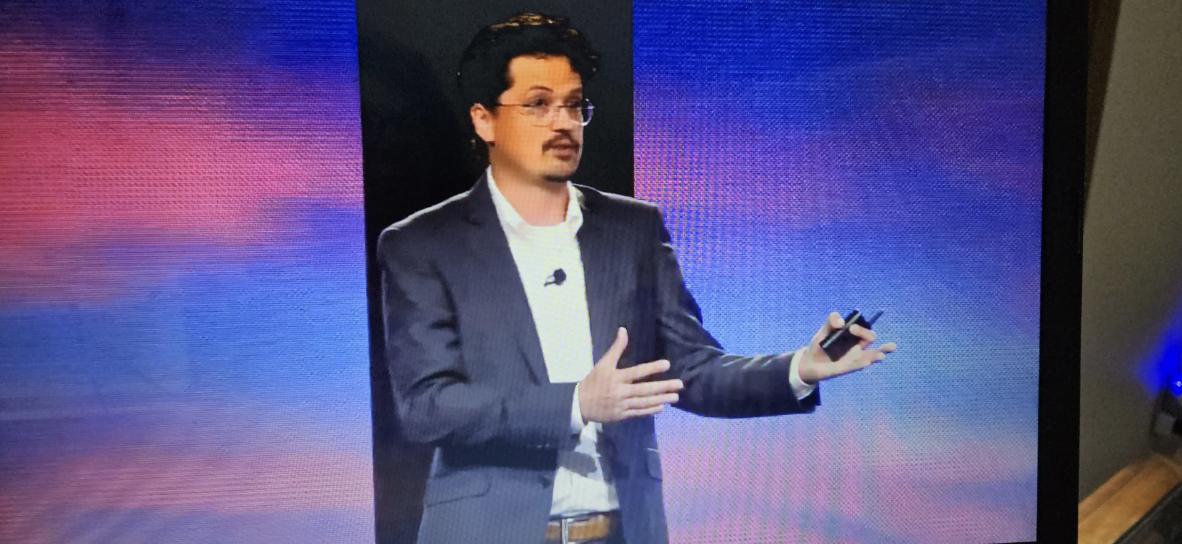
Fork Farms Founder and CEO Alex Tyink talks about his company's mission to help people grow their own fresh food via hydroponics systems. Screengrab from livestream
His company creates horticultural systems built into places where people work, live and play.
“Think of it like we're going to feed just one school, and by the volume of produce that we grow at a school, it's a drop in the bucket compared to what the row croppers are doing, and everything else I'm hearing about today,” he said. “But if you think about putting a farm in every school, that changes the supply chain, because most schools are the largest restaurant in their community, and that's what we do.”
Tyink was a speaker at the Midwest Ag Summit, hosted by the Fargo-Moorhead-West Fargo Chamber on June 9. The event highlighted emerging technologies and sustainability initiatives in agriculture. One panel featured the commissioners of agriculture for North Dakota, South Dakota and Minnesota, who spoke about how their states are responding to and planning for change. A second panel featured the consuls general of Canada, China and Mexico, who discussed the importance of international trade and partnerships.
“What we've learned is that when people get engaged, they somehow get emotionally connected to it, and when they get emotionally connected to it, they eat it,” Tyink continued.
According to Tyink, their farming installations have led to a 30-40% boost in fresh food consumption by providing year-round, affordable access. He emphasizes that for any fresh food program to be sustainable long-term, it must offer either superior quality at the same cost or equivalent quality at a lower price.
The company is servicing approximately 600 farms across all 50 states and 22 counties.
“The biggest thing we've learned through those deployments is that you have to make it applicable to that community. You can't just go in and have a one-size-fits-all approach. The farm has to modularly scale to fit their needs,” he said.
One of their products, the Flex Farm, is about the size of a small refrigerator, and it grows 25 pounds of food every month. For an average elementary school staff, it means that they generally won't have to buy salad greens from an outside vendor again and again, he shared.
Another company, MyAgData, is modernizing the way growers report acreage to the U.S. Department of Agriculture with less paperwork and more accuracy. The company is headquartered in Fargo and helps farmers take the field data they’ve collected and turn it into accurate FSA (Farm Service Agency) and RMA (Risk Management Agency) reports.
MyAgData CEO Michelle Tressel said growers are asked to make million-dollar decisions based on incomplete information, such as long-range weather forecasts, the political environment, tariffs, and input and commodity costs, among others.
“What we try to focus on is how we can take friction out of the things we can know. We're focused on really helping farmers look at their data — not changing the way they farm, but really finding ways to be efficient given the data that is available to them,” she said.
Accurate data is critical for growers, especially given the current tight margins. By simply utilizing collected field data, farmers can improve efficiency in areas like crop insurance, which can lower credit risk and offer significant financial savings, such as the 7% or $7,000 savings one North Dakota grower achieved by accurately accounting for challenging landscape features like prairie potholes, she shared. While data collection can be difficult, the potential for optimized farm operations and improved relationships with advisers, bankers and lenders is substantial.
Tressel said the number-one issue preventing “clean” data in agriculture is trust. Growers don’t want to share their data. They want to know how that data will be used, who can access it and where it’s going.
“That's why we sit as an independent third party. We don't sell them anything else,” she said. ”We don't sell them seed, we don't sell them input. We help them clean their data, so that they can be in charge of their farming operation and leverage that data. That trust is the number one reason.”
She’s excited about AI and thinks it’s going to bring “incredible innovation to us. However, I want to be really honest with the fact that you can have fragmented map-based 30-year-old data, and put the most powerful AI engine over top of it, and you're going to get a completely beautiful wrong answer.”
Farmers need to take control of their data story, Tressel said, or someone else will do it for them.
“If a grower has a good clean set of data that they have built and that they or their trusted adviser owns, the grower can now participate in additional lines of revenue,” she said. “As you think about input costs, you think about the political environment, this is a way we can help growers to really move forward and see the future.”
The next Midwest Summit will focus on technology and be held Aug. 13.
Carrie McDermott joined Prairie Business magazine in March 2023. She covers business industry trends in North Dakota, South Dakota and west central Minnesota. Email address: cmcdermott@prairiebusinessmagazine.com.