

How Much Does it Really Cost to Feed a High-Producing Dairy Cow In The Middle East?
Smart Fodder Farms
July 16, 2026
Answering this question requires looking beyond the price per kilogram of alfalfa, hay or concentrate. Behind every litre of milk produced in the region, there is a cost structure shaped by raw materials, transport, storage, water availability, forage quality, supplier stability and the farm’s real ability to control its own feeding strategy.
A high-producing dairy cow may consume approximately 22 to 26 kg of dry matter per day, depending on milk yield, body weight, stage of lactation, climate conditions and ration formulation. This figure matters because feed cost should not be assessed only in fresh weight, but in dry matter, nutritional value, digestibility and ration stability.
In the Middle East, and especially in countries such as Saudi Arabia, this analysis becomes even more relevant. Local forage production is conditioned by water scarcity, agronomic limitations and the restrictions applied in recent years to reduce water consumption in forage crops. As a result, many farms depend on purchased alfalfa, imported forage and concentrates that reach the farm after passing through a long and costly logistics chain.
According to recent market references, alfalfa in Saudi Arabia may be around 2.1 SAR per kilogram in commercial format. This figure is useful as a reference, but it does not fully express the real cost for a dairy farm. By the time that feed reaches the manger, the farmer is not paying only for alfalfa, but also for external production, handling, transport, storage, possible quality losses and dependence on a market that can change due to logistical, climatic or geopolitical factors.
This is where hydroponic green fodder begins to make sense as an economic and nutritional tool.
HGF should not be presented as a complete replacement for the traditional ration of a dairy cow, because a professional diet must still balance effective fibre, energy, protein, minerals, dry matter and rumen function. Its value lies in allowing the farm to replace a specific part of the more expensive, more variable and more externally dependent traditional feed with fresh fodder produced directly on-site.
This partial replacement is not based only on a commercial argument. There is also a technical and experimental basis behind it. In the work by F. Hernández and colleagues, carried out by the Department of Animal Production of the Faculty of Veterinary Science at the University of Murcia together with IMIDA, the evolution of the chemical composition of barley hydroponic green fodder and its use in dairy ruminants was studied. In the trial with lactating Murciano-Granadina goats, replacing alfalfa hay with barley HGF did not negatively affect average milk production or the main milk composition parameters, such as fat and protein.
Although this trial was carried out in dairy goats and not cows, it provides a relevant scientific reference for understanding the potential of HGF in ruminants: good adaptation to the feed, productive stability and the possibility of introducing it as part of a ration strategy formulated by a nutritionist.
The Smart Fodder Farms nutritional sheet, prepared from studies carried out in collaboration with the Department of Nutrition of the University of Murcia, also helps explain why HGF should not be assessed only by its fresh weight, but by its nutritional quality and digestibility.
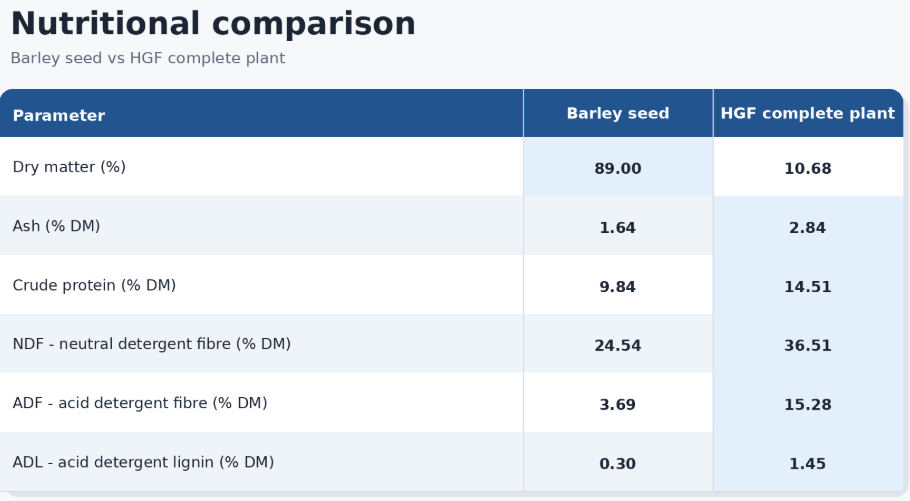
These data show a fresh feed with higher crude protein content than the original seed, a relevant fibre fraction and a low level of lignification, which reinforces its interest within a ration where digestibility and daily homogeneity are key factors.
According to these studies, the optimal harvest day is around the sixth day of the production cycle, when an efficient balance is reached between seed used, fresh fodder produced and dry matter obtained. At that point, the technical reference indicates a production of 7.38 kg of fresh fodder per kg of seed, 0.90 kg of dry matter per kg of seed and an efficiency of 90.23% in relation to dry matter obtained.
This has a direct economic implication.
The farm stops limiting itself to buying forage on the market and begins transforming a simple raw material, such as seed, into a fresh, homogeneous feed produced every day inside its own facilities. The final cost of HGF must include seed, water, electricity, labour, maintenance and equipment amortisation, but a significant part of the expenditure becomes internal, measurable and predictable.
A prudent approach for a dairy farm may be to introduce HGF as a partial component of the ration, for example around 5-10% of total dry matter, always under the supervision of a nutritionist. In a cow consuming around 24 kg of dry matter per day, this would represent approximately 1.2 to 2.4 kg of dry matter from HGF.
Since technical sizing must be carried out in dry matter and practical delivery of HGF is done in fresh matter, this inclusion may correspond to a daily amount of fresh fodder that will depend on the actual dry matter percentage achieved on the farm. The important point is not to force a universal figure, but to calculate which part of the ration can be covered in a stable, digestible and homogeneous way through on-site production.
This is where one of the main advantages of the system appears: daily nutritional management.
Imported forage can vary in quality, moisture, composition, conservation and palatability depending on origin, harvest, transport and storage. HGF produced correctly in a controlled container allows the farm to provide a fresh feed every day with much more regular parameters, making the nutritionist’s work easier and reducing the uncertainty associated with the variability of purchased forage.
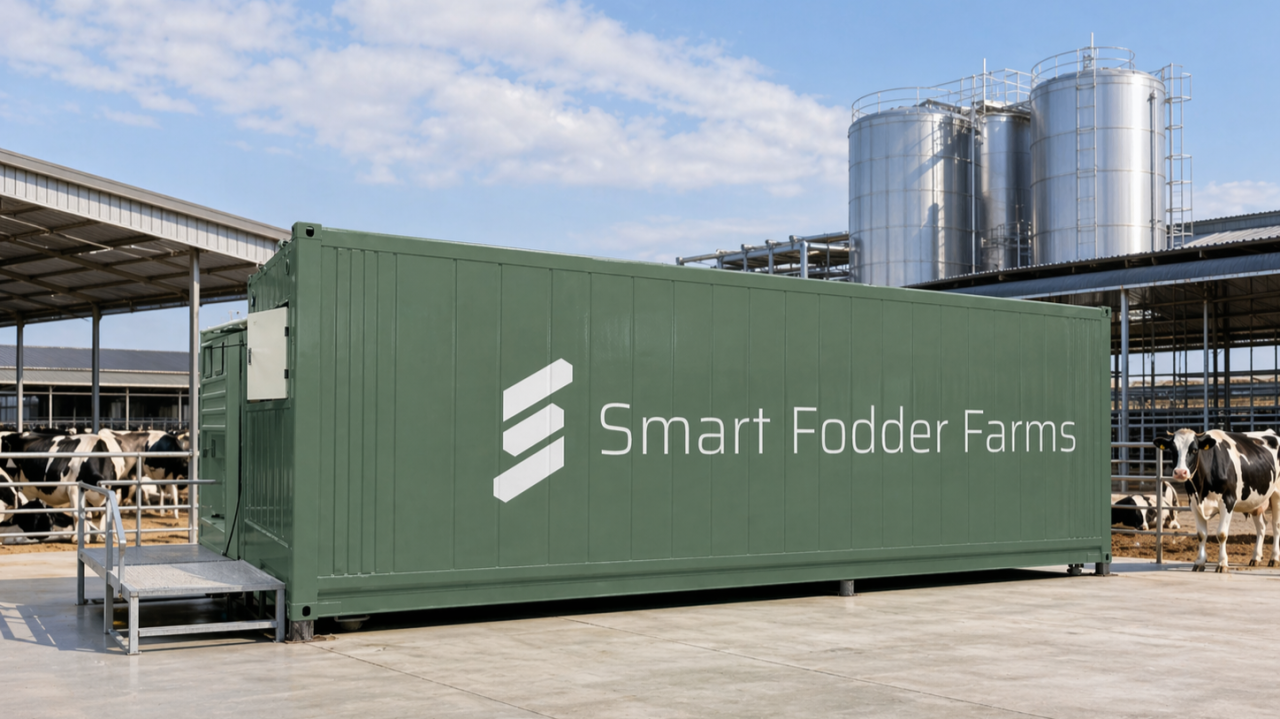
A Smart Fodder Farms 40’ High Cube container can produce up to 840 kg of fresh fodder per day when operating continuously, with six-day production cycles. From a design perspective, this means organising an approximate productive capacity of 5,040 kg per full cycle, distributed to obtain a stable daily harvest. This figure makes it possible to estimate how many cows could receive part of their ration from HGF produced inside the farm itself.
From an economic perspective, the benefit appears at several levels.
The first is the partial replacement of an expensive traditional feed with feed produced on the farm. In regions where purchased alfalfa has a high price, every kilogram of HGF included in the ration can reduce the pressure on the volume of forage that must be bought on the market.
The second is the reduction of external exposure. Every kilogram of HGF produced inside the farm is one kilogram less exposed to price fluctuations, logistics delays, quality variation, supplier dependence and availability problems.
The third is improved planning. Dairy cows need a consistent ration every day, and a professional farm cannot depend on transport, imports or the market always working under ideal conditions. Producing part of the feed on-site adds an additional layer of operational security.
For this reason, the correct comparison should not be only “price per kilogram of alfalfa” versus “price per kilogram of HGF”.
The real comparison must include the cost of buying, transporting, storing and depending on external forage, against the value of producing part of the daily ration inside the farm with a controlled, scalable system designed to provide fresh feed of consistent quality.
In the Middle East, where water is a limited resource, conventional forage production faces major restrictions and imported alfalfa can represent a costly part of the feeding programme, HGF becomes a tool to improve economic efficiency, forage quality and daily nutritional management.
It is not about completely replacing traditional systems.
It is about complementing them intelligently.
Reducing the most expensive, most variable and most externally dependent part of the ration can make a significant difference in the profitability of a dairy operation, especially when the system is correctly sized according to number of animals, inclusion rate, current forage cost and daily production target.
Smart Fodder Farms helps dairy farms calculate which container model they need to produce HGF inside their own facilities and evaluate which part of the ration could be covered with on-site production.
Because, in the end, the question is not only how much it costs to feed a cow.
The real question is how much it costs to depend completely on an external system to feed a high-producing herd every day.