

Q&A: Growcer’s CEO on Container Farm Profitability and What’s Next for Freight Farms Growers

By Kristin Zeit|
August 18, 2025
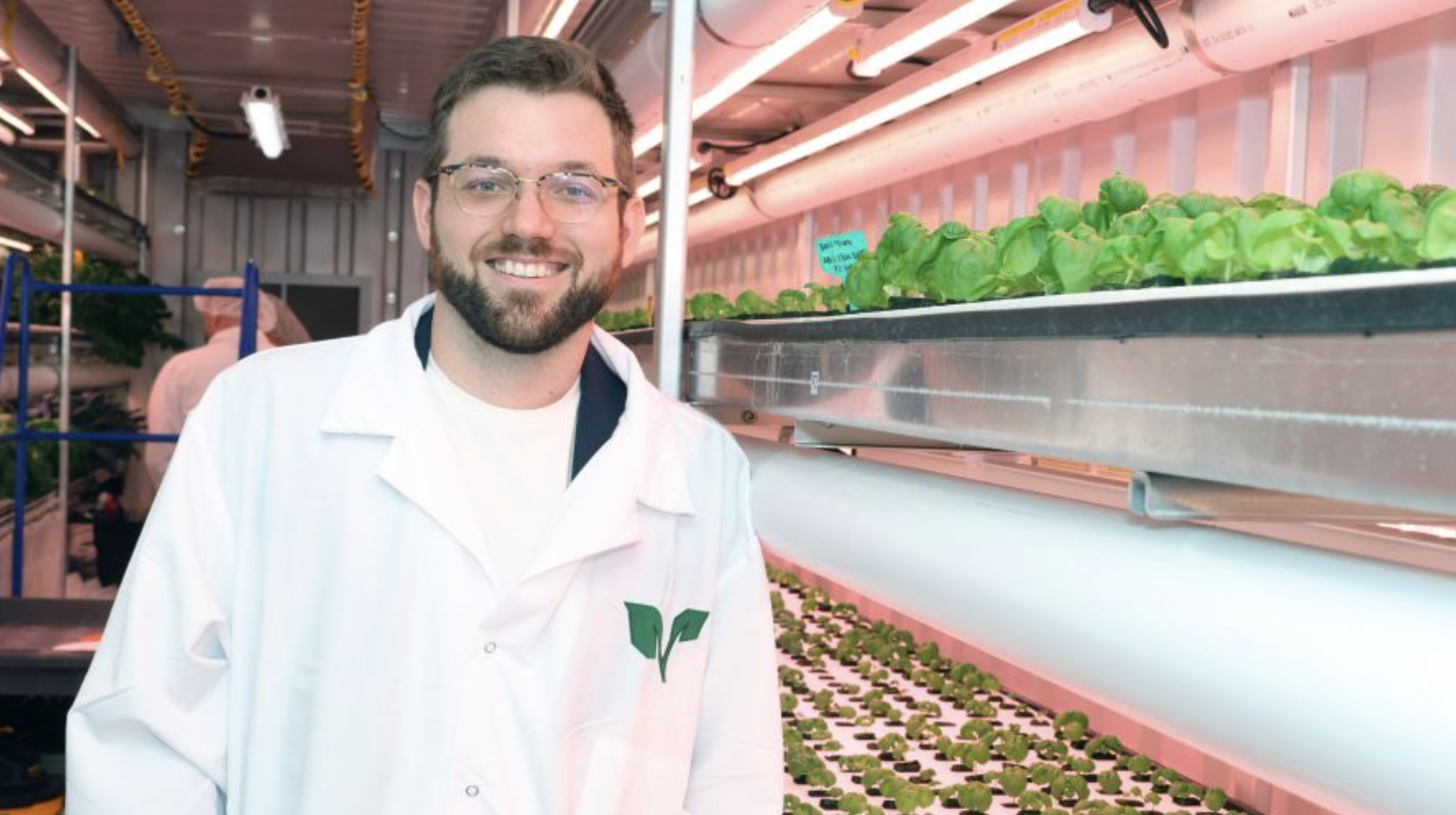
Corey Ellis, CEO and co-founder of Growcer. | Photo courtesy of Growcer
Even with vertical farming’s recent struggles, the Freight Farms’ bankruptcy announcement in April 2025 came as a shock. The company, founded in 2011, had been one of the first to commercialize container farming, selling turnkey hydroponic farms housed in retrofitted shipping containers. It had grown to serve more than 600 customers in all 50 U.S. states and was developing a widespread presence around the world. The day after the bankruptcy announcement, Freight Farms growers were informed via email that they no longer had access to tech support, core software platforms, farm supplies, or replacement parts.
The news spread quickly across LinkedIn, with many CEA suppliers and consultants stepping forward to offer services to the abandoned growers. Growcer, an Ottawa-based supplier of container farms to Canadian growers, was one of them. And now, after outbidding competitors in a Boston courthouse in July, Growcer has taken over Freight Farms’ assets and intellectual property—increasing its customer base by over 500% and expanding its operations into 29 new countries nearly overnight.
“We didn’t initially think we were going to participate in the bid. But ultimately, we know there’s a strong business in modular containerized farming,” says Growcer CEO and co-founder Corey Ellis. “We wanted to send a signal to the market that [the Freight Farms bankruptcy] is the consequence of bad decisions of one company, not of the industry as a whole.”
Below, Ellis spells out Growcer’s plans to support its influx of new growers while building on the promise of container farming for hyper-local fresh food supply. He also shares his perspective on what it takes to be successful in container farming—and who should just walk away.
CEAg World: You’ve suddenly gained a huge foothold in the U.S. after previously focusing on Canada. Was expansion already on your radar?
The Benefits of Automating Your High Tunnel
Ellis: Yes, we had made some recent hires for that. We landed our first U.S. customer last year, and [expanding the U.S. customer base] was part of our roadmap for 2025. So this was just an accelerant to the existing strategy.
How are things going to be different for these growers than they were before?
First of all, customers just want continuity. They want the software to work the way it’s always worked. They want the consumables to be turned back on so they can purchase seeds, supplies, fertilizer, etc.
So for now, phase one, everything will be online again, the software working the way they expect it to, and everything looking and feeling the same as they knew it prior to April 30.
Financially speaking, the major change we’re making right away is moving to a fee-for-service model on the service and support side. Before, support was a free function that was essentially built into your farm purchase. That works when you have 10 customers; it doesn’t work when you have 800 customers. All we’re looking for there [through fees] is cost recovery, because we know that support is one of the most important things for growers.
We’re going to run this business more efficiently. We won’t scale up until there’s revenue associated with it. Growcer has been bootstrapped from day one; we have a few outside investors, but they’re very strategic and long-term. The company is profitable today and self-sustaining.
Also, we’ll turn down customers who want to buy our product if we don’t think they’ll be successful. Quite literally, if somebody shows up to our door and says, “Look, I want to make this much money” and it’s a number we don’t think is actually possible in their market, we won’t sell a farm to them. It’s just not worth the workload for us later. We ask a lot of questions to understand their business model because that’s a customer we want for life.
And then, in the last year, we started to finance our own farms. It’s essentially a rent-to-own model—we don’t charge anything upfront, you just pay three grand a month. That gives us predictable revenue every month, and we’re deploying farms to customers in a way that reduces the upfront capital barrier.
So from your perspective, what are realistic expectations from a commercial container farm?
This is not going to be the cheapest vegetable you can produce. If you’re selling lettuce as a commodity, trying to compete against either imports or large-scale field or greenhouse production, you’re in the wrong business.
Growcer farms allow a hyper-local, decentralized food production model. And [growers] need to find customers who value that—who want a pesticide-free, local product that has a longer shelf life—and are willing to pay a premium for it.
[A container farm] grows a known amount of produce every week at a predictable cost. You control your inputs and your outputs, and as long as you do all the work you’re supposed to do, you’ll get a relatively stable yield every single week.
Within 5% per year is typically where we land of the annual yield target. And then your cost, it’s going to be plus or minus 5 to 10% of where you expect it’s going to be, because things are a lot more controlled. So our growers go into it knowing that this is a product that needs to command a certain price to be profitable.
The second thing is, I think a lot of people think this is just like a piece of software: You click and a lettuce appears.
It’s still farming, right? Even though it’s tech-enabled, that doesn’t mean it’s any easier from an agronomical or horticultural point of view. So people who are successful realize that they’re learning a new skill, and they’re either hiring someone who comes with a horticulture degree or they’re willing to take the time to learn.
We’ve trained over 250 growers who’ve never grown in their life, and a year later, they’ve gone through the crash course of what it means to run a farm. So people can learn.
It’s not perfect. There are going to be hard days where you make mistakes or something happens to your system and you need to react. And what separates the great growers from the good ones is how quickly they can get back on track, whether they can spot issues early before they become even larger issues.
It’s early in the process, but how’s it going so far, integrating the Freight Farms customers?
It’s very fresh. We’re managing expectations with growers that it’s going to be 30 days for systems to be back online working like they used to. And it’s going to be three to nine months, depending on the part of the business, for us to start getting our hands onto them and understanding how to make them better.
So we’re just asking for patience as we work to integrate the business to be as efficient as possible.
This stuff takes time and we want to be judicious. We don’t want to break things. We want to make sure when we make changes that they’re going to be lasting changes. We’re positioning ourselves as the calm hands on the wheel—we’re here for the long run.
This interview was edited for length and clarity.