


Welcome to iGrow News, Your Source for the World of Indoor Vertical Farming
Hydroponics System Compared Side-By-Side
Today we’re talking about an experiment which we ran to compare four of the most popular hydroponic techniques.
by Urban Leaf Team | Dec 3, 2018 | Getting Started, How to Keep Plants Alive |
Today we’re talking about an experiment which we ran to compare four of the most popular hydroponic techniques. Since these techniques are used in dozens of commercially available units, we decided to test them out for ourselves directly side-by-side to determine which is the most effective form of indoor gardening. If you’re new to hydroponics and want to learn a little bit more about the science behind the systems discussed here or how they work, check out our YouTube video which goes through each of them in detail.
THE EXPERIMENT
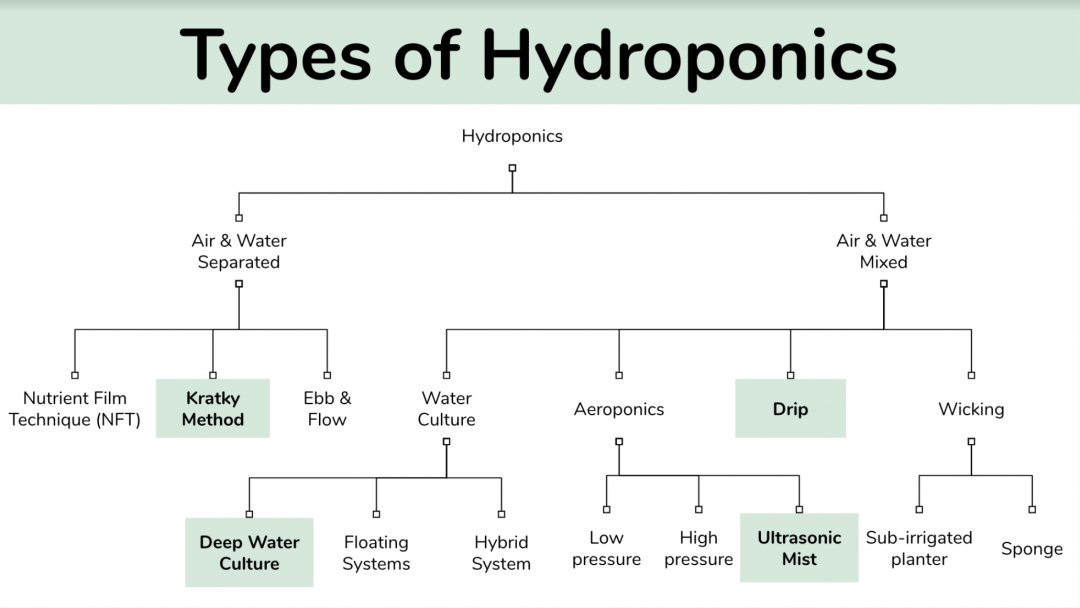
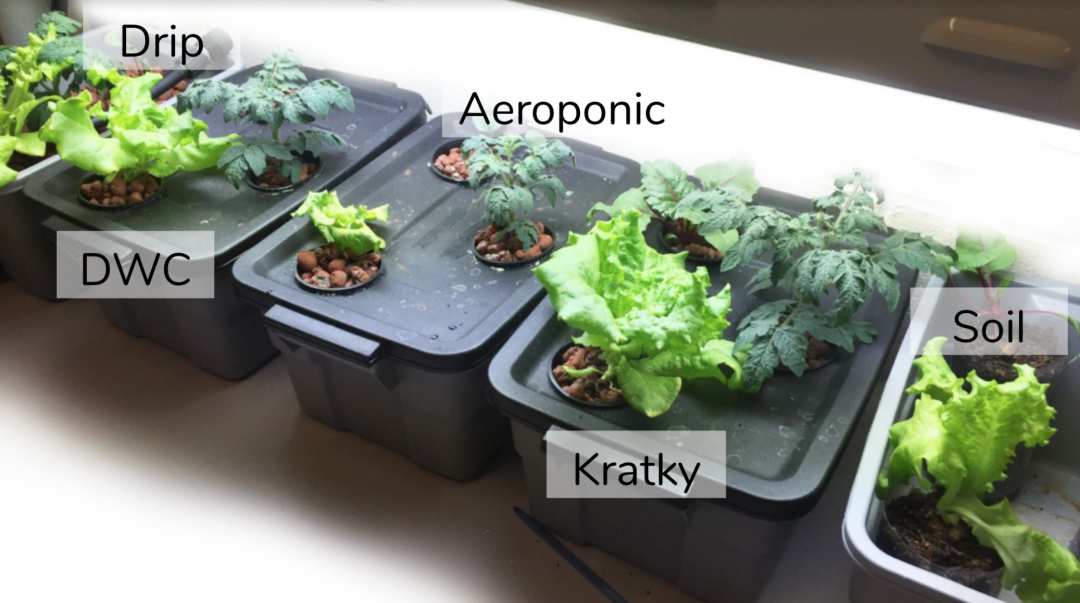
The test included five different systems: four hydroponics and one control sample. We ran this experiment for three months on a bench in a basement with grow lamps situated to shine directly onto the plants. Each of the five systems contained three different plants including: cherry tomatoes (a model for flowering fruity plants), lettuce (a model for leafy greens), and beets (to represent root crops). All of the containers were solid opaque plastic to keep the light out of the water reservoirs and reduce the amount of aloe growth.
Check out some time lapse videos on YouTube. This post will focus on the data of the plant sizes, fruit yield, quantity of water usage, and temperature of each of the different systems.
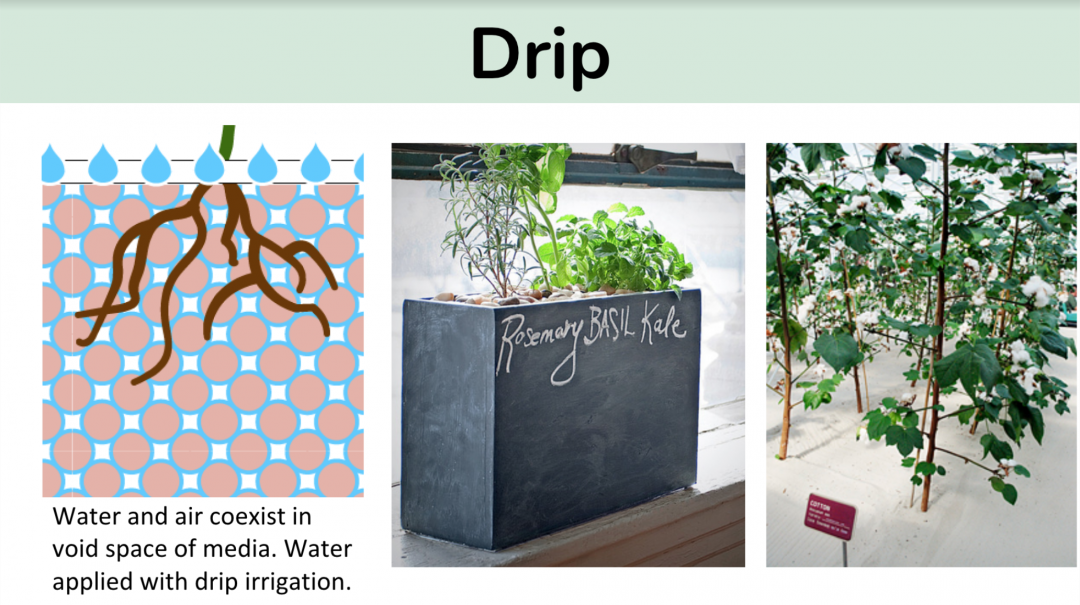
#1: The Drip System: First, we have a drip system. The drip system uses clay pebbles to anchor the plant and delivers the water through an HTPE gardening irrigation system with three emitters. This system delivers water three times per day for 15 minutes each time.
#2: The Deep-Water Culture (DWC): Next, is the Deep-Water Culture. In this trial, the water is aerated with bubbles delivered by an aquarium tube and air stone.
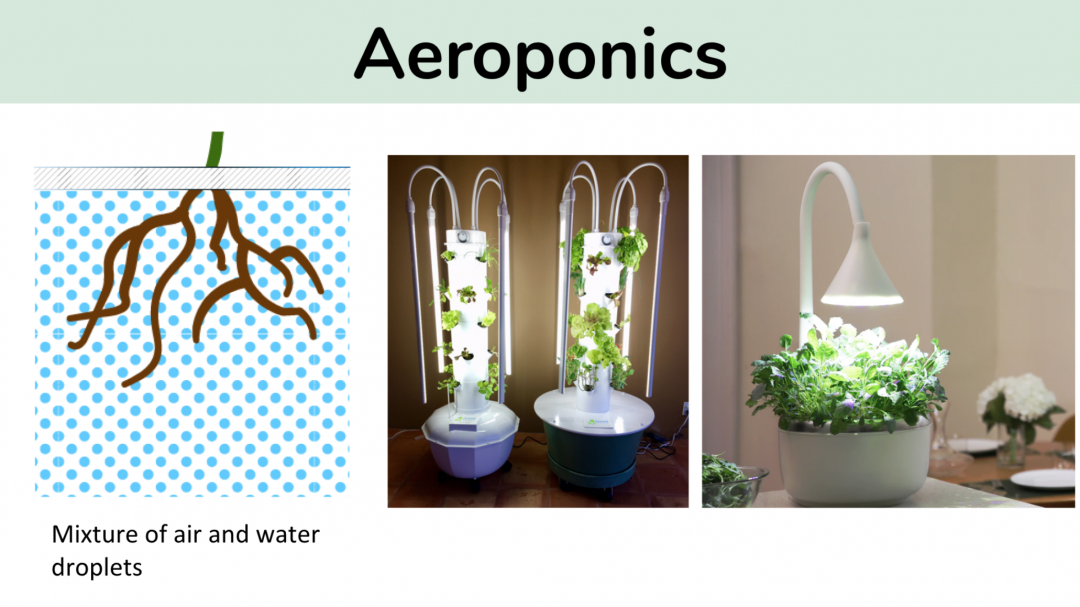
#3: Aeroponics: The third system contains one ultrasonic fogger. These foggers were purchased from a specialty supplier for around $30 each.
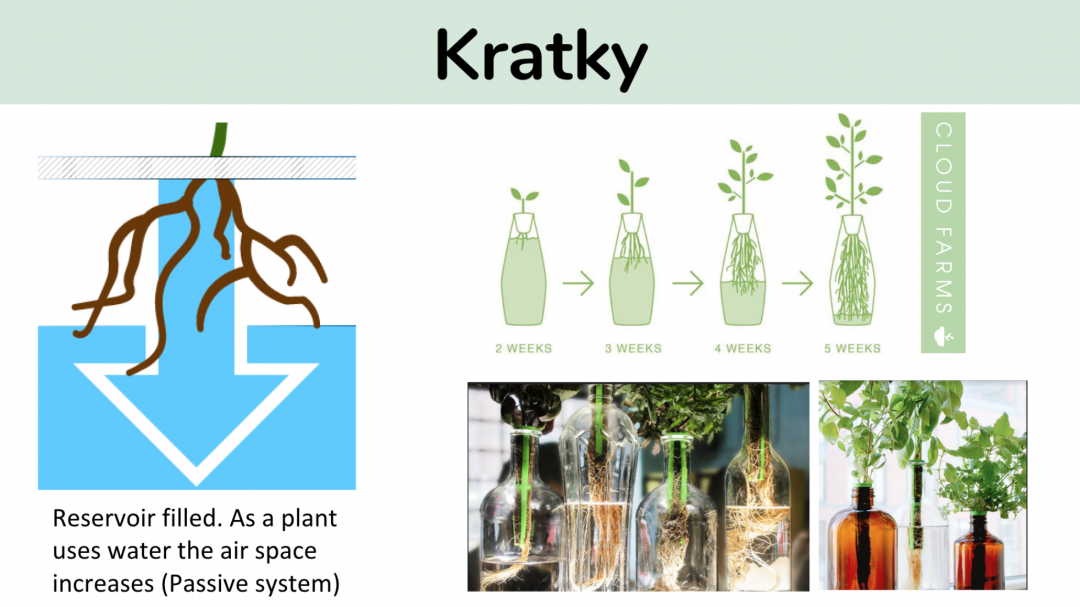
#4: The Kratky: The fourth set-up is the Kratky: basically just distilled water and nutrients.
#5: Control Sample: Lastly, basic soil. Miracle Grow potting mix was placed into three free-draining containers (aka water bottles with holes in them) to use as the control. This was watered by hand, but truthfully, some waterings were missed and it got too dry every once in awhile.
ISSUES WITH THE EXPERIMENT:
There were some limitations and problems which might skew the results, including:
(1) The plants in the DWC with the bubbles died early. This wasn’t intentional, but (as we learned) the system goes through water extremely rapidly.
(2) Some of the plants were not given enough time to reach their full potential. For example, the tomato plant in the drip system grew very large but was slower to flower. Unfortunately, the experiment ended before it was given enough time for all of its flowers to fully produce fruit.
(3) Finally, there was an element of human error. Life happens and occasionally the control system wasn’t watered as a result.
EXPERIMENT RESULTS
What did we learn from our experiment? The most consistent and comparable data ended up being for the tomato plants, so that is the data which will be compared here.
Plant weight: The drip system grew the biggest plant, by far, but was much slower to flower. Unfortunately, because it ran out of water the Deep-Water Culture tomato plant didn’t make it to the end.
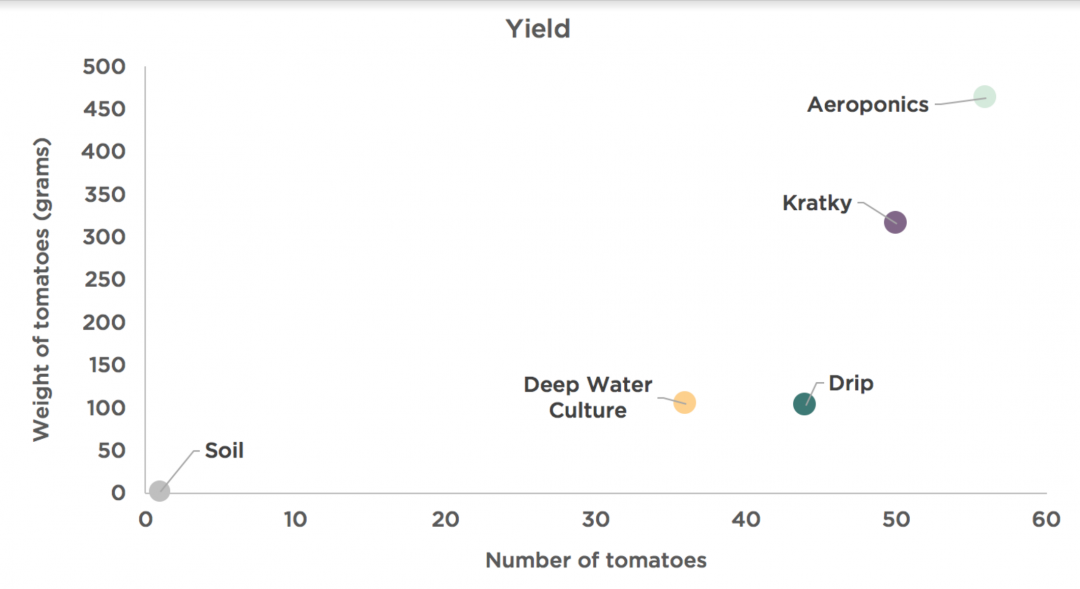
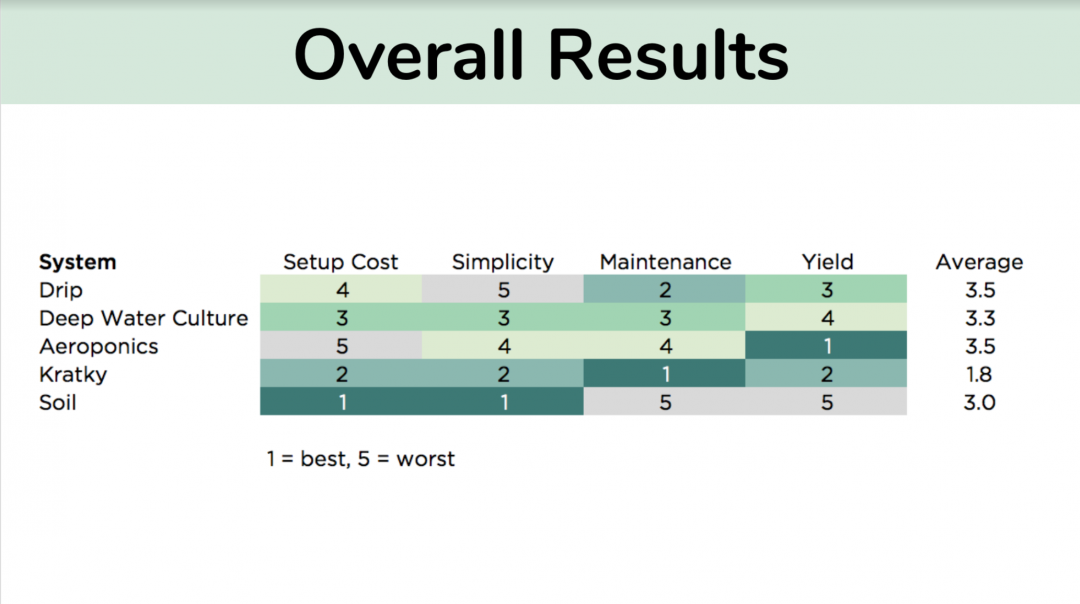
Yield: The aeroponic fog-based system produced both the largest and greatest quantity of fruit. The most surprising result was that the Kratky was the second best in terms of fruit yield. Given the simplicity and low cost of a Kratky set-up, it punches well above its weight.
Temperature: (Remember that these were all sitting in the same room, side-by-side.) You’ll notice from the graph that the aeroponic system was very warm. This is due to the heat emitted by the electronic fogger. Meanwhile, the DWC system with the bubbler was by far the coolest because the constant evaporation of water forced by the system is an endothermic reaction which absorbs heat.
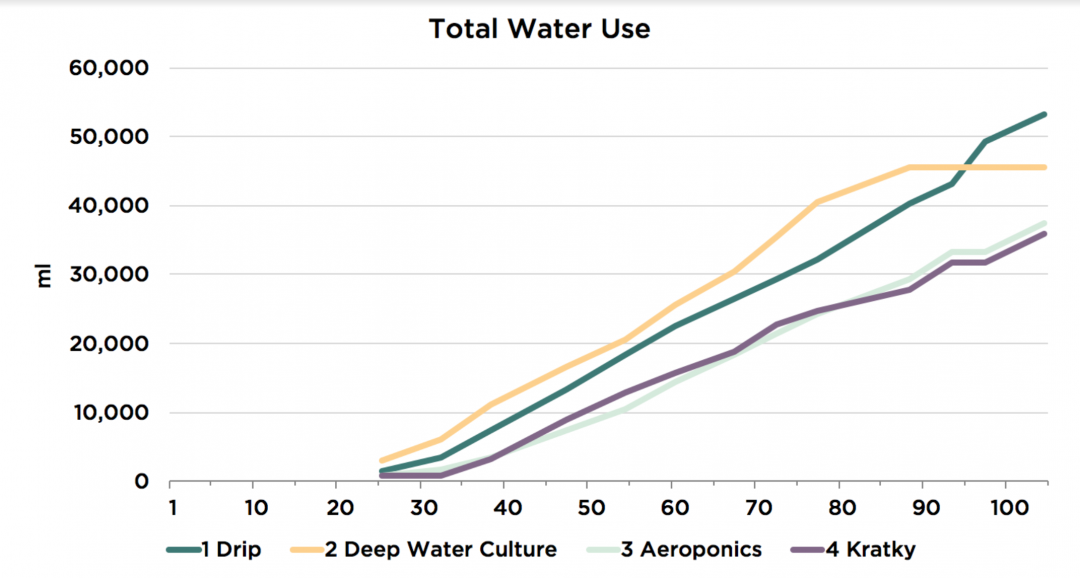
Water use: The major differences in these systems was how they related to water use. The DWC with the bubbler by far consumed the most water. The Kratky consumed the least because it’s a passive system which doesn’t really force the air out. With the aeroponics, which was quite close to the Kratky in water usage, the vaporized water is able to condense back into the system so it recirculates rather than constantly intaking new water.
WHICH SYSTEM WAS THE OVERALL BEST?
If overall cost and maintenance are not a constraint, you’re likely to get the best results from an aeroponic-based system. However, in terms of bang for your buck, ease of set-up and use, and the fact that there are no moving parts, the Krafty system is hard to beat.
Hopefully, this has been a useful overview. Don’t forget to head on over and check out our video explaining the science behind each of these four hydroponic systems.
To learn more about hydroponics, gardening, or growing your own food, don’t forget to subscribe to our YouTube channel, sign up for future emails from Urban Leaf, or leave a question in the comments below.
Indoor Vertical Farming 2019: What I've "Really" Learned..
This July marks five challenging years since I made the bold decision to pursue a career in indoor vertical farming; the growing of plants indoors using only LED lights and liquid nutrients – no sun, no soil.
Published on January 3, 2019
Jim Pantaleo
Senior Advisor - Indoor VerticalFarming
This July marks five challenging years since I made the bold decision to pursue a career in indoor vertical farming; the growing of plants indoors using only LED lights and liquid nutrients – no sun, no soil. My work, focused solely on growing plants in large scale for human consumption, has somewhat morphed into pursuing the fascinating and much-needed application of PMPs or plant-made pharmaceuticals. PMPs, simply stated, are the result of isolating key proteins in plants and extracting those proteins for use in antibiotics and vaccines…again, simply stated.
Did you know a plant produces proteins which fight hemophilia and rheumatoid arthritis? It’s true and profound. Just ask Dr. Barry Holtz of iBio CDMO in Texas. I could go on and on about PMPs, but what I really want to convey are some of the lessons my indoor vertical farming ‘journey’ has imparted. The hope is my experience may in some way inspire, or provide a cautionary tale, for those who have been seeking a career change, or better, a life change.
Since the summer of 2014, the road I’ve traveled has been bumpy, sometimes smooth and always winding…barreling head first towards the unknown…and the known. What is unknown is where I will be and who I will work with in 2019. You see, I’ve recently resigned my position as Vice President at one of the nation’s largest, privately-held indoor vertical farms for food production leaving me at the moment, sans employment.
What is known is my steadfast and dogged resolve to never, ever give up on this nascent industry and the people I’ve encountered along the way…not the noble and generous horticultural professionals and not the charlatans or whack-jobs either.
It was in 2015 when I wrote “Indoor Vertical Farming 2015: What I’ve Learned.” I was amazed at how many people actually read it. I reviewed my previous ‘year of immersion’ into indoor vertical farming and the people, start-ups and organizations I came to know. People like Marc Oshima, who along with David Rosenberg, the founders of AeroFarms, or the dear and generous-of-spirit industry colleague Brian Lanes of the Dutch R&D concern, PlantLab, or a true ally in Philips (Signify) City Farming representative, Blake Lange.
It was that summer of ’15 when I secured three pro-bono gigs with indoor vertical farms located in various parts of the world. Remotely from my home in California, I wrote business plans; researched cannabis in Colorado; assisted with marketing and generally ingratiated myself to the CEOs of these upstart operations. I also began to write. Over the next year I produced a dozen articles, blogs and interviews for Urban Ag News, the online resource for all-things controlled environment agriculture (CEA). I thank Urban Ag News founder Chris Higgins for not only this opportunity but also to work like a dog for a week in his company’s (Hort Americas) Dallas warehouse and experimental greenhouse.
I wrote and blogged about indoor farms and the ecosystem that surrounded them…like Priva and others. I interviewed industry leaders like American Hydroponics’ founder, Michael Christian, who turned me on to the sandbox argument of whether produce could be considered organic if it’s not grown in soil. “Jim, a nitrogen atom is a nitrogen atom!” he emphatically explained.
I wrote about hospitals who feed their patients high fat, high sodium, nutrition-less food and I shed a light on those forward-thinking hospitals who ‘grew their own’ in an effort to heal with food. I wrote about why LED’s can emit a pink hue. “Don’t call them pink!” was the public chastisement I once received from UC Davis horticulture professor and CEA leader, Dr. Heiner Lieth.
I also organized an amazing networking event with Urban Ag News in Salinas, California where eight member companies from the Japan Plant Factory Association shared their work (bravely presenting in English!) with a gathering of American agriculture companies and professionals. Included in this event was my personal CEA hero, Dr. Toyoki Kozai, a rock star in Japan and widely known as “The Father of the Japan Plant Factory.”
It was in the fall of 2015 when I secured my first paying gig at the now-shuttered indoor vertical farm, Urban Produce, ironically located in my hometown of Irvine, California, a former bucolic agricultural strong-hold now an over-built Orange County suburb. Over the next three years I would go from assisting Urban Produce with business development and marketing to working on ‘the farm’ growing tons (literally) weekly of USDA-certified organic wheat grass and micro greens. One of the hardest (physical) jobs I’ve ever had. In fact, I lost over 50 pounds in six months! Eventually, I was asked by Urban Produce’s investors to take over the operation as General Manager in the fall of 2017.
The many leadership lessons learned since 2015 not only from my role as General Manager but eventually as a C-Level Vice President of one of our nation’s largest privately-funded indoor farms were harsh and sobering. Meaning, just because you get the title and the “corner office” (I literally had a corner office) does not mean those whom you lead will accept your leadership. In fact, subversive behavior and a constant watchful eye over my every move were omnipresent. It’s true, when you reach the top, you should expect to be knocked down.
And let me provide a dose of reality when it comes to these large and well-funded indoor farms; they are not perfect, technologically-speaking, by any stretch of the imagination. The technical and facility challenges around water and water cleanliness along with air conditioning, energy and heat were again, omnipresent. If you have ever seen a large warehouse flooded with thousands of gallons of water because a grower forgot to turn off a hose for example…or a chiller did not chill…or a dehumidifier did not dehumidify…then welcome to the world of indoor vertical farming!
The copious amounts of money spent, precious operational time lost (along with actual crop loss…defined as catastrophic crop loss) and the hard labor extended to address these facility challenges were beyond anything I could ever have imagined. Over time and as I built credibility, I had the opportunity to speak publicly about this embryonic industry thanks to the likes of Indoor Ag Con’s founder, Nicola Kerslake, or the administrators at the University of California and the University of Nevada or Andy LaVigne, President of the American Seed Trade Association. I owe them and others a great debt of gratitude for their belief that I could be some sort of industry thought leader. Gratitude also to David Proenza who tapped me as the Master of Ceremonies for the second International Congress on Controlled Environment Agriculture held in steamy Panama in May of 2017.
From these speaking experiences I learned there was a true need not only to understand indoor vertical farming but to understand how the many peripheral industries could become involved, from academia and technology to packaging, to those breeding seeds meant only for controlled environments.
Fast-forward to 2018 and the aforementioned VP gig at one of the nation’s largest, privately-funded indoor farms. It was in this role where I came to know the world of PMPs along with how our government is becoming engaged with indoor vertical farming. In June of this past year, I traveled to Washington D.C. on the invitation of Dr. Sarah Federman of the Office of the Chief Scientist for the USDA for a gathering of industry folk. All the “Bigs” where there including Plenty, AeroFarms and Dr. Dickson Despommier, who played a key role in sparking the discussion around indoor farming with his 2010 book “The Vertical Farm.” A few months later I found myself back in D.C. for a gathering put together by Dr. John Reich of the Foundation for Food and Agriculture Research(FFAR). The three-day meeting was a starting-point and nexus in the public/private funding needs for credible research in indoor farming.
During this past year I have had the good fortune to meet and work with a number of universities including the team at the University of Arizona’s Controlled Environment Agriculture Center (CEAC) led by Director Dr. Murat Kacira and past Director, Dr. Gene Giacomelli. Cornell University’s College of Agriculture and Life Science Dr. Neil Matson and the previously mentioned Dr. Lieth of UC Davis along with Dean of Horticulture at the University of Nevada’s Dr. William Payne have all enriched my experience.
One of my last efforts during 2018 was working with the seed breeding team at Bayer/Seminis. It should be no secret that the fledgling indoor farming industry requires a different kind of seed than those sown in outdoor environments – and companies like Bayer know it. I presented research and data (compiled by a diligent R&D team) which shared trials of growing seed specifically meant for indoor environments. The experience was an important and valuable one, and my appreciation goes to Team Bayer for their vision and partnership.
What I would like to convey to the reader is if you want to make a change in your career and your life, I say do it! But do it for the right reasons. I have aggressively pursued this “business” because I wanted to make my children proud of me. I wanted to help the planet and I wanted to do something that would make a difference to human kind. I did not care, nor do I care now, about making money. Do something you love and you’ll never work a day in your life as the saying goes, but be prepared for a journey and to work very, very hard. My journey continues and I welcome you to reach out to connect with me…even if you don’t know me. That’s what I did and it is one of the key reasons I have made it this far.
Very special thanks to those not mentioned above but who have been integral to my career thus far: Herbert Kliegerman Founder of iGrow News, Glenn Behrman Founder at GreenTech Agro LLC., Michael Yates, Dominic Chen and Erika Summers of Sananbio U.S., Dr. Paul Zankowski of the USDA’s Office of the Chief Scientist, Dr. Sarah Taber, Henry Aykroyd Founder of Intelligent Growth Solutions, A.G. Karamura Founding Member of Orange County Produce and Former Secretary of Agriculture for the State of California, Val Dodd Former Managing Member of Urban Produce LLC., Brad Wahlgren of Bayer, Dr. Nadia Sabeh aka “Dr. Greenhouse”, Dr. Leo Marcelis of Wageningen UR, Dr. Sheila Bhattacharya, Glen Zimmermann of Sunrise Produce, Jan Westra of Priva, Adam Porsborg, Dr. Andy Moreno, Dr. Karl Kolb, David Armstrong President/CEO of Sakata America, Victor M. Hernandez of the USDA, Robert Colangelo Founding Farmer/CEO at GreenSense Farms, Jeff Randall of Get Fresh Sales, Dr. Gary Stutte Founder of SyNRGE LLC., Robert Puro Founder of SeedStock, Will Kain CEO/Co-Founder of Pantheon Energy, Dan Albert Founder/GM at Farmbox Greens.

How Do You Stop Diseases On Controlled Environment Edible Crops?
Controlling the environment is a key component of preventing diseases on edible crops.
As an increasing number of growers start growing edible crops in controlled environment structures they may be facing some diseases that they haven’t encountered before. For ornamental plant growers who are adding edible crops, they will not have as many or as effective chemical controls as they have access to with their ornamental crops.
“Growers currently don’t have a good complement of products for edible crops being grown in greenhouses or other controlled environment structures,” said Michigan State University plant pathologist Mary Hausbeck. “And if there are chemical controls available, growers may want to spray all of their herbs together. For instance, if the rosemary needs to be sprayed to protect against Botrytis, it’s wise to make sure that other nearby herbs are also listed on the fungicide label. Otherwise, growers need to make sure that their employees who are going to be spraying know which herbs they can and cannot spray with a particular product. Fungicides labels can be complicated.”
Hausbeck said growers should be cautious about using pesticides in greenhouses and other controlled environment structures like warehouses, vertical farms and plant factories.
“Previously, EPA required that use in greenhouses had to be specifically stated on a pesticide label in order for greenhouse growers to use it. But states varied in their interpretation and so usage was determined on a state-by-state situation. Several years ago EPA determined that if the label doesn’t restrict use in greenhouses, then a pesticide can be applied to a greenhouse-grown crop. In Michigan, our state agency views greenhouses and other controlled environment structures similarly. Just make sure that the label doesn’t prohibit the use of a fungicide in a greenhouse.”
Optimizing environmental control
Because of the limited number of chemicals available to greenhouse growers of edible crops, Hausbeck said it is critical for growers to use environmental control to limit disease.
“Environmental control has to be part of the equation,” she said. “Powdery mildew, downy mildew and Botrytis have a tremendous capability to reproduce in large numbers via spores. A microscope is needed to see one spore, but when there are many spores, the eye can see the fuzziness of the mildew or grey mold on the plants. The spores are moved around the greenhouse via air currents.
“Powdery mildew and downy mildew tend to be specific as to what plants they will infect. Powdery mildew is a problem on tomatoes, cucurbits and peppers. Downy mildew can be a problem on basil, cucumber and lettuce. Botrytis has a much broader host range.”
Botrytis is in a lot of growing environments because it can take advantage of plant tissue whether it is alive or dead. Downy mildew and powdery mildew won’t colonize dead plant tissue that is lying on the floor or sitting in a trash pile. Botrytis will infect plant parts that are still attached or have been discarded.
Powdery mildew, downy mildew and Botrytis prefer cooler temperatures.
“Occasionally I have seen Botrytis sporulate in coolers,” Hausbeck said. “Older leaves that are mature and are senescing may be in direct contact with moist growing media and may lead to Botrytis infection. Plants growing in a moist environment with high humidity and extended periods of leaf wetness are at particular risk of Botrytis infection. For instance, Botrytis can cause stem blight on rosemary and other herbs leading to significant losses.”
Hausbeck said Botrytis has a fairly broad temperature range in which it can infect plants.
“Growers who effectively use environmental control to keep conditions dry and unfavorable for Botrytis can get by without fungicides,” she said. “Botrytis needs leaf wetness to infect plants. Moisture is key.
“At 80-85 percent relative humidity even a small drop in temperature can lead to Botrytis issues. If the relative humidity is maintained at a low level, Botrytis won’t be successful in becoming established. Growers should do everything possible to keep Botrytis at low levels.”
Botrytis can cause stem blight on rosemary leading to significant losses.
Photo courtesy of Mary Hausbeck, Mich. St. Univ.
Botrytis can also come in as a secondary problem. It may become a problem as a result of the plants undergoing an environmental stress that results in some leaf browning. Botrytis can take advantage of this dead tissue.
Hausbeck said Botrytis can be an issue with rosemary propagated by vegetative cuttings.
“Growers should try to lower the humidity immediately following taking cuttings from rosemary stock plants for 24 to 48 hours,” she said. “Botrytis infection can occur on the wounded stems of stocks plants leading to dieback. Growers can raise the temperature in the greenhouse by a degree or two to reduce the relative humidity. Growers should try to drop the humidity below 70 percent or as low as possible depending on the circumstances of the greenhouse. They should also provide good air movement around the plants. Having good airflow movement around the plants helps to prevent all types of diseases, including Botrytis, bacterial diseases, powdery mildew and downy mildew.
“It doesn’t take a lot of expensive technology to keep the relative humidity low and the plants dry. Avoid overwatering and keep the leaves dry by watering at a time of day when they can dry rapidly. Keep the air in the greenhouse moving so that there aren’t pockets of high humidity. Ensure there is good drainage so there is no standing water on the greenhouse floors. In areas of the greenhouse where there is standing water, the relative humidity in these areas can be increased by as much 15 percent.”
Correctly identifying the disease
Hausbeck has encountered times when some of the problems growers have reported were caused by environmental stress.
“In some cases growers have been able to send me really good pictures and I can make a diagnosis based on the photos,” she said. “If it appears the plants have a potential disease I’ll recommend that growers send samples to a diagnostic lab. There are some symptoms that don’t look like a pathogen at all. I ask the growers about their growing systems and to describe when the symptoms first appeared and the pattern they are seeing across the crop.”
Having good airflow movement around plants applies to preventing all types of diseases, including basil downy mildew. Photo courtesy of Mary Hausbeck, Mich. St. Univ.
Hausbeck said as more edible crops are being grown, she expects to see some “oddball” diseases showing up that she hasn’t seen before.
“Some of these are fungal pathogens,” she said. “I have seen Septoria, which is a fungal leaf blight, on a couple of herbs. As herbs are being grown in greater volume, it’s likely that we are going to see more problems develop just by the sheer amount of plant material being grown. It’s important for growers to recognize in some situations this is still a relatively new arena for plant disease.
“We don’t know everything about the range of crops that can be impacted and what the disease symptoms might look like. If growers see a problem with a crop they really should connect with a diagnostic lab sooner than later. In the case of a disease problem, the recommendation may be to toss the plants and not try to save them because there isn’t a good complement of fungicides. Growers may sit on a crop trying to nurse it along with different growing regimes, not recognizing that it is a pathogen that is destroying their crop. This could result in costing them more time and more money.”
More control options available
Hausbeck and her laboratory at Michigan State have developed a reference chart for “Registered Products for Common Greenhouse Diseases on Vegetables and Herbs.”
“We have compiled this “cheat sheet” for products that can be used on edible crops,” she said. “We have grouped the crops according to brassica, cucurbit, leafy greens, fruiting and herbs. It is only meant to be used as a guide. Growers must read the pesticide labels carefully.
“What we have learned is that there is not a blanket product that can be used on all herbs. If a product can be used on herbs, it may or may not include basil. The situation is getting better with these crops and registered products in terms of having more options.”
For more: Mary Hausbeck, Michigan State University, Plant Biology Laboratory; hausbec1@msu.edu; https://veggies.msu.edu.
Hort Americas works with a wide variety of vendors that help controlled environment gorwers manage the climate inside their greenhouses and vertical farms. Learn more about fan, ventilation equipment and other products available from Hort Americas.
This article is property of Hort Americas and was written by David Kuack, a freelance technical writer in Fort Worth, TX.

‘Farming 4.0’: In Space-Starved Hong Kong, The Future of Agriculture May Be In High-Rise Buildings, And Hi-Tech
An old factory building in Tai Po is using ‘vertical farming’ to turn a 10,000 sq ft space into one the size of a football field.
By replacing shovels and hoes with computers and drones, the operation only needs four farmers
21 December 2018
A hi-tech vegetable farm in Hong Kong’s Tai Po district is thriving inside a converted factory building, and produces four tonnes of lettuce, wild rocket, endive and cabbage for salads each month.
HONG KONG NEWS
At Farm66, workers in their 20s and 30s tend to neat rows of racks, each 30cm tall and 10 tiers high, filled with potted greens lit by low-energy light-emitting diode (LED) lamps and connected to fish tanks on the floor.
Instead of shovels and hoes, they work with computers and drones.
“We farm with technology, not ploughs,” said the vertical farm’s co-founder, Gordon Tam Chi-ho, who is in his 30s. “This is farming 4.0.”
The 20,000 sq ft space is air conditioned and fitted with sensors which check the temperature, humidity and height of the vegetables to make sure the environment is kept stable for the growth of greens.
Once a day, a drone flies over the racks to inspect the vegetables. If some are too short, a technician in a control room will adjust the racks remotely to move the plants closer to the LED lamps.
The plants are watered automatically using the fish tanks. Carp reared in the tanks produce the waste that becomes organic fertiliser for the vegetables.
Farm66 offers a glimpse of the future of farming by harnessing technology and using less space than traditional farming, long regarded a sunset industry in Hong Kong.
Primary industries, mainly comprising farming, fishing, mining and quarrying, accounted for HK$502 million (US$64 million) last year, a tiny fraction of the city’s total gross domestic product of HK$2.65 trillion.
But Tam, who is optimistic about the prospects for aqua-farming, said: “Hong Kong is a service-based city, but we still need healthy food. This is a viable business in Hong Kong because of demand for healthy produce and the growing awareness of food safety.”
Tam had been troubled by allergies to metals and pesticides in vegetables when he and his two partners – Billy Lam Chi-yeung and Terry Chau Tak-hung – founded Farm66 in 2013.
They started in an old industrial building in Chai Wan before moving in June this year to premises 10 times larger at Tai Po Industrial Estate. The current property is part of the Hong Kong Science and Technology Parks Corporation’s revitalised precision manufacturing centre.
Setting up the vertical farming project cost more than HK$10 million, Tam said, with investment coming from an undisclosed angel fund.
The farm currently uses about half of its available space. When fully operational, output is expected to rise to about 16 tonnes a month, or 200 tonnes a year.
As the vegetables are grown in a tightly controlled ecosystem, they grow faster than outdoors, do not need pesticides and are ready to eat upon harvesting.
Tam, who trained as an architect in the United States and studied sustainable urban development in Hong Kong, said innovation had made farming more viable and less labour intensive.
Vertical farming using tiered racks means 10,000 sq ft of space can expand to become an area the size of a football field.
“We apply computer science and technology to the growing process, and that’s why we have only four people handling operations,” he said.
The future of farming: Japan goes vertical and moves indoors
Technology also allows the company to overcome the lack of sunlight indoors. The farm uses different types of LED lamps of varying wavelengths – for example, red LED light to help the plants grow taller and blue to encourage thicker, bigger leaves.
“Our biggest enemies are bacteria and insects – that’s why the growing areas are restricted areas and we keep track constantly of the data collected by our sensors,” Tam said.
Funding and space remain challenges too. “Raising angel funds and finding a sizeable space in Hong Kong are not easy,” he said. Rent accounted for 40 per cent of costs, labour 30 per cent, research and development 10 per cent and the rest went on utility bills.
To make the business more financially viable, he decided not to grow mass market greens such as choi sum or bak choi, which sell for about HK$12 for two catties (1.2kg).
Instead, the farm grows higher-priced salad greens which it packages in boxes sold for between HK$25 per 30 grams to about HK$68 for 120 grams.
Its vegetables, which are on sale at City’super, will soon also be available in other supermarkets and about 10 vending machines to be set up in residential clubhouses and office buildings.

A Peek At Your New Plate: How You’ll Be Eating in 2019
Here are some of the most intriguing guesses at what and how Americans will be eating in the new year.
Better lettuce? Cheese tea? Here are the most intriguing forecasts for the food world — best consumed with a grain or two of salt.
Get ready for more cheese tea — green or black tea sipped through a cap of cream cheese blended with cream or condensed milk. Credit Jeenah Moon for The New York Times
By Kim Severson
Dec. 21, 2018
More vegetables. Improved gut bacteria. Cocktails with less alcohol.
Many of the predictions about what we’ll eat and drink in 2019 point to a quiet, restorative and potentially grim time ahead. Then again, these forecasts always arrive carrying the clean, healthy pine scent of New Year’s resolutions.
The good news: There will be cheese tea. And salad robots, according to the prognosticators.
As we pored over dozens of lists handicapping the next big food trends, and interviewed the people who get paid to drill into consumer behavior, we kept in mind that everyone could be dead wrong. Food forecasting is not a science, or even an art. Still, the game is a fun one.
Here are some of the most intriguing guesses at what and how Americans will be eating in the new year.
Will celtuce, a Chinese lettuce bred to highlight its long, crunchy stem, be the year’s breakaway green? Credit Andrea Sperling/Getty Images
With health scares about romaine, and the popular Little Gem lettuce hitting a saturation point, the field is open for a new lettuce to catch on. Credit Axel Koester for The New York Times
The Next Lettuce
The great romaine scare of 2018 — a strain of E. coli that was eventually traced to a reservoir in California — has helped make lettuce ripe for a new star in 2019. The current darling of the restaurant salad, Little Gem lettuce, was denounced this month as overexposed by New York magazine’s restaurant critic, Adam Platt.
Expect to see little-known varieties showing up on menus, and an explosion in lettuces grown hydroponically, many of them in urban container farms. Some chefs are rallying around celtuce, a lettuce with a leafy, bitter top and a stalk that’s kind of a cross between celery and asparagus. Chinese cooks know it as wosun. Even wild weeds like dandelion greens or sorrel may get a shot. Whichever wins, kale is still over.
Food forecasters say dishes with fermented ingredients will grow in popularity, like this noorook, a grain porridge seasoned with koji, from the Los Angeles chefs Kwang Uh and Matthew Kim. Credit Elizabeth Lippman for The New York Times
The New Flavor Profile
Sour and funky, with shades of heat. This is what happens when you mix the interest in fermenting with the millennial palate. Melina Romero, who has the title of trend insights manager at CCD Helmsman, a food research and product development firm in Emeryville, Calif., explained the generation that loves global mash-ups and bold flavors this way: “They grew up with Flamin’ Hot Cheetos, and while they still want spicy, I think, beyond that, they have grown to become interested in flavors that are acquired — sour flavors and even funky flavors like fermented foods.”
Tea of all kinds, but particularly the creamy, sometimes salty import from Taiwan called cheese tea, will appear on more menus. Credit Jeenah Moon for The New York Times
The Thing You Will Try Against Your Better Judgment
Cheese tea, an import from Taiwan, will hit the American mainstream this year. Green or black tea is sipped through a cap of cream cheese blended with cream or condensed milk, which can be either sweet or slightly salty. It’s already a hit in San Francisco, where they make it with Meyer lemon and mascarpone.
If it has to do with fermenting, probiotics or gut-friendly food like kimchi, you will likely be eating more if it. Credit Karsten Moran for The New York Times
The Big Health Fix
Anything to do with your gut flora. That means you can expect more ways to ingest probiotics and prebiotics and foods designed to improve the bacterial health of your intestinal tract, according to several grocery store chains and wellness market analysts. As the obsession with digestive health dovetails with the fascination for fermenting, kimchi, sauerkraut and pickled things will work their way into new territory. Smoothies with kefir will be popular, and kombucha will show up in unexpected places like salad dressings.
The Hot Diets
Diets that emphasize fat over carbohydrates will continue to dominate. Instagram says video posts using the hashtag “keto” — the name of a high-fat, low-carb diet — grew fivefold over the past six months. Hannah Spencer, a registered dietitian who tracks the food service industry for the market research company Mintel, said the keto diet might be losing its edge. Still, she added, restaurants will add more low-carb options. The term “pegan” — a cross between a paleo and a vegan diet — will take hold. Pinterest says the number of searches for the term rose 337 percent in the past six months.
Cooking in foil packets is a technique expected to gain popularity in the coming year. Credit Ilmoro 100/Getty images
The New Sheet-Pan Supper
With barely any cleanup and a deep whiff of nostalgia (remember your first Scout camping trip?), cooking dinner in foil packets is poised for popularity. Pinterest notes that searches for “foil-pack dinners” have jumped nearly eightfold in the past six months.
At the bar, expect more natural wines, lighter drinks and cocktails without any alcohol. Credit Lisa Corson for The New York Times
The Driest Drinks
At the bar, lighter wines, natural wines and drinks with less or no alcohol will be popular. Americans ages 18 to 34 are more interested in spirit-free cocktails than any other demographic group, according to Mintel. As a result, bartenders will replace high-alcohol liquors like gin with lower-alcohol wines like Prosecco in mixed drinks, and make more use of shrubs, craft vermouths, botanicals and distilled nonalcoholic spirits like Seedlip. This may force bars to try to come up with better names than the no-jito or the no-groni. Outlier prediction: Forbes magazine is betting that the breakfast cocktail will be big.
With food delivery growing and waste reduction a priority for many consumers, restaurants will feel pressure to cut back on packaging and the use of plastic. Credit Sunstock/Getty
The Case Against Waste
With the plastic straw and the plastic bag increasingly out of fashion, restaurants, food manufacturers and groceries will face new pressure to reduce other packaging waste. In a recent Mintel survey, 36 percent of diners said they wanted restaurants to cut back on packaging. (The number is even higher among baby boomers.) Restaurants that serve food on plastic with disposable cutlery will have an incentive to invest in reusable plates and forks. Cutting waste in the increasingly robust carryout and delivery markets will get new attention, too.
The Playlist Ploy
Restaurants will keep seeking ways to expand their brands beyond food; Dunkin’ Donuts has put its name on a Saucony running shoe, and KFC recently sold out of fire logs that smell like fried chicken. For higher-end restaurants, the vehicle of choice will be the customized Spotify playlist. David Chang has already issued one, as has Flour & Water in San Francisco.
Expect more vegetable entrees like this black-eyed pea salad at Teranga in New York. Credit An Rong Xu for The New York Times
The Plant-Based Main Course
Substantial vegetable entrees will become a fixture on restaurant menus, in the way that alternatives to dairy creamers became standard at coffee bars a few years ago. Many diners have started to eat less red meat or abandon animal protein altogether, whether for health, environmental or ethical reasons. A few corporations have banned meat consumption on their campuses. In Los Angeles, a member of the City Council this month proposed a law that would require a substantial vegan protein entree be available at movie theaters and other large entertainment centers.
The Motherless Meat
Laboratory-grown proteins will enter the mainstream. KFC, Tyson Foods and Cargill are investing heavily, and the products are catching on so fast that ranchers have started campaigns to stop the engineered proteins from being called “meat,” Forbes reports. Prepare for the next generation of plant-based alternatives to dairy products: substitutes for cheese, butter and ice cream made with nuts, soy or coconut.
Salads made by robots like this one from Chowbotics can assemble a customized bowl of fresh vegetables in about two minutes. Credit Christie Hemm Klok for The New York Times
The Tech Advancement You’ll Hate Until You Need It
Salad-making robots will show up in hospitals and airports, where freshly made food is not easy to find at all hours. The systems rely on chilled containers of fresh ingredients that are restocked during the course of the day. Push a few buttons on a keypad and the robot makes a custom salad topped with dressing.
Millions of investment dollars are pouring into companies trying to put marijuana byproducts into food and drink. Credit Jim Wilson/The New York Times
The Hope for Dope
Major food and beverage companies are researching ways to get THC, the psychoactive component of marijuana, and cannabidiol, a part of the plant that may have therapeutic properties, into more food and drinks. The authors of the federal farm bill have removed hemp from the list of controlled substances, and Gov. Andrew M. Cuomo is pushing to legalize recreational use of marijuana in New York.
Fresh mushrooms may show up in a wide range of products, from burgers to teas.
Credit Aaron Borton for The New York Time
Sea vegetables like dulce, kelp, seaweed and spirulina are trending. Credit Daniel Krieger for The New York Times
The New ‘It’ Vegetable
It’s a tie between mushrooms — which have acquired what food marketers call a health halo and are expected to pop up in teas, desserts, jerky and cocktails — and sea vegetables, which most people just call seaweed. Consumption of seaweed is growing 7 percent annually in the United States, James Griffin, an associate professor at Johnson & Wales University, told Nation’s Restaurant News. It checks all the boxes: healthful, environmentally sound and full of umami.
Khachapuri, a traditional egg and bread staple of Georgia, is a ready-made Instagram star. Credit Morgan Ione Yeager for The New York Times
The New ‘It’ Cuisines
It’s a tossup. The market research firm Technomic says popular dishes will come from eastern Mediterranean nations like Lebanon, Syria and Turkey. Baum & Whiteman, a consulting firm based in New York, is betting on food from the “Stans” — Kazakhstan, Tajikistan and Uzbekistan. The global buyers for Whole Foods Market have money on flavors from the Pacific Rim. The San Francisco food consultant Andrew Freedman is calling it for Georgia, with its Instagrammable star, khachapuri — the cheese-filled bread boat topped with a runny egg. The prognosticators at the Kind food company are pulling for the flavors of Africa, though they did not specify a country.
The chef José Andrés created a new model for providing direct relief through cooking, after Hurricane Maria devastated Puerto Rico last year. Credit Eric Rojas for The New York Times
The Cause of the Year
How a restaurant or food company cares for its employees, its purveyors, its customers and its community will move up the priority list in 2019, Mr. Freedman said. More chefs will become first responders, providing food at disaster sites. Companies will fine-tune training for how employees should treat one another. Immigrants and their role in American food culture will be front and center.
Sara Brito, a founder and the president of the Good Food 100 list, said in her 2019 trend report that customers will demand that restaurants tend to more than just how food tastes.
“They need to demonstrate they care about the whole system and story of food,” she said, “including the environment, farmworkers, animal welfare and inclusion in the workplace.”
Alain Delaquérière contributed research.
Correction: December 21, 2018
An earlier version of this article misstated Melina Romero’s title and the name of the company where she works. She is the trend insights manager at CCD Helmsman, not the trend associate manager at CCD Innovation.
Kim Severson is a Southern-based correspondent who covers the nation's food culture and contributes to NYT Cooking. She has written four books and was part of a team that won a Pulitzer Prize in 2018 for public service for reporting on workplace sexual harassment. @kimseverson • Facebook
“Quisque iaculis facilisis lacinia. Mauris euismod pellentesque tellus sit amet mollis.”

Playing "Happy Families" To Understand Urban Agriculture In France
We hear a lot about urban agriculture, but what is it exactly? How is it different from traditional agriculture? What is the difference between rural farms and urban farms?
11 December 2018
Agnès Lelièvre, lecturer in agronomy at AgroParisTech, Baptiste Grard, postdoctoral researcher at the Laboratory of Functional Ecology and Ecotoxicology of Agroecosystems (AgroParisTech/INRA), Christine Aubry, head of the Urban Agriculture research team at AgroParisTech, and Véronique Saint-Ges, economist at INRA, tell us about the different forms of urban agriculture.
We hear a lot about urban agriculture, but what is it exactly? How is it different from traditional agriculture? What is the difference between rural farms and urban farms?
New definitions of that concept have emerged in the past few years—including that of Canadian expert Luc J.A. Mougeot (2000) and French experts Paula Nahmias et Yvon Le Caro (2012)—, along with new typologies such as those of Cerema, Exp’AU and IAU. In the present case we will use Mougeot’s definition of urban agriculture:
“A production unit located within a city or metropolis (urban) or in its direct vicinity (peri-urban) that produces, raises, processes and distributes a diversity of food or non-food products by massively (re)using human and material resources, products and services from that urban area and its surroundings, and providing human and material resources, products and services to that same area.”
To depict the different forms of urban farming, we have chosen to use the analogy of “Happy Families”, where each category of urban agriculture is a family. For each family, we will relate the story of its ancestors and parents (the ancient forms) as well as that of its children (the current forms).
Without further ado, let’s get to know all these happy families.
1. The “Feet in the soil” family
This family has historically lived in an urban environment, while staying deeply connected to the soil. In today’s context, this category suffers from two recurring issues: access to land and pollution.
The ancestors of that category were the vegetable gardens of aristocrats, such as the well-known “King’s garden”, established in Versailles during the 17th century to provide fruit and vegetables to Louis XIV’s court.
In this family, the parents are a popular and commercial version of their ancestors. They are, for example, the marais ("swamps") at the heart of Paris, which have led to the French word maraîchage (“market gardening”). These farmers were great initiators and inventors of agricultural techniques that are still being used today. They practiced intensive agriculture on small areas using frames or glass domes to cultivate earlier in the season. Horse manure (which at that time was abundant in the city) and urban mud were some of the resources commonly used. This shows how helpful market gardeners were to city dwellers.
They have a large, varied descent that includes peri-urban farms, often pushed outside of the cities due to urban densification and hygienization. These farmers continue to sell their products to city dwellers, i.e. mainly vegetable produce and small animals (chickens, eggs, etc.). Over the past fifteen years, these farms have become increasingly popular through the development of short, local distribution networks such as AMAPs. These farms usually cover a few hectares each. In 2010, almost half of French farms producing vegetables and honey sold their produce through short distribution networks.
However, some farmers have managed to establish themselves within cities—or to maintain ancestral farms, although this is less common—by diversifying their activities. Some of them do community work, for instance for individuals that have been disconnected from the job market (such as the gardens of association Aurore), others do educational work (Veni Verdi for vegetable production, Bergers urbains for urban pastoralism) or organize cultural events (La ferme du bonheur).
The closest descendants of market gardeners work in production farms (such as Perma G’Rennes), located on former agricultural plots, or in schools or parks with plots from a few hundred m2 to 1 or 2 hectares.
The garden of the Pierre Mendès France college in Paris, overseen by the Veni Verdi association. (Michèle Foin/Vimeo, 2016).
2. The “Rooftop” family
This family has been around for centuries, as plants were already found on rooftop terraces in ancient Egypt, as shown in certain images of the book Palais et Maisons du Caire ("Palaces and houses of Cairo"), on the architecture of the 13th-16th centuries. Today urban honey is harvested from beehives installed on the roof of many public and private buildings.
There has been a growing interest in "green roofs" (i.e. not producing food) since the 1980s. Now the “agricultural descent” of this family includes farm that are community-oriented—to foster social interactions (Culticimes), for educational or experimental purposes (AgroParisTech‘s rooftop) or for event planning (Jardins suspendus). Some roofs also host farms for productive purposes (Aéromate, AgriPolis).
Interview of Louise Doulliet, co-founder of startup Aéromate. (Supbiotech/YouTube, 2017).
These “rooftop farms” have specific requirements as they have limited space compared to regular land farms. Today, rooftop vegetable gardens can be seen as a solution to issues related to land access and soil pollution, to the point that in a growing number of cities, new constructions anticipate their presence. Yet many questions remain unanswered, including about their design and the growing medium used.
3. The “Vertical” family
Growing produce on walls may seem risky... Yet Montreuil’s peach walls were renowned worldwide during the 19th century for the quality of their production: the fruits were exported as far as the Russian Tsar’s court. Vines have also been climbing on small walls and all kinds of arbors since antiquity.
Whether in museums, hospitals or malls, living walls designed for decorative purposes have become increasingly popular since the 90’s and 2000’s. Today living walls producing vegetables or hop are also found next to urban microbreweries. Farms specializing in event planning also use walls on rooftops. This family is less common than the two previous ones.
Paris hops will grow on the walls https://t.co/6XSGvftnTJ — Le Parisien | Paris (@LeParisien_75) 18 février 2018
4. The “Greenhouse” family
Greenhouse farming extends the production period of fruit and vegetables. The aristocracy was the first to reap its benefits through orangeries and winter gardens. During the 19th century, greenhouses were built in Auteuil and Paris’s Jardin des plantes to ensure the conservation of varieties and species constituting plant collections.
Today, greenhouses are extensively used in agriculture—including in the well-known Dutch production units—but also in cities for productive purposes (Skygreen) or on rooftops (Les Fermes Lufa, The New Farm). They can also be used to educate or experiment on social reinsertion and food therapy (such as in the Cité maraîchère in Romainville).
Greenhouse kale crops in Montreal’s Loufa farms. Les Fermes Lufa Facebook page
Aquaponics is another form of greenhouse farming that combines raising fish and growing vegetables. Although this type of production can be done in tanks based on a living substrate (with fertilizing power for the plants), it is usually based on a neutral substrate in hydroponic systems where the necessary elements for plants—and fish, if any—are provided through water. This type of production is currently being studied as part of a national research project.
5. The “Shade” family
The ancestors of this family developed underground, in mushroom and endive farms. They are known as produits de cave (“basement products”) and are commonly found in the greater Paris area. The parents haven’t diversified their products, yet they have developed new production systems. The children took over the family business by diversifying the offer, through micro-sprouts in particular, and by reusing new types of waste generated by the city, such as coffee grounds. It is mostly production-oriented (Boîte à champignons, La Caverne).
The Boîte à champignons (mushroom box). Agnès Lelièvre
A high tech “parent” has appeared in the last few years with growth in a controlled environment (light, atmosphere, etc.) thanks to recent progress in spatial research. Its children are using existing buildings or recycled containers (Agricool, Farmbox). This family is strongly developing in some countries with high population density or facing intense climatic stress. In France, it has been used as an opportunity to reuse areas such as abandoned parking lots, and in certain cases, to establish mobile farms.
6. The “Sunday gardening” family
The ancestor of the individual garden has led to private gardens, but also to group gardening with allotment gardens, which emerged at the end of the 19th century.
The children of this family continue to maintain private gardens on balconies, terraces and actual gardens, which can be produce high yields. They also practice collective gardening which covers shared gardens, family gardens and multiple hybrid experiments. While private gardening is aimed at growing vegetables, collective gardening also has a social and educational purpose.
This family has grown a lot since the 20th century and it has become increasingly popular, especially in the case of collective gardening. There are over 1,000 collective gardens in Île-de-France, covering at least 900 hectares, in a context where professional vegetable production covers 5,000 hectares. It is a great success, even though obtaining a plot to cultivate in the city or its surroundings remains difficult, as evidenced by the long waiting lists to access a family or collective garden.
Family gardens in the Lilas public park in Vitry-sur-Seine (94). Agnès Lelièvre.
7. The “Self-service” family
Inspired my movements such as Guerrilla gardening, which, in the 70s, started reclaiming land that had been built and abandoned, this is a family of creative, conquering activists.
It has given birth to active offspring seeking to establish plant production in public spaces for everyone to enjoy. It includes international initiatives such as the Incredible edibles, as well as initiatives launched by cities themselves such as permis de végétaliser ("license to plant") and the reintroduction of fruit trees in public parks. Although still discreet, this family has a bright future, as it is an inspiration to local communities.
The original version of this article was published on The Conversation.
Saskatoon Company Develops ‘Space-Age Farming’ Tech To Grow Crops Indoors
WATCH ABOVE: Farm Boys Design Corp. creates customizable indoor ecosystems to produce fresh crops using automation.
December 20, 2018
By Rebekah Lesko Reporter Global News
Kale, radishes, chives and basil are among the leafy greens and herbs growing in a shipping container in a parking lot at Innovation Place in Saskatoon.
It’s the first prototype unit that Farm Boys Design Corp. has been using for testing purposes in the past year.
“It initially started as a basic idea of having affordable food in areas where it’s hard to get fresh produce,” Farm Boys CEO Chad Fischl said.
The AeroPod prototype has been used for testing purposes for the last year.
Devin Sauer / Global News
The unit runs on automation, with the light, air and water controlled.
“This environment is optimized to grow plants,” explained Lena Syrovy, the research and development agronomist with Farm Boys.
“The roots, actually most of the time, are exposed to air. The plants are in this Rockwool medium and the roots grow out of the Rockwool into the middle of these columns and then, based on a set schedule, the water and nutrient solution is pumped to the top of the columns and then it trickles over the roots.”
Fischl said the aeroponic system Farm Boys created uses up to 98 per cent less water than growing crops outdoors.
Leafy greens, microgreens and herbs are growing in the AeroPod prototype.
Devin Sauer / Global News
RELATED
Next year, Farm Boys plans to work with communities in the Middle East and northern Canada, according to Fischl.
“We’re just trying to make fresh produce that traditionally comes from areas like California and places like Central America, more readily available to areas like the north, so you can get highly nutritious, nutrient dense food in areas of the north that doesn’t have to get transported,” Fischl said.
The company has been in talks with the country of Qatar to start a pilot facility there in early 2019.
READ MORE: Soil-free gardens at Grant MacEwan growing fast (2015)
Fischl said there is also a big opportunity for the units to be used by licensed producers in the cannabis industry.
“With the new micro cultivation rules, where you can grow in a smaller setting, a smaller foot print,” Fischl said. “Something like this has great application for that.”
Herbs, such as chives, can be grown with the Farm Boys automation technology.
Devin Sauer / Global News
“The idea of space-age farming is what we’re after,” Fischl said.
“It’s about automation and it’s about growing in an effective way that can be reproduced on a massive scale.”
© 2018 Global News, a division of Corus Entertainment Inc.
Salmon Arm Business To Provide Fresh Greens Year Round
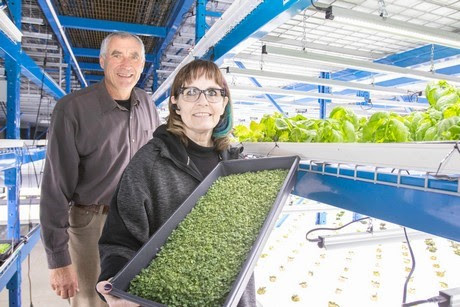
Wolf Wesle and Karen Dow show a tray of microgreens in front of a rack of lettuce, both of which are being grown by Living Leaf Growers located at the Westgate Public Market. (Jodi Brak/Salmon Arm Observer)
Area Residents Invited To Participate In Test Market To Help Develop Signature Salad Mix
December 15, 2018
Salad lovers will be able to access locally grown greens and microgreens, thanks to Living Leaf Growers.
Located at Westgate Public Market, co-owner Karen Dow says the company has been working on developing a commercial hydroponic system for two years under the direction of Wolf Wesle of Green Croft Gardens organic farm in Enderby.
While the produce will not be certified organic, Dow says it is as good as organic.
“It’s all done in water, no chemicals; it’s grown with just nutrients,” she says. “We are testing different types of nutrients as some are better than others.”
The produce will be grown in racks that go 24 feet high, consisting of seven rows, in four different sections. At the moment, Living Leaf is running about 25 per cent of the system but planning to be up to 50 per cent soon.
“We have eight different lettuce types that feed into a salad mix and we want to test different combinations of colours, types, textures and tastes,” she says. “We want to come up with their own best seller and we need help to do that.”
For the next two or three months while production ramps up, Living Leaf will prepare sample mixes of lettuce and invite a test group to buy a bag of salad or microgreens for $1 and provide feedback on how long it lasts in the fridge, texture and taste.
As well as lettuce and microgreens, Living Leaf is planning to grow strawberries and probably cherry tomatoes.
Microgreens are a vegetable green, harvested after sprouting as shoots, that are used as a component or ingredient to enhance the attractiveness and taste of dishes with their delicate textures and distinctive flavours.
“We have the capacity to grow 28,000 heads of lettuce a month and 700 strawberry plants and I don’t know what the numbers are, but we can grow a lot of microgreens year round,” says Dow. “Lettuce, mixed salad lettuce and strawberries will be available all year round, but the strawberries won’t be available until next spring.”
Dow says the first batch of lettuce will be harvested on Dec. 17, with lots more becoming available in January and February.
To join the test market and register for the lettuce and microgreen program, go online to www.westgatepublicmarket.com, click on the Living Leaf Growers page and fill out the registration form.
“When we have lettuce and/or microgreens available, we will notify you by email to come in and pick up your bag,” Dow says, noting people may only buy one bag at a time and will be required to fill out a questionnaire before they can buy more.

Gulf Region, UAE: $1.2bn GCC Vertical Farming Boom Seen By 2021
New research says a growing importance is being given to vertical farming across the Gulf region
The UAE is leading the vertical farming change and has upcoming projects facilitated by the government as well as private players to help increase food security in the region.
A growing importance is being given to vertical farming across the GCC and is generating interest and increased investments from regional and overseas players, according to a new report.
Orbis Research said the region's vertical farming market is expected to reach $1.21 billion by 2021 at a compound average growth rate (CAGR) of 26.4 percent from only $380 million in 2016.
It said the UAE is leading this change and has upcoming projects facilitated by the government as well as private players to help increase food security in the region.
These include the UAE Ministry of Climate Change and Environment allotting space for 12 vertical farms to be built by Shalimar Biotech Industries, and the world’s largest vertical farm for Emirates Airlines by Crop One Holdings Inc.
With around 90 percent of food being imported in the UAE, territorial problems of water scarcity and small percentages of arable land, vertical farming is becoming increasingly vital to ensure food security within the region, the report added.
Mariam Al Mehiri, Minister of Future Food Security, also plans to create a "Food Valley" or a technology hub, dedicated to the development of food and farming automation.
The report comes ahead of AgraME 2019, a platform for the latest technology to be showcased to the regional agribusiness market.
Henry Gordon-Smith, founder and managing director of Agritecture who will be speaking at AgraME 2019, said: “The potential is certainly there to transform what has historically been a relatively small traditional farming industry into perhaps the most technologically advanced agriculture industry in the world.
"This means economic development, increased production of nutritious local produce, and lowered food costs, all with minimal water consumption and increased resilience to climate change and foreign markets.”
Samantha Bleasby, exhibition director of AgraME added that the show, which takes place in Dubai from March 5-7, is attracting key players in the industry such as Certhon, Agrotonomy, Veggitech, Wuxi, iGrowths Technology Co Ltd, Ozorganic Urban Farming and Van der Hoeven.
For all the latest tech news from the UAE and Gulf countries, follow us on Twitter and Linkedin, like us on Facebook and subscribe to our YouTube page, which is updated daily.


Indoor Farming Technology Market To Grow To $ 40.25 Billion
The indoor farming technology market was valued at $ 23.75 Billion in 2016, and is projected to reach $ 40.25 billion by 2022, at a compound annual growth rate (CAGR) of 9.65% during the forecast period, according to a report by MarketsandMarkets.
17 Dec 2018
The indoor farming technology market is projected to reach $ 40.25 billion by 2022.
The indoor farming technology market was valued at $ 23.75 Billion in 2016, and is projected to reach $ 40.25 billion by 2022, at a compound annual growth rate (CAGR) of 9.65% during the forecast period, according to a report by MarketsandMarkets.
One of the main advantages of indoor farming is its higher yield compared to traditional farming, which makes it a viable option. Enclosed facilities used in indoor farming create optimum growing conditions for farmers to grow a crop from the seed to its harvesting stages in lesser time and obtain higher yields in each cycle with limited land area.
The indoor farming technology market was valued at $ 23.75 Billion in 2016, and is projected to reach $ 40.25 billion by 2022, at a compound annual growth rate (CAGR) of 9.65% during the forecast period.
The indoor farming technology market was valued at $ 23.75 Billion in 2016, and is projected to reach $ 40.25 billion by 2022, at a compound annual growth rate (CAGR) of 9.65% during the forecast period.
Indoor farms help increase overall crop yield
According to the USDA data, in 2016, the average yield of tomatoes grown in greenhouse hydroponics was 10.59 pounds per square foot, and that of traditionally grown tomatoes was 1.85 pounds per square foot. “Therefore, indoor farms can help in increasing the overall crop yield per unit area with the usage of stacked layers of potted seeds,” states the report.
Also read: Colruyt Group develops vertical farm
Market for aeroponics to grow at the highest rate
In aeroponics, the plant roots are inserted in containers filled with plant nutrients, instead of soil, which is ideal for oxygenation and moisture and helps the plant absorb nutrients effectively, thereby aiding faster development and cultivation. This system can be controlled externally through computers or timers for the release of moist air at regular intervals and does not require frequent use of pesticides, weeding, and other maintenance processes as compared to conventional farming. “Thus, with a high adoption rate of this technology, the market for aeroponics is projected to grow at the highest rate during the forecast period,” says MarketsandMarkets.
Indoor farming is used for growing crops or plants suitable for both large- and small-scale farming.
Increasing consumer demand for pesticide- and herbicide-free food
Indoor farming is used for growing crops or plants suitable for both large- and small-scale farming. “On a larger scale, indoor farming is followed to bolster local food supplies and provide nutritious, fresh produce to urban and suburban consumers. This method of farming controls the input of plant-fertilizing nutrients, so the food that is grown using this technique is highly nutritious. Indoor vertical farming systems provide organic food that is not contaminated with the use of agrochemicals. Hence, the driving forces for indoor vertical farming are the increasing consumer demand for pesticide- and herbicide-free food and the growing requirements to reduce the carbon footprint of traditional agricultural practice,” the report states.
Key players in the indoor farming technology market
The key players in the indoor farming technology market include Philips Lighting (Netherlands), Argus Controls Systems (Canada), Netafim (Israel), LumiGrow (US), Illumitex (US), and EVERLIGHT Electronics (Taiwan).
These companies are developing new processes or products to help improve productivity and achieve overall market growth. For instance, Philips Lighting (Netherlands), which provides lighting solutions for indoor farming, has been undertaking R&D operations for providing energy-efficient lighting systems. In January 2018, Philips Lighting introduced GreenPower LED top lighting at IPM Essen, Germany. This new version offers higher light efficacy, longer lifetime of 35,000 burning hours, and high energy efficiency compared to the former top lighting module.
Furthermore, companies are focusing on investments, partnerships, and agreements. For instance, in July 2017, Softbank (Japan) invested USD 200 million in Plenty (US), a Silicon Valley start-up for vertical farm technology. In August 2014, FarmedHere LLC (US) partnered with Illumitex, Inc. (US), a leading lighting solution provider, to cultivate crops using less energy and lighting systems provided by Illumitex, Inc.
Future opportunities for indoor farming technology
According to MarketsandMarkets, the cultivation of crops such as tobacco and cannabis for large-scale production of biopharmaceutical proteins is a recent development in indoor vertical farming. Biopharmaceuticals are proteins or compounds produced by a living organism, used for diagnostic and therapeutic purposes in human or animal health. Conventional methods of manufacturing biopharmaceuticals involve the usage of organisms that are highly expensive.
"The driving forces for indoor vertical farming are the increasing consumer demand for pesticide- and herbicide-free food and the growing requirements to reduce the carbon footprint of traditional agricultural practice,” states the MarketsandMarkets report.
Indoor vertical farms as pharmaceutical facilities
“However, using existing agricultural technologies such as indoor vertical farming to produce biopharmaceuticals in plants is cost-effective, requires less time and efforts, is pollution-free, and easy to produce. Indoor vertical farms are being used not only for food production, but also for aiding in applications that can support human health. For instance, Caliber Biotherapeutics, LLC (US), the world’s largest plant-made pharmaceutical facility that has an 18-story, 150,000-square foot warehouse facility, which contains a 2.2 million tobacco-like plants, stacked 50-feet high. These plants are grown for making new drugs and vaccines. These indoor vertical farms are carefully monitored and controlled by technicians, thus eliminating the chances of possible diseases and external contamination.”
Below you can watch a report by CBS on vertical farming

One of The Largest Living Things Even Bigger Than Previously Thought
This makes the enormous honey mushroom, which mostly consists of an underground network of tendrils wrapped around tree roots, heavier than three blue whales.
US Biologists Re-Examine Giant Honey Mushroom
A giant honey mushroom, since some decades considered a contender for the largest organism on the planet, is both much larger and much older than previously thought. Scientists first studied the enormous fungus, which lives deep underground in a Michigan forest, in 1992.
Then they estimated it was 1,500 years old, and the extensive mass of underground fibres and mushrooms that formed it weighed 100,000 kg and stretched 15 hectares. Returning to the site, the same team used more rigorous testing to estimate the fungus was in fact closer to 2,500 years old.
They also discovered that it weighed closer to 400,000 kg and stretched over 70 hectares.
This makes the enormous honey mushroom, which mostly consists of an underground network of tendrils wrapped around tree roots, heavier than three blue whales.
“I view these estimates as the lower bound… The fungus could actually be much older,” said Professor James Anderson, a biologist at the University of Toronto who undertook both studies. The findings were published in the journal Proceedings of the Royal Society B.
While the Michigan fungus is large, it is outclassed by another honey mushroom from Oregon that is even larger. Uk.news.yahoo.com also tells of the Pando aspen in Utah, a forest originating from a single underground parent clone that is thought to weigh up to 6 million kg.

Beyond Garnish: How Science Helps An Indoor Farm Amp Up Flower Flavor
December 26, 2018
WHITNEY PIPKIN
At the restaurant Siren by Robert Wiedmaier, pastry chef Maddy Morrissey uses marigold as the base for a Japanese dessert served with nasturtium leaves, flower petals and pineapple sage shortbread. | Brian McBride/RWRestaurant Group
From inside the overly-lit interior of a 1960s strip mall, software programs and science are helping an urban farm fire up the flavor of fennel fronds and control the size of nasturtium leaves. By carefully monitoring each variable and its impact on the way a plant tastes, looks and grows, Fresh Impact Farms is inching closer to its goal: delivering edible flowers and herbs catered to the taste preferences of top-tier chefs.
To that end, nutrient mix, water temperature, light spectrum and countless other variables are regularly tweaked to produce more of the thumb-sized, lily-pad-shaped leaves chefs prize from nasturtium, each packed with a peppery punch. Lights at the "far red" end of the spectrum shine down on the same plant to coax its orange and vermilion blooms to appear earlier and more often. Every change is an experiment, and every aspect of the plant a potential moneymaker.
But, even though everything grown at the 1,000-square-foot farm in Arlington, Va., will likely be the last element placed onto the plate and the first pop of color a restaurant diner sees, "this isn't a [typical] garnish farm," says owner Ryan Pierce.
Fresh Impact Farm owner Ryan Pierce (left), and operations chief Matt McKinstry (right), stand in the 1,000-square-foot space in a suburban strip mall where they grow up to 60 varieties of edible flowers, herbs and greens at a time for restaurants.
Whitney Pipkin for NPR
"We didn't set out to just grow things that are pretty," adds Pierce, who, at 32, looks like an off-duty surgeon in blue scrubs, disposable gloves and a hat worn for food safety. "We set out to grow things that become an element of the flavor of the dish. We want to give chefs a palette to elevate their food."
Pierce comes to the field of hydroponic growing from a career in cloud computing, where he learned to make sense of a dizzying number of data points. He saw in indoor farming an opportunity to apply that background while producing edibles in a way that uses less water and land, reducing pollution and waste in the process.
Those same factors have fueled the hydroponic industry's meteoric growth in recent years. For urban farmers looking to make the most out of limited spaces, microgreens are often the crop of choice. But shoots and sprouts comprise only a small fraction of Pierce's business.
A purple ice plant flourishes under a spectrum of light designed to help it flower and thrive in an indoor environment at Fresh Impact Farms in Arlington, Va. / Whitney Pipkin for NPR
Instead, he has found a way to infuse surprising flavor into the plate-topping flowers, herbs and greens restaurants are already accustomed to buying.
Take one of the many varieties of hyssop that Fresh Impact grows, says D.C. Chef Robert Wiedmaier, whose high-end D.C. flagship Marcel's was the farm's first customer. "You close your eyes, taste that and it's like, 'Wow. What is that? Boom.' "
The hyssop, which smacks of mint and licorice-y anise, tops pan-seared scallops at Wiedmaier's Michelin-starred restaurant, Siren, and makes cameos in cocktails. Wiedmaier is such a booster of Pierce's business that he hosted a five-course dinner featuring the farm at Siren this fall. There, candy apple sorrel-flavored meringue topped a black sea bass dish and bright orange marigolds starred in a Japanese dessert with pineapple sage shortbread.
But Wiedmaier says: "You can't throw flowers on just anything." These garnishes must be used with care or they could overpower a dish. The musty marigold can be a challenge to deploy correctly, even if it's pretty.
Some of Fresh Impact's products pack such a flavor punch, they should come with a warning label. But chefs can't seem to get enough of the hard-to-grow and equally potent wasabi arugula. And, at the Japanese tasting room Nasime in Alexandria, Va., chef-owner Yuh Shimomura isn't timid about plating tiny yellow flowers from the toothache plant, so named because of their intense saliva-increasing, tongue-numbing effect.
Since launching in 2016, the farm has experimented with 250 plant varieties and currently grows between 50 and 60 at a time. Many of the successful varieties were originally suggested by chefs — some of them new to the concept that a farm could tweak the flavor of an herb or flower they thought they knew so well.
Ryan Pierce holds one of the nasturtium blooms prized by his chef-customers for decorating and flavoring dishes at high-end restaurants. / Whitney Pipkin for NPR
When Johnny Spero, executive chef and owner of Reverie in Washington, D.C., first requested that Pierce grow huacatay, a feathery plant used in Peruvian stews and sauces, he expected it to taste as pungent as varieties he'd tried elsewhere.
But Pierce's was milder, and Spero initially asked if he could make it more intense.
Adding "intensity" entails stressing the plant, something that is hard to do in a controlled environment where the plants are protected from the elements. Pierce can mimic that stress with an imbalance of nutrients, by applying different spectrums of light or by harvesting leaves from older plants—but every crop is different.
"Our goal is, as we collect data, to understand how small shifts change the overall flavor and success of the crop," he says. "Ultimately, we want to get to a point where we can tweak those crops on demand to produce specific flavor outcomes."
The farm's latest experiment? The succulent iceplant. Its leaves look like water droplets have frozen, still dewy, on the surface, and biting into one of them delivers a blast of hydration. One of Siren's chefs has said he wants the largest leaves possible for a dish he's dreaming up. Meanwhile, chefs at D.C.'s two-Michelin-starred minibar by José Andrés say they want the tiny clusters of leaves the plant produces before it blooms.
"If we can get it to production, we already know we have two customers interested in different parts of the plant," says Pierce.
The farm worked with a company to develop its own software that tracks the feedback received from chefs for each crop. If a chef thought a batch of bronze fennel was too bitter or too sweet, that information is stored and considered for the next crop.
Eventually, Pierce wants to bring all of that data into real-time — with chefs providing feedback through an app. Already, monitors on each of the water basins report data on its Ph, temperature and overall nutrient level to a computer every four seconds. The goal is to eventually measure each of the 17 nutrients essential for plant growth — all the time.
"The challenge is for us to drill down to that level," says Pierce, who'd like to get the flavor-changing equation down to a science. It's not going to be easy, he admits. "If you feel like you have this down already, then you're not doing something right."
garnish strip mall Farm fine dining microgreens flavor chefs

Introducing Living Food Company: The Future of Food
India’s Food Supply Chain is Not Working
Why is India, one of the fastest growing economies, undergoing a nutrition and health crisis? India has the largest micronutrient deficiency among all countries and among the highest disability-adjusted lost years of life from micronutrient deficiencies. Diets low in nutrition are the leading cause of this current health and nutrition crisis. Fresh food that is nutrient-dense is surprisingly difficult to find in India, particularly for the urban consumer.
We don’t know where our food comes from, what it contains and how long it takes to reach us.
The food we consume has been designed to be stored and shipped in containers over long distances. The industrial food supply chain is extremely complex and is plagued by inefficient supply management and wastage at the distribution stage. The agriculture system is failing us by producing food that contains harmful chemicals in the form of pesticides and fertilizers.
On an average, Indians consume close to 42000 metric tonnes of pesticides in a year, including those that are banned in other countries for their carcinogenic effects.
In June 2017, more than 40 cotton farmers died after inhaling chemicals while spraying pesticides in Maharashtra in one agricultural season.
Micronutrient deficiency in India. Source: http://unicef.in/Whatwedo/8/Micronutrient-Nutrition
We now depend upon cheap, low-nutrient food that sacrifices quality for quantity at the cost of our health and the environment. Global crop production has more than tripled since the 1960s. This has led to the depletion of water resources for irrigation, soil pollution from overwhelming fertilizer application and rising greenhouse gas emissions.
The average concentration of pollutants in the Indian soil is almost twice the amount found globally.
Such high levels lead to long-term damage in the central nervous system, immune and reproductive systems, while also being one of the leading causes of cancer.
The organic food movement, tries to address some of the health risks by eliminating the use of fertilizers. Yet, organic produce that is grown in soil can’t prevent harmful chemicals from entering our bodies. Contaminated groundwater containing dangerous proportions of heavy metals such as Arsenic is still used in organic farming and can cause long-term damage to our cells and immune systems. Simply put, organic food doesn’t solve the problem.
We are what we eat
In June 2017, my life took a drastic turn. My mother was diagnosed with Thyroid cancer and had to undergo a painful surgery. Less than a year later, on 20th March, my father was diagnosed with Stage 4 Peritoneal cancer.
This personal tragedy shook me to the core and I started investigating into this deadly disease. The more I read, I found out — how less I knew. I had never imagined that the everyday food that we eat can either strengthen our immune system or completely break it down making us susceptible to life threatening diseases, such as cancer. Everything I read brought me to the same point — we are what we eat.
Real food is about trust and transparency. It is also about ensuring quality and traceability at every step. Living food Company was born to provide food that we can trust. Our produce is grown with passion, care and precision and by controlling the entire process we guarantee high quality produce that can be traced at every step.
Living Food Company: The Future of Food
Living Food Company was born from the need to take control of our food production systems. We decided to grow microgreens, 10–12 day old baby plants that are extremely rich in nutrients, anti-oxidants and essential vitamins and minerals. They contain upto 40 x the nutrition found in their mature counterparts.
We focus on growing extraordinarily highly nutritious microgreens such as Kale, Broccoli, Mizuna (Japanese mustard), Pink Radish, Red Chard and 15 other powerful varieties. We make these nutrient rich foods affordable and accessible for the average urban Indian consumer and democratize access to superfoods.
Akash K. Sajith
CEO & Founder at @LivingFood, building the future of food.

US: Ohio, ME Students Share Tower Garden Project
DECEMBER 21, 2018 BY PIQUA DAILY CALL
US, Ohio, ME Students Share Tower Garden Project
Hydroponic garden bought with MEEF grant
For Miami Valley Today
Students gather around the Tower Garden in Kathy Irick’s fourth grade classroom at Miami East Elementary. Students shared their favorite learning experiences with the Tower Garden by writing a story about it. The authors, pictured here, were Joselyn Rowe, Alyssa Siefring, Alivia Palivec, Lincoln Littlejohn and Charley Hatcher.
CASSTOWN —Miami East Elementary Schools fourth graders are taking gardening to new heights.
Kathy Irick’s fourth grade classroom added a hydroponic Tower Garden purchased with a Miami East Education Foundation grant.
Recently, four students, Charley Hatcher, Lincoln Littlejohn, Alivia Palivec, Joselyn Rowe and Alyssa Siefring, wrote a story about their Tower Garden to share how it works.
Fourth grade student Carson Smith said, “The Tower Garden grows quicker than a normal garden. Like when I’m at my house, my garden didn’t grow until the end of summer.”
It produces enough greens to feed 80 kids at a time. Students shared how the Tower Garden is a team effort with students testing water levels and the pH balance.
The students shared how the Tower Garden works using gallons of water to grow the plants. Students add nutrient solutions to the water and test the pH balance levels.
“I like that every week a team of two students gets to take care of the Tower Garden. They test the pH and measure how high the water level is and add gallons if needed,” said fourth grader Haley Lang.
The students’ story can be found online at www.miamieast.k12.oh.us.
Trouble In The High-Rise Hothouse
Big indoor farms are attracting big investments. But transforming agriculture might depend on putting nanofarms everywhere — maybe even in your home.
Editor-in-chief, Ideas: The Magazine of the Aspen Institute, senior editor, The Atlantic, five-time James Beard Journalism Award winner, restaurant critic
December 6, 2018
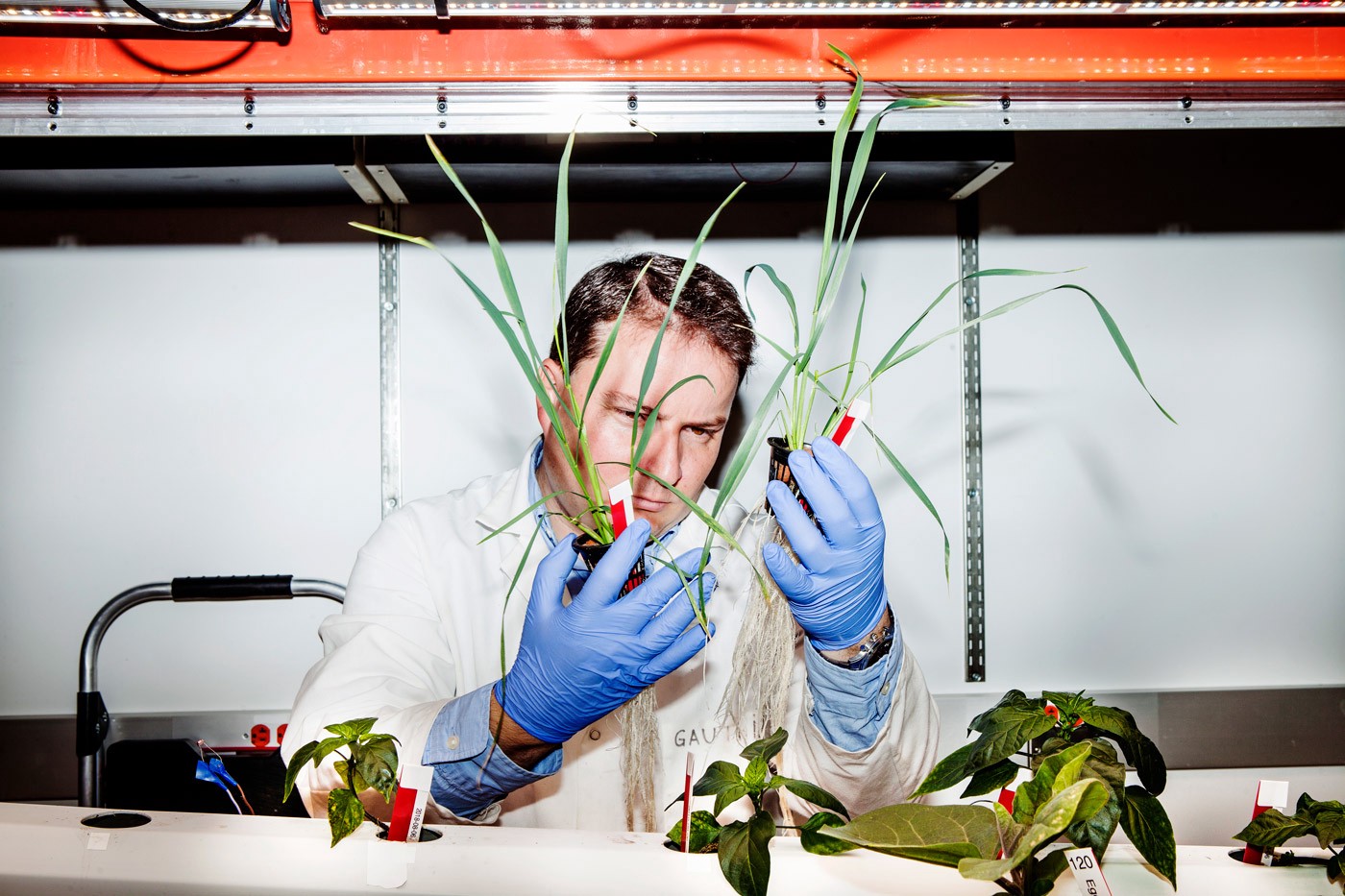
Paul Gauthier launched Princeton’s Vertical Farming Project to explore the economics of indoor agriculture. Photo by Lauren Lancaster
Big indoor farms are attracting big investments. But transforming agriculture might depend on putting nanofarms everywhere — maybe even in your home.
This was written for NEO.LIFE in association with NOVA Next/WGBH Boston.
Paul Gauthier, a plant physiologist at Princeton University, took a short drive up the New Jersey Turnpike to try to figure out whether the biggest vertical farm on the East Coast is succeeding. The answer isn’t as clear as you might think.
AeroFarms, which runs a 70,000 square-foot operation in Newark, is one of the highest-profile companies founded on the premise that growing crops indoors will transform agriculture. These aeroponic indoor farms stack leafy greens and herbs on racks that nurture the produce with sprays of mist and light from LEDs or high-pressure sodium lamps. They use no soil or pesticides, and can operate year-round. For further efficiency, AeroFarms mechanizes the seeding, harvesting, packaging, and cleaning of its produce.
It requires a great deal of electricity to give plants the light and heat they could get for free outdoors. But the idea is that vertical farms in big urban centers will be less costly—both economically and for the environment—because of the inputs they avoid, like toxic chemicals and long-distance transportation to consumers.
So do they actually come out ahead? Gauthier studies the science and the economics of growing food indoors, and he wants it to work. But the indoor farms getting glamour-puss investments refuse to release their numbers. And after touring several of them, digging into their methods to weigh the costs and the benefits, he’s suspicious about whether the numbers add up.
If you ask him whether the farms are making money or on track for any real financial viability, Gauthier, raised in Nantes and trained there and in Paris, where he earned his Ph.D, does a French thing with his mouth that translates to an existential shrug. “Who knows? So they say.” But he’s pretty sure that economics is a “major part of what’s stopping vertical farms from growing.”
Feeding 10 billion people in a world stressed by the rapidly changing climate is going to require constant innovations in how food is produced—a new green revolution, just this time not involving methods that wreck soil and water. But while vertical farms might work as a technical concept, thriving as businesses is another matter.
The problem, Gauthier suspects, is that the future of indoor agriculture might not look like a venture capitalist’s dream, with microgreens and other fancy kinds of lettuce sold at macro markups. To have a truly global impact, the startups ideally would also be researching how to grow staple crops threatened by climate change and trying to maximize their nutritional value. And, Gauthier and others argue, these agricultural startups should be thinking small at the same time—encouraging cottage and studio-apartment farmers to raise indoor tomatoes and strawberries themselves and join what could become an information-sharing revolution.
“Stupid designs”
Gauthier, who has been at Princeton’s geosciences department for six years, has a typical academic’s curiosity but also a French touch of mischief. He considered medical school, he says, but “then someone told me that even if we cure all the diseases on earth, people will still have to eat. Plus plants are cool.”
A set of test shelves in Gauthier’s lab. Photo by Lauren Lancaster
And nothing sounded cooler than saving the world by growing its food indoors, right where rapidly expanding urban populations need it. But he was baffled by the wildly optimistic predictions he read and heard for vertical farming. A widely cited 2013 study by German economists at the Macrothink Institute made the case that vertical farms in high-density urban areas, particularly in India and China, could be cost-effective because of the transport costs they would save. And they could increase access to food and reduce hunger in the bargain.
But the claims being made for the majority of vertical farms were, Gauthier says, unbacked by current, deep, and comparative data. “As a scientist, this wasn’t acceptable,” he says. “A lot of what they said was just marketing.” So two years ago he launched Princeton’s Vertical Farming Project to understand what can and can’t work economically.
He regarded with a beady eye the Ivy League grads applying for investment and Silicon Valley venture capitalists funding indoor vertical farms. Where they see a future full of urban warehouses and exurban hangars repurposed to grow food, he sees a bubble likely to burst too soon, with all those massive buildings more likely to be eventually repurposed for marijuana — the one indoor crop guaranteed to turn a profit.
Lettuce, microgreens, and herbs—the primary crops of vertical farms—have a high markup relative to, say, brussels sprouts, and being highly perishable suits them to very short transport time from indoor farm to store. But not many other commercial crops check those same boxes. Some vertical farms market kale, which is an odd choice, because it’s dirt cheap. Why bother? Gauthier leans over as if imparting a big secret: “Because anyone can grow kale, and it grows everywhere.”
Vertical farms might work as a technical concept. Thriving as businesses that transform agriculture is another matter.
Anything grown in a vertical farm might sell in China, where contaminated-food scandals mean consumers will pay a premium for food they consider to be safe, like that of fast-food chains. Vertical farms use little water and don’t need pesticides or fertilizers, all of which can be sources of contamination. So it could be smart that the most highly capitalized vertical farm company — Plenty, based in San Francisco, which has raised more than $200 million — plans to build 300 vertical farms in China.
It also would be wise to diversify the number and kind of crops in vertical farms. That optimistic German study from 2013 was based on a simulation of a farm that would grow not just vegetables but also tilapia, in tanks. Variety of output protects any business against the collapse of any one product — but that isn’t the current practice in vertical farms. Why? Perhaps because new startups follow the examples of others that seem to be successful. Perhaps because research on protein-rich products like chickpeas or fish is less evolved than it is for easy-to-grow, easy-to-sell bagged lettuce. Perhaps because different crops require different amounts of light, humidity, and nutrients and thus make for less-efficient production in a single space. David Rosenberg, cofounder and CEO of AeroFarms, says his company has experimented with growing 700 different plants, but his production is still heavily concentrated on microgreens that can fetch $40 a pound. He also sells baby greens, which he’s proud to have turned profitable, as they usually go for a much lower price to stay competitive—just $6 a pound.
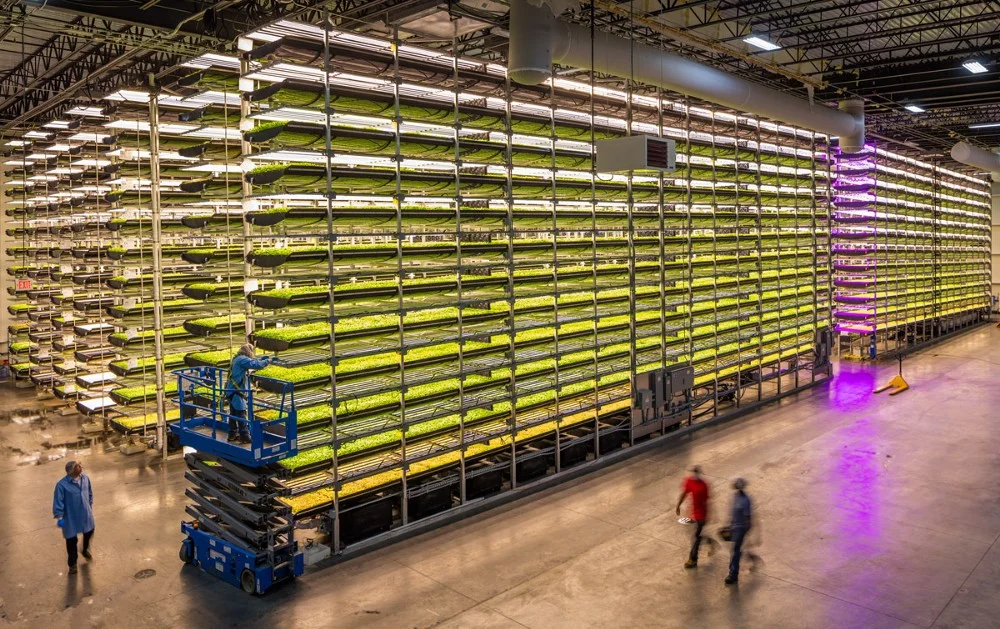
Inside AeroFarms’ facility in Newark. The company’s CEO has said most startups in the industry won’t survive three years. Photo courtesy of AeroFarms
More diversified crops are possible to grow together in vertical farms — and economically safer in the long run, Gauthier thinks. But the business models might be trickier to construct for startups looking for funding. He has two indoor test gardens, one on wire shelves in a side room off his lab in the atmospherically collegiate Princeton geosciences building, and one a bit outside of the tony, horsey town of Princeton. In these little indoor gardens he grows particularly sweet strawberries he’s proud of. They don’t grow efficiently enough, though, to appeal to today’s commercial vertical farms.
Though Rosenberg won’t disclose whether AeroFarms is profitable, he shares much of Gauthier’s general skepticism about many of his competitors in vertical farming. In a keynote address to an indoor-farming conference last year, he predicted that 60 to 90 percent of indoor farms would fold within three years of starting. Some already have gone bankrupt.
Rosenberg says not enough of them truly understand how costly their build-outs and operations will be before their first robot plants a seed in ecologically ultra-responsible growth medium. He says he and his team of 120 workers, most of them engineers, have learned this from several years of expanding into four buildings in downtown Newark. “Biological systems scale in non-obvious ways,” he says.
In the last year alone, he says, four companies that were going out of business approached him to buy their assets. Those companies had “stupid designs,” he says. “They lost before they got going.”
Lettuce, microgreens, and herbs have a high markup, and being highly perishable suits them to very short transport time from indoor farm to store. But not many other commercial crops check those same boxes.
In general, Gauthier says, energy for lighting and climate control accounts for as much as 60 to 70 percent of operational overhead in a vertical farm. Add in labor costs, which are higher in the urban areas where vertical farms are located, and the farm is likely to have, at best, a profit margin of 4 to 5 percent. That’s more than what’s reaped by most U.S. farms, which are strapped by international competition and the current trade war. Even 4 to 5 percent, though, is nothing to venture funders, who look for profitability of 10, 15, 20 percent and beyond. (Rosenberg, without disclosing specifics of AeroFarms’ business, says those fatter profit margins are indeed possible—but only if debt-service and real-estate costs are low, and if many processes are mechanized.)
Peppers harvested from Gauthier’s lab. He tinkers with the pH of the growth medium to manipulate the peppers’ spiciness. Photo by Lauren Lancaster
The danger, Gauthier thinks, is not that a few well-funded farms will turn only a modest profit growing niche crops to be sold by boutiques whose customers can afford high markups. It’s that many indoor farms will fail, because anyone who tries the things he thinks would best serve the industry — crop diversity within the same indoor space, research into lower-margin staples like wheat that are threatened by climate change, efficient techniques for growing high-protein crops — won’t appeal to funders who expect too much too soon.
Micro-farm in the rec room
Vertical farmers might have a better chance of nailing the math if they had real-world data about what works. And that’s hard to come by. Those well-funded indoor farms keep their data secret: the costs of buildout and climate control and labor; how plant growth varies with the nutrients they feed plants; the amount and color of the light and heat and humidity and growing time for each one, the prices the harvests fetch.
What if a lot more of that data were widely available to anyone who wanted to transform agriculture by bringing it indoors, anywhere in the world? How expensive are the lights, shelves, aeration, and hydration and climate-control systems? How long do they take to amortize? How do different plants grow indoors in different places and conditions — not just the sterile, ultra-controlled-atmosphere buildings stacked 37 stories high, the utopia conjured in endless vertical farm stories?
Gauthier checks the roots on two new plants. Photo by Lauren Lancaster
Gauthier envisions a much broader ecosystem: a future of thousands upon thousands of farms, in basements and bedroom corners, growing strawberries and basil and lettuce and tomatoes, uploading data to central servers that help cottage growers all over the world as well as larger-scale indoor farmers. “Everybody has a basement or a corner,” Gauthier says. Only 15 minutes of tending a day max, he promises. And if the climate isn’t perfect and the lighting is not custom-tailored for one plant, well, people’s gardens in real life aren’t so tailored either.
These micro-farms in every rec room, study nook, and garage would be simple — no need for the colored lights that large-scale vertical farms use. Just full-spectrum LEDs of the kind Gauthier has in his pocket-sized lab farm. The vivid light in the space makes it warm and inviting, unlike the compact fluorescent light over his research assistants in the next room. “People come here and say, ‘I could put my desk here,’” he says. Just being here and fussing with his leggy strawberry and basil plants visibly brightens Gauthier’s mood.
Why would you follow his suggestion and buy the makings for your own basement or closet? The same reason that inspires window-box and patio gardeners everywhere: to have fresh food you’ve grown yourself, for pennies on the dollar and the kind of brightness of flavor those bright lights suggest. And unlike with window boxes and mini-terraces, indoor gardens would flourish independent of weather.
Turning basil into data
Caleb Harper, of MIT’s Media Lab, also has very large ambitions for very little indoor farms all over the world. He founded the Open Agriculture Initiative, or OpenAg, with open-source data, hardware, and software as founding principles. He wants to create more “digital farmers” around the world by making how-to information and tools easily available to them, and he hopes to connect them so they do the neighborly tip-sharing that used to take place at the feed and seed store.
One of Harper’s first moves, in 2015, was to release designs for a prototype “food computer,” a kit that creates a milk-carton-sized, digitally controlled hydroponic growing environment for even, say, one stalk of basil. That was version one, and the costs for materials ran from $2,500 to $4,000 for a souped-up model. The most recent version, V3, costs about $500. Its starter equipment includes a “central nervous system” that incorporates a printed circuit board, USB camera, LED lights, fans, and sensors to measure temperature, humidity, and carbon dioxide. Wi-Fi-connected processors in the box upload millions of pieces of data about the plant’s progress to cloud servers that help others replicate and share their results.
One of Caleb Harper’s “food computers” that captures data about growing conditions. Photo by MIT Open Agriculture Initiative (CC-BY-NC-SA 4.0)
Harper’s idea, like Gauthier’s, is that the more information that indoor farmers around the world share — the levels of irrigation, minerals, nutrients, light, and temperature that together he calls the “climate recipe” — the faster the field can keep up with what Harper calls mounting climate and ecological pressures.
The VC firms funding vertical farms, Harper says, seem to believe that they need to hoard the best and most efficient technology and formulas to farm indoors. But little to none of the materials that go into vertical farms are much farther evolved than the off-the-shelf equipment used in greenhouses and what his food computers require. Few if any processes are likely to be so different from what anyone else is using as to create windfalls, he thinks.
Even so, companies won’t disclose data about indoor farming. They’re saying to Harper, “Why are you telling the Muggles our secrets?” His operative answer: “I want to make vertical farming work. And I see how often claims are completely baseless — and the number of bankruptcies over the past 10 years.”
OpenAg operates two sets of food computers at MIT, one in miniature in the glossy, glassy Media Lab building and another in three repurposed shipping containers in a former storage warehouse for a disused linear accelerator. Harper himself is all over the world all through the year, raising awareness and raising money. He researches what his funders want. So one of the shipping containers at MIT has an extra-tall growing chamber to fit hazelnut trees for Ferrero, the hugely profitable, family-owned maker of Nutella. Harper recently dispatched half his team to India to rig out a shipping container to grow cotton for Welspun, a sheets and towels manufacturer that hopes to enlarge the limited supply of sustainably grown cotton. But even though his high-profile clients are usually secretive, all the research the MIT team conducts is, by the Open Agriculture Initiative’s contract, open-source.
“Why are you telling the Muggles our secrets?”
Hildreth England, OpenAg’s assistant director, has a diplomacy major’s fluency of expression and comes from a multi-generational engineering family. As she explains the uses of the 3.5 million data points she says the food computers produce per plant every growing cycle, her head is illuminated by a mesmerizing light show emanating from the box behind her. The food computer can be programmed to cycle through green, red, yellow, blue, and white lights shining on a basil plant viewable from a little window inside the black honeycomb cube, like something in Hamburg’s Reeperbahn. Various colors of light can make the plant express more of the volatile essential oils and fragrances it produces in reaction to the stress that microbes in dirt, wind, and drought inevitably impose — “in a sad, sad way we’re stressing the plants out,” she says — and these compounds can be valuable in dietary supplements and medicines. She and Harper expect indoor farms to someday grow high-profit plant-based derivatives for the pharmaceutical industry, alongside tomatoes bred to express more cancer-resisting lycopene thanks to data uploaded by thousands of growers.
In a collaboration with the United Nations World Food Programme, the Initiative put food computers in Syrian refugee camps in Amman, Jordan, to provide fresh food where people aren’t allowed to make changes to the land. A professor who was a refugee had the idea of experimenting with how to create a climate recipe that would increase the active ingredients in St. John’s wort to treat depression and anxiety: for many people, drinking herbal tea is more culturally acceptable than taking Prozac.
The uses of indoor farming, then, can be as unexpected and ingenious as the places it appears and the people who tend the plants. The underlying technology might be similar the world over, Gauthier says. But think of the iPhone: Everyone uses it a little differently, and Apple collects that data so it can make the next generation easier to use. Large leaps and small serendipities might well come from the tiny plots both he and Harper envisage — the ones that can turn the latest sexy innovation into tomorrow’s world-changing revolution.

Medi Kingdom - Africa’s 1st Medical Cannabis Cultivator




In late 2014, our UK founders together with two South African horticultural specialists first decided to develop the idea of pioneering a legal medical cannabis cultivation operation in Lesotho to supply the world’s burgeoning legal markets needing medical grade cannabis.
We knew Lesotho was already historically known for growing cannabis easily, mainly due to its unique topography with mineral rich soils, natural spring waters & high altitudes.
Although at the time it was illegal to cultivate cannabis or “Dagga’ as known locally, its primary purpose was as a subsistence crop that provided food and education resources for the poor villages & farmers.
This was most definitely, an untapped opportunity to develop the first legalised cannabis cultivation for medical purposes on the Roof of Africa, in this Sovereign country called The Kingdom of Lesotho.
We knew if this staggeringly beautiful country legalised this opportunity through its government given the right education and knowledge of this already globally legalised phenomenon, would without question bring huge economic and social development to the benefit of its country and Basotho people.
Once we had gained a clear line of sight to further develop we duly acted as unofficial ambassadors for Lesotho helping to gain further international exposure. We in turn attracted huge appetite for foreign investment that would then help provide all the requisite expertise, specialised knowledge and technology to cultivate world class quality cannabis ethically, and become the 1st African country to cultivate in the Southern Hemisphere.
Our firm intention we believe still to this day is that Lesotho becomes recognised internationally as a world class cultivator of cGMP compliant medical grade cannabis product in various forms exporting to international sophisticated markets globally.
Our journey to legalisation
Lesotho early 2015 gave start to the first 24 months developing the licence in Lesotho. Our activities involved engaging international consultants, licensed growers & specialist scientists to assist us with our journey.
Over that period we very much adopted a hearts & minds approach with the local Basotho people to understand more about how farmers had cultivated ‘Dagga’ for 1000’s of years primarily seeing its purpose as a sustenance crop.
We helped to explain how the worlds perception was rapidly changing eradicating prohibition to allow legalised cultivation given the huge advances in cannabis medicines since its 1st recorded use over 6,000 years ago. These advances gained through more advanced understanding of the plants 143 known different cannaboids and its harmonious connection with the human endocannaboidal system.
Throughout the early days we extensively connected with local councils leaders, constituency chiefs, advocates, commissioner of police, government ministers and their civil servant principal secretaries eventually through to several private audiences with the Lesotho Prime Minister.
We explained how legalisation would further ensure direct foreign investment, local job creation, international skills transfer, utilisation of the higher educated skills workforce in agricultural, scientific, technology & renewable energy sectors not to mention providing the country with new tax revenue streams, that many western countries were already hugely benefiting from having already legalised its use.
In 2019 we will commence global exports of medical grade cannabis flower cultivated from the latest state of the art cGMP greenhouse facilities.
Medi Kingdom Lesotho Licence No : 18/08/01/2017
The ‘01’ in our licence no. 18/08/01/2017 denotes Medi Kingdom as the 1st License presented by the Lesotho Ministry of Health given to cultivate, manufacture, supply, hold, import, export and transit a prohibited drug namely Cannabis.
Lesotho Cannabis Regulations
Medi Kingdom complies to the following:-
Drugs of Abuse Act (No.5), 2008

Ikea Sweden To Start Growing Lettuce
Ikea Sweden will grow its own lettuce next year at two of its locations. In cooperation with waste processing company Bonbio, Ikea will begin cultivating in containers in Malmö and Helsingborg in the course of 2019. Part of the plant food will come from organic waste. The goal is for the lettuce to be served in Ikea restaurants.
"More than 25 percent of carbon dioxide emissions come from food. This project is in line with Ikea's ambition to find innovative and sustainable solutions to environmental problems," says Jonas Carlehed, Sustainability Manager at Ikea. Ikea Sweden already supplies organic waste to various recycling companies, including a biogas plant in Helsingborg from OX2 Bio, a sister company of Bonbios.
"Because we can regulate light, temperature, supply of water and food, we are unaffected by weather influences and we can guarantee a large quantity of fresh locally grown vegetables all year round," says Fredrik Olrog, director of Bonbio. Ultimately, the Ingka group, the largest franchisee of the Ikea brand, hopes to become self-sufficient in terms of lettuce and other leafy vegetables. "This way we avoid transport costs and we don't need soil or crop protection. The required electricity comes from our own wind power plants," says Catarina Englund, innovation manager at the Ingka group.
Bonbio will use a cultivation container of 30 m2 for this project, but will create a total cultivation area of 80 m2. They achieve this by growing vertically on four floors. Each floor has 45 gutters and there is room for 20 cultivation bins in each gutter. It's grown hydroponically, using only 10 percent of the amount of water needed for traditional cultivation. The climate parameters, such as light and carbon dioxide, are controlled by sensors. After five to six weeks, they expect about 18 kg of lettuce to be harvested per container.
Source: www.mynewsdesk.com
Publication date : 12/19/2018
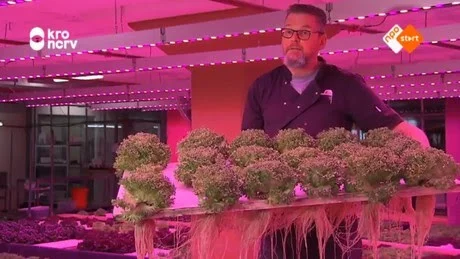
"What We Are Doing Here Is A Big Compromise"
Jos Hakkenes, Duurzame Kost City Farm:
On the fifth floor of Strijp-S in Eindhoven in the Netherlands, lettuce is growing. Under LED lighting, and completely circular. The fertilizer for the lettuce comes from fish, the roots of the lettuce are used to feed insects, and these insects feed the fish. The plants, meanwhile, have to do nothing else but hang in the water, according to Jos Hakkenes in a segment in Dutch TV show Binnenstebuiten about the 'vegetable garden', where people work who experience difficulty on the labor market.
The different lettuce varieties are being mostly supplied as mixed lettuce to restaurants. Not everything is a success, as the basil failed for example. The cultivation climate is still a compromise. Something to work on in the coming years. Jos in the broadcast: "It is not much yet, but sales are growing. I expect to place this kind of cultivation location at multiple locations in The Netherlands".
Watch the segment here (in Dutch).
Publication date : 12/24/2018

What's Wrong With Today's Food Supply Chain And How Do We Fix It?
The new year is just around the corner and we continue to radically rethink today's agricultural landscape - in Germany and abroad
Worldwide it is estimated that approximately 1.8 billion people engage in agriculture and most use pesticides to protect the food and commercial products that they produce. Every year over 5.6 billion pounds of pesticides are used worldwide. Among them are highly toxic substances, harming not only nature but the farmers and humans who get in touch with these substances. It has been estimated that as many as 25 million agricultural workers worldwide experience unintentional pesticide poisonings each year.
Why all the stats? The heavy use of pesticides is one reason, why we have the conviction to revolutionize the urban food supply through our indoor cultivation. With Dryponics we protect our environment, using zero pesticides and only a fraction of the water and fertiliser that other cultivation methods require.


Producing hyper locally allows us to deliver freshness and nutrients, instead of low quality produce that travels thousands of miles. In short: we combine the benefits of the best local farms with advances made possible by technology to grow produce you can feel good about eating.
We still have a long way to go but with our ambitious vision, our diverse team and strong partners we get closer to achieving our goals day by day. We want to thank everyone who has believed in us and supported us so far. We are looking forward to an eventful new year and are excited to announce that we are expanding to the Middle East in 2019.
While our Dryponics farm in Hamburg is up and running since 1.5 years, we are ambitious to increase our impact by producing greens in dry regions where food imports are an even bigger challenge. Stay tuned for more details coming up soon!
Producing hyper locally allows us to deliver freshness and nutrients, instead of low quality produce that travels thousands of miles. In short: we combine the benefits of the best local farms with advances made possible by technology to grow produce you can feel good about eating.
We still have a long way to go but with our ambitious vision, our diverse team and strong partners we get closer to achieving our goals day by day. We want to thank everyone who has believed in us and supported us so far. We are looking forward to an eventful new year and are excited to announce that we are expanding to the Middle East in 2019.
While our Dryponics farm in Hamburg is up and running since 1.5 years, we are ambitious to increase our impact by producing greens in dry regions where food imports are an even bigger challenge. Stay tuned for more details coming up soon!
Producing hyper locally allows us to deliver freshness and nutrients, instead of low quality produce that travels thousands of miles. In short: we combine the benefits of the best local farms with advances made possible by technology to grow produce you can feel good about eating.
We still have a long way to go but with our ambitious vision, our diverse team and strong partners we get closer to achieving our goals day by day. We want to thank everyone who has believed in us and supported us so far. We are looking forward to an eventful new year and are excited to announce that we are expanding to the Middle East in 2019.
While our Dryponics farm in Hamburg is up and running since 1.5 years, we are ambitious to increase our impact by producing greens in dry regions where food imports are an even bigger challenge. Stay tuned for more details coming up soon!
Producing hyper locally allows us to deliver freshness and nutrients, instead of low quality produce that travels thousands of miles. In short: we combine the benefits of the best local farms with advances made possible by technology to grow produce you can feel good about eating.
We still have a long way to go but with our ambitious vision, our diverse team and strong partners we get closer to achieving our goals day by day. We want to thank everyone who has believed in us and supported us so far. We are looking forward to an eventful new year and are excited to announce that we are expanding to the Middle East in 2019.
While our Dryponics farm in Hamburg is up and running since 1.5 years, we are ambitious to increase our impact by producing greens in dry regions where food imports are an even bigger challenge. Stay tuned for more details coming up soon!
Producing hyper locally allows us to deliver freshness and nutrients, instead of low quality produce that travels thousands of miles. In short: we combine the benefits of the best local farms with advances made possible by technology to grow produce you can feel good about eating.
We still have a long way to go but with our ambitious vision, our diverse team and strong partners we get closer to achieving our goals day by day. We want to thank everyone who has believed in us and supported us so far. We are looking forward to an eventful new year and are excited to announce that we are expanding to the Middle East in 2019.
While our Dryponics farm in Hamburg is up and running since 1.5 years, we are ambitious to increase our impact by producing greens in dry regions where food imports are an even bigger challenge. Stay tuned for more details coming up soon!

This Futuristic Vehicle Could Solve Logistic Problems of Amazon, Walmart And Target
A new car, called Lotte, has been presented. It is a robotic courier. It autonomously transports packages to homes and businesses and uses a robotic arm to place the packages in a pickup locker.
A car named 'Lotte'
The company that came up with Walmart's pickup towers has now developed a self-driving car that could really result in a dramatic shift in the last-mile delivery industry.
A new car, called Lotte, has been presented. It is a robotic courier. It autonomously transports packages to homes and businesses and uses a robotic arm to place the packages in a pickup locker. Eventually, it will be able to deliver packages to mailboxes and pickup towers as well.
The Lotte, designed by Estonia-based technology firm Cleveron, is among the only self-driving delivery vehicles that can complete deliveries without any human intervention.
"Since the robot courier will replace human labor, which makes the last mile delivery cheaper," said Cleveron CEO Arno Kutt. "This in turn helps e-commerce grow even more. It will be less expensive and extremely convenient. The parcels are waiting for you safely in your own parcel locker."
A 2016 McKinsey study estimated that autonomous vehicles, including drones, would account for about 80% of all consumer parcel deliveries during the next 10 years. And according to a new study from consulting firm KPMG, approximately one million autonomous delivery robots could be on the streets by 2040.
Autonomous delivery could be a boon for retailers, which have seen shipping costs balloon in recent years. Amazon, for example, saw its shipping costs double between 2015 and 2017 to $21.7 billion.
Businessinsider.com reports how Ford and Walmart recently partnered to begin testing the delivery of goods using autonomous vehicles in Florida.
Publication date : 12/13/2018