

USA - OHIO: Seed to Salad: Mayfield Students Harvest 82 Heads of Lettuce for School Lunches

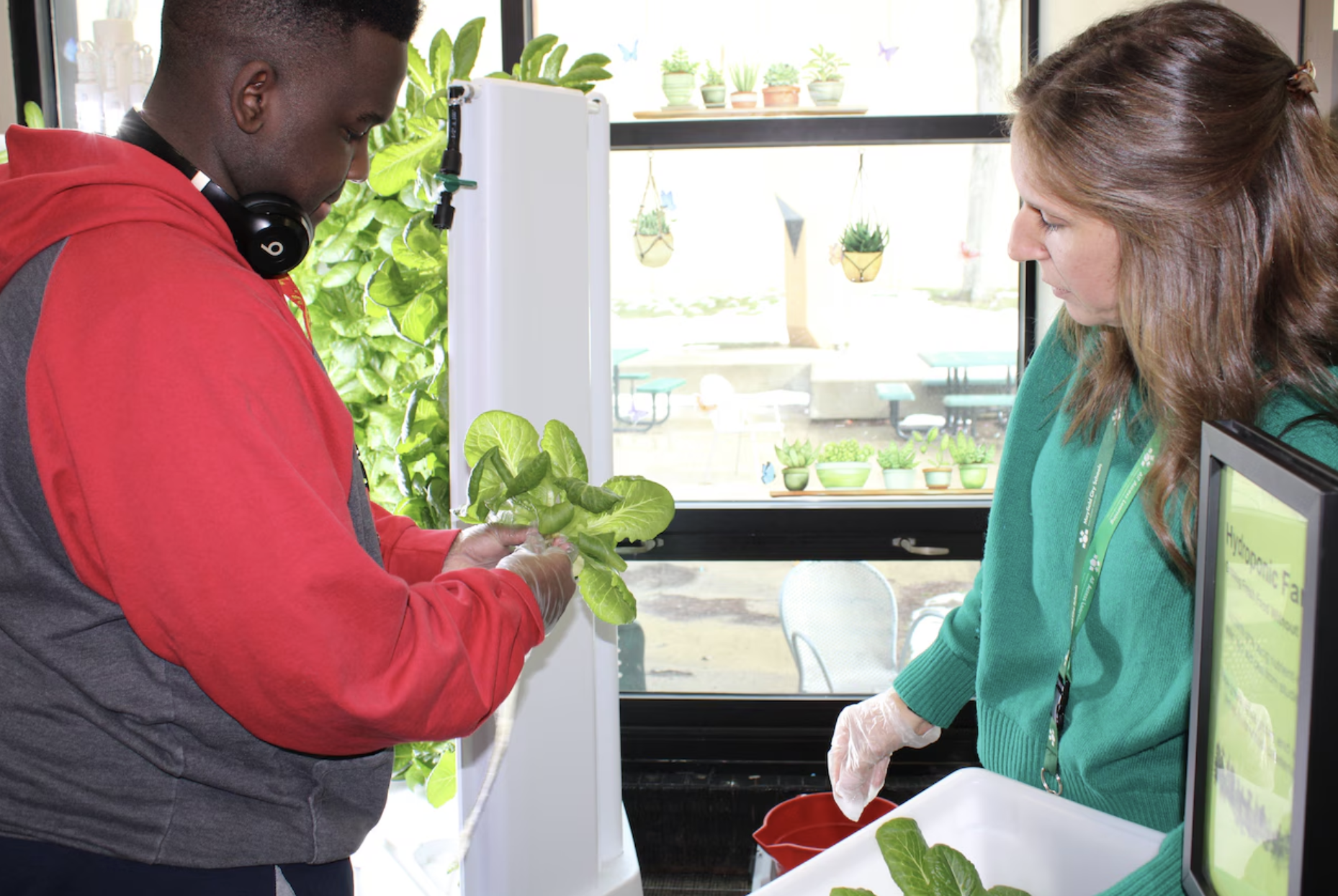
Mayfield High School environmental science teacher Kristen Cervenik, right, and student David H. take a look at some of the lettuce recently harvested at the school as part of a new hydroponics growing class. The lettuce was used in the school's cafeteria for salads, sandwiches and wraps, as will future harvests.Photo Courtesy of Mayfield Schools
MAYFIELD, Ohio -- Some Mayfield City Schools students are experiencing the satisfaction of having the fruits (or in this case the lettuce) of their classroom efforts result in a real-life application -- helping to feed their fellow students.
The Mayfield High School students, as well as the recently graduated high school students of the CEVEC school, are learning about growing lettuce via hydroponics.
Hydroponics is a soilless, water-based cultivation method that delivers nutrients directly to plant roots.
It results in faster growth and provides for year-round, high-density production while using less water than it takes to grow plants in soil.
Two vertical growing units -- standing just over 5 feet in height -- are located in the Mayfield High library and in the CEVEC (Cuyahoga East Vocational Education Consortium) building near the front of the Mayfield High property.
Seven students in teacher Kristen Cervenik’s environmental science class and two in CEVEC teacher Sarah Keso’s class are learning about, and growing with, hydroponics.
“The students are in the forefront,” said Heather Wellendorf, the library media coordinator at Mayfield High.
In the host space for the program, Wellendorf regularly sees the plants’ growth and the work of the students who are doing the growing.
“Kristi (Cervenik) and I are more coaching in the process,” Wellendorf said.
“(The students) are the ones who plant. They check the pH levels, the water (and) they add the nutrients.”
Mayfield Schools received a $12,000 Grow Ohio Grant from the Ohio Department of Education and Workforce, which made the program possible.
Mayfield Schools Food Service Director Robin Smeal, along with help from Associate Principal of Consortium Learning Deanna Elsing and administrator Kati Tomco, devised the program and submitted the successful grant application.
“The idea of growing seed to salad was so exciting and a win-win in food service, where we were also dealing with several lettuce/salad mix recalls,” Smeal, a dietitian and nutritionist, said of why the program came about.
“The hydroponic salad is grown without soil and is very clean. The collaboration with the students in a hands-on, innovative environment was so exciting for us.”
“Part of the grant is that students are the leads in this operation,” Wellendorf said. “They’re instrumental in the entire process.”
After receiving the growing units, the students assembled them in the library in preparation for their first growing attempt.
Forty-eight days after the lettuce was planted, the students harvested a large crop.
“On Jan. 8, we planted our first seedlings, and on Feb. 25 we harvested about 82 heads of lettuce,” Wellendorf said.
“The head of the (district’s) food service department, the food service manager, Sandy Smith, was there (for the harvest), took that lettuce to the (Mayfield High) cafeteria, and they prepped it, cleaned it.
“Then, on Friday, the (Feb.) 27th, we served our first harvest in subs and sandwiches and salads.
“We achieved one of our outcomes that is part of the grant, which was to serve our produce in our school cafeteria.”
Wellendorf explained that, because it was the students’ first attempt, the growing process took a bit longer than the normal 25- to 28-day period.
The first harvest was of romaine lettuce.
Wellendorf said there were no complaints from student diners on the two days it took to consume the 82 heads.
The students now look forward to planting green star lettuce, which also will be put to use in the cafeteria.
After that is harvested later this month, she said, the third planting may include fruits.
Students in Cervenik’s class, having enjoyed their first harvest, are looking forward to more hydroponic growing.
“I think the way the roots were growing inside the hydroponic farm and how long the roots were is the most interesting part,” student Kenai A. said of the experience.
“I also think monitoring the pH levels is interesting.”
A vertical hydroponics growing farm in the Mayfield High School library.Photo Courtesy of Mayfield Schools
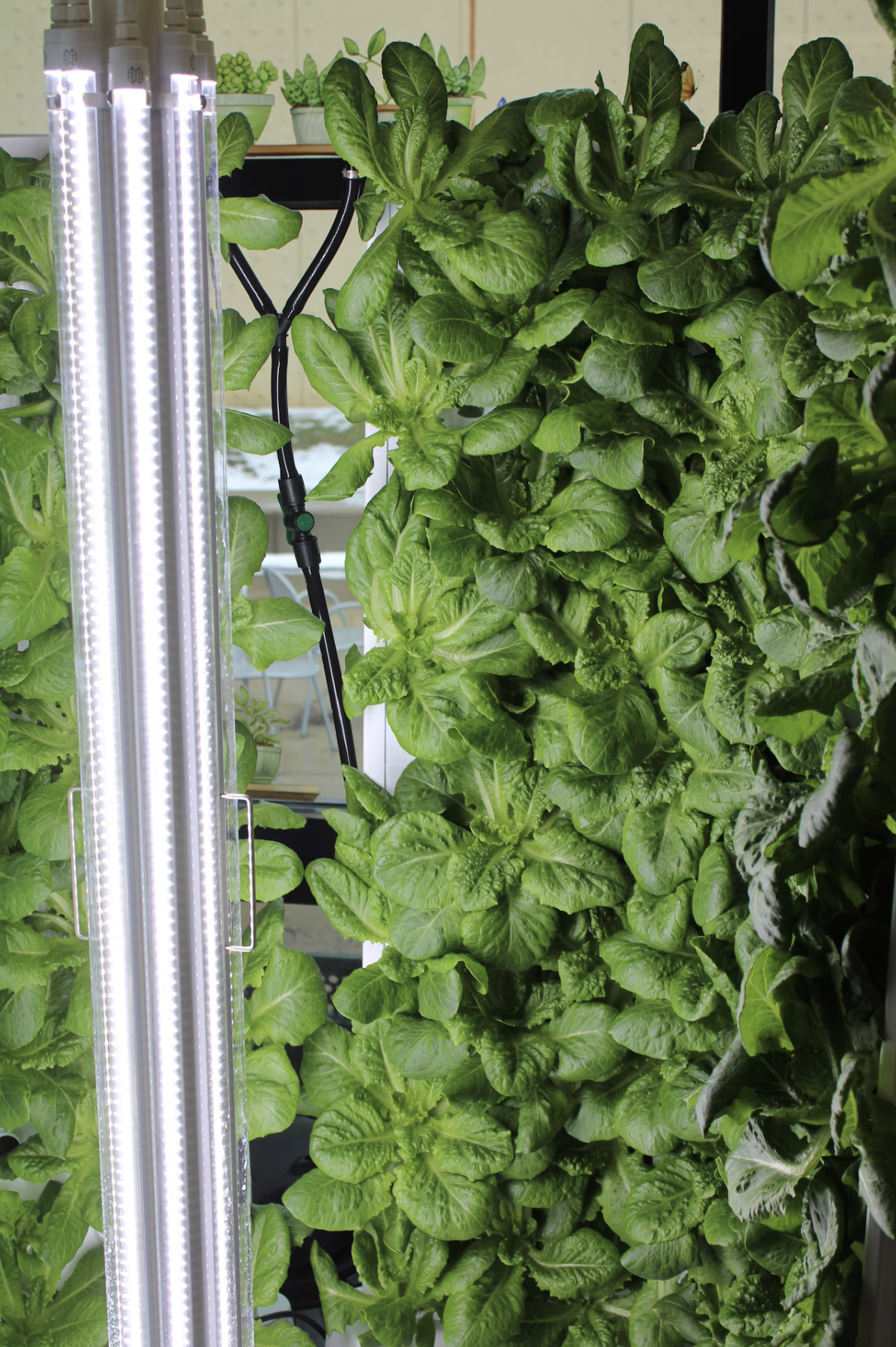
“It took seven weeks for the romaine lettuce to grow inside the hydroponic farm,” said student Lexia W.
“I like that we can get outside of the classroom to check the PPM (parts per million of dissolved nutrients) levels.”
Sabrina Feldman, a CEVEC student, said of the experience: “Our farm is amazing because it grew so fast. The lettuce is so healthy and fresh.
“The basil (also grown) smells good, too. I learned how to take care of our lettuce and basil by taking a sample of the water to test it to see if we needed to do anything different.”
Said Cervenik, “The students seeing the entire project full circle, from installation to harvest, is rewarding.
“The students are learning about sustainability and what it takes to maintain nutrient levels within the hydroponic farm.”
“I call it a ‘library to table’ innovation in action,” Wellendorf said of the library’s part in the program. “That’s kind of my pet phrase.
“What’s interesting is that (participating students) are seeing what they’re doing come to fruition. It’s not like just reading it in a textbook.
“They’re taking time to plant seeds, see these seedlings grow, transplant those seedlings, harvest and then see that food in the cafeteria.
“They’re seeing the full cycle, sustainability and how food is grown. And it’s exciting seeing their excitement, when they come in and see how much growth has happened.
“And, it’s in a library -- showing you can do things anywhere. In the most unlikely place, you can harvest 82 heads of lettuce.
“We’re much more than books in a library, we’re growing plants,” Wellendorf said.
Of the program’s importance, Elsing said, “Hydroponics is valuable to students because it turns classroom concepts into hands-on, real-world learning.
“Instead of only reading about plant biology, chemistry or environmental science, students actively monitor nutrient levels, measure growth and solve problems as they arise.
“This kind of experiential learning strengthens critical thinking and makes academic content more meaningful, which aligns fully to the Mayfield Portrait of a Graduate,” Elsing said.