

USA - WISCONSIN: Proposed Greenhouse Could Expand Hands-on Learning at Osceola High School

By Matt Anderson, editor@osceolasun.com
September 13, 2026
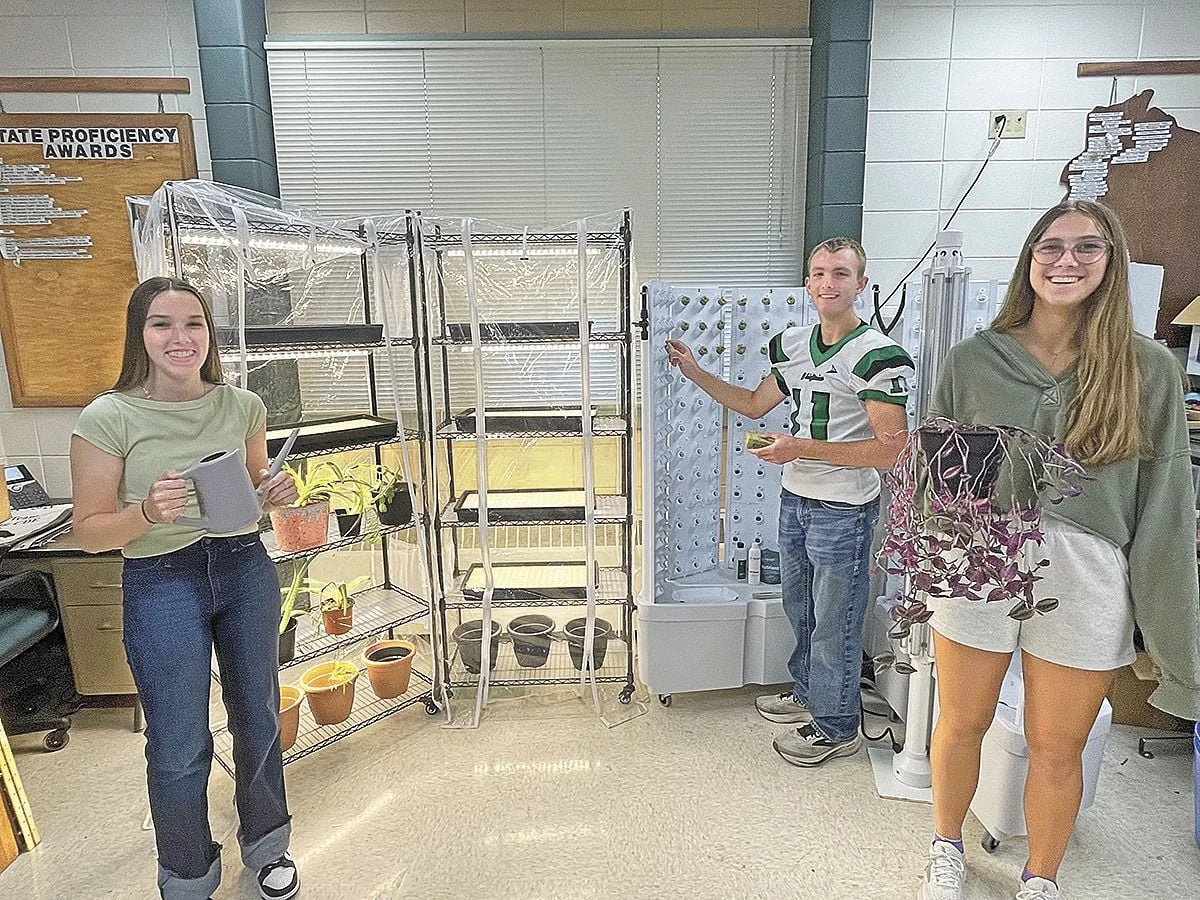
Current growing equipment consists of racks, grow lights, and hydroponic systems. Pictured left to right are students Reecelyn Rada, Jacob Haase, and Hannah Davis.
Osceola High School’s Agriculture Program could once again have a greenhouse, opening the door to year-round, hands-on learning opportunities for students ranging from plant science and hydroponics to business management and crop production.
The Osceola School Board recently approved phase one of the greenhouse project, authorizing Kraus-Anderson to begin design services for up to $50,000. That first phase includes design, engineering, preliminary budgeting, code reviews, and preparation for bidding. Construction has not yet been approved by the board.
Once the design process is complete and bids are submitted, the board will review the costs before deciding whether to move forward with construction of the proposed greenhouse.
Agricultural Teacher Amanda Lietz said discussions about bringing another greenhouse back to the district have been ongoing for years now, particularly following the former sale of the district’s farm property.
“I think there have always been conversations since the school farm regarding the past greenhouse and keeping that an opportunity in Osceola,” Lietz said. “I think having a facility where students can get that hands-on experience of growing plants, whether it’s flowers or poinsettias or vegetables, is a really great life skill to have, but also a potential career path for students.”
Funding for the project is earmarked specifically for the Agricultural Program. In 2021, the district sold the farm and forest property for $482,000, and received $477,510 after closing costs. At the time of that sale, the school board dedicated those proceeds to the district’s agricultural program.
Although some of those funds have already been used to remove the former greenhouse, disconnect utilities, and repair brick and grout near the former doorway, the remainder of the funds are being held in an interest-bearing account.
Thinking ahead to the possibility of a greenhouse being returned to district property, Lietz said the opportunity would provide a dedicated space for year-round learning.
In the meantime, Lietz said she has been using rolling racks with plastic covers to give her students the opportunity to grow plants, but that setup has its own limitations.
“Plants can only grow so tall in a shelving unit,” she said.
A greenhouse would also give students a more flexible space that would allow them to experiment, and pursue individual projects. Lietz said students in the Agricultural Program participate in the Supervised Agricultural Experiences, where they can develop their own learning goals.
The proposed greenhouse would also give students the ability to experiment with different growing methods, including hydroponics, and to grow plants suited to different seasons, such as poinsettias, Easter lilies, vegetables, and other plants.
The flexibility of the space would also allow for multiple agricultural classes. Osceola offers an introductory agricultural class, “Pizza, Plants and Animals,” as well as a horticultural class focusing on plant science. Looking ahead, Lietz said a greenhouse management class could also be added to the curriculum.
Other classes could also make use of the facility, including students in wildlife management, who could potentially start wildflower seeds there.
“There are a lot of opportunities that way where we can partner with different grade levels or different content areas when and if needed,” Lietz said.
The greenhouse also gives students the potential to learn skills beyond just growing plants. If the program were to host a spring plant sale, students could be involved in deciding what to grow and sell, while learning about costs and business management.
Lietz said students could also learn about crop production, identifying pests and diseases, recognizing nutrient deficiencies, and using greenhouse technology. Many modern greenhouses have features such as automated shade systems, temperature controls, and automatic vents, some of which may be incorporated into the design of the proposed project.
Unlike the former greenhouse attached to the high school, the new design is likely to have some notable upgrades. Lietz attended Osceola High School herself and recalled more basic features, such as the gravel flooring, which would be replaced with solid, modern flooring with a drainage system.
While still in the planning stages, Lietz said one of the most important decisions is where to build the new greenhouse.
“Where’s the best location?” Lietz said. “Where are we going to utilize it best with all of our classes? How’s it going to impact the most amount of students?”
Outside of the school, the project could also build connections with the Osceola community and the school’s agricultural program. Lietz said plant sales could give community members the opportunity to directly support the students by purchasing something they’ve planted and grown with their own hands. The project could also be an opportunity to invite community members with expertise in areas like agriculture and horticulture to partner with the program.
While the project is still in its early stages, Lietz said she and the students are excited for the possibilities that may come with a new greenhouse to call their own. Lietz said the ultimate goal of the greenhouse is to provide more learning opportunities outside a traditional classroom setting.
“It’s that hands-on, real learning, real-world learning opportunity,” she said. “Being able to see how a facility is used beyond just the four walls of a classroom.”