

USA - NEW MEXICO: From School Farm to School Table

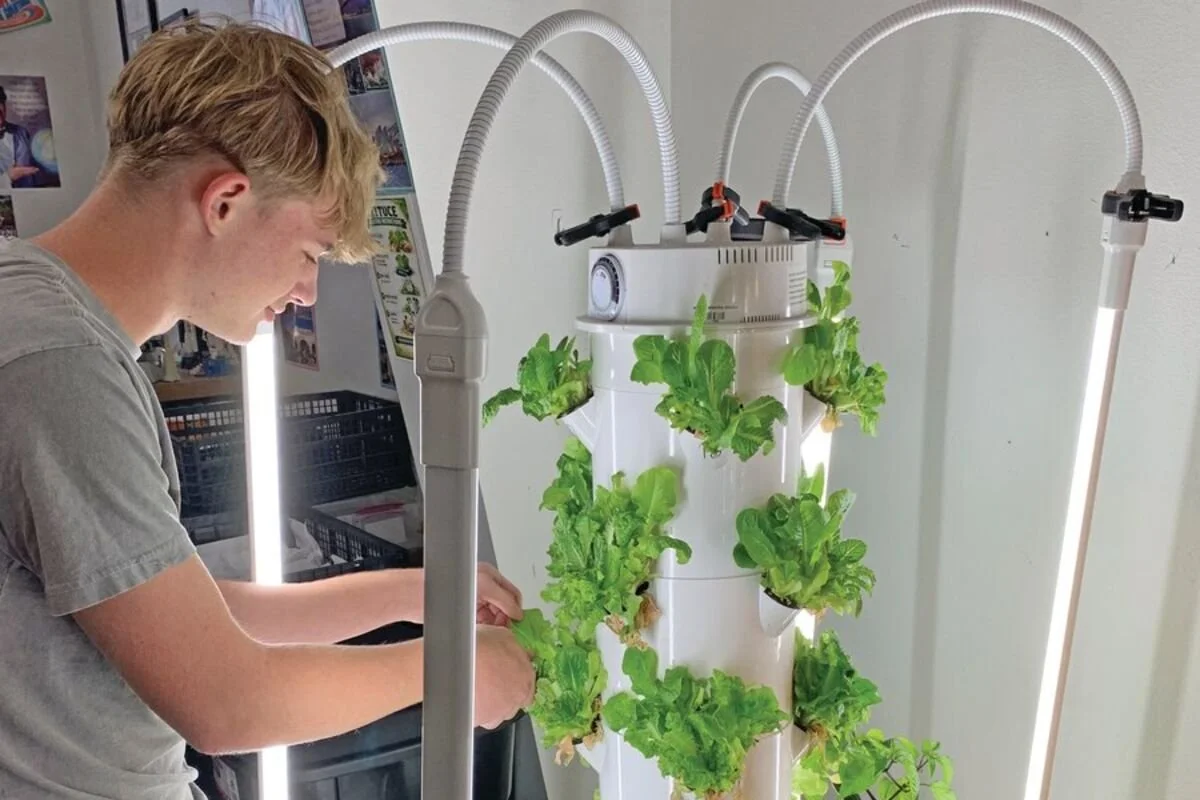
Melrose sophomore Jaxon Preble harvests lettuce from one of the hydroponic towers in the junior high science classroom. - (Landry Sena)
What began as an idea for a few hydroponic towers has grown into something much bigger at Melrose schools. The student-run operation now includes hydroponics, aquaponics, a traditional garden, chickens, composting and plans for even more.
They call it Buffalo Farms.
The project is giving students an opportunity to learn where their food comes from while providing fresh produce for the school cafeteria.
Chris Acuff, junior high science teacher at Melrose, has taken the lead on the project. He said the idea began around Christmas break last year, when a meeting was planned to discuss using hydroponics to grow food for the school cafeteria through a grant. Although the meeting was ultimately canceled, Acuff had already begun researching hydroponic towers and moved forward with getting them ordered.
"I had gone ahead and looked up where the towers were and put in a purchase order for it, in case they wanted to buy them for that," Acuff said.
Once the towers arrived, Acuff and the students began experimenting with growing lettuce.
"It was kind of trial and error at first," he said. "Growing the lettuce and whatnot. And then it became pretty successful."
The elementary students, in particular, took an interest in the lettuce, Acuff said. That success led him to write a grant for a traditional garden, allowing the project to expand beyond the hydroponic towers.
Today, the school has hydroponics, a traditional garden and is beginning an aquaponics project.
Students are also involved in composting, growing mealworms and sunflowers for the school's chickens, which the agriculture department handles, and caring for flowers and planters around campus.
Food scraps are part of the project
One of the project's biggest lessons is the cycle created from the school's own waste.
Food scraps from the cafeteria are collected and turned into compost. Wastepaper from around the school is shredded and mixed with the compost to create material that can be used in the garden.
"We take the scraps from the cafeteria that are left over each day, and then we turn that into compost, which we use for fertilizer in the garden," Acuff said. "So it's like a cycle. It comes out of the cafeteria, then back in is food."
The project had already produced about 80 pounds of compost by the third week of the school year, according to cafeteria manager Summer Tyler.
"Everything from our shells for our eggs that we're cracking and our watermelon rinds that we're buying; all that just kind of goes right back into the garden," Tyler said.
The garden also benefits from locally grown produce purchased by the cafeteria through New Mexico Grown funding.
Tyler said the school received just under $2,000 through the program this year. The funding can be used for produce and, within certain limits, New Mexico-grown beef and other products.
But Tyler said the school's own garden is already making a difference in the cafeteria.
The school goes through approximately 60 pounds of lettuce each week. Last week, about 25 pounds of lettuce came from the school garden.
For now, the garden's produce is primarily being used on the salad bar because there is not yet enough to serve the entire school.
When younger students receive their salads, Tyler said the cafeteria staff can tell them where the food came from.
"We'll make an announcement that the students across the street grew the lettuce for you," she said. "Those cucumbers that are on your plate came from your school garden."
That connection is one of the project's most valuable parts, Tyler said.
Students who come through the cafeteria line recognize the food they helped grow.
"They'll come through the line, they'll be like, 'I grew that lettuce. That super bright one there, that one was mine,'" Tyler said.
For students involved in the project, the lessons go beyond simply planting and harvesting.
Jaxon Preble, a sophomore, said he has helped water tomatoes and other plants in the garden and recently helped with the aquaponics project.
'There's a lot of weeds'
Before joining the project, Preble said he did not know much about gardening.
"There's a lot of weeds," Preble said. "Really annoying. And tomatoes need a lot of water."
Fellow sophomore Khloe Smith has worked with composting and has also begun painting signs for the garden.
"It takes a lot of hard work to get the compost and then go over and make sure you chop it enough and not chop it too little, not chop it too big, and make sure everything is weighed properly," Smith said.
The project also incorporates math and other classroom lessons.
Tiffany Dial, junior high math teacher, who helps with the class, said students weigh compost, subtract the weight of their containers and record their totals.
Dial also connects the project to one she works on through Eastern New Mexico University involving a lunar lava tube habitat.
In that project, students must consider how people could grow food in an environment where they could not simply rely on stores or delivery services.
"Hydroponics and aquaponics are choices, but now they get to see what that actually looks like and participate in it," Dial said.
The garden is still relatively small, but Acuff has bigger plans.
Tomatoes, cucumbers, green beans, sunflowers, pumpkins, peppers, jalapeños and green chile are currently among the crops being grown. Acuff said carrots are also planned.
The school has received donated plants and additional hydroponic towers, and the garden is expected to expand as grant funding becomes available.
Acuff hopes eventually to grow enough produce to replace many of the vegetables the cafeteria currently has to purchase.
His goal is not simply to reduce the school's grocery bill, but to create a self-sustaining operation.
"If we could replace all of the main vegetables to the cafeteria, that would save on costs," Acuff said.
He also hopes the garden could eventually generate its own funding through projects such as a pumpkin patch and a fall festival.
Next up: Chicken operation
The school also hopes to make its chicken operation more self-sustaining by growing food for the chickens rather than purchasing as much feed.
The cafeteria cannot yet use eggs from the school's chickens because the flock includes roosters, meaning the eggs could be fertilized. Tyler said the school can instead use New Mexico Grown funding to purchase eggs from approved suppliers.
As temperatures eventually drop this fall, the garden will change with the seasons. Fresh outdoor produce will decrease, but Acuff said the work will continue as students prepare for the next growing season.
The school plans to expand garden beds, fencing and irrigation during the winter while relying more heavily on the hydroponic system for fresh produce.
Eventually, the school hopes elementary students will be able to take field trips to the garden and participate more directly.
The project is also part of a larger effort to beautify the school grounds. Students already help water flower planters around campus, and Acuff hopes to eventually add garden beds throughout the school.
For Acuff, the project's success has been made possible by the support of Melrose administrators.
He specifically credited the school's administrators for continually asking what they can do to help rather than placing limitations on the project.
"None of this would be possible without them at all," Acuff said.
For now, the garden continues to grow, both literally and as a learning experience for the students involved.
What started with a few hydroponic towers has become a cycle that connects the classroom, the cafeteria and the school grounds: 35 students grow food, the cafeteria serves it, food scraps become compost, and that compost helps grow the next crop.