

From Warship to Greenhouse: Canada’s Floating Farm

By Ban Zhang
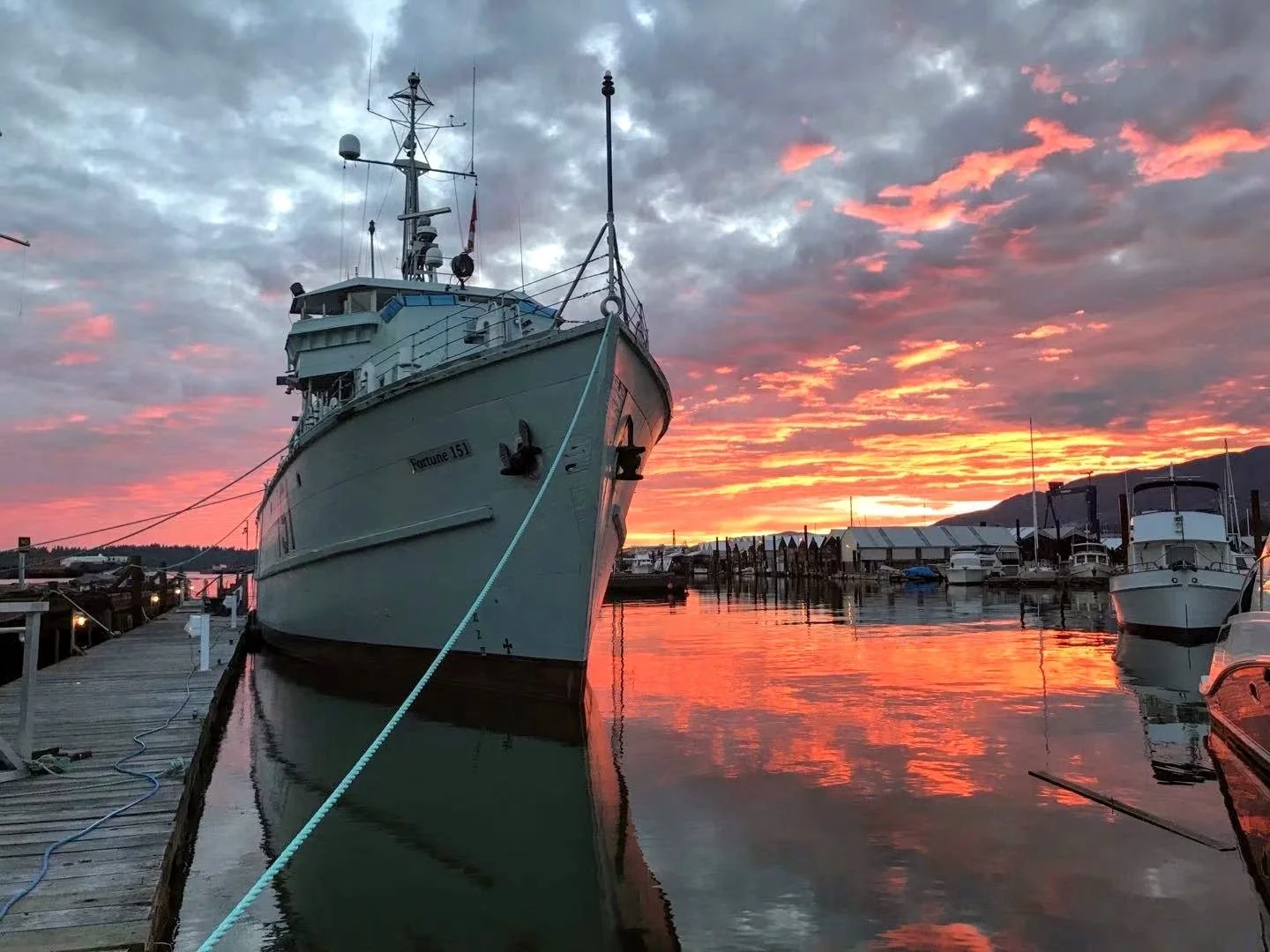
This warship has been transformed into a floating vertical farm. Photo by Ban Zhang.
On the quiet coast off the traditional territory of the Squamish people in British Columbia, a retired Canadian warship lies moored in the still waters of Burrard Inlet. Once a Bay-class minesweeper, she braved Arctic ice and Pacific storms, serving the Canadian Navy through tense decades of the Cold War. Today, her mission has shifted dramatically: she grows food.
Inside her steel hull, the armory has been cleared, sailors’ bunks disinfected, and reflective film laid along the walls. Rows of vertical racks glow with violet LED light, cradling lettuces, cherry tomatoes, and bright red peppers. What was once a machine of war has been reborn as a floating vertical farm, a vessel now committed not to combat but to sustenance, resilience, and innovation.
This transformation is the vision of a young team of Canadian innovators, many of Chinese descent, who saw an urgent need in the nation they call home.
“Canada doesn’t need more weapons on the water,” says Rong Ge, the project’s leader in his early 30s. “We need food. We need resilience.”
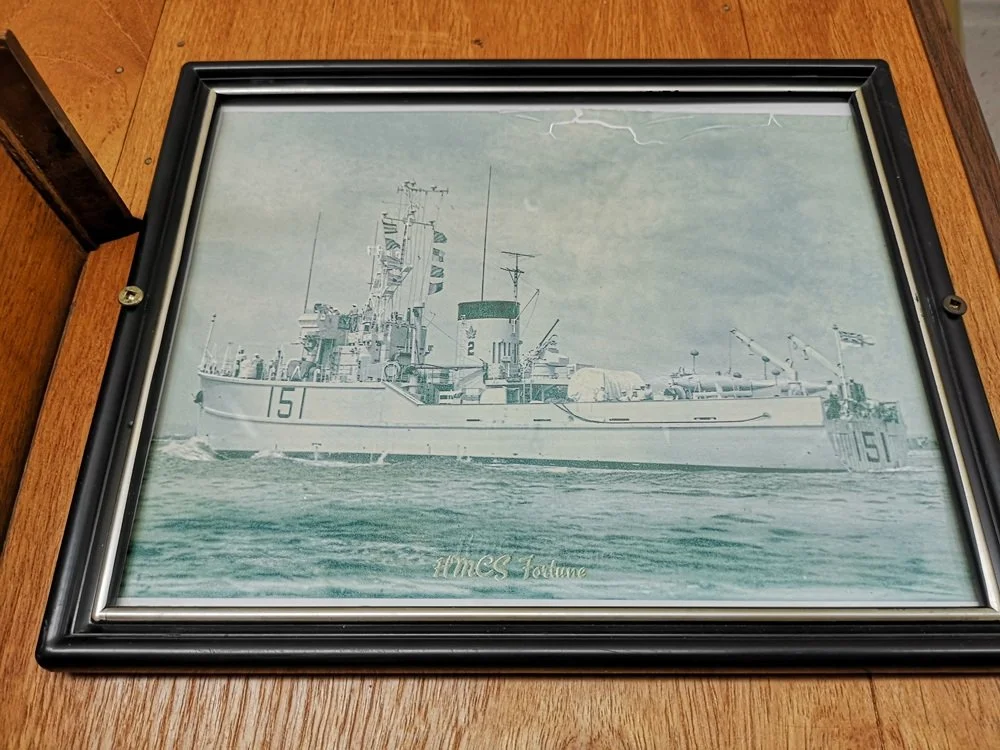
This photo of the HCMS Fortune speaks to its military past. Photo by Ban Zhang.
From warship to museum
I first boarded this ship years ago, when she was still a naval museum. Sitting in the captain’s chair on the bridge, I imagined the storms she had weathered, the Arctic ice and fog, the tense moments of command. The polished compass seemed to whisper of voyages through danger and uncertainty, a relic of a time when every decision carried national weight.
The vessel was originally HMCS Fortune, which once served as flagship for the Second Minesweeping Squadron during the Cuban Missile Crisis. She was decommissioned in 1964, later sold to private interests, and spent decades as a floating museum. In 2018, renamed Fortune 151, she became a living monument to naval memory, her steel hull a canvas for history and storytelling.
But even as a museum, she held surprises. The old gun mounts had been converted into lookout points, offering sweeping views of Grouse Mountain and Burrard Inlet. The engine room hummed quietly, the faint vibration underfoot a reminder that the vessel’s heart still beat. And in the armory, where once steel and gunpowder dominated, thousands of books now filled the shelves: The Art of War, Tang poetry, Shakespeare’s plays. Ink and paper had replaced the smell of gunpowder, turning the former warship into a temple of ideas.
Standing there, I found myself wishing all warships around the world could make such a trade: words for weapons, thought for firepower.
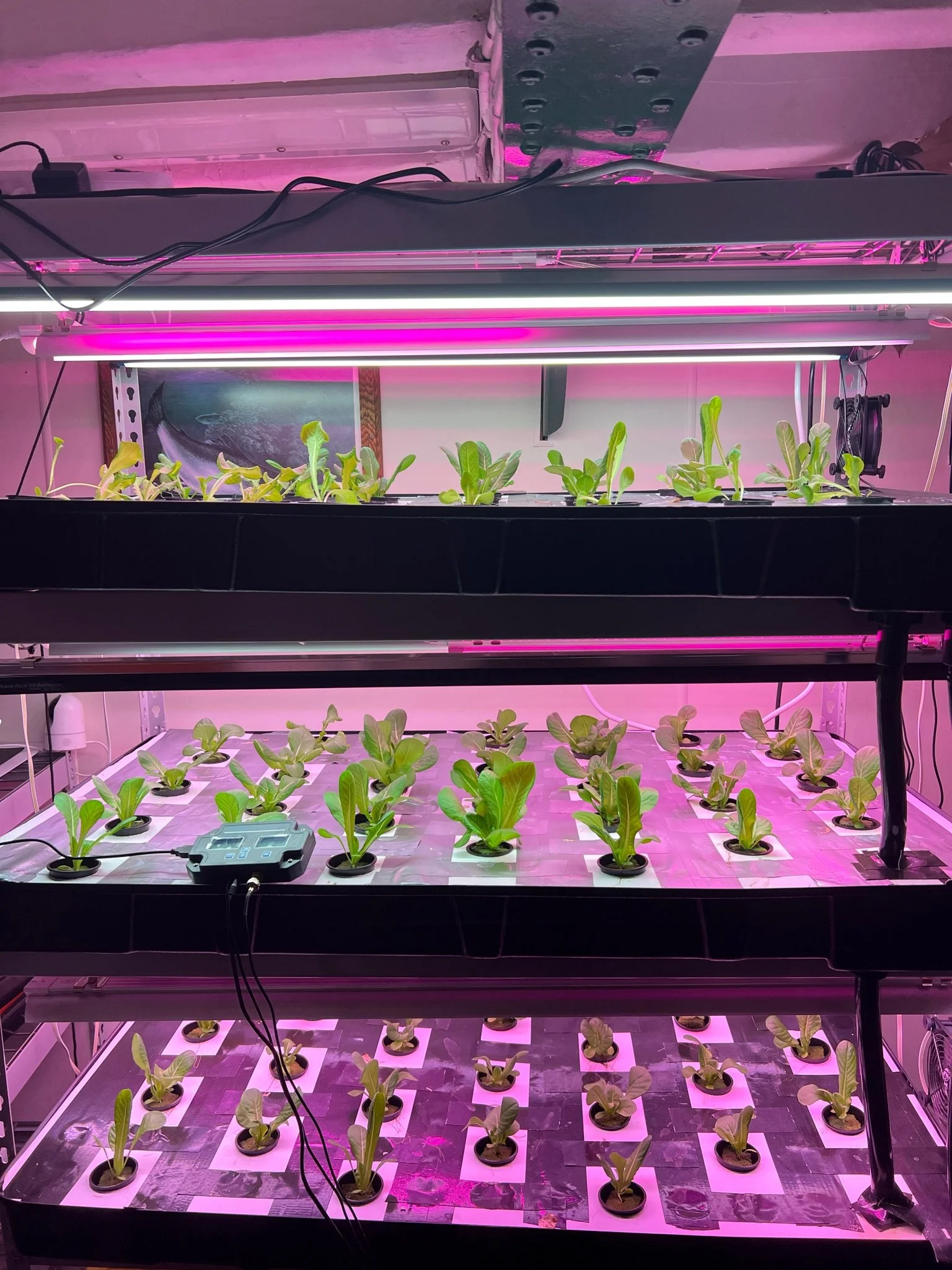
It’s possible to grow vegetables on a former warship. Photo by Ban Zhang.
A new frontline
When I returned a year later, the transformation was breathtaking. Cabins once lined with bunks were now climate-controlled grow rooms, each simulating a different environment: coastal spring, temperate autumn, tropical summer. Where sailors had monitored radar and fire control systems, engineers now monitored light cycles, humidity, and nutrient solutions through screens of sensors and algorithms.
“We don’t send this ship to the frontlines of war anymore,” Rong Ge said. “We send it to the frontlines of food insecurity.”
Rong leads a young, cosmopolitan team: engineers, agricultural scientists, designers, and graduate students, some Canadian-born, others hailing from Europe, Asia, and beyond. They jokingly refer to themselves as “a Marine Corps without weapons”. Together, they are experimenting with a new type of warfare: one against hunger, isolation, and scarcity.
The floating farm is designed for both symbolic and practical purposes. For urban and remote communities alike, it represents a proof of concept: that fresh, nutritious food can be grown anywhere, even in places historically dependent on long supply chains. It is also an invitation to rethink what a ship can do—to shift from symbols of national power to tools of community empowerment.
Why Canada needs a floating farm
The symbolism is striking, but the urgency is real. Canada, despite being a global agricultural powerhouse, faces rising food insecurity. By 2024, nearly 10 million Canadians—about one in four—lived in households where access to food was uncertain. Of these, 2.6 million were children. In far northern communities, grocery prices are staggering: in Nunavut, a cucumber can cost seven dollars; a bundle of asparagus, thirty. In Attawapiskat, an Indigenous community in northern Ontario, a family of four spends nearly $2,000 per month on food—twice what a household in Toronto pays.
Trade tensions with the United States, Canada’s largest agri-food trading partner, only magnify the risk. Almost 60 percent of Canada’s agricultural imports come from the U.S. Should tariffs rise or trade restrictions tighten, grocery prices would spike, placing even more pressure on vulnerable households.
In the northern territories, the crisis is particularly stark. Communities in Nunavut and the Northwest Territories rely on long-distance supply lines. The cost of fresh produce is astronomical, while options are limited. The floating farm addresses this directly: vegetables are grown where they are eaten, harvested fresh rather than shipped frozen across thousands of kilometers.
But the project’s value goes beyond calories and nutrition. It offers technical knowledge, confidence, and the possibility of self-reliance. In Arctic communities, a compact vertical farm could be operated by young people, assisted by elders, with children exploring the growing process. It is food, but also empowerment. And in a broader vision, ships like Fortune could one day deliver harvests—not arms—to conflict-affected regions such as Ukraine, Gaza, or Ethiopia, offering sustenance where it is most needed.
The battle of standards
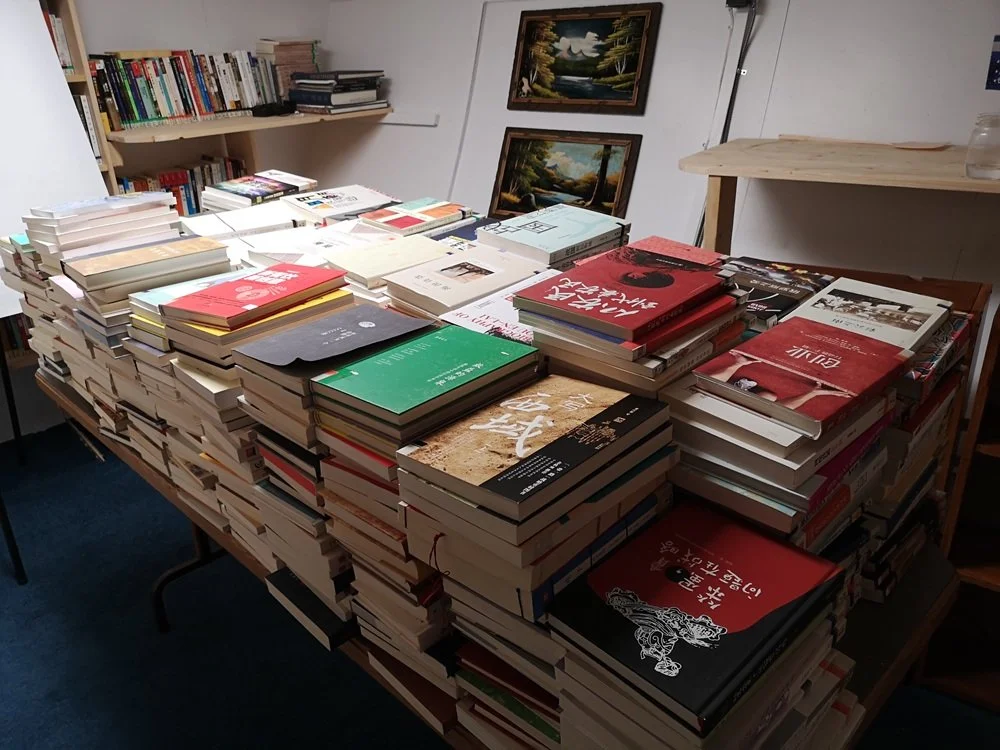
There are plenty of Chinese-language books onboard for staff and visitors who speak Chinese. Photo by Ban Zhang.
Yet even the most innovative technology can be hampered by outdated regulation. Vertical farming, hydroponics, LED lighting, and nutrient recirculation are advancing rapidly. But building codes, food-safety protocols, and environmental standards remain rooted in traditional agricultural assumptions. Few regulations imagine lettuce sprouting in the belly of a ship.
Katherine, a second-generation Irish-Canadian engineer responsible for the project’s standards testing, describes the frustration. “The technology isn’t the problem. The problem is the regulatory vacuum,” she says. A proposed vertical farm in a downtown warehouse was delayed for months because zoning laws didn’t account for “indoor agriculture”. Light and nutrient systems failed certification simply because standards did not exist.
“If standards aren’t clear, public trust falters,” Katherine warns. “Are these vegetables safe? Are they sustainable? Without answers, doubts grow.”
Her plea is simple: Canada must create new standards for new agricultural realities, allowing innovation and public confidence to advance together.
Culture, too, must adapt
Technical innovation is only part of the story. Culture plays an equally important role. In Indigenous communities, modern vertical farming is not part of traditional practice. Yet when a 12-year-old boy eats a leaf of lettuce he helped grow, the joy is unmistakable.
In multicultural societies, adaptation also requires translation. Chopsticks or forks are secondary; the critical question is whether systems allow meaningful participation. Innovations led by Chinese Canadian, European Canadian, and South Asian communities must be integrated inclusively to take root in the industry and society.
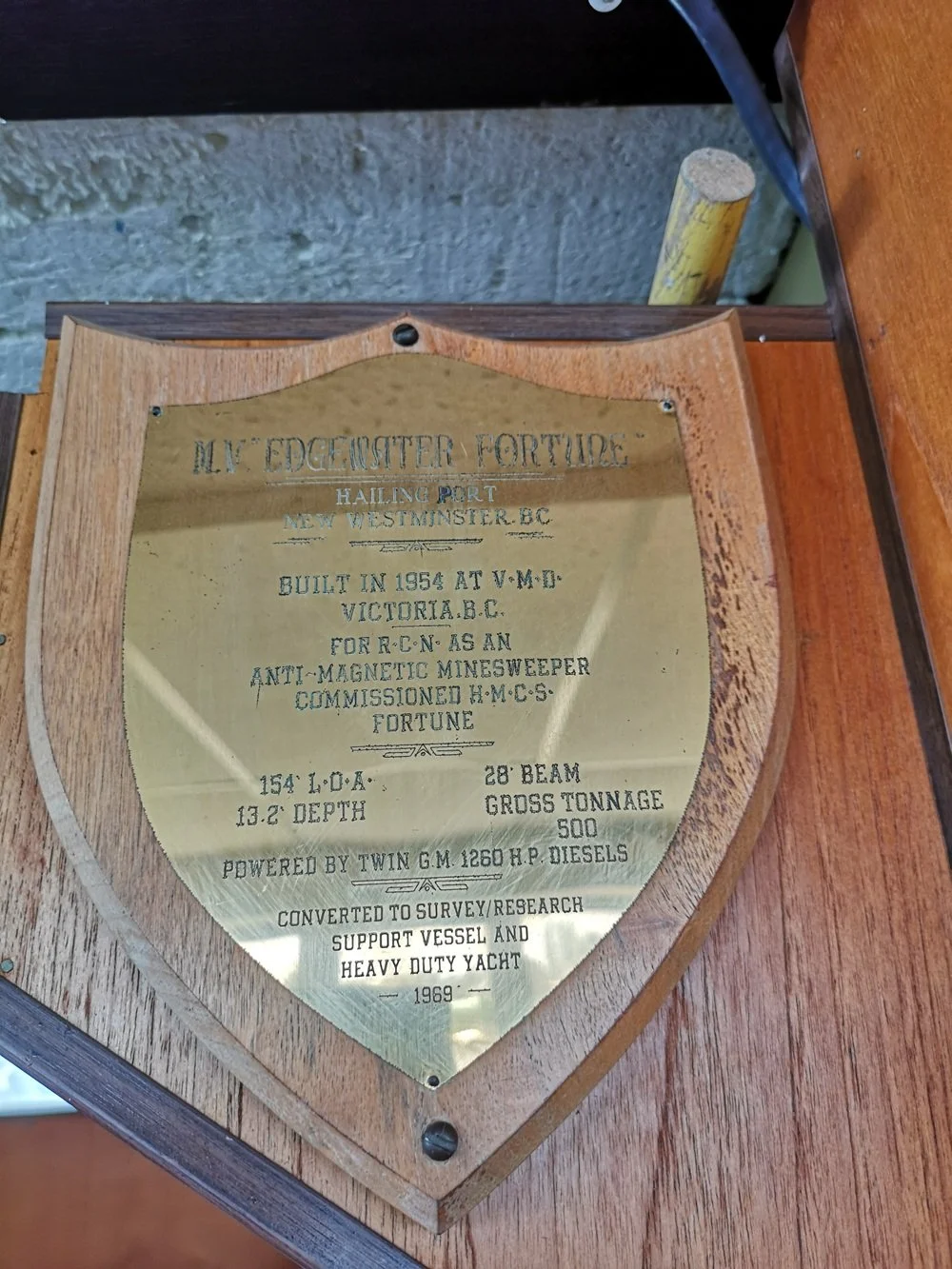
This plaque announces that the ship was built in Victoria in 1954.
Redefining the ship
Ships have long been symbols of conquest. This one, transformed into a greenhouse, carries a very different cargo. Once a vessel of national power, she now embodies ecological awareness, technological ingenuity, and humanitarian purpose.
In an era of fractured trade and rising scarcity, the ship’s mission offers a tangible path toward sustainability. Imagine a fleet of green ships crossing the Pacific, delivering fresh produce to remote Canadian communities, while sharing technology across borders—Chinese agritech applied in Yukon or Nunavut, Canadian innovations used abroad. Across latitudes and cultures, humanity might redefine what a “farm” truly is.
“Smart farming as a service is reshaping how people connect to food and business,” says Maggie, the youngest team member. She dreams of a platform that empowers farmers and communities alike, bridging technology and tradition.
A moonlit evening
I returned for one final visit on the Mid-Autumn Festival. The sky was clear, the sea breeze carried both salt and sunlight, and the young team moved briskly through the cabins, greeting visitors from across the ag-tech world.
Passing the grow rooms, I stopped in surprise: my newly published book, Going to the Grouse Grind, sat on a shelf alongside military histories and agronomy manuals. I ate salad freshly harvested from the ship, paired it with Chardonnay from the Okanagan Valley, and smoked cheese from Quebec’s Eastern Townships. As I bit into a mooncake under the glow of the full moon reflecting on the water, I realized something profound: the ship had changed. And we had changed with it.
The vessel no longer carries weapons; it carries hope, knowledge, and green shoots of possibility. From warship to museum to floating farm, Fortune 151 embodies a journey of transformation—one that charts a course for Canada’s future, one leafy sprout at a time.
Ban Zhang is the author of Going to the Grouse Grind – Collected Essays. The Chinese edition is available through the Harvard Book Store and other online booksellers.
Follow Pancouver on X @PancouverMedia and on Instagram @PancouverMedia.