

BRITISH COLUMBIA: At UBC, The Future of Food is Growing Just Steps From The Dining Hall

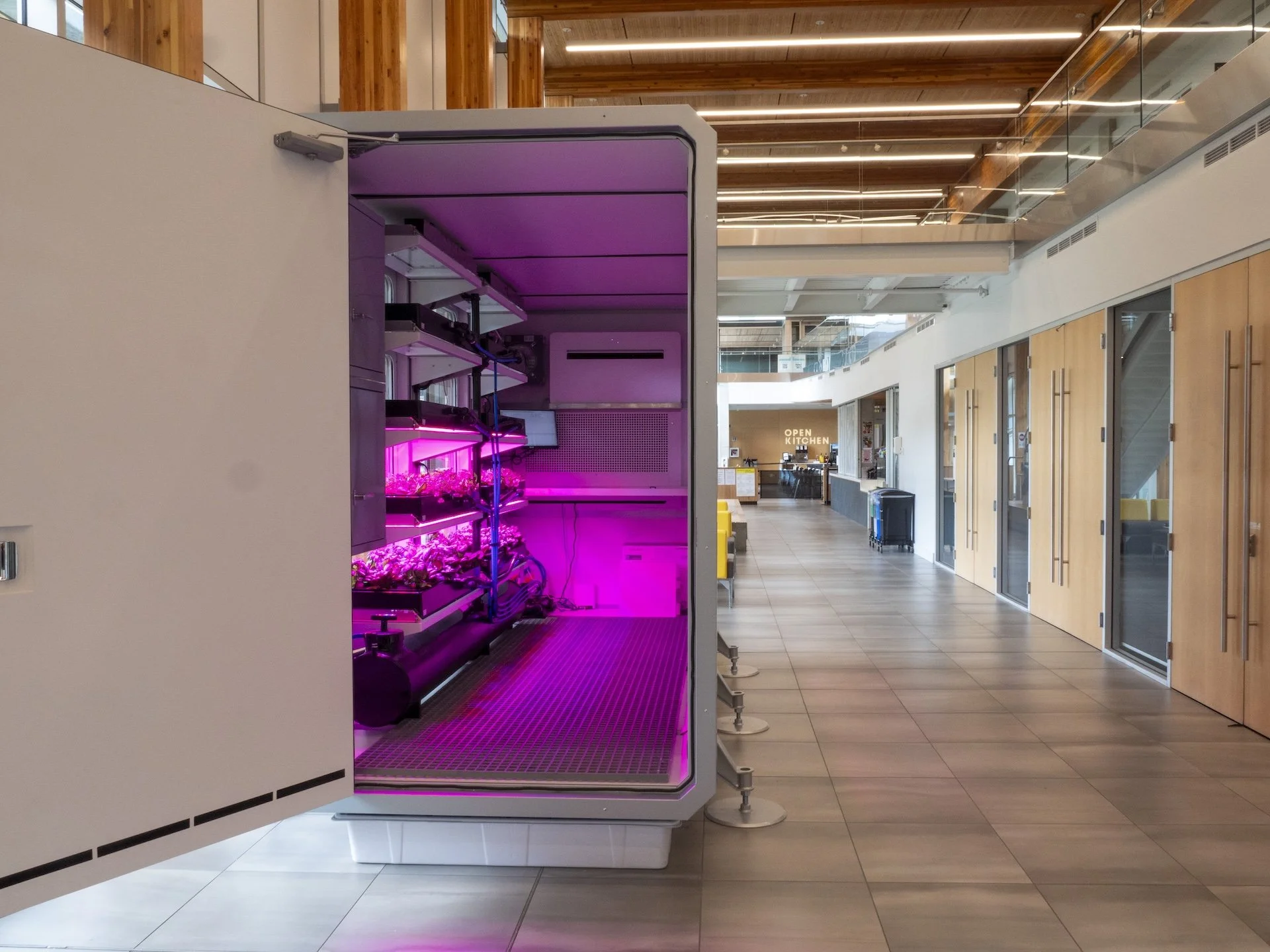
A new indoor growing pod at UBC is putting campus-grown produce on students’ plates through a partnership between researchers, industry and UBC Food Services.
Oct 5, 2026
UBC students are getting a taste of the future of local food production. On Oct. 6, UBC Food Services will harvest leafy greens from a compact indoor growing pod at the UBC Orchard Commons dining hall and serve them through campus dining.
The transparent chamber looks futuristic, but its purpose is practical and educational. The pod uses stacked hydroponic trays and precisely tuned LED lights to grow plants all year round. A standard electrical connection powers the portable, modular Building-Integrated Agriculture (BIA) pod, making it easy to install in any building.
The pod is more than a source of salad greens. It’s a full-scale research prototype, a living laboratory for exploring how food production can be integrated into buildings and city infrastructure, and support year-round growing in remote communities.
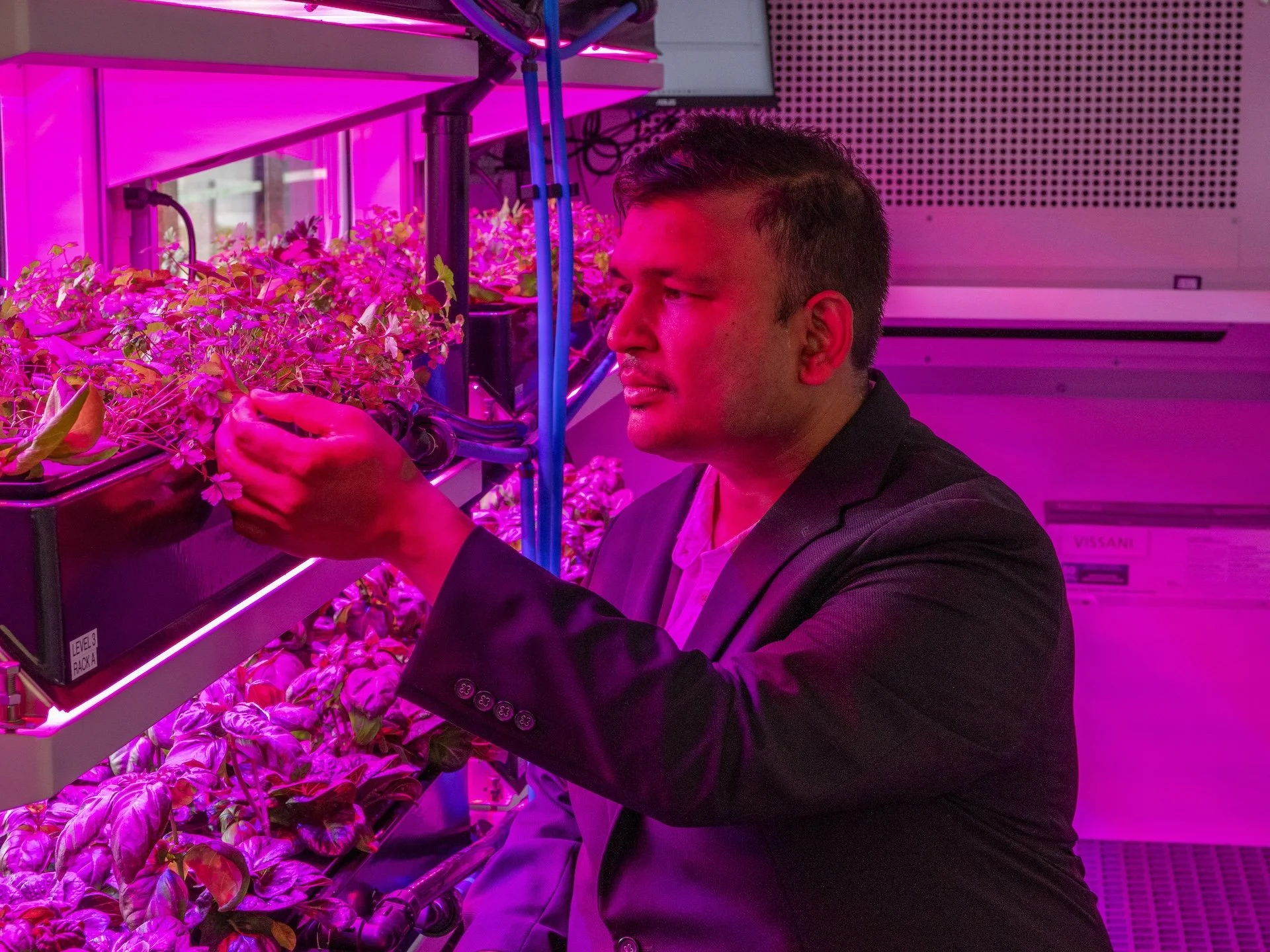
Dr. Anubhav Pratap-Singh inspecting the plants in the pod. Photo credit: Duncan McHugh/UBC.
“It’s not simply a greenhouse, it’s a smart, digitally connected food production system that also allows us to study the nutritional and sensory quality of the produce and consumer response, and could become part of future buildings and urban infrastructure,” said Dr. Anubhav Pratap-Singh, research project lead and associate professor in the faculty of land and food systems.
The project brings together food-systems research, campus dining operations, architecture and agricultural technology in a place where ideas can be tested at full scale and in public view.
Perkins&Will, a global architecture firm and a UBC architecture partner, designed the pod, in collaboration with FORM3, to understand how environmentally controlled agriculture could be integrated into existing and future buildings. QuantoTech Ltd., a Vancouver agri-tech company and UBC Food Services vendor, developed the hydroponic growing system and optimized LED lighting to support year-round production and reduce the need to transport greens into the dining hall.
“We tend to think of cities as places that consume resources. This project asks us to imagine them differently, as productive ecosystems where buildings can help grow food and strengthen community resilience,” said Dr. Mohamed Imam, senior research lead and senior associate at Perkins&Will. “The pod turns that big idea into something everyone can see, touch and taste. Just as importantly, it gives us real-world evidence about yield, energy, carbon, cost and space, the trade-offs designers and operators need to understand if building-integrated agriculture is to scale responsibly.”
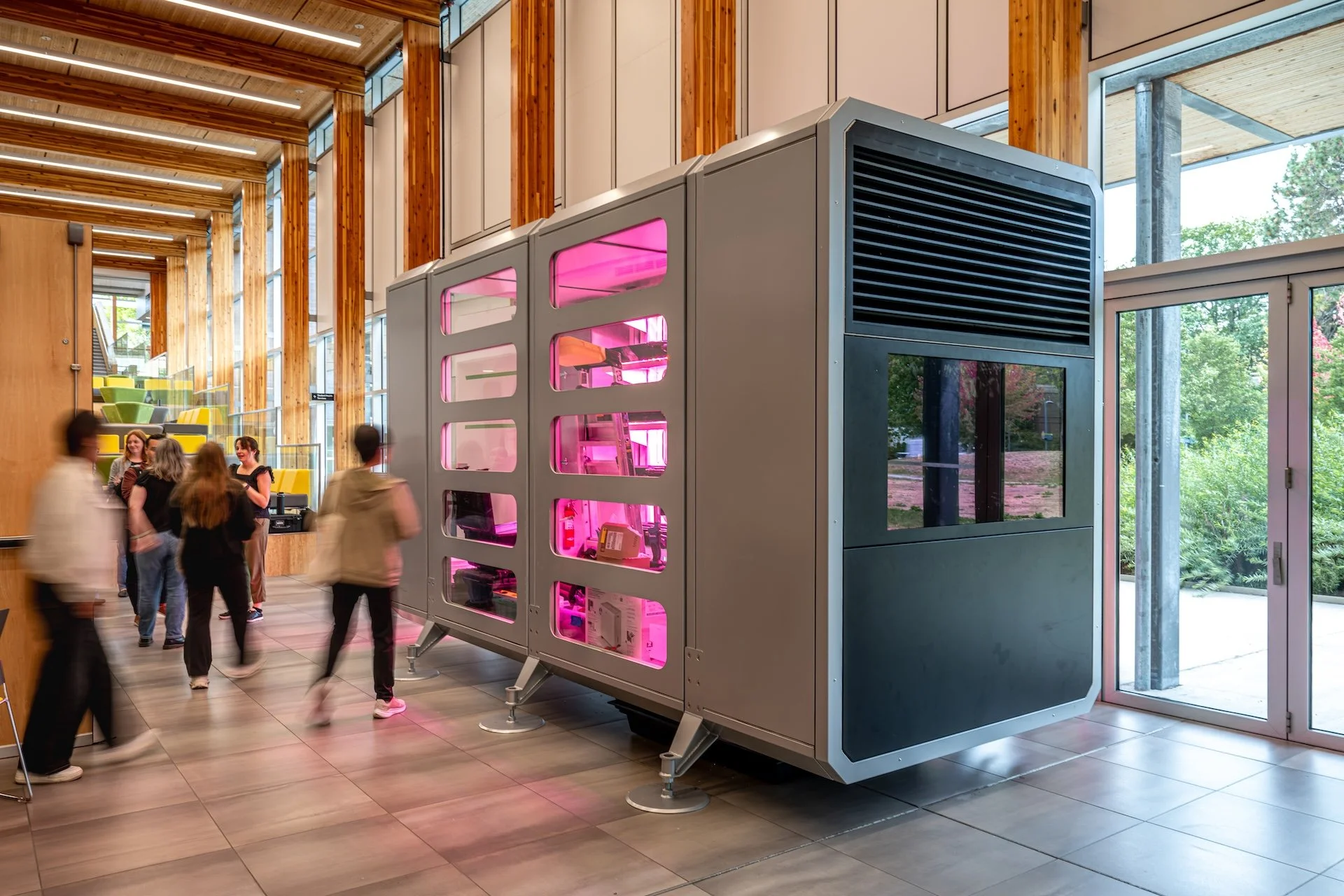
Photo credit: Tom Kwok Photography, Perkins&Will.
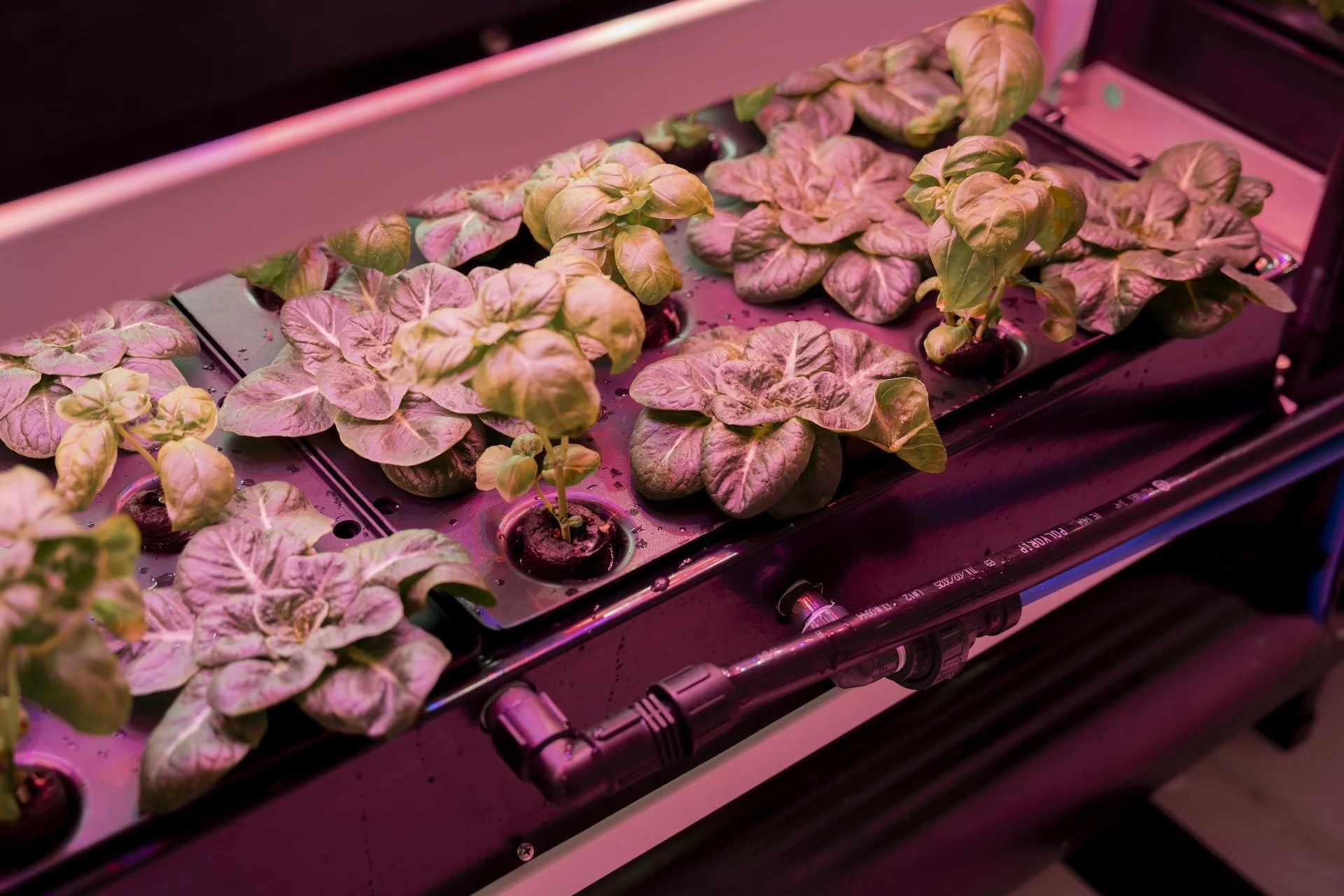
Photo credit: Mariam Al Roujuleh/UBC, courtesy Perkins&Will.
The demonstration brings Perkins&Will’s Resource Circularity research off the page and into daily campus life. The project explores how buildings can do more than provide shelter by contributing to food production in urban settings.
UBC researchers will compare produce grown in the pod with similar products available in grocery stores. The research will examine nutritional quality, growing conditions and perceptions of food produced within residential buildings or community infrastructure, such as universities, community centres or hospitals.
“The larger question we’re trying to answer around food security is: Why should cities only consume food? Why can’t cities and rural communities actually grow their own food?” said Pratap-Singh.
The project also explores whether cities can play a greater role in food production while reducing reliance on lengthy supply chains, improving food security and climate resilience. Researchers hope to better understand how local growing systems can support more resilient food networks in an increasingly urbanized world by bringing food production closer to where people live.
“Vertical farming is going to become essential as climate change continues to impact traditional agriculture and the global population increases,” said QuantoTech founder and CEO Alycia van der Gracht. “We hope this prototype produces evidence about distributed growing systems supporting a more resilient, localized food system, especially for regions with decreased access to land and water, or for climates with a very short growing season from deserts to the Arctic. So this demonstration will test the flexibility to be used inside a building, under-utilized community spaces or alongside traditional farming operations.”
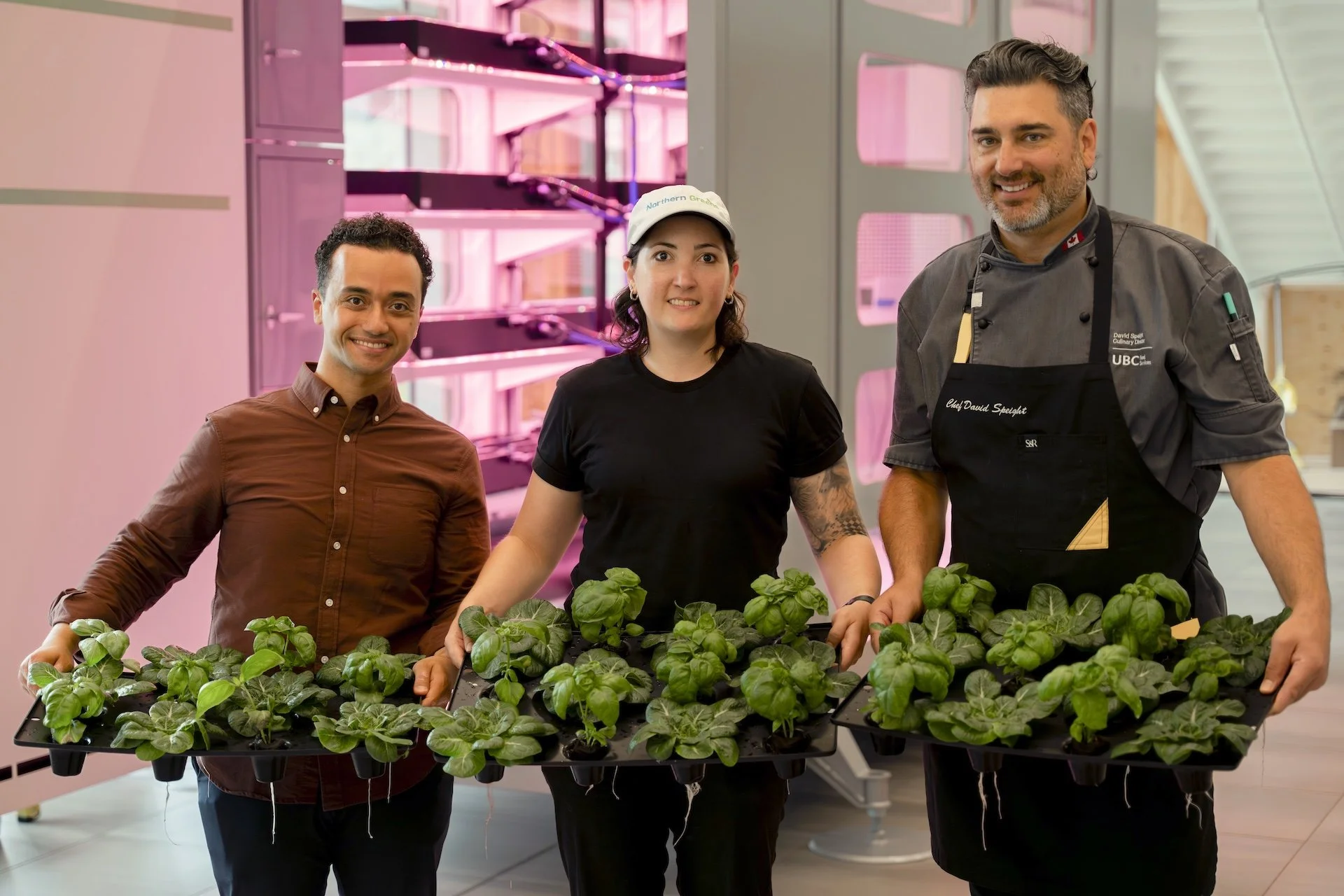
Left to right: Dr. Mohamed Iman, Alycia van der Gracht and David Speight. Photo credit: Mariam Al Roujuleh/UBC, courtesy Perkins & Will.
For UBC Food Services, the project offers an opportunity to explore how hyperlocal food production could complement existing dining operations.
“What we learn through this project could help inform future decisions. We may possibly install more of these pods in existing locations and new buildings,” said David Speight, staff project lead and executive chef and culinary director at UBC Food Services.
“We’re excited about the potential for future growth in on-campus food production,” said Speight. “If we can do more year-round growing on campus to support our needs during the winter and reduce our dependency on imported produce, that could be a real win for us.”
The pods will also provide students with an opportunity to learn about local food and climate-friendly food systems, including screens displaying real-time growth and resource circularity data. Produce from the pods will support chef demonstrations, food literacy activities, and student research and engagement around healthy, plant-forward eating.
“Any time we can engage students around local and plant-based food, that’s a huge opportunity for us to talk about climate-friendly food systems, plant-based eating, local supply chains and supporting B.C.-owned businesses,” said Speight.
The installation can also help students have a deeper appreciation for the work put into producing food, said Speight. “Students will see produce go from a tiny seedling to a fully grown plant, then harvested directly for their dining experience.”
The BIA pod is expected to move to additional locations on and off campus next year. The team will continue to study crop quality, public perceptions, and how small food-growing systems may empower communities and serve schools, hospitals or remote areas.
This project is supported by funding from UBC’s Campus as a Living Lab competitive grant, MITACS, Agriculture and Agri-Food Canada’s Agricultural Clean Technology (ACT) Program and the BC Centre for Agritech Innovation (BCCAI).
Multimedia assets: Dropbox
Event: UBC to celebrate first harvest from innovative indoor growing pod
Date/Time: Tuesday, Oct. 6, 9-11 a.m.
Location/Map: Orchard Commons Student Residence, 6363 Agronomy Rd., Vancouver; Room #1116 by Open Kitchen dining hall. (MAP)
Parking:
Assignment editors: Media are encouraged to register by emailing luixia.lee@ubc.ca. Please arrive by 8:40 a.m. to allow enough time to set up.
Event details:
UBC Food Services will harvest the first crop of lettuce and herbs from the new Building-Integrated Agriculture (BIA) Pod at Orchard Commons residence. The pod, illuminated by vibrant LED lighting and equipped with custom-made, compact vertical hydroponic growing systems, is part of a research project exploring how buildings can become hubs for hyperlocal, low-carbon food production.
There will be a live harvest of the produce, demonstrations of the pod’s technology and growing environment and sampling of freshly harvested produce.
Interviews:
Golshan Matinfar, Mitacs student researcher and food science PhD candidate at UBC faculty of land and food systems
David Speight, staff project lead and executive chef and culinary director, UBC Food Services
Hayley Simpson, Mitacs student researcher and graduate student at the UBC faculty of arts and Institute for Resources, Environment and Sustainability
Dr. Mohamed Imam, Ph.D., senior research lead and senior associate at Perkins&Will
Alycia van der Gracht, founder and CEO, QuantoTech Ltd.