Scalable Fodder Strategy: Why Livestock Farms Need to Stop Depending Completely on External Suppliers

May 21, 2026
For many livestock companies in the Middle East, the real problem is no longer whether they can buy forage: is how much control they actually have over their own feeding strategy.
Alfalfa, hay and fresh forage are essential for cattle farms, especially in dairy and intensive livestock operations. But when a farm depends heavily on external suppliers, imported feed, long-distance transport and seasonal availability, the feeding system becomes exposed to decisions and disruptions that happen outside the farm.
🐮 A supplier changes conditions.
🐮 A logistics route becomes more expensive.
🐮 A shipment is delayed.
🐮 A market tension affects transport costs.
🐮 A dry season reduces availability.
🐮 And suddenly, the farm has to absorb the impact.
This is not a theoretical risk. In the GCC region, food and agricultural supply chains depend heavily on imports, and fodder is one of the strategic vulnerabilities for large livestock operations. For cattle companies, this creates a very direct business question:
How much longer can a professional farm rely on the market for something it needs every single day?
That is why hydroponic fodder production should not be seen as a small technical innovation. It should be seen as a scalability strategy.
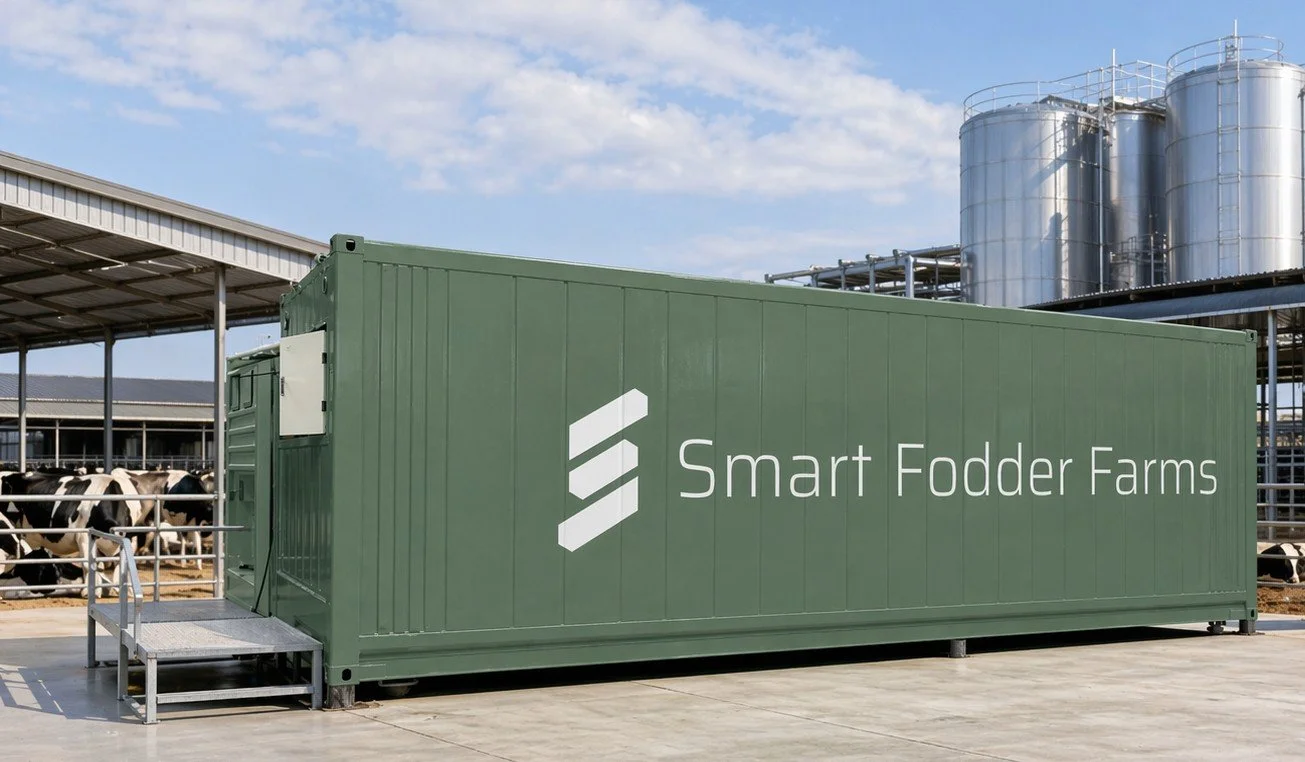
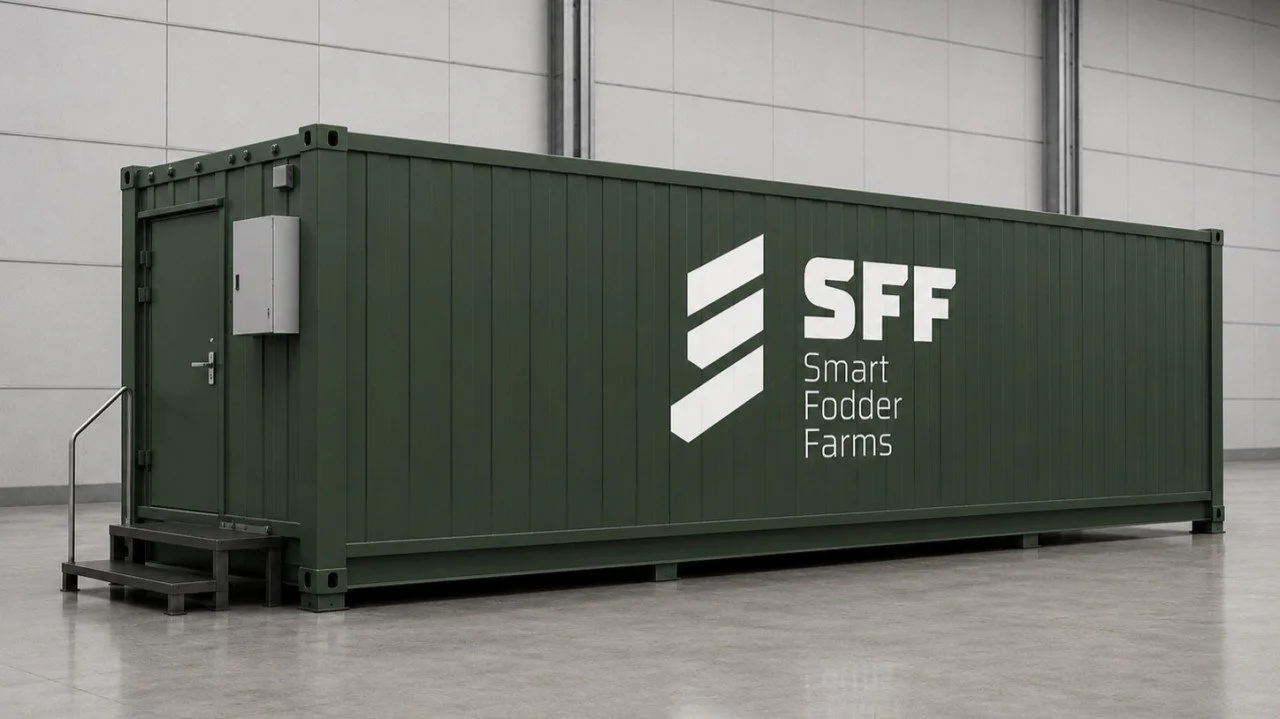
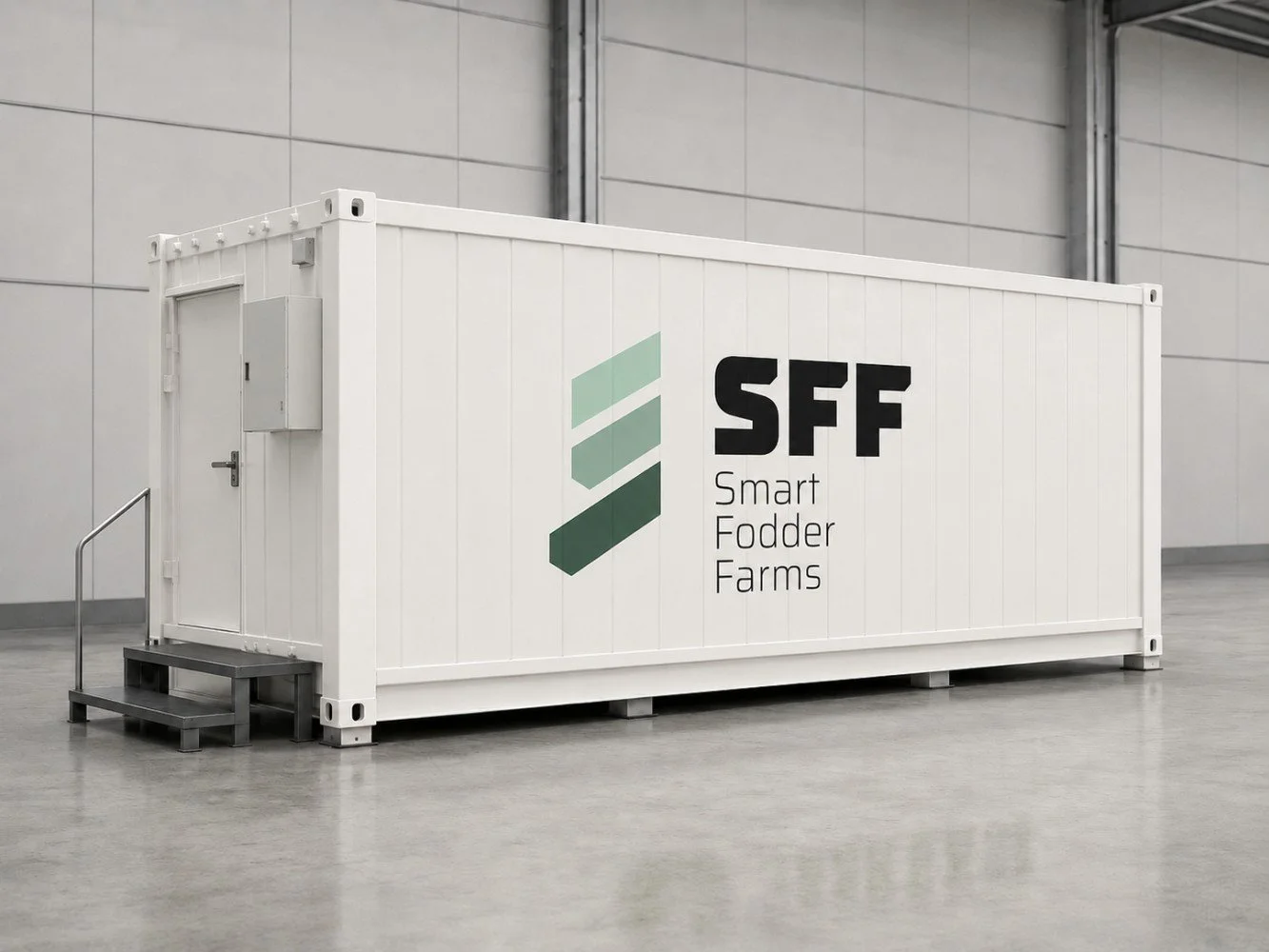
A Smart Fodder Farms container allows livestock companies to start producing fresh hydroponic fodder directly on-site, inside a controlled and automated production module. The system is designed to germinate and grow cereals and legumes under controlled humidity, temperature, irrigation and lighting conditions, producing fresh green fodder with high palatability and digestibility.
The key point is not only production. The key point is control.
A farm can begin with one container, validate the operation, integrate the fresh fodder into its ration strategy, measure the impact on daily feeding logistics and then scale progressively with additional modules. That is the real advantage of a modular system.
You do not need to transform the entire feeding model in one single step. You can reduce dependence at your own pace.
Start with one container ➡️ Stabilise daily production. ➡️ Train the team. ➡️ Adjust the ration strategy. ➡️ Measure operational results. ➡️ Then add more modules when the farm is ready to increase internal fresh fodder capacity.
This is how a livestock company moves from buying feed reactively to building a more resilient production model.
Smart Fodder Farms offers different container formats, including 20’, 40’ and 40’ High Cube models, so each project can be adapted to the size of the farm, the number of animals, the available space and the daily production target.
For higher-capacity operations, the 40’ High Cube model is especially relevant. It can produce up to approximately 840 kg of fresh hydroponic fodder per day, with 440 trays and 6-day production cycles.
That means a cattle company can install one unit as a first production base and then grow by adding more containers according to herd size, consumption strategy and future expansion plans.
One container is a starting point. Several containers become a fresh fodder production platform.
This matters because livestock companies in the Middle East are operating in one of the most demanding environments in the world: high temperatures, limited arable land, water pressure, high demand for animal protein and strong exposure to imported agricultural inputs.
In this context, scalability is about reducing vulnerability.
Every container added to the farm increases internal production capacity. Every kilo of fresh fodder produced on-site reduces dependence on external supply. Every controlled production cycle gives the farm more predictability in a market that is becoming less predictable.
For cattle farms, this can support a more stable feeding strategy throughout the year.
Fresh hydroponic fodder can be produced 365 days a year, without requiring fertile soil, large forage fields or conventional irrigation land. The crop is grown vertically in multiple levels, inside a compact space, with automated control of irrigation, lighting, ventilation, humidity and temperature.
The result is a system designed for professional farms that need daily output, operational discipline and controlled production.
This is a solution for livestock companies that want to take back part of their feed production.
The farms that continue depending entirely on imported alfalfa and external forage suppliers will remain exposed to every disruption in logistics, every price increase and every supply constraint.
The farms that start producing part of their fresh fodder on-site will have a different position.
➡️More control.
➡️More planning capacity.
➡️More resilience.
➡️More room to grow.
A scalable hydroponic fodder strategy does not need to start with a massive installation. It can start with one container and grow module by module, according to the real needs of the farm.
That is the strength of the model.
It allows cattle companies to make a first step, validate the system and expand sustainably, instead of waiting until feed costs or supply problems become impossible to ignore.
If you manage, operate or purchase for a cattle farm in the Middle East, this is the conversation worth having now:
How much fresh fodder should your farm be producing internally in the next 12 months?
Send us your herd size, your current feed challenge and your daily production target.
We will help you evaluate which container model fits your operation and how to scale your hydroponic fodder production step by step