


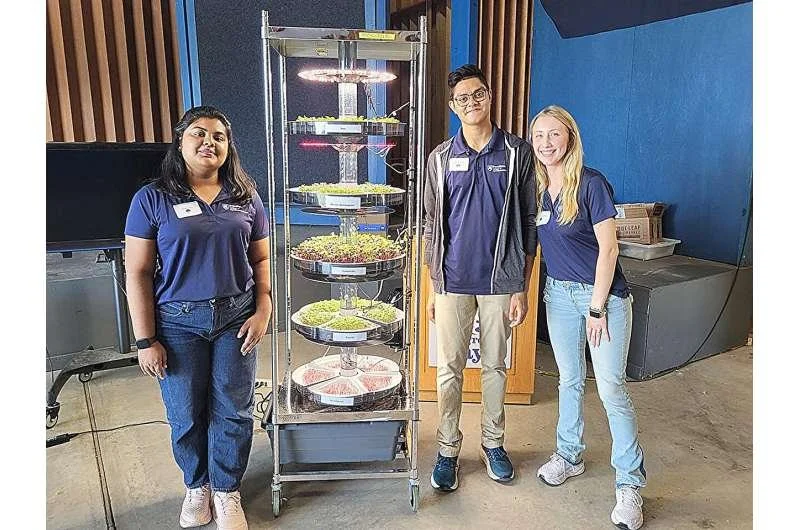
Three members of the microgreens research team standing next to a vertical hydroponic tower for the cultivation of microgreens. From left: Sanchita Saha, Rishi Ravichandran, and Aline Novaski Seffrin. Credit: Penn State
Microgreens are nutritional powerhouses. A team of plant scientists at Penn State conducting research on multiple aspects of microgreens recently published three studies reporting progress on multiple fronts, including iron enrichment, productive indoor growth and a faux lightning technique that could improve microgreens' growth, yield and nutritional quality.
First, the researchers found that in soilless growing systems, adding modified iron fertilizer can make radish and pea microgreens significantly richer in iron without substantially compromising their growth or nutritional quality. That's important, they said, because growing iron-enriched microgreens could be a practical way to improve dietary iron intake and help combat human iron deficiency. The researchers recently published their findings in Biological Trace Element Research.
In a second study, the team determined the effect of the red-to-blue LED light ratio on growth and quality of microgreens grown indoors under low-light conditions. By adjusting the ratio of red and blue light under energy-efficient light intensity levels, the researchers concluded that indoor growers may be able to produce microgreens with more desirable nutritional properties. They recently published their findings in Horticulturae.
Finally, in a third study, the team found that plasma-activated water—made by exposing water and the air directly above it to high-voltage electrical discharges, mimicking natural lightning to dissolve oxygen and nitrogen into the liquid—could improve the growth, yield and nutritional quality of pea microgreens. They recently reported their findings in the Journal of the Science of Food and Agriculture.
"Each study is addressing a different issue; however, in all three we are using agronomic approaches—crop management practices—and technological solutions to enhance the quality and nutritional value of microgreens, while improving their resource-use efficiency," said team leader and senior author on all three studies, Francesco Di Gioia, associate professor of vegetable crop science in the College of Agricultural Sciences.
"The work is important because the microgreen industry is continuing to grow, and with nutrient-dense microgreens, we can address malnutrition issues and improve our diet."
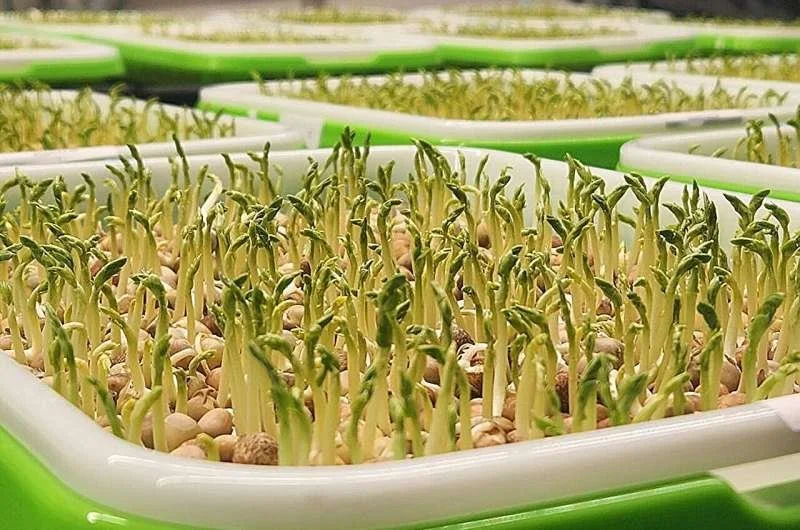
In this study, the researchers tested five iron fertilizers to determine which was most effective at increasing iron levels in radish and pea microgreens. Pea plant early shoots are shown here. Credit: Penn State
Fertilizing microgreens yields iron-rich plants
In this study, the researchers tested five iron fertilizers to determine which was most effective at increasing iron levels in radish and pea microgreens. The fertilizers were applied through irrigation at different concentrations. A fertilizer called Fe-EDTA was the most effective, the team found. It increased iron content by three to five times in radish microgreens and two to three times in pea microgreens compared with plants that received no iron fertilizer.
According to the researchers, Fe-EDTA fertilizer could be highly effective for iron biofortification in microgreens because it provides a stable, highly water-soluble and bioavailable form of iron under typical microgreens growing conditions.
"Fertilizing microgreens with iron is tricky because its chemical form affects how easily plants can absorb it," said study first author Rishi Ravichandran, a doctoral candidate in the intercollege graduate degree program in plant biology. "Also, in excess amounts, iron can compete with the uptake of other essential minerals and can become toxic for plants, so our experiment was a bit of a delicate balance."
The team was able to demonstrate that Fe-EDTA provided a more stable form of iron and increased iron content while causing minimal negative effects on plant yield and mineral composition.
"It's really the first time the enrichment efficacy of different iron fertilizers has been tested in microgreens," Ravichandran said.
Iron deficiency in people—primarily affecting women and children—can lead to physical and cognitive problems, and growing iron-enriched microgreens could be a practical way to improve dietary iron intake and help combat iron deficiency at household and community scales, he added.
Discover the latest in science, tech, and space with over 100,000 subscribers who rely on Phys.org for daily insights. Sign up for our free newsletter and get updates on breakthroughs, innovations, and research that matter—daily or weekly.
LED lighting color ratios affect growth, nutrients
In the second study, the team experimented with the red-to-blue LED light ratio under low-light conditions typical of indoor microgreens growing operations to improve the growth, quality and nutritional content of radish and broccoli microgreens.
The researchers found that microgreens grown under 100% blue, red or white light grew taller, which is generally not desirable as shorter shoots are preferred. Blue light produced the tallest shoots and the lowest dry biomass—plant material after water is removed. Higher dry matter content is better for shelf life. However, the blue light produced the highest antioxidant activity in plants—which can help combat free radicals and promote human health—increasing antioxidants by about 16.3% across both microgreen species.
Different light combinations resulted in changes in the plants' mineral contents. A mixture of 75% red and 25% blue light produced the highest nitrogen content, the team reported. In broccoli microgreens, exposure to red and blue light also increased iron concentrations by 15% to 20% compared with single-color or white light.
No single light treatment was best for every outcome, noted study first author Aline Novaski Seffrin, a doctoral candidate in agricultural and environmental plant science. Blue light favored antioxidant activity, while mixed red and blue light reduced shoot height and improved certain mineral levels.
"Blue light may help microgreens develop more antioxidants, while combining red and blue light may help them accumulate certain minerals," she said. "The ideal light combination depends on whether the goal is to maximize growth, biomass or nutritional value. It may be possible for growers to customize light regimens to achieve certain plant qualities."
While light quality is known to influence plant growth and phytochemical accumulation, before this research, little was known about how red-to-blue LED ratios affect microgreens under low-light conditions, Novaski Seffrin said.
"This study is among the first to systematically evaluate the effects of red-to-blue spectral combinations on both productivity and nutritional quality of brassica microgreens grown under low-light conditions," she said. "By examining growth, mineral composition, pigments and antioxidant traits, this work provides new insights into how spectral management can be used to maintain crop performance and enhance nutritional value in light-limited environments, supporting more nutrient-dense and resource-efficient microgreen production."
Stored, plasma-activated water best to grow microgreens
The third study focused on plasma agriculture, a new, clean technology that uses only air, electricity and water, pointed out first author Sanchita Saha, who earned her master's degree from the Department of Plant Science this past spring and is now a doctoral student at the University of Florida. Initially, she said, the research team's focus was the effect of plasma-activated water on microgreens' growth and yield, but they quickly assessed that the method improved plant qualities.
"The study suggests that plasma-activated water could be a more sustainable way to grow microgreens by improving plant productivity, water-use efficiency and nutritional quality while potentially reducing reliance on synthetic fertilizers," Saha said. "With the right treatment and storage times, it could become a one-stop sustainable technology that benefits the environment, growers and consumers alike."
The team specifically considered plasma-activated water as a possible substitute for synthetic nitrogen fertilizer applications.
"However, plasma-activated water is not merely substituting nitrogen fertilizer," Di Gioia said. "It is a more complex input that also has the potential to enhance the nutritional profile of microgreens."
In the study, the researchers found that fresh plasma-activated water—used immediately after plasma treatment—contained more reactive oxygen and nitrogen compounds and had a lower pH. Water undergoing moderate treatment times of 30 to 90 minutes increased pea microgreen yield by 5% to 13%, but water given the longest treatment time of 120 minutes reduced microgreen yield, possibly because it stressed the plants.
Storing plasma-activated water for 72 hours changed the water's chemistry, the team reported. Short-lived reactive compounds decreased, while nitrate levels increased. Every stored-water treatment improved pea microgreen yield compared with tap water, and some outperformed conventional nitrogen fertilizer.
The best outcome was achieved with plasma-activated water treated for 60 minutes and stored for 72 hours. That combination increased microgreens' biomass by 19.7% and water-use efficiency by 21.5%.
Stored plasma-activated water also increased the plants' calcium and magnesium content and raised levels of beneficial plant compounds, the team reported, including carotenoids, phenolics and flavonoids—compounds associated with antioxidant activity.
Publication details
Rishi Ravichandran et al., Speciation-Dependent Iron Uptake Drives Biofortification Efficiency and Nutritional Quality in Radish and Pea Microgreens, Biological Trace Element Research (2026). DOI: 10.1007/s12011-026-05319-8
Aline Novaski Seffrin et al., Red:Blue LED Ratio Modulates Growth and Nutritional Quality of Brassica Microgreens Under Low Daily Light Integral, Horticulturae (2026). DOI: 10.3390/horticulturae12101210
Sanchita Saha et al., Plasma‐activated water processing and storage time impacts pea microgreens yield and quality, Journal of the Science of Food and Agriculture (2026). DOI: 10.1002/jsfa.71124
Journal information: Journal of the Science of Food and Agriculture