


Welcome to iGrow News, Your Source for the World of Indoor Vertical Farming

VIEDO: How To Make Cupcake Microgreens At Home With A Cupcake Container And Lid
How to make cupcake microgreens at home with a cupcake container and lid.

Glase Provides Analysis of CEA Market Growth To Industry Members
Using the results of the USDA’s 2007, 2012 and 2017 censuses, Mattos discussed the national market growth of food crops produced under protection with detailed analyses of the top producing states
During GLASE’s Industry Talks series presentation, executive director Erico Mattos discussed changes to the CEA market based on USDA Census of Agriculture data.
By David Kuack
One of the benefits offered by the Greenhouse Lighting and Systems Engineering (GLASE) consortium to its industry members is its Industry Talks series. This series of informal conversations are presented by academics and field experts who focus on topics suggested by the consortium’s industry members.
During the consortium’s Industry Talks presentation in August, GLASE executive director Erico Mattos reviewed controlled environment production market growth based on the results of the USDA’s Census of Agriculture. Using the results of the USDA’s 2007, 2012 and 2017 censuses, Mattos discussed the national market growth of food crops produced under protection with detailed analyses of the top producing states. The full video can be accessed by GLASE members at the GLASE.org
Increasing value of protected food crops
Total market value for all protected food crops, including tomatoes, vegetables, berries, and fresh herbs, increased 17.9 percent from 2012 to 2017. Market growth for sales of all protected food crops increased 20 percent from $634 million in 2012 to $748 million in 2017. Greenhouse tomato sales increased 4.7 percent from $400 million in 2012 to $419 million in 2017. Other greenhouse vegetable sales increased 40.6 percent from $234 million in 2012 to $329 million in 2017. Fruit and berries sales decreased 13.5 percent from $29 million to $25.1 million even though production area for these crops rose from 7.9 million square feet to 11.7 million square feet.
Greenhouse tomato production area expanded from 55.1 million square feet in 2012 to 63.9 million square feet in 2017, a 16 percent increase. For other greenhouse vegetables, production area rose from 42.8 million square feet in 2012 to 48.6 million square feet in 2017, a 13.6 percent increase.
Only other greenhouse vegetables and fresh-cut herbs saw an increase in market share from 2012 to 2017, rising from 35 percent to 43 percent. Both greenhouse tomatoes and fruit and berries saw a decline in market share between 2012 and 2017. Tomatoes fell 6 percent from 60 percent in 2012 to 54 percent in 2017. The decrease for fruit and berries was only a 1 percent drop from 4 percent in 2012 to 3 percent in 2017.
Increase in protected food crop operations, production area
The number of protected growing operations increased for all crop categories between 2012 and 2017. The number of farms producing greenhouse tomatoes rose 26 percent, up from 6,323 operations in 2012 to 7,974 operations in 2017.
The number of farms producing other greenhouse vegetables rose 36.6 percent between 2102 with 5,268 operations to 7,198 operations in 2017.
Farms producing greenhouse fruit and berries also saw a double digit increase (25.7 percent), up from 673 operations in 2012 to 846 operations in 2017.
Number of small farms increasing
Mattos said the increase in the number of protected crop operations is driven by the establishment of smaller farms.
“There are a lot of smaller farms producing greenhouse vegetables, but they represent a very small part of the market share,’ he said. “In general, as the size of the farms increases the value of sales increases until the size of operations reaches 40,000 square feet or more where there is a dramatic jump in the value of sales.”
Small size farms from 1-999 square feet represent 31.6 percent of the number of farms in the United States. These small operations only cover 1.1 percent of the square foot production area for the total industry. These farms also only represent 1 percent of total sales. They are receiving a net rate of $5.74 per square foot for what they are selling.
Operations from 1,000 to 2,999 square feet account for 32.8 percent of U.S. farms. The net rate sales are the lowest for operations from 2,000 to 2,999 square feet at $4.42.
Those greenhouse vegetable operations with 20,000 to 39,999 square feet in size are earning the most money per square foot at $11.23 per square foot. Mattos said this size category might be a good mix of technology and greenhouse management and are definitely doing something right.
Mattos said there are fewer large farms producing greenhouse vegetables, but they dominate a big part of the market. The largest operations in the U.S. with 40,000 or more square feet represent 2.7 percent of the number of farms. However, they account for 67.6 percent of the square footage (76.1 million square feet) in the U.S. These large operations also have the highest value of sales per square foot at 67.8 percent. These farms are making $6.67 per square foot.
For greenhouse tomatoes, the largest operations are the most efficient, accounting for 74.5 percent of sales and having the largest return per square foot at $7.28.
Major protected-environment producing states
On a state-by-state basis for all greenhouse vegetable categories, the top state in regards to market share value was California with 46 percent, which had a market value increase of 26 percent from 2012 to 2017. Even though the number of farms decreased from 427 to 409, the amount of square footage grew 24 percent from 28.3 million to 35.2 million square feet.
Other leading states with market share included Texas (14 percent), Ohio (10 percent), New York (9 percent), Maine (8 percent), Virginia (7 percent) and Minnesota (6 percent). Ohio had the largest rise in sales, increasing from $10.5 million in 2012 to $43.8 million in 2017, accounting for an increase of 317 percent in just five years. Virginia also experienced a large sales increase (270 percent), going from $8.5 million in 2012 to $31.5 million in 2017.
While California still had the largest market share (33 percent) for greenhouse tomatoes, it wasn’t as dominant as it was for total greenhouse production. Other states which accounted for greenhouse tomato market share included Texas (21 percent), Ohio (13 percent), New York (12 percent), Minnesota (10 percent), Arizona (6 percent) and Illinois (4 percent).
States with the largest increase in tomato share included Ohio (908 percent increase), going from $3.2 million in 2012 to $32.1 million in 2017. Illinois also saw a major rise in greenhouse tomato sales going from $1.7 million in 2012 to $10.7 million in 2017, a 517 percent increase.
For other greenhouse vegetables and fresh-cut herbs, California dominates sales ($126. 2 million) with 60 percent of the market. Virginia followed with 11 percent of the market and Illinois had a 7 percent market share. These two states had the largest growth in this crop category with sales in Illinois rising 565.8 percent from $2.2 million in 2012 to $14.3 million in 2017. Virginia saw sales grow 245 percent from $6.7 million in 2012 to $23 million in 2017.
For more: Erico Mattos, Greenhouse Lighting and Systems Engineering (GLASE), (302) 290-1560; em796@cornell.edu; https://glase.org.
David Kuack is a freelance technical writer in Fort Worth, Texas; dkuack@gmail.com.
Posted in News

Netled To Supply SweGreen With Production Units
Netled has signed a distribution agreement with Swedish technology company SweGreen. They will start providing Vera Compact Production Units for SweGreen’s urban farming destinations in Sweden. SweGreen is an innovation and technology urban farming company based in Stockholm. The company provides circular solutions for controlled-environment urban farming
Netled has signed a distribution agreement with Swedish technology company SweGreen. They will start providing Vera Compact Production Units for SweGreen’s urban farming destinations in Sweden.
SweGreen is an innovation and technology urban farming company based in Stockholm. The company provides circular solutions for controlled-environment urban farming. By integrating smart vertical farming solutions into real estate properties SweGreen provides circular energy-waste-water and carbon-absorbing systems, which enable locally grown, quality greens and help minimize the environmental footprint of facilities. Under the brand Stadsbondens, SweGreen’s CityFarm in Stockholm produces herbs for ecological-minded citizens all year round in a sustainable way.
Netled´s Vera Compact Production Units are especially well-suited for limited scale production of salads, herbs, seedlings and pot plants, and will complement SweGreen’s efforts perfectly.
For more information:
Netled
netled.fi

Publication date: Tue, 08 Oct 2019
Bootstrap Farmer Announces The Urban Farm Academy in NYC
Online Platform for Business & Workforce
Development is Evolving Local Food & Agriculture
New York, NY, September 23, 2019 -- Bootstrap Farmer, a company known for supplying small and medium-sized farms, announced the launch of the Urban Farm Academy during the NYC Agtech Week, a collaboration with entrepreneurs across food and agriculture.
The collaboration consists of entrepreneurs, teachers, and farmers rebuilding local food systems through the business they’ve created. The classes teach frameworks for developing, running & scaling a business or career inside of the hyperlocal food economy using their own businesses as the proof of concept.
“We’re people who came from other careers,” said Brandon Youst, a co-founder. “But we didn’t want to be commodity farmers. We wanted to leverage our past experiences to do something different within food & ag.”
This isn’t a typical academy with a typical curriculum. “These are self-guided courses for creating within a hyperlocal food economy. That means zero-waste supply chains, businesses built on relationships and lean-startup principles” said Youst.
There are future classes in development for addressing food deserts, teaching STEM through aquaponics and urban farm manager training.
The goal of this collaboration is to provide a low-cost education option outside of the traditional educational system. With higher education becoming increasingly expensive and less relevant in many areas, the Urban Farm Academy looks to provide an online option for those not needing a degree for the business they want to start, or the job they seek to get.
“As a business owner, I’d rather see what someone has accomplished rather than seeing what school they went to before I work with them. It’s just a better filter” said Jeff Bednar, co-founder, and owner of Profound Microfarms. “Through this academy, we want to help those who want to join the local food movement in a more practical way, and it doesn’t involve sitting in a classroom.”
The first courses are available through the website
www.urbanfarmacademy.com.
For all inquiries, please contact admin@urbanfarmacademy.com.

VIDEO: What Is Vertical Farming? And What Are The Benefits?
Higher yields, fresher food, smaller carbon footprint: This is the potential of vertical farming.
World Economic Forum
Higher yields, fresher food, smaller carbon footprint: This is the potential of vertical farming.
Read more about the inspiring pioneers finding creative solutions to climate catastrophe here:
https://wef.ch/pioneersforourplanet
About the series:
Each week we’ll bring you a new video story about the people striving to restore nature and fighting climate change. In collaboration with @WWF and the team behind the Netflix documentary #OurPlanet. #ShareOurPlanet
Want to raise your #VoiceForThePlanet? Life on Earth is under threat, but you can help. People around the world are raising their voice in support of urgent action. Add yours now at www.voicefortheplanet.org
Pakistan: A Futuristic Vertical Farm Now Blooms In Karachi’s Old Yarn Factory
Having setups like the vertical farm allows us to grow these vegetables within our own country throughout the year and then send it to the market. Pakistan’s first urban vertical farm is a commercial venture, with the produce being supplied to some of the city’s finest restaurants and supermarkets
NAIMAT KHAN
September 30, 2019
Pakistan’s first vertical farm grows eco-friendly, fresh greens for sale to city’s finest restaurants and markets
Urban agriculture is immune to the constraints of climate, allowing non-seasonal vegetables to grow year-round
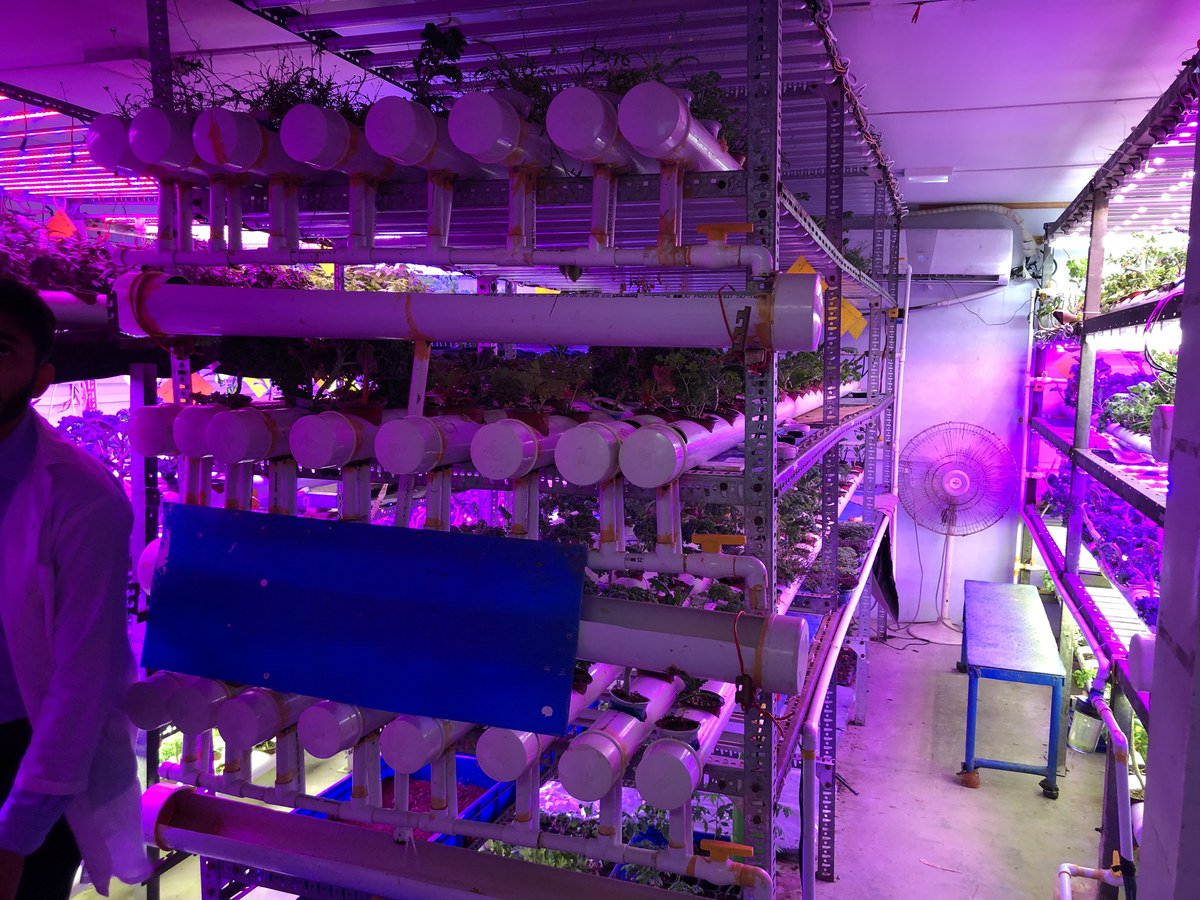
KARACHI: In 2006, Sohail Ahmed’s once-booming polyester filament yarn plant closed down due to a worldwide recession, alongside lawlessness and a power crisis at home, in Pakistan’s seaside metropolis of Karachi. Twelve years later, Ahmed has converted the top floor of the old yarn factory into a futuristic farm, with kale, rosemary and dozens of other vegetables growing vertically under the purple glow of LED lights.
Different types of vegetables, mostly non-seasonal, are grown at this vertical farm at the Site Industrial Area of Karachi, where light, humidity and temperature is optimally controlled. September 26, 2019. (AN Photo)
Pakistan’s first urban vertical farm is a commercial venture, with the produce being supplied to some of the city’s finest restaurants and supermarkets. But the use of hydroponics, where plants grow in nutrient solution instead of traditional soil, and where water is continuously recycled, contributes toward eco-friendly practices by using 90 percent less water than field farming, using no pesticides and omitting gas emissions involved in the long transportation routes from rural to urban centers- all leading to the freshest greens in the city.

Farhan Sohail, a process and product development engineer in Pakistan’s first vertical farm, speaks to Arab News in Karachi on September 26, 2019 (AN Photo)
“When our family business shut down in 2006, I started to think about different business models with the help of technology. In 2009, I did a course on environmentally friendly and futuristic plant growing technologies. In the next two years, we set up our flower greenhouses in Karachi and Murree,” Ahmed told Arab News, and added that the success of his greenhouses led him to think of urban agriculture as a serious business model.
Different types of vegetables, mostly non-seasonal, are grown at this vertical farm at the Site Industrial Area of Karachi, where light, humidity and temperature is optimally controlled. September 26, 2019. (AN Photo)
Ahmed and his son, Farhan Sohail, an engineering graduate from the American University, started working on the urban agriculture project in 2016 and by April 2018, their vertical farm had been set up in the 60 ft. room, and already blooming.
Farhan, who largely oversees the project, said around 2,500 plants of kale, cherry tomatoes, pak choi, iceberg lettuce, red swiss chard, rocket, basil, capsicum, jalapenos, microgreens, parsley, celery, oregano, rosemary, thyme, and sage are grown within a cycle of 45 to 60 days from the time of seeding to harvesting.
Different types of vegetables, mostly non-seasonal, are grown at this vertical farm at the Site Industrial Area of Karachi, where light, humidity and temperature is optimally controlled. September 26, 2019. (AN Photo)
Farhan explained the nutrient solution traveled from a tank into PVC pipes which became inundated, and because the plants rested inside these pipes, when they were flooded, the roots took water up and the plant watered itself.
Dim LED lights are optimized for every plant, adjusted according to its own declared spectrum.
“In addition to that, we also artificially provide exactly what the plant needs in terms of carbon dioxide, humidity as well as temperature levels,” Farhan said.
Different types of vegetables, mostly non-seasonal, are grown at this vertical farm at the Site Industrial Area of Karachi, where light, humidity and temperature is optimally controlled. September 26, 2019. (AN Photo)
“We have 70 times more production per square meter as compared to field farming,” he said, and added that the elimination of pesticides and preservatives, meant the produce that came out of his vertical farm was “extremely healthy.”
Urban agriculture is largely immune to the restraints of climate conditions, which force most farmers in Pakistan to stay away from growing certain crops throughout the year and adding to the country’s import bill, Farhan said.
Different types of vegetables, mostly non-seasonal, are grown at this vertical farm at the Site Industrial Area of Karachi, where light, humidity and temperature is optimally controlled. September 26, 2019. (AN Photo
“Having setups like the vertical farm allow us to grow these vegetables within our own country throughout the year and then send it to the market,” he said, and added that if the model was successful on a large scale, Pakistan could start producing vegetables for export to international markets as well, especially to the Middle East.

Green Walls Can Purify Indoor Air And Even Grow Veggies
Want to insulate your office from the heat and cold outside, while purifying the air inside from potential toxins? Israeli startup Vertical Field is accomplishing that with sensor-controlled indoor and outdoor “green walls” installed by the likes of clients such as the Israeli offices of Google, Apple, Intel, and Facebook
Israeli startup Vertical Field sensor-controlled smart planters allow customers to place hundreds of greens up and down a wall, indoors or outdoors.
By Brian Blum OCTOBER 6, 2019
Green walls purify indoor air. Photo courtesy of Vertical Field
Want to insulate your office from the heat and cold outside, while purifying the air inside from potential toxins? Israeli startup Vertical Field is accomplishing that with sensor-controlled indoor and outdoor “green walls” installed by the likes of clients such as the Israeli offices of Google, Apple, Intel, and Facebook.
Indoor air pollution is an invisible but serious problem. High levels of carbon dioxide (CO2) in offices, classrooms, homes, trains, and planes could be affecting our cognitive performance and in more severe cases may trigger inflammation or even kidney calcification and bone demineralization, according to a recent study published in Nature Sustainability.
Guy Elitzur, Vertical Field’s CEO, tells ISRAEL21c that one solution to “sick building syndrome”is to bring healthy and natural elements inside.
Plants work their magic by transforming carbon dioxide (CO2) into oxygen via photosynthesis. Installing a Vertical Field living biofilter in your home or office can remove about 95 percent of the pollutants in a building, the company claims.
Vertical Field’s green walls are not static. Sophisticated sensors measure fluctuating air quality in the building, while cameras track how many people are in a room bumping up the amount of CO2.
When the CO2 level goes above a certain threshold, Vertical Field can “manipulate the plants in an active way,” Elitzur says, by adding precise amounts of water, fertilizer and other nutrients through drip irrigation into the planters’ soil in order to increase absorption of CO2 and other allergens.
The result is “a wall that reacts to the indoor environment,” Elitzur explains. “It’s not just for beauty” — although a vertical wall of plants is that, too.
A typical Vertical Field installation contains between five and 15 types of plants. Software and big data drive the system’s customization.
“We have a characterization for each type of plant – its soil needs, the vitamins it requires to be more efficient, plus data coming from outdoors,” Elitzur notes. “This creates the best-growing program for each specific plant.”
A vertical forest on the exterior of a building creates a protective ecological shell. Photo courtesy of Vertical Field
Vertical Field also installs “vertical forests” on the exterior of buildings. Israeli cybersecurity leader Check Point, for example, has a green wall outside floors 12 to 15 of its Tel Aviv offices.
Elitzur says the vertical forest creates an ecological shell that protects the building against direct radiation from the sun and enables a more stable internal temperature with less artificial cooling.
The cost for installing a vertical green wall starts “from a couple of thousand shekels per square meter,” Elitzur tells ISRAEL21c. The outdoor ones “are less sophisticated so they cost a bit less.”
Urban farming
Purifying the air and insulating buildings is only part of the Vertical Field story. The company also specializes in urban farming: a green wall growing lettuce and other leafy greens.
One such customer isTel Aviv chef restaurant L28, which grows organic pesticide-free vegetables in a vertical farm on the building’s roof.
A vertical wall growing edible greens. Photo courtesy of Vertical Field
In New York, Vertical Field has a project installed “in a shipping container in the parking lot of a hotel and another one at a senior living facility,” Elitzur says. In the latter, the seniors take an active part in planting and harvesting.
An urban farm on the roof of a supermarket could provide the store’s customers fresher produce with no carbon footprint since the vegetables do not have to be trucked in from a far-off farm.
“The technology we’re creating can help bridge the way we live today with the complexity of nature,” Elitzur says.
Vertical Field CEO Guy Elitzur. Photo: courtesy
Vertical Field was founded in 2006 by Guy Barness. Guy no. 2 (Elitzur) came to Vertical Field from Bio Ag Technology, a startup that has developed eco-friendly biological pesticides.
“It was the same concept of doing something better for the globe and lowering the chemical footprint,” Elitzur says.
Vertical Field already has hundreds of projects, mainly in Israel through its Israeli subsidiary, Green Wall. Vertical Field is the entity that’s expanding beyond the Middle East, with the United States as its first target market.
While Vertical Field is focused on corporate clients, it can install a green wall in a private home thanks to a cadre of trained subcontractors, Elitzur says.
Vertical Field is not alone in offering vertical farming and green walls. Other companies include Germany-based InFarm, Freight Farm (which specializes in container farming) and Florida-based Live Wall and GSky. The latter is the biggest of the bunch with more than 800 green walls installed in 19 countries.
We asked Elitzur what makes Vertical Field different.
“All of us are great,” he says. “But we’re the only ones using soil to grow. Most of the others are based on hydroponics. Soil is a better way to grow plants. It provides a better ecosystem and is healthier. But there’s a place for everyone. We’re all serving a very good cause.”
For more information, click here
Founders Brewing Executive Named CEO of West Michigan Hydroponics Farm
John Green, who for more than a decade served as executive chairman of Founders Brewing Co., has been named CEO of Revolution Farms, an indoor hydroponic farm based in Caledonia that grows lettuce and salad greens
September 17, 2019
John Green has been named CEO of Revolution Farms. (Courtesy photo)
By Brian McVicar | bmcvicar@mlive.com
CALEDONIA, MI — John Green, who for more than a decade served as executive chairman of Founders Brewing Co., has been named CEO of Revolution Farms, an indoor hydroponic farm based in Caledonia that grows lettuce and salad greens.
Green is a founding investor in the farm and has served as acting CEO for the past three months, according to a news release. He is also chairman of its board of directors.
“We launched Revolution Farms to change the world by changing the way we grow food," he said in a statement. “Our revolution begins at home, by growing closer to where we live, more sustainably, with less water and land, and figuring out how to accomplish this in Michigan all year long.”
Revolution Farms has the capacity to produce more than 500,000 pounds of lettuce and salad greens on a yearly basis at its 85,000-square-foot indoor farm on 76th Street in Caledonia, the company says. Its products are sold at Family Fare, D&W Fresh Market and VG’s Grocery stores across Michigan.
West Michigan company's innovative salad greens now on store shelves
Revolution Farms is selling its product in 16 SpartanNash stores in Michigan.
The farm grows its products using 95 percent fewer acres and 90 percent less water than traditional farming methods, Green said. Its salad greens can be shipped to stores in one or two days, “less than half the time it takes for lettuce grown and shipped from California, Arizona, and Mexico to make it to Michigan store shelves.”
Green has worked at Founders since 2006. He will remain at the brewery while its majority ownership transitions to Spanish brewing conglomerate Mahou San Miguel. Founders announced late last month it was selling a 59 percent ownership stake in the company to Mahou.
The deal is expected to close next year and was valued at $198.8 million, according to documents filed with the Michigan Liquor Control Commission. Once completed, the deal will boost Mahou’s ownership of Founders to 90 percent. Mahou purchased a 30 percent ownership stake in Founders in 2014.
Green is among a group of Founders shareholders selling their stake in the company to Mahou. Records submitted by Founders to the liquor control commission show Green owned an 8.03 percent stake in the company. In addition, members of his family-owned an 8.36 percent stake in Founders.
In addition to his position at Revolution Farms, Green will maintain roles with Odyssey Media Group and Cirkul.
He also serves as director of the Grand Valley State University Foundation and is a founding board member of Grand Rapids Whitewater. Green also sits on the board of directors for the Grand Rapids Downtown Market.
In addition to Family Fare and other SpartanNash grocery stores, Revolution Farms sells its products through Doorganics, an organic grocery delivery service based in Grand Rapids, and Van Eerden Food Service.

Rochester Institute of Technology: New "AgTech" Cropping Up On Campus
RIT recently hired its first-ever farmer, David Brault. Brault, a native of Irondequoit, New York and a University of Vermont graduate in Horticulture, is now taking care of leafy greens and herbs grown on-site in RIT’s new hydroponic container farm. The farm is located in a 40-by-8-by-9.5-foot up-cycled shipping container just behind the Campus Center
by Catherine Rafferty | published Oct. 8th, 2019


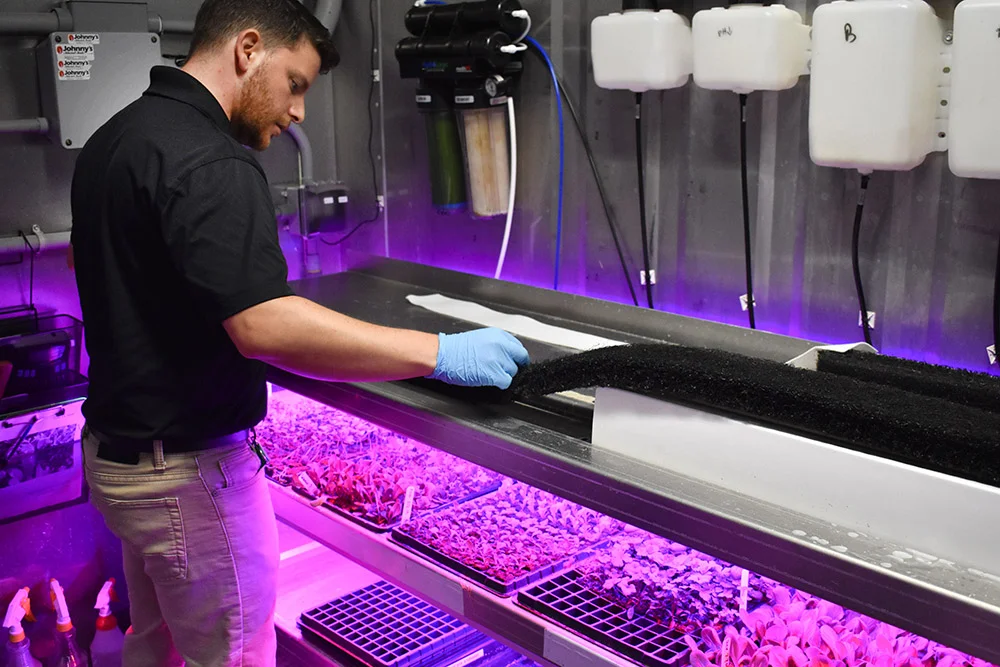


RIT recently hired its first-ever farmer, David Brault. Brault, a native of Irondequoit, New York and a University of Vermont graduate in Horticulture, is now taking care of leafy greens and herbs grown on-site in RIT’s new hydroponic container farm. The farm is located in a 40-by-8-by-9.5-foot up-cycled shipping container just behind the Campus Center.
“Alright, close your eyes and picture a farm. You'll see a field, maybe someone on a tractor and there's dirt and all that," Brault described. "Then you go a step removed, and you put in a greenhouse. And then you take a step farther and now you've got a hydroponic greenhouse. And you remove the greenhouse and you've got hydroponics inside this container. So it's different.”
The farm was installed on June 10, 2019. Kory Samuels, executive director of RIT Dining Services, said the project made sense with the recent renovation of Gracie’s as just another way to “up our game” in the quality of food on campus. RIT is just one of two universities in the state to have a hydroponic farm on campus, the other being Stony Brook University in Stony Brook, N.Y.
HOW DOES IT WORK?
Hydroponics is defined as growing plants with nutrients and water but without soil. The plants are rooted either in water or an artificial medium which can include substances like sand, gravel, perlite, peat moss, sawdust, coir or Rockwool.
Some crops are better to grow hydroponically than others. Brault said he started by growing lettuce and herbs because of their size and quick turnover rate. Crops like corn are a less practical option because of the lower yields and the space needed to grow it. The container is lit by LEDs that use special bulbs emitting only red and blue light spectra, the most beneficial lighting for optimizing plant growth.
RIT’s farm is a vertical farming system created by Freight Farms, which has provided shipping container farms to many other college campuses. The container is insulated so crops can be grown year-round. Brault can control lighting, temperature, humidity, carbon dioxide levels, concentration of fertilizer and pH levels in the farm all from his smartphone. It operates as a closed system, meaning the water used to feed the plants is recycled for the next crops.
"This is an offering that I think distinguishes us versus other campus dining programs."
WHY HYDRO?
Samuels first saw a shipping container farm at a National Association for College and University Food Service conference back in 2016. Samuels had noticed an interest in seasonal menus and locally sourced produce at other universities. RIT doesn't have an agriculture school, so Samuels saw the hydroponic farm as the perfect solution for RIT's tech-oriented community.
“It was an idea that was kind of put on our roadmap that it'd be cool to eventually get to the point where we are not just sourcing our food as local as possible, but potentially actually being a part of the food system," Samuels said.
In terms of food safety, it's safer for RIT Dining to produce their own product because they can control everything, including the cleanliness of the space, the fertilizer they grow with, the water they use and who touches the product.
In terms of sustainability, Brault explained, you don't have to worry about fertilizer runoff — a major concern in conventional agriculture. It's also hyperlocal, so any emissions that would have been produced in processing and transporting the product are eliminated.
“This requires capital investment, but once it’s operational, it is lower maintenance. Also you get more yield, so you can grow a lot more in a smaller space and you can grow crops faster and you get a better quality and quantity of crop — and you can do it all year,” Brault stated.
The farm is also an appealing addition to RIT's dining resume. RIT Dining can make decisions about its offerings since it's all in-house owned and operated. Samuels and Brault see this program as a new way to draw in prospective students. Campus life is an important part of the college experience, and food is just one aspect of that. Brault thinks that students' expectations are setting the bar high.
“They [students] are starting to expect a different level of experience in dining. This is an offering that I think distinguishes us versus other campus dining programs,” Brault said.
IMPACT
The first container is just a small seed in a larger plan for RIT Dining and its farm. Both Brault and Samuels would like to see the program expand, in growing more crops and potentially adding more containers to campus. They also see the farm becoming a teaching tool for students. Samuels suggested farming could become a new wellness or sustainability course offering in the future for students to learn more about the agriculture industry.
"I look at the farm as a way to connect our department and students in just another way."
Brault was hired to jump-start the program, but there's talk of bringing in student employees to assist with planting and harvesting. There's the potential for co-op and research opportunities collaborating with programs in the academic departments or Student Affairs. Collaboration could also extend out into the greater Rochester community through programs like FoodLink and Recover Rochester, said Samuels.
Overall, Samuels wants students to use the farm to connect and gain a new perspective.
"I look at the farm as a way to connect our department and students in just another way," he said.
RIT Dining will not be able to provide all the food on campus solely from the farm as they serve over 14,000 meals per day between all of their dining locations, concessions and catering. However, the farm will produce 10 to 15 percent of the produce on campus.
The farm is currently growing bibb lettuce, salanova lettuce, basil, cilantro, parsley, kale, swiss chard, tatsoi, mizuna and arugula. Next time you are at an RIT-catered event and you see some salad, know that it’s freshly grown — right from the container.

US (AZ): Controlled Environment Indoor And Vertical Food Production Coordinated Research Conference
FarmTech Society board member Penny McBride—who chairs the FTS committee on standardization—presented on the need for standards for food safety and was honored to sit on a panel alongside NASA plant scientists Gioia Massa and Arizona Food Safety inspector Stewart Jacobson
This year’s USDA–NIFA Conference, held at Biosphere 2 outside of Tucson, AZ, from September 9 to 12, brought together a diverse set of experts in the industry—scientists, engineers, economists, business people, and policymakers—to hear from panelists and form ongoing working groups.
Hosted by the University of Arizona’s innovative Controlled Environment Agriculture Center (CEAC), the goal of the conference was to create an interdisciplinary Controlled Environment Agriculture R&D Roadmap and Coordinated Research Plan, which will help these stakeholders apply for funding from the USDA to help fast-forward the CEA industry through basic and applied research.
The conference’s keynote speakers, panels, and breakout groups focused on:
Economics
Engineering
Production systems
Plant breeding
Pest and disease management
Food nutrition and safety
Industrial ecology in closed systems
FarmTech Society board member Penny McBride—who chairs the FTS committee on standardization—presented on the need for standards for food safety and was honored to sit on a panel alongside NASA plant scientists Gioia Massa and Arizona Food Safety inspector Stewart Jacobson. How CEA production can affect health and nutrition emerged as a key line of inquiry for researchers going forward.
Fellow board member Wythe Marschall—who chairs the FTS committee on education—served as record keeper for the engineering working group. The engineering group agreed on a need for benchmarks and open standards for lights, energy, sensors, and plant breeding.
Overall, FTS was brought into a series of discussions with leading CEA experts, furthering our mission of connecting the industry at a pre-competitive level and creating a platform for amplifying industry voices at the level of university education, government research, and policy.
The final day, conference participants met to discuss the current funding landscape for CEA and form new grant-writing groups to develop specific grant proposals.
For more information:
FarmTech Society
Tom Zoellner
tz@farmtechsociety.org
farmtechsociety.org
Publication date: Fri, 27 Sep 2019

Colorado: Urban Farm, Restaurant And Market Coming To Englewood
Behind that glass window will reside a hydroponic system where plants will grow on indoor towers. Hydroponics is a method of growing plants year-round in sand, gravel or liquid with added nutrients without using soil. Farms that use the hydroponic method use up to 10 times less water than traditional farms, according to the National Park Service
Grow + Gather Will Occupy The Old Bill's Auto Service Building


Monday, September 16, 2019
Joseph Rios
jrios@coloradocommunitymedia.com
George Gastis sold his tech business four years ago — a year after he packed his bags and moved to Englewood from Platt Park. Contemplating what his next move would be, he knew he always had a green thumb and a love for food.
At first, he had planned to find a property to purchase or rent where he would grow food that would be sold to grocery stores and restaurants. In the process of planning his next steps, Gastis purchased the old Bill's Auto Service building, located at 900 E. Hampden Ave.
“The idea quickly became more than just a place to grow food. There seemed to be a great opportunity to create a place where not only can we grow food, but reconnect the neighborhood and surrounding communities,” said Gastis, referring to places like Littleton, south Denver, Greenwood Village and other areas near Englewood. “Our geographic location is sort of strangely unique in the sense that we sit on the edge of some of those communities.”
After planning and talking to people from his past, Gastis realized there was an opportunity to create a hub around food at the old Bill's Auto Service building. Gastis seized the opportunity, and depending on construction, Grow + Gather will open its doors in October. The development will be a casual restaurant and a market that'll sell coffee and freshly harvested produce and foods - all grown at Grow + Gather.
“When we moved to this neighborhood, I saw the potential in this area. There wasn't a ton to do,” said Gastis. “Combined with trying to figure out what I wanted to do and recognizing the opportunity here — Englewood seemed to be in the process of reviving itself with a lot of new businesses moving in, a lot of development, certainly (Swedish Medical Center) and their role they played in the community — it seemed really interesting.”
The restaurant will be operated by chefs like Caleb Phillips, a Tennessee native who plans to bring a Southern twist to some of Grow + Gather's dishes. Phillips says the menu will be simple, but it'll center around ingredients that will come from Grow + Gather's farm. Some of its dishes will include biscuits, salads, pies, egg dishes, and grits. Beer will also be available at the restaurant, brewed from the second level of the building.
“It's just the neatest idea. I get to walk 20 yards to get fresh vegetables,” said Phillips. “The community has already been super kind and receptive. I think it's going to be a lot of fun.”
When customers walk through Grow + Gather's community room, an area designated for guests to have coffee and for classes on gardening and cooking, they'll be able to see their food being grown behind a glass window. Behind that glass window will reside a hydroponic system where plants will grow on indoor towers. Hydroponics is a method of growing plants year-round in sand, gravel or liquid with added nutrients without using soil. Farms that use the hydroponic method use up to 10 times less water than traditional farms, according to the National Park Service.
Gastis says the rooftop of the building will serve as rooftop greenhouse, where he'll grow crops like tomatoes.
“It is exciting to see a new business concept like Grow + Gather here in Englewood as well as the repurposing of the property once occupied by Bill's Auto Service. It is sure to bring new life to that area,” said David Carroll, executive director of the Greater Englewood Chamber of Commerce. The chamber works to promote its business members while engaging with new businesses in the city.
PHOTOS: COURTESY OF GEORGE GASTIS

5 Tips On Being More Sustainable, The Brooklyn Way
It’s easy to feel cynical in regards to the current state of our environmental resources. With the recent release of a United Nations report highlighting the dire future of our global food supply, fires scorching the Amazon rainforest and record-breaking temperatures hitting cities across the world, the news cycle continues to project little hope in solving our global climate crisis
September 6, 2019
Keyshae Robinson
Brooklyn Grange's Navy Yard location. Eagle file photo by Lore Croghan
It’s easy to feel cynical in regards to the current state of our environmental resources. With the recent release of a United Nations report highlighting the dire future of our global food supply, fires scorching the Amazon rainforest and record-breaking temperatures hitting cities across the world, the news cycle continues to project little hope in solving our global climate crisis.
But by implementing habitual sustainable practices into a daily routine, we can all be more active in preventing further damage to our fragile environmental ecosystem.
“I think it’s really about purchasing habits, consumption habits, waste habits,” said Anastasia Plakias, co-founder and COO of Brooklyn Grange Farms, the largest soil-based rooftop farming business in the world. “The key to sustainability is knowing you’re not going to be perfect and making peace with that.”
To make the transition of “going green” less intimidating, we spoke to three different eco-conscious organizations local to Brooklyn about how to be both more sustainable and more accountable. Here’s what they had to say:
Brooklyn Grange Farms:
The agricultural space opened their third farm, the largest to date, on Aug. 18th in Sunset Park. Aside from providing fresh produce to local farmer’s markets and restaurants, the space will absorb roughly 175,000 gallons of rainwater, helping to reduce the amount of CSO’s entering NYC’s water system. Learn more here.
1. Find practices that make you happy
“If you enjoy skincare or beauty routines, great! Save your coffee grinds and use them as a skin exfoliator. Or if it’s shopping, shop local by visiting the nearby co-op or butcher,” said Plakias. “Most New Yorkers are incredibly busy, so it has to be habits that spark joy in order for us to actually make a routine of it.”
Grow NYC
Founded in 1970, Grow NYC is the largest environmental nonprofit in the city. With several programs, including educational outreach, waste reduction, and community gardens, their efforts provide essential sustainable resources for more than 3 million New Yorkers. Learn more here.
2. Start small
“Cooking at home is a huge step in the direction of sustainability,” said Liz Carollo, assistant director of GrowNYC’s Green Market programming. “You can buy food directly from a farmer, save your food waste and take it directly to a market for composting, or drop off your old clothing so it doesn’t go into a landfill. All great efforts in reducing your carbon footprint.”
3. Don’t let false perceptions dissuade you
“We have markets in all five boroughs and we serve every single income level,” said Carollo. “It’s ridiculous that there is a belief that if you’re lower income, you aren’t concerned about the environment because those from vulnerable communities are the most impacted by climate change.”
Earth Angel
Headquartered in Brooklyn, Earth Angel is an organization holding the local entertainment industry accountable by mitigating the waste and disposal habits on production sets. The film industry has bypassed much of the environmental criticisms typically aimed at fashion, aviation or oil industries, despite contributing an estimated 500,000 tons of waste each year in production alone. Learn more here.
4. Cut back on meat
“It takes 660 gallons of water to produce one hamburger and people don’t often think about the environmental impact of agriculture,” said Emillie O’Brien, founder and CEO of Earth Angel. “When it comes to livestock, it’s even more exaggerated. Eating meat three times a week instead of five for example is a small shift that has a profound impact.”
5. Eliminate single-use plastic
“Plastics are a petroleum based product and a lot of them aren’t safe so I always advocate for using reusable straws, shopping bags, or avoiding ordering from delivery services,” O’Brien said.

Square Roots & Gordon Food Service Open Michigan Indoor Farm
The modular indoor farm, sited on less than two acres of the Gordon Food Service headquarters property, was almost immediately in production following construction completion earlier this month
September 30, 2019 - General News
(PHOTO: Square Roots) Meet the Square Roots Michigan Cohort (left to right): Rebekah Box, Winn Hermanski, Katie LaRue, Savie Sonsynath, Jacob Smaby, Jarad Jaent, Joshua Van Kleeck, Alyssa Patton, Amal Jennings.
PRESS RELEASE: Wyoming, MI, September 30, 2019
Gordon Food Service® BB #:100172, North America’s largest privately held and family-managed foodservice distributor, and Square Roots, the technology leader in urban indoor farming, today celebrated the opening of their strategic partnership’s first co-located farm at a ribbon-cutting event on the campus of Gordon Food Service’s headquarters in Wyoming, Michigan. In addition to executives and staff from both companies, guests included customers and local, state, and federal government officials. Attendees learned more about the facility, the first of its kind hosted by a broadline foodservice distributor, including a tour of the indoor farm’s operations.
In his remarks, Rich Wolowski, President and CEO, Gordon Food Service said, “We’re building exciting relationships with change agents that are helping to reshape how food is produced, prepared, and served – and Square Roots is a great example of leading-edge thinking and technology driving new solutions. We know it’s imperative that we participate in the future, today, to ensure we are relevant tomorrow, and this is a model that could help revolutionize our food systems. And it’s great that we can prove the concept in our own backyard.”
The modular indoor farm, sited on less than two acres of the Gordon Food Service headquarters property, was almost immediately in production following construction completion earlier this month. The ten cloud-connected growing units, employing sophisticated, digitally-controlled hydroponics and LED lighting systems, are projected to produce more than 50,000 lbs. of premium herbs and greens annually, or roughly the equivalent production of a traditional 50-acre farm. However, unlike more typical agriculture, the Square Roots produce will be non-GMO, pesticide-free, and harvested all year long. Initial crops will include basil, chives, and mint. The herbs will be sold to local foodservice customers in Grand Rapids as well as throughout Michigan, northern Indiana, and Ohio.
The companies noted that this first farm installation serves as a template, with ambitions to see additional indoor farms on or near Gordon Food Service’s more than two dozen distribution centers across Canada and the eastern U.S.
Tobias Peggs, Square Roots Co-founder and CEO, noted, “This partnership reflects our shared commitment to local, real food and at a scale that will serve people and communities across North America. But it’s also Square Roots’ mission to empower the next generation of leaders in urban farming. Through our Next-Gen Farmer Training Program, we train future farmers in all aspects of local food systems—from seed to shelf. And with each new Square Roots farm, the Next-Gen Farmer Training Program opens doors for more young people to start exciting careers in the agriculture industry.”
The new farm is tended by a cohort of Next-Gen Farmers selected by Square Roots as part of their unique Next-Gen Farmer Training Program. The paid, full-time and year-long commitment has attracted thousands of diverse applicants eager to be change-makers at the forefront of urban agriculture and contributing to the local, real food movement. Half of the Michigan team hails from in-state while others come from as far away as Texas and New York.
Rich Wolowski, North American President and CEO of Gordon Food Service, stated, “We are excited to be the first broadline foodservice distributor to host an urban farm, with the ability to bring fresh, hyper-local produce to our customers year-round. It’s an important example of our pursuit of innovation to better serve our foodservice customers, and our customers’ customers while answering the growing demand for fresh, nutritious and local food.”
About Gordon Food Service
Since 1897, we have delivered uncompromising quality and heartfelt service for our customers. We began as a simple butter-and-egg delivery service, and have grown to become the largest family business in the foodservice industry by upholding the same approach for over 120 years—remaining passionately committed to the people we serve. Today we serve foodservice operators in the Midwest, Northeast, Southeast, and Southwest regions of the United States and coast-to-coast in Canada. We also operate more than 175 Gordon Food Service Store® locations in the U.S., which are open to the public and provide restaurant-quality products and friendly, knowledgeable service without a membership fee. By partnering with organizations from across industries—healthcare to education, independent and chain restaurants, and event planners—we help our customers create food experiences that people choose, enjoy and remember. To learn more about Gordon Food Service visit gfs.com.
About Square Roots
Square Roots is the technology leader in urban indoor farming. Its scalable “farmer first” technology platform brings fresh, healthy food to urban areas year-round, while simultaneously training future generations of farmers. Founded in 2016 by serial entrepreneurs Tobias Peggs and Kimbal Musk, Square Roots has a mission to bring local, real food to people in cities across the world while empowering the next generation of leaders in urban farming.
Central to the Square Roots mission is a “Next-Gen Farmer Training Program”—a year-long program that puts participants at the forefront of the indoor urban farming industry while they are growing food as part of the Square Roots farm team. Using a unique and scalable technology platform, these young farmers are armed with intuitive tools, enabling them to quickly learn how to grow food that is delicious, responsible, healthy, and profitable. During their year at Square Roots, they’re also educated on plant science, food entrepreneurship frameworks, and engaging local communities—preparing them for successful subsequent leadership roles in urban agriculture. To learn more about Square Roots visit squarerootsgrow.com.
Tagged container farm, indoor farming
Is Indoor Farming Poised To Challenge The Status Quo?
Two categories of indoor farms dominate the industry: greenhouses, which use sunlight as at least part of their energy source; and vertical farms, which use artificial light, typically LEDs, and no sunlight
September 18, 2019
By Adam Bergman, Wells Fargo Head of AgTech and FoodTech Investment Banking Practice
Industrial agriculture is enabling farmers to successfully feed a rapidly growing global population.
In the U.S., production efficiencies and an ability to grow food inexpensively have reduced the share of disposable personal income spent on food by over 40 percent during the past 55 years. (1) Yet the characteristics that made industrial agriculture so successful—economies of scale (large-scale monoculture), fertilizers, pesticides, and innovation in seed genetics—have led to a backlash from today’s consumers.
In lockstep with the increased societal awareness of environmental issues tied to industrial agriculture is an increasingly vocal consumer base wanting foods with clean ingredient labels, grown locally and sustainably, and from farms that care for the environment and their employees. Today, many consumers associate the development of inexpensive and highly processed foods with higher fat, sugar, and sodium levels that lead to health issues, including obesity and diabetes, and also believe them to have lower nutritional value and less taste.
This backlash has generated a growing interest in the indoor farming sector, as consumers look for fresher, healthier, tastier, and more sustainable foods. Consumers looking to reduce the carbon footprint of the food they buy are asking “Where is my food grown?” And, this is driving a farm-to-table movement and resurgence of local farmers’ markets.
“How is my food grown?” This is another consumer question reflecting worries about chemicals and pesticides, following some recent large jury awards to individuals who had used these products. The goal for some consumers is that all of their food be grown in neighborhood indoor farms, enabling them to purchase fresher, tastier, and more environmentally friendly food that is pesticide-free. However, the reality is that the current generation of indoor farms grow mostly specialty products, like herbs, leafy greens, microgreens, and specialty peppers and tomatoes, leaving staples like carrots, corn, wheat, and potatoes to be grown in outdoor fields through traditional farming methods.
What is indoor farming?
Two categories of indoor farms dominate the industry: greenhouses, which use sunlight as at least part of their energy source; and vertical farms, which use artificial light, typically LEDs, and no sunlight. Most people equate greenhouses to the large industrial structures that have been used for growing crops indoors for over 150 years. However, today’s greenhouse designs are integrated with the latest technologies, including advanced seed genetics, data science, and machine learning, as well as robotics and automation. It is clear to these farmers that for greenhouses to be profitable, they must both optimize these technologies and achieve economies of scale.
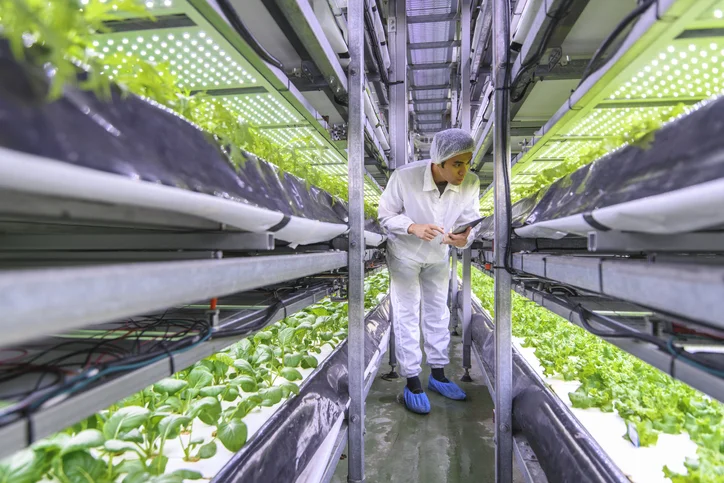
In contrast, vertical farms utilize new technology and have mostly proliferated as a result of the rapidly declining prices of LED lights, but have yet to be proven profitable. Nevertheless, vertical farms offer tremendous opportunities as seed companies develop genetics to optimize growing conditions, including the replacement of sunshine with more reliable and predictable LED lights. Such controlled indoor environments provide significant advantages compared to the outdoor field, which is subject to the whim of Mother Nature. We are seeing the emergence of two different types of vertical farms: one built-in large warehouses to maximize economies of scale, and the other having a smaller footprint, like shipping containers, that can be placed at hotels, supermarkets, and universities, enabling produce to be harvested and eaten the same day.
Both greenhouses and vertical farms are looking to optimize production through the use of data analytics and machine learning, something much easier to do in a controlled environment than in a field. Additionally, field-grown products typically are grown far from the end consumer, leading to a large amount of spoilage and food waste. With over 30 percent of global food production ending up as food waste(2), this problem will need to be addressed in order to feed a population projected to reach over 9.5 billion people by 2050.(3)
Investment heats up
Strong consumer interest in indoor farming has been matched by a sizable amount of venture capital investment in this sector. Whereas indoor farming is a relatively nascent business in the U.S., the Netherlands has built a successful indoor agriculture industry, and has played a key role in feeding neighboring European countries for decades. Additionally, an increasing amount of the non-processed tomatoes and specialty peppers sold in the U.S. are grown in Canadian greenhouses, where electricity is cheaper, and in Mexican greenhouses, where labor and other production costs are lower. It isn’t surprising, therefore, that indoor farming companies have raised over $1 billion in equity during the past five years.(4)
A number of companies, including AeroFarms, AppHarvest, BrightFarms, Bowery Farming, Plenty Ag, and Shenandoah Growers each have raised over $50 million in equity, demonstrating the growing commitment to a variety of indoor farming techniques.(4) Significantly more capital is likely to be raised in the coming years as indoor farms are positioned for rapid growth, and investors bet on new entrants with unique technologies that might result in lower production costs than those realized with field-grown produce.
Trend or fad?
Despite all the capital that’s been raised, and the positive press surrounding indoor farming start-ups, many people have asked me whether indoor farming is a fad or a trend. Having worked closely with a number of thin-film solar companies as that sector emerged in 2004, I have noticed many parallels between that experience and what is happening in indoor farming. First, large sums of capital are being raised to fund new, but not-yet proven technology. Second, companies are making aggressive predictions about their cost structure once they reach commercial scale. Finally, a growing number of investors are rushing into a sector about which they have limited knowledge and investment experience. Consequently, as I began evaluating the indoor farming sector three years ago, I was very skeptical about its viability, since outdoor farming has occurred for thousands of years, and the growing process has already been revolutionized to substantially improve yields and reduce costs.
However, following my visit to an indoor farm in the Bay area, less than two hours’ drive from Salinas, California, known as the “Salad Bowl of America”, I started to understand the reason why indoor farming makes sense. The most compelling reason is taste. Produce that I have tasted that was grown in indoor farms tastes much better than the field-grown varieties available in stores and restaurants. Most people are unaware that the seed genetics used in field-grown produce are often selected based on ability to survive transport over long distances rather than for taste optimization. Furthermore, most of the produce eaten in the U.S. is grown in California, Arizona, and Mexico, and shipped throughout the U.S. on trains and in trucks. There is no greater evidence of logistics winning over taste than iceberg lettuce. Despite being comprised of almost all water and having little nutritional value, iceberg lettuce was identified as a product able to survive being packed in ice and shipped cross country. I know very few people who are excited to eat iceberg lettuce, yet it remains a staple on many dinner tables throughout the U.S.
In addition to taste, indoor farming offers a number of other potential benefits including:
Year-round production – important since even in California produce is typically harvested no more than nine months of the year, forcing reliance on additional supplies from global and potentially less regulated production areas
Environmental sustainability – indoor farming has a smaller environmental footprint as a result of elimination of pesticides, reduction in water, and reduction in cross-country transportation since product can be grown regionally throughout the country in close proximity to distribution centers or retail outlets
Consistent production whereby growers are able to provide the same size and quality of products to distributors and retailers in every location
Reduced manual labor through the use of robotics and automation
Elimination of climate dependency – produce can be grown in even the harshest weather conditions globally, which will become more important as the impact of climate change accelerates.
Indoor farming companies must overcome a number of issues to achieve success, the most important of which are cost structure, type of produce grown, and branding.
Achieving a competitive cost structure
Today, very few indoor farming companies are able to produce at a cost structure competitive with field-grown produce. With so much capital being raised, most indoor farming companies are more focused on scaling production rather than profitability. While many investors are less focused on near-term profitability, it will become more important as indoor farming companies look to build new farms, and need to be able to undertake financing using debt/project finance. Even if indoor farming companies can raise enough equity capital to build new indoor farms in the short term, long-term success will be tied to the optimization of capital structures through the use of low-cost debt capital.
Building market share
Although there is a substantial opportunity for indoor farms to take market share from field-grown herbs and leafy greens, these remain relatively small market opportunities. With so many indoor farming companies currently producing or preparing to produce herbs and leafy greens, these areas will likely get oversaturated at some point. Consequently, I think it is essential that indoor farms move into, or expand production in, other high-value and high-margin products such as berries, melons, peppers, and tomatoes.
Gaining brand recognition
The final area of concern is whether indoor farming companies will be able to build either category strength or a brand name that will catch on with consumers. Consumers are less familiar with the names of the companies that provide their fruit and vegetables, in contrast with major consumer-packaged-goods companies, like General Mills, Kellogg’s, Kraft Heinz, and Nestle, which have been highly successful at building brand-name products sold in the middle of the grocery store. Without brand visibility, most indoor farming companies likely will end up selling to larger established players, such as Taylor Farms, Del Monte, and Dole, and receive commodity pricing as opposed to the premium pricing of major brand label, which Beyond Meat and Impossible Foods have done successfully in the alternative protein sector.
Coming to a store near you
Consumers appreciate that there are major advantages for an increasing amount of high-end produce to be grown in “state-of-the-art” indoor farms. However, it remains to be seen whether indoor farming companies will have the breadth of products to truly challenge the dominance of incumbents, who have extensive field-grown production capabilities and efficient distribution networks. Indoor farms must deliver a high quality and better-tasting product at a competitive price to displace the existing growers. Nevertheless, though these are considerable challenges, I believe the indoor farming sector is poised to create significant disruption in a number of high-margin specialty crop segments. I foresee that, over time, the indoor farming sector will experience consolidation, leading to indoor farming companies with regional brands achieving a more national presence.
Adam Bergman, Wells Fargo Head of AgTech and FoodTech Investment Banking Practice
USDA Economic Research Service, Food Expenditure Series, October 24, 2018.
2. United Nations population report, June 13, 2013
3. United Nations Food and Agriculture report on Global Initiative on Food Loss and Waste Reduction, April 2, 2019
4. Pitchbook and company press releases

US: Indiana - High-Tech Aeroponic Farming Company Bringing Greenhouse To Electric Works
A northeast Indiana native and Purdue graduate, Clint Crowe, with an extensive background in health technology, is bringing his innovative and high-tech urban-farming concept to Electric Works
September 18, 2019
A northeast Indiana native and Purdue graduate, Clint Crowe, with an extensive background in health technology, is bringing his innovative and high-tech urban-farming concept to Electric Works.
Sweetwater Urban Farms, an Atlanta-based company founded in 2017 that uses aeroponic technology, helped by with proven Internet of Things — no human interaction to transfer data — to produce nutrient-rich greens and herbs, will open a greenhouse in the food hall at the planned Electric Works, according to a statement from a spokesman for the developer, RTM Ventures.
The greenhouse uses a “zero-mile delivery” system, so food is available closer to where it is consumed. It will also offer retail sales of its produce at Electric Works, a mixed-use project that reuses the former General Electric complex on Broadway. As of Aug. 29, the project had up to 15 leases or letters of intent for leases on between 200,000 and 225,000 square feet at Electric Works.
Sweetwater Urban Farms plans to make produce available for delivery to local restaurants, hotels, health care institutions, and schools.
The greenhouse is expected to house up to 400 patented commercial Tower Gardens and produce an estimated 47,000 pounds of produce a year, according to the statement. Tower Garden aeroponic technology re-circulates valuable water, requiring only 10% of the land and water of traditional growing methods.
Crowe, a Decatur native with nearly 18 years of experience in healthcare technology, founded the company with his wife, Sheree.
“When we visited the Electric Works site, we immediately saw the unique potential it offered our company and the community,” Crowe said in the statement. “Being from the region, it’s exciting to come back and see the momentum in the city. Food security is at the heart of any community’s long-term plan, and we see Sweetwater Urban Farms and Electric Works as a strategic starting point and will play a key role in ensuring this community’s future food security.”
Crowe expects to partner with area healthcare and educational institutions, and fellow agricultural-business entities to support increased awareness and education of the value of locally sourced food and its impact on health and wellness. The company may also support a planned agriculture-technology program that Fort Wayne Community Schools is exploring for its planned STEAM — Science, Technology, Engineering, Arts and Mathematics school at Electric Works.
“At the intersection of agriculture and technology, Sweetwater Urban Farms is the kind of innovative company that we want to bring to Electric Works and Northeast Indiana,” said Jeff Kingsbury of the Electric Works development team in the statement. “Clint’s unique background — both in health care technology and as a regional native — makes the company a perfect fit for Electric Works. The food hall and public market are important to building community within the Electric Works district. But, it’s also about enhancing access to healthy food to address this neighborhood’s long-standing status as a food desert – Clint and his team will play an important role in that from the beginning.”

Inside Indoor AgTech
In order to better foster thought leadership through The Mixing Bowl and gain a deeper perspective for investment opportunities at Better Food Ventures, we have created a landscape of Indoor AgTech (Download Landscape Here)
Chris Taylor and Michael Rose provide a deep-dive analysis of Indoor Agriculture, tracking more than 1,000 companies to capture the technology ecosystem of controlled-environment agriculture: vertical farms, greenhouses, urban farms, plant factories, and container farms...
Understanding the Landscape
Controlled Environment Agriculture (CEA) or, Indoor Ag, as it is more commonly known, has been garnering tremendous attention because of the compelling benefits of growing indoors in a controlled environment. In order to better foster thought leadership through The Mixing Bowl and gain a deeper perspective for investment opportunities at Better Food Ventures, we have created a landscape of Indoor AgTech (Download Landscape Here). As with our partners’ landscape maps from Brita Rosenheim and Seana Day on FoodTech and AgTech (field production), this landscape focuses on the technology of the Indoor Ag market.
With the first release of this Indoor AgTech Landscape, we believed it was important to start with an ecosystem of the market as opposed to an investment heat map. As part of this effort, we are tracking more than 1,000 companies in the indoor space. This landscape is a subset of those companies, and others, that are active in the space. While some market assessments, including the notable AgFunder AgriFood Tech Investment Report, include cannabis, algae, and insect production, this landscape is limited to traditional food crop production, from seed to immediate post-harvest activities, and utilizes a lens focused on digital and information technology.
The landscape is segmented into broad categories of component technologies, production growing systems, and actual growers. Some other important components of indoor operations, such as the structures themselves, energy systems, and traditional or tangential equipment and supplies are not part of the map. Additionally, many companies in this space, particularly established vendors, offer products in multiple categories but are only represented once. Also, tools that are often shared with field farmers, such as supply-chain platforms and other downstream applications, are captured on the AgTech Landscape created by our colleague Seana Day.
Greenhouses as part of the Indoor Ag Landscape
While there has been much media attention on growing indoors with artificial lights in “Sunless” environments (sometimes referred to urban, vertical, indoor, plant factory,…), greenhouses, as an indoor farming approach, need to be included in the discussion and we have made a point to include them in this landscape. Greenhouses provide similar compelling benefits as a complete Sunless approach and have been utilized to enhance crop production for decades. They have evolved to become technically sophisticated, large in scale and widely deployed while incorporating a broad range of innovations in energy, sustainability, lighting, environmental control, irrigation, monitoring and automation. There are a number of greenhouse operations where production is already fully automated such as Little Leaf Farms in Massachusetts.
Component Technology
Indoor AgTech component technologies are represented on the left half of the landscape map segmented into environment, monitoring, management, and automation. In general, these technologies may be applicable to both sunless and greenhouse environments.
The landscape includes vendors of systems that are used to maintain an optimal growing environment, namely environmental control, irrigation/fertigation, and lighting. Environmental control and fertigation are not new technologies, but as they encapsulate and effectuate a grower’s decisions, they have enabled greater precision and scale in operations. Lighting, the third component, has seen more change in recent years as LEDs have emerged as a viable alternative to traditional lighting technologies. Lighting systems, most obvious in sunless environments, are also applied in greenhouse operations.
Companies offering monitoring solutions, including sensors and imaging systems to gather data on the environment, crop health and pests and disease pressure are also included. Environmental Monitoring companies measure conditions such as indoor and outdoor weather, soil moisture, and nutrient, CO2 and light levels; data that has been used historically to drive decisions and control at a relatively macro level. Newer innovations in Pest/Disease and Crop Monitoring like automated scouting, stress detection, and growth monitoring can shift focus from maintaining external conditions to a plant’s real-time response to a grower’s decisions.
The Management and Analytics segment, including crop and farm management solutions, may hold the most promise of all the component technologies. With more extensive deployment of sensors and associated big-data analytics, the growth environment will be increasingly managed by predictive, proactive, real-time, and autonomous optimization by AI that can recognize complex interactions beyond a grower’s capabilities. However, as with field farming, maximizing yield does not necessarily equate to maximizing the success of the overall operation. Forecasting, labor and overall farm management solutions address that greater requirement.
Production Growing Systems
In addition to individual component technologies being marketed to the Indoor Ag market, companies are also selling production growing systems in various formats and configurations: appliances, containers, and sunless and greenhouse production systems. These systems extend almost linearly in size and features from countertop consumer units to acres-scale installations, many being provided as complete growing environments. While one can find countless consumer and hobbyist growing systems on Amazon, Alibaba, and Walmart.com, the landscape does not capture them due to our commercial growing focus.
Industrial Appliances
A step up from the consumer growing systems are Industrial Appliances. These standalone units, intended for restaurants, grocery stores or corporate/school foodservice, are designed for volume production and can be located in the front of the store and in the “back of the house”. While primarily focused on greens and herbs, they provide retailers and foodservice with the freshest produce available, virtually eliminating the carbon footprint of distribution. Some questions do arise around food safety and challenges of adding new operational roles to this labor impacted sector. These appliances not only contain all the requisite elements of a growing environment and operating software, but many are offered with a service/supply program that included seeds, nutrient inputs, grow recipes and even remote monitoring and operation, i.e., remote growing by the appliance vendor.
Container Systems
Like the Industrial Appliances, Container Systems offer a complete growing environment but typically enclosed in a shipping-like container. In general, these units provide a significant increase in production volume and great flexibility in location, including and typically outdoors. Available for a moderate investment (roughly $100,000) they can produce tons of greens and herbs annually. This combination of benefits has made this approach appealing to a broad range of customers from retailers or food service locating units at their distribution centers to rural field farmers wanting to try their hand at indoor growing on a yearly basis.
Sunless and Greenhouse Production Systems
Manufacturers can deploy production systems at industrial scale. They are usually modular and allow purchasers to expand a system footprint as needed. Typically these systems are complete growing environments that include all the necessary components for production, often configured to be site-specific. These systems are specifically designed to reduce labor and maximize yield for the space allocated, often through the use of automation. As with other segments of the landscape, many of these system manufacturers are building products for both the sunless and greenhouse markets.
The growing environment of Sunless Production Systems is vertically oriented and typically configured as stacked horizontal trays or vertical growing panels/walls. Most of these systems deliver nutrients utilizing hydroponics though some providers are offering aeroponics approaches such as the Mobile Aeroponics system from the CombaGroup in Switzerland. Currently, most systems deployed are producing leafy greens and herbs, and in some cases strawberries. While generally smaller in footprint compared to greenhouses, they are capable of large production per floor area due to the system’s vertical orientation, such as at the Jones Food Company facility with its 17 levels stacked to a height of 36 feet. In some instances though, Sunless Production Systems have been deployed with larger footprints such as SananBio’s Chinese installation covering more than two acres and producing 1.5 tons of leafy greens a day. These systems are being offered with various business models. This can range from a simple equipment sale to a turnkey offering where a provider such as Infinite Acres will partner with the purchaser and provide operational expertise.
Greenhouse Production Systems are typically horizontally oriented with nutrients delivered through various approaches such as deep water with floating rafts, Nutrient Film Technique, or drip irrigation. The systems will operate in environments with ambient light, and supplemental lighting purchased separately. They are available for a range of crops from leafy greens and herbs to vining crops such as tomatoes, cucumbers and peppers and increasingly, strawberries. The footprint of a typical Greenhouse Production System is quite large with installation increments characterized in acres, or even tens of acres. Automation within systems varies and is usually crop dependent with a minimal amount in systems for vining crops and an extensive level in leafy greens and herbs. A number of providers such as Hortiplan and Viscon have extensive deployments of fully automated systems that handle seeding to harvest.
Growers
As mentioned above, we thought it was important to highlight indoor growers in addition to Indoor Ag technologies in this year’s landscape. While it is still farming at its core, technology is the essence of modern Indoor Ag and its operations. Not only do indoor producers leverage technology to farm, in many instances growers such Plenty, Bowery and aquaponics grower, Edenworks, are developing their own technology.
The landscape captures as a subset of the growers operating in the market today. Those represented are noted for the respective scale and scope of technology used in their operations, innovative systems integration, novel approaches, or that they are currently pioneering technical growing practices in their country or region.
Modern Sunless Growers, catching the spotlight in the last few years, are standing on the shoulders of early Plant Factories built in Asia where they began over 25 years ago. While most of the publicly identified funding for Sunless Growers over the last few years has been in the U.S., there are now more than 500 Plant Factories in operation throughout Asia according to New Bean Capital. Operating economics remains a key challenge and criticism for these facilities and sunless operations in general, although the Japanese grower Spread, which opened their second facility in late 2018, claims that through the use of technology, scale, and automation they are not only profitable but can be cost-competitive with field farming.
Greenhouses are the larger and more developed growing method. Cuesta Roble Consulting estimates that there are more than one million acres of vegetable production inside permanent structures worldwide. Though, most of the technically advanced and greatest concentration can be found in the Netherlands where there are more acres “under glass” than the size of Manhattan. While already well established as an indoor-growing approach, it appears the recent attention on Sunless farming and cannabis has stimulated additional activity in the sector. Since the beginning of 2018 more than $500 million has been invested in Sunless growers. During that same time period, the Greenhouse sector has seen the likes of Equilibrium raise and deploy its new Controlled Environment Foods Fund of $336 million, Gotham Greens and Bright Farms raise $84 million and investors such as ValueAct Capital Management and Revolution invest in AppHarvest, which is building one of the country’s largest greenhouse in Eastern Kentucky.
There are many impressive and much needed community-based and social impact organizations focused on indoor growing. These efforts range from Teens for Food Justice working on urban access of fresh produce to increasing employment opportunities for veterans by Veterans to Farmers. These are important entities but are not captured on the landscape as it focuses on commercial-scale businesses and production.
The Changing Landscape
For the purpose of this first Indoor AgTech Landscape, we make the distinction of Greenhouse and Sunless as a growing approach or market. This segmentation is done only to raise awareness, to ensure the entire market and various approaches are represented.
Too often we hear declarative statements that “this” is the “right” approach for Indoor Ag or is “the” future of farming. It is more appropriate to start with the question “what problem are you trying to solve?” The unique environmental, climate, economic, and market factors will inform the growing approach. It is doubtful that a one-size-fits-all solution will dominate, but rather utilization of the most appropriate growing structures, systems, and technologies for the desired crop, location and business goal. The challenges, needs, and parameters in Singapore are not going to be the same as St Louis, or Dubai. It is not always an either-or question.
Not only are we seeing vendors and technology providers offering products and systems for both the Sunless and Greenhouse segments, some growers are now utilizing or combining the two approaches. Veteran indoor grower Green Sense Farms is now designing combined facilities and Shenadoah Growers, a long time field and greenhouse grower, has added Sunless production to their operations. Deliscious, a Dutch lettuce grower has seamlessly integrated sunless seeding and propagation into the automation workflow before plants are transported and finished in a greenhouse mobile gutter system. Even on the financing front, start-up Contain is providing a leasing and insurance platform for all indoor farming approaches from “container farms and warehouse farms to the most sophisticated greenhouses and plant factories.”
Moving Forward
To meet its promise and continued expansion, particularly to those locations underserved by traditional production methods, Indoor Ag needs to drive down its cost of operations. Sunless production, especially, has further to go on this front mainly due to a lack of efficiencies from scale and energy use. While indoor costs need to be closer to field production, no one will benefit from a race to the bottom on cost. Indoor and field production are both working on some of the same challenges including labor, sustainability, safety, traceability, and profitability. Technology has an important role in meeting those challenges and we look forward to seeing further advances, innovations, and implementations in data capture and analytics, automation, and predictive and autonomous control.
We welcome your thoughts and reactions and look forward to following the Indoor AgTech landscape together for the coming years.
Bios:
Chris Taylor, a Senior Consultant on The Mixing Bowl team, has spent more than 20 years on global IT strategy and development innovation in manufacturing, design and healthcare, focusing most recently on Indoor AgTech.
Michael Rose is a Partner at The Mixing Bowl and Better Food Ventures where he brings more than 25 years immersed in new venture creation and innovation as an operating executive and investor across the Internet, mobile, restaurant, and Food Tech and AgTech sectors.

High-Tech Indoor Farming Seen As Key To Fixing Dubai’s Food Supply
Desert terrain, extremely high temperatures, and limited rainfall have historically made agriculture unworkable in the United Arab Emirates (UAE) — but thanks to new technology, companies in Dubai are finding ways to grow locally-sourced produce.
October 2, 2019
Desert terrain, extremely high temperatures, and limited rainfall have historically made agriculture unworkable in the United Arab Emirates (UAE) — but thanks to new technology, companies in Dubai are finding ways to grow locally-sourced produce.
With temperatures in the desert city regularly exceeding 40 degrees Celsius in summer months, a massive 80% of Dubai’s food supply is imported. But the government is keen to reduce dependency on imported foods.
Badia Farms is one of several firms tapping into the demand for locally grown foods by developing an indoor farm in the city.
Using hydroponics, a growing technique that doesn’t require soil, the farm is successfully growing fruit and vegetables that are already being served in some of Dubai’s top restaurants.
Speaking to CNBC’s Dan Murphy, founder and CEO Omar Al Jundi explained that crops are moved along a production line in artificially optimized conditions.
“As they move along the production line they sprout and grow, (then) at the end we take them out and offer them to the market,” he said, adding that some plants can be grown and sent to a restaurant in as little as 30 days.
“Our region is agriculturally challenged,” Al Jundi added. “I really wanted to solve a problem and impact this region positively — and I want to inspire the rest of the region as well. We have a long list of issues and problems, we need to start tackling them.”
By confronting the UAE’s food supply problem, Badia Farms is also helping Dubai work toward its sustainability goals. By reducing the need for long-distance transport, Al Jundi’s indoor farm and others like it are reducing the carbon footprint of the food consumed in the city. Additionally, thanks to the technology being employed, Al Jundi’s said his facility uses 90% less water than open-field farms.
“We control the humidity, we control the temperature, we control the CO2,” he told CNBC. “We’ve got dehumidifiers to regulate the humidity… and each one produces 60 liters of water, so in the summer we were water positive for the first time.”
The farm’s annual crop yield is claimed to be much higher than that of a traditional farm.
“Depending on the crop (we can produce) between four to eight times (as much),” Al Jundi said. “For example, with lettuce, we could grow twelve cycles a year, compared to conventional farming which has four cycles a year.”
“Once we take care of all the leafy greens we want to go into vine crops — tomato, capsicum, chilies, melons — everything that could be grown within this type of controlled environment,” he added. “In the future, you’ll be able to grow all these crops anywhere in the world, pesticide-free, with minimal use of water and environmentally-friendly setups,” he said.

Amazon Plans To Have 100,000 Electric Delivery Vans On The Road By 2030
Amazon CEO Jeff Bezos has revealed that his company has placed an order for 100,000 electric delivery vans from Michigan-based electric vehicle company Rivian
09.20.19
Amazon CEO Jeff Bezos has revealed that his company has placed an order for 100,000 electric delivery vans from Michigan-based electric vehicle company Rivian. Amazon says its order of 100,000 vehicles is the largest order ever of electric delivery vehicles. It is just one of the ways Amazon pledged on Thursday to help combat climate change.
Our fleet is Electrifying! Thrilled to announce the order of 100,000 electric delivery vehicles – the largest order of electric delivery vehicles ever. Look out for the new vans starting in 2021.

Amazon says that the goal with the vans is to have all 100,000 of them on the road by 2030. Yes, that’s a decade away, but the company will begin the Rivian van rollout much earlier—in 2021. By 2022, Amazon says it hopes to have 10,000 of the vehicles on the road. And once all 100,000 hit the roads by 2030, Amazon says it will save 4 million metric tons of carbon per year.
The announcement was made as part of Amazon’s Climate Pledge, which sets the goal of meeting the historic Paris Agreement 10 years early—by the year 2040. Bezos says that by 2030 it wants Amazon running on 100% renewable energy, and by 2040 it wants the company to be a net-zero carbon producer. The Paris Agreement’s goal is for companies and countries to hit these metrics by 2050.
Announcing its new set of climate action plans, Bezos said:
We’re done being in the middle of the herd on this issue—we’ve decided to use our size and scale to make a difference. If a company with as much physical infrastructure as Amazon—which delivers more than 10 billion items a year—can meet the Paris Agreement 10 years early, then any company can. I’ve been talking with other CEOs of global companies, and I’m finding a lot of interest in joining the pledge. Large companies signing The Climate Pledge will send an important signal to the market that it’s time to invest in the products and services the signatories will need to meet their commitments.

SDLN: The Leading AgTech Networking Forum | Connecting Global High-Level Value-Chain Leaders In Miami, Oct 22 - 24
MIAMI, FL – Keynote, a global leading event company for emerging technology, announced today the Company’s next strategic decision to expand into the AgriTech industry through a new event: Sustainability and Digitalization Leadership Network (SDLN) - Miami Forum.
SDL Miami Speakers
The 2019 SDLN Miami Forum connects AgriTech’s investors with innovators and their ideas, moving the most critical conversations forward to improve the planet’s future in sustainable agriculture and emerging tech. SDLN is dedicated to addressing today’s food supply challenges by creating a platform for collaborative, open dialogue and high- level networking between industry experts from across the globe.
The three-day event at the James L Knight Center in downtown Miami will cater to AgTech seniors with an international attendance of company executives, investors and market consultants. Alongside presentations covering current world projects and tech advances, the forum will feature panels focusing on innovation vs implementation, long term sustainability and investment in the food ecosystem. This carefully curated agenda will feature entrepreneurs and established investors alongside agriculture’s international leaders, intended to provide strategic, tactical skills and knowledge for those attending.
SEE FULL SCHEDULE
As a hub connecting agriculture across the Americas and beyond, Miami sets the stage for the rapidly expanding industry. Attendees will meet with innovators throughout the supply chain at the SDLN Official Launch, Wednesday 22nd October, as well as a second evening of networking on Thursday 23rd. Further opportunities for breakout sessions led by industry heads, facilitated networking and 1:1 business meetings will follow.
The first round of presenters announced last week includes Howard Yana Shapiro, Chief Agricultural Officer at Mars; Claudia Rössler, Agriculture Strategic Partnerships at Microsoft; David Friedman, CEO at VividGro.
A core advisory board will oversee and advise on partnerships to ensure quality of connections and sustainable business strategy. For enquiries please email lyndsey@sdlnetwork.com
About Keynote:
Hosting international events since 2012 across Europe, North America and the Middle East, Keynote has curated forums for emerging technology industries, launching high profile fintech projects and acting as a platform to raise significant funds, connecting and enabling companies to reach their potential.
Event Website: https://sdlnetwork.com/
For media partnership enquiries: amandah@sdlnetwork.com
For partner and sponsorship enquiries: amy@sdlnetwork.com

VIDEO: What Grows Inside The Leafy Green Machine?
The LGM allows for immediate growing of a variety of crops regardless of weather conditions, resulting in year-round access to local and fresh produce