


Welcome to iGrow News, Your Source for the World of Indoor Vertical Farming

MIT Media Lab Director Joi Ito Resigns Amid Epstein Funding Fallout
The director of the Massachusetts Institute of Technology’s Media Lab stepped down on Saturday after a New Yorker magazine article revealed the lab tried to conceal donations from disgraced late financier Jeffrey Epstein, the university said
REUTERS September 7, 2019
Former MIT Media Lab director Joi Ito - Image Credit: MIT Media Lab
(Reuters) — The director of the Massachusetts Institute of Technology’s Media Lab stepped down on Saturday after a New Yorker magazine article revealed the lab tried to conceal donations from disgraced late financier Jeffrey Epstein, the university said.
“This afternoon, Joi Ito submitted his resignation as Director of the Media Lab and as a professor and employee of the Institute,” MIT President Rafael Reif said in a letter posted online.
Ito could not be reached for immediate comment. The New York Times and New Yorker reported he said in an internal email, “After giving the matter a great deal of thought over the past several days and weeks, I think that it is best that I resign as director of the media lab and as a professor and employee of the Institute, effective immediately.”
Last month, Reif said the elite university would review its process for accepting donations after taking about $800,000 from foundations controlled by Epstein, who committed suicide while in jail awaiting trial on sex trafficking charges.
The New Yorker article uncovered deeper fundraising ties between the Media Lab and Epstein and said the institution had actively tried to conceal the extent of its connections with the disgraced financier.
On Saturday, Reif described the acceptance of contributions from Epstein as a “mistake of judgment” and said he had instructed MIT’s general counsel to bring in a prominent law firm to investigate the matter.
“Because the accusations in the (New Yorker) story are extremely serious, they demand an immediate, thorough and independent investigation,” Reif said.
Ito previously apologized for having accepted donations from Epstein and had said he would raise an amount equivalent to the donations the lab received from foundations controlled by Epstein and “direct those funds to nonprofits that focus on supporting survivors of trafficking.”
The New Yorker said Ito disclosed this week he received a further $1.2 million from Epstein for investment funds under Ito’s control and $525,000 for the lab. Epstein also secured $7.5 million in donations for the lab from other wealthy individuals.
On Saturday, Ito also resigned from the board of directors of The New York Times Co and of PureTech, a biotechnology firm, according to statements from the two companies.

2 Day Webcast Series: New Ag International Digital Week
Join us 14 & 15 October 2019 for New Ag Digital Week, a global 2-day series of live educational webcasts and downloadable resources providing the latest insights on Biostimulants, Biocontrol, specialty fertilizers, Irrigation and new/the latest Greenhouse and Precision Ag technologies
Join us 14 & 15 October 2019 for New Ag Digital Week, a global 2-day series of live educational webcasts and downloadable resources providing the latest insights on Biostimulants, Biocontrol, specialty fertilizers, Irrigation and new/the latest Greenhouse and Precision Ag technologies.
Day 1: Monday, October 14, 2019
The Impact of Swarm Robotics on Arable Farms
9am EDT / 2pm BST / 3pm CEST
Does deficit irrigation work in annual crops? Best practices learned from Spain
10am EDT / 3pm BST / 4pm CEST
Day 2: Tuesday, October 15, 2019
New Biostimulant Technologies Focus on Efficiency
9am EDT / 2pm BST / 3pm CEST
Development of New Biological Control Agents Against Apple Scab and Powdery Mildew
10am EDT / 3pm BST / 4pm CEST
REGISTER NOW
To sponsor future digital events, contact partners@knect365lifesciences.com or request details.

Global Warming: Grapes Are Ripening Faster
Due to their sensitivity to weather, grapes are also very useful for getting a peek into past climates. This means that the start of the harvest is ideal as a kind of climate proxy
©pixabay
Posted by Almut Otto | Sep 4, 2019
How does a vintner know that the grapes are ripe? By the traditional method, they taste the grapes themselves. Like this: put the grape in your mouth, bite into it, let the juice run out and in doing so determine the sugar and alcohol content. And it is precisely the latter that could become an issue in the traditional growing regions over the next few years and decades. According to a study by the University of Bern, the grape harvest in Burgundy has been starting 13 days earlier on average than it has in the past six centuries.
Grapes are sensitive to changes in temperature
This result is on the one hand interesting for winemakers and wine lovers. This is because grapes are very sensitive to temperature and rain. Higher temperatures make the grapes ripen faster. And the resulting increase in dryness also results in a higher alcohol content. Which is not what is supposed to happen, not just because the trend is towards lighter wines. Wines with too high an alcohol content also taste slightly ‘burnt,’ In order to avoid this, the artful technical skill (for which the Germans are world-renowned, as it happens) of the master vintner is now in high demand.
According to Frank R. Schulz, head of the communications department at the German Wine Institute, German winegrowers are able to benefit from the current situation, at least for a short while. “We are now in a position to make the most of it. World vine varieties such as Merlot or Sauvignon Blanc, which were previously only native to southern Europe, are now growing here. Whereas in Spain the grape harvest is much lower than in previous years, in the main due to drought. And even in northern Germany, such as on Sylt or in Schleswig-Holstein, attempts are now being made to cultivate grape varieties. And last but not least, sparkling wine viniculture in the south of England also shows that wine regions could shift over the long term. In order to be able to react to climate changes, the southern regions are working on improving their varieties. For example, a thicker skin makes the grapes somewhat more resistant.
Grapes act as a climate proxy
Due to their sensitivity to weather, grapes are also very useful for getting a peek into past climates. This means that the start of the harvest is ideal as a kind of climate proxy. It is an indirect indicator of change, as we have seen in other natural archives. These include tree rings, ice cores and corals. Plus, historical documents like the grape harvest. The scientists from Bern used a series of data from the grape harvest of the past 664 years for their analysis.
“We did not predict that the rapid rise in temperatures since the 1980s would be so clearly visible in this time series,” explains Christian Pfister, Professor Emeritus of Climate and Environmental History at the University of Bern and a member of the Oeschger Centre for Climate Research.
He was responsible for the study together with colleagues from Switzerland, France and Germany.
Records of wages paid to harvest workers
The main author of the study, Thomas Labbé, who conducts research at the universities of Burgundy and Leipzig, meticulously reconstructed as far back as 1354 the data from grape harvests in Beaune, the wine capital of Burgundy. He used a large number of unpublished archive sources, including information on wage payments to grape pickers, records from Beaune City Council and newspaper reports. The uninterrupted recording of grape harvest data is the longest reconstructed time series of its kind and ended in 2018.
“The harvest records clearly show two phases,” says Thomas Labbé. Until 1987, the grapes were typically harvested on or after 28 September. Since 1988, however, the grape harvest has started on average 13 days earlier. Analyses of the data show that hot and dry years were unusual in the past, but have since become normal in the last 30 years. The research team consisting of historians and natural scientists has validated its time lines with the help of detailed temperature records taken over the past 360 years in Paris. This made it possible to estimate temperatures between April and July for the Beaune region throughout the 664 years covered by the dataset.
From research to action
“The transition into a period of rapid global warming after 1988 is very clear. And it is obvious to everyone that the past 30 years have been extraordinary,” Christian Pfister states.
“I hope that our recent work will help people realistically assess the current state of our planet’s climate and finally begin to take action.”
This unique reconstruction of the Burgundy grape harvest has just been published in the journal “Climate of the Past” published by the European Geosciences Union (EGU).
SUPPORT US!
Innovation Origins is an independent news platform, which has an unconventional revenue model. We are sponsored by companies that support our mission: spreading the story of innovation. Read more here.
On Innovation Origins you can always read articles for free. We want to keep it that way. Have you enjoyed this article so much that you want to contribute to independent journalism? Click here:
| Tags: climate change, German Wine Institute, Grapes, University of Bern

Mini Greenhouse For Microgreens
The fully automated "Plantcube" greenhouse from Munich-based company Agrilution offers a closed ecosystem for plants and, according to the manufacturer, optimal growth conditions. Irrigation is done automatically
Automated Ecosystem From Agrilution
The fully automated "Plantcube" greenhouse from Munich-based company Agrilution offers a closed ecosystem for plants and, according to the manufacturer, optimal growth conditions. Irrigation is done automatically.
The fully automated greenhouse "Plantcube" / Image: Agrilution
The high nutrient density ensures an intense aroma and pronounced textures. Currently, 17 different lettuces, microgreens and herbs can be selected from the Agrilution range, among which there are unusual varieties such as red Pak Choi or Wasabina leaf mustard. The system is controlled by the Agrilution Cloud and a user-friendly app provides insight into the growth process and notes on maintenance and harvesting. The "Plantcube" is the size of a small refrigerator.
For more information:
Agrilution GmbH
Centa-Hafenbrädl-Str. 61
81249 München
Telefon: +49 89 230 292 92
E-Mail: info@agrilution.com
www.agrilution.com
Publication date: 9/19/2019

Solar Foods Receives World's Most Prestigious Design Award
Solar Foods is a foodtech company developing globally revolutionary solutions for food production. The bioprocess and technology developed by Solar Foods enable food production without agriculture. In the future, harvesting can comprise of an entirely new harvest grown in a clean environment, while complementing existing protein sources with new natural protein
06/09/2019
Solar Foods, the Finnish company producing protein by using carbon dioxide and electricity, has been presented with the Index Award supported by the state of Denmark. The 100,000 euro award is given for the most impactful solution significant to the environment and improving people’s lives.
The Index Award is a biennial award supported by the state of Denmark. The total award fund is €500,000 divided between the winners in five award categories. Index Award has existed since 2005 and is the biggest money prize in its class. This recognition, also called the “Nobel prize for design”, acknowledges actors solving global problems in areas such as equality, food production, and plastic pollution.
Participants include projects from all over the world, with the finalists and winners judged by an international jury. Other winners of this year’s prize include Microsoft and Xbox, with previous winners including Elon Musk. The award is under the patronage of Crown Prince Frederik and Crown Princess Mary of Denmark.
Denmark has the ambitious goal of being a carbon-neutral country by 2050. Therefore, many Danish companies have set themselves the target of becoming the most responsible company before anyone else in their business.
“It is a magnificent feeling to know you are taking part in global responsibility. Researchers must turn the inventions and technologies incubated in laboratories into reality and commercialise them faster to benefit humankind. The Solein® protein is an excellent example of an innovation urgently needed by humans and the entire globe,” says Pasi Vainikka, CEO, Solar Foods.
Solar Foods is a food tech company developing globally revolutionary solutions for food production. The bioprocess and technology developed by Solar Foods enable food production without agriculture. In the future, harvesting can comprise of an entirely new harvest grown in a clean environment, while complementing existing protein sources with new natural protein.
At the core of the company’s operation is a sense of enormous responsibility: using renewable energy for producing food in a way that has the lowest possible environmental burden.
“The report by the Intergovernmental Panel on Climate Change and the rainforest wildfires in Amazonia are recent examples of the dire news we are witnessing about the state of the globe and its food system. At Solar Foods we develop solutions that disconnect natural resources from economic growth and food production. That’s how we are contributing to a solution in the crisis of global food supply,” Vainikka says.
Cleanest natural protein
Solar Foods is introducing a globally revolutionary protein for foodstuffs for consumers made in its bioprocess developed in-house. The Solein protein, suitable to be added to a variety of products, is produced mainly from air and electricity. In the future, Solein protein can be grown and harvested anywhere: in the middle of a desert, or even in space.
Solein is natural protein at its cleanest. Its production minimises harmful environmental impact, thereby providing transparent support for sustainable development. Revolutionary on a global scale, Solein is a protein for solving problems in managing the global food crisis and the overexploitation of natural resources. Solein is the product of natural evolution over hundreds of millions of years by using the diversity of nature.
At present, Solar Foods is studying the applicability of the Solein protein to different diets and consumer preferences. The protein includes no additives, instead, consumers will know it as an example of an ethical, clean source of protein. Solein’s amino acid composition is like that of soya and algae, therefore optimal for human needs.
Solar Foods aims at starting the first stage of commercial production of the protein during 2021.
Download Solar Foods Presentation
More information:
Pasi Vainikka, DSc (Tech), CEO, Solar Foods Oy, tel. +358 40 5825 987, pasi@solarfoods.fi
Solar Foods is a food-tech company that develops revolutionary innovations for food production at a global level. Solar Foods is an active player in solving the global food crisis and securing sustainable use of natural resources by disconnecting food production from agriculture. Solein® is a registered trademark of Solar Foods. www.solarfoods.fi

A New Hydroponic Farm Starts A New Age For UAE farmers
A new hydroponic farm is under construction in Abu Dhabi, UAE, and it will be one of the most important model projects of Kingpeng in Abu Dhabi
A new hydroponic farm is under construction in Abu Dhabi, UAE, and it will be one of the most important model projects of Kingpeng in Abu Dhabi. The total project is 1.2 hectares and will grow leafy vegetables and fruit vegetables with hydroponic technology. This project has a leafy vegetables NFT system and hanging gutter growing system.
The owner of this project has more than 5 years of organic food growing experience and organic food production certificate. Now he will start a hydroponic farm; all products will be purchased by high-standard hotels and restaurants in the future. Meanwhile, the owner of the greenhouse will establish a new brand for his green vegetables. The idea is for it to be very famous in the market of UAE and around Gulf countries.
“Three years ago, I have visited a lot of farms with greenhouse projects in UAE, but it seems that there are not many high-standard hydroponics farms which can provide what the market wants. So, I visited Kingpeng in 2018 and we confirmed the design and project soon after several meetings. Now in UAE, my project is still on the top level and we will be one of the biggest green vegetable suppliers in Abu Dhabi after the project’s completion and we will expand the production scale soon next year”, said the owner of the greenhouse.
“We really thank Kingpeng for the good service and products and we believe it will not only be a perfect vegetable production base for me but also start a new age for UAE farmers because they will have a better choice.”
Kingpeng has been active in the Middle East for more than 12 years, and they provide one-stop service, full greenhouse solutions and also growing services for the customers after project completion.
For more information:
Beijing Kingpeng International Agriculture Corporation
7th floor, Advanced Material Building, Feng Hui Zhong Lu, Haidian District, Beijing, China, 100094
T: +86 58711536
F: +86 58711560
info@chinakingpeng.com
www.kingpengintl.com
Publication date: Thu, 26 Sep 2019

CAN (ON): University of Guelph Has A New Controlled Environments Professor
The School of Environmental Sciences is pleased to welcome Thomas Graham as the new PhytoGro Research Chair in Controlled Environment Systems
Thomas Graham is the new PhytoGro Research Chair in Controlled Environment Systems
The School of Environmental Sciences is pleased to welcome Thomas Graham as the new PhytoGro Research Chair in Controlled Environment Systems.
In this new role, created through a $1 million donation from PhytoGro Canada, a PRM Inc. company, Graham will lead cutting edge research to develop novel approaches in controlled environment plant production systems in a range of applications from urban agriculture and phytopharmaceutical applications to space exploration.
“Thomas has a strong resume with impressive industry connections,” says Prof. Jon Warland, director of the School of Environmental Sciences. “He is well known in the American, German and European space agencies for his bio-regenerative life-support research, and it is great to have his unique skill set and knowledge part of our faculty.”
One of Graham’s primary areas of focus will be the optimization and standardization of plant-based medicine production, including medicinal cannabis.
“Most of the global population still relies on plant-based medicines as their primary medical intervention,” says Graham. “This puts an enormous and unsustainable pressure on the largely wild-harvested plants. Bringing these crops into controlled environment production will improve the quality, consistency, and safety of these medical commodities while also relieving the pressure on wild populations.”
“We feel extremely fortunate to be working with Professor Graham and the whole team at CESRF,” shares Ken Clement, founder of PRM Inc. “My dreams of producing plant-based medicine to pharmaceutical standards would not be possible without the efforts of the entire team and for that, I will be forever grateful.”
“I’m very excited for the opportunity to leverage leading-edge technology to tackle many of the pressing issues of our time,” says Graham.
“The University of Guelph is in a truly unique position to make major advances in several key areas including plant-based medicine production and standardization, addressing food insecurity, and advancing human space exploration through bioregenerative life-support.”
Graham is also very passionate about how controlled environment agricultural production can solve food insecurity issues in Canada and around the globe.
Graham has been the Research and Development Manager at the University’s Controlled Environment Systems Research Facility since 2015. Prior, he held a prestigious post-doctoral research fellowship at N.A.S.A. at the Kennedy Space Centre. He received both his Ph.D. and MSc from the University of Guelph. His B.Sc. is also from the University of Guelph, with part of the degree completed through an exchange with the University of Stirling in Scotland. To date, he has published 37 peer-reviewed articles.
Publication date: Thu, 26 Sep 2019

Singapore Airlines, One of The Most Ritzy Airlines In The World, Is Partnering With A High-Tech Urban Farm
AeroFarms, the company supplying the greens, is a high-tech "vertical farm," which uses a controlled climate, LED lights, and a new type of farming called aeroponics to grow crops in reclaimed urban spaces
Singapore Airlines, one of the most ritzy airlines in the world, is partnering with a high-tech urban farm to make sure it serves the best meal on every flight. Take a look inside the futuristic operation.
September 17, 2019
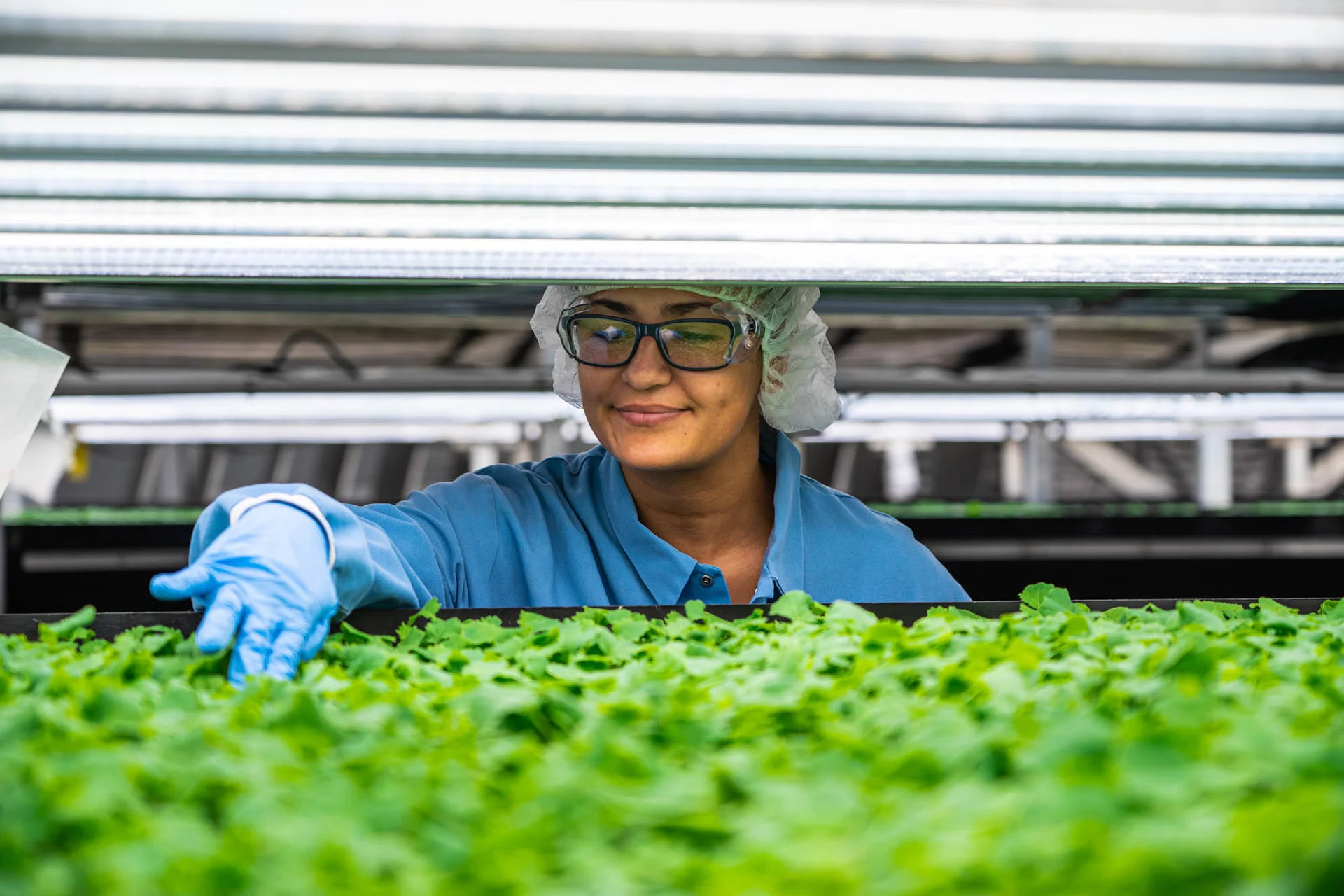
David Slotnick/Business Insider
Singapore Airlines is about to launch a new "farm-to-plane" dining program, using vegetables grown at a local farm in Newark, New Jersey, in dishes on board its flights from the New York City area.
AeroFarms, the company supplying the greens, is a high-tech "vertical farm," which uses a controlled climate, LED lights, and a new type of farming called aeroponics to grow crops in reclaimed urban spaces.
Business Insider toured the AeroFarms facility to learn more about how the process works, and how things like baby kale and watercress can go from the farm to 35,000 feet in just a few short hours. Scroll down to walk through this unique urban farm.
What's the deal with airplane food?
If Singapore Airlines has anything to say about it, that classic stand-up joke will soon be a thing of the past.
The airline made headlines in 2017 when it announced a new "farm-to-plane" dining service coming to its long-haul flights, and again this spring when it announced its first sourcing partner.
Now, the locally-sourced, fine-dining initiative is about to launch on the world's longest flight.
After months of planning and preparation, the farm-to-plane service is kicking off next month on the airline's flight between the New York City-area Newark airport and Singapore.
The airline will work with AeroFarms, a unique indoor vertical farming company based in Newark, New Jersey, to source leafy greens and vegetables for several of the appetizers in its business class cabin starting in October. Meals made with the local greens will eventually be expanded to other courses and other cabins — the plane operating the flight is entirely business class and premium economy.
While the novelty of the "farm-to-table" concept in the sky, coupled with the fresh taste of the meals has an obvious appeal, the airline also touts the sustainability of both sourcing ingredients locally, and supporting eco-efficient businesses like AeroFarms with its business. It could be easy to dismiss that — the airline, after all, is an airline, and relies on fossil fuels to fly emission-generating planes around the world — but there's a twofold benefit that sourcing crops from a company like AeroFarms can provide.
Normally, while catering in the winter, "the greens for our flights from Newark had to be flown in from 3,000 miles away, from California, Mexico, or Florida," said James Boyd, Singapore's head of US communications. "This allows us to instead source our greens from less than five miles away, cutting down on shipping waste."
Additionally, Singapore is looking to expand the farm-to-plane initiative with similar sustainable urban farms around the world, giving a boost to growing eco-friendly businesses — for instance, AeroFarms, which said it plans to add more facilities, is a certified B-Corp, a designation given to businesses that meet certain environmental and ethical standards.
Business Insider recently toured the AeroFarms facility at Newark to see how everything works. Take a look below for our walkthrough of the facility, and the process of getting the greens from the farm to the skies.
Welcome to AeroFarms.
David Slotnick/Business Insider
This high-tech, the one-acre vertical farm can be found at an old steel plant in Newark, New Jersey.
David Slotnick/Business Insider
The farm grows a variety of leafy greens and vegetables that will be used in dishes prepared by Singapore Airlines for its flight from Newark Airport to Singapore — the longest flight in the world.
David Slotnick/Business Insider
Despite its small one-acre footprint, the farm can grow roughly 390 times as much output as a normal farm with the same acreage.
David Slotnick/Business Insider
That incredible output isn't just because the crops are grown on trays stacked to the ceiling — it's because of a unique and proprietary method that AeroFarms uses, based off a technology called "aeroponics."
David Slotnick/Business Insider
Aeroponics is a seemingly simple but cutting-edge growing process.
AeroFarms
It uses a mist of water and air to help crops grow in an environment without soil, pesticides, sunlight, or weeds. Aeroponics farms can grow crops year-round, regardless of season.
David Slotnick/Business Insider
It starts with a cloth-like material on which seeds are placed, and where the roots will eventually take hold. The material is laid across trays, which are placed into the farm's growing racks.
David Slotnick/Business Insider
From there, the farm uses a mist of water, coupled with nutrients, to start the seeds' growth.
David Slotnick/Business Insider
Instead of sunlight, the farm uses LED bulbs emitting specific light spectrums, designed to discourage pests, optimize the nutrients the plants get, and even control the flavor of the plants.
David Slotnick/Business Insider
With this method, AeroFarms can grow mature, ready-to-harvest plants in a fraction of the time of a normal farm.
David Slotnick/Business Insider
While baby leafy greens would normally take 30–45 days to reach maturity, AeroFarms said that it only takes AeroFarms 12–14 days.
David Slotnick/Business Insider
That faster growth means that food can be supplied faster, keeping up with demand while using just a fraction of the energy.
David Slotnick/Business Insider
Within just a few days, the farm will see its seeds begin to germinate...
David Slotnick/Business Insider
...Begin to grow...
David Slotnick/Business Insider
... Take hold in the cloth medium ...
David Slotnick/Business Insider
... And grow ...
David Slotnick/Business Insider
... And grow ...
David Slotnick/Business Insider
... And grow.
David Slotnick/Business Insider
The farm has a variety of high-tech solutions to optimize plant growth, including computer-controlled misting...
David Slotnick/Business Insider
... Temperature controls ...
David Slotnick/Business Insider
... And systems that help manage the growth environment, ranging from fans, controlled air pressure between different rooms, and more.
David Slotnick/Business Insider
The racks of trays resembled a server room in an office, except that each row had plants growing on it ...
David Slotnick/Business Insider
... Something you typically wouldn't see around computer servers.
Singapore Airlines
Sensors, controls, and backups help ensure that the plants can grow in the best conditions possible ...
David Slotnick/Business Insider
... And make it easier to keep track of different crops and growing cycles.
David Slotnick/Business Insider
Employees and visitors take a number of precautions to avoid accidentally interfering with the growth or contaminating the food-bound plants ...
David Slotnick/Business Insider
... Including removing jewelry, entering through a series of pressurized rooms and doorways, and wearing hair nets, gowns, gloves, and more.
David Slotnick/Business Insider
The farm employs about 150 people.
David Slotnick/Business Insider
Once plants reach a certain point...
David Slotnick/Business Insider
... They're ready to go into the food supply — including in Singapore Airlines' dishes.
David Slotnick/Business Insider
Growing trays can be taken individually to the harvest room, whenever they're ready — unfortunately, we weren't able to take photos of the process ...
David Slotnick/Business Insider
... And then to the packaging room ...
David Slotnick/Business Insider
... Where they're packaged either for bulk delivery to clients like Singapore Airlines, or for retail.
David Slotnick/Business Insider
The growing, harvesting, and packaging operation may be unique ...
David Slotnick/Business Insider
... But AeroFarms is planning to expand, hoping to open additional locations.
David Slotnick/Business Insider
Business Insider sampled a few different harvested greens, including baby kale, and spicy watercress.
David Slotnick/Business Insider
After being packaged, the sky-bound greens are trucked to nearby Flying Food Group — the caterer that supplies Singapore's Newark flight, which is about four miles away — where they're used for the day's dishes. The airline said it would start with three appetizers, including a garden green salad, heirloom tomato ceviche, and a soy poached chicken, pictured here.
Singapore Airlines
Then, the dishes are brought from Flying Food Group just down the road to Newark Airport, where they're loaded onto the plane.
Nicolas Economou/NurPhoto via Getty Images
If you're interested in trying AeroFarms' produce and you're located in the New York City metropolitan area, the farm sells packaged goods in local grocery stores under the brand name Dream Greens.
David Slotnick/Business Insider

UK: Heliospectra To Supply New Technology For John Innes Centre
This order of Heliospectra’s fully controllable Elixia LED lights complements the previous orders made by the customer and will be part of a project retrofitting glasshouses automated by Heliospectra’s helioCORE light control software
Heliospectra, an intelligent lighting technology provider for greenhouse and controlled plant growth environments, announces a new order from the John Innes Centre in the United Kingdom. This order of Heliospectra’s fully controllable Elixia LED lights complements the previous orders made by the customer and will be part of a project retrofitting glasshouses automated by Heliospectra’s helioCORE light control software. The order value is SEK 2.4 million (£ 200,000).
The John Innes Centre is an independent, international research center of excellence in plant science, genetics and microbiology. To meet the challenge of feeding a growing population, plant breeders and scientists are continuously looking for ways to increase genetic gain in crop production. As a result, the John Innes Centre has become one of the world’s leading research centers on speed breeding which is a cultivation technique allowing researchers to shorten the breeding cycle and accelerate research studies through rapid generation of crops.
“A growing human population and changing environment have increased the concern regarding food security. We desperately need crops better suited to today’s climate. At the John Innes Centre, we are well-known for our speed breeding research and are conducting ongoing crop research on a range of different crops. For that, we need a solution that allows for complete control of all environmental parameters, such as light, temperature, and humidity,” said John Lord, Horticulture Manager at John Innes Centre. “Heliospectra’s ELIXIA lights enable us to upgrade our lighting environment to market-leading lighting standards with spectrum-based control. We have the capability to program each individual wavelength to adapt to individual crop needs.”
”The John Innes Centre is one of Europe’s leading research institutions with critical speed breeding expertise as the world is accelerating food production to support an additional two billion people by 2050. Heliospectra continues to work with the John Innes team to expand their large-scale helioCORE installation. We look forward to supporting their work and significant advancements in crop performance with our pioneering horticulture lighting, automation, and light control solutions,” said Peter Nyberg, Head of Technology and Development at Heliospectra.
Heliospectra's ELIXIA light creates clear business benefits for cultivation teams and researchers around the world. The fully adjustable LED lighting solution is compatible with Heliospectra's helioCORE light control software, enabling growers to improve the quality of plants and accelerate harvest and production cycles while providing consistent and standardized returns 365 days a year.
The order will be delivered in Q3 and visible in the accounts for Q4 2019.
For more information:
Heliospectra
Box 5401 SE-402 29 Göteborg Sweden
Phone: +46 31 40 67 10
Fax: +46 31 83 37 82
info@heliospectra.com
www.heliospectra.com
Publication date: 9/19/2019
Urban Agriculture Group Seeking Farm At Amazon’s HQ2
The Arlington Friends of Urban Agriculture (FOUA) have formally submitted a request for less than 2% (or 1,000 square feet) of the upcoming HQ2 campus to become an urban farm space
September 11, 2019
An urban agriculture group wants in on one of the most elusive spaces in town: Amazon’s new headquarters in Pentagon City.
The Arlington Friends of Urban Agriculture (FOUA) have formally submitted a request for less than 2% (or 1,000 square feet) of the upcoming HQ2 campus to become an urban farm space.
“We believe Arlington is poised to become a national leader for urban agriculture, and the Metropolitan Park project offers an opportunity to showcase Amazon’s and Arlington’s commitment to sustainable, biophilic (integrating the natural world into the built environment) development,” the FOUA board wrote in a letter to HQ2 stakeholders this month.
FOUA said in exchange for dedicating space for the farm, Amazon and the community will reap the rewards of:
Aesthetically appealing, biophilic focal point event space for movie nights, public or private receptions, exercise classes, etc.STEM plant lab for K-12 researchPublic demonstrations of growing sustainable techniques & methodsAt-scale food production for distribution to local food banks.Incubator for urban agriculture-focused startupsEncourage public interaction with local food systems.
Amazon did not immediately respond to requests for comment.
There has been growing interest in urban agriculture in Arlington, advocates say, and Amazon could help spread it to an area where there is little land available for growing fruits and vegetables.
“We really think Amazon’s commitment to creating an environmentally-sound campus provides an opportunity to create a public amenity that would benefit everyone,” said Matt McKinstry, a FOUA board member.
FOUA wrote the proposal in light of the upcoming Site Plan Review Committee meeting for HQ2 on Monday, September 23.

Urban Crop Solutions Joins EIT RisingFoodStars Community
“The vertical farming industry is getting recognized as an important global game-changer in the future like the 3D printing industry was seen as such 10 years ago,” speaks Tom Debusschere, CEO of Urban Crop Solutions.“
Urban Crop Solutions has been accepted in the EIT RisingFoodStars community. EIT Food is a Knowledge and Innovation Community established by the European Institute for Innovation & Technology (EIT), an independent EU body set up in 2008 and working in Europe to make the food system more sustainable, healthy and trusted by consumers.
The mission of EIT Food is to support innovative impactful agrifood entrepreneurs, startups and scale-ups to deliver new food innovations and businesses across Europe. The RisingFoodStars program selects only those companies to participate in their community that will drive the disruption of the food system and thereby help tackle the strategic objectives of the EU.
Together with Urban Crop Solutions, 13 other young Agrifood companies were accepted from 10 different countries in Europe. The unique business model as a total solutions provider for indoor vertical farming, the built-up know-how on plant growth in closed environments, the availability of commercial working indoor farming growing solutions and the quality of the management team were all determining factors for the lengthy audit that resulted in the admission to the RisingFoodStars Association. The membership of the EIT Food RisingFoodStars will open many gates for Urban Crop Solutions in terms of increased visibility and access to, and collaboration with, an expert network of industrial and academic partners in EIT projects.
“Over the last 5 years we worked day and night with our team with the mission to secure all built up knowledge to develop commercial products and services for our customers” smiles a proud Maarten Vandecruys, co-founder and CTO of Urban Crop Solutions. “This acceptance is really the recognition of the great work of our team.”
Annick Verween, manager at EIT RisingFoodStars: “With Urban Crop Solutions we add again a new impactful member to our community who we know will leave a positive mark on society.”
“The vertical farming industry is getting recognized as an important global game-changer in the future like the 3D printing industry was seen as such 10 years ago,” speaks Tom Debusschere, CEO of Urban Crop Solutions. “This acceptance strengthens our vision that focusing on economical crop yield is the only way forward for our fast emerging and promising industry to become mature. Turning our in-depth know-how into value for our customers is the promise that we will keep making in future. ”
Urban Crop Solutions develops tailor-made indoor vertical farming solutions for its clients. These systems are turnkey, robotized and able to be integrated in existing production facilities or food processing units. Urban Crop Solutions also has its own range of standard growth container products. Being a total solution provider, Urban Crop Solutions can also supply seeds, substrates, and nutrients for clients that have limited or no knowledge or experience with (indoor) farming. Currently, the company has developed plant growing recipes for more than 220 varieties of crops that can be grown in closed environment vertical farms. Some of these recipes (ranging from leafy greens, vegetables, medicinal plants to flowers) are developed exclusively for its clients by the Urban Crop Solution team of plant scientists.
Urban Crop Solutions has its headquarter in Waregem (Belgium – Europe) but has also operations in Miami (Florida, US) and Osaka (Japan)

Magic Johnson Says This Hospital-Run Greenhouse Is Changing Health In N.J.
Basketball legends, greenhouses, and hospitals might not seem to have a lot in common, but Magic Johnson, this particular greenhouse, and Newark Beth Israel Medical Center sure do

September 27, 2019
Amanda Brown| For NJ Advance Media
Basketball legend and entrepreneur Magic Johnson (left) toured the greenhouse at Newark Beth Israel. Community Wellness Coordinator Lorraine Gibbons (right) shows him some of the crops they grow.
By Brianna Kudisch | NJ Advance Media for NJ.com
Long rows of fresh herbs and vegetables neatly line the enclosed and sunlit space, filling it with an earthy scent and an abundance of green. Tiny plants of basil peek out from their squares, string beans grow on winding vines on the left side of the entrance, and toward the back, a lone bright lemon hangs from its stem.
“Oh yeah, this is great,” Earvin “Magic” Johnson says to the greenhouse’s community wellness coordinator, gently touching the yellow fruit in admiration.
Basketball legends, greenhouses, and hospitals might not seem to have a lot in common, but Magic Johnson, this particular greenhouse, and Newark Beth Israel Medical Center sure do.
Johnson, 60, toured the hospital’s greenhouse—the only hospital to have one in New Jersey—Thursday afternoon, as part of the hospital’s health and wellness initiatives and partnership with Johnson’s own company, SodexoMAGIC. Both organizations are working to increase access to nutritious food and wellness in the city, along with educating people on healthy lifestyles.
Eighteen percent of Newark’s 72,000 children live in extreme poverty, compared to 7% of New Jersey children overall, the hospital said in a release. More than half of the children receiving the Supplemental Nutrition Assistance Program (SNAP) in Essex County live in Newark, it also said.
Johnson and Darrell Terry, the hospital’s president and CEO, talked about the limited access those kids have to fresh fruits and vegetables while they’re growing up -- something they’re aiming to change now.
“You had the bodegas, but you didn’t have the access,” Terry said. “So we’re not only trying to educate about it, but provide the access. I was born in this hospital, and grew up not far from here, and you’re right, there was no supermarket, so you go to the bodega. You didn’t have these healthy options, so people chose what was convenient and cheap.”
“And you can see it, you can touch it, you can eat it,” Johnson added, referencing the hospital’s greenhouse and farmer’s market, a weekly program at the hospital that invites urban community farmers to sell their goods. “You know, I’ve been to a lot of hospitals, but I’ve never seen fresh produce right here and they can pick it up right here. That’s been amazing to see.”
Amanda Brown| For NJ Advance Media
Basketball legend and entrepreneur Magic Johnson (center) toured Newark Beth Israel along with President and CEO Darrell K. Terry (left). He took a look at their greenhouse and farmers' market and spoke to the employees. Amanda Brown| For NJ Advance Media
The Beth’s Greenhouse, which started in 2016, utilizes hydroponic growing, which grows plants in a water-based, nutrient-rich solution, instead of soil. About 100 pounds of food— cultivated and harvested at the greenhouse—is sold every week at the Farmer’s Market and donated to local food pantries.
Located in the hospital’s lobby every Thursday, the Farmer’s Market opened in 2011, as one of the hospital's first wellness initiatives. From Granny Smith apples and parsnips to butternut squash and microgreens, there was a variety of fresh produce at the most recent market.
And in October 2017, the hospital started accepting NJ SNAP benefits at both the greenhouse and the farmer’s market, allowing people to affordably purchase fruits and vegetables.
Newark Beth Israel is the first and only hospital-based vendor in New Jersey that allows people to use SNAP for its locally grown produce, it said. Proceeds from sales are reinvested in programming for health and wellness activities in the community, a release said.
But more than providing access to healthier foods and wellness programs, the hospital and Johnson said they want to educate on and encourage lifestyle changes. He stressed that practicing what he’s preaching is a crucial step in impacting the community.
“So I had my protein shake, I eat egg whites,” he said, “So my diet changed years ago, and so, now maybe to say (to someone else), ‘Hey, I’m doing it myself.’”
Last year, the hospital partnered with SodexoMAGIC to provide food services for both employees and patients. The company focuses on diversity and inclusion within the community, Terry said.
Amanda Brown| For NJ Advance Media
Basketball legend and entrepreneur Magic Johnson toured Newark Beth Israel, a RWJBarnabas Facility. He took a look at their greenhouse and farmers' market and spoke to the employees.
This week marked the first time the basketball hall of famer visited the hospital, and people were excited. Throngs of people closely surrounded Johnson as he moved through the hospital, their arms extended with their phones, in hopes of taking a selfie with the star, whose infectious smile was hard to miss.
Johnson graciously obliged, taking photos with as many people as possible, and greeting everyone individually, with a warm handshake and a sincere “How are you?”
In his concluding talk to a packed auditorium at the hospital, filled with enthusiastic doctors, nurses, staff, and community members, Johnson spoke of his childhood and his dreams growing up. The basketball player, who has lived with HIV since 1991, talked about the importance of healthy living and said Terry is doing “great things, out of the box things” at the hospital.
“This is a true community-based hospital, with its leader being born right here, and also having ties to the community,” Johnson said. “So I love it, I love being a part of something. It’s changing mindsets, attitudes, and now, your body.”
Brianna Kudisch may be reached at bkudisch@njadvancemedia.com.
Follow her on Twitter @briannakudisch. Find NJ.com on Facebook. Have a tip? Tell us. nj.com/tips.

VIDEO: Get An Inside Look At A Vertical Indoor Microgreens Business - From Growing Systems To Harvesting
Located in East Garfield Park, Garfield Produce Company is an indoor vertical farm and a licensed wholesale food establishment in the City of Chicago
More About Garfield Produce Company:
Website: https://www.garfieldproduce.com/
Instagram: https://www.instagram.com/garfieldpro...
Twitter: https://twitter.com/garfieldproduce
Located in East Garfield Park, Garfield Produce Company is an indoor vertical farm and a licensed wholesale food establishment in the City of Chicago.
The company was formed with the social mission of serving the neighborhood by building sustainable wealth and creating employment in Chicago’s impoverished areas while growing some of the highest

Thinking Outside The Box: RIT Hydroponic Farm Changes The Dining Experience
The lettuce is tasting fresher at RIT’s main campus since the university installed a hydroponic farm-in-a-box behind the Student Alumni Union
September 23, 2019
A. Sue Weisler
Inside the 40-foot-long farm-in-a-box, farm manager Dave Brault harvests some leafy greens. By using a vertical hydroponic system, Brault is able to maximize the farms growing space.
The lettuce is tasting fresher at RIT’s main campus since the university installed a hydroponic farm-in-a-box behind the Student Alumni Union.
Made from an upcycled freight container, the new RIT Hydroponic Farm will provide fresh produce for the chefs who serve nearly 14,000 meals on campus every day. So far, the farm has produced roughly 40 pounds of greens since farm manager Dave Brault started harvesting in early August. Once Brault establishes a consistent growth cycle, he hopes to harvest roughly four times per month.
A. Sue Weisler
Produce from the farm is already being used in Brick City Café and by RIT Catering. In the future, the produce will be used at all dining areas on the main RIT campus.
Rather than using soil to grow plants and provide them nutrients, plants on a hydroponic farm get everything they need from water. Using a vertical hydroponic system for RIT’s farm, Brault anchors the seedlings in a breathable mesh that allows for water flow, and he hangs them from the ceiling in long containers to maximize space.
RIT is one of few universities in the United States that has implemented a hydroponic garden to help sustain its dining needs. Stony Brook University, the University of Arkansas and Clark University have also had success using the same hydroponic set-up RIT adopted, purchased from Freight Farms.
“It helps us stand apart from other universities. This is how we keep RIT and RIT Dining at the forefront of innovation,” said Denishea Ortiz, director of strategic marketing and retail product management for Auxiliary Services. “It is one of many steps that we have taken to highlight the fact that RIT has an innovative campus beyond the classroom.”
Right now, Brault is focusing on growing smaller, leafy greens like basil, cilantro, kale, arugula and different varieties of lettuce. Going forward, he will get feedback from RIT chefs to see what types of produce are in high demand.
“This is square one and from here we have a huge opportunity to turn this farm into something lasting and impactful,” said Brault. “Hopefully, other universities will see that it can be done and that the logistical challenges in implementing something like this are not insurmountable.”
Gabrielle Plucknette-DeVito
Emma Junga, a third-year mechanical engineering student with a concentration in energy and the environment, works at the farm a few days a week. After taking a tour of the farm, Junga was interested in the process and asked Dave Brault for a job. Now, she helps care for the plants, including planting and harvesting, and helps give tours to help share information about the new farm.
Ortiz explained that the goal is to provide produce for all dining facilities on campus. Before they can roll things out on a larger scale, Brault and RIT Dining are experimenting with the growth cycles and outputs to learn what the farm is capable of.
The greens from the hydroponic farm are currently supplying produce for Brick City Café and are being used by RIT Catering.
“Brick City Café is known for its salad bar, thus the proximity of the farm is a chance to provide a literal farm-to-table experience,” Ortiz said. “The produce is fresher and contains more nutrients.”
Before coming to RIT, Brault built and established his own hydroponic farm in the Finger Lakes region of New York. Brault said he looks forward to the unique opportunities the university can provide with its plentiful resources of man-power, brain-power and technological innovations.
“Farming is not something that most people would think involves a lot of technology, but the industry needs these advances to address the challenges that are coming our way,” he said. “I think RIT will continue to find ways to innovate and use technology to help farmers move forward.”
CropKing Pres. Paul Brentlinger On Ag’s Undervalued Human Element
Dan Brentlinger, the late founder of CropKing, knew he wanted to be an indoor grower as early as a sixth grade when he wrote an essay about his dream of pursuing horticulture. By that time, he was already growing strawberries in his basement. It took years for the industry to catch up to his ambitions
All images courtesy of CropKing and Paul Brentlinger
Dan Brentlinger, the late founder of CropKing, knew he wanted to be an indoor grower as early as a sixth grade when he wrote an essay about his dream of pursuing horticulture. By that time, he was already growing strawberries in his basement. It took years for the industry to catch up to his ambitions. He founded CropKing because he felt other indoor operators were offering poor products with even worse support for growers. Now, Paul, his son, is at the reigns, and we chatted about financing tips, the ag data revolution, and how the human element of agriculture is more vital than ever.
What is the biggest challenge in indoor ag right now, compared to when CropKing got started?
You fast forward 35 years [from the founding of CropKing] and the bigger challenge isn’t that nobody understands what hydroponics is, or what the benefits of controlled environment agriculture are, or why our food system isn’t working in its current state.
Now the bigger question is, how do you weed through all the garbage? As any industry matures, you’ve got the guys like CropKing or AmHydro, who have been around for almost 40 years. You don’t make it for 40 years if you’re not providing good products and good support. But now that CEA and hydroponics are somewhat mainstream, you’ve got everybody and their brother claiming to be experts and to have packages and tech support and quality supplies.
In the age of social media and mass information, how can growers make sure they’re getting reliable advice?
I would talk to as many people as I could that are doing what you’re doing. You’re not inventing something new. It doesn’t matter where you live, within a hundred miles of you, somebody is doing something very similar to what you want to do.
Find out who they went with, what made them successful, what do they not like about their process of getting set up. Get as much info as you can from going to seminars, going to trade shows. Meet with the people you’re going to buy your stuff from because those are the same people that are going to support you afterward, and if you don’t like ’em, find somebody else. If you don’t think you’re going to want to call these people weekly or daily in your first year, you’re going to have to find somebody else, because that’s realistically what you should be doing.
What’s CropKing’s signature approach?
Customer service. I’m not selling something that is extremely unique. It’s not, “You have to have this specific thing to succeed.” What you need to succeed is support, the ability to get through the problems, to not have a catastrophic failure, all of those things that, when you look at our ag space, crush people in their first year.
There is only a really small group of successful small businesses that last longer than 10 years. Well, if you look at the number of growers that CropKing has set up over the last 38 years, it would be safe to say that over 80% of them are still in business 10-to-15 years later.
What should new growers know about financing?
There’s a lot of entry points. The growers that Contain is more likely financing, and the growers that CropKing typically sells packages to, are relatively small commercial growers, typically less than an acre, most of the timeless than half an acre.
When it comes to financing these guys, they probably don’t have the agricultural experience that traditional banks are looking for to say, “We believe in ag, and you obviously have the skillset to make this successful.”
Our answer to that is a business plan model that we can help you put together that is very beneficial to the bank and being able to look at it and go, “OK, we understand what you’re accomplishing and how you’re going to be able to do this,” and you can then explain to the financier the support system that you have by going through CropKing. So we can help people navigate that.
In the end, though, if you’re not financeable, you’re not financeable. If you’ve got bad credit, or you don’t have substantial assets, or you’ve gone through two bankruptcies, there probably are not great options to get a loan to start a business.
Why work with Contain?
Even if you are financeable, an agriculture loan can still be more difficult to get than a traditional business loan. This is where Contain comes in, and I think, is starting to fill a niche, in that you guys are saying, “Hey, we know that if you, the grower, are going to buy from x, y, or z, you are more typically successful than not, so we’re willing to finance it, assuming it’s coming through these channels.”
There was clearly a missing section in finance as it relates to small commercial ag in controlled environments, and that’s what you guys are filling. I think it’s great. And you guys are first to market, but I think in the next five years you’ll see more similar models to what you guys do, and I think it’s awesome.
How does financing change based on grow size?
Financing of a less than half an acre and financing a two-acre are worlds different. If you are financeable and you’re trying to do something that’s less than a million dollars, you could probably accomplish that in the next four or six months if you’ve got your ducks in a row. If you are trying to do a two-acre project and you’re looking for financing, if you’re not anticipating 18 months from now, you’re really delusional. It’s just that long of a process to get this stuff together.
When you’re talking about building a two-acre facility, you’re talking about way more involvement with city officials and understanding what the look of this has to be and bringing in infrastructure and utilities and turn lanes and all that stuff that people who are building a two-bay, four-bay, half-acre greenhouse get away with by putting it in the back of their property and utilizing the wonderful world of ag exemptions.
What trends are you most excited about in indoor agriculture?
There’s the increased focus on data collection. It’s got pros and cons. A lot of people are looking at AI and data as a way to get to where it’s more of a process and an app, and we’re just setting programs. I don’t think we’re going to get to that level. I think the human aspect in growing is very key, and you’ll never work that out of a greenhouse. But the ability to have this data to make that human that much better is extremely valuable.
This conversation transcript has been lightly edited for length and clarity.
Learn more about Contain and funding your indoor ag business at our website, and subscribe to Inside The Box, our weekly newsletter.

CANADA: NatureFresh Farms Celebrates Strong Start To Season For Newly-Developed 32-Acre Greenhouse In Leamington, ON
After nine months of construction, the fully completed facility measures 32 acres in total area and, to the gutter, is 7.3 meters tall. With ample space to grow hundreds of thousands of pounds of Tomato varieties for every season to come
NatureFresh Farms is celebrating a 20-year growing milestone with a strong start to the first season at their newly-developed 32-acre greenhouse in Leamington, ON.
After nine months of construction, the fully completed facility measures 32 acres in total area and, to the gutter, is 7.3 meters tall. With ample space to grow hundreds of thousands of pounds of Tomato varieties for every season to come, NatureFresh Farms is growing just over 15 acres of Tomatoes-on-the-Vine and over 15 acres of a diverse range of Specialty Tomato varieties, including Red Cherry, Red Grape, and Cocktail Tomatoes.
For their first crop, NatureFresh Farms successfully planted 235,000 Tomato plants in May 2019. With it only taking 8-9 weeks from planting to reach the first harvest of Tomatoes, their team started picking Tomatoes in June 2019 and will continue until late next Spring. A crew of 80 team members will be working every day to pick, pack, and ship their Tomato products, with the Growers, Scouts, and Crop workers attending the plants, offering their expertise for a seamless growing season.
Matt Quiring
Executive Retail Sales Accounts Manager Matt Quiring isn’t surprised by the great success of this new facility to meet demands for fresh local produce that is available year-round: “NatureFresh Farms made a major commitment to year-round consistency in supply, quality, and flavor five years ago when we built our greenhouse in Ohio for winter production. This allowed us to offset the typical growing season for Canada and it has been a tremendous success for our retail partners – and consumers have shown support for the USA-grown program from the start,” said Matt. “That demand continues to grow each year. We are excited to be able to offer retailers and consumers in Ontario and Canada that same consistency in supply, quality, and flavor that local products offer!”
This state-of-the-art greenhouse is also equipped with innovative technology, creating the best growing environment possible. The use of self-driving cart systems, High-Pressure Sodium supplemental lighting fixtures, and Vertical Circulation Fans are just a few examples of the innovative technology being used in this cutting-edge facility – all of which will help the NatureFresh Farms Tomato crop grow during the winter months and produce high-quality food on a consistent basis.
The completion of this greenhouse brings NatureFresh Farms to over 200 acres of family-owned facilities. With 20 years of providing quality greenhouse-grown vegetables all year-round, NatureFresh Farms looks forward to the future – with continued advancements in sustainable technology and product innovation on the horizon.

Sustainable Urban Farming: M&S Partners With Infarm For In-Store Cultivated Fresh Herbs
Marks & Spencer is partnering with urban farming platform infarm to deliver a range of fresh produce – including Italian basil, Greek basil, Bordeaux basil, mint, mountain coriander, and curly parsley – to some London stores, where they will be grown and harvested
16 Sep 2019 --- Marks & Spencer is partnering with urban farming platform infarm to deliver a range of fresh produce – including Italian basil, Greek basil, Bordeaux basil, mint, mountain coriander and curly parsley – to some London stores, where they will be grown and harvested. The first in-store vertical farming will be in a newly reopened South West London store and the high-end UK grocer is set to roll out vertical farming units to a further six stores by the end of the year.
Each in-store farm unit uses 95 percent less water and 75 percent less fertilizer than traditional soil-based agriculture and is capable of producing the equivalent of 400 square meters of farmland. This results in a more sustainable use of natural resources and ensures zero pesticide use.
Infarm’s groundbreaking farming technology combines highly efficient vertical farming units with the latest Internet of Things (IoT) technologies and machine learning to deliver a controlled ecosystem with the optimum amount of light, air, and nutrients, says the company.
Each unit is remotely controlled using a cloud-based platform that learns, adjusts and continuously improves to ensure each plant grows better than the last one.
“Infarm’s innovative farming platform is a fantastic example of what can happen when passionate agricultural, food and technology experts work together,” says Paul Willgoss, Director of Food Technology, M&S Food. “We operate as part of a complex global food supply chain and want to understand the emerging technologies that could help provide more sustainable solutions, while also delivering fantastic products with exceptional taste, quality, and freshness.”
Erez Galonska, co-founder and CEO of infarm adds that London represents many of the sustainability challenges that people will experience in cities over the next several decades. “By offering produce grown and harvested in the heart of the city, we want to practice a form of agriculture that is resilient, sustainable and beneficial to our planet. This is also while meeting the needs of urban communities – first in London, and in the future, in cities across the UK,” he says.
M&S is the first UK retailer to work with infarm and the partnership will be supported by the construction of a series of infarm distribution centers in and around London. These central hubs will provide the seedlings for each unit, which are then grown in-store. Infarm farmers will visit the stores at least twice a week to harvest and add new seedlings to the farm. The plants retain their roots post-harvest to maintain flavor and freshness.
Founded in 2013, infarm is one of the world’s largest urban farming platforms harvesting and distributing more than 200,000 plants each month across its network. Infarm currently operates across Germany, Switzerland, France, Luxembourg and the UK, where it has deployed more than 500 farms in stores and distribution centers.
The herb range available in M&S will all be priced at £1.20 (US$1.49)
Edited by Gaynor Selby
To contact our editorial team please email us at editorial@cnsmedia.com

US: CHICAGO - Indoor Farm of The Future Uses Robots, A.I. And Cameras To Help Grow Produce
For the last three years Jake Counne, the founder and CEO of Backyard Fresh Farms, has been pilot testing vertical farming using the principles of manufacturing

September 27, 2019
By: Ash-har Quraishi
Farm of the future uses robots and A.I. to help grow produce
CHICAGO – According to the USDA, the average head of lettuce travels 1,500 miles from harvest to plate. That transport leaves a heavy carbon footprint as flavors in the produce also begin to degrade. While many have looked to vertical farming as an Eco-friendly alternative, high costs have been a challenge.
But inside a warehouse on Chicago’s south side, one entrepreneur hopes to unlock the secret to the future of farming.
For the last three years Jake Counne, the founder and CEO of Backyard Fresh Farms, has been pilot testing vertical farming using the principles of manufacturing.
“Being able to have the crop come to the farmer instead of the farmer going to the crop,” said Counne. “That translated into huge efficiencies because we can start treating this like a manufacturing process instead of a farming process.”
It’s a high-tech approach – implementing artificial intelligence, cameras, and robotics that help to yield leafy, organic greens of high quality while reducing waste and the time it takes to harvest.
Some have called it Old McDonald meets Henry Ford. Large pallets of vegetables are run down conveyor belts under LED lights.
“The system will be queuing up trays to the harvester based on where the plants are in their life-cycle,” explains Counne.
It’s the automation and assembly line he says that makes this vertical farming model unique. Artificial intelligence algorithms and cameras monitor the growth of the crops.
Lead research and development scientist Jonathan Weekley explains how the cameras work.
“They’re capturing live images, they’re doing live image analysis,” he said. “They’re also collecting energy use data so we can monitor how much energy our lights are using.”
“So, what essentially happens is the plant itself is becoming the sensor that controls its own environment,” Counne added.
Another factor that makes the process different is scaleability. Right now, Backyard Fresh Farms can grow 100 different varieties of vegetables with an eye on expansion.
“There’s really no end to the type of varieties we can grow and specifically in the leafy greens,” said Counne. “I mean flavors that explode in your mouth.”
And it’s becoming big business.
The global vertical farming market valued at $2.2 billion last year is projected to grow to nearly $13 billion by 2026.
Daniel Huebschmann, Corporate Executive Chef at Gibson’s Restaurant Group, says the quality of Backyard’s produce is of extremely high quality.
“We’ve talked about freshness, but the flavors are intense,” he says. “It’s just delivering an unbelievably sweet, tender product.”
Counne says he has nine patents pending for the hardware and software system he and his team have developed in the 2,000 square foot space. But, he says the ultimate goal is to have the product make its way to grocery shelves nationwide.
“The vision is really to build 100 square foot facilities near the major population centers to be able to provide amazing, delicious greens that were grown sustainably,” he said.
If he succeeds where others have failed, his high-tech plan could get him a slice of the $63 billion U.S. produce market. At the same time, he hopes to bring sustainable, fresh vegetables to a table near you.

Indoor Farming Technology Leader, SANANBIO®, Debuts UPLIFT Vertical Farming System
SANANBIO firmly believes that agriculture technology should be based on science paired with input from farmers. Michael Yates, SANANBIO's VP of Sales said, "Advanced knowledge of plant physiology and photobiology are fundamental to success in the vertical farming industry
The System Offers Customers A Fully
Automated Indoor Growing Process
LAS VEGAS, NEVADA (September 25, 2019) – SANANBIO®, a leading provider in LED horticulture lighting and vertical farm equipment and technology, announces the commercial release of its fully automated vertical farming system, UPLIFT (Unmanned Platform of Lean and Intelligent Farming Technology). Decades of manufacturing and automation experience, combined with successful multi-year vertical farm operations through parent company Sanan Optoelectronics has given SANANBIO the expertise in designing and operating the UPLIFT system to offer its customers a proven, fully automated indoor growing process.

SANANBIO firmly believes that agriculture technology should be based on science paired with input from farmers. Michael Yates, SANANBIO's VP of Sales said, "Advanced knowledge of plant physiology and photobiology are fundamental to success in the vertical farming industry. Through employing one of the world's largest teams focused on advancing vertical farming technology, UPLIFT is the solution born from the efforts of over 100 plant scientists and engineers."
The UPLIFT automated solution is based on SANANBIO's highly successful manual vertical farming grow system being used in farms today, RADIX. "With over 1M square feet of commercial vertical farms currently using RADIX, farmers and investors in more than 10 countries believe in our company's highly engineered grow technology. The proof is in the plants as our customers like to say," said Yates.
SANANBIO designed and installed the first pilot UPLIFT farm in April 2018 at its facility in Xiamen, China. After 18 months of operation and optimization, the UPLIFT system is now available for commercial deployment globally.
UPLIFT offers a full suite of automation for growing vertically. From seeding and germination to transplanting and harvesting, the high-stack, high-cube configuration offers the latest advancements in vertical farming solutions that reduce labor while achieving higher yields. The UPLIFT farming platform also benefits from an industry-standard production and inventory management system facilitating crop management, farm production planning, and crop traceability.
"Labor costs continue to be a major challenge for vertical farm operators while also maintaining profitability," stated Dr. Charlie Wang, SANANBIO CEO. "The UPLIFT system will help operators significantly reduce labor costs so they can sell more fresh and healthy produce, and therefore receive better returns on their investment. The system also provides an open platform to integrate technology that enables farms with more intelligence and controls allowing for maximized yields and profitability," said Wang.
SANANBIO's engineers and sales teams are prepared to work with leading farmers and investors in the industry who share the same passion to build ground-breaking projects in controlled environment agriculture using this cutting-edge technology.
SANANBIO® is a trademark carried and backed by Sanan Sino-science Photobiotech, a company invested in by Sanan Optoelectronics, one of the world’s largest LED chip manufacturers. Supported by an elite R&D team comprised of plant scientists, researchers, and engineers; SANANBIO utilizes state-of-the-art technology that enables growers worldwide in the horticulture industry to increase the quality and quantity of their yields. Years of extensive research and real-world deployment and operations allow SANANBIO to offer its customers proven, scalable, efficient and cost-effective solutions in LED horticulture lighting and Controlled Environment Agriculture (CEA) vertical farming grow systems. SANANBIO empowers growers with the technology and knowledge to achieve unprecedented results in farming operations.
To learn more visit: https://sananbious.com/
###

Bruce Carman, CEF: "Urban Farming Is Getting More And More Recognition"
"CEF’s mission is to engineer, construct and operate agricultural facilities that contain the optimum growing environment for the cultivation of locally grown fresh fruit, vegetables, herbs, shrimp and fish year-round", says Bruce Carman, owner of CEF
"CEF’s mission is to engineer, construct and operate agricultural facilities that contain the optimum growing environment for the cultivation of locally grown fresh fruit, vegetables, herbs, shrimp and fish year-round", says Bruce Carman, owner of CEF.
They intend to address the demand for locally grown, nutritious, quality food at competitive and consistent pricing through the construction of new, patent-pending, organic food production facilities. Each facility, engineered as a kit, can be replicated anywhere geographically and permits the cultivation of a wide range of organically cultivated products.
CEF facilities contain IP cultivation concepts, including software development, that will integrate the most critical aspect of closed-loop aquaponics: nutrient water purification and oxygenation. Product cultivation occurs through a closed-loop, aquaponics water flow system that uses the fish waste to provide nutrients for plant growth. The fish waste is cycled through mechanical and microbial filtering equipment, eventually being dissolved within the nutrient water system. The ability to consolidate and intensify this process, within the controlled environment facility, provides for sustainable water conservation and enhanced cultivation. The facilities are engineered to operate successfully by producing nutritious, quality consistent product, and consistent quantities with affordable pricing, year-round.
Licensing
CEF will License facilities to those who wish to own and operate a CEF facility. License applications are approved on a case by case basis and take into consideration: Financial Capacity, Knowledge of CEF Methods and Systems, Knowledge of Aquaponics, Marketing and Distribution Capacity, Site Location, Demographic Analysis, Human Resource Capacity, and Employee Education.
CEF will work for the owner(s) to develop the facility in the same way it would if it was a CEF facility. This includes demographics, economic analysis, product diversity/demand, distribution, and future expansion capacity. Licensing includes on-going outreach/support with webinars as needed on improvements within the methods and systems, employee education, R&D on products and equipment and market trends. Outreach/support programs are for five years and are renewable.
Currently, SBA 504 and USDA Business & Industry loan programs are available.
Tucson facility progress
CEF's proposed Urban Farm in Tucson, AZ took a step forward with the acceptance of a Purchase Agreement, by both parties, for the land. The proposed facility will be located in downtown Tucson, on E 22nd Street, and will have a footprint of approximately 40K SF.
Internal operations will consist of a closed-loop aquaponics nutrient system that will support the germination, cultivation, harvesting, processing, packaging, and distribution of locally grown fruit, vegetables, herbs, shrimp and fish. Recognition of the need for locally grown food and the Urban Farming Regulations within the City of Tucson made the location possible.
The preliminary schedule is to finish financing and engineering over the next 4 to 5 months and start construction early next year. Food production operations should be starting in late 2020 with product availability in early 2021.
"Placement of Indoor Ag facilities within the city limits of a municipality, Urban Farming, is getting more and more recognition," said Bruce Carman. "It definitely provides greater freshness and affordability to the residents of the local community. That provides tangible value to the area."