
Welcome to iGrow News, Your Source for the World of Indoor Vertical Farming

Urban Leaf x Farm.One
Urban Leaf is excited to announce our new collaboration with Farm.One, a vertical farming company that grows hundreds of specialty crops right here in New York City. Using hydroponics and LED lighting, Farm.One grows hard-to-find produce such as purple basil and marigold flowers for top end chefs around the city.
Like us, Farm.One believes in the importance of fresh and local food, using innovative techniques to grow food indoors in urban settings, and using practices that benefit the health of the planet.
We’re thrilled to share that starting this month, we will be working with Farm.One to provide a gift to everyone who visits the Farm.One site in TriBeCa. Through this collaboration, we hope to help more people discover the magic and ease of urban farming by giving them a chance to experience it at home.
Of course, you don’t have to wait to visit Farm.One to try some of the exotic flavors that top chefs use in their own dishes. You can grow some of these rare plants in your own indoor garden today. All you need is one of our kits, a dark glass bottle, and a sunny windowsill to get started. Or alternatively if you’re in New York save 10% on any Farm.One tour with code ‘URBANLEAF’.

Precision Indoor Plants (PIP) Consortium to Revolutionize Agriculture
Foundation for Food and Agriculture Research (FFAR) is launching the Precision Indoor Plants (PIP) Consortium, a public-private partnership that transcends the bounds of traditional agriculture to develop flavorful, nutritious crops specially intended for indoor agriculture
First-of-its-Kind Consortium Develops Crops Intended for Indoor Agriculture
WASHINGTON (April 3, 2019) – The Foundation for Food and Agriculture Research (FFAR) is launching the Precision Indoor Plants (PIP) Consortium, a public-private partnership that transcends the bounds of traditional agriculture to develop flavorful, nutritious crops specially intended for indoor agriculture.
Sustainably feeding a growing global population requires researchers to examine innovative food production approaches. One approach gaining traction is controlled environment agriculture (CEA), also known as indoor agriculture. Worldwide, interest in indoor agriculture is booming. Yet, CEA research largely focuses on design elements for the indoor systems, such as vertical productions facilities and lighting, not the plants themselves.
“The majority of the crops grown indoors have been developed over thousands of years for outdoor production,” said Sally Rockey, FFAR’s executive director. “While understanding the indoor system’s design elements is important, PIP seeks to understand which environmental and genetic factors help crops thrive indoors.”
The PIP collaborative convenes a diverse array of participants representing aspects of the indoor agriculture industry. The collaborative pools resources to fund joint research that produces nutritious, flavorful crops that can grow anywhere, year-round, profitably. PIP’s research will explore increasing nutrient content and yields, growing crops with less energy and understanding how crops perform best in CEAs.
“Do you remember the taste of tomatoes from your childhood? If you’re like me, every summer you complain that commercial tomatoes today are not the same. Commercial tomatoes are abundant, shelf-stable and disease resistance – but not perceived as tasty as they once were,” noted John Reich, FFAR Scientific Program Director. “However, PIP’s research could produce a tomato plant that grows quickly indoors, tastes great and is highly nutritious. This plant would require less energy to grow indoors, potentially increasing affordability, and could be grown anywhere regardless of environmental constraints.”
With a growing population, shifts in consumer demand for healthier, tastier food and challenges arising from a changing climate, producing crops indoors can mitigate these challenges and meet demand. CEA is successfully growing lettuce and other leafy greens profitably. PIP’s research seeks to make CEA an option for growing a variety of crops, including leafy greens and herbs, tomatoes, strawberries and blueberries. Initial PIP projects will focus on improving nutritional content and changing the size and shape of the plant.
This research has implications for a wide variety of agricultural environments, including outdoor agriculture and space. For farmers planning outdoors, PIP’s research has the potential to reduce strain on the environment, make crops more resilient to stresses, bolster food and nutritional security and shorten the supply chain for producers. The research is also useful for government agencies and corporations interested in growing food in space for long-term space exploration.
FFAR is investing $7.5 million in PIP, and with matching funds from participants, the consortium will invest a minimum of $15 million to develop flavorful, nutritious crops for indoor agriculture. PIP’s participants represent world-class indoor growers, breeders, genetics companies and agricultural equipment leaders, including AeroFarms, BASF, Benson Hill Biosystems, Fluence Bioengineering, Intrexon, Japan Plant Factory Association and Priva.
About the Precision Indoor Plants Consortium
Precision Indoor Plants (PIP) is a public-private partnership created by the Foundation for Food and Agriculture Research (FFAR) to produce new flavorful, nutritious crops specially intended for indoor agriculture. By focusing on innovative science and technology, the consortium’s research efforts will increase our ability to produce crops that are high-value, of consistent quality, and desired by consumers. Ultimately, PIP can help food producers grow flavorful, nutritious food indoors.
FFAR’s initial $7.5 million investment is matched by the PIP participants for a total investment of $15 million to develop flavorful, nutritious crops for indoor agriculture. PIP’s participants include AeroFarms, BASF, Benson Hill Biosystems, Fluence Bioengineering, Intrexon, Japan Plant Factory Association and Priva.
Fluence Bioengineering - Quote From Dave Cohen, CEO
Fluence is proud to be a founding member of the Precision Indoor Plants Consortium. Our cultivation and engineering teams are aggressively innovating how growers use LED lighting solutions to cultivate nutritious, high-quality produce. PIP is an important initiative to verify research into photobiology for commercial applications and enable more growers to profitably cultivate plants for people that do not normally have access to fresh vegetables, herbs and fruits,” said Dave Cohen, CEO, Fluence Bioengineering.

Dozens Have Fallen ill During A Five-State E. coli Outbreak, And Nobody Knows Where It’s Coming From
The Centers for Disease Control and Prevention said Friday it has yet to determine the source of an E. coli outbreak that has infected 72 people in five states — an admission one expert in food-borne illness called “perplexing,” considering how many have become sick
E. coli infections are gross. Here are 5 facts you can't unlearn about them.
An estimated 265,000 people report suffering from E. coli infections each year in the U.S., according to the Centers for Disease Control and Prevention. (Monica Akhtar/The Washington Post)
April 5, 2019
The Centers for Disease Control and Prevention said Friday it has yet to determine the source of an E. coli outbreak that has infected 72 people in five states — an admission one expert in food-borne illness called “perplexing,” considering how many have become sick.
The recent spate of sickness, which began March 2, is directly linked to a strain of E. coli known as “O103,″ according to the CDC. Eight people have been hospitalized as a result of the outbreak, however, no deaths have been reported. The patients’ ages range from 1 to 74 with a median age of 17.
Symptoms of E. coli infection often include severe stomach cramps, diarrhea and vomiting, typically occurring three days after consuming the bacteria. The states affected by the outbreak are Ohio, Virginia, Kentucky, Tennessee and Georgia.
Bill Marler, a food safety lawyer from Seattle, told The Washington Post there’s “no question” the patients in this case share one common source of infection. It’s “concerning,” he said, that the CDC has yet to pinpoint the source to a specific food item, grocery store or restaurant chain.
“Given the size and the number of states that are involved, what you’re seeing is very unusual,” Marler said. “If it was five people or 10 people, that’s a little harder to figure out. But when there’s 72 people and they’re being interviewed by epidemiologists, it’s pretty unusual you don’t have a culprit.”
He added: “The real question is, what do 72 people have in common over five states? It has to be something.”
[Romaine lettuce E. coli outbreak is over as new evidence points to tainted water]
That something, Marler said, is likely a food or water product that people can’t remember they ate. State and local health officials are required to interview ill patients and determine what they consumed in the week leading up to their symptoms, but recalling one’s dietary choices is often easier said than done, he said.
Condiments, garnish, toppings, and spices can all contain traces of E. coli. But it’s unlikely the patients in this outbreak were keeping track of all the additives in their recent diets, he added.
“That’s probably why it’s taking longer to figure out — because people can’t remember what was in their meal,” Marler said.
Citing a CDC data set that dates to 1998, Marler noted outbreaks of E. coli O103 are relatively uncommon. Eighteen such outbreaks have been reported in the United States since 2000, with the highest number of reported illnesses being 29 during a 2010 outbreak in Minnesota.
That makes this O103 outbreak by far the largest in recent memory, he said.
It’s likely that number will grow. Marler said the CDC estimates that for every person reported sick, there are 5 to 10 ill people who have not been accounted for. “I would expect to see the numbers at least double in the next 10 days unless immediate action is taken this weekend,” he said.
Thirty-six of the reported illnesses in this case stem from Kentucky. Last week, local health officials issued an alert for a “sudden increase in O103 cases” in the state, according to the Mercer County Health Department, which wrote in a Facebook post the illnesses were found in “children and teenagers with extensive exposure to fast food.”
If that’s true, Marler said, it corresponds to the dietary habits of many 17-year-olds: the reported median patient age.
“It definitely does underscore it’s probably some convenience, fast food consumed by kids,” he said. One silver lining, he added, is that people in this age range are typically healthy and not prone to further complications from E. coli.
To avoid disease, the CDC advises that people cook foods thoroughly, wash fruits and vegetables and limit consumption of raw or unpasteurized juice and dairy products. Hand washing can also help prevent contamination.
But Marler says people fearing illness should go one step further: avoid uncooked food items entirely, at least until the CDC draws its conclusion.
“It won’t kill you not to have a salad or smoothie made with fresh fruits and vegetables,” Marler said. “You can live without that for a couple days as this shakes out.”
Lena H. Sun contributed to this report.
Read More:
Bad diets kill more people around the world than smoking, study says

Can Indoor Farming Fulfill The Dream Of Opportunity Zones?
Opportunity zones and indoor farms are both new frontiers for investment, and one company is seeking to combine them.
Zale Tabakman has developed a concept for an indoor farm that grows greens, herbs and vegetables using modular construction, called Local Grown Salads. One LGS farm would be 15K SF and fabricated off-site almost entirely — even the HVAC system, often one of the costliest elements of construction. All the site needs is for the walls, floor and ceiling to be sealed and the water and power to be connected to the grid.
“It’s like installing a giant washing machine into a building,” Tabakman, who is based in Ontario, Canada, told Bisnow.
Tabakman estimates that without any delays, an LGS unit can be installed in two weeks, with its first harvest possible in 30 days, and each subsequent one 30 days after. Each plant produced will be certified organic, non-GMO and kosher (in order for greens to be kosher, they must never come into contact with insects). Each farm is estimated to cost $2.2M, require 15 to 20 workers and start producing income after 150 days.
Several companies have already introduced urban farming, particularly near some of the most in-demand urban markets such as New York and San Francisco. But whereas many of those farms are in sizable, purpose-built new industrial buildings, LGS has a much smaller capital requirement and can take space in older warehouses that are otherwise obsolete for any industrial use.
Because each LGS unit only requires a 15K SF pad with 14-foot clearance heights, Tabakman believes it is actually better suited to older warehouses than newer buildings with higher ceilings, saying “all that extra space would be wasted.” The model is, in a way, ideally suited as an opportunity zone investment. To that end, Tabakman is working to launch a qualified opportunity fund called I95 OZF, focusing on the Northeast corridor, from Richmond, Virginia, up to Boston, where space is at a premium and the most dense population in the country has sky-high food needs.
Many of the opportunity zones in cities like Baltimore and Philadelphia that are in need of investment would consider fresh, local produce to be a godsend. Baltimore in particular is rolling out the welcome mat for opportunity zone investment.
“In community development, there is a lot of concern about food deserts, so something like [an urban farm] could meet community improvement needs,” Ballard Spahr Tax Credits Team Leader Molly Bryson said. “So [if a city had] any parameters about meeting goals of the program, that would potentially be within the spirit of the law.” Those areas also often contain functionally obsolete industrial buildings for which an urban farm could easily meet the significant improvement threshold required under the opportunity zone regulations, according to CBRE Philadelphia Senior Research Analyst Lisa DeNight.
Bowery Farming Bowery Farming, Kearny, N.J.
“[Philadelphia] is one of the oldest industrial stocks in the country, so its buildings are definitely on a smaller scale than other industrial hubs, even on the East Coast,” DeNight said.
“Baltimore is probably very similar.” Because the regulations are otherwise so open-ended, many cities are eager to welcome businesses like LGS with open arms. “We talk to a lot of cities and economic development corporations, and what we’re seeing is that they want stuff to happen in opportunity zones that will help the people that live there, that will generate economic activity, create jobs and fulfill the purpose of the zones,” Tabakman said. “A new condo building, cities aren’t very excited by that. They want businesses, with jobs and permanent economic activity.”
Though he has not signed deals for any locations, Tabakman said that his business’ proper launch is not delayed by any lack of enthusiasm. “One national investor told me, ‘Once you get past the first step, we’d like to [help you] be in 30 cities,’” Tabakman said. Taking that leap remains the biggest obstacle to any opportunity zone investment at this point in time. Investing in an operating business is much more of a gray area than a pure real estate deal, and Tabakman is upfront about the amount of help he would need to truly get LGS off the ground. “The kind of model we have in mind is [for] multiple buildings, and we do not have the skill for that,” Tabakman said.
“We’re looking for someone to come in who has a lot of warehouses and brings us in as a tenant, with someone else coming in [to provide] money.”
Google Maps
Tabakman said that he has talked to institutional investors, private equity sources and cities with public investment funds, and few are willing to take the risk as of yet. The combination of normal startup risks and the unsettled nature of opportunity zone investing may be too much to overcome as of yet. For example, LGS' business model requires that it sell to a distributor, grocery or restaurant chain of a big enough size, rather than to individuals. "An issue is if you use a distribution center outside the zone, or if you sell to customers outside of the zone, that’s still a gray area,”
Bryson said. The exact structure of I95 OZF will be determined by its initial investors, but Tabakman envisions some combination of property management-savvy real estate owners and private equity firms. Either way, he trusts that his model will produce sustainable returns that both satisfy local community groups and investment targets. “We’re attracting investors who either own [old industrial] buildings or are looking to own those buildings by putting opportunity zone funds in there, holding for 10 years and pursuing exit strategies,” Tabakman said. “My hope would be to buy the building for the farm after 10 years, but if after 10 years, gentrification happens, they may want to kick out the farm and redevelop the building or something like that.”
While many investors wait on final clarifications to deploy their capital, a significant number of institutions are seeking opportunities for their social impact funds. Tabakman told Bisnow that social impact investors are among the most interested parties with whom he has spoken, but he has been cautious with his dealmaking because he is hyper-aware of the public damage a failed deal can do to a company touting its social benefits.
“The impact investment market is huge, but there are people who just say they’re impact investors and don’t have standards, and others that have lots of restrictions,” Tabakman said. Nailing down a potential investor at this moment is highly difficult because of the uncertainty surrounding rules of opportunity zone investing.
The most recent hearing for regulation was Feb. 14, and the IRS and Treasury Department have yet to set a firm timeline for any further guidance or a final hearing. Though Tabakman is confident that his business fulfills the spirit of the opportunity zone legislation, he is acutely aware of the herd mentality of investors. “It’s just a matter of when, not if," Tabakman said. "The only challenge is risk tolerance for the people we’re dealing with.
The opportunity zone [legislation] is kick-starting everything; I’m getting three or four calls a day."

Fresh Produce Needs Even More SXSW Representation
It’s good that produce industry leaders participating in the Center for Growing Talent’s Executive Leadership Experience were here to hear, first hand, how one panel — in a massive ballroom simulcast online – basically threw Salinas, CA, and the fresh produce industry, under the bus
Panelists (from left) Matt Barnard of Plenty, Daphne Miller, MD, Chef Dominique Crenn and author Mark Bittman talked about localizing food to restore human health at SXSW in Austin.
March 14, 2019
AUSTIN, TX—As someone who has lived in the Austin area full time for nearly two decades, I’ve treated the annual South by Southwest conference with a local’s disdain and avoidance.
The traffic. The crowds. The people.
But I can’t avoid it anymore. Produce must be part of the conversation. I can’t imagine how representatives from the Produce Marketing Association felt the first time they went to the event and listened to what people have to say about our industry.
It’s not that we don’t hear criticism and misinformation about the produce industry – often, from a lot of different viewpoints – but it must be incredibly frustrating to hear it from a conference that’s all about the global discussion of the future of … pretty much everything.
It’s good that produce industry leaders participating in the Center for Growing Talent’s Executive Leadership Experience were here to hear, first hand, how one panel — in a massive ballroom simulcast online – basically threw Salinas, CA, and the fresh produce industry, under the bus.
The session, “Localizing Food to Restore Human Health,” dragged “industrial” agriculture in favor of vertical farms and growing in urban gardens on vacant land.
Matt Barnard, co-founder and CEO of Plenty, a San Francisco-based vertical farming operation, said he talked with “one of the largest growers in the Salinas Valley of California,” about the business:
“He said to me that we can’t imagine a world where demand drives supply. We don’t have the option. We have data from consumers that tells us we shouldn’t even be growing iceberg lettuce, and yet it is the largest cash crop in fruits and vegetables in the United States of America because it’s a tank in the field. It withstands whatever the environment throws at it…it has no flavor, no nutrition and that’s the thing that gives us certainty in an uncertain production environment.”
Barnard said the grower told him the data shows “people like things like radicchio and arugula,” but that growers can’t produce it because it’s too difficult in the field.
The problem with this?
It’s not sure whether the argument is right or wrong – whether iceberg really is the biggest cash crop in the U.S., or whether consumers would rather have radicchio (something I highly doubt, personally), it’s that this guy is telling the whole produce story, on the international stage.
I was glad to see that PMA put together a panel on how we need to do more to increase consumption of fresh fruits and vegetables. It’s a start, but there’s so much more opportunity, even beyond what happens here in Austin at SXSW.
We all need to push our way out of our comfortable produce community and join the broader discussions where they are happening.
Tagged analysis, produce marketing association, produce with pamela
Pamela Riemenschneider is the Retail Editor for Blue Book Services.
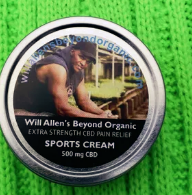
Urban Farmer Will Allen Launches CBD Business
His Beyond Organic's product line includes oil, lotions, dog treats
March 25, 2019, 1:41 PM
Urban farmer and longtime Growing Power leader Will Allen has launched a new venture in the growing industrial hemp market.
Will Allen
Based in Oak Creek, Will Allen’s Beyond Organic produces USDA-certified organic products, including CBD oil, lotions, soaps, dog treats and protein powder.
Allen founded and ran urban agriculture nonprofit Growing Power for 23 years before its board decided in fall 2017 to dissolve the organization. Since then, Allen has worked to launch his new business, which sets itself apart in the burgeoning cannabis market by using certified organic hemp seed in certified organic soil.
Allen grows the hemp at his Oak Creek farm and has two employees, he said.
Wisconsin lawmakers first approved use of CBD oil in 2013 under limited circumstances for those with seizure disorders, but allowable uses were expanded in 2017 to include certain medical conditions with a certification from a doctor. Also in 2017, Wisconsin lawmakers approved the creation of a pilot program for industrial hemp production.
Allen signed up to grow hemp shortly after the law passed in 2017, but he has taken time to familiarize himself with the plant.
“Before doing anything, I always want to research to make sure I know how to do it,” Allen said. “I took my time and learned about the plant and decided to produce some hemp oil with the plants I had.”
As a particularly absorbent plant used for soil remediation, hemp pulls chemicals and toxins from the soil in which it’s grown. That’s why it’s important for consumers to use CBD made and grown from organic hemp seed in organic soil, Allen said.
“You have to really be careful; if you go into a shop, you need to know where it’s coming from and where it’s grown,” Allen said.
Allen sells Will Allen’s Beyond Organic products online and at hemp workshops he holds in the community. Allen is also working with psychiatric health care providers to offer CBD products as a treatment option for patients. He said CBD products are useful for a variety of conditions, ranging from anxiety to arthritis to PTSD.
“It’s a natural remedy for common ailments,” he said. “I know, personally, it’s helped me with my arthritis … I’m trying to educate the community about it without pushing it down people’s throats.”
Allen considers the new venture an extension of his lifelong work of connecting communities with fresh, locally-sourced food.
“It’s a different way of improving people’s health,” he said. “If they’re eating organic vegetables and using CBD, it’s pairing those two concepts to help people.”
Allen envisions opportunities for others in the community to create indoor greenhouses in abandoned buildings, particularly in Milwaukee’s central city. He wants to serve as a consultant for those looking to build growing systems.
“Milwaukee is an ideal city for that because of the number of old empty buildings we have, like in the 30th Street Industrial Corridor,” Allen said.
Allen, a former professional basketball player and corporate marketing professional, operated a for-profit business, Will’s Roadside Farms, from 1993 until 1995, when the operation became nonprofit Growing Power.
Throughout his career, he’s garnered national recognition for his leadership in the urban agriculture movement, including receiving a $500,000 genius grant from John D. and Catherine T. MacArthur Foundation in 2008, joining First Lady Michelle Obama in her Let’s Move! Campaign in 2010 and being named one of the “World’s 100 Most Influential People” by Time magazine that same year.
Mounting financial concerns, however, prompted the Growing Power board to dissolve the corporation in late 2017.
Allen owned the organization’s headquarters at 5500 W. Silver Spring Dr. on Milwaukee’s north side from 1993 until 2014, when he sold it to the former organization’s board. A new business, Ultimate Farm Collaborative Inc., has since taken over the site with plans to create a collaborative for farmers. Allen said he remains involved in that work.

A Glimpse Inside A Chinese Indoor Farm
Vertical farming is big, and one of the biggest countries in the world, China, is no stranger to this movement. ECNS offers us a glimpse inside one of the country's indoor farms
Vertical farming is big, and one of the biggest countries in the world, China, is no stranger to this movement. ECNS offers us a glimpse inside one of the country's indoor farms.
Here, vegetables grow in a plant farm belonging to the Institute of Advanced Technology at the University of Science and Technology of China in Hefei, Anhui Province. The farm, housed inside a closed container, uses artificial lighting to help the vegetables grow well.
Dr. Zhang Fangxin, the general manager of Anhui Angkefeng Photoelectric Technology, said the system allows plants to grow well even when placed in an underground space.


Publication date : 3/13/2019
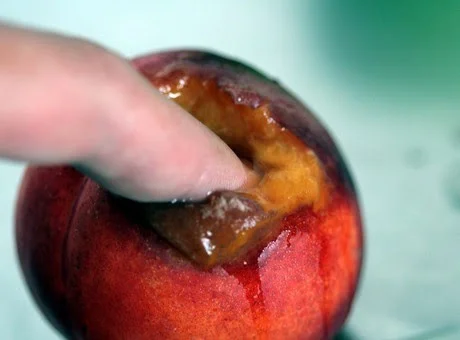
UK: Scientists Work On Tech To 'Smell' When Produce Goes Off
Scientists in the UK are working to develop new technology which will be able to ‘smell’ when fruit or vegetables are going off
Scientists in the UK are working to develop new technology which will be able to ‘smell’ when fruit or vegetables are going off. Their aim is to potentially save tonnes of waste; waste advisory body WRAP claims 1,200,000 tonnes of fresh fruit and vegetables are needlessly wasted each year.
Now, a UK-based research team are hoping to develop a new system by utilising a technique commonly used in space science. They say this new technique can assess the quality of the produce, which will help in waste reduction and allow the industry to make better informed assessments of shelf-life.
Not only would this help reduce waste, but allow food suppliers to be able to pinpoint when the produce is at its peak condition and therefore when it has the most nutritional value to consumers.
Researchers have already identified the unique set of molecular markers given off by rocket leaves before they are about to go off, but wanted to see if they could apply this to other produce. However, there are a number of logistical issues to overcome before they can make a device suitable for the food and drink industry.
Small and portable
Initial work utilised an expensive laboratory technique, Gas Chromatography-Mass Spectrometry (GC-MS) for this research – which is a way of separating and identifying different chemical compounds. This technology has been used for a number of different applications, from climate science to planetary science.
Farminguk.com quoted Dr Hilary Rogers, from Cardiff University as saying: “Our biggest challenge now is to take this complex technology and apply it to a cost-effective platform so that it can be used at different points in the supply chain, from production through to retail.”
Publication date : 3/12/2019

A Middle School Farm Team Is Automating Agriculture
Take me to your seeder: Behold, the FarmBot, an agricultural automaton that can plant, till, water, take pictures, check soil conditions and more, built and programmed by the young geniuses at Melville's West Hollow Middle School.
MARCH 14, 2019
By GREGORY ZELLER //
Meanwhile, back on the farm, the future was evolving.
The farm, in this case, is inside West Hollow Middle School, a forward-looking jewel of the Half Hollow Hills Central School District. And the future comes in the form of FarmBot, a kid-crafted, kid-coded automaton that could help feed future generations on this increasingly crowded planet – and even astronauts exploring distant worlds.
The robot, of course, tills its land on a relatively small scale: FarmBot measures 9 feet by 14 feet, an impressive achievement for middle-schoolers, if not quite ready to solve a global food crisis.
But as a blueprint for creative and sustainable agricultural innovations – a veritable must, with 7.5 billion hungry humans already seated and 3 billion additional dinner guests expected by the end of the century – FarmBot truly shines.
Described as “an open-source farming robot,” the mechanism slides on vertical and horizontal axes, carrying a camera, a small rake, a grasping tool and even soil-quality sensors that know when it’s time to make it rain, all designed and installed by ambitious sixth-, seventh- and eighth-graders (school maintenance professionals plugged in the electricity and water lines).
FarmBot knows what to do, and when, because of coding. “Kids who are interested in engineering” volunteered their time to build it, according to Half Hollow Hills CSD Public Relations Director Charles Parker, and now “different kids with interests in coding” are working on the programming side.
“Students came during their lunch periods and after school to build it,” Parker told Innovate LI. “And now students who are interested in coding are spending their time off in the school day to come work on it.
“These students are really doing phenomenal stuff.”
Part child, part machine, all farmer: West Hollow Middle School students help FarmBot work the land.
While the obvious goal is to automate the indoor growing process – interesting to overstuffed urban centers, future populations crowded into arctic regions and possibly space colonies – there are bigger themes at play.
Not only do students strengthen those increasingly important STEAM skills (for science, technology, engineering, art and math), they gain a wider understanding of alternative agricultural practices – also a priority, as farming environments shift, in many cases for the worse.
The effort even has a heart of gold: Hauppauge-based hunger-relief organization Island Harvest has donated seeds to the FarmBot project and will gather the fruits of the robo-labor for distribution to regional food-insecure families (other FarmBot produce will be used by the middle school’s Family and Consumer Science teaching staffs).
It’s a healthy crop of cross-disciplinary goodness, packed into a truly innovative 21st century educational effort, according to West Hollow Middle School science teacher Christopher Regini.
Life on MarsFarm: The crispy green fruits of hydroponic labor.
“The goal is to combine computational thinking, data collection and analysis, electronics and prototyping, and general good science practices to better understand plants, food production and the resources needed to reduce food insecurity,” Regini noted.
FarmBot, which was constructed and programmed this school year, follows in the virtual footsteps of another West Hollow Middle School future-farming foray: the MarsFarm, an indoor hydroponics farm already in its second year of operation.
Incorporating cutting-edge sensor technology into its soil-less system, MarsFarm allows students to remotely control systems and analyze data; via the education-focused Flipgrid videoconferencing network, they share their agricultural experiences with students in Acapulco and China, among other places.
Together, the STEAM-powered middle school farms are already producing healthy crops of cabbage, bok choy, bell peppers, basil and other herbs and vegetables, and there’s more on the way. Expect the tech to grow, too – according to the school, students are eager to begin 3D printing new tools for their prototype FarmBot system.
Regini – who noted the MarsFarm data is shared with Princeton University researchers and Growing Beyond Earth, a partnership between NASA and Florida’s Fairchild Tropical Botanical Garden – said the forward-thinking farming efforts are a critical tool for familiarizing young learners with science, art and engineering.
“The goal is to apply STEAM education in a way that is meaningful, allowing us to focus on topics already within the science curriculum,” the science teacher added, “while engaging students in a practice that equips them with the 21st century skills that make them future-ready.”
TOPICS: Charles Parker Christopher Regini Fairchild Tropical Botanical Garden FarmBot Flipgrid Half Hollow Hills Central School District Island Harvet LeadMarsFarm NASAPrinceton UniversityWest Hollow Middle School
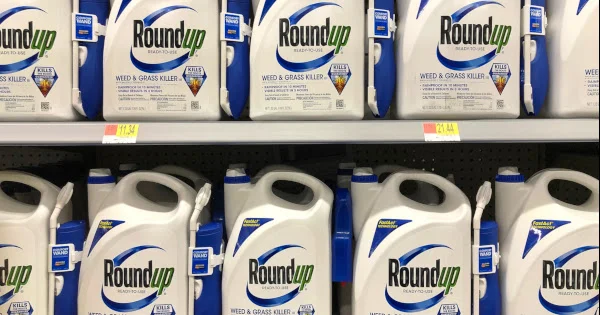
No Amount of Money Makes Up For The Pain And Suffering
Because these threats are still very real.
After years of battling Monsanto, of working to expose the lies about glyphosate and Roundup weedkiller, we’re seeing glimmers of hope.
But this fight is far from over. And we desperately need your help to keep it going.
We’ve extended our spring fundraising campaign because we simply must reach our goal. Can you make a donation today? Every donation, small, large and in-between, will help fund our work to get pesticides out of your food. You can donate online, by mail or by phone, details here.
Within the past eight months, juries in two key trials against Monsanto have unanimously agreed that Roundup caused the plaintiffs’ non-Hodgkin lymphoma cancers.
Both juries punished Monsanto-Bayer with huge fines.
No amount of money makes up for the pain and suffering Roundup weedkiller has caused the victims in these two trials, or the tens of thousands of other people sickened by exposure to glyphosate.
But here’s what both these trials have made clear: The overwhelming evidence points to Roundup as a cause of cancer. And what’s more, it shows that Monsanto has known all along that Roundup causes cancer—and yet the company has gone to great lengths, and spent millions of dollars, to hide that evidence from the public.
In an article published by the Guardian, U.S. Right to Know’s Carey Gillam wrote:
Even the US district judge Vince Chhabria, who oversaw the San Francisco trial that concluded Wednesday with an $80.2m damage award, had harsh words for Monsanto. Chhabria said there were “large swaths of evidence” showing that the company’s herbicides could cause cancer. He also said there was “a great deal of evidence that Monsanto has not taken a responsible, objective approach to the safety of its product . . . and does not particularly care whether its product is in fact giving people cancer, focusing instead on manipulating public opinion and undermining anyone who raises genuine and legitimate concerns about the issue.”
In 2016, 131,672,984 kilograms (290,289,239 pounds) of glyphosate was sprayed in the U.S., according to data published by the U.S. Geological Survey, obtained and analyzed by Pricenomics.
Where does all that poison end up? In soils, in drinking water, on your food—and in your body.
The widespread presence of glyphosate in everything from bread to cereal to snack bars to fruit juices to baby foods to ice cream to beer and wine has been well documented.
The latest report? Widespread glyphosate contamination in foods sold by popular chain restaurants, including many that market themselves as “healthy,” “natural” and even “organic.”
The anti-Monsanto verdicts, the testing and reporting about glyphosate in our foods, the investigative reports showing Monsanto’s extreme efforts to discredit the scientists who uncover the truth about glyphosate and Roundup have all led to greater consumer awareness.
But even as more cities and school systems announce plans to ban glyphosate, the U.S. EPA fails to act on the evidence. In fact, the EPA recently (and very quietly) moved to disapprove state efforts to impose their own restrictions on pesticide use!
We are in the middle of our own lawsuit against Monsanto, for placing misleading claims on bottles of Roundup sold to consumers.
We continue to test products for glyphosate, to report on those test results, and to go after the companies that claim their glyphosate-contaminated food is “natural.”
We are also a major funder of U.S. Right to Know, a nonprofit public interest, consumer and public health organization that has been deeply involved in exposing Monsanto’s lies and government ties.
But the simple truth is this: We can’t do this work without your help.
We rarely extend a fundraising deadline. We are doing it now because we must meet this quarter’s fundraising goal.

These London Vegetables Can Survive A Bomb Blast

Richard Ballard and Steven Dring have been growing vegetables and micro-herbs that can survive a bomb blast.
That’s because these two urban farmer-founders have been using a Second World War air-raid shelter as their first controlled environment agriculture site for their London-based agtech startup Growing Underground.
The pair first rented this space from Transport for London back in March 2015. For the last few months, they have been offering “Founder Tours” of their hydroponics-grown produce to a curious mix of scientists, reporters, agri-tourists, investors, politicians, environmentalists, film scouts and celebrity chefs eager to graze on sprigs of wasabi or pea-shoots..
Dring wastes little time in setting the scene: “Five-inch steel plate on the roof, designed to take a direct hit from a 500-pound German bomb,” he explains tersely. “The walls are 6 feet thick in places. Double helix staircases. Lift shaft down the center. Goes down 130 feet. By the time you get downstairs, you’ve got 70,000 square feet of space.”
What was all this space doing disused in the heart of South London?
AgFunderNews freelance reporter Richard at Growing Underground
It’s one of many historical quirks relating to the world’s first underground passenger railway, known to Londoners as the Tube. The interior looks like vaulted Tube tunnels. Which is because this was one of eight bomb shelters, designed to hold up to 8,000 people each, that were built to be converted, in peacetime, to a second and faster Northern Line. The aim was to reduce crowds and commuter times. Yet in post-war Britain, these eight shelters were never linked up (a perhaps irritating fact for today’s rush hour commuters on the Northern Line.) Instead, it was used for static purposes throughout the Cold War, including government document storage, before falling into disuse.
The elevator trundles downwards. By farm level, you still hear the sounds of the Northern Line; its trains rumbling along two storeys above.
Test Tube For the Future of Farming
Dring then throws on a white doctor’s coat over his tweed jacket. He dons a blue hairnet and a pair of wellington boots before washing his hands. It is as though he were about to step into an operating theater. Working down here is about science and the future of farming far more than historical posterity when it comes down to it, he says as we step inside the farm.
The tunnels glow pink, with layers of hydroponic vegetable beds growing under the Finnish firm Valoya’s wide spectrum LED growing lights. Scientists from the University of Cambridge, led by Dr Ruchi Choudhary, have set up sensors to track and analyse growth rates under variable conditions.
“We have been monitoring environmental conditions for the past three years, to identify optimal growing conditions, while minimising resource use,” says Melanie Jans-Singh, a member of the research team.
The data generated are bound for the Alan Turing Institute for data crunching.
The founders expect the findings from these data will help the Growing Underground team to simulate conditions in a widening variety of underground conditions with a broadening range of herbs and vegetables.
“We know the environmental recipe for about 100 products. We’ve grown micro-herbs, baby leaf salads, pea shoots. We’re starting trials on whole head lettuce,” says Dring. According to company estimates, circa 700 kg of fresh produce is delivered per week currently. This is projected to rise to over 4200 kg at full capacity across a mix of products.
To meet and ultimately surpass these targets, the founders say plans are now afoot to expand into the remaining space at their Clapham site in South London. (Much of it is still empty and sublet occasionally for movie sets.) But they are planning to expand to at least three other underground sites nationally. “There are tens of millions of square meters of underground space that we have been offered in the UK, and out of that we have identified the relevant sites,” he says.
What about logistics? Aside from being closer to market, Dring, who has a background in logistics, has already brokered partnerships with major UK retailers, including Marks and Spencer, Waitrose, Ocado, farm-to-consumer eGrocer Farm Drop, Planet Organic, and specific high-end restaurants who they supply via New Covent Garden, a fresh produce hub. “We are projected to penetrate that to a level that would require us to have four farms in the UK.”
Soil degradation, population growth, further automation and climate change will all play into the hands of underground farming globally, the founders claim, offering year-round and locally sourced fresh produce with low energy inputs.
In the UK context, one groundbreaking study by PWC from 2014 estimated that up to 95% of UK supermarket Asda’s fresh produce supply chain is at risk from climate change. Already, hotter, less predictable seasons have disrupted supplies of strawberries and lettuces in the UK in recent years. Underground, seasonal temperature fluctuations are largely taken out of the equation, meaning there could be many other climate-adapting countries where subterranean farming may fill a niche in the not too distant future. “The conversations we’re having include China, the Middle East, India, South Korea, the United States. We’re at that point of making sure we are taking advantage of global opportunities,” says Dring, declining to comment more specifically on vague references to joint ventures in the offing.
Funding in an Age of Plenty
So far, Growing Underground, with its team of twenty-two, has raised £2.7 million through crowdfunding platform Crowdcube, and a slice of corporate investment from G’s Global, a large scale vegetable producer and distributor.
Recent funding rounds for similar-minded companies provide cause for hope for this team and their focus on indoor controlled environment farming. In 2017, indoor vertical farming company Plenty managed to raise $200 million of Series B funding, led by Softbank’s Vision Fund. Similarly, in December 2018, Bowery Farming, the New York-based indoor farming group, secured a $90 million Series B round, led by Google’s venture arm GV.
Plenty and Bowery grow produce in vertically-stacked warehouses. Cambridge researcher Jans-Singh says the Growing Underground case study is a slightly different proposition. “By being underground,” she writes, “the boundary temperatures of the greenhouse are more stable year-round, thus reducing the need for heating and cooling, and the farm can function without heating in winter, by simply reusing the waste heat of the lighting.”
Even so, could the breakthroughs of companies like Plenty and Bowery be misleading beacons of hope from across the Atlantic? After all, the London scene is another fundraising environment. If London’s political and media scene are anything to go by, things are looking up. Growing Underground has received warm words of support from politicians like London Mayor Sadiq Khan and his predecessor Boris Johnson. They’ve even secured high profile advice from celebrity chef Michel Roux Jr, an early convert. But as they open their Series A funding round soon, it still remains to be seen if their political and media sparkle translates into investors venturing underground with similar conviction that there is light at the end of the tunnel.
Nevertheless, funding or no funding, Dring reckons his firm is in hot pursuit of his deeper-pocketed American rivals: “We’ve taken a different approach to our peers in the US. We’ve proven the profitability of the model, developed then tested the technology, optimised the farm through data capture and analysis, stressed the logistics, built a solid customer base, and now it’s time to rapidly scale”.
Image: Martin Cervenansky
Microgreens Grown Locally Gain Popularity At Area Grocery Stores, Restaurants
Microgreens — tiny plants smaller than baby greens but more mature than sprouts — have been trending in popularity with chefs, restaurants and area farmers markets
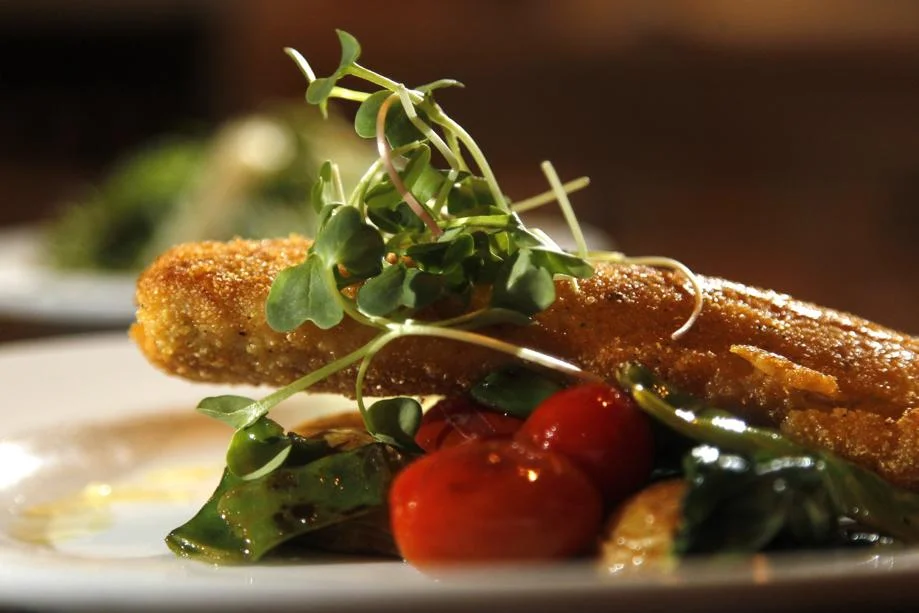
Locally grown microgreens on top of cornmeal crusted walleye with spring vegetable ragout at the Winds in Yellow Springs. LISA POWELL / STAFF Lisa Powell
Kaitlin Schroeder, Staff Writer
Microgreens — tiny plants smaller than baby greens but more mature than sprouts — have been trending in popularity with chefs, restaurants and area farmers markets.
The nutrient dense produce have grown popular as a way to color and flavor to sandwiches, soups, salads and stir fries.
“They are really high in their nutrient value and they add a good presentation to your entree,” said Dean Sink, with Hydro Growers, based in Pleasant Hill, who has added microgreens to his business about five years ago.
Most of their business is with restaurants, though Hydro Growers does have a booth downtown at Second Street Market.
Michelle Mayhew, Dorothy Lane produce director, said microgreens have been a long growing trend that grew from restaurants — where food trends tend to start — to grocery stores and home cooking.
“People started using them as garnishes and found out how flavorful they are,” Mayhew said. “It’s definitely growing because we went from like three varieties to six to eight. So that tells you the trend is growing.”
Small hobby farms and larger operations have started producing microgreens in recent years. 80 Acres Farms, which does indoor vertical farming and is expanding in Hamilton, grows microgreens and Waterfields in Cincinnati is one of the larger suppliers of the specialty greens to chefs in the region.
The crop has a quick turnaround since the plants are harvested so early. It’s a product with a short shelf life, which has created a market for local farmers to be the suppliers, said Sam Wickham with Fox Hole Farms in Brookville.
Wickham said her farm’s products are on shelves at two of the Dorothy Lane Market locations and they are also a vendor at Oakwood and Centerville farmers markets.
“They are pretty popular. They are kind of our workhorse right now,” she said.
Stephen Mackell, farm manager with Mission of Mary Cooperative in the Twin Towers neighborhood, said his organization has taught classes in the past on microgreens and said they help attendees understand the difference between microgreens and sprouts.
Sprouts have been a popular item on grocery shelves in kitchens for longer than microgreens and are germinated seeds that typically have sprouted but haven’t done photosynthesis yet. Microgreens are grown until they have a few leaves and are a green product.
“It tastes like you are eating a plant rather than a little protein sprout,” Mackell said.

Farm Refreshed: UrbanKisaan
MARCH 19, 2019
Urban Kisaan seeks to revolutionise the concept of urban gardens with hydroponic farming methods
A chance meeting with a scientist led this accounts person to set up UrbanKisaan, a startup involved with farming. Vihari Kanukollu a Certified Management Accountant (CMA) who met Sairam, a scientist at a spiritual retreat, broached the topic of farming and water scarcity and concerns about the future of farming in a water-scarce world.
“Dr Sairam invited me to his home. I accepted the offer. There I was spellbound and surprised at the same time when Sairam showed me his little experiment — a vertical hydroponic garden set up in his balcony that was thriving and had been providing him with a healthy yield for many months. Though I am a commerce graduate, I also closely looked at the food crisis we will be facing in the years to come and thinking what do we do. Social causes are close to my heart so I wasn’t ready to give up,” says Vihari.
Together with Sairam, a biotechnology scientist, and Srinivas Chaganti who has done Masters in Computer Science Vihari gave birth to UrbanKisaan. This two-year-old startup has emerged among the top 100 social entrepreneurs in India as per Action For India (AFI) forum; it is one of the top 8 startups to be featured by Discovery India for its documentary series Planet Healers to be aired on March 29.
Their farm in Mahbubnagar, about 80 kilometres from the city, doubles up UrbanKisaan’s research area. The leased out land gives a peek into the future of farming the world over. “Especially because it conserves water,” adds Vihari.
Soil free but nutrient-rich Vihari vouches their startup grows pesticide-free produce in a vertical hydroponic environment. Hydroponics is a method of growing terrestrial plants without soil, by using mineral nutrient solutions in water. Though the farms grow plants in water, they use 95% less water. UrbanKisaan manages everything from the seeds to its proprietary, “farm-controlling software system and also empowers people to grow their own safe, fresh and high-quality food,” shares Vihari.
What spurred Urbankissan
Sairam developed the nutrient solution for their start up. “As you all know Hydroponic farming is a soil-less farming technique that replaces soil with nutrient solution; so it can be used to grow crops indoors. With timely nutrition and light, these plants do not need pesticides. Hydroponic farms are ideal for the urban environment and can give city dwellers access to fresh produce every day right from their own kitchen or rooftop,” explains Vihari. You can grow almost anything — vegetables and berries, greens, herbs, cauliflower as well as peppers — provided you have the right potting techniques and nutrient mix.
Ensuring food safety UrbanKisaan is different from other Hydroponic farms in the way that they are developing this farming technique for urban homes that have less space. “Before getting down to start the farm and research center, we used Dr Sairam’s hydroponic home set up as the prototype and sold home kits to raise the money. Our home kits sell between ₹ 15000 to ₹ 50000, depending on how big a vertical hydroponic garden you want,” says Vihari.
At the farm, my attention goes to the over-grown plants. Have they been over-fed I asked, “No they are seed-bearing plants we grow for seed saving for our nursery,” says Vihari.
If you are still sceptical, “Come see our farm that double up as a store, in Jubilee Hills,” smiles Vihari.
Their store in Jubilee Hills opens in the first week of April.

The Effect of Far-Red Enriched Spectra On Lettuce
One of the exciting features of LED grow lights is the ability to customize spectrums of light to fit various plant growth applications. Therefore understanding the relationship between light and plant growth is key for healthy, high-quality crop production.
Plants do not only utilize light for photosynthesis, but different light spectrums can be used to promote different growth responses in plants, at different growth stages.
Researching the effect of far-red
A research study was conducted by Heliospectra’s Plant and Light Experts on the effect of a Far-red enriched spectra on Black-Seeded Simpson. The purpose of the research was to study the effect of Far-red enriched spectrum on lettuce in a sole-source light environment.
The Far-red wavelength peaks around 735 nm, this waveband is not included in Photosynthetically active radiation (PAR) which range from 400-700 nm but has been proven to steer growth responses in plants.
The research was conducted in Heliospectra’s plant lab using Heliospectra’s fully adjustable Elixia LED grow light. The lights have the ability to control and monitor provide growers with full control over the composition of the spectrum, intensity, and duration, giving growers the possibility to create their own light strategies.
The lettuce was seeded in 7x7 cm (2.7x2.7 in) pots with a mix of soil substrate and vermiculite. Four days after germination pots containing one plant were placed into a LED growth unit (1.4-m², 15ft² open area) with reflective curtains. The plants were grown under four different spectra, all with the same light intensity (200 mol/m2/s) and spectral composition within PAR (red, blue and white wavelengths), three of the four spectra had additional Far-red added to their spectrum at different intensities (Low, Mid, and High).
The lettuce were grown under LED light for a total of 22 days and the experiment was repeated 3 times.
Clear visual difference
At harvest, 5 pots per treatment were collected and measured. The lettuce head diameter was measured with accuracy of 0.5 cm with a ruler, and fresh weight were taken per plant with a scale (Mettler P1200).
A clear difference could be seen in height and size of the lettuce at harvest depending on the light strategy. With the head diameter and weight increased proportionately to the increase of amount of Far-red used.
These results indicate that far-red added to the spectrum has great impact on the growth of Black-Seeded Simpson lettuce. In a controlled sole-source environment, the spectral quality is of high importance, and gives growers a real potential to steer the visual appearance of the crop grown to fit their production goals.
Click here to download a summary of the test.
For more information:
Heliospectra
Box 5401 SE-402 29 Göteborg Sweden
Phone: +46 31 40 67 10
Fax: +46 31 83 37 82
info@heliospectra.com
www.heliospectra.com
Publication date : 3/15/2019

The Crazy Food Fight Over The Future of Vegetables
What’s at stake is billions of dollars and the future of food on the planet. Over the past 50 years, large farms growing massive amounts of one crop (known as monoculture) have gobbled up land. While industrial farming has increased crop yields, it’s done so at the expense of consumer choice
Who Knew Farming Could Get So Dirty?
BY RICHARD MARTIN
March 28, 2019
CHRISTOPHER TESTANI
On a cold, rainy night in Brooklyn, a crowd gathers inside the building that houses Square Roots, a company co-founded by CEO Tobias Peggs, a tech entrepreneur, and Kimbal Musk, who sits on the boards of Tesla and SpaceX (both started by his older brother, Elon) as well as Chipotle. Located on a dreary street in Bedford-Stuyvesant, the building is, technically, a farm. Its parking lot holds ten enclosed shipping containers.
With a bit of showmanship, Peggs throws open the door to one of the containers and a violet glow envelops the crowd. Inside, tightly packed vertical rows of red leaf lettuce, basil, and mint grow hydroponically through a combination of artificial light and a nutrient-rich solution. Musk and Peggs say they can cultivate three acres of plants in one container using a technique that could be adopted by any city in the world.
CHRISTOPHER TESTANI
At the heart of the vertical-farming trend championed by Musk and Peggs is the idea that although you can find lettuce at your grocery store in Boston in January, thanks to a system that allows farms in states like California and Arizona to ship fresh greens across the country at a reasonable cost, there are better alternatives.
Growing lettuce outdoors on a large-scale farm uses a lot of water. Plus, it’s estimated that during the up-to-five-day domestic trip from these farms to the grocer, the greens lose much of their nutritional value.
About 35 miles north of Brooklyn, a back-to-the-future approach to farming is growing. A few days later, I join Jack Algiere, the farm director of Stone Barns Center for Food and Agriculture in Pocantico Hills, New York, and we walk along a hillside path with cows and lambs grazing on one side, goats frolicking on the other.
CHRISTOPHER TESTANI
Dressed in a flannel shirt and a sturdy coat, Algiere enters a half-acre greenhouse. Lettuce leaves the size of a baby elephant’s ears luxuriate in the warm air. Purple and yellow stalks of chard erupt from the earth, which is dark brown and lush.
Algiere treats this food with the same care and attention as Dan Barber, a top chef. Barber runs Blue Hill at Stone Barns, a farm-driven restaurant that consistently ranks as one of the best restaurants in the world.
You would think the viewpoints of Musk and Barber, two of the most influential voices in farming, would be closely aligned, but their debate about how to grow lettuce is getting heated and dirty.
CHRISTOPHER TESTANI
Barber: “[Kimbal’s] really smart, but the only reason he wants everyone to eat salad in the winter is because it’s the only thing he can grow in a vertical farm. He’d be telling you he’d want everyone to eat rutabaga if he could grow rutabaga. I love the guy, but let’s be honest: You can’t grow anything.”
Musk: “I don’t think [Dan] has a fundamental disagreement with what I’m doing. He sees the momentum moving towards indoor farming, and he doesn’t like that future.”
What’s at stake is billions of dollars and the future of food on the planet. Over the past 50 years, large farms growing massive amounts of one crop (known as monoculture) have gobbled up land. While industrial farming has increased crop yields, it’s done so at the expense of consumer choice.
In a span of 80 years, the variety of the world’s seeds dwindled by 93 percent, according to the Rural Advancement Foundation International: In 1903, 497 types of lettuce existed, but by 1983, there were just 36.
Industrial farming is so chemically reliant and ultimately bad for the soil (not to mention bad for the diets of those who live on its produce) that the United Nations’ 2013 trade and development conference urged a global return to sustainable farming practices.
Nowhere are the consequences of industrial farming more evident than at your supermarket, where identical-looking potatoes, carrots, and greens line the produce shelves. The presentation looks attractive, but that sameness is a result of destructive land-management practices—practices that lead to less-nutritious produce.
And then there’s foodborne illness. Remember the Great 2018 Romaine Lettuce Scare? Investigators traced that outbreak back to a large-scale farm in Santa Maria, California.
“It’s not like this is the question we should be thinking about five generations from now,” Barber says. “This stuff takes a long time, but time is running out.”
The Musks Shall Inherit the Earth
Square Roots may be the least splashy of all of Kimbal Musk’s endeavors. The South African native became involved in the food world after making millions building and selling start-ups, both on his own and with his brother. He did a stint in culinary school in New York City, then settled in Boulder, Colorado.
Lost in the shadows of the Musk sibling mythology is that Kimbal is actually a legitimate farm-to-table pioneer. He opened his first restaurant, the Kitchen, in 2004, sourcing ingredients from Colorado’s rich agriculture and livestock communities.
Musk launched Square Roots with Peggs in 2016 with one concept: “Can we take a young person with no experience and bring them in and teach them how to farm in a box in double-quick time and get them to grow food that is tasty, that people want to eat?”
Kimbal Musk (left) and Tobias Peggs | CHRISTOPHER TESTANI
The initial results were encouraging, although Square Roots cycled through distribution concepts before arriving at its current direct-to-retail model. You can now find Square Roots’ greens and herbs at specialty grocers around New York City.
Later this year, the company plans to operate in other U. S. cities and then scale from there. In each market, the produce will travel from the shipping containers to nearby store shelves, a solution that is hyperlocal and, now, highly traceable.
During the romaine-lettuce scare of late 2018, when an E. coli outbreak in California led to a coast-to-coast recall, Peggs and Musk realized that the data they compile for Square Roots would allow them to trace everything they grow back to the very shipping container that produced it. Now there’s a “Transparency” section on the company’s website where consumers can enter the lot number from their package of Square Roots herbs.
There are energy concerns with this type of farming, as well as a sense that it isn’t natural, but Musk is leaning into those issues. This is lab-grown food, and his team is sciencing the shit out of it. Strawberries, eggplants, beets, radishes, carrots, and more will come to market in five years.
“Right now we’re super-premium and people love it,” Musk says. “But over time we really want it to be about real food for everyone. We can get the price down and deliver delicious product 365 days a year.”
The Real Dirt on Heritage Farming
Stone Barns Center runs apprenticeship and education programs aimed at training and supporting small farmers. Small-scale farming is knowledge-intensive and complicated, Algiere acknowledges, but it’s the right thing to do for ourselves and the planet.
Watch the news and it’s depressing for farmers, but there was a glimmer of good news in the USDA’s 2017 Agriculture Census. At the same time that the overall number of farms in the United States decreased by 5 percent to only 2 million, farms with annual revenues between $100,000 and $250,000 saw the largest increase in sales between 2016 and 2017.
“This is so important,” says Algiere, launching into a soliloquy about the rising interest of young, first-time farmers and the surprising upswing in the number of small U. S. farms. He grabs a rake and continues his lecture on how small farms on the perimeter of major urban centers can not only thrive but can also conserve the land.
Algiere walks out into a plot of carrots and runs the rake over the greens protruding from the soil, explaining that most of the equipment available to farmers is of the giant John Deere tractor variety, because industrial farming has dominated society since the mid- to late 20th century.
“The problem is that there hasn’t been a set of tools for small-scale, diversified farms since 1940,” he says. That’s why among the many educational endeavors that Stone Barns Center supports is Slow Tools, a collective of farmers, designers, and engineers (with an annual conference held on the property) aimed at manufacturing equipment that can help small farmers grow vegetables and work their five-ish acres more efficiently.
Attendees include retired engineers who’ve developed a desire to farm, prototypical millennials seeking a return to the land, and even city dwellers who got their first taste of farming by working at one of the vertical hydroponic farms.
Barber so believes in Algiere’s work, as well as the entire regenerative-farming and land-management movement, that he cofounded Row 7 Seeds last year. Barber asserts that most of the seed business is now owned by chemical companies that have little interest in small, regenerative farms.
Jack Algiere (left) and Dan Barber | CHRISTOPHER TESTANI
“They don’t make money on the seeds; they make money on the intervention of chemicals,” he says. “That’s why the seed company became so important to me. It really does lay the foundation for everything that follows, including flavor, up to when it hits your mouth. That can be determined on a genetic level.”
Back in the greenhouse, Algiere puts down the rake, heads outside, and walks to a barn filled with hundreds of chickens. They swarm toward him and produce a cacophony of clucks that make it impossible to hold a conversation.
He moves toward the pigs and extends his hand toward a comically large sow that comes to greet him. “My animal operations feed the compost and pasture operation here,” he says. “My compost system feeds the crops and orchards, and any leftover feeds the pigs.” As hogs wrestle playfully, he whispers about how amazing the bacon coming from these animals will taste.
Eat the pork from Stone Barns Center and you will immediately understand what Algiere means. Try its carrots and you’ll come to believe what Barber does. The flavor of these foods—started from diverse seeds (both heirloom and experimental hybrids), coddled by premium soil, cultivated with gentler farming methods—rewards the eater in a way that your typical supermarket versions cannot.
Is it hard work? Algiere’s calloused hands prove that, yes, it is. But it’s not anything we haven’t done before.
The Fight for Farming’s Futures
Chris Newman, who cofounded Sylvanaqua Farms in rural Virginia with his wife in 2013, calls himself a “permaculturist” and proclaims his reverence for the land—but also for technology. “There is no single ‘right’ way to produce food,” he says in an email interview.
His own farming practices aim to be regenerative, like Algiere’s, and he’s adamant that these types of farms can produce food while helping to restore the environment. Yet ultimately they won’t be able to keep up with demand.
“Sooner or later, people on both sides of the debate will have to understand that sustainable food production lies in the intersection of nature and technology, not in their mutual exclusion.”
Call them rigid in their convictions, but Musk, Peggs, Barber, and Algiere are at least stoking the debate about how to feed the planet healthy food. And they’re drawing prominent investors into the search for a resolution.
Investors like Tom Colicchio, a cohost of Top Chef and an early backer of Bowery Farming, a company with two hydroponic farms. “I like what [Barber] has to say, and I also believe that through the right kind of farming and regenerative practices, we can build soil, we can grow,” he says. “That doesn’t help if there’s flooding or drought with climate change. I’m looking at 20 or 30 years down the road, and we’re going to have to rely on indoor farming.”
But then there’s the issue of energy use. Henry Gordon-Smith, a leading consultant on urban agriculture, advises multinational corporations and individuals wanting to start their own vertical, rooftop, or greenhouse farms.
Seated in his Brooklyn office, he recounts a study he conducted for an international beverage company to determine the carbon footprint of five crops grown in three settings: a vertical farm and a greenhouse, both in New Jersey, and a soil-based farm in California.
The results were mixed, depending on the crop, but a key takeaway was that the vertical farm’s carbon footprint was “extraordinarily higher,” due to the energy used. He adds that when you account for food waste, water use, and social impact, the playing field levels a bit, but the bottom line, he says, is “there’s no silver bullet. That’s not the catchy sound bite that people are looking for, but that’s the fact.”
Yet the cash continues to pour into vertical farming. Venture capitalists have pledged about $1 billion over the past two years to fund start-ups like Plenty, AeroFarms, and Bowery Farming. Amazon, Google, and Microsoft are in the game.
Market research projects the global vertical-farming market will hit $10 billion by 2025. Operations like AeroFarms’ 70,000-square-foot facility in Newark, New Jersey, and the 100,000-square-foot farm that Plenty built outside Seattle will soon become commonplace, proponents suggest.
Matt Barnard—the CEO of Plenty, which has amassed more than $200 million from investors like Amazon’s Jeff Bezos and SoftBank, the majority shareholder in Uber—explains that he’s going big because of the scale of the problem.
“I was brought in by one thing and now I’m here for many—for health, nutrition, stresses on the land system,” Barnard says. That mission, however, may depend on trusting in not one solution but a combination of many.
For the moment, the vegetables available at your local farmers market or upscale grocery store reflect this dichotomy. You can easily find a plastic tub of lettuce from a hydroponic farm and, depending on the season, you may also find a sweeter, smaller, more efficient variety of honeynut squash developed in part by Barber and Row 7 Seeds.
Hydroponically grown greens and soil-grown, small-farm-produced squash living side by side in harmony: It’s a utopian vision already playing out in front of your shopping cart. The true question is, will you buy either? The answer, if you’re really concerned about your health and the health of the planet, is that you’ll buy both.
Bowery Greens Available On Peapod, AmazonFresh
March 28, 2019
( file photo )
Fresh greens from Bowery Farming, New York, N.Y., are now available throughout the greater New York area from Peapod and will be offered on AmazonFresh in mid-April.
The two online grocery service partners will make Bowery’s produce available for delivery across all five of New York City’s boroughs, north to Scarsdale in Westchester County, east to Deer Park, Long Island, and throughout northern and central New Jersey for the first time, said company spokeswoman Emily Drago.
Bowery Farming grows hydroponic salad greens in vertical indoor farms. The company launched in 2017 with a plan to build indoor farms near or in cities nationwide. The first two farms in Kearny, N.J., supply restaurants and retailers in the tri-state area.
Related articles:
GV leads $90 million investment in Bowery Farming
New York’s Bowery launches hydroponic indoor farm
Crop One Holdings CEO endorses digital distributive agriculture

Salmon And Baby Chard, Brought To You By A Brooklyn Farm
Photographer: Victor J. Blue/Bloomberg
Edenworks, an aquaponics operation in East Williamsburg, already sells salads at a local Whole Foods and is looking to scale up.
March 28, 2019
Brooklyn is not what most people envision when they think of farm country.
But if you take the L train to Montrose Avenue and walk a block, past the liquor store and catty corner to Louis Tommaso funeral home, you’ll find Edenworks. It’s an indoor aquaponics operation is raising salmon, shrimp and a hybrid striped bass on the lower level, with teeny tiny salad greens known as baby greens and microgreens, upstairs. A stone’s throw away is Oko Farms, also doing aquaponics, but outdoors and with an educational focus. And Smallhold, which grows mushrooms in its Minifarms in several New York City locations, is headquartered in nearby Fort Greene.
By housing fish and crops under one roof in East Williamsburg, Edenworks is putting a modern spin on an ancient form of agriculture. Chinese rice farmers have been putting carp in their flooded paddies for centuries, and the Aztecs grew crops on “chinampas,” or artificial islands, in lakes. The fish fertilize the crops and can be eaten at the end of the growing cycle.
The Edenworks version—urban, with a focus on premium products—should appeal to the growing category of shoppers looking for local, sustainable, healthy food that comes with lots of flavor and a good backstory. The company already sells two-ounce Spicy Microgreens and Mighty Microgreens Personal Salads for $4.49 each at the Williamsburg, Brooklyn, location of Whole Foods Market. (Sorry locavores, but for now, the fish are only available to a select few at promotional or local events.)
A worker feeds Atlantic Salmon in a tank
Photographer: Photographer: Victor J. Blue/Bloomberg
Novel farming operations have proliferated in recent years, and several have attracted huge investments, notably indoor farms Plenty, which raised $200 million in 2017, and Bowery Farming, which pulled in $90 million in December. But profitability is elusive, and investments in such startups dipped last year, dropping 7.3 percent to $601 million, according to researcher AgFunder, even as the overall agri-tech sector raised a record-breaking $16.9 billion.
The hard part is turning small-scale operations into big ones. Several have failed, among them PodPonics in Atlanta, FarmedHere in Chicago and another Brooklyn aquaponics enterprise, Verticulture Farms. The indoor farming niche is “more challenging than many other ag-tech categories,” says Louisa Burwood-Taylor, AgFunder’s head of media and research. “Investors might be more wary until they’ve seen some of these concepts proven out.”
Welcome to the Aqualab
Edenworks co-founder Jason Green, a technologist with a background in neuroscience, believes he has a winning formula. The company closed a $5 million seed round in May, with investors including venture capitalists and food industry veterans. The bet is that Edenworks’s (relatively) simple plan to go to market, with a focus on greens before scaling the seafood, will land it alongside such aquaponics operations as Wisconsin’s Superior Fresh, which now produces 1.8 million pounds of leafy greens and 160,000 pounds of fish each year.
Green, who runs Edenworks, founded the company with construction manager and systems engineer Matt LaRosa and chief technology officer Ben Silverman in 2013, originally building a pilot system raising tilapia and a variety of vegetables. Now they’re growing only baby greens and microgreens, with itty bitty versions of red kale, chard and cabbage—and the lowly tilapia has been abandoned. That commonly farmed species, Green concedes, is never going to be a marquee item. “You can’t brand or market your way out of it being a tilapia,” he says.
Jason Green | Photographer: Victor J. Blue/Bloomberg
Edenworks’ ecosystem harnesses the power of the microbiome instead of pesticides, antibiotics or synthetic fertilizers. The ground-level Aqualab is where the fish live. The waste, mostly feces along with a bit of ammonia from the fish urine and uneaten food, is run through a mechanical filter to separate liquids from solids. Bacteria grown from a starter culture then convert the ammonia to nitrates, sending fertilizer-rich water to the greens in the Farmlab two flights up. For now the solids are aerobically digested, a bacterial sewage treatment process, similar to the ammonia’s conversion to nitrates. (In future facilities, Green said, they’ll be gasified to generate energy.) The result is yields more than twice industry averages and more than eighteen months of farming without any foodborne pathogens, according to the company.
A ‘Win-Win-Win?’
The next step is ramping up the operations into a larger, New York metro area farm in 2020. But scaling vertical farms, even those just focused on a single production system, has been a challenge.
“It sounds like a win-win-win,” says Henry Gordon-Smith, founder and managing director for Agritecture Consulting, an urban-farming consulting firm one L stop away. “But the challenge is anytime you combine multiple systems and make them depend on each other, things get complicated.”
To start, the technology does not scale linearly. “When you have more lights, people, systems and plans, the calculations and requirements to create the consistent micro-climate get more challenging,” he says. Running a farm indoors, as opposed to outdoors in consistently warm weather, drives up energy usage, too. Then there’s the feed problem. The vast majority of commercially available fish feed is made from seafood taken from the already fish-depleted ocean.
Microgreens growing at Edenworks | Photographer: Victor J. Blue/Bloomberg
Green recognizes these challenges: Edenworks is growing only baby and microgreens, high-value crops with short growth cycles. Plans for a larger facility include a more precise “climate delivery” (as opposed to “climate control”) system that will help avoid problems encountered by other vertical farms. For the time being, the company will raise only as much fish as necessary for the salad side, a ratio of 1 pound of seafood for every 10 pounds of produce, until it’s satisfied with the greens business. Automation will restrain labor costs; new farms will use renewable energy technology.
Edenworks is experimenting with plant-based feed and plans to adopt fish-free feed when it becomes globally available in the next year or so, Green says. Jacqueline Claudia, CEO of aquaculture-based company Love the Wild, says increasingly sustainable feeds options are already available at reasonable prices. Still, she adds, Edenworks is likely ahead of most of the seafood industry. “Anytime you can grow more food, in the space you have, close to market, it’s a win,” she says. “What you’re really talking about is splitting hairs.”
Gordon-Smith is also confident in the company. “I’m optimistic they’re going to be able to navigate the challenges,” he says. While the obstacles are real and not every crop can be grown this way, farms like these are a piece of more sustainable future. “As the climate gets worse, we will need adaptation strategies.”

Eating Local Just Got Easier For Some North American Cities
There are many benefits to eating local food—reduced carbon emissions from transport, more nutritious products picked closer to ripening, supporting local economies—but for a lot of people, local isn’t an option. There are many food swamps and food deserts throughout the United States that are in part a result of limited access to healthy, local food.
Much of the time, food racks up quite a few miles on the foodometer before it reaches our plates. But the organizations Square Roots and Gordon Food Service are partnering to help bring locally-grown food to customers across North America year-round.
Founded in 2016, Square Roots has developed scalable urban farming technology to achieve their mission of bringing local, real food to people in cities to empower the next generation of leaders in urban agriculture. Gordon Food Service is one of the leading food service providers with distribution operations spanning North America, along with 175 retail locations. This partnership will help enable Square Roots to develop new indoor farms near Gordon Food Service distribution centers and retail stores, which will make an assortment of high-quality, local produce available to Gordon Food Service customers.
“Customers want an assortment of fresh, locally grown food all year round. We are on a path to do that at scale with Square Roots and are excited to be the first in the industry to offer this unique solution to our customers,” said Rich Wolowski, CEO of Gordon Food Service.
Square Roots will not only bring their high-tech farming platform to the collaboration—including their transparency timeline—but they will implement their Next-Gen Farmer Training Program in the new locations. This program trains young people to become future food leaders and includes education in plant science, food entrepreneurship, community engagement, and of course growing food.
With this partnership, eating local will get a bit easier for the many cities that will soon have a Square Roots campus, helping people reduce their carbon footprint while supporting the next generation of urban farmers.
Featured Image Courtesy of Square Roots

IKEA To Start Serving Salad Grown At Its Stores
IKEA, the world's biggest furniture retailer, is preparing to serve lettuce grown in high-tech containers outside its stores as part of efforts to improve its environmental profile
April 04, 2019
A basil plant and a red lettuce grown without soil, using nutrients and water while LED-lights give it the light it needs to grow, is pictured.
KAARST, Germany (Reuters) - IKEA, the world's biggest furniture retailer, is preparing to serve lettuce grown in high-tech containers outside its stores as part of efforts to improve its environmental profile.
IKEA, which demonstrated one of the LED-powered containers at an event at a store in Kaarst, western Germany, expects to start serving home-grown salad to customers at its restaurants from pilot projects at two stores in Sweden next month.
"The conditions are perfect for maximum taste and growth and you also have the sustainability advantage because you don't have the transport," said Catarina Englund, innovation manager for the Ingka Group, which owns most IKEA stores.
The containers, managed by circular farming firm Bonbio, have four shelves, carrying up to 3,600 plants in total, fed by nutrients extracted from organic waste, including leftovers from IKEA's restaurants. Circular farming involves waste food being turned into nutrients that are used to grow new crops.
The system, known as hydroponic farming, means the plants need no soil or pesticides, and use 90 percent less water and less than half of the area of conventional farming, with the LED lights to be powered by renewable energy, IKEA said.
One of the world's biggest sellers of LED lights, IKEA also sells home hydroponic kits for hobby indoor gardeners.
Englund said about 15-20 kilograms of salad can be harvested a day from each container and the fact that the lettuce will be grown on site means production can be precisely tailored to the demand of a store, reducing food waste.
Sales of IKEA food like hotdogs or Swedish meatballs account for about 5 percent of the group's 35 billion euros ($39.34 billion) of turnover.
(Reporting by Emma Thomasson; editing by Emelia Sithole-Matarise)

A Beginner’s Guide To Help You Grow Plants Indoors
In the last 5 to 10 years, a number of exciting technologies have come forward that may change the way people garden forever
Do you ever feel like your garden just won’t grow right, no matter how many nutrients, pesticides, or hours of care you throw at it?
If you answered yes, you are not alone! Growing up, many of us have seen our parents or teachers work magic with plants in their garden, dealing with cold weather, frost, bugs, animal invasions, and other tedious garden tasks. Many of us are left wondering how dealing with the elements and bugs can be worth it for anyone!
In the last 5 to 10 years, a number of exciting technologies have come forward that may change the way people garden forever. No longer do gardeners have to brave the elements and deal with cold winters where nothing grows. Indoor gardening has gained global attention, and there are countless innovators working on indoor growing solutions for the home and office.
Here are a few of these technologies. We hope these tips can empower you grow more food for more of the year!
LEDs
Horticultural LEDs have revolutionized indoor gardening in more ways than any other technology could. With access to controlled indoor light that isn’t too expensive to run, anyone can turn their soil or hydro container farm into an indoor set up, eliminating the need for sunlight and the risk of climate damage to crops. With the right LEDs giving your crops light, you can also expect way higher yields and fuller growth from your plants!
Hydroponics
This is the most popular of the indoor growing methods today. Hydroponics is the process of growing plants using no soil, suspending them in or over a nutrient rich solution for food and often using LEDs or artificial lighting to induce day/night cycles for plants and allow them the energy to photosynthesize. There are many kinds of hydroponic system designs and configuration, all of which carry out different approaches for different plants and outcomes.
Aquaponics
Similar to hydroponics, this growing method allows the user to grow plants without soil. Using slightly different irrigation and feeding methods, aquaponics takes fish waste from a fish tank and circulates it into the hydroponic root system, giving plants truly organic natural food. The plant roots then soak up the waste and clean the water, which can then be circulated back to the fish and the cycle repeats. This technology most closely mimics a natural energy cycle, and also has the added benefit of producing more than just plants, but seafood in your home too!
Container Gardening
Container gardens can be either indoor or outdoor, and are the lowest tech and oldest indoor gardening solution. Using a container with a water catching tray underneath, anyone can move their plants indoors, eliminating many of the pest and climate issues commonly associated with container gardening outdoors. Besides being the lowest cost indoor gardening solution, container gardens are a great way to transition from soil gardening outdoors to soilless gardening indoors using something like a hydroponic system. Whether using LEDs or natural light from a window, container gardening will keep you growing right through the winter months with a little less work and risk.
Smart Gardening
The newest of these options, smart gardening utilizes a plug and play growing appliance or device which controls lighting, feeding, watering, and monitoring your plants for you. This is the most effortless and failure free gardening option for homeowners anywhere. Whether you have a colder climate, a busy job, or a full social life, having a smart garden guarantees you the space and time to grow a garden without the hassle, time commitment, or pesticides. Smart gardens often utilize full climate control systems to guarantee your plants an optimal environment, and produce much less waste, toxins, and runoff than any other indoor gardening solution. Smart gardens come in all shapes and sizes, growing everything from herbs and greens to tomatoes and cannabis! If you are looking to up your gardening game for good, you can’t do better than a Smart Garden!
Many people we meet and talk to at Aeroasis agree on a few key things:
First, gardening is an incredibly rewarding experience, minus one or two very tedious and time consuming tasks. Second, limitations like seasonality make it hard to keep their garden up year after year, and this affects people’s willingness to garden over time. Third, everyone is looking for a better way to grow, spending more time and money on their plants directly and less on tertiary tasks like weeding, spraying, and watering their crops. With the option to garden inside, all of the more tedious aspects of growing become significantly less limiting, and seasonal plants are a thing of the past!
We at Aeroasis hope to keep empowering more people to grow their food indoors, and to spread the joy of controlled environment agriculture globally!