

USA - NEW JERSEY: 'Shroom Boom: Two River Mushrooms Scales Organic Supply as Specialty Sales Surge
Learn how a strategic mix of sales channels allows this farm to move 3,000 pounds a week of specialty mushrooms at peak demand.

Shara Rutberg, Freelance writer
November 12, 2025
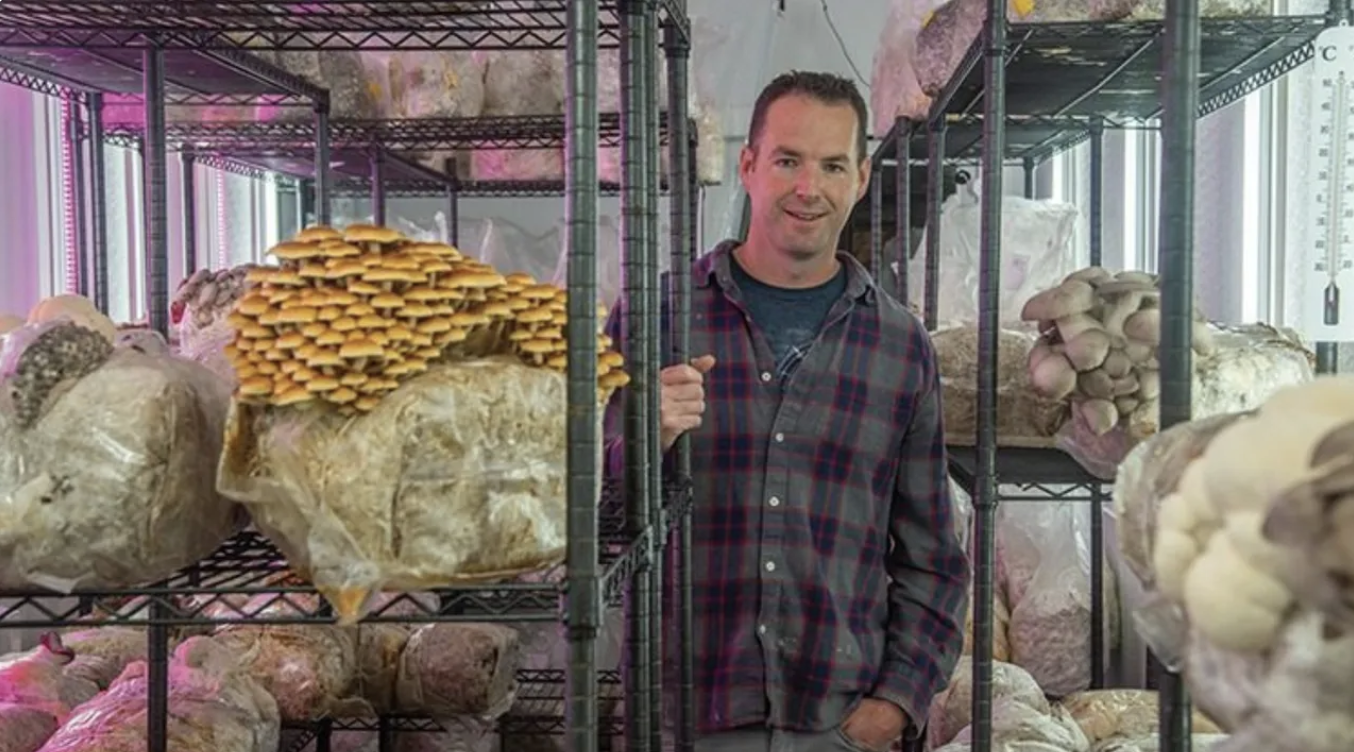
K.C. Sullivan, an environmental science teacher and founder of Two River Mushroom, is scaling up his organic operation with functional mushroom broths. All photos: Two River Mushrooms
At a Glance
K.C. Sullivan, an environmental science teacher, started the organic mushroom brand out of his apartment.
Nationwide sales of specialty mushrooms are up, outpacing conventional mushrooms, following demand for functional foods.
In August, Two River Mushroom won the Retailer's Choice Award for its mushroom broth.
On a busy week in Millstone, New Jersey, K.C. Sullivan cultivates thousands of pounds of USDA Organic specialty mushrooms—and about 65 high school students. The seniors will graduate. The ‘shrooms go to chefs in over 100 restaurants in New Jersey and New York, local CSAs, farmers markets and gourmet grocery stores that can’t seem to get enough of the Lion’s Mane, Pioppino, Maitake, Chestnut and other specialty mushrooms Sullivan’s team grows at Two River Gourmet Mushrooms.
A little over 10 years ago, Sullivan taught himself how to coax shiitake mushrooms out of logs underneath his apartment. Today, Two River Gourmet Mushrooms grows and sells up to 3,000 pounds of organic specialty mushrooms a week during the busy season. It is the only USDA Organic Mushroom farm in New Jersey that grows many of these beloved strains.
The farm is across the state line from the mushroom mecca of Chester County, Pennsylvania, the “Mushroom Capital of the World,” that grows 67% of all mushrooms produced in the U.S, according to the USDA. Many of those farms are multigenerational farms passed down to children, nephews, nieces and cousins in third, fourth and even fifth generations. Two River Gourmet Mushroom is a different story. Although Sullivan credits his mother for launching his love for growing—she was the president of the local garden club—it was a lack, rather than a legacy, that launched the efforts that would become Two River Gourmet Mushroom.
When scaling up, Sullivan got creative and starting growing mushrooms in an overhauled shipping container.
Vertical farm scales up
Sullivan, who earned a degree in environmental and marine sciences, became an environmental science teacher and worked for decades in the restaurant industry. “Everything from busboy and bartender to server,” he says. “I saw the need for a local, organic mushroom offering, so I started growing mushrooms at the apartment where my wife and I still live.” Trial-and-error led to shiitake success in 2014 and by 2018, Sullivan began growing more mushrooms in a friend’s barn. Along the restaurant grapevine, word and demand spread.
For his next step in scaling up the operation, Sullivan got creative. He transformed a shipping container into a mushroom farm. He and a very small team spent four months adding insulation, drainage, lighting, humidification, environmental controls and HVAC. The 40-foot container held a fruiting room, a packaging room and a mechanical room. The urban, vertical farm received USDA Organic certification and ramped up to produce about 500 pounds of hardwood mushrooms weekly.
Meanwhile, nationwide, sales of specialty mushrooms were growing. Consumer trends such as plant-based diets, functional foods and adaptogens were creating an ideal substrate for growing an organic mushroom business. Over the last decade, organic specialty mushroom sales doubled and overall U.S. mushroom consumption increased 20%, according to The Guardian. During the second quarter of 2024, organic mushroom sales increased 13.5% in volume and 8.2% in dollar sales compared to 2023. Specialty mushrooms are outpacing conventional mushrooms in growth, driven by consumer demand for organic and functional foods.
And, according to the USDA analysis mentioned above, for the 2024–2025 season, U.S. growers produced 117 million pounds of certified organic mushrooms, with specialty mushrooms representing approximately 20% of that volume. The average price for specialty mushrooms rose to $5.83 per pound in 2024–2025, up by $0.37 from the previous year.
Sullivan began thinking outside the box. Kurt Cavano, a retired software executive with roots in farming, joined the Two River team, bringing capital and extensive business experience. Cavano purchased a 25-acre parcel of farmland preserve, Mighty Dare Farm, that Two River leases. They cleared the land and purpose-built an Amish pole barn to hold a mushroom operation with a sophisticated temperature, humidity-controlled mushroom grow facility and multiple grow rooms and a laboratory. The farm also includes spaces for community gatherings such as farm-to-table meals and educational workshops.
Two River Mushrooms grows its fungi on substrate comprised of 50% red oak sawdust, an agricultural byproduct from Maine, and 50% organic, non-GMO organic soils. After the mushrooms are picked, the substrate is tilled into the expansive gardens, where the beneficial fungi enrich the soil to grow better-tasting and more nutrient-rich heirloom vegetables, herbs and berries, says Sullivan. “We consider ourselves a regenerative farm, although we don’t have the official declaration,” he says.
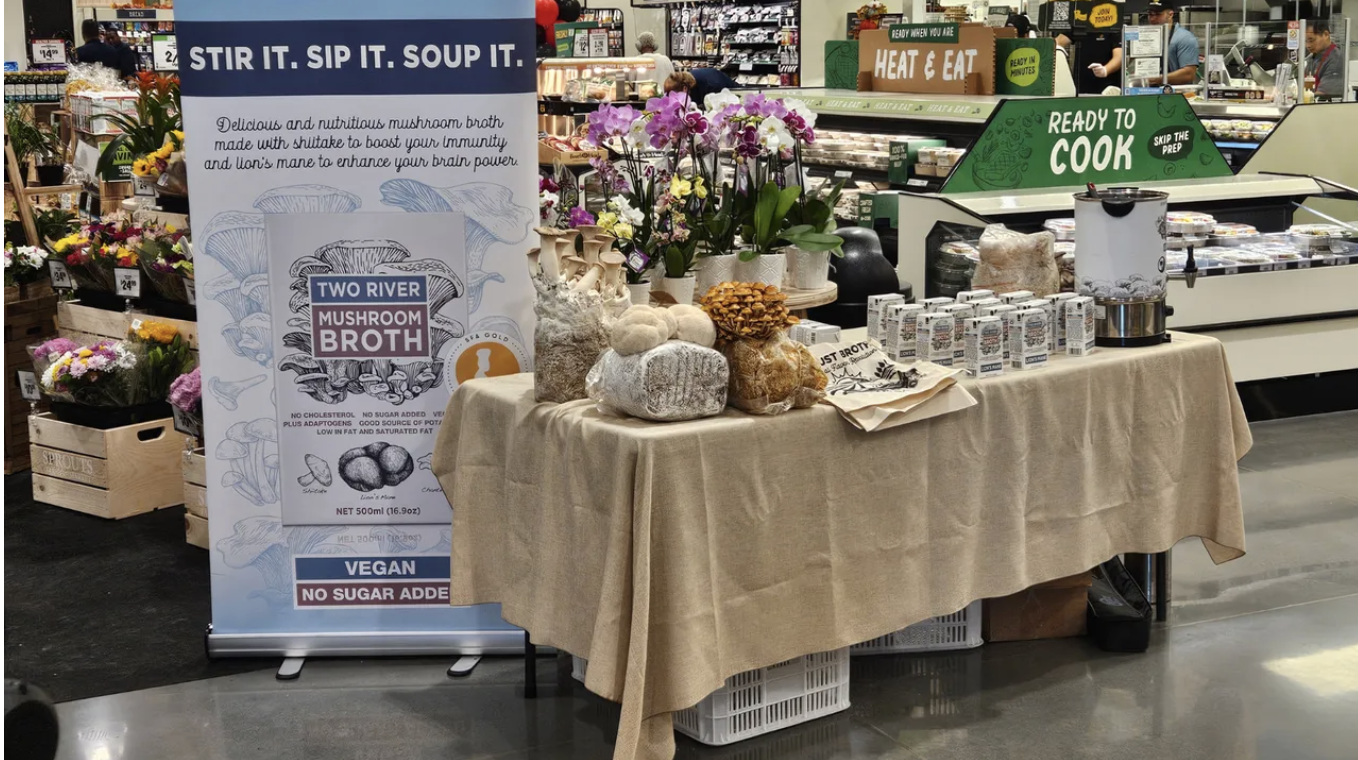
Two River Lions Mane Mushroom Broth won the Sofi Gold Product Award for Soup/Broth at the Specialty Food Association Fancy Food Show in 2023.
Restaurant to retail
The team moved onto the farm three years ago and has been growing ever since, producing 2,000 pounds of mushroom weekly, and close to 3,000 pounds during the busy summer season when the restaurants on the nearby Jersey Shore are cranking. About 50% of the crop goes to wholesale restaurant customers and 50% is sold through the farm, CSAs, farmers markets and gourmet grocery stores. “We pride ourselves on picking and delivering to the chefs and to retail the same day,” says Sullivan. That takes two drivers and two refrigerated vehicles. Partner Scott Szegeski (retail and wholesale logistics), four full-time staff on the farm (including expert mycologists) and seasonal farmers market employees round out the team. In addition to fresh mushrooms, Two River also sells value-added products such as dried mushrooms and tinctures.
A few years ago, Sullivan’s restaurant veteran-mushroom farmer mind honed in on another white space: premium, shelf stable functional mushroom broth. He applied for and received a USDA Value-Added Producer (VAPG) grant to develop it. They worked with food scientists at the Rutgers Food Innovation Lab and the University of North Carolina Food Innovation Lab over two years to develop a recipe and molecular formula that delivers delicious mushroom flavor and benefits. Two River Lions Mane Mushroom Broth, made with lion’s mane and shiitake mushrooms, debuted in 2023. It won the Sofi Gold Product Award in the Soup/Broth category from the Specialty Food Association Fancy Food Show. In August, the broth won the Retailers Choice Award representing innovation and market impact at Newtopia Now. Sprouts began selling the broth nationwide in September.
“We’re just super excited to keep pushing forward,” says Sullivan. Simultaneously, he is in the midst of his 21st year of teaching environmental science. “There’s obviously a lot of alignment between what I teach and what I do on the side … especially being USDA Organic certified. That lets me teach the students about what that looks like and the importance of it all.” And, while the containment suit he sports in the Two Rivers Mushroom lab does resemble fellow teacher Walter White’s from Breaking Bad, Sullivan’s products are far more sustainable –in every sense of the word.
About the Author

Freelance writer
Shara Rutberg has written for numerous publications, including The Denver Post and New Hope Network, during her career as a freelance writer. She has a passion for animals and people.