

Fresh Mint, Strawberries and Spicy Peppers: Inside Gjoa Haven’s Greenhouse

Jun 25, 2025
Powered by solar and wind, team grows food year-round in converted shipping containers
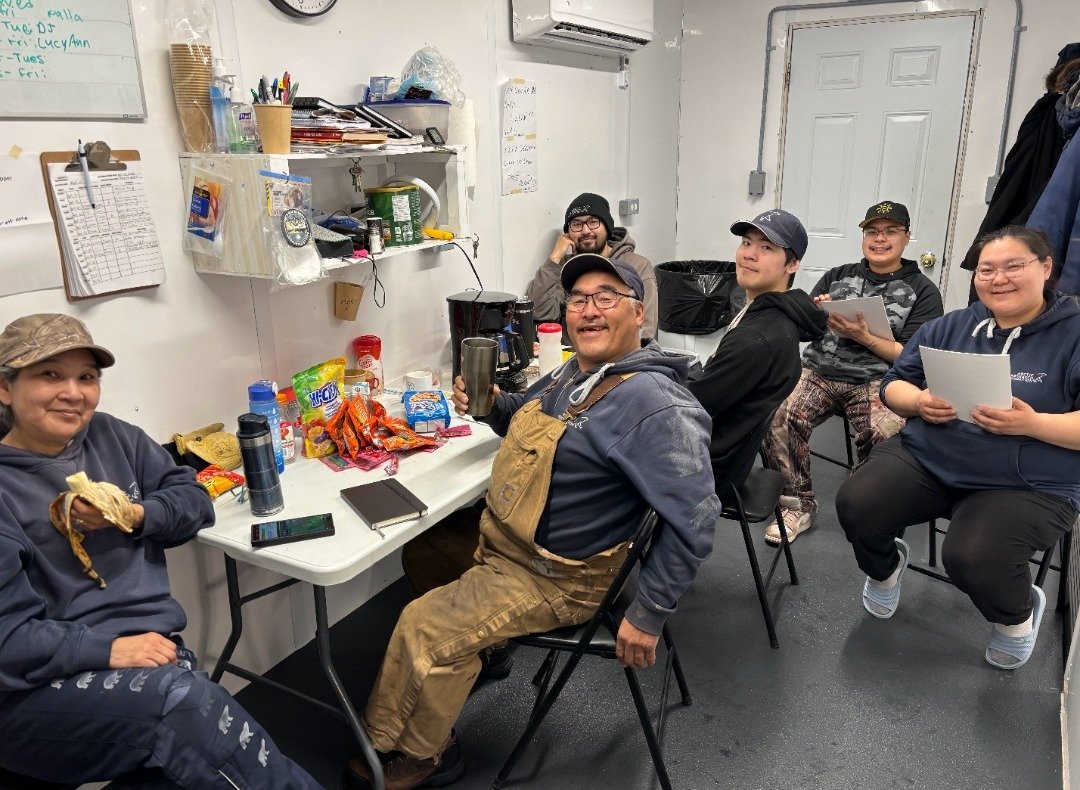
From left, Betty Kogvik, Mark Ullikataq (front), Brett Tiririarnaq, John Qirqqut, David Jr. (DJ) Porter and Lucy Ann Oogak are part of the team running Naurvik, an indoor farm in Gjoa Haven. Using solar and wind power, the group grows fresh produce year-round in retrofitted shipping containers to help improve local food security. (Photo by Caroline Mullany)
By Nehaa Bimal
Step inside the sea cans located in uptown Gjoa Haven and the dry Arctic air gives way to rainforest-like humidity.
Fresh basil, strawberries and cherry tomatoes grow in stacked rows under LED lights at Naurvik — “the growing place,” in Inuktitut — an off-grid greenhouse powered mostly by wind and solar energy.
Naurvik manager Betty Kogvik prepares a snack of freshly harvested cucumbers, carrots and hot peppers — a rare treat in Gjoa Haven. (Photo by Nehaa Bimal)
Working at the greenhouse on June 10, manager Betty Kogvik looked over the fresh produce she’d prepared for the team’s snack and said: “If only I had ranch dip, I’d have all the fixings for a great salad.”
For Kogvik, who has been working at Naurvik since it opened in 2019, the facility is more than a workplace — it’s a vital source of fresh food in one of Canada’s most remote regions.
Naurvik is a community-led project operated in partnership with the Arctic Research Foundation, Agriculture and Agri-Food Canada, the Canadian Space Agency, National Research Council Canada, and local technicians from Gjoa Haven.
The farm uses three old shipping containers that have been turned into climate-controlled “pods” each with 168 square feet of growing space.
Each insulated container holds seven racks with shelves for plants, tall racks for vine crops, and six 50-gallon tanks with nutrient solutions filtered by ultraviolet light. A large exhaust fan controls carbon dioxide and humidity levels, while a dehumidifier keeps the air just right.
All the power comes from Canada’s northernmost solar and wind setup.
It includes two six-kilowatt wind turbines, two sheets of solar panels producing 7.32 kilowatts each, lithium-ion battery banks, and a diesel backup generator. This system keeps the farm running all year, even with little sunlight.
The team delivers fresh produce to elders, search-and-rescue teams, schools and anyone in need in the community of about 1,300 people.
“Everything we harvest goes to the community for free,” Kogvik said.
The setup also includes a utility pod to store seeds, soil and equipment. The team grows potatoes, carrots and radishes outside in the summer. They’re growing watermelons this year, a first for the Arctic farm.
The facility hasn’t been without challenges.
At one point, an infestation of spider mites from the sea containers threatened to destroy nearly the entire crop. “It was a good thing it happened during the winter,” Kogvik said, so the team was able to freeze the pests and send them back down south.
“Even if there’s house flies or spiders, we get rid of them and clean every week, because you never know who’s bringing what in here with their footwear.”
Despite the setbacks, the team lives by a saying posted on its whiteboard: “A smile a day keeps the bugs away.”
Kogvik, who began with no knowledge of plants six years ago, takes pride in tending the crops.
“I work on the plants. I make sure they don’t have algae, look for dead leaves and see if there’s anything that needs to be harvested,” she said.
The first produce she grew was romaine lettuce. Kogvik remembers being “really amazed” by how it turned out.
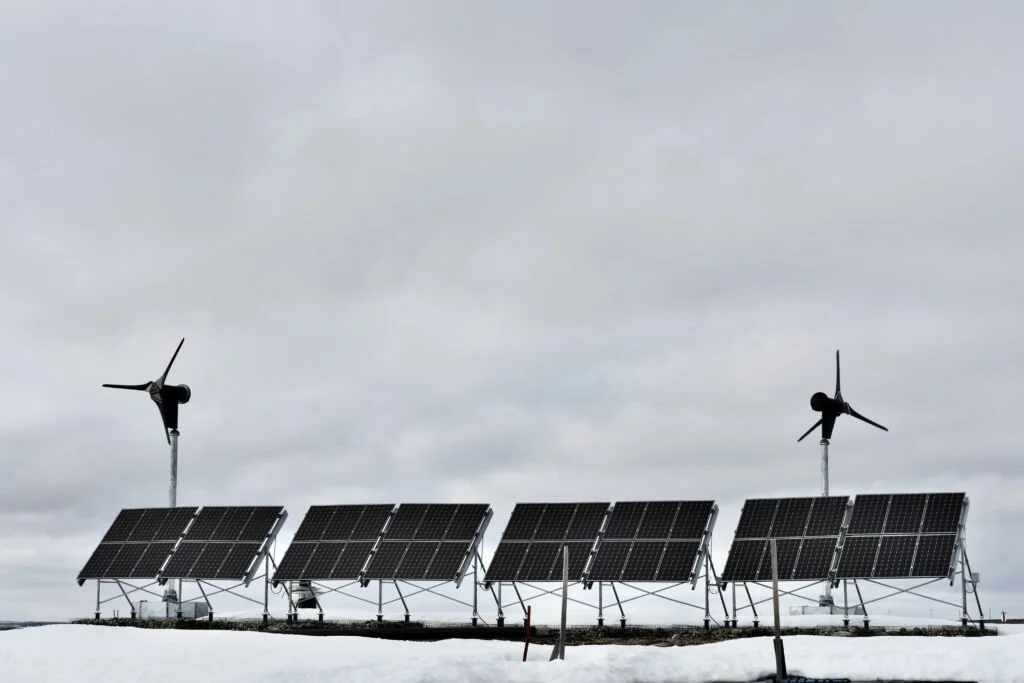
Wind turbines and solar panels power the Naurvik indoor farm in Gjoa Haven. The renewable energy system helps keep the year-round growing operation running, even during the long, dark Arctic winter days.
(Photo by Nehaa Bimal)
“The taste is a big difference from the stores,” she said.
The full-time, eight-person crew works long days — often from 11 a.m. until 5 p.m. — maintaining the delicate balance of light, humidity and nutrients in the pods.
Winter poses its own challenges.
Power outages during 24-hour darkness require the team to keep doors closed to retain heat and humidity. Sometimes they have to travel over deep snow by snowmobile if the diesel backup fails.
Yet the facility manages to produce 75 per cent of its power from renewable sources year-round, critical toward sustainable Arctic food independence.
Kogvik said food prices “are crazy and get higher every few months. Tomatoes in Gjoa Haven can cost up to $9 a pack. I can’t even have food on the table anymore,” she said.
“I wish we could expand. There are other communities close by that really want something like this for the future. It would be nice.”
Carleigh Paul, a spokesperson for the Arctic Research Foundation, confirmed expansion plans, noting the organization currently has 18 similar labs deployed across the Arctic.
“The Naurvik project was always meant to be replicable in other communities, and we are actively working to make it as efficient as possible so we can achieve this goal,” Paul said in an email.
Costs for the mobile labs vary depending on design and power needs, ranging from about $80,000 for a basic unit connected to the power grid to roughly $200,000 for a fully independent lab with wind turbines, solar panels and battery storage.
For now, the team in Gjoa Haven continues to nurture its unique Arctic garden, working toward growing more plants native to King William Island.
At the request of a local elder, they’ve even started growing dandelions for medicinal use, which Kogvik is looking forward to learning more about.