

CANADA: Can Souped-Up Shipping Containers Solve Food Insecurity?

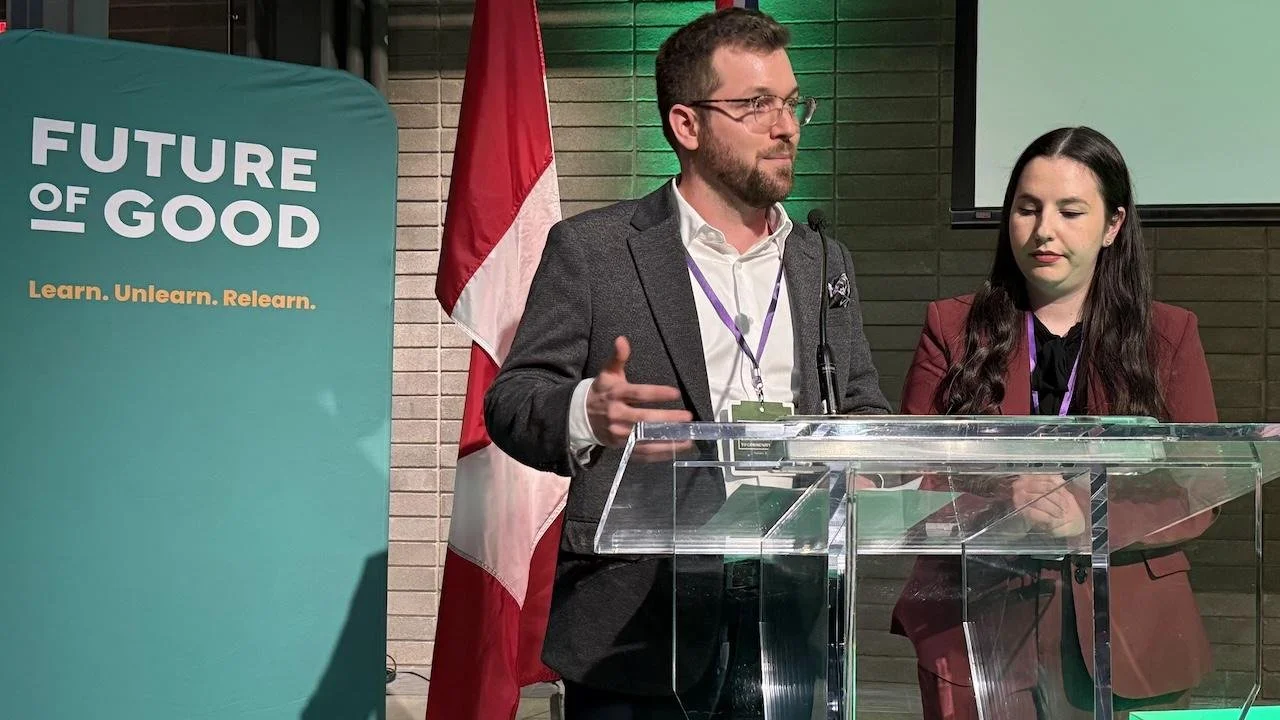
Corey Ellis and Alida Burke first conceived of Growcer as students at the University of Ottawa. (Steve Paikin)
Two former university classmates think so. They might be on to something
While campaigning in last year’s federal election, Leslie Church knocked on a door on Winona Drive, near St. Clair West in Toronto. It was a cold, snowy day. No one answered, so she began to leave. She only got to the end of the driveway before a woman bounded out the front door of her home and chased Church down in stocking feet, holding a toddler in her arms.
“I just didn’twant to miss you, and I will only hold you for one minute,” the frantic woman told Church. “Please remember food security.”
Toronto—St. Paul’s, which Church now represents, is one of Ontario’s higher-income ridings. And yet there is a food bank at the end of Church’s street, serving hundreds of people every weekend. There’s also a soup kitchen around the corner. Actually, there are now several food banks.
The interaction was a not-so-subtle reminder to Church that even in her riding, which features so many upscale neighborhoods, getting three squares a day is still an issue for too many people.
Shockingly, in a country as rich as Canada, seven million people visit a food bank every month. In Ontario alone, between April 2024 and March 2025, officials counted 8.7 million visits to food banks — the ninth consecutive year of growth and a 13 per cent increase over the previous year. Astonishingly, it’s also a 165 per cent increase since COVID -19 hit, six years ago.
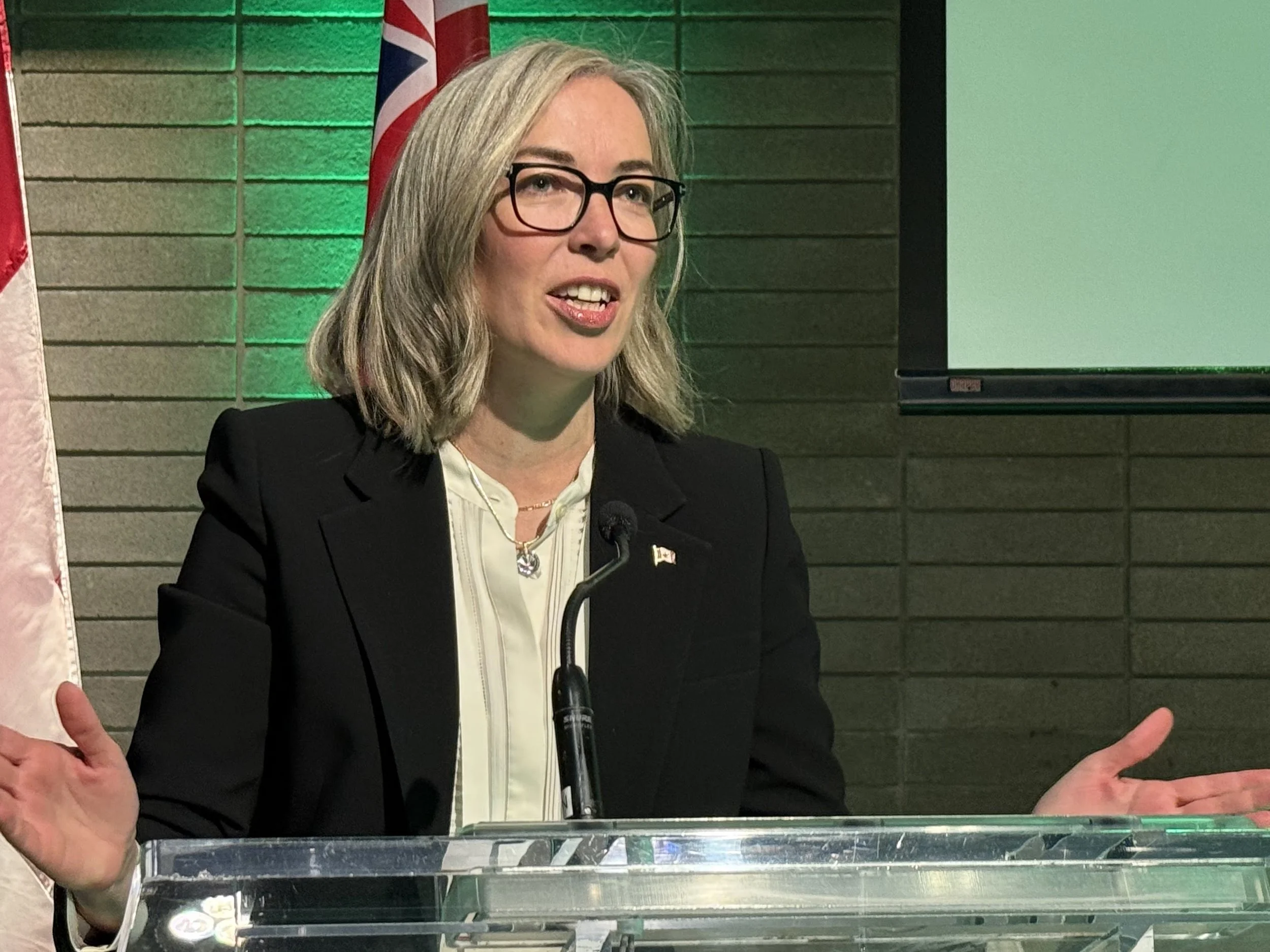
“It is hard togo to a food bank, but it's harder to go to work or go to school hungry,” says Evelyn Cerda, who runs a food bank in Regina, Saskatchewan. “A hungry child can’t learn, and ahungry community can't thrive.”
More than a decade ago,two students at the University of Ottawa, Alida Burke and Corey Ellis, were on a school trip to Nunavut when they got a firsthand look at food insecurity. Families were dependent on food being shipped in from thousands of kilometres away, if it came at all. A head of lettuce costs $15.
“We came back to Ottawawith one question that we could not let go of,” Burke recently told an audience of community activists at the Brickworks in Toronto. “What if communities could growtheir own food locally, year-round, regardless of where they were or what the weather looks like?”
The two students looked around for a solution, but seeing none, decided to create one themselves. In 2016, they developed a modular, indoor farm — what looks like a shipping container with a greenhouse inside it — capable of growing 10,000 pounds of vegetables every year, even in temperatures of -40 C. They called their new venture Growcer.
The founders say Growcer has solved several problems: needing to import food from thousands of kilometres away; food going bad; food having little nutritional value; supply chains breaking down. “A Growcer farm has changed that equation,” Ellis says. “Once it's running, a community's producing its own food, week after week, week in, week out, season after season, and the cost for every harvest goes down.”
Ellis adds that the money to run the indoor farms stays in the community. Young people who may have needed to leave town for work can now stay and run the farm. Students learn about agriculture, nutrition, and the food system.
“Communities stop seeing themselves as dependent on the outside world and start seeing themselves as capable of feeding their own people,” Ellis says.
Today, 150 communities across Canada have a Growcer indoor farm, from Indigenous communities to food banks, from schools and hospitals to municipalities. Having partnered with the RBC Foundation, Ellis and Burke are in the midst of a $15 million initiative to sign up 100 more communities — and they’re in talks with still 100 more, with an eventual goal of 1,000 working farms. Every dollar they raise is matched by $3 from other sources. (The biggest cost, obviously, is the outlay for the modular farm itself, which can run up to $250,000).
A year ago, the RBC Foundation donated $1.5 million to the Ottawa Union Foundation, which in turn funded a partnership with The Ottawa Mission. The Mission serves a million meals a year, and the money enabled the organization to buy two Growcer farms, producing 20,000 pounds of fresh greens annually.
“So that’s what the model looks like in community,” says Thea Silver of RBC. “We're proud to see Growcer’s efforts evolving from grassroots to a mainstream initiative.”
Meanwhile, the federal government has put $200 million (via three different programs) to assist with food insecurity — directly funding food banks, nutrition projects, or helping small and medium-sized companies under tariff pressures. The Ontario government also provides tax credits to farmers who donate fresh produce to local food programs.
“We want more greenhouses in this country,” says Church, who’s also the parliamentary secretary to the minister of children and youth — sadly, some of the most active users of food banks. “We want more Canadian food sovereignty, and that's how we're gonna get it. There’s nothing more important that we can be doing than this.”

Steve Paikin has been producing fact-based, public-interest journalism for nearly four decades. He's the host of TVO Today Live and the Paikin Podcast, and the co-host of the #onpoli podcast. He is also a columnist for TVO.org and the Toronto Star, and has published ten books. Steve was invested as an officer of the Order of Canada by Governor General David Johnston, and a member of the Order of Ontario by Lieutenant Governor David Onley, both in 2013. In 2025, Lieutenant Governor Edith Dumont presented him with a King Charles III Coronation Medal. In 2012, Victoria Tennant presented him with a Queen Elizabeth II Diamond Jubilee Medal. In 2025, the Public Policy Forum gave him the lifetime achievement award for excellence in journalism. Steve tends to fall in love with hard-luck sports teams. He loves the Toronto Maple Leafs despite no Stanley Cups since 1967. He adores his hometown Hamilton Tiger-Cats despite no Grey Cups since 1999. His patience with the Boston Red Sox finally paid off with four World Series in the 21st century.