

Can a Hydroponic Fodder Container Become a Local Supply Business For Cattle Farms?

Smart Fodder Farms
June 18, 2026
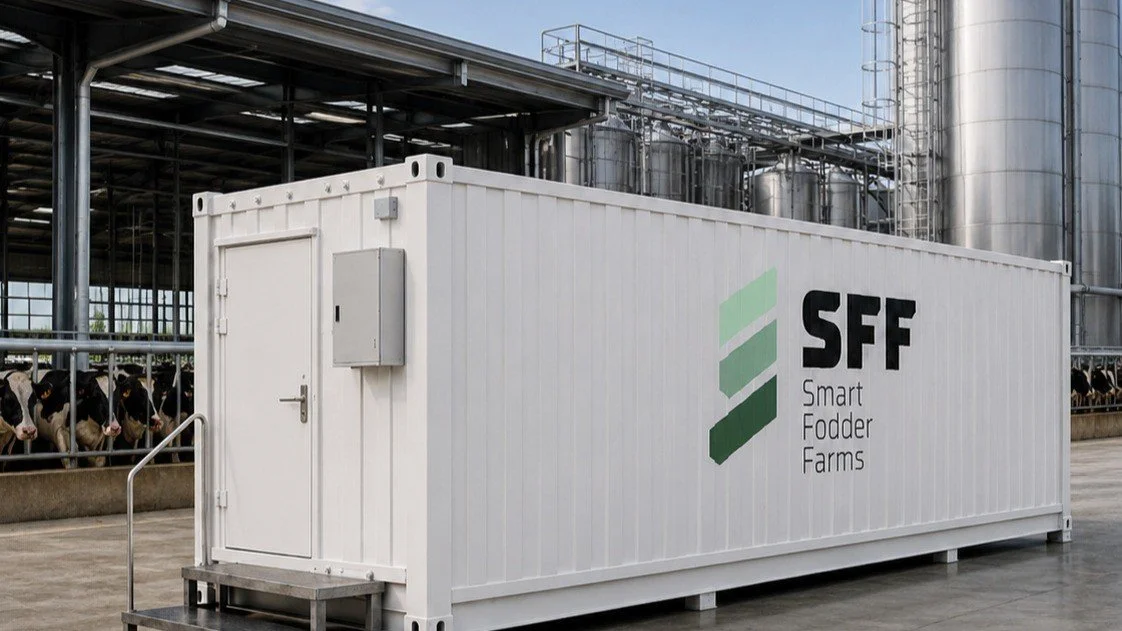
In many livestock regions, feed is no longer just another operating expense recorded on a balance sheet; it has become a strategic factor that directly influences the stability and profitability of the entire livestock operation. This reality is particularly evident across parts of the Middle East, where cattle farms often work under challenging conditions characterised by high temperatures, limited water resources, restricted access to fertile agricultural land and a significant dependence on external forage suppliers. In these environments, fresh feed is not simply purchased and delivered without concern. It must be sourced, transported, stored and managed within a supply chain that can be affected by market fluctuations, climatic conditions and logistical constraints.
When forage production is concentrated far from the farms that consume it, livestock businesses become vulnerable to a series of risks that begin long before the feed reaches the animals. Transportation costs can increase unexpectedly, seasonal conditions may affect production volumes, suppliers may prioritise larger customers, and water scarcity can place additional pressure on conventional forage cultivation. As a result, availability becomes less predictable and logistics more expensive, creating a situation in which one of the most critical daily inputs for livestock production remains largely outside the farmer’s control.
Against this backdrop, hydroponic fodder production deserves to be considered not only as a tool for self-sufficiency but also as a potential business opportunity. For agricultural entrepreneurs, cooperatives and agribusiness companies, the concept extends beyond producing feed for their own animals. It opens the possibility of establishing local production centres capable of supplying fresh fodder to nearby cattle farms, reducing dependence on distant suppliers and bringing production closer to consumption.
A hydroponic fodder container can operate as a compact and highly controlled production unit where seeds germinate and develop under carefully regulated conditions of temperature, humidity, irrigation and lighting. This controlled environment allows fresh green fodder to be produced continuously throughout the year without requiring extensive agricultural land or traditional forage fields. The result is a fresh, digestible and palatable feed source that can be generated close to livestock operations, fundamentally changing the way forage supply is organised.
Rather than relying entirely on external producers located hundreds of kilometres away, a local operator can establish a production system designed to serve farms within a defined geographical area. This is where the concept becomes particularly attractive from a business perspective. A Smart Fodder Farms 40’ High Cube container can produce up to approximately 840 kg of fresh hydroponic fodder per day using 440 trays operating in 6-day production cycles. While this capacity may support the needs of a single livestock operation, it can also serve as the foundation for a local supply model aimed at multiple farms.
The distinction lies in how the project is conceived from the outset. When the objective is self-consumption, the primary concern is determining how much fresh fodder the herd requires each day and configuring production accordingly. However, when the goal is to supply neighbouring cattle farms, the analysis becomes broader and more strategic. Factors such as the number of farms in the area, their estimated daily demand, the distance between production and consumption points, delivery logistics and future expansion plans all become essential elements in evaluating the viability of the project.
These considerations are far from secondary. They determine whether the installation functions merely as a production unit or evolves into a scalable local supply business. This is precisely why modularity plays such an important role in hydroponic fodder projects. An entrepreneur does not need to invest immediately in a large and complex facility. It is possible to begin with a single container, validate production performance, establish harvesting routines, understand customer demand and build commercial relationships with nearby livestock farms before committing to further expansion.
As demand increases, additional modules can be incorporated progressively. What begins as a single production container can eventually develop into a local fresh fodder hub capable of serving a wider network of livestock operations. This scalability is particularly relevant in regions where cattle farms face recurring challenges related to imported forage costs, transportation dependency, limited water availability, scarcity of cultivable land and uncertainty regarding fresh feed supply.
In this context, hydroponic fodder production should not be viewed solely as a technological innovation. It can also be understood as a service model for the livestock sector, built around proximity, continuous production and greater control over supply. For cattle farms, the benefit lies in gaining access to fresh fodder produced closer to the point of consumption. For the operator, the opportunity comes from developing a business around a product that livestock producers require every day and whose demand tends to remain consistent over time.
This combination of operational flexibility and market relevance is what differentiates hydroponic fodder containers from many traditional agricultural investments. Unlike conventional forage production, they are not dependent on large areas of fertile land, nor are they constrained by seasonal harvest cycles. Their compact design, controlled environment and modular structure allow projects to start at a manageable scale and expand according to proven market demand rather than speculative forecasts.
Naturally, the success of such a venture depends on more than the container itself. The real value comes from careful planning and a clear understanding of the market being served. Production targets, customer profiles, logistics requirements, delivery models and long-term growth objectives must all be considered when defining the appropriate configuration. For this reason, the most important question is not simply how much fodder a container can produce, but rather how much demand exists within the surrounding area and what proportion of that demand could realistically be supplied through local production.
For agricultural companies operating in the Middle East, this perspective offers a different way of thinking about livestock feed. Instead of viewing forage exclusively as a cost or a recurring supply challenge, it can be approached as an opportunity to strengthen local production, reduce dependence on external suppliers and create a scalable service that supports the livestock sector.
At Smart Fodder Farms, we help clients evaluate whether a hydroponic fodder container should be configured for self-consumption, local supply or phased expansion through multiple production modules. If you are considering producing fresh fodder for cattle farms in your region, we can analyse your target market, estimated demand and growth objectives to help define the most suitable container configuration and prepare a tailored proposal.