

Welcome to iGrow News, Your Source for the World of Indoor Vertical Farming

Can Vertically-Grown Leafy Greens Make Your Salad Fresher And More Sustainable?
As indoor farms can control everything from temperature to humidity to airflow and even lighting schedules, their products are often marketed as more sustainable than outdoor agriculture
Courtesy of Forward Greens
A warehouse may seem like an odd place for a farm, but it's one of the places you'll find arugula, kale, and other leafy greens growing in Vancouver, Washington. The 25,000 square foot warehouse is home to Forward Greens, one of several indoor vertical farms attempting to use technology to make our lunch salads taste better and be better for the planet.
"We're trying to grow the cleanest healthiest greens we can while preserving the earth's resources," said Ken Kaneko, the founder of Forward Greens. Even if you haven't yet had greens from an indoor farm, chances are more and more of the greens in your salad are going to come from farms like Forward Greens, Gotham Greens, Bowery Farming, and others.
Related: Young Farmers Need Land and These Organizations Are Helping Them
What Exactly Is a Vertical Farm?
Simply put, it's a farm where rows of produce are stacked. "We grow up instead of out," Kaneko said. In the late 1990s and early 2000s, Columbia University professor and microbiologist Dickson Despommier and his graduate students began popularizing the idea of vertical indoor farms as one answer to some of the world's biggest problems: how to feed a growing worldwide population, especially with more and more people, centered around cities, and how to produce that food more efficiently and sustainably.
Today most indoor farms use soilless farming techniques. Some like, New York-based Gotham Greens, one of the early pioneers of indoor farms and whose products you'll find in Safeway, Meijer, and Harris Teeter, among others, use a hydroponics system. Other soilless systems include aeroponics and aquaponics.
Does Arugula Grown on an Indoor Farm Taste Better Than Arugula Grown Outside?
While outdoor farms rely on water, sun, and sometimes luck to produce leafy greens, most vertical indoor farms use technology and constant data monitoring to grow their crops. That data means that indoor farms can tweak everything from how your arugula tastes to how it feels to the nutrients it contains.
But beyond the tech, depending on where you live, leafy greens grown indoors might be fresher. Most of the salad greens you find in the supermarket likely came from Salinas, California, or Yuma, Arizona. According to Kaneko, Forward Greens delivers its products to markets in the Pacific Northwest within 48 hours of harvest. As vertical farms aren't dependent on weather, you can buy the same arugula from the same farm year-round. "We can provide a consistent year-round supply," said Gotham Greens CEO Viraj Puri. And that supply is also fully traceable, possibly making it safer.
Are Leafy Greens from an Indoor Farm More Sustainable?
As indoor farms can control everything from temperature to humidity to airflow and even lighting schedules, their products are often marketed as more sustainable than outdoor agriculture. According to Bowery Farming, whose leafy greens are available in the Mid-Atlantic and Northeast at Whole Foods Market, Giant Food, Stop & Shop, Walmart, and Weis Markets, their indoor farms are more "productive on the same footprint of land than traditional agriculture."
Similarly, Forward Greens says through its technology; it can use 95 percent less water, 99 percent less land, and 100 percent less pesticides compared to outdoor agriculture. But there's not much data on how vertical farms compare to their conventional counterparts. Researchers from Cornell University are in the middle of a three-year grant looking at not only how controlled-environment agriculture compares to traditional field agriculture in terms of energy, carbon and water footprints, profitability, workforce development, and scalability but what if any educational and psychological benefits local systems can offer by connecting urban people to their food. However, it's not clear if that study will also account for food waste, which has been found to be as high as one-third on traditional farms, and which both Puri and Kaneko say their farms can reduce.
While indoor farming likely isn't going to save the planet it may be one part of the puzzle and will make it easier to get fresh, locally grown salad greens year-round.

Living Lettuce, Vertical Gardening: This Startup Is Using AI For Organic Farming
Analytics India Magazine got in touch with Shivendra Singh, founder and CEO of Barton Breeze, who believes that in the future the vegetable greens will likely come from the building next to you
13/10/2020
Srishti currently works as Associate Editor at Analytics India Magazine.…
The interest and popularity of organic and sustainable farming are increasing drastically. While the consumers are often skeptical about the food products that they consume, Dubai and New Delhi-based Barton Breeze is growing safe, delicious, and healthy food while relying on analytics and AI. It offers top-quality products that are grown locally in nutrient-rich water without pesticides. The crops are harvested weekly and delivered to sales outlets within a couple of hours.
Following the principle of ‘living lettuce’, it follows a method where roots are left intact, which makes it last longer. The startup also follows vertical gardening where it uses vertically stacked growing beds, up to five levels high using less than 1% of the space required by the conventional growing, a precious commodity in densely populated urban areas.
Analytics India Magazine got in touch with Shivendra Singh, founder and CEO of Barton Breeze, who believes that in the future the vegetable greens will likely come from the building next to you.
The Journey
After graduating from IIM Ahmedabad, Singh started working on a pilot project around hydroponics and set up two container farms in Dubai. “During this time I thought, a country like India with profound climate changes needs this technology more than anyone else,” he says.
Soon after, Barton Breeze was established in 2015 in Dubai, UAE, with a mission for technology innovation in agriculture. As Singh recalls, the journey initially was challenging and well expected, but with the right vision, it became unstoppable. In addition to the lack of proper information, availability of funds, market volatility, the task to create consumer confidence was critical. Another challenge was that hydroponics was a new technology to adapt, and the existing unprofessional quality and high prices made it difficult to find the right customer in the market.
Overcoming these challenges, Barton Breeze is now the market leader in the sector and has expanded operations to India.
Data Science And AI Is At The Core
Barton Breeze team includes experts from deep data science to engineering, and from marketing to producing. “When we started, people had no idea about this new technology. And whatever talent was available, they had to unlearn. Training and building our staff from the ground up, we are now a team of six core members, supported by 25 field farms,” added Singh.
Explaining how Barton Breeze uses analytics and AI to increase the farm produce, Singh shares the areas as below:
Smart Farms: Each smart farm is backed with the expertise of the chief technology officer, a dedicated R&D team, plant scientists, microbiologists, mechanical engineers, and design engineers.
Cloud Architecture and Data Center: Barton Breeze collects hundreds of data points at each of its farms to its data center, which allows it to quickly alter its indoor precision control for taste, texture, color, and nutrition. It also helps in adjusting variables like temperature and humidity to optimize its crop yields. Barton also collects all yield and harvest data into the cloud to calculate sales projections and market trends.
Using Artificial Intelligence and IoT (Internet of things): Barton uses software with a device clipped on the stems and leaves of each plant. It informs the nutrients or mineral needs of the plants.
Highlighting other venues where AI is used, Singh shares that they have perfected their algorithm for optimal taste, texture, color, and nutrition so one can taste the science of flavor in every delicious bite of leafy greens. “We do this by leveraging plant science, engineering, and lighting to optimize our plants while also using 85% less water, 5x productivity, and zero pesticides,” he added.
He further shares that Barton Breeze carefully monitors the health and quality of plants daily to optimize taste, texture, color, nutrition, and yield to deliver a better product using AI. “Barton’s growing techniques can be highly customized,” he said.
The startup has also developed iFarm, a cloud-based data and farm output AI software. It allows the clients to get all their farm and production details on the cloud at home or office. “Our farm dashboard and IoT uses artificial intelligence and data analytics to measure important indicators that help in food/crop planning and hence help connect in the food security ecosystem,” he said.
Some areas where AI and IoT are used at Barton:
SMS alert system
Data logging facility
Online monitoring and control
Sensor-based control system
Environment management system
Water temperature management
Sunlight monitoring system
Crop management system
Farm system efficiency dashboard
Nutrition management system
Barton team includes members with deep expertise in science, engineering, technology, food safety, crop physiology, microbiology, and more to help deliver rapidly deployable and scalable solutions.
“Being first and one of a kind in the segment of agri-tech, we at Barton Breeze are trying to create and promote healthy lifestyle’ To achieve it, we are working into the whole ecosystem in the form of B-FRESH, B-FARM and B-HOME,” shares Singh.
Growth Story
With experienced and known names in the team, Barton Breeze has increased team members, post-COVID to increase the outreach. “Currently we are in 10 states, and Barton Breeze is planning to enter five more states in the next couple of months,” shared Singh. The startup takes pride in increased customer query by 200% and increased consumer awareness by 10X post COVID.
Singh further shares that there has been an increase in the interest level from angel investors and venture capitals for Barton Breeze with VC calls gone up by 150%. The startup is closing 1.5 million USD funding within this year.
“Our goal is to achieve 360-ton produce marketing per year by the end of March 2021 while adding 25 more clients. We are targeting 50 crores revenue @CAGR 800%. We would also be coming up with ten new commercialized farms apart from doing R&D on 50 crop varieties,” concluded Singh on an ambitious note.
Srishti currently works as Associate Editor at Analytics India Magazine. When not covering the analytics news, editing, and writing articles, she could be found reading or capturing thoughts into pictures.
Running A For-Profit Business With A Not-For-Profit Mission
Vertical Harvest is using controlled environment agriculture to give people with disabilities the opportunity to improve their livelihoods along with the sustainability and economies of their communities
Vertical Harvest is using controlled environment agriculture to give people with disabilities the opportunity to improve their livelihoods along with the sustainability and economies of their communities.
Jackson, Wyo., might not be the first place you think of when it comes to innovation in controlled environment agriculture. Vertical Harvest, which began operating in 2016, produces leafy greens, tomatoes, and microgreens in a 13,500-square-foot vertical greenhouse.
“From the beginning, Vertical Harvest set out to create a model that could leverage the greatest impact in communities,” said Nona Yehia, co-founder and CEO. “We are a model that is setting forth to cultivate healthy people, communities, and economies. It is through that understanding that all those things are linked to create sustainable communities. We know that successful communities are sustainable communities.”
Yehia said Vertical Harvest was born out of two critical needs in her community.
Nona Yehia, co-founder and CEO at Vertical Harvest, said her company is a model that aims
to cultivate healthy people, communities, and economies. Photos courtesy of Vertical Harvest
“Number one was that we import the vast majority of food that we eat,” she said. “By the time it arrives, it’s not that great to eat. Number two is that Jackson is a burgeoning local community, but it has never been a place that has been known to build careers. People come here to ski and party and then they leave. Business owners were having a really hard time keeping consistent employees, making it really hard to run a business.”
Creating a diverse, inclusive, and profitable workplace
One of the things most unique and innovative about Vertical Harvest is the workforce it employs.
“What was really important to me and to company co-founder Caroline Croft Estay was that Vertical Harvest would provide a place where underemployed populations could feel that they were contributing in a profitable environment,” Yehia said. “By employing people with physical and intellectual disabilities we were exposing peoples’ abilities rather than focusing on their disabilities. We were creating an employment bank that was actually beneficial to the bottom line. This was a big part of why we wanted to be a for-profit organization as well.”
From the beginning, Vertical Harvest was set up as a L3C or a benefit corporate model.
By employing people with physical and intellectual disabilities, Vertical Harvest has developed a workforce that is beneficial to the company’s bottom line.
“We wanted Vertical Harvest to be a scalable, replicable model that doesn’t have to be supported by a charitable or philanthropic organization,” Yehia said. “We wanted it to be a model that could be a part of the civic infrastructure and could perpetuate its own growth. The scalability and replicability of Vertical Harvest was why we chose the L3C model.”
Croft Estay was an employment facilitator trying to find consistent, meaningful work for her clients with physical and intellectual disabilities.
“These were people who grew up in the community, who wanted to contribute to their community and wanted to find consistent meaningful work,” Yehia said. “This is where we put food and jobs together in this vertical capacity. From the beginning, we were targeting a common problem that businesses undergo in our community.
“Right from the outset, other business owners were saying they were having this problem and they saw that Vertical Harvest was not. They asked us to help them. There is not only support for the individuals with disabilities, but there is support for the whole employee team to create a diverse inclusive workplace. The most valuable thing that we have built out of this commitment is our culture. We all know that businesses live or die on the quality of the culture that they have built. It is one of the most amazing things that we have built through this commitment to diversity and inclusion.”
Vertical Harvest, which initially built a 13,500-square-foot vertical greenhouse (shown) to
produce leafy greens, tomatoes and microgreens, is planning to expand with a 50,000-square-
foot prototype.
Developing a premium brand
Arik Griffin, who is Vertical Harvest’s chief financial officer, said one of the things the company has discovered is that part of the power of Vertical Harvest’s brand is the humanitarian good it is doing.
“People want to support us and buy our products,” Griffin said. “The restaurants and grocery stores like us for our quality and for the humanitarian message that they can get behind as do the consumers in the market place. People love our quality and they love our message. That translates into a brand premium.”
Yehia said it also helps that more people want to know where their food is coming from.
“Everybody has someone they know or a family who has a disability and the struggles that person goes through,” she said. “The reason that I am so passionate about this project is because I have a brother with a disability. At a very young age I realized he wasn’t going to have the same opportunities that I was going to have to create a career. That really resonates with people.
Vertical Harvest has expanded its customer base for its leafy greens, tomatoes and microgreens from Wyoming to include Montana and Idaho.
“We are creating opportunities and we have created an employment model where we bring out the abilities and it changes perceptions of what people are able to do. That creates a foundation of trust and strength with the community that really resonates with people, especially right now. It is what businesses can do. There is a real reward in benefitting people outside of your own stakeholder groups. This is something that is going to become more attractive as we move into 2021 and beyond.”
Unlimited expansion
Yehia has no doubt that the model Vertical Harvest has created can be profitable.
“Our incubator farm in Jackson will achieve profitability next year,” she said. “Vertical Harvest’s position in the industry is unique. There are a lot of these farms that have not succeeded. We have created a group of stakeholders who are committed to seeing Vertical Harvest and its prototype achieve profitability.
“Our two biggest hurdles that we learned are the production facility was too small to start out with and our market is too small. Jackson is a seasonal market. It is a smaller market than what our production system can produce in order to be profitable. We’ve expanded our customer base to include Montana and Idaho.
Arik Griffin, chief financial officer at Vertical Harvest, said part of the power of the company’s brand is the humanitarian good it is doing, which has been supported by its customers and consumers.
“We have worked very hard to understand the right crop mix, the correct market size, and the correct farm size that can create a return that would be attractive to social impact investors. We have created a 50,000-square-foot prototype that when placed in the right markets will succeed and that will occur quickly. We knew that we could take what we’ve learned from our successes as well as our failures to create this model that fits within the objectives of social impact finance.”
Vertical Harvest is looking at building five new greenhouses in the next five years. Its next project will be built in Westbrook, Maine, in 2021 with crop production expected to begin the following year.
“We want to bring this model to every community that we possibly can within the country and internationally,” Griffin said. “We have as our mission providing good food and good jobs to local communities. Another piece of our mission is to spread that out, to bring it to as many people as possible. We’re in the first stage of our Series A capital raise. We are raising funds in order to provide the infrastructure at the corporate level so that we can expand.
“The other thing we need to achieve this is hearing from communities and finding local stakeholders who want to do impact investing and make a difference in their communities. Bringing together the people who want to make a difference. We also need to make sure we are constantly in touch with experts in the CEA industry trying to nurture our relationships with the very best people.”
For more:
Vertical Harvest, (307) 201 4452; info@verticalharvestfarms.com; https://verticalharvestfarms.com/
This article is the property of Urban Ag News and was written by David Kuack, a freelance technical writer in Fort Worth, Texas.

GUAM: Small Urban Farms Can Be An Oasis For Underserved Neighborhoods
Adrian Higgins | The Washington Post
October 15, 2020
I ate the last of the season's potatoes the other day, and it's not a bad harvest achievement when you consider I dug the lot in July from a bed no more than 15 feet long. I've eaten many meals over the summer where the bulk of my plate has come straight from my small community garden plot in the city.
It is amazing how much you can grow in a small space if the soil is good and you stay on top of tasks such as watering and weeding. But even in a pandemic-driven planting year full of homegrown potatoes, beans, and carrots, you have to face reality. If you relied on most urban veggie plots alone to feed yourself, never mind a large family, you'd be forever tightening your belt.
FLOWER GARDEN: Dominic Hosack, left, and Scott Kratz, of Building Bridges Across the River, take in the flower garden at the National Children's Center urban farm in Washington on Oct. 2. Adrian Higgins/The Washington Post
This is why I've had my doubts about whether urban agriculture can meet the challenge where it is most needed: in poorer, food-insecure neighborhoods.
Rosie Williams is in charge of such a garden, in an expansive side lot of the National Children's Center, an early-learning and educational development provider in Southeast Washington.
The garden packs a lot in. There are almost 70 raised planter beds, each four by eight feet and filled with deep, rich soil. That's a lot of growing area; the beds generate bushels of edible plants for most of the year. A shed houses tools, a single beehive is active, a few fruit trees ring the area, and one side is devoted to little benches for little people. The center, which normally houses classes for 188 children up to age 5, has been closed because of the pandemic, though a limited reopening is in the works.
Williams, a teacher and the garden coordinator shows me cool-season veggies growing in the fall, young plants of kale, collards, cauliflower, broccoli, and red cabbage. In other planters, mature plants are seeing out the season in robust vigor. The most obvious is a single pepper plant – now taller than Williams – whose leaves hide unripe green chiles that hang like ornaments. This is a mighty hot pepper from Trinidad named Scorpion, she said, and I have no doubt that it has a sting in its tail.
Nearby, a Japanese eggplant is full of purple streaked fruit. Along another path, Williams stops to lift a wayward cherry tomato vine and places it back in its bed. "I don't like to step on my babies," she said.
Elsewhere, wizened sunflowers have had their day. "We bring the kids out, we show them how to plant seeds, what the plants need," she said. "It's getting folks exposed to the garden." Food from the garden is used in the center's kitchen.
Thus the children (and their families) get a sense that food comes from the soil. This is not so obvious a connection in Ward 8. In this corner of the capital of the United States, there is one full-service grocery store for 80,000 people, and access to something as basic as fresh vegetables is limited.
"We have a lack of grocery stores," said Jahni Threatt, the CSA market manager for the nonprofit Building Bridges Across the River. "In Wards 7 and 8, we have three grocery stores." Residents eat from fast-food chains or out of convenience stores and liquor stores. "The food that's available isn't necessarily healthy," she said. Under Community Supported Agriculture programs or CSAs, growers provide direct weekly harvests to subscribers.
'Through the lens of equity'
The Baby Boomers Urban Farm that Williams coordinates at the National Children's Center is one of seven in a network of city farms east of the Anacostia River, including a one-acre farm run by Threatt's organization at THEARC, the arts, education, and social services campus at 1901 Mississippi Ave. SE.
This one farm produced as much as 1,600 pounds of food this year, but to provision its CSA program, the Building Bridges group turns to an additional 10 farms within 50 miles of the city, most of them Black-owned, said Scott Kratz, vice president.
AN OUTDOOR CLASSROOM: The urban farm functions as an outdoor classroom for almost 200 children and is a portal for sources of fresh vegetables for families in a predominantly Black area of Washington with just one grocery store. Here, the pollinator garden is shown on Oct. 2. Adrian Higgins/The Washington Post
The CSA runs three seasons of subscriptions, and bags are picked up on Saturdays at THEARC. The spring season was canceled because of the pandemic, but the summer and fall ones have been heavily subscribed and will provide food for more than 400 families this year. The season has also been extended, from the end of this month to the end of next. Lower-income subscribers get a reduced rate, and families on assistance get the food free, Kratz said.
This is heartening because the pandemic has hit the city's poorest wards the hardest. Many residents have underlying health issues related in part to their diet, and many are front-line workers or rely on the gig economy, putting them at greater risk of contracting the novel coronavirus, Kratz said. Ward 8, which is 92% Black, so far has the highest number of virus deaths in the district, with 127, according to city-data. Ward 3, 81% White, had 34 for the same period.
"We need to make sure that the programming we have is coming through the lens of equity and making sure the access people need is available to everybody in the community," said Dominic Hosack, farm director of Building Bridges.
I am rethinking my sense that mini-farms in the city are of limited value. They are, rather, a key portal into a larger infrastructure of food-security efforts.
Beyond their utility, they are places of deep reconnection, to the soil, to food, and to communities. In the food deserts of big-city America, they are the oases.
Lead photo: CHECKING ON HER BABIES: Garden coordinator Rosie Williams checks a pepper plant at the National Children's Center urban farm in Washington in October 2020. Adrian Higgins/The Washington Post
Tags Farm Rosie Williams Food Agriculture Gardening Vegetable Garden Plant Pepper Veggy

WEBINAR: CEA Database And Benchmark Tool
A controlled environment agriculture (CEA) database and benchmark tool would allow growers to identify energy efficiency opportunities, prioritize investments and make comparisons with other facilities
Date: October 22, 2020
Time: 2 p.m. - 3 p.m. EDT
Presented by: Erico Mattos (GLASE) and Kyle Clark (EnSave)
Click Here To Register
Technologies used in CEA facilities have been rapidly evolving, providing growers with energy-efficient solutions to reduce energy consumption and maximize production profitability. However, the lack of public information and industry benchmarks represents a challenge to identify and implement new energy-efficient technologies.
A controlled environment agriculture (CEA) database and benchmark tool would allow growers to identify energy efficiency opportunities, prioritize investments, and make comparisons with other facilities. Utility companies will benefit from the aggregated data to identify industry-standard practices and trends, market projections, and energy load and demand planning.
Government agencies will be able to gain industry insights to foster the adoption of energy-efficient technologies aimed at strengthening the CEA agriculture sector through improved economic, environmental, and social outcomes. Join us to learn more about the new GLASE CEA Database and Benchmark tool and how you can participate.
Upcoming Webinars
November 19, 2020 02:00 PM
Light Quality
presented by Ricardo Hernandez, North Carolina State University
Register Here
December 10, 2020 02:00 PM
Dehumidification, Ventilation, and Air Flow Control in CEA Systems
presented by Murat Kacira, University of Arizona
Register Here
Special thanks to our Industry partners
Q & A With Jake Counne, Founder, Wilder Fields
Jake Counne, founder, Wilder Fields shares greens with Calumet City Mayor Michelle Markiewicz Qualkinbush
Jake Counne, founder, Wilder Fields shares greens with Calumet City Mayor Michelle Markiewicz Qualkinbush. Pictured announcing Wilder Fields’ commitment to build and operate a full-scale commercial vertical farm in a former Super Target store in Calumet City, Ill.
When Jake Counne established Backyard Fresh Farms as an incubator in 2016, he knew that most large-scale vertical farming operations were large-scale financial disappointments.
So rather than attempting to patch up the prevailing model, he and his team chose to build something new from the ground up. “Other start-ups had tried scaling their operations with antiquated greenhouse practices,” he says. “We realized that to solve the massive labor and energy problems that persist with indoor vertical farming. We needed to look to other industries that had mastered how to scale.”
That vision, and several years of persistent innovation, came to fruition in 2019 when Counne announced he would transplant the successful pilot farm—now renamed Wilder Fields—into a full-scale commercial vertical farm. It is currently under construction in an abandoned Super Target store, with an uninterrupted expanse of three acres under its roof in Calumet City, just outside Chicago.
Wilder Fields is designed to supply supermarkets and restaurants in the Chicago metro trade area,. It is scheduled to sell its first produce in the spring of 2021. It will provide fresh produce to those living in nearby food deserts in Illinois and Northwest Indiana. In this Q & A With Jake Counne, Indoor Ag-Con will share more about Jake’s vision and plans for the future.
According to an Artemis survey, only 27 percent of indoor vertical farms are profitable despite attracting $2.23 billion in investments in 2018. Why do you think a small start-up like Wilder Fields can succeed where so many have yet to earn a profit?
We started four years ago by investing our own resources. We were also working on a very limited scale in a small incubator space. I think those constraints pushed us to be more discerning about what we should tackle first. In that time, we developed an array of proprietary software and hardware, many of which have patents pending. And we refined a new paradigm for vertical farming, moving from the greenhouse model to lean manufacturing.
We also had the good fortune of starting up just as many first-wave indoor farms were closing down. So we looked at those case studies to understand what went wrong. And, what they could have done differently—what was needed to succeed. In fact, the founder of one of those first-wave farms now serves on our advisory board and really helped us identify the right blend of automation and labor.
With traditional vertical farming, the bigger you get, the more your labor costs increase. It seemed to us that the first generation of large-scale commercial vertical farms thought they could simply scale-up labor as they grew.
But we realized that operational excellence and efficiencies are essential to marry growth and profitability. It’s very hard to control a wide variety of factors using a 100 percent human workforce; for the most part, our industry has realized we need to recalibrate and find ways to automate.
This 135 thousand square foot former Super Target store in Calumet City, Ill. will soon be transformed into one of the world’s largest vertical farms. This former retail space will house 24 clean rooms with the capacity to produce 25 million leafy green plants each year.
So automation solves the problem? It’s not as simple as that.
Now the problem that the pendulum has swung a little too far in the other direction. The industry is almost hyper-focused on automation—as if automation is the answer to all of the vertical farming’s problems. It’s not. Remember when Elon Musk tried using too much automation to produce the Model 3? I believe he called his big mistake “excessive automation” and concluded that humans are underrated.
We believe well-run vertical farms, and the most profitable ones will achieve the right balance of human labor and automation. And that’s been our laser-focused goal from day one—to bring down labor costs in an intelligent way, in order to make vertical farming economically sustainable.
We also reduced costs by repurposing an existing structure rather than building a new one. We located a vacant, 135,000-square-foot Super Target in the Chicago suburb of Calumet City. What better way to farm sustainably than to build our farm in a sustainable way? Along with City leaders, we think we can help revitalize the depressed retail corridor where it is located.
To my knowledge, converting a big-box space to an indoor vertical farm has never been done before. So we also are creating a blueprint for how to impart new life to empty, expansive buildings.
We also will provide opportunities for upwardly mobile jobs and environmentally sound innovations, and produce food that promotes community health.
Vertical farming is a fairly new development. How does it fit into the history of modern agriculture?
I make an analogy with the automobile industry. Field agriculture is sort of like the combustion engine. It came first and was easy to scale up, making it available to more and more people. There were obvious downsides to it, but soon the whole world was using the combustion engine, so we kept churning them out.
But as the detrimental effects began to accumulate, we started asking ourselves how to reduce the negative impact. That’s when the auto industry came up with hybrid cars—they’re the greenhouses in this analogy—and while they were certainly a less bad solution, they weren’t really the solution.
And now we have the fully electric car and it has started outperforming combustion engines on many different levels—just as indoor vertical farming is now beginning to outperform field agriculture
Today’s business mantra holds that the more you automate, the more efficient you become. So why is vertical farming any different?
There are certain efficiencies that don’t require specialized robotics, especially if these tasks can be accomplished in other ways that sustain quality and reduce costs. For example, instead of our workers going among the plants to tend them, the plants come to the workers in an assembly-line fashion that requires fewer harvesters. So it’s always a balance between the investment in specialized machinery and the cost of the labor that it will eliminate.
And while there’s definitely room for automation, it doesn’t always require new specialized robotics. In our industry, plenty of mature automation already exists that can be used to good effects, such as automated transplanting and automated seeding: both employ proven, decades-old technology.
So when I see some other start-ups trying to reinvent these processes, it’s hard to understand. They design and build new, expensive equipment—something possible with an unlimited budget—but in fact, a more affordable, simple solution already is available.
Start-up costs are notoriously difficult to finance. How were you able to get off the ground? What advice would you have for others in the industry?
There’s no easy way to bootstrap from a small start-up to a large scale without that big infusion of capital. You’ve got to decide early on if you should try to secure venture capital from institutional folks or search out more, smaller checks from friends and family and accredited investors.
As I see it, venture capitalists look to the founders’ background and education more than a business model that needs to be tested. If you don’t have that pedigree out of the gate, it’s an uphill battle.
We chose to take a different path, one that has proven successful for me in the past. It’s one where I led a group of investors who acquired overlooked residential properties on Chicago’s South Side. We brought stability to neighborhoods and now manage a large portfolio of quality rental properties. There was no white paper when we embarked on that venture, but we shared a vision for revitalizing good housing stock.
I also tell people to explore equipment financing, which thanks to the cannabis industry has opened up more and more. It’s definitely possible to finance some of this equipment. That seems to be a good route as well.
How will vertical farming impact the types of the crops you grow?
Wilder Fields grows and will continue to grow a wonderful variety of leafy greens. Many will be new to people because they can’t be efficiently raised in a field. So we are building our product line around flavor and texture as opposed to supply-chain hardiness.
But remember, the indoor vertical farming industry is in its very early days. Soon we will have a whole new frontier of applications and crops to grow. Especially now that certain companies are offering indoor-specific seeds. We’ve seen this movie before. When greenhouse-style vertical farms first came on the scene, they used seeds that were really bred for the field. They were doing okay. But, as soon as seeds were bred specifically for that greenhouse environment, yield and quality shot through the roof.
Now that we’re on the cusp of having specialized seeds bred specifically for our purposes, I think we’re going to see that same leap in yield and quality as well.
Of course, your initial planning could not have factored in a global pandemic and ailing economy. How have the ramifications of COVID-19 affected Wilder Fields, and your industry at large?
This is a time for us to champion the benefits of indoor agriculture because vertical farming is doing really well. Any farms primarily serving restaurants obviously had a problem. Companies that pivoted away from restaurants have been able to reach consumers more than ever. They’re capitalizing on their indoor-grown—and therefore much cleaner—product.
Supermarkets are our primary market. With people cooking more at home and looking for fresher and healthier choices, they’re eating more leafy greens. This is another positive phenomenon.
The success of your model relies heavily on your proprietary technology. Do you have any plans to eventually license your innovations—to make them available to others, for a fee?
That’s a question we’ve been asked a lot, not only from our industry but also from the cannabis industry. We may revisit that opportunity in the future, but it’s not something we’re immediately considering.
Here’s why. When I first entered the industry in 2016, I noticed there were so many consultants. Many people were licensing technology, but none of them were actually using that technology to grow leafy greens at scale. They’re like the folks who sell the pickaxes and the shovels instead of mining the gold.
My perspective is, “You’ve got to venture into the mine to know what sort of shovel and pickaxe you need”; in other words, that’s how to understand what models to create for logistics and ergonomics and what tools are needed to make them work. I did not want our company to be one of those that are just sort of camping outside the mine and hawking its wares.
I think the only way we can develop a solution that’s worth its weight is by operating our own technology and equipment at scale. And I haven’t seen anybody do that yet. Is it possible that we license our technology somewhere down the road once we’ve actually proven it out at scale? Maybe; but it’s not part of our business model right now.
So, along those lines, when will Wilder Fields deliver your first produce—grown in your first full-scale commercial vertical farm—to grocers in metro Chicago?
We have committed to the end of the first quarter of next year: March 2021. In addition to this Indoor Ag-Con Q & A with Jake Counne, you can learn more about Wilder Fields visit the company website

VIDEO: “Everyone Can Become A City Farmer”: Interview With iFarm’s Co-Founder And CEO Max Chizhov
If you’re interested in agtech and the future of food but also in having a positive social impact, reducing our carbon footprint, or how to build a solid team in a startup, you’ll find some good advice from Max
October 13, 2020
Today’s agricultural models have shown their limits in terms of their impact on the environment, biodiversity, and production. In a bid to reduce pollution, biodiversity loss, and shrinking yields, one solution presented has been ‘vertical farming’, otherwise known as growing crops in vertically stacked layers, and in a controlled environment.
We recently caught up with Max Chizhov, co-founder and CEO of Helsinki-based iFarm, a startup founded in 2017 that are providing ‘plug&play’ automated vertical farms for stores, restaurants, warehouses, and even homes. We asked him a few questions about things that matter when you’re an entrepreneur and leading your company to grow.
If you’re interested in agtech and the future of food but also in having a positive social impact, reducing our carbon footprint, or how to build a solid team in a startup, you’ll find some good advice from Max down below.
Hello Max, thank you for being with us today. Could you please give us a short overview about how you became an entrepreneur as well as why you founded iFarm?
In 2017, I was looking for a project that, on the one hand, would be interesting for me from a professional point of view, and on the other, bring tangible benefits to the society. I already had experience in the technological field, that is why I focused on that area. At that time, I also met Alex Lyskovsky, who had just finished a course at a culinary school in France. That experience left him wondering whether it was possible to grow high-quality vegetables all year round, regardless of climate conditions and with the least environmental impact, ideally making profit. His story resonated with me, so I researched the topic thoroughly and realized that that was something I really wanted to do — that’s how iFarm was born.
iFarm is based in Vantaa, Finland. What is your opinion on the environment for creating a tech company there?
Finland offers a favorable environment for tech startups that care about the social side of business as much as the profits. It has a strong community of tech entrepreneurs, an excellent networking base, and government support.
iFarm has announced recently an approx. €3.6 million seed investment. What are your future plans with such capital?
The company will use the funding to develop our iFarm Growtune IT platform that enables operations of multiple varieties of vertical farms and quadrupling the number of plants available to iFarm’s tech. In addition, iFarm will be optimizing its automated production lines to reduce labor costs and complete experiments with growing strawberries, cherry tomatoes, sweet peppers, radish, and other crops.
We are also currently preparing for Series A round, which will take place in Q4’2020 – Q1’2021. Next year we are planning to expand our presence in Northwest and Central Europe and the Middle East.
This news comes amidst great uncertainties with COVID-19. Has the pandemic impacted your activities and priorities as a company?
Over the last few years, the overall trend in agriculture has been to localize production. This is due to the high rates of urbanization, growth of population, and in 2020 the additional impact of the Covid-19 pandemic and the quarantine following it that made the problems of long supply chains and food security even more obvious.
Such conditions make growing vegetables, berries, and greens in the immediate vicinity of the consumer a necessity. Countries have begun to think strategically about food security issues, which brought us several large customers.
From the point of view of organizing teamwork, we did not face any difficulties. Even before the pandemic, we had been building processes and implementing tools for smooth work of an effective remote team.
Since 2017, your team has grown to over 20 people. What tips would you give to someone who wants to build a solid team?
Create a welcoming atmosphere and avoid strict hierarchies. At iFarm, every employee has the opportunity to contact the founders, ask any question, or come up with a proposal. This does not require full control over tasks and is based on the trust and professionalism of each team member. Top management is to come to the rescue when necessary and prioritize a large pool of operational issues. This increases the level of employee motivation and loyalty, that is how we manage to achieve our goals and to meet deadlines, while maintaining high quality.
Hire people that share your company’s mission and values, are independent and self-organized. We allow for mistakes to take place, they can happen and it is part of the process. Reflecting on these mistakes, understanding their essence and cause helps employees to become stronger and more confident, and to avoid them in the future.
In your opinion what makes iFarm stand out from the competition?
iFarm provides a turnkey solution, so our clients do not need to have special knowledge — everyone can become a city farmer and produce crops for sale; traditional agricultural productions will be able to modernize their capacities, and such businesses as HoReCa, retail and food manufacturers will receive a technological solution that ensures uninterrupted supply of ingredients for their dishes and goods.
Another important advantage of iFarm is the range of crops that can be grown using our technology, while most vertical farms in the world produce the same salads and greens, which is often criticized in the market.
What is it like to tackle such an important issue as food and agriculture?
That is a great challenge and a great responsibility. On the one hand, we want to ensure access to healthy and high-quality food for as many people in the world as possible, on the other hand, we want to conserve the natural resources of our planet and minimize our carbon footprint. Thus, creating iFarm technology, we are always guided by these principles when making decisions that affect this result.
What is your advice to young entrepreneurs looking to kick off their own agtech company?
Don’t be afraid to make mistakes, set ambitious goals, work in a team, and remember to delegate.

Signify’s LED Lighting Helps GoodLeaf Farms To Increase Food Production All Year Round
As a branded producer, GoodLeaf grows and packs fresh, nutritious, and pesticide-free micro and baby greens year-round
October 15, 2020
Eindhoven, The Netherlands – GoodLeaf Community Farms in Canada selected Signify (Euronext: LIGHT), the world leader in lighting, to equip its new state-of-the-art farm with Philips Horticulture LED lighting and increase its food production, enhance flavor and improve nutritional value. As a branded producer, GoodLeaf grows and packs fresh, nutritious, and pesticide-free micro and baby greens year-round. The company operates a 4,000-square-metre indoor vertical farm in Guelph, Ontario, which is now fully operational to supply some of the largest Canadian retail chains. GoodLeaf is backed by McCain Foods as its strategic investor.
The vertical farm is fully automated and equipped with the latest LED lighting technology for growing indoors. The energy-efficient Philips Greenpower LED production modules enable GoodLeaf to shorten production cycles. As it provides a controlled environment it also allows GoodLeaf to produce all year round without any lighting, temperature, and pesticide worries and reducing waste at the same time.
GoodLeaf Farms started working with Philips products in 2013 at the company’s test facility in Truro, Nova Scotia. “Signify has been very advantageous to GoodLeaf. We’ve worked with many vendors and Signify would stand out as one of the most collaborative, if not one of the best partners we’ve had through this project. We will work with them on a go-forward basis and very much look forward to that,” said Jeff McKinnon, Chief Financial Officer and Vice President of GoodLeaf Community Farms and TruLeaf Sustainable Agriculture.
Signify has built up a substantial track record in more than 400 projects in the horticultural lighting market since 1995, developing ways to apply lighting technology to crop farming. With cutting-edge LED innovations, the company can custom-build a science-based solution for growers providing data and plant expertise to optimize yields.
This expertise is built on close collaborations with Signify’s horticulture partners and through research at its own vertical farming research facilities in Eindhoven, called GrowWise Center. Vertical farming, or city farming, means that plants can be grown indoors in a controlled environment without sunlight. This is ideal for propagating young plants, cultivating full head crops, and growing healthier, pesticide-free crops. It maximizes production by using LEDs to light multiple layers of crops, achieving a higher yield with a smaller footprint.
“The support from Signify and the folks from GrowWise Center is phenomenal. We meet with them monthly. The data they collect covers the data we collect as well, so sharing that knowledge has been excellent, and the service over their Philips’ products has been exceptional,” said McKinnon.
For more information about this project at GoodLeaf, you can watch the video here.
--- END ---
For further information, please contact:
Global Marcom Manager Horticulture at Signify
Daniela Damoiseaux
Tel: +31 6 31 65 29 69
E-mail: daniela.damoiseaux@signify.com
Signify Global Media relations - Professional Lighting
Wendy Schellens
Tel: +31 6 51 863 401
Email: wendy.schellens@signify.com
About Signify
Signify (Euronext: LIGHT) is the world leader in lighting for professionals and consumers and lighting for the Internet of Things. Our Philips products, Interact connected lighting systems and data-enabled services, deliver business value, and transform life in homes, buildings, and public spaces. With 2019 sales of EUR 6.2 billion, we have approximately 36,000 employees and are present in over 70 countries. We unlock the extraordinary potential of light for brighter lives and a better world. We have been named Industry Leader in the Dow Jones Sustainability Index for three years in a row. News from Signify is located at the Newsroom, Twitter, LinkedIn, and Instagram. Information for investors can be found on the Investor Relations page.

The Farm Of The Future Might Be In Compton. Inside A Warehouse. And Run Partly By Robots
Plenty wants to build at least 500 of these vertical farms around the planet, especially in densely populated cities of at least 1 million people
BY STEFAN A. SLATER IN FOOD
OCTOBER 6, 2020
Lettuce grows in a vertical farm at Urban Crop Solutions in Waregem, Belgium, on September 20, 2016. (JOHN THYS/AFP via Getty Images)
From the outside, the gray and white warehouse near the corner of Oris Street and Mona Boulevard seems like a thousand other mundane Southern California buildings. But the interior, once completed, will resemble a sketch from a futurist's daydreams. If all goes well, the 95,000-square-foot Compton facility will house rows of hydroponic towers organized into emerald walls of non-GMO, pesticide-free leafy greens. These plants won't rely on sunlight in order to grow. Gleaming LED lamps will provide all the light the crops could ever want. Robots will transport seedlings while other machines move the towers as part of an orchestrated production process. Picture a grow room in a futuristic Martian colony and you're probably on the right track.
The exterior of Plenty's vertical farming facility in Compton. (Stefan Slater for LAist)
The operation is run by Plenty, a San Francisco-based startup that uses vertical farming to create high-quality, nutritious plants "you'd actually want to eat" (their words). Stated another way, they grow crops, often without natural light or soil, in vertically stacked beds in enclosed and controlled environments.
Plenty wants to build at least 500 of these vertical farms around the planet, especially in densely populated cities of at least 1 million people.
The first Plenty farm, in South San Francisco, went into production in 2018 and was upgraded in the summer of 2019 to increase production. For its agricultural second act, the company chose Compton.
A farm operations associate in front of leafy greens growing in vertical towers at Plenty's vertical farming facility in South San Francisco. (Spencer Lowell/Courtesy of Plenty)
Plenty's long-term goals go beyond tasty salad greens. It wants to combat food apartheid by bringing healthy, locally-grown crops to communities that lack access to nutritious produce.
"We want to invest in places where we can serve a large number of people," says Shireen Santosham, the company's head of strategic initiatives. "Compton can help us better serve Los Angeles while also allowing us to invest in a community with a long history of farming."
The goal for Plenty's Compton outpost, once it's running at full capacity, will be to create enough produce to make regular deliveries to hundreds of grocery stores. In early August, the company reached an agreement with Albertsons to provide 430 of its California stores with assorted leafy greens.
Company reps say the Compton site will initially focus on producing kale, arugula, fennel, and bok choy before adding strawberries to its repertoire. They expect prices to be similar to organic leafy greens currently on grocery store shelves.
The company was hoping its Compton farm would be able to bring produce to market by the end of 2020 but the coronavirus pandemic altered that timeline. Plenty now hopes to start its first customer deliveries sometime in 2021.
A view of the grow space at Plenty's vertical farming facility in South San Francisco as seen through the vestibule window. (Spencer Lowell/Courtesy of Plenty)
WHY COMPTON?
Los Angeles has for centuries been a land of citrus groves, peaches, olives, and even vineyards, and Compton was no exception. In the late 1860s, Reverend Griffith Dickenson Compton led roughly 30 people from Stockton to settle in and cultivate the area. Rough weather and tremendous floods nearly destroyed their dreams, but they persisted, and their agricultural efforts eventually began to thrive.
A drawing of the Compton farm and Star Cheese Dairy of Omri J. Bullis in 1880. It was located on Alameda Street, north of El Segundo Blvd. (Security Pacific National Bank Collection/Los Angeles Public Library Collection)
In 1888, Compton donated his land and the area was incorporated as the city of Compton under the condition that a swath of it be zoned for agriculture. That particular area — a 10-block neighborhood sandwiched between downtown Compton and what's now the 91 Freeway — became Richland Farms, known for a variety of crops including pumpkins, sugar beets, and cauliflower. By the 1940s and '50s, Compton had become a working-class suburb. African American families, many of whom had moved to the West Coast to work in military production during World War II, settled there and were drawn to the Richland Farms neighborhood. With its large lots and agricultural zoning, residents could grow crops and raise livestock to provide for their families and their community.
Richland Farms — home of the Compton Cowboys — remains a living link to Compton's agricultural past. Drawing on that history, Plenty began designing and developing its Compton vertical farm (located a few miles north of Richland) in the summer of 2019.
"There is just a rich tradition of farming in Compton, and to have Plenty come back in an innovative way is exciting for our community," Compton Mayor Aja Brown says.
City officials are working with the company to connect its facility with nearby schools so kids can learn about vertical farming and the technologies associated with it.
A farm operations associate tends to plants in the grow space at Plenty's vertical farming facility in South San Francisco. (Spencer Lowell/Courtesy of Plenty)
OK, BUT WHAT EXACTLY IS A VERTICAL FARM?
Compared to traditional field agriculture, which humanity first started tinkering with approximately 12,000 years ago, vertical farming is in its infancy.
One of the first vertical farms was a hydroponic system built-in Armenia sometime before the early 1950s, although there's not much information about it.
The modern vertical farm, at least in the way we think of it, was popularized two decades ago by Dickson Despommier, an emeritus professor of public and environmental health at Columbia University.
Baby kale is grown at AeroFarms on February 19, 2019, in Newark, New Jersey. (ANGELA WEISS/AFP via Getty Images)
In 1999, he wanted students in his medical ecology class to explore ways they could feed New York's residents on crops grown entirely within the city. They started with rooftop gardens but those barely made a dent in the amount of food they needed. Then, Despommier remembered the city's abandoned buildings. "What if you could fill up those buildings with the grow system that you've instituted on the rooftop and just increase food production?" he says.
The result was a multi-level, urban farm featuring layers of crops stacked on top of one another.
Greens growing at Bowery Farming, a vertical farm in Kearny, New Jersey, on January 28, 2019. (DON EMMERT/AFP via Getty Images)
Until the 21st century, commercial vertical farming seemed like the stuff of utopias, a grand if impractical dream evangelized by a handful of futurists and agricultural techies. But the last few years have seen a jump in interest — and venture capital. Between 2016 and 2017, investments in vertical farming grew nearly eightfold.
In 2017, Plenty received $200 million from several high-profile investors including Alphabet chairman Eric Schmidt and Amazon founder Jeff Bezos. One of its East Coast competitors, Bowery Farming, received a $90 million investment from Google Ventures.
The UAE's Badia Farms in Dubai, seen on August 4, 2020, uses hydroponic technology and vertical growing towers to produce fruits and vegetables year-round. (KARIM SAHIB/AFP via Getty Images)
AeroFarms, which uses aeroponics to grow produce, scored $40 million from IKEA and Sheikh Mohammed bin Rashid of Dubai. The United Arab Emirates is also hoping vertical farming will boost the country's limited domestic food production. The Abu Dhabi Investment Office sunk $100 million into four ag-tech companies, including Aerofarms, which plans to build a new vertical farm and R&D center in Abu Dhabi.
Two farm operations associates tend to plants in the grow space at Plenty's vertical farming facility in South San Francisco. (Spencer Lowell/Courtesy of Plenty)
WHY DO WE NEED THEM?
Vertical farming is all about efficiency. The process allows growers to control and monitor light, oxygen, nutrients, temperature, humidity, and carbon dioxide levels. In a vertical farm, you don't need to wait for the right season. Growth and harvesting can occur year-round.
Plenty's approach relies on automation, intricate sensors, machine learning and hydroponic grow towers where plants are cultivated in a nutrient-rich water solution instead of soil. With this method, the company claims it can grow 350 times as much produce, per square foot, as a conventional, outdoor farm — all while consuming a fraction of the water.
"[Vertical farms] are much more water-use efficient than field production," Neil Mattson, associate professor of plant science at Cornell University, says.
Santosham claims Plenty's vertical farms will use "about 1% of the land and 5% of the water" required by a comparable traditional farm.
Producing more food with less land is a must if we want to keep humanity fed.
A worker tends to basilicum plants at an indoor vertical farm at Colruyt Group in Halle, Belgium on March 3, 2020. (THIERRY ROGE/BELGA MAG/AFP via Getty Images)
By 2050, Earth will have 9.8 billion residents and two-thirds of them will probably live in a city. In places like Los Angeles or New York, where real estate doesn't come cheap, vertical farms could be installed without taking up much space.
Produce from vertical farms would also be less likely to spoil since it would, in theory, only travel a few miles to the nearest grocery store, market or restaurant, instead of sitting on a plane or cargo ship for hundreds or thousands of miles.
Plus, vertical farms could help make our food supply chain more resilient.
Since March, the pandemic has impacted everything from beans to strawberries. When the hospitality industry shut down, some farmers had buyers for only half of their crops, so they had to let them rot or plow them back into the soil. Dairy farmers dumped millions of gallons of milk. Meat plants have had to shut down due to COVID-19 outbreaks. Plus, the workers who pick the crops, raise the cows and run the slaughterhouses have been ravaged by the virus. And all of this has been happening while hunger skyrockets. In the last six months, food banks have seen a surge in demand, in some cases by as much as 600% percent.
"I don't think all of our food is going to come from urban production," Mattson says. "It does add diversity to our food supply chain to have some of our produce — the nutrient-dense foods — come from close to where they're consumed."
With COVID-19 exposing the weaknesses in our food supply chain, Mattson believes indoor growing (which includes vertical farming and greenhouses) and more localized production might get their moment in the high-intensity LED spotlight: "We're going to see these trends happen even quicker than if we hadn't encountered COVID."
The central processing area at Plenty's vertical farming facility in South San Francisco. (Spencer Lowell/Courtesy of Plenty)
A PEEK INSIDE
The Compton farm is still under construction but the company is using its existing South San Francisco facility as a template.
That facility, which started in 2015 as a container farm, features 50,000 square feet of production space and a roughly 10,000-square foot grow room. It provides produce to approximately 40 grocery stores and runs entirely on solar and wind power.
The Compton farm will feature a similar grow system. Employees, referred to as growers, will oversee the process of cultivating seeds into seedlings. Robotics will transfer the seedlings to large vertical grow towers, arranged to form what looks like a vast, green wall.
The amount of time produce spends in the grow room depends on the crop. Nate Storey, chief science officer and co-founder of Plenty, explains that one leafy green crop might go through the entire process from seedling production to harvesting in two to three weeks. That's significantly less time than if those crops were grown via traditional agriculture.
Laborers harvest romaine lettuce using a machine with heavy plastic dividers that separate them from each other on April 27, 2020, in Greenfield, Monterey County, California. (Brent Stirton/Getty Images)
On a large, outdoor farm in the Salinas Valley, baby kale would typically require 35 to 50 days, depending on the time of year, before it was ready for harvest, according to Richard Smith, a University of California Cooperative Extension vegetable advisor for the Central Coast.
"For something like lettuce, where you might be waiting for several weeks in the field, we're carving a significant amount of time off that production schedule," Storey says.
A post-harvest associate inspects produce for packaging at Plenty's vertical farming facility in South San Francisco. (Spencer Lowell/Courtesy of Plenty)
Once the plants spend some time in Plenty's grow room, robots pick up the towers and retrieve the produce, which is moved to a processing area where it's packaged. Through it all, human hands never touch the food.
"We're able to create an environment that's so favorable to plants and not pathogens or pests that we can deliver a product without ever applying pesticides, which is a big win," says Nick Kalayjian, senior vice president of engineering at Plenty.
In fact, without bugs or human contact, he claims Plenty's produce doesn't need to be washed. Kalayjian also says the small adjustments in temperature, water, nutrients and light result in produce that's at the peak of flavor.
Plenty sent me samples of their baby kale, baby arugula and Sweet Sunrise mix, a combo of fennel, beet leaves and other greens. Did visions of tree stars seize me and shatter all perception of space and time? No. But they did taste exceptionally fresh. The flavors were strong, clean and... just good. I found myself snacking on the Sunrise mix straight from the package, something I never do with greens.
A farm operations associate tends to plants in the grow space at Plenty's vertical farming facility in South San Francisco. (Spencer Lowell/Courtesy of Plenty)
WHERE DO WE GROW FROM HERE?
Vertical farms aren't cheap to build. They also require a lot of energy to run, much more than conventional field agriculture or greenhouses. "That, to me, is one of the big sticking points," Mattson says.
In a 2020 study, Mattson and other Cornell University researchers studied the economic and environmental impacts of bringing leaf lettuce to U.S. cities via field-based agriculture vs. CEA (controlled environmental agriculture) supply chains such as greenhouses and vertical farms.
"We had almost the same carbon footprint of growing in a greenhouse in New York City as compared to field growing and shipping 3,000 miles. The vertical farm had about twice the carbon footprint of either of those," Mattson says.
In Plenty's case, making sure their farms operate on sustainable, renewable power is a priority. The South San Francisco facility has a power purchase agreement in place with a renewable provider to supply the farm with sustainable energy. Plenty wants its Compton farm to run entirely on clean energy but that won't happen until some undetermined point in the future. Company reps couldn't offer a more precise timeline on when that might happen.
Various leafy greens grow in vertical towers at Plenty's vertical farming facility in South San Francisco. (Spencer Lowell/Courtesy of Plenty)
Warehouse-sized vertical farms may someday be common sights in major cities but it'll take time to scale up to that level. No one, except maybe the most optimistic futurists, thinks vertical farming is going to overtake field agriculture anytime soon.
"We're an additive technology, not a replacement technology. We simplify the supply chain and allow domestic production in places that don't currently have it," Kalayjian says.
A worker tends to lettuce under artificial lights at the Pink Farms warehouse in Sao Paulo, Brazil, on August 28, 2020. (JONNE RORIZ/AFP via Getty Images)
Although vertical farming is still in its earliest stages, Despommier urges us to imagine how it might work in 50 years. "We're looking at a sort of Stanley Steamer [car], not even a Ford Model T," he says, "We're looking at the early trials and tribulations of an industry that wants to supply all of your food. Look how fast it took America to go from no cars to two cars per person."
Maybe by the time humanity has figured out how to colonize other planets and build Star Trek-style replicators, the urban dwellers of earth will rely on skyscraper-style vertical farms. Maybe thousand-acre fields of fruit and vegetables will someday look as obsolete as rotary phones. Until then, we'll be playing in the dirt, just as we've done for thousands of years.

A New Factory In France Will Mass-Produce Bugs As Food
A new facility in northern France aims to help solve the future of food problems in a new, unexpected, and kind of cringe-inducing way: by manufacturing a huge volume of bugs—for eating
October 08, 2020
Though the world’s population is no longer predicted to grow as much as we thought by the end of this century, there are still going to be a lot more people on Earth in 30, 50, and 80 years than there are now. And those people are going to need healthy food that comes from a sustainable source. Technologies like cultured meat and fish, vertical farming, and genetic engineering of crops are all working to feed more people while leaving a smaller environmental footprint.
A new facility in northern France aims to help solve the future of food problems in a new, unexpected, and kind of cringe-inducing way: by manufacturing a huge volume of bugs—for eating.
Before you gag and close the page, though, wait; these particular bugs aren’t intended for human consumption, at least not directly.
Our food system and consumption patterns are problematic not just because of the food we eat, but because of the food our food eats. Factory farming uses up a ton of land and resources; a 2018 study found that while meat and dairy provide just 18 percent of the calories people consume, it uses 83 percent of our total farmland and produces 60 percent of agriculture’s greenhouse gas emissions. That farmland is partly taken up by the animals themselves, but it’s also used to grow crops like corn and soy exclusively for animal consumption.
And we’re not just talking cows and pigs. Seafood is part of the problem, too. Farm-raised salmon, for example, are fed not just smaller fish (which depletes ecosystems), but also soy that’s grown on land.
Enter the insects. Or, more appropriately, in this case, enter Ÿnsect, the French company with big ambitions to help change the way the world eats. Ÿnsect raised $125 million in Series C funding in early 2019, and at the time already had $70 million worth of aggregated orders to fill. Now they’re building a bug-farming plant to churn out tiny critters in record numbers.
You’ve probably heard of vertical farms in the context of plants; most existing vertical farms use LED lights and a precise mixture of nutrients and water to grow leafy greens or other produce indoors. They maximize the surface area used for growing by stacking several layers of plants on top of one another; the method may not make for as much space as outdoor fields have but can yield a lot more than you might think.
Ÿnsect’s new plant will use layered trays too, except they’ll be cultivating beetle larvae instead of plants. The ceilings of the facility are 130 feet high—that’s a lot of vertical space to grow bugs in. Those of us who are grossed out by the thought will be glad to know that the whole operation will be highly automated; robots will tend to and harvest the beetles, and AI will be employed to keep tabs on important growing conditions like temperature and humidity.
The plant will initially be able to produce 20,000 tons of insect protein a year, and Ÿnsect is already working with the biggest fish feed company in the world, though production at the new facility isn’t slated to start until 2022.
Besides fish feed, Ÿnsect is also marketing its product for use in fertilizer and pet food. It’s uncertain how realistic the pet food angle is, as I’d imagine most of us love our pets too much to feed them bugs. But who knows—there’s plenty of hypothesizing that insects will be a central source of protein for people in the future, as they’re not only more sustainable than meat, but in some cases more nutritious too.
We’ll just have to come up with some really creative recipes.
Image Credit: Ÿnsect
Vanessa is the senior editor of Singularity Hub. She's interested in renewable energy, health and medicine, international development, and countless other topics. When she's not reading or writing you can usually find her outdoors, in water, or on a plane.
TAGS Future of Food

How An Indoor Farm Is Redefining Local
Bowery is an indoor, vertical farming company. Walking into its Nottingham Farm feels a bit like stepping into the greenest library you could imagine
Washington D.C. sits at the intersection of some of the best farming areas in the country. According to the 2017 United States Census of Agriculture, there are over 53,000 farms in Pennsylvania plus another 40,000+ farms in Virginia. Yet, for all of the area’s agrarian prowess, you may not have seen a farm quite like this.
Standing in front of Bowery Farming’s newest farm, located just outside of Baltimore in Nottingham, you could easily mistake it for a shipping warehouse. But, like most good things, it’s what’s on the inside that counts.
Bowery is an indoor, vertical farming company. Walking into its Nottingham Farm feels a bit like stepping into the greenest library you could imagine. Rows and rows of fresh lettuces and herbs stretch towards the ceiling, where they’re nourished under LEDs and a constant, carefully controlled amount of filtered water and essential nutrients.
Bowery’s pesticide-free, Protected Produce is also restoring the Nottingham area to its farming roots. From the 1940s to the late 1970s, this land was largely agricultural. Since then, it has been cleared and developed. But today, Bowery has repurposed an industrial area back into a fully operational farm that employs local Modern Farmers who keep the Mid-Atlantic region nourished with fresh produce year-round.

So why grow indoors anyway? After all, traditional farms have been growing food across the country as long as anyone can remember. Growing produce indoors has a few distinct advantages.
First, Bowery’s indoor farms use less finite resources like water and land. Filtered water that’s not taken up by the plants is recycled, refiltered, and fed back to the plants. Bowery’s farms also take up less space. Because of their vertically stacked design, they can grow 100x more food on the same square footage as a traditional farm.
Indoors, crops are also exempt from seasons. Rain, sleet, or snow, Bowery’s greens grow every day, all year long. And, because their farm is located right outside of the cities they serve, their fresh produce reaches local retailers within days of harvest.
Lastly (but to our taste buds, most importantly), Bowery selects non-GMO seeds for flavor attributes, unlike outdoor growers that are usually looking for options that can withstand a range of weather conditions or pests. Bowery removes the uncontrollable variables found in the field, giving plants the seasonal conditions they crave indoors so they can grow up to be the best expression of themselves.
Want to try it for yourself? Support local and find Bowery Farming near you here.
![The Fifth Annual [Virtual] NYC AGTECH WEEK](https://images.squarespace-cdn.com/content/v1/57c8695d5016e11e71be1d83/1602855385792-8GOXB983PAR03VW7284G/agtech+week+2020+%283%29+%281%29.png)
The Fifth Annual [Virtual] NYC AGTECH WEEK
Our 2-day virtual conference features farm tours, panels, workshops, and presentations highlighting the fast-growing and innovative AgTech sector in NYC, the US, and Internationally
THE FIFTH ANNUAL [VIRTUAL]
NYC AGTECH WEEK
OCTOBER 20-21, 2020
Produced by the NYC Ag Collective: a Non Profit organization dedicated to educating and sharing the opportunities and benefits of AgTech. NYC AGTECH WEEK is the only AgTech conference on the East coast run by the leaders of the industry themselves.
Our 2-day virtual conference features farm tours, panels, workshops, and presentations highlighting the fast-growing and innovative AgTech sector in NYC, the US, and Internationally. NYC AGTECH WEEK brings together industry Founders, Investors, CEOs, Startups, and Thought Leaders through curated networking events and opportunities.
GET YOUR TICKET HERE
Use the following Discount Code: iGrow10
20 October 2020 - 21 October 2020
20 October
Day 1: The Local View - Session I
Session I: Introduction to NYC Urban Agriculture - Oko Farms Tour - Farm.One Tour
[Virtual]
12:00 PM - 01:30 PM
Tickets
20 October
Day 1: The Local View - Session II
Session II: NYC Food Resilience During COVID-19 - Opening remarks and introduction
[Virtual]
02:00 PM - 03:15 PM
Tickets
20 October
Day 1: The Local View - Session III
Session III: NYC AgTech Startups: Where They’re At Now - Product/ tech demos
[Virtual]
03:30 PM - 04:00 PM
Tickets
20 October
Day 1: The Local View - Session IV
Session IV: Networking Breakout Rooms
[Virtual]
04:15 PM - 05:30 PM
Tickets
21 October
Day 2: The Global-View - Session I
Session I: Spotlights & Comparisons of Global Urban Agriculture Hotbeds - Region
[Virtual]
12:00 PM - 03:00 PM
Tickets
UA-CEAC Online Hydroponic Tomato Intensive Workshop
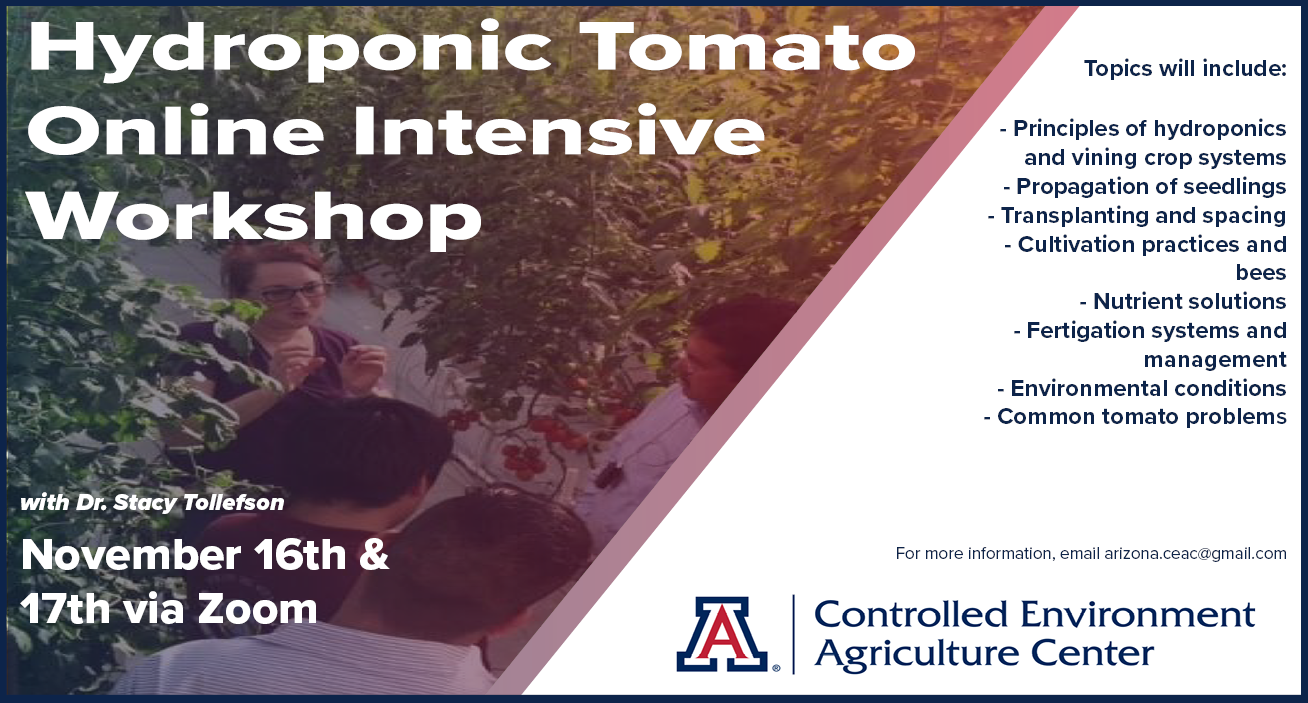
Are you interested in growing tomatoes hydroponically? Join the University of Arizona Controlled Environment Agriculture Center for the Hydroponic Online Intensive Workshop - November 16th& 17th via Zoom
The University of Arizona Controlled Environment
Agriculture Center Is hosting Its First-Ever
Hydroponic Tomato Online Intensive Workshop
On November 16th and 17th
Are you interested in growing tomatoes hydroponically? Join the University of Arizona Controlled Environment Agriculture Center for the Hydroponic Online Intensive Workshop - November 16th& 17th via Zoom.
Taught by Dr. Stacy Tollefson, this two-day event is perfect for novice growers and will be packed with tons of critical information and research discoveries that UA-CEAC has assembled into their courses and programs for over 20 years.
You will get access to numerous lecture materials, personal question follow-ups, certificate of completion, and tons of knowledge!
Click Here To Register!
Limited seats are available
For questions, please email arizona.ceac@gmail.com

GE Current Donates Horticulture Lighting Fixtures To The Ohio State University
“We are excited to be deepening our relationship with OSU,” said Melissa Wesorick, Chief Product and Strategy Officer at Current. “This is a great opportunity to strengthen our ties with this historic institution and the Ohio community, as well as inspire and empower the next generation of growers.”
GE Current, a Daintree company has gifted 272 horticultural lighting fixtures to The Ohio State University to benefit the university’s College of Food, Agricultural, and Environmental Sciences.
The Arize Element L1000 LED fixtures will illuminate a state-of-the-art greenhouse being built within the new Controlled Environment Food Production Research Complex. The greenhouse was made possible with funding from Nationwide Insurance, as well as support from other Ohio-based companies.
“We are excited to be deepening our relationship with OSU,” said Melissa Wesorick, Chief Product and Strategy Officer at Current. “This is a great opportunity to strengthen our ties with this historic institution and the Ohio community, as well as inspire and empower the next generation of growers.”
With construction slated to begin in 2021, the production greenhouse will provide hands-on training opportunities for students to learn how to grow various crops in a greenhouse setting. The multiple tailored light spectrums offered by the Arize Element L1000 opens the door for unique research and scientific exploration into crop production and plant growth, as well as expand upon the understanding of how LEDs can further that growth. The facility will also serve as the location for future grower conferences and workshops.
“Lighting is a key technology of controlled environment agriculture,” said Chieri Kubota, professor in Ohio State’s Department of Horticulture and Crop Science and lead researcher at the new greenhouse facility. “We are excited about potential research outcomes that will advance the science and technology of growing in these environments. We greatly appreciate Current’s generous and important gift to help make this happen.”
Kubota’s work encompasses plant physiology and horticulture engineering to enhance the understanding and efficiency of controlled environment agriculture production systems such as greenhouses, warehouses (vertical farms) and growth chambers.
For more information:
www.gecurrent.com
cfaes.osu.edu
Publication date: Thu 8 Oct 2020

Five Tips For Horticulture: New Video On Monitoring Hydroponic Systems
This video is part of the series called “Five Tips for Horticulture” featured on the Greenhouse Training Online channel (https://tinyurl.com/ufgto)
Dr. Paul Fisher from the University of Florida IFAS Extension hosts Jon Greene of Bluelab Corporation in a new YouTube video (https://youtu.be/Yxt7OZnieng). They discuss technical tips for pH and electrical conductivity (EC) monitoring in hydroponic plant production, as well as water management and the importance of maintaining monitoring equipment.
This video is part of the series called “Five Tips for Horticulture” featured on the Greenhouse Training Online channel (https://tinyurl.com/ufgto). The series highlights technical topics from university and industry experts. Look for upcoming videos on topics such as growing media, vermicompost, and hydroponics substrates. The channel is sponsored by the Floriculture Research Alliance (floriculturealliance.org).
For more information on hydroponics, take the UF IFAS Extension online course for growers on Hydroponic Vegetable Production beginning on November 9 (https://hort.ifas.ufl.edu/training/) in English and Spanish.
The mission of the University of Florida Institute of Food and Agricultural Sciences (UF/IFAS) is to develop knowledge relevant to agricultural, human, and natural resources and to make that knowledge available to sustain and enhance the quality of human life. With more than a dozen research facilities, 67 county Extension offices, and award-winning students and faculty in the UF College of Agricultural and Life Sciences, UF/IFAS brings science-based solutions to the state’s agricultural and natural resources industries and all Florida residents. ifas.ufl.edu | @UF_IFAS
Share this:
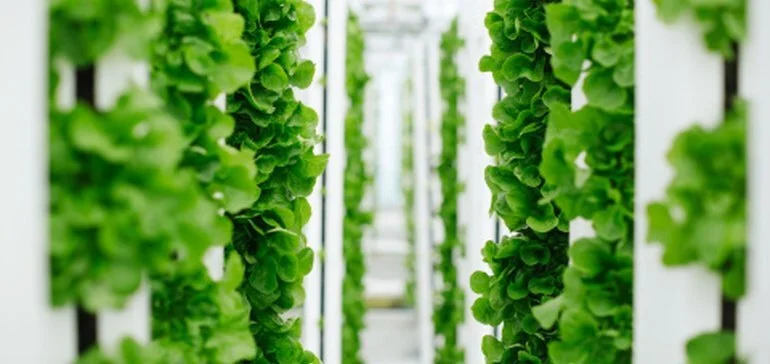
Vertical Farming Startup Takes Crown In Ahold Delhaize Innovation Contest
Evergreens Farms, founded in 2017 in Massachusetts, brings fresh and local produce to the New England market regardless of the season by using technological processes to grow crops indoors with "no need for soil, sunshine, pesticides, or excess water," according to the company's website
Author: Rosie Bradbury
Oct. 8, 2020
Dive Brief:
Vertical farming startup Evergreens Farms won Ahold Delhaize’s supply chain innovation pitch competition, Retail Business Services, the services company of the food retailer’s U.S. operations, announced in a press release. The startup’s winning pitch involved a solution to provide vertical farming technology in any climate year-round. A panel of retail and venture capital experts determined Evergreens Farms had the most viable technology.
Evergreens Farms, founded in 2017 in Massachusetts, brings fresh and local produce to the New England market regardless of the season by using technological processes to grow crops indoors with "no need for soil, sunshine, pesticides, or excess water," according to the company's website.
Dive Insight:
By scouting out and building relationships with high-tech vertical farms start-ups, Retail Business Services can integrate new agricultural technologies to supplement produce sourcing for stores. Regional vertical farms startups such as Evergreens Farms cut down on food waste and transport costs by growing produce close to where it is consumed, as well as appealing to consumers’ penchants for locally grown fruits and vegetables.
Their shorter supply chain also allays consumers’ concerns of contamination risks such as E. coli, and market research suggests that consumers will be more willing to pay more for locally-grown products. Large grocery retailers have increasingly taken notice of the advantages of vertical farming. In August, supermarket chain Albertsons announced its partnership with farming tech firm Plenty to supply salad greens to 430 of its stores. Farming firms such as Plenty and Evergreens Farms also appeal to grocers’ efforts to adopt sustainable practices, as their technology-intensive approaches cut down on both land and water consumption compared to traditional commercial farms.
Greenhouse operator BrightFarms, a major player in farming technology, also supplies packaged greens to Ahold Delhaize, Walmart, and Kroger stores. Earlier this year, BrightFarms expanded its distribution to Food Lion stores in the Mid-Atlantic region.
For stores left with unnecessary floor space as much of its operations shift to online, miniature vertical farming hardware could act as a savvy supply line as well as an attractive use of space. Kroger and Whole Foods have both recently installed small produce farms inside stores.
Recent efforts by Ahold Delhaize indicate it is looking to cultivate partnerships with young companies on the technological cutting edge. Earlier this year, Ahold Delhaize scouted more than 380 smart cleaning technology companies to participate in a Cleaning Bot Challenge.
Lead photo: Courtesy of Bayer
Reminder RSVP - Indoor Ag Science Cafe October 20th 11 AM Eastern Time
Learning critical control point for hydroponic food safety - "Hydroponic Crops How can you produce safe vegetables?"
October Indoor Science Cafe
October 20th Tuesday 11 AM Eastern Time
If you already signed up, thank you!
Learning critical control point
for hydroponic food safety
"Hydroponic Crops
How can you produce safe vegetables?"
by
Dr. Sanja Ilic (The Ohio State University)
Please sign up so that you will receive Zoom link info.
Indoor Ag Science Cafe is an open discussion forum, organized by Chieri Kubota (OSU), Erik Runkle (MSU), and Cary Mitchell (Purdue U.) supported by USDA SCRI grants.
Sign Up Here

More Than $30 Million of Additional AgTech Deals in Abu Dhabi’s Pipeline
The Abu Dhabi Investment Office (ADIO) announced today upcoming developments in Abu Dhabi’s agriculture sector as part of continued plans to bolster local AgTech capabilities and innovations in desert agriculture
September 24th, 2020
The Abu Dhabi Investment Office
The Abu Dhabi Investment Office (ADIO) announced today upcoming developments in Abu Dhabi’s agriculture sector as part of continued plans to bolster local AgTech capabilities and innovations in desert agriculture. In the coming months, more than AED 110 million (USD 30 million) in financial incentives are to be offered to AgTech companies looking to establish or fast track their growth in Abu Dhabi.
The update was given at ADIO’s first sector-focused webinar, “Inside Abu Dhabi: Innovation in Agriculture”, which took place on 23 September and highlighted opportunities in the emirate’s AgTech space. The webinar was attended by participants from all across the world, including the United States, the United Kingdom, Israel, and India.
The new pipeline is part of ADIO’s incentive programme, established under the Abu Dhabi Government’s Ghadan 21 accelerator programme. The incentive packages include competitive financial incentives and other non-financial benefits for companies that develop and commercialise new arid and desert agriculture solutions based on pre-determined criteria.
The new deals will build on the milestones achieved by the four AgTech pioneers – AeroFarms, Madar Farms, Responsive Drop Irrigation (RDI), and RNZ – ADIO partnered with earlier this year to establish R&D and production facilities in the emirate.
H.E. Dr. Tariq Bin Hendi, Director General of ADIO, said: “We have made significant headway towards realising our mission of turning sand into farmland, prioritising innovation that has the potential to make real, lasting change in the region and beyond. Despite the current global conditions, 2020 will be a transformational year for AgTech in Abu Dhabi as we close in on deals to bring more pioneering companies to the UAE. We will continue to work closely with ecosystem players like the Ministry of Food Security, the Abu Dhabi Agriculture and Food Safety Authority (ADAFSA), and ADQ to support AgTech founders and startups with the resources and infrastructure they require to achieve long-term success in the emirate.”
ADIO announced in April that it made AED 367 million (USD 100 million) in financial incentives available to four AgTech pioneers, partnering individually with AeroFarms, Madar Farms, RDI, and RNZ to establish new R&D and production facilities in Abu Dhabi. During the first “Inside Abu Dhabi” webinar, each company announced significant milestones in their respective projects over the past five months.
USA-headquartered vertical farming company AeroFarms has set up its corporate office at Abu Dhabi Global Market (ADGM) to plug into the emirate’s innovation ecosystem and support R&D plans aimed at tackling agriculture problems within desert and arid climates. The company has also built out a local team, including hiring a general manager to lead AeroFarms’ Abu Dhabi strategy.
David Rosenberg, Co-Founder, and CEO of AeroFarms, commented: “Our excitement grows as we advance in Abu Dhabi the building of the world’s largest R&D indoor vertical farm in the world. We have set up corporate offices and started to build out an incredible team including our General Manager. We are working to finalise partnerships to co-innovate together in our Abu Dhabi facility as we work to solve some of the most pressing problems in agriculture in the region and the world. We are honoured to be working closely with ADIO to make Abu Dhabi a nexus for AgTech innovation and we encourage companies and universities to reach out and partner with us as we work on the next generation of agriculture breakthroughs.”
Madar Farms, a home-grown UAE AgTech innovator, has made significant progress in developing the local food offering in the market. The company has launched new products and is reaching consumers through expanded distributors and platforms. It is also partnering with a UAE education institution to teach students about AgTech and hydroponic systems, educating them about sustainable indoor agriculture from an early age.
Abdulaziz AlMulla, CEO and Co-Founder of Madar Farms, said: “We are happy to be part of the conversation. At Madar Farms, we are already leading a new agriculture revolution by growing a wide range of high-quality fresh produce every day here in the UAE with the use of advanced farming technologies. We want to create a lasting change by providing a holistic approach to sustainability and every day we are working towards achieving our vision and establishing Abu Dhabi as a global AgTech leader.”
RDI, which has developed an innovative irrigation system to transform water usage in UAE agriculture, has secured a facility in Abu Dhabi’s integrated trade, logistics, and industrial hub, KIZAD, to be used for industrial research, product manufacturing, and distribution. Given the emirate’s strategic location at the intersection of the Middle East, Europe, Sub-Saharan Africa, and Asia regions, the new distribution hub will allow RDI to reach more water-stressed countries that can benefit from its irrigation solution. The company is also set to install pilot projects using green technologies in Abu Dhabi over the coming months, paving the way for the development of the best AgTech practices in desert environments.
Jan Gould, Co-Founder, and CEO of RDI, commented: “The foresight and vision of Abu Dhabi’s ruler and its government leaders to focus and support innovations in agriculture has defined the UAE capital as a leader in ensuring food security for its citizens, developing local food supply chains, addressing challenges and preserving the planet’s precious resources for the future. Responsive Drip Irrigation is committed to working with ADIO and our partners in the AgTech programme to build a greener tomorrow for generations to come. With Abu Dhabi’s leadership and support, there is hope for recovery if we all work together. We just need to plant the seed.”
RNZ, which produces customised solutions for farming communities, has broken ground on a plot in KIZAD and laid the foundations for its new R&D centre, expected to be operational towards the end of the first half of 2021. The team is steadily being assembled with both a Head of Research and Head of Production appointed. The centre will look into developing effective agri-inputs to yield higher productivity, with an early focus being the development of 100% organic and residue-free solutions to support the region’s date palm farmers.
Raza Soomar, CEO of RNZ, said: “As our new R&D centre in Abu Dhabi begins to take shape, we are just months away from looking into solving problems for farmers and bringing effective solutions to the market that are relevant in Africa, Asia, and the Gulf. We are proud to be part of Abu Dhabi’s AgTech ecosystem and excited about the possibilities for RNZ’s new R&D hub.”
ADIO will announce further details of its upcoming AgTech deals in the coming months.
FacebookTwitterLinkedInPinterestShare
© 2000 - 2020 Al Bawaba (www.albawaba.com)

How To Prevent And Identify Plant Diseases In Hydroponic Growing Systems
Depending on what kind of disease or virus your crops have, it’s possible the sickness could destroy your entire crop as it spreads from one to the next.
Plant diseases in hydroponic gardens can be detrimental if not properly taken care of. Depending on what kind of disease or virus your crops have, it’s possible the sickness could destroy your entire crop as it spreads from one to the next. In this article, we’re going to discuss how to identify and prevent plant diseases in hydroponic growing systems.
Preventing Plant Diseases
To prevent plant diseases from occurring in your hydroponic garden, you’ll want to follow these rules:
Promote good air circulation by adding fans to your growing area, spacing out plants, and pruning or removing dead or diseased plants.
Make sure your hydroponic system has good drainage by not overwatering and checking to see if there’s any standing or oversaturated water.
Try growing plant species that have been bred for growing indoors since they are made to be disease-resistant.
Prevent your plant’s stress by ensuring they have the necessary nutrients, and the correct temperature and humidity. Stressed plants can be more vulnerable to diseases.
Clean and sanitize your tools, growing media, and trays regularly.
Check for signs of plant diseases at least 1 to 2 times per week.
If able, allow for a one to two-month crop-free period once a year to eliminate all threats of disease.
Check for signs of pests because they can introduce and spread diseases amongst your plants.
Signs of Plant Diseases
Depending on what kind of disease your plant has contracted will determine the symptoms and signs to look out for. Plants are susceptible to viruses, diseases, fungi, and pythium. Once a pathogen enters your plants you’ll notice a development of galls, swellings or leaf curls, yellowing or stunted leaf, fruit, or root growth, or plant tissue die-off (wilting, rotting, browning, etc.).
Bacteria: If your plant has been contaminated by bacteria, you will notice a slimy, brown-colored coat on the plant’s roots. Try seeing if this brown coating is on your hydroponic reservoir’s walls, tubes, and water pump filter.
Fungi: Evidence of a fungal pathogen is when you notice powdery or fuzzy growths on the plant’s roots or leaves. These growths are typically gray, blue, white, or green colors.
Pythium: This type of disease is known for being the most deadly for hydroponic growing systems. Pythium will blacken the plant’s roots, ooze a foul-smelling odor, and halt the growth of the plant. This pathogen is highly contagious and can spread quickly to ruin entire crops.
Virus: While viruses in plants are rare, they can be fatal when they do occur. Viruses are typically brought about by outside insects or outdoor soil. When introduced to a virus, the virus will spread quietly through the crop and can hide dormant in plants waiting to come out later. If not treated, a viral plant infection can lead to the destruction of the entire crop.
Want to Learn More?
We at the Nick Greens Grow Team have a plethora of knowledge covering hydroponic growing. Join our new Patreon page so you can get behind the greens, which is a behind the scenes look at growing food inside a closet and on kitchen counters. Learn every process of how to hydroponically grow strawberries, lettuce, green onions, kale, cucamelons, lemon cucumbers, and microgreens. We upload how-to and informational videos twice a week.
#plantdiseases #hydroponicsdiseases #hydroponicdiseases #hydroponic #hydroponics #hydroponicsfarming #hydroponicsgrowing #hydroponicfarming #hydroponicgrowing #usinghydroponics #hydroponicsfarmer #hydroponicfarmer
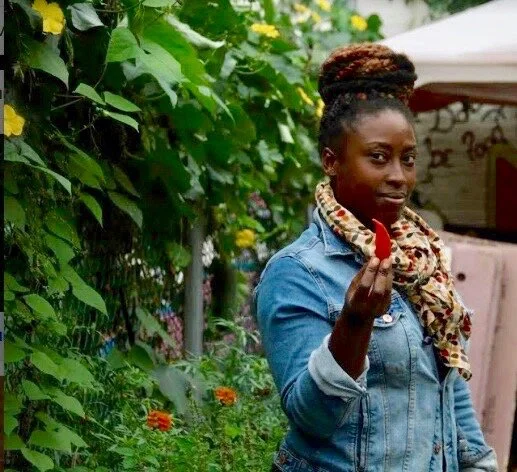
US - NEW YORK: Yemi Amu’s Urban Farming Concept Takes Root In The Big Apple
Earth is the only home we have. If we don’t start now to turn around the environmental damage we have caused, we might not be around to save it and the plants and animals that we depend on
By Tony Binns | October 6, 2020
Earth is the only home we have. If we don’t start now to turn around the environmental damage we have caused, we might not be around to save it and the plants and animals that we depend on. As a possible solution, many metropolitan cities are turning to urban farming and aquaponics. In Brooklyn, New York, Nigerian-born Yemi Amu has been a part of this movement by opening the city’s only teaching aquaponics farm, Oko Farms.
What is aquaponics and why is it important to the sustainability of our planet?
Aquaponics is farming in water. It is the cultivation of fish and plants together in a symbiotic aquatic ecosystem whereby fish waste provides nutrients for plants while plant roots filter the water for the fish. This farming method allows you to raise both fish and plants while using up to 80% less water than traditional farming. Aquaponics is also scalable and can occur both indoors and outdoors.
As we deal with the environmental impacts of climate change including soil erosion and drought, alternative growing methods like aquaponics can help create food security for vulnerable communities.
What is Oko Farms and how did it find a home in Brooklyn?
Oko Farms is an aquaponics farming and education company in Brooklyn. In 2013, we converted an abandoned lot in East Williamsburg, Brooklyn, into the Oko Farms Aquaponics Education center — NYC’s first outdoor — and only publicly accessible — aquatic farm. We were able to acquire the lot through a partnership with the Brooklyn Economic Development Corporation and GreenThumb NYC.
In addition to growing a wide variety of vegetables and fish, we provide workshops, tours, and support individuals and organizations with setting up their own aquaponics farms.
What type of produce and fish do you grow on your farm?
We grow a variety of vegetables on our farm, including leafy greens, herbs, onions, tomatoes, peppers, sweet potatoes, cabbage, sorghum, rice, millet, squash, etc. We also raise catfish, bluegill, tilapia, goldfish, and koi
How did you get into aquaponics?
I learned about aquaponics while I was managing a rooftop farm that I helped to create. The rooftop farm was located at a housing facility for formerly homeless adults in Crown Heights, Brooklyn, in 2011. One of the neighborhood volunteers introduced me to aquaponics and I was attracted to the fact that it saves water while producing both fish and vegetables. After that, I spent a couple of years studying and visiting aquaponics farms in Florida and the Midwest.
Are there career opportunities for people of color in the field?
Aquaponics farming is a great option for people of color interested in a career in farming, especially those living in urban areas. Access to land for farming can be challenging for people of color in the U.S, but some cities like Detroit, Philadelphia, and Atlanta have urban ag[riculture] policies that support farmers of color with land access.
For more information, visit www.okofarms.org.
Lead photo: Yemi Amu, director of Oko Farms (Photo courtesy of Harrison Chen)