


Welcome to iGrow News, Your Source for the World of Indoor Vertical Farming

Four Innovative Design Responses To The Climate Emergency
Design Emergency began as an Instagram Live series during the Covid-19 pandemic and is now becoming a wake-up call to the world, and compelling evidence of the power of design to effect radical and far-reaching change
October 4, 2020
Design Emergency began as an Instagram Live series during the Covid-19 pandemic and is now becoming a wake-up call to the world, and compelling evidence of the power of design to effect radical and far-reaching change. Co-founders Paola Antonelli and Alice Rawsthorn took over the October 2020 issue of Wallpaper* – available to download free here – to present stories of design’s new purpose and promise.
The redesigned System 001/B, The Ocean CleanupTragic, and destructive though the Covid-19 crisis has been, it is one of a tsunami of threats to assail us at the same time. A concise list of current calamities includes the global refugee crisis; spiraling inequality, injustice and poverty; terrifying terrorist attacks and killing sprees; seemingly unstoppable conflicts; and, of course, the climate emergency. Since the start of the pandemic, global outrage against systemic racism following the tragic killing of George Floyd, and the destruction of much of Beirut have joined the list. Design is not a panacea to any of these problems, but it is a powerful tool to help us to tackle them, which is why Paola Antonelli and Alice Rawsthorn are focusing Design Emergency on the most promising global efforts to redesign and reconstruct our lives for the future.
Thankfully, there are plenty of resourceful, ingenious, inspiring, and empathetic design projects to give grounds for optimism. Take the climate emergency, where design innovations on all fronts: from the generation of clean, renewable energy, to new forms of sustainable food growing, and rewilding programs are already making a significant difference to the quality of the environment.
Here Are Four of Paola Antonelli And Alice Rawsthorn’s
Favorite Design Responses To The Ecological Crisis
Urban farm
Photography: © Nature Urbaine
Looming beside the Porte de Versailles subway station in south-west Paris is the colossal exhibition venue Paris Expo Porte de Versailles. By the time it hosts the handball and table tennis events in the Paris 2024 Olympics, Paris Expo will also be the home of Agripolis, the largest urban farm in Europe. Agripolis already operates other urban farms in Paris and occupies 4,000 sq m of Paris Expo’s roof. Over the next two years, it plans to expand across another 10,000 sq m, to produce up to 1,000kg of fresh fruit and vegetables each day using organic methods and a team of 20 farmers. The produce will be sold to shops, cafés, and hotels in the local area, while local residents will also be able to rent wooden crates on the roof to grow their own fruit and vegetables. Once it is completed, Agripolis’ gigantic rooftop farm at Paris Expo should place the Ville de Paris’ program of encouraging urban agriculture at the forefront of global developments in greening our cities.
The Ocean Cleanup

The redesigned System 001/B, The Ocean Cleanup
Scientists claimed that it wouldn’t work. Environmentalists warned that it risked damaging marine life. Few design projects of recent years have been as fiercely criticized as the Ocean Cleanup, the Dutch social enterprise founded in 2013 by Boyan Slat, who quit his degree in design engineering to try to tackle one of the biggest pollution problems of our time by clearing the plastic trash that is poisoning our oceans. Despite its critics and a series of setbacks, notably, when the original rig had to be towed back to San Francisco to resolve technical problems, the Ocean Cleanup has persevered. The redesigned System 001/B (pictured top) successfully completed its trials in the Pacific last year, and System 002 is scheduled for launch next year. The Ocean Cleanup has also developed a parallel project, The Interceptor, a solar-powered catamaran with a trash-collecting system designed specifically for rivers, and which can extract 50,000kg of plastic per day.
The Great Green Wall

Photography: The Great Green Wall of the Sahara and Sahel © UNCCD
Few regions are hotter, drier, and poorer than the Sahel, on the southern edge of the Sahara Desert. The brutal climate has wrought devastating damage in recent decades by causing droughts, famine, conflicts, poverty, and mass migration. The Great Green Wall is an epically ambitious project launched in 2007 by the 21 countries in the Sahel to restore the land by planting an 8,000km strip of trees and plants from the Atlantic coast of Senegal to Djibouti on the Red Sea. The practical work on the Great Green Wall, which is run as an African-led collective supported by the United Nations Convention to Combat Desertification, is executed by each of the 21 countries. So far, more than 1,200km of greenery has been planted, although the focus of the project is less on the progress of the wall itself than on its impact in persuading each country in the Sahel region to transform what has become arid desert back into fertile farmland.
Zero-waste village
Photography: © Kazuhiro Nogi/AFP via Getty Images
This was to have been the year when the people of Kamikatsu, a village on the Japanese island of Shikoku, would achieve their goal of becoming a zero-waste community. The 1,500 villagers may struggle to produce no waste at all in 2020 but will come impressively close to doing so in a 20-year experiment that demonstrates the contribution a resourceful group of individuals can make to curb the climate emergency. The initiative began in 2000 when the local government ordered the closure of Kamikatsu’s incinerator. Rather than ship their waste elsewhere, the villagers took a collective decision to reduce and, eventually, eliminate it. They opened a Zero Waste Academy, where waste is sorted into 45 categories for reuse or recycling. Anything sellable is dispatched to a recycling store; fabric is upcycled at the craft center. The villagers have now eliminated over 80 percent of their waste, but are still struggling to recycle leather shoes, nappies, and a few other tricky exceptions.

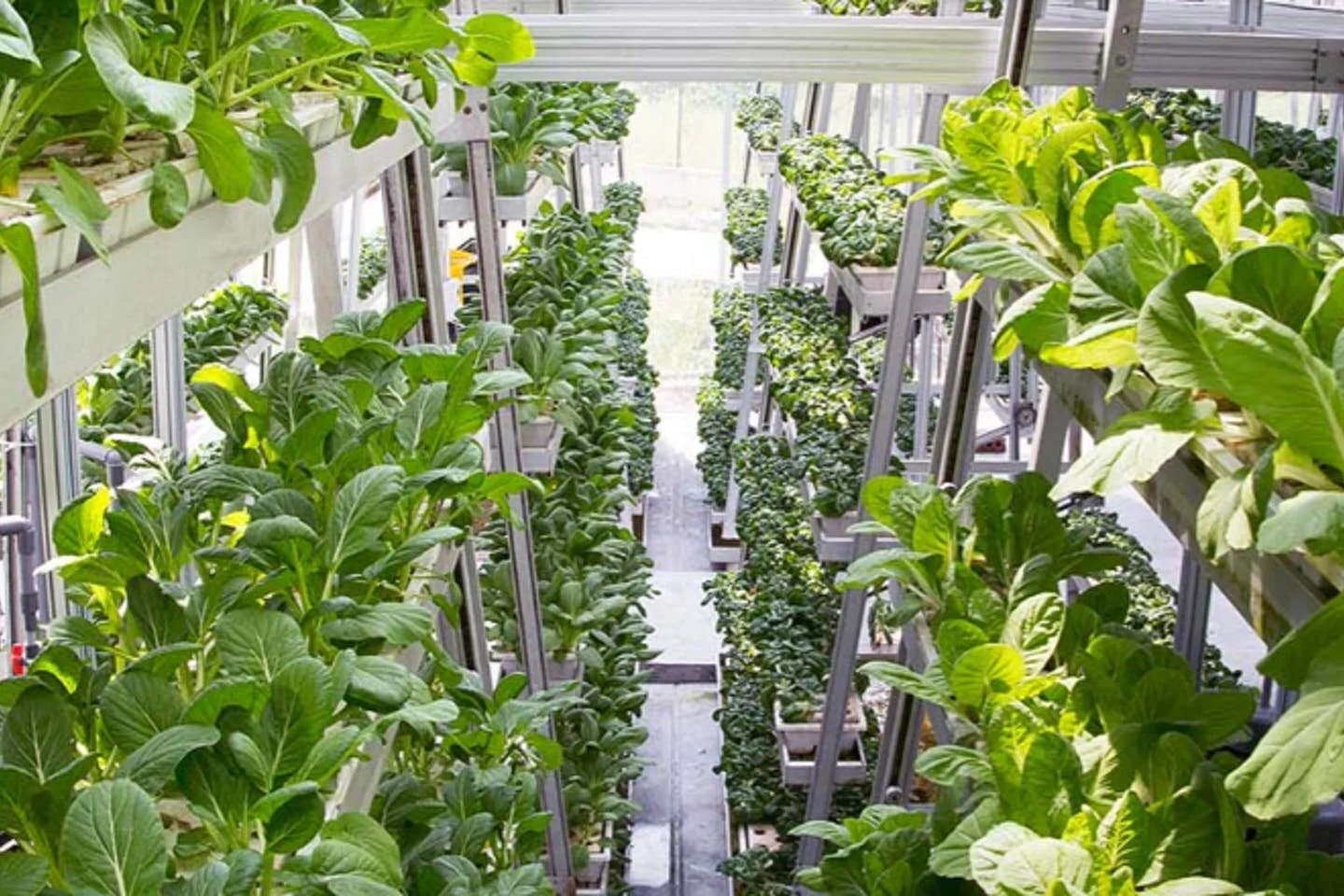
Vertical Farms Are Overserved: Global Food Resilience Needs A Rebalancing Act
Recent moves by Singapore’s state investment firm Temasek in the food and agritech space have prompted a rethink of what the political economy of food could look like over the next decade

By Huiying Ng
Oct. 11, 2020
Focusing investment in agritech among a few, powerful corporations is not the right way to ensure the future of food security and agricultural sustainability, writes Huiying Ng.
Recent moves by Singapore’s state investment firm Temasek in the food and agritech space have prompted a rethink of what the political economy of food could look like over the next decade.
Urban farm models—which Singapore is intent on exporting—will stream proprietary genetic information, business profits, and property assets to the same companies and individuals at the expense of both people and global, diverse multi-crop ecosystems. Many urban farms in Singapore are receiving large amounts of state support—including nearly $40 million in funding announced earlier this month.
As Temasek increases its investments in the agricultural and food technology space, it is worth looking at how a state sovereign fund uses its wealth.
In the last few years, Temasek supported German company Bayer’s buyout of Monsanto in 2018, funded Impossible Foods and Just Food, and reinvested as Impossible’s third-largest investor in 2020. Some of these groups have stirred controversy: Monsanto, a seed and agrichemicals giant, is facing several ongoing class-action lawsuits in the United States from farmworkers stricken with cancer from the use of the herbicide Roundup. Bayer later paid $10 million in settlements, which comes down to an average of less than $160,000 per plaintiff not considering litigation fees—while continuing to sell the very same pesticide to farmers.
This year, Temasek expanded its agri-food investments by partnering with Bayer to set up a company, Unfold, to sell genetically modified seeds to vertical farms.
Merged with Monsanto, Bayer-Monsanto is one of the largest agri-food conglomerates supplying most of the world’s seeds and agrichemicals, controlling 30 percent share of the world’s proprietary seed genetic material and agrichemicals. This means that many farmers are at the mercy of seed-agrichemical pairings made by a limited number of agribusiness companies.
Bayer-Monsanto’s investment decisions actively create a world of petrochemical and genetic dependence. Their products narrow the range of genetic resources and make resources that exist in the commons into commodities we have to pay for.
This is done in the name of food security. But in practice, these companies drive capital towards commodity production lines that require scale and homogenization. Their work strips smallholders of land, knowledge, and agri-cultures, and propagates the inequalities that took root in the Green Revolution, the era after World War II when synthetic fertilizers, pesticides, and herbicides were used to boost production, causing long-term chemical-based soil degradation.
While the Green Revolution is said to have lifted smallholders out of hunger and poverty, in practice it was a war on smallholders across the world, orchestrated over half a century by companies in Western Europe and the United States. Temasek’s choices indicate the state’s investment in dependence on big agritech at a time when global agriculture needs to be nourished and our knowledge capacities rebuilt, and its protective and regenerative functions renewed.
Seed laws, genetic diversity, and organic farming
Seed laws
Many seed laws such as the Trade-Related Intellectual Property Rights (TRIPs) Agreement of the World Trade Organisation (WTO) define seeds as a “creation and invention” belonging solely to seed corporations.
This effectively prohibits farmers from the free breeding and exchange of certain seeds.
Dietary diversity
Currently, no more than 120 cultivated species provide for 90 percent of human food supplied by plants, and 12 plant species and five animal species alone provide for more than 70 percent of all human food. Seed laws, which are generally used to develop standardized, homogenous crops to meet the demand of urban populations, have the effect of limiting genetic diversity in farmed crops. This negatively impacts the range of foods in our diets.
Crop uniformity
Seed corporations have asserted the need for crop homogeneity in response to industrial agriculture’s application of chemicals to control pests, diseases, weeds, or to fertilisers. This makes them less able to cope with continuously evolving pests and diseases. Organic farmers, however, tend to grow diversified crops as a way to adapt to the same challenges, but which do not threaten food resilience.
The global political economy of food
It’s clear that food security cannot be achieved through production alone. What is more important is the continued viability of our living environments to sustain and renew themselves. A political economy is needed that supports regenerative agriculture and ensures the fair distribution and management of resources—including financial capital.
Financial support for a narrow range of companies will create a market where people will eventually depend on a particular brand of farm, and increasingly that will mean indoor, ‘hi-tech’ vertical farms.
The global indoor farming market size was worth US$100 billion in 2018. By 2030, innovation in food and agriculture could be worth $700 billion. Hi-tech farms designed to grow a single crop will guzzle energy for air-conditioning, use up land, and give up on the land’s ability to be restored. Even with the new jobs high-tech farming will create, workers will have no real power to disengage from a system that narrows the planet’s genetic seed stocks, land, and knowledge resources.
In Asia, where so much of the future of food is at stake, we need to have public conversations about agritech to get greater clarity and transparency about the impact of new farming models on people and the planet, and how to create socially responsible products.
Companies can either increase social inequality and environmental degradation or join a global community working to increase our shared human access to land, knowledge, food resources, and peace. Agritech firms play an important role in shaping where investors put their money, and if 2020 makes anything clear, it is that neither business-as-normal nor the new normal can achieve food long-term security and sustainable agriculture.
Agritech’s climate responsibilities
Businesses have always had the power to look after the needs of people—and they are under more pressure than ever to do so today.
This decade will see more transboundary environmental disasters. Agritech and its funders would be wise to consider how their investments shape greater transboundary resource renewal, including the regeneration of lands and waters.
What agritech can do
There are five things agritech and agrifinance can do to redistribute equity in the food system:
1) Invest in solutions that increase the amount of arable non-monocrop food forest and arable land that commits to using regenerative multi-cropping techniques
2) Commit to working with national or regional seedbanks to increase genetic diversity, encouraging clients and customers to use saved, native, and heirloom seed varieties in gardens and urban farms
3) Broker regional peace and trust by improving food distribution logistics and addressing bottlenecks in the food supply chain. More food production is nothing if we do not address this.
4) Ensure food is grown with the principles of nutrition, diversity and equity in mind, by bringing the food insecure into the conversation, ensuing profits are redistributed among local communities to develop relationships in neighborhoods, workplaces, and schools.
5) Begin real dialogues with food sovereignty organizations and networks.
Seeds produced for vertical farms are highly profitable for the companies that produce them. But it is not in these companies’ business interests to replenish the arable land and water resources that we need to live on this planet.
We need to invest in practices that renew agricultural knowledge across our generations, reforest degraded and degrading lands, and redistribute resources that have been taken from elsewhere.
And we need to invest in technologies that support seed banks, enable innovation in the use of available low-carbon resources, and help people make the right choices about what to plant locally.
Now is the time to create the pathways that will afford us better solutions for the planet, not profit—and these solutions need to bear fruit within our lifetimes. Let’s invest appropriately.
Huiying Ng is partnerships and research lead at the Soil Regeneration Project.
The sidebar was written by Edmil Chue and Amanda Foo from Project Rewild.
FOOD & AGRICULTURE
Vertical farms ‘underserved’ when it comes to new seed varieties
Read now
Lead photo: A vertical farm. Are investments in seeds for vertical farms being concentrated among fewer, large corporations? Image: SkygreensThanks for reading to the end of this story!
We would be grateful if you would consider joining as a member of The EB Circle. This helps to keep our stories and resources free for all, and it also supports independent journalism dedicated to sustainable development. For a small donation of S$60 a year, your help would make such a big difference.

Rooftop Greenhouses Take Urban Farming To New Heights In Quebec
Lufa claims this latest site, opened this summer, becomes the world's largest rooftop greenhouse
BY EMMA JACOBS (FREELANCE REPORTER/PRODUCER) , IN MONTREAL
Lauren Rathmell co-founded the company Lufa, whose latest rooftop greenhouse opened in Saint-Laurent, QC earlier this year. Photo courtesy: Lufa.
October 8, 2020 — Cherry tomato plants tower over Lauren Rathmell’s head in the latest greenhouse built by the company she co-founded, called Lufa.
"We train everything vertically so that we can keep these plants a lot longer than a typical garden tomato plant," she explains. "We're in the probably 15 to 20-foot-long plant range now. They're really high."
Emma Jacobs Rooftop greenhouses take urban farming to new heights in Quebec
Their height makes it hard to tell that the greenhouse encloses a space the size of three football fields — all dedicated to growing varieties of tomatoes and eggplants.
It’s also four stories off the ground, on the roof of a former Sears warehouse not far from Montreal’s Trudeau International Airport.
Greenhouse-grown produce is a relatively small but growing part of agriculture in the Canadian provinces of Ontario and Quebec.
Lufa claims this latest site, opened this summer, becomes the world's largest rooftop greenhouse.
The NCPR team has worked tirelessly to make sure you and your neighbors can depend on us for journalism like this story in this challenging time. And you’re essential to that work. If you’re able, please make a donation now to ensure our effort can continue to be everything you count on.
"Once everything's picked and ready, it's going to go down right to our warehouse below us and packed into tomorrow - early tomorrow morning, into the baskets for the day," says Rathmell. The baskets containing the items customers' order online get delivered around the Montreal area and as far away as Quebec City in the company's electric delivery vehicles.
"We forecast really accurately and we try to pick just what's needed for that day's baskets. It's better for taste, it's better for quality, and it means no waste in the end as well," she says.
Lufa's latest 163,000 square foot greenhouse is located on top of a former Sears warehouse in Saint-Laurent, QC. Photo courtesy: Lufa.
Rathmell, originally from Vermont, founded Lufa with her husband to try and eliminate the environmental footprint associated with shipping produce across the continent. Lufa is named for a Lebanese cucumber. Rathmell’s husband is Lebanese. They call their customers "lufavores."
While greenhouses use a lot of energy, especially up north, Rathmell says putting them on a rooftop cuts winter energy use in half.
"We benefit by just passively receiving the heat that's coming from that building below, rather than being on a cold ground level in wintertime," she said. The greenhouse also creates an insulating bubble over the building below. The former Sears building now also contains other offices and warehousing.
Lufa established what was then the world’s first commercial rooftop greenhouse back in 2011.
With its latest, the company now operates four sites in the greater Montreal area, which have year-round growing seasons. Building on a rooftop does come with extra costs but Rathmell says energy savings and proximity to consumers help to offset them.
At the start of the pandemic, those customers doubled virtually overnight. People looking to order groceries for delivery signed up at rates that took the company by surprise.
"Within a week or two we had gotten a waitlist in place, first time ever we've never had a waitlist before, but we couldn't keep up," Rathmell recalls.
The company had to reorganize its greenhouses and warehouses for safety while also increasing the density of plants in its greenhouses. But Rathmell says it was a useful test for their business, which she’d like to expand someday to other cities, potentially in the northeastern United States.
Eggplants grow in the Saint-Laurent rooftop greenhouse. Photo courtesy: Lufa.
She’s also interested in expanding the range of crops.
"We do have two banana trees at one of our greenhouses as well," she says. "You can basically grow anything in a greenhouse. Is it worth growing in a greenhouse? Maybe not. But yeah, the bananas, I think they took like a year and a half, but we did get bananas.
So Quebec’s probably not the next banana capital, but certainly, a good place to experiment with greenhouse farming in cold climes.
Related Topics
montreal · environment · quebec · canada · agriculture

Last Chance To Reserve Your Spot At The Aquaponics Conference
Wherever you are in your aquaponic journey there is a community for you. Engage with industry professionals and grow your aquaponic skills
Don't miss the opportunity to engage with aquaponic experts in live
Q&A, panel discussions, and farm tours!
Get Your Ticket Today ›

PMA Virtual Town Hall: Global Societal Macrotrends And How They Affect The Produce Industry
The first of the macrotrends that was discussed was that of globalization
This week’s PMA virtual town hall focused on five important macrotrends in society and how these trends affect the produce industry. “It is always a good time to think about the big picture, but especially now, when what happens in the future is so critical to guiding our everyday operations,” Lauren M. Scott of PMA says. She was joined by Marc Oshima, Co-Founder and CMO of AeroFarms, Sharon Foo, who works as a consultant, Elizabeth Nardi, CEO of Organically Grown Company, and Wyard Stomp, VP of Sales and Marketing to discuss this topic.
Globalization
The first of the macrotrends that was discussed was that of globalization. “In the context of COVID-19, the interdependency of our supply chain has become increasingly clear,” says Oshima. “This interdependency is due to globalization. We have to think more specifically now in terms of food security and resiliency in the supply chain due to the pandemic,” he adds.
While globalization has been an important factor that has been increasingly impacting the entire world for decades now, and even arguably for centuries, the outbreak of the pandemic has also brought forth an increased popularity of locally grown produce. Nardi explains: “This is definitely something we have been seeing here on the West Coast, this trend of hyper-localization. The pandemic has given consumers a real desire to know where their food came from. Consumers are looking for trusted sources and want to support local economies.”
Population diversification
The diversification of populations is the next macrotrend that was discussed. This topic can be approached in many different ways. Nardi, for example, looked at the different lifestyle trends among the population: “We’re seeing that non-gmo has become one of the most recognized labels in the world, and organic has been seeing a significant growth in popularity. There is a shift in how people think about the products they are purchasing.”
For Oshima, the population diversification translates increasingly into product diversification. “With regard to food trends, borders have become seamless. Food continues to play a powerful role in bringing people together, so we think about it as a way of preserving customs and traditions of specific cultures through food.”
For Stomp, generational diversification is also an important aspect of this trend. “Millennials and Gen Z are a whole new game, and we are working to understand them better, especially Gen Z, who are now coming into play as consumers.”
Precision technology
The advancement of technology has always been closely integrated with the produce industry. This is something that AeroFarms, for example, was built on: “For us, it’s about optimizing the key attributes that consumers are looking for. We are working with chefs and the menu development now starts at the farm. We’re able to use technologies to build smart farms, which allow us to bypass season and deliver product consistently year-round,” Oshima shares.
“It’s not science for science’s sake, but for a greater reason,” Foo adds. “Today’s technology helps to solve the problems of the consumers. It’s important that people have a clear grasp on the drivers behind certain developments so that we can understand that the technology is there to enable great access for consumers to the healthy foods the industry has to offer.”
Climate adaptation
Changes in the climate and the environment are central to the agricultural industry, and so this next macrotrend is vitally important for everyone in the supply chain. “We like to look at agriculture as a way of reversing climate change,” says Nardi. “There is so much we can do to pull the carbon out of the air and put it back into the soil.”
Foo explains that she looks at it in terms of regeneration rather than sustainability. “Realistically, there’s not much left to sustain, so we need to change our vocabulary and start looking at it as regeneration instead. We need to build a circular economy and build solutions.
Accelerated urbanization
The final macrotrend that was discussed was urbanization. The majority of the world’s population lives in urban areas, and the consumer trends in urban areas differ widely from those in rural areas. “Our produce is grown by the community, for the community. We have farms located in inner-city schools and growing inside cities. It is about diversifying the supply chain and improving last-mile efficiency, and indoor farming is a big part of that,” Oshima says.
Stomp sees urbanization as a creator of additional opportunities. “This macrotrend is one of the most important ones, from the sales and marketing point of view. Urbanization rates create a lot of opportunities, but they also require that we adjust how we approach the market. For example, people in urban areas shop more often, sometimes even going to the store multiple times a day. This creates a lot of opportunity, but in order to capitalize on these opportunities, we need to recognize the trend and translate the data into a strategy. In the produce industry, so much of the business is focused on the short term – day to day and week to week, but it’s very important to keep track of these macrotrends, analyze the data and simplify to see how it impacts your business, what opportunities you can take from it, and then drive actionable strategies from there,” Stomp concludes.
Next week’s virtual town hall will focus on global trade issues and will include insights from leaders in trade about how to navigate difficult environments and address trade disruptions.
Publication date: Thu 1 Oct 2020
Author: Annika Durinck
© FreshPlaza.com
BARBADOS: Agricultural Push
“To date, we have some 800 farmers signed up to be trained for the FEED program and in St George North I am prepared to come here and identify space, where Toni can have Freight Farms which is also a Hydroponic system on a lease-to-own basis to young people who are interested in getting involved in agriculture.”
10/10/2020
Agriculture Minister Indar Weir
The Ministry of Agriculture and Food Security is pressing ahead with plans to breathe new life into the sugar cane industry.
Speaking at the Barbados Labour Party (BLP) public meeting at Newbury, St. George on Thursday night, Minister Indar Weir reported that the strategy to revitalize this country’s oldest industry has already gone to Cabinet.
“We are modernizing our sugar industry to the extent that we are using a full value chain industry which goes from sugar for domestic consumption, molasses for our rum industry, and then the waste matter is being used to generate renewable energy.”
Minister Weir thereby explained the government’s foresight is to “bring the industry to profitability”.
“And all of you who are part of the labor force in farms and in the sugar industry would have an opportunity for the first time in our existence to own shares where you can get a return on the profits made through the sugar industry transitioning program.”
The Agriculture Minister also informed the people of St. George North that he will honor the BLP candidate Senator Toni Moore’s wish to introduce Hydroponics and Aquaponics into the constituency.
He said this will be achieved through the Farmers’ Empowerment and Enfranchisement Drive (FEED) program aimed at reducing agricultural imports into the island which will ensure national food and nutrition security. Currently, farmers are also being trained in Apiculture and Freight Farming.
“I say to you St. George North that you do not have the traditional jobs that you used to get – we do not have enough land space even. And so, we must embrace technology, where you can take a freight farm and with your mobile phone, laptop, tablet and you can operate that farm, get to production faster and get greater yields. Yet, you do not have to use pesticides and of course, it is a revolving system so, therefore, it is less water-intensive, and you do not have to worry about climate change and prolong droughts,” he explained.
“To date, we have some 800 farmers signed up to be trained for the FEED program and in St George North I am prepared to come here and identify space, where Toni can have Freight Farms which is also a Hydroponic system on a lease-to-own basis to young people who are interested in getting involved in agriculture.” (TL)
The Ministry of Agriculture and Food Security is pressing ahead with plans to breathe new life into the sugar cane industry.
Speaking at the Barbados Labour Party (BLP) public meeting at Newbury, St. George on Thursday night, Minister Indar Weir reported that the strategy to revitalize this country’s oldest industry has already gone to Cabinet.
“We are modernizing our sugar industry to the extent that we are using a full value chain industry which goes from sugar for domestic consumption, molasses for our rum industry, and then the waste matter is being used to generate renewable energy.”
Minister Weir thereby explained the government’s foresight is to “bring the industry to profitability”.
“And all of you who are part of the labor force in farms and in the sugar industry would have an opportunity for the first time in our existence to own shares where you can get a return on the profits made through the sugar industry transitioning program.”
The Agriculture Minister also informed the people of St. George North that he will honor the BLP candidate Senator Toni Moore’s wish to introduce Hydroponics and Aquaponics into the constituency.
He said this will be achieved through the Farmers’ Empowerment and Enfranchisement Drive (FEED) program aimed at reducing agricultural imports into the island which will ensure national food and nutrition security. Currently, farmers are also being trained in Apiculture and Freight Farming.
“I say to you St. George North that you do not have the traditional jobs that you used to get – we do not have enough land space even. And so, we must embrace technology, where you can take a freight farm and with your mobile phone, laptop, tablet and you can operate that farm, get to production faster and get greater yields. Yet, you do not have to use pesticides and of course, it is a revolving system so, therefore, it is less water-intensive, and you do not have to worry about climate change and prolong droughts,” he explained.
“To date, we have some 800 farmers signed up to be trained for the FEED program and in St George North I am prepared to come here and identify space, where Toni can have Freight Farms which is also a Hydroponic system on a lease-to-own basis to young people who are interested in getting involved in agriculture.” (TL)

Agriculture, Industrial And Consumer Equipment Sales Veteran Dan Schmidt Joins CubicFarms As Senior Vice President of Global Sales
In Dan’s new role, he is responsible for growing and leading the Company’s global sales strategy as it enters its next phase of rapid growth
VANCOUVER, BC, OCTOBER 8, 2020 – CubicFarm® Systems Corp. (TSXV:CUB) (“CubicFarms” or the “Company”) is pleased to announce the appointment of Dan Schmidt as Senior Vice President of Global Sales, effective immediately.
In Dan’s new role, he is responsible for growing and leading the Company’s global sales strategy as it enters its next phase of rapid growth.
Dan has spent more than 20 years forging a successful, proven track record for building commercial brands with some of the largest heavy agricultural equipment manufacturers in the world.
He has been responsible for establishing and growing independent dealer-partner channel relationships for multi-national organizations, including John Deere, JCB, and Stanley Infrastructure, while mentoring, developing, and advancing the teams that work with him.
Prior to joining CubicFarms, he served as Vice President of Sales at Stanley Infrastructure, a division of Stanley Black & Decker – a manufacturer of hydraulic attachment tools – and led the integration of five independent sales organizations into one division comprising 180 sales staff and approximately US$500 million in annual revenue.
As JCB Americas’ former Vice President of North American Sales, Dan was responsible for recruiting and leading 120 JCB Americas dealers and sales staff to achieve US$650 million in annual revenue. He also held various senior roles within JCB, including Vice President of North American Agriculture – where he led the development of an independent agriculture dealer network of 120 dealers for revenue diversification, as well as Sales Director for Eastern Europe – where he built brand awareness for JCB’s heavy equipment line in 15 Eastern European countries.
At John Deere, a world-leading manufacturer synonymous with the farm tractor, he served in manager-level sales and marketing roles, implementing the southern U.S. division’s annual marketing and sales plans through multiple distribution outlets, combination dealerships, independent dealerships and mass channel partners. He also led a cross-divisional channel sales team that generated over US$500 million in annual consumer revenue.
Dan holds a Bachelor of Business Administration in Political Science and Business Communications from the University of Kansas, and a Masters of Business Administration from the University of Georgia’s Terry School of Business.
CubicFarms CEO Dave Dinesen commented: “After an exhaustive search for a proven sales leader, Dan emerged as the right candidate to help propel our business onto the global stage. He deeply understands our customers’ operational and financial objectives and has the experience to educate and partner with them to ensure overall satisfaction and longevity with CubicFarms. His expertise in developing relationships with global distributors and dealers, and coaching in-house sales teams, will be a huge asset to our company. I’m excited to work with Dan and extend him a warm welcome to our executive team.”
Dan Schmidt, Senior Vice President of Global Sales, commented: “Having worked in agricultural equipment manufacturing and distribution sales for the last few decades, I have witnessed the agriculture industry’s evolution of new farming techniques and the adaptation of technology to help manage the fields. I’ve always kept my eye on emerging concepts such as vertical farming, which could alter the future of how and where we get our fresh food.
“When I discovered the innovation built into CubicFarms’ proprietary systems, I knew I wanted to be part of the bold idea that agriculture could take place anywhere without being at the mercy of Mother Nature. I believe that CubicFarms really could be the next technological evolution of the tractor!”
Neither the TSX Venture Exchange nor it’s Regulation Services Provider (as that term is defined in the policies of the TSX Venture Exchange) accepts responsibility for the adequacy or accuracy of this release.
About CubicFarm® Systems Corp.
CubicFarm Systems Corp. (“CubicFarms”) is a technology company developing and deploying technology to feed a changing world. Its proprietary technologies enable growers around the world to produce high quality, predictable crop yields. CubicFarms has two distinct technologies that address two distinct markets. The first technology is its CubicFarms™ system, which contains patented technology for growing leafy greens and other crops indoors, all year round. Using its unique, undulating-path growing system, the Company addresses the main challenges within the indoor farming industry by significantly reducing the need for physical labor and energy, and maximizing yield per cubic foot. CubicFarms leverages its patented technology by operating its own R&D facility in Pitt Meadows, British Columbia, selling the system to growers, licensing its technology, and providing vertical farming expertise to its customers.
The second technology is CubicFarms’ HydroGreen system for growing nutritious livestock feed. This system utilizes a unique process to sprout grains, such as barley and wheat, in a controlled environment with minimal use of land, labor, and water. The HydroGreen system is fully automated and performs all growing functions including seeding, watering, lighting, harvesting, and re-seeding – all with the push of a button – to deliver nutritious livestock feed without the typical investment in fertilizer, chemicals, fuel, field equipment, and transportation. The HydroGreen system not only provides superior nutritious feed to benefit the animal but also enables significant environmental benefits to the farm.
Information contact:
Kimberly Lim
VP, Corporate Communications & Investor Relations
Mobile: 236.858.6491
Office: 1.888.280.9076
Email: kimberly@cubicfarms.com

VIDEO: Net Zero Festival: Vertical Farming - Food For Thought In A Net Zero World?
In the first of three Glimpses reports looking at potential net zero gamechangers, BusinessGreen looks at the role for vertical farming in delivering a more sustainable food system
To view the video, please click Here
VIDEO: In the first of three Glimpses reports looking at potential net-zero game-changers, BusinessGreen looks at the role for vertical farming in delivering a more sustainable food system
One of the most devastating and direct ways in which the climate crisis impacts on society is on our food and farming system: water scarcity, drought, and soil degradation are just a few of the problems that are being exacerbated by the planet's rising temperatures. Meanwhile, our unsustainable food production system is also a major contributor to climate change, accounting for around a quarter of humanity's greenhouse gas emissions.
But the demand for change from consumers, policymakers, and businesses is growing, as shoppers seek greater transparency over where their food comes from, and more and more people cut down on their meat and dairy intake.
As a result, businesses are being forced to respond in increasingly innovative ways. In the first of three of 'Glimpses' videos produced for the world's first Net Zero Festival last week, BusinessGreen takes a look at the challenges facing the food and farming system, and also visits Vertical Future, a company developing indoor farming technologies that could be set to play an increasingly integral role in the future net-zero economy.
All of the panel debates, keynote speeches, and presentations from the world's first Net Zero Festival - which took place over three days from 30 September featuring hundreds of top speakers from business, politics, and academia - are now available to watch again on demand through the Net Zero Festival website.
RELATED ARTICLES
Raising The Roof: Cultivating Singapore’s Urban Farming Scene
Urban farming has become quite a bit more than a fad or innovation showcase for our garden city. “The practice of urban farming has picked up in scale and sophistication globally in recent years,” said an Urban Redevelopment Authority (URA) spokesperson.“
by STACEY RODRIGUES
NOKA by Open Farm Community at Funan Mall is one of the latest urban farms to take root in Singapore. (Photo: NOKA)
Call it a social movement or Singapore’s solution to sustainable self-sufficiency, but urban farming in our garden city is growing to new heights.
Whether you’re wandering through a residential area or exploring the recently re-opened Funan mall, you may have noticed new urban farms sprouting up – flourishing with fruit, herbs, and vegetables, occasionally tilapia inconspicuously swimming in an aquaponics system.
Urban farming has become quite a bit more than a fad or innovation showcase for our garden city. “The practice of urban farming has picked up in scale and sophistication globally in recent years,” said an Urban Redevelopment Authority (URA) spokesperson.“
In Singapore, we encourage innovative urban farming approaches such as rooftop farming, which optimizes land, introduces more greenery into the built environment, and potentially enhances our food supply resilience.”Several companies have taken on the gargantuan task of cultivating the urban farming scene here. Rooftop farming pioneer, Comcrop (short for Community Crop), has been hard at work with its latest commercial farm, an 11-month-old greenhouse in Woodlands Loop. Edible Garden City (EGC) has more than 200 farms across the island and works closely with restaurants to ensure sustainable supply and demand.
Indoor micro-greens being grown at NOKA. (Photo: NOKA)
Citiponics has made a name for itself building water-efficient aqua organic “growing towers” that can be used to build anything from butterhead lettuce to sweet basil. In April this year, they opened the first commercial farm on the rooftop of a multi-story car park. The farm produces vegetables sold at the Ang Mo Kio Hub outlet of NTUC FairPrice under the brand, LeafWell.
Sky Greens is arguably the most impressive urban farming venture. It is the world’s first low carbon, hydraulic driven vertical farm, and has been recognized globally for its sustainability innovation.
There are several benefits to having our farms so close to home. Through community gardens or access to commercial-scale farm produce, the public has an opportunity to understand how food is grown.
As urban farmers take great care to ensure produce is pesticide-free, while incorporating sustainable zero-waste and energy-saving practices, there is also comfort in knowing where the food comes from and its impact on the environment.
Mushrooms fruiting in a chamber at NOKA. (Photo: NOKA)
“Having food production within the city or heartland [also] brings food closer to the consumers as it cuts transport costs and carbon emissions, and may improve environmental sustainability,” said a spokesperson from the Singapore Food Agency (SFA), the new statutory board created in April this year to develop the food supply and industry.
However, there are also broader concerns about the impact of climate change and food security in Singapore. It is why much is being done by the likes of the SFA to achieve “30 by 30” – “which is to develop the capability and capacity of our agri-food industry to produce 30 percent of Singapore’s nutritional needs by 2030,” said the SFA. “Local production will help mitigate our reliance on imports and serve as a buffer during supply disruptions to import sources.”
Singapore still has a long way to go as the urban farming scene is still a very young one. But there are opportunities for growth given the continued development here. In the URA’s latest phase of the Landscaping for Urban Spaces and High-Rises (LUSH) 3.0 scheme, “developers of commercial and hotel buildings located in high footfall areas can propose rooftop farms to meet landscape replacement requirements.”
Naturally, developers are taking advantage of this. One of the newest kids on the block is the urban rooftop farm run by EGC for a new Japanese restaurant, Noka by Open Farm Community at Funan. Noka is putting its money on offering Japanese cuisine that infuses local ingredients, from the butterfly blue pea to the ulam raja flower – ingredients are grown and tended to by the farmers at EGC’s 5,000 sq. ft. urban garden just outside Noka’s windows.
WOHA Architects’ edible sky garden, at the firm's office in 29 Hongkong Street, is a testbed for urban farming techniques. (Photo: WOHA Architects)
“The urban farming space is still in the emerging stages of development,” said Bjorn Low, co-founder of EGC. “We are literally scratching the surface of what’s possible. The areas of growth are in the application of urban food production in urban design and city planning, the use of urban farms for deeper community engagement, and the role urban farms plays in creating social and environmental impact in the city.”
While many farmers have found ways to convert existing rooftop spaces into farms or gardens, Jonathan Choe, an associate at WOHA Architects, says that one of the greatest opportunities to advance urban farming in Singapore is to build an entirely integrated system that not only incorporates growing spaces but also how these farms can interact with the entire building infrastructure – from building cooling measures to water recycling and energy management. The firm, which has their own testbed rooftop garden, is currently working on the upcoming Punggol Digital District development.
Dwarf bok choy being grown at WOHA Architects’ edible sky garden. (Photo: WOHA Architects)
But the greatest challenge for urban farmers is truly economies of scale. “Agriculture on its own is already a challenging industry due to industrialization of farming and our food system,” said Low. “Scale is a limiting factor in the city, and urban farming business models need to be able to adapt to both the challenges of a globalized food system and the availability of cheap food, whilst operating in areas of high cost and overheads.”
It begins with cultivating an awareness of and demand for local produce amongst both consumers and businesses alike. For Cynthia Chua, co-founder of Spa Esprit Group – the people behind Noka – taking an interest in agriculture is more than necessary, as it will have long-term benefits in preparing for the future generation of Singaporeans.
A harvest of white radishes from WOHA Architects' edible sky garden. (Photo: WOHA Architects)
Restaurants like Noka, which choose to highlight local produce are an easy way in for consumers to learn about the benefits of supporting local farming businesses. As a business owner, Chua has also noticed that “traveling chefs from different countries are gaining interest in playing with our tropical produce.” In Chua’s opinion, it is the “right timing” to push innovation and continue to turn this “scene” into a fully sustainable industry.
“As a city-state, the general population is disconnected from farming and the way food is being farmed,” said Low. “Urban farms should become touchpoints for us to learn about sustainable agriculture techniques, and encourage consumers in Singapore to eat more responsibly, locally, and ethically.”

Second Chances Farm Announces New Farm In Philadelphia
The farm will be part of the North Station redevelopment of several million sq. ft. of vacant buildings and land near the Temple University campus being led by Bailkin’s Arete Group
Second Chances Farm founder Ajit Mathew George recently announced that he has reached an agreement with Philadelphia developer Michael Bailkin, who will invest the capital needed to open a 30,000 square feet farm – roughly 10 times larger than Second Chances Farm’s current operation – with enough space to eventually expand to 100,000 square feet.
The farm will be part of the North Station redevelopment of several million sq. ft. of vacant buildings and land near the Temple University campus being led by Bailkin’s Arete Group.
Second Chances Farm will not be putting capital into the project but is considered a minority partner because staff from the Wilmington operation will be sent to Philadelphia to help get the new farm up and running. The new farm is slated to open in 2021. Michael said that he intends to use Philadelphia as a headquarters site, while opening satellite farms in “older industrial cities” throughout Pennsylvania.
Michael has been very interested in indoor vertical farming for a long time, and his wife, Billie, and son, Cole, were looking at a whole range of opportunities.
“And then we met Ajit about a year ago,” he says, who is active in Opportunity Zones, “and we became very intrigued by the technical approach that he had, setting up a vertical farm, and doing that in a way that was going to make a major social impact by bringing in returned citizens and providing a job base and other opportunities for them. It was the combination of those two things that made us focus on doing something with our budget and over the next year or so, we continued working with him.”
Michael and Second Chances Farm agreed to do a large project in Philadelphia, essentially as the headquarters, at least the regional, possibly national, headquarters for expansion. Starting off with a 30,000 sq. ft. facility with a potential to expand it up to a 100,000 sq. ft., they will open a series of smaller units, of 15 to 20,000 sq. ft. in Opportunity Zones in some of the older industrial cities in Pennsylvania like Scranton, Coatesville and Norristown, while also doing economic development in those cities. The most important consideration will be on creating opportunities for second chance citizens.
The second target of the partnership is to provide healthy food for areas that are food deserts, which most of these opportunities are. The third is economic development, which is what Michael brings to the table. “Second Chances Farm will be the anchor and catalyst for other economic development activities in each of these opportunities zones,” Bailkin says.

For more information:
Second Chances Farm
www.secondchancesfarm.com
Publication date: Wed 30 Sep 2020

USA - Minnesota - Based Living Greens Farm Ready For Coast-to-Coast Expansion
The company plans to break ground on a nationwide expansion at the end of this year, or the beginning of 2021, he said
Written By: Noah Fish
September 14, 2020
After spending nearly a decade mastering an aeroponic growing process, Living Greens Farm believes it’s ready to supply consumers nationwide a stronger and healthier form of produce.
Michelle Keller, head grower at Living Greens Farm, and George Pastrana, CEO of the company, stand in the 20,000-square-foot growing site where the company grows its produce. (Noah Fish / Agweek)
FARIBAULT, Minn. — George Pastrana has been the CEO of Living Greens Farm for only a couple of months, and what impressed him first and more than anything was just how green the produce was.
"That color, the thickness and then the taste — it's all what nature intended," said Pastrana, staring at a rack of fresh basil. "It's not what you would expect, because we've been eating stuff for so long that isn't like this."
Freshly harvested basil raised in the 20,000-square-foot growing site in Faribault, Minn. where the Living Greens Farm grows its produce. (Noah Fish / Agweek)
The 20,000-square-foot growing site in Faribault where Pastrana was admiring recently harvested greens is considered to be a "test farm" for the company.
"We believe we've perfected an aeroponic growing process that allows us to create large heads of lettuce at a fantastic yield," said Pastrana.
The company plans to break ground on a nationwide expansion at the end of this year, or the beginning of 2021, he said."That will be the first of multiple phases of expansion," Pastrana said. "To ultimately ship to and supply two-thirds of consumers and households in the United States."
Construction will take place, not in Faribault but somewhere else in the U.S., which will be announced later by the company. The first phase of expansion will be a site that will service the Midwest, and following sites will serve other sections of the U.S. until it's covered.
Pastrana said there's "a lot of excitement amongst the investor community" to fund the expansion efforts. He said most of that interest existed before the pandemic, and the "controlled environment" area of ag-tech has shown a lot of promise over the last decade."
But I think the pandemic really brought to life the need for a better, more consistent supply chain, and controlled agriculture doesn't have all the problems of traditional agriculture, with recalls and so on," said Pastrana. "(The pandemic) has just hyper-exaggerated the need for better farming techniques."
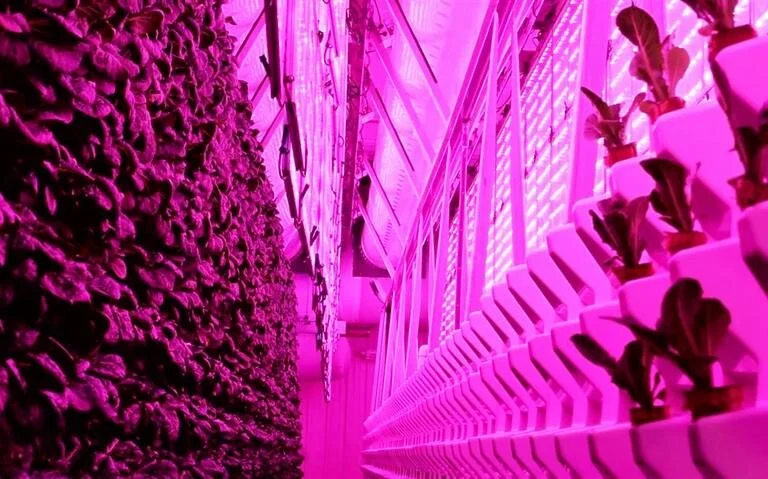
Greens nearing the point of harvest are stacked across from plants on day-one of the growth stage at the 20,000-square-foot growing site in Faribault, Minn. where Living Greens Farm grows its produce. (Noah Fish / Agweek)
True aeroponics
According to Pastrana, what makes Living Greens Farm a "true aeroponic vertical farming business model" is its ability to produce exceptional products.
"We are able to deliver much heavier heads of lettuce than our competitors and more consistent yields in an environment that is herbicide and pesticide-free," he said.
Unlike most of its competitors, the company does its own cutting, washing, and bagging of produce on-site, Pastrana said."So we're going to get our product on the shelves of retailers within 24 hours of harvest," he said. "That makes us pretty unique."Michelle Keller, head grower of the operation in Faribault, has worked at Living Greens Farm for seven years."
Since basically the conception of the project," she said.
She said those years were spent building, reconfiguring, and rebuilding grow systems — all aimed at finding the best way to grow romaine and butter lettuce in a vertical space.
One of the multiple grow rooms at the 20,000-square-foot growing site in Faribault, Minn. where Living Greens Farm grows its produce. (Noah Fish / Agweek)
"We always wanted to go vertical," said Keller of Living Greens.
Traditional vertical farming is "stacked," she said, but the company wanted to incorporate a system that people could work from the floor, without the use of ladders or platform machines.
"So each person can stay on the ground and work the farm completely from the safety of the floor," she said.
It takes a family Keller takes pride in the camaraderie at the farm, with workers leaning into their roles as plant nurturers. She's also not afraid to admit that she and other employees talk to the plants and sometimes give them names.
"We are a small family," said Keller of the different grow groups at the farm. "It's not uncommon to know everyone's name, and to know what they're going through and what they're able to accomplish at the farm."
Patti Guillen, an employee at Living Greens Farm, transplants heads of lettuce in the 20,000-square-foot growing site in Faribault, Minn. where, the company grows its produce. (Noah Fish / Agweek)
Before Living Greens came up with the A-frame technology that it uses now, the company tried four different renditions of a "staircase approach", said Keller.
As head grower, her primary goal is to raise "full-grown heads of lettuce that are robust enough to survive the packaging process," and go on to have a full two-week shelf life.
Living Greens is also committed to being pesticide-free, said Keller, and the farm mandates a high standard of cleanliness to prevent harmful things from getting into its facilities and a protocol for if something does."Every stage of the growth pattern is followed by disinfecting or sanitation," she said.
Keller said the operation at Living Greens is guided by GAP — good agricultural practices — as well as GMP — good manufacturing processes. What makes the operation unique is that it has been conducting both of these processes successfully under the same roof long before the COVID-19 pandemic, Keller said.
When the pandemic broke out in March, Keller called an all-employee meeting where she was straightforward about what was in their control. They now meet every week to discuss what's happened lately with the outbreak.
"We were always just really honest about it," said Keller of the pandemic.
She told them in that original meeting that Living Greens Farm would stay open if employees not only took the on-site precautions seriously but were also "hyper-aware" when they were at home."Making sure that there's no miscommunication about this is what has to be done, to keep ourselves open," Keller said.
Living Greens Farm products can now be found at Whole Foods, HyVee, Walmart, Cub Foods, and more.
Find locations at https://www.livinggreensfarm.com/store-locator.
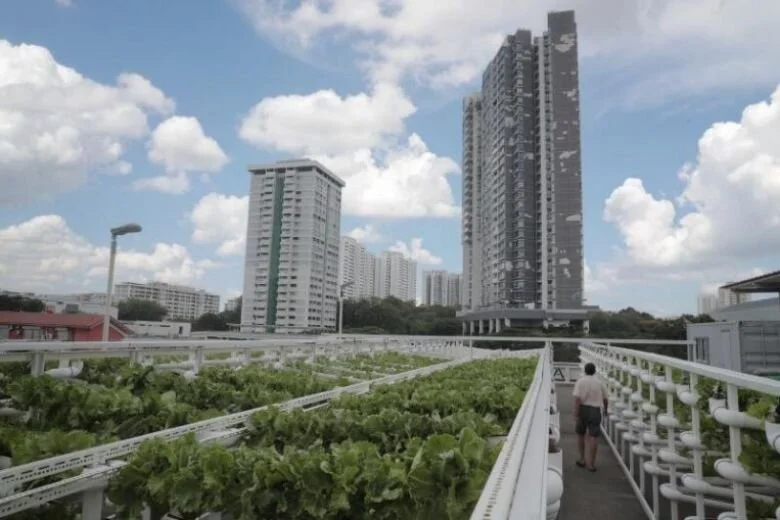
Tenders Awarded To Turn 9 HDB Carpark Rooftops Into Urban Farming Sites
With these farming systems, the sites have the potential to collectively produce around 1,600 tonnes of vegetables annually"
September 30, 2020
SINGAPORE - Parked cars will soon make way for growing vegetables as tenders were awarded for urban farming at nine carpark rooftops by the Singapore Food Agency (SFA) on Wednesday (Sept 30).
The sites, which are rooftops of Housing Board multi-storey carparks, comprise five single sites and two clusters of two sites each. They were awarded to six tenderers.
Each site has a term of up to three years.
The highest tender of $90,000 for annual rent was awarded to IT Meng Landscape and Construction for a cluster site in Jurong West, with one site spanning a total area of 3,311 sq m - three-fifths of a football field - and the other at 2,974 sq m.
Other carpark locations include Choa Chu Kang, Tampines, Hougang, Ang Mo Kio, Toa Payoh, and Sembawang.
SFA chief executive Lim Kok Thai said: "The successful tenderers' proposals included hydroponic and vertical farming systems with a variety of innovative features such as IoT (Internet of Things), blockchain technology and automated climate control."
With these farming systems, the sites have the potential to collectively produce around 1,600 tonnes of vegetables annually."
He added: "We look forward to seeing these HDB multi-storey carpark rooftops transform into productive vegetable farms that will contribute to Singapore's '30 by 30' goal, and we will render assistance and guidance to farms where needed."
The 30 by 30 goal refers to Singapore's aim to produce 30 percent of the country's nutritional needs locally by 2030.
Ms. Phoebe Xie, 30, director and co-founder of local urban technology company AbyFarm, was one of the six who successfully tendered for the carpark rooftop spaces. With the 3,171 sq m site at Ang Mo Kio, the company hopes to begin construction of the farm in the next few months, and to have its launch date within the first half of next year. Using a combination of hydroponics and aeroponics vertical farming methods, the farming process is expected to use 90 percent less water, and it is said to be 10 times more productive compared to traditional methods. “The farm will be entirely automated, with real-time technology used to control the environment within the green house, and to consistently monitor the crops and early identify the possibility of bad crops, which will ensure the quality of our crops,” she said. With an expected yield of 200 tonnes of fruits and vegetables each year, the company is looking to harvest local favourites, such as kang kong and kailan as well as other types of produce such as mushrooms, figs, and Japanese melon. Co-founder of SG Veg Farms Eyleen Goh, 46, who secured a cluster site at Sembawang, said the company is expecting around 80 to 100 tonnes of vegetables per site each year. The company will be selling most of its produce to nearby supermarkets, though it hopes to host weekend markets for residents to buy its vegetables.
Minister for Sustainability and the Environment Grace Fu said in a Facebook post on Wednesday that “the challenges of Covid-19 and climate change, together with other trade and environmental pressures, pose a threat to Singapore’s supply of critical resources such as food”.
As land is scarce in Singapore, the SFA has been “unlocking alternative spaces to grow food, such as vacant buildings, like the former Henderson Secondary School and carpark rooftops”.“
Over the next few years, we will be master-planning the larger Lim Chu Kang area and will be engaging the stakeholders and the public in the process,” she said, adding that there are longer-term plans in place to “expand agriculture in the Lim Chu Kang area and aquaculture off (Singapore’s) southern coast”.
Mr. Melvin Chow, senior director of SFA's food supply resilience division, said in May that the launch of the tender for the nine sites came as a result of growing interest from both the industry and the public towards urban farming in community spaces.
Last year, a pilot urban farm - spanning 1,900 sq m - was launched at a multi-storey HDB carpark in Ang Mo Kio. Known as the Citiponics Farm, it aims to grow up to four tonnes of vegetables a month.
The tender for the nine sites, which was launched on May 12, had closed on June 16, and the sites were awarded using the price-quality tender method, where both the bid price and the quality attributes, such as production output, design, and site layout, as well as business and marketing plans, were factored into the tender evaluation.
The SFA said it will be working with HDB to tender out more multi-storey carpark rooftop sites for urban farming in the fourth quarter of the year, as the move is also in line with HDB's Green Towns Programme to cool HDB towns through the use of greenery, such as on carpark rooftops.
More details of these plans for tender will be released at a later date.
Lead Photo: Local agri-tech firm Citiponics' vertical farming plot at the multi-storey carpark rooftop at Block 700 Ang Mo Kio Avenue 6.ST PHOTO: JASON QUAH

UK: £5m Funding Award For John Innes Centre To Modernize Horticultural Facilities
A little over £3m of the investment will provide new Controlled Environment Rooms (CERs) for plant and microbial experiments. CER’s offer scientists precise control of environmental factors such as light, temperature, and humidity
A multi-million-pound project to modernize the horticultural facilities at John Innes Centre has been approved.
The £5.1m upgrade is funded by UKRI-BBSRC. Work will begin in Autumn 2020, and the project set to be completed by March 2021.
The company's Horticultural Services support the world-renowned science of the John Innes Centre and The Sainsbury Laboratory and occupies a large site on the Norwich Research Park.
A little over £3m of the investment will provide new Controlled Environment Rooms (CERs) for plant and microbial experiments. CER’s offer scientists precise control of environmental factors such as light, temperature, and humidity. The upgrade will also improve the containment measures required for experiments that investigate plant pathogens, or for growing genetically modified plants.
The new infrastructure offers energy efficiency and sustainability gains due to LED lighting, wastewater treatment, and rainwater harvesting. The reduction in utility costs from installing these technologies is estimated to be £116,000 per year.
Further savings will be achieved by more efficient use of glasshouse space (£200,000 per year) and reduced reliance on off-site horticultural facilities (£240,000) per year.
The current glasshouses (which cover an area of 5,775m2) is mostly single-span structures designed and built several decades ago. This investment is the start of a long-term move away from using glasshouses and towards controlled environments which better enable consistency of inputs and experimental results.
Head of Horticultural Services at the John Innes Centre, John Lord said: “World-class science needs world–class, market-leading technology. This investment is timely because there is a desperate need for our scientists to work on solutions to the challenges that face us. From understanding pathogens that cause plant diseases, to creating climate-resilient, nutritious crops that feed the world.
“This investment will bring a much-needed upgrade, providing facilities that are relevant and appropriate for the world-leading plant and microbial science that takes place on the Norwich Research Park. It also future proofs the site to fit with longer-term ambitions to redevelop the infrastructure here.”
Features of the new modernization include 30m2 of large walk-in growth space which offers LED lighting, nutrient enrichment, climate control, and state-of-the-art irrigation systems. The spaces will be configurable, it can be divided into multiple layers or used as a large open space, offering the next step towards bigger trials for crops.
The new facility will also benefit from a sustainable water supply, as it will harvest rainwater. The rainwater will be monitored and treated onsite to ensure it is free from phytopathogens, and that it has the correct pH. This soft, nutrient-rich harvested rainwater means that scientists will be able to minimize the use of fertilizers, and the consistent, monitored water supply will ensure that scientific experiments are reliable and repeatable.
“This is the start of a wider, long term project to update horticultural services at the John Innes Centre to ensure that it continues to meet the needs of science of today while being flexible enough to meet the needs of tomorrow as problems and new technologies arise,” said John.
For more information:
John Innes Centre
www.jic.ac.uk
Publication date: Thu 8 Oct 2020

Register For ERASMUS + ECVET PONICS VET LAUNCH - Friday, October 16th
Erasmus plus helps the CEA industry grow with free online vocational training courses in hydroponics for the technician level profile
ERASMUS DAYS PUBLIC LAUNCH
October 16th, 2020
Register for ERASMUS+ ECVET PONICS VET
LAUNCH:
Erasmus plus helps the CEA industry grow with free online vocational training courses in hydroponics for the technician level profile
PONICS VET:
Hydroponics Technician is an Erasmus + project. It aims to service agriculture communities and future growers from outside the industry. It provides essential basic training and an introduction into practices and the use of technology in the soilless growing of plants. Hydroponic systems have a proven track record in resource efficiency and resilience in the age of climate change. It also provides an attractive solution for existing farm operations that are not economical anymore and create new income streams for growers and would-be farmers.
The PONICS VET training services an innovative professional profile, the hydroponics technician, and delivers credentials for such a profile in a commercial context. The course will introduce system definitions, various technical insights, and important proficiencies in practical growing, including pest control, food safety, and certification information. Also included are case studies and ample supporting material. The micro-credential rules are drawn from the ECVET (the European credit system for VET) methodology, which will allow recognition of applied learning outcomes in the EU and beyond.
As the development of workforce pathways in times of CoVid19 and for the agriculture, communities has become a critical demand, FTS and its industry-based membership was selected as a critical partner in the development and deployment of PONICS VET project. Stay tuned for further modules and languages.“Workforce development in Agriculture has been underserviced in new and innovative agriculture practices and needs to be the main focus by the industry as well as the policymaker, PONICS VET is a great start for the Controlled Environment Agriculture sector as there currently no accredited vocational training courses online outside of the NL/BE greenhouse cluster. “ ~ FarmTech Society
HOW TO JOIN THIS EVENT:
Registration Page
INTERESTED IN JOINING THE COURSE:
Link to FREE ONLINE COURSE (Guest)
About FTSFarmTech Society (FTS) ASBL is an international non-profit association that unites and supports the Controlled Environment Agriculture (CEA) industry, seeking to strengthen the sector through the development and implementation of resilient and future-proof methods and technologies for indoor growing. A prime focus area of the FTS is education, by developing training and education courses and creating credentials for graduates facilitating certification that meets industry needs. Secondly, the FTS engages with lawmakers in order to help promote policies and regulations that foster innovation and propel businesses in CEA. Thirdly, the FTS supports the establishment of standards to help the industry grow and innovate. Lastly, the FTS also provides an international network for the CEA industry.
Project Partners:
1 Latvia University of Lifesciences and Technology (Lativia)
2 Eurocrea Merchant Srl (Italy)
3 IDEC (Greece)
4 BIC Innobridge (Bulgaria)
5 FarmTech Society ASBL (Belgium)
6 zemniekusaeima (Lativa)

October 16th to 18th - Awesome Features of The First ONLINE Aquaponic Conference
We want this conference to maximize your connection and engagement with other attendees. We're featuring both live and recorded speakers and by reserving a ticket you can access all these recordings until the end of the year!
Interactive Sessions, Networking &
industry Experts Sharing Exciting Developments
In The World of Aquaponics
You're not going to want to miss this.
We want this conference to maximize your connection and engagement with other attendees. We're featuring both live and recorded speakers and by reserving a ticket you can access all these recordings until the end of the year!
You'll find sessions ranging from aquaponics in prisons, experts in decoupled aquaponics, STEM educators, and international discussion panels!
Get a greater understanding of this rapidly evolving industry and connect with the experts today.
Reserve Your Ticket ›
The Aquaponics Association
© 2020 Aquaponics Association

VIDEO: Urban Fresh Farms Launches New ZipGrow Facility In Dubai
A 1,000 square foot ZipGrowTM ZipFarmTM was recently installed in Urban Fresh Farm’s facility in the Industrial center of Dubai and will soon be producing pesticide-free fresh herbs and leafy greens for the local market
October 8, 2020
ONTARIO, CANADA & DUBAI, UNITED ARAB EMIRATES - With more than 80% of food being imported into the UAE, Urban Fresh Farms, Dubai’s newest indoor vertical hydroponic farm from ZipGrowTM, is doing its part to contribute to a more sustainable local food system.
A 1,000 square foot ZipGrowTM ZipFarmTM was recently installed in Urban Fresh Farm’s facility in the Industrial center of Dubai and will soon be producing pesticide-free fresh herbs and leafy greens for the local market. Urban Fresh Farms is a new company, founded by people who always had an interest in sustainable agriculture but thought they did not have the knowledge or financial backing to get into the industry.
“We, as a group, always found vertical farming really interesting and knew there would be a strong demand for it in the Dubai area”, said Scott Naude, co-founder of Urban Fresh Farms. “We were hesitant to jump in at first, but the combination of ZipGrow’s technology and ongoing training, the increasing demand for higher quality and fresh produce, and the Middle East’s booming tech sector all aligned perfectly for us to begin this venture.”
As with the rest of the world, COVID-19’s impact on the local supply chain has also impacted the Dubai area, with food selections being limited in local grocery stores during the peak of lockdowns.
“Around the world, we are hearing from all our growers that food retailers are actively looking for local food goods to supply”, explains Eric Lang, President of ZipGrow Inc. “We are also hearing from government’s around the world, including in the UAE, who want to actively seek out ways to reduce supply chain lengths to ensure a more consistent and high-quality food stream.”
Hydroponic growing, as an industry, is still recently new to the Middle East region. The UAE government is a leader in the Middle East region, and in 2018 launched a National Food Security Strategy 2051, led by the Minister of State for Food and Water Security, Her Excellency Mariam bint Mohammed Al Mheiri. This strategy aims to increase local food production in the UAE, while simultaneously maximizing the use of modern technologies to bring fresh and sustainable food to the region.
“There's also a demand for healthy eating options and this has given rise to a number of excellent meal plan services and all-in-one meal ingredient boxes which in turn is creating a need for the best, freshest vegetables to be readily available” adds Naude. “We’re planning on starting out growing primarily herbs such as basil, parsley, and coriander, and hope to have our first crop available in December.”
Urban Fresh Farm and ZipGrow Inc. plan to use this new facility to showcase this vertical farming technology to the UAE and the wider Middle East region. Naude adds; “We’re excited about our ongoing partnership with ZipGrow Inc. There is so much educational content available, as well as a fantastic team. So even for someone like myself who is new to all of this, ZipGrow provides all the tools needed to get growing.”
ZipGrow Inc. is an international leader in indoor, vertical farming technology. Our flagship product, the ZipGrowTM Tower, is a core component of many of the world’s most innovative farms; from indoor hydroponic warehouses to vertical aquaponic greenhouses and high-density container farms.
For more information contact:
Gina Scandrett at hello@zipgrow.com or at 1-855-ZIPGROW.
425F Fourth Street West, Cornwall, Ontario K6J 2S7, Canada www.zipgrow.com 1-855-ZIPGROW

Why Kroger And Publix Are Bringing The Farm To The Grocery Store
In March, Publix’s GreenWise market in Lakewood, Florida, added a 40-foot container hydroponic farm in the parking lot
October 8, 2020
By Jesse Klein
Just like every other retailer, grocery stores are focusing on the customer experience to get people back in store. Grocery delivery was already a rising trend, and the pandemic kicked it into the next gear. In May, U.S. online grocery sales had grown to 40 percent. So grocers including Kroger and Publix are looking at onsite vertical farms as one way to attract consumers.
"That experience of going into a grocer and picking something essentially off the vine is compelling from a customer experience standpoint," said Shireen Santosham, head of strategic initiatives at Plenty, a vertical farm company based in San Francisco.
According to Grant Vandenbusschet, chief category officer at Fifth Season, a robotic vertical farm company based in Pittsburgh, fresh produce is keeping a lot of traditional grocery stores alive. It’s the main category still driving traffic into stores, he said, so innovating and investing in this department has been a focus for most retailers.
On-site container farming is not a new idea for grocery stores, but as urban vertical farming has advanced to become a more mainstream part of the supply chain, the idea is becoming more feasible. Some big players have finished their strategic analysis and pilot programs, and are leaning into vertical farming in a bigger way.
That experience of going into a grocer and picking something essentially off the vine is compelling from a customer experience standpoint.
In two Seattle stores, for example, Kroger installed modular vertical farms from German startup Infarm. While the seedlings spend the first few days at Infarm’s centralized nursery, most of the growing happens on-site at the grocery stores.
In March, Publix’s GreenWise market in Lakewood, Florida, added a 40-foot container hydroponic farm in the parking lot. Customers can see the equivalent of three acres of traditional farmland through the container’s windows. It grows about 720 heads of lettuce each week, all sold in the store. But it’s still early days and the process has kinks to work out. At first, Publix wasn’t getting the yields it was expecting.
"It takes time to grow the product and offer consistent quality, flavor, and size," said Curt Epperson, business development director at Publix. "I believe over time, once hydroponic growers refine their processes, and scale-up, we’ll find more efficiencies."
According to Vandenbusschet, one of those efficiencies may be a focus on supporting vertical farms at a large-scale grocer’s distribution center instead of at every single retail location. To get significant business and sustainability impacts from vertical farming, companies will need to get large enough to take true advantage of economies of scale.
"We think a lot of retailers are looking at this format if they are going to have high enough volumes of product to start replacing [traditional] grown products inside of all of their stores," Vandenbusschet said.
Growing is a hard, finicky business. Retailers are experts at retailing, and it’s hard to be good at both retailing and growing, so expect to see key partnerships materialize. Along with the Infarm and Kroger partnership, Publix’s onsite farm is run and managed by Brick Street Farms.
"Finding systems that are not over-encumbering to their operations, things that they can plug-and-play well is really going to be critical," Vandenbusschet said.
If retailers pursue this model, the customer experience might be more akin to going to a farmers’ market than going straight to the farm. But this model has a better chance of scaling well for businesses while also creating sustainability benefits such as cutting freight emissions, lowering water usage, and prolonging shelf life.
Lead photo: Publix is hoping to lure shoppers back to grocery stores with new onsite vertical farms.//Courtesy of Publix

World’s First Fully 3D-Printed Vertical Farm Debuts
The Banyan Eco Wall is a vertical farm with a seamless sculptural design. Unlike other 3D-printed structures, its functionality — the irrigation and drainage system — is embedded inside. The eco wall was printed with a BigRep One V3, which is considered one of the most advanced large-scale industrial 3D printers in the world
29-09-2020 | Yahoo/In The Know
The world’s first fully 3D-printed irrigated green wall made its debut in June 2019.
The Banyan Eco Wall is a vertical farm with a seamless sculptural design. Unlike other 3D-printed structures, its functionality — the irrigation and drainage system — is embedded inside. The eco wall was printed with a BigRep One V3, which is considered one of the most advanced large-scale industrial 3D printers in the world.
Mirek Claßen, Tobias Storz, and Lindsay Lawson of NowLab, BigRep’s research and innovation program, designed the project.
“Similar vertical farm structures have required channels to be manually embedded into the design in a complicated process after manufacturing with metal piping and a variety of other parts,” BigRep said in a statement. “The Banyan, on the other hand, is 3D-printed with internal channels included in the design.”
That means consumers won’t have to figure out how to create and install a plumbing system on their own once the vertical farm is installed. Thus, it’s cheaper and more user-friendly than its predecessors — which is also demonstrated by its irrigation system’s ability to self-regulate. The Banyan disperses water in the form of “micro-showers” at controlled intervals to meet each plant’s needs.
Not only is it functional, but it’s also aesthetically beautiful. The white wall consists of interlocking, organic shapes that resemble the curves of tree branches.
The Banyan is 6.5 x 6.5 x 2 feet and printed in four modular parts that snap together. It is printed with PETG, a form of plastic used in 3D printing that can be 100 percent recyclable.
“Systems such as this inspire interior designers and architects developing a greener future — from home or workspace plant walls and green facades to vertical gardens and other forms of urban farming,” the statement said.
Source: Yahoo/In The Know
Photo Courtesy of Bigrep
Green Shoots: Rooftop Farming Takes Off In Singapore
Urban farms are springing up in crowded cities around the world, but the drive to create rooftop plots has taken on particular urgency in densely populated Singapore, which imports 90 percent of its food
30 September 2020
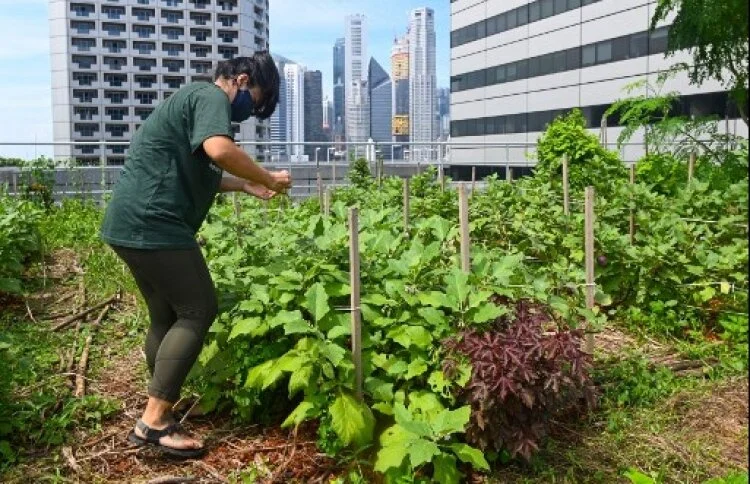
This photograph taken on September 7, 2020 shows a staff member tending to a rooftop garden used for urban farming to grow edible plants above the Raffles City mall in Singapore. - On the rooftop of a Singapore shopping mall, a sprawling patch of eggplants, rosemary, bananas and papayas stand in colourful contrast to the grey skyscrapers of the city-state's business district. (Photo by Roslan RAHMAN / AFP) /
On the rooftop of a Singapore shopping mall, a sprawling patch of eggplants, rosemary, bananas and papayas stand in colourful contrast to the grey skyscrapers of the city-state's business district.
The 10,000 square-foot (930 square-metre) site is among a growing number of rooftop farms in the space-starved country, part of a drive to produce more food locally and reduce a heavy reliance on imports.
The government has championed the push amid concerns about climate change reducing crop yields worldwide and trade tensions affecting imports, but it has been given extra impetus by the coronavirus pandemic.
This photograph taken on September 7, 2020 shows a casper eggplant growing in a rooftop garden above the Raffles City mall in Singapore. - On the rooftop of a Singapore shopping mall, a sprawling patch of eggplants, rosemary, bananas, and papayas stand in colourful contrast to the grey skyscrapers of the city-state's business district. (Photo by Roslan RAHMAN / AFP) /
"The common misconception is that there's no space for farming in Singapore because we are land-scarce," said Samuell Ang, chief executive of Edible Garden City, which runs the site on the mall.
"We want to change the narrative."
Urban farms are springing up in crowded cities around the world, but the drive to create rooftop plots has taken on particular urgency in densely populated Singapore, which imports 90 percent of its food.
Farming was once common in the country but dwindled dramatically as Singapore developed into a financial hub packed with high-rises. Now less than one percent of its land is devoted to agriculture.
In the past few years, however, the city of 5.7 million has seen food plots sprouting on more and more rooftops.
Authorities last year said they were aiming to source 30 percent of the population's "nutritional needs" locally by 2030, and want to increase production of fish and eggs as well as vegetables.
With coronavirus increasing fears about supply-chain disruption, the government has accelerated its efforts, announcing the rooftops of nine car parks would become urban farms and releasing Sg$30 million ($22 million) to boost local food production.
'Buffer the shock'
Edible Garden City, one of several firms operating urban farms in Singapore, runs about 80 rooftop sites.
But they have also created many food gardens in more unusual places, including a former prison, in shipping containers, and on high-rise apartment balconies.
Their farms use only natural pesticides such as neem oil to repel pests.
"What we really want to do is to spread the message of growing our own food. We want to advocate that you really do not need large parcels of land," said the firm's chief executive Ang.
The company grows more than 50 varieties of food, ranging from eggplants, red okra, and wild passion fruit to leafy vegetables, edible flowers, and so-called "microgreens" -- vegetables harvested when they are still young.
It is also using high-tech methods.
At one site inside a shipping container, they are testing a specialised system of hydroponics -- growing plants without soil -- developed by a Japanese company.
This photograph taken on September 7, 2020, shows a staff member tending to a rooftop garden used for urban farming to grow edible plants above the Raffles City mall in Singapore. - On the rooftop of a Singapore shopping mall, a sprawling patch of eggplants, rosemary, bananas, and papayas stand in colourful contrast to the grey skyscrapers of the city-state's business district.
(Photo by Roslan RAHMAN / AFP) /
The system features sensors that monitor conditions, and strict hygiene rules mean crops can be grown without pesticides.
Edible Garden City's produce is harvested, packed, and delivered on the same day -- mainly to restaurants -- but online customers can also subscribe to a regular delivery box of fruit and vegetables.
Sales to restaurants slowed when Singapore shut down businesses to contain the coronavirus from April to June, but Ang said household clients grew three-fold in the same period.
William Chen, director of the food, science, and technology programme at Singapore's Nanyang Technological University, said developing city farms was a "way to buffer the shock of supply chain breakdowns".
"Skyscraper farming in Singapore is certainly a bright option," he added.
Still, there are limits to what a country half the size of Los Angeles can achieve, and Chen stressed the city would still have to rely on imports of other staples, such as meat.
"We don't have animal farms, and for rice we don't have the luxury of land," he said. "Growing rice and wheat in indoor conditions will be very costly, if not impossible."
In addition, a lack of skilled farmers in modern-day Singapore presents a challenge.
"While we are able to recruit people with an interest in farming, they do not have the relevant experience," Ang said.
Singapore, Singapore | AFP

COLORADO: Kalera To Open Newest Vertical Farming Facility In Denver, Continuing Its Rapid Expansion Across The US
Kalera, one of the fastest-growing vertical farming companies in the United States, today announced it will open its newest facility in Colorado in 2021
The Denver-Area location Is The Fifth
Facility Announced by Kalera, One of
The Fastest Growing Indoor Farming Companies In The Nation
October 05, 2021
Kalera, one of the fastest-growing vertical farming companies in the United States, today announced it will open its newest facility in Colorado in 2021. The Denver-area facility further establishes Kalera as a leading producer of vertically-grown greens across North America.
Source: Kaleraphoto-release
ORLANDO, Fla., Oct. 05, 2020 (GLOBE NEWSWIRE) -- Kalera (NOTC: KALERA, Bloomberg: KSLLF), one of the fastest-growing vertical farming companies in the United States, today announced it will open its newest facility in Colorado in 2021. The Denver-area facility further establishes Kalera as a leading producer of vertically-grown greens across North America.
The announcement is the latest step in Kalera’s rapid domestic and international expansion plan to grow fresh, clean, and nutritious leafy greens in close proximity to urban centers. Kalera currently operates two growing facilities in Orlando and is constructing facilities in Atlanta and Houston which will open in early 2021. The new Colorado facility will generate approximately 60 jobs for the local community.
“As the gateway to the Rockies and one of the great food cities in the world, Denver is the ideal location for Kalera’s latest vertical farm. Chefs and retail customers in Colorado are very health-focused and have a strong appreciation for local, fresh, better-than-organic produce,” said Daniel Malechuk, Kalera CEO. “Kalera is quickly becoming a world-leading company in indoor vertical farming with an ability to deliver fresh, locally grown greens, nationally. Thanks in large part to our streamlined design process, we are able to achieve a high rate of growth.”
By the end of 2021, Kalera will have five commercial growing facilities open and operating across the US. The company’s major milestones include:
Its first commercial vertical farm, the HyCube growing center, currently operates on the premises of the Orlando World Center Marriott, bringing fresh, local produce to the hotel’s visitors and customers.
In March 2020, Kalera opened its second facility in Orlando, providing produce to the area’s top retailers, leading foodservice distributors, resorts, hospitality groups, and theme parks.
The Atlanta facility is the third farm in Kalera’s portfolio and when it opens early next year, will be the largest vertical farm in the Southeast.
Its fourth facility is slated to open in Houston spring 2021 and will be the largest of its kind in Texas.
As Kalera accelerates its growth over the next few years, it will continue to open additional facilities, expanding production capacity throughout the US and internationally.
"Kalera's model has proven that we are able to provide produce at industry-leading yields and unit economics that allow end-user customers to purchase our premium quality greens at stable, conventional pricing,” continued Malechuk. “We believe that everyone should be able to afford to eat safe, clean, fresh, and healthy local produce. And with yields at 300-400 times that of traditional field farms, we are on the way to achieving our goal."
Kalera utilizes cleanroom technology and processes to eliminate the use of chemicals and remove exposure to pathogens. Kalera's plants grow while consuming 95% less water compared to field farming.
About Kalera
Kalera is a technology-driven vertical farming company with unique growing methods combining optimized nutrients and light recipes, precise environmental controls, and cleanroom standards to produce safe, highly nutritious, pesticide-free, non-GMO vegetables with consistent high quality and longer shelf life year-round. The company’s high-yield, automated, data-driven hydroponic production facilities have been designed for rapid rollout with industry-leading payback times to grow vegetables faster, cleaner, at a lower cost, and with less environmental impact.
Media Contact: Molly Antos
Phone: (847) 848-2090