

Welcome to iGrow News, Your Source for the World of Indoor Vertical Farming

VIDEO: Home Hydroponics: Tech Trend Or The New Victory Garden?
Home gardening is experiencing a renaissance spurred by the Covid-19 pandemic. Facing anxiety surrounding food security and the need for hobbies during quarantine, close to 20% of Americans have reported taking up gardening as a result of the pandemic. Seed sales have soared to unprecedented level
Jun 30, 2020
Rob Girling Contributor
Co-Founder of Artefact, a purpose-driven strategy, and design company dedicated to responsible design. I am a designer passionate about mitigating the negative impact of technology and maximizing the positive.
Home gardening is experiencing a renaissance spurred by the Covid-19 pandemic. Facing anxiety surrounding food security and the need for hobbies during quarantine, close to 20% of Americans have reported taking up gardening as a result of the pandemic. Seed sales have soared to unprecedented levels.
An indoor vertical hydroponic system by Gardyn. COURTESY OF GARDYN.
As Covid-19 highlights, the precarious supply chain that supports our modern lifestyles and the benefit of more self-sufficiency, hydroponics – a method of growing plants without traditional soil, using water-based, nutrient-dense solutions – is emerging as the latest trend in smart home devices. Advances in hydroponic food-growing technology and LED lighting have reached a point where smart devices can take some of the labor, land, and expertise of traditional gardening out of the equation. Make no mistake that “real” gardening requires deep knowledge and effort to yield nutritional and emotional benefits; however, technology can now help laypeople experiment with growing fresh, nutritious food in their homes.
While home hydroponic systems are more effective, easy to use, and aesthetically pleasing than ever, there is a long way to go before the promise of sustainable, accessible food for all comes to fruition. Who wins and who loses in the smart food ecosystem and just how sustainable are these services? Let’s look at the design of three leading home hydroponics systems and the broader impact of such “smart growing”.
Home Hydroponics Leading the Pack
Gardyn, Rotofarm and Click & Grow are three of the leading “smart growing” entrants that promise attractive, no-hassle, indoor hydroponic systems.
The Gardyn system consists of three vertical artificial “stems” where up to 30 plants can grow at once. These stems are rooted in a sturdy, oval-shaped base reservoir where water, pumps and electronics are discretely hidden under a wooden lid. Two vertical aluminum bars hide the latest-generation LED lights that focus their attention on the plants and dissipate heat effectively. Gardyn comes with an AI assistant app that monitors and manages temperature, humidity, and light.
The most sculptural of the leading home hydroponic systems, the Bace Rotofarm is a jaw-droppingly gorgeous object with a supporting app component. Using a rotating circular drum, it slowly turns up to eight plants around an LED hub, compressing 5.5 feet of growing space into just 15 inches and eliminating gravitational penalty to help plants grow faster. Despite winning several design awards for its science-fiction-turned-reality aspiration, the Rotofarm will not launch until 2021 and its price remains a mystery.
A more economical home hydroponics system comes in the form of the Click & Grow Smart Garden. With three- and nine-plant growing options, the Click & Grow design concept looks vaguely like a carrying basket with an end-to-end handle that cleverly hides LED lights. Click & Grow is unique in its scaled design, allowing customers to stack Smart Gardens together to create a compact food growing system. Like the others, the system has a companion app to track growing schedules and help troubleshoot.
Improving Access to Produce, at a Cost
There is great opportunity for home hydroponics to improve education and access to healthy produce for those who live in food deserts or do not have access to nutritious food. Yet, so far, smart growing systems target tech-savvy, mostly affluent people living in high-density urban communities.
No matter the brand, existing home hydroponics systems command a hefty price tag. The Click & Grow system ranges from $99 for three plants to $599 for a 27-plant system, while the Gardyn kit starts at $799 with a monthly fee of $69 for 240 seed plants. Each plant might produce up to five yields before it needs replacing – that’s a lot of money for leafy greens, fresh herbs, and a handful of fruit.
These products make big claims about sustainability, healthy living, and a reliable food ecosystem, but don’t provide sufficient practical value for communities who could benefit the most from home hydroponics. One hopes that the pricing of these new systems reflects the enormous startup costs of building their business. Perhaps subsequent generations and scale can reduce the unit costs, like what has occurred in the electric vehicles market.
Lowering Environmental Impact
Dirt, when combined with growing chemicals, is responsible for significant water pollution in traditional farming. Rather than using soil, most home hydroponics systems call for compostable refill cubes similar to espresso pods. Each cube includes seeds planted in the company’s patented “growing medium” – in other words, artificial soil consisting of natural materials designed to hold water and nutrients more efficiently than regular dirt. Unlike espresso pods, these cubes are made from compostable corn-based plastic that can be thrown in the yard waste.
Gardyn's compostable "yCubes" are made up of rockwool and corn. COURTESY OF GARDYN.
The essential trade-off with indoor hydroponics is foregoing the free light-bulb in the sky: the sun. Depending on the amount of natural light available in a home, an LED hydroponic system uses significant electricity that adds to energy consumption and utility bills.
Nevertheless, growing food through hydroponics reduces reliance on industrial agro-farming with its heavy reliance on chemicals, fresh water, and the transportation infrastructure needed to get from production to table.
A Victory Garden Redux
Smart growing and home hydroponics is an exciting new trend in consumer hardware. While early entrants to the market feel more proof-of-concept than robust products or services, I predict that this category of products will improve quickly and become commonplace in homes of all types, expanding into other types of gardening and food production beyond leafy greens alone.
Although smart gardens may not yet be as impactful as the victory gardens that produced nearly 40% of vegetables in the US during World War II, there is significant opportunity for home hydroponics reduce dependence on an easily disrupted global food infrastructure while also easing individual environmental impact and increasing access to fresh, healthy produce.
I am a designer passionate about mitigating the negative impact of technology and maximizing the positive. I co-founded Artefact, a purpose-driven strategy and design company dedicated to responsible design. I have worked across the tech industry in various leadership roles at IDEO, Apple, Sony, and Microsoft. I also co-founded the SAAS resource management software 10000ft, acquired by Smartsheet in 2019

I am a designer passionate about mitigating the negative impact of technology and maximizing the positive. I co-founded Artefact, a purpose-driven strategy and design company dedicated to responsible design. I have worked across the tech industry in various leadership roles at IDEO, Apple, Sony, and Microsoft. I also co-founded the SAAS resource management software 10000ft, acquired by Smartsheet in 2019
Rob Girling

4 Facts You Need to Know About Vertical Farming LED Lighting
One of the main components that make vertical farming possible is the evolution of light-emitting diodes (LEDs)
One of the main components that make vertical farming possible is the evolution of light emitting diodes (LEDs). As LEDs become more and more accessible and affordable, the futuristic idea of vertical farming becomes more realistic for cities all over the globe. In this article, we’re going to share four important facts regarding vertical farming led lighting and how these systems are important to the future of farming.
LEDs are the best lighting system for vertical farming
With their ability to be highly energy efficient, LEDs produce light at optimal power while being able to last a long time. These effective light solutions are able to last for nearly six years, which is quite longer than other lighting solutions. What makes LEDs perfect for vertical farming is that they’re able to be confined in tight spaces with vertical layered crops, and they don’t emit too much heat. Other lighting solutions such as HPS or MH lights will damage vertical farming systems because they release too much heat, which is harmful to the crops.
LEDs are a cost-effective, energy saving solution
HPS lighting systems consume too much power in order to emit the same light levels as LEDs, which is why LED lighting systems are paving the way toward an affordable indoor growing environment. One of the significant benefits of using LED lights is that these advanced lighting systems do not consume as much power, which leads to reduced energy costs and higher productivity.
They use a visible spectrum to match the plant’s grow cycle
The innovative uses behind vertical farming LED lighting is that these systems use wavelengths on a visible spectrum to promote plant growth. When you see those pink colored lighting systems, this means that the LED lighting system is using a minuscule wavelength between the red and blue spectra to produce the pink glow. Plants depend on blue lightwaves to enhance the leaf’s color and prevent stretching, and the red light waves optimize photosynthesis. LED lights are able to emit the wavelengths needed to grow healthy, bountiful plants by mimicking their required natural environment.
LEDs are sustainable solutions to growing foods
Farmers are learning to work with LED lights because of their sustainable, efficient solutions. These vertical farming LED lighting systems are able to provide controlled lighting all-year-round, which allows for optimal plant growth. Also, by having a controlled indoor LED lighting environment, crops are saved from yearly harsh environmental conditions such as flooding, drought, hurricanes, and more. By being able to mimic sunlight, LEDs are a cost-effective solution to growing sustainable and healthy foods all year round indoors.
We at the Nick Greens Grow team are always learning and sharing our advanced farming knowledge with our subscribers. If you want to always stay up-to-date with the newest innovative farming technology subscribe to our YouTube channel for weekly videos or subscribe to our blog to get the latest farming information sent straight to your inbox!
#LEDlighting #verticalfarming #growlights #growfoodwithleds #verticalfarminggrowlights #ledlights #ledgrowlights #verticalfarmingLEDlighting #leds #indoorfarming

Ground Broken on New Hydroponic Facility To Serve The Marginalized Communities in Torrington CT.
The mission of the farm is to provide entry-level, safe, clean “green jobs” to members of the community
Published on July 6, 2020
Joe Swartz
Vice President/Lead Horticulturalist at AmHydro - 36 years as Controlled Environment Ag Consultant and Commercial Grower
June 30, 2020, was an exciting day for the local Connecticut organization, New Opportunities. http://www.newoppinc.org/ After years of planning, the ground was broken on a new hydroponic farm project called "CT Food4Thought" that is going to bring fresh, nutritious, pesticide-free food to local food banks, shelters, soup kitchens, and schools to communities throughout Connecticut. In addition to that, the farm will also supply retail grocery stores and co-ops with fresh produce as a way to generate income for programs through selling the produce grown. New Opportunities partnered with industry-leading Controlled Environment Agriculture Technology company AmHydro of Arcata, CA. (https://amhydro.com/ )
The groundbreaking marked the start of three greenhouses, containing AmHydro’s soilless hydroponic growing systems, being constructed in partner with Borghesi Engineering with plans to expand up to 12 greenhouses in the future. AmHydro VP Joe Swartz and the Commercial Growing Team at AmHydro will provide on-going support and grower training to ensure a successful project and economic sustainability.
New Opportunities is a social service organization that serves marginalized and low-income communities throughout Connecticut. The mission of the farm is to provide entry-level, safe, clean “green jobs” to members of the community. Specifically, CT Food4Thought wants to offer these job opportunities to those with developmental disabilities, those who have been previously incarcerated, and those who are unemployed as a way to provide a path to higher-level employment opportunities in both this industry and others, such as: the field of nutrition, food safety, environmental management, and horticulture.
Dr. James H. Gatling, Ph.D., CEO of New Opportunities, speaks prior to breaking ground.
New Opportunities Foundation had a vision and worked directly with hydroponic industry leader AmHydro to develop the most optimum growing system and production methods available. This hydroponic farm will use 90% less water than conventional field agriculture and will be able to produce more than 10 times the amount of produce that traditional growing methods yield. The farm will also be able to operate year-round due to the environmental controls inside the greenhouse that can simulate the perfect growing conditions for plants even in the dead of winter. This will allow people in Connecticut to have access to fresh, local produce all year in comparison to the normal outdoor growing season in the area that lasts approximately 120 days.
Bill Rybczyk, New Opportunities, Joe Swartz, AmHydro, Jon Jensen, the Corporate Advisory at the project site this Spring.
AmHydro is proud to partner with New Opportunities on their new project CT Food4Thought and is excited to continue to be a part of and support the project through providing training to members of New Opportunities and members of the community.
Quote, from Bill Rybczyk, Director of Research, Planning, and Development for New Opportunities Inc : “We’re planting seeds for lettuce and other herbs, but we’re also planting seeds into people’s lives, and they can then take that, and they begin to grow….and that impacts not only their lives but their children’s lives and their grandchildren’s lives into the future…..and that’s what this project is all about."
For more information, please contact Joe Swartz, VP, AmHydro at Joe@AmHydro.com
Published by
Vice President/Lead Horticulturalist at AmHydro - 36 years as Controlled Environment Ag Consultant and Commercial Grower
Please check out this amazing project that American Hydroponics is proud to be a part of. New Opportunities will be producing fresh, pesticide-free food, local "green jobs," and economic empowerment to marginalized communities.
Truly wonderful. hashtag#LocalFood hashtag#LocalFarms hashtag#WeGotThis hashtag#HelpingOthers hashtag#SustainableFarming

Officials Break Ground on STX Aquaponics Center
After several years of planning, government officials, members of Farmers in Action and Fresh Ministries broke ground on a plot of land in Estate Bethlehem’s coconut grove for an agribusiness center for aquaponic farming
By Susan Ellis
June 29, 2020
After several years of planning, government officials, members of Farmers in Action and Fresh Ministries broke ground on a plot of land in Estate Bethlehem’s coconut grove for an agribusiness center for aquaponic farming.
The project began seven years ago when Gov. Albert Bryan Jr. and Sen. Allison DeGazon met Rev. Robert V. Lee III of Fresh Ministries. Degazon worked at the Labor Department and Bryan was commissioner of Labor at the time. Several members of Lee’s staff had aquaponics training at the University of the Virgin Islands, and the three officials began planning for a new aquaculture system for St. Croix. Lee secured a $2 million grant from the U.S. Economic Development Administration, and Bryan and DeGazon worked to find a suitable location.
Aquaculture is farming animals such as fish, crayfish, prawns or even snails, fish, crayfish or prawns normally found in the sea, and hydroponics is cultivating plants directly in liquid (water and nutrients in solution) rather than soil. In an aquaponic system, both seagoing creatures – typically tilapia – and plants can be grown together in one hydroponic system, with the water from the fish being circulated through a hydroponic plant system that uses the fish waste matter to fertilize the plants. The cleaned water is then recirculated back to the fish.
An aquaponic system can be built on one-seventh of an acre and raise its crop on 96 percent less water than a comparable, traditional farming operation.
During Saturday’s groundbreaking ceremony, Lee talked about the work and programs of Fresh Ministries. In January 2019, the nonprofit organization announced a partnership with the Desmond Tutu Project for Global Hunger. The initiative created an agricultural business incubation program in the Virgin Islands and Haiti. The program was described as “state-of-the-art, climate-resilient greenhouse farming” in areas that import most of their food. Lee has met with Desmond Tutu several times, and the St. Croix program was one of his last sponsorships.
The Rev. Robert V. Lee III of Fresh Ministries speaks Saturday at the aquaponics groundbreaking at Estate Bethlehem. (Source photo by Susan Ellis)
“Desmond Tutu put his name on this program right here,” Lee said.
Bryan talked about his long friendship with Rev. Lee and the Fresh Ministries aquaponics center in Jacksonville that has become a tourism product in its own right. He said the St. Croix project has multilevel economic development aspects and job opportunities for farmers to feed their families.
“On a 2,000-square foot farm you can make $100,000 in revenue, working just two to four hours a day,” Bryan said.
“The program is no longer about soil and the sun breaking our backs. It is about science,” DeGazon said.
Deputy Agriculture Commissioner Diana Collingwood said the “initiative screams food security.”
Bryan said they envision greenhouses and water catchment units but have no specific design plans for the St. Croix center yet.
Lee said there have been conversations with the University of the Virgin Islands about working with the UVI aquaponics program, which pioneered the system.
“We’re hoping these two converge,” he told the Source.
For more than 30 years, Fresh Ministries has helped people around the world learn life skills, prepare for jobs, and start business incubators. The aquaponics program focuses on education, training and production of fresh, nutritious produce.
The aquaponics program also is sponsored by Farmers in Action and the Episcopal Diocese of the Virgin Islands.
Lead Photo: V.I. government officials and representatives from Fresh Ministries and Farmers in Action turn the first shovels of dirt at the future site of an aquaponics center. (Source photo by Susan Ellis)

CropKing Offers First Digital Workshop - Wednesday, July 8, 2020
CropKing will hold their first digital workshop on Wednesday, July 8, 2020, at 10:00 AM EST, via Zoom. During this 7 hour course, participants will learn many of the same topics covered in their in-person workshops
CropKing will hold their first digital workshop on Wednesday, July 8, 2020, at 10:00 AM EST, via Zoom. During this 7 hour course, participants will learn many of the same topics covered in their in-person workshops. Topics will include an introduction to greenhouse plants and hydroponic systems including Nutrient Film Technique (NFT) and Bato buckets, best practices for growing in these systems, pest identification and management, different types of soilless culture (focusing primarily on Perlite and Rockwool) and more. The CropKing team of experts will lead this interactive course, leaving plenty of time for Q&A.
The introductory workshop price is $75. Don’t worry if you can’t attend the live event, your registration includes 30 days of access post-event. Course materials will also be available for download following the event.
Still, want the hands-on greenhouse experience? Choose the optional add-on ($150) to spend the day in the Lodi, OH research greenhouse. They’ll schedule these on a first-come, first-served basis, making sure to adhere to CDC and Department of Health guidelines and best practices.
Date: Wednesday, July 8, 2020
Time: 10:00 AM EST
Cost: $75 (introductory price), option to add on a greenhouse visit for $150
Details: A Zoom meeting link will be sent to participants 24 hours prior to the event. Course is best viewable from a computer with microphone and camera access, however, those are not requirements for participation.
Click here for more information and to register.
Publication date: Thu 2 Jul 2020

Focusing On The French Market With Turnkey Greenhouse Projects
"Sustainability is really a theme in France," says Richard van Dijk with HortiNed. The company is focused on the French market, although they do projects in other countries as well.
"Sustainability is really a theme in France," says Richard van Dijk with HortiNed. The company is focused on the French market, although they do projects in other countries as well. Just before the COVID-19 pandemic outbreak, the concrete was poured at a 4-hectare project in Nîmes. Hortined prefers to do the whole project, from greenhouse and heating to screening and gutters.
French market
In the beginning of the COVID-19 pandemic, the pricing in France was under a lot of pressure. There was a great deal of uncertainty on the market for, among others, vegetables, flowers and plants. "France always needs some import to meet the demand, and little goes abroad."
"The French appreciate the French product more than the Dutch appreciate the Dutch product," explains Richard. "French people like to eat food from their own country." The country tries to keep its own market up, by putting only French products in the supermarkets. The pricing is influenced positively by this, and most vegetable growers have been able to have decent results. The flower and ornamental industry has been hit pretty hard, though.
The projects were allowed to continue during the corona crisis, luckily. With the necessary adjustments, forms were required, for instance, and extra obligations had to be met. "Fortunately we were in regions where the virus didn't hit as hard as in other regions." In the cafeteria, everyone had to sit a bit further apart and cleaning was done more often. The projects are large and spacious, and everything is outside, which makes it easier to work further apart. "We did let the local security officer check everything."
Projects
A good example of sustainability in the French projects is also the project which HortiNed did in Égletons. HortiNed took care of the greenhouse, the heating and the screening here, in cooperation with French company Divatec. The project is run by two young growers and an experienced one who already runs a project nearby. Tomatoes are grown here, and at the end of 2019, it was time for the first harvest. "At least one, probably two seasons will be grown here, and then the next 4 hectares will be built." There's air treatment units in the greenhouse, that ensure that the customer can efficiently manage the climate and dehumidify.
Residual heat
The greenhouse in Égletons is connected to a waste incineration plant. "Up until now, most of the heat from the plant was not used, but now we can heat the greenhouse with it." There still is a boiler room at the company, but that's only used as a back-up, or when the incineration plant is in maintenance. In France, it's quite common to connect greenhouse projects to residual heat, for instance geothermal, waste heat, or wood boilers. A project like this, with a waste incineration plant, is also not uncommon. "With our heating experts, we can determine what the best way of using the heat is, and prepare and execute this technically. With this, we help clients as much as possible."
Brittany
HortiNed also recently started with a new project in Brittany. "That wasn't easy, the labor inspection didn't allow the start of the work due to the COVID-19 outbreak. We sat around the table with them and explained the situation, upon which they allowed us to start. That is the advantage of focusing on a certain market, we know the people and where we have to go, which enables us to take care of these kinds of cases more easily. That is good for the customer and for us."
The project in Brittany is also four hectares in size. It is an existing nursery of eight hectares, of which half will be removed by greenhouse demolishing company Olsthoorn. This will be recycled, and four hectares will be built back.
For more information:
HortiNedJogchem van der Houtweg 5
2678 AG De Lier
The Netherlands
info@hortined.nl
www.hortined.com
Publication date: Mon 29 Jun 2020
Author: Marlies Guiljam
© HortiDaily.com

China Demands COVID-19 Declaration On U.S. Export
“The recent move by Chinese authorities to require a statement of undertaking for food importers is not based on any legitimate food safety concern,” according to a statement from Western Growers president and CEO Dave Puglia
June 26, 2020
Chinese customs officials are demanding U.S. ag exporters sign a form guaranteeing their exports are free from COVID-19, trade and government reports say. That demand has sparked pushback from trade industry leaders and the Trump administration.“
The recent move by Chinese authorities to require a statement of undertaking for food importers is not based on any legitimate food safety concern,” according to a statement from Western Growers president and CEO Dave Puglia.
Western Growers members and exporters of table grapes, apples, nectarines, almonds, and pistachios are among those who have been asked to sign the form, said Cory Lunde, senior director of strategic initiatives and communications for Western Growers".
“Our food system is the safest in the world, and the known science behind the transmission of COVID-19 is inconsistent with the Chinese government’s call for more restrictive food safety-related trade measures,” Puglia said in the statement.“
Indeed, the very food safety guidance referenced in the required statement — issued by the United Nations and World Health Organization — affirms that there is ‘no evidence to date’ of COVID-19 being transmitted through food or food packaging. This point is important for our domestic consumers to remember, as well.”Efforts by some countries to restrict global food exports related to COVID-19 transmission are not consistent with the known science of transmission of COVID-19, Agriculture Secretary Sonny Perdue and Food and Drug Administration Commissioner Stephen Hahn said in a joint statement.“
There is no evidence that people can contract COVID-19 from food or from food packaging. The U.S. food safety system, overseen by our agencies, is the global leader in ensuring the safety of our food products, including product for export,” Perdue and Hahn said in the statement.
Puglia said the viability of many U.S. farms depends on international trade with key partners like China. “At a time when American farmers are still trying to dig themselves out of a coronavirus-induced financial hole, it will be difficult for the industry to absorb further losses due to unfounded demands like this,” he said in the statement. “We are aware that the Trump administration has objected to China’s actions and request that the administration continue to pressure the Chinese government until it reverses this ill-timed and scientifically indefensible trade barrier.”
The Washington D.C.-based Agriculture Transportation Coalition said in an e-mail to members that U.S. exporters are reluctant to sign the General Administration of Customs China form guaranteeing their exports are free from COVID-19. “Instead, some (coalition) members report that they are sending their own ‘Commitment Statements’ along with the cargo,” according to the e-mail. “While China Customs has not confirmed that these statements are acceptable substitutes for the official form, we are hearing that exporters sending these statements have not encountered any issues so far with their customers clearing cargo in China,”
Lead Photo: File photo
The Packer's COVID-19 UpdatesThe Packer's China Upates
Related Topics: Exports USDA Western Growers China
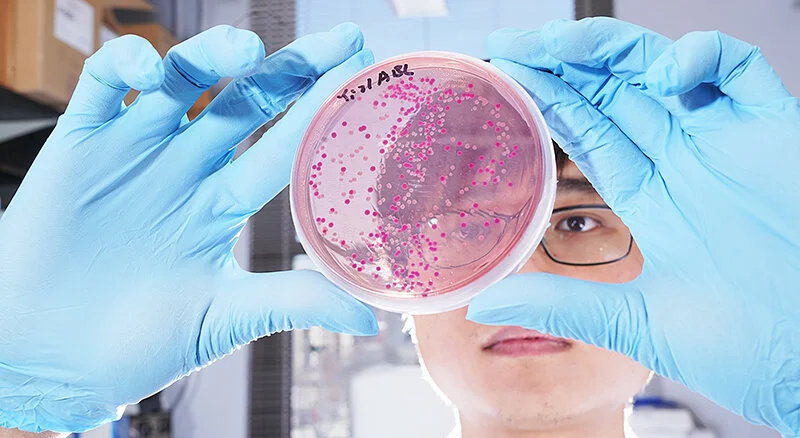
Risk of E.coli In Hydroponic and Aquaponic Systems May Be Greater Than Once Thought
It’s been thought that hydroponic and aquaponic systems could reduce these issues since there is little opportunity for pathogens like E. coli to contaminate the edible parts of plants
It’s been thought that hydroponic and aquaponic systems could reduce these issues since there is little opportunity for pathogens like E. coli to contaminate the edible parts of plants.
Brian Wallheimer | Purdue University
04/21/20
A spate of foodborne illnesses in leafy greens and other produce in recent years has sickened consumers and disrupted growers and supply chains. It’s been thought that hydroponic and aquaponic systems could reduce these issues since there is little opportunity for pathogens like E. coli to contaminate the edible parts of plants.
Hye-Ji Kim (left), pictured with graduate student Seunghyun Choi, found the presence of E. coli bacteria in aquaponic and hydroponic growing systems, suggesting the bacteria could reach produce consumers. (Agricultural Communication photo/Tom Campbell)
A Purdue University study, however, has found the presence of Shiga toxin-producing E. coli (STEC) – the same bacteria that have made consumers of several produce products ill – in hydroponic and aquaponic growing systems. Hye-Ji Kim, an assistant professor of horticulture and the study’s corresponding author, said the findings suggest growers using these systems should be careful in handling and harvesting to avoid contamination.
“Many people think that there is no chance that E. coli could be present in these systems and that risk of contamination is low,” said Kim, whose results were published in the journal Horticulturae. “Our findings suggest there is some potential for food safety concerns. We’re not saying that these foods are unsafe, but that it’s important to handle these plants properly and carefully.”
Aquaponic and hydroponic growing systems are thought to have little risk of containing bacteria that can sicken produce consumers. After finding E. coli in both types of systems, Hye-Ji Kim suggests growers to use caution to not introduce the bacteria to their operations. (Agricultural Communication photo/Tom Campbell)
The E. coli outbreaks that have occurred in recent years tend to happen in leafy greens and other vegetables grown in irrigated fields. Potential sources could be from E. coli in manure or groundwater that reaches the edible portions of plants, or from those contaminants getting to plants after root damage by wild animals.
Proponents of hydroponic and aquaponic systems suggest their growing methods would reduce or eliminate any risk of contamination. Both soilless systems, hydroponic plants are grown in water and chemical fertilizers or nutrient solutions, and aquaponic systems include the raising of fish, with fish wastewater utilized as water and nutrient source for the plants.
The fish used in aquaponic growing systems may introduce E. coli to water and potentially produce crops, and accidental contamination is possible in hydroponic systems. Hye-Ji Kim and Yi-Ju Wang (pictured) suggest growers take careful steps to ensure that these bacteria don’t reach plants that could sicken consumers. (Agricultural Communication photo/Tom Campbell)
Kim, Yi-Ju Wang, a graduate student in Kim’s lab, and Amanda Deering, a Purdue clinical assistant professor of food science, set up both hydroponic and aquaponic systems for growing lettuce, tomatoes, and basil for about two months. The scientists found E. coli in both systems at the time of harvest.
In the aquaponic system, the authors believe the E. coli was introduced by the fish. The bacteria was found in the water, on plant roots, and in fish feces.
“Our separate aquaculture system confirmed that fish feces were a major source of contamination with STEC in the aquaponic system,” the authors wrote. “These results indicate that introducing contaminated fish can be a source of foodborne pathogens in aquaponics.”
The presence of E. coli in the hydroponic system, in which fish were not used, suggests that the bacteria was introduced accidentally. Kim believes it could have splashed from a nearby aquaponic system or have been introduced by a visitor who brought it in from outside the greenhouse. Either way, the presence in the system suggests that accidental contamination is a real risk.
E. coli was also found on plant roots in both systems, but the bacteria did not internalize in the plants. In other words, even with the bacteria present in water and on the roots, the edible portions of the plants were still safe to consume.
The key, Kim says, is proper handling to ensure that E. coli or other pathogens don’t make it to the edible parts of plants. Damaged roots would allow bacteria into the plants, potentially making it to edible portions internally. And the splashing of water during growing or harvesting could introduce bacteria to the edible portions of the plants.
“The best way to manage these issues is to not touch roots or water throughout production cycles. If you do, you should thoroughly wash your hands before touching the edible parts of the plants,” Kim said. “Proper sanitization of equipment is also important. And acquiring fish that do not contain E. coli would also be beneficial.”
Kim’s lab is continuing to investigate food safety risks in hydroponic and aquaponic systems. Projects include damaging roots and simulating splashes to understand how much contamination can occur.
The Indiana State Department of Agriculture, the U.S. Department of Agriculture’s National Institute of Food and Agriculture, and the Purdue University College of Agriculture funded this research.
The content & opinions in this article are the author’s and do not necessarily represent the views of AgriTechTomorrow
04/21/20 | Precision Farming, Processing & Supply Chain | Aquaponics, hydroponic, safety

How Singapore Plans to Survive The World’s Impending Food Crisis
One of the most densely populated countries on the planet, its 5.7 million people rely on other nations for almost everything they eat
Singapore’s obsession with food goes far deeper than its world-famous chili crab and laksa. One of the most densely populated countries on the planet, its 5.7 million people rely on other nations for almost everything they eat. Just 0.9 percent of its land area of about 700 square kilometers was classified as agricultural in 2016, only marginally more than icebound Greenland.
Despite producing little of its own, Singaporeans arguably have better access than anyone else to affordable, abundant, and high quality produce. The country has ranked first in an index of food security for two years running and is now deepening its focus as the COVID-19 crisis exposes the fragility of global food supply chains. To this end, the country is developing expertise in technologies such as vertical farming, nutrient recovery from food waste, and the use of insects, microalgae and cultivated meat as alternative protein sources, according to William Chen, the director of Food Science and Technology Programme at Singapore’s Nanyang Technological University.
Already, work is underway to free up more spaces for urban food production, for example on the rooftops of multistory car parks, according to the SFA. The government is financing research into sustainable urban farming as well as future foods such as alternative proteins and seeking to expand fish farming off the south coast of the country. It’s also funding technology to help raise output from its existing farms, which totaled about 200 licensed operations as of 2018, producing mainly vegetables, fish, and eggs.
Read more at Japan Times
Publication date: Wed 27 May 2020

Food Insecurity Rates Vary Across States
USDA monitors the extent of food insecurity in U.S. households at the national and State levels through an annual U.S. Census Bureau survey
USDA monitors the extent of food insecurity in U.S. households at the national and State levels through an annual U.S. Census Bureau survey. Food-insecure households are defined as those that had difficulty at some time during the year providing enough food for all of their members due to a lack of resources.
Food insecurity rates vary across States because of differing characteristics of the population, State-level policies, and economic conditions. Data for 2016-18 were combined to provide more reliable State statistics than one year alone would provide.
The estimated prevalence of food insecurity during 2016-18 ranged from 7.8 percent of the households in New Hampshire to 16.8 percent in New Mexico with a national average of 11.7 percent. In 12 States, the prevalence of food insecurity was higher than the 2016-18 national average, and in 16 States, it was lower than the national average. In the remaining 22 States and the District of Columbia, differences from the national average were not statistically significant.

This map appears in the Food Security and Nutrition Assistance section of the Economic Research Service’s Ag and Food Statistics: Charting the Essentials.
Horti Daily | Tuesday, May 12, 2020

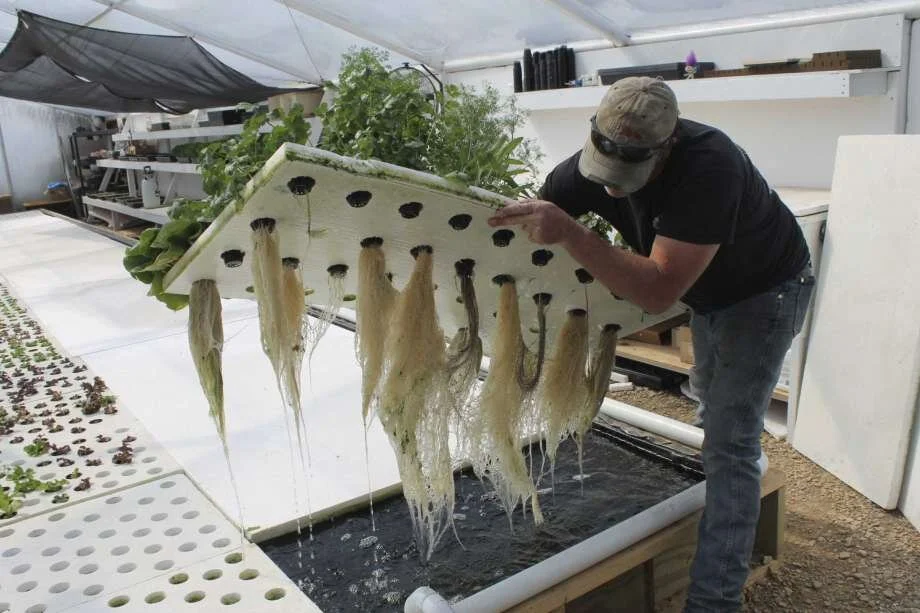
How To Start Growing With Hydroponics For Beginners
If you’d like to know how to build your own hydroponic garden and get started with indoor growing then this article will show you how!
If you’d like to know how to build your own hydroponic garden and get started with indoor growing then this article will show you how!
Think of this as the “ultimate” hydroponics guide for beginners because we’re not going to bog you down with too many details or confuse you with a ton of jargon …
On this page you’ll just find the simple, 30,000ft view of how it all works and how you can get started as quickly as possible growing your own hydroponic plants!
What Is Hydroponics?
Before we get started, let’s actually define what we are talking about here …
What is hydroponic farming anyways?
Wikipedia actually has the perfect definition because it’s so simple:
“Hydroponics is a subset of hydroculture and is a method of growing plants using mineral nutrient solutions, in water, without soil. Terrestrial plants may be grown with their roots in the mineral solution only, or in an inert medium, such as perlite or gravel. The nutrients in hydroponics can be from fish waste, normal nutrients, or duck manure.”
So basically, we’re looking to grow plants without actually having to plant them in the ground. That means we can grow them indoors if we choose!
Eljay from the YouTube series “How To Hydro” has a great explanation for why we want to do indoor gardening. He says, “Indoor growing is all about creating perfect Sundays, every day, for all your plants”:
Why Would You Want To Start Growing With Hydroponics?
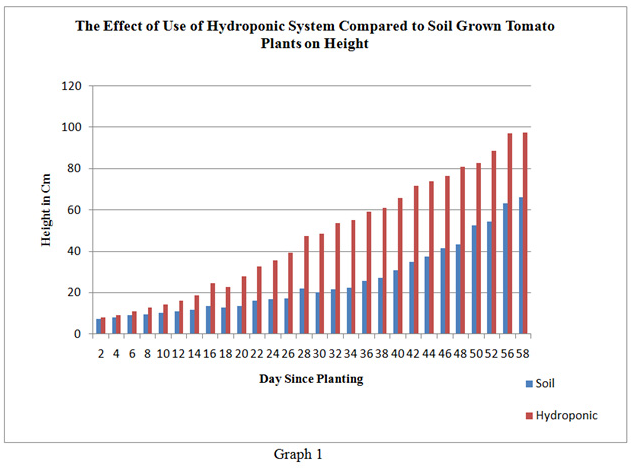
A hydroponics vs. soil comparison for Holland Hybrid tomatoes showing taller plants from hydroponics.
There are many reasons why people want to get into hydro plant growing, but we’ll cover some of the most important and popular reasons here…
Faster Growth! Plants grow faster with hydroponics because it’s a more efficient way to grow them. For example, most experts agree that plants will grow at least 20% faster with hydroponics vs soil. That’s a huge time saver!
Bigger Yields! Scientists have lots of theories as to why this is the case, but the fact of the matter is that experts also agree you can expect at least 20-25% more yields with hydro as compared to growing in soil. That truly adds up!
No soil! This can be a benefit because you may live in an area where there is no good soil to grow plants outside. Or perhaps you don’t have any outside area because you live in an urban area. With a hydro grow you can still grow plants, even if you don’t have soil!
Space Saving! Because your plants don’t need to spread their roots out into lots of soil to get the nutrients they need (because they’re surrounded by oxygenated nutrient-rich water solution)–you can pack more plants closer together. This saves a TON of space and one of the amazing features about indoor grows is how many plants can be put together and grown in a small space. Again, this is perfect for urban dwellers who want to grow a lot of plants with little space.
Water Saving! Because you are using reservoirs that are covered (to prevent evaporation) and no water seeps out of the bottom (because they’re sealed)–the plants take up the exact amount of water they need at any one time and the rest remains in the reservoir to be used later. Compare this to soil gardening where you have to water your plants daily and most of the water is wasted. It’s easy to see how the same amount of water used to water a plant in soil for a day can water a plant in a simple hydroponic system for multiple days or even a week at a time! In short, you can save about 90% of your water by switching to hydro growing.
No Weeds! One of the most tedious, time-consuming and frustrating activities for many gardeners is cleaning their gardens and pulling out weeds. With hydroponics growing there are no weeds to pull!
Less Diseases & Pests! Because you’re not using soil, you also get rid of a lot of soil-borne diseases and pests that can normally wreak havoc on your plants and make gardening a pain.
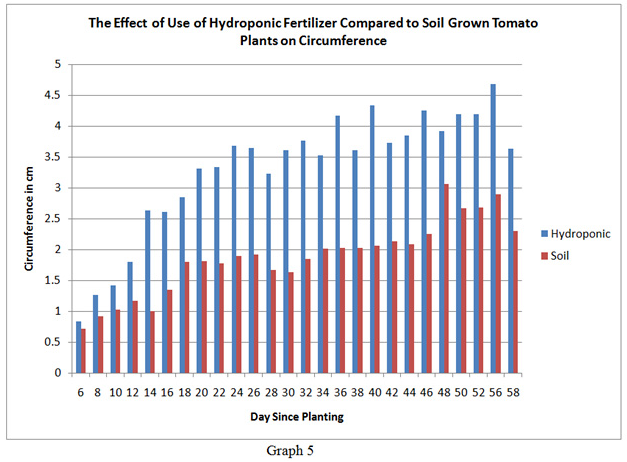
A graph showing bigger circumference (size) plants from hydroponics. From A hydroponics vs. soil comparison for Holland Hybrid tomatoes.
Why NOW Is A Great Time To Start Your Own Hydro Farm
The truth is that Hydroponics gardening has never been more popular than right now!
The Different Types of Hydroponics and How They Are Different
When it comes to hydroponics systems, there are six main types to choose from. These are:
Deep Water Culture (DWC)
Ebb and Flow (Flood and Drain)
Wicking
Drip
Aeroponic
Nutrient Film Technique (NFT)
Now, there are actually multiple variations of each of these different types of hydro systems, but these are the “high level” overviews and categories of basic designs.
Here’s the important thing to remember:
ALL these systems are hydroponics because they don’t use soil, and because you’re feeding the plants a nutrient-rich water solution instead of planting them in soil. The only difference between each type is HOW they deliver the water, oxygen and nutrients that you’re feeding the plants.
The EASIEST Type of Hydroponics System To Setup
Without a doubt, most hydroponics experts would agree that a Deep Water Culture (DWC) hydroponics system is the easiest type of hydro system to use for indoor growing because it requires the LEAST amount of materials, supplies, and know-how to get started:
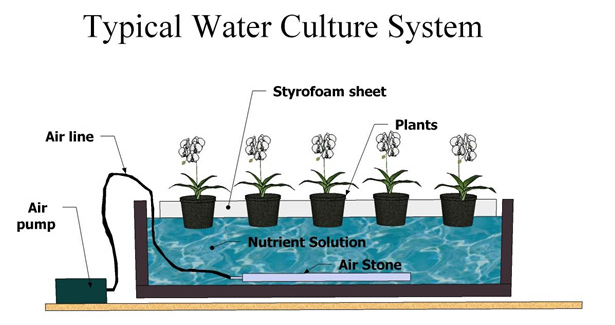
The Deep Water Culture (DWC) hydro system is the easiest for beginners to use.
In a DWC hydro system, you simply fill up a reservoir with your nutrient solution. You then suspend your plant’s roots in that solution so they receive the steady, continuous supply of water, oxygen, and nutrients.
Then a continuous oxygen supply is added to the water. The most common way that growers oxygenate the nutrient solution reservoir is with an air pump and airstone to pump bubbles into it. This keeps your plant’s roots from “drowning” which — while it sounds weird — is a real concern because your plants will suck the oxygen they need out of the water.
Using the DWC system, you’ll find it’s extremely simple to setup (once you understand how it all works) and extremely low-maintenance (again, once you understand how it works) making it perfect for hydroponics beginners.
What About Lighting For Your Plants?
The fact is that your plants need light to grow.
The simple answer is that if you can locate your hydroponics system where your plants can get at least 6 hours of sunlight per day, that is the best. Sunlight provides all the lighting that your plants need to grow correctly.
If you can’t locate your plants in direct sunlight, then you will have to provide artificial lighting using your own indoor grow lights. The truth is that a complete discussion of the proper indoor grow lights is beyond the scope of this article, but you will need to select the proper lighting system with the correct spectrum of light, intensity, power and that covers enough “footprint” to work with your garden. For more information on choosing the right hydroponic grow lights, click here.
Big Tip: Start Your Plants From Clones
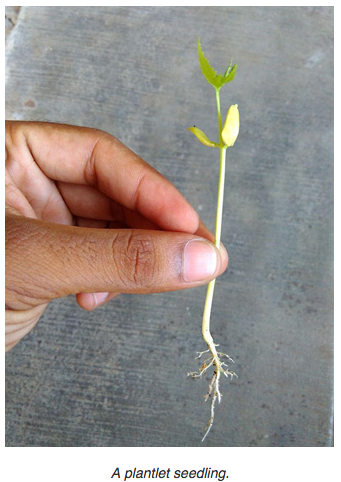
If you’re just getting started growing hydroponically, you want to make it easier on yourself. The best way to do that is to eliminate all the things that might go wrong.
That’s why we recommend starting from a live plant instead of trying to use seeds for your first grow. This is called “cloning” and more tips on how to do this can be found here.
To use herbs as an example, simply acquire an herb seedling and gently remove it from the soil and potting container it came in and wash away all the dirt from the roots of the plant. You don’t want to contaminate your water.
Once you have rinsed the plant’s roots with water, then you can simply add it into your net pot in the lid of your bucket. If the seedling already has roots that you can pull through the net pot into the water, that’s even better and going to make your job easier. Then you simply cover the root system with your growing media and let the system do the rest of the work!
How To Make Sure Your Water Doesn’t KILL Your Plants!
If possible, you want to use Reverse Osmosis (RO) water for your nutrient solution because if you don’t you could seriously harm your plants. See our article “Why all hydroponics growers should use reverse osmosis water systems” for complete details.
Also, if you are using RO water and especially if you are using tap water, you need to know that pH is an important factor. Most tap water is in the 7.0-8.0 pH range. The recommended herbs in this guide thrive in water that’s a little lower pH than this, around the “sweet spot” of 5.5-6.3
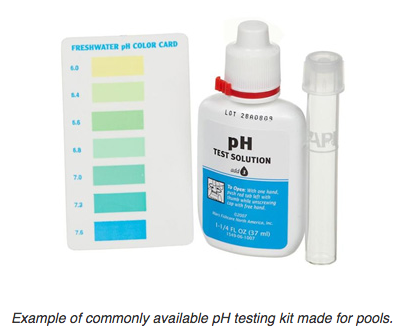
How do you know? You’ll need to buy a pH testing kit to test your water. And if your pH is off then you will need to add pH-Up or pH-Down to adjust your pH levels.
Why is this so important? Because when the pH of your hydroponic system gets out of balance—which can happen quickly if some kind of stabilizing agent or mechanism is not put in place—the ability of your plants to absorb macro, secondary, and micronutrients, as well as vitamins, carbohydrates, and other beneficial sources, is limited.
The truth is that dealing with pH issues can be a real hassle. That’s the bad news. The good news is that, if you use the right products, you can completely eliminate all your pH issues and you will never have to worry about this!
The Best Nutrients For Beginners Are From Advanced Nutrients
The fact of the matter is that, no matter what you’re growing, the nutrients from Advanced Nutrients are the best nutrients for beginners (They’re also the best nutrients for professional growers too, but for different reasons that are beyond the scope of this article!).
How can we make such a bold statement?
Quite simply, it’s because all of Advanced Nutrients products are specifically designed for hydroponics growing. And they are the only nutrients to utilize scientific breakthroughs like pH Perfect Technology.
The fact is that Advanced Nutrients has spent many thousands of man-hours developing a technology that automatically balances your pH for you — putting it in the “sweet spot” and holds it there for weeks.
You can see more about pH Perfect Technology when you click here but the point is that for a beginner, again, the less variables the better. And utilizing the best nutrients in the world will only make your job easier.
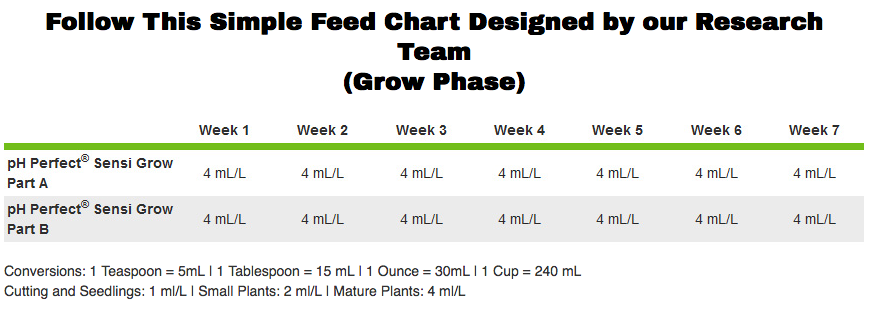
Specifically, for the types of herbs we’re recommending on this page for beginners, we recommend using pH Perfect Sensi Grow A & B because you don’t actually want the herbs to bloom (because that could make them bitter).
By Advanced Nutrients | December 15, 2016

Horti ASIA And Association for Vertical Farming to Launch 'Vertical Farming Pavilion'
Horti ASIA emphasizes horticultural solutions that are both relevant and important to the development of Asian markets
Horti ASIA emphasizes horticultural solutions that are both relevant and important to the development of Asian markets. The Association for Vertical Farming (AVF), as an official partner of Horti ASIA, will be running Asia's first vertical farming pavilion. The AVF Forum will be integrated into Horti ASIA's overall program to ensure significant interest and traffic from the exhibit's attendees.
About the AVF pavilion:
A pavilion to showcase the latest innovations in vertical farming to the world's biggest agricultural market
Three days of events including roundtables, expert panels, and presentations
AVF Forum - Topics including:
Developing the right light recipe
Driving investment in vertical farming
Efficiency and green energy in vertical farming
Business models and many more to come…

For more information:
Horti ASIA
www.horti-asia.com
Publication date: Thu 25 Jun 2020

VIDEO: Syrian Builds Rooftop Farm To Beat Economic Hardship
Syria's rooftop farm
Location: Damascus, Syria
Abdulrahman al-Masri has turned his roof into a hydroponic farm
The 23-year-old entrepreneur cultivates over 33 tons of fruits and vegetables

Syria's rooftop farm
Location: Damascus, Syria
Abdulrahman al-Masri has turned his roof
into a hydroponic farm
The 23-year-old entrepreneur cultivates
over 33 tons of fruits and vegetables
(SOUNDBITE) (Arabic) HYDROPONIC FARM OWNER, ABDULRAHMAN AL-MASRI, SAYING: "The good thing about the project is that it can work, even in the smallest places that we have not thought to explore. Any roof exposed to the sun can be used in this project. Same applies to utilizing the rooftops of farms, buildings under construction, factories and neglected spaces in farms."
Advantages of hydroponic farming technology include
//saving water, pesticides and space//
Researchers say hydroponics can also tackle high food prices
by making more food available locally
(SOUNDBITE) (Arabic) HYDROPONIC FARM OWNER, ABDULRAHMAN AL-MASRI, SAYING: "The reality can impose changes according to the climate conditions that may affect the growth of the plants, or according to the market's prices that may rise or decrease suddenly because of their instability. The economic viability is still theoretical more than practical, but theoretically it can support a three-member family in worst case scenarios."
Reuters Videos | May 11, 2020



Re-Nuble Helps Soilless Farms Grow Net Income By Going Closed Loop
Re-Nuble has cracked the code on how to help soilless farms grow their net income by going 100% closed loop, through the utilization of food waste
New York, NY | July 1, 2020
Re-Nuble has cracked the code on how to help soilless farms grow their net income by going 100% closed loop, through the utilization of food waste. Over the past 5 years, the company has developed technologies that unlock water-soluble nitrates from plant-based food waste streams, producing industrial-grade organic fertilizer for soilless farms. While others with the same vision have found themselves burdened with the obstacle of building an organic fertilizer that is both cost and yield-production competitive with synthetics, Re-Nuble has succeeded.
The business of food production has produced enormous food waste in its wake. 20.2 million tons in the USA alone go unharvested each year, often left to rot or sent to landfills where valuable nutrients are locked away from ever hoping to rejoin the ecosystem. Re-Nuble’s goal is to reintegrate food waste as an industrial grade, closed-loop fertilizer that is both price and yield competitive with the standard synthetic fertilizers for soilless farms. Their fertilizers are shown, on a grow cost per plant basis, to be 2X more cost-effective than the current dominant market standard, mineral salts.
Re-Nuble selects a proprietary mix of food waste streams which are then processed using similarly proprietary methods in order to kill any pathogens. The food waste is then prepared to become a plug-and-play fertilizer. Re-Nuble funnels this fertilizer through their patent-pending Nutrient Delivery System, an on-site hardware technology suite that rapidly solubilizes provided fertilizers, monitors pH levels, manages EC control, and ensures the long-term recirculation of the same nutrient-rich water for years to come. Part of this technology is available immediately to solubilize products, and the full suite will be available in early 2021.
As an added value, the company also offers client waste integration through an on-site hardware technology suite. The client’s own food waste stream is used as input and converted into a yield-enhancing fertilizer supplement. This enables farms to decrease water loss, enhance food supply chain security, and further decrease their operation’s GHG emissions. This has been of particular interest to farms operating at least 4 acres of production space.
From a net income perspective, Re-Nuble fertilizers are far more cost-effective than mineral salts and deliver a wider micronutrient and microbial profile. These fertilizers align with crop growth at the speed and year-round sowing or harvesting cycles of mineral salt-fertilized soilless farms. Since they are 2x more cost-effective than mineral salts, client farms receive immediate net income improvements. Furthermore, Re-Nuble’s fertilizers unlock organic food production that fetches a long-term, far greater
gross margin increase (at least 20% or more). Combined, the significant savings on the cost side and enhanced earnings enable client farms to become significantly more profitable and viable businesses.
It is Re-Nuble’s philosophy to mirror the processes of our natural food ecosystem, infinitely more complex than human-built food production methods that have hundreds, if not thousands, of discrete, often-invisible ways to re-integrate food waste back into nature. Wind and birds carrying seeds, small mammals burying acorns, yeast protecting the outer layers of fruits for longevity, and so on. Closing the loop on food production is an attempt to industrialize this natural re-integration process. The benefits include net income growth, emission reduction, and enhanced food security. For farms that find this of value, please do reach out to Rahul Bhansali (rahul@re-nuble.com).
ABOUT RE-NUBLE
Re-Nuble is an agriculture technology company that uses organic cycling science to unlock the conversion of food waste into industrial-grade organic fertilizer for soilless farms. We are the world’s enabler of closed loop food, recirculating natural resources from participant waste streams and the greater food system. We divert the valuable resource of food waste from entering landfills, eliminating methane emissions that would have been circulating in our ecosystem. Through our pelletized fertilizer and proprietary “nutrient delivery system”, farms rapidly convert waste streams into soluble nitrates, amongst other nutrients, for quicker plant uptake and yields. The results are comparable to the nitrate availability of industry-dominant fertilizers, synthetic mineral salts, allowing farms to increase their bottom line. Our recirculating nutrient technology enables soilless farms to more competitively grow soil-quality, organic produce with sustainable best practices.
For more information, please visit www.re-nuble.com and follow @Re_Nuble on Twitter and https://www.facebook.com/ReNuble on Facebook.

"Vertical Farming Is A Great Answer For Food Security Worldwide"
“Vertical farming is a great answer for food security worldwide, especially in locations where the climate makes it hard to grow plants in or in megacities.”, says Gabriele Puccetti with the Goat Project
“Vertical farming is a great answer for food security worldwide, especially in locations where the climate makes it hard to grow plants in or in megacities.”, says Gabriele Puccetti with the Goat Project.
ENVI-BIO VF module
Their product ENVI-BIO VF is a newly patented vertical farming system, now in line for funding to start agronomic testing and the industrialization of the module. The module has multiple floors that provide plants with everything they need: water, nutrients, lights (LED), pumps, sensors, WI-FI communication, and a pH corrector. The module itself is a micro, self-sufficient vertical farm.
The all-inclusive costs are $590 per net vegetative square meter. The production costs for lettuce, when energy costs $100 per MWh, are 0.29 per head and 1.93 per kilogram. 21,000 tons per year can be harvested out of 15,000 square meters, per year, and 105,000 tons from 75,000 square meters. “This is why we are a revolution in industrial vertical farming.”
Dubai EXPO 2021
When the tests have been done and the system is ready to be sold in the industry, in the first year a demo plant close to the EXPO 2020 location in Dubai will be set up. Here, people who are interested in vertical farming can visit it and see the machine at work.
Challenges and opportunities
The biggest challenge for vertical farmers is the high production cost due to the high investment and electricity needs and labour costs. Over the last years, many solutions have come to the market, many of them with a lot of financial help from venture capitalists.
There is a big market for vertically produced products, so it’s easier for farmers to enter this market. “We have an innovative solution to lower the area and maximize the production, so we lower the production costs. All this thanks to a low-cost structure, automation, and no workers needed inside.”
For more information:
The Goat Vision Holding
Gabriele Puccetti
+39 3922730361
+96 0958999
tgp@thegoatproject.bio
gabriele.puccetti@themaldivianalliance.mv
Publication date: Tue 30 Jun 2020
Author: Marlies Guiljam
© HortiDaily.com
Hort Americas Expands Services With Canadian Branche
Supported by GE Current’s grow lights, designed and engineered in Montreal, Hort Americas Canada has the resources and knowledge to enhance production capacity in vertical farms and greenhouses
Speaking French and English
An exciting new step for Hort Americas. Since 2009 the company, headquartered in Bedford, Texas, has been providing leading knowledge in commercial hydroponic production, vertical farming, greenhouse production, urban agriculture specifically on topics like engineered substrates, fertilizers and LED grow lights.
Now they cross borders and expand their business with a Canadian branche. The new local team in Montreal will help Canadian growers out. "We're providing local support on horticultural lighting, growing systems and whatever growers might be dealing with. Either in French or in English", the team says.
The team explains how the Quebec expansion and their physical presence in Canada is their effort to deliver the best personalized service for growers across the border. "Our Canadian team will offer the same value-added services and products while bringing to the table deep technical skills in horticulture lighting solutions", they say.
Supported by GE Current’s grow lights, designed and engineered in Montreal, Hort Americas Canada has the resources and knowledge to enhance production capacity in vertical farms and greenhouses. "Our team advises and supports growers with their projects through light plans, design optimization, energy savings evaluation and crop-specific DLI and spectrum selection."
Hort Americas Canada also partners with Grodan by distributing their stone wool growing media solutions. "We are pleased to work with a team who is dedicated to creating the optimal environment for roots resulting in healthy and strong plants. In fact, most recently, Grodan launched the new NG2.0 substrate technology optimizing yield growth while using less water, nutrients and space," says the team.
"We're passionate about horticulture and strive to assist growers in their quest for hydroponic solutions enhancements and technology advancements. If that is in English, or if it is in French!"
For more information:
Hort Americas Canada+1 438 521 3752
canada@hortamericas.com
www.hortamericas.com
Publication date: Mon 25 May 2020

Scientists Develop ‘Probiotics’ To Help Plants Fight Disease Without Pesticides
With concern about the impacts of pesticides on human health and the natural world growing, and disease resistance leading farmers to increase their use, the team is hoping to find a chemical-free solution
Enhancing a plant’s immune system with ‘probiotics’ could help it to fight off pests and diseases without the need for pesticides, according to scientists at the University of Sheffield. At the university's Institute for Sustainable Food, a study was launched, funded by a £1.5 million grant from the Biotechnology and Biological Sciences Research Council, into how beneficial bacteria protect plants’ health – in a similar way to gut bacteria in humans.
With concern about the impacts of pesticides on human health and the natural world growing, and disease resistance leading farmers to increase their use, the team is hoping to find a chemical-free solution.
Today, many fruits and vegetables – particularly tomatoes and soft fruits like strawberries – are grown hydroponically (without soil) in vast greenhouses and polytunnels covering 948 hectares in the UK. This enables farmers to grow high-value produce out of season – but because the plants are grown in sterile conditions, any diseases that do find their way inside can devastate entire crops.
By introducing beneficial bacteria to these greenhouse environments, the University of Sheffield scientists hope to prevent these outbreaks – helping to improve productivity and avoid food waste.
Looking at tomato plants, the team will use a combination of genetics and biochemistry to gain a thorough understanding of how roots interact with beneficial microbes in the soil. This knowledge will then be applied to develop plant versions of probiotics – methods of adding good bacteria to growing systems that will support the tomatoes to fight off pests and diseases using their own enhanced immune systems.
Scientists at the Institute for Sustainable Food have already developed synthetic foam ‘soils’, which can grow two to 10 times more produce than natural soil, relieving pressure on agricultural land and increasing the potential for urban farming. By injecting these probiotics into the foam, they hope to create ideal growing conditions for a whole range of herbs, fruits, and vegetables to be grown year-round.
"Scientists have learned a lot in recent years about how beneficial bacteria in our guts keep us healthy – and we believe the same is true for plants.
By investigating how tomato plants interact with good bacteria in the soil through their roots, we hope to be able to develop plant probiotics to boost their immune systems and help them fight diseases without the need for harmful pesticides.
Coupled with our synthetic foam soils, this completely new approach could help farmers to grow healthy and sustainable fruits and vegetables out of season and in the urban areas where most people live," says Professor Duncan Cameron.
Source: The University of Sheffield.
Publication date: Wed 3 Jun 2020

The FarmTech Society (FTS) Held Its Second Constitutional Annual General Meeting (Virtually) on June 24th, 2020
Newly elected Chairman Ian Kanski commented “Thanks to the excellent work of FarmTech Society’s founding board and members, the organization is well-positioned for growth and impact in 2020
The Farm Tech Society (FTS) is an international non-profit industry association that unites and supports the Controlled Environment Agriculture (CEA) industry, seeking to strengthen the sector through the development and implementation of resilient and future proof methods and technologies for indoor growing.
The FarmTech Society is enlisted in the EU Transparency Register with #469686733585-87
The FarmTech Society (FTS) held its second constitutional annual general meeting (virtually) on June 24th, 2020. FTS members elected a new board of directors, who in turn appointed the new advisory board. The new boards are elected for a period of two years. The board of directors also appointed the daily management team. The election was held electronically and independently third-party verified.
Newly elected Chairman Ian Kanski commented “Thanks to the excellent work of FarmTech Society’s founding board and members, the organization is well-positioned for growth and impact in 2020. This is an important time for all regions to be investing in sustainable localized food and circular agriculture. Our new leadership team is committed to supporting the quality, safety, and education initiatives that will drive the adoption of Controlled Environment Agriculture globally.”
The election results were as follows:
New Board of Directors
Chairman: Ian Kanski Harrisburg University
INTAG Systems
Vice-chair: Nicole Thorpe Cultinova
Vice-chair: Tisha Livingston Infinite Acres
Director: Marinus Luiten Priva Group
Director: Alina Zolotareva Aerofarms
Director: Nico Domurath Frauenhofer Institute
Director: Andrew Blume Symphony Agtech
Director: Wythe Marschall Ph.D. candidate,
Harvard University
Director: Stefan Frey FREYconsult
Honorary: Gus Van der Feltz (founding member)
The appointments by the Board of Directors were as follows:
New Advisory board:
Edwin Vanlaerhoven Certhon
Maren Schoormanns Viscon Group
Chante Van der Walt Candidate Full Stack
Developer Udemy
Marvin Boell TüVSüd
Enrico Costanzo Cerial Docks
Stefanie Linzer. Valoya
Pierre Grootscholten Grootscholten
Consultancy
Kyle Barnett HortAmericas
Franc Bogovic Finance.Brussels
Yanni Garcia (founding member)
Penny McBride (founding member)
Adam Rosenbaum (founding member)
Daily management:
Secretary-General: Thomas Zoellner (founding member)
Treasurer: Stefan Frey FREYconsult
Communication: Mark Horler Soya Project / UKUAT
Legal counsel Stanislas Demeestere European Future Forum
Farm Box Foods - Digital Farming Entrepreneurs
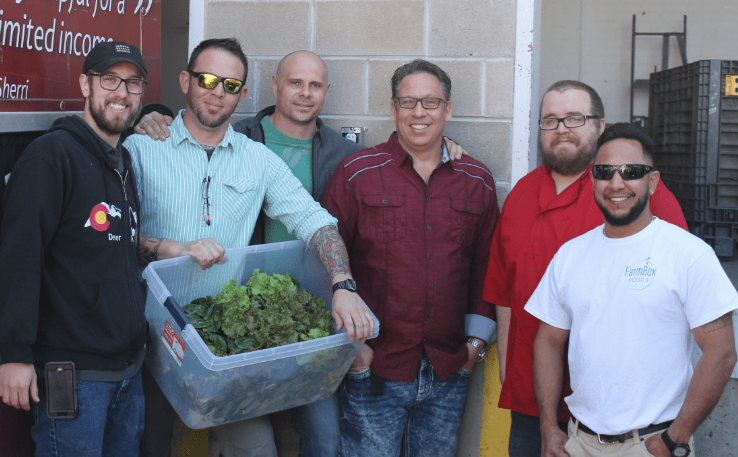
In 2017, an unlikely group of friends—a real estate agent, a solar energy entrepreneur, and a fabricator, decided to take action. From the drive to decentralize food supply chains and assist communities to produce more locally grown, healthy food, FarmBox Foods was born
OUR MISSION
We want to empower communities to produce their own locally grown produce year-round.
We strive to change the way people farm by merging technology and agriculture into a system that greatly reduces water usage and transportation costs while maximizing space.
We see a future where communities have achieved food independence by producing their own healthy food and distributing it locally – no longer relying on centralized food systems.
Our Story
Our planet is in trouble, and we need to find new, innovative approaches to food production.
In 2017, an unlikely group of friends—a real estate agent, a solar energy entrepreneur, and a fabricator, decided to take action. From the drive to decentralize food supply chains and assist communities to produce more locally grown healthy food, FarmBox Foods was born.
Our founders knew they had to search for agricultural innovations. At the heart of this new approach lies the shipping container. Our goal was to develop the most efficient, high-yielding container farm on the market. Early in our research and development, we saw the appeal of vertical farming—this design principle would allow us to maximize limited space. Bringing all these ideas together, FarmBox Foods created a hydroponic farm with an elegant and user-friendly design.
With our hydroponic farm on the market, FarmBox Foods is now looking for new ways to bring more healthy food options to communities. Enter mushrooms. With their myriad health benefits and culinary versatility, mushrooms are the perfect crop for sustainable food systems. Our first-of-its-kind gourmet mushroom farm will debut in 2020 and boost access to this superfood.
FarmBox Foods is changing the way we think about growing food, one shipping container at a time.
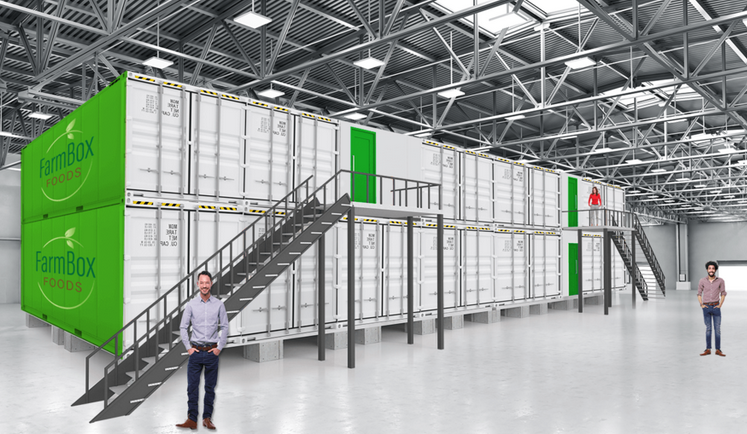
It comes down to what’s inside, the “Plant Force One” is built inside of a recycled 40-foot container. Helping the environment and help you change the way you farm

Future Farm Technology Expo Announces That The UK Urban Vertical Farm Association Urban Agritech UK (UKUAT) Has Joined Future Farm Technology Expo As An Official Supporter of The Event
Mark Horler, Chairman, and Founder of UKUAT commented “We are very excited to announce UKUAT’s partnership with FFT Expo and to have the opportunity to promote urban agriculture and the related technologies at such a leading and exciting event
Future Farm Technology Expo is delighted to announce that the Uk urban vertical farm association Urban Agritech UK (UKUAT) has joined Future Farm Technology Expo as an Official Supporter of the event as an Official Association. UKUAT will be working with the team at FFT Expo to help promote, educate and support UKUAT exhibiting members and connecting the UK urban vertical farming industry to suppliers, farmers, and those who are researching the industry. FFT Expo will run from 11th & 12th of November 2020, at the NEC Birmingham.
Statement from Mark Horler here:
Mark Horler, Chairman, and Founder of UKUAT commented “We are very excited to announce UKUAT’s partnership with FFT Expo and to have the opportunity to promote urban agriculture and the related technologies at such a leading and exciting event. Urban farming is an integral and rapidly growing part of farming. UKUAT is proud to represent and promote our members who are creating new technologies, sharing knowledge, and ultimately producing food in urban and peri-urban areas. It’s a truly exciting time to be involved with UKUAT, as we have networked with different internationally recognized institutions to promote the fantastic new technology that is arising from the sector. We seek always to create new strategic links with experts, organizations, institutions, and to share knowledge. This partnership with FFT Expo will enable us to expand and promote these activities, utilizing this event, online webinars, whitepapers, and networking events in the future.”
Mike Enser, Marketing Manager for the show said ‘the launch edition in 2019 attracted motivated and engaged visitors from across the farming community, with 96% of attendees having buying power. We are delighted that UKUAT is working with us. The knowledge they have of the UK sector is second to none and we at FFT Expo are looking forward to working with Mark and his team to ensure the UK urban vertical farm market is showcased through its exhibiting members, through the associations thought leadership and through its vision ‘To utilize Urban Agritech as a tool to achieve greater sustainability & resilience in the UK food system. Expanding the horizons of Urban Agritech to better inform communities across the UK.’
Future Farm Technology Expo is run by Farmers Weekly and Reed Exhibitions. The event hosts demonstrations of new technologies and the multitude of capabilities that data provides as well as bringing together innovators in agricultural technologies with farmers looking to improve their productivity and yields.
Editors notes:
The UK Urban AgriTech collective, or UKUAT, brings together the UK’s key players in modern agricultural technologies. We’re a cross-industry group devoted to promoting urban agtech as a solution for food and environmental crises. We influence policy by sharing information, educating, and communicating practitioner needs as one. We promote the uptake of agtech in urban and peri-urban settings by uniting to attract funding and customers.
Future Farm Technology Expo is one of the only UK events dedicated to solving the challenges faced by farmers through agricultural technology solutions.
Whether you are looking to optimise your production or reduce waste, here you have direct access to the experts and technological solutions that will benefit you long-term and plant those seeds for positive change.
For immediate circulation:
To get in touch with UKUAT please email info@ukuat.org
If you would like to talk to the team behind FFT Expo, please email Mike Enser –michael.enser@reedexpo.co.uk