


Welcome to iGrow News, Your Source for the World of Indoor Vertical Farming

US (CA): Vertical Farm Launches Personalized Cultivation and Delivery Service
South Bay Area residents will be the first to experience Farming as a Service through Willo’s innovative cultivation technology. Residents within 20 miles of Santa Clara, Calif. can subscribe to an exclusive plot in Willo’s farm starting at $99 a month at willo.farm
Indoor vertical farming startup Willo debuted a brand new direct-to-consumer delivery program in San Jose to provide a custom produce experience in the Bay Area. Founded by brothers Samuel and John Bertram, Willo’s personalized cultivation and delivery service connects consumers directly to their own plot in Willo’s local vertical farm.
South Bay Area residents will be the first to experience Farming as a Service through Willo’s innovative cultivation technology. Residents within 20 miles of Santa Clara, Calif. can subscribe to an exclusive plot in Willo’s farm starting at $99 a month at willo.farm. The membership grants access to regular deliveries of customizable packaged salads starting in August. A single purchase option is also available for $49. The rapidly growing list of available crops currently includes Toscano Kale, Red Mizuna, Pea Shoots, Protein Crunch and Genovese Basil. Willo will add additional fruits and vegetables to its farming capabilities as it scales.
“Willo is unleashing the power of plants on human health,” said Samuel Bertram, co-founder and CEO of Willo. “For the first time, fresh food will be grown specifically for the person consuming it. Personalization exists everywhere except for the food industry; and we’re here to give the market what they are asking for. By letting people configure their own plot in Willo’s farm, we can grow the specific fruits and vegetables they desire, while making recommendations tailored to their health needs. Willo plans to build farms in every major city on Earth with the mission to eliminate diet-related disease through personalized plant-based nutrition.”
A strong proponent of Community Supported Agriculture (CSA), Willo also announced a partnership with HomeFirst Services of Santa Clara County to further extend the positive impacts of sustainable local indoor farming practices. Willo will deliver fresh produce from its farm to assemble 40 ready-made plant-based meals each month for homeless individuals and families in the San Jose area.
“This is a really important part of a well-balanced diet that is difficult to procure on a large scale for homeless shelters,” said Lori Smith, director of development and communications at HomeFirst. “Together with HomeFirst, Willo will bring tasty, nutrient-dense produce to shelter guests and the at-risk community served in Santa Clara County.”
Scalable and sustainable farming in cities
Willo’s technology is optimized for scaling into urban settings with the intent of making local farming a global reality. Willo currently delivers within 20 miles of its farm, and the consumer’s hands are the first to touch it. Willo’s highly automated farming techniques remove pesticides and contamination, and produce essentially zero water consumption by recycling the water supply.
Following the success of the Bay Area launch, Willo will continue expanding the Farming as a Service model to urban communities across the country with planned expansions to cities like Los Angeles, San Diego, New York and Washington D.C. in the next 24 months. Willo aims to scale its technology to every major city globally to make local and sustainable farming accessible to everyone.
For more information:
Willo
willo.farm
Publication date: Mon 15 Jun 2020

Aquaponic Growers Eligible For Coronavirus Assistance
Multiple USDA representatives assured the Aquaponics Association that aquaponics operations producing qualified crops are eligible for financial support through the Coronavirus Food Assistance Program (CFAP). The Deadline to apply is August 28, 2020. Growers are also eligible for Small Business Administration Programs
Multiple USDA representatives assured the Aquaponics Association that aquaponics operations producing qualified crops are eligible for financial support through the Coronavirus Food Assistance Program (CFAP). The Deadline to apply is August 28, 2020. Growers are also eligible for Small Business Administration Programs.


By Thomas Wheet and Brian Filipowich
The COVID-19 pandemic has negatively impacted the American agricultural industry in unprecedented ways. Farmers have watched harvests spoil, been forced to destroy crops, and have euthanized livestock due to the shifts in consumer behavior.
The USDA created the Coronavirus Food Assistance Program (CFAP) to assist farms that have suffered economically due to the outbreak.
We reached out to the USDA to inquire about aquaponic growers’ eligibility for CFAP and received encouraging, yet somewhat inconclusive, responses. While aquaponics is not explicitly highlighted as an eligible growing method for CFAP, numerous USDA representatives assured our policy team that aquaponic operations producing qualified crops could receive financial support through the program. Because funding decisions will ultimately be conducted at the county level, both the Aquaponics Association and USDA personnel strongly encourage any aquaponics organization to reach out to its county’s Farm Service Agency (FSA) to confirm that the organization meets all criteria required to receive support before completing the application process.
Deadline to apply: The USDA is accepting applications until August 28, 2020. Make sure to check with your FSA at your local USDA Service Center for any questions regarding the application process.
Who can apply for CFAP:
Producers of eligible commodities who have experienced a 5% or greater price decline due to COVID-19.
Individuals and/or legal entities that average an adjusted gross income of less than $900,000 in 2016, 2017, 2018. Make sure to check the CFAP website for additional eligibility guidelines.
Eligible crops: Non-specialty crops, wool, dairy, livestock, and specialty crops are all eligible for CFAP. For a complete list, make sure to take a look at the CFAP website.
General Business Assistance Programs
In addition to agriculture-specific economic assistance, the Federal Government has augmented general economic relief programs so that they also apply to agricultural. The U.S. Small Business Administration’s (SBA) Economic Injury Disaster Loan Program offers $10,000 loan advances for businesses experiencing a temporary loss in revenue and have less than 500 employees. The loan advances do not need to be repaid.
The USDA website notes: “For the first time, agricultural enterprises are now eligible for the disaster assistance from EIDL. As a result of the unprecedented legislation, American farmers, ranchers, and other agricultural businesses will now have access to emergency working capital.” The website also specifically notes that “aquaculture” businesses are eligible. Eligibility for CFAP is unaffected by participation in the PPP or EIDL.
Also from the SBA, the Payroll Protection Program offers guaranteed loans to support the payroll of businesses with less than 500 employees during the coronavirus pandemic. Unfortunately, the PPP deadline is June 30, 2020 (the day of this posting).
What is the Economic Effect of COVID on Aquaponics?
Surveys have indicated that COVID19 has hurt commercial aquaponic growers.
See:
1) Survey Results; COVID’s Effect on U.S. Aquaponics; and
2) Commercial Growers Hit Hard by Coronavirus.
We must do more to support commercial aquaponic growers during the pandemic so that we don’t set back our most efficient, sustainable form of agriculture.
Are you a grower that receives, has applied, or plans to apply for economic assistance through these government programs? Please complete this quick survey to let us know your experience, and if you have any questions or comments on the process.
Please Click Here To Access
The COVID Government Assistance Questionnaire

Are There Really Little Bugs in Your Strawberries?
Have we been unknowingly enjoying larvae in our triple-berry parfaits? Should we just never eat fruit again? I talked to some experts to find out
May 22, 2020
The internet is freaking out about a TikTok video (and accompanying Buzzfeed article) showing what appears to be little worm-like bugs crawling out of fresh strawberries soaked in saltwater. Is this for real? Have we been unknowingly enjoying larvae in our triple-berry parfaits? Should we just never eat fruit again? I talked to some experts to find out.
Here’s the short answer: this is a real thing that can happen, but it’s not common. And neither the food safety experts nor the bug experts advise washing your fruit in saltwater.
What is actually happening in this video?
Krista Torres, who made the video, writes: “I filled a bowl with room temperature water, poured in a shit ton of sea salt (like five large spoonfuls), put the strawberries in, and waited about 30 minutes.” She then notes little white wormy things crawling out of the strawberries and concludes that they are the larvae of spotted-wing fruit flies, Drosophila suzukii.
It’s not clear from the video whether she’s identified the species correctly, but more about that in a minute.
The saltwater soak is actually a technique that growers and wholesalers use to check for fly larvae in berries, entomologist Hannah Burrack told me. She helps berry farmers with pest management at North Carolina State University. Berries are sold from growers to wholesalers (who package them into those clamshell boxes) and from there, resold to supermarkets. “If [the wholesalers] find larvae in the fruit coming from the grower, they will send all of that fruit from that grower right on back,” says Burrack.
Since they only test a sample of the fruit in each shipment, there’s no guarantee that the rest of the berries are larvae-free, but the general idea here is to minimize the chances of any bug-filled berries making it into the supply chain
.Are there bugs like this in all strawberries?
No. But there are probably bugs in some strawberries.
You know fruit flies, right? Those little tiny guys that show up around overripe fruit you’ve left on your counter too long? They’re often Drosophila melanogaster or Drosophila simulans, Burrack says if not one of their relatives. The adults, which you’ve seen and swatted away a million times, reproduce by laying their near-microscopic eggs in the soft parts of the fruit. The eggs hatch into itty-bitty larvae—aka maggots—which look exactly like the “worms” in the TikTok video. Eventually the larvae grow bigger and turn into flies, and the circle of life repeats.
Usually you find these guys in fruit that’s damaged or overripe, but there is a species called Drosophila suzukii that uses a saw-toothed ovipositor (a, uh, butt spike) to inject its eggs into fresh berries while the fruit is still growing on the plant.
As the Buzzfeed article puts it, “the females shoot their eggs into the interior of fruits that are just beginning to ripen, especially blueberries, strawberries, and raspberries. MEANING THESE BUGS ARE LIKELY IN ALL BERRIES!”But Burrack tells me that there’s no way to know whether the larvae in the video are D. suzukii, since all Drosophila larvae look alike. And since growers and wholesalers do their best to keep D. suzukii out of the food supply, it’s not very likely: These larvae could just as well be from a fruit fly that was buzzing around the grocery store or Krista Torres’ kitchen.
Would it be harmful to accidentally eat these bugs?
Nope. The idea they are lurking within your berries may be unappetizing, but they’re not going to hurt you. “You can eat them, but kinda gross,” says Ben Chapman, a food safety specialist from North Carolina State University.“‘Natural’ protein,” tweeted food safety specialist Courtney Crist when I asked about it.“If you’re eating berries I would assume you have probably eaten these at one point,” says entomologist Joe Ballenger.
Excuse me, bugs in food are grossA valid point. But since you brought it up: This is nothing new. Did you know that vegetables are grown outside, in dirt, and that there are lots of bugs out there? Ballenger casually mentioned he’d picked a plant bug (that is, I am not joking, its actual name) out of his lettuce recently. Plant bugs inject their saliva into leaves and then suck out the resulting slurry. You have probably eaten a lot of plant bug spit.
Similarly, Chapman noted that worms in fresh fish are so common, sushi restaurants are required to freeze raw fish before serving it to kill any worms. Which mean the worms are still there, they’re just dead.I could go on, but I won’t. Suffice it to say, you’ve probably eaten a lot of things you’d rather not think about. Or as Ballenger puts it: “If you look too closely at it, pretty much anything is gross.”
Okay, so what should I actually do with my strawberries?
Everybody I talked to said the same thing: you don’t need to soak them in saltwater or do anything special. A regular rinse is fine.
Burrack points out that you should keep your berries in the fridge. This makes them last longer and it keeps them away from the fruit flies buzzing around your counter. Bonus: After three days of refrigeration, any fruit fly eggs or larvae in your berries will likely be dead, at least.
All the classic strawberry-keeping advice still applies, the other biggie being to not wash your berries until you’re ready to eat them. Washing can damage the berries slightly, creating opportunities for mold and microbes to get under the skin. So just take the handful of berries you intend to eat, wash those, and leave the rest in the fridge until next time.
Beth Skwarecki Posts Email Twitter
Beth is Lifehacker's Senior Health Editor. She has written about health and science for over a decade, including two books: Outbreak! and Genetics 101. Her Wilks score is 302.
Lead Photo: Shutterstock

ONLINE SUMMIT: Planet Forward. Plant Seeds of Change - July 2nd & 3rd, 2020
Join us at the Women in Agribusiness Online Summit Europe July 2 & 3 for ideas, networking and to hear what others are doing
Join us at the
Women In Agribusiness Summit Europe
July 2 & 3
For Ideas, Networking, And To Hear What Others Are Doing
Our most lofty and challenging goals cannot be achieved overnight. However, they can be attained if we start working on them right now. Some have plans in place to contribute to: No poverty, zero hunger, good health, climate action and preserving diversity of life.
Plant seeds of change now within your company, office and home. Begin growing a better planet for future generations — a planet where hunger doesn’t exist and food plays an invaluable role in sustaining individual wellness and healthy communities.
Join us July 2 & 3
Here are a few sessions to get you up on the issues and thinking about your actions...
We all share one planet, and if we all take ownership, we can make a difference and truly move it forward for a brighter, better, and greener future.
Thank You To Our Sponsors

VIETNAM: Shipping Container Farm - Growing Strawberries Indoors in Vietnam
At the 88.17 hectare Agriculture High Tech Park in Ho Chi Minh City, Center for Business Incubation of Agricultural Hi-Tech (AHBI), a first batch is underway with 100% indoor cultivated strawberries. The first batch was planted earlier this year and harvest is expected within 3 months
At the 88.17 hectare Agriculture High Tech Park in Ho Chi Minh City, Center for Business Incubation of Agricultural Hi-Tech (AHBI), a first batch is underway with 100% indoor cultivated strawberries. The first batch was planted earlier this year and harvest is expected within 3 months. The AHBI serves as a testing lab as well as an educational centre to stimulate the development of advanced horticulture in the region.
Meeting the demand for fresh organic produce
Ph.D. Hoang Anh Tuan, Deputy Director of AHBI, talks about how the cultivation is doing and what the challenges and opportunities are. “The demand for fresh and affordable strawberries is increasing across Asia. Our aim is to grow strawberries all year round and near the city”, says Ph.D. Hoang. Until recently, growing strawberries in Ho Chi Minh is not possible due to the local climate. With improvements in climate control, many parameters could be controlled but the right lighting with easy controls was not available until HortiPower launched in Vietnam.
Upgrading yields and more investments
While Vietnam is already known as a significant agricultural producer, its farmers are increasingly looking to upgrade production capacity and increasing yields. PhD Hoang explains: “New generation growers are looking to maximize the yield per square meter with high-value cultivars, to lower the energy use per fruit and affordable solutions to help them start.” There is also a push from private investors, but they are looking to start with technologies and investments that can scale, rather than a large upfront investment with long payback term.
“To support private investors and help them move towards high-tech agriculture we introduced hydroponic container farms. It allows us to control the climate which enables us to grow a high value crop and to grow all year round”.
“The initial investment is reasonable and has only a 2-year payback. They allowed us to do a trial so we would have our own data about potential production results”.

Growing high quality strawberries and producing them year-round has remained a challenge when growing in the field. Growing strawberries in consistent size and quality will require the right lighting, so that the production process becomes more predictable and the yield increases. Consumers indicate that they are prepared to pay more for overseas strawberries that are larger, sweeter and have a softer, smooth skin compared to the local varieties grown normally in the region. Getting the right lighting is very important when growing fully indoor. “We’ve evaluated many different lighting fixtures from other companies. We had the best results with HortiPower since its lighting system allowed us to completely control lighting distribution, the intensity and spectrum. It can also run lighting algorithms without the need for a local onsite computer.”
“Since last year we have actively visited several growers onsite to understand their needs and challenges. We are working closely with a team of our own researchers and several universities to provide suitable lighting solution for many laboratories in the region”, says Katherine Tran - Sales Director of PTP Vietnam which represents HortiPower.
Starting in the spring
This spring, new LEDs from HortiPower were installed. Each shelf has 4 fixtures for an even distribution of light. And with a fully adjustable µmol intensity and spectrum, the strawberries can get exactly what they need at each stage of strawberry cultivation. Supporting plant growth, flowering, and fruiting may require different lighting which affects the nutrient production, quality, taste, and brix. The new lighting also gives better control of harvest times, which is commercially relevant to get ready just before the popular spring festivals and other dates with peak consumer demand.
“With HortiPower we are able to control the exact amount of light intensity, spectrum and ratio. We are now able to control the growing process in a much better way.”

Katherine Tran during A/B testing at AHBI
The right lighting
AHBI evaluated horticultural lighting and chose HortiPower with a spectrum of plant-centric red, green, blue, white, and far-red. This spectrum not only produces the desired stem elongation, but it also makes it possible to achieve a higher yield of strawberries with a low percentage of malformed fruit. The team evaluated various models and chose the linear 20W version with full control on intensity and ratio. “We’re excited and look forward to delivering delicious strawberries all year round”, says the Deputy Director with a smile on his face.
For more information:
HortiPower Asia
Katherine Tran - Sales Director
info@hortipower.com
HortiPower Research
Jille Kuipers – Innovation Manager
info@hortipower.com
www.hortipower.com
Publication date: Mon 8 Jun 2020

Infarm Looks to Raise $200m For Vertical Farm Expansion
Berlin-based Infarm has closed an initial $140m of a planned $200m Series C funding round, said people involved in the deal, at more than double the valuation at which it raised $100m a year ago
German Start-Up Grows Herbs and Salads
Inside Supermarkets and Restaurants
Infarm’s latest funding deal will value the company in the hundreds of millions of dollars © Simone M.Neumann - www.simone-m-neumann.de
June 28, 2020
by Tim Bradshaw in London
Infarm, a German start-up developing indoor farms, is closing in on a new $200m investment, hoping to capitalise on renewed investor appetite for companies that can address food supply problems that arose during the pandemic.
Berlin-based Infarm has closed an initial $140m of a planned $200m Series C funding round, said people involved in the deal, at more than double the valuation at which it raised $100m a year ago. The deal values the company in the hundreds of millions of dollars, these people said.
Unlike other vertical farming ventures that install crops in huge warehouses, Infarm’s smaller “modular” units sit on supermarket aisles and inside restaurants. These hydroponic farms can avoid the use of pesticides thanks to a tightly controlled environment, and reduce lengthy supply chains by offering produce that is fresh at the point of sale.
Hundreds of its small farms growing herbs and salads can be found on the shelves of supermarkets after it struck deals with Marks and Spencer in the UK and Kroger in the US, as well as European supermarkets including Metro, Casino, and Migros. Last month it signed up Aldi in Germany.
LGT Lightstone, the “impact investing” arm of the Princely House of Liechtenstein, is said to be among Infarm’s new investors, joining venture capitalists including Atomico, Balderton, TriplePoint, Cherry Ventures, and LocalGlobe. LGT Lightstone is also an investor in Lilium, the German air-taxi developer.
Infarm’s modular units sit on supermarket aisles and inside restaurants © Simone M.Neumann - www.simone-m-neumann.de
“Vertical farming is a pandemic-proof business,” said one investor.
Infarm declined to comment. LGT Lightstone did not immediately respond to a request for comment.
But while the Covid-19 pandemic’s pressures on food supply chains have opened opportunities for new producers such as Infarm, it has also hit demand from restaurants, which make up a smaller portion of the company’s business.
While tech investing has continued during the pandemic, lockdowns make it harder for potential investors to perform due diligence on hardware-based companies such as Infarm.
The company was founded in 2013 by Osnat Michaeli and brothers Erez and Guy Galonska. It competes with several other venture-backed indoor farming start-ups including Plenty, Bowery Farming and AeroFarms.
The group was founded in 2013 by Osnat Michaeli, pictured, along with brothers Erez and Guy Galonska © Simone M.Neumann - www.simone-m-neumann.de
Bowery has raised more than $140m from investors including Alphabet’s GV, according to Crunchbase, while SoftBank-backed Plenty has a $400m war chest.
Infarm’s latest fundraising, when complete, would allow it to close the gap with Plenty, which also counts Amazon founder Jeff Bezos and former Google chief Eric Schmidt among its investors. In late March, Bloomberg reported that Plenty was looking to raise at least $100m in new financing.
However, Infarm’s expansion has outpaced Plenty, which remains largely focused on building facilities in its native California.
While larger warehouses such as Plenty’s have high upfront costs and are expensive to provide with lighting and air conditioning, Infarm argues its modular farms are easier to scale and prove appealing to retailers looking for differentiation. Investors hope that it can also build a brand of its own, unlike most agricultural suppliers.
Additional reporting by Emiko Terazono

Space Peppers to Spice Up Astronauts' Diets
Astronauts and cosmonauts spend a lot of time aboard space stations - sometimes more than a year at a time. When you're up there that long, it would be nice to bite into some freshly grown vegetables
Astronauts and cosmonauts spend a lot of time aboard space stations - sometimes more than a year at a time. When you're up there that long, it would be nice to bite into some freshly grown vegetables. Particularly if humans will return to the Moon or even go to Mars, it's essential to be able to grow fresh food there. Researchers are looking into the unique challenges of growing space veggies, learning a thing or two about cultivation on Earth in the process. One of them is Jacob Torres, who works at the Space Crop Production Lab at NASA’s Kennedy Space Center. In a recent webinar, he shared his experiences conducting space agriculture research.
Jeff Kohler, who supports the Technology Transfer Program at NASA and hosted the webinar, said he met Jacob Torres about a year ago, when the latter submitted a proposal for a new plant nutrition system. Jacob was raised in a traditional farming community in New Mexico, so it's not entirely surprising that he ended up working in agriculture, albeit controlled environment agriculture.
Tap to pollinate
Kicking off the webinar with a video shot in one of his plant growth chambers, Jacob explained why (chile) peppers are particularly suitable to grow in space. First of all, there are no pollinators in space - you can't just open up a box of bees inside a space station. "With peppers", Jacob explains, "you can tap on one of the flowers, then a pepper starts to grow." This makes peppers more suitable than crops like cucumbers, which do require pollination. Another advantage is the high nutrient content of peppers, making them a welcome addition to the astronaut diet. And last but not least, peppers are both fresh and spicy, adding extra flavor to space food, which can sometimes taste bland due to the way taste buds behave in space.
Moon and Mars missions
The research Jacob and his team carry out at the Kennedy Space Center, serves astronauts on the International Space Station (where they use systems like Veggie and the Advanced Plant Habitat), but they're also looking at the bigger picture. With the Artemis program, NASA is looking to put people on the Moon again, and they also have their sights set on Mars. On those longer missions, astronauts will spend a lot of time in deep space such as on Gateway space stations, and later on the red planet itself, where they will appreciate having fresh grown food and fresh food will supplement the packaged diet. The main idea behind this is to add more vitamin C, K and B to space traveller's diet, which will be the team's mission for the next 10 to 15 years.
Spare parts
No matter how advanced NASA's technology may be, it's only a matter of time before a part starts to fail. "When this happens on the Moon, you can't just go to a shop to get spare parts, or order them through Amazon Prime - not yet at least", Jacob jokes. So what do you do then? When an acid addition pump in one of Jacob's NFT channels disintegrated, he found out it took two weeks to have a new one shipped. "Hand mixing the pH or stopping the experiment was not an option." Instead he had the disintegrated part 3D printed, and the system was back up and running in no time.
A bit of New Mexico on Mars
With the technical details sorted out, the next step is to figure out what variety of pepper to use. "So we hit up the literature to see what work had already been done and demonstrated. In New Mexico, chile peppers are a big part of the culture, so graduate students and professors have been writing research on that for over a century." Gathering pepper seeds from all over the world, it was found that one particular New Mexico pepper performed really well: Española Improved, a hybrid between Big Jim and Española peppers. Española also happens to be Jacob's hometown - "I'm really stoked about that", he commented.
Red Robin tomatoes growing in the water delivery test bed (DAP 88)
Light recipes
The Advanced Plant Habitat, one of the NASA-developed plant growth systems that Jacob works with, features LED light banks with all frequencies, provided by OSRAM. With the system, colors in LEDs can be adjusted, even the UV, to create recipes for specific crops (leafy green, peppers, and so on). Technology like this is absolutely vital in astrobiology, Jacob explains. "Growing crops won't be a primary thing that astronauts have time to do." In addition to the light recipe system, hyperspectral imaging to monitor crop health will also help them with that, and it may even work better than the human eye, according to Jacob.
Irrigation without gravity
Another issue when growing without gravity is irrigation. When you wring a towel in space, the water just sticks around the towel, as demonstrated in the video below by Canadian astronaut Chris Hadfield. "The same thing happens with roots", Jacob explains. "Existing hydroponic systems are largely inoperable in microgravity." (The current system uses time-released fertilizers, but they would like to use a hydroponic system at some point.)
To find a solution to this problem, several candidate microgravity systems were tested against a control system. "Irrigation systems for microgravity should be sustainable, ideally even with reusable plant medium you don't have to throw away, featuring low heat production and energy use, minimal failure mode (without a pump, that would be awesome), reduced crew interaction, and it should be scalable. You should be able to do science on it, then scale it up to do crop production and grow a lot."
PPTNDS
The Passive Porous Tube Nutrient Delivery System (PPTNDS) was the solution to the irrigation problem, using the capillary force of water to force water up. "You can wick water up, the water evaporates from the tube, and water from the bag then replenishes it."
Jacob and his team used water bags like the ones used on the International Space Station, which they connected in a loop to the hoses. They put seeds on top of the tubes, wrapped them up with wrap, added water, air, light - and the crops started to grow, much to the team's delight.
Jacob grows lettuce, peppers, and tomatoes in the PPTNDS. The Red Robin tomatoes (top left) were still going strong 111 days after planting. The peppers (top right) didn't fare so well, but given that Jacob had forgotten about them for weeks, if not months, it's quite impressive that they still bore fruit.
When compared with the NFT control system, the PPTNDS uses much less water (about 25% of the standard amount of water). With only six plants grown on each system, the PPTNDS crops also used up only 25% of the space used in the control system, and the number of crew interactions is also a lot lower, which is a must in space. And as an added bonus, the PPTNDS also scored better in taste tests.
Back on Earth
So, what does this all mean for the non-astronauts among us? Well, in industrial cultivation, the PPTNDS could see use in the top layers of vertical farms, which can't be visited that often by growers. In education, teachers can use it to teach students about agriculture in a system that basically grows itself, and it could even be marketed as a novelty item to consumers, Jacob believes, using the slogan "Developed by NASA". NASA’s expertise in space and scientific exploration contributes to essential services provided to the American people by other federal agencies, such as weather forecasting and natural resource management. The agency freely shares this unique knowledge and works with institutions around the world.
If you're looking to get involved in the agricultural space race, you can participate in the Space Chile Challenge, to grow the hottest possible space pepper. Later this year, NASA will also open up the Lunar Nutrition Challenge, asking the public, academia and industry to develop and demonstrate food production systems suitable for future space exploration. Registration for that is expected to open in late 2020.
For more information:
NASA Technology Transfer Program
technology.nasa.gov

Publication date: Fri 26 Jun 2020
Author: Jan Jacob Mekes
© HortiDaily.com

Workplaces of The Future Will Have Responsibility For Health and Wellbeing
Even before the coronavirus swept around the world, employers were beginning to take a role in employees’ health and wellbeing
GUEST AUTHOR , 24TH JUNE 2020
Written By;
Johnathan Ransom
Co-founder
Square Mile Farms
Even Before The Coronavirus Swept Around The world, Employers Were Beginning to Take A Role in Employees’ Health and Wellbeing
It started with big tech employers, like Google and Facebook, which transformed their offices into fun campuses filled with table tennis tables, yoga studios, and candy shops.
Not only did these campuses represent a new, more modern way of working, they also helped attract and retain top talent. Of course, during the lockdown, this trend became more relevant than ever, with employers establishing new wellbeing teams within their HR departments to help look after the health and wellbeing of their remote working staff.
This investment isn’t purely due to a moral imperative, although that is, of course, a factor. Employee sickness, especially during an epidemic, can be costly to the business, while a decreased sense of wellbeing can impact significantly on productivity.
In fact, every £1 spent on workplace health initiatives results in a return on investment of between 2x and 34x. A healthy workplace and work culture help improve both the health and wellbeing of employees, creating a happy, healthy, and productive office.
Yet, lockdown also means that these fun tech campuses need to compete with home offices. Sure, the campus has table tennis, a juice bar, and yoga classes, but your home has a TV, garden, all your hobbies, and so on. And it requires no commuting.
So, what happens after the lockdown is over? Working from home has become second nature to many, yet the practice has also highlighted the importance of a physical place to share ideas, collaborate on projects, foster greater creativity, and engage colleagues on a personal level. While working from home may have a bigger place within society, it will never fully replace the office.
However, every business will need to adapt to attract people back into the office after lockdown. To achieve this goal will require a complete culture shift to prioritize employee health and wellbeing. This will mean more investment in communal areas, communal activities and providing physical experiences that are beyond digital screens and tools.
As Jonathon Gibson, Director and Head of Sustainability at Avison Young nicely summarises:
“It will polarise between ultra-efficient low cost and soulless spaces, driven by cost per head, which are there purely as a function for when people absolutely need to meet up.
“Then, on the other end of the spectrum, you’ve got the high quality, experiential office, designed to be a space people want to come to and spend time in, that will help attract the best talent. People will be coming to the office for an experience, to have ideas and be creative.
“If you’re operating in the middle ground you’re in danger of being left behind or paying for something that’s never used. So, for this reason, the right companies will make the investment.”
Exciting new health and wellness ideas for the workplace
There are a plethora of workplace wellbeing solutions that focus on supporting employees working from home. The likes of Perkbox, for example, gives employees a range of discounts and monthly rewards. However, they do little to encourage top talent back into the office.
To inspire employees, rather than simply distract them, ideas need to be purposeful, and not just simply a source of entertainment.
So, to truly entice people back into the office, companies will need to implement solutions that improve both physical health and mental health, whilst impacting across many areas such as aesthetics, air quality and connection to nature.
Here are some of the most promising ideas:
Reconnecting with nature
It’s frequently been observed that humans feel better after communing with nature. This “love of life”, or biophilia as it’s known, could involve walks in a park, increasing natural light and fresh air, interacting with an office dog, or adding a few plants to the workplace. Connecting with nature can help reduce stress, improve focus and productivity, and increase mental stamina.
According to a Human Spaces Report, working in an environment that incorporates natural elements increases employee wellbeing by around 15% compared to those who work in environments lacking in nature. While this may sound obvious, reports indicate that 47% of workers receive no natural light and 58% have no natural greenery.
Square Mile Farms is capitalizing on these findings by designing and installing vertical farms within workplaces in London. Not only does this approach offer a highly-visible, attractive green space, but it also provides a source of fresh food. Imagine just walking around the office to collect your salad!
Enabling healthy choices
With the enhanced role HR and wellbeing teams are taking in employee health, it’s not enough to simply give employees gym memberships and leave it up to them. Without space and time to make use of the gym membership, it’s pointless, and it shifts responsibility to the employees.
While health and wellbeing need to be a choice for employees, it is up to employers to enable those healthy choices. Doughnuts on a Friday may be popular, but a fruit basket from Monday to Thursday could be much more effective at improving health.
More than either of these perks, however, employees want more sports within the workplace. According to research by Perkbox, the first and second most prized workplace perks are extracurricular activities and office sports, respectively. These were ranked above unlimited holidays and free lunches.
For example, some businesses are offering free fitness streaming via sites such as TV.FIT to help employees stay healthy at home during the lockdown. So many of TV.FIT’s corporate clients have asked about creating better employee engagement through the platform when things get back to ‘normal’, so they bought a leaderboard app to allow greater competition between users.
At Square Mile Farms, as well as installing vertical farms, we also run employee engagement sessions, where employees learn more about growing plants and their food supply, enabling them to make healthier choices on their own. The plants we grow on-site can also be eaten, providing direct access to highly nutritious food, and reconnecting employees to the food supply.
Not only do classes and sports competitions improve employee health and wellbeing, but they also foster improved teamwork and collaboration. In terms of the culture shift, the results can be dramatic.
To serve us into the future, workplaces need to undergo a massive transformation. Offices need to become attractive spaces filled with nature and light. Employers need to enable healthy choices by creating time and space for collaborative office activities, such as sports and education, as well as offering healthy food and drinks.
Those who achieve this transformation will attract the top talent and produce the most creative work, making it well worth the investment!
HR & PEOPLE

VIDEO: Farm On A Paris Rooftop: Urban Farm Aims To Be Europe’s Largest
The first phase of a vast urban farming project in Paris is now underway following a two-month delay caused by the Covid-19 pandemic. Set on a Paris rooftop, the farm is set to grow over the next two years to become the largest urban farm in Europe
22/06/2020
Text by: FRANCE | Video by: Sam BALL
The first phase of a vast urban farming project in Paris is now under way following a two-month delay caused by the Covid-19 pandemic. Set on a Paris rooftop, the farm is set to grow over the next two years to become the largest urban farm in Europe.
The farm, on a rooftop of the Paris Exhibition Centre in the south-west of the city, currently covers an area of 4,000m², but those behind the project plan to expand the agricultural space to 14,000m² by 2022.
They hope to be able produce around 1,000kg of fruit and vegetables every day in high season thanks to a team of around 20 farmers while providing a global model for sustainable farming where produce is grown locally and according to the seasons. “The goal is to locally supply healthy, pesticide-free products to local businesses, company restaurants, and to farming associations in a nearby area, ” Agripolis president Pascal Hardy told AFP.
Along with commercial farming, locals are able to rent space on the rooftop to grow their own fruit and veg, while visitors can sample the produce at an on-site restaurant.
The farm is part of what appears to be a growing trend in the French capital to produce and consume food locally, with a number of urban farming projects springing up around the city in recent years, while Paris City Hall has committed to creating 30 hectares of urban farming space in the city in 2020.
“The real trend today is towards quality local products, more so than organic,” said Hardy. “We’re at the top of the organic wave, but we’re on the way down, and the challenge now is to be able to show how the products were generated and also to show that they don’t come from the other side of the planet, like beans from Kenya, for example, or from deep in Spain with farming practices that are not very virtuous.”

Providence's Art-Deco Superman Building Reimagined as Vertical Farm And Senior Housing
The art-deco building was built in 1928 by Walker & Gillette and George Frederick Hall as the Industrial Trust Building. It has been vacant for almost eight years and is listed by the Providence Preservation Society (PPS) as an endangered property. Shreya Anand has suggested converting the structure into a vertical urban farm that uses hydroponic technology
Seven graduate students studying adaptive reuse at RISD have reimagined uses for the art-deco Superman Building in Providence, Rhode Island.
The art-deco building was built in 1928 by Walker & Gillette and George Frederick Hall as the Industrial Trust Building. It has been vacant for almost eight years and is listed by the Providence Preservation Society (PPS) as an endangered property.
Its visual similarity to the Daily Planet office building in the DC comics series influenced its nickname as the Superman Building.
Saving Superman, the spring studio course for graduate students, was led by the Interior Architecture department head Liliane Wong and faculty members Elizabeth Debs and Jonathan Bell at Rhode Island School of Design (RISD).
Students worked with the PPS and the city planning office to each propose their own design for the interiors of the vacant structure. Each of the proposals was presented virtually on 22 May and can be viewed online. Read on for the seven designs:
The Second Act by Ankit Mandawewala
Ankit Mandawewala's proposal involves converting the building into several theatre and performance spaces. A jazz bar occupies the basement level and terraces would be situated on the higher floors.
Large LED screens cover a portion of the steel-framed structure to create a drive-in theatre on the city streets below.
Super Farmer by Shreya Anand
Shreya Anand has suggested converting the structure into a vertical urban farm that uses hydroponic technology. In the design, the walls and platforms of the 20 storey atrium are filled with plants that could provide food for local restaurants.
The top floor of the building is occupied by several dining options promoting a farm to table scheme.
Synaptic City by Michele Katora
Synaptic City is a biotech and science innovation centre outfitted with laboratories. They can be adapted to research a number of technology-related projects such as wind turbine production, interstellar satellites, artificial intelligence or medicine.
Beyond Years by Rashmi Ravishankar
Beyond Years is senior housing with recreational rooms, housing and healthcare resources. The coronavirus outbreak prompted Rashmi Ravishankar to research air quality and its relationship to virus transmission.
Garden spaces inside the building are included as part of the scheme to purify the air and also serve as a therapeutic resource for the residents.
Super Normal by Yiren Mao
Yiren Mao has imagined what city living could be like following the pandemic. It separates the building into three towers that offer, residential units, offices, retail stores and other community facilities such as a library and outdoor dog park.
The middle portion of the building would house communal resources such as laundry and recreation space, with a co-working tower and living quarters in the adjacent towers. Restaurants, stores and a dog walking trail would occupy the building's lower levels.

Expedition Superman by Nameera Najib
Najib has designed a corporate headquarters for international toy company Hasbro, which is located in Providence.
Features of the colourful interiors include an exploratorium with a domed planetarium, play scapes with twisted slides and other interactive gadgetry that promotes play.
Vertical Thrills by Hongjia Zhou
Vertical Thrills transforms the historic building into an amusement park and tourist destination that could earn revenue. It involves opening the space up to install equipment for indoor skydiving, bungee jumping, and a massive climbing wall.
In her drawings, Hongjia Zhou has mimicked the style of the DC Superman comic strips in an homage to the building and its nickname.
Images courtesy Rhode Island School of Design.
Read more:
VIDEO: Indoor Farming Emerges As A Reliable Source For Fresh Food As Coronavirus Wreaks Havoc On Traditional Food Supply Chains
The coronavirus has laid bare many issues in America's food supply chain. Could indoor farming be the solution? Irving Fain, CEO of Bowery Farming, joined Cheddar to discuss

Bayer Settles Roundup, Dicamba And PCB Water Lawsuits For $10 Billion
Bayer reached a settlement with plaintiffs in its Roundup, glyphosate, lawsuits, and litigation concerning dicamba drift and PCB water. The company agreed to a total payment of $10.1 billion to $10.9 billion.
June 24, 2020
Bayer reached a settlement with plaintiffs in its Roundup, glyphosate, lawsuits, and litigation concerning dicamba drift and PCB water. The company agreed to a total payment of $10.1 billion to $10.9 billion.
Bayer provided the following statement:
“Bayer announced today a series of agreements that will substantially resolve major outstanding Monsanto litigation, including U.S. Roundup product liability litigation, dicamba drift litigation, and PCB water litigation. The main feature is the U.S. Roundup resolution that will bring closure to approximately 75% of the current Roundup litigation involving approximately 125,000 filed and unfiled claims overall. The resolved claims include all plaintiff law firms leading the Roundup federal multi-district litigation (MDL) or the California bellwether cases, and those representing approximately 95% of the cases currently set for trial, and establish key values and parameters to guide the resolution of the remainder of the claims as negotiations advance. The resolution also puts in place a mechanism to resolve potential future claims efficiently. The company will make a payment of $8.8 billion to $9.6 billion to resolve the current Roundup litigation, including an allowance expected to cover unresolved claims and $1.25 billion to support a separate class agreement to address potential future litigation.”
Included in the settlement is a payment of up to $400 million for dicamba drift litigation and $820 million for PCB water litigation exposure. The separate class action settlement will need to be approved by Judge Vince Chhabria of the U.S. District Court for the Northern District of California.
In 2015 the World Health Organization’s (WHO) International Agency for Research on Cancer (IARC) found ‘convincing evidence’ that glyphosate caused cancer in lab animals. Those results have been disputed—in fact, a court recently ruled that California could not list glyphosate as a cancer agent based on numerous EPA and other agency reports that claim the product is safe.
IARC claimed there is ‘limited evidence’ that glyphosate can cause non-Hodgkin’s lymphoma and lung cancer in humans. This is the basis in which many of the lawsuits were filed.“
It has been a long journey, but we are pleased that we’ve achieved justice for the tens of thousands of people who, through no fault of their own, are suffering from non-Hodgkin’s lymphoma after using a product Monsanto assured them was safe,” said Robin Greenwald, practice group chair, environmental pollution and consumer protection at Weitz and Luxenburg, one of the plaintiff attorneys that reached a settlement today.
Bayer purchased Monsanto for $63 billion and took on the glyphosate lawsuits in 2018. If the settlement is approved, this should mark the end of this chapter of lawsuits for the company. The company says funding was sourced from free cash flow and a recent Animal Health divestment.“
First and foremost, the RoundupTM settlement is the right action at the right time for Bayer to bring a long period of uncertainty to an end,” said Werner Baumann, Chief Executive Officer of Bayer. “It resolves most current claims and puts in place a clear mechanism to manage risks of potential future litigation.”
Jersey City May Have The U.S.'s First Municipal Vertical Farm. Experts Share How it Can Thrive
The city has signed a three-year contract with the Newark-based vertical farming company AeroFarms and plans to begin growing leafy greens in 10 locations including senior centers, schools, public housing complexes and municipal buildings later this year
Rebecca King | NorthJersey.com
June 26, 2020
Jersey City is on track to implement the country’s first municipal vertical farming program.
The city has signed a three-year contract with the Newark-based vertical farming company AeroFarms and plans to begin growing leafy greens in 10 locations including senior centers, schools, public housing complexes, and municipal buildings later this year.
“A lot of people don’t go for regular physicals,” said Jersey City Mayor Steven Fulop. “They’re not checking their sugar levels, blood pressure or cholesterol. Having people be more diligent about their diet will hopefully increase their lifespan, long-term.”
Once the microgreens start sprouting, members of the community will be able to sign up to receive free produce. They’ll be encouraged to attend seminars about healthy eating and get regular health tests done through Quest Diagnostics, which has also partnered with the city.
Because crops are stacked at this AeroFarms facility, the company says it can produce 390 times the crops from a traditional farm.~Courtesy of AeroFarms
“It’s important to be doing this prior to people getting diseases or sicknesses,” said Fulop. “A lot of what we’re doing is based on education. Many people aren’t aware of the bad foods they’re putting in their bodies on a regular basis.”
Vertical farming is one method of hydroponic controlled environment agriculture. Instead of being grown outside in soil, plants in vertical farms are stacked on shelves inside, misted with nutrients and lit with LED lights in lieu of sunlight.
Garrett Broad, an assistant professor at Fordham University whose research focuses on new food technology, food justice, and community-based organizing, says vertical farming has many sustainability boons.
Because the environment is completely controlled, the weather cannot destroy or affect crops. Vertical farming saves water. It reduces runoff. There’s no need for pesticides. And any kind of crop can be grown year-round. Fulop predicts Jersey City’s program will produce 19,000 pounds of food annually.
“The idea is that by doing vertical stacking, you can get a lot of productivity out of a very small area,” Broad said.
Farmers tend plants at AeroFarms with the help of platforms that can rise and fall.~Courtesy of AeroFarms
But, there are downsides. Vertical farming is extremely energy-intensive. Even energy-saving LED lights require a huge amount of power to shine on the crops. According to Fulop, Jersey City has no way to offset the impact of this energy use yet. Many of the farms are housed in decades-old buildings that have not been updated to include solar panels or other energy-saving technologies.
“It’s something we need to consider in the future,” said Fulop.
The other issue with vertical farming is that leafy greens are essentially the only plants worth growing, said Broad. Larger, heavier fruits and vegetables have too much biomass and require too much artificial light and nutrients to grow in a cost-effective way.
Indeed, Fulop confirmed that greens are the “easiest base material” to grow and will be the focus of Jersey City’s vertical farms.
That said, vertical farms do have the ability to create change in a community when done right, said Broad.
“Vertical gardens are similar to other urban farming projects we see,” he said. “They exist on a sort of spectrum. Some are total failures, some are a fun project and some are actually part of a social change.”
Projects that don’t receive enough funding or attention rank as “total failures.” Small community gardens rank in the “fun project” category -- “They provide small scale change. People get to know their food a bit more, they learn some horticultural skills, but it doesn’t drastically change the community,” said Broad.
According to Broad, Jersey City will have to do extensive community outreach to make vertical farming a long-term success – which means reaching out to faith leaders, schools and groups that are trusted by the community and getting them involved with the distribution of produce.
It means talking to residents about what vegetables they actually eat; planning cooking classes at times when people aren’t working; making dishes at those classes that the attendees will actually cook in their own homes.
As technology continues to improve, the company expects vertical farming to become even more cost-effective. | Courtesy of AeroFarms
“Did we ask to see if the people who are actually the target of this project have working kitchens? Are we making sure they have pots and pans? Are we growing food that’s culturally relevant to them? If we don’t ask these questions, a lot of times vertical farming projects stay in the ‘nice and fun’ category,” Broad said.
Jersey City has launched a few food initiatives in past years. The city gave grants to bodegas and corner stores to redesign display cases, putting fruits and vegetables next to their counters instead of snacks and candy to encourage healthy eating. Another program involved walking senior citizens around a supermarket and teaching them to read the labels on the back of packaged foods. At the end of the tour, they were given money and encouraged to purchase healthy meals.
Areas in which there is an extreme lack of nutritious, affordable food have been called “food deserts.” But, those who study farming technology have been moving away from that term, which brings up images of scarcity and used-up land. Instead, “food swamp” is now used to describe cities and towns that have food available, but few healthy options. Others use the term “food apartheid” to draw attention to food inequality. Poorer neighborhoods are usually the places that lack fresh, affordable food.
Jersey City is one such place, said Broad. If given the right attention, he added, a vertical farming initiative could be a step toward addressing poverty and food inequality.
“This is the kind of thing that can be fun and flashy and get media attention,” he said. “But, it’s up to us to apply pressure to the government and say, ‘OK, show us how this is part of something bigger.’”
Rebecca King is a food writer for NorthJersey.com. For more on where to dine and drink, please subscribe today and sign up for our North Jersey Eats newsletter.
Email: kingr@northjersey.com Twitter: @rebeccakingnj Instagram: @northjerseyeats
June 26, 2020

Indoor Vertical Farming is The Future Says Irish Agritech Start-Up
Farmony says Ireland can become self-sufficient in leafy greens, herbs and microgreens thanks to its approach to vertical farming
Farmony Says Ireland Can Become Self-Sufficient in Leafy Greens, Herbs, and Microgreens Thanks to its Approach to Vertical Farming
Jun 25, 2020
Olive Keogh
Farmony co-founders Rodrigo Andrade, Dan O’Brien, and John Paul Prior
Animals grazing peacefully in the fields and serried rows of crops stretching far into the distance are what usually come to mind when we think about farming. It’s a pastoral image deeply embedded by tradition and worlds away from how they do things at the agritech start-up Farmony, which builds high output, controlled environment vertical farms to produce leafy greens and herbs.
On a Farmony farm, the crops are grown indoors on multiple layers of tiered shelving. The method is ideally suited to growing salad leaves and microgreens and a unit can produce in 55sq m (592sq ft) what would normally occupy five acres if conventionally farmed. It also only uses about 5 percent of the water required by traditional growing methods and a unit can be operational 365 days a year.“Vertical farming is not new. In fact, it’s been around forever. Just look at the Hanging Gardens of Babylon or rock faces or the seashore with plants growing, irrigated and fed by water,” says Farmony co-founder John Paul Prior.
So, in the strictest sense, vertical farming isn’t new but its commercialization is. The first large-scale commercial application only came on stream in Singapore in 2012 and Farmony is joining this nascent industry at a time when it is increasingly seen as part of the answer to sustainably and economically feeding the world’s growing population.
What makes Farmony’s approach innovative is twofold. Firstly, it has designed its system to support multiple crops requiring different growing conditions. Secondly, it has put everything a grower needs together in one turnkey package. “In a nutshell, we build customized, controlled environment vertical farms and use our own hardware and software operating system to improve growing efficiencies,” says Prior, who set up Farmony with co-founders Daniel O’Brien and Rodrigo Andrade in November 2018.
The idea for Farmony was O’Brien’s and he spent about 18 months developing the concept before bringing Prior (a friend from college with a marketing background) and business graduate Andrade (a former colleague at the Kerry group) on board. O’Brien’s background is in agriculture and economics and he had seen the start of commercial vertical farms in Asia and the Far East while working abroad.
The Farmony growing units are modular and can be built to any size
Modular units
Potential customers for Farmony include existing and would-be farmers, schools, colleges, community enterprises, and even individuals with €1,500 to spare who can produce a steady supply of fresh greens from a mini-unit in their own home. Anywhere there’s free space is a potential site and controlled farming environments have been created around the world in many unusual places: from tunnels and disused air raid shelters to vacant car parks.
The growing units are modular so farms can be built to any size. A fully kitted out facility, roughly the size of two 40ft (12m) containers joined together, would cost in the region of €86,000. “We land the farm in someone’s yard or put it together in an available outbuilding – such as an unused mushroom house – hook it up to the [existing] power and water supply and they are ready to start growing,” Prior says.“Growers have no problems with weather or seasonality and don’t have to worry about levels of watering or plant nutrition as this is all controlled for them. With our system it’s not the growing that’s the issue. It’s the selling. They need to have thought out their route to market for the volume they’re planning to produce because if they go for microgreens they’d have crops ready for harvesting every 7-10 days. But if they went for something like basil it’s between 21 and 25 days to harvest so it’s less labor-intensive.”With their shiny growing trays, distinctive LED lighting, and humans dressed in white coats with gloves and hair coverings, a Farmony unit looks more like a plant factory than a farm. However, high levels of hygiene mean the growing environment can be kept pesticide-free. It’s all very quiet and even a little bit eerie as the low labor requirement means people are thin on the ground. Making everything as automated as possible was a priority for the company so the labor input for a 20-module unit would be 25-30 hours a week between seeding, transplanting, harvesting, and cleaning.
Farm dashboard
While the uniform rows of little green plants are the visible manifestation of the Farmony method, they are just one side of the story. The other is the intelligent monitoring system that’s whirring away in the background and measuring all the key metrics, providing minute-by-minute detail about the crops as they grow so environmental tweaks can be made as needed.
Each grower has an individual farm dashboard that gives them updates on their crops and offers advice on things like workflow planning. The dashboard can also be used to reorder raw materials such as seeds and growing mats.
Farmony’s units can be remotely controlled from anywhere in the world from any network. This is different to most smart technology farm systems that require the user to be closer to home. The company’s platform is open source and can be used over GSM phone networks and any wifi or internet connection. Customers can choose to operate alone with just back-up support from Farmony or they can become part of the interconnected Farmony “family”, which among other things uses aggregated data from growers to help them further improve growing efficiencies and gain insights into crop behavior.“
In Ireland alone we import around €300 million in fresh produce that we could be growing here given the right conditions,” Prior says. “With our solution this produce could be grown locally all year round, creating jobs and reducing food miles. There is no reason why Ireland can’t become self-sufficient in leafy greens, herbs and microgreens.”Investment in the business has been about €250,000 so far with support coming from the Department of Agriculture, Fingal Local Enterprise Office, and Teagasc. e
Farmony will make its money from selling hardware and from monthly SaaS subscriptions based on farm size with over-the-air updates and tiered reporting levels available.
In May, Farmony signed a European distribution agreement with the US-based Sananbio, a vertical farming technology company that makes growing modules and horticultural lighting. The plan is for Farmony to start selling its solution across Europe using Sananbio’s equipment and it has already opened a satellite office in Poland to kick-start the process. The company expects to have about five farms up in running in Ireland by the end of the year and already has one in the US with another to follow and one about to come on stream in the UK.

Clima - Digital Publication and Podcast Launched by Agritech Specialist, IGS
Thought leadership brought to you by IGS. Sustainable Food Security - is a global supply chain a thing of the past?

Indoor agritech specialist IGS has launched Clima, its new digital publication and accompanying podcast series. Through Clima, IGS will welcome industry-leading interviewees and share thought pieces on some of the most fundamental issues facing the world, including supply chains, agricultural innovation, and indoor growing.
About IGS:
Founded in 2013, IGS brought together decades of farming and engineering experience to create an agritech business with a vision to revolutionize the indoor growing market. Its commitment to innovation has continued apace and it has evolved the applications of its technology beyond agriculture to create solutions for a wide variety of indoor environments that enhance life for people, plants, and animals.
IGS launched its first vertical farming demonstration facility in August 2018, based at the James Hutton Institute in Invergowrie.
To subscribe to Clima and to access the first edition, please visit www.igsclima.io.
For more information visit www.intelligentgrowthsolutions.com or connect with us on Twitter and LinkedIn.

Former Pilot Grounded With Urban Farming
URBAN farming is fast catching on in Malaysia with many young people taking it up to grow vegetables in the backyards of their city dwellings
BY JENIFER LAENG ON JUNE 14, 2020
Chuo’s hydroponic lettuces are grown in the backyard of his parents’ home.
URBAN farming is fast catching on in Malaysia with many young people taking it up to grow vegetables in the backyards of their city dwellings.
There are many types of urban farming but one that is popular with many city folk is hydroponics.
Former pilot Eric Chuo Chuan Jin of Miri said he developed his interest in urban farming, particularly hydroponics, when he changed his diet last year.
“It all started when I became concerned about my health. I began working out and making changes to my eating habits, basically looking for clean and nutritious food.
“But eating healthy isn’t easy, especially here, and to get around this, I started thinking about how I could grow clean food in the backyard,” the 31-year-old recalled.
Chuo regularly checks on the lettuces he grows in his parents’ backyard.
Chuo said he researched the subject online and attended a hydroponics course in Kuala Lumpur.
“Thankfully, we have the Internet where we can pick up a lot of things. That was how I learned about hydroponic techniques.”
Of the many hydroponically grown vegetables, Chuo chose lettuces such as green coral, butterhead, and red leaf.
It took him some two months — from November last year — to plan and set up his small soil-less farm in his parents’ backyard (about 1,500 square feet) at Taman Tunku.
Chuo admitted starting the project wasn’t smooth sailing and it took him some time to get things right. But with all the trials and errors behind him, he has been reaping the fruits of his labour with good lettuce harvests since January.
New batches of lettuce are continuously planted to ensure consistent supply.
Before going into hydroponic farming, Chuo was a pilot, then a service engineer in Brunei, before moving back to Miri for good.
Opportunities
As he started to harvest more and knowing the difficulty in obtaining fresh and pesticide-free vegetables locally, Chuo realized the huge potential in commercializing his organic greens.
Subsequently, he set up a company to supply fresh, quality, and affordable vegetables to the people in Miri.
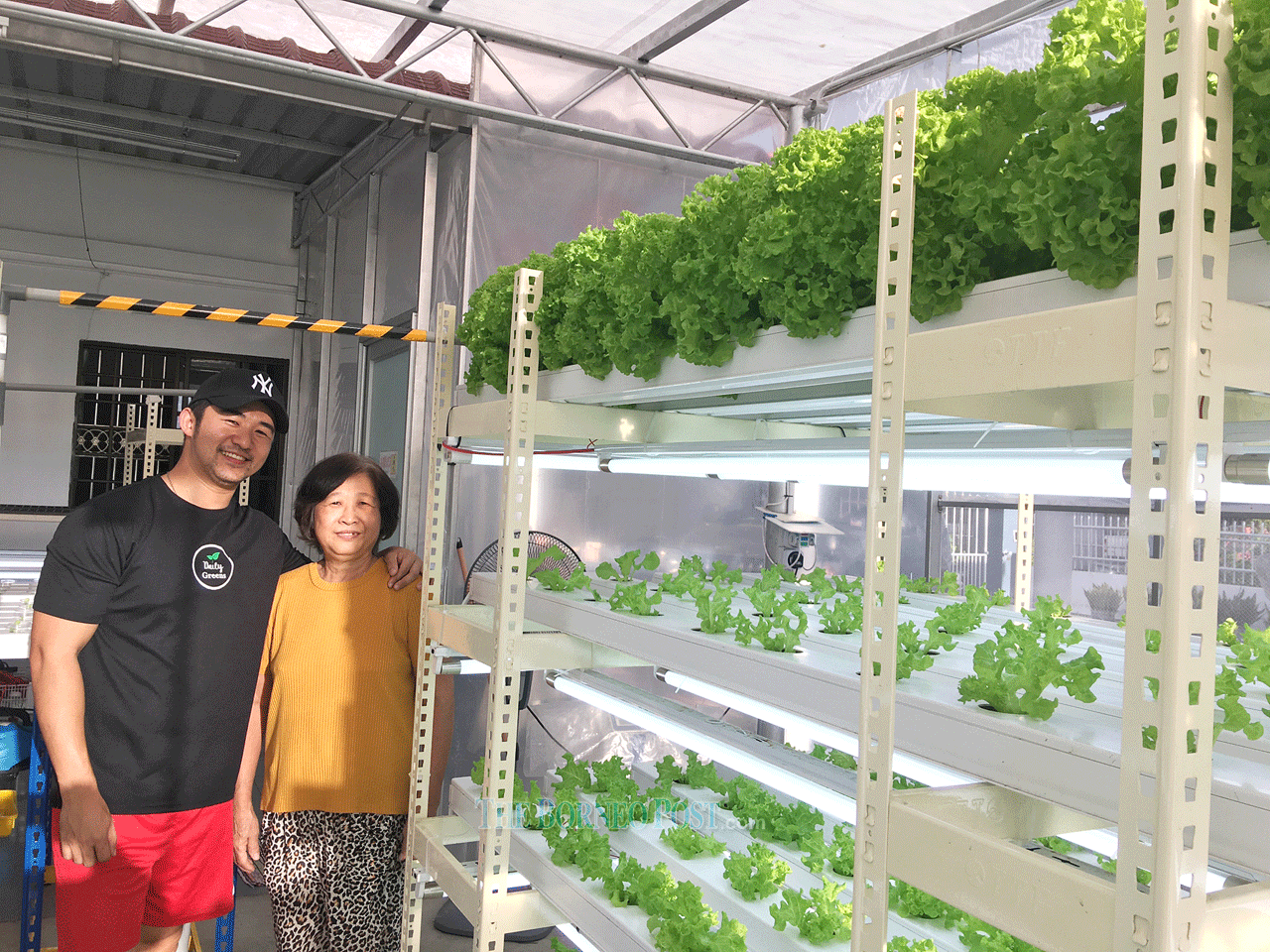
Chuo and his mum stand beside the stands of his hydroponic greens.
With his parents’ help, he has so far managed to sell to a few fruit stores, restaurants, and supermarkets.
“I supply about 5kg of lettuces daily to these places. Sometimes, I get surprise purchases from walk-in customers as well,” he said.
Chua said while he was able to do business under the Movement Control Order (MCO) and the Conditional MCO from March 18 till June 9, he couldn’t supply to restaurants which had been closed due to the lockdowns.
A few days before these lettuces are harvested.
“As you know, lettuces are widely used in restaurants for western food. So when they stopped operating, I was forced to look for other options.
“That was when I approached and negotiated with the supermarkets and stalls, selling fresh fruits, to include my vegetables on their racks. Thankfully, I managed to find these much-needed outlets,” he said.
Now, with the lifting of restrictions, Chuo said he couldn’t wait to resume business with the restaurants he had previously supplied
Challenges
While enjoying good business with his homegrown lettuces, he also faces the challenge of maintaining the amount he produces — on top of vouching for their quality — to ensure consistent supply to meet demand.
According to Chuo, one of the main concerns is the weather as lettuces need cool weather and slight shading to grow.
Fresh lettuces ready for delivery to the supermarket.
He needs to check the water level regularly to produce quality vegetables. The ventilation uses a timer, so it’s easy to control the moisture.
Another consideration is the high electricity bill.
“The ventilation, including the watering system, is automated, so electricity consumption is relatively high. But this is not a big issue,” he said.
Chuo pointed out that due to the limited growing space and the lengthy period between harvests, he had to keep planting in batches to ensure uninterrupted supply.
“It takes 45 days for each head of lettuce to be ready for harvest. So I have to plant continuously to avoid running out of stock. The challenge is I have limited growing space.”
Because of the huge market potential for his products in Miri, Chuo said he would be starting another project soon.
“I’m trying to plant other vegetables as well — tomatoes and herbs such as parsley.
“I’ll be using the same hydroponic and pesticide-free techniques to keep the taste, freshness, and quality of the vegetables,” he said.
New VIDEO by Food Retailer Freson Bros. Highlights Fresh Lettuce From Swiss Leaf Farms, Grown Inside a CubicFarms System
Shoppers at Freson Bros. now have access to locally grown lettuce that helps support Alberta jobs, increase food security, lower food miles, and use significantly less water
Alberta-based Freson Bros., a food retailer supplied by our customer Swiss Leaf Farms, produced a video to show how beautiful, fresh, and tasty lettuce is grown inside a CubicFarms system. Shoppers at Freson Bros. now have access to locally grown lettuce that helps support Alberta jobs, increase food security, lower food miles, and use significantly less water.

PODCAST: Kyle Barnett and Rob Spivock Talk Ag Tech
In this two-part episode of the CropTalk series, #KyleTalksAgTech, Kyle Barnett speaks with Robert Spivock, Director of Technology at GE Current about what makes an LED horticulture light truly reliable, using cars as a reference point for the listeners
In this two-part episode of the CropTalk series, #KyleTalksAgTech, Kyle Barnett speaks with Robert Spivock, Director of Technology at GE Current about what makes an LED horticulture light truly reliable, using cars as a reference point for the listeners.
Listen to the podcast here.

Dutch Revolution - Smart Soilless Growing On Organic Jute Fiber
We create substrates from virgin and circular jute fiber, made intelligent for the high-tech horticulture environment
HollandBioProducts Is Ready To Launch Its 100% Organic Circular Substrates For Horticulture
HollandBioProducts offer a 100% compostable organic fiber-based substrate for the tray, soil, and water cultivation with unique water controlling capacities.
Edward van Wonderen (CEO): "Being patient, listening to you early adopting customers, not being afraid to make mistakes and being flexible once the solution lays ahead of you, has allowed us to scale rapidly around the world. We create substrates from virgin and circular jute fiber, made intelligent for the high-tech horticulture environment.”
We worked for about 10 years on creating the right sustainable circular substrate for horticulture, during a time where the market moved from traditional towards high-tech farming environments. Farms now start all around the world sometimes under extreme weather conditions. It is a very challenging market.
The present world Corona pandemic strongly punts the pressure on non-sustainable ways of industrial farming. Governments and organizations ask for more sustainable ways of farming. Indoor, local, and urban. With smart use of water and energy. Creating higher output at low cost with less waste. Non-sustainable substrates like stone, foam and even peat are more and more being regarded as questionable solutions.
HollandBioProducts is ready to emerge these market opportunities and created 100% compostable and environmentally friendly substrates in cooperation with world-leading innovating farmers.


HollandBioProducts uses a pioneering patented production technology that integrates super absorbing flakes and jute. As there is no other existing company using similar technology, to improve plant quality and increasing water retention capacity of the plug we consider being unique in our final offering.”

What Will The Urban Greenhouse of The Future Look Like?
The market for fresh produce in China is looking very interesting. With a growing middle class, and safely produced, healthy food being high on the agenda in light of the current pandemic, all the ingredients are there for growth
The market for fresh produce in China is looking very interesting. With a growing middle class, and safely produced, healthy food being high on the agenda in light of the current pandemic, all the ingredients are there for growth. So it's no surprise that China was chosen as the location for the second Urban Greenhouse Challenge (UGC). Twenty student teams went head to head, planning concepts, combining agriculture and architecture to create some very interesting projects. Yesterday, the ten teams that would go to the final were announced in a webinar, which also offered a glimpse at what the future of urban farming might look like.
Team USP wants to involve city dwellers in the process of growing food through innovations such as cryptocurrency CoraCoin and application CoraApp.
Northwest A&F University Team designed an immersive ‘future agriculture’ complex that provides a new and replicable solution for urban agriculture, developed in pursuit of a more harmonious mode of coexistence between people and nature in the post-COVID-19 world.
First up to provide their opinion on this were selection committee members Tiffany Tsui, independent consultant, and René Gommersbach of Rabobank. Highlighting the aspects that make the Chinese market particularly interesting, as she had already done in an earlier UGC event, Tiffany called the food industry one of the most interesting fields for investment in the coming years, with Chinese consumers looking for safe, environmentally friendly food. "It will be the next big area for investment," she noted, pointing to the changing supply chain in China, where consumers are more and more buying their food through e-commerce rather than at the traditional wet markets.
The KAS Greenhouse combines high-quality food production, waste reduction and social engagement in form of education- and employment opportunities for urban migrants and farmers.
The Turtle from TeAMSpirit combines Chinese tradition with innovative urban solutions. Powered by a green power plant, it is a food center, business hub, research institute and meeting place all in one.
"Having a social heart is not enough"
Investing in the emerging urban food sector, which has circularity and sustainability high on the agenda, may require having a 'social heart', as presenter Jan Meijroos put it, but that's not enough, René points out. "You have to earn your money, having a social heart is not enough. In the first two, three, four years, you will lose money, but after that you must get your spin-off."
Argos offers an embodiment of sustainable architecture and circular solutions in food production, where people come in contact with vertical farming and sustainable living.
CoExist's project Shennong’s Farmers is an Experiential Knowledge Hub and Excellence Center linking people, products, and local traditions through an innovative hands-on learning experience open to all.
Scaling up circularity
Speaking of circularity, that's what selection committee members Wenqing Jin (Wageningen Plant Research) and Chris Monaghan (Metabolic) paid special attention to. "Circularity requires a certain amount of water or resources," Wenqing said, noting that scale is actually the biggest challenge in becoming circular. Chris added that the teams in the challenge weren't quite fully circular yet in terms of their concepts, but they had "come a long way", with teams focusing on different ways to achieve that. Chris particularly pointed out the need to reuse nutrients from the wastewater system to feed crops in a modern urban and regional food production system.
The Bagua is a food and educational hub, a stacked semi-closed greenhouse that integrates the latest technologies to grow healthy food within planetary boundaries. Inspired by Taoism, flows of resources and synergies between production and consumption help restore the balance between humanity and nature.
Water more valuable than energy
"Circularity is more about the flow of how resources are reused, rather than focusing on the technology", Chris noted. One of those resources that plays a major role in vertical farming right now is energy. However, according to Wenqing, this will change soon enough. "In the future, we will have plenty of electrical energy. At the moment energy is a bottleneck in vertical farming, but I believe that one day, clear water will be more valuable than electricity, so that should become a priority."
AIGreen's HerbTopia revives Lingnan style architecture to create an entertaining, educational, and collaborative environment, with innovative technical solutions around herb production.
Not just tomato towers
Chris then expanded on his thoughts about seeing circularity as a whole system. "Cities will not be resilient for food just by building towers with lettuce or tomato production", he said. "The COVID crisis has emphasized the need for a resilient approach: it's not just about high-tech agriculture."
Green Rhapsody's The Cube is an agro-food complex that serves as the city's living room and as a prototype for future sustainable solutions, including an agricultural theme park and psychotherapy based on gardening activities.
Inside the mind of a generation
Finally, Sigrid Wertheim-Heck (Aeres University of Applied Science Almere) and Stephan Petermann (MANN) shone their light on the challenge. Sigrid pointed at the blurring that's happening between the rural and urban areas, with cities moving into the rural area and vice versa. As a result, there's a balancing act going on between indoor and outdoor production. Commenting on the entries, she calls the challenge "a unique peek inside the mind of a generation", praising the optimism of the teams. "Not everyone is embracing food, circularity and sustainability right now," but the young team members are a breath of fresh air in this respect.
InnerCity designed an innovation hub inside of a modular building that adapts to its surroundings and provides more energy than it consumes. Crop production is determined by data collected directly from the customers.
Ten finalists
Then came the moment everyone had been waiting for: the announcement of the 10 teams that would move on to the finals of the challenge. Rio Pals and Marta Eggers, the organizers of the challenge, discussed how they managed to keep things interesting while it wasn't possible to meet live due to the COVID-19 restrictions. Then Tiffany Tsui took the floor again to address the teams and announce the finalists.
Pictures of the ten winning concepts are sprinkled throughout this article, and you can click through this list to learn more about them:
In the final phase of the competition, the teams will get intensive pitch training. They'll have to present their ideas in a social media pitch, a video pitch, and a longer, written pitch. "Now the real work starts", as Marta put it.
For more information:
WUR Urban Greenhouse Challenge
studentchallenges@wur.nl
urbangreenhousechallenge.nl
Publication date: Tue 23 Jun 2020
Author: Jan Jacob Mekes
© HortiDaily.com