


Welcome to iGrow News, Your Source for the World of Indoor Vertical Farming

2019 Aquaponics Food Safety Statement
The Aquaponics Association presents the 2019 Aquaponics Food Safety Statement, signed by over 130 organizations, including 98 from the U.S. This statement explains the food safety credentials of produce grown in aquaponic systems
The Aquaponics Association presents the 2019 Aquaponics Food Safety Statement, signed by over 130 organizations, including 98 from the U.S. This statement explains the food safety credentials of produce grown in aquaponic systems.
PDF version: 2019 Aquaponics Food Safety Statement
December 9, 2019
Aquaponics Food Safety Statement
Established Science Confirms Aquaponic Fish and Produce are Food Safe
Aquaponics is a food production method integrating fish and plants in a closed, soil-less system. This symbiotic relationship mimics the biological cycles found in nature. Aquaponics has been used as a farming technique for thousands of years and is now seeing large-scale viability to feed a growing global population.
Benefits of aquaponics include dramatically less water use; no toxic chemical fertilizers or pesticides; no agriculture discharge to air, water or soil; and less food miles when systems are located near consumers where there is no arable soil.
Aquaponics has consistently proven to be a safe method to grow fresh, healthy fish, fruits, and vegetables in any environment. Governments and food safety certifiers must utilize the most current, accurate information to make food safety decisions about aquaponics at this time when our food systems adapt to a growing population and environmental concerns.
Food Safety Certification for Aquaponics
For years, commercial aquaponic farms have obtained food safety certification from certifying bodies such as Global GAP, USDA Harmonized GAP, Primus GFS, and the SQF Food Safety Program. Many aquaponic farms are also certified USDA Organic. These certifying bodies have found aquaponics to be a food safe method for fish, fruits, and vegetables. As far back as 2003, researchers found aquaponic fish and produce to be consistently food safe (Rakocy, 2003; Chalmers, 2004). Aquaponic fish and produce continue to be sold commercially across North America following all appropriate food safety guidelines.
Recent Certification Changes Based on Unfounded Concerns
Recently, Canada GAP, a food safety certifier, announced that it will phase out certification of aquaponic operations in 2020, citing concerns about the potential for leafy greens to uptake contaminants found in aquaponic water.
Correspondence with Canada GAP leadership revealed that the decision to revoke aquaponics certification eligibility was based on research and literature surveys related to the uptake of pharmaceutical and pathogenic contaminants in hydroponic systems. However, these concerns are unfounded based on the established evidence.
First, the Canada GAP decision assumes that aquaponic growers use pharmaceuticals to treat fish, and that these pharmaceuticals would be taken up by plants causing a food safety risk.
In fact, pharmaceuticals are not compatible with aquaponics. Aquaponics represents an ecosystem heavily dependent on a healthy microorganism community (Rinehart, 2019; Aquaponics Association, 2018). The pharmaceuticals and antibiotics referenced by Canada GAP would damage the beneficial microorganisms required for aquaponics to function properly.
Second, the CanadaGAP decision misrepresents the risk of pathogenic contamination. Aquaponic produce – like all produce – is not immune to pathogenic contamination. However, aquaponics is in fact one of the safest agriculture methods against pathogenic risk. Most pathogenic contamination in our modern agriculture system stems from bird droppings, animal infestation, and agriculture ditch or contaminated water sources. In contrast, commercial aquaponic systems are “closed-loop” and usually operated in controlled environments like greenhouses. Almost all operations use filtered municipal or well water and monitor everything that enters and leaves the system.
Aquaponics and Food Safety
If practiced appropriately, aquaponics can be one of the safest methods of food production. The healthy microbes required for aquaponics serve as biological control agents against pathogenic bacteria. (Fox, 2012) The healthy biological activity of an aquaponic system competitively inhibits human pathogens, making their chances for survival minimal. This is, in effect, nature’s immune system working to keep our food safe, rather than synthetic chemicals.
The Government of Alberta, Canada ran extensive food safety tests in aquaponics from 2002 to 2010 at the Crop Diversification Centre South (CDC South) and observed no human pathogenic contamination during this entire eight-year period (Savidov, 2019, Results available upon request). As a result of this study, the pilot-scale aquaponic operation at CDC South was certified as a food-safe operation in compliance with Canada GAP standards in May 2011 (GFTC OFFS Certification, May 26, 2011). Similar studies conducted by the University of Hawaii in 2012 in a commercial aquaponic farm revealed the same results. (Tamaru, 2012)
Current aquaponic farms must be able to continuously prove their food safety. The U.S. Food Safety Modernization Act requires farms to be able to demonstrate appropriate mitigation of potential sources of pathogenic contamination as well as water testing that validates waters shared with plants are free from contamination by zoonotic organisms. So, if there is a food safety concern in aquaponics, food safety certifiers will find and document it.
Conclusion
The recent certification decision from Canada GAP has already set back commercial aquaponic operations in Canada and has the potential to influence other food safety certifiers or create unfounded consumer concerns. At a time when we need more sustainable methods to grow our food, it is essential to work on greater commercial-government collaboration and scientific validation to ensure fact-based food safety standards.
In order to expand the benefits of aquaponics, we need a vibrant commercial sector. And for commercial aquaponics to succeed, we need reliable food safety certification standards based on established science.
Consumers can feel secure knowing that when they purchase aquaponic fish and produce, they are getting fresh food grown in one of the safest, most sustainable methods possible.
Sincerely,
The Aquaponics Association, along with the undersigned entities
UNITED STATES
Alabama
Gardens on Air – A Local Farm, Inc.
Southern Organics
California
AONE Aquaponics
Fresh Farm Aquaponics
Go Fish Farm
SchoolGrown Aquaponics
Seouchae Natural Farming
Shwava, Inc.
University of California, Davis
Colorado
The Aquaponic Source
Bountyhaus School Farms
Colorado Aquaponics
Dahlia Campus for Health and Wellness Aquaponic Farm
Ecoponex Systems International LLC
Emerge Aquaponics
Flourish Farms @ The GrowHaus
Grand Valley Greens, LLC
GroFresh Farms 365
Northsider Farms LLC
Connecticut
Marine Bait Wholesale
Delaware
Aquaponics AI
Florida
The Aquaponics Doctors, Inc.
Aquaponic Lynx LLC
The Family Farm
GreenView Aquaponics, LLC
Sahib Aquaponics
Traders Hill Farm
Georgia
FM Aquaponic Farm
Georgia Aquaponic Produce LLC
TRC Aquaponics
Teachaman.fish
Ula Farms
Hawaii
Friendly Aquaponics, LLC
Idaho
FoodOlogy
Illinois
Central Illinois Aquaponics
Kentucky
Janelle Hager, Kentucky State University
K&L Organics
Purple Thumb Farms
West KY Aquaponics
Louisiana
Small Scale Aquaponics
Massachusetts
Aquaponics Academy
Lesley University
O’Maley Innovation Middle School
Maryland
Anne Arundel Community College
Greenway Farms, LLC
Missouri
Www.PlentyCare.Org
Minnesota
Menagerie Greens Inc.
North Carolina
Grace Goodness Aquaponics Farm, LLC
100 Gardens
New Hampshire
University of New Hampshire
New York
iGrow News
Oko Farms
New Mexico
Desert Verde Farm
Growing the Greens
High Desert Aquaponics
Howling Coyote Farms
Lettuce, Etc. LLC
Openponics
Project Urban Greenhouse
Sanctuary at ABQ
Santa Fe Community College
Ohio
Berean Aquaponic Farms and Organics LLC
CHCA Eagle Farms
Wildest Farms
Williams Dairy Farms
Oklahoma
Freedom FFA
Greener Grounds LLC
Oregon
Alternative Youth Activity
Ingenuity Innovation Center
Live Local Organic
Triskelee Farm
Pennsylvania
Aquaponics at State High
Yehudah Enterprises LLC
Puerto Rico
Fusion Farms
Granja Ecologica Pescavida
Rhode Island
The Cascadia Bay Company
Tennessee
Great Head LLC
Texas
BioDiverse Technologies LLC
BnE Enterprises
East Texas Aquaponics, LLC
Gentlesoll Farm
HannaLeigh Farm
K&E Texan Landscaping
King’s Farm
Tarleton State University, Aquaponics Hydrotron
West Texas Organic Gardening
Utah
Aquaponics Olio
Wasatch High School
Virginia
Grace Aquaponics
INMED Partnerships for Children
Return to Roots Farm
Vermont
The Mill ART Garden, LLP
Washington
The Farm Plan
Impact Horizon, Co.
Life Tastes Good LLC
Northwest Aquaponics LLC
Wind River Produce
Washington, DC
Anacostia Aquaponics DC LLC
P.R. Harris Food Hub
AUSTRALIA
New South Wales
Wirralee Pastoral
Solum Farm
BHUTAN
Thimphu
Chhuyang – Aquaponics in Bhutan
BRAZIL
Rio Grande do Norte
Habitat Marte
Santa Catarina
Pedra Viva Aquicultura
BULGARIA
Burgas
Via Pontica Foundation
CANADA
Alberta
Agro Resiliency Kit (ARK) Ltd.
Fresh Flavor Ltd
Lethbridge College
W.G. Guzman Technical Services
British Colombia
Garden City Aquaponics Inc.
Green Oasis Foods Ltd.
Pontus Water Lentils Ltd.
Ontario
Aquatic Growers
University of Guelph
Power From Within Clean Energy Society
GREEN RELIEF
Quebec
ML Aquaponics Inc
Yukon Territory
North Star Agriculture
EGYPT
Cairo
Central Laboratory for Aquaculture Research
FRANCE
Paca
Vegetal Grow Development
INDIA
Delhi
Prof Brahma Singh Horticulture Foundation, New Delhi
Karnataka
Blue’s and Green’s
Spacos Innovations Private Limited
ITALY
Turin
Grow Up
MALAYSIA
Negeri Sembilan
BNS Aquafresh Farming
NIGERIA
Abuja
University of Abuja
PHILIPPINES
Nueva Ecija
Central Luzon State University
Metro Manila, NCR
IanTim Aquaponics Farm
PORTUGAL
Madeira
True Spirit Lda
ROMANIA
Sectors 2 & 4
Bucharest Association of Romanian Aquaponics Society
SAUDI ARABIA
Riyadh
Aquaponica
SENEGAL
Senegal
Ucad Dakar
SINGAPORE
Singapore
Aquaponics Singapore
Contributors:
Brian Filipowich, Aquaponics Association
Juli Ogden, The Farm Plan
Dr. Nick Savidov, Lethbridge College
Tawnya Sawyer, The Aquaponic Source
Dr. R. Charlie Shultz, Santa Fe Community College
Meg Stout, Independent
Contact:
Brian Filipowich
info@aquaponicsassociation.org
References
Chalmers, 2004. Aquaponics and Food Safety. Retrieved from http://www.backyardaquaponics.com/Travis/Aquaponics-andFood-Safety.pdf
Filipowich, Schramm, Pyle, Savage, Delanoy, Hager, Beuerlein. 2018. Aquaponic Systems Utilize the Soil Food Web to Grow Healthy Crops. Aquaponics Association. https://aaasociation.wpengine.com/wp-content/uploads/2018/08/soil-food-web-aug-2018.pdf
Fox, Tamaru, Hollyer, Castro, Fonseca, Jay-Russell, Low. A Preliminary Study of Microbial Water Quality-Related to Food Safety in Recirculating Aquaponic Fish and Vegetable Production Systems. Publication of the College of Tropical Agriculture and Human Resources, the Department of Molecular Biosciences and Bioengineering, University of Hawaii, February 1, 2012.
Rakocy, J.E., Shultz, R.C., Bailey, D.S. and Thoman, E.S. (2003). Aquaponic production of tilapia and basil: comparing a batch and staggered cropping system. South Pacific Soilless Culture Conference. Palmerston North, New Zealand.
Rinehart, Lee. Aquaponics – Multitrophic Systems, 2019. ATTRA Sustainable Agriculture. National Center for Appropriate Technology.
Tamaru, Fox, Hollyer, Castro, Low, 2012. Testing for Water Borne Pathogens at an Aquaponic Farm. Publication of the College of Tropical Agriculture and Human Resources, the Department of Molecular Biosciences and Bioengineering, University of Hawaii, February 1, 2012.

Autogrow Appoints Two Product Specialists For Growing Market
Autogrow has appointed Steve Gardner - Head of Product and Sophie Stanley - Head of Product Marketing, to support the company’s continued global growth. Both are members of the Senior Leadership Team
4 December 2019: Autogrow has appointed Steve Gardner - Head of Product and Sophie Stanley - Head of Product Marketing, to support the company’s continued global growth. Both are members of the Senior Leadership Team.
“It’s great to have someone with Steve’s experience joining us. He will lead customer conversations and engagement to shape the value our products provide to growers and the industry,” says Darryn Keiller, CEO.
“Sophie’s experience within agriculture is fantastic. Combined with her passion for the industry, we are lucky to have her on board.”
Steve previously lead product development involving machine learning, IOT and augmented reality products covering web, mobile, APIs and embedded systems in South Africa and New Zealand.
Sophie, a Nuffield Scholar and previous Vice President of Figured – USA, will lead Autogrow’s go-to-market strategy. Having previously built a successful partnership with one of the largest farm lending institutions in the American Midwest, Sophie will drive market adoption and commercial growth.
Autogrow has increased their team over the past 12 months with new employees in Malaysia, the United States, and New Zealand. This growth will continue through 2020 as new innovations are launched into the market.
PHOTO: Sophie Stanley and Steve Gardner
MEDIA QUERIES
Kylie Horomia, Head of Communications
(e) Kylie.horomia@autogrow.com
(m) +6421 733 025
(w) www.autogrow.com www.farmroad.io www.cropsonmars.com
Sales queries – Sales@autogrow.com
About Autogrow
Autogrow leverages the power of technology, data science and plant biology to provide indoor growers affordable, accessible and easy-to-use innovation – 24/7, anywhere in the world.
Our hardware, software and data solutions support growers and resellers in over 40 countries producing over 100 different crop types.
We are the experts in Controlled Environment Agriculture (CEA) and continue to stay ahead of a rapidly evolving landscape.

Denmark: Grown And Harvested In Stores Now In Copenhagen
This is the beginning of a new partnership between Infarm and the Danish retailer Irma. Infarm is planning to bring their fresh produce to more Irma locations across Sjælland in the next few months
Starting Nov. 21st fresh Infarm produce will be available to Danish consumers for the first time at Copenhagen’s Irma Østerport (Oslo Pl. 2, 2100 København, Denmark). Local shoppers (and perhaps even local chefs) will be able to choose from a selection of living Italian Basil, Greek Basil, Parsley, and Coriander Confetti, grown and harvested right in the store.
This is the beginning of a new partnership between Infarm and the Danish retailer Irma. Infarm is planning to bring their fresh produce to more Irma locations across Sjælland in the next few months.
Infarm
Glogauerstr. 6 10999 Berlin
+49 30 58846540
infarm.de
Publication date: Fri 22 Nov 2019
GP Solutions' New Technologies Provide Cleaner Farming
The company developed what they call a 'GrowPod.' Essentially, a food-grade shipping container refurbished and outfitted with the latest technology to grow clean food in a controlled environment," the publication stated
COLTON, Calif., Dec. 4, 2019,/PRNewswire/ -- GP Solutions (OTC:GWPD), the developer of modular automated micro-farms, may help in solving the E.coli crisis that is sickening dozens across America according to Business Management News.
The article said dozens of people were infected across 19 states in the most recent E. coli outbreak stemming from lettuce harvested in California. The infected range from 3 to 89 years old. 39 were hospitalized. Six developed kidney failure.
While the publication says, "America's food chain is broken," there is "hope on the horizon."
"New indoor Controlled Environment Micro-Farms (CEMFs) have been developed by some forward-thinking companies," the article stated.
"One such company is GP Solutions. The company developed what they call a 'GrowPod.' Essentially, a food-grade shipping container refurbished and outfitted with the latest technology to grow clean food in a controlled environment," the publication stated. "Inside a GrowPod, the air and water are filtered, and since it is a sealed environment, there is little chance for contamination."
Moreover, the magazine noted, these pods are not just for existing farmers.
"They are easy to operate so almost any business, organization, hotel, farmer's market, or restaurant can have their own Pod and supply their customers with truly farm-fresh, clean, healthy food."
GrowPods empower anyone to grow food for their community or for profit. Being portable and modular, they can be placed almost anywhere, and stacked to expand operations or keep crops separated. Farmers can utilize GrowPods to cultivate a broader product line, and sustain revenues and employees over the winter.
The article also stated that growing greens inside a CEMF is efficient and produces a large crop yield equivalent to about two acres of outdoor farmland.
For more information, visit: www.growpodsolutions.com, or call: (855) 247-8054.
To view the article, visit: https://businessmanagement.news/2019/12/01/e-coli-sickens-dozens-across-the-nation/
Forward-Looking Statements
This release includes predictions or information that might be considered "forward-looking" within securities laws. These statements represent the Company's current judgments but are subject to uncertainties that could cause results to differ. Readers are cautioned to not place undue reliance on these statements, which reflect management's opinions only as of the date of this release. The Company is not obligated to revise any statements in light of new information or events.
Connect:
Email: info@growpodsolutions.com
Website: www.growpodsolutions.com
Facebook: facebook.com/GrowPodTechnology
Twitter: @GrowPodSolution


U.K Aeroponic Start-Up LettUs Grow: 'Not Everyone Is Sold on Vertical Farming Initially'
Thankfully, the image of vertical farming is changing rapidly. Nowadays, aeroponic technology "is recognized more as a business plan rather than a pipe dream," said Langley. Indoor farming has also been getting loads more attention
December 05, 2019
Farmers across the globe are searching for sustainable, tech-savvy alternatives as climate change increasingly impacts agriculture's profitability.
LettUs Grow, a Bristol-based aeroponics tech company that provides technology to farms in the U.K., thinks it may have a solution.
The vertical farming tech provider gave us a glimpse into the future of aeroponics and an overview of its innovation.
Overcoming challenges in vertical farming
"There's a perception about vertical farms - not everyone is sold on it initially," LettUs Grow's India Langley told FreshFruitPortal.com.
The company's greatest challenge has been public perception. Oftentimes people imagine that their produce comes from local, small scale farms. However, the reality is that most farms are industrial entities - at least in the U.K. - explained Langley.
Thankfully, the image of vertical farming is changing rapidly. Nowadays, aeroponic technology "is recognized more as a business plan rather than a pipe dream," said Langley. Indoor farming has also been getting loads more attention.
So, the task aeroponics tech companies face is "educating people that the food is just as nutritious".
As vertical farming becomes more mainstream, companies like LettUs Grow have seen more demand for their products.
What, then, does the technology do and what will the future of vertical farming look like?
LettUs Grow walked us through its technology's evolution and the benefits it provides to today's agriculture industry.
The idea for LettUs Grow arose when three Masters students at the University of Bristol - Ben Crowther, Jack Farmer and Charlie Guy - developed a table-top aeroponics system. This in-home model worked so well that the group decided to scale it up.
"We started out solely making hardware, so the physical grow beds," Langley said. The company then began crafting software it calls Ostara - which reduces energy costs up to 15%.
Founders saw that traditional aeroponics - which use high pressure - were inefficient. Old methods, which involved firing liquid through a nozzle to create aerosols, lead to clogging and system failures. In order to reduce waste, LettUs Grow sought alternatives.
To do this, it got rid of nozzles entirely. It also developed a new way of making aerosols. These innovations allowed the platform to be scaled up.
"What the three founders thought was that if they were seeing this increase in growth rate in these home-kits and their main goal was to reduce waste, they would do much better taking this technology and applying it to farm-scale applications."
The result was an aeroponics system that reduces food miles, increases food freshness and "helps farmers keep farming".
According to Langley, there is big problem in the U.K. with farmers needing to diversify. Climate change has posed a risk to farmers' income and vertical farming provides a solution, she said.
She specified that "one of the things that indoor growing does is that it protects the crop" and ensures that farmers profit regardless of weather conditions.
Benefits of aeroponics and LettUs Grow's advice
When asked about the benefits of aeroponics versus other indoor farming methods, Langley said "aeroponics has been an improvement" on hydroponics. This is because it gives the plants better access to "free gas exchange".
In short, it provides the "ideal environment" to grow, claimed Langley. Aeroponics "holds plant roots out of water" and sprays plants with an aerosol. Plants in aeroponics grow 70% faster than in hydroponics, she stated.
She went on to explain the strategic benefits and challenges faced by farmers.
"The main thing that holds you back is whether or not there's a business case for it," said Langley.
"We always advise people who are working with us to think really carefully about what they grow."
LettUs Grow suggests farmers plant crops like microgreens, quick growing crops, and tender crops that struggle to be transported. While the company has tested "dozens" of different plants at its two farms, it encourages farmers to plant profitable crops like basil.
Looking forward, the future of the company
LettUs Grow continues growing as demand for its technology increases. While farms all around the world have requested the company's products, it says plans for expansion into Europe - and eventually, worldwide - are in the works for upcoming years.
Currently, it only provides technology to farms in the U.K.
It seems a lot of demand from countries that face resource issues. Places that contact LettUs Grow tend to be dry regions like the Middle East or regions with less sunlight. Additionally, it is gaining popularity in "places where there's not as much land" in more developed countries like the U.S.
Other urban farming schemes like startup Bowery, Gotham Green and Fifth Season have been gaining steam in U.S. cities.
To meet the needs of diverse farms that request its technology, Lettusgrow plans to continue expanding its product line.
In the past, its implementation of Ostara farm management software allowed it to offer a platform that collects data on plants, oversees irrigation and traces crop history.
Most recently, it has partnered with Octopus Energy to create "vertical power software". The new technology platform reduces energy costs for farmers, making operations more efficient.
It does this by changing the price of energy throughout the day and minimizing costs during peak hours. This both saves customers money and incentives farmers to have more sustainable operations, detailed Langley.
Headline photo: LettUs Grow, Jack Wiseall

THE NETHERLANDS: "Container Offers Flexible Research Solutions"
On the outside it's 'just' a container. But when the doors open, a good deal of high-tech reveals itself. A climate container to be precise
on their way to USA
On the outside it's 'just' a container. But when the doors open, a good deal of high-tech reveals itself. A climate container to be precise. In Aalsmeer in the Bosman Van Zaal production hall, two are ready to be transported to a large American herb grower who wants to use the container to work out the optimum cultivation recipe for basil.
Carlo Castelijn inside of the container in which three 'Danish carts' fit next to each other. If desired, both sides can also be provided with a Grow&Roll-system with Danish carts.
Container over climate chamber
But why a container and not a climate chamber? "Simple", says Carlo Castelijn of Bosman Van Zaal. "These containers can then be clicked onto the back of a trailer. This makes it possible, after a research project, to sell the container or transport it to another location of the company. A lot cheaper than demolishing an entire climate chamber and rebuilding it elsewhere."
Recently, numbers three and four were built, after the first container had already been built two years ago at the request of another customer.
Three Danish cars
A total of three extra wide 'Danish' cars fit in one half of the container. These can be used to create a small-scale multilayer cultivation system with LED and all the bells and whistles that come with it. On the other hand, a growing table has been mounted for research into 'normal', non-multi-layer cultivation.
The only thing needed to get the climate container up and running is electricity, water and CO2. Electricity to keep the LED lights on and the climate computer running. The latter then takes care of the rest, including the water and CO2 dosing.
The side containing the grow table, a request from the customer who wanted the table as low as possible. In addition, gutters are hung in the container so that the customer can experiment with strawberry cultivation.
Over the past few weeks, the finishing touches have been put to the containers, which will be transported in December.
Finishing off with the numbers:
-Container outer dimensions: 6058x2500x2896 mm LxWxH
-Grow&Roll cultivation area: 9x0.9 square meters
-Cultivation surface table: 2 square meters
For more information:
Bosman Van Zaal
info@bosmanvanzaal.com
www.bosmanvanzaal.com
Publication date: Tue 26 Nov 2019
© HortiDaily.com
OUTLOOK 2019: Global Entrepreneurs Eye Pitt Meadows Vertical Farm
Traditional farming practices have many variables that come into play when growing consistent crops, and with climate change being a rife issue around the globe, what does the future of farming look like? It looks like a Greenhouse 2.0, according to Dave Dinesen, CEO of Cubic Farm Systems
Commercial-Style Crops Growing At Cubic Farm Systems
November 28, 2019
Traditional farming practices have many variables that come into play when growing consistent crops, and with climate change being a rife issue around the globe, what does the future of farming look like?
It looks like a Greenhouse 2.0, according to Dave Dinesen, CEO of Cubic Farm Systems.
“It’s an automated commercial-scale vertical farming system that allows you to grow commercial-scale quantities of leafy green vegetables, herbs, animal feed, lots of different sorts of leafy green products, 12 months a year anywhere on earth,” Dinesen explained about the pesticide-free operation.
Pitt Meadows is home to the sole corporate-owned and operated cubic farm facility that produces commercial-scale crops locally that can be found at some IGA and Fresh Street Market locations. Dinesen says the facility is their test kitchen and production site. The company is in business to sell, install and train their farmer customers on how to operate the system.
“Our smallest system is about a 17 machine set up which would grow almost two million heads of lettuce per year or thousands of pounds of microgreens or other crops like that,” he said.
But the company is hearing from retailers that the crop is not what they have come to expect from traditional farms.
“Believe it or not when it comes to our lettuce, the two consistent feedbacks are, best we’ve ever tasted and this stuff lasts forever, which are two comments that you rarely hear… and the difference is, its how we grow, harvest, and package,” Dinesen explained. “And because we’re able to harvest produce and leave the root on and leave it living, it lasts a long time, stays health, stays crispy, retains its nutritional value.”
So what are the benefits of this technology-enabled farming?
“Traditional farming uses an enormous amount of freshwater and we have to preserve that commodity,” explained Dinesen. “We have to be able to grow locally, we can’t keep shipping so much food for so many miles. Technology-enabled farming or indoor automated vertical farming enables all that. It facilitates automation in a way that is challenging otherwise.”
The company has also found the system produces consistent crop yields when environmental factors are eliminated, something that remains a major factor is traditional farming practices.
“Probably the biggest difference between our system and anyone else is that we have a machine that significantly increases the amount of crop you can grow per cubic foot because we can go high as opposed to just one layer which would be a traditional Greenhouse or a traditional field crop.”
The local corporate facility received its GAP (good agricultural practices) certification almost a year ago and has been in operation since.
“I think Pitt Meadows can be proud it’s had one of the largest vertical farms in Canada operating now for a year. People from all over the world fly in, almost every week to see it, so it is generating a significant amount of economic benefit for the city,” said Dinesen.
The company has sold several units in Canada and some in the U.S. Dinesen said there are a few deals in the works for the new year as well.
“We have a very large farm that will be going into another municipality nearby, early in 2020. The system will be a 26 machine system, they will be growing a wide variety of leafy green vegetables, Asian vegetables, Asian herbs… it’s going to be grown for the local market,” he said. “And we have two other deals pending in B.C. that we expect to close early in 2020 for a similar size facility.”
The company is also looking to expand the Pitt Meadows site on the same site or nearby.
Cubic Farm System is created by founders of Langley-based Bevo Farms’ Jack and Leo Benne when the pair were invited to solve growing challenges in Puerto Rico.
Bevo Farms operates 39 acres of Greenhouses in Langley and five acres in Pitt Meadows, according to their website. Last year, the company entered the cannabis industry when they signed a deal with medical marijuana producer Sun Pharm Investments Ltd.

Does Farming’s Greener Future Mean A Return To Tradition, or New Technology That Heralds ‘The End of Sustainable Agriculture As We Know It’?
With the UK committed to becoming carbon-neutral by 2050, agri-tech — technology applied to farming — is increasingly playing a crucial role in reconciling food production with sustainability
Carla Passino November 24, 2019
Indoor farming could pave the way for the UK to move towards net-zero, say experts Credit: Getty Images/iStockphoto
With the climate emergency and biodiversity crisis becoming increasingly pressing, we could see a shift away from conventional agriculture towards indoor food production, say some experts.
With the UK committed to becoming carbon-neutral by 2050, agri-tech — technology applied to farming — is increasingly playing a crucial role in reconciling food production with sustainability. But rapidly advancing innovation, together with the growing interest in the natural capital of land to combat climate change and halt the decline in biodiversity, could change agriculture as we know it, with vertical farming replacing, at least in part, field-grown crops.
Emily Norton, head of rural research at Savills, told a meeting of rural professionals this week that the future may not look anything like they’ve envisioned.
‘Pursuing carbon efficiency in agriculture is going to be transformational,’ she said at a meeting in Norwich.
‘Farmers have naturally been adopting a wait-and-see approach to accessing ELMS, but the climate debate could fast-track disruptive agricultural innovation and signal the end of sustainable agriculture as we recognize it here in Norfolk.’
That’s a stark warning: we think of sustainable farming as a return to traditional methods, and while this will be part of the solution there will be a role for technology such as indoor growing.
‘If agriculture as an industry accepts the net-zero challenge we need to be prepared to adapt accordingly… Indoor production is inevitable for a variety of crops’
‘The Committee on Climate Change Land Use Change report recommended the release of around half of all UK arable land to environmental adaptation,’ she explained.
‘If we’re to produce the same amount of food, this signals a major shift to innovations like controlled environment agriculture — removing food production from the soil. However controversial it might feel, if agriculture as an industry accepts the net-zero challenge we need to be prepared to adapt accordingly. Net-zero, climate change, and technological innovation all suggest that more indoor production is inevitable for a variety of crops.’
There is no doubt that, with the climate emergency at the forefront of people’s minds, there’s a growing demand for land to deliver environmental benefits, whether through planting trees, generating green energy or restoring habitats for fast-disappearing wildlife.
Likewise, the technology to deliver sustainable, indoor-farmed produce has quickly advanced. ‘For many years, we have grown produce in glasshouses and vertical farming is another step forward,’ says Charlie Yorke, technology specialist at rural insurers NFU Mutual, which earlier this month published a report on agri-tech.
‘Crops can essentially be grown anywhere as long as there is water and electricity’
The term, he continues, broadly covers ‘a variety of farming methods that stack multiple layers of crops on top of one another — fully utilizing 3D space.’ Farm designs can be entirely tailored to suit each crop type and space constraints, whether this means having racks of micro-green pallets in a shipping container, or tall spires of lettuces in a bespoke glasshouse. Because of this flexibility, ‘crops can essentially be grown anywhere as long as there is water and electricity.’
But the system’s key advantage, according to Mr. Yorke, is that farmers ‘can control the environment completely,’ targeting it to the specific requirements of the crops they are growing to optimize growth and yields. ‘They can control the humidity, the temperature, the light and they can really start to tailor these crops just by using light and different nutrients.’
Essentially, this means people can ‘consistently produce perfect crops all year round’. And because everything is closely controlled, ‘there is minimal use of pesticides and petrochemical fertilizers’. Vertical farms also ‘hardly use any water and a lot of what they use is recycled — it might be from rain, it might be filtered.’ Mr. Yorke mentions Intelligent Growth Solutions, a vertical farm system in Edinburgh, as an example of a company that recycles rainwater.
All this, together with the ability to make the best possible use of available space, results in ‘higher yields per area of land with much lower waste’.
‘Leafy greens work well but cereals and fruits are a challenge’
Nonetheless, the National Farmers’ Union, which earlier this year stated that agriculture should strive and become carbon neutral by 2040, ten years earlier than the government’s own deadline, believe that it’s yet early days for soil-less farming to supplant more traditional practices.‘Vertical farming is very much in the early stages of being researched to test how feasible it is for the future,’ said a spokesperson. ‘Currently, the high costs of implementation will limit its uptake and therefore its impact on the wider food supply chain.’
Instead, with British growers at the forefront of technological developments that improve quality, yield, environmental protection and energy use, according to the NFU, ‘it is crucial that retailers ensure they also invest and support the farmers that supply them with large, field-scale crops such as root vegetables, where vertical farming is not realistic.’
The NFU Mutual’s Mr. Yorke agrees it’s early days and that, ‘at present, the technology is not suited to all crops; leafy greens work well but cereals and fruits are a challenge.’
Overall, however, he believes the future of sustainable food production lies very much in integrating vertical farming into a wider mix that also includes other ground-breaking tools, such as digital soil mapping systems, robotic micro-sprayers or livestock sensors, that support land-based agriculture and help make it more productive and eco-friendly at the same time.
‘We don’t see vertical farming replacing traditional farming methods — rather we see it complementing farming and maximizing spaces which may have previously been seen as non-agricultural,’ he says, quoting, as an example, Growing Underground, a micro-green and salad producer operating 108 feet below the streets of Clapham, in London. ‘It is one of a number of innovations which are already demonstrating alternatives to conventional field-based production.’

US: OHIO - 8,600 sq ft Indoor Aquaponics Facility Opened In Toledo
There's a new farm in Toledo, and it's located inside a building downtown. Balance Farms is an aquaponics farm in Downtown Toledo vertically integrated with parent restaurant Balance Grille
There's a new farm in Toledo, and it's located inside a building downtown. Balance Farms is an aquaponics farm in Downtown Toledo vertically integrated with parent restaurant Balance Grille.
Their restaurant has been active for nearly a decade, serving vegetable-focused Build-a-Bowls, Asian-inspired Tacos, and seasonal snacks to the Toledo and Cleveland communities
Balance Grille held a grand opening showcase Friday night for its state-of-the-art aquaponics farm, germinating right in the heart of downtown Toledo.
The new 8,600 square-foot facility uses waste from fish as a natural fertilizer for plants to grow in water, pesticide-free. The facility cultivates crops grown outside the soil, specializing in leafy greens, microgreens, living herbs, and fruiting vegetables such as peppers and tomatoes. Additionally, the farm utilizes LED lighting and energy-efficient climate control systems that reduce utility usage. The farm runs on the organic fish matter produced by its collection of tilapia and koi fish.
"In any Balance location, you will notice the open-kitchen concept that informs customers on how their food is being prepared. Opening the Balance Farms helps us take the concept of transparency to another level by showing customers where their food is coming from", they explain.
Scheduled tours are available for groups and individuals.
To View The Video, Please Click Here

Publication date: Mon 25 Nov 2019
How To Run A Successful CSA | WEBINAR
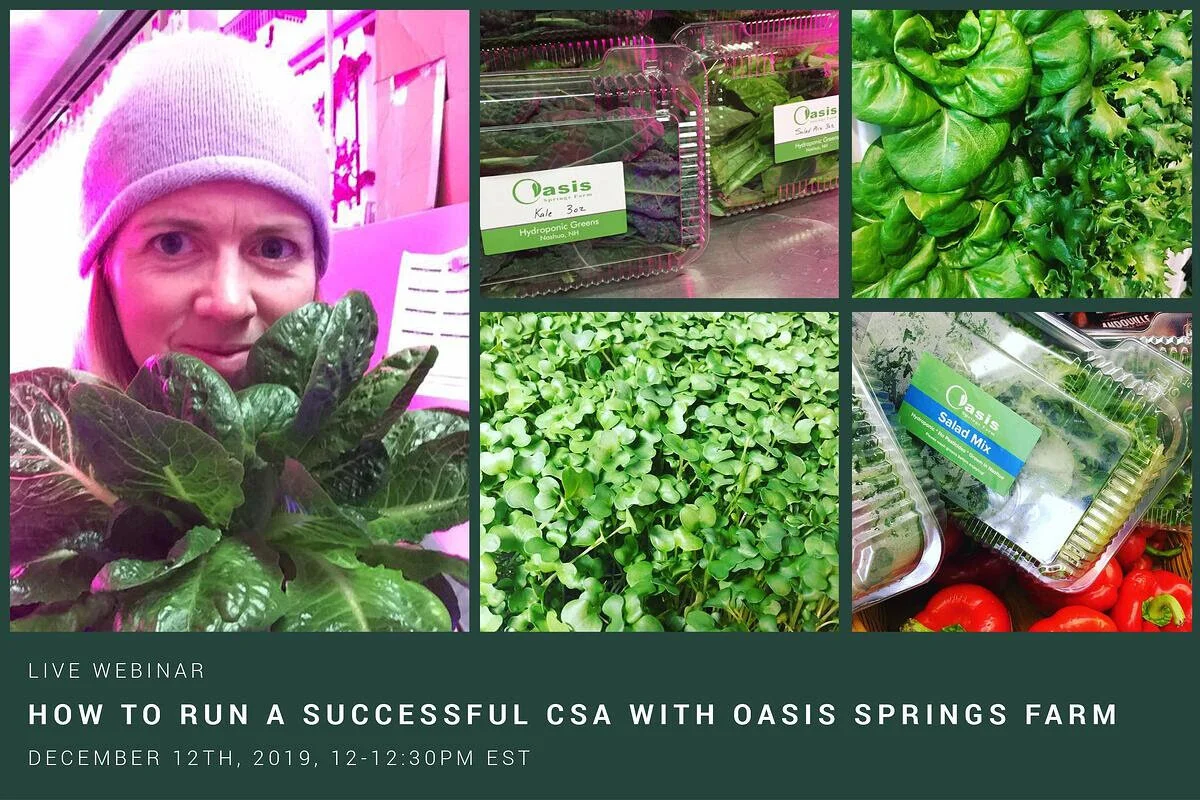
So you want to start a CSA...but you have so many questions. Where do I find customers? What's the best way to set up operations? What should I grow? We went directly to the expert to help you answer all these questions and more
Hear How Sarah Sells Out Her CSA Every Season
Thursday, December 12th, 2019
12 - 12:30 PM EST
So you want to start a CSA...but you have so many questions. Where do I find customers? What's the best way to set up operations? What should I grow? We went directly to the expert to help you answer all these questions and more.
REGISTER HERE
Sarah Ward from Oasis Springs Farm in Nashua, New Hampshire has been operating a successful CSA since 2016. She's sharing how she overcame challenges while growing her customer base and finding creative ways to find free marketing.
GET TO KNOW OUR GUEST
Check out our farmer Q&A with Sarah to get a sneak peek of all the great stuff we’ll cover live.

INDIA: This MeitY-Backed Startup Has Built An Automated Farming Device To Grow Plants And Veggies Indoors
This MeitY-backed startup has built an automated farming device to grow plants and veggies indoors Delhi-based startup Agro2o is marrying hydroponics (soilless farming) and automation to bring a cool new gadget and a whole lot of good vibes to millennial households
This MeitY-backed startup has built an automated farming device to grow plants and veggies indoors Delhi-based startup Agro2o is marrying hydroponics (soilless farming) and automation to bring a cool new gadget and a whole lot of good vibes to millennial households.
Yash Vyas was working in a retail store in Dubai when he stumbled upon the concept of hydroponics in a newspaper.
Hydroponics (also known as ‘soilless farming’) is a practice where plants are grown indoors using mineral nutrient solutions in water solvents. It fascinated Yash instantly and also made him realize that Dubai’s harsh desert climate had made it difficult to grow farms.
“There was inefficiency of land and water, and almost no greenery either at home or outside. That formed my belief that hydroponics could be a fix. It is a clean and sustainable solution, unlike current farming techniques,” Yash tells YourStory. He then returned to India at the end of 2017 and started Agro2o in early 2018.
Yash Vyas, Founder & CEO, Agro2o (centre) with Ashish Goel, CTO, Agro2o (right)
Growing an indoor smart garden
The Delhi-based startup operates at the intersection of agritech and IoT. Agro2o has developed a proprietary smart garden using a fully automated indoor hydroponics system.
The plug-and-play solution allows anyone to grow fresh herbs, veggies, medicinal plants, and even flowers inside their homes. Because it is an IoT-enabled product, it requires little human attention on a daily basis. The Founder-CEO explains, “We call it automated hydroponics. Depending on the plant type, the system can intelligently judge and provide the level of light, water, and nutrients required, and create an ideal growing condition for the plant.
There are microcontrollers fitted into it. All you have to do is insert a nutrient cartridge depending on the plant you want to grow.” The smart garden is also enabled with a touchscreen and WiFi connectivity. It sends out alerts to users whenever the water has to be topped up. In the future, the system could even come with Alexa integrations, Yash shares.
Intersection of hydroponics and automation
He explains that this unique marriage between hydroponics and automation is a result of the startup’s two years of extensive R&D in plant science, for which it collaborated with the Delhi University’s Department of Plant Molecular Biology.
“We also acquired expertise in automation and AI to be able to perfect the technology and apply for design patents,” Yash reveals. While the product is yet to see a commercial launch (planned for early 2020), Agro2o showcased its technology at the Startup Expo held in September.
“It attracted a lot of interest from investors and general buyers,” claims the Founder. Agro2o has even opened pre-orders on its website.
It has also been incubated by Electropreneur Park, an initiative of the Ministry of Electronics and Information Technology (MeitY). The currently bootstrapped startup might even look to raise a seed round of Rs 1.5 crore to Rs 2 crore in 2020. Agro2o’s current device allows you to grow 10-12 crops at a time. These are categorized into Herbs, Greens, Veggies, and Ornamentals.
“Categories of crops cannot be mixed because the nutrients and conditions required for each are different,” Yash says. He adds that a 24-crop device is in the pipeline. The plan is to have three products for varying crop capacities in the price range of Rs 8,000 to Rs 18,000. “It is like any other consumer durable device that can last you for 4-5 years,” Yash adds. Also Read How DST-backed agritech incubator Indigram Labs is ushering in a new green revolution ‘
Key markets and growth plans
As could be expected, the demand for indoor hydroponics systems is much higher in the Gulf countries than in India.
The founder attributes this to severe climatic conditions and higher disposable incomes in these regions. Hence, to tap into this growing demand, Agro2o will launch in the Middle East along with its rollout in Delhi, Mumbai, Bengaluru, and Chennai. By 2025, the startup plans to sell two lakh units in India, and clock revenue of Rs 300 crore - Rs 350 crore. In the GCC countries, meanwhile, it hopes to sell about five lakh units in five years.
Yash observes, “I see two user profiles for our products. One is the value-conscious customer who wants something positive in their space.
The second is urban millennials who like cool gadgets and also love cooking with fresh veggies and herbs.” While smart homes is Agro2o’s immediate focus, the startup also has ambitions to venture into the smart farm segment. “Technology-enabled commercial soilless agriculture will soon become a reality,” says Yash. Also Read Stanford Seed startup Future Farms is out to solve India’s food crisis with clean, soil-less farming
Tech a facilitator for soilless agriculture
Hydroponics is a nascent sector in India. But globally, the market is expected to be worth $12.1 billion by 2025, with the Asia Pacific being the growth driver, according to Transparency Market Research.
Agro2o claims to be the first in Asia to launch a smart hydroponics product. “So, building awareness is both an opportunity and a challenge,” says the founder.
“Our nearest [undisclosed] competitor in the West is valued at only $120 million. This is a relatively new sector, but there is a large potential to be realized,” he explains. Does Agro2o want to be seen as an agritech or an IoT company? A bit of both perhaps. Or, as Yash puts it: an innovation company in the smart hydroponics sector. “Tech is just a facilitator to make soilless farming more accessible,” he signs off. (Edited by Evelyn Ratnakumar)
Read more at: https://yourstory.com/2019/12/meity-agritech-startup-hydroponics-smart-garden-automation-iot

Netled’s Niko Kurumaa On The Potential of Indoor Agriculture In North America
He told Contain, “most leafy greens are grown with pesticides in California and Mexico and then are shipped thousands of miles all over North America. People are starting to see that this isn’t an ethical way to produce food.”
Nov 29, 2019
When we dialed Niko Kurumaa, sales manager at Netled, he took Contain’s call from the rooftop of a hotel in Los Angeles. When asked how his day was going, the tone of his voice was as bright and cheery as the California sun, “Well, it’s nice here so you could say that I’m doing pretty well,” he said.
But Kurumaa was pretty far away from his home-base in Finland. So, what brought him all the way from the cold of Finland to the American west coast?
He was there for one reason: the promise of indoor agriculture in North America.
Kurumaa is the sales manager at Netled, a Finnish company that sells indoor agricultural tech like LED lights for indoor growing and fully integrated vertical farms. And now he’s in the United States to lead sales at the company as it enters the North American indoor agricultural market.
“We at Netled think that there is a huge potential for our products in North America.” He continued, “We have always been a global company, but now we see that North America has the need and the market for indoor growing technology.”
Photo courtesy of Shutterstock
Netled is new to the indoor agriculture market — Kurumaa has been working in the United States for around five months now and has one LED lighting project in the United States so far. Although their experience working in the United States may be limited, this is just the beginning, and they see the potential for future business.
Growing North American indoor agriculture
When Kurumaa talks about Netled’s reasoning behind entering the United States, it all comes down to the economics of indoor farming and the quality of greens grown by their indoor farms.
“Our [vertical farming] system doesn’t just grow better quality greens; it’s economically feasible when you compare it to the traditional ways of growing greens and herbs” Kurumaa explained.
But the Company has seen some challenges to entering the U.S. market, like communicating its feasibility to possible customers.
“There are times when we need to explain the process of indoor agriculture when we meet potential growers. Some people don’t even believe that this technology exists, because people know less about it.”
This makes selling their technologies a challenge, but they find ways to overcome misunderstandings.
“We have two reference farms. One in the UK to go with our customers and a larger one in Finland that has around 47,000 square feet of growing space,” he told Contain.
The company can take growers there so that they can see first hand how vertical farming works. In addition to the farms, Netled has even set up their office as an indoor farm just so that visitors can see their technology in action when they come in for meetings.
Proving the value of indoor agriculture may be a challenge, but to Kurumaa, the promises dwarf any barriers they face to entering the market.
“South California has a long drought season and forest fires are raging. We need to think about how we use land and water. Systems like ours use about 99 percent less than conventional farms,” he said.
He told Contain, “most leafy greens are grown with pesticides in California and Mexico and then are shipped thousands of miles all over North America. People are starting to see that this isn’t an ethical way to produce food.”
He paused and then said, “Now we can produce much better lettuce in urban areas right next to the consumer. There is no reason to ship lettuce the long distances.”
It just goes to show that for this company, the call for indoor agriculture isn’t just about economic feasibility. It is about providing a brighter future for the regions of the United States like the American west. As Netled expands the business to the United States, they bring an economic rational, and an ethical imperative to live more sustainably.
WRITTEN BY
Nicola Kerslake
We’re Contain Inc. We use data to improve access to capital for indoor growers, those farming in warehouses, containers & greenhouses. https://www.contain.ag/

Walmart To Add 500 Stores In China
US retailer set to double its presence in China over the next five to seven years
BY LIAM O’CALLAGHAN
26th November 2019, Hong Kong
US retailer set to double its presence in China over the next five to seven years
Walmart has announced plans to open 500 new stores in China in the next five to seven years, doubling its store count.
According to a CNN report, groceries and online shopping are the key drivers of this expansion. The company also revealed it will remodel over 200 of its Chinese stores, with features such as self-service cash registers, and facial recognition payment set to be added.
The new stores are expected to include a mix of regular stores, supercentres, and depots for online shoppers.
James Ku, a senior vice president with Walmart China, told CNN the company plans to service its customers through multiple outlets.
“Walmart is leveraging multi-format strategies to bring customers freshness, value, and convenience," said Ku.
"We will continue to collaborate with partners and policymakers in China to accelerate our expansion.”
In addition to the 433 stores it currently has in China, Walmart’s ‘multi-format’ approach includes a stake in Chinese e-retailer JD.com.
In 2016 Walmart sold its Chinese online grocery division, Yihaodian, to JD.com in exchange for shares. JD.com now hosts Walmart’s products on its online platform.
Walmart Pork Contained Bacteria Resistant To Multiple Antibiotics, Report Says
The report found 80% of pork samples tested from Mid-Atlantic Walmart stores were resistant to at least one antibiotic, while 37% of the bacteria in the Walmart samples were resistant to three or more classes
AUTHOR: Cathy Siegner
November 26, 2019
Dive Brief:
Pork samples purchased from Walmart contained dangerous antibiotic-resistant bacteria, also known as "superbugs," according to a new report published by the animal-welfare group World Animal Protection. The report found 80% of pork samples tested from Mid-Atlantic Walmart stores were resistant to at least one antibiotic, while 37% of the bacteria in the Walmart samples were resistant to three or more classes. Overall, roughly 27% of the resistant bacteria found on Walmart’s pork were resistant to classes categorized as Highest Priority Critically Important Antimicrobials by the World Health Organization.
A total of 160 pork samples were tested by researchers at Texas Tech University. Of those, 80 were from Walmart and 80 were from an unnamed competing national retail chain in the Mid-Atlantic region. The samples were tested in 32 batches for E. coli, salmonella, enterococcus and listeria. The group said enterococcus was found in 13 batches, E. coli in 10 batches, salmonella in six and listeria in three batches.
"The presence of multidrug-resistant bacteria on pork products illustrates the role the pork supply chain plays in the global health crisis caused by antibiotic-resistant bacteria," Alesia Soltanpanah, executive director of World Animal Protection U.S., said in a release. She said the fact that pork from one of the nation's largest retailers contains bacteria resistant to antibiotics critically important to human health is "particularly alarming and should raise concerns."
Dive Insight:
While the report from the World Animal Protection — an organization whose goal is to protect animals and end cruelty toward them — mainly singled out Walmart, researchers also tested pork samples from another national retail chain and found antibiotic-resistant bacteria. However, the group said no batches from the second retailer contained two strains of multidrug-resistant bacteria in a single batch, and none of the bacteria from that retailer’s samples were resistant to antibiotics considered critically important to human health.
These kinds of antibiotics, known as Highest Priority Critically Important Antimicrobials, are those to which there are few or no alternatives to treat people with serious infections. The Food and Agriculture Organization of the United Nations has said antimicrobial resistance poses a serious threat to the safety and quality of feed and food, especially in food-producing animals.
According to the Centers for Disease Control and Prevention, antibiotic resistance "is one of the biggest public health challenges of our time." The CDC said at least 2.8 million people get an antibiotic-resistant infection annually in the U.S., and more than 35,000 of them die.
Soltanpanah told Newsweek that World Animal Protection had been in contact with Walmart about the pork test results, but she said the world's largest retailer was "not responsive" to concerns about its suppliers. As of Nov. 25, Walmart had not posted a statement or release about the report on its website. However, the retailer has a tracking and audit program for fresh pork and requires suppliers to meet a list of specific animal welfare requirements.
Although the report did not name the second retailer, chances are it's Costco, Kroger or Target. That's because World Animal Protection noted in the report this unnamed retailer "has committed to strengthen its animal welfare policies for its pork suppliers, including working towards a commitment to complete elimination of gestation crates for breeding sows."
According to the release, while Walmart hasn't yet made a specific commitment to phase out these crates — small stalls with not enough room for a pregnant sow to turn around — Target and Costco have agreed to partner by 2022 only with suppliers who don't use them. Kroger said it would do so by 2025.
Walmart is well aware of potential food safety problems with pork and the need for supply chain transparency. In 2016, the company partnered with IBM and Tsinghua University in Beijing to digitally track the movement of pork in China using blockchain, or a list of records linked together into essentially a digital ledger.
Food companies are being challenged by consumers demanding more transparency and checking manufacturing processes to make sure the products they buy reflect their values. Younger consumers responding to surveys note how they're willing to pay premium prices for organic, natural and cruelty-free foods. Both Perdue and Tyson have attracted negative publicity involving animal welfare in recent years and had to change their practices as a result.
Antibiotic-free has become more prevalent as a label claim. Giant Food, a unit of Ahold Delhaize, debuted a private-label pork brand in 2017 with no antibiotics or hormones and 100% vegetarian-fed. And major poultry producers such as Tyson Foods, Pilgrim's Pride and Perdue have committed to reducing or removing antibiotics from their chicken.
There has been overall progress as well. As the antibiotics issue attracts more publicity, the use of medically important ones in animal agriculture has fallen, according to a report out earlier this year from the U.S. Food and Drug Administration. The FDA found domestic sales and distribution of such antimicrobials in food-producing animals dropped 33% between 2016 and 2017. The agency said the reduction showed efforts to support antimicrobial stewardship are having a significant impact.

Indoor Ag-Con Las Vegas Announces Dates, Location For 2020 Edition
"Whether industry members are just starting out, scaling up, buying from or selling to indoor vertical farms, our 2020 edition’s enhanced programming and new show floor features will offer even more opportunities to connect all agriculture supply chain stakeholders,” says Nancy Hallberg, co-owner of Indoor Ag-Con LLC along with other event industry veterans Brian Sullivan and Kris Sieradzki.
Indoor Ag-Con Heads To Wynn Las Vegas
For May 18-20, 2020 Edition
8th Annual Edition Heads To Wynn Las Vegas, May 18-20, 2020, With Expanded Show Floor, Educational Offerings, Networking Events For Indoor the Vertical Farm Industry
LAS VEGAS, NEVADA, UNITED STATES, September 4, 2019, Indoor Ag-Con, the premier event covering the technology of growing crops in indoor systems using hydroponic, aeroponic and aquaponic techniques, heads to Wynn Las Vegas from May 18-20, 2020 for its 8th annual edition in Las Vegas, NV. From an expanded exhibition floor, new educational tracks and networking events to other new show features and displays, the 2020 edition will be a showplace for robotics, automation, AI, breaking technology trends and product innovation.
"Whether industry members are just starting out, scaling up, buying from or selling to indoor|vertical farms, our 2020 edition’s enhanced programming and new show floor features will offer even more opportunities to connect all agriculture supply chain stakeholders,” says Nancy Hallberg, co-owner of Indoor Ag-Con LLC along with other event industry veterans Brian Sullivan and Kris Sieradzki.
2020 Show highlights include:
NEW LOCATION: WYNN LAS VEGAS
To deliver a top-quality meeting experience for its attendees, Indoor Ag-Con heads to Wynn Las Vegas for 2020. Wynn Resorts is the recipient of more Forbes Travel Guide Five Star Awards than any other independent hotel company in the world and was once again named the best resort in Nevada on Condé Nast Traveler’s 2019 “Gold List,” a title received for the 12th time.
THREE IN-DEPTH EDUCATIONAL TRACKS - BUSINESS, SCIENCE, CANNABIS - HEMP
In direct response to feedback from 2019 attendees, show management will be zeroing in on three core tracks for 2020 --- Business, Science and Cannabis | Hemp. The 2020 Conference will bring together 40+ industry-leading speakers to cover timely issues; growth and development strategies for all levels and types of indoor farming businesses; latest developments and innovations through keynote presentations, sessions and panel discussions in each of the 3 areas.
EXPANDED EXHIBIT FLOOR & NETWORKING OPPORTUNITIES
An expanded exhibition floor will showcase the latest innovations including some of the biggest names in the industry and emerging leaders across all sectors, including business/financial services, industry associations, government agencies, and manufacturers/suppliers.
Exhibitors will include business services; chemical pumps; climate control systems; complete indoor growing systems; equipment & accessories; financial services; fertilizers; government agencies; greenhouses; growing products; heating systems; hydroponic pots; insurance providers; irrigation equipment; IT solutions lighting solutions; nutrient products; propagation systems; substrates; tools; vertical farming solutions and much more.
Attendees will also have even more networking opportunities with daily continental breakfast, coffee break and luncheon sessions, evening receptions, round tables and more.
QUICK FACTS:
WHEN: Monday, May 18 – Wednesday, May 20, 2020 (Exhibits Open May 18-19)
WHERE: Wynn Las Vegas, 3131 Las Vegas Blvd, Las Vegas, NV 89101
INFO: For information on exhibiting or attending visit www.indoor.ag or email hello@indoor.ag
ABOUT INDOOR AG-CON LLC
Founded in 2013, Indoor Ag-Con has grown into the premier event in indoor agriculture, the practice of growing crops in indoor systems, using hydroponic, aquaponic and aeroponic techniques. Its events in Las Vegas and Singapore are tech-focused and crop-agnostic, covering produce, legal cannabis |hemp, alternate protein, and non-food crops. In December 2018, three event industry professionals – Nancy Hallberg, Kris Sieradzki and Brian Sullivan – purchased Indoor Ag-Con LLC from Newbean Capital, so setting the stage for further expansion of the events globally.

Purdue University Mechanical Engineering Technology Grad Developing Food Technology For NASA’s Mars Missions
A graduate student who gained experience growing plants for a Purdue Polytechnic research project is now helping NASA develop microgravity food production technology to sustain astronauts during long missions to Mars
August 19, 2019
NASA Technical and Horticultural Scientist Jacob Torres works in the water for microgravity test bed at the Kennedy Space Center’s Space Station Processing Facility in Merritt Island, Fla. Thanks to Torres’ suggestion, the Española chile pepper will be the first fruiting plant to be grown in space this November on the International Space Station. (Photo courtesy Jacob Torres)
A graduate student who gained experience growing plants for a Purdue Polytechnic research project is now helping NASA develop microgravity food production technology to sustain astronauts during long missions to Mars.
Jacob Torres graduated from Purdue in May 2018 with a master’s degree in mechanical engineering technology. During his studies, he worked on the Biowall, an eco-friendly air filtration system that can be used in residential buildings to improve air quality. That experience proved beneficial when he applied for an internship at Kennedy Space Center in Merritt Island, Florida.
“I did the application and never thought I’d hear anything back from them, straight up,” said Torres. “On the application, there just happened to be one line that said, ‘plant growth for food production in microgravity.’ I thought that was pretty cool and in my research at Purdue, I made a biowall, and it uses plants to filter indoor air.”
After that 10-week internship, NASA (the National Aeronautics and Space Administration) invited Torres to continue his work for an additional four months. In December 2018, his position as a technical and horticultural scientist became permanent.
Torres’ path to becoming a research scientist at NASA has been anything but traditional. He moved from New Mexico to Las Vegas immediately after graduating from high school, found a job at a restaurant and worked his way into a management position. A chance encounter with actors Bill Murray and Billy Crystal led to several years as manager of three of Murray’s restaurants in South Carolina and Florida.
“It was such a rough ride,” said Torres. “I told myself I couldn’t run restaurants for the rest of my life. I was like, ‘Is this all I have to do, is this as far as I could go?’ No way.”
Read the full Rio Grande Sun article.

US: BREAKING NEWS - Number of Romaine-Linked E. coli Infections Continues To Grow
The number of states affected is now 23, and the latest date that one of these patients reports becoming ill was Nov. 18, meaning illness onset dates reported to date are prior to the public warning issued Nov. 22
DECEMBER 05, 2019
An additional 35 people have reportedly been infected with the outbreak strain of E. coli O157:H7 linked to Romaine lettuce harvested in the Salinas, CA, growing region. The number of people, now 102, was first reported as 40 when the Centers for Disease Control & Prevention issued an advisory Nov. 22 before increasing to 67 last week. A total of 58 hospitalizations have now been reported.
The number of states affected is now 23, and the latest date that one of these patients reports becoming ill was Nov. 18, meaning illness onset dates reported to date are prior to the public warning issued Nov. 22.
Epidemiologic, laboratory, and traceback evidence collected to date indicate that romaine lettuce from the Salinas growing region may be contaminated with E. coli O157:H7 and is making people sick.
The Centers for Disease Control & Prevention and public health and regulatory officials from several states are investigating the multi-state outbreak.
As a precaution, the CDC issued an advisory Nov. 22 warning consumers not to eat -- and retailers not to sell -- Romaine lettuce from the Salinas Valley. There have been no deaths reported.
Growth of Walmart In The US
So this nationwide chain store all only got underway in 1962? That is quite surprising. That means most Americans had probably not heard of Walmart in the early 70s, while by the late 80s, most Americans would have one in their town
So this nationwide chain store all only got underway in 1962? That is quite surprising. That means most Americans had probably not heard of Walmart in the early 70s, while by the late 80s, most Americans would have one in their town.

GHANA: Create A Conducive Environment For Your Kids—As IGrow Urges Parents
It’s widely perceived across the globe that the future of a country lies in kids or even the unborn babies, as such As I Grow, a non-governmental organization known for its commendable works in the rural areas of Ghana has urged parents to prioritize the creation of a conducive environment for their kids
01.12.2019
By Raphael Nyame
It’s widely perceived across the globe that the future of a country lies in kids or even the unborn babies, as such As I Grow, a non-governmental organization known for its commendable works in the rural areas of Ghana has urged parents to prioritize the creation of a conducive environment for their kids.
The organization is of the strong opinion that the creation of a conducive environment for our future leaders [children] can unlock their hidden potentials and also bring out the best in them both at school and their various homes.
Speaking with the media at donation exercise, undertaken by the organization at the Larteh Salvation Army Primary School in the Eastern region of Ghana, Ms. Opoku, a member of the organization encouraged school children to make the most out of the education they are currently receiving from their teachers even though “As I Grow” is always fighting to provide them with all the basic things they need at their various school to enhance the acquisition of knowledge.
Mr. Debrah Bekoe Isaac, Chief Executive Officer of the organization appealed to the government to prioritize the establishment of ICT labs, libraries and other basic facilities at the Junior high schools especially schools at the rural areas.
He, however, encouraged NGOs and other stakeholders in education to join their campaign in developing these kids for a better and brighter future.
Meanwhile in attendance of the colorful event were Mr. Agyei Obeng, a field team member, Mr. Osei Bonsie, member of the organization and Mr. Afrani Isaac, the transport officer of the organization.
Items donated at the Larteh Salvation Army Primary school
White marker boards
Exercise books
Pens, pencils & erasers
Modern desks (to basic 2)
Office chair for the headteacher
Manila cards
Whiteboard markers
Buckets, sharpener and set of drums
Past projects
In the past years, the organisation has been involved in educational development projects geared towards helping children in the basic and primary schools.
In November 2018, the organisation aided Larteh Salvation Army Primary school in the renovation of its kindergarten block as a means of support to the children.
Early this year [2019] the organisation organized a workshop for all the BECE candidates in Larteh to help them in the core subject area on how to answer questions during their examination.

China's First Intelligent LED Plant Factory in Beijing
the experts of the Chinese Academy of Agricultural Sciences and the factories responsible for researching this technology are very confident. They believe that in the future smart agriculture will become the norm, and the LED smart factory is a business card for Chinese agriculture to go international
This farm at the third ring road in Beijing is the first intelligent LED plant factory in China. The factory is highly modernized and managed by the protected agricultural IoT control system.
In more detail, there are dozens of sensors in the factory to jointly manage various parameters of the plant during its growth. Sensors and artificial intelligence cameras are also monitored throughout the process to adjust various parameters in real-time. Through the sensor and the visual analysis system equipped with artificial intelligence cameras, the parameters such as temperature, light, water and gas fertilizer are continuously optimized, and the changes of plant growth phenotypic parameters are collected and learned and calculated.
The data model of crop growth optimization is obtained, and the “plant dialogue” is implemented. The goal is to achieve maximum yield and quality with the least amount of resources.
In this “farm” built of steel the “farmland” is a row of five-layer double-row seedling racks in the house.
The person in charge of the farm said that the seedling efficiency per unit area of this seedling rack is more than 40 times that of conventional seedlings, and the seedling cycle can be shortened by 40%. Take an example of the cultivation of lettuce. From planting to harvesting, the plant factory only takes 20 days by using the so-called "Deep Flow Technique (DFT)". Besides, the output per unit area is more than 25 times that of open field cultivation, while the produce is still of high quality.
Going against tradition
In fact, this highly efficient method of cultivating vegetables is not a rare thing. As early as 1903, countries began to plant vegetables in a vertical way. But when the LED light source solved the sunshine problem in plant growth, and new technologies allowed for better control, vertical farming really started to take off.
In 2005, Yang Qichang, chief of the "Facilities Plant Environmental Engineering Team" of the Institute of Agricultural Environment and Sustainable Development of the Chinese Academy of Agricultural Sciences, found that the red and blue light combination of LED can provide an ideal spectrum for plant photosynthesis; he immediately imagined that using LEDs in plant factories instead of fluorescent lamps at that time would be a new development direction.
Since the spectral components of civil-used and plant-used LEDs were very different at that time, the team had contacted many domestic research institutes such as the Institute of Semiconductors of the Chinese Academy of Sciences and spent several times the price of civil-used LEDs to jointly develop 4 sets of LED plant light source panel systems. Since then, they have carried out many experimental pieces of researches on plant seedling, leaf vegetable cultivation, medicinal plant cultivation, and plant tissue culture, and obtained a large number of plant light formula parameters.
Afterwards, under the support of the national “863” project “Intelligent Plant Factory Production Technology Research”, the Innovation Project of the Chinese Academy of Agricultural Sciences, and 15 research units jointly tackled the problem and finally obtained a series of innovative breakthroughs: first proposed multiple light formulas for plants, and created LED energy-saving light source based on light formulas and its light environment control technology equipment; first proposed light-temperature coupled energy-saving environment control method, and created the energy-saving environmental regulation technology equipment of the plant factory; first proposed a light-nutrition regulation method for vegetable quality, and created a short-term continuous illumination to improve quality technology and technical equipment before mining; first proposed an intelligent management and control method for plant factory efficacy, energy efficiency and nutritional quality improvement, and created an intelligent management and control system based on the IoT.
Indeed, LED plant factory technology is time-consuming and labor-intensive, but this technology can help the growth of vegetables which means they can be moved indoors, completely freeing the restrictions of land, sunlight, and water. It also has the advantage of “efficient production”. Yang Qichang explained that the unit area yield can reach dozens or even hundreds of times of natural cultivation in the open field, and the water consumption is less than 5%.
However, only 10 years ago, only a few developed countries such as Japan, the United States, and the Netherlands mastered this technology. Today, as environmental and health issues are increasingly mentioned, this technology is used in all areas of agricultural production in various countries.
A long way to go
For China, although the development of this technology has good achievements, it still has obstacles on the way forward. There is a lack of professionals in this technology, and a lot of research and development funds are needed.
However, the experts of the Chinese Academy of Agricultural Sciences and the factories responsible for researching this technology are very confident. They believe that in the future smart agriculture will become the norm, and the LED smart factory is a business card for Chinese agriculture to go international.
Source: chinadaily.com.cn; sheshiyuanyi.com
Publication date: Mon 25 Nov 2019