


Welcome to iGrow News, Your Source for the World of Indoor Vertical Farming

We’ve Gone Vegetarian And Vegan But Soon We Could Be Going Vertical In Crop-Shelf Revolution
The global population is set to grow by two billion within the next 20 years, and demand for food is predicted to be 60% higher. At the same time climate change, the spread of cities and soil degradation will have shrunk the amount of land to grow what we eat
by Stevie Gallacher July 15, 2019
Invergowrie Intelligent Growth Solutions LTD have created a vertical farming indoors in Perthshire.
The world Is heading For A Food Crisis
The global population is set to grow by two billion within the next 20 years, and demand for food is predicted to be 60% higher.
At the same time climate change, the spread of cities and soil degradation will have shrunk the amount of land to grow what we eat.
The solution to global starvation, however, might be found in a shed in Invergowrie.
At the James Hutton Institute in Perth, a company is developing a system of vertical farming.
This is where food is grown in stacks in environmentally-friendly towers.
The revolutionary idea has been hailed as the future of food and is predicted to be one of the early steps on a journey which could end with our crops being grown in city-centre skyscrapers.
That’s the view of David Farquhar, the CEO of Intelligent Growth Solutions, the company developing the new farming technique.
“At the moment we’re growing broccoli seedlings, potato seedlings and strawberry seedlings for local farmers,” he explained.
“We’ve got all the way to growing actual strawberries. We’re growing things like pea shoots, baby kale, baby celery, fennel, coriander, parsley, basil, and every herb you can possibly imagine.
“These are things which would normally be grown in a Mediterranean climate.
“Imagine you’ve taken a field and cut it up into snooker table-size rectangles. You put the rectangles in a box, stack them 10 metres high and put the weather in.
“Then you control that weather via your mobile phone.”
It sounds simple but at Intelligent Growth Solutions the vertical farms, which are around 10 metres high, see cutting-edge techniques being used to grow a variety of crops.
The system attracted £5.4 million worth of investment last month, with one American agri-tech investment company enthusing “nothing else can touch” the Perth initiative.
David hopes to develop pre-packaged farming “towers” which can be installed almost anywhere – from existing farms to modern city centres.
Now everyone from governments to businesses to local farmers is keen to employ his services.
“In Singapore there’s very little arable land,” added David. “In Saudi Arabia, all you’ve got is desert. In the Cayman Islands, it costs £70 for a kilo of basil because it has to be flown in,” added David.
“The amount of miles food has to travel is expensive and bad for the environment.
“Vertical farms could solve these problems.
“Farmers want to grow seedlings for things like potatoes, broccoli and cauliflower more efficiently and cleanly. A lot of seedlings we import are diseased or have pests – we have to throw it away. With our system, we can provide seeds without diseases or pests.”
Food producers are keen to reap the benefits of vertical farming, too. And retailers love the system because it produces fruit and vegetables which have a longer life.
“Because we don’t use chemicals, retailers have suddenly realised that we could salad for them that doesn’t require to be washed,” David explained.
“And what that will do is it will cook between five and seven days extra on to the shelf life.
“We are using no chemicals anywhere in the vertical farm. Everything is grown on an organic basis — although we can’t actually we can’t actually claim it’s organic, because we’re not growing the crops in soil.
“There are no pesticides, no chemicals, nothing. It just grows in peat or it grows in coconut matting.
“That’s the same stuff used if you have a hanging basket in your garden.”
Farming in towers rather than fields may not seem natural but neither is the current state of how we grow the food we eat, according to David.
And he branded those who would rather stick to traditional farming as being stuck in the past. “You will always get Luddites, in any sector,” David added.
“In offices you use computers but there’s always someone who wants to go back to an older system.
“There will always be people yearning for the past but people are going to taste the quality of these crops, and realise it is extremely clean as well as being very, very tasty.
“And then there is the carbon footprint. You can go to the supermarket at any time of the year and pick up a packet of blueberries which have come from Peru, Uruguay or somewhere ridiculous. These have been flown here by jet.
“That is nuts. You can get on your high horse about this type of food, but please stop eating this stuff, or only eat fruit and vegetables when they’re in season – which is what we used to do.
“We’re lacking enough Vitamin C in our diets as it is!
“We keep hearing about how much food is thrown away. Well, if we can solve those kind of problems, then that’s pretty exciting.
“This is never going to replace the farmer growing barley but it might help the ones growing potatoes and broccoli and cauliflowers and soft fruits. It might well help protect these jobs.”
The food produced in vertical farms has also been given the thumbs up by food experts in terms of safety.
“As for the quality? Well, Dundee City Council sent one of their microbiologists to come and run tests on the crops,” said David.
“They said, it’s just about the cleanest if ever seen. And so it’s approved for human consumption. And I’ve actually got a tray of basil in the boot of my car.
“I’m taking it home, my wife is going to make pesto with it tonight. It tastes fantastic.”

NatureFresh™ Farms Reveals New Unveiled Mini Cucumbers
The Unveiled Mini Cucumber is unique to its category, offering a new look with an extra crunch
Leamington, ON (July 12, 2019) - NatureFresh™ Farms takes their Cucumber lineup to the next level with the launch of the new Unveiled Mini Cucumbers.
The Unveiled Mini Cucumber is unique to its category, offering a new look with an extra crunch. A Cucumber highlighted by its pale complexion and the refreshing flavor expected from its class. These mid-sized beauties are ideal for snacks or appetizers adding a flash of color with a satisfying crunch in every bite.
NatureFresh™ Farms has always been focused on searching for new products that stand out in flavor, quality and appearance. By trialing unique varieties in our greenhouses, they continue to discover different levels of innovation within the industry. Dedicated to research and development, NatureFresh™ Farms is excited for their future with the continuous expansion of their team, their advancements in technology and product innovation allowing them to provide fresh produce all year round.
As a company that seeks to develop new products in produce categories, NatureFresh™ Farms believes there continues to be tremendous growth potential for retailers in North America on the entire Cucumber segment. “Retailers are always looking for exciting innovations and new ways to drive categories, sales and enhance the flavor offering for their consumers. Until now, most of the seed variety innovation has revolved around the Tomato category. Our new Unveiled Mini Cucumber will help deliver some excitement for consumers and retailers alike!” explained Executive Retail Sales Account Manager; Matt Quiring. “When our discovery team first saw the Unveiled Mini Cucumber, we were attracted to the unique complexion of the product, however after tasting it, we knew instantly that there was something more to it than just looks and wanted to take this variety to the next level and go to market.”
“This is the crunchiest Cucumber you'll ever taste!” shared Registered Dietitian Taylor Bailey. “Cucumbers are high in water, and a source of fibre and antioxidants, which makes them ideal for healthy snacking while standing out with its seemingly invisible skin and delicious crunch. The Unveiled Cucumbers are definitely a dietitian approved snack!”
Learn more here: https://www.instagram.com/tv/Bz0mbjBFvYq/
Bad Certification News From Canada
CanadaGAP, a government-recognized food safety certification program, stated that it will withdraw CanadaGAP certification for Aquaponic production effective March 31, 2020
A negative situation is brewing in Canada that could spread across borders and set back aquaponics’ progress worldwide.
CanadaGAP, a government-recognized food safety certification program, stated that it will withdraw CanadaGAP certification for Aquaponic production effective March 31, 2020.
Unfortunately, the decision appears to be based on faulty and/or incomplete information:
“New information has come to light related to potential chemical hazards (antibiotics, for example) associated with aquaponic production. Further, there may be potential for leafy greens to uptake possible contaminants found in the water from the aquaculture production. Unfortunately, peer-reviewed scientific studies are limited at this time.”
This decision strikes at the heart of all aquaponic growers. We must publish and maintain trustworthy information about our practice to ensure institutional support, rather than opposition.
The Aquaponics Association is currently working with experts to compile the information needed to counter the false assumptions. We will make this information public as soon as possible. Please stay tuned.
In the meantime, do you have information or data that supports the food safety of aquaponics? Email us at community@aquaponicsassociation.org.
At the Putting Out Fruits Conference this September 20-22, we will talk about actions we can take together to support the advancement of aquaponics. And we’ll discuss what our message needs to be to food safety regulators and other policy-makers that affect our practice.
We’re all in this together!
Brian Filipowich, Chairman
Aquaponics Association

Applications Now Open For FoodTech Accelerator, The Global Corporate Accelerator Powered by Deloitte Officine Innovazione
The accelerator selects up to 10 best-of-breed startups to supercharge food innovation and match Corporate Partners business needs. The aim is to accelerate concrete industrial pilot projects together in a 15-week program
Applications are open until September 30th 2019 for the Foodtech Accelerator: the global open innovation initiative based in Milan and dedicated to innovative projects and startups in the food and retail sectors.
The accelerator selects up to 10 best-of-breed startups to supercharge food innovation and match Corporate Partners business needs. The aim is to accelerate concrete industrial pilot projects together in a 15-week program.
The call: open to companies around the globe established or being set up to innovate in the field of food production and distribution: new foods, quality and traceability of food, healthy lifestyle, circular economy, new delivery models, smart packaging, and precision agriculture.
The program: a hands-on learning experience and out-of-the-building approach to successfully transform ideas into innovative products working directly with expert mentors and corporate executives. Selected startups will validate and scale their business faster to enable MVP and PoC testing.
Initial investment: access to €20k in cash contribution and €50k in services, directly invested by the Partners of FoodTech Accelerator, in exchange for up to 6% of your equity.
Investments: the program ends with the DemoDay. The 7 startups will be presenting their outcomes to selected investors invited by Deloitte and its partners. Corporate Partners have already confirmed their willingness to make additional investments of up to 1 million euros.
How to participate: find all the required info and apply now at
https://www.foodtechaccelerator.io
Should you need any further detail, please write us at
hello@foodtechaccelerator.io

Modernisation of Greenhouse Complexes in Russia And The CIS
Starting from 2013, the output of greenhouse vegetables (mainly cucumbers and tomatoes) in Russia increased by almost 50%. 95% of greenhouse cucumbers and 65% of greenhouse tomatoes in the domestic market are produced in the country
For the last several years production of vegetables in greenhouses has become one of the major drivers for agriculture. Starting from 2013, the output of greenhouse vegetables (mainly cucumbers and tomatoes) in Russia increased by almost 50%. 95% of greenhouse cucumbers and 65% of greenhouse tomatoes in the domestic market are produced in the country.
Rapid development of greenhouse industry in the CIS is supported by the following factors: high retail prices in the domestic market, relatively low price of labour force, moderate, warm climate and access to the Russian market – major market of greenhouse vegetables in Eastern Europe.
“Development of commercial greenhouses is one of
the priority directions of agriculture. For the last three
years greenhouse vegetable production is rapidly
growing owing to the national support”,
— First Deputy Minister of Agriculture of the Russian Federation, Dzhambulat Khatuov.
Team of analysts from Vostock Capital has prepared the report on modernisation of greenhouse complexes in Russia and the CIS. The report provides relevant updates on reconstruction of obsolete and upgrade of operating greenhouse complexes.
The report includes:
investment projects on greenhouse complexes’ modernisation
preconditions and key modernisation technologies
regional and federal support programmes for commercial greenhouses
Get the report
Investment projects on construction and modernisation of greenhouse complexes will be presented at the the 4th International Investment Greenhouse Complexes Russia Forum 2019, to be held 4-5 December in Moscow.
Silver Sponsors: Signify, GREEN AUTOMATION EXPORT; Bronze Sponsor: Rijk Zwaan, Royal Brinkman. Industry Partner: Greenhouses of Russia Association.
Contacts: Elvira Sakhabutdinova, Project Director
+44 207 394 30 90 (London)
Conversations About Food: Food Tank Live in NYC Speakers Series
A year-round event series by Food Tank featuring incredible speakers followed by a delicious reception/networking held in partnership with NYU Steinhardt, the NYC Food Policy Center at Hunter, and Salon.com
Tue, Jul 16 (7:00 PM) Tue, Aug 13 (7:00 PM)
A year-round event series by Food Tank featuring incredible speakers followed by a delicious reception/networking held in partnership with NYU Steinhardt, the NYC Food Policy Center at Hunter, and Salon.com.
May 14: "Equity in the Food System." Speakers: Joel Berg, CEO, Hunger Free America; Manny Howard, Salon.com; Qiana Mickie, Executive Director, Just Food; Danielle Nierenberg, Food Tank; Krishnendu Ray,NYU Steinhardt; Raymond Figueroa, Jr, President, New York City Community Garden Coalition; Chloe Sorvino, Forbes; Noreen Springstead, Executive Director, WhyHunger; and Ellen J. Wulfhorst,Reuters.
June 11: "Good Tech in Good Food." Speakers: Roee Adler, SVP, Global Head of We Work Labs, WeWork; Emma Cosgrove, Supply Chain Dive; Alexander Gillett, CEO, HowGood; Jennifer Goggin, Co-Founder, Startle Innovation; Manny Howard, Salon.com; Bertha Jimenez, CEO, RISE Products; Jenna Liut, Heritage Radio Network; and Danielle Nierenberg, Food Tank.
July 16: "Eating for a Healthier and Sustainable Planet." Speakers: Lisa Held, The Farm Report; Manny Howard, Salon.com; Martin Lemos,Interim Executive Director, National Young Farmers Coalition; Chris McGrath, Chief Sustainability and Well-Being Officer, Mondelez;Danielle Nierenberg, Food Tank; Alex Sammon, The New Republic; Shino Tanikawa, Executive Director, NYC Soil & Water Conservation District; Beth Weitzman, Professor of Health and Public Policy, New York University’s Steinhardt School of Culture, Education, and Human Development; Walter Willett, EAT Lancet primary author, Harvard University; and more to be announced.
August 13: "Healthy Food at Every Age." Speakers: Meserete Davis, Culinary Education Training Developer, NYC DOE School Foods; Dan Giusti, Founder, Brigaid; Manny Howard, Salon.com; Danielle Nierenberg, Food Tank; and more to be announced
In partnership with Great Performances Catering, a leading caterer committed to balancing inequalities in our communities, the events will be followed by networking opportunities as well as some delicious food.
Each of the talks will also be aired as part of a Facebook Live series in partnership with Facebook Community Leadership Program and released on our charting iTunes podcast, “Food Talk with Dani Nierenberg.”
Hurry each event has limited availability!
To join the waitlist for a full event,
please apply at www.foodtank.com/waitlist.
Tags United States Events New York EventsThings To Do In New York, NY New York Appearances New York Charity & Causes Appearances

Great Lakes Growers
An early LED adopter, Bonner began trialing LEDs in 2015, and after seeing the success in a small area, expanded his Philips LED toplighting installation in 2016, again in 2017, and will install Philips grow lights with his greenhouse expansion
John Bonner, owner of Great Lakes Growers, discusses how he considered qualitative and quantitative benefits when evaluating LED lighting.
An early LED adopter, Bonner began trialing LEDs in 2015, and after seeing the success in a small area, expanded his Philips LED toplighting installation in 2016, again in 2017, and will install Philips grow lights with his greenhouse expansion.
Tech Businesses Seek To Shatter Stereotypes About Women In Farming
When Oluwayimika Angel Adelaja-Kuye started Nigeria’s first vertical farming company she already had years of experience advising governments under her belt - yet as a woman, she still struggled to be taken seriously
Reuters . Rome | July 06,2019
When Oluwayimika Angel Adelaja-Kuye started Nigeria’s first vertical farming company she already had years of experience advising governments under her belt - yet as a woman, she still struggled to be taken seriously. ‘In the beginning, even my staff, when they first come on board, are more likely to listen to my husband before me,’ said the founder of Fresh Direct Nigeria, which grows vegetables hydroponically - farming in water instead of soil. ‘These challenges make you hungrier,’ she told the Thomson Reuters Foundation. Women make up nearly half the global workforce in farming, but many say their contribution has long gone unrecognised, particularly in developing countries.
Adelaja-Kuye is among a small but growing group of women entrepreneurs who are helping to change that, many using new technologies to produce food in more sustainable ways. The 35-year-old, who started farming in the heart of the Nigerian capital Abuja in 2015 and uses shipping containers, said she wanted to support those who did not conform to the stereotype of the poor, uneducated subsistence farmer. Four of the six staff at her farm are young women who previously worked as household help.
‘I want young people to see agriculture as a solution for them, one that makes good money,’ she said. ‘If I’m changing the narrative of who a farmer is, I’m happy with that.’
She has that in common with Awa Caba, a computer scientist who co-founded a platform for Senegalese women farmers to sell their produce online. Caba’s company Sooretul - meaning ‘it’s not far’ - sells more than 400 products from about 2,800 rural women online. ‘My background is not agriculture,’ she said. ‘But it’s more sensitive for me to use my knowledge as a woman to target underprivileged groups, and give them more access and income. ‘My vision is to have a pan-African e-commerce platform where you can find different agricultural products produced by women in Africa.’
Sarah Nolet, who works as a consultant to the agricultural technology industry, said more and more women were getting involved in the growing sector. ‘When you take agriculture, it’s male dominated, and tech is often male dominated,’ said Nolet, the Sydney-based chief executive of AgThentic, which consults on innovation in food and farming. ‘So you would think AgTech would be worse. But we actually see, especially in Australia, a lot of female founders starting AgTech companies.’ Globally, women make up 43 per cent of the agricultural workforce, but they tend to have less access to land, credit, technical advice and quality seeds, according to the International Fund for Agricultural Development (IFAD).
If women farmers had the same access to resources as men, they could increase yields by 20 per cent to 30 percent, the UN Food and Agriculture Organization (FAO) has said. But much depends on having the right role models. ‘We have to change mindsets and show women in lucrative, high-value markets, with access to technology, and innovation,’ said Tacko Ndiaye, the FAO’s senior gender officer.
In 2018, companies working on food and agricultural technology globally raised a record $16.9 billion, according to AgFunder, a San Francisco-based online investment platform for these businesses.
Yet estimates based on available gender information show only 4 per cent of that went to start-ups with one or more female founders, said Louisa Burwood-Taylor, head of media & research at AgFunder.
‘However you slice the data, there’s clearly a very big gap in the level of female entrepreneurship in food and agriculture technology,’ she said. ‘The reasons for this gap are broad including educational and investment biases, so we are investigating how they can be overcome.’
Benjamina Bollag, who co-founded Britain-based Higher Steaks with stem cell scientist Stephanie Wallis, is among those who did receive funding - at least $200,000 since setting up 18 months ago.
Higher Steaks hopes to bring laboratory-grown pork to consumers within the next three years.
Several companies are seeking to produce cell-based meat, promising less waste and dramatically fewer greenhouse gas emissions than livestock, but most are focusing on beef or poultry.
Bollag said being a woman in a male-dominated industry had its difficulties, but added, ‘there are times when it was helpful too, where people were like, ‘actually, we want to diversify so we will pick you’.’
Ensuring women’s voices are heard in farming was a key motivation for Rose Funja, whose company uses aerial surveillance to help farmers in Tanzania avoid crop losses to insects, disease and other pests.
Funja, one of the country’s only female drone pilots, said she made a point of going to farms in person because that was the best way to meet the women who worked on cultivating the crop while the men tended to focus on sales.
‘They let me know what their actual needs are and how these technologies can help them. So we have been able to have very good conversations with them as compared to men,’ she said.
‘They (the women) say they feel safe to talk to another woman about their needs.’

Take In A Farm Above The Borough With A Tour of Brooklyn Grange
If you’ve ever wanted to get a rooftop view of the borough while roaming amidst a bumper crop of herbs, vegetables and other growing goodies, you can get a behind-the-scenes look at Brooklyn Grange this summer
Jul 9, 2019 • by Susan De Vries
If you’ve ever wanted to get a rooftop view of the borough while roaming amidst a bumper crop of herbs, vegetables and other growing goodies, you can get a behind-the-scenes look at Brooklyn Grange this summer.
The rooftop farm company operates three urban farms in New York City. The Long Island City farm opened first in 2010, Brooklyn Navy Yard was added in 2012 and the Sunset Park farm opened this year. About 80,000 pounds of produce are harvested between the three farms every year. The locally grown food is available via a CSA program, weekly markets and is also sold to local restaurants and retailers.
Market harvest looking green green green#bgseason10 #bggrows #sofreshandsogreen
To get a glimpse at all that fabulous produce and the techniques employed to make it flourish, Brooklyn Grange is offering tours of two of their farms this summer. Tours of the Navy Yard farm are held every Wednesday at 10 and 11:30 am. Get a look at the Long Island City location on Saturdays at 11 a.m. and 2 p.m. The tours are held rain or shine and last about 45 minutes.
Tickets are $18 per person. For more information on exact location and tour details and to purchase tickets visit the Brooklyn Grange event calendar here.
Related Stories
Uncover the History of Your Home With Tips From Brooklyn Historical Society
Get Out and Green Up Your Bit of Brooklyn With These Gardening Tips
Email tips@brownstoner.com with further comments, questions or tips. Follow Brownstoner on Twitter and Instagram, and like us on Facebook.

IHS ‘Ready to Grow’ Horticultural LED Grow Lights Named As Innovative New Product Winner at HTA National Plant Show
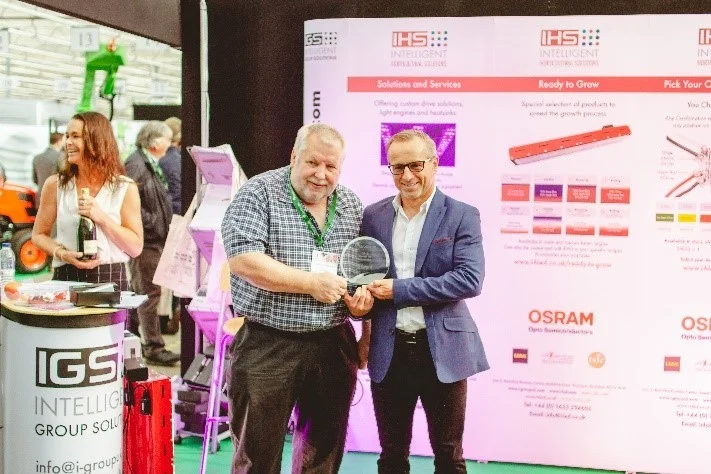
Intelligent Horticultural Solutions (IHS) was thrilled to be announced the Innovation winner in the New Product Showcase at the HTA National Plant Show, which took place on 18-19 June 2019 at Stoneleigh Park, Coventry.
Intelligent Horticultural Solutions (IHS) was thrilled to be announced the Innovation winner in the New Product Showcase at the HTA National Plant Show, which took place on 18-19 June 2019 at Stoneleigh Park, Coventry.
New HTA members IHS received the accolade for their ‘Ready to Grow’ range of Florence horticultural LED grow lights. The annual event was a great success with a wide variety of British suppliers to the horticultural market exhibiting their wares. Attendees, were mainly suppliers to the green-fingered public such as garden centres, landscape gardeners, etc., voted the IHS lighting solution as the most inspiring, Innovative New Product showcased at the show.
IHS’s Florence LED grow lights are designed specifically for low and no sunlight applications, maximising growth potential whilst minimising both initial purchase costs and on-going running costs. The Florence unit is no deeper than a standard fluorescent tube fitting, allowing an easy switch to LED lighting without losing growing space.
The modular design enables a smooth, effortless installation, which paired with the standard 100-240V AC mains input, allows for a quick and easy electrical installation, saving further time and cost. LED recipes are available for a wide range of standard horticultural applications, as well as fully customisable solutions.
The Florence range is proving to be a success within the sector having already won the Award for Best Innovation 2018 at the GroSouth Show held last November in Chichester. This was an important day for IHS, being the official launch and showcasing of the new Florence LED grow light modules into the fast-growing horticultural market.
There are currently eight different standard Florence LED recipes to choose from including; Biomass, Seeding, Flowering, and Fruiting” (available for applications both with or without existing daylight). Three different lens options are available, per recipe – narrow, wide and oval to direct the light onto the target areas.
These recipes were devised in conjunction with experts from LED manufacturer Osram Opto Semiconductors, who are market leaders in the supply of quality LEDs for the horticultural lighting sector.
IHS’s ‘Ready to Grow’ LED lights enable a longer growing season and also increase the speed of growth for plants, when under the correct recipe.
The Florence product range is currently available for purchase through RS Components.
LED Recipe IHS Part Number RS Article (Buy Here)
Biomass FLORENCE-BIO-WIDE-CASED-1CH-01. (187-4965)
Seeding FLORENCE-SEED-WIDE-CASED-1CH-01. (187-4970)
Flowering FLORENCE-FLOWER-WIDE-CASED-1CH-01. (187-4967)
Fruiting FLORENCE-FRUIT-WIDE-CASED-1CH-01. (187-4968)
Quality LED horticultural lighting from IHS is a cost-effective and viable solution for both backyard gardeners and large commercial growers alike. Ideal markets for these grow lights include polytunnels, environmental chambers, propagators, vertical farms and indoor farms, as well as schools, universities and research institutes.
IHS is a LED Light for You (LLFY) Partner, which draws on world-leading quality LEDs from Osram Opto Semiconductors and combines them with other quality components, materials and in-house expertise to provide the LED solution you need.
More horticultural LED Grow Light product families are being introduced from IHS in the near future, watch this space!
All our horticultural LED Grow Lights will be on show at our 2019 Horticultural LED seminars. - Sign up now
For enquiries or further information, please contact +44 (0) 1635 294606 or info@i-hled.co.uk
Or alternatively, refer to our website www.i-hled.co.uk
ILS is a division of Intelligent Group Solutions Ltd (IGS) a well-established and respected industry leading display and opto-electronics solutions provider. IGS’ provides semi-custom or custom products both in component and sub-assembly form. All the senior staff have been involved with the opto-electronics industry for at least 20 years and are dedicated to ensuring that ILS is an innovative and highly successful operation.
4 July 2019
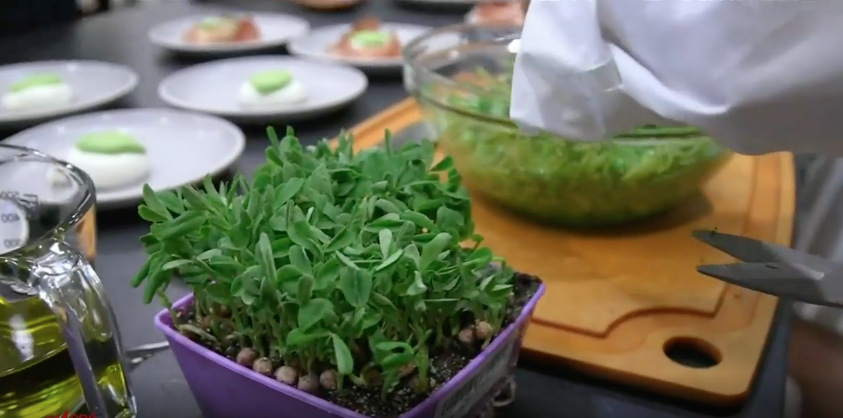
Australia: Indoor Vertical Farming Touted As Future Source of Produce
Indoor vertical farming is being touted as a future source of fresh produce, but fledgling companies in Australia are struggling to move beyond the start-up phase
With drought gripping much of the country there are calls for the government to support new and emerging methods of agriculture.
Indoor vertical farming is being touted as a future source of fresh produce, but fledgling companies in Australia are struggling to move beyond the start-up phase.
To View Video, Please Click Here
Uganda: How farmers Grow Vegetables In Hydroponics
Providing quality nutritive food to millions of people by 2025 will be a major challenge for Uganda.
Increasing population, decreasing land, water holding and global warming are some of the major impediments for agriculture, the backbone of this country
JULY 6 2019
By Lominda Afedraru
Providing quality nutritive food to millions of people by 2025 will be a major challenge for Uganda.
Increasing population, decreasing land, water holding and global warming are some of the major impediments for agriculture, the backbone of this country. Various biotic and abiotic stress factors are threatening the open field agricultural production systems throughout the world in varying degrees.
The soil fertility status has attained almost the saturation level in most parts of the country as the productivity is not rising proportionally with the amount of inputs. With the infertility challenges, scientists across the globe, including those in Uganda have come up with a technology where farmers can grow a number of horticulture crops ranging from vegetables, fruits and flowers, among others in a greenhouse using hydroponics to substitute soil.
Farming
Papius Tumusingiize, an expert in agricultural convergence technology is lead investigator of the technology involving growing of tomatoes in smart greenhouse using hydroponics. According to Tumusingiize smart hydroponics system involves self-monitoring analysis of the greenhouse farm using a computer which is connected to technological systems inside and outside the green house. The green house has a system of censures which is connected to the computer.
“What the farmer needs to know is to engage a scientist to set the growing conditions for the plant in the computer,” says Tumusingiize.
Types of censors
Tomatoes grow best under optimal temperature of between 20 and 28 degrees Celsius which the computer will maintain.
Whereas the temperature outside may be so cold during rainy season below 16 °C or too hot due to heat rays at more than 35 °C, the solar radiation censors will control the temperatures automatically.
There is an exhaust fan installed to control the temperature as well, in case of high temperature the fun will automatically switch on to blow the excess condition. For cold conditions the aeration open outlets will close and for excess heat the shed net established inside the greenhouse structure and on top of it outside will automatically cover the structure.
There are also rain censors which control the conditions when there is a storm which may lead to destruction of the greenhouse structure. This is through an automatic closer of the open ventilators which are in most cases open to allow fresh air inside the greenhouse.
Another component is the installation of wind vane which will indicate the direction of wind flow and the anemometer used to measure the speed of the wind.
In case of too much wind, the computer will read it and the vent will close to avoid its entry into the greenhouse to avoid destruction of the structure and the plants.
Inside the greenhouse there are humidity and temperatures censors as well to regulate the condition inside. Another component of the greenhouse is the carbon dioxide censor used to measure the carbon dioxide rate meant for the plants for photosynthesis to take place.
“Greenhouses work on the principle of the greenhouse effects where the sunshine heats and sunlight penetrates the curtains and it is reflected back to produce heat. Too much heat in the greenhouse will cause wilting of the vegetables. This is the reason farmers must ensure they adopt the technology as it is with all the sensors connected to the computer,” Tumusingiize says. The computer has to be on all the time and in case of any power failure, there has to be back up generate to provide continuous source of energy.
Tumusingiize and team have set up two greenhouses at Kabanyolo each sitting on six by 54 metres but the space occupied by the tomato farm is five by 50 metres.
Prices
A farmer wishing to establish such a smart hydroponic greenhouse structure will need to part with $200,000 (about Shs700m).
However, there is a cheaper option where farmers can establish their hydroponics on a flat piece of land and simply tie strings for the plants to grow and run through on them for continuous harvesting.
The computer is powered by climate control panel machine specifically manufactured to regulate electricity flow in agricultural greenhouses. It reads the climatic conditions suitable for the plant growth and sends it to the computer.
At the moment the greenhouse structures are a demonstration site where farmers mainly from Wakiso District in Namulonge and those from Ssese Island have so far come around for sensitisation and lesson learning.
Requirement
The scientists are purchasing a box of hydroponics with three seed planting outlets at Shs3,000 from Sri Lanka and from each box they are expecting 125 minimum tomatoes. The boxes are packed with sow dust which farmers can acquire locally.
It is fed through drip irrigation of a mixture of concentrate comprising Nitrogen, Phosphorous, Potassium, Magnesium, Calcium, Zinc and Baron. In case of another green vegetable such as strawberry the growth nutrient mixture is different.
Seed preparation
Tumusingiize categorises tomato seed as determinants which grow in four months and after harvesting the stalks are uprooted and replaced with new set of seedlings.
These include local varieties such as Tengeru and MT56 with one kilogramme sold at Shs350,000 each. Other varieties are Nenoveta and Galleria where each packet comprising 200 and 600 seeds goes for Shs50,000 and Shs60,000 respectively.
Agronomy
After transplanting continuous drip irrigation watering is required and this means constant water supply in the computerised tanks which are used to mix the nutrient ingredients which runs through connected pipes to hydroponic boxes. There is a water controlling machine used to regulate water usage in case there is water shortage, the machine will stop operating.
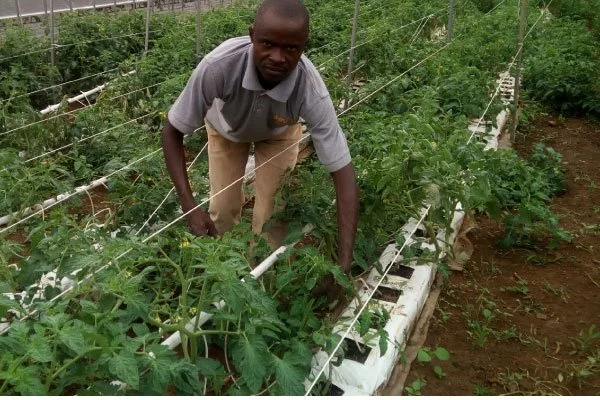
The yield of these varieties grown under this condition is so high because each plant is capable of producing 25 kilogrammes with minimum of 125 tomatoes in one harvest. Trellising is important because as the plant grows it has to be bend downwards and stretched to grow horizontally all the hydroponic structure for more fruiting to occur. One tomato plant measures 12 metres long for the one year season.
Lead Photo: An agronomist explains how to plant tomatoes using hydroponics technology. Photo by Lominda Afedraru
How One Urban Farm Is Breaking Down Barriers To Healthy Food
Today, Project Eats creates and maintains networks of urban farms in low-income neighborhoods around New York City without much access to fresh food. The guiding principle on these farms: small plots; high yield
“If We Can Grow Food In New York City, We Can Grow It Everywhere.”
July 5, 2019
Irene Archos
For over a decade during the Great Recession, Linda Goode Bryant gathered research and edited segments for an independent documentary about the global food crisis, which had pushed prices so high that people with limited income faced serious barriers to access to healthy food.
After reviewing hours of film shot across the world depicting the nutrition challenges facing the urban poor, she put the camera down and turned the computer off. “What kind of world do we live in that people have to eat mud pies in order to survive?” she asked herself. That’s when the idea for Project Eats was born.
Today, Project Eats creates and maintains networks of urban farms in low-income neighborhoods around New York City without much access to fresh food. The guiding principle on these farms: small plots; high yield.
“We should be able to grow our own food,” Bryant explains. “Food is ultimately tied to social justice. The belief behind Project Eats is that we should live healthy lives regardless of income.”
Each farm is both invested in and reflective of its surrounding community, from employees (young people and students from nearby schools), to pricing (sliding-scale), to programming (Saturday “storytelling” breakfasts and farm training).
The first site, Amboy Community Farm, launched in Brownsville in 2009. It’s now used as a production and training site, supplying produce for farm stands throughout the city. After 10 years, Project Eats has expanded its reach to include 10 urban farms across nearly five acres of land.
In a good year, the group distributes nearly 40,000 pounds of fresh, organically grown greens and vegetables to communities that would otherwise face little access and high prices.
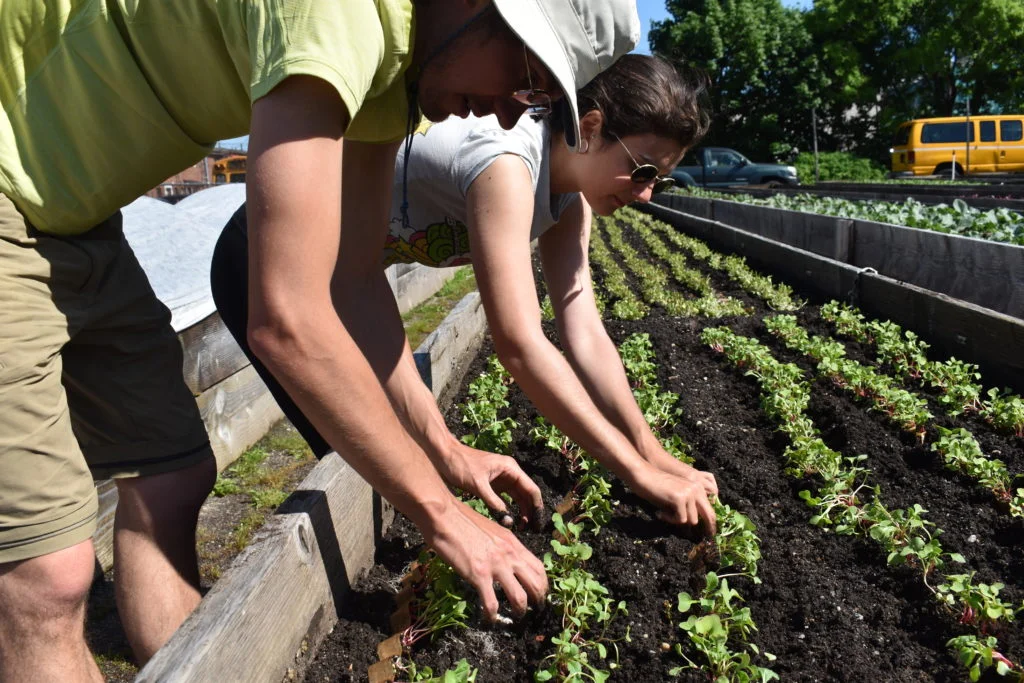
The organization’s largest urban farm sits on a former parking lot under the shadow of the Marcus Garvey Apartments in Brownsville. Since 2014, under the care of two full-time urban farmers, the farm sprouts leafy greens in neat rows: Spinach and mustard greens, arugula and radishes, bok choy and broccolini and more provide a welcome green contrast to the red brick and gray concrete of surrounding buildings.
Located in areas often referred to as a “food deserts,” the farms become a vehicle for introducing city kids to an agrarian way of living. An after-school program employs teens and children for the summer to introduce them to sustainable food production, and, on a more basic level, invite them to interact with nature in a way that’s rare in the concrete-laden environments in which they have grown up.
The Project Eats ‘farmacy’ program, born from a 2017 partnership with Brownsville Action Health Center and Gotham Health in East New York, sought to expand urban farming from grocery shopping to health care. Doctors participating in the program prescribe fresh produce to patients — either in addition to or in place of their synthetic drugs — and the urban farm fills the prescription.
The vision Bryant conceived of back in 2008 has grown to include three farms in Brownsville and one in East New York, plus three more locations in Manhattan and Queens. The first Bronx farm is in development, as is a 10th on Manhattan’s Lower East Side.
Bryant, both a Guggenheim Fellow and a Peabody Award recipient, notes that just making farm-fresh greens available is not the same as increasing demand for them. The choice to use and cook fresh food is more complex than just having it readily available.
“No matter what income class you are,” she explains, “ordering Dominos is easier than preparing fresh food at home. We’ve succumbed to the incessant marketing of such convenient, readily available foods.”
But she remains optimistic about the movement. “If we can grow food in New York City, we can grow it everywhere.”
Irene Archos is an educator and a freelance writer. You can follow her work on her website.
Volunteers at one of Project Eats' gardens. Eagle photo by Irene Archos

US, Massachusetts: Urban Agriculture: Keeping Worcester Fresh
What comes to mind when you think of agriculture? Do you envision sprawling tracts of land in a rural area farmed by generations of farmers? Or do you envision neighbors in a city tending a small parcel of land to produce fresh fruits and vegetables for friends and families? Why not both?
BY MARK A. BORENSTEIN • JUNE 24, 2019
What comes to mind when you think of agriculture? Do you envision sprawling tracts of land in a rural area farmed by generations of farmers? Or do you envision neighbors in a city tending a small parcel of land to produce fresh fruits and vegetables for friends and families? Why not both?
On January 30, 2019, the City of Worcester joined many other large U.S. cities when the City Council adopted urban agriculture zoning regulations aimed at promoting urban-scale farming and agricultural uses. With the input of passionate community members, the City’s Planning staff developed regulations to provide a comprehensive framework encompassing all stages of urban agriculture, from the siting of farms or gardens to the sale of products.
The zoning regulations’ greatest attribute is their flexibility. The regulations provide for both large and small operations and uses that are primary or accessory in nature.
The zoning regulations provide for three primary uses:
Community Gardens – Small-scale gardens (less than 5,000 s.f.) for the use of individuals, neighborhoods and non-profit organizations to grow produce for personal consumption.
Urban Farms – Larger agricultural operations (between 5,000 s.f. and 2 acres) intended for commercial purposes.
Farmers’ Markets – Temporary markets for local producers to sell their products.
In addition to the primary uses, the zoning regulations permit farm stands, yard gardens and on-site composting as accessory uses. Yard gardens (less than 2,500 s.f.) are required to be accessory to a residential use and primarily for personal consumption. Farm stands are permitted as accessory to urban farm and yard garden uses.
Despite the relatively permissive nature of the zoning regulations, the City included safeguards to protect neighbors and the community from being adversely impacted by these operations. For example, community gardens are permitted as of right in all zoning districts, while urban farms are generally permitted in all zoning districts except certain residential districts where the use requires a special permit from the Planning Board. The special permit requirement for urban farms provides an opportunity for the Planning Board and the City to examine the proposed urban farm use to ensure that the use remains in harmony with the surrounding neighborhood. Moreover, urban farms, community gardens and farmers’ markets are required to be operated in accordance with all food, health, soil safety, water and other applicable regulations.
While the enactment of these zoning regulations is a big step toward promoting urban agriculture in Worcester, it important to note that urban agriculture is not new to the City. Many of Worcester’s non-profit organizations, such as the Regional Environmental Council and Worcester Common Ground, have been operating community gardens for years and have experienced tremendous success within the community. By clarifying the standards for agricultural activities and farmers’ markets, the City has made it easier for urban farmers to begin operations and sell products, which will make fresh, healthy and sustainable food more accessible to residents of Worcester and the surrounding towns.
CATEGORIZED: Environmental, Policies, Zoning
TAGGED IN: community gardens, farmers markets, farming, urban agriculture, urban farms, zoning
About the Authors

Strengthen Your Crop Protection Tool Box Through Development, Formulation, And Regulations Insights
In 2019, We Are Bringing The Crop Protection
Community Together
10 - 12 September 2019
Crowne Plaza Barcelona - Fira Center,
Barcelona, Spain
Jump into the world of Synthetic and Biocontrol Crop Protection with updates from the European Commission, Member States, EFSA and leading Industry Case Studies.
With 4 focused tracks on regulations of Crop Protection Products, Agrochemical formulation, biocontrol and new technologies, plus three pre-conference workshops, CIR in Barcelona is the place to be this September.
BOOK NOW
After a full day of insightful debates and
discussions, all attendees
are invited to join the networking reception
On day 1 of the conference. Mix and mingle with colleagues, meet your fellow crop protection peers and network with leading industry experts and decision makers in a more informal setting at our evening drinks reception.
This is the ultimate opportunity to swap top tips and business cards, as well as catch up with your peers.
STRENGTHEN YOUR CROP PROTECTION TOOL BOX THROUGH
DEVELOPMENT, FORMULATION, AND REGULATION INSIGHTS
NETWORKING DRINKS WITH THE CROP PROTECTION COMMUNITY
THE CROP INNOVATIONS AND REGULATIONS MOBILE APP
By booking early, you don’t just secure the best pricing but also access our Networking App, 3 weeks before the conference!
Log in to the event app to:
Browse the attendee list
Access speaker presentations
Set up one-to-one meetings
Send messages to fellow participants
View the latest agenda
Navigate around the venue with maps & floor plans and more!
How To Do Farm To Table In A Desert
Getting the freshest ingredients for restaurants in large cities can often be a challenge for chefs. This becomes doubly hard when your restaurant happens to be in the middle of a desert
JULY 08, 2019
Vegas has reimagined itself into a big, bold restaurant town. The stakes are high for local farms looking for a piece of the action.
Getting the freshest ingredients for restaurants in large cities can often be a challenge for chefs. This becomes doubly hard when your restaurant happens to be in the middle of a desert. Yet, Las Vegas has been making huge inroads into becoming a premier restaurant destination, where diners can expect exceptional meals made from the freshest ingredients available.
It takes a great deal of time, effort and relationship building to make it happen, says Roy Ellamar, executive chef of Harvest, an award-winning market-inspired restaurant at the Bellagio. It helps that there are actually farms near Las Vegas (who knew?) — from small, traditional family farms to cutting-edge indoor urban growers — with even more moving to the area.
“I’m a big advocate of using local agriculture and having strong relationships with our farmers and producers,” says Ellamar. “We’re in the desert, so a lot of things are flown or trucked in and the quality of ingredients isn’t as great as it could be. It’s not what I want to work with.”
Ellamar works with a variety of farmers around Nevada, including Herbs by Diane in Boulder City, 30 miles outside of Las Vegas, where he is able to get “boutique ingredients.” Herbs by Diane, an organic farm owned and operated by Diane Greene, has been around for over a decade. She hand-harvests her produce on two acres, using homemade compost and lots of mulch to combat the sandy soil and arid desert climate, she says. Greene has been working with Ellamar since she started the farm and has a close working relationship with him. “He frequently texts me when he needs something special, and I let him know when I have something different,” she says. “He has been here several times and brought some of his family here.” Besides Harvest, Greene provides everything from microgreens to edible flowers to a dozen other Las Vegas restaurants.
Small farms can only produce so much food, and with close to 40 million visitors to Las Vegas each year, there are large-scale, cutting-edge indoor farms moving to the area to take advantage of the opportunities afforded by the city. James Beard Award–winning chef Shawn McClain, the chef behind Libertine Social at Mandalay Bay and Sage and Five50 Pizza Bar at Aria, believes that Las Vegas is the perfect test market for indoor vertical farms because the city has “demanding world-class chefs” who want good produce that’s grown as locally as possible.
Last year, Oasis Biotech, one of the largest indoor hydroponic vertical-farming facilities in the United States, began operations. Among the factors that drew the Chinese-backed start-up to Las Vegas was the city’s reputation as a “food mecca and tourist destination,” says Michelle Howell, the company’s sales and marketing manager. Another factor was (strangely) the climate. “If we can make this concept work in the middle of a desert that reaches 100-plus-degree temperatures most of the year, we can make it work anywhere,” says Howell.
The 215,000-square-foot facility can produce 1,500 pounds of pesticide- and herbicide-free microgreens and lettuce a day using 90 percent less water than a traditional farm. Its LED lighting also uses 50 percent less energy than high-pressure sodium lights. Oasis Biotech is selling its produce under the brand name Evercress, with delivery times that range from 24 to 48 hours from harvest to plate, according to the company. It’s working with Get Fresh, a Las Vegas food distribution company that services many of the local restaurants and casinos.
Las Vegas chefs are discerning and demand “as close to perfect as you can get in the produce world,” says Andy Hamilton, vice-president of sales for Get Fresh. “If the folks at Oasis Biotech can figure it out here, they should be able to apply it anywhere,” he says. “The company is starting with one of the most challenging and discerning markets, and we’re optimistic that it will be successful.”
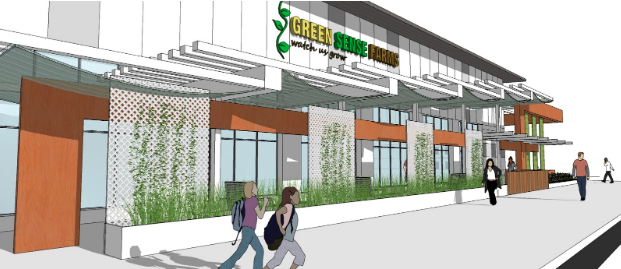
Get Fresh is also working with another indoor vertical-farming company, Green Sense Farms, that’s breaking ground in Henderson, a Las Vegas suburb, and plans to be up and running by next June. The facility will be approximately 20,000 square feet, with an estimated yearly output of one million heads of lettuce and one million herb plants, says Robert Colangelo, the company’s founding farmer and CEO. The company plans to grow a variety of lettuces, herbs and baby greens, such as arugula, kale and cress.
Green Sense Farms, based in Indiana, was approached by a large casino on the strip to dedicate the entire farm production to its operations, says Colangelo. The company’s facility will also include a retail outlet and an education and outreach center where visitors can take a self-guided walking tour to learn how the company grows food, he says.
The arrival of large urban farms to Las Vegas doesn’t mean that smaller, traditional farms will necessarily lose out, says Geno Bernardo, executive chef at The Summit Club, a private luxury golf community in Las Vegas. “There’s enough room for both urban farms and beautiful, rural mom-and-pop farms,” he says.
Is Vertical Farming Really the Future of Agriculture?
Indoor, LED-lit growing operations produce food without soil or sunlight — but scaling up could prove difficult
Indoor, LED-Lit Growing Operations Produce Food
Without Soil or Sunlight — But Scaling Up Could Prove Difficult
By Steve Holt July 3, 2018
A vertical farming setup from farm.one | Photo courtesy of farm.one
This story was originally published on Civil Eats.
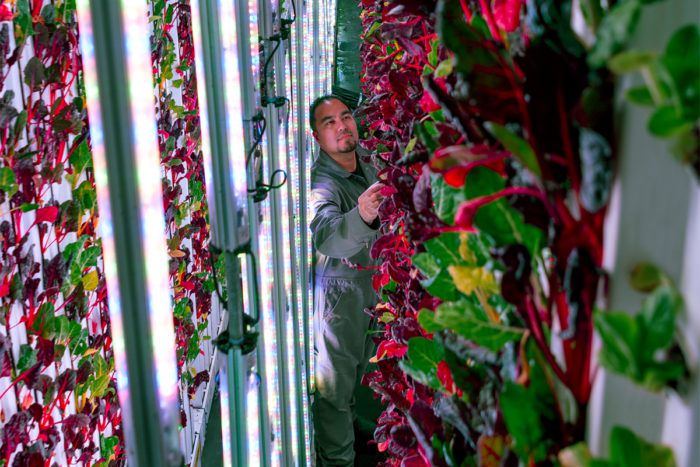
By now, the images of shelves full of perfect greens in hulking warehouses, stacked floor to ceiling in sterile environs and illuminated by high-powered LED lights, have become familiar. Food futurists and industry leaders say these high-tech vertical farming operations are the future of agriculture — able to operate anywhere, virtually invincible against pests, pathogens, and poor weather, and producing local, fresh, high-quality, lower-carbon food year-round.
That future seemed one step closer to reality last year when San Francisco-based indoor farming startup Plenty, which grows a variety of salad and leafy greens hydroponically (without soil) and uses artificial lighting in facilities in three locations, announced that it had raised a whopping $200 million in funding from the SoftBank Vision Fund, whose investors include Amazon founder Jeff Bezos.
Flush with cash, Plenty quickly opened a 100,000-square-foot indoor farm outside Seattle that promised to produce 4.5 million pounds of greens annually—and testing some varieties not yet grown for the masses at scale, such as strawberries and tomatoes, at its research and development farm in Wyoming. To Plenty’s leadership and many observers, the cash influx signaled the economic promise of growing food indoors without sunlight and with less soil and water than field farming.
“My reaction [to the $200 million round] was both that of validation, excitement,” said Matt Barnard, Plenty’s co-founder and CEO, over a manner of farming he says yields 350 times the produce per acre on one percent of the water used by dirt farming. “Now we must move with speed and efficiency if we’re to accomplish our mission of bringing people worldwide an experience that’s healthier for them and the planet.”
Not everyone is in agreement.
“My first thought was, ‘we could build a lot of greenhouses for $200 million,’” recalls Neil Mattson, a professor of plant science at Cornell and one of the country’s leading academic voices on indoor agriculture, who’s found that high-tech greenhouses that harness sunlight are more cost- and carbon-friendly than vertical farms that use artificial light.
Most vertical farmers are only hoping to claim a percentage of the conventional produce market, not replace it. To these founders and their investors, the market for lettuce and greens, especially — grown primarily in California and Arizona and shipped worldwide — is ripe for disruption. E. colioutbreaks like the one that hit Arizona-grown romaine lettuce earlier this year, killing a handful of people and sickening hundreds, only further their case.
But behind futurists’ fervent predictions about indoor agriculture, claims about product quality, and sexy technology lies a reality known by industry insiders but too often missing from media coverage: The future success of this nascent industry is still very much an open question.
The astronomical capital costs associated with starting a large hydroponic farm (compared to field and greenhouse farming), its reliance on investor capital and yet-to-be-developed technology, and challenges around energy efficiency and environmental impact make vertical farming anything but a sure bet. And even if vertical farms do scale, there’s no clear sense of whether brand-loyal consumers, en masse, will make the switch from field-grown produce to foods grown indoors.
Tricky Economics
Walking into any supermarket will reveal a small mountain of salad greens, carrying a price tag of between $9 and $12 per pound. They may be locally grown or organic, which will add $0.50 or $1 to the price tag. Meanwhile, a 4.5-ounce carton of Massachusetts-based FreshBox Farms’ spring mix—grown in the company’s hydroponic farm in Massachusetts—costs $3.99 for a 4-ounce box, or $15.96 per pound. Or kale: the conventional variety will run you $1.33 per pound at Walmart; organic kale costs around $4.99 per pound at Whole Foods; and vertically farmed kale grown at Newark, New Jersey-based AeroFarms will cost you a whopping $14.18 per pound.
That dramatic price gap is due to the millions of dollars currently needed to build one large indoor vertical farm — and that price is not going to drop until the industry scales up. Agritecture Consulting, whose clients include current and prospective indoor farms, estimates that a 30,000-square-foot vertical farm growing leafy greens and herbs in the tri-state area around New York City requires nearly $4 million in startup capital—not including labor.
They should know: In 2016, Agritecture built farm.one in Manhattan’s TriBeCa neighborhood, which supplies hydroponic greens and edible flowers to a number of the city’s top restaurants. Chefs have been quick to catch onto the value of consistent, year-round, locally grown produce.
In 2016, AeroFarms, now considered an industry leader, spent $30 million on its flagship aeroponic farm in Newark. The majority of these costs lie in the equipment needed to grow greens without soil or sunlight—heating and cooling systems, ventilation, shading, environmental controls, and lights.
All of these costs add up to a hefty electricity bill: According to models compiled for Civil Eats by Agritecture, a 30,000-square-foot vertical farm in metro New York City should budget upwards of $216,000 annually for lighting and power, and another $120,000 on HVAC systems; costs will vary region to region depending on what each state charges for electricity.
Energy and equipment costs are, by far, the largest drivers of expenses that can bring the price of operating a vertical farm close to $27 per square foot. By contrast, Agritecture’s models show that the cost to run a 100,000-square-foot smart greenhouse is roughly a third as expensive, thanks to the use of natural sunlight and more advanced automation.
An LED-lit indoor farming operation | Photo courtesy of Agritecture
Vertical farms’ energy usage carries a significant carbon footprint. While vertical farm companies promise more-sustainable produce by growing it closer to consumers and using renewable energy to power their operations, the industry still has a long row to hoe.
Industry leaders acknowledge the energy challenges in the short term, yet tout continually improving lighting technology that has brought down costs. But Mattson, whose Cornell team studies the way plants respond to different lighting, predicts a plateau coming for improvements to LED technology.
“The best LEDs are 40 percent more energy efficient than in 2014,” Mattson says. “There continue to be improvements; however, those improvements will start to slow down over time. There’s only a finite amount of light you can generate at a given wavelength, and in 2022, I’m not expecting new lights to be 40 percent more efficient than the current lights now.”
FreshBox Farms began shipping greens from its 40,000-square-foot hydroponic facility in Millis, Massachusetts, in 2015. The warehouse farm, located 30 miles outside of Boston, runs on a combination of renewable energy and non-renewables, and CFO Dave Vosburg admits his company is “not doing any better” than field-grown greens when it comes to carbon usage.
When it eventually expands outside of Massachusetts, Vosberg says that by introducing a cogeneration system—technology that recycles otherwise wasted heat into new energy—FreshBox Farms will eventually keep costs and carbon emissions down in expensive markets like Connecticut, where commercial users pay an average of more than 14 cents per kilowatt-hour. But Vosburg says the company’s priority is to use contextually appropriate renewable energy sources to power the farms, such as wind energy in the Midwest, hydro in the Northwest, and solar in the Southwest.
“Yes, it sounds crazy to take the sun and turn it into electricity and turn that electricity back into light. It sounds ridiculous, but that’s what we’ll be doing,” Vosburg says. “It’ll be really efficient and clean and create a better product, and it won’t have the same carbon impact that we’re having today.”
And energy isn’t even a vertical farm’s top ongoing expense. The companies Civil Eats spoke to say labor is actually their largest budget item. Vertical farms typically pay workers higher, more metropolitan pay rates than both dirt farms—many of which rely heavily on migrant labor—and the more automated smart greenhouses. The fast-food chain Wendy’s announced in June that it plans to source vine-ripened tomatoes exclusively from greenhouse farms by early 2019.
Moreover, no matter how automated the indoor growing system is, vertical farmers are discovering the constant need for a human eye—or several—on the process. In fact, some estimate that if indoor agriculture continues to grow at the pace it has in recent years, vertical farms will have to hire 100,000 workers over the next decade.
That continued growth is not a given, however. Because of the high cost to launch, operate, and scale up a vertical farming operation, the industry is highly leveraged, with each new farm requiring tens of millions of dollars in investor capital before it can grow a single plant. Between 2016 and 2017, investments in vertical farming skyrocketed 653 percent, from $36 million to $271 million. The lion’s share of that investment went to Plenty, but Newark-based AeroFarms has raised $80 million in recent years and New Jersey’s Bowery Farming added another $27 million.
Just last week, Manhattan-based BrightFarms announced it had raised $55 million. Shoppers can now find produce grown indoors by more than 23 large vertical farms in more than 20 supermarket chains in nearly every major metropolitan area in the country, according to Agritecture.
While industry leaders say scaling offers the best hope for profitability in this business, many vertical farms have encountered problems when they began planning to add additional production facilities. Before Atlanta-based PodPonics closed its doors in 2016, executives from the five-year-old hydroponic farm startup met with executives from supermarket chain Kroger.
A vertical farming operation from farm.one | Photo courtesy of farm.one
Kroger indicated that it was ready to purchase 25 million pounds of produce from PodPonics annually if it would build the facilities to support that kind of production, founder Matt Liotta told a crowd at the 2017 Aglanta Conference. According to Liotta, who said PodPonics had lowered the cost to produce a pound of lettuce to $1.36, Whole Foods and Fresh Market also expressed interest in bringing PodPonics greens into their stores nationally.
“This was our wildest dream,” Liotta said. “Then we realized how much capital that was going to require, how many people we were going to have to hire. Every retailer told us the same thing: ‘We will buy it if you will build it.’ We realized we were incapable of building everything that they wanted.”
Unproven Demand for Food Grown Indoors
In early 2016, researchers from the University of Illinois-Urbana set out to determine whether consumers would spring for produce grown indoors. They asked a panel of 117 participants a series of questions about their perceptions of and willingness to pay for lettuce grown in fields, greenhouses, and in vertical farms. While vertical farming ranked fairly high in terms of produce quality and safety, the tech-heavy production method was rated less “natural” than both field farming and greenhouse and ranked last in participants’ willingness to purchase it.
For the vertical agriculture industry to eat into the profits of field-grown products—a roughly $140 billion industry—Agritecture Consulting founder and managing director Henry Gordon-Smith says it will first need to prove consumers are demanding produce grown indoors. He points out that because of a lack of demand, many vertical farming operations are not yet at full production year-round—despite touting the 12-month growing season as a main benefit of the industry.
His sense is that indoor farms that have achieved the sales to produce continually—such as Gotham Greens has with its New York City greenhouses, for example—have a customer base that’s responding to strong “local” branding rather than the technology behind the food. That may include vertical farms selling their produce using the USDA Certified Organic label, which the National Organic Board reaffirmed in January, much to the dismay of many organic dirt farmers.
“I think the automation and economics are all improving,” Gordon-Smith says, adding that the question of “whether consumers are going to pay more or whether the products coming out of vertical farms are going to align with their values” is still an open question.
But while many of the East Coast vertical farms built their business models around replacing greens being shipped cross-country from California and Arizona, Matt Barnard of Plenty hopes to add to the global population consuming fresh produce. A 2015 report found that where USDA guidelines suggest each of us in the U.S. should eat up to three cups of vegetables daily, current U.S. production is only providing enough for 1.7 cups per person. Barnard extends that supply gap to the rest of the world, especially the Middle East and Asia, where a lack of water and high pollution have hampered agriculture.
Tending to a vertical farm from SF-based startup Plenty | Photo courtesy of Plenty
“We believe the industry will be five times larger when there is supply to meet the demand,” Barnard says. “With the field unable to deliver consistent supply, new forms of agricultural capacity like Plenty must be added to the global food system.”
But as vertical farming companies like Plenty go city by city attempting to dominate local markets, it may be that small farmers get hurt the most. Barnard drew the ire of Washington State dirt farmers last year when he told GeekWire that Plenty expanded to Seattle, in part, because it was the West Coast’s “best example of a large community of people who really don’t have much access to any fresh fruits and vegetables grown locally.”
Not so, according to Sofia Gidlund, Farm Programs Manager at Tilth Alliance, which advocates for and supports local agriculture systems in Greater Seattle.
“We work with many hardworking local farmers who supply Seattle with high-quality, delicious, and nutritious food while caring deeply for our land. These farmers use sustainable farming practices, nurse the soil, create beautiful open green space and provide wildlife habitat,” says Gidlund, who adds that she does not speak for all area farmers on the issue of vertical farming. “Many consumers in Seattle choose to support local farmers, both urban or rural, because of this deep connection to the land. Providing that support is a point of pride for many Seattleites.”
Actual Data Is Coming
Peer-reviewed research into the business of vertical farming has been sparse, partly because the industry is so new. That’s set to change, however, when Mattson and a team of researchers at Cornell University finish a comprehensive study into the viability of this approach.
A three-year, $2.4 million research grant, which is funded by the National Science Foundation and kicked off in January, will compare the vertical farming industry to field agriculture in a slew of categories, including energy, carbon, and water footprints, profitability, workforce development, and scalability. The study will include one of the first nutritional analyses of food grown indoors, as well as comparing the price-per-pound to deliver strawberries, lettuce, and tomatoes grown vertically and outdoors to five U.S. metropolitan areas: New York City, Chicago, Seattle, Los Angeles, and Atlanta.
A 2016 study conducted by a few of Mattson’s colleagues at Cornell found that the energy consumption and carbon footprint associated with a vertical farm (the study calls it a “plant factory”) is significantly higher than that of a greenhouse. Vertical farming leaders counter that they use significantly less water than field farms, are more space-efficient, and do not produce emissions from trucking produce across the country. Mattson says these factors were not considered in Cornell’s previous research but will be included in the current grant.
“[Vertical farming] is not a fad,” says Mattson, who wants to use data to help the industry become more sustainable over time. “I’m not sure to what degree it’s going to scale up, but this is happening. So we need to understand the economic and environmental implications— both the good and the bad.”
The Rise of Urban Food Forests
Cities like Atlanta and Philadelphia are recognizing a park can be more than just a green space when visitors are allowed to pick fruits, vegetables and nuts
Cities like Atlanta and Philadelphia are recognizing a park can be more than just a green space when visitors are allowed to pick fruits, vegetables and nuts.
AUTHOR: Katie Pyzyk@_PyintheSky
July 2, 2019
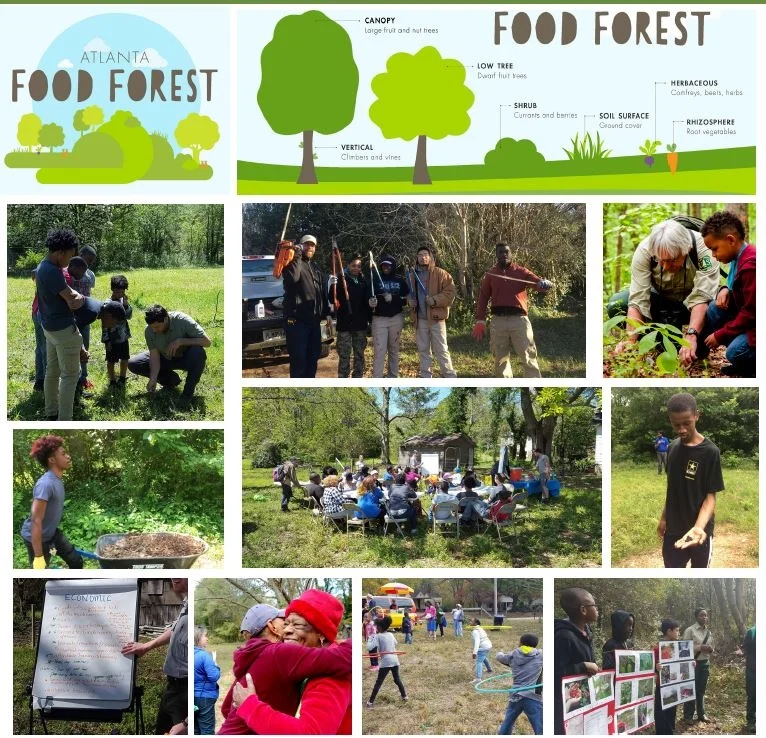
A walk through an Atlanta park will soon include the option of picking berries, plucking apples from trees or gathering herbs from surrounding plants — all for free.
The Food Forest at Browns Mill, which has been years in the making, surged ahead in May when the Atlanta City Council unanimously approved an ordinance to use grant money secured from the U.S. Forest Service to purchase a 7.1-acre plot of land from The Conservation Fund for a food forest.
The land was a working farm for decades but sold for redevelopment in 2006; the development plan was abandoned when the recession hit and the land sat vacant until The Conservation Fund purchased it in 2016.
The park will serve as a community green space complete with trails and a large-scale edible garden. Atlanta's Department of Parks and Recreation will oversee the property while nonprofit Trees Atlanta maintains it. Volunteers already have pitched in for site restoration and construction — including creek and pecan orchard restoration — in addition to planting hundreds of food-bearing trees and plants.
The city conducted extensive community outreach and assessments to identify available land for this project. Some of the suggested properties no longer were suitable for other developments due to issues like drainage, but they could work as a food forest. Targeting these properties carries the ancillary benefit of eliminating blight and improving quality of life for citizens within the neighborhood.
"When you transform that [property] into a lighthouse of nutrition, you have now created the greatest asset in the community out of the greatest liability," said Mario Cambardella, urban agriculture director for the city of Atlanta, in an interview with Smart Cities Dive.
A key component of Atlanta’s Food Forest at Browns Mill is its placement in an area the USDA considers a food desert. The project supports a city goal of strengthening the local food economy to ensure 85% of citizens live within a half mile of access to fresh, healthy food by 2022.
"When you transform that [property] into a lighthouse of nutrition, you have now created the greatest asset in the community out of the greatest liability."
Mario Cambardella
Urban agriculture director, City of Atlanta
In 2010, 53% of Atlanta was considered a food desert and that dropped to 36% by the end of 2017, representing approximately a quarter of the city’s population. Simply relying on grocery stores to fill the void won’t solve the food desert problem, Cambardella said.
"It’s going to take many strategies… We have to stimulate, strengthen and support that local food system that’s going to bring affordable, equitable and resilient local food systems to these communities," he said. "If we’re providing access to free, fresh food, that creates considerable income to be spent on other things that are just as important."
Beyond acting as a food source for visitors, food forests can serve as a source for local food banks; a habitat for bees, birds and other wildlife; an agricultural education and enrichment tool; and a workforce and leadership skills development space.
"The notion of social resiliency is important," Rich Dolesh, National Recreation and Park Association (NRPA) vice president for strategic initiatives, told Smart Cities Dive. "The kinds of partnerships food forests foster are exactly that, resilient partnerships for long-term commitments to a community."
Cambardella said there are also lesser-known benefits. For instance, urban agriculture at Browns Mill provides resources for a local nonprofit that forages medicinal herbs to make into remedies for homeless residents’ hand, foot and extremity ailments. "It’s important to show how this one little food forest is playing a role in supporting our most vulnerable residents," he said.
Although nonprofits and community groups often drive public agriculture projects, public agencies are becoming more involved.
"Park agencies are looking for opportunities to make innovative connections to their communities. This is an emerging, innovative way to look at multi-benefit landscapes," Dolesh said.
Taking root across the US
Food forests are not a new concept, but up until recently, they were not widely applied in urban parts of the United States.
"The whole movement really is taking off," Dolesh said. "A ‘food forest’ is a new name for what were traditionally called 'community orchards.'"
Food forests are a form of permaculture, or a system of regenerating agriculture. Traditional farms, community gardens and orchards tend to grow food completely or mostly at the same plane, but food forests involve an ecological design that mimics how plants naturally grow on multiple layers within a forest.
A complete food forest has seven layers: tall fruit and nut trees serving as a canopy; shorter fruit and nut trees; shrubs or bushes that bear fruit; an herbaceous layer that includes herbs and non-woody plants such as vegetables; ground-hugging plants, such as strawberries; vines; and roots.
While that’s the textbook answer, "the community has to answer that question of ‘what is a food forest,” and each answers it a little differently," Cambardella said.
One project heralded as a leader is Beacon Food Forest in Seattle, which began forming a decade ago. At seven acres, it’s nearly as large as Atlanta’s food forest, which is considered one of the largest in the United States. Many communities setting up their own permaculture projects seek advice from Beacon’s organizers.
Michael Muehlbauer worked with the Beacon group and now aims to establish the Fair-Amount Food Forest in Philadelphia. His organization hopes to formalize an agreement soon with Parks and Recreation to use publicly owned parkland for the project. Like Beacon, the intention is for the Fair-Amount Food Forest to be a primarily volunteer-run project, with the hope of hiring program staff down the line.
The Fair-Amount Food Forest found collaboration in the Strawberry Mansion neighborhood and aims to increase food equity and access in an area area that could be considered a food desert. Organizers have engaged community members to determine what neighborhood residents would like planted. The current plan involves more than 240 species of plants.
"Our partners have been working in food access, nutrition and gardening in the neighborhood for quite a while, and this is a way for us to increase access and education [to fresh food] and food system education in the area," Muehlbauer told Smart Cities Dive.
The Philadelphia Orchard Project is another prominent urban agriculture-focused organization. It partners with other community groups to help with oversight of the more than 50 local orchard sites on city-owned land.
The organization has several principles for choosing viable partners, one of which is increasing citizens’ food security by ensuring at least some of what is grown in the orchards becomes available to those with limited access to fresh foods.
Although not all sites are open for public harvesting, "the food does have to get into the community in one way or another," such as through food distribution or after school programs, said Phil Forsyth, Philadelphia Orchard Project executive director, to Smart Cities Dive. The group requires that "the majority of what's harvested gets out into the neighborhood for free."
Not always a walk in the park
Creating and maintaining a food forest bears plenty of complexities and challenges. Forging the right partnerships is key to successfully overcoming difficulties, sources say.
Many public agriculture projects in the United States are partnerships between the public sector and nonprofit groups. Often the gardens, orchards and food forests are located on publicly owned land, but nonprofit groups manage the site. Non-governmental groups tend to have more flexibility to experiment with agricultural programs and implement them quickly without encountering barriers from layers of bureaucracy.
An obvious issue is figuring out how much funding is necessary and securing a source. Federal grants exist for park permaculture, as do grants through organizations like NRPA.
The budgeting for a food forest takes some research because it isn’t necessarily the same as other public green spaces. For example, a typical park project might budget 90% of its funds toward capital improvements, 5% for community engagement and 5% for maintenance, Cambardella said. But the Food Forest at Browns Mill is splitting its budget in thirds: 33% toward capital and infrastructure improvements, 33% toward community engagement and 33% toward the required management for a food-producing landscape.
Choosing regionally appropriate plants must be part of the process. Apples and peaches are frequently requested items, "but those can be the two most challenging fruits to grow in a humid climate like ours," said Philadelphia Orchard Project’s Forsyth. "We do a lot of work educating partners on other choices… that are much easier to grow, and therefore are more likely to get consistent production from year to year."
In addition, certain plants and trees will bear fruit and nuts relatively quickly, whereas others won't produce a yield for many years after planting.
Ongoing landscape management is sometimes overlooked but should be considered because it is both funding and labor intensive, sources say. Although permaculture in many ways is self-sustaining, ongoing care is necessary, especially in urban settings.
“It’s a very challenging proposition to manage these,” Dolesh said. "Fruit-bearing trees are problematic for parks." If the land is not properly maintained, "food winds up on ground, it gets trampled, it starts rotting, it draws beasts," he said.
Another critical consideration is that food-bearing plants attract pests that can lessen yield, or even decimate crops. Although traditional farms might use pesticides and fungicides to mitigate that problem, public permaculture projects rely on organic land management principles to ensure the public feels comfortable and safe harvesting and ingesting the food.
“You have to look at a whole organic regime of integrated pest management. It's going to be a challenge to manage those and you need highly-trained staff and volunteers to do this right,” Dolesh said. Besides insects, public permaculture “is a buffet” for animals including deer, raccoons, skunks and rats.
"You have to manage the land extensively to control those and not let them completely take over a food forest intended for public benefit," Dolesh said, adding that it takes "a balance."
Balance also is necessary to ensure people do not overharvest at a food forest. Signage helps to remind harvesters to respect the space for the rest of the community.
Public education plays a significant role in preventing overharvesting. Citizens cannot be expected to automatically know which fruits, nuts and herbs are usable.
For example, the Atlanta community largely targeted raspberries for its food forest because that was what they knew, but few residents realized the area’s many mulberry trees bear edible fruits, Cambardella explained. Other food forest visitors don’t know how to harvest at all.
Educating people about the variety of productive crops and driving them toward lesser-known ones can prevent overharvesting while opening doors to underutilized food sources. The combination of better healthy food access and education can prompt people to make better nutritional decisions in their daily lives.
Educational elements are at the forefront of planning for the Fair-Amount Food Forest in Philadelphia as well.
"Just providing access to food isn't really the whole picture. The education on how to utilize and benefit from different plants, how they grow and the environment… needs to be part of the picture for actual change," Muehlbauer said.
Regardless of the challenges, investments in public permaculture projects continue to grow due to the abundant advantages.
“Food forests really help to make resilient communities. They add value not just for the infrastructure aspects but also resiliency outcomes. The partnerships formed are deep and lasting,” Dolesh said.
Follow Katie Pyzyk on Twitter

CO2 GRO Inc. Signs Agency Marketing Agreement With Henry James Innovations LLC
HJI President Steve Stansell commented, “Our grower customers will benefit from a broader selection of plant efficiency, growth enhancement and plant health related products and services. Our company is proud to be partnering with GROW and is excited to bring their CO2 Delivery Solutions to our customers.”
CO2 GRO Inc. Signs Agency Marketing Agreement with Henry James Innovations LLC
TORONTO, ON July 3, 2019 (Access Wire) Toronto based CO2 GRO Inc. ("GROW") (TSX-V: GROW, OTCQB: BLONF, Frankfurt: 4021) is pleased to announce it has entered into an Agency Marketing Agreement (“AMA”) with North Carolina based Henry James Innovations LLC (“HJI”) to accelerate the commercialization of GROW’s patent pending CO2 Delivery Solutions in North America and globally.
The AMA allows GROW to leverage HJI’s mostly U.S. marketing and sales team to initiate CO2 Delivery Solutions trials and commercial pilots with HJI’s customers. GROW will lead all engineering and design support to HJI customers. Revenues from commercial agreements will be shared between GROW and HJI with GROW receiving 55% and HJI receiving 45%.
The Agreement is dated June 28 2019. Its initial term is three years with additional automatic three-year terms.
GROW’s VP of Sales and Strategic Alliances, Aaron Archibald, commented, “The HJI AMA is part of GROW’s marketing strategy to accelerate its CO2 Delivery Solutions roll-out to both the indoors and outdoors markets in the U.S., Canada and globally”.
HJI President Steve Stansell commented, “Our grower customers will benefit from a broader selection of plant efficiency, growth enhancement and plant health related products and services. Our company is proud to be partnering with GROW and is excited to bring their CO2 Delivery Solutions to our customers.”
About CO2 GRO Inc.
GROW's mission is to accelerate all indoor and outdoor value plant growth naturally, safely, and economically using its patent pending CO2 Delivery Solutions. GROW’s global target retail plant markets are food at $8 trillion per year (Plunkett Mar 2017), non-food at an estimated $1.2 trillion per year with retail tobacco at $760 billion (BA Tobacco 2017), floriculture at $100 billion by 2022 (MarketResearch.Biz estimate). Legal cannabis at $52.5 billion per year by 2023 (Statista) and legal US hemp CBD at $22B per year by 2022 (the Brightfield Group).
GROW's CO2 Delivery Solutions are commercially proven, scalable and easily adopted into existing irrigation systems.
The CO2 Delivery Solutions work by transferring CO2 gas into water and misting the water across the entire plant leaf surface which is a semi permeable membrane. The dissolved concentrated CO2 then penetrates the leaf's surface to provide more carbon for enhanced plant growth.
Misting of water, dissolved nutrients and chemicals on plant leaves has been used for over 60 years by millions of indoor and outdoor growers. To date, outdoor growers have not had any way to enhance plant CO2 gas uptake for faster growth.
Indoor CO2 gassing has enhanced plant yields for over 60 years but 60% of the CO2 gas used is typically lost from ventilation. Current greenhouse CO2 gassing levels of up to 1500 PPM are not ideal for worker health and safety. GROW's safer infused CO2 Delivery Solutions can be used by both indoor and outdoor plant growers with minimal dissolved CO2 gas loss and much greater CO2 plant contact resulting in higher plant yields than both CO2 gassing and no gassing plant yields.
About Henry James LLC
Henry James Innovations, LLC, a Raleigh, North Carolina based company was founded with the vision to help companies and individuals bring highly innovative, unique patented products to key US, Canadian and global markets. Leveraging over 30 years of commercial success and relationships, with expertise in sales, sales management, marketing and product distribution Henry James Innovations is currently launching and selling into the greenhouse, nursery, specialty agriculture market sectors, home and garden markets. In addition Henry James Innovations, LLC markets to the golf consumer and golf turf markets.
For more information, please contact Steve Stansell, CEO, Henry James Innovations, LLC, +1-336-209-4316 or Steve@henryjamesllc.com
Forward-Looking Statements This news release may contain forward-looking statements that are based on CO2 GRO's expectations, estimates and projections regarding its business and the economic environment in which it operates. These statements are not guarantees of future performance and involve risks and uncertainties that are difficult to control or predict. Therefore, actual outcomes and results may differ materially from those expressed in these forward-looking statements and readers should not place undue reliance on such statements. Statements speak only as of the date on which they are made, and the Company undertakes no obligation to update them publicly to reflect new information or the occurrence of future events or circumstances, unless otherwise required to do so by law.
Neither the TSX Venture Exchange nor its Regulation Services Provider (as that term is defined in the policies of the TSX Venture Exchange) accepts responsibility for the adequacy or accuracy of this release.
For more information, please visit www.co2gro.ca or contact Sam Kanes, VP Communications at 416-315-7477.

“LitHouse Uses AmHydro EPIC Nutrient To Capture 4 Cannabis Cup Awards”
LitHouse took 4 awards (including a 1st place in the Sungrown Flower category) at the High Times 2019 NorCal Cannabis Cup on June 1st-2nd
July 9, 2019
AmHydro, industry-leading provider of hydroponic growing systems, crop consulting, grower training, and crop-specific nutrients, is proud to announce the recent Cannabis Cup® victory by grower LitHouse Farm® of Mendocino Coast CA.
LitHouse took 4 awards (including a 1st place in the Sungrown Flower category) at the High Times 2019 NorCal Cannabis Cup on June 1st-2nd . A family run operation since 2002, Lit House has cultivated their crops using the AmHydro EPIC® Cannabis nutrient line. AmHydro EPIC, a 5- stage cannabis nutrient program, is available at https://shop.amhydro.com/collections/epic-nutrients
Congratulations to LitHouse for a job well done!
They will be competing next at the Bay Area Cannabis Cup June 22nd-23rd.
Visit LitHouse at: http://www.lithouse.farm/ and on Instagram : https://www.instagram.com/lit_house_farm/?hl=en