


Welcome to iGrow News, Your Source for the World of Indoor Vertical Farming

10 Ways To Grow The Indoor Farming Market
The Center of Excellence for Indoor Agriculture has identified ten strategic areas for accelerating the global transition to indoor farming
by Dr. Eric Stein
The number of indoor farming companies seems to grow almost daily, each claiming to be more innovative than the last. And yet, there is a lack of data pertaining to the profitability, yields, and sustainability of the indoor farming industry. The Center for Excellence for Indoor Agriculture (COE) was established for this very reason. The COE aims to accelerate the development of the indoor farming market by fostering collaboration and knowledge sharing, conducting third-party research, and recognizing excellence in the indoor farming industry.
The Center of Excellence for Indoor Agriculture has identified ten strategic areas for accelerating the global transition to indoor farming: recognition of excellence, development of metrics, realistic investment expectations, job creation vs. automation, greenhouse vs. vertical farm models, crop diversity, sustainability, training, research into the business aspects of vertical farms, and the development of innovative economic ecosystems.
With respect to recognition, the COE has developed its “Best in Class” awards for growers and manufacturers to recognize excellence, encourage knowledge sharing and hold companies accountable.
Eric W. Stein, Ph.D.
“We really think that recognition of excellence is important to the industry, especially if it comes from an independent body. A lot of people make claims about being the best at everything and are promising things they can’t deliver. We really think that it’s important to separate those people from those who are really doing a good job in the industry. We also hope that it will motivate companies to continue to improve,” says Dr. Eric Stein, founder and executive director of the COE.
Eric also highlighted the ambiguities related to automation and job creation in indoor agriculture, which ultimately comes down to the company’s goals. With labor accounting for roughly 25-30% of an indoor farm’s total operating costs, automation can greatly increase profitability by reducing labor costs. However, social enterprises and triple-bottom-line companies may sooner focus on local job creation and use different targets for profitability in the context of their mission.
The cornerstone of the COE and its ten strategic areas is knowledge sharing, which many experts have cited as necessary for the industry’s continued growth.
“I think that one of the biggest needs in the industry is knowledge sharing. Everybody is approaching this from a proprietary perspective, which is typical of emerging industries. But if this industry is going to mature, we need to make sure that we have benchmarks. At the COE, we look at it from an industry level of analysis as opposed to an individual firm level of analysis.”
BrightBox-Venlo
While research and development currently focus mostly on production, the COE considers the entire system from the supply chain to the point of sale. According to Eric, the focus on plant production has effectively over-shadowed equally important factors such as the logistics of the supply chain, packaging, distribution, channels, and marketing.
“There has been a lot of focus on the growing process, which is very important, but in the end, to get products from a seed supplier to the company growing it to a supermarket, lots of things need to take place. It’s not just about having the best growing system. How you get it to consumers is equally important, if not more so.”
With the pandemic limiting face-to-face interactions within the industry, the COE has focused on building its member website, expanding social media channels, and building relationships with growers, manufacturers, and partners such as Indoor Ag-Con. Most recently, the organization has forged a relationship with Sage Publications, a major publisher of academic books, journals, and other scientific resources to feature research related to indoor farming and sustainability.
For more information:
Center of Excellence for Indoor Agriculture (COE)
Eric W. Stein, Ph.D., Executive Director
eric@indooragcenter.org
www.indooragcenter.org
Publication date: Mon 15 Feb 2021
Author: Rebekka Boekhout
© VerticalFarmDaily.com

For Vertical Farms To Succeed, Sensors Must Take Center Stage
Vertical farming—the process of cultivating produce in stacked, indoor shelves, rather than side-by-side in fields—is a fast-growing industry (pardon the pun)

February 19, 2021
Vertical farming—the process of cultivating produce in stacked, indoor shelves, rather than side-by-side in fields—is a fast-growing industry (pardon the pun). Since it was conjured (or revived, depending who you ask) in a 1999 Columbia University lecture, the technology has grown into a global industry set to be worth $13.5 billion by 2030.
Companies like Plenty, Bowery Farms, and Infarm have innovated vertical farming with a dazzling array of modular, IoT-connected smart devices, which can improve plant “recipes” (the insider term for creating better, more nutritious food) and ramp efficiency alongside vast improvements on water and land usage.
Berlin’s Infarm, for example, claims to have saved over 10m gallons of water and 500,000 square feet of land across its 1,200 farming units, installed in supermarkets in restaurants).
But it is scale and efficiency that proves vertical farming’s bete noir. Leafy greens—low on energy demands and relatively high in price—constitute the lion’s share of output. High-energy food like cereals and potatoes, essential to human survival, remain firmly within the wheelhouse of traditional farms, which already occupy 40% of livable land on Earth, and one of our biggest environmental threats.
“What’s really needed, and that will come with time, is a humanitarian aspect to (vertical farming), which addresses food crises and starvation issues in, say, sub-Saharan Africa where farmers have to put up with horrible things like invasion of locusts,” says Dickson Despommier, the professor who popularized the medium 22 years ago. “Locusts would have a very difficult time invading a vertical farm.”
To feed the world, however, vertical farms need better lights. LED technology has already skyrocketed since its mainstream rollout in the 1960s. “Haitz’s Law” dictates that LED light increases by a factor of 20 and cost drops by a factor of ten every decade.
“The direction is clear: the prices have gone down, the efficiencies have gone up, and I see that continuing,” says Lars Aikala, CEO of Valoya, a leading supplier of LED lights to the vertical farming industry.
But things are getting more complex. Nowadays companies like Valoya can tinker with light spectra to increase growth rates in certain plants while reducing energy costs. “When we started in 2009 this field was pretty much untouched,” says Aikala.
Experts expect Haitz’s Law to tail off in the coming years, as technology becomes smaller, compacter and tougher to scale up. Rather, the next big leaps in LED technology will come via smart sensors, which will help lights replicate night and day, isolate spectra and better tailor themselves to plants’ preferred sunlight.
“If growers want to replicate seasons all year round they have to replicate and control all these parameters in a very narrow window, so plants can survive and grow in a healthy state all year round,” says Fei Jia, technical solutions manager at Heliospectra. “LED lighting allows this because of a high photon efficiency.
“Smart farming is the trend in lighting.”
An added bonus is that around 95% of an LED light is recyclable, helping vertical farmers persuade the public they’re not just a flash in the pan. When sensor technology can lower costs enough to produce carbs and other vital produce, their companies can finally claim to be solving a part of a food crisis that is leaving almost a billion people without adequate access to nutrition each year.
“We’re just at the starting point of (LED) technology, so the price will go down but conversion is going to go up to create more power with less energy,” says Infarm co-founder Erez Galonska. “Now we’re standing on 50-60%, and with the next generation of technology, we easily improve the LEDs. It’s already improved so we’re more energy-efficient already.”
FILED UNDER: CLEAN TECH, CONSUMER, FEATURES, SOFTWARE, STARTUPS, TOP STORY
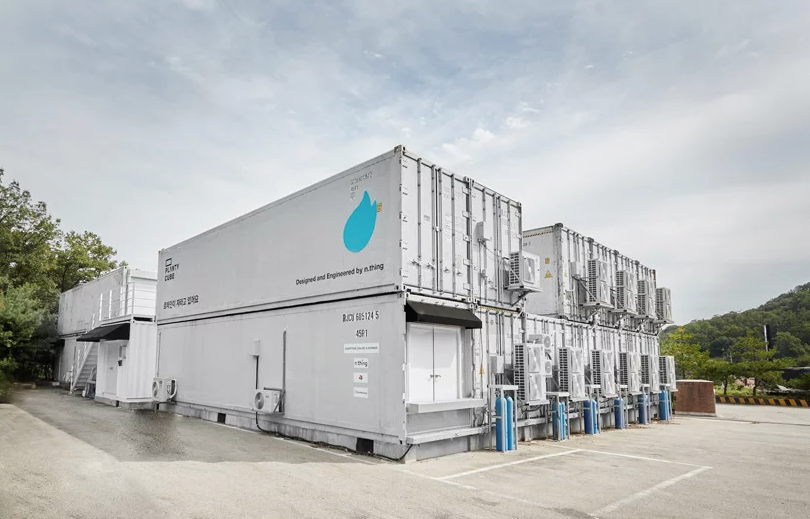
These Stacked Shipping Containers Are Actually High-Tech Farms
A major perk of the Planty Cube system is that it can be set up in multiple environments, such as restaurants, hotels and apartments
FEB 2, 2020
Credit: n.thing
For green thumb owners looking to take their plant parenting skills to the next level, allow us to introduce you to the Planty Cube, a smart vertical farming system developed by Seoul-based agricultural startup n.thing.
The hydroponic setup is based on “internet of things” technology and is comprised of a network of capsules that enables farmers to cultivate “high quality vegetables in a fully controlled environment, ensuring production over tens of times higher than ordinary farmland per unit area, CES explains. The higher crop yields are directly linked to Planty Cube’s ability to support year-round growing.
Credit: n.thing
In pursuit of n.thing’s mission to turn everyone into a farmer, Planty Cube is off to a running start as the winner of CES 2020 Best of Innovation Awards. The intricate system resembles a shipping container but upon closer inspection is actually multiple shelves of planters, or pickcells, that house seeds.
Each pickcell is connected to the modular system, which is comprised of sensors that track each plant’s health and progress, adjusts humidity and temperatures in response to unexpected environmental changes, and also allows farmers to tend to their crops remotely via a smartphone. In the place of soil, the produce is grown via a nutrient that the system delivers to each plant. The system’s enclosed design prevents pests from infiltrating the crops. Not ready for an entire farm? Planty Cube has a solution for such an agricultural conundrum: It allows growers to choose how many units they start with, leaving them with the option of adding additional units as they see fit.
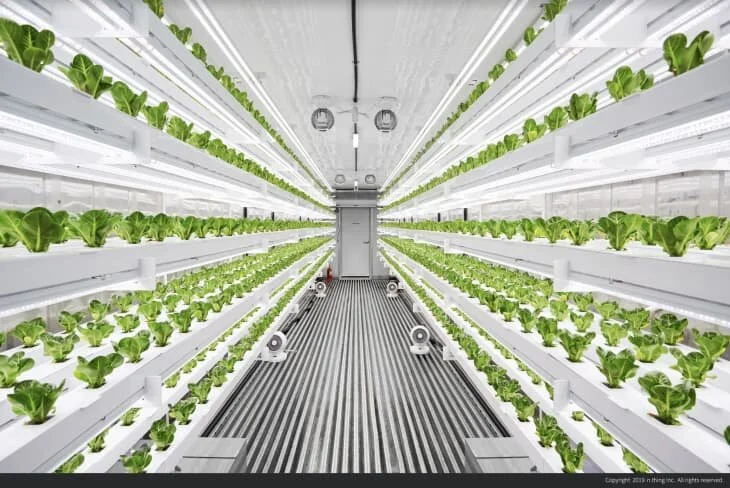
Credit: n.thing
A major perk of the Planty Cube system is that it can be set up in multiple environments, such as restaurants, hotels and apartments. Its sustainable build helps to decrease environmental impact, further eliminating even more of the obstacles presented by traditional farming methods.
Kenya Foy
CONTRIBUTOR
Kenya is a Dallas-based freelance entertainment and lifestyle writer who devotes most of her free time to traveling, gardening, playing piano, and reading way too many advice columns.

Creating A Whole New Fresh Food Experience Category | Q & A With Fifth Season CEO Austin Webb
In this Q & A Austin shares more about the company's mission, unique approach, and plans for the future
Fifth Season has been making headlines in recent weeks. In addition to a feature story in the Pittsburgh Post-Gazette, other outlets have covered the vertical-and-robotic-farming pioneer's expanded distribution partnership with food retailer Giant Eagle Inc, and its designation as "Official Greens" provider for the NHL 2020-2021 season of the Pittsburgh Penguins.
These stories follow many others that have tracked the company'simpressive innovations and accomplishments over the last year. Indoor Ag-Con had a chance to catch up with Fifth Season CEO Austin Webb, who co-founded the Pittsburgh-based company with brother Brac Webb (one of this week's Indoor Ag-Conversations panelists!) and Austin Lawrence. In this Q & A Austin shares more about the company's mission, unique approach, and plans for the future.
READ Q & A WITH AUSTIN WEBB

Agritecture Partners With Mainvest To Democratize Urban Agriculture Financing
The two companies will work together to accelerate the urban farming and controlled environment agriculture (CEA) industry across the country by offering new entrepreneurs a more accessible way to raise capital for small-scale or pilot facilities
Boston, Massachusetts, February 16, 2021 - Agritecture, LLC, an urban farming consulting and digital services firm, announced it has partnered with Mainvest, a small business investment platform that connects local entrepreneurs with investors who care.

The two companies will work together to accelerate the urban farming and controlled environment agriculture (CEA) industry across the country by offering new entrepreneurs a more accessible way to raise capital for small-scale or pilot facilities. Research has shown that urban agriculture provides a range of crucial ecosystem services valued at $33+ billion.
“We’ve seen a great deal of success in the F&B industry fueled by a need for alternative sources of capital and demand from community members for tangible ways to support local brands,” stated Nicholas Mathews, Mainvest CEO and Co-Founder. “As sustainable investment becomes mainstream and urban farming projects increase, we see a niche for our services further up in the local food supply chain. We’re excited to connect innovative entrepreneurs in the urban agriculture sector with retail investors across experience and income levels looking to get involved in a growing industry. We’re excited to partner with Agritecture on empowering the industry to raise capital on more favorable terms with the support of active and engaged communities.”
In 2020, the USDA offered the availability of only $3M in grants for urban agriculture and innovative production to just 10 projects - despite receiving 578 applicants. While the CapEx, or startup cost, can vary widely for these projects, Agritecture notes that nearly 30% of controlled environment farms modeled via their Agritecture Designer digital platform have a CapEx of less than $250,000 - likely a pilot facility for an entrepreneur who wants to start small and learn before scaling up.
“Since our founding in 2014, we’ve seen sustained, year-over-year growth in interest toward urban agriculture, especially amongst industry newcomers,” said Henry Gordon-Smith, Founder and CEO of Agritecture.
This growth has only accelerated since the onset of the pandemic, according to the team at Agritecture, which reported nearly a 2x increase in website traffic since Q1 of 2020.
But despite increasing interest in urban agriculture, and record levels of funding for a handful of indoor mega-farms, financing continues to be a major pain point for small and medium-scale CEA businesses. “Through hundreds of consultations and economic models developed over the
past seven years, we know that these farms can achieve profitability with competitive payback periods, while still serving their local markets and communities,” noted Gordon-Smith.
Gordon-Smith cites Agritecture’s 2019 and 2020 Global CEA Census Reports, produced alongside agtech solutions provider Autogrow, which show that nearly half of all CEA facilities are being started by those with no previous farming experience. Furthermore, per their recent census, 78 percent of CEA business founders who attempted to raise money were unsuccessful in doing so through traditional financing sources, such as banks.
“By teaming up with Mainvest and their innovative financing platform, we can now deliver a direct link from our planning services and digital platform, Agritecture Designer, to critical funding opportunities for these pilot and small-scale facilities,” added Gordon-Smith.
About Agritecture
Agritecture, LLC is the global leader in urban agriculture advisory services, having worked on over 120 projects in more than 25 countries. Based out of New York, Agritecture is on a mission to empower key stakeholders and accelerate the agriculture industry with climate-smart strategies through a proven methodology, real-world data, and an expansive network.
For more information, please visit agritecture.com.
About Mainvest
Mainvest is an online investment platform for building communities and the American Dream. At Mainvest, people can directly invest in businesses they want to see in their own neighborhoods, generating both potential ROI (return on investment) and ROC (return on community). Visit mainvest.com to see the potential impact you can have on a community you care about.
For more information, please visit mainvest.com/for-businesses/urban-ag.
###
For more information about Mainvest, please contact Domenick Bauer at domenick@mainvest.com.
For more information about Agritecture, please contact Briana Zagami via email at briana@agritecture.com.

Space: A Hi-Tech Vegetable Garden To Grow On The Moon And At The Poles
The future is already here! This is demonstrated by Enea, which is working on a hi-tech garden to grow micro-vegetables on the moon and in extreme terrestrial environments, such as polar ones
ENEA: The Experimental Campaign Between Real And Virtual Begins
The future is already here! This is demonstrated by Enea, which is working on a hi-tech garden to grow micro-vegetables on the moon and in extreme terrestrial environments, such as polar ones. The cultivation is set up inside a special igloo greenhouse designed to withstand very low temperatures.
Luca Nardi
Simulated space missions are also contemplated, thanks to advanced immersive virtual reality techniques. These are the challenges of V-GELM (Virtual Greenhouse Experimental Lunar Module), the experimental project that kicks off in the Casaccia Research Center with the aim of developing a lunar cultivation module by combining innovative hydroponic cultivation techniques with virtual experiments to support the life of astronauts in future long-term missions. The project will be carried out by a team of Enea researchers and by students from CITERA (Centro Interdipartimentale Territorio Edilizia Restauro Ambiente) and from the Tuscia University and Sapienza University of Rome.
A virtual reconstruction of some activities
V-GELM has been selected among the best projects conducted by university teams from all over the world in the context of the IGLUNA 2020 mission of the European Space Agency (ESA), presented yesterday 09/07/2020 by the coordinator Swiss Space Center.
The project is divided into two phases: the first involved students and researchers, in collaboration with Mars Planet Society, in the architectural and functional design of the spaces simulated through immersive virtual reality technologies. The second phase will involve Hort3, the innovative Enea garden where the hydroponic cultivation of two particular varieties of radish, Daikon and Rioja, will be tested, inside a particular tent called "EGG" for its particular egg shape, designed by the University of Milan.
The EGG tent
"The virtual experiment - stresses Luca Nardi of the Enea Biotechnology Laboratory - allows you to offer to the public a realistic interactive perspective suitable for simulating the environments and the operations to be performed and also carrying out ergonomic analyzes. In this way, it is possible to identify from the beginning any critical issues and reduce the costs of developing space modules and of astronaut training times".
The module developed by Enea as part of the Hortspace project, funded by the Italian Space Agency, consists of a closed-cycle hydroponic multi-level cultivation system of one cubic meter with LED lighting where different species of micro-vegetables are grown, purposefully selected to reach the ideal growth stage for consumption within 10-15 days.
The laboratory
"It is a soilless cultivation system - explains Nardi - with the recycling of water, without the use of agrochemicals, able to guarantee the members of the crew engaged in space missions high-quality fresh food and correct nutritional intake, without forgetting the psychological benefit given by the growth of plants in confined environments - such as those of future extraterrestrial bases or in extreme environments, such as hot and cold deserts".
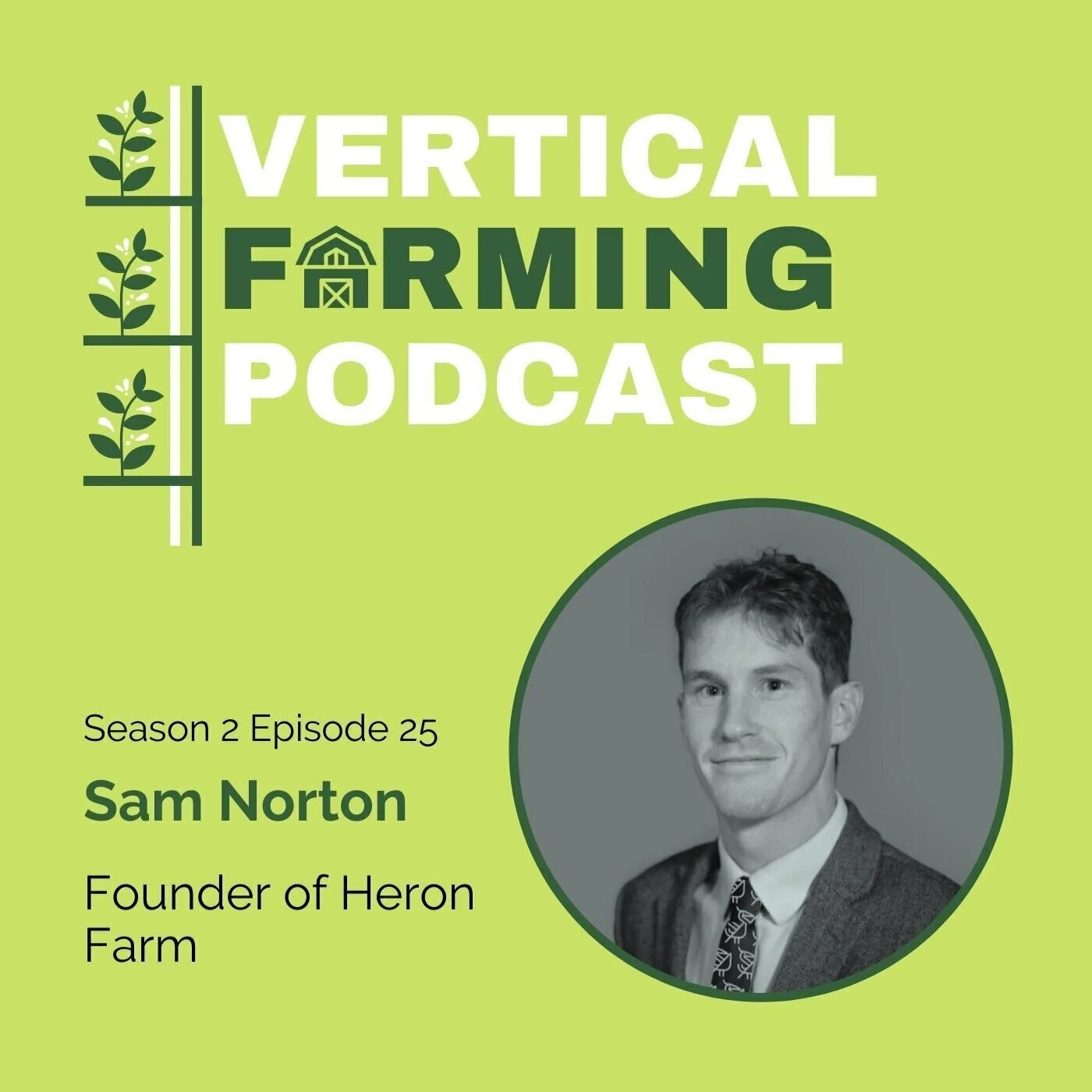
Join Harry Duran, Host of Vertical Farming Podcast, As He Welcomes To The Show Founder of Heron Farms, Sam Norton
It is the mission of Heron Farms to create a sustainable agricultural system and restore the marsh using earth’s most abundant resource: seawater
Season 2 Episode 25 Description
Join Harry Duran, host of Vertical Farming Podcast, as he welcomes to the show Founder of Heron Farms, Sam Norton. It is the mission of Heron Farms to create a sustainable agricultural system and restore the marsh using earth’s most abundant resource: seawater.
In this episode, Harry and Sam talk all about sea beans, Sam’s fact-finding mission to Bangladesh to learn more about how seawater crops are grown, and the work Heron Farms is doing with other brands to help rebuild salt marshes across the globe.
VERTICAL FARMING PODCAST
Listen & Subscribe

Is Controlled Environment Agriculture Addressing The Issues Facing The Agriculture Industry?
As chairman of the USDA Fruit and Vegetable Industry Advisory Committee, Paul Lightfoot at BrightFarms is looking for ways to make major improvements in food production, sustainability and consumption


BrightFarms founder and president Paul Lightfoot, who is chairman of the USDA Fruit and Vegetable Industry Advisory Committee, said controlled environment agriculture could play a major role in helping to solve some of the significant issues facing the ag industry and U.S. Photos courtesy of BrightFarms
As chairman of the USDA Fruit and Vegetable Industry Advisory Committee, Paul Lightfoot at BrightFarms is looking for ways to make major improvements in food production, sustainability, and consumption.
When Paul Lightfoot founded BrightFarms in January 2011 he had no experience in commercial food production. Ten years later he is president of one of the fastest-growing controlled environment agriculture companies in the United States. Starting with one 54,000-square-foot greenhouse facility in Pennsylvania in 2013, BrightFarms has expanded with greenhouse operations in four states with a total production area of 700,000 square feet.
“I had a background in retail supply chain improvement,” Lightfoot said. “I was running a supply-side software company for about nine years and was thinking about whether I could create an opportunity that would combine my career with my personal interest in healthy sustainable food. I studied different opportunities and came across the leafy greens supply chain as one that was ripe for destruction.
“At the time, all salads in North America basically came from the West Coast, either Salinas, Calif., in the summer or Yuma, Ariz., in the winter. I identified a very centralized, very industrialized supply chain that wasn’t benefitting consumers.”

Paul Lightfoot said an increasing amount of growth in the leafy greens market is coming from controlled environment agriculture.
Lightfoot said the concentrated field production locations and long-distance shipping required to deliver leafy greens to East Coast markets was not good for the product.
“Most leafy greens are five to seven days old when they arrive at retailers’ distribution centers, and that shows in the quality, nutrition, and taste,” he said. “I also thought field food production had some Achilles heals’ in terms of food safety and sustainability, which I thought would become more important, providing BrightFarms with a terrific market opportunity.
“I knew that consumers would continue to focus on healthy eating and that the demand for salads was going to rise. I grew confident that BrightFarms could disrupt a supply chain that was fragile and vulnerable.”
After opening its first greenhouse facility in 2013, Lightfoot said by the end of 2014 the company had figured out its operating model.
“We began to raise serious capital,” he said. “We graduated from venture capital to private equity in 2016 as we hit the national stage. We opened much larger greenhouses, one in Virginia to serve the Washington, D.C., market and one in Illinois to serve the Chicago and Milwaukee markets. Those were in partnership with Ahold Delhaize and Kroger.
“Before then I don’t think the produce industry had taken controlled environment salad production seriously. After 2016 we established ourselves as a contender to continue winning market share.”
Lightfoot said just about every major retailer in the U.S. now has an indoor-grown salad program on its shelves.
“There are billions of dollars of market share to be captured with leafy greens,” he said. “It’s a big and growing segment and by far the lion’s share of the growth is coming from controlled environment local production like ours.”
Helping to solve ag industry, societal issues
In October 2020 Lightfoot was elected chair of the USDA’s Fruit & Vegetable Industry Advisory Committee (FVIAC). Formed in 2001, the purpose of the committee is to examine issues that impact the fruit and vegetable industry and to provide recommendations and ideas to the Secretary of Agriculture on how the USDA can tailor programs to better meet the needs of the produce industry. FVIAC currently has four working groups: food safety, production, labor and trade.
“During our committee meetings the members develop a series of recommendations on the matters that are within the preview of the USDA,” Lightfoot said. “These recommendations are relevant to fruit and vegetable companies in the U.S., including growers, shippers, distributors, retailers and other organizations that have a stake in this space.”

Controlled environment vegetable production could be instrumental in providing consumers with healthier, more nutritious, better-tasting produce that is locally grown.
Lightfoot said the U.S. agriculture industry has an opportunity to help tackle some of the most pressing issues facing the U.S., including climate change and nutrition.
“We have a society where the majority of Americans are obese or nearly obese and an extremely high percentage is diabetic or pre-diabetic,” he said. “The leading cause of death in the U.S. is from chronic diseases that are a result of our diets.
“We don’t need fancy technology to see the solution. Only about one in 10 Americans eat the recommended servings of fruits and vegetables. Shifting our diets away from highly processed foods and toward more fruits and vegetables would reduce diet-related chronic diseases, reduce the costs of healthcare, and even improve our military readiness.”
Another area where Lightfoot said the agricultural industry could help resolve issues is related to climate change.
“It is well understood that the energy and transportation sectors are huge contributors to climate change,” he said. “In general, as a world, we are making progress on those fronts. I’m not alone in driving an electric car and powering my home with wind-powered electricity.
“Less well understood is that the U.S. agriculture industry emits 10 percent of our country’s greenhouse gases. It is also one of the most vulnerable sectors to more volatile weather that results from climate change.”
Lightfoot is particularly concerned about the impact the agriculture industry is having on the country’s top soil and water resources.
“We’re mining our soil,” he said. “If we continue to degrade our soils, we only have about 50 seasons of soil left in the Midwest. Farming practices in the Midwest and California have also had a major impact on waterways, reducing sources of potable water.

Paul Lightfoot said just about every major retailer in the U.S. now has an indoor-grown salad program on its shelves.
“More biodiversity needs to be introduced into the areas of the West Coast that currently grow our salads. It has become a monoculture, which has removed the life from the soil and disrupted the water cycles. One idea would be to provide incentives to those farmers to “re-wild” some of that land, adding biodiversity to restore the soils and water cycles. That lost production capacity could be offset with the growth in high intensity indoor farms.”
Taking the CEA industry seriously
Lightfoot said his participation with FVIAC is beneficial to BrightFarms and to the CEA industry.
“It is important to remember that I am representing the entire fruit and vegetable industry in my role with FVIAC,” he said. “I care about BrightFarms like I care about a child, but in this role I will be speaking for the entire industry.
“The U.S. should be doubling the per capita annual consumption of fruits and vegetables. Because Americans are not eating enough fruits and vegetables, our country is suffering.”
Lightfoot said his participation with FVIAC, along with being a board member of the United Fresh Produce Association, reflects the changes occurring in the CEA industry and how it is viewed overall by the agriculture industry.
“The CEA industry was considered fairly new and only recently has it become a bigger player,” he said. “These ag organizations recognize that and want our representation. We are glad to have it. We think we have an important voice and I’m glad to be able represent the CEA industry.”
For more: BrightFarms, Farm Support Center, Irvington, NY 10533; (866) 857-8745; info@brightfarms.com; BrightFarms
This article is property of Urban Ag News and was written by David Kuack, a freelance technical writer in Fort Worth, Texas.

Meet The Advisory Board - Indoor AgTech Innovation Summit, June 24-25
The virtual Indoor AgTech Innovation Summit on June 24-25 will explore how controlled environment agriculture and vertical farming can reach greater profitability and scale, both in the US and globally
The virtual Indoor AgTech Innovation Summit on June 24-25 will explore how controlled environment agriculture and vertical farming can reach greater profitability and scale, both in the US and globally.
Demand for fresh, local, nutritious and pesticide-free production has never been higher. But how can growers drive down energy consumption as they scale up to meet this demand? Which new crops can be optimized for an indoor environment? And how do we bridge the gap between producer and consumer?
We're putting together a powerful two days of interactive sessions and breakout discussion groups, steered by our valued Advisory Board of internationally recognized farm operators, food retailers, investors, seed companies, and technology providers.
MEET THE ADVISORY BOARD
More than 30 of the biggest names in the indoor agriculture and CEA community are helping to shape this June’s program:
SEE OUR ADVISORY BOARD
OUR EXPERTS SAY
"Indoor agriculture is booming as consumers continually demand the quality, variety and flavor that indoor-grown produce can bring. I look forward to the summit bringing together thoughtful content and expertise in the world of Indoor AgTech."
Liliana Esposito
Chief Communications Officer
WENDY'S, USA
"It's time for growers and the sales community to support the data and technology requirements throughout the supply chain that will enable complete product transparency and timely traceability. Data aggregation as in GS1 and technology such as QR codes on packaging have proven to be value-added for growers, distributors, and consumers."
Sean Walsh
North America Director of Fruits, Vegetables, and Dairy
GORDON FOOD SERVICE, USA
"Our capabilities are increasingly driven by AI, machine learning, internet of things, and blockchain, which all enable greater visibility and clarity on how to improve our products and services. We look to intentionally combine human and technological capabilities, so that our tech investments empower our employees and all our partners and customers along the supply chain."
Elyse Lipman
Chief Strategy Officer
LIPMAN FAMILY FARMS, USA
"I'm interested to see a significant dispersion of the food systems so quality produce becomes more affordable by removing all the friction between the producers and actual consumers. This will resolve a significant level of problems and issues we face such as food wastage, supply chain issues, food safety, and costs."
Jessica Naomi Fong
General Manager & Co-Founder
COMMON FARMS, HONG KONG
The program is coming together quickly, so if you’d like to be involved by showcasing your technology or sharing your experiences in a panel discussion, please get in touch with me now!
We look forward to hosting the indoor agtech community again in June.
Best wishes,
Oscar Brennecke
Conference Producer
Indoor AgTech Innovation Summit
oscar.brennecke@rethinkevents.com
+44 (0)1273 789989
SUMMIT PARTNERS
Platinum Partner:
HOSTED ALONGSIDE
Gold Partners:
Webinar: Works To Overcome The Challenges of Food Production
February’s webinar will be chaired by Agri-TechE’s Fiona Rust, with presentations from Dan Hewitt, Head of Agriculture and Sustainability from Kettle Foods UK, and Steven Winterbottom, Managing Director of Tozer Seeds
Writtle University College is delighted to announce the next installment within its popular webinar series, produced in partnership with Liberty Produce.
‘Examining food production systems and identifying skills gaps’ takes place on February 24th.
It is the second of three virtual events, all focusing on major issues facing global food production systems and the transformations we can expect to see in the immediate future.
February’s webinar will be chaired by Agri-TechE’s Fiona Rust, with presentations from Dan Hewitt, Head of Agriculture and Sustainability from Kettle Foods UK, and Steven Winterbottom, Managing Director of Tozer Seeds.
Fiona Rust works as Agri-TechE’s Events and Young Innovators’ Forum Co-Ordinator. She promotes cooperation between farmers, researchers, and tech developers to accelerate innovation.
Fiona explained: “Collaboration and idea-sharing offers us a way forward as we are able to bring together people and organizations to help further develop our sector and find the answers to challenges that we are facing. From experience, we see how small conversations can lead to the big things.”
Benita Rajania, Product Director at Liberty Produce, said: “The aim of teaming up with WUC for this webinar series was to bring together stakeholders from across food production to start a conversation around the transformation of the industry. We are delighted to host Dan Hewitt of Kettle Chips and Steven Winterbottom of Tozer Seeds, both pioneering companies, as they share their thoughts on collaboration and the agricultural/horticultural revolution."
The webinar will investigate challenges faced by the industry and discuss strategies for training and recruiting skilled personnel. A Q&A session with the speakers will take place at the end of the presentations.
Sponsorship is provided by EIRA, a groundbreaking project that supports innovation in the East of England.
Visit Writtle University College’s website to book your place:
Register
The event will be free-of-charge, in line with WUC and Liberty Produce's ongoing commitment to education and knowledge-sharing.
About Liberty Produce
Liberty Produce is a farming technology company founded in 2018 to drive innovations that will enable us to meet our global crop requirements over the next century, without harming the planet. As experts in the development of technology (from advanced lighting systems to machine learning for integrated control systems) for the breadth of indoor agriculture (from glasshouses to Totally Controlled Environment Agriculture systems), Liberty delivers research and products that consistently push boundaries. Liberty Produce develops and builds systems that reduce operational costs with enhanced resource efficiency, improve yields and increase sustainability for greater food security through the growth of local produce year-round. www.liberty-produce.com
Media enquiries:
Claire Apthorp
media@liberty-produce.com
+44 (0) 7920403068
General enquiries: info@liberty-produce.com; +44 (0)20 7193 2933
About Writtle University College (WUC)
Writtle University College (WUC) has been at the forefront of the agrifood sector since 1893. In 2020, it was named the highest-rated university-sector institution in England for student satisfaction by the National Student Survey, also receiving 100% satisfaction for its horticulture course. Industry-focused programmes offer the skills, expert theory, and qualifications required to enter a fast-moving sector. WUC recently launched a degree in regenerative agriculture, which is the first of its kind in the UK. https://writtle.ac.uk/
Media enquiries:
Sara Cork: press@writtle.ac.uk
About EIRA
EIRA is a collaborative project between seven universities and colleges in the East of England. Driving economic growth in the region, EIRA connects businesses with academic expertise, consultancy, facilities, and funding opportunities. Led by the University of Essex, EIRA is also supported by the University of East Anglia and the University of Kent. Backed by £4.7 million of Research England’s Connecting Capability Fund, EIRA delivers activities across three themes: digital creative, artificial intelligence and biotechnology. EIRA has opportunities to work with businesses of all sizes through Innovation Vouchers, Research and Development Grants, i-Teams, Hothouse events, Start-up Microfinance and Innovation Internships.eira.ac.uk
General enquiries: eira@essex.ac.uk
Twitter: @EIRA_eARC LinkedIn:

Indoor Farms Gaining Investors As Pandemic Disrupts Food Supplies
Seed money from investors is helping indoor farms to position themselves as one of the solutions to climate change and pandemic-induced disruptions to the harvesting, shipping, and sale of food
BY KAREN GRAHAM
BY KAREN GRAHAM | 02-19-21
IN TECHNOLOGY
Seed money from investors is helping indoor farms to position themselves as one of the solutions to climate change and pandemic-induced disruptions to the harvesting, shipping, and sale of food.
When the coronavirus pandemic hit, it also exposed major issues with our food supply chain, including some issues that have already been attributed to climate change-related impacts.
The COVID-19 pandemic created shipment delays, and with inadequate demand forecasting, store produce departments suffered. This is when local vertical farms and indoor growing operations were able to step in and "fill in the gaps in a way that was unprecedented," writes GreenBiz
Water scarcity has been exacerbated in recent years by growing urbanisation and increasing demand from agriculture and industry. Fethi Belaid, AFP/File
There is a whole list of companies that are planning to build on their newfound momentum in 2021. And indoor farming is expected to grow. In 2019, revenue from vertical farming alone was estimated at $212.4 million. Forecasts now call for the industry to hit $1.38 billion by 2027, a compound annual growth rate of 26.2 percent from 2021 to 2027.
There are a number of established key players in the indoor and vertical farming industry, including Amazon-backed BrightFarms, AeroFarms, and Plenty reports Reuters.
An acceleration in funding for this industry lies ahead, after pandemic food disruptions - such as infections among migrant workers that harvest North American produce - raised concerns about supply disruptions, said Joe Crotty, director of corporate finance at accounting firm KPMG, which advises vertical farms and provides investment banking services.“The real ramp-up is the next three to five years,” Crotty said.
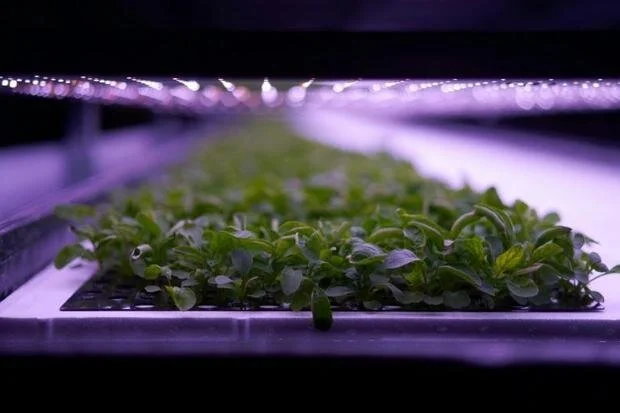
First developed around a decade ago, vertical farms have taken off in Asia and the United StatesThibault Savary, AFP
Vertical farming saves space
Vertical farms are a type of controlled-environment agriculture, which aims to optimize plant growth using soilless farming techniques such as hydroponics, aquaponics, and aeroponics. Vertical farms grow leafy greens indoors in stacked layers or on walls of foliage inside of warehouses or shipping containers.
The main advantage of utilizing vertical farming technologies is the increased crop yield that comes with a smaller unit area of land requirement.
The U.S. Department of Agriculture (USDA), says urban farming increases food security at a time of rising inflation and limited global supplies. And the USDA is seeking members for a new urban agriculture advisory committee to encourage indoor and other emerging farm practices.
More about indoor farms, food supply, technology, food security
Read more:http://www.digitaljournal.com/tech-and-science/technology/indoor-farms-gaining-investors-as-pandemic-disrupts-feeo-supplies/article/585761#ixzz6mwBqwKxt

2021 GLASE Webinar Series
The production of high nutrient density crops in controlled environments (such as greenhouses and plant factories) allows for high density, local, year-round food production
Urban CEA: Optimizing Plant Quality,
Economic And Environmental Outcomes
Date: February 25, 2021
Time: 2 p.m. - 3 p.m. EDT
Presented by: Dr. Neil Mattson (Cornell University)
Click Here To Register
The production of high nutrient density crops in controlled environments (such as greenhouses and plant factories) allows for high density, local, year-round food production. Mattson leads a National Science Foundation project that seeks to better understand the benefits and constraints of urban CEA including: economics, natural resource use, carbon footprint, and nutrition. Mattson will discuss research that seeks to optimize crop performance, nutrition, and resource use through strategic LED lighting and CO2 supplementation. Finally, Mattson will discuss efforts of the NSF project to define workforce development needs by the nascent urban CEA industry and a new USDA workforce development project to expand training opportunities in CEA for 2-year colleges and lifelong learners.
Special thanks to our Industry partners
Join today
If you have any questions or would like to know more about GLASE,
please contact its executive director
Erico Mattos at em796@cornell.edu

Training Artificial Intelligence To Track Greenhouses in Antarctica and Mars
Modern technology has long become a fixture in all spheres of human life on Earth. Reaching out to other planets is a new challenge for humankind
FEBRUARY 17, 2021
Credit: Skolkovo Institute of Science and Technology
Scientists from the Skoltech Center for Computational and Data-Intensive Science and Engineering (CDISE) and the Skoltech Digital Agriculture Laboratory and their collaborators from the German Aerospace Center (DLR) have developed an artificial intelligence (AI) system that enables processing images from autonomous greenhouses, monitoring plant growth and automating the cultivation process. Their research was published in the journal IEEE Sensors.
Modern technology has long become a fixture in all spheres of human life on Earth. Reaching out to other planets is a new challenge for humankind. Since greenhouses are likely to be the only source of fresh food for Mars space crews and settlers, development of artificial intelligence (AI) and computer-vision-based technologies for plant growth automation is perceived as a priority research target. A test site is already in place for developing and testing advanced life support systems: An autonomous plant cultivation module is operating at the Antarctic Neumayer Station III near the South Pole. Right now, scientists are focusing on creating an AI system that could collect information about all the plant growth factors and seedling health and control greenhouses in autonomous mode without human involvement.
"One cannot maintain continuous communication with Neumayer III, and training computer vision models onboard requires too many resources, so we had to find a way to send a stream of plant photographs to external servers for data processing and analysis," Skoltech Ph.D. student Sergey Nesteruk explains.
As a conclusion to their research, the Skoltech team processed a collection of images from remote automated systems using their new approach based on convolutional neural networks and outperforming popular codecs by over seven times in reducing the image size without apparent quality degradation. The researchers used the information from the reconstructed images to train a computer vision algorithm which, once trained, is capable of classifying 18 plant varieties according to species at different stages of development with an accuracy of 92%. This approach makes it possible to both visually monitor the system operation and continuously gather new ML model training data in order to enhance the models' functionality.
There are plans to deploy and test the new systems right on Neumayer III, which will mark an important step towards automation of plant growing modules, thus removing yet another roadblock on the way to Mars.
Lead photo: Plant cultivation module in Antarctica. Credit: Skolkovo Institute of Science and Technology

Take A Virtual Tour of The New CEA Center
“What OHCEAC is unique about is that we are integrative, interdisciplinary, and inclusive team conducting collaborative research to respond to CEA stakeholder needs
18-02-2021 | Urban Ag News
US, Ohio- Dr. Chieri Kubota, the Director of the new center focusing on controlled environment agriculture and protected cultivation hosted this event to introduces the programs and membership at The Ohio State University.
“What OHCEAC is unique about is that we are integrative, interdisciplinary, and inclusive team conducting collaborative research to respond to CEA stakeholder needs. Our focus inclusively covers various production systems and crop types. We use the terminology of CEA as having a very broad meaning including soil-bassed or soilless systems under various types of climate control or modification structures.”
Source and Photo Courtesy of Urban Ag News

US - COLORADO: Urban-Gro Closes $62 Million Public Offering
The Company intends to use the net proceeds to support organic growth, to expand in the European CEA market
urban-gro has closed its previously announced public offering of 6,210,000 shares of the Company’s common stock at a public offering price of $10.00 per share, which includes 810,000 shares sold upon full exercise of the underwriter’s option to purchase additional shares. The gross proceeds from the offering, including the exercise of the over-allotment option, were $62,100,000 before deducting underwriting discounts, commissions, and offering expenses.
The Company intends to use the net proceeds to support organic growth, to expand in the European CEA market, for general corporate purposes, including to fund potential future investments and acquisitions of companies that the Company believes will complement its business and growth strategy and to repay certain outstanding indebtedness.
ThinkEquity, a division of Fordham Financial Management, Inc., acted as sole book-running manager for the offering.

For more information:
urban-gro
720-390-3880
marketing@urban-gro.com
urban-gro.com

18 Feb 2021

Natufia Labs Raises $3.5M For Its Indoor Garden Appliance, Relocates To Saudi Arabia
Natufia makes an automated home gardening appliance about the size of a refrigerator that automatically controls elements such as lighting, as well as water and nutrient dispensing
Natufia Labs, the Estonia-based automated kitchen garden startup, announced today that it is relocating to Saudi Arabia’s King Abdullah University of Science and Technology (KAUST). KAUST is also leading a $3.5 million investment round in Natufia, awarding $2 million through the KAUST Innovation Fund. This brings the total amount of money raised by Natufia to $4.7 million.
Natufia makes an automated home gardening appliance about the size of a refrigerator that automatically controls elements such as lighting, as well as water and nutrient dispensing. The $13,000 Natufia cabinet uses seedpods that are placed in a special unit to germinate before being transferred to pots to grow and be harvested. Right now, Natufia’s appliance can grow leafy greens, herbs, and flowers.
In a press announcement sent to The Spoon, Natufia Labs CEO and Founder Gregory Lu said, “From Estonian icy-snow winters to the arid climate of Saudi Arabia, sustainable access to food supply is a global issue, so it is more than natural that this technology is thriving from Saudi Arabia.”

Problems with our existing food supply chain were revealed by the COVID-19 pandemic last year, causing a surge of interest in consumer indoor agriculture products. A new wave of high-tech appliances automate all the “hard” parts about growing food, allowing people to more easily grow and control their own food supply. Other players in the space including Gardyn, AeroGrow and Click & Grow have all seen demand increase during the pandemic.
With its new funding, Natufia said it will accelerate the development of its next models, hopefully bringing the price down to something more affordable for even more people.
FILED UNDER: CONNECTED KITCHEN FUNDING NEWS SMART GARDEN

Investors Seed Indoor Farms As Pandemic Disrupts Food Supplies
Proponents, including the U.S. Department of Agriculture (USDA), say urban farming increases food security at a time of rising inflation and limited global supplies. North American produce output is concentrated in Mexico and the U.S. Southwest, including California, which is prone to wildfires and other severe weather

Wausau, WI, USA Stevens Point
Feb 18, 2021
By Rod Nickel
(Reuters) - Investors used to brush off Amin Jadavji's pitch to buy Elevate Farms’ vertical growing technology and produce stacks of leafy greens indoors with artificial light.
"They would say, 'This is great, but it sounds like a science experiment,'" said Jadavji, CEO of Toronto-based Elevate.
Now, indoor farms are positioning themselves as one of the solutions to pandemic-induced disruptions to the harvesting, shipping, and sale of food.
"It's helped us change the narrative," said Jadavji, whose company runs a vertical farm in Ontario, and is building others in New York and New Zealand.
Proponents, including the U.S. Department of Agriculture (USDA), say urban farming increases food security at a time of rising inflation and limited global supplies. North American produce output is concentrated in Mexico and the U.S. Southwest, including California, which is prone to wildfires and other severe weather.
Climate-change concerns are also accelerating investments, including by agribusiness giant Bayer AG, into multi-storey vertical farms or greenhouses the size of 50 football fields.
They are enabling small North American companies like BrightFarms, AppHarvest and Elevate to bolster indoor production and compete with established players AeroFarms and Plenty, backed by Amazon.com Inc founder Jeff Bezos.
But critics question the environmental cost of indoor farms' high power requirements.
Vertical farms grow leafy greens indoors in stacked layers or on walls of foliage inside of warehouses or shipping containers. They rely on artificial light, temperature control and growing systems with minimal soil that involve water or mist, instead of the vast tracts of land in traditional agriculture.
Greenhouses can harness the sun's rays and have lower power requirements. Well-established in Asia and Europe, greenhouses are expanding in North America, using greater automation.
Investments in global indoor farms totaled $394 million in 2020, AgFunder research head Louisa Burwood-Taylor said.
The average investment last year doubled in size, as large players including BrightFarms and Plenty raised fresh capital, she said.
A big funding acceleration lies ahead, after pandemic food disruptions - such as infections among migrant workers that harvest North American produce - raised concerns about supply disruptions, said Joe Crotty, director of corporate finance at investment bank KPMG, which advises vertical farms.
"The real ramp-up is the next three to five years," Crotty said.
Vegetables grown in vertical farms or greenhouses are still just a fraction of overall production. U.S. sales of food crops grown under cover, including tomatoes, cucumbers and lettuce, amounted to 790 million pounds in 2019, up 50% from 2014, according to the USDA.
California's outdoor head lettuce production alone was nearly four times larger, at 2.9 billion pounds.
USDA is seeking members for a new urban agriculture advisory committee to encourage indoor and other emerging farm practices.
PLANT BREEDING MOVES INDOORS
Bayer, one of the world's biggest seed developers, aims to provide the plant technology to expand vertical agriculture. In August, it teamed with Singapore sovereign fund Temasek to create Unfold, a California-based company, with $30 million in seed money.
Unfold says it is the first company focused on designing seeds for indoor lettuce, tomatoes, peppers, spinach and cucumbers, using Bayer germplasm, a plant's genetic material, said Chief Executive John Purcell.
Their advances may include, for example, more compact plants and an increased breeding focus on quality, Purcell said.
Unfold hopes to make its first sales by early 2022, targeting existing farms, and start-ups in Singapore and the United Kingdom.
Greenhouses are also expanding, touting higher yields than open-field farming.
AppHarvest, which grows tomatoes in a 60-acre greenhouse in Morehead, Kentucky, broke ground on two more in the state last year. The company aims to operate 12 facilities by 2025.
Its greenhouses are positioned to reach 70% of the U.S. population within a day's drive, giving them a transportation edge over the southwest produce industry, said Chief Executive Jonathan Webb.
"We're looking to rip the produce industry out of California and Mexico and bring it over here," Webb said.
Projected global population growth will require a large increase in food production, a tough proposition outdoors given frequent disasters and severe weather, he said.
New York-based BrightFarms, which runs four greenhouses, positions them near major U.S. cities, said Chief Executive Steve Platt. The company, whose customers include grocers Kroger and Walmart, plans to open its two largest farms this year, in North Carolina and Massachusetts.
Platt expects that within a decade, half of all leafy greens in the United States will come from indoor farms, up from less than 10% currently.
"It's a whole wave moving in this direction because the system we have today isn’t set up to feed people across the country," he said.
'CRAZY, CRAZY THINGS'
But Stan Cox, research scholar for non-profit The Land Institute, is skeptical of vertical farms. They depend on grocery store premiums to offset higher electricity costs for lighting and temperature control, he said.
"The whole reason we have agriculture is to harvest sunlight that’s hitting the earth every day," he said. "We can get it for free."
Bruce Bugbee, a professor of environmental plant physiology at Utah State University, has studied space farming for NASA. But he finds power-intensive vertical farming on Earth far-fetched.
"Venture capital goes into all kinds of crazy, crazy things and this is another thing on the list."
Bugbee estimates that vertical farms use 10 times the energy to produce food as outdoor farms, even factoring in the fuel to truck conventional produce across country from California.
AeroFarms, operator of one of the world's largest vertical farms, a former New Jersey steel mill, says comparing energy use with outdoor agriculture is not straightforward. Produce that ships long distances has a higher spoilage rate and many outdoor produce farms use irrigated water and pesticides, said Chief Executive Officer David Rosenberg.
Vertical farms tout other environmental benefits.
Elevate uses a closed loop system to water plants automatically, collect moisture plants emit and then re-water them with it. Such a system requires 2% of the water used on an outdoor romaine lettuce operation, Jadavji said. The company uses no pesticides.
"I think we're solving a problem," he said.
(Reporting by Rod Nickel in Winnipeg, Manitoba; additional reporting by Karl Plume in Chicago; Editing by Caroline Stauffer and Lisa Shumaker)

Living Greens Farms Ramps Up Midwest Expansion
Living Greens Farm has upped its retail distribution with the addition of UNFI Produce Prescott, a division of United Natural Foods, Inc (UNFI)
Feb. 18th, 2021
by Melissa De Leon Chavez
FARIBAULT, MN - Living Greens Farm (LGF) has upped its retail distribution with the addition of UNFI Produce Prescott, a division of United Natural Foods, Inc. (UNFI). This new retail partnership will help LGF expand its product reach to independent, specialty, and co-op retailers throughout the upper Midwest.
According to a press release, LGF’s proprietary vertical indoor farming method yields high-quality, fresh produce. No pesticides or chemicals are used during the growing process. Throughout the growing, cleaning, and bagging process, LGF reduces handling and time to the retail shelf. All of these benefits continue to attract new users and new retail distribution.
Living Greens Farm has upped its retail distribution with the addition of UNFI Produce Prescott, a division of United Natural Foods, Inc (UNFI)
Beginning this month, LGF’s full line of products featuring ready-to-eat bagged salad products, such as Caesar Salad Kit, Southwest Salad Kit, Harvest Salad Kit, Chopped Romaine, and Chopped Butter Lettuce will be carried by UNFI Produce Prescott (formerly Alberts Fresh Produce).
Across the nation, UNFI has eight warehouses, and LGF’s products will be carried by its upper Midwest location, located just across the river from the Twin Cities in Prescott, Wisconsin.
As indoor farming becomes more popular, who will Living Greens Farm partner with next?
Stay tuned to AndNowUKnow as we cover the latest.
COMPANIES IN THIS STORY
We believe in revolutionizing how produce is grown throughout the world. Our products are fresh, local, and pesticide-free....
UNFI
UNFI is the leading independent national distributor of natural, organic and specialty foods and related products...

How This Vertical Farm Grows 80,000 Pounds of Produce per Week
To some, the pristine growing conditions and perceived mechanical interference of a vertical farm can seem unnatural, but at Bowery Farming “interference” is actually not the goal at all. “We don’t really think about how people are involved in the growing process, but how to take people out of the growing process”
Bowery Farming uses technology to prioritize accessibility and sustainability in their produce growing operations
To some, the pristine growing conditions and perceived mechanical interference of a vertical farm can seem unnatural, but at Bowery Farming “interference” is actually not the goal at all. “We don’t really think about how people are involved in the growing process, but how to take people out of the growing process” says chief science officer Henry Sztul. “Our goal is actually to have as few people walking around our plants as possible.”
Bowery Farming is a network of vertical farms working to reengineer the growing process. Using a system of light and watering technology, Bowery is able to use 95 percent less water than a traditional outdoor farm, zero pesticides and chemicals, and grow food that tastes as good as anyone else’s.
Bowery Farming uses vertical farm-specific seeds that are optimized for flavor instead of insect resistance and durability. Seeds are mechanically pressed into trays of soil, and sent out into growing positions, or racks within the building that have their own lighting and watering systems. Each tray gets its own QR code so that they can be monitored and assigned a customized plan for water and light until they’re ready to be harvested.
Irving Fain, Bowery Farming’s founder and CEO contemplates the prediction from the United Nations that 70 to 80 percent of the world’s population will be living in and around cities in the next 30 years. “Figuring out ‘how do you feed and how do you provide fresh food to urban environments both more efficiently as well as more sustainably?’ is a very important question today, and an even more important question in the years to come.”


USA - SOUTH BEND, INDIANA - Pure Green Farms Launches New Website
The announcement of the new website falls in line with Pure Green Farms’ recent expansion plan, as the company announced back in December that it would be entering the leafy greens sector
February 15th, 2021
by Peggy Packer
SOUTH BEND, IN - The internet has surely become one of the most powerful tools shoppers are using these days to stay up to date on all the new ingredients that could be making their way to their kitchens. On the heels of a recent announcement to expand its offerings, Pure Green Farms has announced the launch of a new website, just in time for the rollout of four new SKUs set to hit retailers this March.
Joe McGuire, Chief Executive Officer, Pure Green Farms“We’re excited to be getting closer to our products being in stores and look forward to the future of our growth,” said CEO Joe McGuire. “We’ve got an excellent production team and have worked hard to get ready for our official release date. The launch of the website is just one of the important steps in getting ready for next month.”

The new website highlights the advanced technology and growing practices used at Pure Green’s hydroponic indoor farm, as well as the products that will be available, according to a press release.
Just in time for the rollout of four new SKUs, Pure Green Farms has announced the launch of a new website
The announcement of the new website falls in line with Pure Green Farms’ recent expansion plan, as the company announced back in December that it would be entering the leafy greens sector. Optimizing its state-of-the-art technology, including automatic seeding, harvesting, and packing technology, the brand will make its debut in the sector with the launch of four lettuce varieties.
AndNowUKnow will continue to report on all the latest news in the fresh produce industry.