

The Next Animal Feed Disruption Will Arrive in a Container

Smart Fodder Farms
August 4, 2026
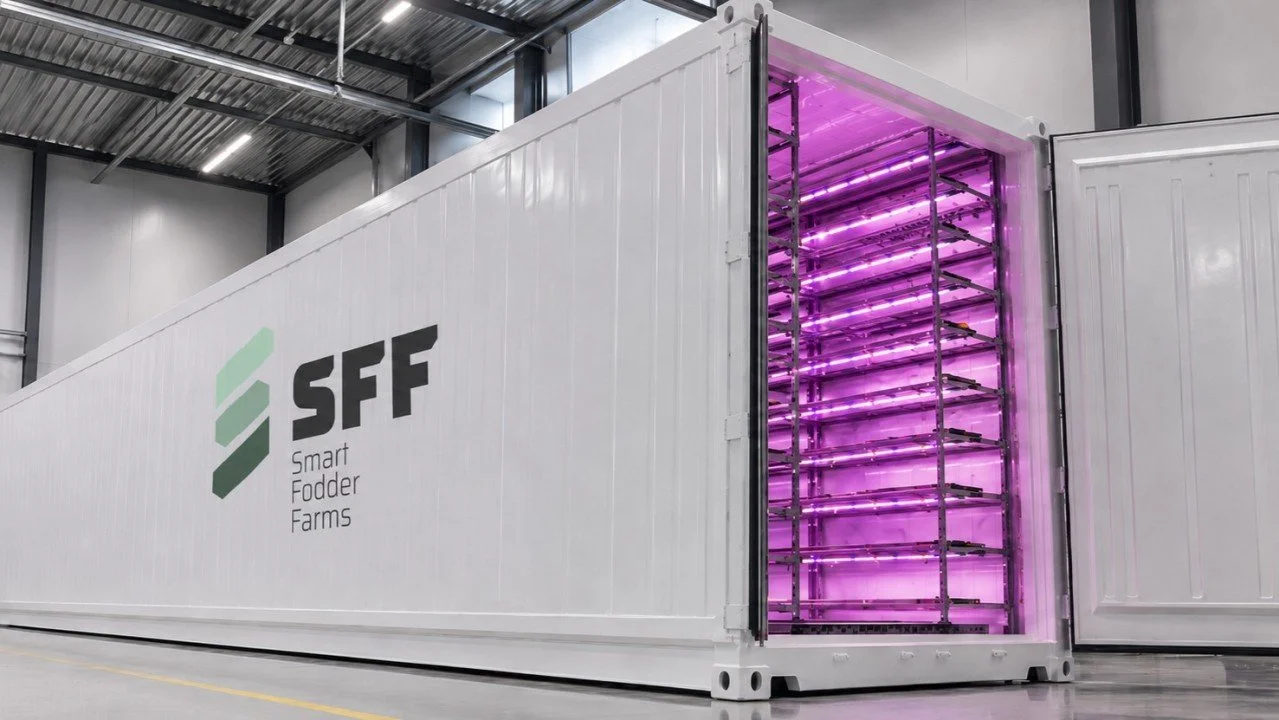
On 3 August, shipping data recorded only six vessels crossing the Strait of Hormuz. Three were bulk carriers.
The number may change tomorrow. The vulnerability will not.
More than 70% of the foodstuffs imported by GCC countries normally pass through the Strait of Hormuz. The UAE alone consumes approximately 3 million tonnes of grain and forage products annually and imports hay, alfalfa and soybean meal to support a livestock population of around 4.8 million cows, camels, sheep and goats.
For livestock operators, this is not a geopolitical headline. It is a feed-planning problem.
A ration formulated today may still depend on forage located thousands of kilometres away, travelling through a limited number of ports, vessels and trade corridors.
The next disruption in animal feed will therefore not be another new ingredient. It will be the decentralisation of feed production.
From purchased tonnes to installed daily capacity
Livestock farms have traditionally measured feed security through inventories, suppliers and purchase contracts.
A different model is emerging: installing part of the farm’s daily feed-production capacity next to the animals.
Not replacing the entire ration. Not claiming complete self-sufficiency.
Producing a defined quantity of fresh fodder every day, under controlled conditions, independently of soil, rainfall and conventional forage harvests.
This changes the purchasing question.
Instead of asking only:
How much will alfalfa cost next month?
The farm can also ask:
How many kilograms of our daily requirement do we want to produce ourselves?
What does that capacity look like?
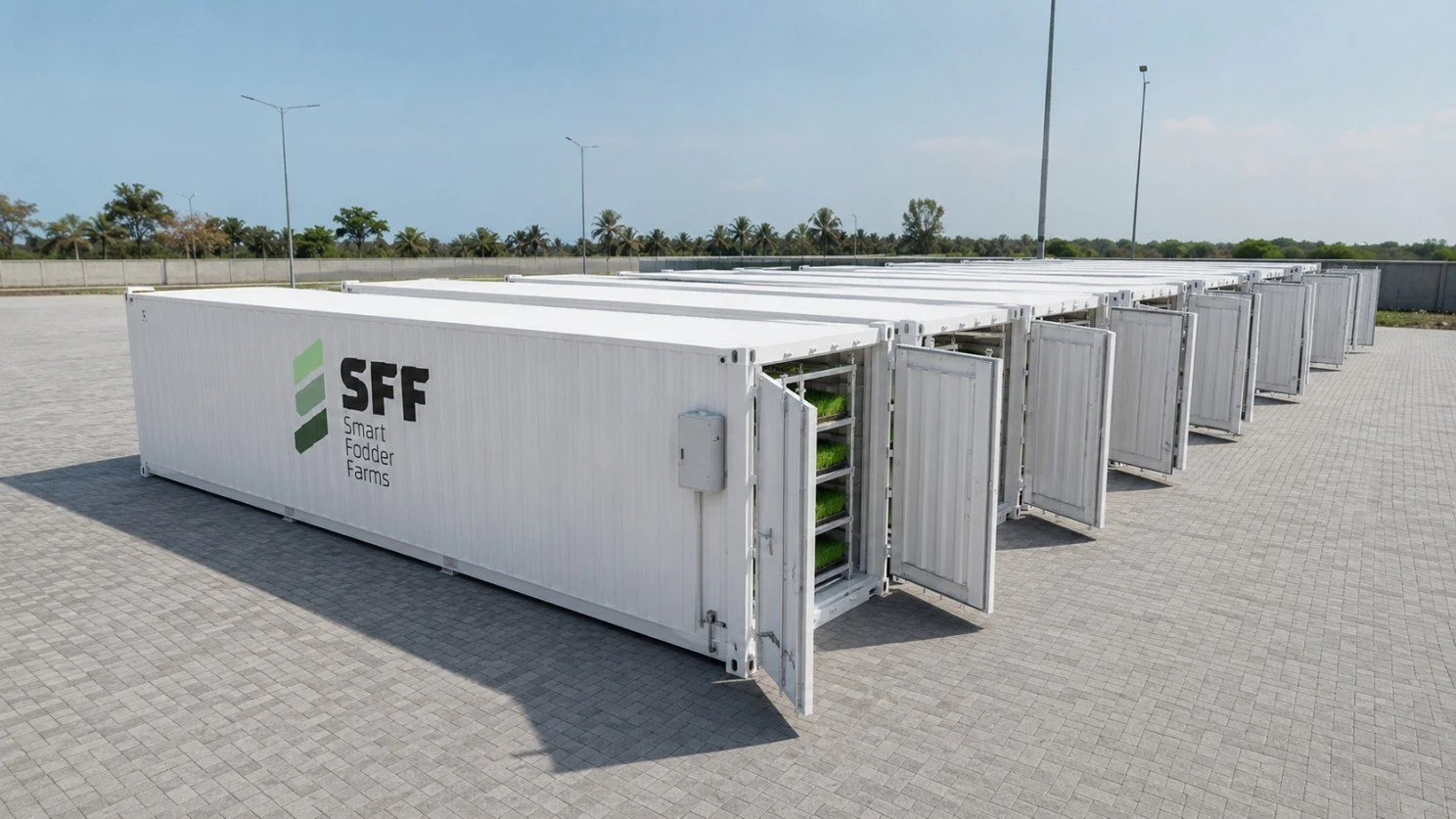
Smart Fodder Farms offers three containerised production levels:
20’ container
Approximately 275 kg of fresh hydroponic fodder per day.
That represents more than 100 tonnes of nominal annual production when operated continuously.
40’ container
Approximately 690 kg per day.
Equivalent to around 252 tonnes of nominal annual production.
40’ High Cube container
Up to approximately 840 kg per day.
Equivalent to more than 306 tonnes of nominal annual production.
The production cycle takes approximately six to seven days. Each insulated unit integrates growing racks, trays, automated irrigation, LED lighting, climate control, ventilation, disinfection and parameter monitoring.
Seed enters the container.
A controlled quantity of fresh fodder leaves every day.
This is not “six times more feed”
One kilogram of seed can generate several kilograms of fresh hydroponic fodder because the plant absorbs water during germination.
That does not mean that the system magically creates six times more dry matter.
This distinction matters.
A 2026 systematic review covering 92 studies concluded that hydroponic fodder works most effectively as a supplementary green feed and as a partial replacement within a balanced ration. The evidence does not support treating it as a universal replacement for every conventional feed ingredient.
Its commercial value comes from something more practical:
Daily production in six-to-seven-day cycles.
Reduced dependence on agricultural land.
Controlled production throughout the year.
Water savings compared with conventional green-fodder cultivation.
A consistent fresh component within the feeding programme.
The ability to add capacity in modules.
That is a more defensible proposition than promising complete feed independence.
It is also more valuable to a serious livestock operator.
The investment starts with one operational number
Suppose a farm wants to secure 600 kg of fresh fodder per day.
A 20’ container would not provide sufficient capacity. A 40’ unit, with an approximate output of 690 kg per day, would be the logical configuration to evaluate.
If the target is closer to 800 kg per day, the 40’ High Cube becomes more appropriate.
If the operation requires 1,500 or 2,500 kg per day, production can be designed using several modules rather than one large, fixed facility.
The decision can therefore be calculated from four variables:
Number and type of animals.
Target kilograms of fresh fodder per animal and day.
Local seed, water, electricity and labour costs.
Current cost and availability of imported forage.
From these figures, the farm can estimate the required model, number of units, production cost per kilogram and proportion of its daily supply produced on-site.
The real product is not the container
The container is the infrastructure.
The product is 275, 690 or 840 kilograms of planned daily output.
It is the difference between purchasing every kilogram through an external supply chain and controlling a defined part of production inside the farm.
Smart Fodder Farms is currently evaluating projects for cattle, sheep and goat operations, as well as distributors interested in supplying fresh fodder locally.
Send us your country, livestock type, number of animals and desired daily production.
We will calculate which configuration should be evaluated: 20’, 40’, 40’ High Cube or a modular combination.
The next feed shipment still depends on the market.
Your next 840 kilograms do not have to.