How Universities Are Using Controlled Environment Agriculture to Prepare the Next Generation of Growers
As agriculture adapts to climate change, resource constraints, and growing food demand, universities are rethinking how they prepare students for careers in the industry. While traditional fieldwork remains valuable, it no longer reflects the technologies transforming commercial food production.
Today, controlled environment agriculture programs are helping institutions bridge that gap. Through indoor growing systems, universities can give students hands-on experience with the same technologies used in modern greenhouses, vertical farms, and controlled growing facilities.
More importantly, controlled environment agriculture (CEA) is changing how students learn. Instead of only reading about plant science, sustainability, and food systems, they can observe, experiment, collect data, and solve real growing challenges throughout the academic year.
What Is Controlled Environment Agriculture?
Controlled Environment Agriculture (CEA)is the practice of growing crops inside carefully managed environments where factors such as temperature, humidity, lighting, water, airflow, and nutrients are controlled to optimize plant growth.
CEA includes technologies such as:
Hydroponics
Vertical farming
Indoor growing systems
Smart greenhouses
Automated climate control
Precision irrigation
These systems allow crops to be grown year-round while reducing water consumption, improving consistency, and using space more efficiently than traditional farming methods.
As CEA continues to expand across agriculture, food production, and AgTech, universities are introducing controlled environment agriculture programs to prepare students for an increasingly technology-driven industry.
Why Universities Are Investing in Controlled Environment Agriculture
Modern agriculture requires graduates who understand far more than crop production.
Today’s employers are looking for professionals who can combine biology with technology, sustainability, engineering, and data analysis.
That makes CEA an ideal educational platform because it naturally brings together multiple disciplines, including:
Plant science
Horticulture
Environmental science
Agricultural engineering
Sustainability
Food systems
Data analytics
Business and entrepreneurship
Rather than teaching each subject independently, universities can use indoor growing environments to connect them through practical learning experiences.
The Shift Toward Indoor Agriculture Education
The growth of indoor agriculture education reflects a larger shift happening across higher education.
Students are increasingly expected to graduate with practical skills alongside theoretical knowledge. Employers want graduates who already understand environmental monitoring, hydroponic systems, crop management, and sustainability practices.
Indoor growing environments help make that possible.
Instead of learning only from textbooks, students can observe every stage of the growing cycle while understanding how variables such as light intensity, nutrient balance, humidity, and temperature influence plant development.
Because these environments operate year-round, instructors can integrate them into multiple semesters without depending on seasonal growing conditions.
Why Hands-On Learning Produces Better Graduates
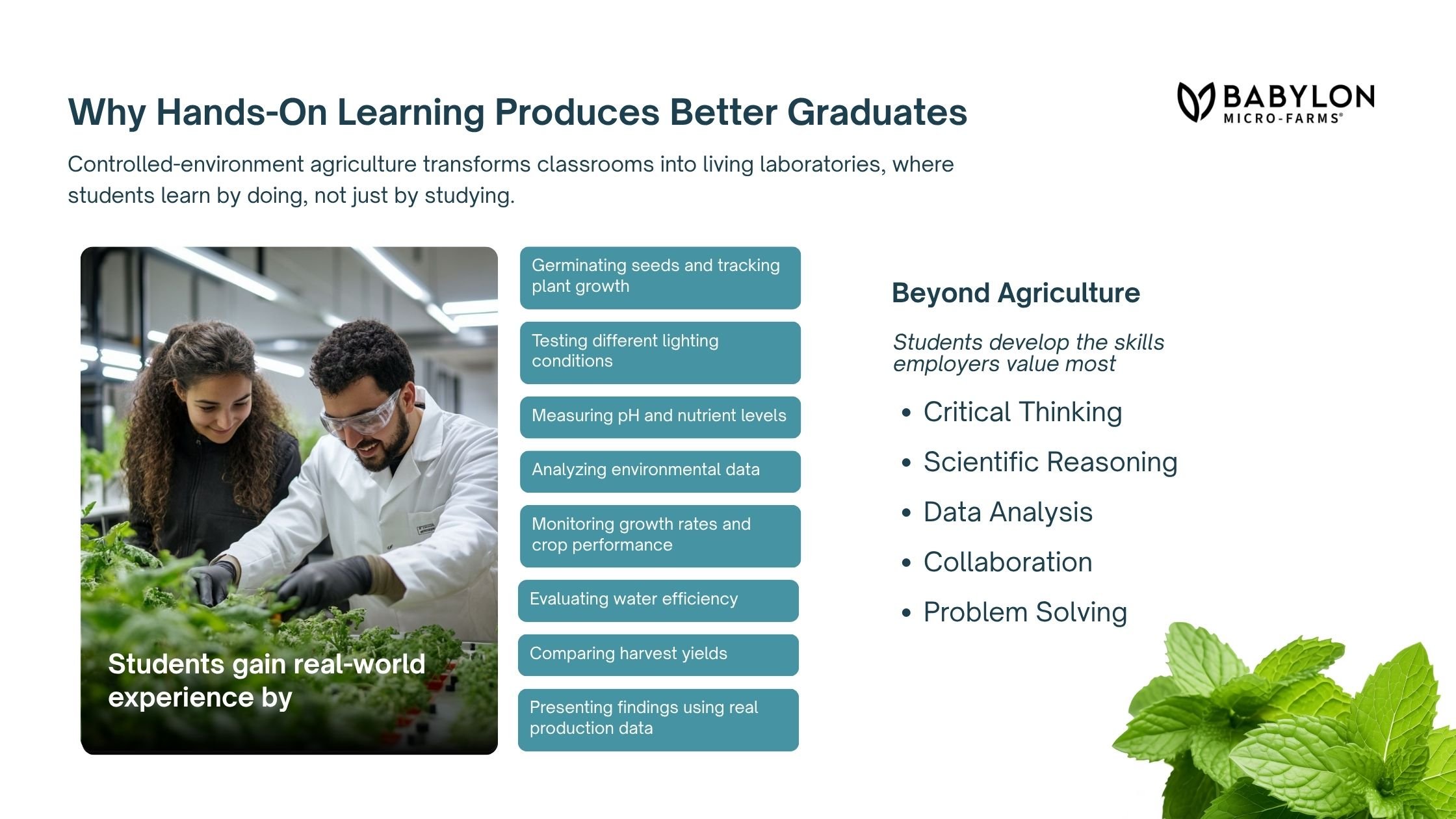
One of the biggest advantages of controlled environment agriculture is its ability to support experiential learning in higher education.
Students don’t simply study agricultural concepts. They actively apply them.
Within a controlled growing environment, students can:
Germinate seeds and monitor plant development
Compare different lighting conditions
Measure pH and nutrient levels
Analyze environmental data
Track growth rates
Evaluate water efficiency
Compare crop yields
Present findings using real production data
These experiences help students develop critical thinking, scientific reasoning, collaboration, and problem-solving skills that employers increasingly expect from new graduates.
Instead of completing isolated classroom exercises, students participate in living projects that evolve throughout the semester.
What Makes a Controlled Environment Agriculture System Effective for Higher Education?
Not every indoor farming system is designed for education.
Universities need growing systems that support learning as much as food production.
The most effective educational systems are those that:
Fit inside classrooms, laboratories, libraries, or shared campus spaces
Allow students to safely observe every stage of plant growth
Generate measurable environmental and crop data
Support multiple courses across different departments
Require minimal maintenance for faculty and staff
Operate consistently throughout the academic year
Encourage student participation rather than passive observation
These characteristics transform an indoor growing system from equipment into an educational resource that can be used across the curriculum.
Beyond Agriculture: A Campus-Wide Learning Resource
One of the greatest strengths of controlled environment agriculture is that it extends far beyond agriculture departments.
Indoor growing systems can support learning across:
Biology
Students study plant physiology, genetics, and environmental responses.
Environmental Science
Classes explore resource conservation, water efficiency, and sustainable food production.
Engineering
Students analyze automation systems, sensors, lighting technologies, and environmental controls.
Nutrition and Health Sciences
Learners connect food production with nutrition, food security, and healthy eating.
Business
Students examine operational efficiency, supply chains, and the economics of indoor farming.
Sustainability Programs
Campuses use growing systems to demonstrate sustainability initiatives while engaging students in measurable environmental outcomes.
This interdisciplinary approach allows one educational resource to benefit multiple academic programs throughout the institution.
Supporting Campus Sustainability and Student Engagement
Many universities have ambitious sustainability goals, but students often experience them only through reports or campus policies.
Indoor growing environments make sustainability visible.
Students can see how food is produced using less water, shorter transportation distances, and controlled resource management. They can harvest produce, evaluate environmental performance, and connect classroom discussions to real outcomes.
These systems also create opportunities for collaboration between academic departments, dining services, student organizations, and sustainability offices.
Some institutions incorporate fresh produce into campus events or dining initiatives. Others use growing systems during orientation programs, research showcases, community outreach, or student-led sustainability projects.
The result is a learning experience that extends beyond the classroom and becomes part of campus life.
Preparing Students for Controlled Environment Agriculture Careers
Demand for professionals with experience in CEA continues to grow across commercial greenhouses, vertical farms, food producers, research institutions, and AgTech companies.
Graduates with practical experience are well positioned for careers such as:
Indoor Farm Manager
Greenhouse Production Specialist
Horticulturist
Agricultural Engineer
Crop Scientist
Sustainability Consultant
Controlled Environment Agriculture Researcher
AgTech Product Specialist
By participating in controlled environment agriculture programs, students graduate with a stronger understanding of both the science and technology shaping modern agriculture.
That practical experience helps them transition more confidently into a rapidly evolving workforce.
Building the Next Generation of Growers Starts on Campus
Preparing students for the future of agriculture requires more than updated coursework.
It requires learning environments where students can experiment, analyze data, solve problems, and understand how technology is transforming food production.
Controlled environment agriculture gives universities an opportunity to create those environments while supporting interdisciplinary education, sustainability initiatives, faculty research, and student engagement.
As the industry continues to evolve, institutions that embrace hands-on learning will be better positioned to prepare graduates who are ready to lead it.
Discover How STEM Garden Supports Higher Education
Universities looking to expand their controlled environment agriculture programs must incorporate learning tools that are practical, engaging, and designed for the classroom.
STEM Garden by Babylon Microfarms helps higher education institutions bring indoor agriculture into everyday learning. Designed for hands-on education, it enables students to explore plant science, sustainability, food systems, and environmental technology through real growing experiences while supporting interdisciplinary teaching, campus engagement, and experiential learning.
Whether you’re introducing students to controlled environment agriculture for the first time or expanding an existing program, STEM Garden helps turn concepts into meaningful, real-world learning experiences.
Ready to see controlled environment agriculture programs in action on your campus? Schedule a demo with our team to explore how STEM Garden can fit your institution’s curriculum and space.
Frequently Asked Questions
1. What are controlled environment agriculture programs in higher education?
Controlled environment agriculture education teaches students how crops are grown in carefully managed indoor environments using technologies such as hydroponics, vertical farming, climate control, and automated growing systems. It combines agricultural science with engineering, sustainability, and data-driven decision-making.
2. Why are universities adopting controlled environment agriculture?
Universities are adopting controlled environment agriculture to provide hands-on learning, support interdisciplinary research, strengthen sustainability initiatives, and prepare students for careers in modern agriculture and AgTech.
3. How does indoor agriculture education benefit students?
Indoor agriculture education gives students practical experience with crop production, environmental monitoring, data analysis, and sustainable growing methods, helping bridge the gap between classroom learning and industry expectations.
4. Which academic departments can use controlled environment agriculture systems?
Controlled environment agriculture systems can support courses in horticulture, biology, environmental science, engineering, sustainability, nutrition, business, and food systems, making them valuable learning resources across multiple departments.
5. How can universities introduce controlled environment agriculture without building a large greenhouse?
Many institutions begin with compact indoor growing systems that fit inside classrooms, laboratories, or shared campus spaces. These systems allow students to gain year-round, hands-on experience with modern growing technologies while supporting teaching, research, and campus sustainability initiatives.