


Welcome to iGrow News, Your Source for the World of Indoor Vertical Farming

USDA Voluntary G.A.P. Program
The USDA recently recognized aquaponics under their voluntary Good Agricultural Practices (GAP) program through the Specialty Crops Inspection (SCI) division

By Tawnya Sawyer
The USDA recently recognized aquaponics under their voluntary Good Agricultural Practices (GAP) program through the Specialty Crops Inspection (SCI) division. This program is in its pilot phase for audits and certification of selected aquaponics farms through the end of 2020. Having a set of guidelines for aquaponics helps to better align with the specifics of growing in soil-less media, using filtered fish waste for nutrient solution, and bio-integration of fish and plants in a growing facility.
Prior to this pilot program, aquaponic farm audits were subject to standard GAP guidelines designed for produce crops grown in a field or cultivated in a greenhouse. This created challenges for auditors trying to modify or interpret guidelines for other growing methods that don’t align or apply to aquaponics. By launching this pilot program, the USDA has indicated that aquaponics is viewed as a commercially viable industry worthy of its own audit guidelines and food safety certification. Find out more about the USDA’s Aquaponics GAP Pilot Program here.

Create Multiple Streams of Income With Container Farming
Right now, despite COVID-19 repercussions, food remains a necessity, and there exists an opportunity to build resilience into our business models. As a result, many businesses, food-related or not, can create a viable new stream of income by growing your own produce with a container farm
CURRENT CHALLENGES
Right now, despite COVID-19 repercussions, food remains a necessity, and there exists an opportunity to build resilience into our business models.
As a result, many businesses, food-related or not, can create a viable new stream of income by growing your own produce with a container farm.
WHAT IS CONTAINER FARMING?
Container farming uses a hydroponic growing system to commercially grow a variety of fresh produce more sustainably and year-round. This type of growth is done in a controlled environment that is time, space, and resource-efficient.
The real value is not only the produce grown, but the ability for a container farm to offer a community or business a local source of produce, a source of employment, and an additional stream of income.
GROWING FOR THE LOCAL COMMUNITY
Those who work closely with our food systems know that growing your own food is not going to solve food security immediately. However, we can’t dismiss the benefit of growing food closer to the people who consume it.
If you’re a co-op store, the container farm is behind your store and ready to fill your shelves. If you’re a nonprofit that cooks meals, sourcing produce is one logistic you can cross off your list. If your community is remote, or further from city centers, the importance of having a local source of food is not lost on you. Access to local food becomes even more critical in light of current events that have shaken our supply chains.
Abbey Gardens purchased a Growcer to ensure that they were able to generate revenue year-round instead of seasonally.
YEAR-ROUND RELIABILITY
Growcer systems are plug-and-play systems built to operate year-round among all conditions. The system allows you to consistently harvest produce and benefit from this stream of income year-round.
If you rely on a seasonal bump for a boost, this consistent source of income increases the foundation you have to work with.
The hydroponic growing system also allows multiple types of crops can be grown at once from over 140 different varieties of produce and the ability to swap what you’re growing to meet demand.
The Yellowknife Co-op has created their own produce line and branding for their Growcer greens.
PROOF OF CONCEPT
Can a container farm really be an extra source of income? We know it can. We’ve collaborated with many diverse communities and organizations that have tailored a Growcer system to work for them.
For example, businesses like Abbey Gardens and The Yellowknife Co-op used the Growcer system to add extra revenue to their main line of business. For the Gitmaxmak’ay Nisga’a Society, they are adding the system to create an entirely new source of revenue for their non-profit.
While a container farm can be a source of extra income, it has to be feasible first. You must factor your situation, your market, and your financial options when investigating if this is a fit.
Take the first step and plug in your specifics into our ROI calculator to evaluate the feasibility of a container farm for you.
StephanieMay 4, 2020

Peloton Meets Greengrocer: Farmshelf Launches Home Version of Indoor Farming System
The latest high-tech offering: a fully-automated indoor farm for greens and herbs, all housed within a sleek case the size of a bookshelf
John Jannarone
IPO-Edge.com April 28, 2020
From Peloton Interactive Inc. to Netflix, Inc., companies offering at-home technologies to keep people busy, healthy, and entertained during the lockdown have thrived. The latest high-tech offering: a fully-automated indoor farm for greens and herbs, all housed within a sleek case the size of a bookshelf.
Farmshelf, which currently sells a professional device popular with celebrity chefs like José Andrés, has launched Farmshelf Home, a slightly smaller version designed specifically for home use. Farmshelf Home, which is available for pre-order, features a remotely-controlled hydroponic system and an app that monitors the miniature crop with cameras and sensors. Everything from hydration to airflow to nutrients are controlled by the machine, with owners simply needing to occasionally refill water and harvest plants.
“Our mission has always been to make it easy for people to grow their own food where they live, work, and eat. We started where they work and eat at restaurants and corporate cafes, now we are coming to the home,” said Andrew Shearer, founder, and CEO of Farmshelf. “Giving people the opportunity to harvest food as it’s needed will not only elevate the idea of ‘farm to table but help reduce the ongoing cycle of food waste.”
Farmshelf Home is truly the first of its kind. While other contraptions exist such as a tabletop system from The Scotts Miracle-Gro Company, they are relatively small. Farmshelf Home produces enough to cover a meaningful part of a weekly shopping list: a sample harvest includes 8 heads of lettuce, 8 bunches of herbs, and 8 bunches of greens.
View photos
“The food we eat was not designed to ship 1500 miles,” Mr. Shearer said. “We are going from shipping food miles to shipping food a few feet. It really changes the equation.”
Users can choose from a diverse menu of over 40 different herbs, leafy greens, and edible flowers. Choices include staples like romaine lettuce along with more exotic plants such as shiso and viola flowers.
The system also reduces food waste because users simply trim whatever ingredients they need for a meal. Farmshelf estimates the system, which sells for $4,950 on pre-order and has a $35 monthly fee for seeds and other essentials, can save users up to $2,500 a year in grocery bills.
The system also has advantages over normal gardening. Thanks to the controlled atmosphere and technology, plants grow three times as fast and need 90% less water. There’s also no need for pesticides or herbicides, meaning users technically can eat greens without washing them.
While away from home, users can keep an eye on their plants through the mobile app. It features live camera views and sends alerts for needs such as a water refill.
The success of the professional model suggests Farmshelf Home will be a hit. Farmshelf is very popular with superstar chefs like Mr. Andrés, who actually has a professional version in his own home. He recently tweeted a video of one of his Farmshelf units, raving about romaine lettuce.
Farmshelf also serves large groups of diners at schools and corporate cafeterias. American Express Company, for instance, uses multiple Farmshelf systems to serve 3,000 people per day.
To date, Farmshelf has raised over $8 million privately. Mr. Shearer said the company may seek more capital in the future as it continues to grow.
Contact:
John Jannarone, Editor-in-Chief
editor@IPO-Edge.com

How One Man Is Urban Farming For Manila’s Greener Future
In October 2016, a year after Becker moved to Manila from Silicon Valley, he founded Urban Greens, an agri-tech startup that aims “to provide cleaner, fresher, smarter greens entirely grown hydroponically,” perfectly catered to an increasingly urbanized world
BY APPLE MANDY
24 APRIL 2020
Luxembourg-born Ralph Becker saw the need for food security solutions, as well as a way to minimize carbon footprint and the farm-to-table distance. While the Philippines is blessed with lush and fertile lands, as well as a climate suited to growing a variety of crops, in recent years, agriculture in the country is struggling. Farmers lack support and training, rural farming practices are outdated, and exposure to typhoons and droughts are making traditional food production methods more and more difficult.
In October 2016, a year after Becker moved to Manila from Silicon Valley, he founded Urban Greens, an agri-tech startup that aims “to provide cleaner, fresher, smarter greens entirely grown hydroponically,” perfectly catered to an increasingly urbanized world.
Growing greens hydroponically is a method of growing plants without soil, meaning that there’s no need for the use of pesticides, fertilizers, or fungicides. Crops are non-GMO (genetically modified organisms) and only require minimal amounts of water for growth. Plants are cultivated using a carefully concocted nutrient solution and can be grown anywhere with oxygen. Another advantage is that the crops will not be subject to the whims of nature, or the devastation of natural disasters.
Becker’s passion for plants stems from his childhood when his Filipino mum would take him to Cebu during the holidays. “My mom loves to surround herself with plants and that’s how my affinity to plants grew,” shares Becker. Growing up, Becker had the opportunity to travel and live in different cities. He studied and pursued his masters in London and Singapore, and worked for Sony Corporation in various locations, including San Francisco and Tokyo. After almost an eight-year stint at Sony, he decided to leave the corporate world and start his own business.
“When I was working for Sony, I was tasked to work on a product and somehow I felt I was like a machine creating more garbage,” says Becker. “I asked myself: ‘How can I make an impact and what industry am I able to contribute my time and effort?’ In the corporate world, you are replaceable. I learned a lot while working at Sony. I learned how to be an entrepreneur and to be an observer, as well as accounting, social media, and human resources. There were certainly some skills I’ve learned that were transferable.”
After 10 years of studying and working abroad, Becker decided to get back in touch with his Filipino roots and move back to Manila. There, he noticed the imported vegetables on the shelves are expensive, but not necessarily of the best quality. With the help of YouTube tutorials, he created a window farm using a hydroponics system inside his apartment in Makati. The enthusiastic feedback prompted him to explore the idea further, which led him to set up his business.
Like any start-up owner, Becker encountered challenges. His first business model—creating custom-built hydroponic towers for individual customers—didn’t work as “it was very inefficient and requires higher maintenance”.
With the new model, Becker focuses more on bringing the right pH and nutrient levels for each plant. He employs the NFT (nutrient film technique) system, one of the most popular hydroponic growing styles, in which nutrients are delivered via a thin film of water to plants arranged on a slanted gutter. This system, Becker says, is easily scalable, with a very flexible and modular design.
“Plants are vulnerable to outside elements. By growing them indoors, you can protect them from too much rain or heat, and control the temperature and humidity easily,” says Becker. “That way each crop looks the same and they are of high quality. There are also no pesticides, so rest assured you are getting better quality.”
Currently, Becker and his team of biologists, engineers, agronomists, and marketing specialists grow around a dozen varieties of herbs and vegetables, including arugula, basil, and mint. His clients include five-star hotels, high-end bars, and local restaurants. Sensors are also incorporated into the system to facilitate remote monitoring and big data analytics and integrates blockchain technology in vertical farming so people can understand more about what goes into putting food on their plates.
“Knowing what nutrients are needed for each crop is important,” says Becker. “We want to create the best possible environment and make everything as transparent as possible. We also want to share when and how the harvests grow so it gives people an idea of what they are consuming.”
Currently, Becker is closing the seed funding round but is continuously seeking strategic partnerships with other SME companies. Internship positions are also available.


“I built Urban Greens because I want to use my knowledge and skills to contribute something for the community and be part of a solution,” says Becker. “I have always wanted to do something more impactful and help the community.”
The Philippines may lag behind neighbors in terms of agriculture output and land reform, but Becker is still positive that the younger generation and Filipino agronomists can still contribute to something bigger. He also believes that Manila is currently undergoing a dynamic shift: It is quickly developing into a hub for social enterprises and start-ups. Like Becker, a lot of people are moving back, a sort of “reverse diaspora,” and bringing back their ideas and expertise. For Becker, the demand for a cleaner and greener Philippines is growing, and the answer might just be hiding in your basement.
Apple Mandy
CONTRIBUTOR
Multilingual lifestyle writer and editor Apple Mandy loves exploring. After 10 years of living in Hong Kong and working for various media companies, including South China Morning Post, she went back to Manila to reconnect with the city she grew up in. There, she explored new places, revisited her childhood favorites, and delved into the creative side of things. She recently moved to New York; you may find her at a café blogging about her experiences while sipping a cup of tea.

The Case Against More Ethanol - It's Simply Bad for Environment
The revisionist effort to increase the percentage of ethanol blended with U.S. gasoline continues to ignore the major environmental impacts of growing corn for fuel and how it inevitably leads to higher prices for this staple food crop
Ethanol, which seemed like a good idea when huge federal subsidies and mandates were put in place a decade ago, now seems like a very poor idea indeed. Yet despite years of bad ethanol reviews, some prominent figures (including former Senator Tim Wirth and attorney C. Boyden Gray in the accompanying article) offer a revanchist argument: Ethanol is not really so bad after all, and we should significantly increase its blending with gasoline from 10 to 30 percent. As Samuel Johnson remarked of a second marriage, this narrative reads like a triumph of hope over experience.
The essence of the argument that we need more, not less, ethanol in our gas tanks is linked to the U.S. Environmental Protection Agency’s upcoming mid-term review of President Obama’s fuel economy standards, established in 2012. Ethanol boosters say now is the time to ramp up the ethanol/gasoline blend to 30 percent because it will reduce harmful particulate pollution, improve gas mileage, and lower gas prices. As for the environmental costs of increased corn production, they contend that vastly improved agricultural methods are steadily reducing the use of chemicals and fertilizers on cornfields.
The truth is, however, that growing corn in the U.S. heartland still has a major environmental impact — one that will only increase if we add even more ethanol to our gasoline. Higher-ethanol blends still produce significant levels of air pollution, reduce fuel efficiency, jack up corn and other food prices, and have been treated with skepticism by some car manufacturers for the damage they do to engines. Growing corn to run our cars was a bad idea 10 years ago. Increasing our reliance on corn ethanol in the coming decades is doubling down on a poor bet.
The effort to rehabilitate corn ethanol is linked to the perceived insufficiency of federal mandates — known as the Renewable Fuel Standard — requiring an escalating quantity of ethanol from corn and cellulosic sources to be blended with gasoline annually until 2022. Cellulosic ethanol, which was supposed to supplant that made from corn in meeting the mandate, has proven a monumental disappointment, and the EPA has taken a big step back from requiring its use.
To continue to meet the renewable fuel mandate will require further use of corn-based ethanol, which is constrained by the so-called “blend wall” — a limit related to current engine design — because most of the ethanol now available is only blended with gasoline at a level of 10 percent. The ethanol industry and others are proposing raising the blend level to 30 percent. Without such a break in the blend wall, the renewable fuel standards mandates are in trouble. At present, though, fewer than 2 percent of filling stations in the U.S. sell higher than 10 percent ethanol blends.
Shrouded in the political fumes and corrosive influence of special interests, the economic fundamentals of ethanol are clear in the light of day. Two prices determine its profitability: the price of corn and the price of oil. The higher the price of corn, the more expensive it is to divert from feeding animals or making high-fructose corn syrup and instead distill it as alcohol fuel for cars and trucks. Second, the higher the price of oil, the more economically ethanol can be blended with gasoline. When corn is cheap and oil prices are high, ethanol margins are fat. But when corn prices rise and oil prices fall, ethanol margins are flat.
As ethanol production took off in the mid-2000s, aided and abetted by a panoply of federal and state subsidies, it chewed up so much corn so fast that it was hoisted on its own petard as corn prices rose to record highs in 2007 while oil prices weakened. Corn prices then fell back as farmers responded to high prices with record plantings. Today, oil prices remain low and corn prices are strengthening again. Despite recent weakness, corn prices remain nearly double their level of 2005 when the major elements of ethanol subsidies and mandates began to be put in place.
The predictable weakness in ethanol margins resulting from low oil prices has led even Archer Daniels Midland (ADM), one of ethanol’s major advocates, to reconsider its stake in its ethanol investment after years of aggressive subsidy-seeking. Reuters and Bloomberg both reported that against a backdrop of lower crude oil prices, ADM is looking at “strategic options” in its ethanol business after spending $1.3 billion since 2006 to build two new ethanol plants and seeing its fourth-quarter 2015 profits fall.
In the face of these tribulations, the revisionist ethanol narrative makes a number of shaky assumptions. First is that a reevaluation of a 30-percent ethanol blend, or E30, is timely in light of the EPA’s current fuel economy standards review, because its efficiency in high-performance engines may be an improvement over the losses in miles per gallon with a 10-percent ethanol blend, or E10.
E85 fuel in “flex-fuel” vehicles may increase ozone-related mortality, asthma, and hospitalizations.
To date, ethanol has been antithetical to fuel economy. According to the U.S. Department of Energy, vehicles typically go 3 to 4 percent fewer miles per gallon on E10 and 4 to 5 percent fewer miles per gallon on E15, because ethanol packs only about two-thirds the BTU’s of gasoline. Advocates of E30 argue that such inefficiencies can be overcome if high-compression engines are tuned to use the fuel and are certified under EPA rules, making such engines more akin to racecars. But this would mean further EPA regulatory backing for E30 to assure its availability.
A key argument of E30 proponents is that higher-ethanol blends would reduce the need for alternative fuel additives that may have negative health effects. In support, they cite studies related to the impacts of aromatic hydrocarbons from gasoline additives used to boost octane, which lead in turn to secondary particulates with impacts on human health. Without question, hydrocarbon fuels have negative health impacts. But ethanol is no exception. Stanford University’s Mark Jacobson estimates that E85 fuel in “flex-fuel” vehicles may increase ozone-related mortality, asthma, and hospitalizations by 4 percent compared to gasoline by 2020 for the U.S. as a whole and 9 percent in Los Angeles alone.
Apart from the scientific evidence that ethanol-based particles in air can kill people and make them sick, more recent scientific analysis links corn for ethanol to declining bee populations, with potentially catastrophic implications for many other high-value agricultural crops (almonds, apples) that depend on these insects for pollination. A recent study found that declines in bee populations are greatest in areas of intense agriculture in the Midwest corn belt and California’s Central Valley, both of which have few of the flowering species, such as goldenrod, that are so important to bee survival. “These results,” the study noted, “reinforce recent evidence that increased demand for corn in biofuel production has intensified threats to natural habitats in corn-growing regions.”
The Environmental Working Group’s Emily Cassidy has written that moving from E10 to E30 would mean “more carbon emissions, more toxic pollutants into drinking water, more toxic algae blooms, and higher water bills for Midwestern residents.” A preview of the role of ethanol in the climate debate occurred during the California Air Resources Board’s 2009 assessment of the full climate impact of ethanol, one of the first assessments to consider the indirect land-use effects of expanded crops and deforestation to meet biofuel demand.
That ethanol demand has no effect on corn prices would come as news to economists documenting its continuing pivotal role.
While the overall impacts on climate remain uncertain, there is no clear evidence that ethanol is part of the solution rather than the problem. If anything, a ranking of nine energy sources in relation to global climate found that cellulosic and corn-based ethanol (E85) were ranked last of nine technologies with respect to climate, air pollution, land use, wildlife damage, and chemical waste.
Third, proponents of E30 blends submit that corn used for ethanol — now about 30 to 40 percent of the U.S. corn crop — is no longer a threat to food prices due to increases in agricultural productivity and that, anyway, U.S. corn is fed mainly to livestock. The part about livestock is absolutely true. Yet even though a portion of the corn product distilled into ethanol can be recovered for animal feed, this does not mean that corn directly available for feed has not been reduced by allocating close to 30 to 40 percent to ethanol. Meat-producing animals consumed an average of 38 percent of the U.S. corn crop from 2012 to 2016, about the same as used for ethanol. If ethanol blends were raised to 30 percent, does anyone really think that there would be no impact on the prices paid by consumers for corn-fed chicken, eggs, pork, beef, and milk?
The idea that ethanol demand has no effect on corn prices would come as news to economists documenting its continuing pivotal role. Brian Wright, an agricultural economist at the University of California at Berkeley has noted that real corn prices have nearly doubled since the ethanol mandates of 2005-2007. “By the standards of agricultural policy changes, the introduction of grain and oilseeds biofuels for use in transport fuels was abrupt, and the effects on the balance of supply and demand was dramatic,” he has written.
E30 advocates seem to have recently made a novel discovery: Conservation tillage is turning corn growing into a “carbon sink” and is now practiced on nearly two-thirds of all U.S. cropland. Reality check from the Corn Belt: Conservation tillage has been practiced intensively for more than 40 years and has shown real environmental improvements over the erosive open plowing of the past. But as to the extent of its use on cornfields, the U.S. Department of Agriculture reported in 2015 that such tillage practices were used on a little more than 30 percent of all U.S. corn acres in 2010-11, mostly outside the Corn Belt This is a lower percentage than on soybeans, wheat, or even highly erosive cotton.
Ethanol sales are actually projected to decline, from 135 billion gallons to 125 billion gallons in 2022.
Ethanol demand for corn has also contributed to major withdrawals of acres from the federal Conservation Reserve Program (CRP), which were taken out of production precisely because they were highly vulnerable to erosion.
Then there is the issue of vehicle engine efficiency. Here, the argument for E30 is supported by recent experimental work at Oak Ridge National Laboratory, which shows that E30’s increased torque delivers more power to smaller, specialized engines so as to achieve rough miles-per-gallon parity with current E10 fuels. Assuming engine designs can be innovated and E30 can be made widely available, it may be possible to overcome the concentrated resistance to ethanol among consumer groups and the auto industry — in the words of a Mercedes-Benz engineer, to make “the dog like the dog food.” To date, however, the dogs’ appetite for ethanol has been weak.
Ethanol sales are actually projected to decline, according to a 2014 Congressional Budget Office report, from 135 billion gallons to 125 billion gallons in 2022, which is one reason behind the urgency of the ethanol industry to adopt higher blend levels. The American Automobile Association (AAA) has objected to ethanol blend increases even to 15 percent, noting that it could cause accelerated engine wear and failure, as well as fuel-system damage.
For this and a host of other reasons, the push to substantially boost the use of corn-based ethanol to power our cars is extremely ill advised. As the American Interest noted of the Renewable Fuel Standard and the drive for E30, “It’s rare that a policy comes along that offers so little to so many distinct groups of shareholders. In that respect, perhaps there is something impressive about the Renewable Fuels Standard: It’s found that elusive policy sour spot.”
By C. Ford Runge | Yale Environment 360 | May 25, 2016
C. Ford Runge is the McKnight University Professor of Applied Economics and Law at the University of Minnesota, where he also holds appointments in the Hubert H. Humphrey Institute of Public Affairs and the Department of Forest Resources. He is former director of the university's Center for International Food and Agricultural Policy and has written for Foreign Affairs
Lead Photograph: Corn fields in the United States heartland. DAN THORNBERG/SHUTTERSTOCK

Nature Fresh Farms Hires New Marketing Director
Nature Fresh Farms has hired seasoned marketer Stephanie Swatkow as its new director of marketing
MAY 07, 2020
Nature Fresh Farms has hired seasoned marketer Stephanie Swatkow as its new director of marketing.

Beginning her career in advertising with Young and Rubicam, Swatkow worked with global agencies, including MacLaren McCann and JWT (Enterprise Creative Selling) before joining the design firm Mamone & Partners. Bringing over 20 years of advertising and marketing experience to Nature Fresh Farms, Swatkow has worked with many brands including Ford, Kraft, Kool-Aid, Jell-O, Airmiles, LCBO, Fairmont, HomeSense, and Birks. Through her experience in consumer-packaged goods, automotive, and retail sectors, Swatkow has a deep knowledge of brand development and management.
“I am happy to welcome Stephanie to our management team and look forward to working together in further developing the Nature Fresh brand. The depth of her marketing knowledge and leadership will benefit our entire organization,” said Director of Business Development Ray Wowryk. “We have experienced some tremendous growth recently, and we are excited to have Stephanie guide us toward continued success in growing the Nature Fresh Farms market.”
With its recent growth, Nature Fresh Farms identified the need to reinforce its marketing team with the addition of seasoned leadership. In her role as director of marketing, Swatkow will work strategically alongside the senior management team to redefine marketing plans and drive major marketing initiatives.
“Stephanie is a welcomed addition to our marketing team and has proven to be a wonderful asset to our company,” said Vice President John Ketler. “We look forward to her sharing her insight and creativity, so we can continue to enhance our operations and exceed our customer’s expectations.”
About Nature Fresh Farms
Continuously expanding, Nature Fresh Farms has become one of the largest independent, vertically integrated greenhouse vegetable farms in North America. As a year-round grower with farms in Leamington, ON, Delta, OH, and Mexico, Nature Fresh Farms prides itself on consistently delivering exceptional flavor and quality to key retailers throughout North America, while continuing to innovate and introduce more viable and sustainable growing and packaging solutions.

US: “We Are Increasing Any Kind of Digital Experience.”
As the situation around COVID-19 worsens in the USA, Freight Farms has still been able to continue its momentum in a meaningful way
As the situation around COVID-19 worsened in the USA, Freight Farms has still been able to continue its momentum in a meaningful way. With the company’s team working remotely during this crisis, demand for Freight Farms’ Greenery has continued to grow, resulting in the team exceeding its sales goals for the first and second quarter of the year. Brad McNamara, President of Freight Farms mentions: “There are a lot of people coming to us seeing the urgency of the food supply.”
The company’s customers are also responding to the crisis in various ways. Many of Freight Farms’ small business customers have been able to quickly pivot from supplying restaurants and foodservice to consumers in their communities directly via CSA, delivery, and drive-through models. CEO Rick Vanzura says that there has been a lot of discussion on how countries' food supply chains were or weren’t prepared for COVID-19. “The situation has spotlighted urgent supply chain challenges faced around the world, and we want to help provide solutions wherever we can.”
The Freight Farms Greenery cultivation area
Business past weeks
Caroline Katsiroubas, Director of Marketing & Community Relations states, “There has been an increase in consumers researching how to grow their own food that’s highlighting a heightened interest in local sourcing and the need to shorten supply chains. People are also searching for food production technology – we’ve seen a significant increase in visits to our website, as well as in inbound inquiries.” The company receives many messages of people that are interested to create a reliable source of food for their communities. “Our small business customers sell their produce directly to consumers in their local communities, as well as to local restaurants and foodservice groups.
Those who relied heavily on restaurant and foodservice sales prior to the pandemic have been nimbly pivoting their business models to reach consumers in their local communities directly through contactless CSAs, drive-through farm stands, and delivery models. And the communities have very receptive – they want access to fresh produce without having to go to the grocery store right now, they want to support local business, and they like knowing their food has been in contact with fewer people – just them and their farmers.”
At the moment Freight Farms is scheduling live videos for social media and online webinar presentations to highlight Freight Farms’ customers. There will continue to be webinars for customers to share their experience and learn new farming and business tactics. “We are increasing digital experiences for our existing farmers and those interested in learning more about our farming technology.”
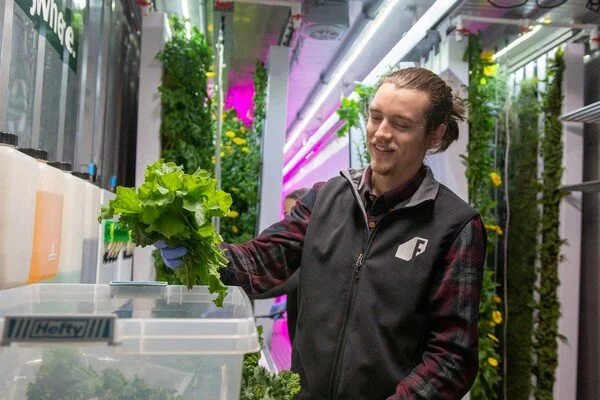
The leafy green machine, succeeded by the Greenery
Freight Farms supporting farmers
McNamara: “We are working on initiatives to support our community of farmers around the globe and domestically. We’re offering free access to our IoT platform Farmhand Connect to support their remote access to their farm operations. We’re also helping to connect farmers in our network who have extra produce to nonprofit organizations seeking donations.” Freight Farms is also supporting its customers by ensuring access to its service and technical teams. “We’ve increased our customer service and engineering support,” Vanzura mentions. We also have an online platform where our farmers share tips and tricks, and we are helping facilitate that conversation, even more, to promote best practices to respond to this crisis.” “For some of them, it’s pivoting to a more B2C model and we want to help them achieve that,” Katsiroubas notes.
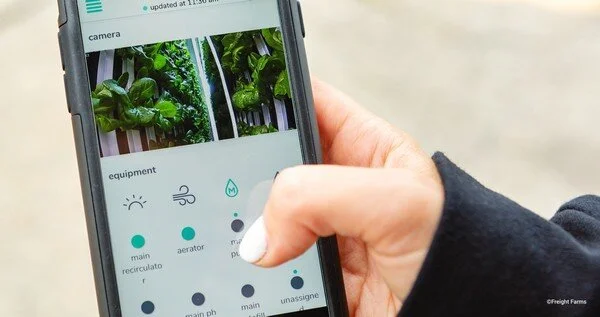
Freight Farms' Greenery Farmhand
Locals are helping out
Katsiroubas: “Some of our institutional customers, like schools which are of course now closed, are donating the produce they’ve been growing for the dining hall to food banks or nonprofit organizations that are lacking fresh produce. Our customers at Saint Joseph's College have been continued growing despite the COVID-19 to deliver their supply to the local elderly population in the community.” “Our customers have the power to grow food in minimal time and pivot supply to where it needs to be in the community. I am so proud of our community of farmers as they’re using our technology to do what they can to help others in this time of crisis,” McNamara notes.
A St. Joseph's student farmer
Pushing forward developments
McNamara states that the company’s resources are ramped up, for the current situation and for continued product development. “Fortunately, our supply chain is in good shape, so we are in a good position not only to support the current network, but also the new farmers coming on board in the upcoming months.” Freight Farms recently hired automation and robotics specialist Jake Felser, as the new head of engineering. “Having Jake onboard has been great. We have a dream team pushing development forward, especially from an automation perspective. We are moving forward constantly and have never been better positioned.”
Freight Farms Greenery calendula
Crispr tomatoes
“We’re always pushing forward on collaborative research, and recently worked with Cold Spring Harbor Laboratory as they explored how seed genetics and vertical farming can work together for efficiencies in food production, especially in confined environments. Our farm was used to create optimal growing conditions to unlock unique characteristics of their gene-edited tomato seeds,” McNamara states. The launch of the Greenery last year has proven to be more powerful with 70% more linear growing room in the same 320 sq. footprint as its flagship farm. “The interior flexibility of the Greenery supports efficient growth of more than 500 varieties of crops, and farmers are able to increase yield overall. With our integrated IoT platform farmhand, these farms will only continue to be more efficient.”
Freight Farms Greenery stacked crane lot
Investment
In February the company raised $15 million in their series B funding led by Ospraie Ag Science. McNamara says, “Ospraie Ag Science is a great investor and focused on agricultural and environmental sciences. It’s important for us to have our mission in line with whomever we work with on the investment side. We are using the funding to push ongoing technology development for our growing customer community.” “The partnership with Sodexo was a milestone moment for the company. By being a key player in their foodservice program, integration of our Greenery farms onto more campuses across the country will accelerate.” “It’s an important time to invest in agtech and to empower food production on a local level everywhere.”
For more information:
Freight Farms
www.freightfarms.com
Publication date: Wed 29 Apr 2020
Author: Rebekka Boekhout
© HortiDaily.com

A High-Yield Indoor Farming System Ideal For The City
According to Pollard, the evolution of new technology, such as LED grow lighting and the Internet of Things (IoT), has complemented the development of indoor soilless cultivation systems
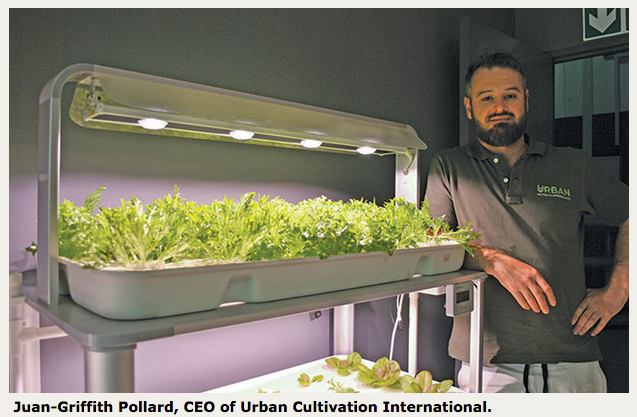
As prolonged droughts occur more frequently in South Africa, some entrepreneurs are investing in and developing new technology and farming methods, such as indoor growing systems, that ensure consistent, high-quality food production. Juan-Griffith Pollard, CEO of Urban Cultivation International, spoke to Pieter Dempsey about his scaleable hydroponic farming system.
More frequent and long-lived droughts. Global warming. Water scarcity. Higher input costs.
These are some of the factors driving the growing interest in new technology that enables a farmer to produce the same quality and yields as conventional farming, but using indoor farming systems instead.
Hydroponics, or indoor soilless cultivation, as Urban Cultivation International (UCI) calls it, is a method of growing plants in a water-based, mineral- and nutrient-rich solution instead of soil, and under artificial LED lights instead of sunshine.
According to Juan-Griffith Pollard, the CEO of UCI, indoor farming uses up to 90% less water than traditional farming practices, and far less space. In addition, plants can be grown pesticide-free and closer to high-consumption areas, such as densely populated cities.
These reasons, and more, explain why an increasing number of growers have begun exploring indoor soilless cultivation.
Precision growing
The system provides the optimal growing conditions for plants, enabling them to develop much faster and be far healthier than is the case with traditional outdoor cultivation.
According to Pollard, the evolution of new technology, such as LED grow lighting and the Internet of Things (IoT), has complemented the development of indoor soilless cultivation systems.
“IoT can be used to automate and regulate indoor farming by monitoring water levels, nutrient levels, pH levels, and temperature and light requirements of plants. “A farmer can be in control of the harvest at all times, wherever he or she is physically present.
“One of the biggest benefits of indoor farming is that produce can be farmed at any time of the year. Thus, a farmer can sell produce at out of season prices, and supermarkets can stock fresh local produce all year around,” says Pollard.
No-soil farming
Pollard started investigating various methods of indoor soilless cultivation in 2016 and fine-tuned them in 2019 to create a healthy, productive indoor farming system.
An entrepreneur by nature, he took note of the various challenges in traditional South African agriculture, including water scarcity and security risks. He also noticed the demand for certain leafy greens and microgreens in cities.
Thereafter, he traveled to the US, Europe and Asia to research systems that could be applied in the South African agricultural environment.
He went on to establish UCI at the N4 Gateway Industrial Park in Pretoria East.
“What makes UCI’s technology different from most other indoor systems is that a farmer can start small and expand by adding additional racks to the system. So there’s no need to commit to a huge capital investment to get started,” Pollard explains.
The UCI model enables the farmer to control the light hours, nutrients and moisture. It is automated to produce rapid harvest cycles with predictable results, and can be used in a small space. Crucially, it is also affordable.
A key advantage is that the plants can be grown without the use of insecticides and herbicides, as the crops are grown in a controlled environment.
Pollard predicts that farms of the future will be urban-based, and crop cultivation will have to become far more sensitive to water and energy usage. There are many cost-effective options for indoor, soilless cultivation, and these allow farmers to move from the fields to the city.
Indoor production is also an easier entry into farming; it can be started by any entrepreneur, or even a retiree, he adds.
A wide range
The options offered by UCI range from small household units to large-scale commercial systems. Regardless of size, they can deliver crop yields of up to 10kg/m2.
The household units are small, with just enough space to service the average household and to plant a variety of crops, such as leafy greens, microgreens and berries.
The household system was also developed for educational purposes and can be used as an entry into indoor soilless cultivation before a large capital investment is made in a commercial unit. UCI has developed a curriculum that explains the A to Z of indoor hydroponic farming.
The company’s industrial units include climate control and a lift system, which makes harvesting easier.
Depending on the type of crop, the return on investment is between two-and-a-half and five years, while high-value crops such as microgreens have a payback period of less than a year on capital investment.
Growing with ease
Plants can be grown from seed to harvest in 28 days, three times faster than that achieved with traditional farming.
“The plants are grown in a controlled environment under 12 to 16 hours of LED lights, giving you optimal harvest and zero wastage,” explains Pollard. In addition, produce grown in UCI’s systems has proved to be of excellent quality and offer good taste.
The entry commercial turnkey solution system contains a 10m-long and 1,9m-wide row, and the buyer can choose to fit between three and 12 levels.
For example, a 10m-row, five-level-high farm enables 100m2 to be planted in a floor space of only 20m2. “The higher you go, the more your yield per square metre,” says Pollard. The grow trays and spacing between plants are designed for optimal growing and yield. No sunlight is needed for this method; all the systems use LED grow lighting.
“LED technology provides the best energy efficiency, which saves you money in the long term,” says Pollard.
Production
A 10m-long unit can handle 54 plants per tray. At 12 trays per level and at five levels, this equates to 3 240 plants per unit.
The lighting is usually kept on for between 12 and 16 hours a day, depending on the requirements of the plants.
“The more light they get, the faster they grow,” says Pollard.
The system can handle a variety of crops such as lettuce, spinach, baby spinach, marog (imfino), cherry tomatoes, strawberries, basil, watercress, sage, zucchini, beans, fodder and a range of microgreens and herbs.
To illustrate potential crop yields, Pollard and his team have used the five-level demonstration system at UCI’s premises to grow 250g lettuce heads in 28 days under optimal growing conditions. A yield of more than 18kg per tray has been achieved.
“Compared with traditional farming, the only major cost drivers are electricity and wages,” he says.
Each tray contains about 20ℓ of constantly recirculated water, and total water use is approximately 1 250ℓ/month. The system is extremely water-friendly, as almost all the water is absorbed by the plant.
“No water is wasted, hence the saving of 90% compared with traditional farming,” says Pollard.
He adds that climate and temperature control is a key factor in the grow room, and even the water temperature is cooled or heated as the plants require.
“We can mimic the controlled growing environment of certain crops as they require. “The system works with any water, and tests are routinely conducted to see what nutrients the plants need, and all variables can be adjusted according to the needs of the plants.
“We have a nursery system that grows the plants from seed to seedlings. After about seven days, the seedlings can be transported into the commercial system; the fully grown plant is then ready to be harvested after another 21 days,” Pollard says.
Due to the way in which the system operates, the chances of a pest infestation are very low.
“Biosecurity is crucial and we prevent any pathogens and pests from entering the facility.”
Harvesting a system that is 10m long and has five levels requires about three hours with two people.
With rapid urbanization increasing the demand for food, UCI’s system offers a number of key advantages.
It brings the farm closer to the people, thereby improving food security, and it reduces transport costs, in turn lowering the carbon footprint of supplying food. The system also offers good potential as a job creator.
“Our aim is to get entrepreneurial farmers to start utilizing the empty spaces in cities, such as empty buildings in city centres. Such spaces can be used to grow food, provide jobs and supply retailers directly,” says Pollard.
Visit urbancultivation.co.za.
By Pieter Dempsey | Farmer’s Weekly | May 6, 2020


Corona-Proof Dining: At This Restaurant You'll Soon Eat In a Private Greenhouse
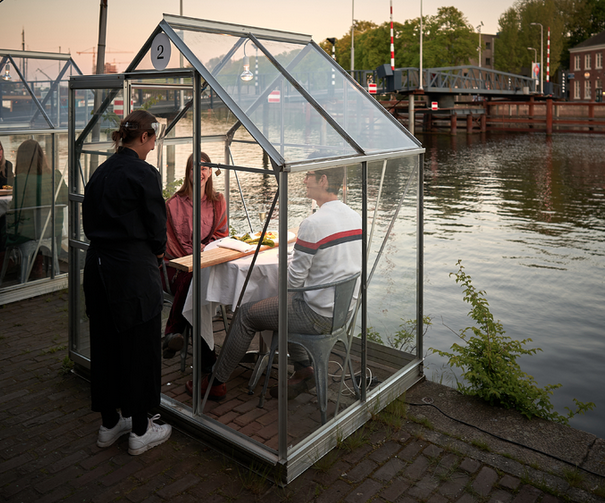
Art and culture institution Mediamatic is going to test safe 'quarantine greenhouses' in which guests can dine
The one and a half meter regulation has many hospitality entrepreneurs scared of opening their doors again May 20th. Art and culture institution Mediamatic is going to test safe 'quarantine greenhouses' in which guests can dine.
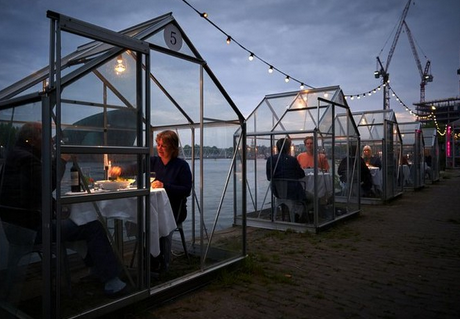
Willem Velthoven, founder and director of Mediamatic, is annoyed by colleagues in the industry who are calling it impossible to be good hosts at 1.5 meters distance. "It may be difficult for large hospitality entrepreneurs with businesses that revolve around peak rushes and mass-turnover. But there is a whole other part of the hospitality industry which is about attention, taking the time and care. These businesses are far less threatened. We are an example of that.”
Photo Credit: Willem Velthoven for Mediamatic Amsterdam
By Horti Daily | May 5, 2020


Babylon Micro-Farms Provides Local Produce During The Pandemic
The coronavirus pandemic has exposed vulnerabilities in this country’s food supply chain, and the co-founder of a local company, Babylon micro-farms, says it's part of a solution
April 27, 2020
By Courteney Stuart
CHARLOTTESVILLE, Va. (CBS19 NEWS) -- The coronavirus pandemic has exposed vulnerabilities in this country’s food supply chain, and the co-founder of a local company, Babylon micro-farms, says it's part of a solution.
“What we saw was an opportunity for technology to make this kind of indoor farming accessible,” said Alexander Oleson, who co-founded Babylon with Graham Smith while they were undergraduate students at the University of Virginia in 2016.
“What we’ve done is basically load all the complex aspects of growing, so nutrient dosing, environmental control, LED grow lights and that kind of thing, into a standardized unit that can be produced at scale,“ Smith said.
Each modular vertical farming unit can hold about 500 plants and yields about 50 pounds of produce each month.
Oleson said each micro-farm takes up about 15 square feet while growing the same quantity outdoors would require 2,000 square feet.
“We’re using 90 percent less water than outdoors," Oleson said. "There’s no intensive pesticide, no intensive fertilizer.”
The company caters to commercial clients like universities, hospitals, and senior living facilities. It operates the units virtually through the cloud using an app.
"All the user has to do is plant their seed pods and harvest,” Oleson said.
During the pandemic, Babylon micro-farms has also donated surplus to the Blue Ridge Area Food Bank. Branch Manager Joe Caputi says locally grown produce has been critical during this crisis.
“It allows us to get their product into the hands of people who really need fresh vegetables and nutritious pounds of food,” Caputi said.
Oleson says having fresh produce that doesn’t rely on a long food supply chain has been a benefit to Babylon's paying clients as well.
“For a lot of the health care and senior living, it’s been really encouraging to see how happy they are to have their fresh produce every week despite the disruption to the supply chain and the crisis around them,” he said

Enea Works on The Future of Vegetable Production
A team of Italian scientists designed GREENCUBE, the first micro-plot to grow vegetables during future space missions
A team of Italian scientists designed GREENCUBE, the first micro-plot to grow vegetables during future space missions. It will be launched into orbit 6,000 km from Earth during the maiden voyage of the VEGA-C rocket by the European Space Agency (ESA). ENEA, Università Federico II in Naples, and Università La Sapienza in Rome take part as coordinators and partners of an agreement with the Italian Space Agency (ASI).
Above: Microgreens Greencube drawing
The prototype (see photo below) measures 30x10x10 cm and envisages closed-cycle hydroponic crops that can guarantee a complete growth cycle of micro-vegetables selected among the most suitable to endure extreme extraterrestrial conditions.
The project is part of ENEA's mission aimed at applying scientific research results to the industry and public administration with sustainable economic development in mind. In this case, we have infrastructures and skills developed for the cultivation of fresh vegetables in closed secluded environments surrounded by extreme conditions such as those found in space.
Luca Nardi
How long will it take for the experiments in space to find practical applications in terrestrial agriculture?
"This experiment will help create a completely automated cultivation system integrated with sensors and non-destructive diagnostic techniques. This was made possible thanks to the cooperation of aerospace engineers, agronomists, and biologists," explained Luca Nardi, a researcher at the ENEA lab.
"A lot of the research conducted in space has been applied to everyday life. In this case, we are trying to grow high-quality produce in a small environment and in extremely hostile conditions by carefully measuring resources while remotely analyzing the health conditions of plants."
"Thanks to the efforts of the Italian Space Agency (ASI) and AVIO, it will be possible for many young university students and researchers to conduct experiments in space using small satellites and significantly reducing waiting times and launch costs."
The Greencube project was financed by ASI. The satellite was entirely built by a group of young aerospace engineers: Paolo Marzioli, Federico Curianò, Lorenzo Frezza, Diego Amadio, and Luca Gugliermetti coordinated by Professor Fabio Santoni from Università la Sapienza in Rome and in collaboration with Giulio Metelli, a biologist from ENEA'S biotechnology laboratory and Professor's Stefania de Pascale research team at Università Federico II in Naples. This platform will also be used to set up production systems in an urban environment.
Above: Drawing Microgreens Greencube photosynthesis diagram
Will this study support the challenge against climate change, one of the main enemies of intensive produce cultivation?
"The studies conducted aim at growing produce in small volumes in the cities too (urban farming) using all the space available also thanks to developed systems and the employment of smart farming techniques. The absence of soil and the impossibility to use direct solar light make this challenge truly difficult."
"Managing to cultivate in indoor farming facilities by carefully using resources such as water, fertilizers, and energy while reducing waste and recycling human and plant waste thanks to the degradation action of micro-organisms forms an integral part of the study at the basis of life-support bioregenerative systems: they are true artificial ecosystems where plants, micro-organisms, and men interact. These systems will be employed more and more in the future to produce food locally and in closed environments while respecting the environment and making production unaffected by the climate and adverse weather events."
Above: breathing diagram
What species have been chosen to conduct the experiments and why?
"We have chosen micro-vegetables such as brassicas to assess their response to the extreme stress conditions generated by radiations, micro-gravity, and reduced pressure. The comparison between the results obtained in space and on Earth will be crucial to assess the possibility of using micro-vegetables as a fresh high-nutrient food in future space missions."
Are you considering the patenting of new varieties?
"Not in this case, as we will be using commercial varieties. We did do it as part of the Bioxtreme project financed by ASI, during which we engineered Microtom tomatoes to produce anthocyanins in plants to protect the plant itself and provide these powerful natural antioxidants to the astronauts."

Publication date: Wed 29 Apr 2020
© HortiDaily.com
VIDEO: Growing Microgreens With Coffee Grounds
Simple step by step processes on growing microgreens, items required are spent coffee grounds, jelly cup, measuring spoon, spray bottle, paper towels, and seeds
Nick Greens
How to Use Spent Coffee Grounds for Planting
Nutritious Microgreens
Are you a coffee lover that hates to throw away your spent coffee grounds? Well, there's some good news. Coffee grounds have a miraculous wide range of benefits that are beneficial for your garden. In this article, we are going to cover how you can use spent coffee grounds for planting microgreens at home.
Making the best out of waste
As humans, we consume plenty of goods, but we also produce a lot of waste. We need to learn as a society how to reduce, reuse, and recycle. Learning how to use coffee grounds for planting microgreens is a great way to start and make use of our waste.
What items will you need to grow microgreens
So you've decided to start growing microgreens. We're going to cover the inexpensive items you will need to start this simple process.
Spent Coffee Grounds
Jelly Cups (or a small plastic container you have around the house)
Paper Towel
What's wonderful about this list is that it is extremely cheap. Using coffee grounds for planting microgreens is affordable for everyone.
How to use coffee grounds for planting microgreens
Growing microgreens with coffee grounds is actually quite simple.
First, you will get your spent coffee grounds and place them on the paper towel. Make sure to dampen the grounds to soak up the moisture.
Then you will place the spent coffee grounds on a fresh paper towel and let them dry overnight.
The next day you will place the dried coffee grounds in your jelly cup. Grab your spray bottle and lightly spray the top of the grounds.
Next, you will want to grab your microgreen seeds with a small measuring spoon. Sprinkle the seeds evenly over the grounds. You will want to grab the spray bottle and spray the seeds lightly.
You are going to use another jelly cup to be the humidifier dome. Do a light spray on the second jelly cup and place it over the first one that contains the seeds. Leave in the dark like this for a day or two and then place in the light.
After about 7 - 10 days, the microgreens will sprout. You can now cut them and eat them with salads or to decorate your foods.
This process is easy-to-understand and simplified. Using your spent coffee grounds for planting microgreens is a cost-effective way to grow food at home.
Why Is This Important?
Learning how to grow your own food is essential for families and tight-knit communities. We grow, flourish, and bond over food; and when it grows close to home, we are even more connected. Using coffee grounds for growing microgreens is for everyone to try. Microgreens are great to share with the family, to decorate your plates, and to enhance flavor. Take control of your food and start growing today.
If you enjoyed this, you might also enjoy these posts:
"Urban Vertical Farming"
"How to stay healthy and grow microgreens"
#coffeegroundsforplanting #microgreens #microgreen #growmicrogreens #growingmicrogreens #spentcoffeegrounds #microgreensathome #growingfood

USDA Launches Innovative Ag Office - Announces $3M Grants
Stay tuned for much more information on these grants in the coming weeks, and mark your calendars for a June 3, 2020 USDA webinar on the grant process

By Thomas Wheet and Brian Filipowich
The 2018 U.S. Farm Bill charged the USDA with creating the Office of Urban Agriculture and Innovative Production (“Urban Ag Office”). The Farm Bill noted that urban agriculture can “contribute to the revitalization of abandoned or underutilized urban land, [bring] social and economic benefits to urban communities, and [create] beneficial impacts on the urban landscape.”
After months of navigating the Congressional appropriations process, the necessary funding for the Urban Ag Office was finally signed into law in December 2019.
The Aquaponics Association reached out to the leadership of the Urban Ag Office and Congressional Offices to get a better understanding of the policies, funding opportunities, and timelines that will affect aquaponic growers.
Here is the Urban Ag Office’s Statement to the Aquaponics Association:
“Thank you for your interest in our efforts to stand up the Office of Urban Agriculture and Innovative Production. The Chief of the Natural Resources Conservation Service was delegated responsibility to implement the 2018 Farm Bill provisions on behalf of USDA and I have been designated as the Interim Director for the Office. We are working collaboratively with other USDA agencies to ensure they each have an equal voice in establishing the office, consistent with the 2018 Farm Bill provisions, and they are able to contribute in areas that fall within their respective missions and areas of expertise.
“As you are aware, the 2018 Farm Bill authorized $25 million annually for the Office. However, the Fiscal Year 2020 appropriation was capped at $5 million and limits the degree to which we can implement the authorized activities. We are moving forward with standing up the office and the external federal advisory committee that serves to provide recommendations to the Secretary, forging a path to establish the urban/suburban pilot county committees, and developing announcements for grants and agreements provided for in the Farm Bill.
“We are planning a series of webinars that will be announced soon that are designed to provide interested persons and stakeholders information about the establishment of the office and the functions we anticipate implementing. We will ensure we keep your contact information on file so you receive information about these webinars.
Then, yesterday, as we were about to publish this article, the USDA released a new, $3 million in grants for urban agriculture initiatives that will increase food access, agricultural education, and innovative production methods within urban environments. Stay tuned for much more information on these grants in the coming weeks, and mark your calendars for a June 3, 2020 USDA webinar on the grant process.
Click to see the USDA Press Release on the $3 Million Urban Ag Grants for more information and webinar registration.
Aquaponics is already taking the urban agriculture and controlled environmental agriculture industries by storm. While accounting for $19 million in 2020, the market is expected to climb to $46 million by the end of 2026 (that’s a CAGR of over 11.5%). This potential impact, however, could be greatly increased with federal guidance, funding, and business support that the Urban Ag Office is intended to provide.
The following list highlights several forms of support that the Aquaponics Association will continue to advocate for on behalf of the entire aquaponics industry:
Funding: Due to high startup costs, aquaponics can be unattainable for many individuals and/or communities looking to begin an operation. We will continue to advocate the new Office to support aquaponics initiatives with appropriate levels of funding needed to develop adequate systems that will lead to successful operations (both for non-profit and for-profit organizations).
Clarity surrounding policies: Though widely understood as beneficial, aquaponics falls within an agricultural ‘no-mans-land’ surrounding guidelines at the local, state, and federal level. This grey-area is partially because aquaculture, food crops, and other crops all fall under different regulatory regimes. Basically the big bureaucracy gets confused and can’t function, like a deer in the headlights. Whether in regards to food safety, greenhouse sterility, organic certification, etc., the Aquaponics Association will promote policies that match the operational realities faced by aquaponic growers across the country.
Defining value: Beyond the monetary value surrounding the produce and protein sustainably grown in aquaponic operations, there are numerous social benefits to localizing food production in urban spaces. From local job creation and educational opportunities about agriculture/nutrition, to decreasing municipal carbon footprints associated with the traditional agricultural system, the Aquaponics Association will work to ensure that Congress and the USDA fully grasp the true value of aquaponic growing.


Designing The Future of Urban Farming
INFARM collaborated with IDEO to further explore their B2B offer, including concepts for the industrial design of the stackable, modular, climate-controlled units; the interaction design of an accompanying app to monitor and control the units, and its business model
Helping a Berlin startup strengthen its offer of vertical farming products and services
INFARM
THE CHALLENGE
Help INFARM develop the vision, products, and services for their B2B vertical farming offer.
THE OUTCOME
Concepts for the industrial design of B2B vertical farm units, the interaction design of the app to control and monitor the units, and a business model for sustainability.
The challenge of how we’ll feed the exploding world population in the future—in a sustainable, cost-effective, and environmentally friendly way—is seeding an agricultural revolution in Europe.
In 2012, INFARM founders Erez, Guy Galonska, and Osnat Michaeli found that vertical farms could be a solution to urban self-sufficiency. These farms could allow people to grow vegetables and herbs in small spaces, with no soil and far less water.
If every city on earth were to grow 10 percent of its produce indoors, it would allow us to take 340,000 square miles of farmland back to the forest.
DICKSON DESPOMMIER, EMERITUS PROFESSOR OF PUBLIC HEALTH AND MICROBIOLOGY AT COLUMBIA UNIVERSITY, AND FATHER OF VERTICAL FARMING
An approach that’s captured the imagination of futurists for decades, vertical farming involves growing vegetables and herbs in stacked units or inclined surfaces, within which moisture, light, temperature, and nutrients are monitored, and controlled.
After creating their first vertical farming experiment in their apartment in Berlin, the founders brought together plant scientists and industrial designers to explore and develop vertical farming’s potential.
Since then, the startup has created custom growing systems for clients including Airbnb, Mercedes-Benz, and Weber. Most recently, INFARM installed a vertical farm growing herbs and vegetables at the Berlin branch of German supermarket chain Metro, the fourth-largest retail chain in the world, to sell to the public. It’s been profiled in Wired Germany, Süddeutsche Zeitung, The Guardian, and Zeit.
The vertical farm is designed to be modular, allowing consumers to purchase according to their needs.
INFARM collaborated with IDEO to further explore their B2B offer, including concepts for the industrial design of the stackable, modular, climate-controlled units; the interaction design of an accompanying app to monitor and control the units, and its business model.
Urban farmers will sign up for “farming as a service,” comprising the units themselves, as well as a monthly subscription for seeds, cartridges filled with nutrients, and a pH regulator. Because they’re stackable, the modules can be scaled to suit anyone from a home grower to a restaurant chef or supermarket owner. And Erez claims a 1 square meter growing tray can yield four to six mature plants every day, 365 days a year, doubling that of state-of-the-art hydroponic greenhouses.

The consumer app allows farmers to choose a set of herbs designed around specific recipes.
As well as remotely regulating each unit’s climate, the app will educate growers about new vegetables and herbs, selling packs of complementary seeds, with suggested recipes for them, and cooking instructions. Aiming to promote biodiversity, the firm will sell rare-breed and heirloom seeds too.
The startup has funding from the EU’s European Pioneers fund and is now looking to secure investment to accelerate software development and ramp up their hardware production capabilities. Quite literally, it's growing its business.

Boosting Food Security With Small-Scale Indoor Farm
Tungsram’s mini indoor farm called Growth Cabinet is a means for the Budapest-based international corporation to lend a hand as the global community scrambles to stamp out the epidemic and ease the economic fallout
As the coronavirus pandemic sweeps across the globe, leaving in its wake fatalities and a shattered world economy, food security is increasingly emerging as one of the key concerns of policy makers and citizens the world over. Tungsram’s mini indoor farm called Growth Cabinet is a means for the Budapest-based international corporation to lend a hand as the global community scrambles to stamp out the epidemic and ease the economic fallout.
Since the company’s founding in 1896, experts at Tungsram have often been at the forefront of technological development by reading the signs of the times. The end of the last century brought about the realization that conventional lamp manufacturing became outdated, and in a bid to meet and steer market demand, the company’s focus shifted to futureproof solutions. The development of Growth Cabinet is rooted in Tungsram’s recognition of the need for a smart appliance suitable for growing plants autonomously and providing a possibility to carry out research projects.
Growth Cabinet, Tungsram’s first mini indoor farm solution, has 4 telescopic growing layers, with a production area of maximum 1.7 m^2 and a complete custom-built hydroponic system. The inside temperature and ventilation of the mini farm can be controlled. The lighting was designed using luminaries from Tungsram’s new VF portfolio as VF lamps are suitable for building a dynamic lighting strategy in vertical farms. The lighting and the hydroponic system are remotely controlled via the Internet.
“If the tanks are filled up and the user applies the basic steps of plant protection, the Growth Cabinet can grow plants indoors for weeks without any human intervention. We believe that this product provides essential help for researchers and those seeking increased food security in an urbanized environment,” said Keith Thomas, commercial director at Tungsram’s Agritech division. While targeted end users are hotels, supermarkets and restaurants, Growth Cabinet is also an ideal solution for individuals wishing to grow their own produce at home, the executive adds.
For more information:
Tungsram
tungsram.com
Lőrinc Utasi, Agronomist
lorinc.utasi@tungsram.com
Keith Thomas, Commercial Leader
keith.thomas2@tungsram.com
Publication date: Wed 29 Apr 2020


Agri-Tech Students Investigate Potential Soilless Growing Systems To Aid Food Security
Hydroponics is a method of growing plants without using soil, in which plants are grown with only their roots exposed to nutrient solutions, and may also be supported by inert material such as coconut coir or vermiculite
Students at Pershore College have been undertaking research to see if growing food both without soil and during the winter could make the UK more self-sufficient when it comes to feeding the nation. Agri-Tech degree students have been conducting pea plant trials grown hydroponically at the college’s Agri-Tech Research Centre.
Hydroponics is a method of growing plants without using soil, in which plants are grown with only their roots exposed to nutrient solutions, and may also be supported by inert material such as coconut coir or vermiculite. The students have been monitoring the crop that was planted in the centre’s outdoor vertical farming facilities in November. The aim is to see if pea plants can be grown in a system where produce is stacked in vertical layers without the use of soil.
Tom said: “We are investigating the potential for the UK’s food producers to cultivate overwintering vegetables in our outdoor hydroponic tunnel using a system of vertical farming. This has the potential to replace crops that would be flown into the UK from overseas from Kenya or Guatemala. Normally, this plant can be overwintered in the UK but wouldn’t flower until the spring. We found that our protected unheated trial crop was already flowering by January or February and producing fruits in March.”
The UK is currently reliant on importing much of its fresh grown produce during the winter months. According to the British Growers Association, it is only 40% self-sufficient in indigenous fruit supply and less than 60% self-sufficient in vegetables & salads.
Tom’s fellow student Nick said: “The country’s self-sufficiency in food has been declining over the last 30 years and the government acknowledges that climate change will present significant risks to our food supply. The UK needs new food production technology that can provide sustainable food production systems.”
Roy Kennedy, Professor in Agri-Tech research and development said: “As part of the food production module of their Agri-Tech degree course, Tom and Nick are investigating the potential for the UK to grow sustainably-produced overwintered crops which would normally be imported into the UK during the winter months. So far they are finding that peas would be a good candidate for substitution of imported fresh produce.
“Other vegetable and fruit crops are being investigated for their potential for import substitution during the off-season. Hydroponic production regimes appear to give advantages to some cultivars resulting in cropping under lower light and at lower day and night temperatures.”
The Agri-Tech foundation degree at Pershore College is a two-year course aimed at providing students with the knowledge and skills needed to succeed in today’s horticultural industry. Modules include agri-tech mechatronics, global food security, and soil science technology.
Publication date: Wed 22 Apr 2020
Vertical Field's New Portable Farms Are Making The World More Sustainable - And Better Fed
Vertical Field’s Urban Crops offers an ideal alternative to traditional agriculture, especially in urban settings where space is scarce. The soil-based platform can grow hundreds of types of crops – pesticide-free, indoors or outdoors – and requires no training to operate
REVIVING URBAN LIFE – AN INNOVATIVE SOIL-BASED INDOOR
VERTICAL FARM THAT BRINGS THE PRODUCTION OF FOOD
TO THE PLACE IT IS CONSUMED
• Consistent Supply
• Reduces Inventory Waste
• Less Human Handling
• More Sterile Environment
APRIL 28, 2020, New York/Rana’na, Israel
Urban areas contain more than half the world’s population and contribute to some 70% of the planet’s energy emissions. Cities guzzle the bulk of Earth’s resources and produce more waste. Many residents live in “urban food deserts.” And buildings are literally making their occupants sick.
Our planet is home to some 7.7 billion people. In many places, hunger is a reality. Unpredictable climate patterns are threatening the availability and stability of fresh produce. Yet the global population is rising. How will we feed the world by the mid-21stcentury, when an expected 10 billion of us need food? And now in-light of the COVID-19 pandemic, the food supply chain is in jeopardy more than ever before -- the need to bring food easier and faster directly to consumers is more important than ever.
One revolutionary agro-tech company, Vertical Field (www.verticalfield.com), is harnessing the power of geoponic technology, agricultural expertise, and smart design to tackle all of these issues and more. The Israeli startup – cited by Silicon Review as a “50 Innovative Companies to Watch in 2019” and named by World Smart City in 2019 as “Best Startup” – produces vertical agricultural solutions that help the environment, improve human health conditions, cut down on human handling, reduce waste, and make fresh, delicious and more produce available 365 days a year locally and directly to consumers and other end users.
“Vertical Fields offers a revolutionary way to eat the freshest greens and herbs, by producing soil-based indoor vertical farms grown at the very location where food is consumed,” said Vertical Field’s Chief Executive Officer, Guy Elitzur of Ra’anana, Israel who is hoping to place his ‘vertical farms’ in retail chains and restaurants establishments in cities throughout the US.
Vertical Field’s Urban Crops offers an ideal alternative to traditional agriculture. The soil-based platform can grow hundreds of types of crops – pesticide-free, indoors or outdoors – and requires no training to operate.
“Not only do our products facilitate and promote sustainable life and make a positive impact on the environment, we offer an easy to use real alternative to traditional agriculture. Our Urban farms give new meaning to the term ‘farm-to-table,’ because one can virtually pick their own greens and herbs at supermarkets, restaurants or other retail sites,” he adds.
Vertical Field’s Urban Crops offers an ideal alternative to traditional agriculture, especially in urban settings where space is scarce. The soil-based platform can grow hundreds of types of crops – pesticide-free, indoors or outdoors – and requires no training to operate.
From Wall to Fork
Vertical farming in cities is an energy-efficient, space-saving, farming alternative to traditional crops grown in acres and fields. Thanks to Vertical Field, everyone from city planners and architects to restaurants, supermarkets, hotels are using vertical farming to create lush, green edible spaces in congested areas around the world.
Portable Urban Farm
An alternative to the living wall is Vertical Field’s unique Vertical Farm®, which can be placed in either a 20-ft or 40-ft. container equipped with advanced sensors that provide a controlled environment. This technology constantly monitors, irrigates, and fertilizes crops throughout every growth stage. Healthy, high-quality fruits and vegetables flourish in soil beds that contain a proprietary mix of minerals and nutrients.
Advantages of Vertical Field’s Vertical Farm:
● Bug-free and pesticide-free – healthy, fresh, and clean produce
● Less waste – uses 90% less water
● Shorter growing cycles, longer shelf life
● Plants are “in season” 365 days/year - grow whatever you want, no matter the weather or climate conditions of the geography
● Consistent quality
● Modular, expandable, and moveable farm
● Automated crop management
● More Sterile Environment
● Less Human Contact
Creating a more sustainable way of life in cities across the globe has never been more urgent. Vertical Field is responding to the challenge today. Green cities will enrich life in urban areas, provide healthier and better food, and shorten the distance between consumers and their food.
About Vertical Field:
Vertical Field is a leading agro-tech provider of vertical farming and living green wall solutions for urban environments and smart cities. The company is operated by professionals, agronomists, researchers, and a multi-disciplinary team, enabling the development of smart walls that combine the best of design and manufacturing, smart computerized monitoring, soil-based technology, water and lighting technology and more. Vertical Field delivers next-generation vertical farming systems for a global clientele, including Facebook, Intel, Apple, Isrotel, Microsoft, and many more.
For more information:
Vertical Field
www.verticalfield.com

Podcast Agency FullCast Launches Vertical Farming Podcast with David Farquar of Intelligent Growth Solutions
The vertical farming industry must 'take a hard look at itself' before it fulfills its promise of reliable, quality food, produced affordably and sustainably, says one of its leading figures
NEWS PROVIDED BY
May 06, 2020
MINNEAPOLIS, May 6, 2020, /PRNewswire/ -- In the inaugural interview of the Vertical Farming Podcast, David Farquhar, CEO of Intelligent Growth Solutions (IGS), says Covid-19 has prompted a spike in interest in vertical farming, as retailers and governments scramble to improve supply chain resilience and lower their reliance on imported food.
The vertical farming industry must 'take a hard look at itself' before it fulfills its promise of reliable, quality food, produced affordably and sustainably, says one of its leading figures.
Vertical Farming Podcast produced by FullCast
"But it will be fascinating to see what changes last on the back of this pandemic," he says. "To what degree are we willing to invest to prepare ourselves to survive another one? We're working with a lot of governments to think about how this might happen."
"Yes, there are huge opportunities, but let's be realistic. Vertical farming and indoor agriculture are young; making them work is a marathon task. Anyone who says otherwise is lying."
"In three decades in the tech sector, I've never seen anything that's attracted so much interest nor created so much misinformation."
"A lot of people are telling a lot of lies. The industry must grow up. Many commentators and participants within the industry feel the same."
A former British Army officer, Farquhar announced on the podcast that he's committing the company to openly publish all its data – energy consumption, water usage, and nutrient utilization – from its 'in a box' vertical farming systems, in a bid to demonstrate the industry-wide honesty and transparency that he believes is so sorely needed.
Headquartered in Scotland, IGS is currently working with commercial and government groups across Australasia, the Middle East, the Caribbean, and North America. Farquhar was interviewed for the first episode of Vertical Farming Podcast, a new show produced by FullCast and hosted by Harry Duran. Harry has launched VFP to engage with the leaders, founders, and visionaries of the evolving vertical farming industry, to bring their insights and knowledge to a wider audience.
Farquhar kicks off a line-up of guests that includes Agritecture's Henry Gordon-Smith, Freight Farms founder John Friedman, and AgTech journalist Louisa Burwood-Taylor of AgFunderNews.
Listeners are invited to subscribe today at: https://verticalfarmingpodcast.com
Contact Information
Company: FullCast
Contact Name: Harry Duran
Email: harry@verticalfarmingpodcast.com
Phone: +1-323-813-6570
Address: 340 S Lemon Ave #5557 Walnut, CA 91789
Website: https://verticalfarmingpodcast.com
SOURCE FullCast
Related Links

How Could AI Improve Controlled Environment Agriculture?
The use of artificial intelligence in the production of controlled environment crops has the potential to grow crops more quickly and efficiently
by David Kuack
The use of artificial intelligence in the production of controlled environment crops has the potential to grow crops more quickly and efficiently.
Most people are familiar with the term artificial intelligence or AI. Ken Tran, founder of Koidra LLC, said artificial intelligence is a very loosely defined term.
In his efforts to apply artificial intelligence to controlled environment agriculture, Ken Tran (right) collaborated with horticulture specialists worldwide, including Dr. Xiuming Hao (left) and Shalin Khosla in Canada. Photos courtesy of Ken Tran
“AI very broadly means anything that a computer can do to perform a task,” said Tran. “Classical AI can be a program that doesn’t have the capability to learn and improve all the time. For example, a program can be written for a computer to play chess. A computer can play chess by itself, but it follows a specific logic imposed by the programmer. This type of AI doesn’t improve over time with data.”
A second type of AI can have accountability to learn and improve over time with additional data.
“This type of AI is very promising because it can continuously improve,” Tran said. “With this type of AI a computer can autonomously learn how to use the data.”
Tran said both types of AI are useful and will enhance each other.
“The second type of is considered the second stage of AI,” he said. “The learnable AI is the next phase of the expert-system type of AI. Both types of AI could have major applications to controlled environment agriculture.”
Greenhouse challenge incorporates AI
Tran was the principal investigator and leader of a team of AI and horticulture experts that won the first International Autonomous Greenhouse Challenge organized by Wageningen University and Research in the Netherlands. Tran was the principal research engineer for the Project Sonoma team. At the time Tran participated in the challenge he was an employee of Microsoft Research where much of his focus was on machine learning.
Ken Tran (second from left) was the principal investigator and leader of a team of artificial intelligence and horticulture experts that won the first International Autonomous Greenhouse Challenge.
The greenhouse challenge ran from May through December 2018, with five teams growing a cucumber crop in their own greenhouse compartment at the university. The purpose of the challenge was to combine AI with greenhouse data to maximize crop production while minimizing greenhouse inputs.
“The success of the Sonoma team in the competition came from our collaboration with horticulture researchers,” Tran said. “Without their participation and the domain knowledge they provided we wouldn’t have achieved this success.”
The team worked with researchers including Dr. Xiuming Hao at Agriculture and Agrifood Canada, Shalin Khosla at Ontario Ministry of Agriculture, Food and Rural Affairs Agriculture, and Dr. Chieri Kobota at Ohio State University.
“Before growing cucumbers for the competition, we had not grown cucumbers, but we were still able to win,” Tran said. “During the competition, our team outperformed a team of expert Dutch growers who had previously grown cucumbers. Our team was able to produce more than 55 kilograms of cucumbers per square meter. Also, the net profit on the cucumbers was 17 percent higher than the Dutch growers.”
Potential benefits for CEA
While Tran was employed at Microsoft he worked on reinforcement learning. He explained reinforcement learning, in a simplistic definition, is a data-driven method used in control applications. It learns to find the best actions based on reward or punishment data.
“We wanted to find a good application to motivate our reinforcement learning research,” he said. “In 2017, I was looking for a pure application, meaning an application that would have a great impact and would also be doable for reinforcement learning. I began with indoor vertical farms which are a good application because it is a well-controlled environment with little influence from the outside. It is easy to get started because the test environment can be as simple as a small growth chamber.
“Some types of applications that would fit include using reinforcement learning to solve a control problem. We wanted to solve a problem in the real world, but applying reinforcement learning in the real world is really challenging. That is why I was looking for applications that are well controlled and can have different scales from a small growth chamber to a large grow room.”
Tran saw the potential that vertical farms had to help solve sustainable food production problems worldwide. He spoke with CEA researchers and experts around the world, including the United States, Japan, and China. One of the institutions that Tran contacted was Wageningen University.
“When we were visited the university we learned about how they were going to organize this greenhouse challenge,” Tran said. “We discussed with them exploring collaborative opportunities. With this competition platform we could get our feet wet by actually doing something and not just talking about theory and the possibilities.”
Collecting more data from growers
Tran said much more data is needed from growers in order for computers to autonomously learn how to use the data.
“We are trying to understand how good growers produce a crop,” he said. “This isn’t just one grower, but multiple growers. We study the plant science and try to come up with a sound formula for how to grow a crop. That formula doesn’t evolve itself. It is a fixed formula. It is reacting to changing conditions that indicate under these conditions to try this.
“This is the first step in our research and it was very successful. It already performed better than many other growers would because we were able to aggregate the knowledge from multiple expert growers. We are trying to develop AI that can learn and improve over time with more data. We don’t want to stop at one system.”
Tran said controlling a vertical farm is easier than controlling a greenhouse.
“However, in both scenarios, our current technology can already be used,” he said. “This technology will keep evolving for even further impact. The technology can be used in both applications by using what we already know about plant science, machine learning, and AI in general. It’s not like having to wait for new technology or the research is not ready and we have to wait. We can already leverage the technology today and we have demonstrated that in multiple scenarios.”
Ken Tran is working on a commercial artificial intelligence program that will be adaptable to a variety of crops grown in vertical farms and greenhouses.
Tran is working on a commercial AI program that will be adaptable to a variety of crops.
“The process is going to be similar for developing a program for any CEA crop,” he said. “The data will include environmental data from inside and outside the greenhouse. This data will be generated automatically from multiple sensors installed inside the greenhouse, including light levels, temperature, relative humidity, nutrient levels, water quality, and carbon dioxide levels.
“For every crop, we would need to talk with the growers to find out how they currently grow to set up a baseline. Crop data would be provided manually by the growers on a daily and/or weekly basis depending on the crop. The program will evolve from the baseline with more data coming in. We want the program to be safe for every crop.”
Principles for adopting AI to horticulture
Tran said in order for growers and the horticulture industry to adopt AI, safety-first principles must be followed. These include:
The AI system must start growing the same way as what growers want with no risky deviations from what growers would do. This growing would continuously improve.
Growers could easily switch between manual, recommendation and autopilot modes. The greenhouse operator is always in control and can choose to exit AI control mode at any time. In recommendation mode, the AI system would only send recommendations to the operator for review and the setpoints would still be inputted manually by the operator.
The system must support easy and continuous monitoring.
For more: Ken Tran, Koidra LLC, (512) 436-3250; ken@koidra.ai.
David Kuack is a freelance technical writer in Fort Worth, Texas; dkuack@gmail.com.
Posted in Interviews

Urban Vertical Farming: The Key to a Sustainable Future
Vertical farming is the practice of growing crops/foods in vertically stacked layers. This is usually done indoors and in a controlled environment. This method optimizes plant growth and allows the use of soilless techniques such as hydroponics
Living in a dense city population can make you wonder, "where does our food come from?" When you live in urban areas like Houston, New York City, or Seattle, it's rare that you notice farms on your drive to work.
The idea that our food is grown hundreds to thousands of miles away can be worrisome. What if something were to happen to those farms? Our resources would cut off and we would have limited access to foods. This is why vertical farming in urban areas is critical to ensure cities can be sustainable food leaders.
What is vertical farming?
Vertical farming is the practice of growing crops/foods in vertically stacked layers. This is usually done indoors and in a controlled environment. This method optimizes plant growth and allows the use of soilless techniques such as hydroponics.
How does vertical farming work?
Vertical farming needs several things to work. We'll cover each one below:
Physical Layout - The purpose of farming indoors is to maximize volume. We do this by maximizing the output efficiency per square meter. This is why you will see physical layouts in the form of skyscrapers or vertical tower-like structures.
Lighting - To optimize crop growth, a need for artificial and natural lights are essential.
Growing Medium - There are several different growing mediums for vertical farming. These methods include hydroponics, aeroponics, and aquaponics. Coco Coir, Rockwool, ,Biostrate, Vericulite, Perlite, SunShine #4 and Black Gold are great mediums used in indoor farming.
Sustainability Features - Sustainable features often used with vertical farming feature rainwater tanks, wind turbines, and spaces with low energy costs.
Why is urban vertical farming important?
By 2050, the forecast is that we will have an extra 2 billion people on the planet. Many of these people will live in urban areas. And we have already used a third of arable farmland in the past 40 years.
We need to come up with other sustainable ways to grow food to ensure we can feed everyone. Vertical farming allows us to grow healthy, accessible foods within a few acres of land, close to home.
This is critical for urban areas because they will become more populated over time. Instead of relying on faraway food sources, we need to take matters into our own hands. By establishing urban vertical farming settings, we'll be able to control and grow our own food sources.
Vertical farming also uses 95% less water than traditional farming methods. The use of water needed to grow crops traditionally is wasteful. To be able to handle an influx in population, vertical farming is a sustainable solution.
How does vertical farming benefit us?
There are many reasons why vertical farming is the future of farming. By building vertical farms, there will be an increase in job opportunities. There will be easier access to healthier and attainable foods. With food grown close to home, we will always be aware of where our food comes from.
Because of the controlled environment, there is a higher chance of growth success. We will be able to grow crops year-round and have larger yields. Crops will not be exposed to harsh weather conditions since they'll be grown indoors. Urban vertical farming methods should start being adopted right now.
The Takeaway
To prepare for the upcoming increase in food demand, urban areas need to adopt sustainable policies. People should start growing their food indoors as well as increasing the demand for high-tech farming methods.
If you enjoyed this, you might also enjoy these post:
"How to stay healthy and grow microgreens"
"The Ultimate Guide to growing microgreens"