

Welcome to iGrow News, Your Source for the World of Indoor Vertical Farming

This Brooklyn Farm Company Is Training A New Generation of Urban Farmers
In old shipping containers, the shoots of a new way of urban farming are starting to emerge, which could help meet the demand of a growing urban population
February 7, 2020, by World Economic Forum
(Credit: Unsplash)
This article is brought to you thanks to the collaboration of The European Sting with the World Economic Forum.
Author: Kate Whiting, Senior Writer, Formative Content
The average age of an American farmer is 57.5 years.
Just under 70% of the world’s population will live in urban areas by 2050.
Square Roots is teaching young city farmers how to grow food sustainably.
Among the high-rise buildings and concrete sidewalks of Brooklyn, there’s a quiet green revolution taking place.
In old shipping containers, the shoots of a new way of urban farming are starting to emerge, which could help meet the demand of a growing urban population.
Square Roots is an indoor urban farming company, which not only grows food sustainably without soil but is teaching a new generation of farmers how to do it too.
“We realized there were tens of thousands of young people who were as passionate about changing the food system as we were, but just didn’t know how to get started,” says Tobias Peggs, CEO of Square Roots.
Feeding the future
Square Roots is tackling several issues in one go: the need to use less water and other resources in agriculture, the aging of farmers, the global population rise and, in particular, the growing urban population.
Farmers in the US aren’t getting any younger, with an average age at 57.5, according to census data, up 1.2 years from 2012.
A new way of farming. Image: WWF/Netflix
And it’s a similar story in other places around the world. In Kenya, the average farmer is 60. In Japan, 67.
By 2050, 68% of the world’s population is expected to live in urban areas, so that’s where much of the focus of food growing will need to be.
“Younger generations are really interested in making sure we’re all eating healthy food that’s nutritious and grown in sustainable ways, but they’re less interested in living in the middle of the country,” says Peggs.
The future of farming
The Next-Gen Farmer Training Program teaches would-be farmers how to grow leafy greens in a high-tech hydroponic system that it says uses up to 95% less water than traditional farms.
They study plant science, to find out what’s happening at a molecular level as the plant grows, they learn about the business side and engage with the local community and agriculture ecosystems.
Food
What is the World Economic Forum doing to help ensure global food security?
Two billion people in the world currently suffer from malnutrition and according to some estimates, we need 60% more food to feed the global population by 2050. Yet the agricultural sector is ill-equipped to meet this demand: 700 million of its workers currently live in poverty, and it is already responsible for 70% of the world’s water consumption and 30% of global greenhouse gas emissions.
New technologies could help our food systems become more sustainable and efficient, but unfortunately, the agricultural sector has fallen behind other sectors in terms of technology adoption.
Launched in 2018, the Forum’s Innovation with a Purpose Platform is a large-scale partnership that facilitates the adoption of new technologies and other innovations to transform the way we produce, distribute and consume our food.
With research, increasing investments in new agriculture technologies and the integration of local and regional initiatives aimed at enhancing food security, the platform is working with over 50 partner institutions and 1,000 leaders around the world to leverage emerging technologies to make our food systems more sustainable, inclusive and efficient.
Learn more about Innovation with a Purpose’s impact and contact us to see how you can get involved.
Each shipping container at the company’s campus in Brooklyn’s Bed-Stuy neighborhood can produce up to 45kg of fresh basil, chive or mint leaves per week, which is grown without pesticides and uses data to optimize flavor and nutrition.
“Successful companies in the 21st century have to be doing well – and doing good at the same time,” says Peggs.
“We’re growing food and selling food, that’s how we make money. But we’re doing that in a sustainable way, which is better for the planet and we’re empowering the next generation of leaders in urban farming.”

Stimulating Debate In Controlled Environment Agriculture - 18th March, 9:00 am – 5:00 pm
Can we really feed 40,000 people with a ‘SkyFarm’? Or will everyone in London have a ‘Personal Food Computer’ by 2040? These are the sorts of provocative questions being posed ahead of the upcoming Controlled Environment Agriculture (CEA) conference being held on 18th March at the John Innes Centre
DESIGNED FOR THE FUTURE: STIMULATING DEBATE IN CONTROLLED ENVIRONMENT AGRICULTURE
Can we really feed 40,000 people with a ‘SkyFarm’? Or will everyone in London have a ‘Personal Food Computer’ by 2040? These are the sorts of provocative questions being posed ahead of the upcoming Controlled Environment Agriculture (CEA) conference being held on 18th March at the John Innes Centre.
The event is hosted by Agri-TechE, a business-focused membership organization that is supporting the growth of a vibrant agri-tech cluster of innovative farmers, food producers and processors, scientists, technologists, and entrepreneurs.
Matt Millington, of Method Strategic Design Studio, is a speaker at the event. He comments: “Humans only evolve when they are pushed to. There are technological advances that can contribute to making urban farming a wider reality, but more importantly, there are drivers: climate change, soil degradation, urbanization…”
He’s right about there being drivers of change: models indicate that 70% of the human population will live in cities by 2050*.
CEA, the concept of growing crops in a secure indoor space, is seen by many as the ultimate solution to food security in an urban context and the upcoming conference will provide an opportunity for stakeholders in the field to discuss how to reach the future that they want to see.
Speakers include visionaries: Matt, from Method; and Thomas Cox, a Bristolian Architect with ambitious plans for a modular high-rise farming block. Both will arrive at the upcoming Agri-TechE conference with plenty of thoughts to fuel a debate on the future of CEA.
Food Computers and Cooperatives – Matt Millington, Method
Method is a strategic design studio, making products, services, experiences, and businesses for the digital age. They use design as a tool to help organizations make better strategic decisions about the future of business.
Matt says: “At Method, we often make things that are designed to trigger controversy and promote a conversation about what a future might look like, and in this case, we hit upon the Personal Food Computer as just that – an object to frame a conversation around.
“What does it mean for the food system, if something like the food computer became common-place?” According to Matt, it’s all part of the mission to simulate debate: “Rather than asking people what they want, we show them that potential future.”
“The food computer is an experimental growth chamber designed to be built by anybody, and at a low cost, with detailed instructions also available for free online,” Matt adds. 'Growth recipes', shared via the cloud, enable the grower to control specific attributes of the crop through close monitoring of ‘environmental inputs' such as lighting.
Matt expects that as CEA is picked up in urban centers, growers could begin to form into cooperatives, which will provide a big boost to the overall productivity: “Much as we’re starting to see local urban energy production in parts of London, producing their own electricity and selling it back, I think you’ll see in future cooperatives within London who are producing their own food on a relatively large scale.
“So, I think you’ll see CEA in cities develop more on a cellular basis – areas of cities providing the urban farming model, which then influences perhaps what a supermarket sells in that region. I think supermarkets will play a big role influencing the sorts of crops that get grown and sold within local communities.”
At the Agri-TechE conference, Matt is ready to fuel debate: “We need to provoke a conversation around what the future should look like… in order to make decisions to design toward that future or, more importantly, away from that future that we don’t want.”
SkyFarms – Thomas Cox, Wotton Donoghue Architects
Thomas Cox is a ‘grey-sky’ thinker. He is concerned by levels of air pollution in dense urban centers. Smog, caused by the release of Nitrogen Oxides from internal combustion engines, is a major health issue in the world’s largest population centers such as Los Angeles, Beijing, and Delhi, and is becoming increasingly prevalent in London. Thomas’ response is a building design that he calls the ‘Sky-Farm’.
“The Sky Farm is covered in beans and pulses that take in nitrogen from the air and store it in their roots. Essentially, you have a big greenhouse, which is cleaning up air pollution and converting this into green fertilizer and food.”
Thomas designed his Sky Farm to sit on a small footprint of land in Battersea, on the south bank of the River Thames in London. “The ‘Sky Farm’ was designed to be a small-scale supplement to traditional farming, but I worked out that it could sustainably feed half of the population of the borough of Battersea – approximately 40,000 people.”
“I think we need to plan now, so we’re ready to act when population increase starts to detrimentally affect our quality of life. I know that’s a bit of a bleak vision, and we’re maybe talking 100 years’ time, but we need to stay ahead of the curve.”
Matt and Thomas will be joining the fray at Agri-TechE’s ‘Controlled Environment Agriculture – The Industry is Growing Up’ conference, alongside some twenty other speakers. Other participants include IGS, world-leaders in vertical farm engineering; LettUs Grow, looking at total in-farm automation; and Growpura, designing hydroponics solutions on a massive scale.
The all-day event will be held at The John Innes Centre, Norwich Research Park NR4 7UH on 18th March, 9:00 am – 5:00 pm. For tickets or more information, please visit www.agri-tech-e.co.uk/events
Contacts for media
Ewan Richardson / Rachel Holdsworth, Holdsworth Associates PR
Tel: 01954 202789 or email: ewan.richardson@holdsworth-associates.co.uk
About Agri-TechE www.agri-tech-e.co.uk
Agri-TechE is a business-focused membership organization that is supporting the growth of a vibrant agri-tech cluster of innovative farmers, food producers, and processors, scientists, technologists, and entrepreneurs.
Agri-TechE brings together organizations and individuals that share a passion for improving the productivity, profitability and sustainability of agriculture. It aims to help turn challenges into business opportunities and facilitate mutually beneficial collaboration.

The Influence of Temperature And Daily Light Integral on Culinary Herb Production
Greenhouse average daily temperature (ADT) and daily light integral (DLI) can be adjusted to improve crop timing, maximize biomass production, and increase crop quality
Date: March 12, 2020
Time: 2 p.m. - 3 p.m. EST
Presented by: Roberto Lopez and Kellie Walters
Register here
Greenhouse average daily temperature (ADT) and daily light integral (DLI) can be adjusted to improve crop timing, maximize biomass production, and increase crop quality. In this webinar, Michigan State University researchers will discuss how the growth, development, and color of culinary herbs is influenced by ADT and DLI. They will share research on crops including sweet basil, purple basil, sage, and spearmint, giving research-backed tips on how to use these environmental parameters to improve crop yield and quality.
Join today
If you have any questions or would like to know more about GLASE, please contact its executive director Erico Mattos at em796@cornell.edu
Special thanks to our Industry partners
US: Florida - Kalera Opens New Vertical Farming Facility In Orlando
Built in record time, the new farm has the highest production volume capacity in the Southeastern United States
March 03, 2020 | Source: Kalera
Kalera, a technology-driven vertical farming company, announced the opening of its new state-of-the-art growing facility in Orlando, Florida. Daniel Malechuk, CEO of Kalera, believes the company is leading the way in defining what pick-to-plate means for the future.
Kalera’s New Facility Is The Highest Production
Volume Vertical Farm In the Southeast
ORLANDO, Fla., March 03, 2020 (GLOBE NEWSWIRE) -- Today, technology-driven vertical farming company Kalera announced the opening of its new state-of-the-art growing facility in Orlando, Florida. This new facility is the highest production volume vertical farm in the Southeast.
The rapidly constructed facility also demonstrates Kalera’s ability to quickly build and open farms around the US and the world. This new facility complements Kalera’s initial HyCube growing facility located at the Orlando World Center Marriott and is centrally located in the heart of Florida, one of the largest tourist destinations in the world. The new facility has the capacity to supply millions of heads of leafy greens per year to consumers while also providing dozens of new high-quality jobs.
Originally announced at the end of August, Kalera was able to get its new growing facility up and running in less than six months due to a streamlined design and construction process that illustrates the company’s ability to quickly scale and expand its vertical farms. Kalera was able to retrofit the existing building with its proprietary technology to create the highest production volume vertical farming facility in the Southeastern United States. As Kalera accelerates its growth over the next few years, it will build additional facilities, expanding production capacity throughout the US and internationally.
“Adding a large-scale vertical farm to Central Florida was the next logical step for us as a company. We’ve spent years perfecting and fine-tuning our technology to place us as industry leaders in the local farming ag-tech revolution," said Daniel Malechuk, CEO of Kalera. “Right now, we are leading the way in defining what pick-to-plate means for the future. In a sense, we are trying to perfect Mother Nature indoors by combining science and technology with farming.”
The new facility has the capacity to supply millions of heads of leafy greens per year to consumers while also providing dozens of new high-quality jobs.
"Kalera's business is built on good science. We’re planting non-GMO seed, and over the past several years we have perfected plant and data science-driven methods to optimize the growing environment, nutrient mixes, and distribution that make plants thrive,” said Cristian Toma, Chief Technology Officer of Kalera. “We’re excited to be able to meet customers’ demands for cleaner, safer, non-GMO, pesticide-free leafy greens that are fresher, boast a longer shelf life and higher nutritional value, and are grown locally with consistently high yields.”
The company utilizes cleanroom technology and processes to eliminate the use of chemicals and remove exposure to pathogens. With indoor facilities situated right where the demand is, Kalera is able to supply an abundance of produce locally, eliminating the need to travel long distances when shipping perishable products. This means Kalera can ensure the highest quality and freshness by delivering product to customers within hours of harvest rather than days or weeks. Kalera's plants grow while consuming 95% less water compared to field farming.
Kalera opened its first vertical farm in 2018, the HyCube growing center, on the premises of the Orlando World Center Marriott to bring fresh, local produce to the hotel’s visitors and customers. This farm has served as a successful model illustrating the place of vertical farms in the sustainable food movement.
About Kalera
Kalera is a technology-driven vertical farming company with unique growing methods combining optimized nutrients and light recipes, precise environmental controls, and cleanroom standards to produce safe, highly nutritious, pesticide-free, non-GMO vegetables with consistently high quality and longer shelf life year-round. The company’s high-yield, automated, data-driven hydroponic production facilities have been designed for rapid rollout with industry-leading payback times to grow vegetables faster, cleaner, at a lower cost, and with less environmental impact.
Media Contact:
Elka Karl
Phone: 510-508-7328
Email: elka@dadascope.com

Darragh McCullough: Vertical Farming Is All The Rage, But The Downsides Will Limit Its Potential
There are so many stories about this tech that you would be forgiven for thinking that there is going to be a vertical farm at every traffic light next time you make it into the city
What grows up, must come down: Vertical farming presents interesting possibilities, but it has its limits
Darragh McCullough
February 20, 2020
Vertical farming is all the rage. It makes great click-bait by combining key buzz words: 'technology' in the form of new LED lighting; 'novelty' food that some celebrity chef can shout about producing beside their New York restaurant, and 'sustainability' courtesy of zero food miles and a low carbon footprint.
Your phone's news feed is probably similar to my own.
There are so many stories about this tech that you would be forgiven for thinking that there is going to be a vertical farm at every traffic light next time you make it into the city.
But beyond the low-energy LED lights in colours tailored to turbo-charge plant growth even in the depths of winter, you realise that we've had vertical farms for decades.
More recently, I've seen production in tunnels and glass take on vertical formats. Modern glasshouses are now so tall that each line of tomatoes or peppers is tended to via nifty little scissor lifts. I see the same trend in tunnels, with 4m high tunnels now standard in new soft fruit set-ups.
When I visited the Farmony vertical farm in Ballycoolin, west Dublin for Ear to the Ground this year, we all had to gown up before being allowed access to the growing unit.
It might have appeared a bit over-the-top given that we were just stepping into a converted refrigerated truck container that has a few pumps, fans and extra sockets fitted.
But by manipulating every single aspect of this growing environment - and maintaining near-sterile conditions - the people behind Farmony claim that their 80 square metre unit can produce the same amount as a 5ac field. That's a 250-fold increase in the productivity per square metre, which is impressive by any measure.
Farmony is focusing on the unit's ability to grow leafy salads and herbs, especially the baby and micro-leaved versions that are so beloved of chefs and foodies.
Normally these are flown in from places like Africa, Israel and further afield at this time of year when it's just impossible to grow them commercially here in tunnels or glass.
The beauty about using refrigerated truck containers is that they are insulated, allowing the grower to maintain ideal temperatures at a relatively low cost.
They are also pretty secure and mobile so that they can be parked anywhere there's room for a truck container.
The idea is that they'll pop up in carparks, basements, and office block roofs, regardless of whether that's in baltic Belfast or boiling Beirut.
Farmony claims that the €87,000 price tag is a snip given that the herbs the container is capable of producing would pay that off after all costs in about two years.
The downsides? The unit should be able to work well for produce that is 95pc water and has a short growth cycle of just 1-3 weeks. These plants don't need a lot of heat and light to get to a saleable point. But if you wanted to grow a more carbohydrate-dense food - like any root crop, or even a strawberry where only a small fraction of the plant that you've poured light and heat energy into ends up being saleable - the calculations start to unravel.
And, much and all as we should be reducing our calorie intake, there's only so much salad that a body can take.
We'll certainly see more of the LED light tech being incorporated into existing production systems like tunnels and glass, and there are interesting possibilities for old mushroom tunnels to be repurposed as salad units.
But there's a lot to be said still for good old-fashioned horizontal farming.
Indo Farming

8 Keys To Getting Funding Through Contain
Figuring out financing is one of the big challenges every new indoor farmer faces. Like death and taxes, it’s nearly inevitable. According to research from software provider Artemis, indoor farmers’ greatest challenge is finding funding
February 28, 2020
Figuring out financing is one of the big challenges every new indoor farmer faces. Like death and taxes, it’s nearly inevitable. According to research from software provider Artemis, indoor farmers’ greatest challenge is finding funding.
Contain’s mission is to change that, and in our work using tech to better connect growers to vendors and lenders, we always get the same question: how do you up your odds of securing equipment leases? Well, we’ve got answers.
We put together this guide to help anyone considering working with Contain up their odds of funding. We hope it helps demystify the funding process in general, too.
1. Where are you based?
We work with growers across the U.S. and Canada, but our best lender coverage is in the lower 48.
2. How long have you been farming?
We work with lots of startup farms. They’re great. But those with at least a two-year history of operations are more appealing to lenders. They’re viewed as a safer bet. Occasionally, lenders are willing to consider the track record of a different kind of business as you finance your farm.
3. Is your farm profitable?
Naturally, lenders prefer to work with profitable farms. That said, they also understand that increasing a farm’s scale will transform its economics, too. Don’t count yourself out if you’re still building towards the black.
4. What lease size are you looking for?
For a startup farm, we’ve found that it’s best to start small, sell out your produce and then scale to meet your customers’ demand. A common mistake we see is new growers trying to launch with a large setup, more than $1 million in equipment. Lenders rarely back farms like this at the get-go.
5. How much deposit will you put down?
Lenders generally want at least 20% down, and up to 50%. Of course, higher deposits often mean lower interest rates and, generally, better funding odds.
6. Do you have other collateral?
Lenders like to see other collateral for the lease, such as land or an existing property—especially if you’re a new grower. It’s not always necessary, but it definitely helps.
7. Do you have agreements with customers?
We know that most farmers sell produce without a prior written agreement but — at least where it makes sense for your business — lenders always appreciate letters of intent or even letters of support from customers. No bank has ever been mad because it got too many documents vouching for you.
8. How does your credit look?
A good credit rating with no recent bankruptcies usually translates into better leasing offers.
So that’s what you need to get started! Want to calculate your own odds of finding lease-funding? Take our quiz here.
Photo credit: Steve took it on VisualHunt.com / CC BY-NC-SA
Tags: Startup Funding Agriculture Sustainability Small Business
WRITTEN BY
Nicola Kerslake
We’re Contain Inc. We use data to improve access to capital for indoor growers, those farming in warehouses, containers & greenhouses.
Gaby Miodownik Appointed Netafim's New CEO
"It is a great honor for me to be appointed CEO of Netafim after years of personal growth with the company
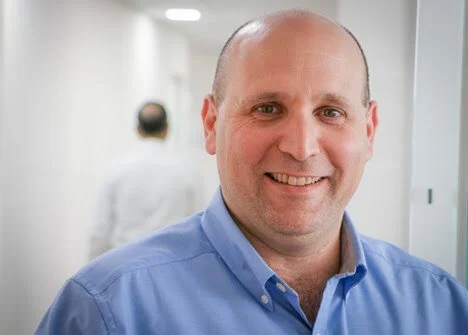
Gaby Miodownik has been appointed as the new CEO of Netafim, and will replace Ran Maidan, who announced his desire to retire from Netafim after six years as CEO. The company's board of directors has approved the appointment of Gaby Miodownik as CEO of Netafim, as of March 2020.
Gaby Miodownik, 46, married with 3 children, a CPA in his education, joined Netafim 16 years ago as CFO of the Latin American unit and then held a number of management positions in the company, including Head of the Mexican subsidiary, VP of EMEA division (Europe, Middle East, Africa) and most recently Senior Vice President and President of the Americas Division.
Daniel Martinez Vella, CEO of Orbia and Chairman of the Netafim Board of Directors: "I am proud and happy to appoint Gaby Miodownik as CEO of Netafim. Gaby has had a rich experience in Netafim, during which he gained extensive knowledge in agriculture and irrigation, extensive knowledge of the global market and the company's customers, and demonstrated high management, leadership, and impressive growth in all the roles he has played to date. I believe in Gaby and in his ability to lead Netafim to new heights, contributing to Orbia's vision to advance life around the world". Daniel added: "I want to thank Ran Maidan who led the company for the last 6 years taking it to unprecedented new heights and driving Netafim to significant sales and profit growth in recent years, along with developing growth engines and strengthening the company's competitive advantage".
Ran Maidan, CEO of Netafim: "I am grateful for the opportunity I have been given to lead Netafim for the past six years. I thank the management and employees for their great contribution to the success of the company and becoming a global market leader. From my long-standing acquaintance with Gaby, I am convinced that he is a great candidate and the best fit to move this great company forward".
Gaby Miodownik: "It is a great honor for me to be appointed CEO of Netafim after years of personal growth with the company. I would like to thank the Company's Board of Directors and Chairman of the Board Daniel Martinez Vella for the trust they have given me. Netafim is an excellent company with great potential, and I am convinced that together with the company's management and dedicated employees, we will continue to grow the company and further strengthen its position as the world's leading irrigation company."
For more information:
Netafim
www.netafim.com
Publication date: Mon 10 Feb 2020

Michigan State University’s Specialty Crop Research Initiative Grant Funded by The USDA
The initiative, OptimIA, which stands for Optimizing Indoor Agriculture, aims to improve the profitability and sustainability of indoor leafy-greens production
The initiative, OptimIA, which stands for Optimizing Indoor Agriculture, aims to improve the profitability and sustainability of indoor leafy-greens production.
February 11, 2020
A multi-university team of horticulturists, engineers and agricultural economists led by Michigan State University (MSU) has received a four-year, $2.7 million grant from the U.S. Department of Agriculture (USDA) to study indoor production of leafy greens. Industry partners have matched funding, bringing the project total to $5.4 million. The investigators on the grant include Erik Runkle, Roberto Lopez and Simone Valle de Souza of Michigan State University; Chieri Kubota of Ohio State University; Cary Mitchell of Purdue University and Murat Kacira of University of Arizona.
Leafy greens include commonly consumed vegetables such as lettuce, kale, and microgreens. Production challenges outdoors have led to interest in growing these specialty crops hydroponically in controlled environments, such as indoor farms. However, there is little information on whether this is economically viable. Capital and operating costs can be significant for startups, especially as it relates to light-emitting diodes (LEDs) and cooling systems. Leafy greens are a good candidate for indoor farming because they can be grown rapidly and in relatively small spaces. Indoor environments are heavily controlled, so growers aren’t constrained to a small geographic area within the U.S. There are, however, other geographic concerns.
The team and its collaborators have three major goals:
Defining optimal profitability based on yield and other high-value attributes of the plants, such as nutrition content.
Optimizing indoor environmental conditions, such as humidity, air movement, temperature, light and carbon dioxide concentration, to increase yield and high-value attributes.
Encouraging indoor farming stakeholders to collaborate with academic and industry groups that are working in controlled-environment agriculture.
The long-term project goals are to help integrate indoor farming into the specialty-crop segment of agriculture in the U.S.; to increase the sustainability and hence profitability of this rapidly emerging sector; and to locally produce leafy greens that have higher quality attributes.
To this end, economists will better understand operating and capital expenditures (capex), and define risk and production scenarios that are most profitable. Horticulturists and engineers will improve production efficiency, product quality and value-added attributes of leafy greens for reliable, consistent, year-round production. In addition, the team will design and test more effective localized air-distribution methods suitable for indoor production systems, as well as develop strategies to better manage humidity around plants to reduce tip burn.
While the project focuses on leafy greens, the results will also inform a wide range of controlled-environment growers through the development of growth recipes, strategies for nutritional content and anthocyanin enhancement, environmental management recommendations, and insights for economic sustainability as well as market and consumer perception of locally produced crops.
For more information, visit the project website here.
Leafy greens Sustainability USDA Microgreens Controlled Environment Agriculture

Farmers, Nonprofits Sue USDA, Saying Hydroponics Can't Be Organic
Center for Food Safety (CFS), along with a coalition of organic farms and stakeholders, filed a lawsuit challenging the United States Department of Agriculture's (USDA's) decision to allow hydroponic operations to be certified organic
Center for Food Safety (CFS), along with a coalition of organic farms and stakeholders, filed a lawsuit challenging the United States Department of Agriculture's (USDA's) decision to allow hydroponic operations to be certified organic.
The lawsuit claims that hydroponic operations violate organic standards for failing to build healthy soils, and asks the Court to stop USDA from allowing hydroponically-produced crops to be sold under the USDA Organic label. The plaintiff coalition includes some of the longest-standing organic farms in the United States including Swanton Berry Farm, Full Belly Farm, Durst Organic Growers, Terra Firma Farm, Jacobs Farm del Cabo, and Long Wind Farm, in addition to organic stakeholder organizations including organic certifier OneCert and the Maine Organic Farmers and Gardeners Association.
"Healthy soil is the foundation of organic farming," said Andrew Kimbrell, executive director of plaintiff Center for Food Safety, "Organic farmers and consumers believe that the Organic label means not just growing food in soil, but improving the fertility of that soil. USDA's loophole for corporate hydroponics to be sold under the Organic label guts the very essence of 'Organic'."
CFS's lawsuit cites the federal Organic Foods Production Act, which requires farms to build soil fertility in order to be certified organic. Hydroponics cannot comply with federal organic standards because hydroponic crops are not grown in soil, the CFS claims.
"The federal organic law unequivocally requires organic production to promote soil fertility," said Sylvia Wu, senior attorney at the Center for Food Safety and counsel for plaintiffs. "USDA's decision to allow mega-hydroponic operations that do nothing with soil to be sold as 'Organic' violates the law."
"Healthy soil is critical to producing nutrient-dense foods that benefit both people and the environment," said Paul Muller, one of the farm owners of plaintiff Full Belly Farm in Guinda, California, a diversified family farm that has been farmed organically since 1985. "Healthy soil increases and improves the availability of soil nutrients and beneficial microorganisms, and enhances the land's ability to sequester carbon and retain nutrients and water."
"While I welcome the work that my friends in the hydroponic industry are doing, hydroponic production does not conform to the soil-building precepts of organic farming," said Jim Cochran, owner of plaintiff Swanton Berry Farm, one of the oldest certified organic strawberry farms in California. "I would be perfectly happy to have my strawberries compete with properly distinguished hydroponically-grown strawberries, without the latter piggybacking on an Organic label that has taken more than 30 years to develop and establish in the minds of consumers. Certifying hydroponically-grown crops as organic devalues that label."
"The USDA's claim that hydroponics can be certified as organic is disingenuous and false," said Sam Welsch, president of plaintiff organic certifier OneCert, Inc. "Until the USDA started telling certifiers that they could ignore the parts of the law and rules that required fertility to come from organic matter in soil, no one was certifying hydroponic systems as organic."
For more information:
Center for Food Safety
www.centerforfoodsafety.org
Publication date: Tue 3 Mar 2020

Green Infrastructure Conference Call For Proposals
CitiesAlive is the leading green roof and wall conference in North America
CitiesAlive is the leading green roof and wall conference in North America.
This year, CitiesAlive: Green Infrastructure and Water in a Changing Climate is being held in Philadelphia, PA and will celebrate the city’s stormwater successes.
As a city with one of the most progressive stormwater management plans in the United States, Philadelphia paves the way for governments to invest in all forms of green stormwater infrastructure.
The conference will offer insight into Philly’s unique design, research and policy environments that has fostered the development of more than 1100 greened acres since 2009.
CitiesAlive provides a unique opportunity for design, policy, research and non-profit professionals to connect. Attendees will discover resilience and revitalization tools and strategies for resilient, healthier cities. Learn from the success and leadership of progressive cities that are leading the way in resilience planning.
For more information visit https://citiesalive.org/
Are you interested in presenting green infrastructure work? CitiesAlive is currently accepting abstracts until April 19th. Apply today! https://citiesalive.org/

Elon Musk's Brother Wants To Transform Farming
Vertical farming is an indoor farming method in which crops are grown in stacked layers, often without soil. The practice is becoming more popular and important as urban populations grow dramatically and available farmland decreases
February 28, 2020
New York (CNN Business)Plant-based foods are all the rage right now, and vertical farms are capitalizing on the trend.
Vertical farming is an indoor farming method in which crops are grown in stacked layers, often without soil. The practice is becoming more popular and important as urban populations grow dramatically and available farmland decreases.
While vertical farming isn't a new concept, these eco-friendly indoor farms are now rapidly expanding.
Elon Musk's younger brother, Kimbal Musk, who was named "Global Social Entrepreneur" of the year by the World Economic Forum in 2017, started Square Roots, an indoor urban farming company based in Brooklyn, in 2016. Square Roots' mission is to bring fresh, local food to cities around the world by empowering younger generations to participate in urban farming.
"When I was a kid, the only way I could get my family to sit down and connect was by cooking the meal," Musk, co-founder and executive chairman of Square Roots, told CNN Business in an email.
Kimbal Musk teaches students how to plant a vegetable garden in California.
"Getting involved with the internet, especially in the late '90s, was very exciting and I wouldn't change anything about those experiences, but my passion has always been food," Musk said. "The moment Elon and I sold Zip2, our first internet company, I knew I wanted to pursue food and become a trained chef." He moved to New York and enrolled at the International Culinary Center.
Musk said the company plans to open a Square Roots "Super Farm" — with 25 climate-controlled shipping containers, cold storage, biosecurity infrastructure and everything else needed to run a vertical farm at scale — in less than three months.
Since its inception, Square Roots has grown more than 120 varieties of crops, including greens, vegetables, and strawberries.
The company isn't the first of its kind. Startups like Silicon Valley's Plenty, which was founded in 2013 and is backed by Jeff Bezos, are also beginning to dominate the space.
"Environmentalists, urban farmers, architects, agronomists, and public health experts, among others, have been joining this mini-revolution as they partner to work out a way to salvage a food-scarce, ultra-urbanized future," Kheir Al-Kodmany, a professor of sustainable urban design at the University of Illinois at Chicago, said in a report.
It involves various techniques, such as hydroponics, which uses mineral nutrient solutions in a water solvent; aquaponics, which uses aquatic creatures -- such as fish and snails -- and cultivates plants in water; and aeroponics, which grows plants in the air.
As for job creation, rapid climate change will put millions of traditional farmers out of business, but vertical farmers won't be affected, according to microbiologist Dickson Despommier, an emeritus professor of public and environmental health at Columbia University.
Although vertical farming was first introduced in the early 1900s, it was recently popularized by Despommier. More than 20 years ago, he began teaching a class at Columbia called Medical Ecology.
Despommier spent a decade growing crops indoors with his students. "Ten years ago, there were no vertical farms," he said, noting that LED grow lights have vastly improved farming efficiency over the last five years, making indoor growing cheaper and more reliable.
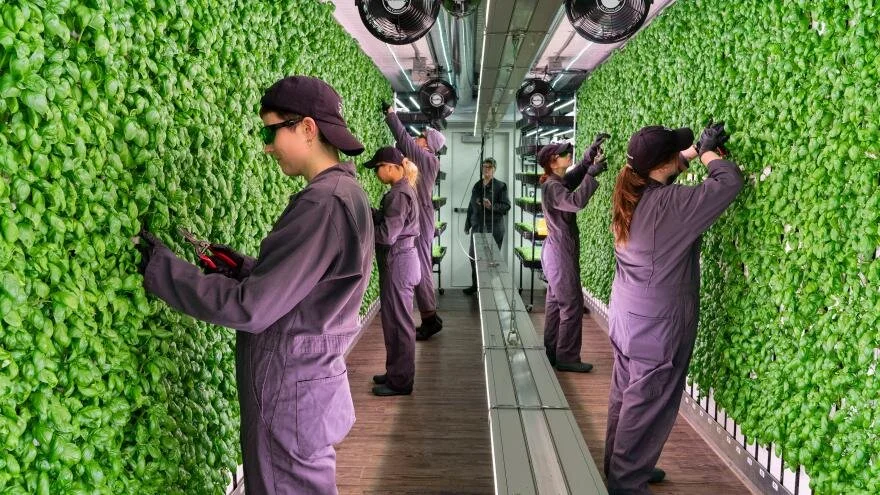
Basil growing at the Square Roots farm in Brooklyn.
"People want local food because they've lost trust in the industrial food system that ships in high calorie, low nutrient food from thousands of miles away with little transparency as to who grew the food and how," said Peggs, the Square Roots CEO.
At the same time, the world population is growing and urbanizing rapidly. Peggs said climate change is threatening existing supplies of food, forcing the industry to figure out new ways to grow food quickly.
Peggs is optimistic about raising money for vertical farming. "A lot of smart money and capital is entering the space," he said. "The quality of food that can now be produced in these indoor systems is at least on par with the best organic field-grown food you can buy."
Despommier said that cities will eventually be able to grow "all they can eat" from indoor farms located within city limits. "If an outdoor farm fails, the farmer has to wait until next year to start again, he said. "Indoor farms fail too, but the indoor farmer can start again within weeks."

Freight Farms Is Now More Green
Freight Farms runs a network of smart farms across 44 states and 25 countries. Each smart farm called a “Greenery” is housed in a 320 -sq.-ft. hydroponic shipping container
The Boston startup that builds automated farm systems in shipping containers raised $15M in a Series B round led by New York City-based Ospraie Ag Science, which invests in agtech companies. Existing investor Spark Capital also participated in the round, which brings the company’s total funding to more than $28M.
Freight Farms runs a network of smart farms across 44 states and 25 countries. Each smart farm called a “Greenery,” is housed in a 320-sq.-ft. hydroponic shipping container. These vertical farming containers are all linked to the startup’s data platform, Farmhand.
The startup’s customers range from food distributors and grocery stores to educational institutions and corporate campuses. In the past, the company has worked with the Compas Group, Google and Federal Realty Investment Trust.
The 10-year-old startup claims its farms can grow more than 500 varieties of crops at a commercial scale by using 99.8% less water than traditional agriculture.
Read more: Freight Farms Raises $15M in Series B For New Partnerships and Expansion

Kyoto’s Spread Co., Ltd. Brings Large-Scale Expertise to the AVF
Established in 2006, SPREAD has grown to become the leading Japanese vertical farm operator, with two farms capable of producing over two tons of lettuce per day
MARCH 3, 2020
KYLE BALDOCK
Established in 2006, SPREAD has grown to become the leading Japanese vertical farm operator, with two farms capable of producing over two tons of lettuce per day. By focusing solely on large scale vertical farming systems, they are leading a huge domestic industry in terms of production and profitability. I spoke to JJ Price, Manager of International Business Development, about their pioneering strategy and plans for the future.
Kameoka Plant
Taking the lead in a large domestic market
If the vertical farming market has matured anywhere in the world, it would be in Japan: current market research shows that there are just over two hundred vertical farms in the country. In 2007, Spread began their journey by constructing the Kameoka Plant, a non-automated vertical farm that is capable of producing 21,000 heads of lettuce per day. This large scale operation became profitable in 2013, but Spread looked to grow even bigger. In 2015, they announced the concept for an even larger, automated vertical farm to be constructed in the Kansai Science City. Fast forward to today and the Techno Farm Keihanna is operational, capable of producing a further three tons or 30,000 heads of lettuce per day.
Techno Farm Keihanna
While the level of automation and key technologies differs between the farms, Spread is now one of the largest vertical farming companies in Japan to be operating multiple farms. Their flagship products, the Vegetus brands of lettuce, are in 2,500 supermarkets across Japan and they recently hit the benchmark of 60 million products sold in total. When it comes to market share of vertically-farmed products on supermarket shelves, Spread is, again, the leader. Crop wise, they only focus on lettuce for commercial development, although various other products are in the works. Currently, 70% of the Vegetus brand production goes to retail and 30% goes to foodservice and ready meal products.
Growing even bigger with a partnership business model
With two farms operational, Spread is hoping to expand further through a partnership business model. With multiple agreements already in place, Spread will work with the partner company and provide expertise, support sales activities, advise on technology and the business model. The first farm under this model was announced on June 24, 2019, with Spread’s partner and member of JXTG Group J Leaf starting construction on Techno Farm Narita, one of Japan’s largest automated vertical farms. Recently, Spread entered into partnership discussions with Kyushu Electric to build the world’s largest automated vertical farm with production capacity of 5 tons of lettuce per day. With this model, Spread hopes to have 10 farms completed by 2025.
Looking outside of Japan, Spread is focused in the shorter term on particular markets. JJ Price told me they are looking closely at the US, Europe, and the Middle East. With the scales growing ever larger, and their reach going global, Spread makes sure that its customers come first.
Connecting with the consumer
Vegetus is a strong brand with Japanese consumers. The Spread team told me that in Japan, most open-field lettuce is iceberg, or a red variety called Sunny; all the varieties that Spread provides are different, milder and sweeter. The packaging of Vegetus clearly demonstrates that the products come from vertical farms, and the advantages are listed: no pesticides during cultivation, better texture, and flavor. In the supermarket itself, the product is set apart from traditional lettuce. In order to overcome negative perceptions of the product, the sales team goes round the supermarkets, holding events to engage consumers and promote the products. Overall, the perception of vertically-farmed produce is much more positive in Japan than in Europe or the US.
Vegetus Brand
In the end, the price is what counts, and Spread has a major advantage because of its scale: 1 head of Vegetus retails for 158 yen (suggested retail price), only 10-20% more expensive than outdoor-grown lettuce. This is central to Spread’s strategy: they are not looking for niche or premium brand products. They want Vegetus to be accessible and affordable for as many people as possible. In order to maintain this market position, I wanted to find out how Spread is innovating to drive down costs.
Innovation and automation to drive down costs
Spread does the majority of its R&D in house, from crop research and development to technology development, trialing and implementation. It is this spirit of innovation that led them through six years of trial and error to become a fully profitable vertical farm. But they are not averse to working with other market-leading companies: they developed their automation equipment and lighting in collaboration with leading Japanese companies. They have been working with the NTT Group to develop IoT and AI technologies that will optimize the growing environment and production processes. In terms of driving down costs, JJ Price told me that they are always on the lookout to improve hardware and automate labor-intensive processes. Furthermore, they also focus on improving the efficiency of human operations. These are the keys to driving down costs and increasing profitability moving forward.
Partner with Spread Co.
Spread is eager to partner with companies in the AVF network. They have invited interested parties to visit the website and connect. Please write to info@vertical-farming.net and ask for an introduction to Spread and we will be happy to connect you.
CubicFarm Systems Announces Its Largest Sale To Date - A 100-Machine Commercial-Scale Vertical-Farming System in Surrey, BC
The Company has a current backlog at C$24.7 million representing 144 machines under deposit and awaiting installation - demonstrating continued sales momentum due in part to the growing demand for its systems. The current backlog is anticipated to be recognized in revenue in mid-2020 to mid-2022
March 2, 2020
VANCOUVER, BC / ACCESSWIRE / March 2, 2020, / CubicFarm® Systems Corp. (TSXV: CUB) ("CubicFarms" or the "Company") is pleased to announce that it has finalized an agreement for the sale of 100 CubicFarms growing machines, and received a deposit in the amount of C$1.2 million from a commercial grower and agricultural product wholesaler based in the province of British Columbia, Canada. The customer had previously provided a deposit for a 12-machine system and now has applied its deposit toward this revised order for 100 machines.
The 100-machine system represents a total of C$16.5 million in sales revenues to the Company, and is expected to be installed in two phases in Surrey, BC. The first phase, consisting of the installation of 26 growing machines and an irrigation system, is planned for installation this year, with the remaining machines planned for installation by mid-2022.
The Company has a current backlog at C$24.7 million representing 144 machines under deposit and awaiting installation - demonstrating continued sales momentum due in part to the growing demand for its systems. The current backlog is anticipated to be recognized in revenue in mid-2020 to mid-2022.
The sale represents CubicFarms' largest to date, following on its 21-machine sale to a customer in Montana, USA - its largest sale in the US - and its 23-machine sale to a customer in Calgary, Canada.
Due to the close proximity of the customer's Surrey site to CubicFarms' headquarters, CubicFarms will provide a turn-key solution to the customer, by facilitating and managing site preparation and installation of the CubicFarms system - leveraging the experience the Company has gained from its R&D and production facility in Pitt Meadows, BC.
CubicFarms CEO Dave Dinesen commented: "We are extremely encouraged by the growth in sales we've enjoyed and the trend toward increasingly larger facilities. It reflects the demand emerging around the world for commercial-scale growing technology. Once installed, the system in Surrey will be one of the world's largest automated vertical-farming systems.
"We are excited to be working with our customer, an established multi-industry group with investments and operations in the agriculture, technology and health space. Our customer understands the importance of using technology to significantly improve yields in an environmentally sustainable manner, and we look forward to helping them scale up production of fresh local vegetables for their market in southwest British Columbia and beyond.
"We are also pleased to receive ongoing feedback from our existing machine customers about the quality of produce from our systems and the resulting growth in demand for that produce."
Concurrent with the 100-machine sale, CubicFarms has entered into a Shareholders' Agreement with the customer and its associated companies with respect to a joint venture entity that will own and operate the 100-machine venture. As consideration for CubicFarms' 20% ownership in the joint venture, the Company will provide approximately C$342,000 in the form of a zero-interest loan.
Neither the TSX Venture Exchange nor it’s Regulation Services Provider (as that term is defined in the policies of the TSX Venture Exchange) accepts responsibility for the adequacy or accuracy of this release.
About CubicFarm® Systems Corp.
CubicFarm Systems Corp. ("CubicFarms") is a technology company that is developing and deploying technology to feed a changing world. Its proprietary technologies enable farmers around the world to grow high-quality, predictable crop yields. CubicFarms has two distinct technologies that address two distinct markets. The first technology is its patented CubicFarm™ System, which contains patented technology for growing leafy greens and other crops. Using its unique, undulating-path growing system, the Company addresses the main challenges within the indoor farming industry by significantly reducing the need for physical labor and energy, and maximizing yield per cubic foot. CubicFarms leverages its patented technology by operating its own R&D facility in Pitt Meadows, British Columbia, selling the System to farmers, licensing its technology and providing industry-leading vertical farming expertise to its customers.
The second technology is CubicFarms' HydroGreen System for growing nutritious livestock feed. This system utilizes a unique process to sprout grains, such as barley and wheat, in a controlled environment with minimal use of land, labor, and water. The HydroGreen System is fully automated and performs all growing functions including seeding, watering, lighting, harvesting, and re-seeding - all with the push of a button - to deliver nutritious livestock feed without the typical investment in fertilizer, chemicals, fuel, field equipment, and transportation. The HydroGreen System not only provides superior nutritious feed to benefit the animal but also enables significant environmental benefits to the farm.
Information contact
Kimberly Lim
kimberly@cubicfarms.com
Phone: +1-236-858-6491
www.cubicfarms.com
Cautionary statement on forward-looking information
Certain statements in this release constitute "forward-looking statements" or "forward-looking information" within the meaning of applicable securities laws, including, without limitation, statements with respect to the anticipated benefits to the customer; timing and the completion of machine installation by mid-2022; benefits to the Company of the sale; the anticipated revenue recognition in mid-2020 to mid-2022; and the joint venture that will own and operate the 100-machine venture. Such statements involve known and unknown risks, uncertainties, and other factors which may cause the actual results, performance, or achievements of CubicFarm Systems Corp., or industry results, to be materially different from any future results, performance, or achievements expressed or implied by such forward-looking statements or information. Such statements can be identified by the use of words such as "may", "would", "could", "will", "intend", "expect", "believe", "plan", "anticipate", "estimate", "scheduled", "forecast", "predict", and other similar terminology, or state that certain actions, events, or results "may", "could", "would", "might", or "will" be taken, occur, or be achieved.
These statements reflect the company's current expectations regarding future events, performance, and results and speak only as of the date of this news release. Consequently, there can be no assurances that such statements will prove to be accurate and actual results and future events could differ materially from those anticipated in such statements. Except as required by securities disclosure laws and regulations applicable to the company, the company undertakes no obligation to update these forward-looking statements if the company's expectations regarding future events, performance, or results change.
SOURCE: CubicFarm Systems Corp

Next Generation of Greenhouses May Be Fully Solar Powered
Many greenhouses could become energy neutral by using see-through solar panels to harvest energy – primarily from the wavelengths of light that plants don’t use for photosynthesis
Many greenhouses could become energy neutral by using see-through solar panels to harvest energy – primarily from the wavelengths of light that plants don’t use for photosynthesis. Those are the findings of a new modeling study conducted by engineering, plant biology and physics researchers at North Carolina State University.
“Plants only use some wavelengths of light for photosynthesis, and the idea is to create greenhouses that make energy from that unused light while allowing most of the photosynthetic band of light to pass through,” says Brendan O’Connor, corresponding author of the study and an associate professor of mechanical and aerospace engineering at NC State. “We’re able to do this by using organic solar cells because they allow us to tune the spectrum of light that the solar cell absorbs – so we can focus on using mostly wavelengths of light that plants don’t use. However, until now it wasn’t clear how much energy a greenhouse could capture if it was using these semitransparent, wavelength selective, organic solar cells.”
To address that question, researchers used a computational model to estimate how much energy a greenhouse could produce if it had semitransparent organic solar cells on its roof – and whether that would be enough energy to offset the amount of energy the greenhouse required to operate effectively. The model was developed to estimate energy use for greenhouses growing tomatoes at locations in Arizona, North Carolina, and Wisconsin.
“A lot of the energy use in greenhouses comes from heating and cooling, so our model focused on calculating the energy load needed to maintain the optimal temperature range for tomato growth,” O’Connor says. “The model also calculated the amount of energy a greenhouse would produce at each location when solar cells were placed on its roof.”
The modeling is complex because there’s a complicated trade-off between the amount of power the solar cells generate and the amount of light in the photosynthetic band that they allow to pass through. Basically, if growers are willing to sacrifice larger amounts of photosynthetic growth, they can generate more power.
What’s more, the solar cells used for this analysis are effective insulators, because they reflect infrared light. This helps to keep greenhouses cooler in the summer while trapping more warmth in the winter.
The end result is that, for many greenhouse operators, the trade-off could be a small one. Particularly for greenhouses in warm or temperate climates.
For example, in Arizona, the greenhouses could become energy neutral – requiring no outside source of power – while blocking only 10% of the photosynthetic band of light. However, if growers are willing to block more photosynthetic light, they could generate twice as much energy as they required to operate the greenhouse. In North Carolina, a greenhouse could become energy neutral while blocking 20% of the photosynthetic light. In Wisconsin, greenhouses couldn’t become energy neutral using the semitransparent solar cells – keeping the greenhouse warm in winter requires too much energy. However, the solar cells could meet up to 46% of the greenhouse’s energy demand.
“While the technology does use some of the light plants rely on, we think the impact will be negligible on plant growth – and that the trade-off will make financial sense to growers,” O’Connor says.
The paper, “Achieving Net Zero Energy Greenhouses by Integrating Semitransparent Organic Solar Cells,” is published in the journal Joule. First author of the paper is Eshwar Ravishankar, a Ph.D. student at NC State. The paper was co-authored by Ronald Booth, a Ph.D. student at NC State; Carole Saravitz, director of the NC State University Phytotron; Heike Sederoff, professor of plant and microbial biology at NC State; and Harald Ade, Goodnight Innovation Distinguished Professor of Physics at NC State. The work was done with funding from the National Science Foundation, under grant number 1639429.
Source: NC State University
Publication date: Mon 10 Feb 2020

Discussing Green Funding At WIA Paris
Green Funding or Impact Investing is when lenders and investors make their decisions based on if the company in question has environmentally conscious business practices such as alternative energy, water, and waste management, or socially positive goals
Giving the Green Light to Green Funding
Green Funding or Impact Investing is when lenders and investors make their decisions based on if the company in question has environmentally conscious business practices such as alternative energy, water, and waste management, or socially positive goals. Companies like Danone and General Mills, as well as the major financial players in ag, are leading the path to responsible funding in the industry.
Green Funding: Critical or Counterproductive
We’ll be discussing how the practice of green funding is affecting the ag space. What are the current metrics being used to determine if a company is green enough, and how are they being tracked? On the flip side, will this practice make a positive impact or is it just an opportunity for companies to “green wash” themselves to get through the funding hoop? Join us to learn more!
Visit our website for more details
Subscribe to receive updates about
Women in Agribusiness Summit Europe.
Thank you to our sponsors
Growing Sunflower Shoot Microgreens
We tend to know sunflowers as the beautiful flowers that we see while strolling through a trail, or neighborhood park. Sunflowers, although beautiful, aren’t just ornamental, but they can be used for other purposes too
Microgreens Facts
February 28, 2020
We tend to know sunflowers as the beautiful flowers that we see while strolling through a trail, or neighborhood park. Sunflowers, although beautiful, aren’t just ornamental, but they can be used for other purposes too. The use of sunflowers has been around since the time of American Indians. The American Indian tribes would often use it for cooking, snacks and medicinal purposes. Most of us are familiar with snacking on sunflower seeds or the use of the oil through cooking, but did you know that they are also gaining popularity during the first shoot. Did you know that you can actually consume the shoots? There are incredible health benefits that come from consuming sunflower microgreens. The shoots are high in unsaturated fats, fiber, protein, calcium, iron, and other nutrients.
Here are some facts about sunflower shoots:
Sunflower Sprouts contain approximately 25% protein and are a rich source of vitamins A, B complex, and E and minerals including calcium, copper, iron, magnesium, potassium, phosphorus and zinc.
Sunflower Shoots also contain, healthy fats, essential fatty acids, fiber, and phytosterols. Numerous clinical trials have demonstrated that daily consumption of foods enriched with at least 0.8 g of plant sterols or stanols lowers serum LDL cholesterol.
Both sunflower seeds and their shoots contain high amounts of vitamin E. Vitamin E works synergistically with vitamin C and selenium to reduce blood pressure, increase the elasticity of arteries and prevent heart disease.
The sunflower shoot is a natural expectorant for chest congestion: In Ayurvedic medicine, these sprouts are thought to have the ability to encourage clearance of the lungs. Natural expectorants may also be used as a preventative measure against lower respiratory infections to deter the invasion of pathogens.
Sunflower shoots at first may not look very impressive but when applied to food they tend to steal the show. Sunflower shoots tend to elevate any dish, from throwing a few on a simple salad to a Michelin star restaurant gracefully placing a shoot on top of something extraordinary. Sunflower shoots are graced with a nutty flavor and a crunchy texture.
We love sunflower shoots so we’ll be giving you some tips on how to grow them. Here are some of our tips on how to grow them.
Cycle: 9-11 days from seed to harvest
Soak:
Room temperature water, 8-12 hours
60 minute sanitize can serve as soaking
Key Growing Strategies:
Soak seeds in room temperature water
Minimized, but optimized light exposure
Do not let lodge when covered
Water stress leads to hardier shoots - they can recover from severe wilt in a matter of hours
Uncovering:
Sunnies should be uncovered when shoots are about 2 inches long or shorter.
A better indicator than shoot length is that they should be uncovered when still perfectly vertical and before the weight of covering trays causes them to lodge
light.
Minimum 2 days light in summer; 3-4 days better in winter, 4 days optimum, depending on conditions.
Double up cover trays to prevent light pockets through drainage holes.
Avoid excess or overly intense light as this can cause an undesirable texture.
Watering:
Do not water upon uncovering - give at least one-day stress
Water consistently afterward for good growth; wet soil also makes trays easier to clean
Be sure to water trays consistently - back of trays often neglected
Rotate trays 180 degrees every 2 days in winter growing conditions
Excess water in hot conditions creates rapid growth but a flavorless and inferior sprout
Drainage is crucial
Stressors:
Restricting water early in the uncovered stage leads to a redder stem and nuttier flavor
Colder weather stunts growth can also cause reddened stems
Excess heat causes rapid, weak growth
Disease:
Susceptible to mold with poor air circulation and warm, wet conditions
Mold susceptibility varies between seed lots
Minor disease can be present in 5-10% of trays with little effect on yield
Disease presence on new seeds is to be expected as they adapt to conditions in the greenhouse; 3-5 weeks may be required for the greenhouse ecosystem to adapt to new seeds
These are just some general tips on how to grow sunflower shoot microgreens. We’re in love with Sunflower shoots over here at Nick Greens. If you have any questions feel free to contact us.
Tags: microgreens sunflower micro shoots microgreen growingtips growingfood growing microgreens

Harvest Fresh Canteen Vegetables On-Site
In schools and universities in America, the catering and service provider Sodexo plans to produce fresh vegetables all year round via indoor farming. To this end, the company is cooperating with the US hydroponics provider Freight Farms. The salad should grow vertically in containers on campus
by Frauke Brodkorb-Kettenbach
February 15, 2020
In the container greenery of the US company Freight Farms, Sodexo grows fresh vegetables for its cafeterias directly on campus. CAROLINE KATSIROUBAS / FREIGHT FARMS
In schools and universities in America, the catering and service provider Sodexo plans to produce fresh vegetables all year round via indoor farming. To this end, the company is cooperating with the US hydroponics provider Freight Farms. The salad should grow vertically in containers on campus.
Over 500 vegetables, such as Salanova Green Butter Salad (pictured), can be grown on a commercial scale in Freight Farm’s containers with 320 square meters of vertical acreage - regardless of the season and without pesticides or herbicides. Delivery routes are also eliminated with this type of vegetable cultivation.
Save resources
With the cooperation, Sodexo is pursuing its strategy of operating as sustainably as possible and at the same time being precisely informed about the origin of its food for customers in the education segment.
In addition, students could monitor the stages of growing their food. For example, schools could integrate hydroponic farming into interactive curricula or school subjects such as technology, agriculture, nutrition, and economics, according to Freight Farms' approach. The vertical farming provider also sees similar advantages for employees when using the containers in companies.
CAROLINE KATSIROUBAS / FREIGHT FARMS
So far, vegetables grow in freight farm containers in 25 countries and 44 states in the US - in small and medium-sized businesses, hospitals, as well as in retail and non-profit organizations, the information says. 35 school facilities now work with the hydroponics system. By working with Sodexo, the number should grow rapidly.
SODEXO, USA
Sodexo USA offers building management and catering services to schools, universities, hospitals, senior citizens' communities, venues, and other key industries. The parent company Sodexo Quality of Life Services, with headquarters in Issy-les-Moulineaux, France, was founded in 1966. According to its own statements, the group offers Benefits and Rewards Services and Personal and Home Services daily for 100 million people in 72 countries. In 2019, it had an annual turnover of 22 billion euros with 460,000 employees worldwide. The portfolio includes reception, security, maintenance and cleaning services, catering, facility management, restaurant, and gift vouchers and fuel passes for employees.
Bowery Is Sprouting In Baltimore With A New Automated Indoor Farm
Using technology that allows farming to go beyond the limits that the land imposes, the company has a mission to democratize access to fresh produce. It initially opened two farms in Kearney, New Jersey, serving the tri-state area
With a mission to democratize food access, the indoor farming startup sees the White Marsh location as a mid-Atlantic hub.
By Stephen Babcock / STAFF / 2/20/20
Inside Bowery's indoor farming operation. (Courtesy photo)
On land in White Marsh that was once associated with a working farm, new growth is taking root. But it didn’t require clearing away the building on the site: All of the growing is done inside.
“We are turning what was once an industrial warehouse back into a modern farm,” said Katie Seawell, chief marketing officer of Bowery Farming.
In early November, Bowery Farming opened a new indoor farming operation inside the warehouse on Franklin Square Drive and has been ramping up operations.
First flagged by Fast Company, it’s the third and largest farm for the New York-based startup, which in 2018 raised $90 million in a round led by Google Ventures.
Using technology that allows farming to go beyond the limits that the land imposes, the company has a mission to democratize access to fresh produce. It initially opened two farms in Kearney, New Jersey, serving the tri-state area.
With the expansion to Baltimore, the company is seeking a wider foothold in the mid-Atlantic. Seawell said the White Marsh location will open up distribution into a 150-mile radius where it can reach a potential 25 million people.
The company looks to hire locally even as it thinks regionally, and Seawell said White Marsh proved to be a transit-accessible location.
When it is fully-staffed, Bowery Farming expects to have about 80 farmers working at the space, in a mix of hourly and supervisory roles. Even for folks with no prior farming experience, Bowery looks to offer opportunities for farmers to move up within the organization as they gain skills. The farmers rotate through different roles on the farm, learning different aspects. Seawell recalled one farmer whom she met in the early days of the Kearney farm when he had a role in the packing section.
“I just ran into him last week and he was now in a support role for the ag science team,” she said.
They also seek out opportunities to support growth. In New York, the engineering team recently taught a coding class.
Inside the farm itself, hydroponics — the process of growing plants without soil — is key to the vertical farming operation, and technology plays a big role, too. CEO Irving Fain teamed with cofounders to apply technology to a big mission area. The team devised a system called BoweryOS to run the farm, which uses visual systems, sensory systems and automation. With data-gathering techniques and machine learning, the company sees its farms as a network, so the data is helping to build on what’s been done at the other two locations.
“Even though it’s the newest farm, it’s the smartest farm we’ve ever had,” Seawell said.
Bowery Farming from above. (Courtesy photo)
When it comes to the crops themselves, the farm has leafy greens and herbs in the market now. They’re available through Amazon Fresh, and Bowery is working on developing retail partnerships in the region to bring produce in the spring and summer. The company is also working to move beyond the “leafy green” category, which is often a staple of indoor farms and is testing other crops. It also has a partnership to regularly deliver hundreds of pounds of produce to the Maryland Food Bank.
Vertical farming doesn’t only upend the traditional growing model. With a wider food system that often involves food being shipped long distances, Bowery’s indoor farming approach yields lots of promise to bring production closer to where it’s eaten, employ local folks and offer a pesticide-free product.
Still, indoor farming remains new, and it’s entering an existing market with plenty of other produce players. As such, it has to make a product that’s attractive to folks, as well, and Seawell said the company has also put a lot of time and care into not just the operations, but also how it tastes.
“We believe we have a great-tasting product,” Seawell said.

Institute For Advanced Learning And Research And Virginia Tech Launch The Controlled Environment Agriculture Innovation Center in Danville
The Institute for Advanced Learning and Research (IALR) is partnering with the Virginia Tech School of Plant and Environmental Sciences and the Virginia Seafood Agricultural Research and Extension Center to launch a Controlled Environment Agriculture Innovation Center on IALR’s campus in Danville, Virginia
By urbanagnews
February 17, 2020
The partnership will create a hub of innovation and economic development in an industry expected to grow to $4 billion
The Institute for Advanced Learning and Research (IALR) is partnering with the Virginia Tech School of Plant and Environmental Sciences and the Virginia Seafood Agricultural Research and Extension Center to launch a Controlled Environment Agriculture Innovation Center on IALR’s campus in Danville, Virginia.
The Innovation Center will leverage technology and research to accelerate advancements, economic development, and regional participation in the developing industry of indoor farming. The value of U.S. greenhouse-grown food crops is expected to exceed $4 billion this year.
“We are delighted that the Institute for Advanced Learning and Research and Virginia Tech’s College of Agriculture and Life Sciences have combined their expertise to create a top program in controlled environment agriculture. This collaborative effort is creating tremendous energy and excitement because of its potential to provide innovative solutions to the agricultural community,” said Alan Grant, dean of the College of Agriculture and Life Sciences. “Partnerships like this will help us realize the vision of the SmartFarm Innovation Network Initiative to support the agriculture industry.”
Convening industry, academia and producers, the Innovation Center will be housed primarily within a modern greenhouse complex on IALR’s campus. Features will include various hydroponic systems, which grow plants in a soilless root medium with optimal amounts of water and nutrients. Vertical growing racks will maximize space, and high-tech engineering and technology will be integrated and on display throughout the center.
High-value demonstration crops will include lettuce, herbs, strawberry, blackberry, hemp, and more. In addition, faculty and staff involved in the center will research and educate on raising fish in controlled environments using aquaponics, or recirculating aquaculture systems that integrate plant and fish production. While traditionally viewed as separate fields, plant and fish production share many similar technologies, issues, and needs.
“We are excited to partner with Virginia Tech, a fellow champion of cutting-edge innovation, to expand the impact of agriculture in promising new ways,” said Mark Gignac, executive director of IALR. “While agriculture is a longtime industry of Southern Virginia, economic factors have demanded a new identity. We believe controlled environment agriculture is one of the defining solutions, and we are proud to work with Virginia Tech to introduce the concept to our region’s growers and attract industry.”
According to Michael Schwarz, director of the Virginia Seafood Agricultural Research and Extension Center, this new collaboration will further bolster domestic seafood production.
“The U.S. currently has a national seafood trade deficit in excess of $15 billion, with more than 50 percent of the seafood we consume originating from aquaculture,” he said. “Through this new programming and leveraging of expertise and infrastructure, we have the opportunity to drastically increase domestic seafood and produce production within the state, region, and country, enhancing food safety, security, sustainability, and, most importantly, socioeconomically within our agriculture economies.”
Controlled environmental agriculture helps protect plants from disease and stress while providing ideal growing conditions for high-quality, quick-to-harvest food products — sometimes in as fast as two weeks depending on the crop. In addition to hydroponic systems, the Innovation Center will use data management, sensors, and vertical structures to ensure ideal distribution of water, energy, capital, and labor. Plus, strict entry protocols will prevent pests. Together these factors result in a high-quality, consistent product with significantly more harvests than outdoor conventional production methods. Other advantages of controlled environmental agriculture include uniform, year-round production, potentially pesticide-free agriculture, and greatly reduced land and water requirements.
AeroFarms, a leading controlled environmental commercial producer based in New Jersey, recently announced the world’s largest indoor farm to be located in Cane Creek Centre in Pittsylvania County, just minutes from IALR. While this industrial-sized operation demonstrates scalability, Michael Evans, director of Virginia Tech’s School of Plant and Environmental Science, believes the technology is accessible to even small farmers in the region.
To encourage market growth, and in line with IALR’s role as a regional catalyst for economic transformation, the Innovation Center will introduce controlled environmental technologies to regional parties interested in entering the market. Conferences, workshops, site visits, and a web presence will comprise part of the outreach and educational activities. According to Evans, controlled environment agriculture is a rapidly growing sector that offers many potential opportunities in Southern Virginia.
“We are excited to house this facility on the Institute for Advanced Learning and Research’s campus and to benefit from both the technology developed and the associated economic development opportunities it provides for the region,” said Scott Lowman, director of applied research at IALR. “Consumer demand for healthy, local, and pesticide-free produce is high and will continue to increase in the coming decades. We look forward to serving this need through controlled environment agriculture.”
The Institute for Advanced Learning and Research serves Virginia as a regional catalyst for economic transformation with applied research, advanced learning, advanced manufacturing, conference center services, and economic development efforts. IALR’s major footprint focuses within Southern Virginia, including the counties of Patrick, Henry, Franklin, Pittsylvania, Halifax, and Mecklenburg, along with the cities of Martinsville and Danville. For more information, visit www.ialr.org.
For more information on IALR, contact Allison Moore at allison.moore@ialr.org or 434.766.6766