

Welcome to iGrow News, Your Source for the World of Indoor Vertical Farming

Old MacDonald Had A Carpark? The Urban Farms Growing In Unlikely Places
Demand in cities for locally sourced food is growing, but space is at a premium. No wonder urban farms are flourishing everywhere from carparks to air-raid shelters
Tue 17 Dec 2019
Growing Underground in Clapham, south London, an urban farm in former air-raid shelters.
Photograph: Dan Kitwood/Getty Images
Demand in cities for locally sourced food is growing, but space is at a premium. No wonder urban farms are flourishing everywhere from carparks to air-raid shelters.
The delivery man arrives back at the farm, his produce drop-offs for the day complete. He’s greeted by ecstatic barking from his three dogs, one of which leaps into his arms, licking his face enthusiastically.
It’s a familiar scene from any farm, anywhere in the world. But this delivery man didn’t drive through muddy fields or down country roads to get here. He freewheeled his bicycle down the blue-striped spiraling entrance of an underground car park.
This is La Caverne, the only subterranean agricultural operation in Paris. It is housed within 9,000 sq m of a disused multistorey parking facility beneath a social housing complex. Since 2017, Jean-Noël Gertz, a thermal engineer and founder of agricultural start-up Cycloponics has used this space to grow mushrooms and endives and deliver them to the organic shops of the city’s inner north.
Cycloponics co-founders Jean-Noël Gertz (left) and Theo Champagnat with some of their subterranean produce. Photograph: Kasia Wandycz/Paris Match via Getty Images
Gertz shows me around the facility, which winds deeper and deeper. One level down, a conveyor belt runs across several numbered parking bays, along which staff separate endives from their gnarly roots and pack them into crates for delivery. Endives, grown entirely without sunlight, are a perfect crop for a below-ground venture like this. Reportedly discovered by a Belgian farmer who tried to hide chicory roots from the taxman in his cellar only to find they grew delicious, tender leaves while they were down there, endives are now the fourth most popular vegetable in France
As we descend even further, Gertz has the straightforward air of someone who thinks running a farm out of an underground car park is a perfectly normal thing to do. He says he doesn’t mind spending most of his time below ground. “We have a lot of space here and we walk a lot, we’re all in very good health,” he says. With limited land, the only idea is to grow food underground and leave the land above for peopleSaffa Riffat, World Society of Sustainable Energy Technologies
Odd as it seems in the heart of the city, this kind of agriculture may soon become widespread as demand for organic, locally produced food grows and car use declines. Underground farms have sprung up in other major capitals such as London and New York.
This particular one runs three storeys deep below a public housing complex in Porte de La Chapelle. Built-in the autocentric 1970s, by the time Cycloponics moved in there were just 40 vehicles left. The area has double the poverty rate of the Paris average, and 30% of residents under 25. Owning a car is simply no longer an option for many people.
Indeed, across Paris, 58% of working households do not own a car. As mayor Anne Hidalgo continues to discourage driving and encourage public transport, the city is looking for new uses for these vast subterranean spaces.
Endives, which grow without light, are the perfect crop for an underground farm.
Photograph: Kasia Wandycz/Paris Match via Getty Images
Since 2016, the town hall’s Pariculteurs programme has offered up spaces like this – as well as rooftops and courtyards – to businesses willing to turn them green. Businesses like Cycloponics can bid for these spaces in a public call. Parisculteurs estimates that by 2022, there will be 1,240 tonnes of fruit, vegetables, mushrooms, herbs and 1.3m plants grown in Paris every year.
Saffa Riffat, the president of the World Society of Sustainable Energy Technologies, says that if the world is going to feed 9 billion people by 2050 agriculture will have to move underground. Riffat is leading a project at Nottingham University on how to convert the 12.5 sq km of abandoned mines in the UK into farms.
Anything that’s local in provenance and sustainable is going to pay a larger and larger role in people’s purchasing decisions Steven Dring, Growing Underground
“With limited land, the only idea is to grow food underground and leave the land above for people,” he says.
He gives the example of China, where vast swathes of land are too contaminated to farm and many people are being sent to the big cities to live.“
People are moving from the countryside to the city so there’s [fewer and fewer] farmers to grow food. So, we have to move the overall infrastructure of growing food from the countryside to cities,” he says.
Clapham, south London, is home to Growing Underground, a massive hydroponic operation in a second world war air-raid shelter. While La Caverne specializes in vegetables that don’t require sunlight, Growing Underground uses LED lighting to grow herbs, microgreens, and salad leaves – something that’s only become possible in recent years with advances in technology, says co-founder Steven Dring. Eight to ten years ago, the lighting available would have made the tunnel too hot to grow anything down there, he says.
An employee carries boxes of micro-green salad from the elevator Growing Underground. The farm’s clients include Tesco, Marks & Spencer and Ocado. Photograph: Daniel Leal-Olivas/AFP/Getty Images
Growing Underground supplies restaurants and supermarkets with 15 different product lines and has deals with Tesco, Marks & Spencer and Ocado, among others.
“Anything that’s local in provenance and sustainable is just going to pay a larger and larger role in people’s purchasing decisions,” Dring says.
Most of what we eat in Paris is cultivated, raised or produced 600km from where we live Julien Roudil, Le Producteur Local
Back at La Caverne, Gertz takes me to see the mushrooms. Neat rectangular bales are suspended from the ceiling in rows, small clusters of mushrooms sprouting out of each. Steam pours out of overhead pipes and the floor is under a centimeter of water in parts. “We have to recreate autumn in here,” he says.
Unlike the familiar carpark sound of footsteps echoing in concrete, the air here smells like a fusty forest floor. It is thicker, damper and warmer than the crisp early winter day above ground.
Controlling the temperature year-round is one of the major advantages of underground farming.
Suspended bales grow champignons de Paris in artificially autumnal conditions.
Photograph: Kasia Wandycz/Paris Match via Getty Images
The disadvantages, Gertz says, involve frequent water leaks and having to haul the farm’s waste up to ground level to dispose of it – not to mention the Herculean effort required to clean the polluted space to the standards required for organic certification.
If hyperlocal city produce seems like the ultimate 21st century demand, there is actually a surprising precedent for growing mushrooms under the streets of Paris. Throughout the 19th century, farmers grew champignons de Paris – button mushrooms – in the abandoned quarries below the city. Stones taken from these underground caverns gave the Hausmann buildings of the capital their distinctive rose-grey hue, and left behind a perfect environment for the fungus to thrive.
The mushrooms were pushed out of the city that gave them their name with the construction of the Métro at the turn of the 20th century. Now, the popularity of the Métro and the decline in car use is what’s bringing them back.
In 2020, with the opening of Cycloponics’ second Paris location, and alongside their shiitake and oyster brethren, champignons de Paris will be grown within city limits once more, 90 years after they disappeared. La Caverne already produces 100-200kg of mushrooms a day, selling to places like Le Producteur Local, an organic supermarket and non-profit cooperative of 45 producers that stocks meat, cheese and vegetables all grown within 150km.
A rooftop farm in Paris run by Agripolis, an urban farming company. Photograph: Agripolis
“You have to realise that most of what we eat in Paris is cultivated, raised or produced 600km from where we live,” says director Julien Roudil, pointing out that much of what a Parisian household regularly consumes is in fact readily available within just 60km.
Although he’s a champion of local produce, Roudil says Paris will probably never be able to feed itself entirely, no matter how many rooftops or carparks are converted into farms. The popularity of locally grown produce already outstrips the local land available for farming, he says, and there’s not enough space available in Paris to supplement that at a reasonable price.
Dring is more optimistic about the prospects of greater London becoming self-sufficient, whether by growing on rooftops, on barges on the Thames or in bunkers. “All these different technologies will be complementary to each other. I think London will certainly be sufficient within 100 miles,” he says

Indoor Farming Is One of The Decade's Hottest Trends, But Regulations Make Success Elusive
How to feed a hotter, more crowded planet is the question of the century. Indoor urban agriculture may be the answer
How to feed a hotter, more crowded planet is the question of the century. Indoor urban agriculture may be the answer.
Written By: Washington Post | Nov 20th, 2019
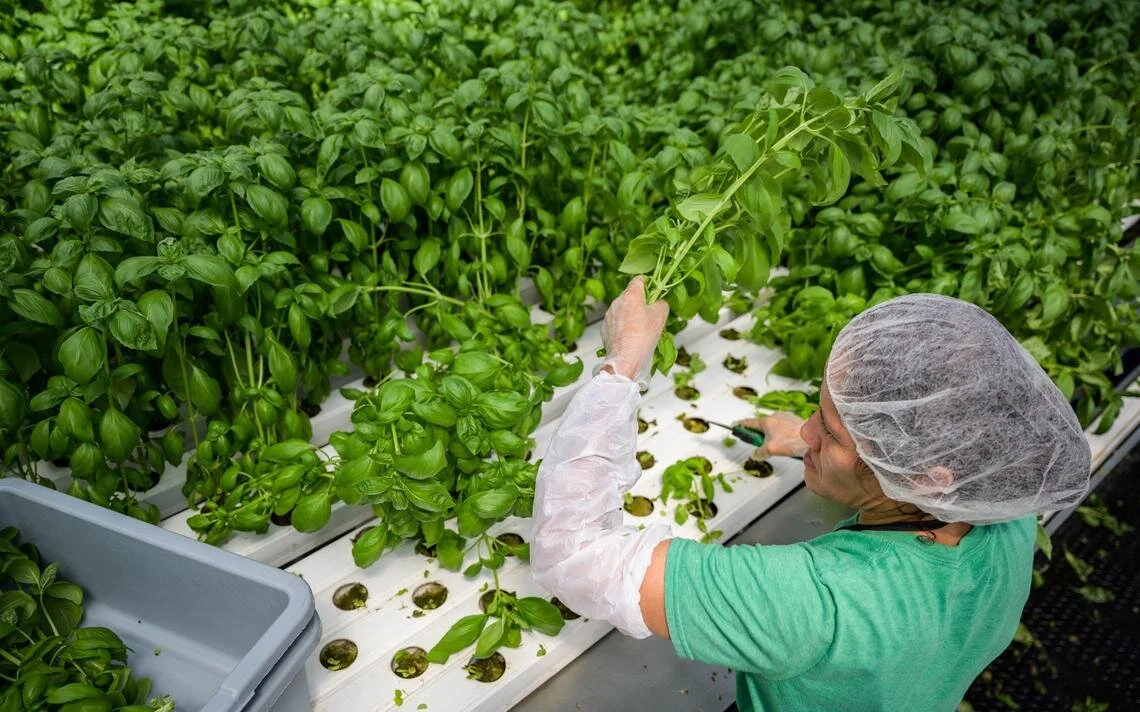
A worker harvest basil inside Gotham Greens facility in Hollis, N.Y. Salwan Georges / Washington Post
BALTIMORE — The next big thing is here, all girders and concrete pads, glass roofing and gravelly dirt. Viraj Puri, co-founder of one of the nation's largest indoor farm companies, walks through the construction site, and even without the luminous frills of thousands of butter lettuces, it's easy to see that the building going up where Bethlehem Steel once stood is something ambitious in the world of food.
The Sparrows Point steelworks in Baltimore, once the largest steel-producing facility in the world, was shuttered in 2012, leaving no trace of what once supported 30,000 families with Bethlehem Steel wages. Now the vacated land is dominated by a FedEx distribution center, an Amazon fulfillment center, an Under Armour warehouse.
And by the beginning of December, Puri's Gotham Greens farm will join them, part of a global craze for decentralized indoor food production.
A worker walks the construction site of Gotham Greens' new Baltimore facility. The farm's first stage will be 100,000 square feet, but there's space to go up to 400,000. Salwan Georges / Washington Post
Food and agriculture innovation have sucked up remarkable amounts of investor capital in recent years and could become a $700 billion market by 2030, according to a Union Bank of Switzerland report.
Millions are being invested globally in indoor urban farms because of their promise to produce more food with less impact, with two dozen large-scale projects launching in Dubai, Israel, the Netherlands and other countries.
Still, the next big thing may be stymied in the United States by high start-up costs, high urban rents and lack of a safety net in a food system that is highly dependent on subsidies and bailouts for a few commodity crops. (An American Farm Bureau Federation report last month found that almost 40% of conventional farm income in 2019 will be provided by trade bailouts, disaster insurance, the farm bill and insurance indemnities.)
And for indoor urban farms, especially those that rely solely on artificial light, there's another concern: lightbulbs.
In September, the Trump administration announced it would roll back Obama-era energy efficiency standards that would have effectively phased out the standard pear-shaped incandescent variety. The step is expected to slow the demand for LED bulbs, which last longer and use less electricity than many other types but are more expensive.
The rollback, slated to take effect in January, is being fought by 15 states and a coalition of environmental and consumer groups that claim the changes will speed climate change and raise consumers' energy bills.
For indoor urban agriculture, especially indoor vertical farms, the reversal represents a threat to an already narrow path to scalability and profitability, according to Irving Fain, chief executive of Bowery Farming. The indoor vertical farming company has raised $122.5 million from celebrity chefs Tom Colicchio, José Andrés and Carla Hall, Amazon worldwide consumer chief executive Jeff Wilke and Uber chief executive Dara Khosrowshahi.
"The Department of Energy recognized a lot of our energy was going to lights and that LEDs were a more efficient form of lighting, so they pushed from incandescent to LED in industrial spaces," Fain said in a phone interview. "Those were the trends that got us here, and we were hoping cost could drop another 50% with more innovation and more volume."
Some indoor farms stack plants vertically nearly to the ceiling in repurposed shipping containers or enormous warehouses, all of the plants' photosynthesis achieved via high-tech light-emitting diode (LED) bulbs. Others, such as Gotham Greens, are vast, glass-topped greenhouses, pulling their plants' needs from the sun and giving a lightbulb assist in low-light times.
Gotham Greens is transforming Baltimore's Bethlehem Steel factory site into a 100,000-square-foot hydroponic greenhouse, the largest greenhouse the company has built. Salwan Georges / Washington Post
In addition to Gotham Greens, the Washington-Baltimore area will become home to an outpost of Bowery Farming in November. In the second half of 2020, a $100 million greenhouse tomato-and-cucumber project with the world's largest LED installation for a single building will debut in Morehead, Kentucky, funded in part by "Hillbilly Elegy" writer J.D. Vance. And around the same time, California-based Plenty, with investors such as Amazon founder Jeff Bezos, will debut a southern California indoor vertical farm about the size of a soccer field. (Bezos owns The Washington Post.)
But the U.S. Department of Energy's proposed reversal of energy efficiency standards could hamper this emerging agricultural sector, according to Fain.
Indoor vertical farming became economically viable when LEDs became plentiful, cheap and efficient. Before that, indoor growing lights produced enormous amounts of heat - heat mapping was frequently how police identified illegal marijuana growing houses - and thus cooling costs and electricity bills were astronomical.
With the passage of energy legislation in 2007, the Department of Energy required that most general-service lightbulbs emit at a minimum efficiency of 45 lumens per watt by the beginning of 2020. Halogen and incandescent bulbs don't generally meet that efficiency standard. LEDs, which use a semiconductor to convert electricity into light, do.
Within just a few years, LEDs doubled in efficiency and prices fell 85%. Widespread adoption caused energy companies to throw money at research and development. Indoor urban farmers, especially those farming vertically, have built their profitability models on projections that LEDs will continue to get exponentially brighter and less expensive, will run cooler and will become more efficient.
Chris Granda, senior researcher/advocate at the Appliance Standards Awareness Project, says rolling back the efficiency standards will hamper the expansion of LEDs and their continued march toward greater efficiency.
"I think what the efficiency standards rollback will do is slow the rate of consumer uptake," Granda said. "There's a cohort of people who just don't like to try new things. The standards would have nudged them along into LEDs. Even if it delays the adoption of LEDs for five years, that's a huge loss of energy."
Efficient bulbs are not the only challenge to indoor urban agriculture, Fain says. To take a small indoor farm and make it a big one requires innovations in robotics and artificial intelligence. There, too, prices have come down substantially for sensors, processing and data storage. Altogether, these make indoor farming viable but not easy.
Fain talks about Bowery's operating system, "the brains and central nervous system of our farm, with a plant-monitoring system and proprietary deep-learning algorithms" that help predict what will happen to each crop. He says the operating system, one of the most expensive components of Bowery, runs everything at each farm, with real-time data to improve outcomes over a network of farms. The cost of that operating system has to be amortized over that network.
And because profitability is so elusive, some of the early promises of indoor agriculture are slow to be realized. Steep start-up costs mean farmers must grow crops that generate major cash: specialty items, such as flowers, or crops that have quick growth cycles, such as leafy greens. The five main indoor crops are leafy greens, microgreens, herbs, flowers and tomatoes, items that are a pull for those of high socioeconomic status but aren't go-to products for low-income people.
There's inherent elitism that is hard to avoid, even with school tours, food bank donations and other efforts toward democratizing access to good food.
Indoor urban farming is frequently touted as a mechanism for urban renewal and job creation in low-income neighborhoods. But farms kitted out with sensors and robots often require highly specialized and educated workers. They typically are not huge employers. Bethlehem Steel employed 30,000 at its peak; Gotham Greens' largest farm yet will have only about 60 full-time employees.
For Puri, Fain and others, the necessity to succeed with indoor urban agriculture is self-evident. More than 95% of head lettuce in the United States comes from two drought-prone states, California and Arizona, and according to the U.S. Department of Agriculture, traditional agriculture accounts for 80% of the country's water consumption, as high as 90% in many Western states.
Viraj Puri, co-founder and CEO of Gotham Greens, in the company's facility in Hollis, N.Y. Gotham Greens builds and operates ecologically sustainable greenhouses in cities across America. Salwan Georges / Washington Post
In 2018 alone, three food-borne illness outbreaks on traditional romaine farms killed six people, hospitalized 128 and infected 300, according to the federal Centers for Disease Control and Prevention. The safety challenges of outdoor farming are becoming more acute with climate change and unexpected shifts in pests and bird migrations.
After Hurricane Sandy in 2012, news stories reported that local Gotham Greens lettuces were some of the only leafy greens available in grocery stores in New Jersey and New York. Indoor farming gives cities "urban resiliency," something planners are increasingly concerned about.
Cities are where most of us live, says Sabine O'Hara, dean of the College of Agriculture, Urban Sustainability and Environmental Sciences at the University of the District of Columbia. The conversation now, she says, is how to shrink the food footprint of cities, how to make cities more sustainable and their food systems robust when disaster strikes.
By the end of the year, Gotham will operate 500,000 square feet of greenhouses across five states.
Gotham Greens' first indoor greenhouse farm debuted in 2011 in Brooklyn on the rooftop of an old bowling alley. The second was on the roof of a Whole Foods, also in Brooklyn, and the third was in Queens atop what once housed the Ideal Toy Co., which made the Betsy Wetsy doll after World War II and had its last big hit with the Rubik's Cube. Another, in Chicago, sits on the second floor of an eco-friendly cleaning products company.
The fifth farm, in Baltimore, will be Gotham Greens' biggest to date, and has raised $45 million in equity capital.
At Sparrows Point, Puri walks past what will be the packaging room, the break room and the computer control room. He lists off some stats. One indoor acre at Gotham is as productive as 40 acres of conventional soil. Gotham Greens' Baltimore farm will require 95% less water and 97% less land than a traditional dirt farm, and only about an eighth of the energy consumption of an indoor vertical farm.
Almost nothing will go to the landfill, the majority of its waste being compostable or recyclable. Gotham Greens lettuce can go from seed to full head in 35 days, about half the time it takes outdoors.
The farm's first stage is 100,000 square feet, but there's space to go up to 400,000. Puri talks about eliminating food waste, passing shelf life along to consumers, millennials' desire to know where their food is from. He says Gotham's first farm became profitable within the first year of operation.
"As the largest urban agriculture company in North America," Puri said, "we've demonstrated that urban greenhouse agriculture can be a viable agribusiness that addresses a real need in the commercial supply chain of fresh produce."
But with almost none of the agricultural subsidies and safety nets of traditional row crop agriculture, and with high operating costs and the trajectory of lightbulb research uncertain, some sectors of indoor urban agriculture may be on shaky ground.
This is article was written by Laura Reiley, a reporter for The Washington Post.

How IGS Reduces Vertical Farming Costs
While vertical farming is not the ultimate solution to the world’s farming challenges, it does give control over many variables or, perhaps more accurately, the weather
December 11, 2019
Editor’s Note: Intelligent Growth Solutions (IGS) is a portfolio company of AgFunder’s and recently attracted investment from leading agtech investor Ospraie. IGS offers plug and play vertical farming technology to vertical farm operators, which they say can increase efficiencies and substantially reduce costs compared to other vertical farming operations. It can be hard to explain exactly how the technology does this, so we caught up with Niall Skinner, lead mechanical engineer at IGS to get an in-depth explanation of how the tech works.
What core challenges facing the vertical farming market does the IGS technology address, and how?
While vertical farming is not the ultimate solution to the world’s farming challenges, it does give control over many variables or, perhaps more accurately, the weather. At IGS we have gone back to basics in our technological approach to make weather control a reality, building four families of patents and patents pending along the way.
We recognised that running a vertical farm needs to be simple, even if the technology behind it is not! By its very design, a vertical farm is often a far more technical and complex environment than a traditional farm or even a glasshouse environment would be. An overly technical system can, however, be off-putting, so we have turned the thinking on its head: there are no computers, cables or capacitors in our systems.
We thought outside the box (quite literally) to work out how to bring weather from the outside in, and allow it to be controlled through a mobile phone app. Our ‘plug and play’ modular systems address the challenges of power and labour costs and offer opportunity to pre-programme ‘weather recipes’ to ensure maximum productivity across yield, consistency and quality. Core to our R&D efforts was to ensure greater commercial viability for operators and the focus on power reducing technology and automation has been paramount. Our approach has enabled us to demonstrate clearly reductions of up to 50% power usage and 80% labour costs.
In addition to our power management capabilities, we are particularly excited about our patents that address the serious challenge of ventilation in a closed space. Keeping crops at an even temperature under hot lights while balancing the CO2 they inhale and the oxygen the exhale is very tricky, but our patent-pending (in this case) technology provides a solution that delivers the required balance, even as it captures, condenses and reuses the water vapour the plants emit.
Can you explain in more detail how your technology can reduce power consumption in a vertical farm
We have developed a power-management platform that flexes with the grid in real-time, allowing it to respond to external impacts such as grid stability and power availability. This means that power can be pulled when it is cheaper or pushed back when it is more expensive and in-demand: in effect, it imitates the role of a large battery where the excess energy is converted into grown produce. The use of industrial Omron SYSMAC programmable logic controllers (PLCs) to automate our system allows automatic recovery from power loss events and means that individual towers and sites get the power they need. As a result, none of the systems need to be reset, reprogrammed or manually repositioned.
Our system has a baseline power consumption of 60 kilowatts (kW), which can be rapidly increased to 105 kW or reduced to 30 kW for short periods to optimise grid stability. Other drains on power include heating and air conditioning, but all our systems including watering are on closed loop systems to minimise power consumption. Our design reduces the need for HEPA (high-efficiency particulate air) filtration to clean large volumes of incoming air, and the heating and/or cooling of this air depending on location and season – all of which are a drain on power. In combination these efficiencies contribute to a power-saving of 50%.
With over 1000 LEDs per tray, lighting forms over two-thirds of the system’s power requirements. We were determined to develop a more efficient system to drive the LEDs, and this is where the three-phase power supply design was born. This system is more commonly used to power machinery in an industrial environment but works by transferring the power supply to a safe voltage level and transmitting it to each individual tray within the tower using aluminium tubes rather than cables. By using tubes rather than cables, we can improve transmission efficiency. Aluminium tubes are also much cheaper and lighter than comparable copper cables. By using three-phase power at a tray level, we can also further reduce losses of power and provide inherent phase balancing. This eliminates the need for costly and inefficient filtering and power factor correction, as well as the use of capacitors for single-phase conversion. These measures contribute to an increase of between 5% and 10% in driver efficiency,
Your approach to the technology replicates a more industrialised environment – why is that?
Initially, when the founding team of engineers came together at IGS, the background was more heavily based in industrial operations. This has actually been a considerable advantage in helping us look differently at the vertical farming environment; it is our industrial environment approach this is key to this. We operate our farms in large steel frame warehouses with insulated cladding walls to provide isolation from the external environment. For example, the standard buildings are 10 metres in height, which allows up to 26 trays to be stacked in towers up to 9 metres high, but we do offer a range of options in addition to this. It really is closer in style to an industrial unit than a more traditional agricultural setting; handling the trays in this environment requires no human involvement whatsoever. It is here we generate savings of as much as 80% in the area of labour.
Within each tower, we have established standalone ventilation and irrigation closed-loop systems, which automatically sterilise and recycle air and water so that the only regular inputs the system needs are power, seed, nutrients, carbon dioxide and harvested rainwater. The air is sterilised by UV filtration technology – similar to that used in clean rooms. Standard industrial chillers and cooling coils cool and dehumidify the air which is then heated as needed, also drawing on waste heat from multiple areas in the facility. Carbon dioxide can be added to this loop when required too. This optimised management right across the components of our system when compared with conventional and glasshouse environments contribute to an overall reduction of power consumption of between 40 and 50%.
All the important factors – light, heat, humidity, water, nutrients, and crop movement – are controlled by industrial programmable logic controllers (PLCs), that run on an architecture that does not need unpredictable updates. The Omron SYSMAC PLCs use feedback from sensors distributed throughout the tower and systems that is transferred to a cloud-based control system. This removes the need for computers and wiring. It makes the whole system much more simple to operate, maintain and control.
With greater control over your LED systems than many (if not all) competitors, how and why have you focused your innovation on this area? What benefits does it bring?
Lighting was always going to be a key area when we were developing our systems as this is where the greatest power consumption comes from. We have focused on light intensity and dimming particularly so we can control each individual colour in the spectrum. Our LEDs are fitted in clusters, with each cluster containing all types of LED. Our system can vary the spectrum or pulse width modulation (PWM) and intensity to simulate solar radiation. We believe this is a unique feature of our system.
Each wavelength can be turned on or off or dimmed via PWM, linear dimming or a combination of both. However, we are still at the early stages of understanding how the optimal mix of light for each crop and stage of growth can impact on different ranges of crops. This is where we use AI to measure and understand the crops’ progress in order to enhance our learning in this area. We are already making some very interesting observations across a range of crops and are showing yield improvements of up to 2-3 times increase.
Our system can also vary intensity through linear dimming or PWM. We can vary PWM infinitely in 0.01% increments over all wavelengths simultaneously and maintain 90% electrical efficiency from grid to LEDs. This means that we can really assess how the delivery of the light is impacting on how well the crops grow.
How important are AI and data aggregation in the future of vertical farming?
It is going to be absolutely pivotal, a real game-changer. It allows control, predictability and the ability to absolutely guarantee the quality, consistency, and yield of produce every single time. We have inbuilt AI and data collection capabilities in all of our systems and that makes day-to-day management considerably easier. It also allows for historic patterns to be tracked which enables us to predict future growing methods and deliver optimum data for the best growing results to our customers in the future.
Dubai Industrial City Home To Badia Farms’ New Large-Scale Vertical Farm
Dubai Industrial City, a TECOM Group member and one of the largest industrial hubs in the region, will be home to Badia Farms’ upcoming new large-scale high-tech vertical farm
December 17, 2019
Dubai Industrial City, a TECOM Group member and one of the largest industrial hubs in the region, will be home to Badia Farms’ upcoming new large-scale high-tech vertical farm. Badia Farms is a regional AgTech leader that was selected by Financial Times in September 2019 as one of the top 25 most innovative companies in the Middle East that are disrupting their sectors.
The signing ceremony drew the participation of His Excellency Dr. Thani bin Ahmed Al Zeyoudi, Minister of Climate Change and Environment, and Abdulla Belhoul, Chief Commercial Officer of TECOM Group. Saud Abu Al-Shawareb, Managing Director of Dubai Industrial City, and Omar Al Jundi, Founder and CEO of Badia Farms, signed the agreement formalizing the partnership.
Spanning an area of 50,000 sq ft, the state-of-the-art facility is expected to start operations in Q2 2020. The vertical farm will have the capacity to produce 3,500 kg of high-quality fruits and vegetables on a daily basis. From Dubai Industrial City, Badia Farms will grow more than 30 varieties of fruits and vegetables sustainably.
Considered as the future of farming, vertical farming uses high-tech methods to produce crops in a controlled environment leveraging vertical space, without pesticides, and using fewer resources compared to traditional farming. The Badia Farms facility in Dubai Industrial City, in particular, is a game-changer, as combining fruits and vegetables in vertical farming is uncommon on a commercial large-scale basis.
This pioneering farm aligns with Dubai’s and the UAE’s efforts to promote the AgTech industry and implement progressive policies nurturing innovation that contributes to national food security in a country where more than 80 percent of fruits and vegetables are imported. The UAE expects to become a food producer in the near future, owing to technological transformations, especially in vertical farming. As a key stakeholder of the Dubai Industrial Strategy 2030 tasked with priority subsectors that include the food industry due to its importance to national food security, Dubai Industrial City offers diverse solutions that cater to the requirements needed for such operations.
His Excellency Dr. Al Zeyoudi said: “Badia Farms is an exceptional example of how the UAE’s agricultural industry can thrive while protecting our environment for future generations. This new high-tech vertical farm will contribute to the UAE’s commitment to becoming more sustainable. Hydroponic technology is a major contributor to agricultural sustainability and food diversity, as it improves crop production and lowers its cost. This is evident in the successful production achieved by Badia Farms in the very short time since its inception. Sustaining food diversity relies heavily on innovation and the employment of cutting-edge technologies.
“The Ministry supports all efforts in this field and works on strengthening its ties with the private sector to explore more potential opportunities. We commend the successful endeavor of Badia Farms, which reaffirms the UAE’s position as a leading incubator for innovation.”
Her Excellency Mariam bint Mohammed Saeed Hareb Almheiri, Minister of State for Food Security, said: “The UAE has set clear plans to enhance its food security, relying on an integrated ecosystem to produce and manage food – a system that employs advanced modern technologies to develop solutions to the challenges the UAE faces, most notably water scarcity and lack of arable land. Controlled-environment agriculture systems are an important solution for producing food in the UAE and the world. The UAE is now home to several vertical farms equipped with hydroponics and soilless farming technologies.”
Her Excellency applauded the announcement to establish a vertical farm as part of Badia Farms that will begin operations next year. She added that the UAE is working to create a conducive environment to promote investment in agriculture in strategic partnership with the private sector, noting that the objective is to ensure sufficient supply of produce to the local markets while driving progress in the food security sector to establish the UAE as one of the top 10 countries on the Global Food Security Index by 2021.
Abdulla Belhoul said: “In line with the UAE’s efforts to lead in innovation and technology, our focus at TECOM Group is on providing an enabling environment for companies across our communities in order to support the growth of our business partners and to attract the most innovative organizations and the best talent that can contribute to Dubai’s knowledge- and innovation-based economy.”
Saud Abu Al-Shawareb said: “As a task force leader of the Dubai Industrial Strategy 2030, our mission is to contribute to the advancement of the industrial sector in the UAE and the sub-sectors identified as priority areas, including the food industry. A main focus for us is on supporting the development of an advanced and sustainable food industry that contributes to national food security. We are proud to have Badia Farms as part of our business community and we are committed to supporting its endeavors to achieve sustainable food production using modern technologies in a state-of-the-art warehouse in line with the National Food Security Strategy 2051.”
Omar Al Jundi said: “In continuation of our efforts to solve the food security challenges in the UAE and the region, we are proud to announce our partnership with Dubai Industrial City to launch a large-scale high-tech vertical farm that will produce gourmet-quality fruits and vegetables all year round. This partnership is key to achieving our objectives and ensuring alignment with the UAE Vision 2021 to provide sustainable solutions to growing food. As founders of the first vertical farm in the region back in 2016, we are committed to innovation in the AgTech space to achieve our ultimate goal of elevating the UAE and the region from importers to exporters of fruits and vegetables.”
Dubai Industrial City provides intelligent infrastructure and integrated solutions for businesses. It is a key stakeholder of the Dubai Industrial Strategy 2030, tasked with developing priority areas, including the food and beverage industry. The hub is home to over 280 factories and more than 750 business partners in sector-specific zones, including major local and multinational organizations.
Based in Dubai, Badia Farms is the AgTech leader in the region that uses innovative hydroponic technology to grow fruits and vegetables all year round. The farm’s ground-breaking methods produce crops without sunlight, soil or pesticides, using 90 percent less water compared to open field farming. The company’s vision is to revolutionize the agricultural sector to provide practical solutions for food security.
Tags: Dubai Industrial City
Take A Look Into The Plant Production Units of Dutch Wholesaler Van Gelder
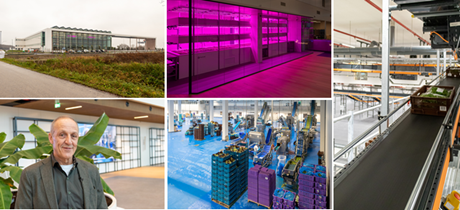
Man and machine in perfect harmony - that is Japanese car manufacturer, Mazda's, slogan. Looking at Dutch wholesaler, Van Gelder's, new head office gives one the same impression. In the facility two Plant Production Units (PPUs) are realised, to offer inspiration in the field of vertical farming. Earlier this year Van Gelder entered a partnership with indoor farming specialist PlantLab to realise this facility.
New Van Gelder building
This new building in Ridderkerk, the Netherlands, is still in its test phase and includes features such as the High Care kitchen, processing, and packaging divisions, and kitchen. These have all been further optimized and enlarged. The warehouse process has been almost entirely mechanized too. All this in a 32,000m2. The whole company will move over at the end of the first quarter of 2020. Our editors were given a sneak peek of the new facilities.
Meeting place for healthy eating"We have grown tremendously in recent years," says Van Gelder's General Director, Gerrit van Gelder. "Last year, we again realized a healthy growth in revenue. This new location was, therefore, desperately needed."
It will not be merely a fruit and vegetable warehouse. "We are helping to meet the demand for tasty, healthy, sustainable products. We have noticed that chefs are open to having more vegetables in their dishes."
"The hospitality industry is moving more toward 80% vegetables, 20% meat. We are responding to that with this building. It will become a meeting place for healthy food. A place where all your senses will be stimulated," explains Gerrit.
Gerrit van Gelder in front of the banana plants in the new building's entrance.
Healthy meals
Come to Van Gelder in a few months, and you will have your choice of healthy meals. There will be 30 serving counters. People will be able to enjoy a fruit salad, smoothie, or healthy sandwich from the refrigerated counter. There is also a good chance the lettuce and herbs will come from the company's own vertical farm. This cultivation is done in their PlantLab's fully controlled Plant Production Units.
"We were looking for tastier, more nutritious products. We discovered the possibilities vertical farming has to offer. We can grow lettuce and herbs in just 18 days. And we can do so in the most sustainable manner."
"In the future, we will go in search of more new, special tasting products. We will do this in consultation with our clients. Seed breeders are getting the opportunity to bring new crops onto the market. These are based on increasingly renewed techniques and plant knowledge," Van Gelder continues.
Indoor farming
Vertical cultivation units
The vertical cultivation units are located on the third floor of the Experience Center. In this building, there is also room to hold events for as many as 500 people. Some of Van Gelder's suppliers have made these consultation areas uniquely their own.
These suppliers include Zespri, Greenco, Fruit Masters, and Deli-Jack. Then there are, Fruity-Pack, Koppert Cress, Schaap Holland, and Peka Kroef. Beekers Berries, Fruity-Line, and BVP packaging are included too.
These areas showcase the Dutch food sector to every visitor to Van Gelder's new home. From 1 March 2020, these spaces will be up for hire for meetings and such. Outside the new building, no fewer than 540 fruit trees have been planted. Roelof Tree Nursery and fruit farmer, De Jong provided these trees. In this way, visitors will be able to compare many of the fruit varieties with each other.
"At this location, we can further explain our tale for healthier eating. Van Gelder will soon share our growers' personal stories with both international and local visitors. This will happen in the Experience Center as well as outside in the orchard," says Gerrit. ‘’It is literally our source-to-plate story."
Advanced shuttle systemMoving on to the warehouse. "Our assortment is expanding rapidly. The market also has ever-shorter turnaround times. As a result, we focused strongly on innovation in the new warehouse. This has been done thanks to the automation and mechanization of all processes."
Vanderlande largely provided the warehouse's automation. This company is very active in baggage logistics at airports. The warehouse boasts an advanced shuttle system. It is good for 52,000 tray storage locations served by 92 ADAPTOs.
This system sends products to order pickers, in crates, at their work stations. Prepared orders are then immediately refrigerated. When needed, these orders are automatically placed on the loading docks, ready to be delivered.
"We bring the products to the people, rather than having the people fetch the products. For this market segment, this type of technology is truly innovative," says Gerrit. Far fewer order pickers are, therefore, needed. More staff is, however, required in the company's technical division.
The washing of the crates is also fully automated. As many as 3,000 crates are washed per hour. This is thanks to a Viscon-designed crate washing line. There is not only a shuttle warehouse for crate storage. There is also a pallet warehouse with different temperature zones.
Ripe fruitWorkspaces, each with its own unique function, have been set up. An example of this is the building's ripening cells. Visitors can get an idea of the added value Van Gelder provides. They can also taste it later.
‘’We are getting more and more of our products directly from the source. Ripening in our building is done in a controlled, even manner. In this way, the fruit is always tasty. You may as well have picked it from the tree yourself."
’Fruit is picked long before it naturally ripens. This practice is due to large-scale food distribution to, for example, supermarkets. This fruit can then be easily transported and stored for an extended period," the General Director goes on to say.
"The fruit in our orchard may only be picked once it is sufficiently ripe. Each piece of fruit is, therefore, much tastier when you eat it. Whether it comes from a tree on our doorstep or from our warehouse."
Van Gelder believes in minimal risk of loss and the highest possible yields. For this reason, they have a processing area in a 12.000m2+ space. It has 35 product lines. They also have a packaging room and various production kitchens. "We want to add more value to everything we do. We want to give something back," concludes Gerrit.
For those who want to have a look at the building - after its official opening, there will be tours twice a week. The public at large is welcome to join. For now, we have compiled an extensive photo report.
For more information:
Gerrit van Gelder
Van Gelder Groente en Fruit
70 Handelsweg
2988 DB Ridderkerk, NL
Tel: +31 (0) 180 618 599
Email: gvangelder@vangeldernederland.nl
Website: www.vangeldernederland.nl
Publication date: Mon 16 Dec 2019
© HortiDaily.com

5 Things You Need To Know About Financing Your Farm
More producers are turning to indoor farming today to meet the demand for locally-grown produce, for its environmental benefits, and as a sustainable way to transform the food system
By urbanagnews
December 11, 2019
By Chris Rawley, CEO of Harvest Returns
More producers are turning to indoor farming today to meet the demand for locally-grown produce, for its environmental benefits, and as a sustainable way to transform the food system. Building a new greenhouse or equipping a vertical farm can require significant amounts of capital. Indoor growers are faced with an agriculture finance system in the United States that is anything but innovative and hasn’t changed significantly in 50 years. USDA guaranteed loans and similar debt vehicles are optimized for land loans and operating agreements for row crop farmers, because that’s where the most significant amount of money is to be had for lenders.
Equity investments can be an alternative for indoor growers. According to PitchBook, about 15% of the $2.1 billion invested by Venture Capital firms in AgTech in 2018 was in indoor agriculture. That said, very few companies actually receive VC investments. Investments of a hundred million dollars or more like that in AppHarvest are the rare exception, not the rule. For a producer who needs to raise between say $200,000 to a few million dollars, the options are much more limited.
How to Finance your Farm
Here are five things indoor producers should know about financing their farm:
1. What’s your purpose?
The first step in any project is to ask yourself why you are doing this? Are you simply in it to make money? If investors understand that you have a vision that goes beyond yourself, they are more likely to trust you with their funds. Without a doubt, investors want to make a good decision based on the math and how it increases their returns, but more and more investors are putting their money into things they believe in. A mission driven opportunity shows that you are thoughtful, focused, and determined – all aspects of a good investment.
2. What’s your plan?
You need to develop a concise, articulate business plan or pitch deck that clearly explains how you will develop or expand your farm, and how investors will benefit from it if they trust you with their money. What is your exit strategy for investors in terms of time line and sources of liquidity? There are several resources online or consultants that can help you put together a professional business plan for your controlled environment agriculture project. In most cases, a 50 page business plan with appendices is not necessary, at least at this stage. A good start is a well-structured slide deck and maybe a one page offering summary. Investors are inundated with opportunities so its better to be short and memorable, then long and complex.
3. Build your team.
People invest in people, not just ideas, or projects, or companies. Investors want confidence that they are entrusting their money with a capable, trustworthy team who can successfully execute a plan. No one is an expert at everything. You may be able to make tomatoes grow on an iceberg, but if you or someone on your team doesn’t know the difference between a balance sheet and an income statement, you’re going to have a hard time running a successful company. So if you are lacking in farming skills, or accounting skills, or marketing skills, you need to surround yourself with people who make up for your shortfalls. A team doesn’t have to be partners or employees. It can be an advisory board, consultants, or contractors. But build a team and ensure your investors know about it.
LET US HELP YOU BUILD YOUR TEAM:
Looking for professional guidance, register here
4. Understand and control your risks.
Above all, investors are afraid of losing their money. They want to understand the ways they could possibly get burned. Indoor farms face market risks, technology risks, and agronomy-related risks. It is crucial to identify, disclose, and explain the ways you are going to reduce the impact of these risks on investor returns.
5. Engage your network.
Before even thinking about approaching an equity funding source, be it a VC or a funding platform, you should run your plan by your internal network. Building a network of industry experts is important, and can be jump-started by attending any of the large number of agriculture or food related conferences. Share your idea and practice pitching it to your friends, family members, or business savvy colleagues. Have a short “elevator pitch” ready to go to talk enthusiastically for whomever you meet about how your new farm is going. Start building your network by attending industry events and conferences. Ask your contacts for honest feedback and referrals to people who may be looking into investing what are doing. Also, don’t be afraid to ask friends and family to take a chance on investing in your farm. Many great companies were started because of these types of early stage investments.
These five items apply to pretty much any type of agriculture business, including the increasing numbers of legal cannabis growers. A solid strategy is required to raise capital whether you are producing hemp or tomatoes and no matter what type of production method you are using.

CubicFarm Systems Corp. Announces Strategic Acquisition of HydroGreen, Inc.
Vancouver, BC – (AccessWire – December 11, 2019) – CubicFarm® Systems Corp. (TSXV:CUB) (“CubicFarms” or the “Company”) is pleased to announce that it has entered into a binding purchase agreement effective December 10, 2019, to acquire HydroGreen, Inc. (“HydroGreen”), an arms-length private company headquartered in South Dakota
December 11, 2019
Vancouver, BC – (AccessWire – December 11, 2019) – CubicFarm® Systems Corp. (TSXV:CUB) (“CubicFarms” or the “Company”) is pleased to announce that it has entered into a binding purchase agreement effective December 10, 2019, to acquire HydroGreen, Inc. (“HydroGreen”), an arms-length private company headquartered in South Dakota (the “Acquisition”).
HydroGreen is a manufacturer of fully-automated hydroponic growing systems that produce live, green animal feed, prioritizing animal health and performance. HydroGreen’s unique process sprouts grains, such as barley and wheat, in a controlled environment with minimal use of land, labor, and water. Its system performs all growing functions including seeding, watering, lighting, harvesting, and re-seeding – all with the push of a button – to deliver animal feed without the typical investment in fertilizer, chemicals, fuel, field equipment, and transportation.
Overview of Acquisition
The Acquisition will be completed by way of a reverse triangular merger of CubicFeed Systems U.S. Corp., a wholly owned subsidiary of the Company, and HydroGreen, resulting in HydroGreen being renamed “of CubicFeed Systems U.S. Corp” and becoming an indirect and wholly-owned subsidiary of the Company. The new CubicFarms subsidiary will operate the existing business of HydroGreen moving forward.
Under the terms of the merger agreement, holders of HydroGreen shares (“HydroGreen Shareholders”) will be entitled to receive an aggregate of 11,000,000 common shares of CubicFarms (the “Consideration Shares”), subject to an adjustment related to working capital. Of the Consideration Shares, 10,000,000 will be issued on closing of the Acquisition with the remaining 1,000,000 shares being issued on the six-month anniversary of closing, subject to any set-off relating to indemnification. None of the current shareholders of HydroGreen will hold more than 5% of the common shares of the Company pursuant to the Acquisition.
The implied value of the CubicFarms common stock issued to HydroGreen is C$1.50 per share. Following closing, principals of HydroGreen holding in excess of 80% of the Consideration Shares will enter into a pooling agreement with respect to their Consideration Shares. Under the terms of the pooling agreement, 25% of their Consideration Shares will be released on the closing of the Acquisition and an additional 25% will be released on each of the dates which are 6 months, 12 months and 18 months following the closing of the Acquisition.
In 2018, HydroGreen recorded unaudited sales revenues of approximately US$1.2 million and an unaudited gross profit of approximately US$700,000.
The Acquisition will require the approval of HydroGreen Shareholders at a special meeting expected to take place in late December (the “HydroGreen Meeting”). In order to become effective, the Acquisition must be approved at the HydroGreen Meeting by HydroGreen Shareholders holding greater than 50% of the HydroGreen shares entitled to vote at the HydroGreen Meeting. HydroGreen Shareholders holding approximately 75% of the issued and outstanding HydroGreen shares have entered into voting and support agreements with CubicFarms in support of the Acquisition. The board of directors of HydroGreen has unanimously approved the Acquisition and will recommend that HydroGreen Shareholders vote FOR the Acquisition. The merger agreement includes representations, warranties, and covenants typical of a transaction of this nature, including with respect to non-solicitation.
In addition to approval of HydroGreen Shareholders, the Acquisition is subject to the approval of the TSX Venture Exchange and other customary closing conditions. It is not anticipated that the Acquisition will be classified as a Reviewable Transaction under TSX Venture Exchange Policies.
The Acquisition is expected to close in December 2019 following the HydroGreen Meeting.
About HydroGreen
The HydroGreen growing system consists of a 10-feet by 8-feet rack with 8-feet by 6-feet growing surfaces stacked 6 layers high to a total height of 10 feet. This is the smallest, one-section system available for sale – two-section up to six-section systems that are 50 feet long, 8 feet wide and 10 feet high are available. The modular system allows farmers to combine multiple systems to feed hundreds or thousands of livestock.
Image 1: The HydroGreen automated three-section growing system for animal feed.
Seeding one growing surface each day with 1.8 bushels of seed can produce 487 pounds of animal feed every six days. A one-section system could produce enough feed for a 20 to 25-cattle farm, while a three-section system could potentially provide most of the feed for a herd of 100.
The HydroGreen growing system’s automated seeder spreads half an inch of small grain seed on the growing surface. A fine mist of water is sprayed from above to initiate growth, followed by a gentle-rain automated irrigation system to feed the plants as they sprout. After six days, fresh green feed on the growing surface is rolled off and harvested at the push of a button on the touchscreen control panel.
As the feed layer is rolled off the surface, it is sliced into pieces with a water jet, ready to be blended with a feed ration or fed directly to livestock. Once the harvest cycle is complete, the surface is automatedly cleaned and reseeded with a new seedbed, ready to be irrigated – setting in motion another grow cycle.
Image 2: The HydroGreen system takes seed to feed in six days.
While growing feed hydroponically is not a new concept, traditional rack-and-stack systems are labor-intensive and are sensitive to mold. Mold tends to grow on seeds in warm, damp or humid conditions. Traditional hydroponic systems rely on human labor to manually clean the growing pans and soak, spread and water the seed, resulting in significant potential for human error and potential for mold to develop. The HydroGreen technology alleviates both problems as it requires only one second of labor per tonne of feed produced – to push a button on the touchscreen control panel. Through its automated process, the system applies a sequence of eleven procedures dedicated to controlling mold, stretching from seed selection to harvest, reducing the potential for human error and for mold to develop.
Economic, environmental and nutritional benefits of hydroponic animal feed
The HydroGreen system provides local, on-demand availability of fresh green feed 365 days a year, unaffected by drought, snow or rain. Hydroponic feed that is fed directly to livestock results in a significant reduction of feed waste since the entire root mass is consumed with the grass.
In addition to savings from reduced labor and water, the system’s vertically stacked surfaces allow for high yields in a very small area, increasing farmers’ independence by growing food for their livestock without the need for cultivated land.
When wheatgrass and barley are sprouted, they release many vitamins and minerals as well as convert hard-to-digest starches into easily digestible proteins. Sprouting results in increased enzyme levels in the ration, which aids digestion and absorption of nutrients; increased levels of vitamins; increased mineral bioavailability and increased fatty acids (quality energy) and amino acids (quality protein). These nutrients are critical to animal health, growth, milk production and reproduction.
Sales and marketing strategy for the HydroGreen system
CubicFarms has signed an authorized reseller agreement with Artex Feed Solutions. Artex Feed Solutions is a joint venture company which is 25% owned by CubicFarms and 75% owned by Artex Barn Solutions, a leader in agricultural supplies for over 40 years. Artex Barn Solutions was founded by John de Jonge – also a board member of CubicFarms – who purchased Artex Barn and grew it into a global provider of cattle handling equipment, ventilation and cow cooling. He has deep expertise in establishing and scaling up multiple manufacturing facilities in China and North America.
Artex and Mr. de Jonge plan to market the HydroGreen system to their existing dealership network in the USA and Canada, and to qualified leads in China, Indonesia, and the Middle East – areas with substantial market potential due to changing food consumption patterns and supportive government policies toward agricultural technology.
Internationally, Artex dealers will target existing agriculture animal producers looking to enhance profitability and environmental sustainability, early-stage farmers with minimal capital and land constraints, small- to medium-size farms seeking feed alternatives to benefit their operations and urban farmers without access to land.
The arrangement with Artex Feed Solutions may be considered a related-party transaction subject to TSX-V Policy 5.9 and Multilateral Instrument 61-101. The Company will be exempt from the need to obtain minority shareholder approval and a formal valuation as required by MI 61-101 as the Company is listed on the TSX Venture Exchange and the fair market value of the transaction with Artex is far below 25% of the Company’s market capitalization.
While remaining on CubicFarms’ board of directors, Mr. de Jonge will transition from his current role as the Company’s Chief Design and Installation Officer to Chief Executive Officer of CubicFarms subsidiary CubicFeed Systems, effective immediately. Rodrigo Santana, CubicFarms’ Chief Operating Officer, will assume oversight of machine design and installations, supported by a management team with significant field expertise.
Dave Dinesen, Chief Executive Officer of CubicFarms, commented: “This landmark transaction with HydroGreen is a catalyst for continued growth at CubicFarms. Having already established a robust sales pipeline for our fresh produce vertical, this acquisition will enable us to capitalize on technology and automation synergies with HydroGreen to capture the animal feed space, which we believe could be a larger market than fresh produce. Approximately two-thirds of the world’s agricultural land is used for grazing and animal feed production. HydroGreen’s “land on a stand” system helps reduce the vast amounts of land required to grow feed.
“While the CubicFarms system is ideal for growing fresh produce, the advancements made in the HydroGreen system in the areas of harvesting, reseeding and self-cleaning, make it particularly well-suited for the production of animal feed. This transaction positions us to be a leading ag-tech company providing controlled-environment growing systems in four diversified verticals – fresh produce, animal feed, hemp/cannabis, and nutraceutical ingredients.”
Dihl Grohs, Chief Executive Officer of HydroGreen, commented: “I am incredibly proud of HydroGreen’s growth trajectory since our first system prototype was built in 2014 in Sioux Falls, South Dakota, then progressively refined to achieve today’s 98% reliability rating and the system’s ability to monitor and correct issues in advance.
“The technology is poised for large-scale commercialization and this merger represents an ideal next step to bring HydroGreen systems to international markets. I am confident that CubicFarms’ global leadership in automated vertical-farming solutions, combined with the go-to-market ability of Artex Feed, will result in significant uptake of our systems as farmers learn how this technology enhances the productivity of their operations.”
John de Jonge, President of Artex Feed Solutions, and Chief Executive Officer of CubicFeed Systems commented: “As a lifelong dairy industry participant, I believe the animal feed market is ripe for disruption, urgently requiring predictable, year round production of nutritious feed while minimizing the inputs of land, labor, and water. I am excited to lead the expansion of CubicFarms’ animal feed business by leveraging Artex’s broad network of dealers in 40 countries to bring the HydroGreen solution to market.”
Neither the TSX Venture Exchange nor it’s Regulation Services Provider (as that term is defined in the policies of the TSX Venture Exchange) accepts responsibility for the adequacy or accuracy of this release.
This news release does not constitute an offer to sell or a solicitation of an offer to buy any securities in the United States. The Consideration Shares to be issued as part of the Acquisition have not been, nor will be, registered under the United States Securities Act of 1933, as amended (the “U.S. Securities Act”), and such securities may only be offered or sold within the United States pursuant to an exemption from the registration requirements under the U.S. Securities Act and all applicable state securities laws.
About CubicFarm® Systems Corp.
CubicFarm® Systems Corp. (“CubicFarms”) is an ag-tech company commercializing large scale, vertical farming solutions for global industrial markets. Founded in 2015, the Company’s mission is to provide industries around the world with efficient growing systems capable of producing predictable crop yields. CubicFarms offers turnkey, commercial scale, hydroponic, automated vertical farm growing systems that can grow predictably and sustainably for 12 months of the year virtually anywhere on earth. CubicFarms enables its customers in the fresh produce, animal feed, nutraceutical, and hemp/cannabis industries to grow locally and to provide their markets with safe, sustainable, secure and fresh ingredients that are consistent in color, size, taste, nutrition and allows for longer shelf life. Further support and value is provided to customers through the Company’s patent-pending germination technology and proprietary auto harvesting and processing methods.
Using its unique, undulating growing system, the Company addresses the main challenges within the indoor farming industry by significantly reducing the need for physical labor and energy, and maximizing yield per cubic foot. The Company has sold and installed systems in Canada and the US and is currently negotiating with a global pipeline of prospective customers. It also operates one wholly owned facility in Pitt Meadows, British Columbia, and sells its produce in the province to retail and wholesale customers under the brand name Thriiv Local Garden™.
Information contact
Kimberly Lim
kimberly@cubicfarms.com
Phone: +1-236-858-6491
www.cubicfarms.com
Cautionary statement on forward-looking information
Certain statements in this release constitute “forward-looking statements” or “forward-looking information” within the meaning of applicable securities laws, including, without limitation, statements with respect to the closing of the Acquisition and HydroGreen’s sales and growth prospects. Such statements involve known and unknown risks, uncertainties, and other factors which may cause the actual results, performance, or achievements of CubicFarm Systems Corp. and its subsidiaries, or industry results, to be materially different from any future results, performance, or achievements expressed or implied by such forward-looking statements or information. Such statements can be identified by the use of words such as “may”, “would”, “could”, “will”, “intend”, “expect”, “believe”, “plan”, “anticipate”, “estimate”, “scheduled”, “forecast”, “predict”, and other similar terminology, or state that certain actions, events, or results “may”, “could”, “would”, “might”, or “will” be taken, occur, or be achieved.
These statements reflect the company’s current expectations regarding future events, performance, and results and speak only as of the date of this news release. Consequently, there can be no assurances that such statements will prove to be accurate and actual results and future events could differ materially from those anticipated in such statements. Except as required by securities disclosure laws and regulations applicable to the company, the company undertakes no obligation to update these forward-looking statements if the company’s expectations regarding future events, performance, or results change.

Auburn University Aquaponics Survey
The School of Fisheries, Aquaculture, and Aquatic Sciences (SFAAS) invites growers to participate in a survey study to generate a ‘snapshot’ of the status of the aquaponics industry. This survey is designed for hobbyists, educators, and for-profit aquaponic producers
The School of Fisheries, Aquaculture, and Aquatic Sciences (SFAAS) invites growers to participate in a survey study to generate a ‘snapshot’ of the status of the aquaponics industry. This survey is designed for hobbyists, educators, and for-profit aquaponic producers.
The survey's questions should take about 20 minutes to complete. Your responses will be kept confidential and any data collected will be presented in aggregate form to ensure anonymity. If you have any questions or wish to provide additional feedback, please do so in the comments section at the end of the survey.
The information you share with SFAAS will be used to develop targeted research, teaching, and extension efforts to support the needs of the aquaponics industry.
The survey can be accessed here
Source: Aquaponics Association

From 10 To 20 To 40 Acres
With this additional acreage Twin Creeks Greenhouse will become one of the largest pepper growers in Ontario, Canada, and with plenty of land left, the sky is the limit!
Twin Creeks Greenhouse Continues To Expand
Mike Cornelissen, owner, and operator of Twin Creeks Greenhouse has been very busy. Mike and his wife Danielle just welcomed their first baby boy and have started construction on their third expansion at Twin Creeks Greenhouse.
Growing up in Watford Ontario, Canada with deep family roots in the agricultural sector, George Cornelissen, Mike's father, has built a thriving and well-respected business. Cornelissen Farms is diversified in field crops, chicken barns, and even grain elevators, but with an eye to the future, George and Mike wanted to expand into the greenhouse sector too.
Mike grew up around his uncle’s greenhouse and learned about the industry from a young age. While in college, Mike took interest in building his own greenhouse and decided to work for his uncle as part of his degree. In the fall of 2015, the Cornelissen family purchased a large plot of land next to a landfill and began working with Havecon to develop their new greenhouse project.
In the spring of 2016, Mike was able to secure a bio-gas agreement with his landfill neighbor and together with Havecon, started construction on their first 10-acre greenhouse block.
In 2018 after a successful first year, they decided it was time to expand again with another 10-acre greenhouse block. Then in 2019, they decided it was time to again grow the business. Havecon and its partners were again invited to start on Twin Creeks largest expansion to date. This time building a 20-acre block, bringing the total greenhouse growing area to 40 acres.
With this additional acreage Twin Creeks Greenhouse will become one of the largest pepper growers in Ontario, Canada, and with plenty of land left, the sky is the limit!
When we asked Mike about why he has chosen Havecon from the beginning and all expansions after, he answers: “From the start the feeling we had with Havecon was good. The same goes for Voorwinden, by the way. In practice the high quality of their workmanship confirmed this feeling. Next to that the speediness of their work throughout the whole process is a big plus. And finally, I would mention the overall support. People at Havecon are always willing to help and think along with you. Therefore, we are looking forward to working with Havecon again for our latest and largest project.”
For more information:
Twin Creeks and Cornelissen Farms
www.cornelissenfarms.com
Havecon Kassenbouw B.V.
Lorentzstraat 8
2665 JH Bleiswijk
Postbus 25
2665 ZG Bleiswijk
Tel. +31(0)10 266 32 70
info@havecon.com
www.havecon.com

All Lettuce Belongs In The Garbage At This Point
The newest Centers for Disease Control recall is for Fresh Express Sunflower Crisp Chopped Salad Kits. The kits are being blamed for eight cases of E. coli food poisoning from three different states. No deaths have been reported, but three of the people who got sick had to be hospitalized
December 10, 2019
Photo: Getty Images
Two bagged salad recalls might make you want to skip your servings of vegetables this week. Or maybe forever.
The newest Centers for Disease Control recall is for Fresh Express Sunflower Crisp Chopped Salad Kits. The kits are being blamed for eight cases of E. coli food poisoning from three different states. No deaths have been reported, but three of the people who got sick had to be hospitalized.
The CDC says to look for “UPC 0 71279 30906 4, beginning with lot code Z, and a best-before date up to and including 07DEC19” on the upper right corner of the bag to see if the bag in your fridge is one of the salads being recalled.
That warning comes shortly after the CDC advised people not to eat any romaine lettuce grown in or near Salinas, California. “This includes all use-by dates and brands of romaine lettuce from this region,” the CDC noted. If there’s no location listed on the lettuce, the agency said to dump it to be on the safe side.
More than 100 people in 23 states have been diagnosed with the same strain of E. coli as those impacted by the Fresh Express kits, although it’s not certain whether there is a link between the two.
We’ve been down on bagged lettuce for a while here at Lifehacker, but can we just agree that all lettuce is doomed?
It’s Time to Stop Eating Bagged Salads [Updated]
It pains me to say this, because I’m lazy. But after the umpteenth outbreak of food poisoning from…
The CDC site for E. coli outbreaks lists two for romaine lettuce in 2018, an outbreak linked to leafy greens in 2017, and even archives outbreaks back to 2006. Humble lettuce, the bed on which we place more appetizing fresh morsels, just can’t be trusted.
Bagged salads are particularly to blame because their contents, which often come from a variety of farms, get distributed widely, not just in one geographic region. That increases the odds that lettuce that gets contaminated somewhere along the way will end up on our plates. The lettuce does get washed several times in a chlorinated bath, all that bathing still doesn’t kill E. coli.
If you’re still craving lettuce for some reason, keep in mind that buying it from a small local farm may not help you avoid foodborne illness. If you buy a head of lettuce, the FDA recommends removing and discarding the outer leaves, then rinsing the rest before use. Spraying with a vinegar wash will help kill bacteria, but in this era of lettuce catastrophes, there are no guarantees. Sorry!
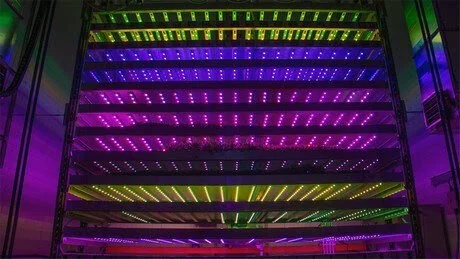
Is Vertical Farming Here to Stay?
Almost two decades after vertical farming pioneer Dickson Despommier first introduced the idea of growing food in buildings, not fields—and later published his seminal book, The Vertical Farm—indoor farms are in more cities than ever before
Posted on April 11, 2019, by Jodi Helmer - Story
Unprecedented investments in indoor agriculture are no guarantee the high tech plant factories will be key players in the future of food.
Almost two decades after vertical farming pioneer Dickson Despommier first introduced the idea of growing food in buildings, not fields—and later published his seminal book, The Vertical Farm—indoor farms are in more cities than ever before.
Vertical farming—so-named because the produce sprouts in floor-to-ceiling racks to grow more food in less space—uses less water and fertilizer than conventional “soil” farming and the climate-controlled environments allow growers to harvest crops regardless of the temperatures outside.
Technologies like LED lights, micro-sensors and data analytics help maximize growing conditions and improve yields. Most vertical farms are located in urban areas, minimizing the environmental impacts of shipping produce thousands of miles from farm to plate.
With a global population expected to hit 9 billion in 2050—and 74 percent of the residents of developed nations living in cities—proponents of vertical farming argue that agriculture requires high-tech reinvention. Record numbers of vertical farms are sprouting up to address the perceived need. In cities from Singapore to San Francisco, startups are growing food in shipping containers and warehouses that know no seasons.
The industry has a number of cheerleaders, including the venture capitalists bankrolling the promise of vertical farms. Investments in indoor agriculture increased by 653 percent between 2016 and 2017.
Despite significant investments, Stan Cox, research coordinator for The Land Institute, a nonprofit agriculture research organization, and vocal opponent of vertical farming believes the model is doomed to fail.
“[Despommier’s] original version of growing food in buildings 30 stories tall has never come close to happening,” he explains.
The mismatch between concept and execution, according to Cox, can be attributed to limitations on the crops that can be grown indoors; ongoing investments in infrastructure and technology; and high costs of energy.
Powering Plant Growth
On conventional farms, crops depend on sunlight to grow. Without the energy from the sun, farmers must use huge amounts of electricity to provide enough light to trigger growth.
In a recorded seminar, Louis Albright, emeritus professor of biological and environmental engineering at Cornell University and pioneer of controlled-environment agriculture ran the numbers: Growing wheat in a vertical farm would generate 20 cents per square foot in annual income and growers would need to charge $23 per loaf of bread just to cover the power bills, he estimated.
In a 2016 TED Talk, Astro Teller, head of research for Google, admitted that the tech giant started—and later shuttered—its vertical farm because it was impossible to grow staple crops like grains and rice via indoor agriculture.
Limited crop production is one of the major criticisms of vertical farming.
Most vertical farms grow leafy greens such as arugula, kale and watercress because the crops require less light than other fruits or vegetables. But even with the most efficient LED bulbs, Albright found that it took 2.72 kWh per head of lettuce to grow the crop in a vertical farm—more than three times the energy required to grow lettuce in a greenhouse.
Last fall, Metropolis Farms constructed a 500-kilowatt solar array on the rooftop above its fourth floor vertical farm in Philadelphia that is reported to generate enough power for its 100,000 square foot indoor farm. (Albright questioned whether solar powered indoor agriculture was feasible, explaining that a one-acre crop of lettuce would require 9.3 acres of solar panels).
“The more technology is involved in something, the more fascinated we seem to be with it but the products produced in these high-tech operations have to be pretty expensive to cover energy and other costs,” Cox says.
A panel discussion at the Agritecture conference in Atlanta called An Examination of Shuttered Vertical Farming Facilities led Chris Michael, co-founder of Bright Agrotech, to pen a post, 9 Reasons Vertical Farms Fail. Competing with retail pricing was among them.
In the article Michael notes, “Your pricing should match the quality of your product, not the status quo. With the right system and distribution strategy, the local product you produce should be better than anything else on the shelves and it should be priced to reflect the increase in value.”
Fresh Direct sells 4.5-ounce clamshells of Dream Greens from AeroFarms for $3.99. The price is on par with other packaged organic greens but more than two times the price of Fresh Express brand romaine lettuce sold at Safeway stores.
Despite promises that vertical farming can address food deserts, the premium prices for the leafy greens grown in these high-tech environments often mean those who struggle with food insecurity won’t be able to afford to buy the fresh vegetables growing in their urban neighborhoods.
Cox notes that indoor agriculture makes sense for a high-value crop like cannabis that commands upwards of $8 per gram, but it’s not feasible for a lower value crop like lettuce, which clocks in at one cent per gram.
“Indoor leafy green production can survive if growers sell to more affluent areas of big cities,” he says. “But we’re not going to see [crops from vertical farms] expand into larger segments of the food market.”
Cultivating Job Opportunities
The proliferation of vertical farms has led to a bumper crop of job opportunities.
A CivilEats article declares, “Millennials look to high-tech farms for careers,” noting that Gotham Greens had seen 400 percent growth in its team from 2015 to 2016, creating jobs in the historic African-American Pullman neighborhood of Chicago; and BrightFarms planned to double its staff in 2016 with future expansions potentially creating up to 500 new job openings.
Vertical Harvest in Jackson, Wyoming, employs 15 staff with developmental disabilities to manage tasks ranging from growing and harvesting to retail sales and deliveries.
Unlike conventional agriculture, which depends on a seasonal labor pool, the 24/7 nature of vertical farms can provide regular, long-term employment—and the opportunities extend beyond cultivating and harvesting leafy greens.
The job openings at AeroFarms include mechanical design engineer, plant scientist, research associate and commercial grower with experience in vertical controlled environment agriculture.
Assessing the Impact
Vertical farms have captured the collective interest of investors, academics and foodies alike but will these high-tech plant factories contribute significant volumes of fresh, local foods to our diets? Cox says no.
“There are not enough warehouses and shipping containers to grow that volume of produce indoors,” he explains. “Vertical farming will never be able to supply a significant percentage of our food.”
The challenges haven’t prevented startups from pushing forward or stopped investors from writing checks to back the potential promise of large-scale indoor food production.
In July, San Francisco-based startup Plenty raised $200 million in Series B funding to expand its operations with a goal of “[producing] Whole Foods quality at Wal-Mart prices.” It was the largest agriculture technology investment in history.
Concerns about climate change and farm labor shortages coupled with the need to figure out how to feed nine billion people have helped drive investments. Venture capitalists know we need solutions and see vertical farming as a potential change-maker. Investors also see opportunities related to the technologies used in vertical farms. One investor cited the high-tech indoor farms (and associated advances in robotics, sensors, and software) to be massive opportunities to disrupt conventional farming methods as his reasons for investing in vertical farms.
But significant cash infusions are no guarantee of success.
FarmedHere was considered a national leader in indoor farming when it launched in 2011 but the commercial-scale hydroponic farm in Chicago declared bankruptcy last year, citing unsustainable labor and energy costs. Atlanta-based PodPonics raised $15 million in startup capital but liquidated its assets and shuttered operations in 2016. Labor costs were a factor.
The high-profile failures don’t surprise Cox. Rather than investing millions in vertical farming, he advocates looking to vacant lots and rooftops where sunshine and water can turn seedlings in raised beds into fresh produce for a fraction of the cost of powering indoor agriculture.
“The closer we can produce fresh produce to densely populated urban areas, the better,” Cox says. “Agricultural production has plenty of problems but we’re not going to solve them by growing food indoors.”
Photo: Marcus Spiske Unsplash
Tags: startups, vertical farming

Urban Crop Solutions Celebrates it's 5th Anniversary
The company is a total solution provider and offers container farms and plant factories and all products and services that growers need to grow healthy crops in an indoor farm
Today, Urban Crop Solutions celebrates its 5th anniversary. On this occasion, a movie was released with testimonials from customers around the globe. Urban Crop Solutions is proud to be a pioneer in the emerging market of indoor vertical farming with a unique business model. The company is a total solution provider and offers container farms and plant factories and all products and services that growers need to grow healthy crops in an indoor farm.
The story of the founding of Urban Crop Solutions starts in 2012 when the founders were experimenting with rooftop farming in urban areas. Only in 2014, the choice was made to focus on indoor vertical farming after some successful tests where done in the warehouse of one of the founders. Since then the company was taken on a rollercoaster and the company evolved from a local AgTech startup to an international scale-up with unique commercial products and services.
Link to the 5 years anniversary movie with testimonials from over the globe.
https://youtu.be/KnqLMtNrr7w
From its incorporation, the company’s vision was always that the knowledge of plant growth is key. Today, the company operates 10 labs, 1 demo plant factory and 1 demo container farm for its research operations.
“Over the last 5 years, we have conducted over 800 cultivar trials. Some tests with seeds failed miserably.” explains dr. Oscar Navarrete, chief plant scientist and the first employee of Urban Crop Solutions. “But through our continuous work to tweak seed selection, LED spectrum, irrigation, substrate and nutrition, we have developed more than 200 plant growth recipes that are available for our clients.”
The design of the plant growth infrastructure that Urban Crops Solutions is building for its clients is the result of the know-how the plant scientists transfer to the mechanical engineers to achieve optimal plant growth in an indoor vertical farm environment. In February 2016, the Flemish Minister-President Geert Bourgeois opened Urban Crop Solutions’ automated indoor farm which was the largest in Europe. This installation was built and is operated by Urban Crop Solutions for research purposes.
“We’ve been at the forefront of this emerging industry since the beginning. Some of our engineering concepts lacked robustness, but by listening to the feedback of our customers we’ve upgraded numerous components to improve the reliability, the operational efficiency, and food safety”, says Maarten Vandecruys, founder and CTO of Urban Crops Solutions. “We now have 24 containers in operation with our customers, of which about half in Europe and half in the USA. We are proud to have collaborations with large corporates and with several scientific institutions”.
Urban Crop Solutions caught in the past 5 years much attention by media, by trendwatchers, by large corporates, by politicians, and by royals. In November 2018, the company could present its technology to the French president Emmanuel Macron and the Belgian King Filip. In September 2019, the company realized a series A capital round, marking the start of the international commercialization of its products and services portfolio.
“It is clear that indoor vertical farming is still an early-stage industry. With the current high initial cost involved, it requires finding the right market niche for the right crop in order to achieve an attractive ROI.” Explains CEO and co-investor Tom Debusschere. “However, the world is changing very fast and besides the obvious food industry we see a lot potential for our products and services in some high-value end-markets like food supplements, fragrances, cosmetics, aromatics and phyto-pharmaceuticals.”
The technology and the products of Urban Crop Solutions are best explained as at “the crossroads between plant biology and factory engineering”. In the coming years, the company will continue to invest in products and services for ‘killer applications’ (revolutionizing market segments) and ‘moonshot crops’ (developing indoor plant growth recipes with large impact) in order to realize its mission: ‘Urban Crop Solutions contributes to the solutions for the challenges caused by global urbanization, the growing world population and the lack of agricultural land in the world’.
For more information on this press release, on Urban Crop Solutions or on the products and services of Urban Crop Solutions you can contact Tom Debusschere, Managing Director (tode@urbancropsolutions.com), or Maarten Vandecruys, Co-founder and CTO (mava@urbancropsolutions.com ) or visit our website ( www.urbancropsolutions.com ):
European headquarters: American headquarters:
Grote Heerweg 67 800 Brickell Avenue, 1100 Suite
8791 Beveren-Leie (Waregem) Miami (FL 33131)
Belgium Florida
(+32)56 96 03 06 +1 (786) 408-6027
Facebook: www.facebook.com/urbancropsolutions
Twitter: www.twitter.com/U_C_Solutions
LinkedIn: www.linkedin.com/company/urbancropsolutions
YouTube channel: http://www.youtube.com/c/UrbanCropSolutions

AeroFarms Plans Largest Indoor Vertical Farm of Its Kind
Governor Ralph Northam today announced that AeroFarms will invest $42 million to build their largest, most sophisticated indoor vertical farm to date in the Cane Creek Centre, a joint industrial park for the City of Danville and Pittsylvania County
At 150,000 square feet, the new farm more than doubles the size of AeroFarms’ last major commercial farm in New Jersey.
RICHMOND—Governor Ralph Northam today announced that AeroFarms will invest $42 million to build their largest, most sophisticated indoor vertical farm to date in the Cane Creek Centre, a joint industrial park for the City of Danville and Pittsylvania County.
Just recognized by Time Magazine as one of the Best Inventions of 2019 for Food & Beverage, AeroFarms is an award-winning farming company with proprietary aeroponic growing technology, enabling year-round local commercial production with over 390-times more productivity for leafy greens on a per-acre basis vs. field farming, while using up to 95% less water and no pesticides, herbicides, or fungicides. Virginia successfully competed with North Carolina for the project, which will create 92 new jobs.
“AeroFarms is a leader in agricultural innovation with farming technologies that make high-quality, local produce available to more communities,” said Governor Northam. “We are bringing capital investment and economic opportunity to rural Virginia by recruiting innovative companies like AeroFarms. I thank the company for choosing Virginia for this important venture and commend Danville-Pittsylvania County for helping to secure this project.”
With global headquarters in Newark, New Jersey, AeroFarms is a Certified B Corporation on a mission to grow the best plants possible for the better of humanity. Hiring locally and creating year-round employment, AeroFarms is able to disrupt traditional supply chains to nourish its communities with locally-grown, sustainably-sourced, pesticide-free produce that delivers peak nutrition and flavor, all year round. Proud to be named one of the World’s Most Innovative Companies by Fast Company two years in a row, AeroFarms has grown over 800 different varieties by creating the perfect conditions for healthy plants to thrive, taking agriculture to a new level of precision and productivity with minimal environmental impact and virtually zero risk. AeroFarms indoor vertical farms use specialized growing algorithms leveraging custom LED lights and precision plant nutrition, calibrated to the needs of each plant, to produce baby leafy greens and microgreens that can be grown in up to a third of the time that it takes out in the field by giving the plants exactly what they need when they need it.
“Agriculture is Virginia’s largest private sector industry, and the Commonwealth continues to be on the forefront of agricultural advancements,” said Secretary of Agriculture and Forestry Bettina Ring. “I look forward to working with AeroFarms as they expand the use of agriculture technology to strengthen Virginia’s food system and provide increased access to healthy foods.”
“AeroFarms has an important objective to ensure our growing population has year-round access to healthy food, and we are proud to support its first Virginia operation in Danville-Pittsylvania County,” said Secretary of Commerce and Trade Brian Ball. “The company’s decision to establish a vertically integrated facility in the Commonwealth is a strong testament to the advantages of our location and transportation and logistics infrastructure, which attract industry-leading companies from around the world seeking expansion into new markets. We welcome AeroFarms to Virginia and look forward to our future corporate partnership.”
“We are excited to expand to Virginia, an incredible state with a strong farming tradition, and we have been honored by the amazing reception at all levels,” commented David Rosenberg, Co-Founder & CEO of AeroFarms. “We want to thank everyone for helping bring our 10th farm to life to create new jobs and increase access to healthier foods with better flavor that top chefs like native Virginian David Chang have embraced. With the property developer RealtyLink, we are building out the largest, most advanced indoor vertical farm of its kind with our next generation of growing technology. Locating in the Danville area also specifically highlights how our innovative indoor growing approach works in both rural and urban environments. At 150,000 square feet, our new farm more than doubles the size of our last major commercial farm in New Jersey that will help us meet the strong consumer demand for safely grown produce that delivers peak flavor always. We are also excited about the future collaboration opportunities with The Institute for Advanced Learning and Research (IALR) to build on our Strategic Partnership work with Fortune 100 companies to solve broader ag-related supply chain issues.”
The Virginia Economic Development Partnership worked with the Virginia Department of Agriculture and Consumer Services, Pittsylvania County, the City of Danville, and the Southern Virginia Regional Alliance to secure the project for Virginia. Governor Northam approved a $200,000 grant from the Commonwealth’s Opportunity Fund, as well as a $200,000 grant from the Governor’s Agriculture and Forestry Industries Development (AFID) Fund, to assist Danville-Pittsylvania County with the project.
The Virginia Tobacco Region Revitalization Commission has approved a grant for $190,000 from the Tobacco Regional Opportunity Fund for the project. AeroFarms qualifies for state benefits from the Virginia Enterprise Zone Program, administered by the Virginia Department of Housing and Community Development. Funding and services to support the company’s job creation will be provided through the Virginia Jobs Investment Program (VJIP).
“We’re pleased that AeroFarms has selected the Cane Creek Centre for their new mid-Atlantic facility”, said Robert “Bob” Warren, Vice-Chairman of the Danville-Pittsylvania Regional Industrial Facility Authority and member of the Pittsylvania County Board of Supervisors. “It is only appropriate that the largest county in the Commonwealth by land area will soon be home to the world’s largest and most advanced vertical farm. The region has placed a heavy emphasis on attracting technology-based agribusiness firms through strategic investments in our workforce, and we thank AeroFarms for their commitment to Southern Virginia and its people.”
“AeroFarms is a perfect example of how blending technology with agriculture can provide an environmentally responsible solution to growing nutritious food,” said Fred Shanks, Chair of the Danville Pittsylvania Regional Industrial Facility Authority. “Given the history and importance of agriculture to this region, I cannot think of a better place for AeroFarms to locate. We are delighted to welcome them to this great community.”
“The Tobacco Commission has always supported Virginia’s agriculture industry, the backbone of our state’s economy, and attracting AeroFarms to Danville-Pittsylvania County is a big win,” said Senator Frank Ruff, Tobacco Commission Vice-Chairman. “AeroFarms’ technologically advanced approach to farming is an example of how the industry is adapting to meet the demands of modern consumers and I am pleased that they chose to grow their business here in Southside Virginia.”
“It is exciting to see an innovative company like AeroFarms open their first Virginia location here in Southside,” said Delegate Danny Marshall, a Tobacco Commission member. “Attracting a company like this to our region shows that the effort we have put into developing a top-notch business climate is paying off. I welcome AeroFarms and their team to Danville-Pittsylvania County and wish them the best as they get hiring underway.”
Tagged greenhouse, indoor farming, vertical farm
Freight Farms Takes Container Growing To The Next Level
This Boston company has opened its new “Greenery” below an overpass
Nature Fresh Farms Holds Ribbon Cutting For Transition of The Phase 1 Greenhouse
On December 4th Nature Fresh Farms announced that they would be passing off the keys to their Phase 1 and 2 greenhouses to a new group of dedicated growers
Leamington, ON (December 9th, 2019) On December 4th Nature Fresh Farms announced that they would be passing off the keys to their Phase 1 and 2 greenhouses to a new group of dedicated growers.
The ribbon-cutting ceremony occurred at the Phase 1 greenhouse where Founder and Owner, Peter Quiring; General Manager, John Ketler; and Executive Retail Sales Account Manager, Matt Quiring cut the ribbon along with their new partners in growing. The facility’s new name will be Chosen Fresh Farms Ltd., owned by Neil Enns, Ben Friesen, Abram Fehr, and Peter Klassen.
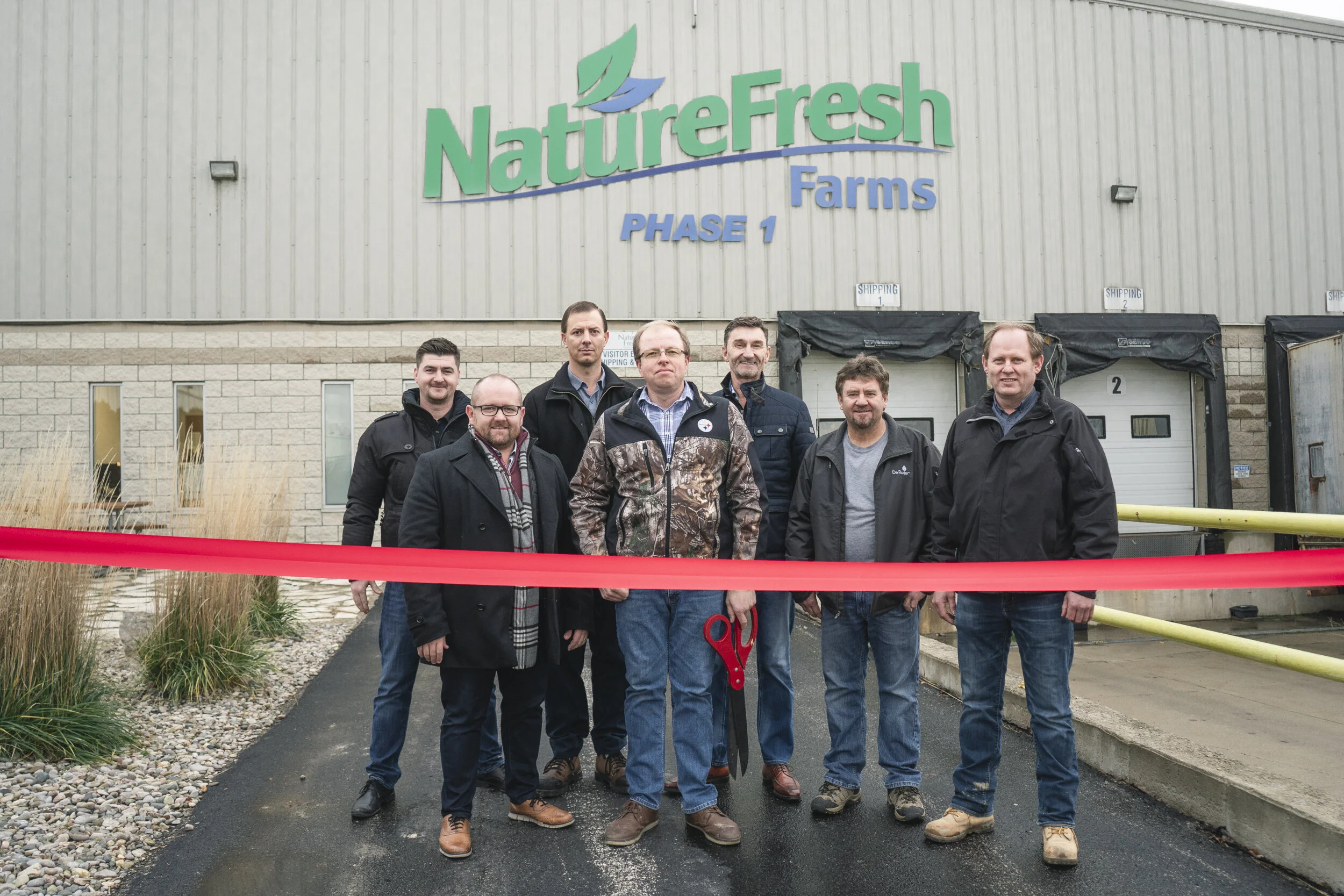
“I’m very excited to help Chosen Fresh Farms purchase my first 36-acre farm and congratulate them on becoming a part of the Nature Fresh Farms team of growers,” said Peter Quiring. “As our market share continues to grow, Nature Fresh Farms needs an ongoing new supply of innovative, passionate growers to keep us ahead of the competition.”
The company shared this exciting news, welcoming the newest addition to their grower family and looking forward to this partnership. By transferring ownership of their first built facilities, Nature Fresh Farms has presented an opportunity for several families to get involved in the industry and hopes to continue to inspire others.
“We are thrilled to work with our new grower, Chosen Fresh Farms, and feel that the opportunity for both companies was a match with this transition,” shared John Ketler. “The sale of our original 36 acres adds a new long term grower to our family of existing growers and allows us to expedite our upcoming plans for expansion. It also supports several local families to get into the greenhouse farming business which encourages others to take an interest in the industry.”
This transaction assists in expediting their expansion plans beyond their current construction of Phase 8 by putting them in a position to continue their future growth. As Phase 8’s completion is planned for next spring, Nature Fresh Farms looks forward to advancing their facilities along with the continued development of their Organic production in 2020. As previously announced they will be continuing their expansion of Organics with an increased focus on year-round growing at the new Phase 8 facility, which will entail a significant increase in production and expanding their commodity base.
With further developments on the horizon, Nature Fresh Farms is thrilled with the growth of the company and their continued partnership with local growers. This is the beginning of a new journey for the company and they hope to continue their growth pattern in the new year.
About Nature Fresh Farms -
Nature Fresh Farms has grown to become one of the largest independent, vertically integrated greenhouse vegetable farms in North America. Growing in Leamington, ON and Delta, OH, Nature Fresh Farms prides itself on exceptional flavor & quality. Family-owned Nature Fresh Farms ships fresh greenhouse-grown produce year-round to key retailers throughout North America.
SOURCE: Nature Fresh Farms | info@naturefresh.ca T: 519 326 1111 | www.naturefresh.ca
Green Life Farms’ Baby Leafy Greens Now Available in Stores Across Southern Florida
Premium produce from Green Life Farms, an innovative commercial-scale hydroponic grower in Lake Worth, is now available in grocery stores across the east and west coasts of southern Florida, including in Boca Raton, Coral Springs, Deerfield Beach, Hollywood, Miami, Naples, and Sanibel
Premium produce from a state-of-the-art hydroponic greenhouse in Lake Worth is grown free from GMOs and contaminants
Lake Worth, FL (December 5, 2019) – Premium produce from Green Life Farms, an innovative commercial-scale hydroponic grower in Lake Worth, is now available in grocery stores across the east and west coasts of southern Florida, including in Boca Raton, Coral Springs, Deerfield Beach, Hollywood, Miami, Naples, and Sanibel. Green Life Farms cultivates, harvests and packages its produce in a food-safety-focused environment to create the freshest, cleanest greens with no GMOs or contaminants.
Green Life Farms’ sustainably grown products include Baby Spinach, Baby Arugula, Baby Kale, Baby Romaine, Red Romaine Mix, Southern Style Greens, and Gourmet Asian Blend.
“For Florida consumers seeking another healthy option, we provide premium baby leafy greens, grown without soil in an enclosed environment, year-round,” said Elayne Dudley, Sales Director, Green Life Farms. “Customers will taste the difference when they try our fresh baby leafy greens because our produce is grown around the corner, not across the country, and they will rest assured that the delicious greens are free of harmful contaminants.”
Green Life Farms’ process combines technology with agricultural best practices to grow premium baby leafy greens. Its flavorful produce is cultivated without soil in clean, nutrient-rich oxygenated water, using natural sunlight and airflow in state-of-the-art greenhouses. The greens are harvested hands-free and packaged in a controlled environment to create the freshest, cleanest greens all year round. Green Life Farms grows approximately 700,000 pounds of premium leafy green produce annually in Lake Worth, with more farms planned.
Green Life Farms products are currently available in more than a dozen grocery stores. For a complete list of locations see below or visit the Find Us Locally section of Green Life Farms’ website:
A.J. Seabra Supermarket, Deerfield Beach
Aroma Market (Kosher), Boca Raton
Bailey's General Store, Sanibel
Bay Supermarket, Miami Beach
Bravo, Coral Springs
Bravo, Mirimar
Bravo, Hollywood
Broward Meat & Fish, Pembroke Pines
Don Victorio's Market, West Palm Beach
Laurenzo’s Farmers Market, Miami
Palm City Farms Produce & Market, Palm City
Presidente Supermarket #38, West Palm Beach
Price Choice, 1851 NE 2nd Ave, Miami
Sabal Supermarket, Miami
Victoria Green Market, Palm Springs
Wynn’s Market, Naples
For more information about Green Life Farms, visit GreenLifeFarms.ag. Please contact Elayne Dudley at Elayne@GreenLifeFarms.ag for sales and Raymond John at Ray@GreenLifeFarms.ag for investor relations.
glf - produce.jpg
Caption: Premium produce from Green Life Farms, an innovative commercial-scale hydroponic grower in Lake Worth, is now available in grocery stores across southern Florida. Green Life Farms cultivates, harvests and packages its produce in a food-safety-focused environment to create the freshest, cleanest greens with no GMOs or contaminants.
glf - sunset.jpg
Caption: Premium produce from Green Life Farms, an innovative commercial-scale hydroponic grower in Lake Worth (pictured above), is now available in grocery stores across southern Florida. Green Life Farms cultivates, harvests and packages its produce in a food-safety-focused environment to create the freshest, cleanest greens with no GMOs or contaminants.
Indoor Ag-Con Launches Start-Up Showcase
New Exhibition Opportunity For Early To Mid-Stage Indoor Farming and Agtech Companies Joins May 18-20, 2020 Edition At Wynn Las Vegas
New Exhibition Opportunity For Early To Mid-Stage Indoor Farming and Agtech Companies Joins May 18-20, 2020 Edition At Wynn Las Vegas
LAS VEGAS, NV (December 9, 2019) -- Indoor Ag-Con will launch a dedicated showplace on the exhibition floor for early to mid-stage indoor farming and agtech companies seeking ways to meet investors, farmers/growers and other attendees during the May 18-20, 2020 edition at the Wynn Las Vegas. One of many new initiatives for the premier crop-agnostic trade event for vertical and indoor farming, the Start-Up Showcase will shine a spotlight on the newest technologies and capabilities from today’s emerging leaders.
“Available exclusively to new, first-time Indoor Ag-Con exhibitors, our Start-Up Showcase is designed to offer these young companies a cost-effective, easily accessible gateway to indoor ag decision-makers,” explains Brian Sullivan, co-owner of Indoor Ag-Con LLC along with other event industry veterans Nancy Hallberg and Kris Sieradzki. “And, it gives our attendees the perfect opportunity to network with these newcomers and get a first-hand look at their offerings.”
The Indoor Ag-Con May 2020 Start-Up Showcase booth package includes a high-top table, two stools, one all-access Indoor Ag-Con Conference Pass, as well as a number of marketing promotions. To learn more, companies can contact Indoor Ag-Con Booth and Sponsorship Sales Representative Peter Lucibelli at peter@indoor.ag or 203.887.3457.
Start-Up Showcase joins a number of other new features and highlights that will all be part of Indoor Ag-Con Las Vegas. Among them:
NEW LOCATION: WYNN LAS VEGAS
To deliver a top-quality meeting experience for its attendees, Indoor Ag-Con heads to Wynn Las Vegas for 2020. Wynn Resorts is the recipient of more Forbes Travel Guide Five Star Awards than any other independent hotel company in the world and was once again named the best resort in Nevada on Condé Nast Traveler’s 2019 “Gold List,” a title received for the 12th time.
NEW ASSOCIATION ALLIANCES
Indoor Ag-Con is forging new alliances with other events, industry associations/groups that will play an integral role in its marketing outreach and conference programming. Look for partnership announcements coming soon.
FINE-TUNED EDUCATIONAL PROGRAM FEATURING THREE DEDICATED TRACKS
Indoor Ag-Con surveyed past attendees to find out what they need from a conference and in response, is building a robust schedule covering 3 core tracks – Business, Science|Technology, and Alternative Crops. The schedule will offer a mix of panel presentations, fireside chats and other programs that bring together different perspectives and steer clear of commercial pitches.
EXPANDED EXHIBIT FLOOR & NETWORKING OPPORTUNITIES
In addition to the new Startup Showcase, the Indoor Ag-Con team is working to bring even more resources for farmers/growers to explore across all sectors – everything from government agencies to insurance/finance and other business services to IT solutions, lighting solutions, substrates, vertical farming solutions and much more. Attendees and exhibitors alike will also have even more networking opportunities with daily continental breakfast, coffee break and luncheon sessions, evening receptions, and more.
QUICK FACTS:
WHEN: Monday, May 18 – Wednesday, May 20, 2020 (Exhibits Open May 18-19)
WHERE: Wynn Las Vegas , 3131 Las Vegas Blvd, Las Vegas, NV 89101
INFO: For information on exhibiting or attending visit www.indoor.ag or email
hello@indoor.ag
ABOUT INDOOR AG-CON LLC
Founded in 2013, Indoor Ag-Con has emerged as the premier trade event for vertical farming | indoor agriculture, the practice of growing crops in indoor systems, using hydroponic, aquaponic and aeroponic techniques. Its events are crop-agnostic and touch all sectors of the business, covering produce, legal cannabis |hemp, alternate protein and non-food crops. In December 2018, three event industry professionals – Nancy Hallberg, Kris Sieradzki and Brian Sullivan – purchased Indoor Ag-Con LLC from Newbean Capital, so setting the stage for further expansion of the events globally.
More information: https://indoor.ag
In addition, Indoor Ag-Con is proud
to be a member of the
Hemp Industries Association.

Cut Produce Recalled Because of Salmonella Risk
Tailor Cut Produce of New Jersey, is recalling its Fruit luau, cut honeydew, cut cantaloupe and cut pineapple products because they have the potential to be contaminated with Salmonella
DECEMBER 09, 2019
Tailor Cut Produce of New Jersey, is recalling its Fruit luau, cut honeydew, cut cantaloupe, and cut pineapple products because they have the potential to be contaminated with Salmonella. The recalled fruit products were distributed in Pennsylvania, New Jersey, New York and Delaware between Nov. 15 and Dec.
The product comes in two/one-gallon cases with a date of production stamped on the side. The potential for contamination was noted after several patients fell ill in four hospitals in Pennsylvania. Production of the product has been suspended while FDA and the company continue their investigation as to the source of the problem.
Distributors who have purchased the cut fruit products dated Nov. 15–Dec. 1 are urged to quarantine them and to call for further instructions.
The Pennsylvania Department of Health is investigating 31 laboratory-confirmed illnesses of Salmonella at four healthcare facilities in southeast Pennsylvania. Salmonella Javiana has been identified among the cases at three of four facilities. According to the Pennsylvania DOH, the epidemiologic evidence collected thus far indicates that this fruit mix is a potential source of the illnesses. The state’s review of invoices shows that a common food eaten by many case-patients was the fruit mix with cantaloupe, honeydew, pineapple and grapes from Tailor Cut Produce.
Salmonella can cause serious and sometimes fatal infections in young children, frail or elderly people, and others with weakened immune systems. Healthy persons infected with Salmonella often experience fever, diarrhea (which may be bloody), nausea, vomiting, and abdominal pain. In rare circumstances, infection with Salmonella can result in the organism getting into the bloodstream and producing more severe illnesses such as arterial infections (i.e., infected aneurysms), endocarditis and arthritis.
CAN (ON): Ontario Supports Healthy Fundraiser That Connects Students With Farmers
"Fresh from the Farm provides an innovative opportunity for Ontario students to learn about the healthy, nutritious food our hardworking farmers grow while also supporting their local schools' extracurricular programming"
On 22nd November, Ernie Hardeman, Ontario Minister of Agriculture, Food and Rural Affairs and Stephen Lecce, Ontario Minister of Education, congratulated schools participating in the Fresh from the Farm fundraising program for their efforts in promoting Ontario produce while helping to increase funds for extracurricular activities. The annual program provides a unique and healthy fundraising opportunity that benefits local schools, supports our farmers and promotes healthy eating to Ontario families.
"Fresh from the Farm provides an innovative opportunity for Ontario students to learn about the healthy, nutritious food our hardworking farmers grow while also supporting their local schools' extracurricular programming," said Hardeman. "We also appreciate the coordination effort of the Ontario Fruit and Vegetable Growers' Association and each school that participates in this great program."
Schools keep 40 percent of the funds raised which are used to support initiatives like schoolyard improvement projects and fun, educational class trips, as well as other supplementary or after-school programs.
Fresh from the Farm is a collaborative initiative between the Ontario Fruit and Vegetable Growers' Association and the Ontario government. This year, 471 schools took part and have generated over $862,355 for extracurricular activities by selling 713,612 pounds of fresh fruits and vegetables.
"I join Minister Hardeman in encouraging healthy eating and lifestyles for our students while promoting the interests of Ontario farmers," said Minister Lecce. "I thank the Ontario Fruit and Vegetable Growers' Association for teaching children with pride about the good things grown in Ontario."
"The Ontario Fruit and Vegetable Growers Association is pleased to be working with the government to deliver the seventh year of the Fresh from the Farm school fundraising program. Once again, the program has been a success with over 710,000 pounds of Ontario-grown apples and root vegetables sold and nearly $350,000 raised for schools. The OFVGA looks forward to continuing this partnership with government in 2020 to support school fundraising, access to local food and Ontario farmers." Bill George Jr., Chair of the Ontario Fruit and Vegetable Growers' Association.
Since 2013, almost 2,200 schools have participated in Fresh from the Farm. Collectively, the schools have distributed over 4.3 million pounds of fresh, local fruit and vegetables to Ontario families, generating a total of almost $5 million in local food sales across the province.
Source ontario.ca
Publication date: Mon 25 Nov 2019

OASIS Grower Solutions Moves Florida Manufacturing
This new facility gives the company 30% more space, providing for anticipated growth in the southern region of the country, as well as for additional capacity and warehousing
To gear up for what's anticipated to be an exciting year for OASIS® Grower Solutions in 2020, it has moved its Florida offices and manufacturing from Mt. Dora to a much larger and more modern facility at 5454 Foliage Way, in Apopka, Florida. This new facility gives the company 30% more space, providing for anticipated growth in the southern region of the country, as well as for additional capacity and warehousing. www.oasisgrowersolutions.com