


Welcome to iGrow News, Your Source for the World of Indoor Vertical Farming

Can Altius Farms Convince Denverites To Pay More For Ultra-Local, Aeroponic Produce?
Sally Herbert's urban farm in Curtis Park uses less water and land to produce lettuce, arugula, and other greens for Denver's booming restaurant scene—and for your kitchen table
Towers of produce at Altius Farms. Photo by Rebecca Stumpf.
Sally Herbert's urban farm in Curtis Park uses less water and land to produce lettuce, arugula, and other greens for Denver's booming restaurant scene—and for your kitchen table.
BY CALLIE SUMLIN | NOVEMBER 2019
At the intersection of 25th and Lawrence streets in Curtis Park, on the second story of a building—high above the millennials zipping around on electric scooters and the yoga warriors exiting a nearby studio—sits Altius Farms, an 8,000-square-foot aeroponic greenhouse. Inside, small fans whoosh gently overhead and the temperature is always somewhere between 65 and 80 degrees. There’s a slight, almost pleasant humidity to the air and the fresh, clean mineral smell of lettuce. The clear polycarbonate roof diffuses and softens the Colorado sunlight, and glass walls make you feel like you’re surrounded by open sky.
Completing the urban Garden of Eden picture is Altius’ version of fields: 340 columns, each eight feet tall, from which sprout floppy green rosettes of butter lettuce, neon mustard frills, ruffles of baby red Russian kale, and lily-pad-like nasturtium leaves. The plants blanket the white, food-grade-plastic columns so thickly they look like edible topiaries.
Fifty-six-year-old Sally Herbert, co-founder, and CEO of Altius, walks through her fields, pausing often to pluck baby kale leaves or fronds of pink-tipped lollo rosso lettuce for sampling. The kale is mild and tender, the lettuce juicy and crisp. Nearby, a smiling intern snips baby arugula leaves into bins while farm manager Ethan Page and other staffers wash, dry, and package the day’s harvest. Assistant grower and account manager Brian Adams will soon deliver bags of the greens to Altius’ growing list of clients, which include Uchi (the farm’s downstairs neighbor), Il Posto, Butcher’s Bistro, and Marczyk Fine Foods.
There’s an efficiency to the way the staff moves that might make you think Altius has been honing its operations for many seasons. In truth, the farm’s been operating for a little over one year. In that time, the company has become a supplier for 40-some restaurants and luxury grocers, and it’s one of Denver’s largest hydroponic vegetable farms. It’s also the only aeroponic-specific facility producing food in Denver proper.
Aeroponics—which was popularized in the 1980s at Epcot’s Land pavilion in Walt Disney World—takes the principles of hydroponic gardening literally to the next level. As with hydroponics, there is no soil involved. In aeroponics, however, plants commonly grow out from vertical columns, not up from pots or beds. The plants’ root systems are housed in ports of spongy, inorganic growing mediums, which are popped into little openings in the columns. A gravity-fed, automated irrigation system pushes a pH-balanced, nutrient-fortified mist through the columns for three minutes at a time in 15-minute intervals, keeping the plants’ air-suspended roots moist.
Aeroponic towers produce lettuce in less space than traditional farming. Photo by Rebecca Stumpf.
The concept has become trendy around the world because these farms can produce food using up to 90 percent less land and water than traditional crops require and can be grown within miles—or even feet—of consumers. In 2018, GV (formerly known as Google Ventures) invested $90 million into Bowery Farming Inc., a New York-based brand that bills itself as “the modern farming company.” Everyone from IKEA executives to the sheik of Dubai has thrown money at AeroFarms, a similarly ambitious outfit in New Jersey. All provide answers to American consumers’ ever-louder demands for local and sustainable food. But the question remains: Can Herbert convince Denverites to join the movement and pay more for greens raised without soil?
Five years ago, Herbert had exactly zero farming experience when a friend recommended she check out Veterans to Farmers, a local nonprofit that trains former service members in traditional and hydroponic agricultural systems. Herbert, who served in the Air Force for 13 years (active duty and reserve), liked the group’s mission to provide veterans with fulfilling civilian careers and joined the board.
While helping a Veterans to Farmer’s trainee at his hydroponic operation in Lakewood in 2014, Herbert learned about controlled-environment agriculture and was fascinated. The timing was apt: Herbert, who typically dresses in plain T-shirts and the sort of breathable pants one might wear hiking, was burnt out as CEO of GS1, a global logistics company. She started researching farming trends and realized that Denver’s short growing season and proliferation of consumers who care about sustainability made it the perfect place for an innovative aeroponic operation.
Finding a location for Altius in the city proved challenging. “I needed a developer who believed in the cause and saw food production as an amenity to their site,” she says. When she connected with Westfield Company Inc. (the developer behind the S*Park complex of luxury townhomes and condos that encompasses Uchi and Altius) in 2015, things clicked.
As it turned out, the plot of land in Curtis Park had been a farm site before. (Elaine Granata, Denver’s grandmother of urban farming, had long coaxed peas and tomatoes from the ground there.) When the Denver Housing Authority sold the property to Westfield, it did so under the condition that the development includes a farming or green space component. Enter Altius. Where other new condominiums tout pools, S*Park’s tenants would have access to fresh vegetable subscriptions and events in the outdoor farm-to-table dinner space, making their “#gardengoals become a reality,” as the S*Park website promises.
With her location secured, Herbert needed funding to bring her vision to fruition. Despite the global interest in vertical farming and her business connections, she had no luck courting local investors. “There’s a lot of money floating around this town for tech startups,” Herbert says. “But trying to get someone to invest in an agriculture company? Forget it.”
It’s not surprising that some investors would be scared off by food production: Slim margins can mean a slow return on capital, and in a city where an acre of land can sell for upward of a million dollars, high-revenue businesses or development projects are preferable to farming’s modest profits. So, to get off the ground, Herbert financed the business herself.
In the midst of Denver’s brutal mid-July heatwave, Herbert’s plants are comfortable in their climate-controlled environment. Herbert, though, is outside, working in Altius Farms’ brand-new garden and event area. Just weeks ago, this ground-level space was a fenced-in rectangle of dirt. Now, it is fully built out with raised beds and long communal tables, ready for ticketed farm-to-table dinner events.
Herbert, her shiny, dark hair pulled into a low ponytail, hunches over one of the 15 soil-filled beds to carefully prune a tomato plant. Nine months in, things are going well at Altius: Through trial and error, Herbert’s team has figured out which varieties of seeds work best in the indoor tower environment. High-end restaurants all over town have begun to name-drop Altius’ greens, herbs, and edible flowers on their menus. And the farm has donated hundreds of pounds of produce to nonprofits We Don’t Waste and SAME Café.
Herbert hopes to expand her aeroponic business beyond Denver. Photo by Rebecca Stumpf.
But it is not enough to turn a profit—yet. It’s still difficult to convince a grocery shopper to pay $4.99 for a clamshell of salad mix when they can get a head of lettuce for less than $2 at King Soopers. “Farming is the hardest thing I’ve ever done,” Herbert says. And that’s even with Altius’ automated irrigation and temperature control systems, the polycarbonate roof that prevented a June hailstorm from shredding her crops, and a strong customer base.
Because, at the end of the day, it’s still farming. It’s still waking up in the middle of the night panicking about the crops. It’s still having to convince folks to buy a premium local product and coaxing nature into a business model. The aeroponic system has drawbacks, too: The towers aren’t suitable for growing root vegetables, and proponents of organic produce tend to frown upon the aeroponic method, which requires plants to be fed liquid nutrients.
Another challenge, which Herbert has grappled with since the beginning, is that the arrival of Altius in Curtis Park meant the displacement of other farmers; Granata now grows at a small space abutting a parking lot at the UCHealth University of Colorado Hospital. Herbert is conscious of the fact that to some, her aeroponic farm is just another sign of a gentrifying neighborhood. As such, she seeks ways to better serve the surrounding area (donating produce to Comal Heritage Food Incubator) and to support other farmers (continuing to serve on the Veterans to Farmers board).
While Herbert is surprised at just how many setbacks have arisen, she’s still confident in Altius. Just as she trusts her seeds will sprout, she says that the farm is on track to profitability. Her lofty goal—to potentially put locations in Denver and cities across the country—feels distant but possible. In the meantime, she pauses to wipe sweat from her brow and survey her work, just for a moment, before heading back to the greenhouse above.
CALLIE SUMLIN, CONTRIBUTOR
Callie Sumlin is a writer living in Westminster and has been covering food and sustainability in the Centennial State for more than five years.

US: Pennsylvania - Building A High-Tech Indoor Farm In The Steel Town of Braddock
Next door to U.S. Steel’s Mon Valley Works, Fifth Season is building an indoor vertical farm that will integrate high-tech elements like artificial intelligence, data analysis, and robotics to seed, harvest and package leafy greens to ship to local grocery stores and restaurants

STEPHANIE RITENBAUGH
October 21, 2019
In the shadow of one of Pittsburgh’s long-standing steel mills, a startup is hoping to cultivate a farm out of the grit of Braddock.sritenbaugh@post-gazette.com
Next door to U.S. Steel’s Mon Valley Works, Fifth Season is building an indoor vertical farm that will integrate high-tech elements like artificial intelligence, data analysis, and robotics to seed, harvest and package leafy greens to ship to local grocery stores and restaurants.
Fifth Season, which was founded in 2016 as RoBotany Ltd. and incubated at Carnegie Mellon University, developed its technology with two research and development vertical farms on the South Side.
The company’s leafy greens, grown without pesticides, have been sold at Giant Eagle and Whole Foods Market grocery stores in the South Hills, as well at restaurants such as Superior Motors, honeygrow, and Kahuna.
Now, the 60,000-square-foot facility is a hive of construction as crews prepare the building for its first seeds in December.
The Braddock farm is expected to produce more than 500,000 pounds of lettuce, spinach, kale, arugula, and herbs from a 25,000-square-foot grow room during the first full year of operation.
That’s quite a jump from the few thousand pounds a year produced at the South Side facility, said CEO Austin Webb, who co-founded the company with Brac Webb and Austin Lawrence. Mr. Lawrence is also chief technology officer.
On 30-foot-tall racks arrayed like bookshelves, trays of lettuce, spinach, kale, arugula, and herbs will be stacked on to shelves.
Along the aisles, a robot can be directed to, say, harvest seven trays of spinach when the time comes, rather than have a human use a ladder or scissor lift to remove trays by hand, Mr. Webb said.
The environment can be controlled around the clock in each area of the facility. In the grow room, the temperature, humidity, nutrients, light spectrum and even how long the day will be, will be closely monitored.
One driver behind Fifth Season’s strategy is to increase access to fresh food and to reduce waste.
Growing food in a neighborhood, with the end-users accessible within 24 hours of harvest, is much better than shipping produce over a long distance that means eight to 10 days until it’s on the store shelf, Mr. Webb said. “It has a much longer shelf life.”
The hydroponic facility also uses 95% less water than traditional techniques, and by reusing water that has been treated, runoff doesn’t go into waterways, Mr. Webb noted.
At full build-out, the Braddock facility plans to employ 40 to 60 people.
“We want to hire local as much as we can,” Mr. Webb said.
While vertical, indoor farming has been around for some time, the practice has gained traction in recent years as urban farming has become more popular amid concerns about food access and available farmland.
Allied Market Research expects the global vertical farming market to grow. In a September report, the Portland, Ore.-based firm said the industry accounted for $2.23 billion in 2018 and is expected to garner $12.77 billion in revenues by 2026.
But efficiency and profitability is a challenge for the sector.
Those are issues that Fifth Season hopes to address, using the technology it’s developed to control the growing process, costs and “optimize key factors such as energy, labor usage, and crop output,” Mr. Webb said.
“We are trying to create a new standard for our industry,” he said.
The company has raised more than $35 million to date, led by Drive Capital and other private investors with close ties to CMU.
Stephanie Ritenbaugh: sritenbaugh@post-gazette.com; 412-263-4910

Special Brand Developed For Vertically-Grown Products
The first vertically grown products have recently become available at Van Gelder fruit & vegetables. This is the result of the collaboration between Van Gelder and vertical cultivation specialist PlantLab
The first vertically grown products have recently become available at Van Gelder fruit & vegetables. This is the result of the collaboration between Van Gelder and vertical cultivation specialist PlantLab. Joint efforts were made to grow and market-fresh vegetables with a lot of taste and high nutritional values as sustainably as possible.
Van Gelder Indoor
To market the vertically grown products, Van Gelder introduced the new "Van Gelder Indoor" line. This is an exclusive fresh line of vegetables available from Van Gelder. These quality products are produced locally and sustainably, irrespective of the season or climate, with consistent quality and a high level of food safety.
Leafy vegetables and lettuce varieties
The first products of the "Van Gelder Indoor" line will be available from 24 October: two salad mixes and five types of leafy vegetables. "We have deliberately chosen to start growing lettuce varieties and leafy vegetables because these products are currently largely imported from abroad," said Gerrit van Gelder, Managing Director. "With this, we shorten the chain which immediately saves on transport costs."
Vertical cultivation in Experience Center
In the meantime, PlantLab's two Plant Production Units (PPUs) have also been taken into use in the Experience Center in Ridderkerk. These PPUs offer inspiration in the field of vertical cultivation. "We will soon start the search for new products with special flavors in cooperation with our customers," explains Commercial Director; Anton van Gelder. “The demand from our customers in this search was the driving factor. Together with them, we will start experimenting. In this way, we want to continue to distinguish ourselves with exclusive and quality products."
For more information:
Van Gelder
Handelsweg 70
2988 DB Ridderkerk
T: +31 (0)180 42 50 77
E: info@vangeldernederland.nl
www.vangeldernederland.nl/indoor
Publication date: Fri 25 Oct 2019
AIPLUS, A Developer of Smart Home Farming Appliance
Just as every home has a refrigerator, all households may have a smart home farming appliance in the future. AIPLUS is seeking to open a new frontier in agriculture and create another blue ocean in the home appliance industry.
#Power of Businesses l 2019-10-21
© AIPLUS
The 2019 Korea Electronics Show was held at COEX, in southern Seoul, from October 8th to 11th. To mark the 60th anniversary of Korea’s electronics sector, this year’s event was joined by 750 companies both from Korea and abroad to showcase prospective products and technologies of the Fourth Industrial Revolution, with 16 brilliant products receiving the “2019 KES Innovation Award.” For this week’s show, we’ll talk about one of the innovative products and companies that shined at this year’s KES. The company we’ll introduce is called AIPLUS. Let’s hear from its co-founder and CEO, Kwon Oh-yong.
Our home farming appliance, PLANTBOX, can be described as a kitchen garden in the form of consumer electronics. Those who have ever tended a vegetable patch will certainly understand how difficult the job is. It is necessary to learn about vegetables and take great care of them constantly. Many people just give up on the onerous work, so we wondered how to come up with a convenient and stylish tool to ease the hassle. We developed a smart home farming appliance and displayed it at this year’s KES.
© AIPLUS
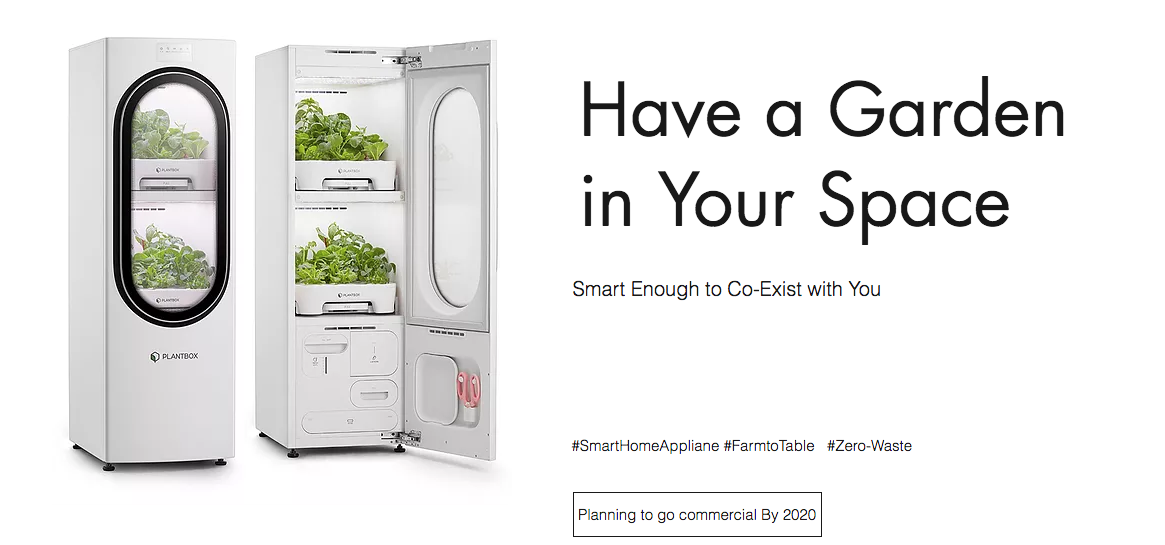
PLANTBOX is a smart indoor veggie farming solution that won the Best Design award at this year’s KES. It looks like a small refrigerator, unlike conventional vegetable-growing boxes that typically take up a lot of space in apartment balconies. Once users plug in the seed capsules, the machine automatically sets the optimal level of light, temperature, moisture and nutrition for the plants so the users can grow vegetables easily. AIPLUS, a startup that was founded last year, is a spin off from Samsung Electronics’ in-house venture nurturing program.
I entered Samsung Electronics in 2004 and worked at the wireless business department to develop mobile phones. The co-founder of AIPLUS, Choi Seon-muk(최선묵), also worked at Samsung Electronics from 2006, but his job was related to consumer electronics. We thought that my experience in the Internet of Things or IoT and his expertise in home appliances could be combined to create something new.
The idea began to take shape when Choi went to a weekend farm with his children. As I said before, farming is laborious work. They had to work hard, catching bugs, in the hot sun. Exhausted, he stopped visiting the farm. He wondered how to grow vegetables in an easier way. Having heard about his story, I recalled my parents who used to cultivate vegetables and herbs on a rooftop garden.
We thought it would be interesting and meaningful to ease the inconvenience of home farming by using our own respective technology.
So, the idea of the new home farming appliance started from Choi’s painful experience at a local farm. Many people visit weekend farms or grow vegetables in a small patch in their apartment balconies in the hopes of eating fresh vegetables they have cultivated themselves. But most of them give up after some time because it is quite challenging for urban farmers to invest large amounts of time and control the damage caused by harmful insects.
To resolve the problems of home farming effectively, Kwon and Choi used their own knowledge about IoT and consumer electronics, respectively, and developed a new product.
© AIPLUS
In addition to adjusting the temperature and moisture, PLANTBOX uses light-emitting diode or LED lighting to ensure the best wavelengths of light for photosynthesis.
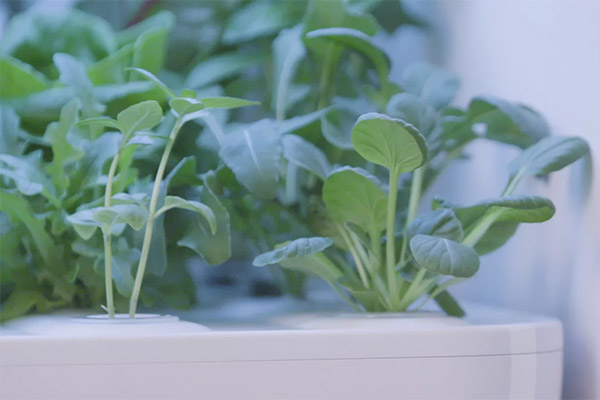
Just like humans, leafy greens need to sleep when the sun sets. In the box, artificial lights appear slowly, just as the sun rises, so the indoor environment can be as similar to nature as possible. Apart from the physical conditions for greens to grow, human touch is also needed. Of course, this is the most challenging part. First, users stick smart seed capsules inside the box, which automatically identifies what kinds of vegetables are put in and sets the best environment for the plants. The indoor environment is connected to the users’ smartphone app through IoT. An alarm will sound on the app to remind them to water the veggies or replace some supplies. That’s all the users have to do, and PLANTBOX will do everything else.
PLANTBOX, a combination of agriculture, home appliance and IoT technology, enables people to raise veggies at home easily without special knowledge or extensive experience in vegetable cultivation.
The inside of the machine consists of three compartments. The bottom part is for watering, replacing consumables and checking the overall conditions. It is the other two compartments in the upper section where plants grow. We call them trays, which serve as a field. When smart seed capsules are put in the trays, nutrients are automatically mixed with the culture fluid on the trays. The plants absorb the nutrients and keep growing on the two trays. Of course, the machine ensures appropriate levels of temperature, moisture and LED lighting. The door can be opened and closed, just like a refrigerator, and is tightly sealed to block the vegetables from outside contaminants. So, users can grow fresh veggies regardless of the season or the weather.
Some companies have produced home farming tools before. But the market response was not very good since they were rather inconvenient to use. Also, there were design and flavor issues.
AIPLUS, a late starter, took a different approach by using a hydroponic cultivation method in a refrigerator-shaped electric appliance and adopting IoT technology. PLANTBOX enables people to enjoy delicious vegetables in their freshest state without using any pesticides. It only occupies 0.2 square meters but produces the same amount of veggies grown in a 3.3 square-meter garden. Users can water the plants just four or five times a month, and some vegetables are fully grown in 25 days. The company has applied for eight patents for the product.
Numerous people who visited AIPLUS’ booth at the recent electronics show were amazed to see the remarkable product. AIPLUS plans to commercialize next year to take the first step in bringing about a major change in the industry.
Currently, refrigerators, air conditioners, TV sets and washing machines comprise a major axis in the home appliance market, while air purifiers, clothing-care systems and body massage chairs are becoming popular these days as well. When a new product is released, market observers generally expect that the market will expand to invigorate the economy.
But what we really want is for PLANTBOX to help people change their lifestyle in a healthier way. Users of the product will realize that vegetables can be so fresh and even tasty, although they may not like veggies very much. They will then consume more vegetables and enhance their nutritional balance. After all, good nutrition and a balanced diet will keep them healthy, possibly preventing and curing high blood pressure, diabetes and obesity over the long term. We hope to provide a product that will bring about a positive change in people’s lifestyles.
Just as every home has a refrigerator, all households may have a smart home farming appliance in the future. AIPLUS is seeking to open a new frontier in agriculture and create another blue ocean in the home appliance industry. We’ll have to wait and see how the company’s innovative product will perform in the market.

Australia - Coming Soon: Acre Farm & Eatery Is A 2500-Square-Metre Urban Rooftop Farm And Cafe In Burwood East
The cafe will be located inside an enormous glasshouse with 450 square metres of vertical gardens in which about 15,000 seedlings have been planted (mainly high-yield greens and soft herbs)
There’s a vertical strawberry wall, a glasshouse cafe
with 15,000 seedlings and even a chicken coop.


28 October 2019
by NICK BUCKLEYSHARE
One of Broadsheet’s top ten stories of all time was the February 2018 news that the “world’s most sustainable shopping centre” was being planned for Burwood Brickworks in Melbourne’s east.
The development enlisted eco-pioneer, florist and designer Joost Bakker as a creative consultant to help turn the project’s rooftop into an urban farm, cafe, and restaurant space, which will open in December as Acre Farm & Eatery.
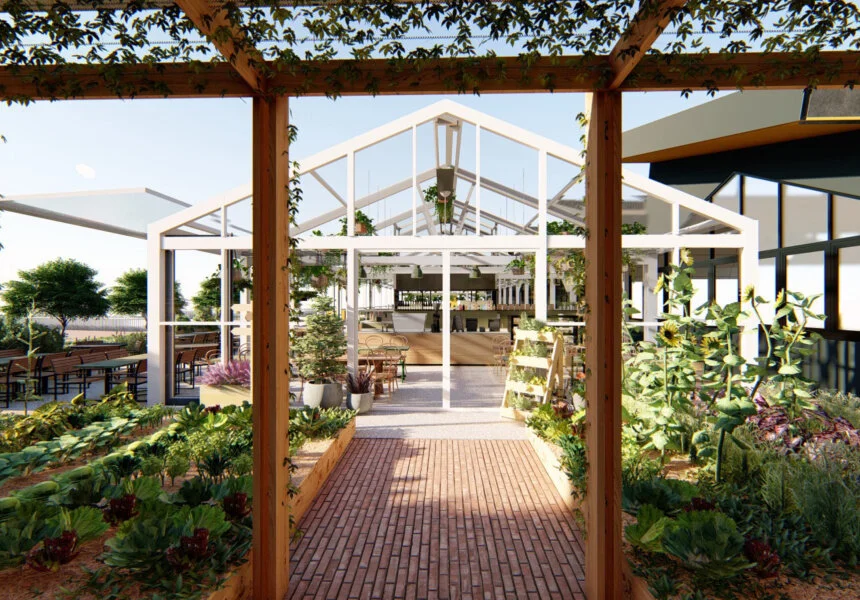
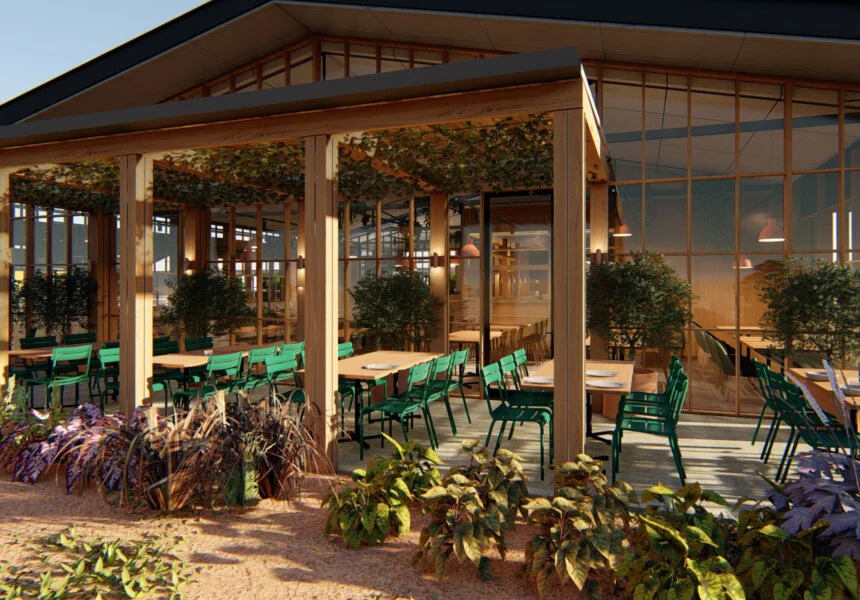
The cafe will be located inside an enormous glasshouse with 450 square metres of vertical gardens in which about 15,000 seedlings have been planted (mainly high-yield greens and soft herbs). Inside, the kitchen is behind glass walls too, giving diners a view of the chefs cooking the ingredients harvested from the rooftop. Adjacent to the cafe is a farmhouse-style restaurant with large windows looking out over the Dandenong Ranges.
Surrounding both dining rooms will be 2500 square metres of urban agricultural land, including a vertical strawberry garden, a chicken coop, established trees and ankle-height gardens that you’ll walk through to reach the glasshouse. Currently being planted are at least 12 varieties of tomato, as well as kale, silverbeet, baby carrots and heirloom baby vegetables, plus established olive and citrus trees. Even the flowers used to decorate the restaurant will be grown on the roof.
“You’ll kind of lose your sense of place going from a shopping centre to what feels like a rural area,” says executive chef Brad Simpson, who spent seven years in the kitchen at Prahran pub The Smith (first as head chef, then as executive chef) before it was sold in July last year. “We want people to feel relaxed, as if they’re in the country, and it’s going to have a warm, homely feel.”
The rooftop gardens and glasshouse will provide some of the produce used in Acre’s kitchens, but they won’t fully sustain them. The gardens are also partly designed to be an educational tool, to get diners to consider the provenance of what they’re eating.
“The reality of the situation is that for us to just use what came off the roof for the restaurant we’d run out pretty quick … you need hectares and hectares of space to do that,” says Simpson. “We’re going to grow as much as we can on the roof while keeping it looking lush so that it can educate people and be a bit of a showpiece for what happens inside.”
Produce brought in from outside will come from local Victorian growers following the same ethos as Acre.
“I’m looking at dealing with farms that operate the same soil-health programs that we will operate on the rooftop. No sort of harsh sprays or anything like that. We want the comparison for what we source outside of the farm to match as closely as possible to what we’re doing on it,” says Simpson, who points to a simple dish of eggplant relish, toasted seeds, and baby vegetables as being indicative of his menu.
“It’s probably the most remedial dish on the menu in some ways … it’s kind of a jazzed-up crudité plate. It’s utilising stuff that’s just been pulled out of the ground,” he says.
Setting up the kitchen has been a learning process for Simpson, who’s trying to minimise food waste and single-use plastics. For example, he’s done away with a Cryovac – a machine used to vacuum-seal food in plastic bags – something he says he never would have imagined doing without five years ago. And the new skills he’s learning are being integrated into his life outside the Acre kitchen too.
“I’m learning things at home just through this process. I’m saving apple skins and apple cores that my son doesn’t eat and turning it into apple cider vinegar,” says Simpson. “Things that I’d just normally throw out I’ve started thinking about differently. I’m making crackers from old sourdough that I don’t get through and stuff like that.”
In that spirit, expect to see secondary cuts of meat on the homely, approachable menu. One dish in the works is a whole, slow-roasted pork knuckle (using hind-quarter hocks from free-range Victorian pigs) with lovage and fennel from the garden, and apple.
“I’m really into the family-style of eating and making sure our menu’s not too structured, that it’s approachable, colourful, social food,” says Simpson. “I don’t want to be cutting edge … I want it to be social, family food that everyone’s going to be able to sit down and enjoy and most importantly not be intimidated by.”
Acre Farm & Eatery is set to open in early December at Burwood Brickworks, 78 Middlesborough Road, Burwood East.
Photography: Courtesy of Acre Farm & Eatery

"The Time Is Now For A Shift To Indoor Cultivation In India", Srishti Mandaar, Red Otter Farms
Indoor growing is at a very nascent stage in India. While there are significant policy changes being adopted by the government, there is still a severe lack of trained personnel in indoor environment management
Indoor growing is at a very nascent stage in India. While there are significant policy changes being adopted by the government, there is still a severe lack of trained personnel in indoor environment management. "It is only when this gap is addressed that the true potential of indoor growing will be leveraged", according to Srishti Mandaar, co-founder of Red Otter Farms.
Srishti points to the need for a concerted effort to bring the various stakeholders – infrastructure developers, produce based experts and professionals linking production to market – to come together and enhance the indoor growing community.
Non-linear trends
First things first though: the consumer, because consumer demand can be a catalyst for growth in the indoor ag market. Identifying singular trends in food can be quite difficult when it comes to India. With nearly five different geographical diversities, a multitude of cultures as well as social status, the consumption patterns vary vastly. From the coast to the high mountains and the deserts, climatic conditions have dictated the food patterns for centuries.
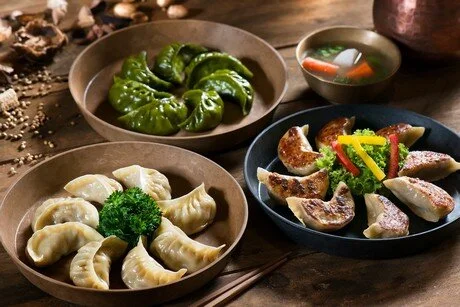
Interestingly, however, over the past two decades, with increased ‘globalization’, urban centers are now witnessing the first wave of food democratization. Food from different cultures are being adopted and adapted to local communities’ preferences. "As an example, the momo is a standard fare in the northeastern mountain regions – usually stuffed with meats and eaten with a spicy chili sauce", Srishti says. "Today, the momo has gained a place as an integral street food with mobile carts being set up but with a twist… it's even served with cream sauce."
So when it comes to the Indian consumer, trends are clearly non-linear. "In the metros, where we will typically find the primary consumers for indoor growing due to their paying capacities, the requirements have shifted. Supermarket shelves have gone international – they stock standard staple produce for a variety of cuisines. Yet, the awareness of the consumer is still limited.
While they now understand that there are at least three or four different types of pasta, their understanding of varieties within product classes is low. The Indian kitchen still buys tomatoes or cherry tomatoes and it will take time before they understand the difference between curry, soup and salad tomatoes."
Connecting with local partners
There is potential for growth in the Indian indoor ag market - but how to tap into that growth? According to Srishti, suppliers can do more to cater to Indian growers. "One of the issues we faced and still often face is technology, seeds, etc. that are offered have no research/data backing their use/trial in the Indian environment. For any of the seed or tech companies to make inroads, they need to believe in a longer-term strategy. They will initially need to invest in finding local partners who can help them demonstrate results over a few months. Agricultural production in that sense is driven by local success."
Opportunities for controlled environment agriculture
Given the very low monetary return from crops, Indian farmers need to improve their production, Srishti says. "Given the weather patterns across the country, CEA has immense potential. It not only mitigates crop losses due to weather but effectively will also enhance farm incomes.
"Proponents of CEA, as well as the infrastructure providers, need to adapt their deliverables based on geographical climate, power availability as well as for the produce being grown. At Red Otter Farms, we have had to go to the drawing board to develop a controlled facility that can address the needs year-round and are currently testing our second prototype. Our own example gives us a clear indication of the benefits of adopting CEA, yet the lack of trained resources and cost-effective technologies has led us to undertake a research route at present."
"Market size should not be a concern"
Srishti also notices a growing awareness amongst the consumer regarding the use of chemical fertilizers, insecticides, and pesticides in their food. "In addition, there is also a realization amongst them that there are options available such as organic and soilless cultivated. The potential for high quality, chemical-free produce is therefore high."
In addition to the growing interest in organic produce, research shows that the Indian plate has been seeing a rise in the use of vegetables as a source of nutrition over the past three decades. "With all these factors aligning themselves, the time is now for a shift to indoor cultivation", Srishti concludes. "And the market size should not really be a concern. India is a country with the largest population of millennials – aware, well-traveled and cares about the quality of the food they eat – and equally ready to pay the premium it may need."
For more information:
Red Otter Farms
www.redotterfarms.in
Publication date: Wed, 23 Oct 2019
Author: Jan Jacob Mekes
© HortiDaily.com

US: Texas Schools Tap ‘Container Farms’ To Fill Cafeterias With Fresh Produce
Texas schools are using refrigerated freight containers converted into hydroponic farms as an extension of the classroom
Texas students are getting hands-on, high-tech experience growing fresh produce inside converted shipping containers. (Freight Farms)
Texas News Service October 25, 2019
SAN ANTONIO – Texas schools are using refrigerated freight containers converted into hydroponic farms as an extension of the classroom.
At IDEA charter schools, students learn how to grow leafy greens and other vegetables, and deliver their harvests directly to the school cafeteria.
Caroline Katsiroubas – director of community relations at Freight Farms, the company that developed the technology – says schools are using the farms in part to shift traditional food culture and improve health by giving students nutritious options.
“In the San Antonio IDEA school’s campus, they don’t use salt or pepper in their cafeteria,” says Katsiroubas. “And they’re growing herbs specifically in their farm to make a seasoning.”
The University of North Texas also is using the container farms as a lab for a wide range of hands-on learning opportunities in biology, organic chemistry, nutrition, and culinary arts, as well as business, computer science, and marketing.
Many schools have developed certificate programs and majors around sustainable food production, which gives graduates a leg up on joining the growing ag-tech field or starting their own farm.
Because the climate is controlled inside the container, food can be grown all school year long with a predictable commercial-scale output. Greenery units can support 13,000 plants at a time, producing harvests of up to 900 heads of lettuce per week.
Katsiroubas says the technology is useful in a state such as Texas and notes Houston freight farmers played a critical role in providing food during Hurricane Harvey.
“These container farms act as a way to control the food supply chain, and make it resistant to shocks like extreme weather patterns or hurricanes or drought,” says Katsiroubas.
Katsiroubas says the container farms also are helping lower schools’ overall carbon footprint. Harvests happen just steps from the dining hall, which all but eliminates transportation emissions and packaging.
She says the farms use 99% less water than a traditional farm, running with as little as five gallons per day, less than the average dishwasher.
Author: Eric Galatas, Public News Service (TX)

Ag Firm Signs Electric Works Lease Muncie Business Uses Fish Waste As Plant Fertilizer
This is the second tenant announcement for Electric Works featuring an agricultural technology company in two weeks. Last week, the developers announced that Sweetwater Urban Farms had signed a lease agreement. Sweetwater Urban Farms uses aeroponic technology to produce nutrient-rich greens and herbs
SHERRY SLATER | The Journal Gazette
A Muncie company that uses fish waste as plant fertilizer has signed a lease for space in Electric Works, officials announced Monday.
Balance Holdings Inc. is a commercial regenerative agriculture technology company that uses 1% of the water needed for traditional farming and less than 20% used in hydroponics, a process of growing plants without soil, officials said.
The company will grow fish and crayfish in tanks. The waste-filled water, which is full of nutrients, is channeled to plants that produce fruits and vegetables. The plants filter the water, which is then cycled back to the fish tanks, creating a closed-loop system with no waste.
Glynn Barber, the company's founder, said that “growing better food is more than just putting a better tomato into the grocery store – it's about growing a better future” for the next generation.
“We believe healthier food produces healthier people, which produce healthier communities – and we see an exciting and unique opportunity for ECSIA to make a profound impact on this community, partnering with healthcare providers and higher education institutions at Electric Works,” Barber said in a statement.
More than 300 varieties of fruits and vegetables have been grown using the company's patented system in Indiana, Texas, and Haiti.
Balance Holdings plans to sell fish, fruits, and vegetables to restaurants in the region and directly to the public at an on-site store in Electric Works.
Jeff Kingsbury, a partner in Electric Works developer RTM Ventures, said the new tenant checks a lot of boxes for the type of businesses RTM is trying to attract.
RTM Ventures, he said in a statement, is looking for “firms that are exploring new technologies and market-based solutions through strategic alliances and creative partnerships with other businesses, as well as healthcare and education institutions.”
“At the same time, (the company's) impact will be felt in the neighborhoods surrounding Electric Works – areas of the city that have struggled with access to healthy food in the past,” Kingsbury added.
This is the second tenant announcement for Electric Works featuring an agricultural technology company in two weeks. Last week, the developers announced that Sweetwater Urban Farms had signed a lease agreement.
Sweetwater Urban Farms uses aeroponic technology to produce nutrient-rich greens and herbs.
Aeroponic systems nourish plants with nothing more than nutrient-laden mist, according to the Modern Farmer website.
Electric Works is a mixed-use district of innovation, energy, and culture, developed as a public/private partnership between RTM Ventures and the city of Fort Wayne. The 39-acre campus just south of downtown is the former location of General Electric.
RTM Ventures plans to convert 1.2 million square feet in 18 historic buildings into space for office, educational, innovation, retail, residential, hotel, and entertainment uses.

Brazilian Company Takes Farming Innovation In An Upward Direction
A vertical farm in Sao Paulo has been experimenting with indoor vegetable growth and it uses artificial pink lighting, also known as Pink Farms
Paulo Cabral | Paulo Cabral@PCabralReporter
October 9, 2019
A vertical farm in Sao Paulo has been experimenting with indoor vegetable growth and it uses artificial pink lighting, also known as Pink Farms.
CGTN’s Paulo Cabral reports.
This is a farm but not your usual kind. Everything here happens indoors and since the plants don’t have sunlight inside to grow.
They are supplied with 100 percent artificial pink lighting also known as Pink Farms.
The principle here is hydroponic agriculture: the plants don’t grow in soil but in a kind of foam soaked in water and nutrients.
After the seeds are planted they move to a first stage of growth in a dark room.
Eventually, they are transferred to these rooms setup with pink lights- made of 80% red and 20% blue- ideal for plant growth.
“We think this is important because we will have in the next years a huge growth in the population so we need to find better ways to grow food for them,” Rafael Pereira, the founder, and partner of Pink Farm said.
“And controlled environment agriculture is one of the ways we have to increase this productivity.”
The products in this farm cannot be considered formally organic because they are not planted on actual soil. But since they are grown in a confined and controlled environment there is no need for the use of pesticides. And the vegetables are totally clean: ready to be eaten right after being picked.
Some shops in Sao Paulo are already selling Pink Farm products. These so-called baby greens – similar to sprouts – are attracting some buyers here.
“This is a totally innovative method,” Marcel Honda, manager of Natural da Terra said.
“We had never seen anything like this. We had already seen hydroponics Sales are still picking up because people still need to get to know these products. So we have been organizing tastings here at the shop and once people try it they buy it.”
“I had never tried this and really liked it,” Rodrigo, a customer said. “Tastes great with this mustard sauce.”
“I am very strict about the quality of food I bring home, Jarbas Pereira, a lawyer said. “And I see this is great. My wife has already bought some.”
For now, this vertical farm is a small scale project that’s just begun to show some commercial results. But as demand for food grows and space to produce it becomes more scarce, opportunities for high-tech farming may become more important to fulfill people’s needs in the future.

US: Colorado - A New Building Rising Behind Stanley Marketplace In Aurora Will Be An Commercial Greenhouse
In a budding industry, Aurora has been handpicked as a landing spot for a green giant. Gotham Greens, the Brooklyn-born company at the forefront of the urban farming industry, is coming to town
New York-based Gotham Greens coming to Colorado, will open 30,000-square-foot facility in 2020 that will serve retailers throughout state and region
Michael Ciaglo, Special to the Denver Post
Gotham Greens co-founder and CEO Viraj Puri gives a tour of their new 30,000 square foot greenhouse next to the Stanley Marketplace Thursday, Oct. 17, 2019, in Aurora. The greenhouse is less than an acre but will produce the equivalent of over 25 acres of conventional farming.
October 23, 2019
In a budding industry, Aurora has been handpicked as a landing spot for a green giant. Gotham Greens, the Brooklyn-born company at the forefront of the urban farming industry, is coming to town.
By the spring of 2020, Gotham Greens will be growing arugula, basil, bok choy and a variety of other herbs and leafy greens out of a 30,000-square-foot greenhouse nestled behind Stanley Marketplace, 2501 Dallas St. As recently as last week, the site wasn’t much more than a slab of concrete spiked with steel beams, but when it opens it will be a state-of-the-art facility set up to produce fresh food 365 days per year.
“Where we’re standing will be filled with plant growing beds,” company co-founder and CEO Viraj Puri said while walking the construction site last week. “Our proprietary growing method uses 95% less water and 97% less land than traditional farming.”
Indoor farming isn’t a new idea in the Denver area. Nonprofit fresh produce provider The GrowHaus will celebrate its 10th anniversary next month. It operates a trio of indoor farms in the Elyria-Swansea neighborhood. Altius Farms has been harvesting and distributing its own brand of aeroponically grown leafy greens and herbs since late 2018. It’s roughly 7,000-acre greenhouse sits on the roof of a restaurant in the S*Park development in Denver’s River North Art District. That project is owned by Westfield Co., the same developer behind Stanley Marketplace that has now brought in Gotham Greens.
What will set Gotham Green’s Denver operation apart is its scale. Its greenhouse is designed to serve the entire state and even some parts of bordering states, Puri said. Whole Foods has already signed on to carry Gotham Greens lettuce mixes, herbal dressings and other goods in all of its Colorado stores, according to the CEO. By growing its products close to consumers, the company also limits the carbon footprint of its business.
“What’s remarkable about this system, is it’s a climate-controlled greenhouse that employs a lot of technology — hydroponic, automation, computer control systems, advanced drip irrigation techniques,” he said. “It will produce a yield equivalent to a 25-acre farm.”
RELATED: Denver urban farming trend grows from a Sloan’s Lake condo tower to a Larimer Square parking garage
Stanley Marketplace is the western front of an ambitious expansion effort. Founded in 2009, Gotham Greens opened its first greenhouse in Brooklyn until 2011. It expanded to Chicago in 2014 and has grown its presence in New York over the last few years but 2019 has been its busiest year to date.
With new greenhouses in Providence, R.I., and Baltimore expected to open by the end of the year, the company will soon crack the New England and Mid-Atlantic markets. When those facilities are up and running, Puri will oversee a company with more than 500,000 square feet of greenhouse space and 350 employees. That’s before the Aurora facility opens and brings on 30 full-time workers, he said.
Colorado — and the Denver metro area specifically — were a good fit for Gotham Greens because many consumers in the state value sustainably grown, eco-friendly food products, Gotham Greens co-founder and chief financial officer Eric Haley said. Haley should know. He grew up in the south metro area and graduated from Cherry Creek High School in 1999.

The Shipping Container Farm Helping To Feed A Dubai Community
Old factories, warehouses, and disused shipping containers have paved the way for a global agricultural revolution that is reaping rewards in a Dubai neighborhood. As more and more indoor farms sprout up in cities across the world, including New York and London, the UAE is firmly on the vertical farming bandwagon
The Sustainable City neighborhood is now home to a vertical farm that is already sowing the seeds of success
Stuart Oda, founder and CEO of Alesca Life, believes vertical farming is set up to succeed in the Emirates. Antonie Robertson/The National
Old factories, warehouses, and disused shipping containers have paved the way for a global agricultural revolution that is reaping rewards in a Dubai neighborhood.
As more and more indoor farms sprout up in cities across the world, including New York and London, the UAE is firmly on the vertical farming bandwagon.
The Sustainable City in Dubai is the latest community to harness the production of fresh leafy greens and herbs in an urban environment, including lettuce, arugula, and basil.
Nestled among the residential neighborhood, Beijing-based Alesca Life Technologies set up a hydroponic shipping container farm in the area two months ago.
READ MORE
Dubai government agrees on deal to start up 12 vertical farms in the city
Gulf's first commercial vertical farm opens in Dubai
Emirates to build Dh150m farming factory next to Dubai airport to feed passengers
“The profile of the farmer is changing dramatically…today’s farming tool is the smartphone, not the plow,” Stuart Oda, founder of Alesca Life told The National.
“Where traditional farmers are dependent on the cadence of nature and seasons, urban farms can control nature.”
Over the past few years, the UAE’s urban landscape has proved to be the perfect host for soil-less food production.
With only a small percentage of the UAE’s land considered arable due to its harsh climate, more than 80 percent of food available in the country is imported, according to the Ministry of Economy.
As the UAE’s vertical farming industry continues to grow organically, this twenty-first-century approach to traditional farming has the potential to bring this figure down.
Buildings dotted among Dubai’s skyscrapers are brimming with life. Keeping the outside elements out, forward-thinking agricultural companies are using climate-controlled technology to turn empty indoor spaces into farms.
Although still in its infancy in the UAE, vertical farming has the potential to meet the growing global food demand by allowing for year-round harvest opportunities.
Bringing food production to cities, indoor farms create consumer convenience. But the benefits reach far beyond that.
Using hydroponics, the method of growing plants without soil via nutrient-rich solutions, they have an environmentally-friendly impact too.
Today’s farming tool is the smartphone not the plough
Stuart Oda
Mr. Oda said urban farms use “90 to 95 percent less water, fertilizer and land” compared to traditional agricultural methods and “no chemical pesticides, herbicides, or fungicides”.
"Annual water use for global food production is about 2.3 million cubic meters...this can be drastically reduced," Mr. Oda said.
“By eliminating the need for long haul transportation for import and export of major foodstuff, it cuts down on CO2 emissions too.”
And by growing up, in vertically stacked layers indoors, vital land is saved, he said.
The shipping container farm is also delivering an impressive yield in The Sustainable City. Antonie Robertson/The National
Controlled through a smartphone app, sensor boxes inside the farms monitor the environment and crops.
Running about “24 harvest cycles each year”, Mr. Oda said the Sustainable City shipping container produces fresh crop batches every two weeks and has already produced 26,0000 lettuces alone.
About 4,000 seedlings can grow at any one time in biodegradable peat moss sponges and each week, 720 leafy greens are sold to residents and cafes within the community for about Dh40 a kilogram, depending on the crop.
“We get to customize a lot of these things so we can reduce our environmental footprint," he said.
“We turn off LED lights when outside heat is optimal and use a drip-feed water cycle system.
“We can even customize a crop’s texture and flavor profile by adjusting the light and watering cycle to simulate a change in seasons.”
The vertical farm produces fresh batches of crops every two weeks. Antonie Robertson/The National
Alesca Life is not alone in taking an innovative approach to farming in the Emirates.
In 2018, the Ministry of Climate Change and Environment issued a rallying cry to the private sector to encourage innovation in agriculture.
One company that took heed was Uns Farms. Last year it opened one of the city’s largest urban farms in Dubai.
Located in an old warehouse in Al Quoz, the 30,000 square foot space harvests more than 1,000kg of leafy greens daily and supplies produce to Union Coop, Emirates Coop and Aswaaq supermarkets across the country, as well as restaurants and hotels.
In the next few months, Emirates Airlines is also expected to open its own vertical farm facility near Dubai World Central airport. Covering 130,000 square feet, it will have a production output equivalent to 900 acres of farmland. The first products are expected to be delivered to Emirates Flight Catering’s customers, including 105 airlines and 25 airport lounges, in December.
Updated: October 22, 2019


Can Cutting Costs, Via Robotics, Unlock Vertical Farming Profits?
Despite the enthusiasm of the investment community for vertical ag in recent years, the indoor vertical farming industry has yet to deliver an economically viable business model
October 15, 2019
Donald Marvin Contributor
GETTY
Despite the enthusiasm of the investment community for vertical ag in recent years, the indoor vertical farming industry has yet to deliver an economically viable business model. No matter how well funded they might be, most indoor vertical farms struggle to be profitable. The reasons are simple: high operating costs, especially for labor and energy.
One of the newest entrants to the vertical ag scene, Fifth Season, has designed its first 60,000-square-foot indoor vertical farm, now being constructed near Pittsburgh, and is looking ahead toward solving the profitability challenge. The company got its start under the name RoBotany while in the incubator program at Carnegie Mellon University’s (CMU) Swartz Center for Entrepreneurship, which supports innovation coming out of the university's renowned robotics, business and other schools. Drive Capital and other investors with connections to CMU have helped supply over $35 million in total funding to date to help Fifth Season commercialize its innovative technology platform.
Co-founder and CEO Austin Webb, a CMU alum and former investment banker with B. Riley FBR, said it took the company three years to develop and perfect its platform technology at two indoor R&D farms, working out of an old warehouse in Pittsburgh. Webb and his team—plant scientists and robotics and AI engineers—designed their facility to achieve the goal of producing greens, including spinach, arugula, lettuce and herbs, to be sold locally, at affordable prices and at a profit.
Fifth Season's first commercial, large-scale indoor vertical farm will begin operation in early 2020. It is a welcomed participant in the revitalization of the riverside town of Braddock, longtime home of U.S. Steel’s Edgar Thomson Works, one of the oldest still-operating steel plants in the Monongahela Valley.
Webb and his colleagues noticed early on that, after an initial surge of investments in vertical farming, funders have more recently been posing very pointed questions about profitability. Accordingly, said Webb, his team has been designing with profitability as the paramount objective.
“Consumers are all in for locally produced, clean food that’s affordable,” Webb noted. “But to be sustainable and profitable long-term, you’ve got to prove favorable ‘all-in’ per-unit costs. And that’s what makes us different in the industry.”
That is where robotics come in. In their due diligence, Webb and colleagues saw that routine work in the full production chain could be turned over to robotics to help drive down costs. That’s most opportune, given that somewhere from 40% to 60% of a typical vertical farm’s operating costs are for labor. Fifth Season has targeted 20% and less, courtesy of robotics.
“We said, let's take an empty warehouse and design a system—from seed to harvest to package to destination,” Webb said. Their resulting proprietary design strings together an “Internet of things” of about 40 different robotic components, or “bots”—in Webb’s words, “a fully integrated solution of robotic hardware and software.”
Energy is another big cost factor in vertical growing, and Fifth Season’s team designed its operation with cost efficiency in mind there, too. Energy costs are reduced via solar collectors, which help provide the power supply not only to the robotics and IT, but for grow lights, which are in use 16 or more hours a day in a typical indoor vertical farm.
Fifth Season is collaborating with GE Current, a Daintree Company, to employ the most efficient lighting technology to its operation. In an interview, Michel Doss, general manager of specialty at Current in Montreal, said he believes a vertical-farming approach that can drive energy and labor costs down toward those of outdoor farming will be the big winner.
“I'm definitely convinced 100% that vertical farming will work,” Doss said in an interview. “But nobody knows exactly when as a date on a calendar. But the economics have to be there for it to happen.”
In addition to working with Fifth Season, Doss's division did the lighting for two of the largest vertical farms in the world: Mirai Co. of Japan and the U.K.’s Jones Food Co.
Doss called the advent of LED lighting a “missing link” that has enabled indoor farming. But, he added, lighting is only one factor, along with seeds, ventilation, humidity control and airflow, among others: “The entire ecosystem for indoor growing is critical. The technology is still evolving as it’s being tested in the field.”
Lighting alone is a work in progress, he said: “We’ve historically done a mix of deep red, which has a 660-nanometer range, and blue, a regular blue that’s readily available and seems to be yielding good results with leafy greens. But we still need more studies. What about adding green? What about white, and what kind of white, because all white isn't equal? We're just at step one of a 10,000-step journey in the space.”
Webb’s team at Fifth Season, along with Doss’s Current lighting crew and other vendors and collaborators, are still tweaking many variables, always with a sidelong glance at the elusive holy grail of indoor growing: tasty and sustainable profits.
Follow me onTwitter.
I am president and CEO of Concentric, a developer and producer of proprietary biological and plant nutrient inputs for specialty and broadacre crops. Concentric was named one of the Forbes Top 25 Most Innovative Agtech Startups in 2018. I report on agtech developments based on my more than 30 years’ experience in building and leading bioscience and agtech companies. Prior to joining Concentric in 2014, I was CEO at IdentiGEN, Inc., a provider of DNA-based solutions to the agriculture and food industries. Earlier in my career, I co-founded the Nasdaq-traded Orchid BioSciences, a pioneer in human DNA identity testing and was president and CEO of Diatron Corporation, a biomedical company developing fluorescence-based instrument systems for the clinical diagnostics industry. I have raised in excess of $350 million in both private and public financings and completed over a dozen M&A transactions. I earned my B.S. in microbiology from Ohio State University and an MBA from Iona College.

The Rise of Vertical Farming
Using Controlled Environment Agriculture (CEA) technology, the artificial control of temperature, light, humidity, and gases makes it possible to produce a vast array of crops on an industrial scale — without any outdoor exposure
It is estimated that one acre of vertical farming offers the equivalent production of at least four to six acres using conventional outdoor methods.
Darcy Simonis | ABB
09/17/19
With over 7,800 high-rise buildings, the city of Hong Kong soars above all others. More than 300 of its buildings surpass 490 feet, with more people living over 15 floors above ground level than anywhere else in the world. Having a skyline in the clouds helps the densely populated metropolis to prosper where space is restricted. Agriculture has taken note of this construction technique, as vertical farming creates impressive yields.
Darcy Simonis, industry network leader for ABB’s food and beverage segment, explains how.
Vertical farming is the process of food being produced in vertically stacked layers, instead of on a single level such as in a field or greenhouse. The layers are commonly integrated into urban structures like skyscrapers, shipping containers and repurposed warehouses.
Using Controlled Environment Agriculture (CEA) technology, the artificial control of temperature, light, humidity and gases makes it possible to produce a vast array of crops on an industrial scale — without any outdoor exposure.
The sky’s the limit
By 2050, around 80 per cent of the world’s population will live in urban areas. With agricultural space in these areas scarce or completely non-existent, how do we deliver produce?
It is estimated that one acre of vertical farming offers the equivalent production of at least four to six acres using conventional outdoor methods. As the plant’s growth is not dependent on sunlight or affected by meteorological conditions, production can continue at the same rate all year round. In terms of resources, the plants require as much as 70 per cent less water than traditional farms.
Organic crops are a huge market, with demand often outstripping supply. As vertically farmed crops are produced in a well-controlled area, there is far less need for chemical pesticides. It is also believed that vertical farming could bring fresh produce closer to urban populations, reducing the risk of nutrients diminishing during transport.
No more soil
Hydroponics is a predominant growing method in vertical farming. The process involves growing plants in nutrient solutions that are essentially free of soil, as roots are submerged into the solution and the plants are regularly monitored to maintain the correct levels of chemical composition.
If we’re ever to fulfill futuristic plans of colonizing Mars, we’re going to need to grow our own food. So, where on Earth has the conditions to test out this method?
It may not share the same qualities as the Red Planet, but Antarctica’s nonstop winters make it impossible to grow produce outdoors, and fruits and vegetables are shipped long distances from overseas just a few times a year.
In a step closer to extraterrestrial farming, a semi-automated hydroponic facility grows plants without soil, using mineral nutrient solutions in a water solvent. Scientists on Germany’s Neumayer Station III grow produce in a 20-foot-long shipping container, cultivating greens in an area where such produce is usually limited. This is just one example of how vertical farming techniques can be used in areas affected by harsh weather conditions.
Sensing growth
To hit high levels of production, growth conditions in vertical farms must be continuously optimized. Sensors and data must be used to effectively track variables such as climate, nutrient composition and light levels.
Climate is characterized by a combination of air temperature, humidity, and carbon dioxide (CO2) levels. The effects of these factors are tremendous. The difference between plant and air temperature, for example, can tell us whether the leaves’ stomata are open. If they’re closed, the plant cannot absorb CO2 and convert it into biomass. We can also measure the light level and spectrum as perceived by the plants and the pH of irrigation water for optimal growth.
Using smart sensors that can monitor these variables will ensure that vertical farms produce yields that greatly exceed those of conventional farms, which are impacted by uncontrollable conditions.
With a skyline full of modern, gleaming constructions, Hong Kong makes the most of its space to deliver prosperity. While vertical farming still has a long way to go before it is commercially viable, it is certain that food producers can learn from the techniques it applies to help deliver produce our rising populations.
The content & opinions in this article are the author’s and do not necessarily represent the views of AgriTechTomorrow

Homefarm In 2019
In August, Homefarm had the privilege of partnering with South African premier kitchen design firm Slavin at the Decorex Johannesburg Design show. It was an opportunity to showcase another example of a built-In Homefarm 'double-stack' in a stunning kitchen
In August, Homefarm had the privilege of partnering with South African premier kitchen design firm Slavin at the Decorex Johannesburg Design show. It was an opportunity to showcase another example of a built-In Homefarm 'double-stack' in a stunning kitchen
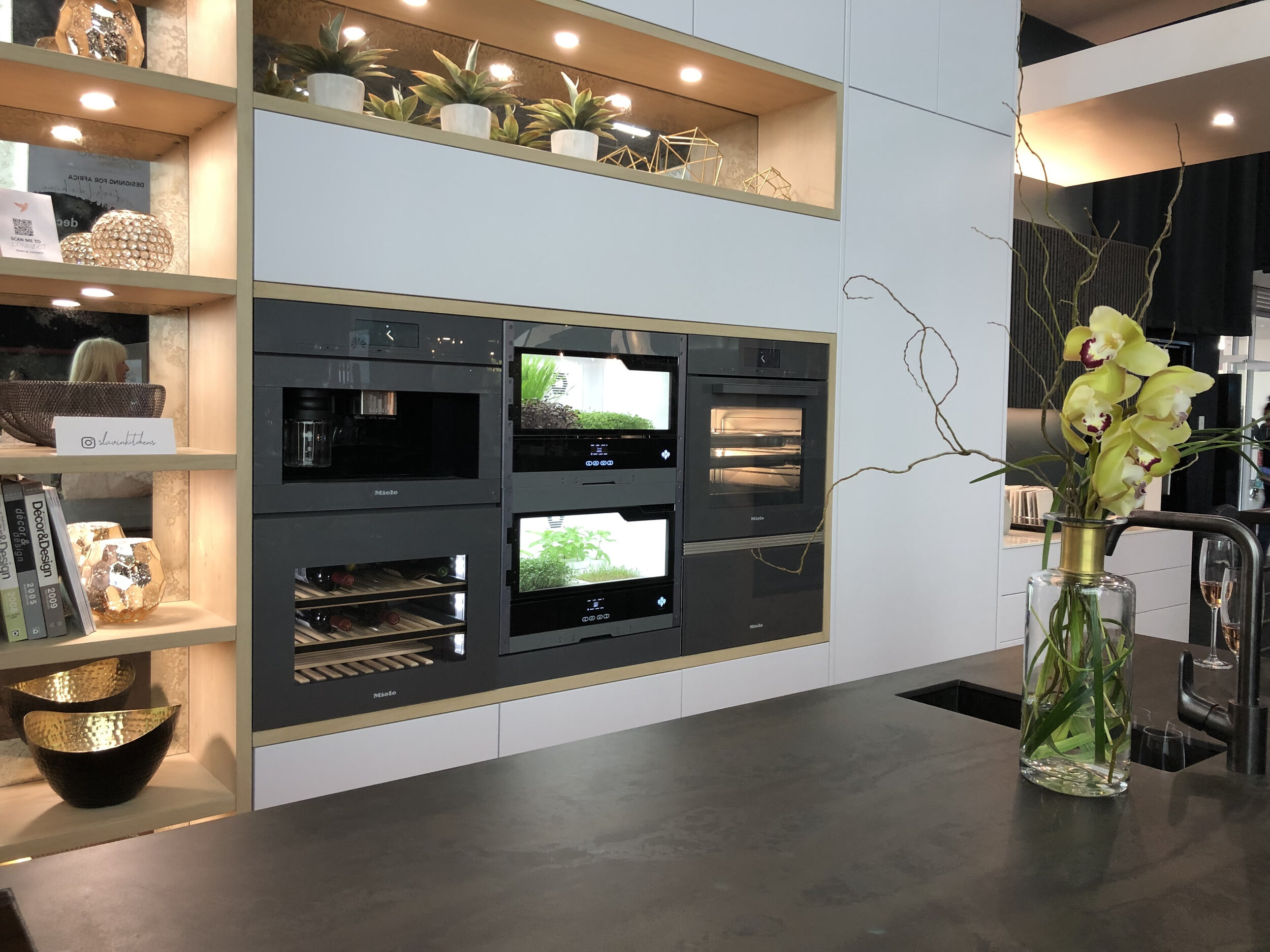
The Homefarm+Slavin stand really looked incredible, and the organizers agreed; awarding the stand as Best Kitchen Stand of Decorex 2019. The show was a fantastic opportunity for Homefarm and served as the public unveiling of our new Anthracite Grey product edition.


Homefarm also developed an Exclusive Black edition in 2019 when it partnered with another premium kitchen design company; Blu_Line. Homefarm now offers 3 color SKUs; White, Grey, and Black. This means that the Homefarm appliance can now seamlessly fit into your kitchen's color scheme.
Homefarm Product Development in 2019
At Homefarm, we never stop innovating and improving our product.
So far in 2019, since launching the product, we have released major improvements to the Homefarm App and on-board software. We have launched an improved watering system, various gardening merchandise, and the Homefarm Grow Pod System.
Homefarm Grow Pod System
The Homefarm Grow Pod System enables Homefarm users to grow, propagate and clone a variety of different garden crops. Some of our users are using the System to germinate and grow out-of-season, while others are using it to clone their prized plants.
A single Homefarm can grow up to 24 individual plants. Depicted above is a Homefarm growing basil clone cuttings as well as basil seedlings (in the foreground) grown from seed.
Homefarm is currently available for only R8499 from the Homefarm website.
If you enjoy eating fresh, healthy, home-grown food every day or you enjoy gardening; Homefarm is the product for you. It makes a great gift for family and loved ones. Why not treat yourself to one of the most gratifying products on the South African market today.
If you order now, your Homefarm can be delivered to your door, anywhere in South Africa within 1 week. You can email us at info@myhomefarm.io with any queries or to request a product catalog.
The Homefarm Team

Knowledge From Algae Industry To Better Vertical Farming System
PaiGE Growth Technologies Inc. entered into MOU with CubicFarm Systems Corp. in Langley, BC to study the effectiveness of combining vertical farming systems with its technology
PaiGE Growth Technologies & CubicFarm partner up
PaiGE Growth Technologies Inc. entered into MOU with CubicFarm Systems Corp. in Langley, BC to study the effectiveness of combining vertical farming systems with its technology.
If successful, the partners will provide an efficient, modular and readily deployable system to grow vegetables or plants using the latest advances in precision agriculture and vertical farming.
CubicFarms is commercializing industrial-scale vertical farming systems for multiple industries worldwide. The CubicFarms platform consists of a containerized, automated and environment-controlled system where trays of high-value crops like leafy vegetables and herbs follow a patented, undulating path that ensures ideal growing conditions.
Pond has developed a growth platform for algae and terrestrial plants using proprietary lighting, controls and artificial intelligence. Pond has granted PaiGE an exclusive license for the application and further advancement of this technology for terrestrial plants.
Improvements
As part of the MOU, PaiGE and CubicFarms envisage a multi-phase study to test the improvements from retrofitting the CubicFarms system with PaiGE technology. Each phase shall compare plant growth and resource input in a PaiGE-equipped growth cube against a standard unit – first incorporating proprietary lighting, then sensors, and finally a precision nutrient and water dosing system. In each phase, PaiGE shall provide the engineering design, coordinate equipment manufacturing, and installation, and run and assess trials. If the trials prove successful and CubicFarms decides to incorporate PaiGE technology into its growth cubes, CubicFarms agrees to pay PaiGE licensing fees for its technology. PaiGE shall retain intellectual property developed by it throughout the joint project.
Increase local production
Dave Dinesen, CubicFarm’s CEO commented: “Our commercial-scale modular CubicFarm growing machines allow our partner farmers to increase local production of nutritious vegetables, herbs, and many other crops, helping to address both food security and the environmental footprint associated with transportation. We’re excited to incorporate PaiGE precision technology with the goal of improving resource efficiency and crop yields.”
Steve Martin, PaiGE CEO stated: “The partnership with CubicFarms allows us to demonstrate Pond’s growth technology in the terrestrial environment, potentially opening the door to a whole new category of applications. CubicFarms is the ideal partner for us to evolve the PaiGE technology as their growth cubes provide a fully controlled environment – similar to Pond algae bioreactors. As a technology provider to CubicFarms, we are excited to support their mission of advancing sustainable precision agriculture and vertical farming.”
Publication date: Wed, 23 Oct 2019

A New Vertical Farm Is Coming To Compton. Is This The Solution To The World’s Global Food Crisis?
At a nondescript gray building about 10 miles south of the Mission District, a team of a couple of hundred people is trying to make vegetables taste better. This is the headquarters for Plenty, a company in the business of vertical agriculture — using hydroponics (growing plants without soil) to farm in an enclosed space
A look inside the Plenty farm in South San Francisco. The company will open a farm location in Compton in 2020. (Plenty)
By JENN HARRIS STAFF WRITER
October 25, 2019
South San Fransisco — At a nondescript gray building about 10 miles south of the Mission District, a team of a couple of hundred people is trying to make vegetables taste better.
This is the headquarters for Plenty, a company in the business of vertical agriculture — using hydroponics (growing plants without soil) to farm in an enclosed space — which is a long-in-development new frontier of farming that is starting to get to a place of technological efficiency that will allow it to scale commercially. In a space the size of a basketball court, the farm is growing kale, arugula, bok choy, beet leaves, fennel, and mizuna.
At Plenty, the mission is to make plants that taste so good, you’ll want to eat them over everything else.
Chief executive and co-founder Matt Barnard, 47, claims that Plenty not only uses 1% to 5% of the water used to grow comparable crops on a traditional farm but also uses a fraction of the land — and he’s doing it all in a 100% renewable facility powered by a combination of wind and solar energy.
After launching the South San Francisco farm this summer, the company will announce Friday that it has inked a deal to open a second vertical farm, this time in Compton. It will take just a few months to get the 95,000-square-foot facility up and running, but the farm is not expected to bring produce to market until late 2020.
Once completed, Plenty will supply produce to dozens of Southern California restaurants, including Nancy Silverton’s Osteria Mozza and Pizzeria Mozza, as well as hundreds of grocery stores.
The farm will be the largest of its kind in the greater Los Angeles area and one of what Plenty hopes is at least 500 farms around the country in densely populated urban areas with 100,000 or more people.
“By doing that, we increase access and availability through high-quality produce, change behaviors and get people to eat fruits and vegetables in lieu of snack food,” Plenty spokeswoman Christina Ra said.
Besides restaurants and grocery stores, the company also hopes to make inroads in local schools. Plenty is in talks with the city of Compton schools to create a partnership that will bring the farm’s produce and technology to kids in the area.
The company declined to say how much it will cost to build and operate the new facility, but Barnard said he plans to create dozens of jobs by hiring locally.
“Compton has rich agricultural roots and Plenty Farms is continuing that tradition,” Compton Mayor Aja Brown said in a statement.
Employees check on produce in a processing room at the Plenty farm in San Francisco. (Plenty)
In the center of the San Francisco warehouse, the Plenty farm is wrapped in a foil-like material that reaches from the concrete floor to the ceiling like an alien fortress. Giant dehumidifiers hum loudly on the outskirts of the rooms.
Once the farm is running at full capacity next year, Plenty claims it will be able to grow enough produce for more than 100 grocery stores. The growing capacity in Compton will be even greater.
Visiting the farm requires hair nets, beard nets, full jumpsuits, booties, gloves and special glasses; the vibe is less American Gothic and more like a movie about a world-ending virus.
The crown jewel of Plenty is the growing room, where plush greens sprout out from tall vertical towers that blend into each other like rows of continuous living walls. Opposite the plants are glowing strips of LED lights. Once the plants spend a few days in the growing room, the towers move along a track out into a processing room. A robotic arm turns the towers on their side, slices off the produce, then sends the greens to a room for packaging.
People manage and sterilize the machines, but no human hands actually touch the produce at any point in the farming process.
“There’s no need to wash our product,” Barnard said. “You know those bags of lettuce that say triple washed? They are washed in bleach. We don’t think people should have to eat pesticides or bleach.”
An employee checks on some produce at the Plenty farm in San Francisco. (Plenty)
Barnard, who grew up on a farm in Wisconsin, sees vertical agriculture as a way to address obesity, drought and food shortage problems — along with eliminating the need for your salad spinner. According to a 2018 USDA report, the earth will need almost 70%more food, 30% more water and more than 50% more energy production by 2050.
In a conference room at the farm, Barnard and Olivia Nahoum, the senior product development and sensory manager for the company, have set out a tasting of sorts. Using tweezers, Nahoum places borage flower, pea herb, wasabi flower, wasabi leaves, and purslane on a plate and instructs me to try them.
Tasting the pea herbs, fairy-sized green leaves attached to tinier stalks, is like biting into a raw snap pea with a freshness and earthiness likely better than the real thing. Purslane tastes of an ice-cold glass of sweet and sour lemonade on a hot summer’s day. Borage flowers, gorgeous sky blue blooms with white centers, evoke
a mojito, with pure sugar and notes of fresh cucumber. The wasabi flowers look innocent enough, but the delicate petals pack a peppery punch. The wasabi arugula leaf was the strongest of the bunch, offering up a nose-tingling slap of wasabi.
But the bulk of what Plenty grows is not fancy herbs. I also sampled baby kale that was soft and sweet, an unbelievably peppery arugula and a mixture of green and purple bok choy that made me think of baked potatoes.
Those greens have impressed Los Angeles chef Nancy Silverton, who is on the board of the company as a culinary advisor and collaborator.
“I was so blown away,” Silverton said of her visit to the farm. “The idea that this not only can be done, but I was so surprised by how good everything tasted.”
Chef Dominique Crenn, who is also on the Plenty board, uses a purple butterfly herb that Plenty grows to add a bit of tartness to her black cod dish at her San Francisco restaurant Atelier Crenn.
In order to tweak flavor profiles, scientists adjust what Barnard refers to as the light recipe of a plant. When you’re outside, everything is up to mother nature; Barnard said the climate, soil and overall growing environment “algorithm” determine a plant’s flavor. Inside, he and his team are adjusting the lights, air temperature and humidity to coax the maximum amount of flavor from the produce.
“For our kale, we can take the flavor spectrum and move it from bitter to sweet so that it’s more balanced and easier to eat healthy food,” Barnard said. “Now that we have brought the farm inside, we can control the things that control flavor and change the recipe in order to make plants that people like.”
Plenty has a plant and flavor science team in Wyoming that tests seeds and varieties to figure out which have the most flavor potential. In the last year, the facility tested 700 kinds of produce. Although most of what Plenty produces are leafy greens, Barnard said they are working on strawberries as well.
It may sound like something out of “Blade Runner,” but Chris Dardick, lead scientist and plant molecular biologist with the USDA’s Agricultural Research Service, says this type of flavor manipulation is feasible.
“Scientifically, I don’t know how much data or evidence there is yet on that, but from our own experience, fruit crops that develop sugars and flavors are influenced by environmental conditions like the amount of sunlight,” Dardick said. “Those properties can be manipulated if you have control over lighting conditions and temperature.”
He is doing his own work with vertical farming and sees immense potential.
Inside the Plenty farm in San Francisco. (Plenty)
“One of the ways we [USDA Agricultural Research Service] got interested in vertical agriculture was the idea being we could take an orchard and bring it indoors,” he said. “We work on fruit crops, particularly temperate trees like peaches, plums, apples, and pears.”
Most of those fruit are challenging to farm indoors because of their size, shape, and need for dormancy. The research Dardick is doing may make it possible to grow these fruit year-round, without the need to wait between planting a seed and the fruit flowering.
Plenty is not the only company to attempt vertical agriculture. There’s Bowery Farming and Farm One in New York, Buckeye Fresh in Ohio, and Canadian Grocer in New Jersey. NASA started testing crop systems with shelves of hydroponic systems at the Kennedy Space Center in the late 1980s. The scientists grew wheat, soybeans, potatoes, lettuce, tomatoes and a couple of attempts at rice in a controlled chamber as a way to test a volume-efficient approach to farming in space.
Raymond M. Wheeler, who was on the team that tested the crop system in the 1980s, said they used high-pressure sodium lamps similar to the orange-colored street lights you see on many city blocks to grow the plants. The lights, he said, were far from efficient, so Wheeler was encouraged by Plenty’s LED light system, the company’s focus on flavor, and what that could mean for growing plants in space.
“If someone can come up with a very flavorful, very nutritious leafy green or a range of types, that would be perfect,” Wheeler said. “You have to get people to eat on space missions so any way you could kind of help that out by enhancing flavor, the texture, the colors, all these things and the nutrients are all a good thing.”
Although the benefits of vertical farming are generally touted as positive, some critics point out that the energy it takes to fuel a hydroponic facility can be excessive. According to Paul Zankowski, a senior advisor at the USDA, it all depends on a farm’s location.
“It all depends on where it is grown and the energy factors of that city,” he said.
Plenty is still working out what will be grown at the Compton farm and where it will be available. The company is currently selling salad boxes of greens for $4.99 at small retailers in the Bay Area like Good Eggs and Bi-Rite, and some of the produce is available at restaurants like the San Francisco robot burger joint Creator.
“We’re looking to compete with the whole middle section of the grocery store — all that dead stuff with highly processed sugars and lots of calories,” Barnard said. “We want to compete straight up on flavor.”
Jenn Harris is a senior writer for the Los Angeles Times Food section. She has a bachelor’s in literary journalism from the UC Irvine and a master’s in journalism from the University of Southern California. Harris covers restaurant news, dining trends, chefs and cocktails. She’s also the unofficial fried chicken queen of Los Angeles. She once visited 22 bars and restaurants in a single day for a story. If you want to see what she’s eating now, follow her @Jenn_Harris_ on Instagram.

VIDEO: The Indoor Farming Revolution
Growing crops in shipping containers could drastically reduce the economic and environmental costs of farming
Growing crops in shipping containers could drastically reduce the economic and environmental costs of farming.
Source: CNN

Can Container Farming Help Meet The Rising Demand For Local Food?
With container farming, farmers can actually control the climate, along with soil, quality, heat and even light exposure. The containers use technology to be retrofitted with heating and water systems, and gas and electrics can also be installed to offer a whole host of benefits for crops and farmers alike.”
October 24, 201
© Andrii Zastrozhnov |
With the demand for local produce constantly rising due to environmental, economic and quality reasons, Johnathan Bulmer, MD at Cleveland Containers, has urged for more pick up on container farming
He suggests that, with Brexit also looming and causing uncertainty as to where the weekly food shop will come from, container farming can produce many of our favorite fresh produce in the UK. The fully contained structures allow for year-round growth no matter the weather or available land.
Bulmer said: “Most of us are eating produce that has traveled thousands of miles from its source. One of the reasons why UK supermarkets sell fruit and vegetables which aren’t often produced in the country is that farmers face the challenge of providing seasonal produce all year round – which isn’t possible with changing weather conditions.
“But with container farming, farmers can actually control the climate, along with soil, quality, heat and even light exposure. The containers use technology to be retrofitted with heating and water systems, and gas and electrics can also be installed to offer a whole host of benefits for crops and farmers alike.”
This modern twist has helped farmers to produce goods all year round, avoiding common restrictions such as extreme weather, pests, and seasonal struggles.
Bulmer estimates that container farms can produce up to 4,000 heads of lettuce every ten days, using no soil and 97% less water than a conventional farm.
“Crops are protected from nasty pests, eliminating the need for pesticides which can also cause health problems in those who consume them,” he continued.
One company, Freight Farms, has produced its ‘Leafy Green Machine’, which it claims to cut water demand by up to 98% using hydroponic container techniques, which could help to reduce demand on freshwater reserves.
Benefits of local produce
By cutting the distance that our food has to travel, greenhouse gas pollution from air freight is minimized, and the shorter distance means that it’s sold sooner after it’s grown and picked.
This benefits not only the taste due to it being fresher, but producers can also pick from a wider variety of fruit that has great flavor but doesn’t usually travel well so it isn’t sold.
He said: “There are a host of other benefits to container farming for local produce. It benefits the local economy, reduces the seasonality of foods, and also cuts down on plastic waste which is often multi-wrapped to protect it from travel.
“This boost in freshness can reduce food wastage and encourage more nutritional diets with simple, fresh ingredients. And you also don’t get the problem of land being in the wrong place or relocation restrictions, because container farms are so flexible. They can be easily stacked, which means farmers also won’t need to empty their pockets and pay for extra land to expand – you build up.
“We’re seeing a huge amount of farmers deciding to go down the container route in this country. The flexibility and option to mass-produce fruit and vegetables within such a short space of time, along with savings on waste usage means they can save costs, but produce seasonal fruit and veg all year, without being limited by space,” Bulmer said.
“There is a billion-dollar consumer demand for local food – let’s work together to achieve it.”
Cleveland Containers offers one of the largest nationwide stocks of new and used shipping containers, available throughout the UK.
Based in Middlesborough, its models for sale or hire come in all sizes to fit different needs. From 6 to 45ft, its specialized containers can be used for storage, office containers, site accommodation, farming, hospitality and more.

US: New York State - Youths Get Hands-On Lessons In Food Production
The equivalent of a 2-acre farm that grows 500 heads of lettuce a week hides inside a 40-foot-long metal box in a parking lot near the police station in downtown Troy
Boys And Girls Club Gets Indoor Hydroponic Farm
Steve Barnes October 23, 2019
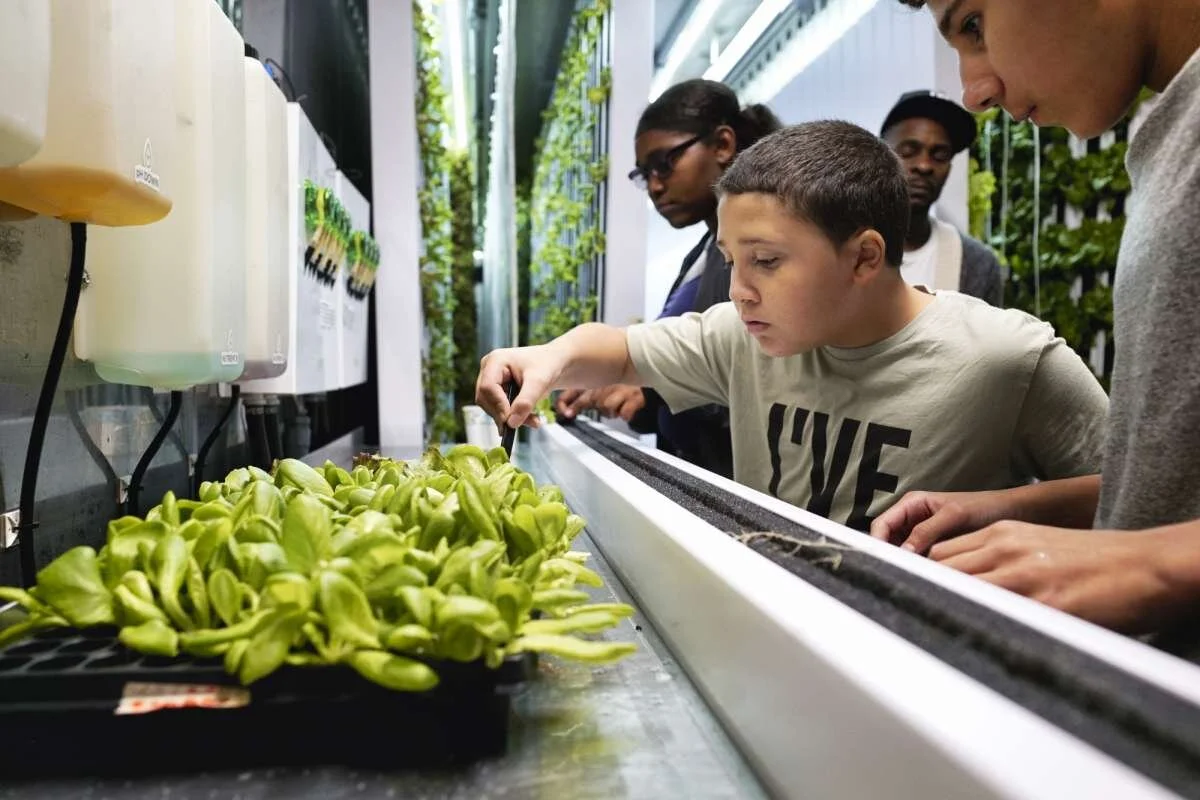


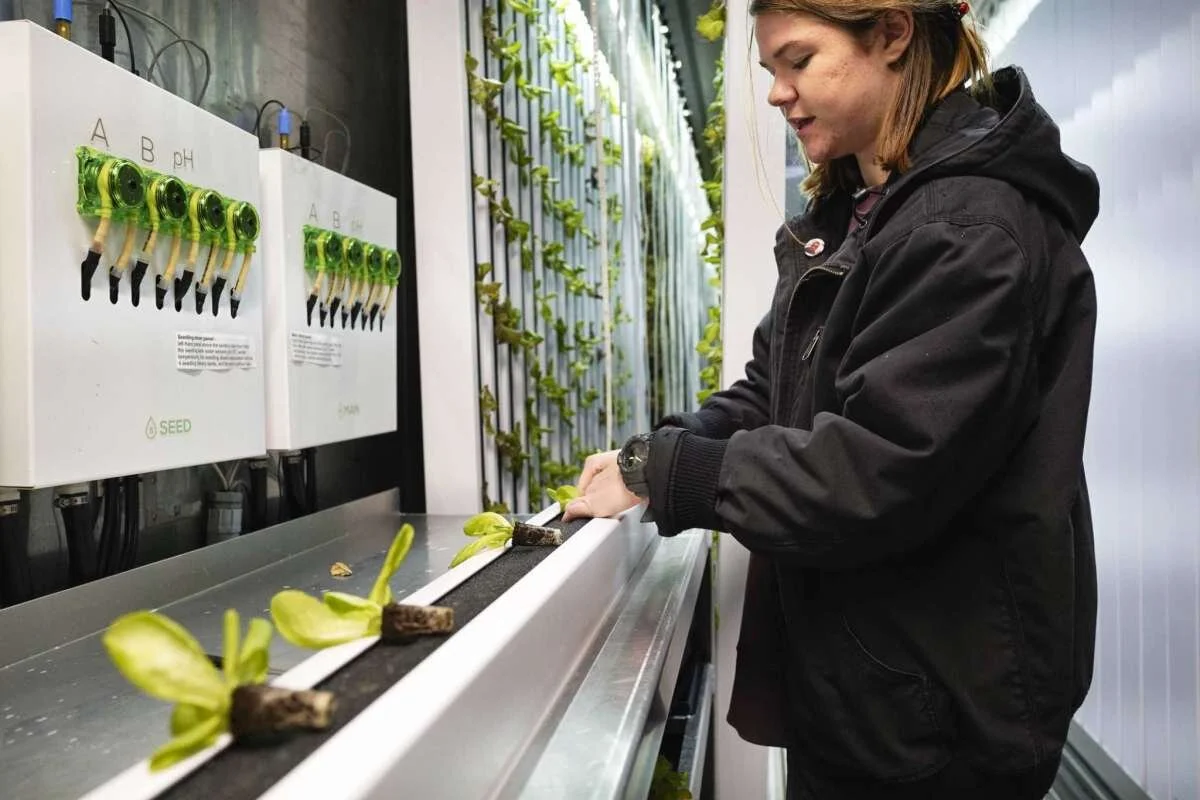




The equivalent of a 2-acre farm that grows 500 heads of lettuce a week hides inside a 40-foot-long metal box in a parking lot near the police station in downtown Troy.
The container farm, as it's called, or Freight Farm, after the Boston-based company that first introduced hydroponic growing systems in repurposed shipping containers, is a project of the Boy & Girls Clubs of the Capital Area. The $90,000 container farm was a gift from the SEFCU credit union, which for the past two years has operated a similar container farm at its offices near the Harriman state office campus in Albany.
Launched over the summer and overseen by two adult staffers, the farm gives young people who participate in the Troy club's after-school programs hands-on experience planting, growing, harvesting and selling fresh produce. Although the farm now grows only greens, including two types of lettuce plus kale and Swiss chard, seeds are available for a variety of items, from radishes and beets to herbs and flowers. They are being considered for future crops, according to the club.
"It's sustainable, year-round and ideally will generate income while giving our teens good experience with fresh produce," said Justin Reuter, CEO of the BGCCA. The organization, formed earlier this year by a merger of clubs in Albany and Troy, serves 5,200 young people annually and recently opened facilities in Cohoes and Green Island.
The unexpected gift of the container farm came out of a conversation early this year, during what SEFCU's president and CEO, Michael Castellana, described as a "good news/bad news meeting" with club leaders, who had asked for a $50,000 donation to pay for a summer program.
"I closed the folder and said, 'Absolutely not,' " Castellana said, a response that was startling because, he said, "We hardly ever say to no them." Instead, aware of the hit SEFCU's own container farm had become among employees and the food pantries its produce was donated to, Castellana proposed giving one to the BGCCA. The offer, he said, initially left club representatives slack-jawed.
"Once they closed their mouths, they said, 'Absolutely yes,' " he said.
Hydroponic growing is hardly new, having been used commercially at least since the 1930s when Pan American Airways established a hydroponic growing operation for vegetables on a Pacific atoll that was used as a refueling station for flights from the U.S. to Asia. But container farms like the one run by the boys and girls club are less than a decade old. Freight Farms, which started manufacturing in 2013, has installed about 200 worldwide.
The only three Freight Farms in the Capital Region, according to a company spokeswoman, are owned by SEFCU, the BGCCA, and Carioto Produce and Seafood in Green Island, which acquired one almost three years ago.
The lettuces raised in the boys and girls club's container farm — butterhead, or Boston, and a red-leaf variety called Lollo Rosso — and the other greens take eight weeks to grow from seed to harvest. Seeds are planted in trays in a soil-like medium of ground coconut shells, where they are watered for three weeks. The small seedlings, with a pyramid-shaped plug of growing medium around their roots, are then transplanted into one of 256 foam-lined vertical columns, each 7 feet tall, that hang in facing rows along the sides of the container farm, 10 heads to a column. Nutrient-laden water, fed from the top by a computerized system, trickles down the columns, and, overnight, LEDs shine specially calibrated light on the plants. With staggered planting, the farm, in theory, can produce more than 600 heads a week, though production hasn't yet ramped up to that volume.
The greens become part of the approximately 1,100 meals a day the BGCCA serves at its locations, and club staffer Patricia Doyle, who manages the farm, said the fact the food is home-grown seems to have generated more receptivity among members than preteens and adolescents might otherwise grant leafy produce.
"When you grow something, you're more apt to eat it," she said. "They're proud of it."
The 10 to 12 club members who work on the farm put their initials on the columns they've planted, following their heads through to harvest.
"I was interested because I like science and nature, and it attracted me because I wanted to do something for my community," said club member Kelyse Bell. The 13-year-old moved to Lansingburgh earlier this year from North Carolina, where she learned gardening from her grandmother.
"This is better for the environment, too — you grow more in a faster time than you would on land on a normal farm," said Bell.
The club sells its lettuces, for $2 per head, at the Troy farmers market on Wednesday afternoon, and, in its first of a hoped-for list of restaurant customers, to Brown's Brewing, for use in its taprooms in Troy and North Hoosick. Much of the approximately 200 heads Brown's buys each week is the base for salads for private events in its Revolution Hall banquet facility, adjacent to the brewpub on River Street in downtown Troy.
"The taste is amazing, the leaves are all intact, there's no dirt, insects, chemicals or anything like that," said Paul Minbiole, operations director for Brown's Brewing and one of those involved in the decision to start purchasing the club's lettuce. He said, "It's processed and delivered to us the same day. You can't get much fresher than that without picking it yourself."
Being able to give a social-services nonprofit for youth the opportunity to expose its members to farming is part of SEFCU's larger mission of offering nontraditional growth opportunities and benefits for the communities it serves, said Castellana.
"SEFCU is committed to trying to change lives by trying to minimize obstacles that people have in their life," he said. "Hunger is one of the most significant and overlooked obstacles that people have, and this is one way to start to address that."
Bell said she is pleased by what she's learned about one of the futures of farming in just a few months since she started coming to the Troy club.
Demonstrating her new knowledge, Bell said the container farm operates at 60 degrees, with 55 to 60 percent humidity, and a higher level of carbon dioxide than in outside air.
"We're only supposed to be in here for about 45 minutes at a time," she said. "The air is good for plants, but people need more oxygen."
sbarnes@timesunion.com - 518-454-5489 - blog.timesunion.com/tablehopping - @Tablehopping - facebook.com/SteveBarnesFoodCritic
Follow Steve on:
Steve Barnes has worked at the Times Union since 1996, served as arts editor for six years, and since 2005 has been a senior writer.
Since 2006, Steve has passed along his knowledge, or at least his opinions, to young writers as a journalism instructor at the University at Albany.
Contact him at (518) 454-5489
Past Articles from this Author:

Resource Innovation Institute To Host Indoor Agriculture Energy Solutions Conference
As California policymakers develop codes for Controlled Environment Agriculture (CEA), Resource Innovation Institute (RII) will convene the inaugural Indoor Agriculture Energy Solutions (IAES) Conference, connecting policymakers, utility program managers, equipment manufacturers and suppliers, researchers, manufacturers, cultivators and investors to shape the future of energy policies and utility programs for CEA. The IAES Conference will be held at the San Diego La Jolla Marriott on February 24-26, 2020.
SAN DIEGO, CA – As California policymakers develop codes for Controlled Environment Agriculture (CEA), Resource Innovation Institute (RII) will convene the inaugural Indoor Agriculture Energy Solutions (IAES) Conference, connecting policymakers, utility program managers, equipment manufacturers and suppliers, researchers, manufacturers, cultivators and investors to shape the future of energy policies and utility programs for CEA. The IAES Conference will be held at the San Diego La Jolla Marriott on February 24-26, 2020.
Expanding on RII’s mission to advance resource efficiency in the rapidly expanding indoor agriculture sector, this first-of-its-kind event arrives at a critical moment in time for controlled environment agriculture. Cannabis legalization is accelerating across North America, and the urban and vertical farming sector is scaling rapidly for crops of all kinds. As a result, the carbon and energy implications of indoor controlled environments are becoming more impactful. Drawing from the experiences of early models adopted by cannabis cultivators, this conference will explore energy solutions for indoor agriculture without focusing on any one crop.
Conference attendees will access educational sessions presented by experts in the field, connect with leaders in the industry and discuss cutting-edge policies and technologies. IAES will elevate innovative solutions related to energy access, efficiency and sustainability and shape the future of indoor agriculture.
“We have the opportunity to take the lessons learned from initial government, utility and non-profit responses addressing the energy and carbon impacts of regulated cannabis and apply them to the broader world of controlled environment agriculture,” said Derek Smith, Executive Director of RII. “As the highest margin crop among a set of leafy greens and small vegetables, cannabis cultivation is driving billions of dollars of privately funded R&D into efficient lighting, automation, and greenhouse design. These learnings will inform controlled environment agriculture broadly. Just as non-cannabis CEA learnings will inform cannabis. This is precisely why we are hosting the Indoor Agriculture Energy Solutions conference. And we look forward to convening top stakeholders to join the dialogue.”
Registration can be secured via https://www.iaesconference.com/registration.
About Resource Innovation Institute
Resource Innovation Institute (RII) is a non-profit organization whose mission is to advance resource efficiency to create a better cannabis future. Founded in 2016 in Portland, OR, USA, RII’s Board of Directors includes the American Council for an Energy-Efficient Economy (ACEEE), a former Energy Policy Advisor to two Oregon governors, a former board member of the US Green Building Council and leading cannabis industry players.
The organization has unique expertise on data, policy, and education related to cannabis energy use. Its Cannabis PowerScore benchmarking survey is backed by the world’s largest dataset on cannabis energy use. RII’s Technical Advisory Council is the leading multi-disciplinary body assessing the environmental impacts and best practices associated with cultivation resource issues. In 2018, RII advised the Commonwealth of Massachusetts on the establishment of the world’s first cannabis energy regulations, and it is now advising other governments. RII’s Efficient Yields cultivation workshops are the only grower-led, non-commercial venues for the exchange of resource-efficient cultivation best practices.
RII is funded by utilities, foundations, governments, and the cannabis supply chain.
Visit our website at ResourceInnovation.org. Follow us on LinkedIn, Facebook, Twitter and Instagram.