


Welcome to iGrow News, Your Source for the World of Indoor Vertical Farming

This Farming Style That Skips Soil And Adds Fish Is Growing In Popularity
Aquaponic farming is not a widespread practice, but it is expected to grow. According to Future Market Insights, the global aquaponics industry is expected to grow more than 7 percent in the next 10 years. In 2018, the United States was home to about 40 percent of all aquaponics operations globally.
Courtesy of Tom McPherson
Springworks Farm, a commercial aquaponics operation in Lisbon.
By Sam Schipani, BDN Staff
February 22, 2019
Aquaponics sounds like the stuff of science fiction. Instead of crops’ roots reaching down into the soil, they are suspended in water that is filled with live, swimming fish that sustain the plants with their nutrient-rich excrement. The closed-loop system is generally less disease prone and more water efficient than soil-based gardening, and at the end of the day, its farmers can sell plants from above the waterline and the fish from below.
Aquaponic farming is not a widespread practice, but it is expected to grow. According to Future Market Insights, the global aquaponics industry is expected to grow more than 7 percent in the next 10 years. In 2018, the United States was home to about 40 percent of all aquaponics operations globally.
The innovative growing method has the potential to make a splash in Maine’s agricultural scene, but first, it has to overcome market roadblocks and a marred past.
The story of Springworks Farm
The only active commercial aquaponics growing operation in Maine is Springworks Farm in Lisbon. Trevor Kenkel, the company’s founder, broke ground on Springworks Farm five years ago, when he was just weeks into his freshman year at Bowdoin College. The 6,000-square-foot facility raises tilapia and grows five different types of lettuce. Kenkel said the farm provides produce and fish to about 25 Hannafords and several distributors.
Courtesy of Tom McPherson
Springworks Farm, a commercial aquaponics operation in Lisbon.
“Our system is about 20 times more productive per acre than a conventional farm,” Kenkel said. “We have this whole web of organisms that allows us to be a steward of that system rather than controlling it.”
Along with their eco-friendly bona fides, aquaponic systems can provide local produce year-round, even during Maine’s harsh winters.
“Maine has a really strong local food movement that I think is really supportive of an operation like this that can produce local food all year,” Kenkel said.
Growing local has an added sustainability benefit: reducing food miles. Most of the lettuce in the United States is grown in California and Arizona, whereas Maine-grown aquaponic lettuce does not accrue the carbon generated by a cross-country journey.
“In terms of carbon use, the amount that you save by reducing the 2,500-mile trucking journey to 200 miles is really incredible,” Kenkel said.
Kenkel said that Springworks Farm is still in “growth mode,” but the outlook is good. It recently broke ground on a second greenhouse.
Courtesy of Tom McPherson
Trevor Kenkel, founder of Springworks Farm, a commercial aquaponics operation based in Lisbon.
But promising aquaponics operations have failed in Maine before. Fluid Farms, billed as the first commercial aquaponics operation in the state, was founded in 2013 in Dresden following a successful Kickstarter campaign that raised more than $9,000. In 2016, it won the $50,000 grand prize in Gorham Savings Bank’s LaunchPad competition. The company was even certified organic by Maine Organic Farmers and Growers Association.
Now, only a few years later, Fluid Farms appears to be no longer operational. According to the Maine Secretary of State’s office, Fluid Farms administratively dissolved in 2018. Tyler Gaudet, one of the founders, declined to comment on what happened to the company.
Aquaponics in the classroom
Aquaponics is used primarily as a learning tool in Maine.
Maine Agrotech in St. Albans, designs, installs and provides technical support for small-scale aquaponic systems throughout the state. Jeff Giallombardo, Maine Agrotech’s founder, said most of its customers are universities and high schools, though he has installed a few at private residences as well.
“The interest now seems to be in the education sector,” he said.
Giallombardo started Maine Agrotech after using aquaponics as an educational tool for an alternative education program for Nokomis Regional High School in Newport.
“I got involved with aquaponics to try to deliver engaging and interdisciplinary instructions to students in my program,” Giallombardo said. “I got inundated with requests from people wanting to know how to do it.”
Education is built into the business model for Springworks Farm, too. Kenkel said the farm has been an educational operation “from the start,” conducting tours and selling small aquaponics kits for aquariums as a didactic tool.
Courtesy of Tom McPherson
Lettuce grown at Springworks Farm, a commercial aquaponics operation based in Lisbon.
“We have those now in something like 130 schools and a curriculum to match,” Kenkel said. “I kind of wish I had that growing up. A micro-farm lets you experience things the hands on way.”
University of Southern Maine is one of the schools that takes regular field trips to Springworks Farm. Theodore Willis, associate research professor at the university, started using aquaponics to teach a land-based aquaculture and research methods class in August 2017. The 10-tank aquaponics system — housed in a university laboratory — grows lettuce, celery, bell peppers and kale alongside tilapia, which is the fish most commonly used in aquaponic systems.
In Willis’ experience, aquaponics is a valuable learning tool, but can be challenging to manage. During the school year, Willis has a steady stream of students to help tend the system, and the school cafeteria and catering services use the produce grown in meals on campus. Summer vacation, on the other hand, proves challenging.
“It works well for nine months out of the year, but for three months we are trying to figure out what to do with the various things we are growing down there,” Willis said. “I’m relying on undergraduate volunteers to come in and clean things and feed fish.”
Roadblocks to aquaponics in Maine
On a larger scale, the small university scheduling issues could translate into real world roadblocks for commercial aquaponics operations.
“If you have any aquaculture system on a large scale, you have to have the financial backing and the personnel to keep it running,” Willis said.
Like at the university, having consumers for aquaponically grown products is also essential to the operation’s success.
“You have to be able to move product,” Kenkel said. “Lettuce has a very short shelf life.”
Unlike at the university — Willis said he is not looking to make money off of its system — consumer preferences matter for commercial operations. Aquaponically grown crops also tend to be more expensive than their soil-based commercial farmed counterparts.
“It is a relatively expensive way to grow food, so there is usually a premium price point on it,” Willis explained. “You have to get the consumer to recognize that head of organic romaine for $2.99 drove thousands miles and was grown with water mined from aquifers, whereas one from aquaponic operation that is $3.25 was grown locally with no added fertilizers.”
Courtesy of Theodore Willis
Associate research professor Theodore Willis growing aquaponics at the University of Southern Maine.
Finding a market for aquaponically grown food and fish in Maine is also going to be a challenge. American consumers have less of a taste for tilapia, the primary fish grown in aquaponic systems. Tilapia is, as Willis described, “a bulletproof teaching fish” because it is so hardy and forgiving. But it is difficult to sell.
“[Tilapia] is a not particularly strong-flavored white flesh fish, like flounder,” Willis said. “A lot of this is training the consumer to accept a different taste than they are used to.”
Not only is it challenging to turn a profit on aquaponically grown products, but also the upfront costs for the energy and infrastructure required for an aquaponics operation are steep. The extreme weather conditions throughout the year make keeping the system at relative stasis especially difficult in Maine.
“In Maine, you’ve got fairly hot summers paired with pretty brutal winters. Keeping things consistent in that kind of environment is difficult,” Kenkel said. “With the right kind of equipment and processes in place, it’s certainly achievable, but getting started is very difficult compared to other kind of agricultural systems.”
Overcoming challenges and the future of aquaponics in Maine
These roadblocks could have prevented commercial aquaponics operations from succeeding in the past in Maine.
“I don’t think anyone has quite figured out the energy equation in Maine in terms of lighting, heating and cooling,” Giallombardo said. “I’m not sure anyone has figured out the market yet either, and what crops are the most profitable.”
Giallombardo believes culinary herbs are an opportunity for aquaponic growers, as most of the herbs sold in supermarkets are grown in the southern United States.
“You can get a much higher quality product grown locally at a better price point right now,” Giallombardo said. “That’s really your best bang for your buck in my research.”
The educational interest in aquaponics across Maine could help with one of its biggest barriers to entry: knowledge.
“People just don’t know enough about aquaponics here,” Giallombardo said.
Giallombardo predicts that the aquaponics industry, as well as similar industries like recirculating aquaculture and indoor agriculture, will only continue to grow in Maine. The proliferance of aquaponics learning tools in classrooms, he said, will prove especially useful as job training.
“You can use these systems really to educate on all of these industries and prepare students for jobs that are no doubt going to be there soon,” Giallombardo said.
Though Springworks Farm still stands alone, Kenkel is also hopeful about the potential for small-scale growers, whether in classrooms or their own homes, to branch out in the future.
“I think there’s a strong community of people who do it on a smaller scale,” Kenkel said. “I wouldn’t be surprised if more people struck out and built larger systems.”

Indoor Agriculture May Hold The Future of Food
Paris has meanwhile come up with its own urban agriculture model, dubbed “Pariculteur,” a series of town hall-mandated projects designed to cover as much of the capital as possible with greenery via a rise in urban farming. An initial 10 hectares for the project is set to grow to 30 hectares by next year
Published: February 24, 2019 AFP
AeroFarms co-founder Marc Oshima. AeroFarms of Newark, New Jersey, is the largest vertical farm in the world.Image Credit: AFP
Paris: In a world faced with the conundrum of mountains of waste and obesity for some and dire shortages and malnutrition for others the future of food is a main dish on today’s global menu.
A key ingredient is the trend in ever more imaginative forms towards urban agriculture, a multi-faceted recipe already being poured over by some 800 million people globally, according to the UN’s Food and Agriculture Organisation.
The trend takes many forms - from collective market gardens in even the most run-down of urban districts to connected vertical farms using indoor farming techniques to meet spiralling food demand in areas largely bereft of arable land.
Today, with our containers, we are 120 times more productive per square metre than on open ground.
- Guillaume Fourdin | Founder, Agricool
Yves Christol, of French cooperative In Vivo, has identified six models of the genre.
They include a key European variant, electronically managed without recourse to pesticide - or even soil or sunshine.
Green beans means ... Iceland
“That has allowed Iceland to become a major producer of green beans,” says Christol, thanks to geothermal heating.
Asian countries are also in on the act, not least Singapore, with the high density population city state bent on ensuring high-tech food autonomy.
Japan and China have sought to give new life to sites which once hosted electronics factories even if the strategy appears costly.
AeroFarms co-founder Marc Oshima. AeroFarms of Newark, New Jersey, is the largest vertical farm in the world.Image Credit: AFP
China has launched some urban farms even in areas where the soil has been polluted by heavy metals and would be too costly to clean up.
The US model, as cities including New York and Chicago seek to become sustainably hunger-proof, includes hydroponic gardens - effectively eschewing soil and using mineral nutrients in a water solvent, although profitability can prove elusive.
But scale is an issue and the concept will not be viable “so long as the price of the vegetables is not increased fourfold,” to cover energy costs, says Christol.
Strawberry containers for ever
The cost of transporting food is something which particularly exercises entrepreneurs such as Guillaume Fourdinier, a founder of French start-up Agricool in Paris and Dubai.
His firm produces strawberries year round in shipping containers fitted out with LED lighting. Urban agriculture’s raison d’etre, he says, comprises fighting against “the ecological disaster of transport”.
“Today, with our containers, we are 120 times more productive per square metre than on open ground,” says Fourdinier.
“We produce in decentralised fashion and closer to customers,” he adds of strawberries sold marginally cheaper than their organic equivalent.
Paris has meanwhile come up with its own urban agriculture model, dubbed “Pariculteur,” a series of town hall-mandated projects designed to cover as much of the capital as possible with greenery via a rise in urban farming.
An initial 10 hectares for the project is set to grow to 30 hectares by next year.
Urban ecologist Swen Deral, who oversaw a pan-European urban agriculture project last year, says if the concept is to be financially viable in cities it has to go “beyond production”.
“Either they recycle, or else they create services linked to urban agriculture, educational activities, restaurants and the like,” he explains.
Researchers point to urban agriculture’s additional benefit of fighting against the effects of climate change as its proponents seek to reinvent urban existence.
Francois Mancebo, researcher at France’s Reims University, summed up the challenge in an article published by peer-review open access publisher MDPI and entitled “city gardening: managing durability and adapting to climate change thanks to urban agriculture.”
Mancebo says the concept must become an integral part of urban planning with local politicians underlining the need for active participation of city dwellers.

Simple Secrets To Start A Vertical Farm
Talking to people just like you, it’s clear that the first step is always the hardest on the road to building a vertical farm. The plunge into the unknown where your own time, capital, and dreams are at risk stops a lot of entrepreneurs from fulfilling their ambition. Fortunately, Matt Farrell took that step for you and tells all in this exclusive interview on the Urban Vertical Project. Keep reading because Matt talks about:
Location, location, location (where to put your vertical farm)
The honest truth about Zip Grow Towers
How much money can you actually make when you start a vertical farm (what restaurants will pay you)
The simple secret of getting customers who pay
I know why taking that first step to start your farm is scary; it means taking a big chance with your time and money to do something that doesn’t really have a standard set of procedures.
I am right there with you. Chances are, if you’ve found this article, you’ve thought about what it takes to make one of these bad boys a reality. Maybe you’ve done some daydreaming or vision boarding, or maybe you’ve even built a small system. In the end, we’ve all probably come across or conjured within our own imaginations an idea for a vertical farm that works, but that’s a far cry from actually making it a reality.
How do you go about doing that? For me, I’m going to follow the process for starting a vertical farm I modeled off another entrepreneur in an earlier article:
Set up a proof of concept
Secure a buyer
Execute
Even knowing a structure like that one exists, transforming that to reality is a different story. But, as my favorite (and legendary, if you can believe such a thing) street performer says “It’s better to go out and do something than to stay home and plan something.”
So, I went out and did something. I helped my father buy a bunch of IKEA products and convert them into a hydroponic system for less than $100. It was a start.

Now I’m working on another prototype, and I hope to actually maintain this one. My goal with this next system is to collect and analyze a bunch of data to project future results like yields, energy costs, and calories/square foot. Maybe that will turn into an open source project that people can turn to for up-to-date information, or perhaps it will evolve into a farm in its own right. In addition to that prototype, I’ve been doing tons of research for different people that’s helped them to think about their own, personal businesses and projects.
Even so, if all of my work turns out perfectly, it still exists in a vacuum. Simply put, there isn’t enough information out there to for people to make realistic comparisons or projections for their own farm. Other websites and news articles have featured fantastic farms, ideas, and projects, but there aren’t a lot of actionable numbers. That partly comes from being in an industry that’s too scared to share (something we’ve mentioned before and that projects like MIT CityFarm is working to overcome). That’s why we work so hard to bring you these exclusive interviews and why we get down and geeky – getting the nitty gritty numbers. I want you to have a successful urban vertical farm.

All of that is to say, I’m working on my first step and outlining that process for you. But this article isn’t about just the first step; it’s about revealing the simple truths real farmers know that can help you think more realistically abut your project.
And that’s where Matt Farrell comes in. Matt has been into hydroponics for awhile, but he doesn’t come from any sort of traditionally agricultural background.

He was studying in the School of International Service at American University where he got hit with the idea to help the school build a small hydroponic system. Though the school has taken it down since, his dedication to the idea of local, high efficiency farming has persevered. Now, he’s out on his own running Stag’s Leap Produce. Their tagline:
“Always Fresh. Never From A Shelf.”
The site goes on to explain their goals a bit more: “We want to connect the community to a local source of fresh, organic produce at an affordable price. Come try the freshest, healthiest produce around.”
I’ve known Matt personally for awhile now and he was generous enough to take time out of his busiest growing season to give me some exceptionally candid answers about his experience getting his farm up and running.
Location
In this section, we’re going to take a quick look at why the location of Matt’s farm is so important and why it means you might have more flexibility than you thought in where to put your vertical farm.

Matt is the owner operator of Stag’s Leap Produce in Mullica Hill, New Jersey. Another New Jersey Farm, huh? Just like Freshwater Greens (from an earlier interview), Stag’s Leap produce illustrates a perfect lesson for aspiring vertical farmers to internalize; take advantage of local market access. In addition to supplying local restaurants and businesses (see below for a list Matt shouts out in addition to a local farmers market and customers that come to him directly), being in New Jersey means they potentially have access to the much denser populations in New York and the surrounding cities.
I talk a little bit more about the importance of these population centers combined with available space in the Rust Belt Hypothesis (you guys remember that, right? Probably not, I wouldn’t either, so here’s a link), but Stag’s Leap might demonstrate an alternative, or even start to unravel that hypothesis. Remember, the Rust Belt Hypothesis is the idea is that declining industrial cities are perfect environments for vertical farms because of the inherent socioeconomic conditions there. Those conditions include: population density, existing infrastructure (usually in the form of abandoned warehouses from the manufacturing golden age), cheap energy, local community support (jobs!), and legislative support to revitalize a struggling economy.
But check this out!
Mullica Hills New Jersey is definitely not a Rust Belt City. So, if Stag’s Leap demonstrates that a vertical farm can work in less dense populations like there, that means the demand for these products (fresh, local vegetables available year round) and the expertise required to produce them is even higher than we expected. It means that if farms like Stag’s Leap become the norm, or even just more common, vertical farms will have demonstrated that they can fill needs beyond urban centers. That opens up huge swaths of the country that would otherwise wouldn’t have been considered; well beyond what’s normally considered the Rust Belt as seen below.

And according to Matt, that fits in perfectly with their mission: “We believe you should have the ability to purchase fresh, healthy, produce straight from its source. Without harmful chemicals or pesticides, at an affordable price.”
How is Matt growing food?
But how exactly is Matt meeting this demand? “I grow lettuce, basil, kale and arugula. I have two types of growing systems, Bright Agrotech’s Zip Grow Towers and custom made shallow water floating rafts.”

Image from Bright Agrotech
Essentially, he is using two types of growing systems inside of one 3000 sq ft greenhouse. Zip Grow towers utilize a wicking medium to deliver water and nutrients to plants.
Here’s a video directly from Bright Agrotech that explains in more detail how the Zip Grows work.
The floating rafts Matt describes to me seem like a conventional deep water culture (DWC) setup, though he’s modified this idea a bit by making the reservoirs shallower. I’ll let the folks at Boswyck Farms in New York City describe what that is as they have one of the few hydroponic certifications around and are really knowledgeable growers in general.
[DEEP] WATER CULTURE
Water culture systems are the simplest form of active hydroponics. Plant roots grow directly in the water reservoir and are supplied oxygen with an air pump. Water culture systems can be built from repurposed glass mason jars, plastic buckets, or tubs as the reservoir container, with the plant suspended from the lid in a net pot, letting the roots grow through the holes into the water below.
In larger, commercial scale designs, several plants are placed in a sheet of buoyant material that floats on nutrient solution like a raft. Water is generally held in a separate, larger reservoir and pumped up to the floating grow bed and then drained back down to the reservoir in a constant cycle.

Deep Water Culture Example From Epic Gardening
The combination of the Zip Grow towers and his tables allows Matt to maximize the efficiency of all the space in his 3000 sq ft greenhouse. That efficiency comes from incorporating the principles of vertical farming we talk about in this blog.
Remember, the definition of vertical farming is growing on multiple levels. The Zip Grows achieve this by having multiple plant sites on a vertical access hanging down from supports running above the ground. Additionally, Matt stacks his DWC beds to double his production/sq ft when compared to a set up like the one in the photo above. Below is a photo of Matt’s stacked system, which, even in its simple form, doubles his production/sq foot! That’s the power of vertical farming!

I was immediately intrigued about Matt using Zip Grow Towers. Bright Agrotech seems like a great company, but I’d struggled to find an account of using their product that wasn’t tied to their marketing material. I didn’t, and don’t, have any suspicions, but I just wanted to check things out. I’d even flirted with buying a few towers myself to test them out, but Matt’s review of the Zip Grow Towers based off his experience running a real business is even more helpful.
“In the zip grow towers I can plant 6-7 heads of lettuce. But lettuce heads grow much better in raft systems than NTF systems, so we grow our heads in our raft beds now. Each bed is around 4’ by 8’ and we grow 50 lettuce heads in each bed, we also stack our beds twice.“ But, as you can see in the video below (no making fun of the flipped video), those Zip Grows are not wasted.
“Basil, kale and arugula grow well in our Zip Grow towers. We plant 7-8 basil and arugula per tower and 6 kale. In a 10′ by 10′ space we can house about 30 towers. We get around half pound of basil and arugula per tower and we count kale by the leaves so we get around 12 or more mature leaves per tower. We pick our towers continuously so that we are always harvesting from our plants and doing little replanting. With Zip Grow towers the majority of the work is in planting and hanging the towers.“
That breaks down along these lines:
Harvest/Tower (Lettuce)Harvest/Tower (Basil)Harvest/Tower (Kale)7 plants½ pound12 leaves
So Matt is growing through a combination of Zip Grow towers and vertically stacked deep water cultures. We’ve looked at a few different ways to grow produce on this site, but what it really comes down to is how much money you can make off of what you grow. Remember, the incentive to go vertical is to produce more calories/square foot at a lower cost. To quote from our introduction to LEDs:
“In vertical farming, it comes down to producing calories people want to buy (assuming your product is food of course). To make money, you need to produce those calories efficiently.”
How much money can you actually make when you start a vertical farm?
Let’s assume you are producing those calories efficiently.
I asked Matt how he set his price points for the different restaurants he sold to. “So originally we followed bright agro’s models for crop pricing. They host a number of blogs and videos talking about how to price your basil and how to sell you produce and offer very large price points for their crops.” Off the top of his head, he cites “$2.00 an oz for their herbs and I think $3/pound for vegetables.”

Bright Agrotech Farm Wall (more info here)
If you remember when I talked about actual restaurant pricing here, you’d understand that I had some doubts that these price points were attainable. Matt agreed. “They like to highlight how restaurants will be happy to pay that price in the winter but all of the restaurants I went to were really turned off by these type of high prices.”
This is the main problem I have with purchasing ready-made systems from companies like Bright Agrotech or Freight Farms. This is not to disparage the actual products; not only have I never grown with them commercially myself, all testimony and evidence points to the fact that they work as intended and are examples of superior craftsmanship. However, it is completely fair to challenge the financial information they provide. They are incentivized by increasing sales of their product to use higher-than-realistic prices when they provide which gives the impression that you can pay off the initial investment in their product faster than is actually possible.
Here’s the table from above with Matt’s harvest per tower again.
Harvest/Tower (Lettuce)Harvest/Tower (Basil)Harvest/Tower (Kale)7 plants½ pound12 leaves
Let’s compare those numbers with those that Freight Farms shares. Real quickly, Freight Farms is a buy and farm as-is shipping container modification that also uses Zip Grows. I will note that I reached out to Freight Farms some time ago when I was originally considering investing in one of these and not for the purposes of an article. They were extremely helpful, but I ultimately decided the product was not for me at a $75,000 price point.
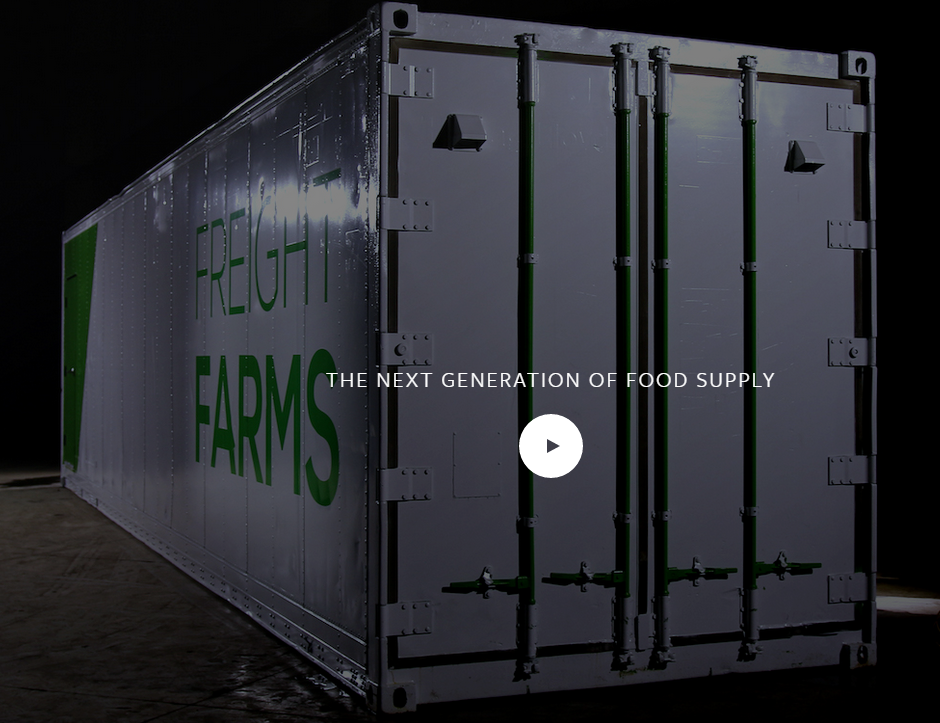
Image from Freight Farms
Here is the nice spreadsheet that they initially sent along for help with financial and crop planning. For full sized lettuce, they are saying that you can fit slightly more than what Matt was able to fit into one tower, but that may just be attributable to variety. They are also saying you can get 35 lbs/week of basil from a single tower. That doesn’t quite seem to stack up, though it could be the difference between a continual harvest like Matt uses, and harvesting a whole tower at once.
Anyways, as I said before, the company is super helpful and if you have any concerns, I’m sure they would be happy to address them. We’re going to look a little more at their financial models in a second too, so stick around.
I’m sure that there are examples of farmers getting the price that they advertise or even higher. However, in the interest of giving you an appraisal of the actual options out there for starting your farm, it’s fair to point out that it might always be the case. I definitely do not intend to disparage these companies or their products, and I’m happy to open up a space for them to respond to anything I’ve written.
As my research shows and Matt confirms “At these prices you’re [or a restaurant is] paying $30 a pound for herbs and twice or three times the industry standard for vegetables. Most restaurants simply can’t do those kinds of numbers. For example, most restaurants will pay around $8-12 dollars a pound for basil that they get from Cisco or other big food providers and while their willing to pay a small mark up for basil, the highest I got was $20, it is hard to get business owners to dish out to much money on basil and lettuce if it is breaking the bank.“
Based on that information, you’d be able to pay of the $75,000 investment in a Freight farm in just 2 years. Not only does that seem a little too good to be true, but if we plug in Matt’s numbers, we get a very different picture. Here are the price points Matt actually advertises when he sells direct to consumers:

Of course, neither Freight Farms nor any other supplier can be expected to anticipate market variance for the entire country. However, I want this information to be out there so you can more accurately make the decision on whether or not these products are right for you to start your business with.
Getting Customers Who Pay
Remember, the three steps to starting your vertical farm are
Proof of concept
2. Secure a buyer
3. Execute
I outline them in more detail here, but I wanted to include them here again to point out getting people who will pay you happens before most of the physical farming at a commercial level begins. Matt didn’t blink when I asked him how he did that and his unflinching attitude is probably one of the reasons Stag’s Leap is still chugging along.
He kept his answer short, too. “I literally just went around to everywhere I could find with a business card and told them I was doing locally grown high value crops. Some people didn’t call me back and others did.“ I can shorten it even more. How do you get people to pay? “Elbow grease.”

Original Photo of Mirai in Japan
A google search is going to blast your screen with thousands of marketing books, articles, blog posts, and everything else that’s going to tell you about building a brand, marketing, and sales tactics. Trust me, I’ve read most of them. But what they all really boil down to is just putting in the work, it’s as simple as that.
Hydroponics versus Soil-based Produce
That work is made a lot easier when you have a quality product to back it up. I still can’t believe how closed minded people still are to hydroponic products. They insist that the best produce comes from soil because it’s natural. Honestly, I just think they have a preconceived picturesque notion of farming in their mind that they are too stubborn to get rid of.
Look, my uncles have owned a restaurant my whole life, and that’s impressive considering most restaurants close within 90% of restaurants close in their first 12 months of opening. I started working there when I was 6 years old and didn’t stop until I went to college. I’ve been cooking my own meals since then (shoutouts to the ginger scallion sauce in the Momofuku cookbook) and gardening for almost that long too. I know what good produce tastes like. I know that it even smells and feels different. And I know that you can get good produce with hydroponic crops because I eat them all the time.
Yet…just try and bring up the idea of vertical hydroponic farming with an organic or permaculture extremist. Even though the ideas are super compatible, it’s still awful.
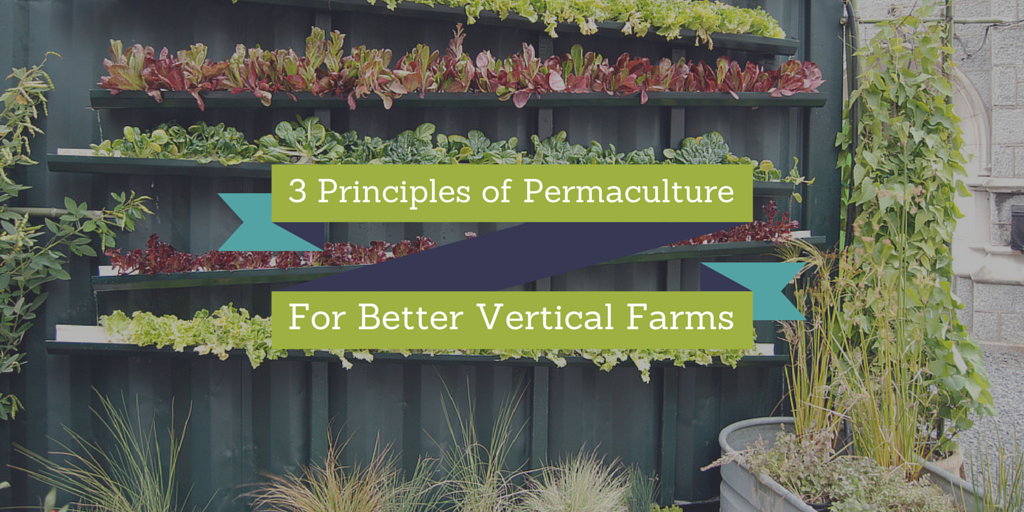
Click for the article
And frankly, people don’t agree with them. As Matt says “I haven’t come across anyone that has said we can’t grow superior produce with hydroponics, and if I were, I would probably refer them to a number of studies that suggest hydroponics can grow healthier, more flavor produce. [I’d] also give them some of our lettuce to try.”
That’s not just regular Joe-schmoes vouching for Matt’s product either. “The chefs that we work with really like our produce and would probably pay a lot more for our produce if they ran their restaurants. We constantly get great remarks about the lettuce we produce and the quality and flavor of our basil. We have a number of repeat customers that come for our salads and lettuce heads that say we have the freshest and best tasting lettuce around. And that definitely has to do with the fact that we are growing inside and with hydroponics. It really makes the whole production a lot easier and since we are selling locally this allows us to grow lettuce for flavor instead of shipping and shelf life.”
Since Matt is focusing on local food, his produce is so much fresher than anything consumers would be able to buy in a grocery store.
Obviously I’m a fan of holistic farming and permaculture techniques. I’m also a general fan of the USDA Organic Label, even if I think it could be improved. I just think that people need to really think about the type of farming Matt is doing beyond writing him off for trying something new, even if he’s using a manufactured product or, “heaven forbid;” PLASTIC. Especially in comparison to USDA Organic, something as simple as plastic doesn’t have as bad of an environmental impact as the pesticides already in use– natural or not.

Matt and I talked about this as well: “So I think its interesting when people like to contrast holistic farming with vertical farming, or holistic farming with hydroponic farming. When I think about what does holistic mean, I think about what is healthy for the consumer and what is healthy or sustainable for the planet. I think that vertical and hydroponic farming are great in both of those ways. Vertical farming really saves on land, which, as we are having a serious land crisis in terms of farming and are losing a lot of farm land to urban sprawl, is a really sustainable and positive for the future of farming. Hydroponics also allows us to recycle about 70-80 percent of the water we use, reduce the fertilizer we use, and eliminate any runoff from fertilizer. We can also do a lot of traditional holistic methods like companion planting and natural pest control using beneficial insects.”
Those are just a few of the ways to merge ideas that both philosophies espouse.
Conclusion
We wandered through a few different areas in this post. We touched on why vertical farms, if Matt’s is any example, might not be so limited in location than I was writing earlier. We also looked at how Matt is growing his food. He is using a combination of Zip Grow Towers and a custom built, stacked water culture system that allows him to maximize his production in the space.
Then, and perhaps a little controversially, we looked at pricing produce. While Matt is able to get a premium for his product’s freshness and sustainability, he still has the feeling that he’s not hitting the marks companies set for their pre-fabricated products. Not all of the numbers we included were exactly comparable, but they still make the point that you need to do your own market research before basing any business plan on those figures.
Next, we looked briefly into how Matt got customers for his produce before wrapping up by focusing on one of my pet-peeves; the rejection of hydroponic growing techniques by soil fanatics. I think this, along with location planning, is a significant challenge to the adoption of vertical farming technology. Though by no means the most important, it would be great to start doing taste studies along those lines.
This post was jam packed, and I hope you enjoyed it. Besides the great discussion about some of the challenges in vertical farming, I think the biggest take away is the detailed look at potential pricing. “Trust, but verify” as the saying goes.

Six Spectral Channels: Osram Unveils Grow Light System For Horticulture Research
Phytofy RL is already being used by NASA and Michigan State University. Osram is using it to carry out research of growth, anthocyanins and taste, conducted in a climate chamber at the TU Munich.
Osram has developed a research luminaire to meet the growing demands of researchers at universities, private institutes and plant production in greenhouses and vertical farms. Researchers and modern agriculturists can use the LED-based plant luminaire system Phytofy RL in the lab or in climatic chambers in order to develop new plant-specific light and growth recipes. These recipes can lead to desired outcomes in plant quality, yield and flavor.
Each of the six spectral channels can be addressed individually with Phytofy RL and the intensity planned and managed precisely in real time.
Selective intervention
"Various light wavelengths and intensities allow selective intervention in the metabolic processes of agricultural crops and ornamental crops", Claudia Zehnpfennig, Global Product Manager with Osram explains. "Yield, coloration and taste as well as other features can be influenced in this way. The latest research shows that not only is this process impacted by photosynthetically active radiation (PAR) – in the range of 400 to 700 nanometers (nm) – but that shorter and longer wavelengths also influence plant development."
With Phytofy RL, six spectral channels – from a natural far-red end-of-day light to UV light – can be addressed individually and the photosynthetic photo flux density (PPFD) planned and controlled precisely in real time: 385 nm, 450 nm, 521 nm, 660 nm, 730 nm as well as a warm white channel with 2,700 Kelvin. At the same time, the large number of LEDs in the fixture allows a higher photosynthetic photon flux (PPF).
Claudia Zehnpfennig & her colleague Kelcey Trecartin last year on the Cultivate
Light recipes
According to Claudia, the highly uniform light distribution is a special feature of the system. "The calibrated system furthermore supplies a precise irradiance map, calculated by the software with no quantum flux measurements required. Use of Phytofy RL allows for evaluation of the most varied light recipes, without having to change luminaires between individual tests. Diverse combinations of wavelengths also can be programmed, in different light profiles and across the entire photoperiod." In addition, users get five light recipes following registration, which have been specially developed by Osram.
Use of Phytofy RL allows the researchers to evaluate the most varied light recipes, without having to change luminaires between individual tests.
Climate chambers
The system software was developed by Osram together with plant biologists and can be used intuitively via the graphical user interface. Manufacturers of climate chambers benefit too, with integration possible in their systems. "The flat and robust design (667 x 299 x 44 mm, just under 9 kilos) is optimized for vertical farms, rack systems and growth chambers."
Phytofy RL is already being used by NASA and Michigan State University. Osram is using it to carry out research of growth, anthocyanins and taste, conducted in a climate chamber at the TU Munich.

For more information:
Claudia Zehnpfennig
horticulture@osram.com
Osram
Marcel-Breuer-Strasse 6
80807 Munich, Germany
Phone +49 89 6213-0
Fax +49 89 6213-2020
www.osram.com/phytofy
Publication date : 2/27/2019

Pushing The Boundaries of Creativity In Fresh Produce
These days image is everything in the fresh produce industry, as consumers become more brand conscious and aware of what they are eating and where the product comes from, not to mention how sustainable it is. Specialists agree that the brand stories and images conveyed on the packaging are of paramount importance.
Igor Moulder, Creative Director at Virtual Hub design agency has been in the business for many years and has seen how much things have changed. “When I started in the fresh produce industry in 1996 it was run by big companies who were slow to move on global consumer developments. Around 15 years ago things changed rapidly when growers started to market their produce.”
“It used to be only the technical qualities of the carton which growers had to think about. However, when growers became more aware of marketing their own products it really opened up the market, and the brand story and end packaging became really important. Modern consumers need to trust a brand and trust the quality that goes with it. They also like to know the story behind the product – where does it come from, is the supply chain transparent, what is the situation with regards to ethics and sustainability, etc.?”
Originally from South Africa Igor has worked with some of the best-known companies designing logos, website, brochures etc. One of his long-standing clients is Cool Fresh.
“Cool Fresh has built a credible story behind their fruit and are also strongly promoting corporate responsibility by supporting large-scale educational, sport and community development projects in South Africa. This gives back to the communities and gives the consumer a good feeling when buying the product.”
“Today, digital marketing and fresh produce need to get together, as there is a big gap to fill. Most people use mobile phones to search these days, so the fresh produce industry needs to become mobile friendly. The fruit sector has been slow to move but things are changing. Having said this, we cannot just rely on digital - print and old-fashioned networking are still important. You can have 1000 friends on facebook but it means nothing if it cannot be turned into sales. People are still people and need to see things and feel emotions. There is lots of emotion behind buying fruit and we need to give this to the consumer while still providing price and quality to the retailer.”
According to Igor it is a case of juggling time and money when designing a new brand. The grower has to like it, it has to be within budget, it has to be acceptable to the retailer and it has to be appealing to the consumer.
Corporate identity is very important, and most companies like to stick to the same logo and style. This year Igor worked on a new concept with Cool Fresh where communicating the company’s strategy was given a whole new look, whilst keeping the old logo but almost hiding it under the new corporate message. “The idea was that if nothing changes, people stop seeing ‘the real message’ after a while. Cool Fresh wanted to create something different and create a talking point, while still maintaining a very clear corporate and strategic identity and message. This was certainly the case with the company’s ‘Connecting Fresh’ approach to this year’s Fruit Logistica in Berlin.”
Igor admits that his ‘out of the box’ style does not fit every company. Yet, in the very competitive retail and consumer world it is important for any brand owner to stand out amongst the competition. Igor believes that innovative fresh produce companies should look at how branding and marketing is done in the fashion business. Igor closes: ‘The Dutch call it ‘gluren bij de buren’. Take a look at how other sectors are managing their marketing. Do not be scared of trying new things!’.
To view Igor's portfolio click here
Igor may be contacted on igor@virtual-hub.net
Publication date : 2/22/2019
Author: Nichola McGregor
© FreshPlaza.com

Plant Factory With Artificial Lighting: Toyoki Kozai's Brilliant Research On An Interesting Practice
According to AgriGarden, 'Plant factory is a highly efficient agriculture system which uses high precision control facilities in the continuous production of crops."
1/9/2019 9:16:19 AM
(MENAFN - GetNews) Dr. Toyoki Kozai's research work is on ' Opportunities and Challenges for Plant Factory with Artificial Lighting (PFAL) (or vertical/indoor farming). Dr Kozai graduated from Chiba University, Japan in 1967. He obtained a Master's degree in 1969, and a PhD degree of Agricultural Engineering in 1972 from the University of Tokyo in 1972. He served as Dean of Faculty of Horticulture and Director of Center for Environment, Health and Field Sciences of Chiba University. He was inaugurated as the President of the prestigious Chiba University in 2005. He resumed his career in research as a professor emeritus in an endowed chair position at the Center for Environment, Health and Field Sciences during 2009-2012. He established Japan Plant Factory Association (non-profit organization) in 2010 together with his colleague, and served as the president until 2018, and is serving as the honorary president to date.
Furthermore, Kozai's academic excellence and his scientific interest can be gauged from the multiple books he has written, namely, 'Smart Plant Factory: The next generation indoor vertical farms (2018), 'LED Lighting for Urban Agriculture (2016), 'Plant Factory: An indoor vertical farm for efficient quality food production (2015), and 'Photoautotrophic (Sugar-free) Micropropagation as a New Micropropagation and Transplant Production System (2005).
His early work on greenhouse light environments, energy savings, ventilation, computer control, knowledge engineering, integrative environment control using a heat pump, fogging and null-balance CO2 enrichment systems, and closed systems with artificial lighting for transplant production in the fields of greenhouse horticulture earned him great recognition in his field.
Kozai has recently been working on 'plant factory with artificial lighting (PFAL) and has been leading the R & D of PFAL. His continuous quest in this field allowed him to dive deeper into this subject. He has been invited as a keynote speaker on the PFAL to more than 20 international symposia during 2015-2018.
According to AgriGarden, 'Plant factory is a highly efficient agriculture system which uses high precision control facilities in the continuous production of crops."
According to Kozai, it is believed that PFAL is expected to contribute to solving the food-environment-resource-health issues concurrently. Kozai has further described the six major components of the PFAL viz., thermally well-insulated, almost closed structure, multi-tier unit with lighting and hydroponic cultivation devices, air conditioners and fans, CO2 supply unit, nutrient solution supply unit and environmental control unit. Furthermore, he has mentioned that relatively large automated PFALs have been built in Japan in the year 2018, and the number of profit-making PFALs has been increasing in Japan since 2016. Besides, there are ongoing large-scale projects in the world hence stressing the fact that this concept is gaining prominence not only in Japan but globally as well.
In addition to the above, Kozai's study throws light on the essential benefits of PFAL as well. First, that PFAL offers a high degree of freedom of environment control and that any environment can be created at minimal costs, thereby making it highly cost-effective. Second, all rates of resource supply, plant production and waste production can be measured and controlled. Then, Resource Use Efficiency (RUE) (amount ratio of resource fixed or kept in plants to the resource supplied to the PFAL) can be estimated online for each resource element including electricity, water, CO2, fertilizer and seeds. This shows the convenience and the hassle-free process.
Currently, compared to the greenhouse, the PFAL can save water consumption for irrigation per kg of produce by 95% by recycling use of transpired water vapor from plants (The transpired water vapor is condensed and collected at the cooling coil of air conditioners and returned to nutrient solution tank). The productivity of leafy lettuce per unit land area is more than 100 times higher in the PFAL than in the open field. Thanks to this high productivity per unit land area, the PFAL can be built in urban areas with non-fertile or contaminated soil, resulting in the reductions of CO2 footprint, loss of produce during transportation, and delivery time of fresh vegetables to citizens.
However amongst all the benefits, there is one issue which still remains unresolved i.e., a methodology to find an optimal set of environmental factors automatically to maximize the CP (or productivity) under given conditions is yet to be developed. To maximize the CP, unit economic value, plant growth rate, percent marketable portion, cost of each resource element, consumption and RUE of each resource element needs to be measured or estimated online, and be integrated to calculate the CP.
Kozai's excellent research suggests how the CP can be more than doubled and the impact and the expected increase this will have on the PFAL market. He has therefore proposed the reduction in cost per kg of produce, an increase in sales per m2 of cultivation space by introducing recent advanced technologies such as artificial intelligence. Currently, costs for electricity, labour and depreciation for the initial investment account for about 20%, 20% and 30%, respectively. The rest (about 20%) is for seeds, fertilizer, water, containers, maintenance, etc.
Further, Kozai has the discussed the idea of next-generation PFAL (n-PFAL) and the associated requirements, scheme for R & D, challenges and opportunities. According to him, n-PFAL needs to create unique environments for plant production to produce high-quality plants with high yields using minimum resources and minimum emission of waste by introducing advanced but inexpensive technologies. He has suggested different technologies, which can be of great use in the same. However, he has submitted some challenges and opportunities, for example, smart LED lighting, phenotyping (plant trait measurement), production management including seed processing and circadian rhythm, efficient use of resources with minimum waste, breeding using DNA markers of plants suited to PFALs, et cetera. He has defined plant phenotyping and has given a detailed account of its usage in n-PFAL. Plant traits include plant architecture, chemical components, physiological status and response, etc.
In the n-PFAL, a huge time-series dataset of plant phenotype (traits), environment and management (human and machine interventions including seed processing) is automatically accumulated in a data warehouse. The data warehouse is connected with a related genome database and other n-PFALs' data warehouse via Internet. This global and local network of n-PFALs each with semi-open database will bring about a paradigm shift of plant/food/agricultural production and breeding of plants suited to PFALs. For example, breeding of plants suited to PFALs can be speeded up using the n-PFAL. Kozai has further recommended four types of models to be implemented in the PFAL: 1) mechanistic models for photosynthesis, respiration, transpiration and growth, and for substance, energy and monetary balance, 2) multi-variate statistic models, 3) behaviour (or surrogate) models, and 4) AI (or deep learning) models.
Kozai's study has won great acclaim amongst the researchers and his brilliant research on PFAL, an upcoming innovation will be of great use not only nationally but internationally as well.

The Investment Company The World Needs
March 9, 2019
Kyle Baldock
Setting a Higher Standard in AgriTech Investment
Neon Bloom is a venture capital firm that focuses on acquiring innovative agriculture and ancillary technology products and services across the globe. With a suite of flagship investments in Holland and one in South Korea, Neon Bloom has made a strong start for a company that only began in January of this year. Of central importance to their investment strategy is a keen understanding of the holistic nature of the industry: they invest in complimentary companies in order to bring various parts of the value chain under a single umbrella. I interviewed Company Director Werner Huisman about this “Seed to Sale,” approach to investing. He told me:
“The big advantage is bringing knowledge together from many different parts of the world. Having the opportunity to bring so many talented individuals under one brand with the same mission and vision empowers each company within the portfolio.”
Read on to learn more about Neon Bloom’s mission to advance the industry for the betterment of mankind.
Getting to know: Neon Bloom
When did Neon Bloom start operating and why is it focused on AgriTech?
WH: Neon Bloom started the operation beginning this year. We are focused on the three pillars of water, power and food. We believe in “the zero hunger” mission and want to be a part of this mission. After learning about the importance of technology to improve sustainability and reduce the cost of goods we realised the importance of innovation to help with “The Zero Hunger” mission.
What technologies and trends are you most interested in for the coming decade?
WH: I believe in technologies based on natural and sustainable solutions. By the year 2050 the world population is expected to grow to 10 Billion people. This is over a 56% increase of food needed compared to 2010. It is going to take innovative technologies and a group effort to meet the demand. Looking at the solutions we bring in from Holland, they are all natural and sustainable.
Within HollandPlug we produce 100% organic substrates based on jute and PLA. This should replace the environmentally-unfriendly stonewool substrates.
Within Holland Pulse Light we are able to extend the expiration date for food by generating an enormous amount of energy through our pulse light technology- the pulse light flash has a power of 1850 Joule. With the electronic magnetic field and the enormous number of photons we are able to generate we are able to flash the food with the light and eliminate bacteria, fungi and viruses with all-natural products. Our machine utilises mainly UV-A which is able to rupture the cell membranes; whereas UV-C light impacts the DNA which changes the texture and taste of the food.
Within Holland2O we sell water machines which are able to produce HOCl water with a very low ppm value! (<30 ppm). This water has a redox value of around 1000 Orp(V) and an pH of 6.6 which is able to remain stable for a long period of time. With this water, we are able to kill all sorts of bacteria, fungi and viruses using only natural substances.
Where in the world are you seeing the most innovation in your three pillars of power, water and food?
WH: In principle, all around the world. In each part of the world there is a shortage of water; in each part of the world they grow fruit and vegetables and in each part of the world there are problems with fungi, viruses and bacteria. We believe that it will take a global effort to help meet the needs of the world over the next several decades.
Which volume are you in the market for- what is a normal project volume?
WH: Depends on which product you are talking about, but talking about % in the substrate market, we think we can take over 30% in 3 years’ time. We also believe our other technologies will have the capabilities to capture a significant amount of the market share. It is important to us that sustainable technologies lead the way in vertical farming.
What does Neon Bloom look for in potential acquisitions/investments?
WH: The requirements are in general as follows:
Product should have a relation to power, water or food;
The product should have a sustainable character;
It should have international potential;
The company must share our core values and vision
Does your company do VC or corporate finance? Debt or equity financing? Does Neon Bloom invest its own money?
WH: Neon Bloom is a VC with a focus on sustainable companies operating in power, water or the food industries. Our firm will provide debt or equity financing depending on our clients need. Yes, Neon Bloom invests its own money and is always searching for innovative companies to help us meet the “Zero Hunger” mission.
What advice would you give to AgTech companies that are looking to attract capital?
WH: You can attract capital from anywhere, so I would advise them to take a substantial amount of time defining their mission and vision statements. If your company’s core values and mission don’t align with an investment partner; then I would recommend finding a better fit. Secondly, see how their network and skill set can help grow your company’s footprint as well as impact in the world.
Why did Neon Bloom choose to become a member of the National Cannabis Industry Association?
WH: We decided to become a member of the National Cannabis Industry Association because of our first-hand experience of seeing the medical benefits the plant provides. This can help veterans dealing with PTSD or individuals with serious diseases. Cannabis is grown naturally and we believe it is a much better medicine than the drugs provided from pharmaceutical companies. It also has had a huge impact on slowing down the opioid crisis.
Why is there no visible investment in any cannabis related tech or producer?
WH: Our substrate technology can be utilised directly when growing cannabis along with our water. Both of these innovative technologies will allow for a product that is free of pesticides. It is the company’s goal to begin working with hemp producers this year. This will help provide food to the world as well as numerous other benefits to other industries.
Why did Neon Bloom join AVF?
WH: We don’t define success based on how much money a company is able to generate. Our firm determines success based on the impact and legacy we can leave on the world. It is crucial for humanity that we begin to implement many of the policies and beliefs of the AVF if we plan on having a sustainable future and to be able to meet the food demand for the ever-growing world population.
Want to find out more?
Visit Neon Bloom on the web: neonbloominc.com
KYLE BALDOCK

Dean Foods Explores 'Strategic Alternatives,' Including Sale
Amid the increase in options and consumer interest in plant-based milks and other dairy alternatives, Dean Foods has struggled
Feb. 27, 2019
Dive Brief:
Dean Foods is exploring "strategic alternatives to enhance shareholder value," according to a release. The options include an outright sale, pursuing a joint venture or merger, shedding assets or continuing on the company's current business plan by focusing on strategic initiatives.
The company has not yet set a timeline for the review of these options, but Evercore Group LLC will serve as financial advisor to Dean. CEO Ralph Scozzafava said in a statement that Dean is "taking vital, transformative actions to maximize the benefits of our scale and position the company for the long term."
Dean — which owns more than 50 dairy brands, private labels and legacy products including Oak Farms and Lehigh Valley Dairy Farm — reported a net income loss of $260.1 million in fourth quarter earnings Wednesday.
Dive Insight:
The announcement of this potential sale came the evening before Dean Foods reported its quarterly earnings. The country's largest milk producer posted losses for the fourth consecutive quarter and suspended dividends. For the full year, Dean reported a net loss of $3.63 per share. Announcing a review of its options before the release of this poor earnings report makes sense. And given the company's recent issues in the category, it shouldn't come as surprising news.
Amid the increase in options and consumer interest in plant-based milks and other dairy alternatives, Dean Foods has struggled. Plant-based and even lab-created milk has been sweeping the industry, hurting farms and milk producers. U.S. non-dairy milk sales were up 61% over the past five years, while dairy milk sales plunged 15% from 2012 to 2017, according to Mintel.
Adjusting to the change in demand, Dean has been working to diversify its investments in waters, juices and plant-based products. Dean bought a minority stake in Good Karma Foods, which sells non-dairy milk and yogurt, and later announced it was taking majority stake in the company. The dairy manufacturer also purchased Uncle Matt's Organic, a maker of probiotic-infused juices and fruit-infused waters. In 2016, it expanded its reach into other dairy segments, buying the manufacturing and retail ice cream business of Friendly's Ice Cream, a Northeast-U.S. restaurant.
In previous years, the company divested some of its plant-based and organic lines, including WhiteWave Foods and Morningstar.
The moves to diversify Dean's portfolio haven't been enough to avoid plant closures and layoffs. Late last year, Dean Foods closed two milk processing facilities and laid off 207 workers. Earlier in the year, the company shuttered three facilities. Dean also terminated more than 100 dairy contracts with the company to curtail how much milk it was purchasing.
Despite these measures, Dean Foods' earnings have continued to disappoint. Last quarter, profits dropped 12% from the same time a year ago. But that decline hasn't just been a result of plant-based competition. The company has battled with an oversupply of milk and tariffs. Since 2014, dairy prices have been falling consistently. Private label brands have also hurt Dean's business, as stores like Walmart and Amazon have launched store-branded milk that bring even more competition to the crowded space.
It seems that the company's cost-cutting measures haven't been enough and an outright sale could be likely. However, it's unclear who will want to buy Dean Foods. JPMorgan analyst Ken Goldman predicted that there won't be many interested buyers, according to Seeking Alpha.
"If Dean Foods does happen to find a buyer (unlikely, in our view), the stock will probably be purchased at a discount to the current price," Goldman said. "Dean is a levered company with a fast-deteriorating business and numerous out-of-date production facilities."

Farming On The Roofs of Shopping Malls In Singapore
Agriculture, takes up only about 1% of its land area.
Amidst the luxurious commercial setting of Singapore's Orchard Road, filled with fancy malls, department stores and food courts, there is a farm.
Reuters reports that the 6,450 sq ft Comcrop farm utilises vertical racks and hydroponics to grow leafy greens and herbs such as basil and perppermint, which are sold to nearby bars, restaurants and stores.
Allan Lim set up the rooftop farm five years ago, and recently opened a 4,000-square-metre farm with a greenhouse on the edge of the city.
The goal, in Singapore where land is at a premium, is to tackle food security.
“Agriculture is not seen as a key sector in Singapore. But we import most of our food, so we are very vulnerable to sudden disruptions in supply,” Lim said.
“Land, natural resources and low-cost labor used to be the predominant way that countries achieved food security. But we can use technology to solve any deficiencies,” he said.
In the country where 5.6 million people are densely packed in, land reclamation, moving transport utilities and storage underground, and clearing cemeteries for homes and highways have been undertaken.
Agriculture, takes up only about 1% of its land area.
Last year, Singapore topped the Economist Intelligence Unit’s (EIU) Global Food Security Index of 113 countries for the first time, scoring high on affordability, availability and safety.
However, importing more than 90% of its food, food security is susceptible to climate change and natural resource risks.
As climate change makes its impact felt across the world, the scarcity of water, shifting weather, and population growth will require better ways to feed the people.
A study published last year, cited by Reuters notes that urban agriculture currently produces as much as 180 million metric tonnes of food a year - up to 10% of the global output of pulses and vegetables.
From what was once an agrarian economy that produced nearly all of its own food, from pig farms, vegetable gardens and durian orchards and chicken in the kampongs, to government is now pushing to relocate over 60 farms in the countryside by 2021, to reclaim land for the military.
Speaking to the publication, Chelsea Wan, a second-generation farmer who runs Jurong Frog Farm said: “It’s getting tougher because leases are shorter, it’s harder to hire workers, and it’s expensive to invest in new technologies.
“We support the government’s effort to increase productivity through technology, but we feel sidelined,” she said.
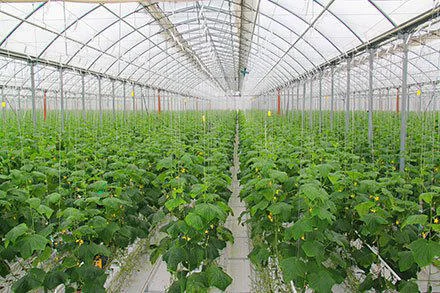
Korean Company Starts Building Hydroponic Greens Houses in Northern Tajikistan
The use of the hydroponic system will help increase productivity, according to the Sughd regional administration.
8 January 2019 14:39 (UTC+04:00)
South Korea’s Myung Sung Placon Ltd has begun building hydroponic greenhouses in the northern Sughd province. The hydroponic system has an ancient history and was reportedly used for building of the Hanging Gardens of Babylon, Trend reports referring to news.tj.
The use of the hydroponic system will help increase productivity, according to the Sughd regional administration.
The building of the hydroponic greenhouses began in the Somgor area of the Bobojon-Ghafourov district on January 7.
An official source at the Sughd regional administration says local “Bars” Company is a contractor and specialists from South Korea are implementing the project.
Sughd authorities have invited Myung Sung Placon Ltd to build greenhouses in the province, taking into account the company’s experience of work in the neighboring Uzbekistan, the source added.
Hydroponic growing is growing a plant without using soil - usually in an inert substance like rockwool or perlite, which hold the roots for easy water and nutrient absorption. Hydroponics systems back several hundred years, and there is evidence that ancient civilizations grew plants in water. Nutrients are vital to hydroponic success: there are sixteen essential elements that a plant needs to grow, and the right balance of these nutrients must be maintained for each specific variety of plants. Equally as important as nutrition are the factors of light, temperature (heating and cooling), and carbon dioxide. Insects play a key role in pollination and pest management.
The Hanging Gardens of Babylon were one of the Seven Wonders of the Ancient World and were described as a remarkable feat of engineering with an ascending series of tiered gardens containing a wide variety of trees, shrubs, and vines, resembling a large green mountain constructed of mud bricks, and said to have been built in the ancient city of Babylon, near present-day Hillah, Babil province, in Iraq. Its name refers to trees being planted on a raised structure such as a terrace.
According to one legend, the Hanging Gardens were built alongside a grand palace known as The Marvel of Mankind, by the Neo-Babylonian King Nebuchadnezzar II (who ruled between 605 and 562 BC), for his Median wife Queen Amytis, because she missed the green hills and valleys of her homeland. The construction of the Hanging Gardens has also been attributed to the legendary queen Semiramis, who supposedly ruled Babylon in the 9th century BC, and they have been called the Hanging Gardens of Semiramis as an alternate name.
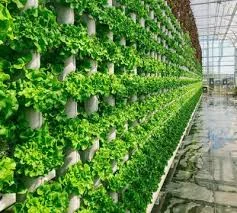
Edeka and Metro are Joining the Growers
In the farm, seedlings of various plants are being used. They are not growing in soil, but have been dipped in a thin layer of liquid that provides the necessary nutrients.
Vertical farming is a way to put an end to the climate-compromising import of vegetables from all parts of the world. Fruits and vegetables can also be grown in the supermarket, some manufacturers promise. But we are not there yet.
There is a large black box with Plexiglas windows, standing in the middle of the vegetable department of the Edeka market in Oberhausen. This is the "greenhouse of the future," explains Pascal Gerdes. In fact, it is a digitally networked herbal farm in which plants are to grow under optimal conditions.
After a critical appraisal of the plants and a smell test, a customer decides to buy some of the coriander, which she places in her almost empty shopping basket. Price: 1,29 Euro. The Gerdes family is not pleased with the customer's choice. This lady is the first buyer of the plants that are grown in the supermarket.
Only a few weeks ago, the futuristic-looking farm was set up in the store of the Gerdes family. It came from Berlin start-up Infarm, which is one of the major suppliers in the field of vertical farming. Infarm also cooperates with other retailers. The 'farm' is to be tested in the Edeka market for a whole year. If the mint, Greek basil, mountain coriander and the like prove to be worthwhile, the farm may remain there. It is, however, still too early to do away with the entire vegetable counter - that would be relying too much on this nascent technology.
Digital farms in Oberhausen, London and Paris
In the farm, seedlings of various plants are being used. They are not growing in soil, but have been dipped in a thin layer of liquid that provides the necessary nutrients. From above, LED lamps provide continuous lighting. Everything can be individually adjusted so that the optimal climate conditions can be created for every plant. Vertical farming promises efficient and, above all, rapid growth.
"Temperature and light intensity are adjusted completely autonomously," explains Martin Weber from Infarm. "We control the state and the growth of the plants via infrared cameras." An employee from Infarm will go to the Edeka stores to harvest. He or she will set the plants that are ready for sale apart, immediately inserting new ones in their place. Supermarket operators like the Gerdes family do not have to worry about anything. But that should change over time. With more experience, sowing and harvesting can be taken over by the supermarket operators.
Until now, Vertical Farming is limited to herbs, as in the Edeka store in Oberhausen. But one can grow any kind of fruit and vegetables, promises Infarms CFO Weber: "We would like to offer everything, without exception."
This optimism has apparently convinced some retailers: The incubators of Infarm are there at numerous German Edeka markets, including stores in the Swiss supermarket chain Migros and in metro markets - including a metro market in the suburb of Nanterre, Paris. And the internationalization is to go on: "In Paris and Zurich, we have already inaugurated the first farms outside Germany. And in early 2019, London will follow," said Weber. In the USA there is potential for the Berlin start-up as well.
Source: Wiwo.de
Publication date : 1/4/2019

Urban Farms Could be Incredibly Efficient—But Aren’t Yet
Casual farmers overwork, buy fertilizer, and use municipal water.
JOHN TIMMER - 12/28/2018, 3:45 AM
The green revolution that transformed modern agriculture has generally increased its scale. There's tremendous potential for efficiencies in the large-scale application of mechanization, fertilization, and pesticide use. But operating at that level requires large tracts of land, which means sources of food have grown increasingly distant from the people in urban centers who will ultimately eat most of it.
In some ways, hyper-local food is a counterculture movement, focused on growing herbs and vegetables in the same dense urban environments where they will be eaten. It trades the huge efficiencies of modern agriculture for large savings in transportation and storage costs. But is urban farming environmentally friendly?
According to researchers at Australia's University of New England, the answer is pretty complex. Within their somewhat limited group of gardeners, urban agriculture is far more productive for the amount of land used but isn't especially efficient with labor and materials use. But the materials issue could be solved, and the labor inefficiency may be a product of the fact that most urban farmers are hobbyists and are doing it for fun.
Urban ag
The researchers—Robert McDougalla, Paul Kristiansena, and Romina Rader—defined urban agriculture as taking place within a kilometer of a densely built environment. Working in the Sydney area, they were able to find 13 urban farmers who were willing to keep detailed logs of their activity for an entire year. Labor and materials costs were tracked, as was the value of the produce it helped create. The energetic costs of the materials and labor were also calculated in order to assess the sustainability of urban farming.
The plots cultivated by these farmers were quite small, with the median only a bit over 10 square meters. Yet they were extremely productive, with a mean of just under six kilograms of produce for each of those square meters. That's about twice as productive as a typical Australian vegetable farm, although the output range of the urban farms was huge—everything from slightly below large farm productivity to five times as productive.
For the vast majority of crops, however, the urban farms weren't especially effective. They required far more labor than traditional farms, and, as a result, the total value of the inputs into the crop exceeded the income from selling it. In other words, the urban farmers were losing money, at least by traditional accounting measures. And the farms weren't especially sustainable, with only about 10 percent of all the inputs coming from renewable resources. Again, labor was a major culprit, as it's not considered very renewable, and urban farming is very labor-intensive.
So that all sounds like a bit of a disaster, really. But as mentioned above, things quickly get complex. The urban farmers, as it turned out, bought compost and fertilizer and used the municipal water supply. Cities, as the authors note, produce large quantities of organic waste that could be used to make compost. While it would require additional labor and land space, it would be easy to make the care of the crops far more sustainable. Combined with the use of collected rainwater, these could get the percentage of renewable contributions up to roughly 40 percent.
Laborious
Then there's the issue of the time spent on labor. The urban farmers don't seem to be especially efficient compared to regular farm laborers, and by all indications they don't necessarily want to be. For many of them, it's more a hobby than career; they put in more labor because they enjoy it or find it relaxing. If you start reducing the labor costs to reflect this, things start changing dramatically. If only the material costs of urban farming are considered (meaning labor was set to $0), then the apparent efficiency improves dramatically.
Not surprisingly, ignoring labor costs also makes a big difference financially, with the profit-to-cost ratio going from a mean of 0.62 up to 2.8, indicating that these urban farms would generally be quite profitable.
Labor also makes a big difference in terms of energy use. As they're now operating, these urban farms aren't very different from rural farms, which means they're not sustainable. Shifting to local sources of materials, like rainwater and compost, would drop the energy use dramatically, shifting the farms into territory that's typically considered sustainable. Eliminating labor considerations on top of that would make urban agriculture among the most efficient means of growing vegetables presently studied.
There are two obvious caveats to this work: the small number of farms sampled and the fact that they were all in a single urban area. This sort of study will obviously need to be replicated in other locations before we can start generalizing about hyper-local produce. But the role of labor in this sort of analysis makes conclusions difficult to generalize. Is it reasonable to discount some fraction of the labor costs when people are doing the farming for pleasure? Do we start considering a tomato plant on a balcony part of an urban farm?
While many of the details are unclear, the overall conclusion seems solid: while urban farms aren't yet there in terms of sustainability and energy use, the potential for them to outpace their larger rural cousins is definitely there. But it will take an entire sustainable support infrastructure for them to truly arrive.

Why Mindfulness Is Essential For Farmers And Their Health
March 8, 2019 in Eco-Living & Health, Health
Farming is tough on the body, and it can also take a toll on the mind. I’ve been a farmer for over six years now and not once has the job been less than physically and emotionally demanding. Before pursuing farming as my chosen career, I worked in a number of professions that exacted their own price from my body, including landscaping and cooking in professional kitchens. None of these jobs came close to matching the exhaustion I’ve felt after a hard day on the farm.
As farmers we face weather extremes, deadlines, unforeseen calamities and a variety of demands on our minds, bodies and bank accounts. Our backs are literally the backbone of our business, and we depend on our shoulders, arms and hands to accomplish our endless to-do lists. We wear through our boots like they were made of paper, and sometimes we get covered in manure. There is a reason that farming is considered one of the most dangerous jobs alongside the ranks of loggers, fishermen and pilots, and that is because we work with and around hazardous things day in and day out. We work days that can stretch far into the nights regardless of the conditions outside. To sum it up, farming can wear a person down, fast.
Farming is tough on the body. Our backs are literally the backbone of our business, and we depend on our shoulders, arms and hands to accomplish our endless to-do lists.
In my twenties I took the health and healing power of my body for granted. It could handle just about anything I threw at it and bounce right back. As I grew older I realized that the time spent bouncing back was growing longer. No matter your health or age, that one time you twist wrong or lift a bucket carelessly or injure an ankle stumbling over a rock can have a huge impact on your day, week, or even year. I’ve found that there is really no surefire way to avoid these accidents, but there is one mental practice that can minimize the frequency of their occurrence.
If you picture a whole farmer health regimen as a stone arch, mindfulness is the keystone that holds it all together. On one side, the arch is made up of our physical practices such as diet and exercise, and on the other side are mental practices such as education and bookkeeping. Mindfulness helps keep us in the moment, focused on what is needed in the present. I have been meditating off and on for more than 20 years, and it always seems to help balance out my perspective, which can sometimes become weighted toward a pessimistic outlook.
Meditation can take as little as five minutes to as long as multiple days. When I became a farmer I seemed to lose the ability to set aside time for meditation on any given day, in part because of the demands placed on any business owner, but specifically because days spent working on the farm were long and tiring, and instead of meditating for relaxation I would rather zone out and read a book or watch YouTube clips. Being honest with myself, I realized that I was not going to meditate or exercise in my downtime if there were distractions around me. I decided that the best action I could take was to find a meditation or yoga class in my area in order to force me to do the things I knew I needed.
My friend and neighbor Tracy Hovde is a professional yoga instructor and part-time farmer with her partner, Mark Triebold. They run Lazy I Ranch, raising cattle on 80 acres just a few miles down the road from my farm. Mark bought the property 10 years ago and started raising Highland cattle six years ago. Tracy brings her yogic perspective to raising their cattle.
Tracy Hovde and Mark Triebold raise Highland cattle on 80 acres of land at Lazy I Ranch.
So what is yoga? It isn’t really necessary to understand the whole history of the practice, but essentially it is a method of working with the mind, body and spirit to bring about balance. As a Zen student I have worked within my mind realm for quite some time, but the beauty of the yogic approach is that it acknowledges that the mind, body and spirit are all intertwined. It doesn’t matter so much to the lay practitioner that yoga was created in fifth and sixth century India by groups of spiritual ascetics, but it does matter how it can make you feel. The word yoga means to “yoke together” or “unite,” and after a yoga session led by Tracy, I feel that my scattered thoughts are quieted and my nerves are soothed.
Before taking her classes, my previous experience with yoga was pretty limited. I had attended a few yoga classes when I lived in the Twin Cities, and I’ve been learning poses and techniques from books for quite a few years.
When Tracy told me and my neighbor friends that she was going to start to hold a yoga class in their barn on Sundays, we were all on board. The hardest part of any endeavor is to get it started. Initially for me it was difficult to get my joints to bend into the correct yoga pose positions, but after a few months of regular practice I began to feel more comfortable in the classes.
Tracy Hovde teaches yoga classes in her barn at Lazy I Ranch in Clayton, Wisconsin.
Now, if I go for too long without attending one of Tracy’s classes my muscles are tight, my bones are unaligned, and I feel full of unresolved tension. It helps that Tracy is a gifted teacher with an intuitive grasp of the energy in a room, as well as the ability to guide that energy into balance. Friends of mine who attend other yoga studios have mentioned that Tracy takes it slow with us farmer folk, which makes sense if you consider that our bodies are already sore from our daily work, whereas in a typical city studio you may have students who are seeking a strenuous physical workout to offset sedentary lifestyles.
I spoke to Tracy in September 2016 about her thoughts on how farmers can keep their bodies and minds healthy and what it is like to raise cattle and practice yoga in the countryside:
What led you to practice yoga, and what does yoga mean to you?
Like most people, I started yoga for purely physical reasons. I started a regular yoga practice when I was a dancer. The physical demands of dancing were extreme, and I wasn’t taking good care of myself. I was burned out and was constantly injured.
I found that the Vinyasa classes offered at the gym I worked at as a massage therapist satisfied my need to move, and did so in a way that didn’t strain my body. Now yoga is less about the postures and more about the way I live, the way I view the world around me and my place in it.
When you teach a yoga class, what are your goals, and how do you work toward them?
My goal is always to bring balance. I never know what that means until my students walk into the room and I see how they are walking, their mood, what are they talking about, their energy level, etc. I also factor in things like season, weather and time of day. I use different breathing exercises (Pranayama), poses and specific sequencing of poses, as well as different styles of yoga to help shift their energy toward balance.
How did it come about that you live on a farm with Highland cattle and Mark, a motorcycle mechanic?
On the surface we might seem very different but Mark could not be any more perfect for me and, I hope, me for him. We think enough alike to be able to be partners, but we see things from a perspective different enough to be able to complement each other.
When I met Mark I knew as much about farming and motorcycles as he knew about yoga, but really those things have more in common than you would think.
What does it mean to you to live in the country on a piece of land caring for animals and plants?
That’s hard to explain because I’m still figuring it out for myself. In a way it’s like I’m learning who I really am without the noise and outside influences that I had been surrounded by most of my life. Out here there is no one to tell me who I am supposed to be or what I should do or think. Things just become simpler and clearer when your world is full of nature and life instead of media and electronics. It is all very grounding, especially the cows.
Did you ever picture yourself living on a farm with livestock?
Nope, I couldn’t even have imagined it. I grew up in the suburbs and my only farm experience was spending the day at my sister’s place a few times a year on holidays. She had horses, but I never really understood or experienced farm life until I moved here.
Several of Tracy Hovde’s Highland cows
I know a lot of yogis are vegetarian or vegan, many for ethical reasons, so how do you explain to them your stance on eating meat?
I could talk about this for days! There are so many reasons, but from a yogic perspective I have to look at the big picture without judgment, criticism or expectation. The reason many yogis are vegetarian or vegan is the concept of ahimsa (non-harming). This is one of the foundational principles of a yogic lifestyle.
My personal belief is that interpreting ahimsa as vegetarianism is a narrow or limited perspective. In yoga philosophy we have layers to our existence. In a yogic view your body is a vehicle for the spirit. We use the body but we are not the body. The physical body is called anamayakosha. This literally means “food body.” Every living thing — from plants to insects to animals to humans — is food for something else, and every living thing has a purpose to fulfill in this existence — or dharma.
So, if I look at the big picture without judgment or expectation I see that death is a necessary part of life and that living things, in their physical death, nourish other living things. I see that animals eating other animals is a part of the natural balance of life as a whole. For me, the practice of ahimsa is to think about minimizing the harm that I do to the whole and to live in a way that is in balance with all.
On our farm, we raise the animals in a way that we believe honors their nature and that their lives contribute to more than just meat on our table. Our cattle have restored land that had been farmed to death through generations of conventional farming. Their hooves till the land, their grazing encourages growth of the pasture grasses and their manure fertilizes the pastures. Something else that is very important to us is how the animals are harvested. Bringing an animal to an approved slaughter facility would mean taking an animal that had lived its entire life on our farm, herding it onto a trailer and bringing it to a slaughter house. Regardless of the humane treatment we provide in its life, ending the animal’s life in this way would, in our view, be traumatic and inhumane. The stress hormones would affect the quality of the meat and from the yogic view, would be energetically damaging as well. If you are what you eat, then you would be eating stress and fear. We do not “ship” animals for processing. We have the butcher come to our farm so the animals don’t have to experience that stress.
In terms of diet, what eating habits have you found to be most beneficial for your own health and why?
I have tried everything including gluten-free, dairy-free, vegetarianism and veganism. I think the biggest benefits for me have come from the nutrient value of the food I am eating now. I get most of my produce from Ken Keppers. He is more than organic. He pays attention to the chemistry of the soil, and therefore, the chemistry of the produce equals a higher nutrient content. All of the meat I eat comes from our farm, yours, or other local farms where I know how the animals are raised.
Beyond nutritional value, I believe that food carries with it a more subtle energy that comes from the land it is grown or raised on and the care taken in raising or growing, harvesting and preparing it. And lard! Good quality lard is the best!
Why and how did you decide to start the yoga in the barn sessions?
I remember standing on the front porch of the house on a cold January day looking at the barn. Mark said, “That would make a pretty good yoga studio.” I thought he was nuts. Who would come all the way out here for yoga? I was thinking about my students in Stillwater and Hudson — an hour away. What I didn’t realize was that there were people out here in the country who wanted yoga but didn’t want to go all the way to Stillwater or Hudson.
Farmers have pretty specific issues with their bodies. What are some issues that you have seen and ways to address them with yoga?
Farmers are very physically active, and we have all types of movement. We have the repetitive movements of daily tasks like weeding, milking, or hauling feed or water, and we also have occasional movements related to seasonal tasks like baling hay or moving fences. As a general rule, I lean toward a slow and gentle approach and avoid strenuous forms of yoga like Ashtanga or other Vinyasa styles that are great for those with a sedentary life but can be depleting for farmers who are already physically stressed. I also spend more time on back bending, chest opening and hip opening to counter-pose the forward motions of carrying and bending that we farmers do all day.
If you could lead one short yoga session each morning or night for farmers, what would it be?
This is great because people think they need to do a 60-minute yoga class. This is so untrue. There is so much benefit from adding a breathing exercise or a few poses wherever you can fit them in. In the morning Agni Sara breathing followed by 5-10 Sun Salutations every morning is the perfect way to start the day. Agni sara stokes the internal fire. This can be done in the shower, when you first get out of bed, whatever. (Needs to be done on an empty stomach, and do not do this during pregnancy or if you have high blood pressure.)
Start by balancing your breath — four counts in and four counts out.
When breath is balanced and steady, switch to four counts in eight counts out.
Then add a pause after exhale — four counts in, eight counts out. Hold four to eight counts.
During the pause, draw your navel back toward your spine and up under your ribs (think of hollowing rather than contracting).
Sun Salutations
Sun Salutations encourage deep breathing, improve mental focus and increase circulation and range of movement for all of the major joints in the body. I would end the day with the following
sequence:
One slow Sun Salutation
Alternating cat/cow poses
Child’s pose
Child’s pose with side stretch
One half pigeon
Windshield wiper stretch
Supported bridge
Legs up wall
Reclining twist
Relaxation pose
Alternate nostril breathing
What do you see as the relationship between yoga and natural farming techniques such as organic, permaculture and holistic management?
There is a very innate, natural relationship here. The word yoga means “union.” Our culture has embraced yoga as a physical exercise but the history of yoga is a more complete lifestyle and spiritual practice. The postures are just a step toward finding union — with nature, God, the Universe, whatever. Anyone who is living a life in union with nature is practicing yoga.
By Andrew French. This article appeared in the April 2017 issue of Acres U.S.A. magazine.
Andrew French is a livestock farmer and permaculture designer based in western Wisconsin working on developing a viable model of regenerative pig farming from farrow to finish using a whole systems design approach. He can be reached at fullboarfarm@gmail.com. Visit fullboarfarm.com for more information.

Will Controlled Environment Agriculture Disrupt The Value-Chain?
Is there a business case for widescale commercial vertical farming in the UK or will it remain a niche opportunity for high-end restaurants and retail? This is the challenge to be discussed by early adopters at the Agri-Tech East conference ‘Innovating for Controlled Environment Agriculture’ 19 March. Advances in logistics and the falling cost of LED lighting may enable year-round growing of undercover produce in the UK, but will energy costs and technical issues delay scale-up and integration within the food supply chain?
Potential to be commercially viable
“We do think there is the potential for indoor farming to be commercially viable and there are some immediate gains for growing crops such as leafy salads in high hygiene environments,” comments Lindsay Hargreaves, MD of Frederick Hiam, a farming and fresh produce business with farms in Suffolk and Cambridgeshire. “Growing indoors provides greater control of quality and quantity and fewer inputs of plant protection products.
“There is also the matter of growing crops closer to the point of consumption. Being able to grow more exotic crops in East Anglia close to distribution centres would reduce the food miles. Additionally, there are opportunities to grow crops for pharmaceuticals, cosmetics and vaccines within a controlled environment.”
There are many approaches to indoor cultivation, such as deep-water hydroponics, vertical soilless cultivation, and aeroponics, where exposed roots are sprayed with nutrients. All of these methods are to be discussed at the conference along with advances in monitoring and robotics.
However, despite the news that Sterling Suffolk, one of the UK’s most technically-advanced glasshouses, is set to produce millions of tomatoes starting in February 2019, the cost (£30M) and the technical challenges mean there are few commercial installations in the UK.
Also, it is proving difficult to demonstrate to retailers that controlled environment agriculture (CEA) can bring tangible benefits to their supply chain.
Aquaponics provides fish with a side salad
Kate Hofman, co-founder of GrowUp Farms, which from 2015 to 2017 operated ‘Unit 84’, a commercial-scale aquaponic urban farm inside an industrial warehouse. The 8,200 square feet of growing space could produce enough for 200,000 salad bags and 4,000kg of fish each year. It sold directly into restaurants, through a New Covent Garden distributor and also through bricks and mortar supermarkets and Farmdrop, the online supermarket.
Kate comments: “A key learning over the last six years is that we can’t just focus on technology – we have to partner along the supply chain to create a business model that ultimately delivers commercial success for growers and retailers.
“One of the major challenges for CEA is to optimise operations to bring down the cost of production to match existing imported products. Our prototype urban farm showed that it was possible to use CEA commercially, and we were able to demonstrate the demand for the produce we could grow. This ranged from specialist micro-greens and cut herbs through to mixed baby leaf salad.
“We are now working on scaling up our business. This will involve relocating, so that our production is co-located with a renewable energy plant and working in partnership with more traditional farming businesses to integrate their experience and expertise.”
There are also technology challenges to be addressed when trying to meet the highly variable consumer demand for high quality, fresh produce.
Year around UK production?
G’s Fresh supply baby leaf crops all year round, with much of the winter supply grown in Spain and Italy to ensure security of delivery. In summertime it produces a huge amount of outdoor salad crop, particularly lettuces and celery in the UK. Ben Barnes is investigating how controlled environment agriculture can increase the long-term viability and profitability of both of those parts of the business.
The organisation has a large standard greenhouse facility that is used to propagate seedlings for planting out into the field. It is running two projects: Smart Prop, which is looking at increasing the efficiency of the propagation facility to improve growth and make stronger plants so they transplant better back into the field. And Winter Grow, a pre-commercial trial, to see if it is feasible to produce baby leaf crops during the winter at an affordable price point.
Ben explains: “I’m going to be talking at the Agri-Tech East event about the commercial journey, in terms of the go and no-go decision-making process and what the key things are that we need to learn in order to be able to make those kind of investment decisions.
“One element of this is the development of ‘lighting recipes’ to enhance plant growth characteristics. We’ve got multi-spectrum LED lights, so we can turn up the different amounts of red, blue, green and white, and even far red light. These are fairly expensive, so once we have worked out what works best we can buy fixed spectrum lights, which are a tenth of the cost.
“You think LEDs are very efficient, but they still generate a heck of a lot of heat when you’ve got them turned up to full. It is more about keeping the space cool, and the plants obviously are transpirating so we’ve got dehumidifiers in there sucking the moisture out of the air.
“One of the biggest problems with the vertical farming concept is this interaction between moisture and temperature. You’ve got the two factors constantly fighting against each other and that ends up sucking up huge amounts of energy if you’re not careful.”
How will it integrate with the value chain?
Dr Belinda Clarke is director of Agri-Tech East, an independent membership organisation that is facilitating the growth of the agri-tech sector, comments that the commercial challenges need addressing along with the technical and agronomic aspects: “The promise of CEA is sustainable, intensive production but achieving that may require a different type of value chain.
“It could be that supermarkets of the future allow you to pick your own fruit and baby leaf instore, or we may see large-scale distribution of veg boxes, with produce grown indoors in optimum conditions or perhaps traditional growers would have more flexibility to grow a greater range of produce all year around with less waste.
“These ideas all have potential but also require significant capital investment and creative solutions for energy management. These are some of the themes we will discuss in the conference.”
‘Bringing the outside In – Innovating for Controlled Environment Agriculture’ taking place on 19 March from 10.00 – 16.00 at Rothamsted Research, Harpenden.
It will look at the different growing systems, emerging technologies, the challenges of implementing a system and the logistics involved with integrating a controlled environment agriculture into the food value chain

Brick Street Farms is a Hidden Gem Producing Fresh Food
By Vanessa Ruffes, FOX 13 News
February 27, 2019
ST. PETERSBURG, Fla. (FOX 13) -
Tampa Bay is full of hidden gems, and even hidden farms.
Brick Street Farms is nestled off of 2nd Avenue South in downtown St. Petersburg, and is making the most of its modest space. It opened about two years ago. At the time, it only served its produce to local restaurants and hotels. Then, more than a year ago, the farm opened its doors to the public with retail and farm memberships.
"We specialize in all things leafy green," said owner Shannon O'Malley, who actually worked with computers before switching to farming. "So, we have about 10 to 12 varieties of lettuce. We do four to five varieties of baby kale, chard, herbs, edible flowers, microgreens, sprouts."
All the growing magic happens inside several containers, which totals roughly 1,200 square feet, but O'Malley says her farm is able to generate 430,000-square-feet worth of produce.


"We actually grow 8 to 10 acres of produce every five weeks," O'Malley says. "We might look small, but we're actually a commercial grower. We go through 50,000 plants every five weeks."
Brick Street grows its crops hydroponically, striving to do the most with the least waste, tailoring water and light conditions specifically to what each type of plant likes.
"We use an LED lighting system, which means there's no sunlight used. We control temperature, humidity, CO2 levels, nutrient levels," O'Malley says. "We make every bit of use of the vertical space, which is why we're able to cram so much into a small space."
All that effort has put Brick Street's team up to its eyeballs in leafy greens, but the farm is starting to branch out, recently digging into tomatoes, peppers, and strawberries.
It doesn't get fresher than this either. O'Malley said everything goes straight from the farm to their market on-site or to their buyers within hours.
Speaking of the market -- shoppers and farm members will find small batch products either grown on the property or locally made. In addition to produce, the market offers items like honey, vinegars, and kimchi. O'Malley says the offerings are constantly changing too.
"I definitely think this is the way of the future," O'Malley says. "People really want to know where their food is coming from. We do everything without chemicals, without pesticides, no dirt, no bugs, non-GMO, no animal products, no animal fertilizers so we eliminate all the contaminant risks with our produce."
If you're interested in a tour, you can schedule a group tour. For more information, check out Brick Street Farms' website.

Urban Agriculture May Uproot Traditional Farms in World of Food Ethics
Even though urban farms are more sustainable, they may encourage gentrification
Photo by Gabriella Holm | The State Press

"Gentrification in cities is changing farming as we know it." Illustration published on Wednesday, Feb. 27, 2019.
By Katelyn Reinhart | 02/28/19
Family-owned farms are decreasing as community gardens and urban agriculture find their footing in a world of food ethics.
In Arizona, it is not atypical to see farmland sold for urban development. Arcadia, a neighborhood located 10 miles from ASU's downtown Phoenix campus, was originally known for its citrus groves before the land was sold for development.
Similarly, the ASU Polytechnic campus hosts the Morrison School of Agribusiness, which was given its name to honor ASU alumni Marvin and June Morrison, who donated farmland to the school in 1998.
David King, an assistant professor in the School of Geographical Science and Urban Planning, said larger farms may be suffering from a shifting economy that relies less on citrus and more on housing.
“Agriculture is very resource intensive to grow here,” King said. “A lot of the agriculture that supported the economy in earlier stages just isn’t as critical to the economy now.”
He said that there are people in urban planning who see a future in urban agriculture, which is popular due to its sustainable appeal.
Kristen Osgood, a program manager for the Rob and Melani Walton Sustainability Solutions Service, said supporting local farmers could save travel time and quality in the foods people eat. She also said protecting farmers is extremely important as farmland is sold for housing development.
“We saw this happen in Mesa, where people were buying land next to a well-established feed-lot and then complained about the smell and tried to have it shut down — farmland isn’t something that grows back, once it’s gone, it’s gone, and that’s something we need to protect,” she said.
UN highlights role of farming in closing emissions gap http://bbc.in/174DJT8 #climate #agriculture
@ClimateNow As organic becomes more mainstream, the need for BigAgri, MonoCulture farms will decrease.
The priority must be the family farm
Osgood said that while farmers should be protected, growing food in a community garden setting could be valuable sustainably, physically and mentally as well.
Greg Peterson, owner of the Urban Farm in Phoenix, said his urban farm takes up a third of an acre and offers free webinar classes and other tools for users to educate themselves on sustainability topics.
“Something we think is important is growing food where we live,” Peterson said. “We have classes, tours and everything we grow here is grown organically.”
Peterson said that while there has been an increase in younger visitors, the most common visitors are baby boomers who want to know more about the way their food is grown.
Even though urban agriculture offers a more sustainable, local option for produce, it may bring gentrification.
Daoqin Tong, an associate professor in the School of Geographical Sciences and Urban Planning who has studied community gardens and urban agriculture said that in her work, said she saw that it was more difficult for community gardens to be successful in low-income areas.
“For a lot of community gardens, people will pay fees to keep it around,” Tong said. "A problem with that is, in the summer, it’s very hard to grow anything, so that money goes to an empty garden. For wealthier families, the pay just doesn’t seem like that much.”
She said lower income families often cannot dedicate the time to maintaining a garden if they are working multiple jobs to support themselves.
Danielle Vermeer, a junior majoring in sustainability and urban planning, said that community gardens and urban agriculture have unreached potential in providing for communities.
“I volunteered at the Tiger Mountain Foundation through ASU," Vermeer said. "What we did was work on an urban farm for people who were incarcerated and are trying to integrate back into the community. As much as I think it would be nice for people to use gardens as a food source, at the moment I do see gardening as more of a privilege.”
Reach the reporter at kreinha3@asu.edu and follow @ReinhartKatelyn on Twitter.
Like The State Press on Facebook and follow @statepress on Twitter.
The Growcer Signs Produce Supply Deal With University Food Services Firm Chartwells
A view inside one of The Growcer's hydroponics pods. Provided.
BY: Techopia Staff
March 6, 2019
ORGANIZATIONS: The Growcer Chartwells Canada University of Ottawa
PEOPLE: Corey Ellis Alida Burke
Ottawa-based hydroponics startup The Growcer will soon be installing its high-tech system for growing fruits and vegetables at colleges and universities across Canada.
The three-year-old company announced this week it has signed a partnership with food-services provider Chartwells Canada to set up mini-hydroponic farms in converted shipping containers on post-secondary campuses around the country. The produce grown inside will be sold to Chartwells, the largest supplier of food services to colleges and universities in Canada.
“Through our partnership with Chartwells, partner colleges and universities across Canada will benefit from having fresh, local and healthy produce grown only steps away from their food halls and cafeterias, no matter the weather,” The Growcer co-founder and CEO Corey Ellis said in a statement.
“We're excited that students will get to enjoy locally grown, nutritious meals throughout the entire year."
Founded by Ellis and Alida Burke when they were students at the University of Ottawa in 2016, The Growcer combines hydroponic technology with climate controls that allow users to grow fresh produce in a contained space. The company claims the system uses 95 per cent less water than conventional agricultural methods and can grow up to 100 kilograms of vegetables per week without the need for herbicides or pesticides.
The company’s products have already been used in Canada’s Arctic, and last year the firm installed one of its retrofitted shipping containers at the University of Ottawa campus in a joint venture with Chartwells.
Now a member of Invest Ottawa’s accelerator, The Growcer appeared on CBC’s Dragons’ Den earlier this year, where its founders landed a $250,000 equity offer for 30 per cent of the company, a deal they accepted on the show but did not finalize.
Ellis told Techopia Live in 2018 the company’s goal is to enable any community in Canada to be more more self-reliant when it comes to food.
“We can do a lot with the technology we have now to allow any community, not only in northern Canada, but in Canada in general, to be more self-reliant. So I’d love to see a Growcer system in every major city in Canada,” he said.
FROM THE ARCHIVES
Ottawa startup The Growcer triumphs on Dragons’ Den
Jan 11, 2019
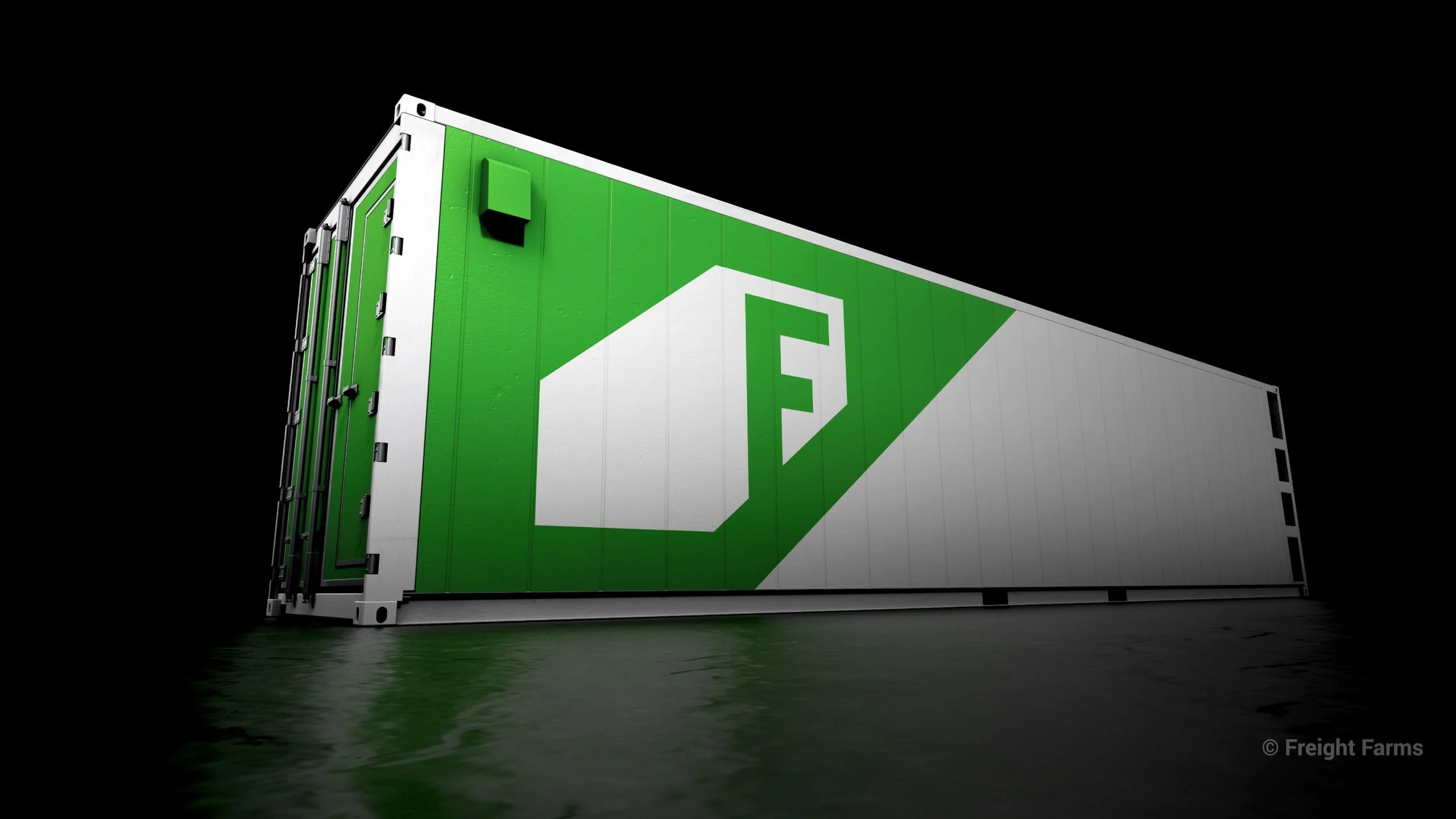
Freight Farms Announces Next-Generation Container Farm, Advancing Production Limits of Hydroponic Vertical Farming
Agtech innovator's new technology adds 70% more growing space, drives yield, efficiency, automation
NEWS PROVIDED BY Freight Farms
Feb 26, 2019
BOSTON, Feb. 26, 2019 /PRNewswire/ -- Freight Farms is proud to announce the Greenery™, successor to the Leafy Green Machine™ (LGM), and the first generational product leap since Freight Farms pioneered the containerized agriculture industry in 2010. Within the same standard 320 sq. ft. footprint, the Greenery offers farmers 70% more growing space, with unprecedented versatility, efficiency, and automation control – advancing the limits of production, and making farming more accessible than ever before.
Performance-Driven Container Farming


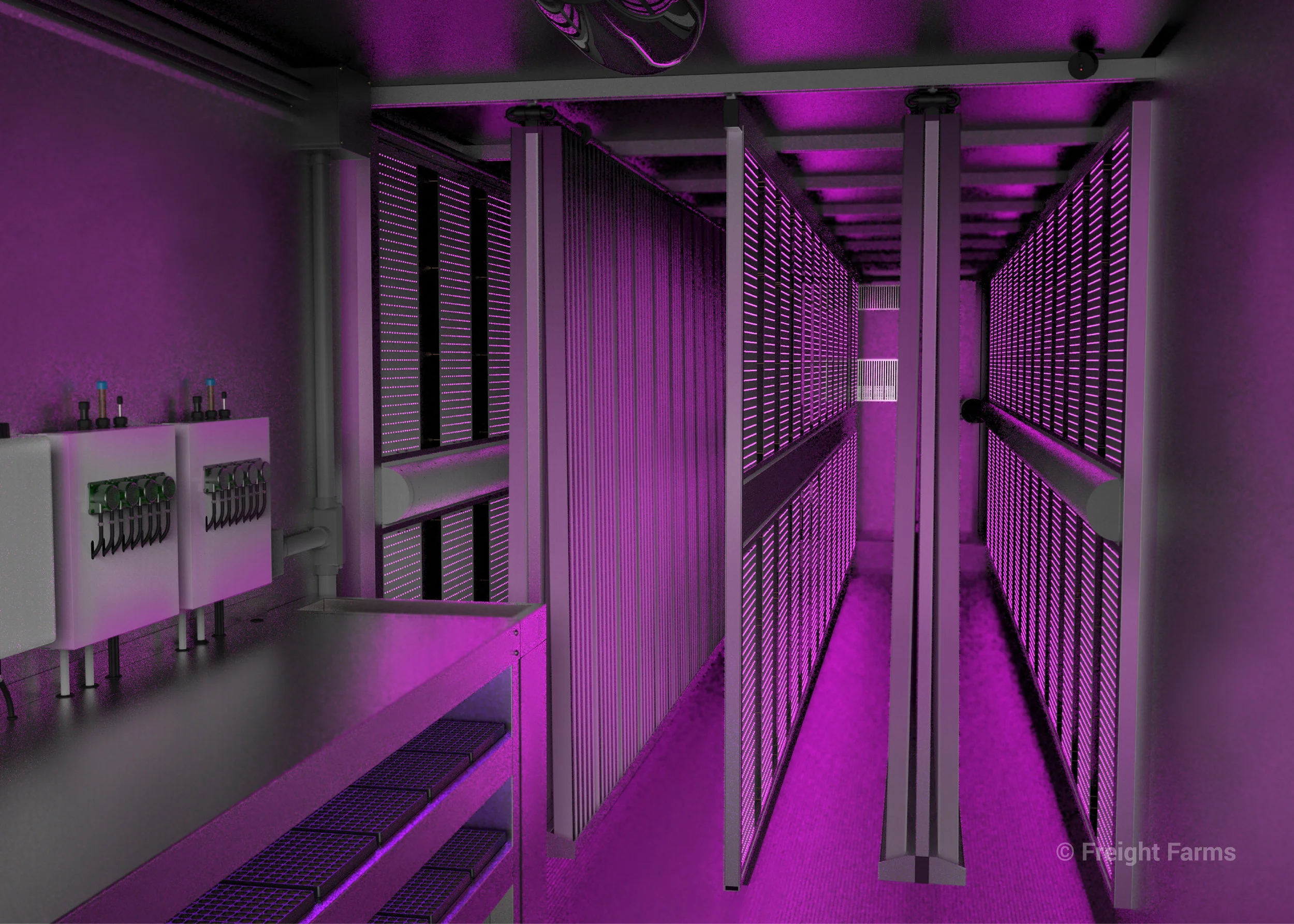

The Greenery combines dynamic aisles with new plant panels and LED technology to boost yields and create streamlined operations for the farmer. Simplified Workflows: Moveable rows provide easy access to plants for convenient harvesting, pruning, cleaning, and maintenance. This drastically reduces labor and increases productivity. Customization & Versatility: With the sliding rack system, farmers can arrange the Greenery based on their needs, allowing them to grow larger plants without experiencing spacing or airflow problems.
Exterior of Freight Farms' Greenery: now made from purpose-built freight containers with all-weather paint, premium metalwork, and superior manufacturing.
The Greenery’s main growing area features 88 plant panels and 112 LED panels. The LED panels are hyper-directionally focused on the plant canopy to prevent light waste and yield fuller, heavier crops in shorter time-frames.
Freight Farms' new vertically hanging 5-channel plant panels replace previous single-channel crop columns, capturing previously unproductive space to unlock 70% more growing space within the Greenery’s 320 sq.ft. footprint.
The Greenery’s nursery station holds 4,608 plant sites. Seedlings grow up toward 3:1 red-to-blue LED light panels that focus directly onto the canopy, with minimal light fall-off or wasted energy.
After years of data collection and development based on the experience of hundreds of farmers in its global network, Freight Farms has again raised the industry bar with a fundamental container farm redesign. Instead of reorganizing existing technology into a refreshed layout, the company saw the potential to blueprint entirely new farm components previously unavailable to the industry. In doing so, Freight Farms keeps the ergonomics of both farmers and plants as the central priority to improve yield, efficiency, and workflow. Today Freight Farms reveals three pillars of the Greenery's design.
Greater Yield, Productivity, and Usability: A fully-reimagined farm interior combines customizable grow rows with innovative plant panel and LED technology to boost yields and create streamlined operations for the farmer.
Mobile rack system: Farmers can now shift grow rows and LED panels to create custom layouts to support the growth of a new variety of crops (larger, vined, rooted, etc.) while drastically improving workflow.
Increased production: Capturing previously unproductive space, a unique 5-channel plant panel design replaces traditional crop columns to unlock 70% more growing space within the same small footprint. The Greenery also hosts 30% more nursery plant sites.
Industry-leading LEDs: Unique, rigid LED panel arrays replace previous rope lighting, tripling the crops' access to light energy to result in fuller, heavier plants within a faster growth period.
Superior Resource Efficiency: Newly designed systems throughout the Greenery, including lighting and climate control, use and reclaim resources with unrivaled efficiency.
Best brightness-to-power ratio: Because the LED arrays are focused directionally, light energy waste is prevented, and despite triple the intensity, there is no 3x corresponding electricity draw.
Intelligent moisture reclamation: The farm's powerful new climate control system condenses and recycles ambient moisture so efficiently that in certain humid regions it is capable of capturing upwards of 1.5 gallons of water per hour, rendering some Greenery operations water-positive.
Time savings: The mobile rack system gives farmers direct access to all plants for more convenient harvesting, pruning, cleaning and maintenance. This reduces farm work time by 25–50%.
Climate Automation and Connectivity: The Greenery pairs exceptional design with complete connectivity. Each farm component is built from the ground up with farmhand® IoT integration, bringing unparalleled control and transparency to farming.
Smart farm: Using IoT-connected sensors, the Greenery continuously relays all climate, component, and camera data directly to farmhand®. With this information at their fingertips – via smartphone, tablet, or desktop – farmers can confidently operate and monitor their farm remotely.
Tailored climate control: With Freight Farms' catalogue of real-world growing data, farmers can replicate ideal environmental conditions, or "recipes," for consistent crop quality. They can even make non-native produce varieties available in their local market by creating environments otherwise impossible in their region.
Combined, the Greenery's features signal a major shift in containerized agriculture. "The Greenery's forward leap in data and sensor technology represent a fundamental improvement to farmers' workflow and production versatility," said Brad McNamara, Freight Farms Co-Founder and CEO. "It also allows for total, real-time transparency for consumers. A single romaine head can be traced back through every growing stage back to the seed it came from, even down to the hour. That standard was previously considered impossible, and one we hope the entire industry will now adopt."
Versatile Design For the Future
With size and resource conservation central to its design, the Greenery is deployable by a single individual, yet powerful enough to meet the needs of regional distributors. This turnkey system can grow a higher capacity of hyper-local food directly onsite for communities, without resorting to time-consuming and capital-intensive indoor farming installations that are often located remotely.
"The Greenery is the most powerful standalone hydroponic farm available, with a fully-connected technology platform you can't achieve from any combination of products elsewhere in the industry," added Jon Friedman, Co-Founder and COO. "By revolutionizing a farm that can be operated by anyone, in any climate, and can successfully support a diverse range of business goals, our team is helping support a higher standard for society's food system than previously possible."
Establishing Containerized Farming
In 2012, Freight Farms debuted the first vertical hydroponic farm built inside an intermodal shipping container—the Leafy Green Machine—with the mission of democratizing and decentralizing the production of fresh, healthy food. With its technology system and integral IoT data platform, farmhand®, Freight Farms now has the largest network of connected farms in the world.
In 15 countries and most U.S states, farmers use Freight Farms technology to grow food in environments ranging from urban neighborhoods to extreme climates. These farms are the cornerstones of hundreds of independent small businesses and non-profit initiatives that localize and improve food access geographically and socio-economically. Leafy Green Machines have also been added to numerous educational infrastructures, as well as corporate and wellness programs by customers like Google, Ford Motor Company, Everlane, and Kimbal Musk's Square Roots.
The Greenery, available for pre-sale starting today, retails for $104,000, with general availability this Spring. For purchasing information, please visit freightfarms.com, or inquire at 1-877-687-4326 ext. 1. Freight Farms can also be visited on Instagram, Twitter, or Facebook.

New Opportunities For Agriculture Bloom in Cleanrooms
February 28, 2019
Some call it the future of farming and in some places it’s already here. It’s called indoor vertical farms, an alternative to conventional outdoor agriculture and it’s being tried in Europe, Asia and the U.S.
CGTN’s Hendrik Sybrandy reports.
“Why don’t we start on this one right here,” said Nathan Lorne, as he began a recent tour of his facility under a purplish glow.
Lorne is the Sales Manager at Infinite Harvest, an indoor hydroponic vertical farm in Lakewood, Colorado that grows four varieties of exactly one crop, lettuce. CGTN’s Hendrik Sybrandy takes us inside the facility.
“What you see here is a Bibb lettuce,” Lorne said. “The variety is Flandria.”
Inside a 500 square meter warehouse, under red and blue lights, because that’s what leafy green vegetables like, sit 52,000 heads of lettuce stacked from floor to ceiling. An automated system controls the variables that allow these crops to survive and thrive.
“Whether it be temperature, humidity, CO2, water temperature, light schedule, the list goes on and on,” Lorne said.
Welcome to at least a part of farming’s future, something that’s being tried in Europe and Asia, as well as other parts of the U.S.
“All of those problems that we see in agriculture as we know it are more or less solved by an operation like this,” Lorne added.
It solves problems like soil-borne contamination, labor costs and drought. It minimizes the need to truck food long distances, trips that often lead to food waste. It’s an answer to the age-old farmer’s dilemma.
“How do we optimize an environment to maximize the production of a crop,” said Josh Craver, an assistant professor of Controlled Environment Horticulture at Colorado State University.
The school dabbles in what’s called controlled environment agriculture. At a time when more and more people want locally produced, high-quality food, vertical farms are bringing that food to the dinner table. Of course man does not live on lettuce alone. This type of agriculture may not make sense for row crops like corn and wheat. While LED lighting has made indoor farming much more possible, it does use its share of power.
“It is relatively expensive to have these structures and to manage these structures year-round, but what you get in return is this premium high-quality crop that oftentimes can be sold for a premium,” Craver said.
Infinite Harvest is constantly tweaking its treatment of lettuce which can be a bit finicky.
“You can ask a plant to do something,” Lorne said. “You can’t tell it to do something.”
Unlike other lettuce farms, which harvest two or three times a year, Lorne says, “this company, whose produce is consumed in restaurants, hotels and hospitals, doesn’t take seasons off.”
Infinite Harvest says it will soon be profitable.
“I don’t think vertical farming or indoor farming will necessarily replace agriculture in the long run,” he said. “I think it will change it though.”
Now, Infinite Harvest is even looking to branch out and produce things like berries.

John Lewis & Partners Announces Partnership With LuttUs Grow to Create ‘Mini-Farms’ Within Retail Stores
LETTUS GROW
John Lewis & Partners are partnering with British start-up company, LettUs Grow, to create 'mini farms' within their retail stores. This will highlight the importance of bringing sustainable food production to the farms of the future.
The 'mini farms' will be placed inside selected stores with the aim to reduce plastic waste and cut back on the unnecessary transport of food across the country. Using pioneering technology, fresh produce will be grown within its stores for consumers to purchase.
The news ties in perfectly with our Country Living #KeepBritainFarming campaign, as both John Lewis & Partners and LettUs Grow have spoken about how they hope the new initiative will bring some much-needed change to the "broken food system."
LETTUS GROW
"We’re thrilled to be working with John Lewis & Partners to investigate the use of urban agriculture within the retail experience. This represents a real opportunity to meaningfully reduce food miles, whilst engaging shoppers with the modern food system," explained Jack Farmer, co-founder and operational lead at LettUs Grow.
"WE CAN SET UP OUR INDOOR FARMS IN ANY ENVIRONMENT - FROM DESERTS TO DISASTER SITES.."
Charlie Guy, co-founder and managing director at LettUs Grow also commented on the partnership: "We can set up our indoor farms in any environment - from deserts to disaster sites. By siting them in supermarkets we can open up a dialogue with the public about how new technologies can be used to make big changes in our broken food system."
LETTUS GROW
Who is LettUs Grow?
The agri-tech company design irrigation and control technology for indoor farms. Using exciting new technology, they work on reconnecting crowded cities with the tradition of locally grown produce.
Passionate about local food, the Bristol-based start-up exists to reduce the waste and carbon footprint of fresh produce. They launched back in 2015 and are now building commercial aeroponic systems for growers around the UK.