


Welcome to iGrow News, Your Source for the World of Indoor Vertical Farming
80 Acres Farms Strikes 'Significant Investment' From San Francisco Private Equity Firm
15-Jan-2019 By Mary Ellen Shoup
Vertical indoor farming company, 80 Acres Farms, has received a "significant investment" from Virgo Investment Group, a San Francisco-based private equity firm, to help rapidly commercialize the company's specialized indoor farming technology.
For more information:
Republic Polytechnic Invests in Urban Farming With New Diploma, Lab
Republic Polytechnic (RP) is paving the way for the future of Singapore's high-tech urban farming.
Jan 11, 2019
On Wednesday (Jan 9), the poly launched the specialised diploma in urban agricultural technology - the first full-qualification diploma in the field.
At the launch, Senior Minister of State for Trade and Industry, Dr Koh Poh Koon, emphasised the importance of increasing the margin of safety for Singapore's food supply through agricultural technology.
Dr. Koh explained that since Singapore imports more than 90 per cent of its food supply, it is crucial to leverage on technology to minimise challenges like disruptive weather conditions and optimise crops' growth cycles.
To overcome the challenges of unpredictable weather and land scarcity, the agricultural industry has turned to urban agriculture.
Commencing in June with an inaugural batch of 25 students, the part-time diploma in applied science gives students the option of signing up for the associated SkillsFuture Earn and Learn Programme
The 900-hour course is ideal for students interested in a career in the industry and adult learners looking to upgrade their skills.
OPENING
Dr. Koh also witnessed the opening of RP's Agriculture Technology Laboratory and memorandum of understanding signing with Singapore Agro-Food Enterprises Federation.
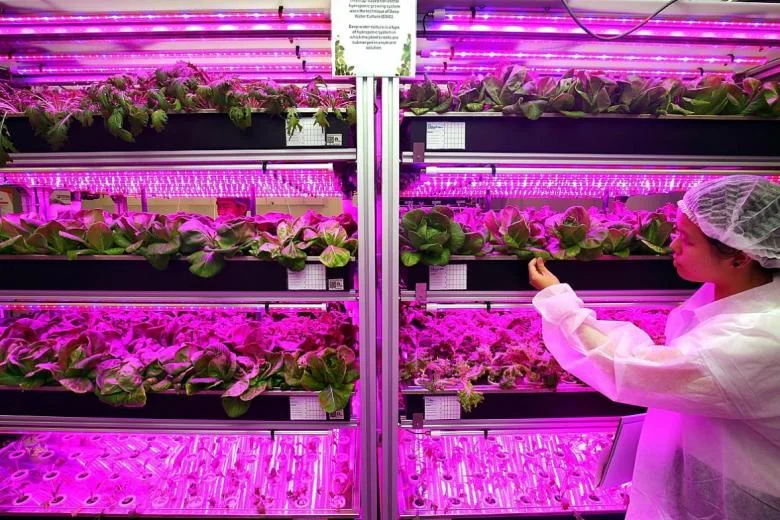
The Agriculture Technology Laboratory is a new facility to support students in deepening their skills through hands-on training.
The lab will be equipped with indoor farming systems like vertical plane cultivation,conduit-based horizontal hydroponic nutrient film technique, tray-based horizontal hydroponic growing and substrate growing systems.
According to Mr Yeo Li Pheow, the principal of RP, the motivation behind the new course and lab stemmed from the pressing issue of food security due to Singapore's limited land area.
"In order for Singapore to be more self-sufficient and resilient, we need to increase the amount of food we produce locally and reduce our dependence on food imports," said Mr. Yeo.

This Urban Pop-Up Farm is Powered by Coffee Grounds
Melbourne roaster Cirrus Fine Coffee grows vegetables and herbs in a tiny garden, thanks to the help of coffee waste.
By Audrey Bourget
17 JAN 2019 - 1:20 PM UPDATED 17 JAN 2019 - 1:56 PM
The pop-up farm on Cirrus Fine Coffee’s parking lot is a little green oasis in the industrial area of Port Melbourne.
“We have heritage varieties of tomatoes, corn, zucchini, pumpkin, spring onion, beetroot, rainbow chard, spinach, silverbeet, flowers to attract beneficial insects and also a range of herbs like chives, basil, oregano and coriander,” says Brendan Condon. And all of this only takes up two parking spaces.
Condon is the director of sister companies Cirrus Fine Coffee, Biofilta and Australian Ecosystems, which have collaborated to develop super-efficient compact pop-up farms. “We often think that we have overcrowded cities, but if you look at them from the lens of urban farming, we have huge amounts of space. We can flip cities into becoming super-efficient food growers,” he says.

These beans deliver more than a caffeine hit.
From landfill to compost
Each year, caffeine-loving Aussies produce around 75 000 tonnes of coffee waste, most of it ending up in landfill where it contributes to the production of methane, a greenhouse gas. But coffee grounds don’t have to end up there; they can be composted and used to produce food.
Cirrus Fine Coffee’s own pop-up garden uses a mix of composted coffee grounds (rich in minerals and nitrogen), husks from the roastery (a good source of carbon), food scraps and a small amount of manure, to help produce around 300 kilos of food per year. With the World Health Organisation recommending adults consume a minimum of 146 kilos of fresh fruits and veggies per year, it means that one of these pop-up farms could provide enough for two people for a whole year.
The Biofilta wicking (self-watering) garden beds are easy to install and low maintenance. The design holds enough liquid to water the garden for a week in summer and a month in winter.
“We want people to take advantage of the abundant resources for urban farming and to engage with it, so we improve nutrition and health, and divert waste from landfill,” says Condon.
Cirrus Fine Coffee is committed to sustainability in more ways than one. Its coffee beans are ethically sourced, the brand's packaging is biodegradable and its offices run on clean energy.
It's also partnered with Reground, an organisation that goes to cafes to pick up coffee grounds and transport them to community gardens and pop-up farms.
“We all need to work together,” says Ninna K. Larsen, founder of Reground. “We work at changing the system rather than just collecting coffee. Coffee is just a great conversation starter. It’s about getting people talking about what organic waste can do, instead of going to landfill. We can grow food with it.”
Condon would like to see cafes and people around Australia embrace urban farming. “If you have a cafe where you recycle coffee grounds to grow food, people will want to go there and support that business,” he says. “Hopefully, in a few years, it will be common practice.”

Innovative Veg Growing Firm Secures £1 Million To Build The Farms Of The Future
January 11, 2019
An innovative Bristol firm which has developed a range of aeroponic technology for indoor farms has announced it has secured £1 million in funding to build world-leading indoor growing facilities.
LettUs Grow was awarded a grant of £399,650 by the UK’s innovation agency, Innovate UK, to lead a £700,000 project – which will help increase food resilience and security in the face of climate change.
This is alongside a further €100,000 from the Green Challenge and several additional research grants.
As part of the project, LettUs Grow will work alongside ECH Engineering, industry leaders in controlled environment technology, and urban agriculture experts from Grow Bristol.
The grants came hot on the heels of the disruptive startup’s most recent investment round, where they raised £460,000 from ClearlySo, Bethnal Green Ventures, the University of Bristol Enterprise Fund II, managed by Parkwalk Advisors, and angel investors.
This funding has allowed the company to scale operations and drive forward product development to access a rapidly growing global market for efficient and sustainable farming technology.
By 2050, it’s expected that humanity will need to increase food production by 70% to feed over nine billion people. Existing methods of agriculture will not be enough to feed this burgeoning global population.
Alongside this, most ‘fresh’ produce is imported out of season, often travelling hundreds of miles to reach consumers and resulting in colossal waste throughout the supply chain.
LettUs Grow has designed a patent-pending aeroponic system that has shown growth rate increases of over 70% compared to existing solutions for leafy greens, salads and herb production.
What Is Aeroponic Growing?
Aeroponics is a way of growing plants without soil, where the roots are watered using a fine mist. Not only does this allow greater oxygenation of the roots, delivering better flavour and faster growth, but it uses up to 95% less water than traditional agriculture.
Charlie Guy, co-founder and managing director said: “This injection of private and public funding into the company enables us to accelerate our innovative products to market and build one of the most technically advanced facilities for indoor growing in the world.
The global agri-tech industry is very exciting right now, all stemming from the necessity to improve the economic and environmental sustainability of food production.
“We are fielding enquiries from all around the world from food producers and farmers who want to experience the benefits of our technology across a growing range of crops.”
Matias Wibowo, investment manager at ClearlySo: “Innovation is critical to ensuring long-term food security and sustainability.
“Our investors see the value, both in terms of financial and environmental returns from tackling this systemic global problem. That’s why they got involved in LettUs Grow.
“LettUs Grow provides the technological innovation piece to the vertical smart farming movement that is currently trending rapidly in the urban context.”
This Sustainable Apartment Complex of The Future Has Farms, Community Space, And Bike Parking Galore
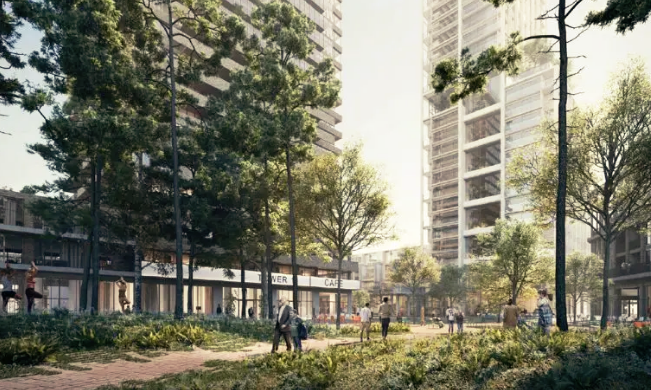
In a new apartment complex that will soon rise in the Dutch city of Utrecht, instead of deliveries from an online grocer, you can get boxes of vegetables grown in an intensive greenhouse on the roof or from a smaller unit built into the facade on your own floor.
01.28.19


The 1,000-unit Mark, in the Dutch city of Utrecht, will be complete by 2023. The majority of its units will be low- and medium-income housing, or “care homes” for the elderly.
1/6 [Image: Vero Visuals]
In a new apartment complex that will soon rise in the Dutch city of Utrecht, instead of deliveries from an online grocer, you can get boxes of vegetables grown in an intensive greenhouse on the roof or from a smaller unit built into the facade on your own floor. In a courtyard downstairs, you can forage for raspberries in an urban forest. In the parking garage–which is designed to house many more bikes than cars–there’s space for aquaculture.
The new development, called the Mark, with more than 1,000 units in three towers, rethinks the sustainability of typical high-rise buildings. One part of that is the food that residents eat. “We put a lot of energy into diminishing the carbon footprint due to food production for the inhabitants there,” says Darius Reznek, a partner at the design firm Karres Brands, which worked on the project along with the firms Architekten Cie, Geurst & Schulze, and a group of developers. A team of urban farmers will manage the on-site greenhouses, which will also supply produce to a rooftop restaurant.
At the ground level, by rethinking mobility options, the designers had more space for plants. “A lot of times, when you develop high-rises, you’re stuck with a lot of parking,” says Reznek. The new apartments are next to a train station, and the city is one of the best places to bike in the world, so residents don’t really need cars most of the time, but the developer will offer an electric car-sharing service to make it even less likely to that someone feels the need to own a car. “Instead of everyone having their own car, we will have 200 car-sharing vehicles, and we provide a lot of bikes, electric bikes, and space for things like that to kind of stimulate a different kind of mobility so that not everybody is stuck to their car,” he says. The garage can fit 3,500 bicycles; the extra space will become an edible forest.
Food is also a way to bring residents together–the apartments have their own balconies, but it’s possible to visit the greenhouses or manage a plot of your own in a community garden. The buildings also nudge people to interact in other ways. “The high-rises are separated in sort of smaller neighborhoods that revolve around collective floors,” says Reznek. Along with green spaces, the buildings have shared spaces with larger kitchens, collective “living rooms” if someone needs more space for a party, shared workspaces, and other community gathering places.
To make the buildings carbon neutral, the developers partnered with nearby parking garages to use their rooftop space to produce enough solar power for all of the apartments. The buildings also use a modular design that can be adapted over time, so future construction also uses less energy.
The apartments, which will be completed in 2023, are meant for everyone: While some will be sold or rented at market rate, the majority will be low-income social housing, medium-rent housing, or “care homes” for the elderly. Older residents will live near a shared courtyard and near services like a physiotherapist’s office and a doctor, and can transition to assisted living while staying in their own apartments.
It’s a model for high-rise apartments that the architects hope becomes more common, both in terms of sustainability and in terms of social interaction that goes beyond seeing neighbors in an elevator. “We believe that in order for skyscrapers or dense urban living to become kind of relevant again, it needs to become less monofunctional,” Reznek says. “It needs to address this solitude of living isolated at the 100th floor and not knowing your neighbors.”
ABOUT THE AUTHOR
Adele Peters is a staff writer at Fast Company who focuses on solutions to some of the world's largest problems, from climate change to homelessness. Previously, she worked with GOOD, BioLite, and the Sustainable Products and Solutions program at UC Berkeley.
Mapping America’s Biggest Employers By State
A few large-scale organizations stand out as the top employer in each state.
In America, approximately 150 million people are currently employed, doing everything from neurosurgery to greeting customers at your local Walmart Supercenter.
A few large-scale organizations stand out as the top employer in each state.
The U.S. is the third most populous country in the world, so it takes a lot of manpower to keep the government running. It’ll come as no surprise that, in most states, either the state or federal government is the top employer. California alone employs a quarter of a million federal workers.
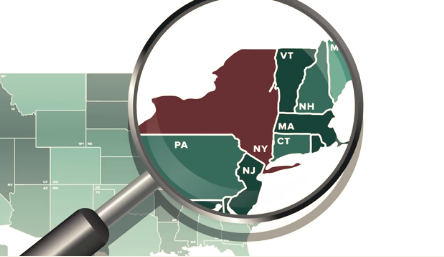
New York State is a unique case as NYC’s municipal workforce is the top employer. Technically, the largest employer on the planet is the U.S. Department of Defense, and in eight states, there are more active military personnel than any single private employer.
When it comes to large-scale employment, there’s one regional trend that stands out the most – the broad blue expanse of Walmart country.

Greenhouse In An Auchan Hypermarket
In Italy, Auchan is testing the installation of a greenhouse in a hypermarket. Fresh herbs and salads grow directly on the shelves and customers do their own “harvesting”.
In Italy, Auchan is testing the installation of a greenhouse in a hypermarket. Fresh herbs and salads grow directly on the shelves and customers do their own “harvesting”.
Agricooltur, a young company from the Turin region, is the originator of this scheme. The neighboring Auchan hypermarket placed the installation in its market area at the end of November; it is a spectacular complex of about thirty meters square. The plants are grown by aeroponics: the roots are hanging loose and are sprinkled with a nutrient solution.
Also in late November, Casino installed a showcase in which an assortment of fresh herbs were grown in its supermarket in La-Varenne-Saint-Hilaire, France.
Source: internationalsupermarketnews.com
Publication date : 1/17/2019
Organic Industry Is Not Giving Hydroponic, Aquaponic Growers A Warm Embrace
The litigious Center for Food Safety two weeks ago filed a rule-making petition with U.S. Department of Agriculture, demanding new regulations prohibiting organic certification of hydroponic agriculture production
By Dan Flynn on February 8, 2019
Some fresh produce from hydroponic growers has been approved for and is being sold under USDA’s organic seal, but farmers who grow their organic crops in the soil don’t like the competition.
The litigious Center for Food Safety two weeks ago filed a rule-making petition with U.S. Department of Agriculture, demanding new regulations prohibiting organic certification of hydroponic agriculture production. The 22-page petition also asks USDA to revoke any existing organic certification previously issued to hydroponic operations.
Food safety comes into play in the petition in only one way. Hydroponics doesn’t have soil, so they come up a little short because they do not provide soil samples as a measure of testing compliance. The CFS points out that regulations implementing the Organic Foods Production Act of 1990 “consistently suggest soil samples as a measure for testing compliance.”
Agents who review operations as part of the USDA’s organic certification process “must conduct periodic residue testing of agricultural products,” with soil samples suggested as a method for testing, CFS’s petition says. “Many hydroponic systems would not contain soil for sampling, as suggested in the OFPA regulations.”
Hydroponic, aquaponic and aeroponic growers currently can earn organic certification. It is allowed by USDA so long as the certifier can show there is compliance with the organic standard. One industry supplier says hydroponics, by definition, is a method of growing plants in a water-based nutrient-rich solution that does not use soil. Instead of plants root in a nutrient solution with access to oxygen.
A year ago, USDA’s Agriculture Marketing Service (AMS) tried to settle some issues concerning organic certification of hydroponic and aeroponic growing operations. The AMS action came after USDA’s advisory National Organic Standards Board (NOSB) recommended banning the non-soil systems from being called organic production. USDA only briefly pondered that one before saying “thanks, but no thanks” to NOSB for the recommendation.
Aquaponics refers to growing crops in a system with farmed fish that supply nutrients for plants. Greenhouse growers and urban farmers using vertical growing systems use hydroponic and aeroponic methods — all without soil. The organic industry has been rocked with debate about these hydroponic methods for nearly a decade.
CFS wants a flat prohibition on hydroponic operations ever being allowed to use the USDA organic label. It claims hydroponic production systems that do not use soil do not meet federal organic standards and violate organic practices, which require that organic farming include soil improvement and biodiversity conservation.
Joining the CFS petition are more than a dozen other organic farmers, consumer, retailer, and certifying organizations, including the Organic Farmers Association, Northeast Organic Dairy Producers Alliance (NODPA), PCC Community Markets, and the Cornucopia Institute.
“Mislabeling mega-hydroponic operations as ‘organic’ is contrary to the text and basic principles of the organic standard. Right now there is a pitched battle for the future of organic, and we stand with organic farmers and consumers who believe the label must retain its integrity,” said George Kimbrell, CFS legal director.
The petitioners say consumers trust the organic label and pay extra for the assurance that it indicates a more healthful and environmentally-friendly way of producing the food they buy.
Since the federal Certified Organic label was introduced more than 20 years ago, CFS says the organic food market has grown exponentially and is now a $60 billion industry in which multinational corporations have bought organic brands and compete with small food producers who use environmentally-friendly methods.
“Allowing hydroponic systems to be certified as organic undercuts the livelihood of organic farmers that take great lengths to support healthy soil as the bedrock of their farms,” stated Kate Mendenhall of the Organic Farmers Association. “Hydroponic producers getting the benefit of the organic label without actually doing anything to benefit the soil undermines the standard and puts all soil-based organic farmers at an untenable economic disadvantage.”
The petition argues that organic agriculture has traditionally been defined as using soil requirements such as fostering soil fertility, improving soil quality, and using environmentally beneficial farming methods such as proper tillage and crop rotation.
USDA continues to allow hydroponics, which goes against the advisory NOSB’s recommendation that organic certification not be extended to the non-soil growing methods.
Canada and Mexico prohibit hydroponics for organics, and the European Parliament voted to end the organic certification of hydroponic products in April 2018.
“Corporate agribusiness lobbyists have been working to water down the organic standards for decades,” said Mark Kastel, executive director for the Cornucopia Institute. “In this case, the careful stewardship of soil fertility is not only a philosophical precept, but it’s also codified in federal law.”
And while CFS is often successful with its legal strategies, the current petition to USDA may not get too far. Jennifer Tucker, the deputy administrator of USDA’s National Organic Program, recently said organic certification of hydroponic operations is “a settled issue.”
“Last year we issued an Organic Insider (e-mail newsletter) that indicated that hydroponics had been allowed since the beginning of the program and that (they) are still allowed,” Tucker said. “We consider that a settled issue.”
The Packer, the produce industry publication, reported Tucker’s comments to the 2019 Global Organic Produce Expo.
“There are some certifiers that certify hydroponics, and there are some that do not; they are all bound by a common set of regulations,” Tucker added.
Tags: Center for Food Safety, hydroponic, Jennifer Tucker, NOP, NOSB, organic certification, organics, USDA Organic
Technology Will Make The UAE One of The World's Most Food-Secure Countries By 2021
From vertical farms to artificial intelligence, the nation is embracing cutting-edge innovations to achieve this ambitious goal, says the UAE Minister of State for Food Security
Food security is without doubt one of humankind’s most pressing concerns and the issue is one that is felt particularly keenly in the UAE. Although considered food secure – primarily because it enjoys a high degree of economic and political stability – the UAE still faces significant challenges. These stem from its arid climate, its shrinking groundwater levels and the volatility of the wider region. Added to these geographic and geopolitical stressors is the country’s spectacular growth. As its population has expanded exponentially, increasing from about 300,000 in 1971 – the year the UAE was founded – to more than nine-and-a-half million today, the need to provide for its residents has increased correspondingly.
My responsibility as UAE Minister of State for Food Security is to ensure that the nation continues to enjoy an adequate food supply for its citizens as it develops and to elevate its current position of 31st on the global ranking for food security to the top 10 by 2021. In order to achieve this, we are championing trade facilitation and enabling technology-based production and supply of food. The initiatives to support strategic goals are anchored in diversification of supply, alternative supply sources, technology-enabled enhancement of local production and international trade links, among others. Thus, a major part of my mandate is involved in incorporating agricultural technology – also known as “AgTech” – into the country’s food security agenda. This agenda is enshrined in the UAE’s recent launch of its National Food Security Strategy.
Variously defined as “transforming the global food system through digital technology” and “smart farmers getting smarter using digital technology”, AgTech encompasses advanced agricultural methods that differ distinctly from the traditional ways of farming practised for millennia. Increasingly seen as a solution to the UAE’s food security issues, my office is now placing a strong focus on adopting AgTech in the country’s agricultural sector, as part of a concerted effort to considerably reduce the 90 per cent of food that the country currently imports.
The AgTech government accelerator project, with its two components, is one such initiative. The first component is the promotion of the use of “controlled-environment agriculture” (CEA), which is a technology-based approach toward food production that utilises highly efficient technologies to properly manage agriculture inputs and maximise output. It involves agricultural industry entrepreneurs working alongside government bodies to provide tangible solutions to promote CEA, primarily through implementing an enabling business environment that is conducive to innovation.
The second component of the project is aquaculture, which is farming in controlled conditions of fish, crustaceans, molluscs, aquatic plants, algae and other organisms in freshwater and saltwater. With agriculture in general being the world’s thirstiest industry, accounting for approximately 72 per cent of total freshwater consumption, aquaculture represents one of the best uses of what is the region’s most precious resource. To this end, the UAE has established a vibrant aquaculture sector with an investment of more than Dh100 million to develop hatcheries and fish farms.
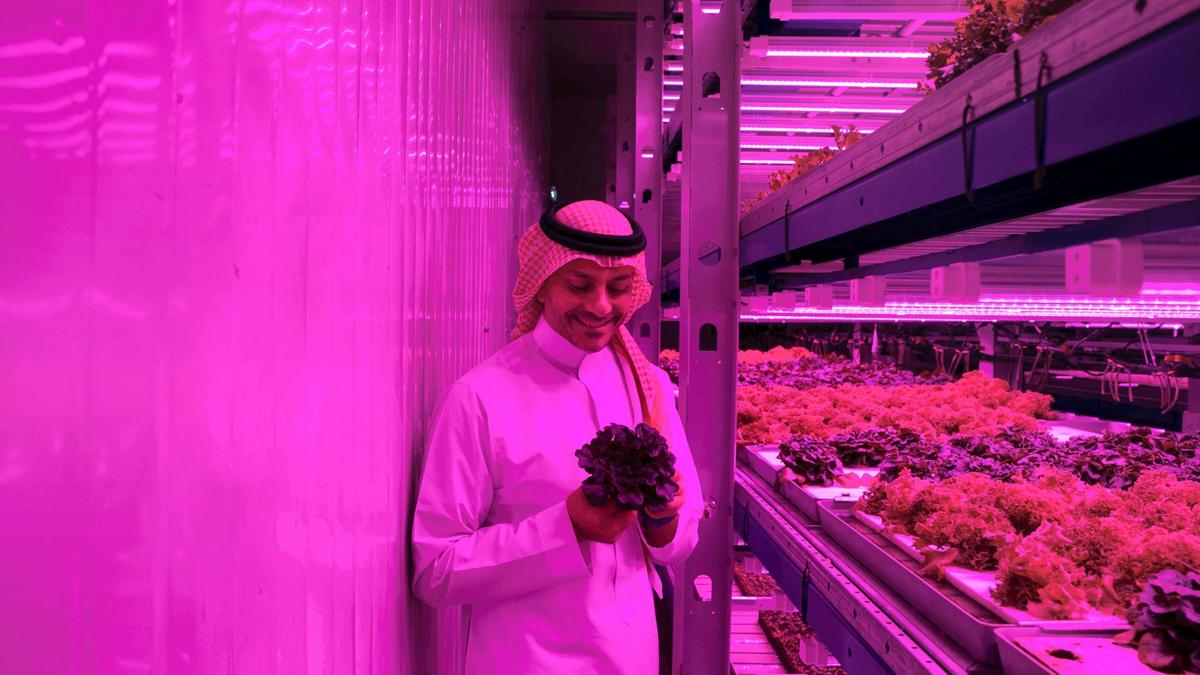
Vertical farming is another AgTech component that my department is promoting and one that has been identified as offering a solution to the UAE’s food security issues. The concept involves plants being grown in vertically stacked layers in an indoor environment where environmental factors can be controlled. Vertical farms typically use artificial light, humidity regulation, temperature control and minimum use of pesticides, enabling the production of vegetables in large quantities all year round without the need for soil, sunlight and chemicals. The commercial applications of vertical farming are already being realised in the UAE, with the opening of the Gulf region’s first-of-its-kind facility in December 2017. Located in the Al Quoz industrial area of Dubai, the 8,500sq ft farm produces 18 varieties of micro-greens, including rocket, kale, radishes, red cabbage, basil and mustard.
Remote-controlled drones have become an accepted presence in the skies above the UAE, with the ubiquitous flying machines used by the authorities to – among other things – monitor traffic and deliver post. Now they are providing benefits for the country’s agricultural sector, with unmanned aerial vehicles (UAVs) being used to map farming areas across the country. Announced in June 2017, the pilot project sees UAVs being used to create a highly accurate agricultural database that supports decision-making and forward planning by enabling the best use of resources and determining the optimum areas for crop growth.
Perhaps the most prevalent form of AgTech being incorporated in the UAE’s agricultural sector is the use of sensors, with their adoption resulting in increased yields in both large-scale agricultural projects and smaller organic farms. Sensor-equipped gyroscopes, accelerators and GPS monitors are being employed to enhance crop production by making the most of land and water use – precision irrigation that is highly effective in reducing water waste. A good example is an organic farm in Sharjah that relies heavily on sensors to determine the salinity and mineral content of the soil to ensure optimum crop growth with minimal use of water. Another prime example is a household name Japanese electronics manufacturer that is creating a farm in Dubai to grow strawberries, with the facility incorporating light-emitting diodes for controlled lighting, air distillation technology and other appliances to check room temperature and humidity.
Aquaculture, vertical farming, drone use and sensors are just four of the technologies that are being utilised in the UAE to maximise crop production while ensuring good husbandry of resources. This is only the start of what will be an expanding role for AgTech in the country’s agricultural sector. The office of food security is currently evaluating how emerging areas of technology, such as robotics, can play a part. Automation combined with artificial intelligence is an exciting field that we are currently assessing. One company in the US has produced a robot that mimics what a fruit picker in the field does. It uses AI to determine which fruit is ripe and ready to be picked, leaving unripe fruit in place on the vine. We are closely following such developments as part of the National Food Security Strategy and will be assessing how rapid technological changes that form part of the Fourth Industrial Revolution can be best incorporated to ensure food security for all.
Mariam Al Mheiri is the UAE's Minister of State for Food Security
Updated: January 16, 2019 04:25 PM
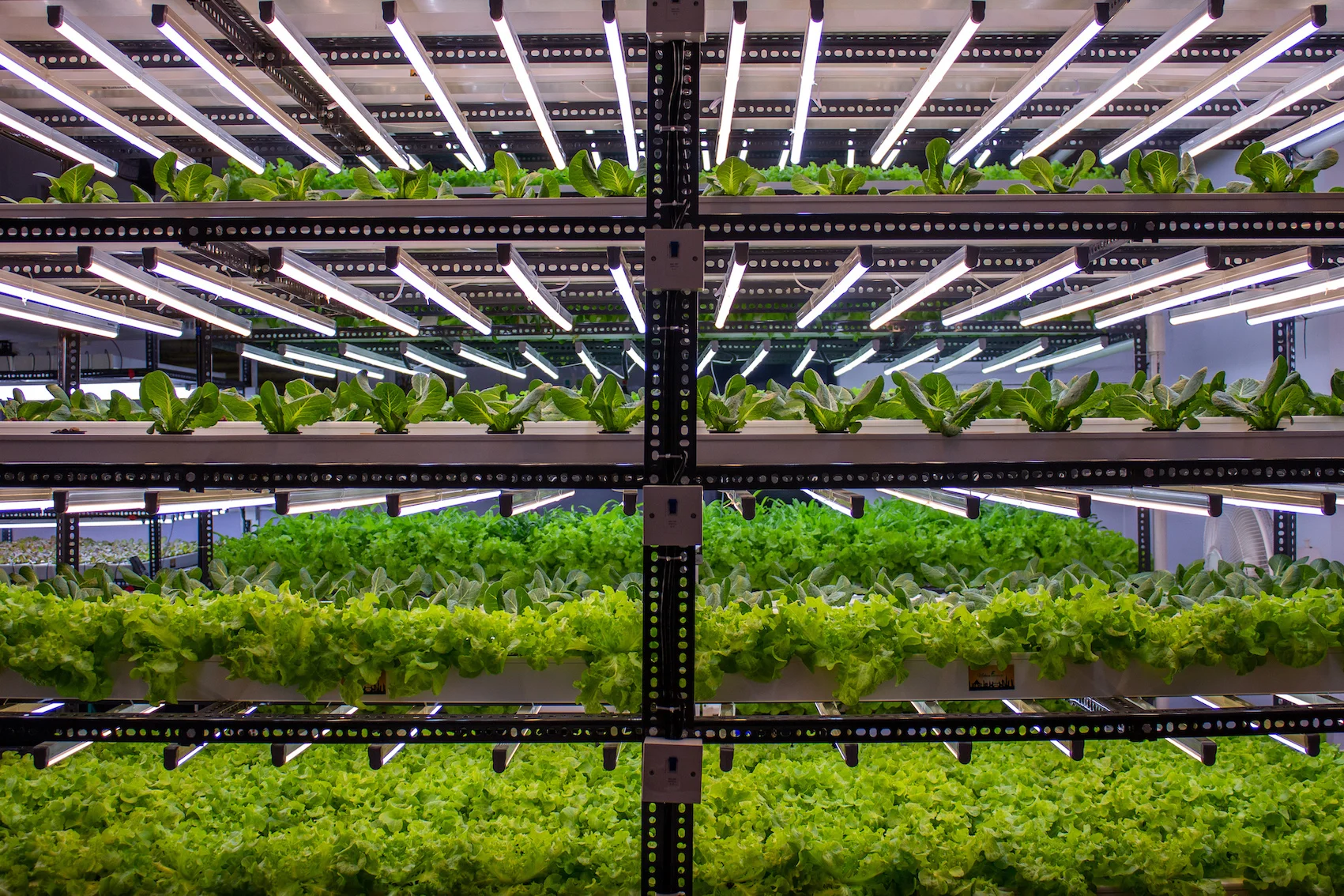
Meet The People Running A Farm In The Middle Of Andheri – Herbivore Farms
The young guns from Mumbai set themselves up on a mission to directly provide the citizens with vegetables through their hyperlocal, hydroponic farm, a first for the city.
By Mallika Dabke January 15, 2019

The minds behind Herbivore Farms
There’s no doubt that the awareness of eating clean food is growing by the day, but for most of us, it’s an ongoing struggle to make that lifestyle shift. Most of us are grossly unaware about where our produce comes from, and the authenticity of organic products is often left as an unanswered question at the back of our minds. Bringing clarity to our kitchens, is Herbivore Farms, which is an actual farm in the middle of Andheri, set up by duo Sakina Rajkotwala and Joshua Lewis. The young guns from Mumbai set themselves up on a mission to directly provide the citizens with vegetables through their hyperlocal, hydroponic farm, a first for the city. I spoke to Sakina and Joshua to know more about them and their work, read on to see what we spoke about!
Give us a quick introduction to Herbivore Farms.
Herbivore Farms is Mumbai’s first hyper local farm located in Andheri East. We grow the super healthy varieties of leafy green veggies like Swiss Chard, Kale, Rocket and Lettuce using hydroponic methods of cultivation.
Our produce is delivered to customer’s homes a few hours post-harvest, so it’s always at its peak of freshness, nutrition and flavour. Our indoor farm enables to grow in a clean, sterile environment and we use absolutely 0 pesticides so it’s 100% safe. We also use up to 80% less water to grow our produce using a recirculating irrigation system.
Talk us through your story – what inspired you, how you started, and the journey so far.
The journey that led us to start this project began in 2017 when we both quit our jobs – Sakina worked at an NGO called Magic Bus and Joshua was working with an ad company called Directi. While our jobs seemed to be working out well for us, we were missing a sense of purpose and were on a mission to find it. So, we decided to pack our bags and go live in Auroville for three months and work on a farm. We wanted to get our hands dirty and also reconnect with ourselves and nature.
We worked as farm labor for three months at Solitude Farm. The farm also had a cafe where lunch was served and made from ingredients that were harvested fresh off the farm the same morning. We ate meals post work there every day and food had never tasted better. It was always basic and simple food but it changed everything for us in terms of our energy levels, our mood and in general, our overall health. We felt happy and well.
This was the starting point of our inspiration. We wanted to create a way for people to enjoy fresh, healthy local produce. We also wanted people to revive their relationship with their food – understand where it comes from, who grows it, how it’s grown, why it’s good for you. We wanted people to be able to feel as good as we did. And that’s how Herbivore Farms was born.
Through extensive research we discovered how we could build a farm within the city and grow indoors. Hydroponics appealed to us because it saves two of the most precious urban resources – space and water. After a year of trial and error and lots of research, we built our small indoor farm. The two of us handle everything right from the farm tasks (planting, monitoring, harvesting) to deliveries, sales and marketing.
We believe that the food we eat is one of the most important factors in determining our health and more and more people are starting to realise it too. What we put in our bodies three times a day can impact just about everything in our lives and we are on a mission to get everyone to start valuing good food and make good choices. We also wanted to build a chain of supply that is completely transparent so people can trust what’s on their plate as opposed to the way our markets currently work.
Give us an overview of the set up and functioning of Herbivore Farms.
We have converted an old industrial warehouse in Andheri East into a climate controlled greenhouse. We’ve built vertical hydroponics systems that enable us to grow 10 times more in the same square footage. Our recirculating irrigation system also enables us to use 75% less water as compared to traditional agriculture. We’ve put in place processes that allow us to harvest on a daily basis, and each morning’s harvest is delivered to the customer’s homes a few hours later.
Up until a month ago it was the two of us managing absolutely everything, we personally went to people’s doors to hand them their produce. It was exhausting but extremely rewarding, and the motive was to dive into the depth of every little detail to put into place effective farm processes which we have been able to do now, and we’re still learning every day. A few weeks ago, we hired our first employee. He is learning quickly and developing into the role of Primary Farm Manager.
How has the feedback been? What are some of the things that customers are saying about you?
The response from customers who tried our free samples was phenomenal. About 90% of the people who took a sample home wrote back to us saying they loved how fresh and flavourful the leaves were and how they wanted to know how soon they can start buying. Some even said that we had changed their perception on leafy greens – what they previously associated with tasting “bitter” or “bland” and didn’t enjoy eating but would force themselves to, to try and be healthy. A lot of people we met at events told us were happy to finally have some transparency as to where their veggies are grown and where they come from, as they were skeptical of eating raw greens because of the fear of pesticides, unhygienic growing conditions, and not knowing who has handled the produce.
How does one place an order at the farm and what all do you currently grow to offer?
A Herbivore Harvest Box (Monthly Subscription) is INR 1500 (extra delivery charges for South Mumbai) for one month. One subscription = total four deliveries (one per week) on a fixed day depending on where the subscriber lives. Each week the subscriber will receive one box at their chosen address which will contain two to three varieties of leafy greens harvested that morning.
Our range of leafy greens – seven types of lettuce (lollo rosso, oakleaf, French romaine, summercrisp, butterhead), three types of Swiss chard (red, yellow, mangold), two types of rocket (wild and cultivated) and we are working on four kale varieties that will be part of our box soon!

Pick from a range of leafy greens!
Lastly, what’s next for Herbivore Farms?
We can’t wait to upgrade to a much larger facility and cater to a larger population of our city. We want to be more than just a farm. We want to teach kids how to grow their own food “kindly”, for that is the most essential foundation of a community of the future. Herbivore Farms aims to create jobs with meaning, and bring people closer together.
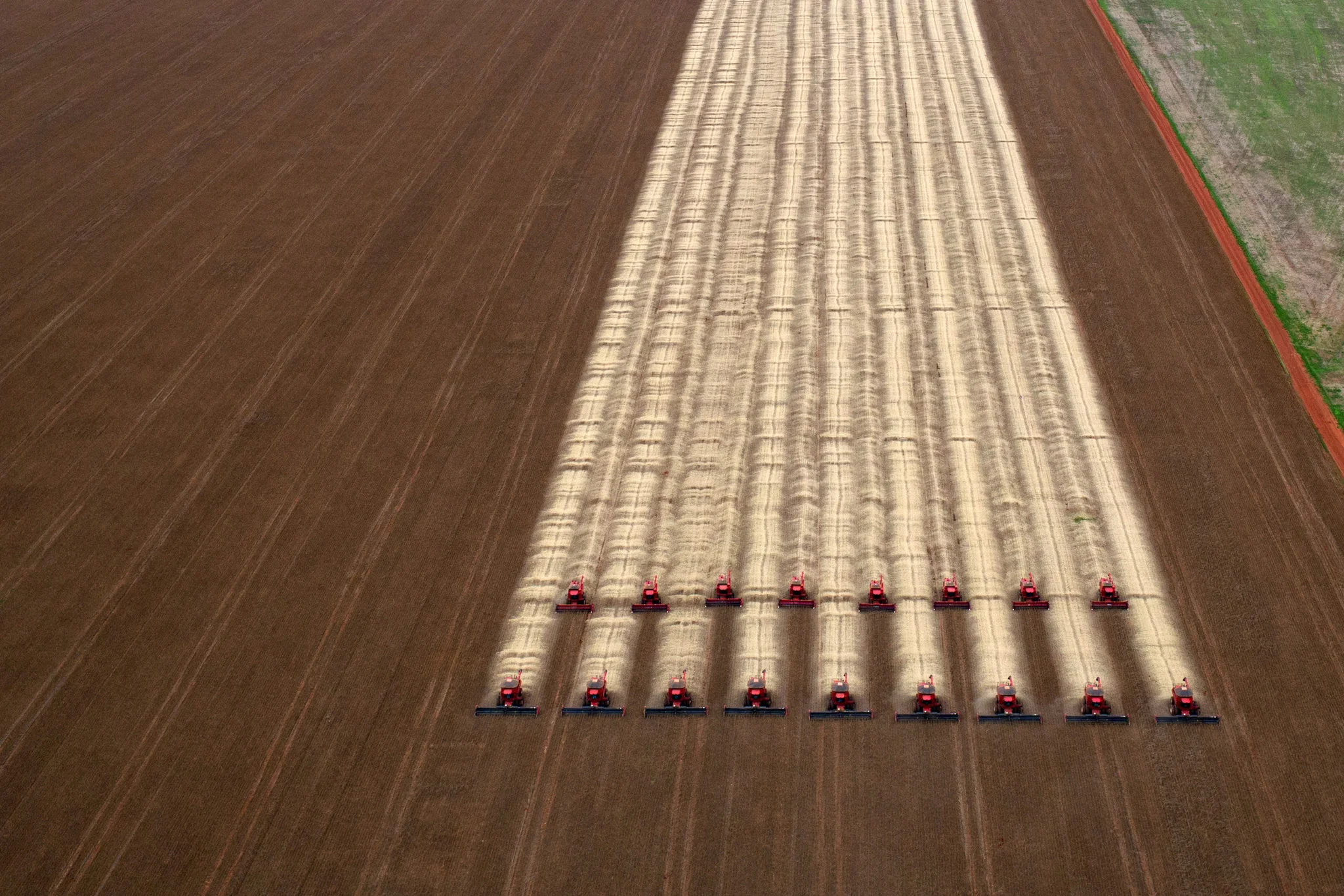
Can We Grow More Food on Less Land? We’ll Have To, A New Study Finds
If the world hopes to make meaningful progress on climate change, it won’t be enough for cars and factories to get cleaner. Our cows and wheat fields will have to become radically more efficient, too.
By Brad Plumer
Dec. 5, 2018
WASHINGTON — If the world hopes to make meaningful progress on climate change, it won’t be enough for cars and factories to get cleaner. Our cows and wheat fields will have to become radically more efficient, too.
That’s the basic conclusion of a sweeping new study issued Wednesday by the World Resources Institute, an environmental group. The report warns that the world’s agricultural system will need drastic changes in the next few decades in order to feed billions more people without triggering a climate catastrophe.
The challenge is daunting: Agriculture already occupies roughly 40 percent of the world’s land and is responsible for about a quarter of humanity’s greenhouse gas emissions. But with the global population expected to grow from 7.2 billion people today to nearly 10 billion by 2050, and with many millions of people eating more meat as incomes rise, that environmental impact is on pace to expand dramatically.
Based on current trends, the authors calculated, the world would need to produce 56 percent more calories in 2050 than it did in 2010. If farmers and ranchers met that demand by clearing away more forests and other ecosystems for cropland and pasture, as they have often done in the past, they would end up transforming an area twice the size of India.
That, in turn, could make it nearly impossible to stay below 2 degrees Celsius of global warming, the agreed-upon international goal, even if the world’s fossil-fuel emissions were rapidly phased down. When forests are converted into farmland, the large stores of carbon locked away in those trees is released into the atmosphere.
“Food is the mother of all sustainability challenges,” said Janet Ranganathan, vice president for science and research at the World Resources Institute. “We can’t get below 2 degrees without major changes to this system.”
Less meat, but also better farming
The new study, the result of six years’ worth of modeling work conducted in partnership with French agricultural researchers, is hardly the first to warn that feeding the world sustainably will be a formidable task. But the authors take a different view of the most plausible solutions.
In the past, researchers who have looked at the food problem have suggested that the key to a sustainable agriculture system is to persuade consumers to eat far less meat and waste far less of the food that’s already grown.
The new report, however, cautions that there may be limits to how much those strategies can achieve on their own. The authors do recommend that the biggest consumers of beef and lamb, such as those in Europe and the United States, could cut back their consumption by about 40 percent by 2050, or down to about 1.5 servings a week on average. Those two types of meat have especially large environmental footprints.
But the authors are not counting on a major worldwide shift to vegetarianism.
“We wanted to avoid relying on magic asterisks,” said Timothy D. Searchinger, a researcher at Princeton University and the World Resources Institute and lead author of the report. “We could imagine a significant shift from beef to chicken, and that by itself goes a long way.” (Poultry production has about one-eighth the climate impact of beef production.)
So, in addition to actions on diet and food waste, the researchers also focused on dozens of broad strategies that could allow farmers and ranchers to grow far more food on existing agricultural lands while cutting emissions, a feat that would require a major shift in farming practices worldwide and rapid advances in technology.
What on Earth Is Going On?
Sign up for our weekly newsletter to get our latest stories and insights about climate change — along with answers to your questions and tips on how to help.
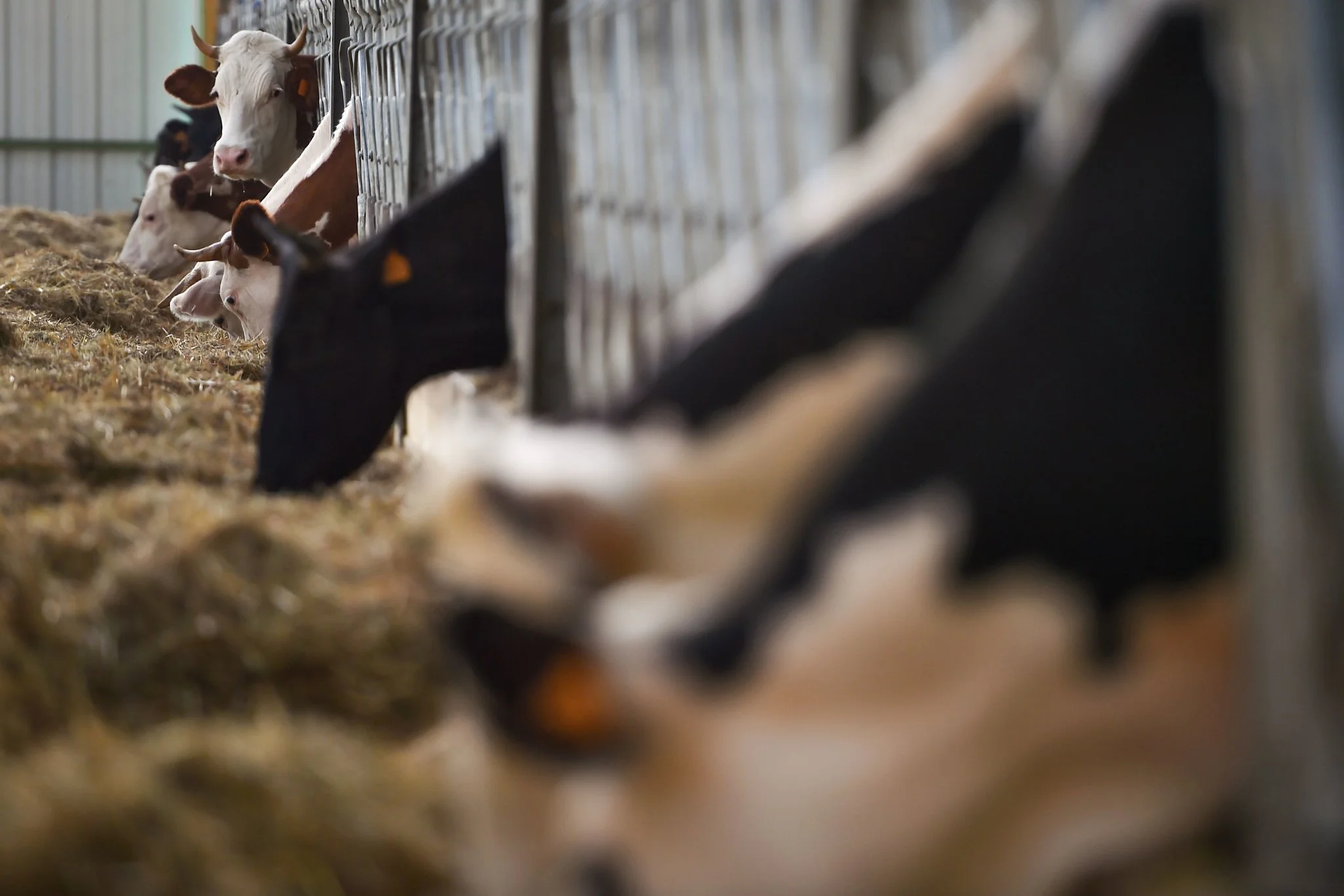
A farm in the Pays de la Loire region of France. Cows have an especially large environmental footprint.CreditLoic Venance/Agence France-Presse — Getty Images
For example, they note, in parts of Brazil, the best-managed grazing lands can produce four times as much beef per acre as poorly managed lands — in part owing to differences in cattle health and how well the grass is fertilized. Improving productivity across the board could help satisfy rising meat demand while lessening the need to clear broad swaths of rain forest.
The authors also pointed to possible techniques to reduce the climate impact of existing farms. For instance, new chemical compounds could help prevent nitrogen fertilizers from producing nitrous oxide, a potent greenhouse gas. And scientists are exploring feed additives that get cows to burp up less methane, another big contributor to global warming.
The report notes that producing 56 percent more calories without expanding agricultural land could prove even more difficult if, as expected, rising temperatures reduce crop yields. But, Mr. Searchinger said, many of the recommendations in the report, such as breeding new, higher-yielding crop varieties or preventing soil erosion, could also help farmers adapt to climate change.
Conserving the world’s remaining forests
The researchers emphasize that strategies to improve the productivity of existing croplands and pastures will have to be paired with more rigorous conservation policies to protect existing forests in places like Brazil or sub-Saharan Africa. Otherwise, farmers will just find it more profitable to clear more forests for agriculture — with dire climate consequences.
“In the past, we’ve often seen agricultural policies and conservation policies moving in parallel without a lot of interaction,” said Linus Blomqvist, director of conservation at the Breakthrough Institute, who was not involved in the study. “The big challenge is to link the two, so that we get more intensive farming without using more land.”
In another contentious recommendation, the report’s authors call for a limit on the use of bioenergy crops, such as corn grown for ethanol in cars, that compete with food crops for land.
Money is also a hurdle. The report’s authors call for large increases in research funding to look at ideas like fertilizers that can be made without the use of fossil fuels, organic sprays that can reduce waste by preserving fresh food for longer, and genetic editing techniques that might produce higher-yielding crops. They also urge new regulations that would encourage private industry to develop sustainable agricultural technologies.
Over the past three years, 51 countries have spent roughly $570 billion a year to support food production, said Tobias Baedeker, an agricultural economist at the World Bank, which contributed to the new study.
If those subsidies were overhauled so that they helped support more sustainable practices, Mr. Baedeker said, “we could have a real game-changer on our hands.”
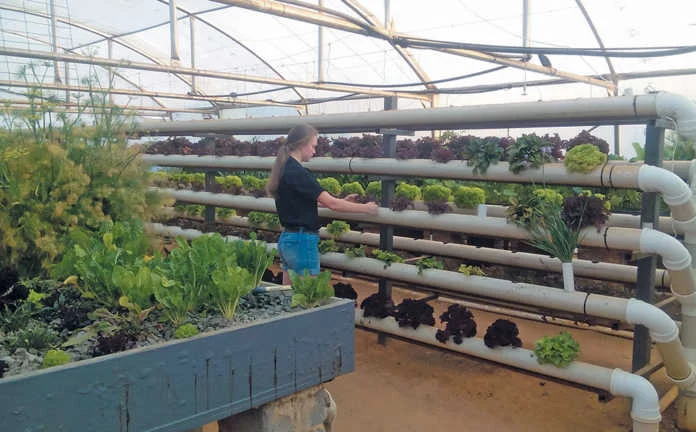
Convert Your Hydroponic System To An Aquaponic System
As we rush towards a greener tomorrow, techniques that have been given to us by mother nature are being revived with modern methods. Aquaponics has a long way to go but both economically and environmentally speaking, this path with have many rewards.
Contributed by | GoblinHydro
01/08/19, 08:48 AM
For those of you who are seasoned growers, aquaponics might be an investment worth while. Aquaponics is all about your water and nutrients in your solution tank, so your not really "converting" as much as you are "adding." it doesn't matter how you choose to deliver water and nutrients to your plant, as long as it comes from the tank inhabited by the fish. Everything you have set up, however it is laid out, you're just a couple steps away from converting your hydroponic or aeroponic system to a aquaponic system.
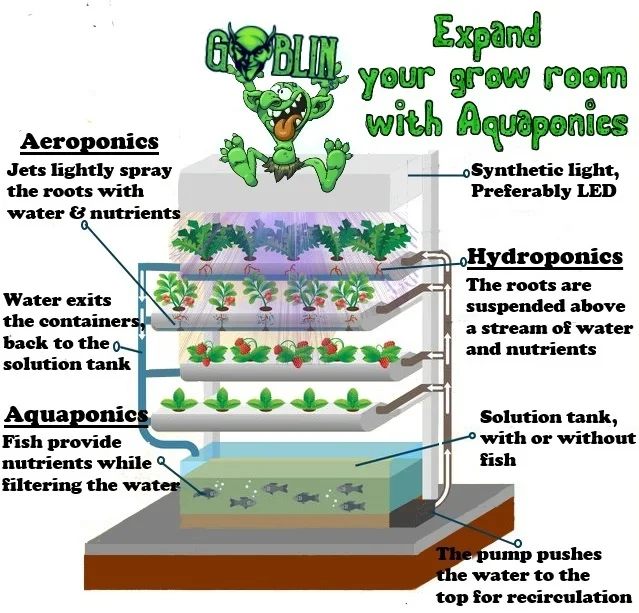
Aside from the many benefits you will read below, teachers have been turning to hands on education using small aquaponic systems in the classroom.
Why convert?
Yes, it may require a little bit of extra capital, but the benefits far exceed the cost. Organic matter contained in fish feces and feed are used for the conversion of fish generated ammonia to nitrate. Bacteria breaks down the fish waste and converts it to plant food and nutrients. This is a huge cut in your nutrient upkeep. Instead, you will be supplying your fish with food and letting them take care of the plants.
Water is constantly being recycled instead of disposed of, which will give you a huge break when paying your hydro bill. Since the water is recycled, the only loss of water comes from evaporation and transpiration.
PH balance is very important to keep an eye on, in aquaponics or any other method. While you will still need to keep that eye on it, bacteria breaking down the fish waste should adjust the PH balance on its own.
Vegetation and fish happen to be healthiest choice in food, and your farming both! Once a fish has matured (depending on species,) you can remove and enjoy a healthy organic dinner while enjoying the freedom of being self sufficient.
Will my yield increase or decrease?
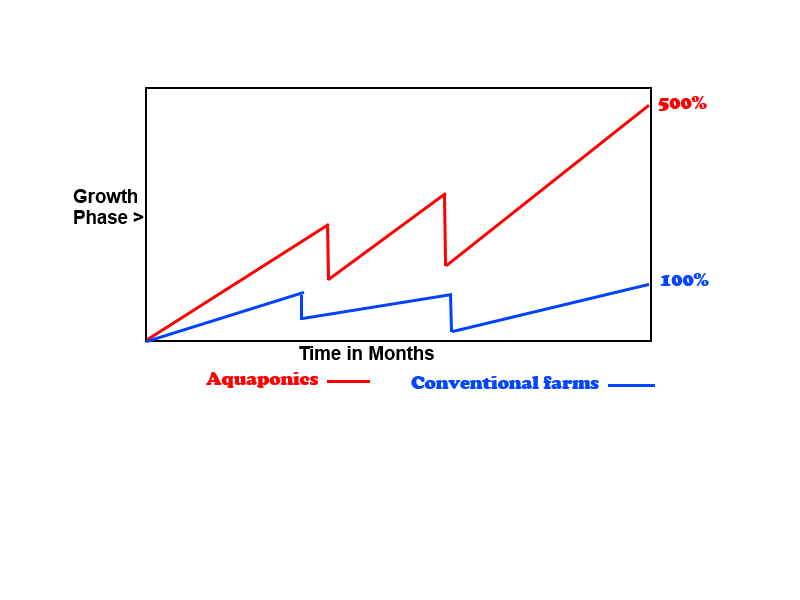
Many cultivators are reporting a rate of 400% - 500% faster crop turns. Not only that but crop density has been heavily increased for many. Every plant responds to aquaponics differently and certain fish seem to partner with plants just a little bit better.
Many different species of fish can be used. Which kind you select will depend on not only your plant species but tank size.
If this is a home project you might want to use ornamental fish like guppies, fancy goldfish, angelfish or even a swordfish. Some have even created environments for turtles, crayfish and even shrimp. If the purpose is not decorative, but still home based, pacu, koi and catfish get along with many different plants. Larger commercial operations use larger fish including larger mouth bass, salmon burramundi, this is to maximize nutrients per fish and to provide a cheaper upkeep solution.
Time to add in your aquaponics tank
Choose your tank - As mentioned above, the size of the tank will be dependent on your grow area and fish species you plan to manage.
Choose your fish - This should have already been decided at the time your obtained your tank. Proper research should be done on the species and the habitat required. Search for studies and/or personal experiences through blogs, forums and research papers on what fish people recommend for your specific plant.
Transfer your pump - Remove the pump from your nutrient tank and place it into your fish tank. The minute delay of water to your plants should not cause any stress. Make sure the pump is safe from any holes or crevices your fish can wedge itself into.
Maintenance - Now that the hard part is complete, a close eye will be needed to ensure your fish accept their new home and produce the bacteria required to detoxify the water. Fish feeding should start off gently so you don't overfeed the fish. Leaving traces of leftover food particles can contaminate the water and throw off the bacteria process causing a buildup of ammonia and nitrate.
The best solution to measuring the amount of food required by your fish is to start with a predetermined amount wait 10 minutes while the fish take their fill. Up to 10% can be left in while more should be added if less than 5%.
Oxygen must be dissolved, if the oxygen falls below 2 mg/l, denitrification can occur. For optimum fish performance, keep the oxygen above 5 mg/l but below 10 mg/l. PH should be kept about 6.0, just add potassium for a boost when needed. tools such as API or Tetra kits for measuring nitrate and ammonia are readily available and relatively inexpensive.
As we rush towards a greener tomorrow, techniques that have been given to us by mother nature are being revived with modern methods. Aquaponics has a long way to go but both economically and environmentally speaking, this path with have many rewards.

I’m Pretty Sure You Don’t Want To Miss This….
iGrow News Branding Sessions Go Live This Friday
iGrow News Branding Sessions are going LIVE this Friday at noon PST to show you How to turn your business into a strong brand
We all know that in today's world having a good product or service is not enough. How many of you working hard to offer great products and services but don't get the results you desire?
It's all about marketing and brand awareness.
That is why In this free webinar, Chief Strategist & Owner of D Branding, Dino H Carter, will teach you how to use branding to grow sales and brand awareness.
The webinar will be live on YouTube. Subscribers will get a link to the webinar before the webinar will start.
>>> 1-CLICK REGISTER HERE! <<<
If you want to learn what big brands use, so you can get more high-quality customers to buy your product or service, this free training is for you.
Here’s what you’ll learn:
The 3 elements for a successful brand that will save you money
How to develop an authentic brand personality that fits your customer
How to sell without selling and why is it so important
Hippie Amenities With A High-End Twist
A hippie house share? Not quite. It was crafts and cocktails night at Urby Staten Island, an upscale rental complex where the demographic skews more young professional than drum-circle enthusiast.
By Kim Velsey
Aug. 18, 2017
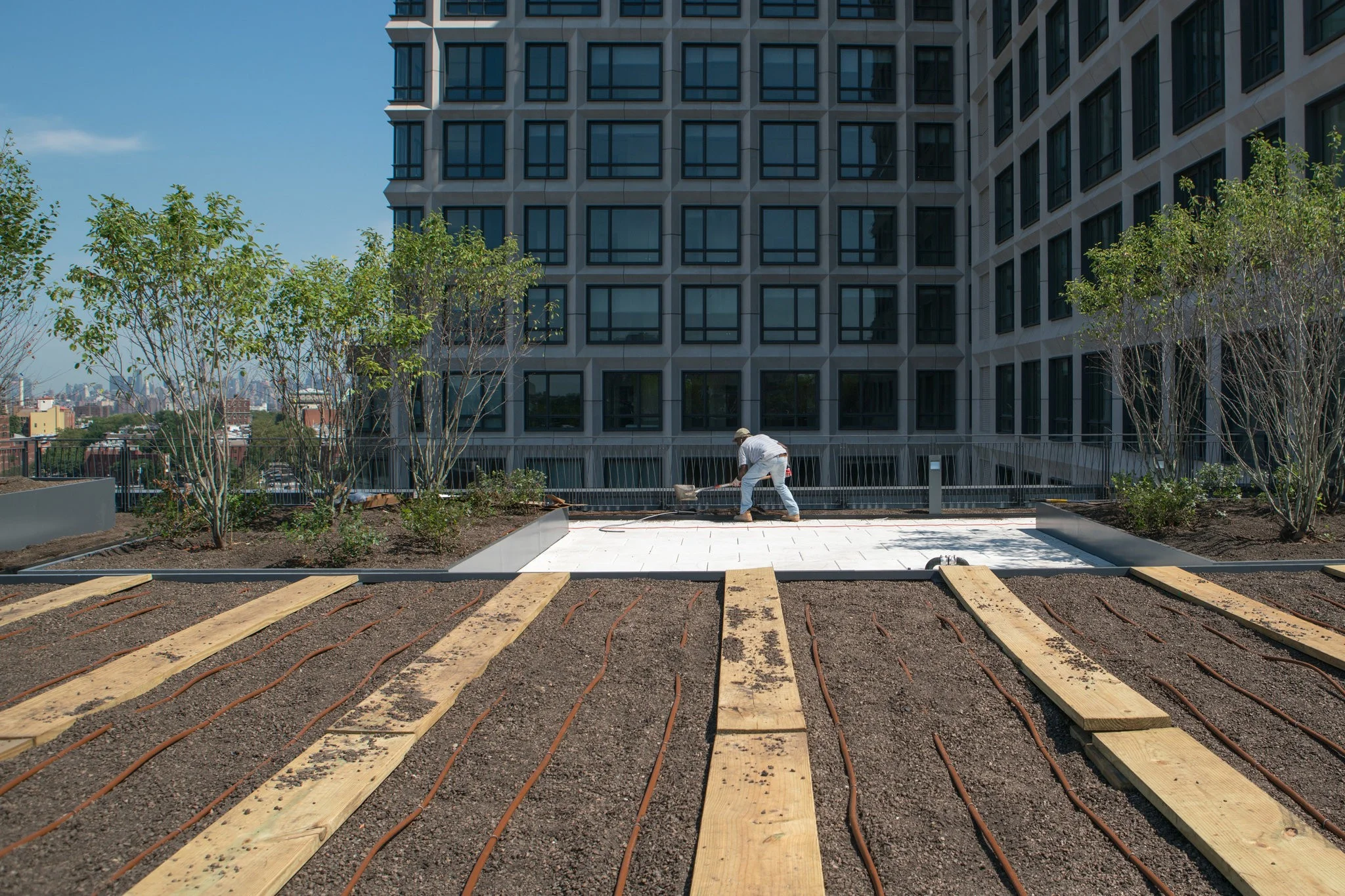
Garden construction in progress on the eighth floor deck of 550 Vanderbilt in Brooklyn.CreditCreditEmon Hassan for The New York Times
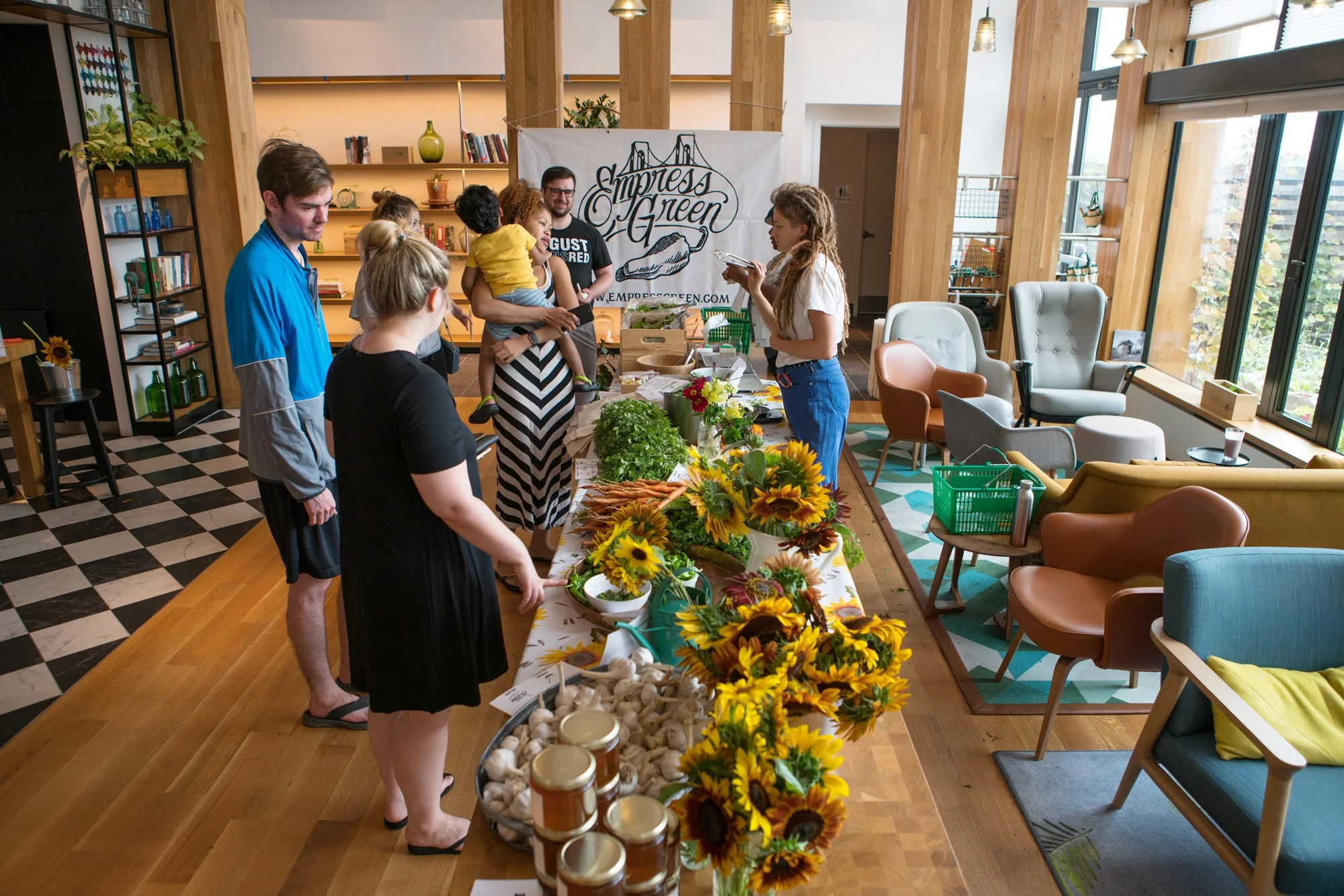
As dusk fell over Staten Island on a recent evening, about 10 people sat around a large wooden table in a communal kitchen, listening to Van Morrison and painting terra-cotta flowerpots. Houseplants were suspended from the room’s high wood-beamed ceilings, and the smell of freshly baked bread hung in the air.
A hippie house share? Not quite. It was crafts and cocktails night at Urby Staten Island, an upscale rental complex where the demographic skews more young professional than drum-circle enthusiast. Nonetheless, the complex has features that might make that crowd feel right at home: In addition to the communal kitchen, there’s a 5,000-square-foot urban farm, a 20-hive apiary — both tended by live-in farmers/beekeepers — and a kombucha workshop planned for later this summer.
“Live cultures are really something people are responding to,” said Brendan Costello, the complex’s in-residence chef, as he wiped the last of the bread crumbs and black maple butter from the countertops. He has already taught well-attended workshops on making sauerkraut and kimchi.
Just as Birkenstocks and bee pollen have come back in style, so have crunchy lifestyle concepts, from yoga and meditation to composting and home fermentation. And with veganism, Waldorf schools, doulas and healing crystals shifting from far out to very much in fashion, a growing number of New York luxury buildings have embraced the hallmarks of 1970s hippiedom with a high-end twist. Look for amenities like rooftop gardens, kitchen composters, art and meditation studios, bike shares, infrared saunas, even an adult treehouse.
“Especially in Brooklyn, the concrete jungle is not the atmosphere people are aiming for,” said Ashley Cotton, an executive vice president of Forest City New York, whose recently opened condo in Prospect Heights, 550 Vanderbilt, developed in partnership with Greenland USA, has window planters for units on lower floors and a communal garden terrace with individual plots on the eighth floor. Two of the terrace’s six large planters will be tended by a nearby farm-to-table restaurant, Olmsted, which will also offer gardening lessons to residents.
Residents of URBY in Staten Island visit a farmstand set up by Empress Green in Urby’s communal kitchen.CreditEmon Hassan for The New York Times
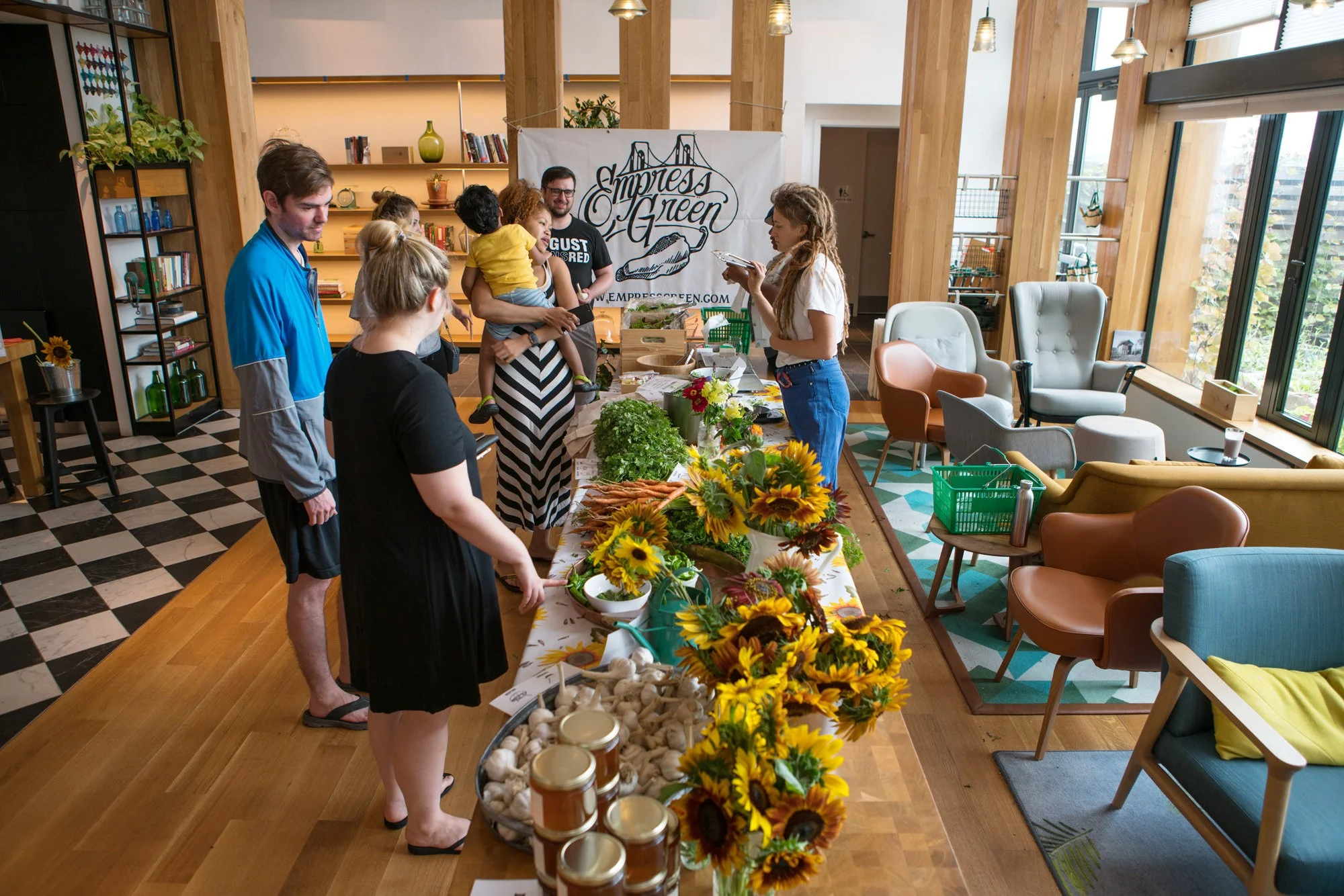
Residents of URBY in Staten Island visit a farmstand set up by Empress Green in Urby’s communal kitchen.CreditEmon Hassan for The New York Times
At Pierhouse, the Toll Brothers City Living condo in Brooklyn Bridge Park in Brooklyn, every kitchen has an in-unit composter, a first for a Toll Brothers development.
“If we were deciding between a compost unit and a wine chiller, we’d probably go with the wine chiller since more people would be interested,” said David von Spreckelsen, the president of Toll Brothers City Living division. “But here we had large kitchens and a lot of the units have outdoor space, so we thought people could compost in their kitchen and go right out to their garden.”
While such amenities might be aspirational for some, others are yearning to get their hands dirty. Christine Blackburn, an associate broker at Compass real estate, said that for a woman to whom she recently sold a condo at 144 North Eighth Street in Williamsburg, Brooklyn, the roof garden was the most important amenity.
“She didn’t care about the gym, she didn’t care about the garage,” Ms. Blackburn said. “They live in a $2 million condo, but for her to be able to grow tomatoes with her son, that was it.
“The garden plots in that building are tiny,” she added, “but it makes some people feel like they’re not living in a high-rise.”
Public green space has always been a priority, of course, and let’s not forget that large swaths of all five boroughs were once farmland.
Green rooftops have some historical antecedents in the city: The Ansonia, on the Upper West Side, kept 500 chickens on its rooftop farm in the early 20th century, with eggs delivered daily to the tenants, according to “The Sky’s the Limit,” a book by Steven Gaines. But the roof was shut down by the Department of Health after just a few years, in 1907. And for the past century, it was accepted that living in New York meant leaving nature, and local honey, behind.
“It definitely used to be an either/or mentality,” said Rick Cook, a founder of the architecture firm CookFox and a designer of 550 Vanderbilt, who moved to New York from a small town upstate in 1983. But after studying abroad in Florence, Italy, he said, “I understand you could have both. That, in fact, the highest quality of life is to have both.”
Indeed, the explosion of the wellness industry has left many craving a different kind of New York lifestyle.
For a younger generation, practices like organic gardening and meditation may not carry any whiff of the counterculture.
“Being green is modern, being organic is modern,” said Jordan Horowitz, 26, an assistant manager of Enterprise Rent-a-Car who grew up gardening in suburban New Jersey and was excited to get a studio at Urby, where residents have an entire city block of gardens. But he is equally enthusiastic about the pool, the giant bean bags strewn across the grounds and learning to make Vietnamese cuisine from scratch in Mr. Costello’s cooking classes.
That many such offerings tend to be far more upscale than their 1970s counterparts no doubt helps to remove any lingering hippie vibe. Rather than a stable of rusty Schwinns, for example, 50 West, in the financial district, allows residents to pedal out on Porsche bikes that cost $3,700 a pop.
Javier and Irina Lattanzio, residents and brokers of 50 West in Lower Manhattan, take a spin on Porsche bikes provided by the building.CreditSasha Maslov for The New York Times

Javier and Irina Lattanzio, residents and brokers of 50 West in Lower Manhattan, take a spin on Porsche bikes provided by the building.CreditSasha Maslov for The New York Times
“Yes, it’s sharing, but in a luxury manner,” said Javier Lattanzio, the sales manager at the condo.
The adult treehouse at One Manhattan Square on the Lower East Side, likewise, is hardly primitive, with Wi-Fi and a staircase. As for all those rooftop herb gardens, asked if they are actually used, one broker replied that they definitely were, though not necessarily for a Moosewood recipe: On a recent trip to 338 Berry in Williamsburg, she saw people with Aperol spritzes clipping herbs to put in their cocktails.
Frank Monterisi, a senior vice president of the Related Companies, emphasized that the new generation of renters and buyers “like to see sustainability, they like to see rooftop gardens.”
At Hunter’s Point South, Related’s massive affordable housing complex in Long Island City, Queens, residents can receive deliveries of fresh vegetables from a C.S.A. — community-supported agriculture. There are also an apiary, about 2,300 square feet of rooftop gardens and a waiting list for the gardening club.
“Everyone wants to garden now. I think New Yorkers have gotten comfortable with the amount of concrete we have, but they also want to see green,” said Joyce Artis, a retired Port Authority worker who helps organize the gardening program at the complex and grows microgreens and lemon trees in her apartment.
Ms. Artis said that when she was growing up in Brooklyn, she was sent to visit relatives in North Carolina in the summer, and hated having to get up early to weed. “But then as I got older, I started missing it,” she said. “And I started growing things in my apartment. No matter how small your space I always say: ‘You can grow one thing.’”
Ms. Blackburn, the Compass broker, said that gardening, for some, is a version of meditation. “Maybe they’re not sitting there with a meditation app, but sticking their hands in the soil — it doesn’t matter if someone’s making $10 million a year — it can be very therapeutic.”
She expects the enthusiasm to continue and intensify. “I wouldn’t be surprised in a year if a luxury building had a chicken coop,” she said.

LED Lighting for Indoor Agriculture
Now, plants can be commercially grown without any sun light. LED lighting is replacing the sun due to advanced technological innovations.
Len Calderone for | AgritechTomorrow
01/10/19, 08:14 AM
Since the beginning of time, plants have relied on the sun to feed and grow through the method known as photosynthesis—a process used by plants and other organisms to convert light energy into chemical energy. Now, plants can be commercially grown without any sun light. LED lighting is replacing the sun due to advanced technological innovations.

Light emitting diodes (LED) work by passing a current between semiconductors. Compared with other forms of electrical illumination, LEDs use less energy, give off little heat and can be controlled to optimize plant growth compared to other forms of electrical illumination, such as fluorescent lamps, which contain mercury, which is needed to make the inert gasses conductive at all temperatures and to make the lamp work properly and efficiently. Mercury is a heavy metal, which is hazardous to the environment.
Then, we have incandescent lamps that are considered the least energy efficient type of electric lighting commonly found in residential buildings. Because of their inefficiency and brief life spans, they are more expensive to operate than LED and fluorescent lights.
LEDs are tiny light bulbs that fit into an electrical circuit. Unlike incandescent bulbs, they don't have a filament that will burn out, and they don't get very hot. They are illuminated uniquely by the movement of electrons in a semiconductor material. The lifespan of an LED exceeds the short lifespan of an incandescent bulb by thousands of hours.
In LEDs, the conductor material is usually aluminum-gallium-arsenide. In pure aluminum-gallium-arsenide, all of the atoms adhere entirely to their neighbors, leaving no free electrons to conduct electric current. Additional atoms change the balance by adding free electrons or creating holes where electrons can go. Either of these variations make the material more conductive.
In agricultural applications, LED lights are used to change how plants grow, alter when they flower, transform how they taste and even modify their levels of vitamins and antioxidants. LED lights can extend a plant’s shelf life as well.
Growers can use LED light modifications to grow two types of basil from the same plant. For example, they can grow sweeter basil for the grocery store and more spicy versions for chefs.
These plants are grown indoors, utilizing a fraction of the land, water and fertilizers of greens raised outdoors with conventional farming. Since the plants are gown indoors, they can be grown close to urban centers. Growers don’t need varieties bred for disease resistance, or plants genetically modified to handle the stresses of growing outside. The harvest isn’t transported across the country in refrigerated trucks, and they are not susceptible to the effects of climate change, which is making growing much more difficult for a lot of farms around the country and around the world.
Indoor growing and LEDs allow fast, year-round crop cycles. This permits growers to produce 200,000 pounds of leafy greens, vine crops, herbs and microgreens annually in a 12,000-square-foot warehouse, which is the equivalent of 80 acres of farmland. Not dependent on the outside weather, plants can grow year-round, enabling a grower to produce 15 or more crops a year.
Conventional greenhouses have depended on on high-pressure sodium lamps (HPS) to complement sunlight, but HPS lights don’t work as well as LED because they consume much more power to produce the same light levels. They also generate too much heat to place near young greens. Greenhouses are moving to a combination of HPS and LED lighting for supplemental lighting, though growers see a time when they will use LEDs alone. Lately, LED lighting costs have been cut in half, and their effectiveness has more than doubled.
Scientists have acknowledged that photosynthesis is improved within the red band, but plants also need blue light waves to prevent stretching and enhance leaf color. A visible range beyond red, known as far red, encourages larger leaves, branching and flowering. With advances in LED technology, light recipes can be finely tweaked to each crop and even to each phase in a crop’s life.

Sunlight is inefficient when it comes to improving small-scale, urban agriculture. The heat produced by the sun can damage plants. The sunlight’s heat effect is further amplified when the plants are packed close together, which they are in urban farming.
In contrast to sunlight, LED lights are known for shifting nearly undetectable amounts of heat onto plants, and the light bulbs are cool to the touch. When using LED lighting, urban farms can closely pack plants for maximum efficiency. This would not be achievable in ordinary agricultural environments without conceding the health of the plants.
There is normally a higher upfront cost using LED lighting. The best way to acknowledge the cost-savings of LED lighting is to look at it in terms of a long-term investment. Over time, LED lighting has a much higher energy productivity over time as compared to other urban farming lighting technologies.
LED's use much less electricity than pressure sodium lights or fluorescent, as much as 40% - 50%. For indoor growing, proper ventilation is required. Ventilation for indoor growing helps prevent excess moisture, the propagation of pests and the weakening of plant stems. LEDs produce much less heat than other types of grow lights, resulting in the need for less ventilation.

LED's grow lights have an extreme life length. They typically have 50,000 hours of usable life, which is approximately 6 years of continuous use. So, if you are utilizing the lights on a 50% on 50% off schedule, the life of LED grow lights is over 11 years.
Since LED's have much lower heat output, they can be located nearer to the plants. This allows the grower to stack more plants in the same vertical space. Therefore, the benefit of using LEDs is to double or triple the production output without changing the area of the growing space. Of course, this depends on the height of the growing space.
As used in commercial indoor growing, LED lighting technologies have been around less than ten years. LED lights are less understood than other types of grow lights, which have been studied for several decades. So, what does this mean? The support for and the knowledge of LED grow lights is far more limited than other types of grow lights. Most importantly, because of the knowledge gap, there are great opportunities.

Legalized Marijuana in New York State: The Green Gold Rush
Andrew Cuomo unveils a plan for legalizing recreational marijuana in New York State.
It’s a moment cannabis advocates have been waiting for. On Tuesday, Governor Andrew Cuomo officially unveiled a plan for legalizing recreational marijuana in New York State, in his State of the State budget address in Albany.
The plan includes the creation of a new Office of Cannabis Management, taxes on cultivation and wholesale, a ban on sales to anyone under 21, licensing for businesses throughout the supply chain, and the ability for counties and cities to ban sales, Gannett’s Jon Campbell reports. Also in the works: a program to review and seal past marijuana-related criminal convictions.
Officials estimate that legalization will eventually bring in $300 million in tax revenue a year, but the industry will be slow to ramp up, the New York Times reports:
That number, though, would not be available until the fiscal year starting in 2023, according to Mr. Cuomo’s budget director, Robert Mujica.
The initial rollout would bring in much less revenue, projections show. Budget documents released Tuesday projected no revenue from marijuana regulation and taxation for the 2020 fiscal year, and $83 million for 2021.

A code name for marijuana written on a train in New Jersey. Source: Wikimedia Commons.
Keeping Up With The Joneses
With more and more states moving toward legalization, the climate around cannabis is shifting quickly. Politicians who would have been loath to endorse recreational marijuana just a few years ago are now starting to worry that their states will lose out economically if they don’t jump on board the legalization bandwagon.
New Jersey, whose governor Phil Murphy campaigned on a promise to legalize recreational marijuana, is racing New York to pass a cannabis law. Reporter Payton Guion for NJ.com explains why New Jersey legislators are anxious to get there first:
If New Jersey were to somehow get beat to legalization by New York, the state would be leaving a lot of potential tax revenue on the table. Millions of people would likely cross the border to buy legal weed, based on estimates of New Jersey’s potential marijuana market.
But no one is likely to cross the border to buy weed in New Jersey if it’s also legal in New York.
While our neighbors New Jersey and Connecticut have yet to legalize, New York is already losing potential business–and tax dollars–to Massachusetts, where recreational cannabis has been legally available since November. Recently, Rockland/Westchester Journal News columnist David McKay Wilson, who writes about tax policy, took a road trip to Northampton, home to Massachusetts’s first legal dispensary. There, he met New Yorkers willing to stand in line for hours for the chance to purchase just an eighth of an ounce:
The New Yorkers claimed they could find marijuana on the streets of Schenectady for $150 an ounce, which would produce about 60 marijuana joints. That cost would be far less than what they would pay in the Massachusetts dispensary. Though state law allows dispensaries to sell as much as one ounce of cannabis, NETA has limited its sales to a maximum of one-eighth of an ounce because its supply of Massachusetts-grown marijuana is limited.
The one-eighth ounce was on sale for $50–equivalent to $400 an ounce. But they wanted to buy the legal cannabis, with its potency tested and certified.
“It better be good stuff for this wait,” [Johnny] Deitz said. “It will be a joy to finally smoke it legally.”
Cannabis isn’t the first vice New York State has seized on as a potential boost to the local economy. In recent years, the state has rewritten the laws on locally made beer, hard cider, and spirits to be friendlier to small brewers and distillers. The result has been a renaissance of small-scale craft beer and spirits in the state.
In an interview with Leafly, Melissa Moore of the Drug Policy Alliance, a pro-cannabis-legalization advocacy group, likens the recent push to legalize cannabis to the craft brewing and distilling movement:
“I think it’s encouraging to look at what the governor has done in terms of encouraging the craft beer and wine industry in New York State, and trying to put forth provisions that help smaller businesses in that arena be able to actually get a foothold to be competitive and grow and thrive,” Moore said. “And I think that’s something that we would certainly encourage him to look for in marijuana legalization as well.”

The chamber of the New York State Assembly, soon to be tasked with hammering out the fine print on marijuana legislation. Source: Wikimedia Commons.
Bumps in the Road?
Even with a cannabis-friendly Democratic majority in both the Senate and Assembly, and the endorsement of the governor, legalized recreational marijuana won’t happen overnight. There are still many details to be ironed out. The AP’s David Klepper reports:
Taxes and regulations must be approved. Rules for licensing retailers must be written. A new government entity may have to be created. Local governments will have to be brought in. Even after a bill passes, it could take a year or more for any pot shops to open, based on what’s happened in other states and New York’s own experience with medical marijuana.
One of the biggest worries for lawmakers is how to deal with marijuana-impaired drivers. There’s no clear consensus on what level of THC in the blood constitutes impairment, and unlike alcohol, marijuana can leave trace substances in a person’s blood for days or weeks, long after the initial high has faded. States are enacting a broad range of different laws and “playing catch-up” with science on the issue, Kaiser Health News reports.
Among the states that have legalized recreational marijuana, there is a range of approaches, from relatively permissive California to highly regulated Colorado. So far, New York has opted to keep the marijuana industry on a tight leash: After the state legalized medical marijuana in 2014, only five licenses were awarded in an intensely competitive process. In 2017, five more companies were awarded licenses.
One of those first five license-winners has deep roots here in the Hudson Valley: Etain, a company with dispensaries in Kingston, Syracuse, Yonkers and New York City, and the state’s only women-owned cannabis business. Founder Amy Peckham, who owns and operates the business with her daughters Hillary and Keeley Peckham, is a Katonah resident whose family operates a large construction business called Peckham Industries.
Getting into business in New York State isn’t easy. Just to apply for one of the state’s five coveted licenses cost the Peckhams about $750,000,The Cutreported in a 2015 feature story.
The first few years of legal medical marijuana have been tough on New York’s pioneering cannabis businesses, with few physicians to prescribe and daunting restrictions on every aspect of the business, but Etain’s founders hope to make good on their investment. Recently,The Street cited Etain as one of the top five businesses that stand to profit most from legalized recreational marijuana in New York State.
5 of The Most Valuable Crops You Can Grow In The US & How To Grow Them
The North American Center for Saffron Research and Development, a new program at the University of Vermont, hopes to make New England the new hotspot for this ancient Mediterranean herb.
5 of The Most Valuable Crops You Can Grow In The US & How To Grow Them
These easy-to-grow and profitable crops are great for small farms.
Photography
Saffron
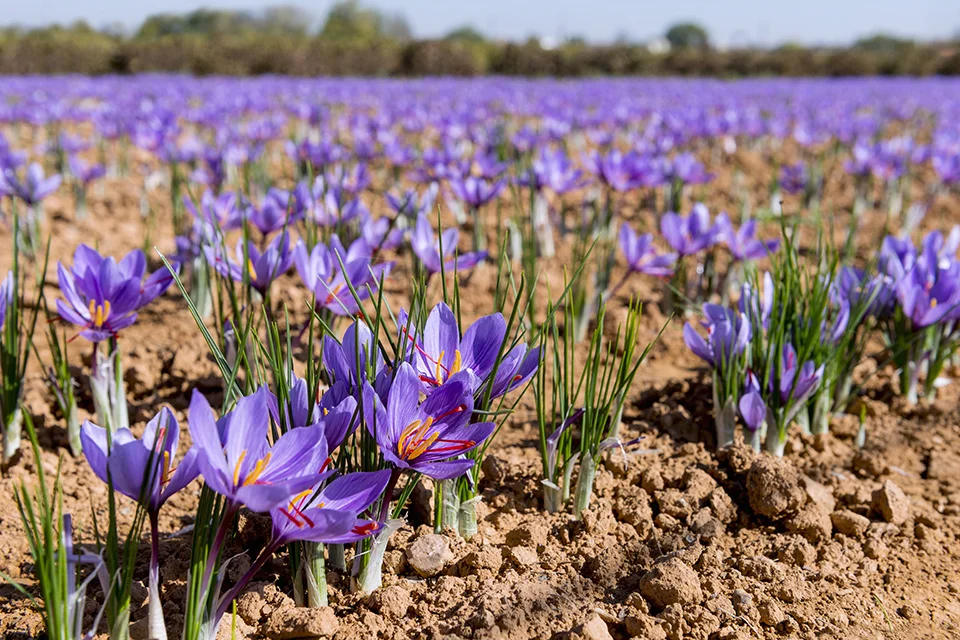
The North American Center for Saffron Research and Development, a new program at the University of Vermont, hopes to make New England the new hotspot for this ancient Mediterranean herb. Selling for $5,000 to $10,000 per pound, saffron is the most expensive culinary herb in the world, mainly because it is composed of the tiny, thread-like stigmas of the crocus flower. Roughly 50,000 flowers are needed to produce a pound of the dried herb, though this requires just a quarter acre of land, hinting at just how lucrative this crop can be.
Saffron (pictured above) crocuses grow best in dry regions with mild winters, such as coastal California. To help expand their viability, the University of Vermont recommends planting them in high tunnels, a simple protective structure made of plastic sheeting over a frame of PVC pipes, which allows saffron to be grown in much of the country. Crocuses are bulbs and cannot easily be reproduced from seed, so growers plant corms, the fleshy tuberous roots. A list of corm sources for crocus varieties that are suitable for commercial spice production is available here.
Ginseng
Wild ginseng root, a medicinal herb which is found in forests throughout much of the northern and eastern United States, is harvested on a commercial scale and sold for astonishing prices, largely to Asian buyers. It is also planted in open fields, though ginseng cultivated this way commands a fraction of the price, as it is not considered as medicinally potent. Wild ginseng is becoming increasingly rare, however, to the point that many states have severely restricted its harvest. “Wild-simulated” ginseng, which is planted as an understory on tree plantations and in naturally-occurring forests, has emerged as a popular, and profitable, alternative to true wild ginseng: it sells for $300 to $700 per pound.
Most native hardwood trees are suitable as a canopy for growing ginseng. The forest needs to be mature enough to cast full shade; moist, well-drained soil is ideal. It is typically planted in the fall from seed, which costs up to $200 per pound. Rake back the leaves and plant them directly in the native soil – no fertilizer necessary. The crop is so valuable that a growing guide from Purdue University recommends protecting your investment by “installing security cameras, keeping guard dogs, and embedding microchips” in the roots. The ginseng market varies from year to year, but when the price is high it’s possible to net up to $50,000 per acre. There is one drawback: it takes from five to 10 years for the roots to reach a marketable size.
Ginseng growing in a forest. PHOTO: Shutterstock / Kirsanov Valeriy Vladimirovich
Lavender
This common garden plant has various commercial uses, including essential oil and value-added products like soaps and lotions. Profitableplantsdigest.com reports that one eight-acre lavender farm in the Northwest grosses more than $1 million per year from it’s various lavender products. But the simplest way to sell lavender, which requires minimal investment in time and equipment to produce, is as dried flower bouquets. A one-acre planting can produce about 12,000 bouquets per year, which are worth $10 each or more on the retail market.
Lavender grows in a wide variety of climates, but requires well-drained soil. Irrigation and fertilizer are generally not needed. The disease-resistant, fast-growing plants are easily propagated in a greenhouse by cuttings and will grow big enough to produce a sizable spray of flowers in their second year; lavender will continue to flower for 10 years or more after planting. Simply tie bunches of the flower stems together with twine and hang in a barn, shed, or other well-ventilated structure to dry for at least one week before bringing them to market.
Lavender growing in a field. PHOTO: Shutterstock / Katarina Bockova
Goji Berries
This “superfood” is grown primarily in China, but the plant is equally well-adapted in North America. Dried organic goji berries regularly sell for $20 or more per pound, with the fresh fruit fetching a significantly higher price at farmer’s markets. With yields up to 7,000 pounds per acre in fresh berries, this is potentially a lucrative cash crop for American farmers.
Goji berries, a close relative of tomatoes, grow on head-high shrubs. They are disease-resistant and adapted to a wide range of soil and climatic conditions. In fact, the plants are so robust that they’re considered an invasive species in some regions of the country. For optimal fruit production, grow one of the named cultivars, like ‘Crimson Star‘ and ‘Phoenix Tears‘ (named varieties are not typically invasive). Light harvests can begin in the second year after planting, though it takes four to five years of growth before full production is reached. Planting goji shrubs “bare root” (when they are dormant) in late winter gets them off to fast start.
Goji growing in a garden. PHOTO: Shutterstock / KVF
Bamboo
The most lucrative crops are not always edible. Bamboo, which is used for everything from flooring to fishing poles (and occasionally in Asian cuisine), is one shining example. Each of the many uses of bamboo comes with its own set of constraints; some applications require special processing, while others are only feasible in particular regions. However, it’s quite straightforward to grow bamboo for sale as nursery plants. Simply plant a grove, let it spread, and then pot up small clumps to sell to local nurseries or direct to consumers. A large clump of bamboo in 25-gallon tub can sell for $200 to $300 dollars. Thousands of tubs can be harvested annually from a single acre of mature bamboo.
The first step is to identify which species of bamboo grow best, and are most in demand by consumers, in your area. This is easily accomplished by asking for advice at local nurseries. Bamboo is not grown by seed, but by transplanting small clumps of roots from an existing patch. Since many landowners consider it a pest, consider advertising locally to find people who will let you come remove their bamboo for free – a win for both parties. Since bamboo can spread aggressively, avoid planting it close to other crops or adjacent to natural areas (since it doesn’t spread by seed, you don’t have to worry about it escaping into the wild). Bamboo thrives on heavy irrigation and nitrogen fertilizer – any animal manure will do. Still, you’ll have to be patient. Depending on the variety, it may take anywhere from three to ten years to establish a patch large enough to start digging out clumps for sale.
Bamboo growing in suburban New Jersey. PHOTO: Shutterstock / Kovtun Oleg

Groups Take Legal Action To Prohibit Organic Hydroponics
Cornucopia Institute
Consumers And Organic Groups Say Hydroponic Systems Cannot Comply With USDA’s Organic Standards.
January 17, 2019
The Center for Food Safety (CFS) filed a new legal action demanding that the U.S. Department of Agriculture prohibit hydroponic operations from using the organic label.
CFS said hydroponic production systems — a catch-all term that applies to food production methods that do not use soil — do not meet federal organic standards and violate organic law, which requires that organic farming include soil improvement and biodiversity conservation; hydroponic systems cannot comply with the organic standard's vital soil standards because hydroponic crops do not use soil at all.
The CFS filing was endorsed by more than a dozen other organic farmer, consumer, retailer and certifying organizations, including the Organic Farmers Assn., Northwest Organic Dairy Producers Alliance, PCC Community Markets and The Cornucopia Institute.
"Mislabeling mega-hydroponic operations as 'organic' is contrary to the text and basic principles of the organic standard. Right now, there is a pitched battle for the future of organic, and we stand with organic farmers and consumers who believe the label must retain its integrity," CFS legal director George Kimbrell said.
The groups said consumers trust the organic label and pay extra for the assurance that it indicates a more healthful and environmentally friendly way of producing the food they buy. Since the federal Certified Organic label was introduced more than 20 years ago, the organic food market has grown exponentially and is now a $60 billion industry in which multinational corporations have bought organic brands and, thus, compete with small food producers growing food using environmentally friendly methods.
"Allowing hydroponic systems to be certified as organic undercuts the livelihood of organic farmers that take great lengths to support healthy soil as the bedrock of their farms," Kate Mendenhall, director of the Organic Farmers Assn., stated. "Hydroponic producers getting the benefit of the organic label without actually doing anything to benefit the soil undermines the standard and put all soil-based organic farmers at an untenable economic disadvantage."
Organic agriculture certification has always included soil requirements such as fostering soil fertility, improving soil quality and using environmentally beneficial farming methods like proper tillage and crop rotation. “The National Organic Standards Board, the expert body assigned by Congress to advise USDA on organic matters, recommended that the agency prohibit certification of hydroponic systems, but USDA instead continues to allow hydroponics. Canada and Mexico also prohibit hydroponics from organic, and the European Parliament voted to end the organic certification of hydroponic products in April 2018,” CFS said in a statement.
TAGS: POLICY

What We Can Learn From The Opportunity Zone Comment Letters
Comment Letters Give A Sense of How Developers Are Thinking About Using The Opportunity Zones.
By Erika Morphy | January 14, 2019
In October 2018, the Treasury Department and the IRS released highly anticipated regulatory guidance related to the Opportunity Zone program. The guidance answered a lot of questions and its generally favorable approach for real estate jump-started interest in the program.
But as Treasury admitted in the release there were still issues to be resolved and it promised another guidance. In the meantime, comment letters have been pouring in that, the writers hope, will have some influence on the final shape of the regulations.
If nothing else, the comment letters provide a guide as to what developers and other participants are thinking about the Opportunity Zones and how they might be used.
CREModels did an analysis on some of the letters and concluded that, “We are starting to see development-friendly trends emerge in the comment letters.”
“There are repeated requests for clarifications surrounding substantial improvement and original use. We also see a lot of requests for extensions beyond the 30/31 month timelines and flexibility around the asset and gross income tests,” it wrote.
Here are some excerpts from comment letters that may shed light on the future shape of the Opportunity Zone program.
National Multifamily Housing Council National Apartment Association
NMHC/NAA request that the Treasury Department and the Internal Revenue Service clarify in a specific example in the final regulations that land itself need not be improved to meet the original use requirement so long as development occurs on the land . We also request that the Treasury Department and Internal Revenue specifically state that the land may have been acquired prior to 2018 and still qualify as Opportunity Zone property so long as development on that land occurs after 2018 consistent with Opportunity Zone rules.
To incentivize additional multifamily rehabilitation projects and address our nation’s workforce housing shortage, we once again respectfully request that the Treasury Department and Internal Revenue Service allow a waiver to the “double the basis” rule if property has been vacant for a period exceeding one year.
While beyond the scope of final regulations, the multifamily industry also urges the Trump Administration to support statutory modifications to reduce the basis increase necessary to qualify a multifamily rehabilitation project for Opportunity Zone purposes.
NMHC/NAA request that the Treasury Department and Internal Revenue Service use final regulations to clarify that debt-financed returns of capital that do not exceed a partner’s basis in an Opportunity Fund are not treated as a sale or exchange.
Individuals may wish to exit one Opportunity Fund to invest in another. We recommend that the Treasury Department and Internal Revenue Service allow such reinvestments without negative consequence to the five-, seven-, and 10-year basis adjustment thresholds so long as proceeds from exiting a Qualified Opportunity Fund are reinvested in another Qualifying Opportunity Fund within 180 days.
NMHC/NAA are concerned that the proposed regulations do not address the ability of an Opportunity Fund to: (1) dispose of a qualifying multifamily asset and acquire or construct another qualifying asset; and (2) own multiple multifamily assets within a single Opportunity Fund. We recommend that the Treasury Department and Internal Revenue Service address the first issue by providing Opportunity Funds the ability to reinvest capital from a sale without adverse Opportunity Fund tax consequence to either the Fund or its investors. This could be done by treating proceeds from a sale as working capital eligible for the 30-month working capital rule. We also request that the Treasury Department and Internal Revenue Service allow for multiple properties to be held within a single Opportunity Fund and that Opportunity Funds be allowed to divide into two funds in the case that a property is sold and the Fund does not reinvest the resulting capital in a qualifying Opportunity Fund asset. In such case, investors would still be able to realize Opportunity Fund tax benefits with regard to assets remaining in the original Opportunity Fund.
Stroock & Stroock & Lavan LLP
It would be very helpful for the IRS to provide guidance that addresses the following questions:
When will a QOZ business be treated as engaged in the active conduct of the QOZ business? For example, if a startup is just spending money on R&D, is that active enough for these purposes?
What constitutes a “substantial portion” of the intangible property of the business? We would suggest that 40% is a substantial portion, based on the use of that percentage for the new markets tax credit. See Treas. Reg. §1.45D-1(d).
Is cash used for advertising, research and development or other purposes eligible for the working capital exception? We would suggest that cash used for expenses to create or buy intangible property be eligible for the same 31-month safe harbor that is provided for cash that is used by a QOZ business to acquire or construct tangible property pursuant to a written schedule.
Under what circumstances should a business be treated as being conducted (and intangible assets be considered to be used) in the zone? For example, should this determination be made solely based on the location of employees and/or tangible assets of the business? We believe those factors should be determinative. Should the location in which property is sold or services are provided be relevant? We believe they should not be, at least if the employee or tangible asset tests are met. Based on the use of 40% for purposes of the new markets tax credit, we would suggest that a business would be considered conducted in qualified opportunity zones if at least 40% of the tangible assets of the business are in one or more QOZs or at least 40% of the employees of the business are employed in QOZs.
Center for American Progress
The zone selection process has resulted in the creation of Opportunity Zones in many tracts that are relatively well off or already gentrifying….In these tracts, the forfeited tax revenue will simply provide windfalls to those who already invested there before the program began rather than to community residents. In fact, certain developers have already cashed in due to their property being in a tract that was designated as a zone.
The Small Business Investor Alliance
SBIA recommends a broader definition of “qualified opportunity zone business property” to include intangible property because the active conduct of certain QOZ businesses will, no doubt, involve intangible product.
Please consider expanding the “substantially all” test (70 percent/total tangible property) to include investments in both tangible and intangible property provided the intangible property relates back to the tangible property of a QOZB.
Treasury regulations should expressly permit QOF investments in entities defined as small businesses under the Small Business Investment Act of 1958 as amended….
Erika Morphy
Erika Morphy has been writing about commercial real estate at GlobeSt.com for more than ten years, covering the capital markets, the Mid-Atlantic region and national topics. She's a nerd so favorite examples of the former include accounting standards, Basel III and what Congress is brewing.
National Multifamily Development Midwest Northeast Southeast Southwest West

Ten-Year Anniversary of The Neumayer Station III




The scientific and political community alike stress the importance of German Antarctic research
The Antarctic is a frigid continent south of the Antarctic Circle, where researchers are the only inhabitants. Despite the hostile conditions, here the Alfred Wegener Institute, Helmholtz Centre for Polar and Marine Research (AWI) operates a research station where researchers live and work year round. Since 2009 the Neumayer Station III, located on the Ekström Ice Shelf on the eastern coast of the Weddell Sea, has served as the primary base of operations for German Antarctic research activities. The station crew, together with a delegation from the research and political communities, are now celebrating its ten-year anniversary.
Extreme cold, raging storms, and the seemingly never-ending Polar Night: the Antarctic is one of the most fascinating habitats on our planet. At the same time, it has a major influence on our climate. For the past ten years, the Neumayer Station III has provided vital support for German and international research projects in the Antarctic. Just a few kilometres from its two predecessors, the station was erected in the course of two consecutive Antarctic summers, and completed in early 2009. In a region that is sparsely populated, even by Antarctic standards, the station’s observatories are continuing unique time series that date as far back as the 1980s. At the same time, new research questions to investigate crop up year after year. In this regard, the station offers an essential ‘base camp’ for expeditions to the Antarctic hinterland, where e.g. the AWI’s snowcats and polar research aircraft come into play.
“The Antarctic continent is home to the Earth’s largest ice masses, and the Antarctic Ocean absorbs tremendous amounts of CO2 and heat, which is why conducting research in this region is of fundamental importance. In order to better grasp global changes, at the Neumayer Station III we gather data over extended time frames – from minute-to-minute weather observations to exploring the planet’s climatic history on the basis of ice cores. In addition, we provide support for observations of Antarctica’s diversity, from penguin colonies to the cold-water corals below the massive ice shelves,” explains AWI Director Antje Boetius.
For example, at the station’s meteorology observatory, radiosondes attached to weather balloons are launched on a regular basis to measure the temperature, humidity, barometric pressure, wind and the distribution of ozone in the atmosphere. Further focus areas include research on atmospheric chemistry, the Earth’s magnetic field, sea ice, and a colony of emperor penguins. Since 2017, under the auspices of the German Aerospace Center (DLR), the EDEN-ISS greenhouse has been tested at the Neumayer Station III. The goal: to pave the way for cultivating crops in space and in regions with challenging climatic conditions. As a result, this year’s overwintering team was the first that could look forward to fresh lettuce on a regular basis. In addition, here Germany’s Federal Institute for Geosciences and Natural Resources (BGR) operates one of 60 infrasound stations deployed around the globe, which serve to monitor adherence to the Comprehensive Nuclear-Test-Ban Treaty (CTBT). The German Meteorological Service (DWD) is also represented at the station, and provides essential forecasts that help ensure researchers know when it is safe to work outside. In the region of the Antarctic known as Dronning Maud Land, the DWD also supports international partners from e.g. Russia, Norway and South Africa by providing aviation weather forecasts.
Currently, a fourteen-person delegation led by the Parliamentary State Secretary at Germany’s Federal Ministry of Education and Research (BMBF), Dr Michael Meister, is taking an inspection tour of the Neumayer Station III.
“These past few days have given us the chance to see for ourselves just how necessary and relevant polar research is for everyone. We need in-depth information on polar processes in order to understand the global climate and its on-going changes, and in order to devise policy recommendations on that basis. This scientific information is an essential prerequisite for making sustainable political decisions. I’d like to thank all of the experts among the research, technical and logistics staff for the valuable work they do under these harsh conditions,” stresses Parliamentary State Secretary Meister.
“With its interdisciplinary centres and its impressive research infrastructures, Helmholtz is making an important contribution to addressing the great challenges of our time,” says Otmar D. Wiestler, President of the Helmholtz Association. “The long-term research being conducted at the Neumayer Station III in the Antarctic is a prime example. Various scientific disciplines profit from the station’s unparalleled resources, including meteorological and climate research, space research, biology, geology and many more. Ultimately, all of these fields help to preserve or enhance our natural resources. I’m grateful to have now had the opportunity to experience the work being done at this extraordinary research station first-hand.”
The Neumayer Station III: Background
For more than three-and-a-half decades, the AWI has maintained a research station staffed year-round in the Antarctic. Named in honour of the German polar researcher Georg von Neumayer, the Georg-von-Neumayer Station commenced operations in 1981. In 1992 it was replaced by the Neumayer Station, which, like its predecessor, was essentially a tubular structure. The current Neumayer Station III represents the largest and most comfortable station in the history of German Antarctic research. During the summer months, it offers accommodation for 50; as a rule, the overwintering team only consists of nine people. Unlike the majority of research stations in the Antarctic, virtually all workspaces, common rooms and supply rooms are centrally located under the same roof. In addition, both the station’s design and operation reflect the highest environmental protection standards. The energy it produces is recirculated in a closed system to the maximum extent possible, ensuring its optimal utilisation. Moreover, at the end of its service life, the entire station can be dismantled down to the last screw, so that the tracks left behind in this invaluable region are kept to a minimum.
That being said, its geographic position alone subjects the station to harsh conditions: every day, the ice shelf creeps roughly 40 centimetres toward the coast, which means there is a natural “expiry date” for the station. In addition, the very ground the station was built upon will one day calve as an iceberg – though, if the ice continues to flow at its current speed, that won’t happen for at least another 100 years. Buildings in the Antarctic also have to withstand virtually never-ending snowfall. In this regard, the Neumayer Station III is optimally adapted to its environment. Unlike its two predecessors, there’s no risk of it eventually being crushed by accumulating snow, since the entire station stands on 16 hydraulic struts, which technicians adjust at regular intervals to keep the building out of the snow. This allows it to rise in keeping with the snow cover, ensuring the platform remains at a constant height of ca. six metres above the surface. Thanks to this system, the station is bound to enjoy a far longer service life than the two stations before it – tentatively, at least until 2035.
Notes for Editors:
Your contact person is Dr Folke Mehrtens, Dept. of Communications, Alfred Wegener Institute, phone +49 (0)471 4831-2007 (e-mail: media(at)awi.de).
Printable images and a video are available in the online version of this Press Release: https://www.awi.de/en/about-us/service/press.html
The Alfred Wegener Institute, Helmholtz Centre for Polar and Marine Research (AWI) conducts research in the Arctic, Antarctic and oceans of the high and mid-latitudes. It coordinates polar research in Germany and provides major infrastructure to the international scientific community, such as the research icebreaker Polarstern and stations in the Arctic and Antarctica. The Alfred Wegener Institute is one of the 19 research centres of the Helmholtz Association, the largest scientific organisation in Germany.