


Welcome to iGrow News, Your Source for the World of Indoor Vertical Farming

Transforming The Way Cannabis Is Grown
30% increase in yield and 8 week grow cycles
Pittsburgh, PA: New technology enables growers to significantly increase profit and yield, GrowQuick Systems patented technology will provide product 52 weeks a year. It is the fastest and most efficient system in the world. Proven to work it’s built with innovative features that will change the way cannabis, hemp and food are grown across the world.
Environmentally friendly while increasing profit due to lower energy use
30% Higher Yields
No Plant Loss Due To Mites or Bugs
The minimal maintenance required is a huge positive for growing in remote locations
7-8 Weeks From Clone to Crop
Less Than 24 Hour Turnaround From Crop to Clone
4-6 Inches Of Growth Per Day On Average
“This cutting edge technology will usher in a new age for cannabis grow systems similar to what the jet engine did for the airline industry”
-Ray Mays
Inventor/CEO
Each GrowQuick System is custom designed for each facility and customer. Featuring custom Full Spectrum LED lighting for fast growth and energy savings, with patented proprietary continuous disinfecting lighting. Allows remote monitoring of 120 control points with smart phone or tablet. Built to last with aluminum and powder coated racking.
GrowQuick Systems is technology for complete builds out of cannabis grow facilities. .

New York's Plan For Legal Marijuana Expected Early Next Year
Gov. Andrew Cuomo plans to put forward a proposal for setting up a legal pot program in early 2019.
By Noah Manskar, Patch Staff | Dec 11, 2018 4:54 pm ET | Updated Dec 11, 2018 4:56 pm ET
NEW YORK — New York lawmakers won't have to wait much longer to spark a blunt debate over legalizing marijuana. Gov. Andrew Cuomo plans to proffer a proposal for setting up a recreational pot program in the state early next year, his office said Tuesday.
Cuomo, a Democrat, commissioned a state Department of Health study early this year that found legalizing the drug for adult recreational use would do more good than harm. The governor in August commissioned a working group to draft legislation to that end and held a series of public listening sessions on the issue.
"Now that the listening sessions have concluded, the working group has begun accessing and reviewing the feedback we received and we expect to introduce a formal comprehensive proposal early in the 2019 legislative session," Cuomo spokesman Tyrone Stevens said in a statement.
The governor's office has previously indicated that a proposal would come in the upcoming legislative session. Unveiling it earlier in the year would give the state Assembly and Senate a chance to consider it before final negotiations over the next state budget, which must be approved by April 1.
Cuomo will likely present his next executive budget proposal in January. It's uncertain whether the marijuana plan will be part of the budget or a separate bill on its own, a Cuomo aide said.
"As we have said since August, the goal of this administration is to create a model program for regulated adult-use cannabis — and the best way to do that is to ensure our final proposal captures the views of everyday New Yorkers," Stevens said.
Officials estimate legal marijuana could become a $3.1 billion business in New York and generate more than $677 million in tax revenue in the first year. At least one politician wants to use some of the money to fund the struggling Metropolitan Transportation Authority, but others argue it should be used to tackle the racial injustices wrought by drug enforcement.
New York would join other northeastern U.S. states in legalizing cannabis. Marijuana sales started in Massachusetts last month and recreational pot use became legal in Vermont in July, according to news reports. Legalization legislation also reportedly got through committee votes in New Jersey's state legislature in November.
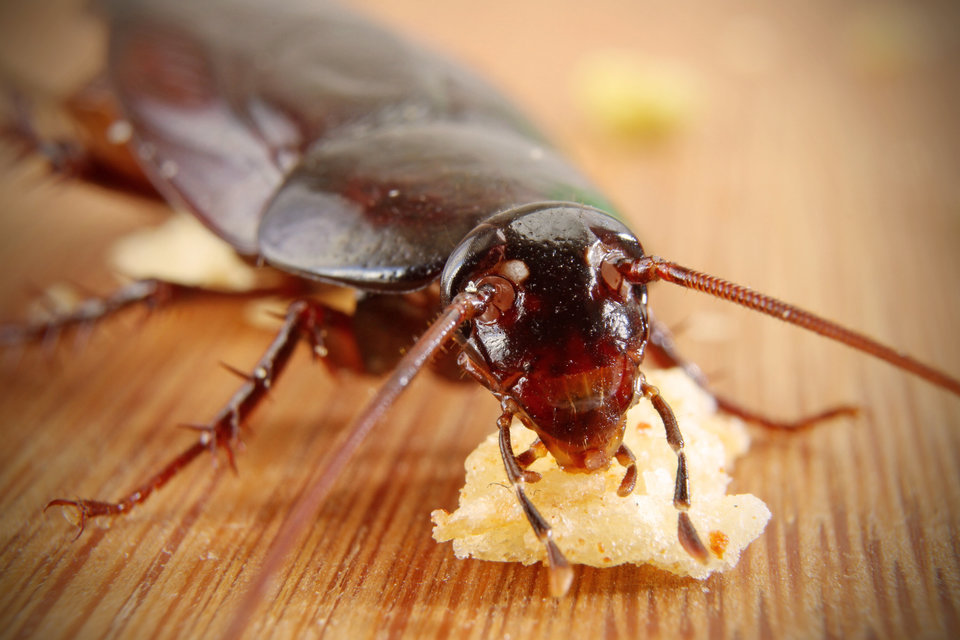
Cockroaches Are Becoming Big Business In China
Cockroaches are being used to get rid of food scraps and to feed pigs.
Thomas Suen and Ryan Woo Reuters - Text
(Reuters) - In the near pitch-dark, you can hear them before you see them - millions of cockroaches scuttling and fluttering across stacks of wooden boards as they devour food scraps by the tonne in a novel form of urban waste disposal.
The air is warm and humid - just as cockroaches like it - to ensure the colonies keep their health and voracious appetites.
Expanding Chinese cities are generating more food waste than they can accommodate in landfills, and cockroaches could be a way to get rid of hills of food scraps, providing nutritious food for livestock when the bugs eventually die and, some say, cures for stomach illness and beauty treatments.
On the outskirts of Jinan, capital of eastern Shandong province, a billion cockroaches are being fed with 50 tonnes of kitchen waste a day - the equivalent in weight to seven adult elephants.
The waste arrives before daybreak at the plant run by Shandong Qiaobin Agricultural Technology Co, where it is fed through pipes to cockroaches in their cells.
Shandong Qiaobin plans to set up three more such plants next year, aiming to process a third of the kitchen waste produced by Jinan, home to about seven million people.
A nationwide ban on using food waste as pig feed due to African swine fever outbreaks is also spurring the growth of the cockroach industry.
“Cockroaches are a bio-technological pathway for the converting and processing of kitchen waste,” said Liu Yusheng, president of Shandong Insect Industry Association.
Cockroaches are also a good source of protein for pigs and other livestock.
“It’s like turning trash into resources,” said Shandong Qiaobin chairwoman Li Hongyi. “ESSENCE OF COCKROACH”
In a remote village in Sichuan, Li Bingcai, 47, has similar ideas. Li, formerly a mobile phone vendor, has invested a million yuan ($146,300) in cockroaches, which he sells to pig farms and fisheries as feed and to drug companies as medicinal ingredients.
His farm now has 3.4 million cockroaches.
“People think it’s strange that I do this kind of business,” Li said. “It has great economic value, and my goal is to lead other villagers to prosperity if they follow my lead.”
His village has two farms. Li’s goal is to create 20.
Elsewhere in Sichuan, a company called Gooddoctor is rearing six billion cockroaches.
“The essence of cockroach is good for curing oral and peptic ulcers, skin wounds and even stomach cancer,” said Wen Jianguo, manager of Gooddoctor’s cockroach facility.
Researchers are also looking into using cockroach extract in beauty masks, diet pills and even hair-loss treatments.
At Gooddoctor, when cockroaches reach the end of their lifespan of about six months, they are blasted by steam, washed and dried, before being sent to a huge nutrient extraction tank.
Asked about the chance of the cockroaches escaping, Wen said that would be worthy of a disaster movie but that he has taken precautions.
“We have a moat filled with water and fish,” he said. “If the cockroaches escape, they will fall into the moat and the fish will eat them all.”

Detecting and Understanding Stray Voltage
Spark Your Electrical Vocabulary
All stray voltage is unintentional and undesirable, yet it is extremely common. In fact, it would be rare to find a farm or home without it, usually not in a good location. The main culprit, even though there are several variations of causation, is that with all standard 120 volt wiring we only have one hot wire, one neutral wire and a ground wire.
If the neutral wire is inadequate or if there is a weak or failed connection, the electrical current arriving on the hot wire must return to the source in some manner, which means it will try to go through any and all other objects that will conduct electricity. This undesirable flow of electrons can be via the earth, metal buildings, metal stanchions, fences or other objects.
The motor on a center pivot irrigation tower had been experiencing a tiny short in the wiring recently on a Midwestern farm. It had been this way for several weeks, but it was still working, and as you know there’s never enough time to do everything on the farm. However, the sand filter on the irrigator was also full, and this function needed emptying. The farmer was up on a metal ladder opening the overflowing trap to clean it out. It was safe, because all the pumps were switched off — except for what he did next, which was to instruct his wife to turn on the pump in order to flush the sand. It was a fatal mistake, as 480 volts surged through the system, instantly killing the farmer.
Another farmer had a grinder in the shop with a minor short in the motor; when it was turned on, it would give out a little shock. He “cured” the problem by turning on the grinder switch with a wooden broomstick. Who hasn’t done something like that?
On another farm there was a series of five livestock water fountains all connected to the electrical line. The first four fountains seemed normal, and the cattle were approaching them casually and drinking water normally. However, the cattle seemed to sense something was wrong with the fifth fountain, and they avoided it. Thirsty, two young heifers approached the fifth fountain, which was also overflowing slightly and creating a small puddle they were standing in. Within seconds after touching the water in the fountain, both heifers were instantly killed.
I heard many stories like this from Jerry Lush, a professional stray voltage consultant and ag engineer from Sioux Falls. After decades in the field of electrical energy, Lush can recount many horror stories of the abundant, and usually safe, power supply that we can’t seem to live without. Even folks who do not allow commercial electricity on their farm can encounter problems. I’m talking about stray voltage, a potential evader that can sneak onto any farm or barn.
What is Stray Voltage?
This is a very aptly named problem, in that it applies to any two objects that have electrical potential between them that ideally should not have any voltage difference between them. How much does it take? In general, we are always hoping for zero voltage, however, almost any animal can easily feel anything at 0.5 volts or higher. We could feel it too, but we usually have shoes or boots on and sometimes gloves. Lush says he finds this all too often and has even seen it run as high as 9 volts of current. Just imagine touching your tongue to a 9 volt battery.
Spark Your Electrical Vocabulary
Amperage: A measurement of the amount (strength) of current that is flowing through a wire.
Current: As stated above, current (flow of electricity) is measured in amps.
Induced voltage: A form of stray voltage that comes from other nearby circuits. This is more difficult to diagnose, but commonly runs through head stanchions or milk lines. It can be diagnosed and cured by a professional.
Resistance: This is something like a heater or light bulb; it is anything that holds back the current. It is measured in ohms.
Single-phase wiring: Brings 120-240 volts via one to two hot wires.
Three-phase wiring: (High voltage for large motors) brings in three hot lines.
Voltage: A unit of measurement of the pressure that pushes the amps through the wire.
Wattage: The sum of volts X amps and equal to power, as in the horsepower of an electric motor, for example. High voltage lines can adjust current flow by vastly increasing the voltage, which simultaneously lowers the flow of current and reduces line loss. Many transmission lines carry 7200 volts (this is what linemen work with) whereas coast-to-coast lines can carry 35,000 volts or more.
Potentially dangerous stray voltage was just diagnosed in our own home because the neutral wire coming from some “professionally installed” wiring, which had been put into our house by licensed electricians during remodeling, had actually been spliced into the ancient knob-and-tube neutral wire that runs through most of the walls and ceilings.
Jerry Lush has nearly 40 years of experience in the field of electrical energy.
Lush states that a big part of the problem is that electricians and linemen may see electricity in a different way than engineers trained in electricity (I’m generalizing here; there are some very knowledgeable technicians, likewise engineers are frequently so specialized they just don’t know everything, some engineers have no electrical training at all). But typically, the linemen have not been trained in household or farm wiring. Sometimes they can barely visualize the flow at all; their job is to get the power to the site.
Electrical engineers, including agricultural engineers, are trained to see electrical current wherever it is, quite like the rest of us might see water flowing. We could hardly expect to see water flowing into a structure without knowing where and how this water will exit. With voltage, if the neutral wire is not fat enough, or if the distance is too far, there’s no way it can keep up with electrical flow so that current “spills” into other areas in order for it to eventually get back to the source.
Stray voltage can come from any electrical device that is malfunctioning. Even properly installed wiring or devices can be damaged by moisture, lightning, or mice, squirrels and rats. Most commonly afflicted are barn fans in the summer and water tank heaters in the winter. Lastly, there can often be problems coming onto your farm from the utility service. Wherever the source, proper diagnosis is a critical starting point.
Symptoms of Stray Voltage
The key word is mysterious. Many farmers think they must be bad farmers or bad managers, or that they must have poor-quality livestock, not realizing there is a hidden cause. Electricity is essentially invisible, and we are usually focused on visible issues. Every single farm, ranch barn, garage or home can have stray voltage problems — we have seen it with dairy, beef, swine, sheep, goats, poultry or horses, but most often electrical problems are most clear in a dairy. In general, dairy animals drink more (to make milk), and they are quite often indoors and being handled, in a place where we can watch them.
Animals that are plagued with stray voltage will most frequently manifest specific problems such as mastitis, or high somatic cell count (pus in the milk), or they are jumpy when they come in to be milked. In many cases they just will not let down their milk flow. Watch your animals when they drink; they will tell you. Frequently they will only drink just enough to satisfy their thirst but not enough to maintain adequate production, which soon falls off even worse. Instead of taking a steady intake of water, they merely lap at the water, bobbing their heads.
Humans are more likely to feel the voltage themselves when walking barefoot on wet concrete, even more so when touching plumbing or metal when they are somewhat grounded by being wet. People have even been known to keep a dry rag around so that they can shut off their shower faucet without getting a mild shock.
Diagnosing Stray Voltage
Ideally, hire a pro! Lush is one of several in the United States. He comes by his skills honestly with two degrees in ag engineering and years of service working for rural electric utilities and co-op extension services. He has focused exclusively on stray voltage problems since 2007. Having worked both for the utility and for the farmer, he understands both sources of problems. He says his main tool of the trade is a simple volt meter, one that can measure micro voltage. At times he will hold a metal rod in one hand as he explores with the leads from a volt meter. He also uses a device that converts electrical current into an audible signal which emits a buzz if there is current flow. Quite often he can instantly spot wiring design errors or find loose connections. By the use of all these devices he can pinpoint sources of the problem.
Electric fencing is rarely a problem, in general, but if wired wrong it can be devastating. Lush says that it is of utmost importance to create a grounding system that is as good as or better than that of the rest of the farm. The fence should have its own individual ground and it should never be attached to any other ground. Place the ground far away from barns or other electrical systems.
Can Stray Voltage Be Cured?
Absolutely! However, Lush admits there are a few mysterious challenges over a lifetime of work. He recalls a few farms that defy logic such as an Amish farm he once investigated that haunts him. They were having barn issues of serious stray voltage in the metal stanchions yet were hundreds of yards from power lines, buried lines, transformers or substations. In some of these cases, even though no source can be detected, the professionals can build a circular passageway around the farm buildings using highly conductive materials.
Most of the time however, he says he can diagnose and cure almost every farm within four hours’ time, and most diagnoses come in the first half hour. Even if the problem is coming from the utility, a power pole/transformer neutral isolator can be installed. Since many problems come from inadequate grounding, this is a cure that can be rewired in a proper manner and without much cost. With 240 volt wiring there are fewer problems because there are two hot wires, and the current will arrive via one hot line and go back to the source via the other hot wire.
However, it’s not always that easy to settle disputes if questions arise with regard to the sources of the problem. If the utility will not accept responsibility for causing the problem or for the cost of fixing it, many farmers can feel left in the lurch. In fact, many institutions practically deny the existence of the problem, some even insinuating that the farmer must either be crazy or just a whiner.
Here in my state of Minnesota alone there are currently at least six pending lawsuits between farmers and the utilities with little hope of resolution in sight. However, the tide is slowly beginning to shift toward more accountability and more willingness to admit that the problem exists. Is it worth fighting? One dairy farmer in Minnesota suing the power utility estimates the voltage running through his dairy cost him over $700,000 in lost production, last year alone. Another Minnesota suit was settled, awarding $3 million to the damaged parties.

Video: Scientists Soup Up Photosynthesis
Oceanographer Penny Chisholm introduces us to an amazing little being: Prochlorococcus, the most abundant photosynthetic species on the planet. A marine microbe that has existed for millions of years, Prochlorococcus wasn't discovered until the mid-1980s -- but its ancient genetic code may hold clues to how we can reduce our dependence on fossil fuels.
Penny Chisholm · Microbial oceanographer, author
Penny Chisholm studies an extremely tiny microorganism that plays an enormous role in ocean ecosystems. Discovered only three decades ago, it has defined her career and inspired her to think differently about life on Earth.

China Might Just Have Grown The First Plant Ever On The Moon
China became the first country to land a probe on the far side of the moon on January 3 when a rover named Yutu 2, or Jade Rabbit 2, touched down in the moon's largest and oldest impact crater, the South Pole-Aitken Basin.
By Ben Westcott and Yong Xiong, CNN
January 15, 2019
Photo of a cotton seed sprouting on the moon on January 12, nine days after the experiment began.
Hong Kong (CNN) Cotton seeds carried to the moon by a Chinese probe have sprouted, marking what could be the first plant to ever grow there, according to Chinese government images.
In making the announcement Tuesday, Chinese researchers released pictures from the probe showing the tiny plant growing in a small pot inside the spacecraft, hundreds of thousands of kilometers away from the Earth.
China became the first country to land a probe on the far side of the moon on January 3 when a rover named Yutu 2, or Jade Rabbit 2, touched down in the moon's largest and oldest impact crater, the South Pole-Aitken Basin.
The mission, titled Chang'e 4, is intended to accomplish a range of tasks, including conducting the first lunar low-frequency radio astronomy experiment and exploring whether there is water at the moon's poles.
The video feed on the first day of the test on January 3.
Another purpose of the mission was to test whether plants could grow in a low-gravity environment, a test which appears to have already yielded results.
The system started to water the seedlings after the probe landed and less than a week later a green shoot had already appeared.
While human beings have grown plants in space before, they've never attempted to grow one on the moon.
Xie Gengxin, dean of Institute of Advanced Technology at Chongqing University, and the chief designer of the experiment, praised the achievement on the university's blog.
China's far side of the moon mission is just the start of its space ambitions
"This (mission) has achieved the first biological experiment on the moon of human history, to sprout the first bud on the desolate moon. And with time moving on, it'll be the first plant with green leaves on the moon," Xie said.
Chinese scientists are also attempting to grow seeds from rapeseed, potato and mouse-ear cress, and are trying to hatch fruit fly eggs.
According to the university's blog, the experiment will show how life develops in low gravity and strong radiation environments. It could even help provide a blueprint for growing resources during a future moon colony established by humans.
China's ambitions for space and lunar exploration aren't limited to the current mission. On Monday, China's space agency announced the Chang'e 5 lunar mission would launch by the end of the year with a goal to bring moon samples back to Earth.
The country's first mission to Mars is scheduled for around 2020, Wu Yanhua, deputy head of China National Space Administration, said at a news conference in Beijing Monday.

Leclerc Opens Second Marché Bio Store
As announced a few weeks ago, Leclerc has been stepping up its efforts to promote biological products through a new brand of organic stores. After the opening of the first supermarket in Saintes at the end of October, a second one will open today in Erstein (Bas-Rhin), near Strasbourg.
The focus is on local and short-circuit supply, as much as possible, and also on bulk. But the main asset for Michel-Edouard Leclerc are the prices. “Our products are about 30% cheaper than in specialized stores, while enhancing the producers and the sector. In order to be accessible, taking a 60% margin is out of the question,” he explained during the opening of the store in Saintes.

Masdar City's Steel Urban Allotments Could Help Solve Food Security Crisis
Vertical farms and eco-villas to be profiled at Abu Dhabi Sustainability Week could help UAE grow more of its own crops
Abu Dhabi’s Masdar City is piloting a project that could see urban communities growing their own food in an allotment, but with a very modern day twist.
A pilot future farming facility built from recycled shipping containers could solve the region’s food production crisis by allowing communities to grow produce, despite the harsh desert climate.
Masdar City, which was built to be one of the world's most sustainable communities, is collaborating with Madar Farms, who try to find sustainable solutions to the GCC's food security issues, to develop vertical farming inside shipping containers. They are equipped with hydroponic systems that can operate using minimal water.
“With the world’s population expected to exceed 9 billion by 2050, efficient and sustainable production and distribution of food is becoming increasingly important,” said Yousef Baselaib, executive director of Masdar City.
“This is particularly true for countries with arid climates and harsh environmental conditions like ours.”
Hydroponics systems allow tonnes of greens to be grown in small spaces. Antonie Robertson / The National
The 1.5 acre plots inside each 12-metre container have the capability to grow crops using less than 40 litres of water a day.
The crops are constantly monitored by the latest technology within a sealed environment, shortening the growing cycle.
Temperature and carbon dioxide levels can be regulated via a mobile phone app, with an automated nutrient delivery system to produce the best possible results.
“We have begun investing in technologies and partnerships focused on sustainable agriculture with the aim of commercialising farming techniques,” said Mr Baselaib.
“These systems can be applied to urban areas to encourage people in the UAE to eat home grown produce.”
Read more:
Abu Dhabi Sustainability Week to place spotlight on real environmental change, says minister
Smart cities look well set to power global economy
Neighbourhood Watch: Farming grows sense of community at Dubai's Sustainable City
Food security and sustainable farming will be one of the key focuses of Abu Dhabi Sustainability Week (ADSW), which begins on Saturday.
The technology and methods used by Madar Farms use approximately 95 per cent less water and land than conventional farming, making the company one of the most efficient and sustainable growers in the GCC.
The initiative joins other similar schemes such as one run by Agricool in Sustainable City in Dubai, where they are growing fresh strawberries for the local community in hydroponic grow room inside shipping containers.
Masdar City first engineered ideas of productive landscapes in 2008 to address food security issues.
Since then, community gardening plots have been developed to allow for plant research, agricultural education and to encourage people to grow their own food.
Masdar’s agricultural strategy hopes to encourage traditional farming methods and the growth of indigenous plants.
An eco-villa has been built in the eco-friendly city to show how green living could be used in the home on a wider scale.
Kyle Wagner, head of operations at Madar Farms, checks the growth of crops grown in a retrofitted shipping container. Antonie Robertson / The National
“The villa is an example of Masdar’s commitment to sustainability and is a pilot project conceived as a template for affordable, energy- and water-efficient residential villas,” said Mr Baselaib.
By this month, they also hope to have implemented home farming technologies and they will be showcasing the project at ADSW.
The eco-villa uses about 72 per cent less power and 35 per cent less water than a typical villa in Abu Dhabi, displacing an estimated 63 tonnes of carbon dioxide annually.
During ADSW, Masdar will also show other projects focused on vegetable and livestock farming, water harvesting and recycling, waste recycling and how to use energy for cooking.
Less than 1 per cent of the region is arable and permanent crop land, and more than 40 per cent of the UAE’s food is imported.
Importing that volume of food will cost more than US$100 billion (Dh367b) by 2030.
The crops are grown inside shipping containers. Antonie Robertson / The National)
More than 40 per cent of natural water sources have been lost in the past 20 years through overuse and despite water scarcity, 84 per cent of water is used for agriculture and irrigation, which contributes less than 1 per cent to GDP.
That has left conventional farming unsustainable in the UAE, forcing the development of alternative models.
Masdar has paired up with the UAE Office for Future Food Security to rubber stamp its commitment to addressing the most important environmental issues likely to impact the nation.
Other sustainable farming methods are being developed in a Central Park project, using vertical farming techniques, solar-powered greenhouses, a self-contained farmers’ market and edible maze.
“Tackling the challenge of food security is a priority for Masdar and one that we are addressing in a holistic manner by looking at solutions in energy, food and water,” said Mr Baselaib.
How A Facebook Post Drove A Banker To Launch A Multimillion-Dollar Vertical Farming Business
January 15 2019
Karen Gilchrist @_KARENGILCHRIST
Next time you feel guilty about idling away your commute on social media, remember that inspiration can come from all sources.
That was certainly the case for Benjamin Swan, whose subway scrolling sparked an idea that led him to quit his corporate job and embark on a multimillion-dollar business venture.
“It all started with an article on Facebook, ” Swan told CNBC’s Christine Tan in a recent episode of “Managing Asia.”
Benjamin Swan, co-founder and CEO of Sustenir | Sustenir
“I was on my way home from work and I read an article by (microbiology professor and author) Dickson Despommier on the future of farming and vertical farming very specifically,” said Swan, referring to the practice of growing crops in stacked layers, rather than horizontal fields.
“I was looking at a lot of the illustrations and thought to myself ... (this) just wouldn’t work for Asia.” So, that evening, the ex-engineer, who at the time was working for Citibank in Singapore, consulted “Professor You and Dr. Google” (YouTube and Google), and set about finding a solution.
’’I felt that everything I have done in my life kind of boiled down to this point ... I felt that this was my opportunity to do something that would make a difference.
Benjamin Swan
CO-FOUNDER AND CEO OF SUSTENIR
Six months — and many long nights of experimentation — later, Swan, along with co-founder Martin Lavoo, finalized the first working prototype for an indoor vertical farm that could replicate in Singapore the conditions required to grow non-native crops.
And with that, the first seeds of Sustenir were sown. Within 18 months, Swan and Lavoo had quit their day jobs to pursue the project full-time; and today, five years on, the pair have pumped millions of dollars of their own and investors’ money into vertical farms designed to make food production in Asia more sustainable and efficient.
Addressing global food challenges
It may seem like a dramatic move for a banker bored on his commute. Indeed, Swan, Sustenir’s CEO, said “never in (his) wildest dreams” did he think he’d go into farming, or even entrepreneurship. But, when he first stumbled across the idea in Despommier’s article, he said he saw it as his opportunity to “fight the good fight.”
“I felt that everything I have done in my life kind of boiled down to this point,” said Swan. “My construction days, working as a banker, all my skills that I had learnt, I felt that this was my opportunity to do something that would make a difference, an opportunity to fight the good fight.”
Kale growing in Sustenir’s Singapore-based vertical farm facility. | Sustenir
Globally, food production is becoming a hot button issue, with governments and corporations looking for innovative ways to make the process more suitable for today’s society and climate concerns. That challenge is especially felt in Asia — and Singapore and Hong Kong in particular — where rising populations and limited land availability put pressure on the agriculture sector.
Vertical farms can provide a solution to that by reducing the space needed for production and manipulating the indoor climate (with LED lights for example) so that exotic crops can be grown away from their natural environment, thereby moving production closer to consumers. In the case of Sustenir’s kale, Swan said it can make the process 127 times more efficient than traditional farms per square foot.
“Farming right now we know is a problem,” said Swan. “We are reliant on techniques that have been used for centuries and whilst we are trying to bring in automation, and improving the ways we’re using machinery and so forth, the thing that we can’t improve is land usage. So vertical farming can solve that problem.”
Making farming cool
Vertical farming companies, of which Sustenir is one of many across the globe, are not only trying to reinvent tired processes. They’re also attempting to reinvigorate a tired industry that has struggled to attract young, millennial workers, typically thought to prefer big cities and co-working spaces to provincial life.
Swan, who is now 38, said he hopes his business can help overhaul that mindset and attract more young people into agricultural careers.
“When people think of farming they think they’re going to be out in the soil, in the sun,” said Swan, who is now 38. “It’s not until we bring them into this environment that they actually go ‘wow, this is pretty cool.’”
We like to think of this as more of a tech company. We’re actually using technology to create great products.
Benjamin Swan
CO-FOUNDER AND CEO OF SUSTENIR
“We like to think of this as more of a tech company. We’re actually using technology to create great products,” he continued, referring to Sustenir’s use of artificial intelligence and its development of a real-time robotic assistant to monitor the farm’s environment.
Part of that, said Swan, is incorporating a youthful, forward-thinking mentality into his leadership style. As CEO, he builds a morning gym session into his work day routine, saying that’s when his “ideas come best,” and he encourages his 30 employees to enjoy similar autonomy.
“I create an environment for all my leaders inside of this company, to craft the way they want to get their job done,” said Swan. “I give them that freedom, I set the KPIs as what needs to be achieved but allow them to do it in the way that they want to do it, thereby giving them full ownership.”

CO2 GRO Inc. Is Pleased To Present An Audio Interview Conducted By The OTC Markets Group With John Archibald
CO2 GRO Inc. is pleased to present an interview conducted by the OTC Markets Group with John Archibald, CEO. John presents an overview of CO2 GRO, an outlook for 2019 and the significance to the Company of the recently enacted US Farm Bill.
CO2 GRO Inc. | Suite 2400 120 Adelaide Street West Toronto, Ontario M5H 1T1

$1.2bn GCC Vertical Farming Boom Seen by 2021
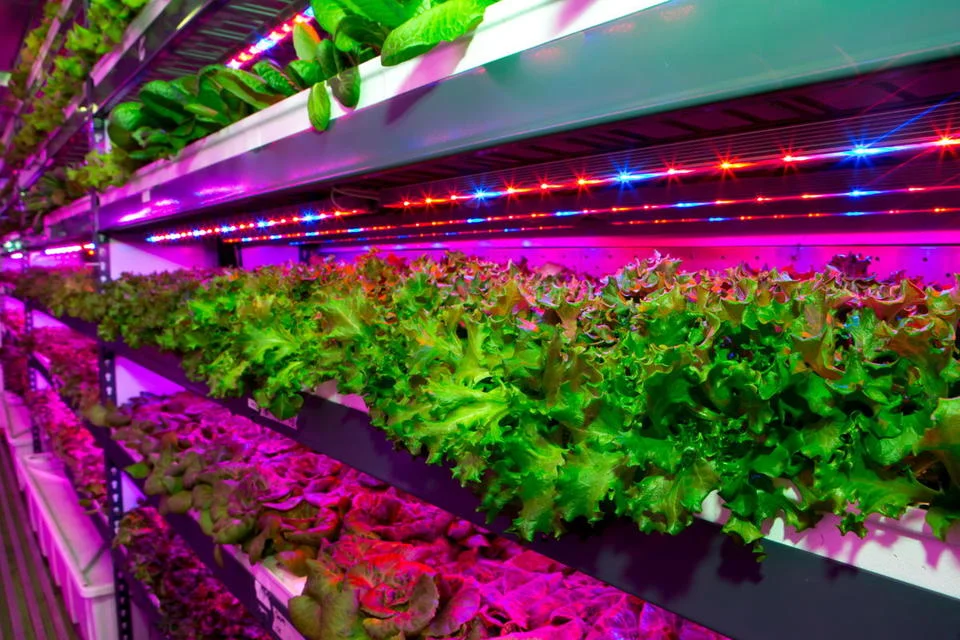
The UAE is leading the vertical farming change and has upcoming projects facilitated by the government as well as private players to help increase food security in the region.
Image by: Crop One Holdings
A growing importance is being given to vertical farming across the GCC and is generating interest and increased investments from regional and overseas players, according to a new report.
Orbis Research said the region's vertical farming market is expected to reach $1.21 billion by 2021 at a compound average growth rate (CAGR) of 26.4 percent from only $380 million in 2016.
It said the UAE is leading this change and has upcoming projects facilitated by the government as well as private players to help increase food security in the region.
These include the UAE Ministry of Climate Change and Environment allotting space for 12 vertical farms to be built by Shalimar Biotech Industries, and the world’s largest vertical farm for Emirates Airlines by Crop One Holdings Inc.
Image by: Crop One Holdings
With around 90 percent of food being imported in the UAE, territorial problems of water scarcity and small percentages of arable land, vertical farming is becoming increasingly vital to ensure food security within the region, the report added.
Mariam Al Mehiri, Minister of Future Food Security, also plans to create a "Food Valley" or a technology hub, dedicated to the development of food and farming automation.
The report comes ahead of AgraME 2019, a platform for the latest technology to be showcased to the regional agribusiness market.
Henry Gordon-Smith, founder and managing director of Agritecture who will be speaking at AgraME 2019, said: “The potential is certainly there to transform what has historically been a relatively small traditional farming industry into perhaps the most technologically advanced agriculture industry in the world.
"This means economic development, increased production of nutritious local produce, and lowered food costs, all with minimal water consumption and increased resilience to climate change and foreign markets.”
Samantha Bleasby, exhibition director of AgraME added that the show, which takes place in Dubai from March 5-7, is attracting key players in the industry such as Certhon, Agrotonomy, Veggitech, Wuxi, iGrowths Technology Co Ltd, Ozorganic Urban Farming and Van der Hoeven.

Nevada: Henderson-based Xtreme Cubes Sees Growing Industry
As indoor farming grows, which is what these would be used in, they’re environmentally sealed containers.

By Bailey Schulz / Las Vegas Review-Journal
January 5, 2019
Cannabis farms, military shelters and downtown Las Vegas’ Container Park all have one thing in common: They were built from interlocking blocks created by Xtreme Cubes.
The Henderson-based company builds modular street structures it describes as “giant, prefabricated Legos.” The blocks come in a range of sizes and can be interlocked and used for things like offices, residential buildings, retail buildings and remote work sites.
According to CEO and co-founder Brandon Main, the modular building industry has been growing rapidly, with a growing number of diverse sectors taking an interest.
This Q&A has been edited for length and clarity.
What’s it like working in Henderson?
We started the company in Las Vegas, Nevada, in 2008, but we quickly outgrew that factory. We landed on a property out here in Henderson in 2015. Moving out here, we have the space, we have the access to interstate, we have rail access, and Nevada is actually a very business-friendly state. There’s no income tax and a lot of opportunity with a tremendous workforce in the surrounding areas.
It’s a tough economy right now with low unemployment, but we can pull employees from neighboring states. Geographically, we’re in a good spot. Moving to Henderson allowed us to achieve our growth plans.
How has the modular building industry changed over the years?
The industry is growing rapidly. There’s a workforce shortage with such low unemployment. Contractors are struggling to find people to perform their work, and there’s a need for a high-quality product quicker.
The modular building industry has been around a long time. Even though there were other options, we took a cutting-edge approach to the process, and we said we’re going to design a steel building frame system that can carry all the load. Ours is a standalone application that is specifically aligned to customer needs.
What sort of industries use Xtreme Cubes?
Industrial was our starting sector, but over the years we got into commercial and retail and then residential. We built some cabin-style or condo apartment-style buildings. We’re getting into some hotels and then military or government-type buildings.
Some of the new sectors include military applications and hospitals. We’re going to be building some modular rehabilitation clinics and hospitals, or hospice care. We’re getting ready to release our first set of hotels, a multi-story apartment.
With the legalization of marijuana, medical cannabis is another new sector. As indoor farming grows, which is what these would be used in, they’re environmentally sealed containers. A lot of the problems with the cannabis industry is related to control of crops. No mold, pesticides, insects, anything that’s a potential infection to crops. We have a clean room where the operators can grow. If can be leafy greens, tomatoes, specialized herbs.
We as a manufacturer offer turnkey solutions to our customers. We design and build to exact requirements.
What’s the benefit of building with blocks as opposed to traditional construction methods?
Speed to market. With traditional construction methods, you’re burdened with the permitting process and delays with on-site inspections. We have the same building codes as traditional construction methods but in a factory environment. We have our own third-party inspector that comes to our factory. We marry them up together in sync and save all that time. We end up with a finished product in one-third of the time. We can run around the clock.
Contact Bailey Schulz at bschulz@reviewjournal.com or 702-383-0233. Follow @bailey_schulz on Twitter.

ZipGrow Helping To Transform Indoor Agriculture
A dedicated team of farming pioneers based in Cornwall are helping to bring local fresh food to the table in a growing number of communities.
December 13, 2018
By Bob Peters
Cornwall Ontario – A dedicated team of farming pioneers based in Cornwall are helping to bring local fresh food to the table in a growing number of communities.

ZipGrow manufactures vertical growing systems in Cornwall and works with farmers in external markets to install the technology and build economically viable indoor farms.
Essentially plants are grown from seeds in rows that are oriented vertically as opposed to on a traditional horizontal plane. Light, water and nutrients are supplied via a system that maximizes efficiency and crop yield.
“Our towers are designed by farmers for use by farmers,” says Eric Lang, President and Co-Founder of ZipGrow. “Going vertical allows you to grow crops in a relatively small physical area, which makes it ideal for indoor locations.”
The system is scaleable as well, which means that restaurants can grow their own greens, students can learn about agriculture and entrepreneurs can build commercial farm operations are that are climate-proof.
The ZipGrow method of farming is versatile and can accommodate different crops. Indoor farmers have had success with leafy greens such as lettuce, kale and arugula while herbs like basil, mint, and rosemary are perfect matches for growing vertically. With a little extra planning and preparation, you can also successfully grow fruiting plants such as strawberries, cucumbers, and bell peppers.
ZipGrow is located on Fourth Street West in the middle of Cornwall. Demand for their product has led to continuing increases in production, requiring the company to expand its physical footprint. The company now employs 15 people.
“We are selling ZipGrow systems in North, Central and South America and demand continues to increase quarter after quarter,” says Eric Lang. “Each sale paves the way for another as people become familiar and comfortable with the technology.”
Mr. Lang is partners with Eric Bergeron who first brought the concept of indoor farming to Cornwall with SmartGreens in 2014.
“Indoor farming offers solutions to problems that conventional agriculture struggles with – namely environmental impact, timely transportation of perishable goods to distant markets, climate change and more,” says Mr. Bergeron, Co-Founder and Chief Marketing Officer for ZipGrow. “We believe that with right knowledge and the right technology, individuals and communities can help bring farmers and consumers much closer together for the benefit of all.”
About ZipGrow
ZipGrow designs and builds vertical farming technology for installations around the world. Its team of proven leaders in the field educate, equip, and empower local farmers to grow better food for their communities and operate successful vertical indoor farms.
Web: ZipGrow.com
Floating Deep Farms Promise Year Round Production of Food Crops
Now researchers at Nottingham University have developed the concept of floating deep farms, consisting of large vertical shafts or containers, submerged under seawater near coastal areas
By Helen Knight 16th January 2019
With the global population expected to reach over nine billion by 2050, food production will need to increase by almost 70 per cent to meet the increasing demand.
Floating Deep Farms at the coastal area of a megacity (Prof. Saffa Riffat/WSSET)
However, rising sea levels caused by climate change are likely to lead to increased erosion and inundation of salt water, reducing the amount of land available for farming, particularly on small islands and in low-lying coastal regions.
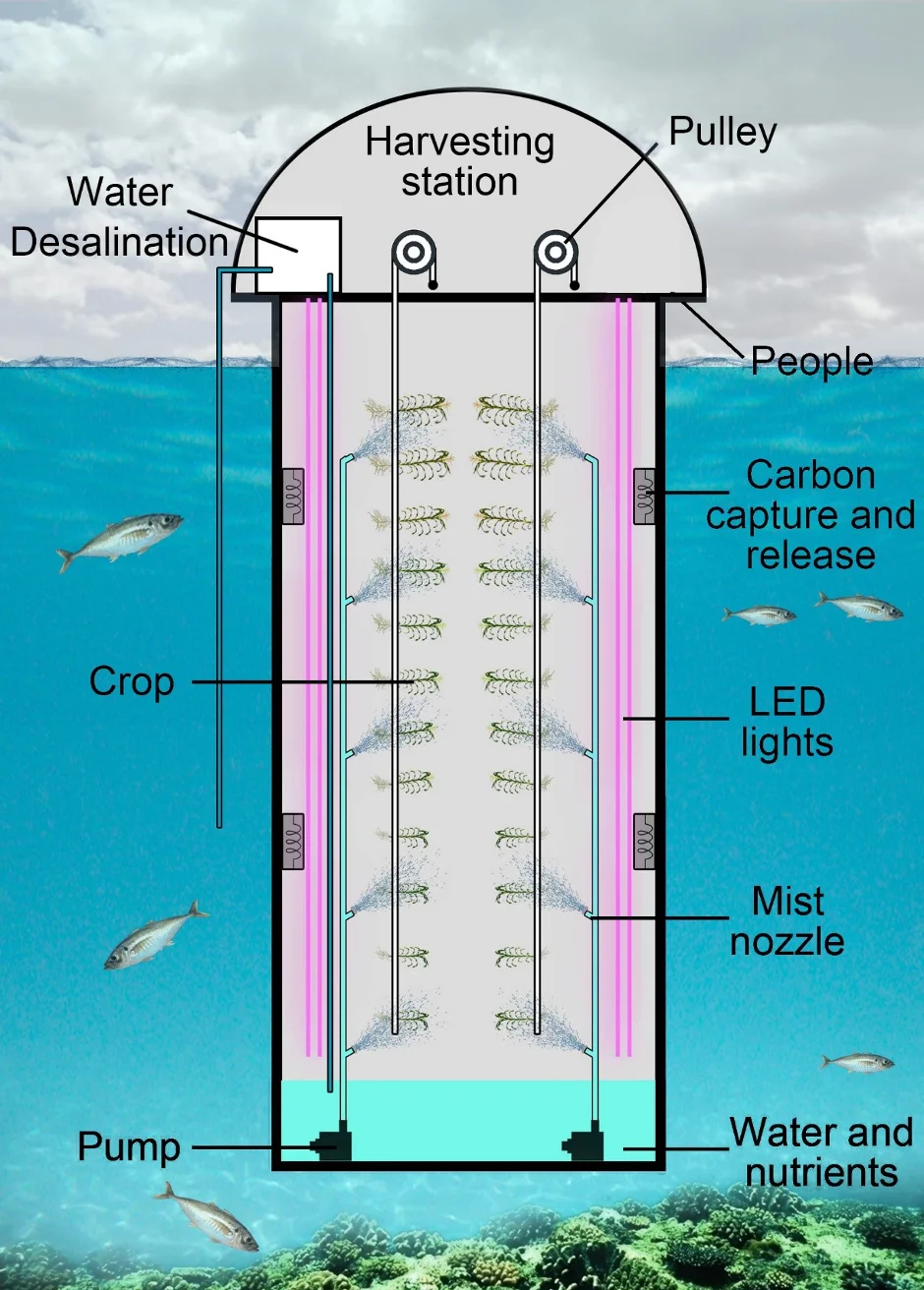
Now researchers at Nottingham University have developed the concept of floating deep farms, consisting of large vertical shafts or containers, submerged under seawater near coastal areas.
The containers, which could be used to grow a variety of crops, could also act as a sink for carbon dioxide captured from the local environment.
The project is the brainchild of Prof Saffa Riffat, chair in sustainable energy at Nottingham’s faculty of engineering, and research fellow Prof Yijun Yuan, a specialist in mining engineering and sustainable energy.
In October, 2018 the pair unveiled plans to build underground farms within the disused tunnels of depleted coal, salt and gold mines in countries such as the UK and China. They have since had interest in the idea from as far afield as the US and South Africa.
To develop the idea further, the researchers have now filed a series of six patents on the use of such deep farms in land, seawater, and rivers.
Crops can be grown all year round
“For areas close to the sea, which are vulnerable to sea level rise caused by climate change, one option is to go into the water, so they can still carry on producing food,” said Riffat.
The floating containers would be sealed at the bottom, and covered with a dome at the top. Crops would be grown using either hydroponics, in which plant roots are fed with nutrient-rich waters, or aeroponics, in which they are housed in a mist environment.
The containers would be lit by LEDs of appropriate wavelengths to maximise photosynthesis, while consuming as little power as possible.
Waste heat from the LEDs could also be combined with solar energy and used to convert seawater into fresh water by desalination. The solar energy and LEDs would heat the salt water, causing it to evaporate, and this vapour would then be condensed inside tubes to produce fresh water for the plants.
Unlike conventional farming, which is restricted by annual seasonal changes, the controlled environment within the containers means crops can be grown all year round. The enclosed farms also allow plant diseases and pests to be more easily controlled.
Floating Deep Farm at the coastal area of seawater (Prof. Saffa Riffat/WSSET)
What’s more, submerging the farms in seawater provides a stable temperature all year round, unlike conventional greenhouses and vertical farms, which rely heavily on expensive and energy-intensive heating and cooling systems to regulate the environment.
To provide the necessary power for the LEDs and other systems, the vertical shafts could be directly connected to offshore wind turbines, or wave or tidal power devices, to utilise locally available renewable energy.
The floating farms could also incorporate aquaculture for fish and shellfish, with oxygen produced by the plants fed directly to the sea creatures.
They could also provide protection for coastal communities from erosion, according to Riffat.
“You could have a number of these farms around coastal areas, and they could also work as a barrier, a defence system across the coastal area,” he said.
The researchers have also filed a patent on the use of deep farms in desert regions. The vertical shafts could be sunk into the sand, with solar panels used to power desalination of salty or brackish water from the underground water basin.
Floating Deep Farm concept (Prof. Saffa Riffat/WSSET)

Singapore Aiming To Become Region's Urban Agriculture Technology Hub: Koh Poh Koon
January 15, 2019
SINGAPORE - Singapore has the "right ingredients" to make it the urban agriculture and aquaculture technology hub in the region, Dr Koh Poh Koon, Senior Minister of State for Trade and Industry, said on Tuesday (Jan 15).
In a keynote speech at the Indoor Ag-Con Asia conference at Marina Bay Sands Expo and Convention Centre, which is being held in Singapore for the fourth time, Dr Koh said Singapore is in a strong position to "catalyse technological and business innovations", as it has a climate for innovation, strong talent base and strategic location which can transform agriculture and aquaculture in the Asia-Pacific region.
"Where arable land is scarce, innovating how we produce food is critical in helping us overcome our farming constraints and better contribute to our food sustainability and traceability efforts," he said.
Senior Minister of State for Trade and Industry Koh Poh Koon said Singapore is in a strong position to "catalyse technological and business innovations".PHOTO: LIANHE ZAOBAO
"Investments in agri-tech can also help to reduce our reliance on food imports and allow us to enjoy seasonal produce while lowering our carbon footprint."
To boost the agri-tech sector, Dr Koh announced that Enterprise Singapore, through its investment arm Seeds Capital, has appointed seven investment partners under Startup SG Equity - a scheme that encourages private sector investment for start-ups.
Seeds Capital aims to spur the growth of emerging and strategic sectors such as agri-tech, by stimulating investment in innovative local start-ups.
Under this partnership, more than S$90 million worth of investments will go into early-stage tech start-ups with food and agri-tech solutions.
The appointed partners are AgFunder, Hatch, ID Capital, Openspace, The Yield Lab, Trendlines and VisVires New Protein.
With Seeds Capital, the partners will assist early-stage start-ups, such as by introducing new business partners and providing support to enter new markets.
Seeds Capital will also provide co-funding of up to $4 million per deep tech start-up under Startup SG Equity.
Dr Koh said: "We are building a vibrant agri-tech start-up environment to uncover more talent, anchor experts, partners, investors and accelerators into our ecosystem, and expand the pool of knowledge and resources.
"We are developing relevant research capabilities in areas such as seed formulation and fish nutrition, advanced biotech-based protein production and food safety science. (Furthermore) we are establishing a high-tech physical cluster in Kranji to support operations in urban agriculture and aquaculture."
One of the Singapore agri-tech companies at the conference was Protenga, an insect farming company that produces animal feed. It has incorporated data sensors into its farms to help determine the right feeding frequency and amount, increasing the quality and volume of produce.
Another company VertiVegies, an indoor vertical farming firm, also displayed its modular planting system that uses technology to ensure efficient plant growth, while taking up minimal space and giving Singapore the potential to achieve food security.
"Singapore's journey to become a leader in agriculture technology is still in the early days, and there is much more for us to do," added Dr Koh. "I encourage industry representatives and leaders to carry on your good work in leading the development of solutions and standards for the sector, to provide fertile ground for the germination of new ideas, technology matching and transfer, capability development."
Spotlighting Women In AG
Female Growers and Innovators Are Featured At 2019 EcoFarm Conference
By Amy Wu
Even in the 21st century, the image of the modern-day farmer often centers on overalls, pitchforks, and the image of the “farmer” as a man steering the tractor. While the image remains reality to an extent, agriculture is fast extending into a new generation of women growers and innovators, who are carving a path in agtech, science, and research while others are running their own enterprise.
As a journalist, who specializes in telling stories about women leaders in farming, I am delighted that this year’s EcoFarm features a wide range of women-focused events, and many more feature female panelists and keynote speakers. There is also a plethora of amazing women spotlighted on the "Equity, Food Justice, Sovereignty" track.
The “Women in Food & Ag Mixer” that traditionally bookends the conference on Friday also returns. And one of this year’s keynote speaker on the final conference day is social expert Nikki Silvestri founder and CEO of Soil and Shadow, which works to create systems change towards economic development and ecosystem restoration. Silvestri’s impressive background also includes being co-founder of Live Real and former executive director of People's Grocery and Green for All that focus on food justice.
In the past year, discussion over food and farming has also morphed into the intersection of environment, agriculture and climate change. Case in point regenerative agriculture, loosely defined as using a variety of farming techniques and land practices to improve soil health and improve water cycles.
To be sure, for a second year in a row there is an entire day devoted to “Women in Regenerative Agriculture Field Day” at Paicines Ranch in San Benito County, where attendees will have a chance to connect with female farmers, ranchers, scientists, physicians and advocates, bookended with a wine tasting.
The uptick in women panelists and speakers can only be positive since it directly touches the critical area of land equity; how many farms are owned and operated by underserved communities whether that be women or people of color? A January 23 workshop is devoted to discussion surrounding the importance and ways to increase diversity on farms and in the food system and “address root causes of inequity, and explore strategies for moving forward in healthy relationships with one another and the land,” according to the program description.
The opportunities and potential surrounding ownership are immense for women, especially as more farms struggle to stay afloat. Many farms across the country are being squeezed by severe labor shortage, limited water and land supply, skyrocketing costs of doing business, the ongoing trade wars, and the reality that the next generation might not be interested in farming. The upshot is a growing number of women are managing farms in the capacity of owner or operator; I recently had the pleasure of spending a morning with Jacky Vasquez one of the few if not only female farm operators in Monterey County. On any given day you’ll find Jacky in the vast landscape of berries on the farm where she runs, walking through the fields and reviewing the berry quality, on a tractor, or directing field crews. She is proud to be boots on the ground. She has a passion for agriculture that transcends gender and demographics.
“I like the mix of it. Yesterday I was in heels and speaking in a conference and today I am about to walk the fields and check strawberries for their qualities. It’s from eating gourmet catered meals to tacos from a truck,” Jacky shared. My personal hope is that down the road I will find more women like Jacky and female farm operators will no longer be an anomaly.
This appears possible as a silver lining emerges with the current landscape; an estimated 1 million women are now farm operators and over a half-million own and lease land to farmers, and a third of farmland in the U.S. is farmed or co-farmed by women, and women own 87 million acres.
Finally, last but not least there is a powerhouse panel of women, Malaika Bishop co-director of Sierra Harvest, Denisa Livingston of Diné Community Advocacy Alliance and Karen Washington co-founder of Black Urban Growers (BUGS), who will take a deep dive in “Engaging & Empowering our Communities to Transform the Food System.”
Having documented and profiled some amazing women leaders in farming, I am excited to participate in the discussion and dialogue at EcoFarm 2019. My hope is that in years to come women will no longer be spotlighted, but will simply be a part of the landscape of discussion of agriculture.
To learn more and register for EcoFarm Conference 2019 visit www.eco-farm.org/conference
Amy Wu is the founder and chief content director of “From Farms to Incubators,” a resident company inside the WG Center for Innovation and Technology. She previously reported on ag for The Salinas Californian. She considers herself bicoastal and splits her time between New York and California.

The World Agri-Tech Innovation Summit Returns To San Francisco March 19-20, 2019.
Now in its 5th year, the summit will gather 1000+ global agri-food corporates, innovators and investors to uncover the most exciting innovations in the agri-food sector and to forge the right partnerships to take those solutions to market.
Turning Disruptive Technology into Business Strategy Through Partnership & Collaboration
Mission Statement:
Focussed on predictive agriculture, automation, robotics, AI backed genomics and biological discovery platforms, the World Agri-Tech Innovation Summit explores the business models and partnerships needed to scale new technologies and transform the food supply chain into a more sustainable, affordable and nutritious system for future generations.
Now in its 5th year, the summit will gather 1000+ global agri-food corporates, innovators and investors to uncover the most exciting innovations in the agri-food sector and to forge the right partnerships to take those solutions to market.
Each year the summit attracts important delegations from Europe, Israel, Asia and Australia and is where valuable business connections are made to accelerate the transition of technology from the laboratory to the field.
Venue:
Hilton San Francisco Union Square
333 O’Farrell Street
San Francisco
CA 94102
Registration:
https://worldagritechusa.com/register/
World Agri-Tech Innovation Summit:
Early Bird (until January 17, 2019) $1,895
Full Price $2,295
Two Summit Pass: World Agri-Tech and Future Food-Tech
Early Bird (until January 17, 2019) $2,995
Full Price $3,495
About the Summit
Focussed on predictive agriculture, automation, robotics, AI backed genomics and biological discovery platforms, the World Agri-Tech Innovation Summit 2019 explores the business models and partnerships needed to scale new technologies and transform the food supply chain into a more sustainable, affordable and nutritious system for future generations.
Now in its 5th year, the summit will gather 1000+ global agri-food corporates, innovators and investors to uncover the most exciting innovations in the agri-food sector and to forge the right partnerships to take those solutions to market.
Each year the summit attracts important delegations from Europe, Israel, Asia and Australia and is where valuable business connections are made to accelerate the transition of technology from the laboratory to the field.
OUR EVENTS
DOWNLOAD BROCHURE
REGISTER
REGISTER BY JANUARY 17 2019 TO SAVE $400
US, New York, Seeds of Sustainable Future Planted at Third Hydroponic School Lab Opening In Astoria
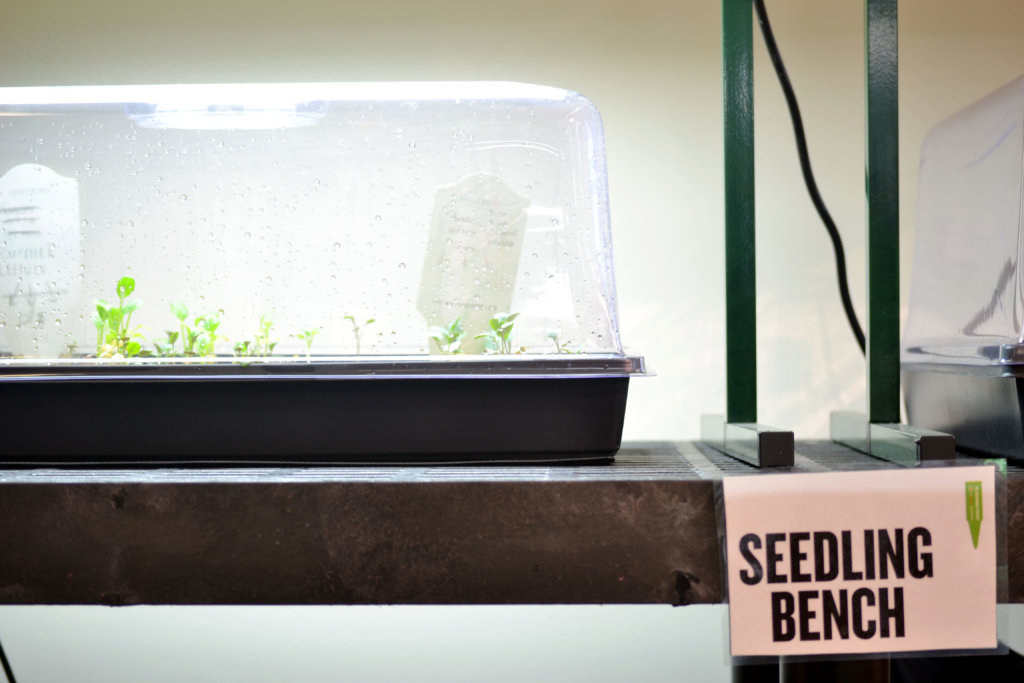
Hydroponic labs are spaces where student can grow plant life without the use of soil and offer hands-on lessons on biology, ecology and agriculture. Studies have shown that students who physically experience scientific concepts are more likely understand them better.
Photo by Alejandra OConnell-Domenech/QNS
January 15, 2019
The seeds of a sustainable future have been planted at P.S. 84 – Steinway in Astoria, where Councilman Costa Constantinides helped opened a new hydroponic science lab on Jan. 14.
“Environmental changes are increasingly making science a component of every industry, so we must make sure our leaders of tomorrow get the hands-on experience now to solve problems of the future,” said Constantinides.
Hydroponic labs are spaces where student can grow plant life without the use of soil and offer hands-on lessons on biology, ecology and agriculture. Studies have shown that students who physically experience scientific concepts are more likely understand them better.
This was apparent during Constantinides visit to P.S. 84 – Steinway, as grade-school children guided him through their new lab explaining the biology behind plant growth.
“These are the best lessons in life,” said P.S. 84 – Steinway Principal John Buffa. “[This] develops a love of learning because when children take ownership of their learning, they are going to take it from beginning to end.”
Besides teaching students to take responsibility for their own learning, hydroponic science labs teach children how to think sustainably. According to Manuela Zamora, the executive director of New York Sun Works, the nonprofit that built the hydroponic lab at P.S. 84, each school equipped with a lab also receives a curriculum with appropriate ways of teaching complex scientific concepts to depending on their age.
Zamora used ladybugs to exemplify this. If the plants P.S. 84 – Steinway become infested with a pest such as aphids, “[we] will bring in ladybugs who will eat the aphids so that we don’t have to use pesticides.” This creates a teachable moment about the harms of pesticides and alternative methods of pest removal.
New York Sun Works, offers curriculum for kindergarten through 12th grade.
The new lab represents a broader push by Constantinides to enhance science curriculum, educational technology and renewable energy in its schools. As chairman of the City Council’s Environmental Protection Committee, Constantinides has also allocated funding to cover STEM lab updates, solar panels. He also recently announced a push to have the city study how it can shut down gas-fire power plants across the five boroughs by the end of 2020.
But opening the plant at P.S. 84 – Steinway is more than just politics for the councilman; it’s also personal.
“This is repaying a debt,” said the councilman, an alum of the elementary school.
According to Constantinides, the New York Power Authority (NYPA) has agreed to fund the hydroponic lab at P.S. 84 – Steinway.
“NYPA has had preliminary conversations to discuss the possibility of giving programmatic support to schools in the councilman’s district that are near its power facility and meet further criteria,” said NYPA in an email to QNS. ” However, discussions are still ongoing with both NY Sun Works and the councilman’s office to identify which schools, in Queens as well as other areas of the city, can be supported in 2019.”
Topics: Astoria climate change Councilman Costa Constantinides eating green

Trader Joe’s Repeats As Top U.S. Grocery Retailer
January 11, 2019
Trader Joe’s is once again the top-rated grocery retailer, according to a nationwide study by dunnhumby. The grocery retailers with the highest overall consumer preference index scores are: 1) Trader Joe’s, 2) Costco Wholesale, 3) Amazon, 4) H-E-B, 5) Wegmans Food Markets, 6) Market Basket, 7) Sam’s Club, 8) Sprouts Farmers Markets, 9) WinCo Foods, 10) Walmart, 11) Aldi, 12) Peapod, 13) The Fresh Market.
“While consumer confidence in the U.S. is at a near 18 year high and the U.S. economic growth is outpacing the rest of the world, there are signs of turbulent times ahead and grocery retailers need to be prepared,” said Jose Gomes, President of North America for dunnhumby. “Because of pressures that grocery retailers are facing today, a common reaction is to think only of the short term. But by focusing on the customer preference levers that we have identified in this RPI to inform their strategies, retailers can buy an insurance policy for the future to ensure they can weather the storms ahead.”
The overall RPI ranking evaluates retailer performance on seven pillars: price, quality, digital, operations, convenience, discounts/rewards and speed. The retailers who focus their business on superior value perception — defined by the strongest combination of price and quality — tend to have the most financial success and the strongest emotional bond with consumers.
Key findings from the study:
Understand customer needs and be excellent at what matters most to win their preference. Trader Joe’s is a prime example of a retailer making trade-offs to deliver superior Value, and it has earned them the top spot for two years in a row. With its small format, lack of digital shopping and limited national brand offering, the retailer focuses on speed of in-store shopping and having a rich Private Brand offering. This bricks-and-mortar only, private brand approach minimizes costs and keep prices low, allowing them to reinvest in customer service, product quality and in-store experience. This strategy sacrifices reaching customers through a growing digital channel and breadth of assortment, and therefore losing on one-stop shop-ability and convenience. However, this loss is also their gain since it allows them to deliver what matters most to their customers.
Two needs rise above all others for most food retailers and have the greatest weight in determining RPI ranking, forming the core of value perception: price and quality. Retailers that rank in the first quartile overall excel in value perception and, as a result, have sales growth that is two times greater than retailers in the second quartile and nine times greater than retailers in the bottom two quartiles. The other customer needs, like digital, speed, convenience or discounts/rewards, while still important, have a weaker association with retailer preference.
First quartile retailers are mostly non-traditional grocers, who have developed a highly targeted offering designed to maximize value perception for their specific customer base. More traditional, regional grocery banners with a long history are hurting because of it, having relatively poorer performing financials and/or emotional bonds. The reason: these traditional banners have inferior price perception and/or quality. The RPI’s top three overall retailers excel in these two factors (Amazon in price; Trader Joe’s and Costco on both).
For some traditional, regional grocers, discounts/rewards and promotions are contributing to sales growth, but for many, this is adding to financial difficulty. In the U.S., hundreds of millions of dollars are spent on discounts, rewards and promotions every year, but over two-thirds of promotions don’t break even. To maximize the success of a discounts/rewards program, retailers need to have at least average price perception and a highly relevant assortment, supported by a strong private brand.
Private brand is a common key to driving value perception and improving customer preference for retailers up and down the rankings. Six of the top 10 private brand performers are in the first quartile of the RPI overall. Additionally, many of the most successful traditional, regional grocers occupy the second quartile, and they complement a highly relevant assortment with a strong private brand, allowing them to maintain solid price perception. Lastly, private brand is a key element in driving both price and quality perception and thus overall value perception, where retailers in the bottom two quartiles are struggling the most.
Retailers who tended to see improvements in their digital rank also tended to see slips in their operations (i.e. out of stocks, pricing consistency, clean stores, right product variety). Retailers that ramp up investment in digital must be cautious not to take their eye off the retail basics.
Some retailers have achieved an excellent digital customer experience, but their financial performance has not benefited, while others with a focus on digital manage to thrive. Retailers missing any of the following are not maximizing the impact of digital investment: large scale, great price perception and a category DNA leaning toward center store items and non-grocery products.
dunnhumby, the global leader in customer data science, released the second annual dunnhumby Retailer Preference Index, a comprehensive, nationwide study that examines the $700 billion U.S. Grocery market. The RPI study surveyed 7,000 U.S. households to determine which of the top 56 largest grocery retailers have the strongest combination of financial performance and consumer emotional sentiment.

CO2 GRO Provides A 2018 Review And 2019 Outlook
TORONTO, ON – January 15, 2019 – Toronto based CO2 GRO Inc. (“GROW”) (TSX-V: GROW, OTCQB: BLONF, Frankfurt: 4021) is pleased to provide a 2018 Review and 2019 Outlook:
2018 Grow Trials and 2019 Commercial Revenue
During 2018, GROW conducted scientific and commercial grow trials using CO2 Foliar Spray on high value plants including cannabis, flowers, lettuce, micro greens and peppers. All trials led to major value improvements in plant size, quality and growth speed.
GROW’s accumulated positive data was sufficient for our first two customers to sign Commercial Agreements to install CO2 Foliar Spray equipment in mid-Q1, 2019. Data to August 2018 was filed to take a provisional PCT CO2 Foliar Spray patent to pending status.
Site technology leasing revenue is expected start in late Q1, 2019.
GROW’s 2019 pipeline of companies and plant growers includes US hemp growers that can now grow unlimited acres as the US decriminalized US hemp growth in 2019.
Targeted geographic areas for CO2 Foliar Spray commercial development are primarily the Southwest, Southeast and Midwest US and Eastern Canada. In 2020, potential international CO2 Foliar Spray trials and commercial installations are being considered in the EU, South America and Africa.
Year-End 2019 Revenue and EBITDA Expectations
GROW is forecasting a site license lease revenue run rate of C$10M/year entering 2020 with EBITDA margins of 50%.
Use of Q4 2018 Equity Financing
In October 2018, $1.427M was raised from the exercise of 7.135M of GROW’s $0.20 warrants. Proceeds are being used to:
1) Retire a $200,000 secured three-year note resulting in the Company having no debt outstanding.
2) Hire key US and Canadian personnel to accelerate GROW’s CO2 Foliar Spray technology leasing revenue growth and,
3) General corporate purposes.
Business Development and Scientific Staff Appointments
US Appointments
1) Michigan based US Midwest Representative with 35 years of flower and vegetable based grower and greenhouse experience.
2) Florida based US Southeast and parts of Southwest Reperesentative with extensive hemp and medical cannabis market development expertise.
3) California based Market Representative with a plant micronutrient background.
4) Minnesota based Dr. Matt Julius who is a Biology Professor at St. Cloud State University, Minnesota – he will start as acting Chief Science Officer from April to December 2019
Canadian Appointments
5) Ontario based Representative for Ontario, Quebec and New York State with extensive greenhouse experience.
6) Ontario based Manager of Project Engineering.
John Archibald, CEO, commented “2018 was a pivotal year as we completed GROW’s restructuring and reorganization, conducted successful scientific and commercial trials and signed our first two site license agreements. For 2019, we are now staffed to execute on our highest impact trials and provide CO2 Foliar Spray solutions to customers that want to proceed directly to installations as our first two customers did.“
About CO2 GRO Inc.
GROW's mission is to accelerate all indoor and outdoor value plant growth naturally, safely, and economically using its patent pending CO2 Foliar Spray technology. GROW’s global target retail plant markets are food at $8 trillion per year (Plunkett Mar 2017), non-food at an estimated $1.2 trillion per year with retail tobacco at $760 billion (BA Tobacco 2017), floriculture at $100 billion by 2022 (MarketResearch.Biz estimate). Legal cannabis at $52.5 billion per year by 2023 (Statista) and legal US hemp CBD at $22B per year by 2022 (the Brightfield Group).
GROW's CO2 technologies are commercially proven, scalable and easily adopted into existing irrigation systems.
The CO2 technologies work by transferring CO2 gas into water and foliar spraying water across the entire plant leaf surface which is a semi permeable membrane. The dissolved concentrated CO2 then penetrates a leaf's surface area naturally like nicotine dissolves through human skin from a soluble nicotine patch.
Foliar spraying of water, dissolved nutrients and chemicals on plant leaves has been used for over 60 years by millions of indoor and outdoor growers. To date, outdoor growers have not had any way to enhance plant CO2 gas uptake for faster growth.
Indoor CO2 gassing has enhanced plant yields for over 60 years but 60% of the CO2 gas used is typically lost from ventilation. Current greenhouse CO2 gassing levels of up to 1500 PPM are not ideal for worker health and safety. GROW's safer infused CO2 Foliar Spray can be used by both indoor and outdoor plant growers with minimal dissolved CO2 gas lost and much greater CO2 plant bioavailability resulting in higher plant yields than both CO2 gassing and no gassing plant yields.
Forward-Looking Statements This news release may contain forward-looking statements that are based on CO2GRO's expectations, estimates and projections regarding its business and the economic environment in which it operates. These statements are not guarantees of future performance and involve risks and uncertainties that are difficult to control or predict. Therefore, actual outcomes and results may differ materially from those expressed in these forward-looking statements and readers should not place undue reliance on such statements. Statements speak only as of the date on which they are made, and the Company undertakes no obligation to update them publicly to reflect new information or the occurrence of future events or circumstances, unless otherwise required to do so by law.
Neither the TSX Venture Exchange nor its Regulation Services Provider (as that term is defined in the policies of the TSX Venture Exchange) accepts responsibility for the adequacy or accuracy of this release.
For more information, please visit www.co2gro.ca or contact Sam Kanes, VP Business Development at 416-315-7477.