


Welcome to iGrow News, Your Source for the World of Indoor Vertical Farming
Backyard Farms’ Northeast Expansion Sets Record
December 04, 2018
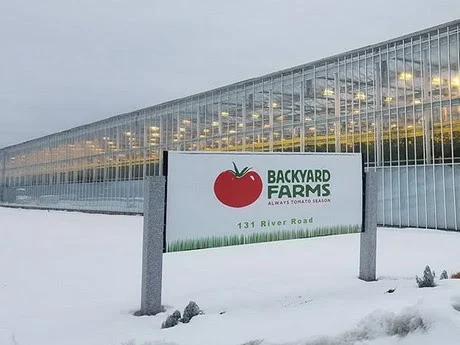
Mastronardi Produce Ltd. is expanding the Backyard Farms brand with the introduction of a high-tech greenhouse in New York, one the largest-ever single builds in North America.
“This expansion allows us to meet the incredible loyal consumer and retailer demand for this brand," said Paul Mastronardi, president, chief executive officer and the fourth-generation family member to lead Mastronardi Produce. “It also ensures that all Northeasterners can enjoy what New Englanders have come to expect: fresh-from-the-vine Backyard Farms tomatoes delivered within hours.”
The 71.6-acre glass greenhouse is only Phase I of the company’s mission to satisfy customer appetites — and exceed flavor expectations — for locally grown Backyard Farms tomatoes.
The new, industry-leading greenhouse more than doubles Backyard Farms’ greenhouse growing acreage and increases Mastronardi Produce’s internal greenhouse network to seven locations across the United States. In total, Mastronardi produces and delivers fresh, flavorful produce to retailers from more than 4,000 productive acres of growing capacity.
New-York-grown Backyard Farms tomatoes are planned to hit stores in Fall 2019

France Agriculture: Here Rooftop Farms Give You Vodka And The Fish Grow Plants
December 05, 2018
By OLIVER MATHENGE @olivermathenge
Sous les fraises' Marie Dehaene explains their operations on the rooftop of Galeries Lafayette in Paris on November 26, 2018 / OLIVER MATHENGE
On a chilly Wednesday afternoon, our driver slows down and parks along Haussmann Boulevard in the 9th arrondissement of Paris.
As the door slides open, the warmth inside the van is replaced with some gashing cold air as we prepare to once again fight the freezing weather.
We are outside Galeries Lafayette, one of the many shopping malls in the City of Paris where according to our program; we would be meeting some urban farmers.
It is warm again inside the mall as we await our hosts as well as get our passports entered into the visitor's system.
What we do not know is that this warmth is short-lived as our elevator journey lands us on the roof of the mall.
Our tour is on the roof where temperatures have dropped to six degrees with darkness set to engulf the Paris skies within the hour.
Unlike other rooftops that we can see from here, this particular one has a lot of greenery and you can smell the various flavours of edible plants here.
Our host, 31-year old Marie Dehaene, kicks off the tour by asking us why a mall such as Galeries Lafayette has allowed her team to put up what looks like hanging plants on their roof.
We make several guesses before she explains that they approached the mall with the idea of putting up a rooftop farm as part of giving Paris some green spaces.
“In 2013, we worked together to design and think about how it would work because it was the first time in France that there was a commercial rooftop farm,” Marie says.
She added; “They were concerned about things like; Are you going to bring dirt into the department store? Are you going to flood the roof? Are you sure these things will not fly away? Real technical things.”
Marie is an agronomist engineer and a founding member of sous les fraises (under the strawberries) startup that has not only moved farming into the city but is greening the rooftops of Paris high rise buildings.
We learn that the start up has dressed Galeries Lafayette Haussmann, where we are standing, with a green roof that houses more than 150 varieties of edible plants.
On the more than 1,200 m² of this surface, they grow more than 18,000 plants, including strawberries, raspberries, edible flowers, aromatic plants, cabbage and even produce honey.
“Here for instance when we put the tomato plants they each give at least five kilos of tomatoes. This means five tonnes of tomatoes per year for just this garden,” Marie says adding that they have a total of 14 gardens.
She promises to take us to one of the other farms on Friday, a day before we finalise our France trip.
As we walk around the rooftop, Marie explains the use of the different plants that we can see and how they are grown without the use of too much soil.
She explains that they use sheep and hemp wool membrane, with a little soil, compost and water.
We do not see a lot of produce as the last harvest is done in October just before the cold season checks in which Marie and team use to plan for the next year.
Nonetheless, we get to learn about some of the plants we can see which they pick and sell to various restaurants around Paris.
"Most of these are used for salad dressing. Some of these we distil and make gin and vodka (which some members of our entourage got to taste later) with it," Marie says.
She adds; "We meet the distiller and agree on the recipe and then deliver the plants and three months we get the gin and vodka. The alcohol captures all the flavours."
Marie says that the projects are important to them because they have a low carbon footprint and create local jobs now having a workforce of 15 full-time employees.
"When we started, we were just three people," Marie says.
Galeries Lafayette Corporate Communication Officer Eva Perret told the Star that they allowed the project because of the unique opportunity it gives to empowering customers.
"For us, it is a first step towards talking to our customers about sustainable consumption," Perret said.
Before we leave, we sample some of the products that are produced from the plants grown on this rooftop farm as we agree on the Friday trip.
So on Friday afternoon, which is a bit warmer than the previous days, we set out to Farmhouse Aubervilliers nestled in the heart of the business park ICADE Porte de Paris.
While the plants are set up in a similar fashion as those we saw on the rooftop of Galeries Lafayette, here sous les fraises use techniques of urban agriculture Aquaponics - breeding fish in symbiosis with growing plants.
This particular farm accommodates some 6,000 fish, which are sold to various restaurants, and more than 8,000 plants.
"Here we grow fish basically because the fish poop feeds the plants that we have while the plants clean the water for the fishponds," Marie explains.
For irrigation, the farms use a closed robotic water circuit can feed all plants according to their needs and the weather by analyzing data via sensors on the plants.
Marie says that the system sends an SMS alert to them in case there is a problem.

Tomatoes And Microgreens In Space
We Have Lift-Off
Originally scheduled for November 19, the Eu:CROPIS mission, featuring life support system greenhouses that are to demonstrate that growing tomatoes in space is possible using urine, was launched December 3 and is now in orbit.
In other space news, December 5 will see another satellite launch, this time from Cape Canaveral Air Force Station. Space Tango customer payloads will be making their departure for the International Space Station for the SpaceX Commercial Resupply Services-16 (CRS-16) mission. Included in the mission are two horticulture projects.

„Test of outside cameras and Payload No.4 (SCORE) successfully accomplished. The images show the inside view of the non-deployed solar panels”
#SSOA #SmallSatExpress @DLR_de @UniFAU @SpaceX @elonmusk @DLRWeaselWorks @Lizzard07 @nohka @SpaceflightInc @DLR_next
Aeroponic Farming in Microgravity
The Aeroponic Farming in Microgravity payload will evaluate an aeroponic system designed for use in a microgravity environment. The primary payload objective is observing the behavior of mist immediately after it is ejected from its source and how it moves thereafter. The secondary objective is to observe how a sample plant grows using the aeroponic system.
In order to examine the feasibility of using small-scale aeroponics systems in microgravity, this experiment features a chamber with an ultrasonic fogger unit. The mist is sprayed onto material containing microgreen seeds and the resulting germination and growth are imaged. Research data collected should provide a helpful model for future plant growth studies on the ISS.
Growth of Assorted Microgreens in Microgravity
The Growth of Assorted Microgreens in Microgravity payload studies the morphology and physiology of the germination of four different microgreens within modular growth chambers in microgravity.
The seeds are placed under automatic growth lighting conditions to provide day and night lighting cycles that simulate successful terrestrial lighting. While imaging and numerous environmental sensors provide an incremental evaluation of the plant growth on the International Space Station, multiple terrestrial control experiments will be conducted for comparison.
The Growth of Assorted Microgreens in Microgravity experiment demonstrates modular, autonomous and retrievable crop research in space by contributing to the understanding of plant cultivation in service of food, oxygen and other habitat requirements on long-term space missions. This experiment also provides insight on plants grown under unusual conditions and can inform crop science, basic biology and horticultural applications on Earth.
Publication date : 12/5/2018

5 Major Crops In The Crosshairs Of Climate Change
October 25, 2018
Heather Kim/NPR
Climate change is coming like a freight train, or a rising tide. And our food, so dependent on rain and suitable temperatures, sits right in its path.
The plants that nourish us won't disappear entirely. But they may have to move to higher and cooler latitudes, or farther up a mountainside. Some places may find it harder to grow anything at all, because there's not enough water.
Here are five foods, and food-growing places, that will see the impact.
Wheat
Wheat, source of bread and a foundation of life in much of the world, will suffer from hotter temperatures — and the country where the impact may be greatest also is among least well-equipped to cope with a shortfall. India is likely to see a large drop in wheat production due to heat stress — about 8 percent if average global temperatures rise by 1 degree Celsius, according to one recent study. Temperatures are expected to rise more than that; according to a recent report from the U.N. Intergovernmental Panel on Climate Change, limiting climate change to 1.5 degrees Celsius will require heroic and dramatic action. It will take significant cuts in greenhouse gas emissions within 15 years, plus efforts to recapture some of the carbon that's already been emitted, perhaps by planting new forests.
Globally, though, wheat may not be in short supply in a warmer world. Russia, which is already a major wheat exporter, may be able to expand the amount of land devoted to this crop.
Mary Mathis and Heather Kim/NPR
Peaches
Despite Georgia's claim to be the Peach State, California is the country's biggest peach producer. Farmers there grow about half of the country's fresh peaches, and almost all of the fruit that's canned and processed in other ways.
Many fruit trees, including peaches, have a peculiar requirement. If they don't experience enough chill during wintertime, they get confused and don't bloom properly. No bloom, no harvest. The peach trees currently grown in California's Central Valley require about 700 "chilling hours" during the winter. But scientists are predicting that by the end of the century, only 10 percent of the valley will reliably see that much chilling. And even if plant breeders create peach varieties that need less chilling, there's another problem: Peach trees also yield less fruit when it gets too hot in summertime.
Heather Kim/NPR
Coffee
Coffee can't take freezing temperatures, but it doesn't like extreme heat, either — at least the highly prized Arabica type doesn't. So it's mainly grown on relatively cool mountainsides in the tropics. Brazil is the biggest coffee producer in the world, by far, but as the globe warms up, most of its main coffee-growing regions probably won't be suitable for growing this crop anymore, due to heat as well as more frequent rainstorms. Coffee could move to cooler parts of the country, but researchers don't think those new growing areas will make up for what's lost.
Meanwhile, rising temperatures could threaten native coffee trees that grow wild in the forests of Ethiopia and central Africa. The wild trees represent an irreplaceable storehouse of coffee's original genetic diversity. The world's commercial coffee trees are genetically very similar to each other, and those genetically diverse wild trees could be the source of genetic traits that plant breeders may need in order to create commercial trees that can thrive in tomorrow's climate. Some of the wild trees, however, are preserved in "gene banks" in Ethiopia and Latin America.
Mary Mathis and Heather Kim/NPR
Corn
Nothing says Iowa quite like fields of corn. Climate models, though, see a different future. They're predicting that a warming climate will bring several changes, most of them bad for growing corn. Rain will come less often, and when it comes, the storms will be more intense — neither of which is helpful for a crop that demands frequent rains, but doesn't do a good job of preventing soil erosion. In addition, corn suffers when it gets too hot — especially when it's too hot at night. Add it all up, and one study estimates that corn yields in Iowa will fall substantially, anywhere from 15 percent to an astounding 50 percent. "By 2100, the Corn Belt is going to be in Canada, not in the United States," says Jason Clay, senior vice president for food and markets at the World Wildlife Fund.
So what will replace corn on Iowa's fertile land? According to one study, by the end of the century this part of the Midwest will be more suited for growing cotton, soybeans, grass and forests.
Mary Mathis and Heather Kim/NPR
Almonds
California, the biggest single source of America's fresh vegetables and nuts, and the primary source of almonds for the entire world, is a dramatic illustration of how subtle shifts in climate can have huge effects. California's farms rely heavily on snow that piles up in the Sierra Nevada mountains during the winter, and then slowly melts during the summer, delivering a vital flow of water to the state's irrigation canals. As the climate warms, though, winter precipitation will arrive more often as rain, and the snow that does fall will melt much more quickly, leaving farmers scrambling for water to keep crops alive in late summer. Also, there will be more variation from year to year; wet years will be wetter, and dry years will be even dryer.
Both trends increase the chances that from time to time, farmers will face catastrophic shortages of water. And that's especially bad for tree crops, of which almonds are the biggest, because losing an orchard is much more devastating than losing a single crop of, say, tomatoes. California's farmers may be forced to reduce the amount of land devoted to orchards, since there there's a chance that they will not survive a major drought.

Botanist And Agricultural Researcher - Rooftop Gardens Have Huge Potential As Food Source
November 23, 2018
MA Sobhan
Botanist and agricultural researcher MA Sobhan talks with New Age Staff Correspondent Sadiqur Rahman about rooftop gardening
Dhaka is among the most densely populated cities having thousands of buildings for habitation.
Residents can create well-planned garden in the rooftop, MA Sobhan says as he sees a huge opportunity to turn the rooftop gardens into earning sources for urban people.
Citing the Cuban experience, he says that Cuba has become the pioneer of urban horticulture, especially in rooftop and balcony gardening. At least 70 per cent fo the Cubans live in urban areas.
They not only can meet their daily demands of vegetables and fruits from their own gardens but also earn some extra by selling them.
‘Bangladesh’s weather is almost similar to that of Cuba. People here can make use of it by farming vegetables and fruits at their rooftop and balcony gardens throughout the year beside flower. This is a country of six seasons and varied crops can be grown in each season,’ Sobhan says.
Moreover, there are some vegetables like tomato, asparagus bean, okra, sour gourd, sweet gourd, bitter gourd, pointed gourd, pumpkin, cucumber, bottle gourd, and basil, pumpkin leaf, coriander, taro stem and stem amaranth which are now grown in all seasons.
The botanist says that vegetable and fruit farming on rooftop obviously can ensure nutritious foods for the growers.
At present, parents are worried about their children’s health that vegetables and fruits available in market may have been grown in pesticide-applied fields or coated with toxic preservative.
Sobhan believes that home-grown vegetables will be free of these unhealthy substances as organic farming is getting popular for the rooftop gardening.
He says, ‘I think, children of the urban families having rooftop gardens will be benefited in a different way. Besides taking vegetables and fruits, they can learn about the plants. They also have the opportunity to breathe very fresh air while playing near the plants’.
Sobhan has planted coconut, palm and banana trees on his rooftop. Although he knows that the trees in containers will be less productive, he planted them for his grandchildren so that they can learn about trees.
Sobhan says the green roof reduces temperature during summer and keeps the building warm in winter. It purifies the ambient by absorbing carbon dioxide as well as particulate matters and controls spread of diseases.
He thinks that the government should provide necessary policy directions with amendment of the national building policy to promote rooftop gardening in the city area.
He says that enthusiast people in Dhaka can collect samplings of vegetable and fruits from Bangladesh Agricultural Development Corporation outlets at Manik Mia Avenue, Gabtali, Siddique Bazar of Old Dhaka or other government-facilitated nurseries.
As a botanist, Sobhan served in Bangladesh Jute Research Institute. He is a hobbyist gardener. Wherever he got the chance, he did gardening. Although he retired from BJRI, Sobhan is still well-known at BJRI at Manik Mia Avenue as he created a garden there with more than 2,500 plants.
Father of three daughters, Sobhan is currently living at Mirpur with his wife and two families of his daughters. ‘Although the other members are not gardeners like me, they enjoy the garden much,’ he says.
Sometimes when he cannot manage time to look after the garden he visits it on a regular basis as the habit makes him feel better.
Sobhan is currently serving as president of http://beezbistar.org/, an organisation promoting conservation of local seeds as well as indigenous agricultural practices.

The Indoor Farming Market Is Becoming Increasingly Diverse With A Huge Range of Variants Performing Industries
Mrudula.k October 25, 2018
Indoor Farming Market report gives statistical analysis on current trends, market size and shares, Revenue value and volume within the geographical regions and leading manufactures. Indoor Farming Report lets you to understand the key strategies to survive in the industry during forecast period.
The global Indoor Farming market is expected to register a CAGR of about 14.4 % during the forecast period of 2018-2023.
Indoor Farming Market report focuses on global major leading industry players with information such as company profiles, product picture and specification, capacity, production, price, cost, revenue and contact information. Upstream raw materials, equipment and downstream consumer’s analysis is also carried out. What’s more, the Indoor Farming industry development trends and marketing channels are analysed. Major key players are given in the report are: Aerofarms , Bowery Farming , Contain Inc. , Freshbox Farms , Garden Fresh Farms ,Indoor Farms of America , Philips Lighting
In this Indoor Farming Report development policies and plans are discussed as well as manufacturing processes and cost structures. This report also states import/export, supply and consumption figures as well as cost, price, revenue and gross margin by regions and other regions can be added as follows: US, Canada, Germany, France, UK, China, India, Japan
For the sake of making you deeply understand the Indoor Farming industry and meeting you needs to the report contents, Global Indoor Farming Industry Situation and Prospects Research report will stand on the report reader’s perspective to provide you a deeply analysis report with the integrity of logic and the comprehensiveness of contents. Indoor Farming report will provide to the report reader a professional and in-depth industry analysis no matter you are the industry insider potential entrant or investor.
Indoor Farming Market Report Includes these important TOC points:
Introduction: Market Definition
Research Methodology: Indoor Farming Market size and forecast determination efforts
Executive Summary: Interviewing the key executives from the industry
Key Inferences: Sources like reference book, directories, and records
Indoor Farming Market Overview: Current Market Scenario, Porter’s Five Forces Analysis
Indoor Farming Market Dynamics: Drivers, Restraints, Opportunities, Key Challenges
Market Segmentation: By Device Type, By Application, By Geography
Competitive Landscape: Mergers & Acquisition Analysis, Agreements, Collaborations, and Partnerships, New Products Launches
Key Players
Future of the Market
Finally, the feasibility of new investment projects is assessed, and overall research conclusions are offered. At the end Indoor Farming report provides major statistics on the state of the industry and is a valuable source of guidance and direction for companies and individuals interested in the Indoor Farming market.

Marlboro Parent Company Makes $1.8 Billion Bet On Cannabis
12/07/2018
Altria Group Inc. announced today the world’s first “Big Tobacco” investment into the cannabis space: a whopping $1.8 billion for Canadian LP Cronos Group, CNN reports.
Altria — the parent company behind Phillip Morris USA and Marlboro cigarettes — will have a 45 percent stake in Cronos following the investment, with the option for increasing its share to 55 percent over the next five years.
News about the potential investment first broke earlier this week.
“Altria is the ideal partner for Cronos Group, providing the resources and expertise we need to meaningfully accelerate our strategic growth.” — Cronos Group Chairman, President, and CEO Mike Gorenstein, in a press release
Altria has seen its stocks consistently drop in recent years as the popularity of cigarettes and tobacco and general has diminished.
“Investing in Cronos Group as our exclusive partner in the emerging global cannabis category represents an exciting new growth opportunity for Altria,” Altria Chairman and CEO Howard Willard said in a statement. “We believe that Cronos Group’s excellent management team has built capabilities necessary to compete globally, and we look forward to helping Cronos Group realize its significant growth potential.”
Altria stock had fallen 25 percent so far, this year — however, following its cannabis announcement, the major tobacco firm’s shares saw a 2 percent rise in early trading on Friday. Meanwhile, Cronos shares had soared some 30 percent.
“Importantly, Altria shares our vision of driving long-term value through innovation, and we look forward to continuing to differentiate in this area,” said Cronos CEO Mike Gorenstein. “As one of the largest holding companies in the adult consumer products sector, Altria has decades of experience in regulatory, government affairs, compliance, product development, and brand management that we expect to leverage, particularly as new markets for cannabis open around the world.”
The $1.8 billion investment — about C$2.4 billion — is the industry’s first “Big Tobacco” investment, but several major alcohol companies have already injected money into the cannabis space. Constellation Brands, the brewer of Corona beer and a major North American distributor for Svedka vodka, invested $4 billion into Canada’s Canopy Growth earlier this year. It remains the largest investment into the cannabis space, so far.
Coca-Cola Inc. was also in talks briefly about launching a CBD product line in Canada but the potential deal reportedly stalled shortly after it was revealed.
Lead photo: Sarah Johnson

The Benefits of Installing Light Movers In A Grow Room
Nancy Hamilton | November 15, 2017
Source: Botany Unlimited Design Systems
Takeaway: Plants crave a natural supply of sunlight, which includes movement of the light to reach every leaf. The only way to achieve that in the grow room is to employ the use of automated light movers.
Light mover automation is an important part of the growroom set-up, and the more we automate, the better. With just a little planning, growers can free themselves and have confidence that the automation is working perfectly. With formulas for success plugged in to repeat, growers can advance with improved growth rates and yield numbers.
Complete Grow Light System Control
Automation in our growroom gives us that extra layer of perfection and protection. And, with grow light systems automated on light movers, growers can now expect much higher standards when it comes to results.
In other words, we see an even, high-yield outcome from those perfectly keyed in variables. Consistent quality and yield results are what matters most, and robotic light mover automation can provide growers with that control.
Automation is also about reducing human error, resulting in fewer mistakes in the growroom. Through automation, indoor growing systems can be dialed in for the exact results required. Specifically, a grow light system can be supercharged on light movers.
Lights Make or Break a Growroom
One thing to know by heart is this: a grow light system is the key to everything. Indoor grow lights will either make or break indoor growing results every time.
Quality of light equals quality of yield; it’s just that simple. That statement gets us to the specific details of light mover automation. Quality grow lights on light movers make all the difference in growth rates, numbers of nodes, and yield results.
Goodbye Hotspots, Goodbye Shadows
The light mover grow light system affects light as it relates to distance when the grow lights are moved along the light mover rail—it eliminates hot spots and shadows.
Without the negative impact of hot spots and zoned light overkill, we can now get our grow lights closer for maximum photosynthetically active radiation (PAR) right to the canopy.
It’s an example of the Inverse Square Law, which states the following: The farther away an object is from a light source, the effect of that light is geometrically diminished. So, a grow light that is up close is powerful and effective. But, at five feet away (1.5 meters), that same grow light is only 50 per cent as powerful.
Remember, it’s geometrically diminishing, so at four feet away (1.2 m), we are still doing poorly and are fast approaching that 50 per cent number.
Even at two to three feet away (0.6-0.9 m), we are not using the grow lights to their full potential, even though that is generally what light manufacturers recommend. However, they are giving us these numbers thinking in stationary grow light terms.
We can, however, get 3,000+ PAR right to the canopy, but we cannot do that with stationary grow lights that are multiple feet away. We can only achieve that through robotic light movers.
In other words, stationary grow light systems force us to position our grow lights at a certain distance. In doing that, and trying to avoid the hot spots while also trying for a little stationary light spread, it undermines our efforts.
It is a catch-22 for indoor grow light systems. The solution is to use light movers. That simple change allows growers to break all the stationary grow light rules.
Robotic Lights Reach Every Leaf
At the same time, light movers also affect light as it relates to leaf area. When we move our grow lights along the light mover rails, each leaf area interacts with the intensity of those moving grow lights. That interaction is for the correct period of time for each leaf surface. This is called Leaf Area Index (LAI), and it’s very important for achieving maximum yield.
Light movers, which turn indoor grow lights into robotic moving lights, get all the leaves to interact and work for the good of the plant by getting that closer, quality, improved PAR indoor plant light to reach all the leaves for the right amount of time.
To understand LAI, it’s helpful to know that there is a limit to what each leaf surface can effectively absorb. To put it simply, each leaf surface needs intermittent light.
What is ideal is to have a powerful and intense grow light interaction for a period, have it move off slightly, then return once again to being powerful and intense without the plants waiting too long for that return.
That scenario is perfect for each leaf surface, as each leaf area can only absorb light at its own pace. Only then do all the leaves work best for the good of the plant. In other words, the sun isn’t always at high noon and neither should our grow lights.
Light movers are truly the only way to get the indoor plant light to duplicate a natural supply of sunlight.
30% More Area Covered
Light movers can cover at least 30 per cent more area compared to stationary grow lights. Not only do they employ automation in the growroom, including closer coverage for maximum PAR and more leaves working for the good of the plant, but they also allow each light to cover more of the growroom. That creates efficiency and can reduce maintenance and electricity costs.
The more we automate our set-up, the better results we can achieve. This is especially true when we take the single most important variable, the grow light system, and we make it that much better. Light mover automation gives growers bang for the buck in efficiency, protection of outcome, and improved results.
Robotic light movers provide the ultimate automation and that automation is in the very area that counts the most.
Written by Nancy Hamilton
Nancy Hamilton is executive vice president of Gualala Robotics, the manufacturer of the LightRail brand. LightRail robotic light movers are instrument-grade light movers, rated for continuous duty and made in the USA since 1986. The company headquarters is based in Steamboat Springs, Colorado. Full Bio

Canadian Test Kit Promises To Identify E. coli-Contaminated Lettuce
A new rapid testing kit developed at Western University in London, Ontario, can detect E. coli in romaine lettuce long before shipments hit grocery shelves.
The Public Health Agency of Canada has warned against eating romaine lettuce because of an E. coli outbreak, forcing retailers to pull supplies from their stores.
Researchers said the Western University-developed kit detects a protein unique to the E. coli 0157 bacteria and can show results in under 24 hours. That's the same strain of bacteria causing the current outbreak in the United States and Canada.
The current test method relies on cultures being taken from possibly contaminated samples and being sent away for testing, with results taking up to two weeks to come back. By that time, the food has often been shipped to market.
Cbc.ca quoted Dr. Michael Rieder, professor at Western's Schulich School of Medicine & Dentistry and scientist at Robarts Research Institute: "This technology is not only faster, but it's less expensive, it's easy to use, and it can occur right in the processing plant."
The Western University kit has been approved by Health Canada and is now being shipped to food processing plants in North America.
Publication date : 11/26/2018

Shareholders Still Stuck With Worthless Greenhouse And Aquariums
In July the project went bankrupt, after which the curator tried to continue the vegetable cultivation and the fish breeding
Netherlands: The financial failure of The Hague's urban greenhouse
Urban farms may one day form an integral part of the future megalopolis, but it's clear the concept still needs some refinement. The experiment in The Hague, a 1200 m2 greenhouse on top of the building De Schilde, proves to be a financial failure as its backers stand to lose money even after the farm shut down.
"Assuming that the disposal costs of the greenhouse and the aquariums will be very high and with the uncertainty about their current condition, the value of the goods is very low and possibly even negative," says a recently released bankruptcy report about the project in the Hague.
In July the project went bankrupt, after which the curator tried to continue the vegetable cultivation and the fish breeding. The activities of Urban Farmers were losing them money from the start, as costs were high and revenue too low.However, no interested parties were found that wanted to continue the current activities.
The Fonds Ruimte en Economie Den Haag, shareholder of one third of the building, will take over the greenhouse and try to minimize financial losses. No more (public) activities will take place at the urban greenhouse.
Read the bankruptcy report here (in Dutch).
Publication date : 11/26/2018

Worms, Fish Farms, Hydroponics, Aeroponics Help Fuel Oregon Hotel
Many of the celebrities that stay at The Nines have requested tours of the food lab and their private chefs that travel with them are fascinated at what the restaurant is doing.
Author: Nina Mehlhaf
November 19, 2018
PORTLAND, Ore. — Some believe that the future of food combines technology and transparency, so diners know where their food comes from, and that it shouldn't come from far away. A Portland hotel is experimenting with how to do it.
Jeff Brown, the general manager of food and beverage at The Nines Hotel, is leading the charge at his facility.
And he's doing it far from the hotel lobby, and deep underground from the restaurants and kitchens of The Nines hotel.
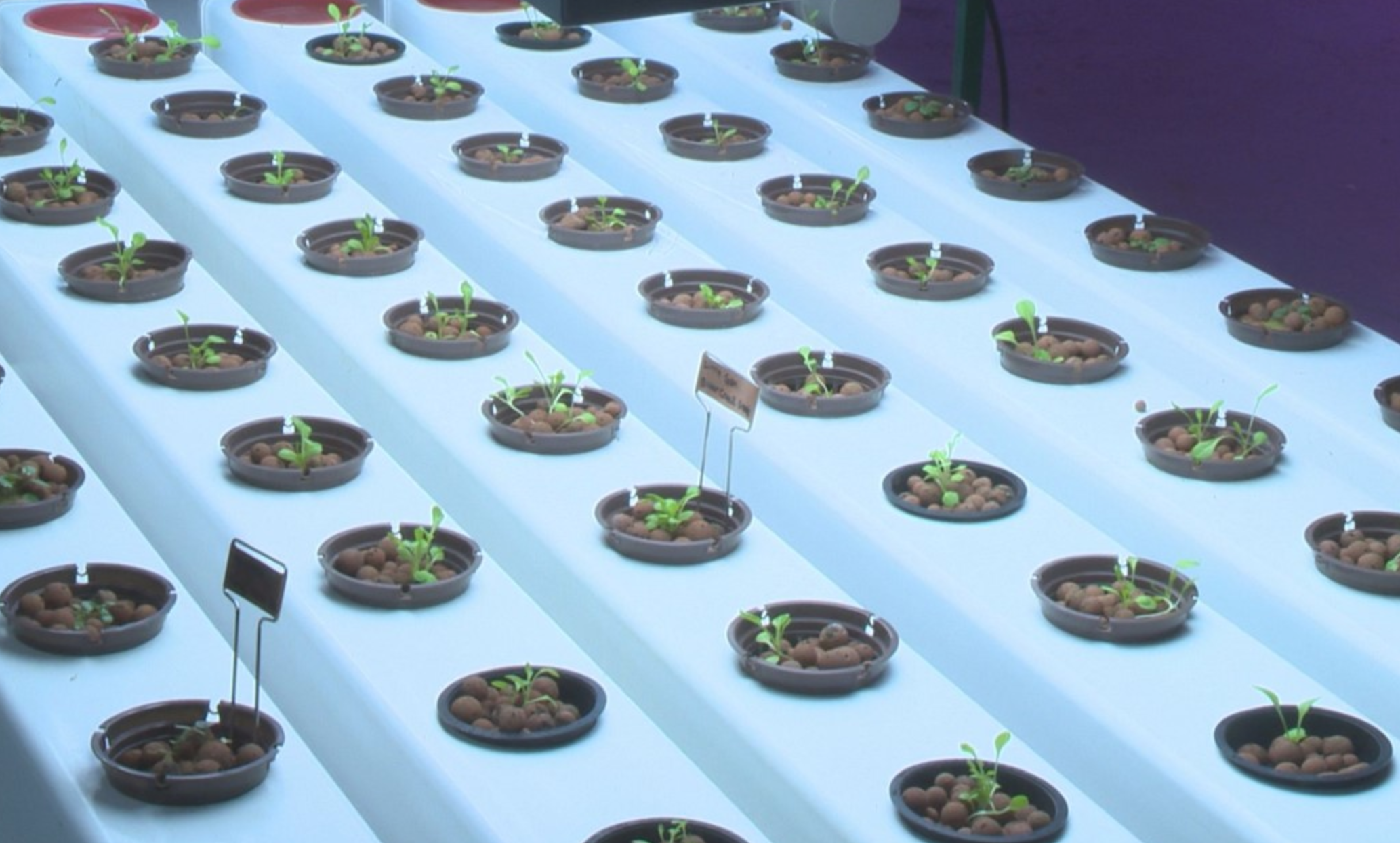
The Nines, a luxury hotel in downtown Portland, is growing much of its own food in hydroponic facilities in the basement of the hotel. Photos by Nina Mehlhaf, KGW 2018
"Let's go feed our fish," Brown says enthusiastically as he punches in the code to unlock the keypad to a food lab in the sub-basement of the hotel. "These are tilapia, they are about 8 months old," he says of a tank full of open-mouth fish eager for food.
They're part of the farm of the future. The goal for those who embrace food-based technology growing practices is to allow food to be produced even in outer space or catastrophic climate situations.
The fish poop provides nitrate which acts as a fertilizer and is filtered through into water for some small tomato plant and basil starts nearby. It's known as aquaponics.
And hydroponics grows plants without fish, just water, LED lights to mimic the sun and no soil. Lettuce and basil grown in the hydroponic tubs in the basement are being served on the menu at Urban Farmer restaurant, one of the hotel's two signature restaurants.
"This is what I'm most excited about," says Brown as he opens the double doors to a purple-hued lit cabinet, much taller than he is. A sophisticated setup that soon, hotel guests will get to see when it's moved up to a room near the lobby. This is the aeroponics garden.
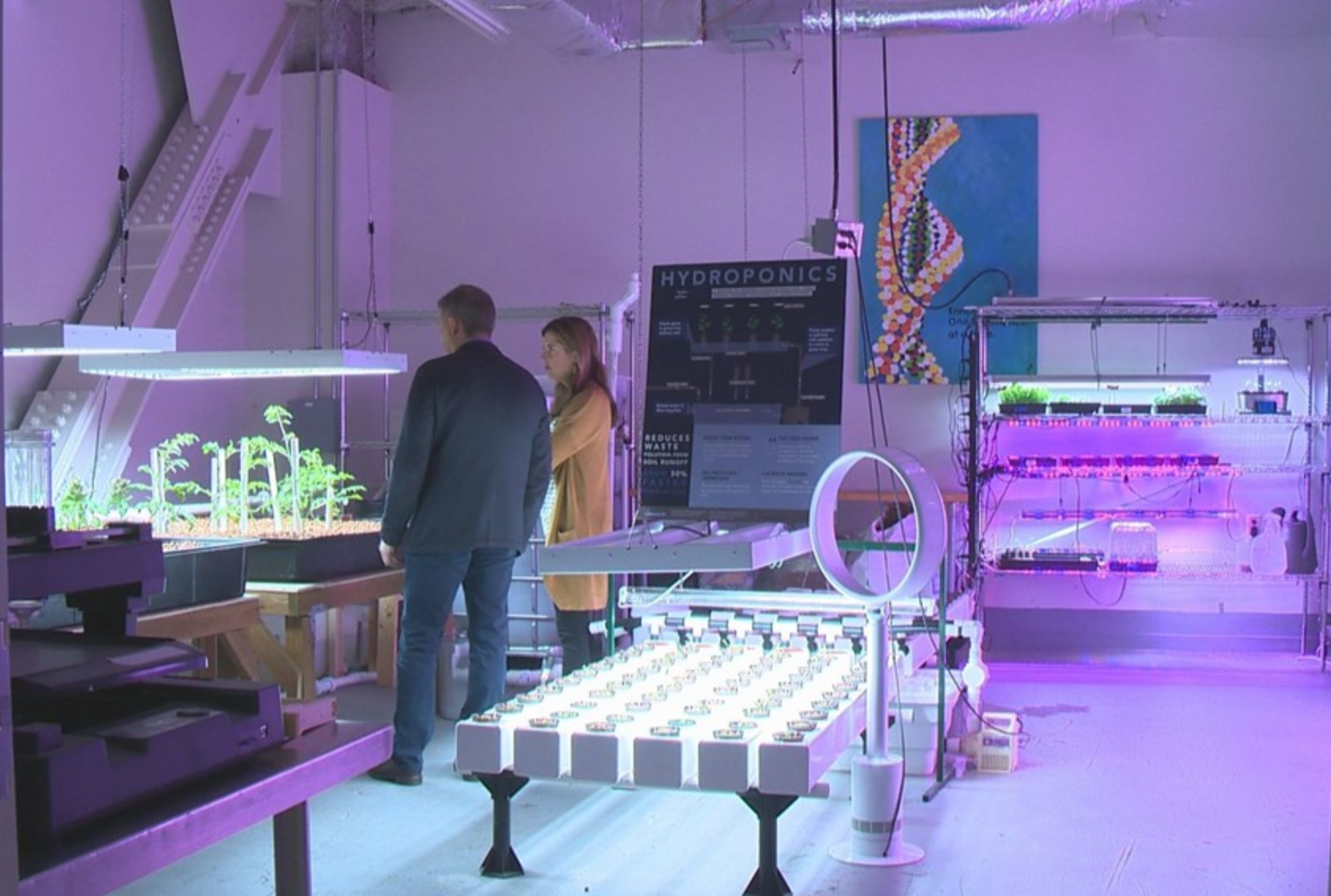
The Nines, a luxury hotel in downtown Portland, is growing much of its own food in hydroponic facilities in the basement of the hotel. Photos by Nina Mehlhaf, KGW 2018
"So these are just misters and it's just misting the root." It's the same way Matt Damon survived on Mars in the movie "The Martian." Artificial light, mist, no soil. Brown and his chefs have beta-tested 102 types of vegetables, fruit and flowers in the past year, experimenting with which method works best.
"The chefs love that they can grow specific foods and grab it themselves and don't have to worry about foods being wilted or old and they can speak to it to customers, it's the transparency component," said Brown.
"If you think about it, it's simply, it's just seeds, light and water yet people are fascinated by it. We eliminate the carbon footprint this way. But the staff feel like they're part of something bigger. They can contribute to the guest's dining experience."
Another basement-level down, in the hotel's huge trash room, another hotel is humming along. Urban Farmer and Departure, the hotel's restaurants, compost salad scraps, coffee grounds and newspaper into a huge plastic bin for red wiggler worms. The worms eat the scraps and make a nitrate-rich soil that fertilizes the plants in the food lab. The tilapia also eat the worms.
Brown loves technology almost as much as he loves food. He has ideas for augmented reality at the restaurant dinner table as well that would get rid of the high cost and trees of printing menus every day.
"You would get your phone out and look at a marker, that's what they call it, on the table for instance. And the menu would pop up on their phone and you can move it around and learn more about things through other markers around the restaurant. What farm their steak comes from, or more about the process of how their vegetables were grown here in Oregon."
Many of the celebrities that stay at The Nines have requested tours of the food lab and their private chefs that travel with them are fascinated at what the restaurant is doing.
© 2018 KGW
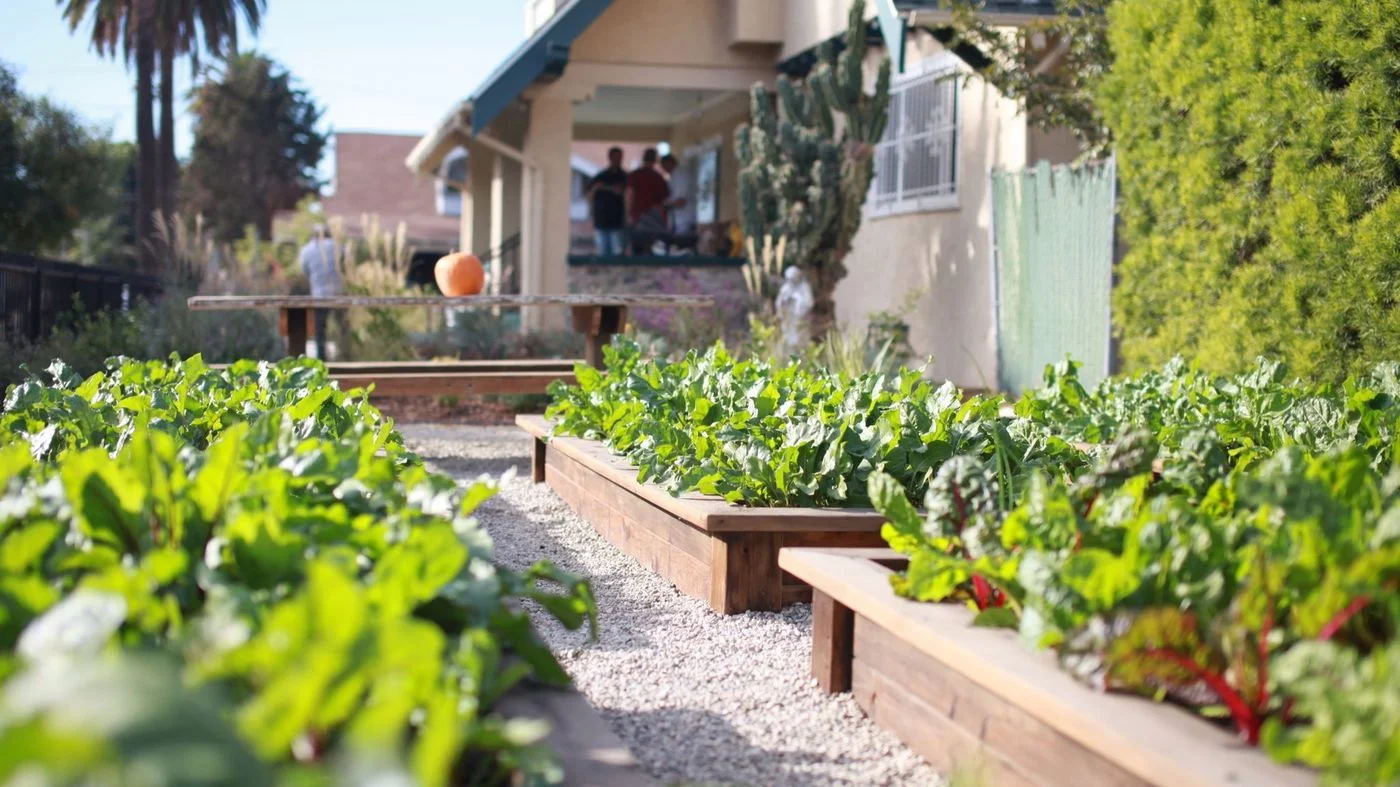
Urban Farms are Becoming Budding Business Enterprises
Urban farms cropping up all over Richmond are more than backyard gardens on steroids.

Joe Jenkins, owner of Bow Tide Farms, harvests Arugula with Kate Lainhart at the farm in Richmond on Tuesday, Oct. 16, 2018.
By TAMMIE SMITH Richmond Times-Dispatch
Nov 18, 2018
Urban farms cropping up all over Richmond are more than backyard gardens on steroids.
Joe Jenkins and his wife, Whitney Maier, were growing more organic vegetables in raised beds in their backyard in North Richmond than they could eat, so he started taking some to his job at a restaurant to give to co-workers.
The chef there said the arugula was better than what he was getting from vendors and that he wanted to buy it from Jenkins.
Jenkins and business partner Josh Dziegiel operate Bow Tide Farms, which grows and sells arugula, mixed greens and other produce to about half a dozen Richmond restaurants.
At Shalom Farms’ new Westwood urban farm in North Richmond, mostly volunteers work there, including those that recently helped farm manager Katharine Wilson harvest sweet potatoes — produce that went to food access initiatives such as a healthy corner store project, mobile markets and local food banks.
After the harvest, the fields became a classroom as Wilson talked to a group of elementary school kids about the farm and had them help pull up rows and rows of leftover sweet potato vines to go into a compost pile.
***
The urban farming phenomenon is creating agricultural entrepreneurs — agripreneurs — who are passionate about growing healthy, tasty food locally using methods that are sustainable and that minimize impact on the environment.
The farms are a mix of commercial enterprises and charitable operations.
“It’s similar to many small businesses. The profits don’t start rolling in when you put up your nameplate,” said Sally Schwitters, executive director of local urban farm pioneer Tricycle — Urban Ag Culture.
She has seen a shift from urban farms created as feel-good enterprises to those focused on customers and buyers.
Tricycle — Urban Ag Culture, a nonprofit that started its first urban farm more than a decade ago in Church Hill, has updated its programs accordingly.
The organization is about to graduate its second class of urban agriculture fellows who have spent a year learning crop growth and management and farm business management. The training program is offered in partnership with the U.S. Department of Agriculture and Bon Secours Richmond Health System.
“We have courses on how to develop your business plan, how to get a loan, marketing and promotion of your business. We’ve seen that shift,” Schwitters said.
“A lot of this is customer demand where it has moved from this romantic notion to what consumers truly want. Our restaurants, our small grocers, our large grocers all want to be able to source more locally produced food. We as consumers are demanding that,” she said.
Some past fellows have gone on to start commercial urban farms such as Creighton Farm LLC and Hazel Witch Farm, Schwitters said. Operators of both also are working other jobs as they build their businesses, she said.
***
Jenkins and Dziegiel are just finishing their first growing season at Bow Tide Farms at the corner of Brook Road and Wilmington Avenue in North Richmond.
From the start, their plan was to sell to restaurants instead of trying to hit all the farmers markets. Both still work full-time jobs in hospitality. They are self-taught farmers, learning from other farmers, books and videos, and Dziegiel interned at a farm in Canada in summer 2017, Jenkins said.
“Our business plan was basically to go in and say both Josh and I have been in the restaurant industry. We know a lot of the chefs. We saw the product that was out there, and we felt like that we could do something better,” Jenkins said.
They took samples to local restaurants and pitched their products, including arugula and salad mixes, to chefs.
Their clients include the three Tazza Kitchen locations; Mama Zu; SB’s Lakeside Love Shack; Julep’s, where Jenkins works; and Edo’s Squid, where Dziegiel works.
“At this point, we are doing a little better than breaking even with a little less than half a growing season,” Jenkins said in an interview in October.
“We didn’t have water until after June. We didn’t have power until after mid-August,” he said.
They are leasing the land that had been used for softball. It’s been just the two of them and one other person hired to come in one day a week to help with harvests, Jenkins said.
He said they have spent about $15,000 getting the farm up and running. Having the water lines installed cost about $8,000.
They bought a piece of equipment called a paperpot transplanter, which sells for about $2,800, to speed up planting. Using the machine, they can put 264 small plants into the ground in 15 to 20 minutes, work that would take the two of them 90 minutes if done completely manually.
They raised some of the startup funds through a crowdfunding campaign. Contributors got membership in the farm’s Community Supported Agriculture organization.
They sell their arugula for about $10 a pound, Jenkins said. Heirloom tomatoes were priced higher than cherry tomatoes. During a typical week, they processed between 180 and 220 pounds of greens, he said.
“There is a number that you can go through that everyone has,” Jenkins said. “There is a kind of set price across the board in Richmond. You can say this is the average of what everyone is paying. That’s kind of where we priced our things out. We tried to look at it as one of those beds is usually worth between $400 and $500. So once it’s completed its cycle, we want to see that it’s made $400 or $500.”
On a recent morning, Dziegiel delivered an order of arugula that has been harvested, washed and dried the day before to The Big Kitchen, a new concept in Scott’s Addition in which fully prepared meals are made, kept chilled and then packaged in containers that allow for a pop into the microwave or oven once at home.
***
Shalom Farms, a nonprofit with volunteers providing most of the farm labor, limits to 10 percent the amount of its produce to be used to earn income, said executive director Dominic Barrett.
Last year, the organization’s primary farm in Powhatan County grew over 220,000 pounds of produce, food that was distributed through the organization’s food access programs.
The group’s new Westwood site began farm production on about half of the 5 acres available. It’s probably the area’s largest urban farm, though because of its size and use of tractors, Barrett said they don’t call it an urban farm.
“We just call it a farm. It’s not that it’s not an urban farm. We think people typically think of smaller scale, more attentive growing, often raised beds [as urban farms]. What we are doing there resembles more traditional rural agriculture in many ways but just placed in a city setting,” Barrett said.
***
At Virginia State University, urban agriculture expert Leonard Githinji said part of a 12-week certificate program in urban agriculture that VSU offers focuses on how to make urban farm enterprises successful.
Participants get the benefits of research-proven methods. One project underway there now is comparing growth of 14 varieties of sweet potatoes.
“You learn how to grow stuff in the most optimal way, but then you need to have a market,” said Githinji, an assistant professor and extension specialist in sustainable and urban agriculture.
He has seen some interest in indoor hydroponics systems that don’t use soil, but the higher initial investment can be a deterrent.
“With those, you can get produce fairly quickly, in a couple of months, while people who are growing in the ground it may take longer because of preparation and depending on the season,” he said.
Githinji also said the urban agriculture movement is more than a fad.
“In my opinion, it’s here to stay for a couple of reasons. There is a high demand for produce, and now there is also this movement of people wanting to consume locally grown produce. The more they understand the benefits of locally grown produce, they have the demand to buy food grown within their neighborhoods,” he said.
“There are also people out there who want to have a small business to serve other people,” Githinji said.
More than 60 people have gone through the certificate course that meets from 9 a.m. to 3 p.m. on consecutive Saturdays. The next session starts in May.
To finish the programs, participants have to complete 80 hours interning with community farms or co-ops in order to receive certification. So far, 23 have completed the requirements to be certified, said Cynthia Martin, education support assistant for the cooperative extension program at Virginia State.
Martin said she knows of at least four participants who have started farms. Others have talked about family land they would like to farm.
“Their dream is to go back,” Martin said. “The passion is there, but the land has been sitting there with nobody doing anything.”
***
Challenges to the growth of urban farms include land-use policies and infrastructure, said Duron Chavis, community engagement coordinator for Lewis Ginter Botanical Garden. Chavis for years helped drive grass-roots efforts to establish community gardens in Richmond.
“The city has a great deal of vacant property, close to 1,000 or more vacant parcels that the city owns. The Maggie Walker Community Land Trust is working to identify parcels of land that cannot be turned into affordable housing that could be turned into urban ag enterprises,” said Chavis, who is on the board of the trust. Land toxicity can be an issue, as well.
“There are a lot of harsh chemicals that pollute urban land. That has to be mitigated before you can produce food,” Chavis said. “There have been conversations about indoor farms. None of them have gotten traction here in Richmond.”
***
Initiatives such as the Real Local RVA and businesses such as Ellwood Thompson’s Local Market and Little House Green Grocery are important to the survival of urban farms, experts say.
Real Local RVA’s members are small independent grocers, restaurants, farmers markets and others, and the organization emphasizes locally produced food. This year’s annual farm tour highlighted four Richmond-area urban farms — Tricycle Urban Ag, Bow Tide Farms, Community Food Collaborative and Lakeside’s Tiny Acre.
Little House Green Grocery on Bellevue Avenue in Richmond gets in produce almost daily from local farms, said store owner Erin Wright. It carries products from over 50 local vendors, including bakery products, prepared foods and home goods.
“There are so many reasons why urban farms are important,” Wright said. “The environmental impact. When we can buy directly from farms, we can reduce the amount of packaging and the amount of food miles that the food travels, making it more nutritious and more delicious. We can reduce waste because we are simply getting it fresher.”
Connections are made between consumers and producers who know each other, she added.
“We are able to talk directly to farmers and find out what is going on with them, what they are excited about and what their challenges are, and pass that along to the consumers as a real look at the impact of their purchasing power,” Wright said.

Orange Packaging Goes Green!
12.6.18
One Hudson Valley company is leading the charge in making plastic more earth-friendly. Orange Packaging of Newburgh, New York, is now offering an innovative, proprietary compostable plastic. Made from 100 percent sustainable, renewable plant-based materials, this plastic can be thermoformed into a variety of shapes and packages and is guaranteed to start breaking down in a composting environment within 45-60 days.
“We’ve spent a long time perfecting the tooling and production process in preparation for this new, earth-friendly plastic offering and are we thrilled with the result,” says Michael Esposito, Vice President of Orange Packaging.
For manufacturers in search of earth-friendly packaging, this news is huge. “When you’re done with the product inside the package you can compost the container along with your other food scraps in your backyard compost pile or a local commercial facility,” said Esposito. “The plastic is designed to begin breaking down in under two months. It’s a win for the manufacturer, the customer and the planet.”
Orange Packaging’s proprietary compostable plastic meets food-grade standards and can withstand higher and lower temps than previous iterations of compostable plastics, making it ideal for any and all packaging—including food packaging. It can be refrigerated, frozen or microwaved without affecting the plastic package or its contents. In warehouse environments, this compostable plastic holds infinite shelf life, so there is no expiration date.
The R&D invested in this new process allowed Michael and his team at Orange Packaging to create a preferred, earth-friendly solution that won’t break the bank for commercial clients. For pricing and more information on Orange Packaging’s proprietary compostable plastic, email michael@orangepkg.com.

Bio-Dome At St Mary's Junior School
We would like to start off by giving a special mention to St Mary’s junior school in Shinfield, who have built 24 raised beds to grow food to sell to their local community. After a dry summer, the school decided to install a Bio-Dome to improve the yields.
The school have raised £7,000 through the sales of their produce and after one of their pupils was deeply saddened by seeing a homeless person in Reading they are donating all of the money to the homeless charity ‘Launchpad’. Whilst learning about biodiversity and self-sufficiency, these children are also directly helping those in need.
*Video embed here* https://www.youtube.com/watch?v=7eDc3SzSw9s
Using our new LED Horticultural Grow Lights in order to help enhance plant growth, the Florence modules are perfect for use with or without supplemental lighting. There are eight standard recipes all chosen by LED industry experts OSRAM Opto Semiconductors. Each LED light recipe is designed to suit particular plants types and stages of growth in order to provide the best solutions for each individual application.
Florence Grow Lights are soon to be available through RS Components. These are also currently available as fully customisable solutions from Intelligent Horticultural Solutions (IHS).
IHS has a full range of customisable PYO (pick your own) LED lighting products so that growers can develop their own LED recipes specific to their application. IHS also have controllers available to make this easier to do.
IHS is a part of the global OSRAM Lighting network LED Light for You (LLFY) and draws on world leading quality LEDs from Osram Opto Semiconductors which combines them with other quality components, materials and services to provide the LED solution you want.
For more information on the Florence Ready to Grow Horticultural range, Click here!

Local Lettuce Grower Has A Safer Way Through Hydroponics
Acting on the CDC’s recommendation, grocers nationwide are pulling suspect romaine lettuce product from store shelves.
By Bill Hudson November 21, 2018 at 6:41 pm Filed Under:Bill Hudson, Center For Disease Control And Prevention, Local TV, Revol Greens, Romaine Lettuce
MINNEAPOLIS (WCCO) — The nationwide recall of romaine lettuce couldn’t have come at a worse time. As families prepare for their Thanksgiving Day feasts, romaine lettuce is being pulled from their tables.
On Tuesday, the Centers for Disease Control and Prevention issued a nationwide romaine recall based on 32 recent illnesses in 11 states and 18 reported illnesses in Canada.
All are likely linked to eating romaine lettuce contaminated by E. coli. It’s believed the field-raised lettuce may have been contaminated by irrigation water that contained the E. coli 0157 strain.
Acting on the CDC’s recommendation, grocers nationwide are pulling suspect romaine lettuce product from store shelves.
But in Medford, the nine-month old Revol Greens company has safer way to grow leafy greens – by raising the lettuce hydroponically indoors.
“We have eight or nine different varieties here that we grow,” said company president Jay Johnson.
Johnson says that unlike lettuce that is grown outdoors in massive fields in Arizona and California, their crops are grown hydroponically – under glass and in pools of irrigation water which they sterilize with ultra violet (UV) light.
“We started from the beginning with food safety in mind, and this is the safest way,” said Johnson. “That’s why it’s difficult to be grouped in with the broad romaine alert.”
RELATED: Romaine Recall Leaves Mpls. Nonprofit Looking For Nutritious Replacement
It’s also why Revol is working with the industry’s lobby to ask federal regulators to exempt indoor grown lettuce from the recall. Arguing that unlike field-raised crops, their romaine lettuce is never exposed to possible contamination sources from birds or animals.
“E. coli comes from the intestines of animals and birds. So [unlike] a bird flying over your field or an animal running through your field, we are enclosed with this glass greenhouse,” explained Johnson.
Even without more clarity from the CDC, Johnson says other lettuce varieties, such as iceberg and baby arugula are not impacted by the recall and will remain on grocers shelves.
Finally, Revol Greens wants to assure customers who might have its romaine lettuce in their refrigerators that it is safe to eat. Because it is grown not in a farm field, but in the company’s controlled and sterile environment.

Rooftop Greenhouse Teaches, Nourishes and Empowers Students
The nation’s first student-run rooftop greenhouse with the capacity for year-round food production helps stock the UA Campus Pantry.
By Emily Dieckman, UA College of Engineering
Nov. 20, 2018

Gene Giacomelli, left, former director of the UA's Controlled Environment Agriculture Center, talks tomatoes with Todd Millay, director of the Arizona Student Unions, in the greenhouse on the Student Union roof.
EXTRA INFO
The UA Campus Pantry has food distribution days from noon to 7 p.m. on Wednesdays and from 11 a.m. to 3 p.m. during the academic year. Tours of the rooftop garden are available on Wednesday mornings at 10 a.m. and can be signed up for at the Arizona Student Unions information desk.
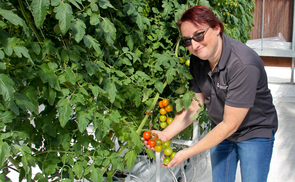
Stacy Tollefson, project and production manager for the greenhouse and a professor of practice in the Department of Biosystems Engineering, tends the crops in the greenhouse atop the UA student union building.
Twice a week in the basement of the Student Union Memorial Center, about 500 students, faculty and staff pick up free groceries at the University of Arizona Campus Pantry.
Twice a week on the roof of the student union, UA students and future commercial growers harvest cucumbers, tomatoes and bell peppers from the Rooftop Greenhouse and send the vegetables down to the Campus Pantry. This student-designed, and mostly student-run, controlled-environment facility is the first rooftop campus greenhouse in the nation that can produce food year-round, with 10 times the productivity of an outdoor garden.
“We harvest on the same days the campus pantry does distribution and bring the food right down, so the produce is super fresh,” said Stacy Tollefson, project and production manager for the greenhouse and a professor of practice in the Department of Biosystems Engineering, as well as an expert vegetable grower for the UA’s nationally recognized Controlled Environment Agriculture educational program.
Seed of an Idea

Student volunteer Maggie Lacross, UA Campus Pantry operations chair, offers some nutrition guidelines.
When Todd Millay became director of the Arizona Student Unions in December 2016, he was excited to see there was a small outdoor garden on the roof being run by staff. When he heard about the Campus Pantry, which was serving about 30-40 people every few weeks, he offered pantry volunteers a central campus location in the Student Union, but noticed they weren’t receiving many fresh produce donations. The potential for connection seemed clear.
“Why don’t we just make a better garden on the roof and send the food down?” he thought. “And maybe instead of Student Union employees figuring out how to do this, we could ask students how to build it.”
Millay and some Student Union colleagues partnered with the UA Office of Student Engagement and launched a four-month competition. Twenty-five groups of five students each were given a hypothetical $50,000 budget to design a cost-effective, productive and sustainable system to grow fresh produce for the Campus Pantry. Coca Cola, Shamrock Farms, the UA Student Union, the UA Student Services Fees Grant and the UA Green Funds Grant helped finance the competition and the eventual greenhouse.
The winning team, composed of four UA College of Engineering students and one UA College of Agriculture and Life Sciences student, proposed a 750-square-foot temperature-controlled greenhouse that would grow tomatoes, cucumbers and bell peppers. Design advice from Gene Giacomelli, a professor of biosystems engineering and the former director of the Controlled Environment Agriculture program, combined with donations from companies like Autogrow, Formflex, Grodan, Wadsworth Control Systems and Polytex Inc., led to the greenhouse’s construction in 2018.
The Tech Behind the Tomatoes
The greenhouse is temperature-controlled and could yield produce year-round, but the team harvests for nine months and takes the summer off to prepare for new student recruits and start afresh. In those nine months, Tollefson expects the greenhouse to yield 3,000 pounds of cucumbers, 1,200 pounds of tomatoes, 800 pounds of cherry tomatoes and 250 pounds of bell peppers.
The plants don’t get their nutrients from soil, but from two large tanks of solution with just the right mix of nitrogen, phosphorous, potassium and other nutrients. Any solution that isn’t absorbed by the greenhouse’s four rows of plants is recirculated back into the tanks, revitalized and fed back to the plants.
“We’re saving tons of water with this recirculating hydroponic system because we’re only losing maybe 5 percent to evaporation, and we’re saving tons of nutrients,” Tollefson said.
In addition to conserving water and nutrients, the recirculation system ensures that no fertilizer water is discharged into the environment. Another hi-tech feature is that the greenhouse climate and irrigation control systems are connected to the internet: The greenhouse team can log in and monitor the nutrient solution for pH, electrical conductivity and temperature from their phones.
Efforts Bearing Fruit
Tollefson, who has a Ph.D. in agricultural and biosystems engineering, said working at the greenhouse has been an excellent learning experience, even for her – this is the first time she has grown hydroponic tomatoes while recirculating the nutrient solution, so both she and the students are learning how to manage plant nutrition more efficiently. Student interns are learning hydroponic cultivation techniques and greenhouse management techniques that translate to valuable career skills.
“There’s a tremendous demand out in the industry for people who know how to operate these greenhouses because of the recent interest in locally grown and urban agriculture,” Giacomelli said.
Tollefson oversees two interns – plant sciences major Chris Patzke and veterinary science major Tyler Rodriquez – and full-time greenhouse manager Quinn Waltz, a senior majoring in agricultural technology management.
The greenhouse team makes frequent visits to the greenhouse to check on the hydroponic system, care for the plants and monitor the environmental conditions, and harvest, weigh and deliver the crops to the Campus Pantry. The idea is to make sure everything is running smoothly – and it certainly is. This fall, the cucumber plants were growing about 2 feet a week, and the tomato plants about 18 inches. The tomatoes and bell peppers are just starting to ripen, but they’re already delivering about 50 pounds of cucumbers to the pantry each week.
“We keep the conditions just right,” Patzke said. “Happy plants grow really fast.”
The students in the greenhouse say they love knowing their work is making a difference in the Wildcat community.
“It’s inspiring and humbling to know we are the first ones working on this project,” Waltz said. “We are setting the foundation for future students who want to be a part of something that impacts others, and want to learn about how and where their food comes from.”

NatureFresh Farms Ohio-Based Greenhouse Growing Strong Throughout The Winter
Delta, OH (December 5th, 2018)
With the last weeks of 2018 still ahead of us, NatureFresh Farms is in the thick of a third winter growing season at their Ohio- based facility. Located in the northwestern community of Delta, OH, the NatureFresh Farms USA greenhouse will be picking, packing, and shipping fresh and flavorful Tomatoes throughout the coldest months of the year – good news for retailers looking to add NatureFresh Farms products to their store shelves all year long!
Since 2015, NatureFresh Farms USA has experienced great success with consistently healthy crops and high fruit yields every season. This year, the greenhouse grower is producing Tomatoes-on-the-Vine, Beefsteak Tomatoes, and a large variety of Specialty Tomatoes across 45 acres.
The Delta-based greenhouse was strategically built in the northwestern region of the Buckeye state to allow for quick transport of products to all the company’s North American retail partners.
The Delta facility is using High-Pressure Sodium (HPS) lighting fixtures, a powerful grow light technology which allows for winter Tomato production. Paul Schockman, Sales Manager, shares that the Delta greenhouse gave NatureFresh Farms the opportunity to produce locally-grown Tomatoes at a time of year when traditional farms are not in operation: “Our retail partners within the northeastern region of the United States can now provide high-value Ohio-grown products to their customers when locally-grown food is typically not available. With such an effective arrangement, it wouldn’t surprise me if we add more acreage in Ohio in the future.”
Growing in the state of Ohio has also provided the NatureFreshTM Farms team with the opportunity to develop a strong partnership with the Ohio Proud program. Featuring the Ohio Proud sticker on all Tomato products grown and packed at the NatureFresh Farms USA location ensures consumers know they are purchasing Ohio-grown products, creates support for local growers, and promotes local agriculture, the number one industry in Ohio.
With exciting plans for market growth, as well as various expansion projects to look forward to, NatureFresh Farms is positioned to reach incredible new heights in 2019 and beyond.
-30-
About NatureFresh Farms
NatureFresh Farms has grown to become one of the largest independent, vertically integrated greenhouse vegetable growers in North America. Growing in Leamington, ON and Delta, OH, NatureFresh Farms prides itself on exceptional flavor & quality. Family owned since 1999, NatureFresh Farms ships fresh greenhouse grown produce year-round to key retailers throughout North America.
SOURCE: NatureFresh Farms
info@naturefresh.ca
T: 519-326-1111
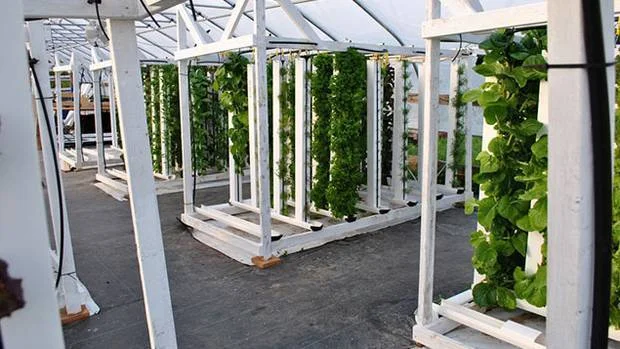
Research Shows Vertical Farming Has Limits
27 Nov, 2018
Vertical farming - where food is grown indoors in high stacks - will not replace traditional fruit and vegetable growing in New Zealand, but it may supplement it in future if technology makes it economically viable, research released today finds.
As part of her Kellogg Rural Leadership Programme, Horticulture New Zealand environmental policy advisor Rachel McClung has published a report, Can vertical farming replace New Zealand's productive land to deliver high quality fruits and vegetables in the future?
"Growing towns and cities are reducing access to some of New Zealand's most productive land for growing fruit and vegetables," McClung says.
"There is some complacency about this because of the misconception that fruit and vegetables can be grown 'somewhere else'. But the combination of the right soils and climate is necessary. With housing taking a lot of our prime soils and climate change impacting regional weather patterns, it seemed a good time to look at alternative growing methods, such as vertical farming.
"With an estimate that demand for fruits and vegetables in New Zealand will be 33 per cent higher in 2043 than today, a new way of thinking is required, hence my research.
"I found it interesting that while there are many recognised benefits of vertical farming, with the most prevalent being growing independent of weather conditions, the costs of the electricity needed for artificial lighting and temperature control, combined with the high capital investment and operational costs, currently outweigh the benefits.
"I also found that the type of crops that can be grown in a vertical farm are limited to the likes of leafy greens and herbs, and that vertical farms cannot grow the full range of fruits and vegetables we enjoy in New Zealand.
"I surveyed growers to gain insight and while three respondents had investigated establishing a vertical farm in New Zealand, none had proceeded due to the economics.
"My conclusions include that the New Zealand Government should take a balanced approach to the issue of New Zealand's diminishing productive land and food security," McClung says.
Leafy Greens From A Growing Machine
Advancements In Automated Commercial Scale Vertical Farming
Growing produce automated or nearly automated and in any possible location are some of the advantages often supplied by the vertical farming industry. The Canadian company CubicFarms shows how also traditional greenhouse companies can benefit from indoor farming techniques.
DelFresco Pure recently chose CubicFarm Systems to grow leafy greens alongside their greenhouse production of peppers, cucumbers, tomatoes and strawberries.
CubicFarms has a background in greenhouse horticulture. The British Columbia, Canada based company has developed a indoor growing system based on a conveyer rotation method, allowing indoor farming to become scalable. It is quite a mouthful, but they explain their produce to be grown safe, sustainable and self-sufficient, cost-effective and on commercial scale.
Currently CubicFarms Systems Corp. is expanding and growing with both sales of systems, and sales of produce grown in CubicFarms.
CubicFarm installation in full swing in Pitt Meadows, BC
This summer, CubicFarms finished construction of their first full-scale, completely operational, 11 machine CubicFarm System in Pitt Meadows, BC.
"With the capacity to grow over 1.5 million of heads of lettuce, or over 9 million basil plants, or over 150,000 pounds of microgreens each year, or any combination thereof, we quickly became one of the largest producers of living lettuce, herbs, and microgreens in Canada", they explain.
Plans are already in place to expand the site by 10 fold over the next 12 months.
CubicFarms in Ontario, Canada
CubicFarms recently exhibited at the PMA 2018 show in Florida with its newest customer, DelFresco Pure, of Leamington, Ontario.
DelFresco Pure recently chose CubicFarm Systems to grow leafy greens alongside their greenhouse production of peppers, cucumbers, tomatoes and strawberries. "Our system will allow DelFresco Pure to bring additional produce into their local market without disturbing their current greenhouse operations. Installation has begun and are expected to be completed by the end of January, 2019."
A mini demonstration CubicFarm growing machine was built to display in DelFresco’s huge booth at the Orlando PMA. Strawberry Sundaes with CubicFarm growing micro basil was the big flavour hit at the show.
CubicFarms in Central Alberta
CubicFarms has also recently partnered with Swiss Leaf Farms near Edmonton, Alberta. Swiss Leaf chose CubicFarms’ automated growing machines to bring local, fresh leafy greens to central Alberta.
"The machines have just been installed and will commence growing in December. Swiss Leaf will be utilising CubicFarm’s “Thriiv Local Garden” produce brand to market and sell living lettuce, herbs and microgreens."
Thriiv Local Garden
And there's more. CubicFarms' launched their lettuce, basil and microgreens into Fresh Street Market stores in October, under their proprietary “Thriiv Local Produce” brand.
"We received positive responses from customers enjoying the freshest possible produce. Their living lettuce heads are available in 3 different blends (Springtime Trio, Butter Blend and Merlot Medley) and are sold in their proprietary packaging that allows lettuce to stay alive and fresh on the windowsill or in the fridge for weeks", they explain.
The microgreens have a variety of blends, including the spicy “Fire and Ice” and “Chef’s Blend”.
Video: Hydroponic Growing of Lettuce And Spinach On PVC pipes
2018
With the constant change in climate and unfavorable conditions for food production. It makes sense to explore other alternatives that are sustainable.
The hydroponic growing of fresh fruits and vegetables offers a great solution to have a constant supply of veggies for both family and commercial purposes.