


Welcome to iGrow News, Your Source for the World of Indoor Vertical Farming

Climate Change Insurance: Buy Land Somewhere Else
This fall, the United Nations stunned the world when it released a report saying that if no action was taken, the catastrophic effects of climate change could be felt as early as 2040.
In case global warming makes their homes uninhabitable, some millennials have a Plan B: investing in places like the Catskills, Oregon and Vermont.
By Alyson Krueger
November. 30, 2018
Mark Dalski is an owner of Highview Creations, a company that designs and builds green roofs in New York City, and he knows a lot about climate change. That’s why he is working on his escape.
Mr. Dalski, 33, lives in Greenwich, Conn., but he can envision a time when his home there might be besieged by extreme weather and rising sea levels. So he bought four acres of land in the Catskill Mountains, in Roxbury, N.Y., where he is building a home that is as sustainable and self-sufficient as possible.
To date, he has drilled a well, set up poles for power lines and designed a septic system that has been approved by the New York City Department of Environmental Protection. (The property is in the city’s watershed.)
He is working on designing and then securing building permits for the house. He wants it to be no more than 1,200 square feet — “it should be simple, small and sustainable,” he said — and to have an open floor plan and a lofted master bedroom. The windows will look out over land where he can grow corn, collard greens and root vegetables.
“Will I need it 10 years from now, or 30 years?” he said. “I don’t know.”
But if his part of Greenwich is ever in jeopardy, he added, “I’ll have a safe space.”
Mark Dalski lives in Connecticut, but has bought land in the Catskills, where he plans to build a sustainable house that will be self-sufficient.
Jane Beiles for The New York Times
This fall, the United Nations stunned the world when it released a report saying that if no action was taken, the catastrophic effects of climate change could be felt as early as 2040. It painted a bleak picture of a world plagued by fires, food shortages, extreme heat, droughts, floods and disease. Entire populations might have to migrate away from coastal or Southern cities. There would be a strain on resources and damage to the economy. Some believe that prices on Northern land will surge.
“It’s going to be a slow, gradual burn, if you will,” said Vivek Shandas, founder of the Sustaining Urban Places Research Lab at Portland State University. “But there will be destabilization, and it will all happen in the foreseeable future.”
Then, late last month, the federal government issued a report concluding that climate change would cause hundreds of billions of dollars in damage, and as much as 10 percent of the American economy could be destroyed by 2100 because of rising temperatures.
There is one group, however, that is slightly less anxious than the rest of us about this news: a small number of young professionals who are preparing homes away from the places where climate change is expected to strike the hardest. They are following in the footsteps of billionaires like Peter Thiel, who is investing in real estate in New Zealand in case a climate apocalypse occurs. Although they are doing it on a far more affordable scale.
They have studied maps and research that show the areas of the country that will be less affected by devastation, either because of geography or an ample supply of natural resources. And they are optimistically buying land and homes in these areas, many of them mentioned in an article published in Popular Science in December 2016 titled “These will be the best places to live in America in 2100 A.D.,” which has amassed 28,000 views in the past six months and gets about 100 Google search hits a day.
Not quite survivalists, they are nonetheless teaching themselves essential life skills — like how to grow their own food and make their own electricity — just in case things spin out of control, and the government can’t step in to help. They believe they are making sound real estate decisions by buying land on high ground that will appreciate in value, while at the same time developing a Plan B.
“We are blatantly facing a catastrophe, and all we’re doing is getting rid of straws,” Mr. Dalski said. “There are things I’m going to do for preservation.”
That includes buying land on a wooded, undeveloped part of Plattekill, a 3,500-foot mountain in the Catskills, because the area is filled with natural resources. The land is at a high elevation but it is also in a bowl, so it collects precipitation. Also, there are creeks that run through the area year-round, and he has family nearby.
Michael Phelan, 26, a Ph.D. student in bioengineering in Philadelphia, is deeply concerned about life in a post-climate change world as well.
“I’ve been hearing people talk about moving north to places like Michigan or Maine,” he said. “Seeing how recent government reports have detailed the threats of mass migration or economic loss, I wonder if it’s even possible to move away from it.”
Catch up and prep for the week ahead with this newsletter of the most important business insights, delivered Sundays.
Mr. Phelan has entertained the idea of going someplace less vulnerable to the effects of climate change. He is also more focused on preparing for the natural disasters that are projected to increase in frequency and severity in the coming decades. “I wouldn’t say I’m a survivalist at this point, but I’m trying to learn more about preparedness,” he said. “It gives me a degree of confidence to know what to do in situations like that. At least in the very short term, if an emergency occurred, I would have enough of a plan to not panic.”
Others his age have parents and grandparents who are buying shelters they can use if and when climate-related disasters occur.
Dave Anderson, shown with his daughter, Casey Delperdang, bought a ranch in Oregon as a retreat for his extended family, in case their homes in Houston become uninhabitable.
Paul Wagtouicz
Dave Anderson lives in Houston, not far from his 27-year-old daughter, Casey Delperdang, her husband and their toddler. They all love being there; they are close to family and friends and get together often. But five years ago, Mr. Anderson decided that his family needed another place to congregate: a ranch in Oregon.
He bought a 70-acre property with plenty of space for hiking and relaxing in nature. There are rivers where the family can fish for salmon and steelhead trout, and forests where they can hunt for elk. One of his new neighbors assured him that they would never go hungry in this part of the world. “I can’t guarantee you’ll always like what you eat,” the neighbor told Mr. Anderson, “but you’ll eat.”
Mr. Anderson said he was looking for more than a vacation home; he wanted his family to have a place to escape to if living conditions in Houston became unbearable. “I’m no doomsday prepper,” he said. “That said, we intentionally purchased a relatively remote property well above sea level, with ample water and wildlife, with the expectation that the property would survive for generations of family use.”
While Mrs. Delperdang said she would be hesitant to move there, she acknowledged that her Plan B home could become a primary residence in a worst-case scenario. “During Hurricane Harvey, homes flooded that never had before,” she said. “I’m sure a lot of those people had looked at flood maps and thought they were in protected areas.”
In the past year, Mr. Shandas, of the Sustaining Urban Places Research Lab, said he has seen an increase in parents worried about the next generation’s safety.
“A few venture capital and investment bankers have taken me out to lunch or coffee to ask for a secret location, a place where their 18-year-old nephew or son or daughter should move,” he said. “It’s like they want to find a secret fishing spot. I always have to say, ‘I don’t have a magic ball, I can only tell you the conditions we are likely to see in the future in each place.’”
But hedging against climate change with an isolated home or piece of land isn’t a fail-safe strategy.
Bruce Riordan, program director for the Climate Readiness Institute at the University of California Berkeley, cautioned that it isn’t realistic to expect to live in a bubble. “Sure, you can grow your own vegetables, but what about wheat and grains?” he said. “And what happens when you need medical attention?”
Mastering surgery would certainly be a lot harder than learning to grow tomatoes.
A better strategy, Mr. Riordan suggested, would be to find a community that is intelligently preparing for whatever climate change may bring. He equated the situation to what California has done about earthquakes: They can’t be avoided, but we can build safer buildings, get better at predicting them and establish systems to care for vulnerable populations when they occur.
That type of planning is what pushed Josephine Ferorelli, 35, a yoga teacher and climate activist — she is a founder and a director of a grass-roots organization called Conceivable Future that focuses on the connection between climate change and reproductive rights — to buy an apartment in the Albany Park neighborhood of Chicago.
Ms. Ferorelli is well aware that her city is at high risk for wildfires and heat waves. “We are not taking good care of Lake Michigan; it’s possible we could have a Flint-type scenario,” she said, referring to the water-quality issues in Flint, Mich.
But she trusts her community, from the nonprofits to her neighbors, to handle whatever comes. “These are the people I want to depend on during hard times,” she said.
As Mr. Shandas said, “The most resilient have been those that have had communities of people working together to try to respond. Pulling away and isolating yourself is one of the most dangerous things you can do.”
There is also the likelihood that no matter where you set up your Plan B home, it won’t be immune to climate change.
Montana, for example, with its ample land, cooler climate and natural bodies of water, is considered an appealing place to move in the future. But Bill Milner, the former owner of a real estate agency in Whitefish, Mont., said his state is under siege as well.
“Our glaciers are melting, our summers are hotter and longer, winters less severe, forest fires have become annual events,” he said. “Climate change lives here, too.”
Then there is the reality that many younger people can’t afford to buy any home — let alone one in a place with a better climate.
“Most of my peer group just isn’t thinking about homeownership anywhere,” said Peter Hess, 31, who wrote the Popular Science article and lives in New York City, despite knowing the risks. “I guess we will stay here and drown from coastal flooding with our friends.”
But some of those who can afford to buy land — or have planned carefully to be able to do so eventually — are confident that they aren’t just making an investment in their safety, they’re also making a good financial move.
If “I can pick up a few acres, it is going to triple in value,” Mr. Dalski said. “In 100 years’ time, it will be worth something. People are going to have to move north at some point.”
For weekly email updates on residential real estate news, sign up here. Follow us on Twitter: @nytrealestate.
A version of this article appears in print on Dec. 1, 2018, on Page RE1 of the New York edition with the headline: Climate-Change Escape Plans. Order Reprints | Today’s Paper | Subscribe
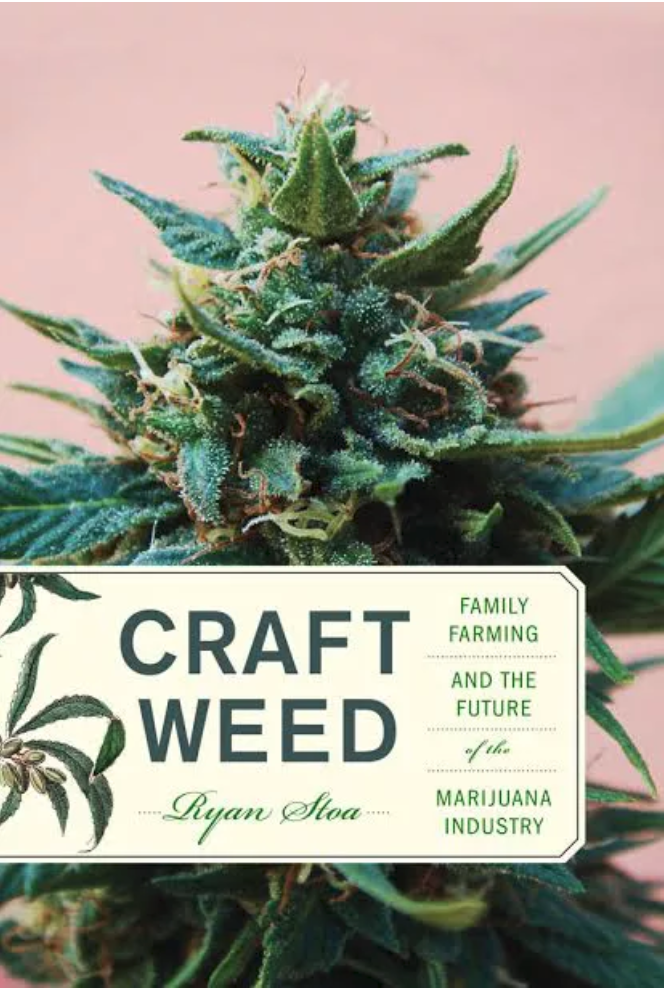
Why the Future of Marijuana Farming Could be Craft Weed
Big Marijuana is not inevitable
By Angela Chen@chengela Nov 21, 2018, 10:29am EST
There are plenty of predictions about how cannabis farming is poised to go corporate, but Big Marijuana is not inevitable, says Ryan Stoa, a professor of law at Concordia University.
That doesn’t mean it won’t happen. But Stoa, the author of Craft Weed: Family Farming and the Future of the Marijuana Industry, argues that in a world where cannabis is legal, there is a route for cannabis agriculture to stay sustainable and local.
The idea for Craft Weed began when Stoa started hearing about water conflict in Northern California, specifically around marijuana agriculture. Before, the state government had been going after marijuana growers just for growing. But now, they are targeting them for issues related to water rights. “Cannabis, as an industry, is evolving so quickly,” says Stoa, “How do you manage a water rights system when the users are in this legal gray area?” Once he started looking into these issues, Stoa found that marijuana farming is largely unregulated, which means that there’s a lot of confusion and a lot of potential for policymakers to shape marijuana agriculture into the industry they want.
The Verge spoke to Stoa about what’s fending off a corporate takeover, potential legal regulations that could help the industry remain small, and the environmental impact of farming.
This interview has been lightly edited for clarity.
In the beginning of the book, you mention this Big Marijuana prophecy about how conglomerates are sure to take over. Where are we hearing this, and why is it inevitable?
With legalization comes a lot of hype about big marijuana and about marijuana changing from the black market where there’s a lot of mom-and-pop small-scale farming, at least in the United States, to one in which the industry will be dominated by one or two really large corporations, the way Philip Morris and Monsanto do. You hear this prophecy when it comes to fears about opening up the industry or from cannabis startups saying they want to be “the Starbucks of weed.” But something different is possible.
I’m not trying to say that Big Marijuana will never come to pass or there won’t be corporate involvement in the cannabis industry. Corporate involvement in cannabis is inevitable. I just don’t think it has to be a complete and total takeover. Just like in the beer market, you have the microbrews living alongside a thriving and growing craft beer market. There are a few big-picture reasons why I think that might be the case.
Why is that?
One is that the cannabis plant is capable of a remarkable amount of genetic variation. We think of it as one generic product, but that’s not the case. There have been incredible amounts of different cannabis plants, and each strain may have different characteristics for the consumer, each strain requires its own care-taking method for the farmer. That fact will make it harder for Big Marijuana to come to pass.
I think the simplistic vision for the takeover is that this 20,000-acre farm will produce marijuana so cheaply that it’ll flood the market with this generic product and run small-scale farmers out of business. But that’s hard to do if there isn’t a generic product in the first place, and the market is more differentiated.
Second, there’s a lot of interest among both the marijuana farming community and the consumer base to see locally made or locally produced artisanal products. On the regulator size, states have a role to play. You already see states like California putting a cap or limit on the size of marijuana farms, essentially saying, “If we’re going to legalize this industry, we want to spread the benefits to as many people as possible.” Other states are capable of replicating that model.
What other regulatory protections might help?
Another one is using an appellation system that will essentially mirror the ones we have for wine. So when we drink a bottle that says “Napa,” you can be confident it came from Napa, and Napa producers are protected because others can’t take advantage of their reputation by falsely claiming that it’s coming from them. You could see the same with cannabis.
If appellation were adopted, different regions could have their own products, which, again, makes it harder to take over the industry and produce a single one. Certainly, some will want the cheapest marijuana, but as the market matures, you’ll see a connoisseur consumer market emerge more than already so. There are a lot of reasons to think a craft weed model is possible.
Right now, in California, it was estimated that there are about 50,000 marijuana farms. (And, for the sake of comparison, there are 3,000 wineries.) We’re still dominated by small-scale family farmers. A lot of estimates on the black or gray market activity are pretty fuzzy, but it’s already the status quo. So it’s not a matter of trying to create a family-farming model out of nowhere but of trying to preserve the rural development already taking place.
What effect would federal legalization have?
One of the interesting effects of federal prohibition is that it prevents any interstate commerce from taking place. So anytime a state legalizes marijuana, it needs to produce marijuana in state, and that’s requiring them to, in essence, create local industries of marijuana producers. In a way, the federal prohibitions alongside state legalization are giving smaller-scale producers a leg up. Once you have prohibition, you’re going to have across-the-country procedures in many different states.
With federal approval, you could finally have marijuana farming certified as organic. Right now, the US Department of Agriculture regulates the term “organic,” and since marijuana is illegal federally, states are not able to certify that. The organic marijuana market right now is a bit hazy, with lots of products billed as organic marijuana that are really far from that.
We’ve been talking about law, but what about the environmental issues of cannabis farming?

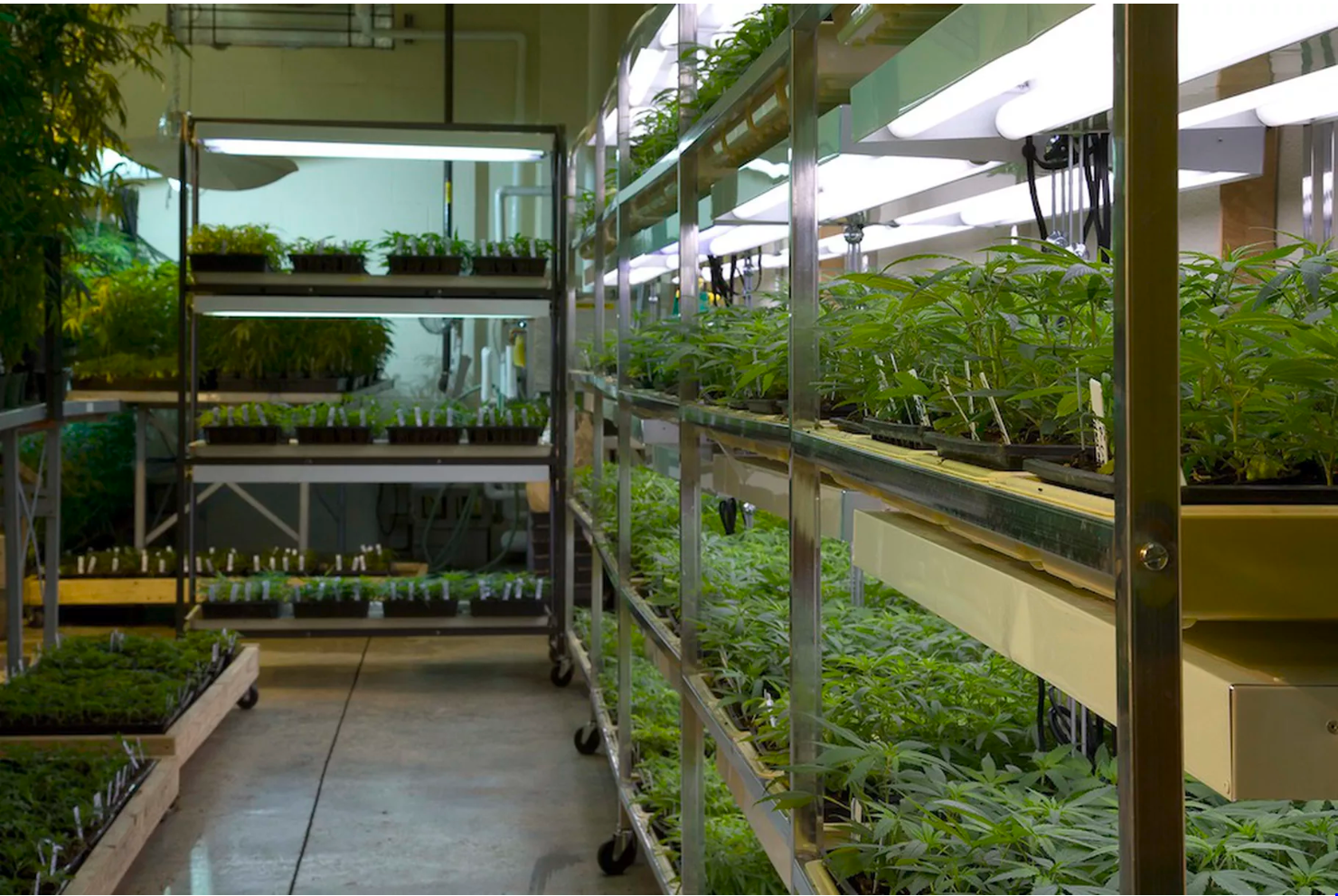
Photo: Ryan Stoa
I wrote a whole chapter on the debate between indoor and outdoor farming and power use, which are two closely related issues. Both indoor and outdoor farming have significant environmental impacts and implications. For outdoor farms, you’re taking advantage of natural sunlight and soil, but you need water diversions, so you have to look at what type of water rights system you’re using and then the runoff. Are you using pesticides? Are they safe? Are they certified? Can you make sure you’re not running off into streams and damaging the ecosystem, wildlife, and downstream water users?
For indoor farmers, it’s a little different. They don’t have as many water issues, but they do have significant energy concerns. Indoor farms consume an incredible amount of electricity. There’s a third model — mixed-light or greenhouse growing — which has a little bit of the pros and cons of indoor and outdoor.
One interesting issue facing the marijuana farming industry is which of these models is going to dominate. States like Colorado are largely adopting indoor, and California is largely adopting outdoor growing, but both models are going to have to face environmental consequences. Marijuana is just like every other crop: you need to comply with all of the other regulations. But since marijuana is such a unique industry and such a unique crop, it may not be time to regulate like every other agricultural product. So that means a lot of effort and thought.
How is marijuana not like any other crop?
Marijuana farming remains pretty labor-intensive and relatively specialized. A lot of it requires intense hours and significant skill sets. Plus, the popularity of the strains really fluctuates, and the high level of care and uniqueness really differentiates it.
Plus, it has such a unique historical context. Cannabis was grown extensively in the US in the form of hemp, but the psychoactive marijuana farming side of the industry as we know it grew up on the black market. It’s difficult to usher a black market industry into a regulatory system designed to address corn or wheat.

Carl Mastronardi Wins Produce Person of The Year From OPMA
During the annual OPMA Gala on November 9, Carl Mastronardi, President of DelFrescoPure® was the proud recipient of the OPMA Cory Clack-Streef Produce Person of the Year Award. Mastronardi received this prestigious award for his diligence and dedication to the greenhouse strawberry program.
“This is one of the most unforgettable events of my life. To be recognized by OPMA, my peers and the experts in the produce sector is a highlight that I treasure with abundant gratitude!” expressed Carl. “I was completely unaware that OPMA was considering me for this award, so it came as a complete surprise!”
Back in July of 2016, Carl Mastronardi and his partner, Jamie D’Alimonte, decided to test run the growing of one acre of strawberries in their greenhouse. Upon completion of the trial, the analysis of the growth within the greenhouse micro-climate environment coupled with favorable feedback from local and national retailers, had Carl convinced that they had tapped into an important niche market.
By September of 2017, ten acres of cucumber greenhouses were retrofitted to grow strawberries using high-pressure sodium grow lights enabling the strawberries to grow all year long. Production was scheduled for January 2018. "We were the first greenhouse grower in Ontario to offer greenhouse-grown strawberries during the winter season," said Mastronardi. With support from local and national retail partners, the strawberry program was a huge success and drove the further expansion of six acres for a total of seventeen acres of strawberry growing – all year round.
DelFrescoPure® said its strawberry program marketing and communication plan includes: a social media campaign with a local registered dietitian, promoting the ‘locally grown’ and ‘buy local’ message for strawberry sales, a double-sided billboard rental spot at the Ontario Food Terminal, social media outreach with Produce Made Simple, TV segments with RT and other influencers, featured ads with retail partners throughout the year, in-store demos with consumer-facing POS materials about how they grow, editorials in the Windsor Star, multiple interviews with the media, a video on “How We Grow Greenhouse Strawberries”, and outreach with trade publications promoting YES!Berries Your Everyday Snack™ strawberries.
During the launch of our new YES!Berries Your Everyday Snack™ strawberries product, the initiation of these communication plans resulted in multiple compliments for Carl regarding consumer education outreach throughout various social media platforms, according to the company.
“I would like to congratulate our president, Carl Mastronardi, on winning the OPMA ‘Cory Clack-Streef Produce Person of the Year Award’ and our DelFrescoPure® team in achieving the vision we both had in creating a truly unique, fresh and flavorful product that’s available year-round!” Expressed Jamie D’Alimonte, Chief Operation Officer for Del Fresco Produce Ltd. “To all of our staff from our greenhouses, warehouses, distribution, sales and marketing as well as our many loyal retail partners, we could not have done this without you! A sincere thank you is extended to all of them.”
For more information:
Fiona McLean
DelFrescoPure
Tel: +1 (519) 733-6101
news@DelFrescoPure.com
www.delfrescopure.com
Publication date : 11/28/2018

France: Agricool Raises 28 Million US Dollars For Urban Farming
With the announcement of a new funding round of $28 million, in addition to the $13 million previously raised, Agricool pursues its ambition to make pesticide-free fruits and vegetables accessible to all. Through its innovative concept, the company has paved the way for a new form of urban and technological agriculture, seeking to meet the ever-increasing demand for locally produced food and the expansion of local distribution networks.
The company has raised funds from new investors including Bpifrance Large Venture Fund, Danone Manifesto Ventures, Antoine Arnault via Marbeuf Capital, Solomon Hykes, and a dozen other business angels passionate about Agricool’s mission. The existing investors, which include daphni, XAnge, Henri Seydoux and Xavier Niel via Kima Ventures, have also participated in this new funding round.
Taking the lead in a booming market
According to UN reports, in 2030, 20% of products consumed worldwide will come from urban farming (compared to 5% today). In the past 3 years, Agricool’s teams have developed a technology to grow local, healthy fruits and vegetables more productively and within small and controlled spaces, known as “Cooltainers” (recycled shipping containers transformed into urban farms). Thanks to this new funding round, Agricool will be able to confirm its role in the development of this new type of agriculture, while positioning itself as a key player in the segment of vertical farming in France and worldwide. Agricool plans to multiply by a hundred its production by 2021, in Paris first, then internationally starting with Dubai, where a container has already been installed for several months in The Sustainable City.
The emergence of a new profession with the recruitment of 200 people
The deployment of these production modules will be made possible thanks to the recruitment of over 200 people in the Paris area and around the world, from now until 2021. This will result in the emergence of a new profession: the Cooltivator - an entrepreneur and urban farmer hybrid. These “market gardeners of the future” will play an important role in producing this new type of local, healthy food made accessible to all.
Cities of tomorrow
The challenge of urban farming and for Agricool is to help develop the production of food for a growing urban population who wants to eat quality products, while limiting the ecological impact of its consumption. Agricool strawberries are harvested when ripe, and the company claims they contain on average 20% more sugar and 30% more vitamin C than supermarket strawberries.
"Paris is dreaming of itself as an agricultural city", according to the ambition of the Paris City Council, and many metropolises like London, New York and Singapore share the same approach. "We are very excited about the idea of supporting urban farming towards massive development, and it will soon no longer be a luxury to eat exceptional fruits and vegetables in the city", stresses Guillaume Fourdinier, co-founder and CEO of Agricool.
For more information:
agricool.co
www.bpifrance.fr
www.danoneventures.com
www.daphni.com
www.XAnge.fr
Publication date : 12/4/2018

"Educator Greenhouses Foster The Perfect Learning Environment"
GrowSpan Commercial Educator Greenhouses provide a growing environment to encourage hands-on learning. The American-made structures offer an economical growing solution for instructors looking to enhance their program and teach horticulture throughout the year.
The Commercial Educator Greenhouses are 14’ wide and built to various lengths, tailoring the size of each structure to the program’s specific needs. The durable frame is made from triple-galvanized steel to prevent corrosion over time, while the clear, UV-resistant Twin-wall polycarbonate cladding is 12 times lighter than glass and accompanied by a 10-year warranty. GrowSpan is able to customize Educator Greenhouses with complete environmental control systems, including lighting, heating, ventilation and hydroponics systems as desired.
Starmont High School utilizes a GrowSpan Educator Greenhouse to take this learning a step further by organizing an annual plant sale to incorporate commerce and business experience into their program. As a GrowSpan customer, their educational program finds immeasurable value in the knowledge their students gain while working in the greenhouse.
GrowSpan understands the benefits of agricultural education for people of all ages. These greenhouses are suitable for primary and secondary schools, colleges and universities, research institutions, correctional facilities and more.
For more information:
GrowSpan Greenhouse Structures
1395 John Fitch Blvd
South Windsor, Connecticut 06074
Toll-free USA: (800) 476 9715
International: +1 860 528 9550
info@growspan.com
Publication date : 12/4/2018

Freight Farm To Grow Vegetables For Detroit Homeless
Lettuce seedlings grow under grow lights in seedling troughs in a shipping container at Cass Community Social Services on Wednesday.(Photo: Todd McInturf, The Detroit News)Buy Photo
Candice Williams, The Detroit News | . Nov. 28, 2018
A 40-foot shipping container transformed into a freight farm will be used to grow vegetables for 700,000 meals served by Cass Community Social Services each year to those in need.
The donation of the container from the Ford Motor Company Fund is part of a $250,000 grant Cass Community Social Services received through the Ford Motor Farm project.
With the use of a hydroponic system and LED lighting, the farm operates without pesticides, sunlight or soil. It also uses 90 percent less water than an outdoor garden.
“It means fresh produce all year round, which is really huge,” said Faith Fowler, executive director of Cass Community Social Services. “Homeless people have a number of issues that are exacerbated by junk food, poor nutrition. To be able to have fresh food every day. Salads and greens and herbs are good for them.”
Freight Farm assistant Charlotte Gale of Detroit inserts seeds into peat moss pods, where they start to grow, in a converted shipping container at Cass Community Social Services in Detroit. (Photo: Todd McInturf, The Detroit News)
The first crop of vegetables will be ready to harvest in two to three weeks, said Kathy Peterson, the farm freight supervisor.
Currently, red leaf and butterhead lettuce plants are in various stages of growth inside the 7.5-ton shipping container stationed inside a garage space at Cass Community Social Services on Rosa Parks Boulevard. It only takes about five days for a lettuce seed to sprout and eventually be transferred to a plant wall where it will grow before it is harvested to eat.
“We have just started this endeavor, but I do know we can produce hundreds of thousands of produce a year,” Peterson said.
The project was the idea of a “Thirty under 30” team, Ford’s philanthropic leadership program, according to Jim Vella, president of the Ford Motor Company Fund and Community Services. The group initially thought to create a farm in the bed of a Ford F-150, and that idea evolved into the idea of growing vegetables inside a shipping container.
Cass Community Social Services received earlier this year a Ford F-150 with a garden bed that uses to teach healthy eating habits at local schools. The Ford Mobile Farm runs during the spring and fall.
“It not only provides produce to the kids, but it also educates and teaches kids that maybe didn’t know that carrots came from the ground, that you can pull from the ground and eat fresh delicious food,” said Chris Craft, a member of the “Thirty under 30” team.
Lettuce grows in vertical grow columns. (Photo: Todd McInturf, The Detroit News)
“However, we realized that education was only one part of the solution and that we also needed to address systemic unemployment and also food deserts that had no availability of fresh produce.”
Craft said the team researched and found the concept of using recycled shipping containers as farms. Cass Community Social Services was selected for the grant.
Fowler said the nonprofit will also use the grant money to employ developmentally disabled adults at the freight farm.
“We anticipate hiring between three and five men and women working there as a job-training site and some potentially for long-term,” she said.
cwilliams@detroitnews.com
Twitter: @CWilliams_DN

Why Urban-Fringe Farming Is Vital For Food Resilience
November 29, 2018
When you pick up supplies at your local supermarket for tonight’s dinner, the produce will likely have come from many parts of Australia and from distant parts of the world. But some of the fresh produce may also have come from one of the highly productive foodbowls on the fringes of Australia’s state capitals.
The role that city fringe farmers play in feeding cities is sometimes overlooked in an era of sophisticated supply chains that enable food to be sourced from all over the world. But city foodbowls make a significant contribution to Australia’s fresh food supplies, and cities can do more to support them.
Areas outside Melbourne identified as ‘foodbowls’ for city-fringe farming. Foodprint Melbourne
Why being close to cities makes sense
Many cities now recognise the need to strengthen relationships with local farmers as a way to increase the resilience of their food supplies to climate change and make efficient use of scarce natural resources.
Retaining food production close to urban areas can reduce food shortages if transport routes into the city are cut off (for example, by a major storm or flood). Recycled water from city water treatment plants can also be used to grow food during a drought, and food waste can be processed into organic fertilisers for use on nearby farms.
Strengthening links between cities and farms on the fringe can improve farmer livelihoods and grow the local economy.
Farmers on the city fringe are caught in a tight “cost price squeeze” with very high land prices (and rates) and low farm-gate prices. Many are small-scale farmers who find it difficult to compete through economies of scale. But there are also advantages to being close to the city, such as the proximity to city markets and access to recycled water.
The Foodprint Melbourne project has just released an infographic that showcases the mutually beneficial relationships that can be developed between cities and the farmers on their fringes. These ideas were developed in workshops that brought Victorian stakeholders together from across sectors (farmers, industry, local government, state government and civil society) to explore how the viability of farming on Melbourne’s fringe could be strengthened.

How food can make its way from the city fringes to urban residents. Foodprint Melbourne
The infographic shows how strong links between cities and local farmers can create a two-way exchange. Farmers can capture a higher share of the food retail dollar by selling direct to local consumers (through farmers markets or community-supported agriculture) or local businesses (such as cafes and restaurants). City residents benefit from access to fresh, local produce and from opportunities to participate in agri-tourism activities on nearby farms (such as pick your own produce and farm-gate bike trails).
Food from Melbourne’s foodbowl can also be sold directly to local families, shops and restaurants in the city, in addition to being transported interstate and overseas via city airports. A new provenance brand could be introduced so consumers and businesses can easily recognise food from the area and support local farmers.
State and local governments could introduce food procurement standards so that government services, such as hospitals, prisons and “meals on wheels” programs, are encouraged to buy food from Victorian farmers. Government food procurement standards like these are already used in other countries, such as the United States and Canada.
Farmer incubators could be established to help new farmers access land and begin farming on the city fringe, mentored by experienced growers. Farmer-owned food-processing co-operatives could enable these growers to add value to their produce and take greater control of the food supply chain.
Governments are slowly starting to realise the importance of city fringe farming and providing greater protections. Foodprint Melbourne
How to encourage city fringe farms to thrive
Cities around the world now recognise the importance of actively strengthening links with farmers on the city fringe. The UN Food and Agriculture Organisation has released a “city region food system toolkit” that supports cities in building closer links with nearby farmers to improve farmer livelihoods, grow local economies and increase access to healthy, sustainable food.
A key step is to provide certainty about the future of farming areas close to cities by introducing laws that protect them for the long term. The city of Portland, Oregon, for instance, has created rural reserves that protect important farming areas for at least 50 years.
Measures to promote the viability of farming are equally important. In Ontario, the provincial government funds the Friends of the Greenbelt Foundation to promote farming, tourism and conservation in the agricultural area surrounding Toronto.
The links between cities and the farmers on their fringes have weakened as modern food supply chains have developed, but there is renewed interest among consumers in reconnecting with where their food comes from.
To improve access to locally grown food and increase the resilience of food systems to climate change, we need to build mutually supportive relationships between cities and the growers on their fringes, so that farms thrive as our cities grow.
This article is part of a series focusing on the politics of food – what we eat, how our views of food are changing and why it matters from a cultural and political standpoint.
Rachel Carey, Research Fellow, University of Melbourne; Jennifer Sheridan, Researcher in sustainable food systems, University of Melbourne; Kirsten Larsen, Manager, Food Systems Research and Partnerships, University of Melbourne.
This article was originally published on The Conversation.

Technological Supplier THORILEX Is Looking For Partners And Distributors
THORILEX launched several new products this summer including reusable THORILEX Hydroponics baskets for an automatic vertical THORILEX Hydroponics system and the company is looking for partners and distributors now.
“We can see a huge opportunity on the vertical farming market that is still moving forward with a significant growth at a CAGR of 22%. The vertical farming market is projected to grow from present 2,45 billion € to 6.54 billion € till the year 2023. We would like to find great partners and distributors to grow.” Explains Marek Hrstka from THORILEX
“I know that we have truly great products that are now placed in the THORILEX Farm in the biggest glass house complex in our country and it is possible to visit the farm to see the products in operation. Finding truly great partners or distributors is important to achieve our strategy.”
“It will take some time to find the right one. We are looking for someone who haS similar thoughts, likes, innovations and have experience in the horticulture industry. It can be a big or a small company or even an individual.
We are looking for a win-win situation where both sides are prospering from mutual cooperation.” Concludes Marek

Altria In Talks To Buy Cannabis Company Cronos Group
Lauren Hirsch
December 3, 2018 CNBC.com
Marlboro cigarette maker Altria is in early talks to acquire Canadian cannabis producer Cronos, a person familiar with the matter told CNBC.
Cronos has not agreed to any deal and there is no certainty it will do so, the person added.
Marlboro cigarette maker Altria is in early stage talks to acquire Canadian cannabis producer Cronos, as it seeks to diversify its business beyond traditional smokers, people familiar with the matter told CNBC.
Cronos has not agreed to any deal and there is no certainty it will do so, the people said.
The news comes as Altria is also eyeing a significant minority stake in e-cigarette company Juul, people familiar with the situation have told CNBC.
The people asked not to be identified because the matter is confidential. Altria did not immediately respond to a request for comment, while Cronos declined to comment.
Reuters first reported the talks between Altria and Cronos.
The deal talks come as the tobacco industry is under pressure. Cigarette sales have declined as older smokers are dying and fewer young people are starting to smoke. Last year, cigarette smoking in the U.S. fell to its lowest point in recorded history, according to data from the Centers for Disease Control and Prevention.
At the same time, both the cannabis and e-cigarette industries are growing.
Counting both legal and black market sales, the total demand for pot is approximately $52.5 billion, Marijuana Business Daily has reported. The e-cigarette market meantime, is projected to hit $6.6 billion in the U.S. this year, according to Wells Fargo analyst Bonnie Herzog.
Correction: This article has been updated to state that the e-cigarette industry is growing.

CO2 GRO Trials
Matthew Bohlsen
November 20, 2018
There’s a lot of activity coming out of Canada with the recent legalization of cannabis, which has been very good for CO2 GRO. Following this the desire to produce better and faster crops and flowers looks like the next challenge for CO2 GRO to expand into new markets beyond cannabis.
CO2 GRO Inc. (TSXV: GROW | OTCQB: BLONF) (“GROW”) is a Canadian company with CO2 technologies that are dedicated to increasing the growth of all indoor and outdoor value plants. The technology works by transferring CO2 gas into water and foliage spray for use across the entire plant leaf surface area, which is a semi permeable membrane. The dissolved concentrated CO2 then penetrates the leaf’s surface area naturally, like concentrated nicotine dissolves through human skin into the bloodstream from a nicotine patch.
Previously CO2 GRO has had good success in the cannabis market. The Company previously announced a 45% increased commercial cannabis bud value growth in trials. More recently the Company announced trials on flowers and peppers proving it’s not only cannabis that can benefit.
CO2 GRO trials result in quicker growing flowers
On October 24, 2018 CO2 GRO announced a series of positive flower grow trials using dissolved CO2 spray versus no CO2 gassing at a commercial Michigan flower greenhouse. The first two trials were done in a large commercial greenhouse that does not use CO2 gassing. The dissolved CO2 sprayed flowers were healthier, showing more branching and side shoots with bigger, thicker leaves, and a more advanced root systems that delivers more water and nutrients up to the leaves. Importantly these flowers were commercially ready to ship 7-10 days faster at 32-35 days versus the control flowers requiring 42 days. The third and fourth trials resulted in bushier plants without additional stretching, with deeper more vibrant flower coloring. Propagation times were consistently reduced by one-third to 14 days versus the control flowers requiring 21 days.
John Archibald, CEO of GROW, stated: “We are really pleased with these Michigan flower results as the global flower market is a $200 billion a year retail business. Flowers are more valuable than food on a greenhouse per square foot basis.”
CO2 GRO trials on pepper yield great results
CO2 GRO have also been conducting pepper grow trials, with dissolved CO2 sprayed plants receiving a 30% greater fruit yield and a 20% faster growing rate.
CEO John Archibald stated: “Until legal cannabis, the top two greenhouse crops in Canada were tomatoes at 38% and peppers at 33%. We can add plant yield and speed to maturity value to any greenhouse or indoor grow facility that does not use CO2 gas, or to the 95% of the world’s plant food grown outdoors, where it has been impossible to add CO2 until now.”
GROW’s global target plant markets are retail food at $8 trillion per year, retail non-food plants at an estimated $1 trillion per year, and legal retail cannabis that may reach $50 billion per year by 2022.
The world has been discussing global warming and food shortages for years now. With almost a permanent drought in many continental climate type countries, the global food basket is under pressure.
With a mission to accelerate the growth of all value plants safely, economically, and naturally; using their patented advanced carbon dioxide technologies, GROW now have proof in trials that their concentrated CO2 foliage spray could well be a savior to the world’s food shortages and of course don’t forget the great results from cannabis trials.
GROW expect to continuously strengthen their patent portfolio as experience optimizing CO2 technologies for plant yields continues to evolve. Keep an eye on this company as they have something the planet definitely needs.

NASA Technology To Grow Crops Faster
NASA has created a new technology to grow crops on other planets with the prospect of establishing colonies on Mars or another planet in the future. A group of scientists from the John Innes Center, the Earlham Institute, the Quadram Institute in the United Kingdom, and the University of Queensland have tested the application of this technology in terrestrial crops.
They have applied the new technology in a greenhouse at the John Innes Center in Norwick (United Kingdom). Researchers conducted rapid genetic improvements using shorter crop growth and harvest cycles, in addition to improved LED lighting. The research, which was published in the scientific journal Nature Protocols, shows that this method of cultivation can produce crops that are resistant to diseases, climate challenges, and that are more nutritious to feed a growing world population.
This technique uses improved LED illumination and day regimes of up to 22 hours to optimize photosynthesis and promote rapid crop growth. It accelerates the plants reproduction cycle: for example, it allows producers to grow six crops of wheat in a year, well above the two crops per year that are achieved with traditional improved farming methods.
By shortening breeding cycles, the method allows scientists and plant breeders to make accelerated genetic improvements, such as increasing yields, disease resistance and tolerance to climate change in a variety of crops, such as wheat, barley, rapeseed, and pea.
Source: lavanguardia.com
Publication date : 11/29/2018
The Decline In U.S. Life Expectancy Is Unlike Anything We've Seen In A Century
For a nation that spends more on healthcare per citizen than almost any other, America isn’t exactly reaping the rewards. Life expectancy has been steadily climbing for decades now, but in the last few years it’s taken a troubling turn in the other direction.
The CDC identified three things shortening American lives.
By Sara Chodosh November 29, 2018
More Americans are dying by their own hands and by overdoses. Pexels
For a nation that spends more on healthcare per citizen than almost any other, America isn’t exactly reaping the rewards. Life expectancy has been steadily climbing for decades now, but in the last few years it’s taken a troubling turn in the other direction.
A new report from the Centers for Disease Control shows that a small decrease in life expectancy, from 78.7 to 78.6 years, is part of a continuing trend. Even as we make progress treating cancer, heart disease, and stroke—three of the biggest killers—we’re losing ground on other fronts and have been since 2014. That makes this continuous decline unlike anything we've seen since World War I and the Spanish influenza, which both happened between 1915 and 1918.
In its report, the CDC highlighted three things that have contributed to American's shrinking life expectancy in recent years: drug overdoses, chronic liver disease, and suicide. “Increased death rates for unintentional drug overdoses in particular—a subset of unintentional injuries—contributed to the negative change in life expectancy observed in recent years," the report reads.
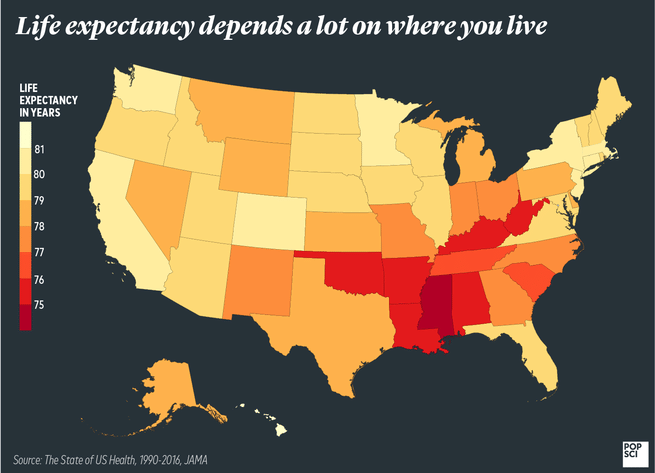
But the changes aren’t affecting everyone equally. Take a look at these charts:
These are the three main factors the CDC identified as being behind the drop in life expectancy. Infographic by Sara Chodosh
Health and life expectancy varies geographically. Worldwide variation is enormous, but even within the United States you can expect to live 6.6 years longer if you live in Hawaii, the top-ranked state, than in Mississippi, which comes in last. With its 81.3 year life expectancy, Hawaii looks more like the Netherlands than the United States. Mississippi's 74.7 year projection looks more like Kuwait.
Americans living in much of the South have much shorter lives than those in the rest of the country. Infographic by Sara Chodosh
Tackling the various problems that contribute to the recent upticks in suicide, liver disease, and drug overdoses won’t be easy. They’re multifaceted issues—often complicated by economics—that we’ve only just begun to parse. But if we want Americans to lead long and healthy lives, it looks like we’re going to have to change what we’re doing. If these charts tell us anything, it's that our current methods aren’t working.
tags: life expectancy death cdc opioids drugs suicide health

Is Digging Down The Future of Vertical Farming?
Academics at the University of Nottingham have patented a new concept that would see food production in deep farms in cities. The ideas are being promoted by University of Nottingham academics Professor Saffa Riffat, Fellow of the European Academy of Sciences and President of the World Society of Sustainable Technologies, and Professor Yijun Yuan, Marie Curie Research Fellow.
Deep farming technology would allow crop production all year-round. Up to 10 crop cycles per year could be achieved compared to 1-2 cycles for conventional agriculture. Put another way, 1 indoor acre is equivalent to 4-6 outdoor acres or more, depending on the crop.
Example of a Deep Farm City
As Deep Farms could be located close to urban centres, CO2 emission due to transportation of crops would be reduced. This is particularly important as the proportion of people living in cities continues to rise. Over the last 20 years, the percentage of people who live in cities globally has increased from 20% to nearly 50%.
Cost-effective deep shafts for crop planting would be constructed using new drilling techniques. Existing coal mine shafts, mines and tunnels, many of which are now abandoned could also be used for crop production.
A variety of crops could be grown in the Deep Farms using hydroponic planters (plant roots fed with nutrient-rich water) or aeroponics (growing plants in an air or mist environment). LED units would enable photosynthesis in the absence of sunlight. Groundwater could be used directly or water could be condensed from ambient air in hot/humid desert climates. A major benefit of this approach is that crop production is largely unaffected by climatic or seasonal factors - one of the greatest limitations of conventional farming methods.
Automated Deep Farm concept
New vertical shafts could be created for Deep Farms and also redundant coal mine shafts could be used for crop production. In the UK, for example, there are over 150,000 redundant coal mine shafts.
Carbon dioxide is required for plant photosynthesis and Deep Farms are well suited for carbon capture from ambient air. The CO2 could be released to achieve the concentration levels required by plants.
Use of carbon capture systems has the added benefit of reducing CO2 concentration in the environment, as additional carbon is adsorbed in materials in the ground space. Advanced control systems including sensors and remote controls could be used to monitor crop production. Automated systems such as robots could be used for crop planting and harvesting. Electricity generated from renewable sources and off-peak power could be used to power the LED lighting for plant photosynthesis.
View from above of a Deep Farm
It is estimated that a small Deep Farm can produce 80 tonnes of food per annum. Some of the crops can be ready for harvesting within 2-3 weeks. The amount of energy it would require is equivalent to that consumed by 3 UK homes.
Deep Farms could be installed at various locations to create a ‘Deep Farming City’. This would facilitate the supply of a wide range of fresh crops to the local population.
For more information:
University of Nottingham
Professor Saffa Riffat
+44 115 748 4479
www.nottingham.ac.uk
Revolution Farms Harvests First Batch Of Aquaponics Crops Grown Without Soil
Tripp Frey, founder and CEO of Revolution Farms
Locally grown lettuce now will be available in Michigan grocery stores during all four seasons.
Revolution Farms, at 2901 76th St. in Caledonia, harvested its first crop of aquaponics lettuce last month and made its debut in 16 SpartanNash stores, including Forest Hills Foods, 11 D&W Fresh Market locations and select VG’s Grocery and Family Fare locations.
Tripp Frey, founder and CEO of Revolution Farms, said the farm will be harvesting lettuce three times per week, which will result in 4,000 pounds per week. He said there are plans to grow more in the future; the farm has the capacity to produce more than 350,000 pounds of lettuce per year. Revolution Farms currently has between 12 and 15 full-time employees, according to Frey.
He said the farm purchases a variety of seeds from Johnny’s Selected Seeds, a national seed supplier, to grow its lettuce aquaponically, without soil, in a 55,000-square-foot glass greenhouse.
“We have about 15,000 fishes, and we are basically composting,” Frey said. “We break down the fish waste using a mechanical and biological infiltration, and we turn that ammonia into nitrogen for the plant. By growing it this way and in a greenhouse, we can grow the produce year-round and offer really healthy products to people. Consumers want fresh, locally grown food, and they care where their food comes from.”
In addition to growing year-round salad mix, which includes green butter, red oak, sweet crisp and romaine lettuce, Frey said the farm will be using fewer resources than traditional farmers, such as 80 percent less water, 90 percent less land and 95 percent fewer miles traveled. About 95 percent of lettuce in Michigan comes from outside the state, according to the Michigan Department of Agriculture and Rural Development.
“This method of farming is sustainable; you use significantly less water,” he said. “There is no agricultural runoff, and we are not trucking products across the country from California. So, there are really no negatives, in terms of the product. It is really great for us.”
Lettuce season generally occurs from May to October, and lettuce production from the farm is not only beneficial during the wintertime. Ronald Goldy, a vegetable educator at Michigan State University Extension, said the hardest time for traditional farmers to grow lettuce is in the summer.
“Lettuce doesn’t like it hot because it goes to seed quickly and gets bitter tasting under hot conditions,” he said. “So, aquaponics farming is good during the summer season, also.”
Along with the seasonal benefits for aquaponics, Roger Betz, farm business management educator at MSU Extension, said aquaponics can lower the risk of bacteria, like E. coli and salmonella, that is plaguing the lettuce industry across the country, including Michigan.
“It is a very controlled biosystem, so diseases will be under control, detained and so forth,” he said. “Diseases will have limited access as opposed to the outdoor terrain.”
The packaged and prepared salad industry has a market value of $12 billion, and by 2025, the industry is estimated to be valued at $21 billion, according to Revolution Farms.
The farm is a $3.3-million project that was partially funded by the Michigan Commission of Agriculture and Rural Development through a $50,000 performance-based grant. Along with the construction of the aquaponics farm, there is a 35,000-square-foot warehouse on-site.
Danielle Nelson
Danielle Nelson is a Grand Rapids Business Journal staff reporter who covers law, startups, agriculture, sports, marketing, PR and advertising and arts and entertainment. She is also the staff researcher who compiles the weekly lists. Email Danielle at dnelson at grbj dot com. Follow her on Twitter @Dan_Nels

iGrow Blog - News Stories And Analysis of Stocks In The Cannabis Industry
iGrow Blog
Welcome!
I am thrilled to welcome you to my blog.
Every week, I will provide news stories and analysis of stocks in the cannabis industry from an informational and educational perspective only.
These are exciting times for the cannabis industry.
With the fast changing pace of the industry as increasing numbers of players are moving into the space, there’s lots to write about.
So welcome aboard and check back in weekly for new articles.
Stella Osoba CMT
Technical Analyst and Writer
Disclaimer
If you wish to invest in any of the companies I mention in this blog, you must do your own due diligence and your own research. You must make sure that you fully understand the risks of investing in any of the companies mentioned. You must make sure that it fits with your investment goals. Nothing in this blog is to be construed as investment advice and I do not recommend any of the stocks I mention as suitable for any form of investment. The information provided is for educational purposes only.

Old Coal Mines Can Be 'Perfect' Underground Food Farms
By Matt Lloyd BBC Wales
December 2, 2018
Experts say former mine shafts could be used to grow food |GETTY IMAGES
Abandoned coal mines across the UK could be brought back to life as huge underground farms, according to academics.
Mine shafts and tunnels are seen as "the perfect environment" for growing food such as vegetables and herbs.
The initiative is seen as a way of providing large-scale crop production for a growing global population.
Advocates say subterranean farms could yield up to ten times as much as farms above ground.
President of the World Society of Sustainable Energy Technology, Prof Saffa Riffat, believes the scheme would be a cost-effective way of meeting the growing need for food.
It could also breath new life into many mines that have been closed since the decline of the UK coal industry in the late 1980s and a cheaper alternative to vertical farming in giant greenhouses.
NOTTINGHAM UNIVERSITY How it would work
The idea has already gained support from mine owners, including the Land Trust and Coal Authority, while the Chinese government has also expressed an interest.
There are an estimated 150,000 abandoned shafts and 25,000km-sq of disused mines and tunnels in the UK.
"I'm very excited about the enormous potential. Rather than import so much food by air, rail and sea, we could grow a lot of it here and in huge quantities," said Prof Raffat.
"I wish I had thought of this idea when they were making all the miners redundant. We may have been able to offer them an alternative job."
So what are underground farms, and how would they work?
A problem solved?
By all predictions, global population will continue to grow with the figure in the UK set to reach 80 million before the end of the century, according to the United Nations.
Increasingly, people are opting to live in cities rather than rural areas, putting a strain on food production and land space.
"We have a major issue with food production and supply with the world's population expected to reach nine billion by 2050," said Prof Raffat, of Nottingham University.
"We need to do this for our future. We have a growing demand for food, especially in the cities, but less space to grow it."
ZERO CARBON FOOD | Richard Ballard (left) and Steven Dring grow food in a former air-raid tunnel in London
Why tunnels?
A former World War Two air-raid shelter 100ft (30.5m) under Clapham Common, London, is already being used to grow greens for local supermarkets and restaurants.
Unlike current agriculture, farming underground is unaffected by irregular seasons, climate change and the extreme weather witness throughout 2018.
Almost all the ingredients needed for growing crops such as lettuces, carrots, mushrooms and strawberries are already in place.
The air temperature and humidity levels are generally temperate and constant while there is a ready water supply as well as carbon dioxide.
"Tunnels and shafts would need less energy with heating, so are very attractive for food production. They're almost perfect," said Prof Raffat.
Skip Twitter post by @GrownUnderView image on Twitter
Growing Underground@GrownUnder
THROWBACK THURSDAY! Remembering a very special visit down on the farm earlier this year from @MONKEY_47 Looking forward to celebrating something very special with these guys soon. Stay tuned! #minesagin #undergroundfarm
See Growing Underground's other TweetsTwitter Ads info and privacyReport
End of Twitter post by @GrownUnder
How would it work?
Crops would either be grown in water or suspended in the air and sprayed with water and nutrients.
Lighting would either be from LED lights which are now "extremely cheap to buy and run" or fibre-optic technology which can tunnel sunlight up to 40 metres into the ground.
Carbon-capture technology would capitalise on the naturally occurring CO2.
NOTTINGHAM UNIVERSITY
Is it viable?
Currently, mass-producing crops requires large areas of land.
However one 7m-sq shaft can produce 80 tonnes of food per year, according to Prof Riffat, approximately eight to 10 times the amount of food grown on the same area of land above ground.
"You're looking at about £30,000 to set up one shaft and the running costs are very low - less than the energy consumed by three houses each year. With natural sunlight, the costs are even less."
What has been the reaction?
The Land Trust owns and manages many former colliery sites that have been converted into public spaces.
"It's a great idea and one that we have previously considered ourselves," said chief executive Euan Hall.
"There are obvious challenges, not least that many shafts have been capped or have been built on, but there are lots of coalfields where there's no community around them, where this is clearly something worth looking at.
"A lot of hill farmers in Wales are living hand to mouth so anything that helps diversity and brings a new form of income would be very welcome."
A spokesperson for the Coal Authority said it was "open to considering new ideas" as part of its innovation strategy.
He added: "As an organisation, we constantly review new ways to develop our mining legacy in an effort to minimise remediation costs, generate income from by products and create a future for these important and unique areas.
"Any schemes involving former coal mines would inevitably throw up many technical, legal and financial challenges that would need to be overcome."
NOTTINGHAM UNIVERSITY | Shafts close to cities to provide a steady supply of fresh food.
Related Topics

Infarm Expands Its ‘In-Store Farming’ To Paris
Steve O'Hear@sohear / November 2018
infarm
Infarm, the Berlin-based startup that has developed vertical farming tech for grocery stores, restaurants and local distribution centres to bring fresh and artisan produce much closer to the consumer, is expanding to Paris.
Once again, the company is partnering with Metro in a move that will see Infarm’s “in-store farming” platform installed in the retailer’s flagship store in the French capital city later this month. The 80 metre square “vertical farm” will produce approximately 4 tonnes of premium quality herbs, leafy greens, and microgreens annually, and means that Metro will become completely self-sufficient in its herb production with its own in-store farm.
Founded in 2013 by Osnat Michaeli, and brothers Erez and Guy Galonska, Infarm has developed an “indoor vertical farming” system capable of growing anything from herbs, lettuce and other vegetables, and even fruit. It then places these modular farms in a variety of customer-facing city locations, such as grocery stores, restaurants, shopping malls, and schools, thus enabling the end-customer to actually pick the produce themselves.
The distributed system is designed to be infinitely scalable — you simply add more modules, space permitting — whilst the whole thing is cloud-based, meaning the farms can be monitored and controlled from Infarm’s central control centre. It’s data-driven: a combination of IoT, Big Data and cloud analytics akin to “Farming-as-a-Service”.
The idea isn’t just to produce fresher and better tasting produce and re-introduce forgotten or rare varieties, but to disrupt the supply chain as a whole, which remains inefficient and produces a lot of waste.
“Many before have tried to solve the deficiencies in the current supply chain, we wanted to redesign the entire chain from start to finish; Instead of building large-scale farms outside of the city, optimising on a specific yield and then distributing the produce, we decided it would be more effective to distribute the farms themselves and farm directly where people live and eat,” explains Erez Galonska, co-founder and CEO of Infarm, in a statement.
Meanwhile, the move into France follows $25 million in Series A funding raised by Infarm at the start of the year and is part of an expansion plan that has already seen one hundred farms powered by the Infarm platform launch. Other recent installations include Edeka locations in Düsseldorf, Frankfurt, Stuttgart, and Hannover. Further expansion into Zurich, Amsterdam, and London is said to be planned over the coming months.
“One thousand in-store farms are being rolled out in Germany alone,” adds Infarm’s Osnat Michaeli. “We are expanding to other European markets each and every day, partnering with leading supermarket chains and planning our North America expansion program for 2019. Recognising the requirements of our customers we have recently launched a new product; DC farm – a ‘Seed to Package’ production facility tailored to the needs of retail chains’ distribution centres. We’ve just installed our very first ‘DC farm’ in EDEKA’s distribution center”.

Mitch McConnell’s Farm Bill Could Blow Up The CBD Market
by Lester Black • Nov 28, 2018
Mom is going to be buying CBD at Walgreens if this bill passes. UPPERCUT IMAGES / GETTY
CBD is already big business in America with hundreds of millions of dollars in sales every year. But the market for pot's second most famous compound might soon skyrocket thanks to a somewhat unlikely ally: Kentucky Senator Mitch McConnell.
The powerful Republican from Kentucky included provisions in this year’s Farm Bill that would fully legalize industrial hemp. That bill is now a top priority for Congress to pass before the end of the year, and if it becomes law we might see CBD on the shelves of every drug store in America.
“Once CBD is fully legalized, we expect that market to absolutely explode, with sales hitting $22 billion by 2022, which is higher than the US Cannabis industry,” said Bethany Gomez, the director of research for the cannabis research firm Brightfield Group. “That growth will absolutely be a result of legalization."
CBD, a non-psychoactive and medicinal compound in pot that can be used to treat a wide range of conditions, currently occupies a legal gray area in America. Legal sources of CBD exist, but those sources require significant hurdles and the federal government rarely enforces laws against illegally sourced CBD. That has created a system where there’s a lot of illegally sourced CBD being sold on retail shelves. This gray area has hampered CBD’s growth by stopping big retail players like CVS and Walgreens from selling the drug. Most CBD is sold either online or in small independent health stores.
McConnell’s bill would likely change that. This year’s proposed Farm Bill removes industrial hemp, the most common source of CBD, from the Controlled Substance Act. Industrial hemp is any cannabis plant that contains less than 0.3 percent THC. By making industrial hemp fully legal, McConnell’s bill would make it easier for farmers to grow CBD-rich cannabis and less risky for big retailers like CVS to know that what they are buying is federally legal.
Brandon Beatty, the founder & CEO of the CBD brand Bluebird Botanicals, said the bill would allow large retailers to stock CBD products. Right now CBD products are largely relegated to independent natural health stores.
“Many watching the industry guess that the day the 2018 Farm Bill gets signed will be the day that some of the biggest players in the industry put in their orders to get CBD-rich hemp extracts on their shelves.”
Gomez said getting retail chains involved in CBD would blow the industry up.
"Year-on-year growth even prior to legalization hit 80% in 2018, with the year expected to close at $591 million. This is a strong year-on-year growth, but considering that all of the chained retailers and large Healthcare and Consumer Packaged Goods companies are kept out of the industry, this is tiny,” Gomez said in an e-mail.
Industrial hemp looks just like pot (because it is). It just doesn't have THC. GETTY IMAGES
McConnell’s hemp legalization is an expansion of what Congress did in their last Farm Bill in 2014. In that law, Congress made it legal to grow CBD-rich industrial hemp if a farmer received a research permit from either a state government or a university. Seth Goldberg, a partner and the head of the cannabis practice at the Philadelphia law firm Duane Morris, said 2018’s version would make it so farmers would no longer need those special permits.
“McConnell’s bill would remove industrial hemp from the CSA [Controlled Substance Act], which is a change to industrial hemp research program in the 2014 Farm Bill. Under that program industrial hemp and uses of it were restricted to state-regulated, university-affiliated agricultural research programs,” Goldberg said in an e-mail.
These state research programs have become more common since 2014 with dozens of states adopting them, but they are often expensive and full of cumbersome regulations. The Washington State Department of Agriculture created an Industrial Hemp program but many farmers never got involved thanks to expensive permits and invasive regulations. McConnell’s bill would remove any requirement to comply with those programs.
Beatty from Bluebird Botanicals said the Farm Bill would also expand banking access for CBD companies and allow farmers to buy crop insurance for the CBD-rich hemp crops. Beatty said these extra protections would grow the market even further.
“In just five years, the markets developed rapidly into over a thousand companies and a number of large companies. The further protections of the 2018 Farm Bill will open the floodgates to the many who didn't have the courage to get into the industry earlier but see a market booming,” Beatty said in an e-mail.
Goldberg, who is watching the Farm Bill for a trade group of West Coast pot businesses called the Western Regional Cannabis Business Alliance, said the hemp legalization measures appear to have support from both Republicans and Democrats.
“The bill seems to have bipartisan support and there is no indication that it will not be included in the 2018 Farm Bill when it passes,” Goldberg said via e-mail.
The biggest problem with the Farm Bill might be a controversial Republican proposal to add new work requirements for food stamps. The federal government’s food stamp program forms the bulk of the Farm Bill’s spending.
Goldberg said the bill might not pass before the end of the year, during the so-called "lame-duck" session.
“There appears to be an effort to pass the 2018 Farm Bill during the lame-duck session. In all events, it does not seem like McConnel’s bill is the cause of the delay and it will be included in the bill whether passed in 2018 or early 2019.”
Lester Black
Lester Black is a staff writer for The Stranger, where he writes about Seattle news, cannabis, and beer. He is sometimes sober.

Romaine Lettuce Scare Has Montreal Clients Turning To Local Greenhouses
With no romaine lettuce in stores or restaurants because of the E. coli outbreak, some are turning to local greenhouses for safer greens.
MICHELLE LALONDE, MONTREAL GAZETTE
November 27, 2018
As food safety authorities in Canada and the U.S continue to warn against eating romaine lettuce because of the recent E. coli outbreak, many consumers seem to be turning to local, hydroponically grown greens as a safer way of getting their salad fix.
Lufa Farms, which operates three rooftop greenhouses in the region, has seen a significant bump in new clients ordering their weekly baskets of local products. Lufa Farms co-founder and marketing director Lauren Rathmell said it seems likely the increase is because of the romaine shortage.
While Rathmell said she has no evidence that a direct correlation can be made with the increase in members to Lufa Farms with the romaine lettuce shortage, she said, “I would certainly say that the past week and a bit have been our record weeks to date by far.”
She said clients have been calling to ask specifically about the safety of Lufa’s hydroponically grown romaine lettuce at its Anjou site.
News of the E. coli outbreak has prompted most grocery stores and restaurants in the U.S. and Canada to remove romaine lettuce from shelves and menus, since the first public health notice was issued on Nov. 20.
Lauren Rathmell of Lufa Farms with bok choy that will soon be ready for harvest at the third, and newest, commercial rooftop greenhouse built for the urban farming organization, this one in Anjou. PIERRE OBENDRAUF /MONTREAL GAZETTE
The Public Health Agency of Canada and the Canadian Food Inspection Agency continue to collaborate with U.S. agencies to try to find the source of the most recent outbreak.
In the U.S., 32 people in several states have so far been confirmed sick from E. coli contaminations after consuming romaine lettuce, and 13 have been hospitalized. In Canada, there have been 22 confirmed cases so far, including 17 in Quebec, four in Ontario, and one in New Brunswick. Eight Canadians have been hospitalized, and one has contracted hemolytic-uremic syndrome, a severe complication that can cause ongoing kidney problems or death.
The news has some people seeking out greenhouse-grown vegetables, where there is less chance of contamination from contact with feces from infected animals.
“When you grow hydroponically in greenhouses like we do, its soil-less,” Rathmell said. “So there is no manure, and there are no other contaminants coming in from outside. So there is very, very little risk. We can’t say there is no risk … but there is virtually none.”
Founded in 2011, Lufa now has rooftop greenhouses in Laval, Ahuntsic and Anjou. The company partners with local farms to provide food baskets containing not only rooftop grown vegetables but also fresh, locally produced meats, dairy products, bread, pasta, etc. Clients customize their baskets online and pick them up from locations around the city.
Rathmell said Lufa ships baskets of produce to about 14,000 clients a week, and that number has been growing, generally, by a few hundred per week. She declined to give exact recent numbers but said that in the past couple of weeks, the increase has been “in the higher hundreds rather than the lower hundreds, if I had to give you a ball park.”
Experts say there is no such thing as no risk of contamination, since seeds can be contaminated before planting and post-harvest handling by humans can also transmit harmful pathogens, but food grown in greenhouses without soil is definitely lower risk.
“There is very little handling,” Rathmell said. “The Anjou site is remarkable. It’s basically this sea of greens when you walk in. So there is almost no handling or walkways in between the crops. You plant a seedling, and about four to five weeks later it’s ready to harvest and there is just one step. We take that lettuce, roots and all, we put it in a bag and it goes straight to the customer within a day. So there are no entry points” for pathogens, she said.
But for another local hydroponic producer, the romaine lettuce shortage has not been particularly beneficial.
Martin Desrochers (left) and Sylvain Terrault of Hydro-Serre Mirabel with its water-grown Boston lettuce. Terrault says it is producing at capacity and can’t satisfy the demand for more lettuce. MARIE FRANCE COALLIER/ MONTREAL GAZETTE FILES
Sylvain Terrault, president and CEO of Hydroserre Mirabel, said his company is already producing various greens — mainly Boston lettuce, but also oakleaf lettuce, swiss chard, mâche, etc. — at capacity in its three greenhouse complexes in the region.
The company does not produce romaine, but his clients, mainly grocery store chains in Canada and the U.S., have been calling to demand more of the greens Mirabel does produce to fill the void left by romaine.
“It has had an impact, but not necessarily an agreeable one, in the sense that our clients want a lot (more greens), and we can’t satisfy (the demand), and a client not satisfied is not a happy client,” he said, adding his company has a policy of not increasing prices as a function of a punctual shortage, so there hasn’t really been an upside.
RELATED

Farms In The City: How A Chinese Firm Uses Tech To Boost Yield
By Feng Yilei
2018-12-01
An appetite for clean, fresh greens is growing with the burgeoning population in Chinese cities and towns. But feeding the rising demand is a challenge, partly because of the country's massive shift from being an agrarian to urban economy.
In the next 15 years, over 200 million Chinese are expected to move from rural areas into urban and suburban environments. This will greatly reduce the labor force on China's arable lands, which some say calls for a revolution in farming methods in order to create sustainable food production.
Beijing COFCO wisdom farm. /COFCO Photo
In suburban Beijing, a number of plant factories built with innovative techniques have incorporated farming into urban growth.
Dr. Wei Lingling, a researcher at the Chinese Academy of Agricultural Sciences, said controlled environmental agriculture (CEA) aims to get the most output with the least resources at the highest efficiency. They use technology like artificial intelligence (AI) and the Internet of Things (IoT) to precisely control production.
On a small plot of indoor space, plants are rooted on layered shelves vertically and bathe in light continuously during the day. Sensors linked to automatic irrigation and temperature control systems provide optimal conditions for growing.
Planned production means a higher yield resource-wise, space optimization, and labor savings. Dr. Wei believes CEA technologies will be more accurate in the future to better balance cultivation and the environment with less energy consumption.
“And in this closed production system, we circulate water and fertilizer to cut emissions, and improve sustainability of agriculture,” she added.
Plant factory using artificial light. /VCG Photo
While many believe this industrialized and intelligent way of farming will gradually replace extensive farming, which relies heavily on manual work and land usage for mass production, ordinary Chinese may have to accept difficulties in their daily lives during the process of moving on to the next stage.
For individual farmers that own the country's hundreds of millions of small plots, some have temporarily transferred their leaseholds to these high-tech farms and are adapting to their new roles.
Villager Wang Xiangang said that he got paid for both his land and working on the farm as an employee meaning he no longer worries about natural disasters and has time to learn about organic farming. He doesn't make as much as he used to, but it is stable.
And when conditions are ripe – will consumers be ready to pay a higher price for the products? Experts say the public will recognize the value of these crops as awareness of food safety and environmental stewardship rises. And once the demand rises, more players are expected to use tech-based food production, which will drive down prices.