

Welcome to iGrow News, Your Source for the World of Indoor Vertical Farming

Israel’s Vertical Field Inks Deal To Deploy Its Farming System In UAE
Ag-tech company to launch pilot in Emirates ahead of wider roll-out; its vertical farming system could lessen food insecurity in water-scarce Gulf state
By LUKE TRESS

Produce grown using Israeli start up Vertical Field's farming system. (Courtesy/Vertical Field)
Vertical Field, a startup that has developed a vertical farming system, has signed an accord with an Emirati company to deploy its products to the United Arab Emirates.
The Israeli ag-tech firm signed the agreement with Emirates Smart Solutions & Technologies, Vertical Field said in a statement on Wednesday.
Vertical Field will set up pilot vertical farms in the Emirate of Umm Al Quwain ahead of a wider roll-out in the UAE, the company said. The pilot will aim to determine which crops are best for the local market and will be supported and overseen by Vertical Field’s Israeli agronomists.
The firm expects the project to expand into a multimillion-dollar venture that will include distributing Vertical Field’s products to additional Gulf states, the company said.
Roughly 80 percent of agricultural food products in the UAE is imported from abroad, amounting to $10 billion in trade in 2018. The increasing cost of transporting food and concerns over food security played a part in the new partnership, Vertical Field said.
“Arid desert regions face many challenges surrounding the production of high-quality agricultural produce at low prices. With the help of various agricultural technologies and new developments, we believe that we can successfully align the demands of the market with competitive prices without compromising quality,” Guy Elitzur, Vertical Field’s CEO, said in a statement.
Maher Makalde, the CEO of Emirates Smart Solutions & Technologies, said, “We are excited for the opportunity to partner with Vertical Field and bring advanced Israeli vertical technology that enables the growth of produce in a controlled and predictable way, overcoming harsh outdoor climate conditions.
“Our goal is to establish food security that is independent of imports and to develop a high-quality agricultural infrastructure that reaches the retail market,” Makalde said.

An illustration of vegetables growing on walls by Vertical Field. (Courtesy)
Vertical Field’s soil-based installations are made up of separate blocks of plants that can be rearranged at will to produce locally sourced vegetables. This green wall of vegetation is suitable for growing vegetables in stores, offices and apartment buildings, or anywhere in urban areas, which have little space but many walls.
The firm, formerly called Green Wall Israel, said that products grown with its farming method are pesticide-free, generate less waste than conventional agriculture and utilize 90% less water, growing in precise quantities in a controlled environment with shorter growing cycles.
Produce in its containers can grow 365 days a year and is free of the limitations usually imposed by seasons, weather, climate and location.
The farms are modular, expandable and moveable, with fully automated crop management and a sterile environment that requires significantly less human contact. The crops that are currently offered include lettuce, basil, parsley, kale, mint and others, and are competitively priced, the firm said in a statement.
Israel and the oil-rich UAE signed a US-brokered normalization agreement in September, opening the way for business and tourism between the two countries, after years of covert trade exceeding $1 billion annually by some estimates.
The UAE, a federation of seven desert sheikdoms dependent on petrodollars, has been keen to cash in on the influx of Israeli investment and travel, particularly after the pandemic diminished demand for oil and hammered international tourism.
Earlier this month, Vertical Field signed an agreement with Moderntrendo S.R.O, an agricultural distributor in Ukraine, to deploy its plant installations in supermarket chains nationwide.
In December Vertical Field also signed a “multi-million dollar” agreement with Israeli discount supermarket chain Rami Levy for the installation of its vertical farming containers on the stores’ premises.
Vertical Field is based in Ra’anana in central Israel and was founded in 2006.
VIDEO INTERVIEW: Fork Farms Experiences “Growth” In Vertical Farming
January 12, 2021
GREEN BAY, Wis. (WBAY) - Hydroponic farming is a way to grow fresh food year-round indoors.
Fork Farms in Green Bay is one company leading the way on vertical farming. You may have seen their hydroponic walls growing fresh greens at the Appleton International Airport. The company has more than 600 installations and just expanded into the overseas market.
On Action 2 News at 4:30, Fork Farms President Alex Tyvink talked about the growth (pun intended) in this industry and how vertical farming can make a difference in communities.

Women In Agribusiness Is Proud To Announce The New WIA Career Connector
Women in Agribusiness is proud to announce the new WIA Career Connector
Find your next Agribusiness career TODAY
Create a new job seeker account and keep your career on the move
START YOUR JOB SEARCH
Search and apply for Agribusiness jobs.
Load your resume and choose who to release
your contact information to.
Create Job Alerts to receive job notification emails.
Access career resources, job searching tips, and tools.
Find who you need in Agribusiness
Post and feature your jobs easily to the searchable database.
Email your job directly to WIA Connector Connector job seekers
via our exclusive Job Flash™ email.
Search our Resume Bank using robust filters to narrow your candidate search.
LIST YOUR JOBS TODAY

Agri Matters Podcast: Interview With AquaFarms Africa Co-Founder On Empowering Women With Aquaponics
In the latest episode of the Agri Matters Podcast, we spoke to Wiatta Thomas, co-founder of AquaFarms Africa, an agritech startup based in Conakry, Guinea
In the latest episode of the Agri Matters Podcast, we spoke to Wiatta Thomas, co-founder of AquaFarms Africa, an agritech startup based in Conakry, Guinea. She told us about implementing aquaponics technology, a combination of fish farming and soilless vegetable growing, in Africa.
In this ecosystem, the fish excrete waste that is converted by beneficial bacteria to nutrients for the plants, which purify the water in return.
"The focus of AquaFarms Africa was to locally produce fruits and vegetables that normally are imported because they're not able to be produced in Guinea," said Thomas. The produce would be sold to high-end restaurants and hotels that offer higher margins.
Aquaponics is also generally considered more efficient than conventional farming. It is more productive on a per square meter basis and requires 95% less water than traditional agriculture. It is also completely organic.
For the last nine years, Thomas has lived in Guinea and worked across West Africa in youth economic development, giving her a deep understanding of entrepreneurial ecosystems and promising agricultural value chains. She has also built a business incubator called Dare-to-Innovate. She actively promotes economic development and African diaspora investment in the continent, with agriculture being a priority sector.
To Listen To The Podcast, Please Click Here
Here are some of the highlights from the interview:
Pinduoduo: How did the idea of AquaFarms Africa come about?
Thomas: What I found is that it's very, very difficult on the continent for young people especially to start agribusinesses, for several reasons. One is that there's a lack of capital. So the idea was that rather than just start an aquaponics farm ourselves, what we would do is create or design a franchise system.
Pinduoduo: Why did you or your partner choose aquaponics?
Thomas: The main reason was that we needed a way to have a closed system that would allow us to control the temperature in order to produce some things that wouldn't normally grow in a tropical climate or very intense weather conditions. So aquaponics gave us a way to control the entire environment in which we're growing our produce.
(In the aquaponics system,) you can't put chemicals because it'll kill the fish. So automatically, you're going to have organic produce. And so it's really an all-natural system. We really wanted to recreate an environment inside of our greenhouses.
Pinduoduo: What kind of yield can we expect?
Thomas: One farm (12 by 12 foot) will produce somewhere around one ton of vegetable and fruit product that doesn't include fish product. We haven't included that yet in our total revenue system — it's more just to keep the system going. But we will be selling fruit shrimp and tilapia fish later on.
Pinduoduo: Do you work with local lending partners to provide loans to franchisees?
Thomas: Part of the loan system is provided by investments from the diaspora. Some of it is with partnerships with local banking systems that we've already started forging. So it's a combination of all of that. Because it's very, very hard for a young person to come off the bat and be able to get loans in Guinea.
Pinduoduo: What are the training and technical support provided?
Thomas: We are building an app that we haven't deployed yet. But in 2021, we're going to be deploying it that will allow our franchisees to be able to monitor their system so all of the indicators, such as the nutrient levels, or the temperature in the system, through IoT devices that will be placed in their systems, and will be able to monitor or to track growing schedules, harvesting and planting with an app.
Pinduoduo: Does this technology gives women more opportunities than traditional farming?
Thomas: It's actually more geared toward women. And the great thing is that because it's not as strenuous of work, and because it's in urban areas, we can give a lot more opportunities to women who are in urban areas and who are unemployed.
In case you missed our end-of-year newsletter, here's the link where you can find the best of Agri Matters podcasts of 2020.
Agri Matters is a podcast about cutting-edge technology and innovation in agriculture. From scientists, venture capitalists to startup founders, we talk to the people responsible for bringing food from farm to table. Subscribe to Agri Matters on Spotify, Apple Podcasts, Google Podcasts, and other major podcast platforms.
For more stories about the latest in agriculture and technology, visit us at https://stories.pinduoduo-global.com/category/agriculture. Subscribe to our YouTube channel and follow us on Twitter, LinkedIn and Facebook.

CubicFarms Announces Change of Financial Year End And Change of Auditor
CubicFarms is a local chain, agricultural technology company developing and deploying technology to feed a changing world. Its proprietary technologies enable growers around the world to produce high quality, predictable crop yields
VANCOUVER, B.C., January 19, 2021 – CubicFarm® Systems Corp. (TSXV:CUB) ("CubicFarms" or the "Company"), a local chain, agricultural technology company, today announced that it has changed its financial year-end from June 30 to December 31. The change in financial year-end has been made to coincide with the financial year-ends for the parent corporation and all its subsidiaries.
For details regarding the length and ending dates of the financial periods, including the comparative periods of the interim and annual financial statements to be filed for the Company's transition year and its new financial year, reference is made to the Notice of Change in Year-End filed by the Company on SEDAR pursuant to Section 4.8 of National Instrument 51-102, a copy of which is available electronically at www.sedar.com
In addition, the Company has changed its auditor from MNP LLP (the "Former Auditor") to KPMG LLP (the "Successor Auditor"). At the request of the Company, the Former Auditor resigned as the auditor of the Company effective January 7, 2021, and the Company appointed the Successor Auditor as the Company's auditor effective January 7, 2021, until the next Annual General Meeting of the Company.
"We would like to thank MNP for their expertise and guidance and we are pleased to announce that KPMG will be our auditor going forward," said Dave Dinesen, CubicFarms' CEO.
There were no reservations in the Former Auditor's audit reports for the period commencing at the beginning of CubicFarms' two most recent financial years and ending at the date of the resignation of the Former Auditor. There are no "reportable events" (as the term is defined in National Instrument 51-102 – Continuous Disclosure Obligations) between the Company and the Former Auditor.
Neither TSX Venture Exchange nor its Regulation Services Provider (as that term is defined in the policies of the TSX Venture Exchange) accepts responsibility for the adequacy or accuracy of this release.
About CubicFarms
CubicFarms is a local chain, agricultural technology company developing and deploying technology to feed a changing world. Its proprietary technologies enable growers around the world to produce high quality, predictable crop yields. CubicFarms has two distinct technologies that address two distinct markets. The first technology is its CubicFarms™ system, which contains patented technology for growing leafy greens and other crops indoors, all year round. Using its unique, undulating-path growing system, the Company addresses the main challenges within the indoor farming industry by significantly reducing the need for physical labour and energy, and maximizing yield per cubic foot. CubicFarms leverages its patented technology by operating its own R&D facility in Pitt Meadows, British Columbia, selling the system to growers, licensing its technology, and providing vertical farming expertise to its customers.
The second technology is CubicFarms' HydroGreen system for growing nutritious livestock feed. This system utilizes a unique process to sprout grains, such as barley and wheat, in a controlled environment with minimal use of land, labour, and water. The HydroGreen system is fully automated and performs all growing functions including seeding, watering, lighting, harvesting, and re-seeding – all with the push of a button – to deliver nutritious livestock feed without the typical investment in fertilizer, chemicals, fuel, field equipment, and transportation. The HydroGreen system not only provides superior nutritious feed to benefit the animal but also enables significant environmental benefits to the farm.
For more information, please visit www.cubicfarms.com
US: OHIO: Gigantic Indoor Growing Farm Opens In Hamilton
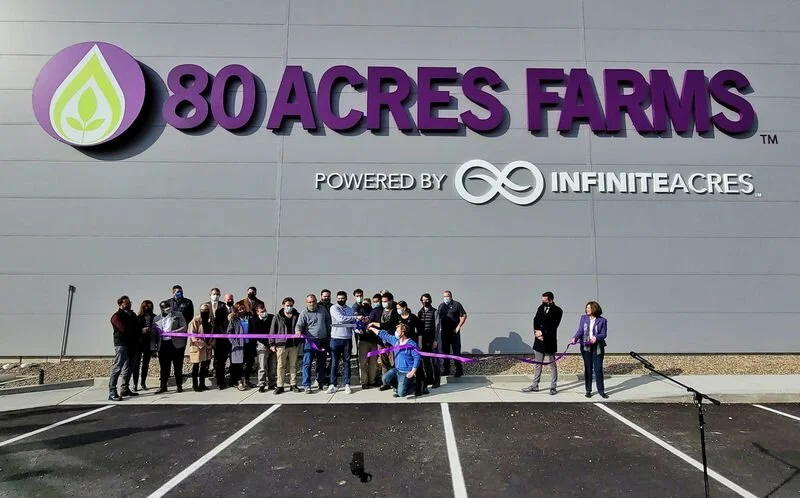
The immense indoor growing operation that 80 Acres opened in Hamilton on Wednesday continues a move toward a “a new standard” in food quality, company CEO and co-founder Mike Zelkind said at its grand opening
NEWS | Jan 14, 2021
By Mike Rutledge
The immense indoor growing operation that 80 Acres opened in Hamilton on Wednesday continues a move toward a “a new standard” in food quality, company CEO and co-founder Mike Zelkind said at its grand opening.
“What we are here to celebrate today is an automated farm that can grow a variety of fruits and vegetables — not just leafy greens and lettuces — but soon, tomatoes, cucumbers, and peppers, and berries, in the same system, year-round, without any pesticides, using 97 percent less water,” he said.
“What you’re seeing here today is a new standard being set for food quality, way beyond the organic, which was the best until today. A farm that smartly removes much of the back-breaking labor through innovation, creates high-quality jobs, a farm that is designed for food-safety and quality, a farm that is built to keep workers safe and customers healthy.”
Explore Inside the change: How Hamilton’s 80 Acres works on the front lines of farming tech
The ceremony, with a champagne toast and a recorded video speech by Gov. Mike DeWine, was linked to company partners in the Netherlands, United Kingdom and Sweden, among other companies, as well as to other 80 Acres farms in this country, officials said.
“Ohio is showing the world what future farms can look like,” DeWine said in his remarks.
He noted the new $30-million-plus, 62,000-square-foot building will be able to ”grow more than 10-million healthy servings of fresh food each and every year.”
“This facility’s already growing unprecedented yields of high-quality, most varied produce that you’ll find anywhere in the world,” Zelkind said. “And it really took a village to make this happen, so thank you all very much.”
Mayor Pat Moeller said “the future visited Hamilton, Ohio, a couple years ago when 80 Acres came to town. And the future has now put down even more roots, and Hamilton is very, very grateful.”'
Explore Innovative Hamilton company 80 Acres Farms impresses Ohio agriculture leader

VIDEO: Common Mistakes When Setting Up Hydroponics
Even if you have a lot of guidance in setting up your grow space, you may make mistakes in the initial development stages
January 4, 2021 | By Joy King
Starting a hydroponics garden is thrilling. It's an exciting project where you can enjoy the progress your plants make over time. However, producing perfect plants requires some skill and attention to detail that take time to develop. Even if you have a lot of guidance in setting up your grow space, you may make mistakes in the initial development stages.
What is hydroponics?
Wikipedia describes hydroponics as "a type of horticulture as a method of growing plants, usually crops, without soil. It's become popular in vertical and indoor farming. Let's examine some common errors to avoid when setting up a hydroponics grow:
Ignoring plants
New growers may not devote the amount of time necessary to grow hydroponically. Some mistakenly believe that they can check in on plants on the weekend. But, a lot can go wrong if you're not regularly checking on them. Even if your system is fully automated through a grow controller, it's essential to check on your plants daily to ensure that everything is going smoothly.
Check that your automation system isn't clogged or failed in some other way. Once you are a more experienced grower, it will become easier for you to identify failures in your systems and problems with your plants since you're dedicating time to their wellbeing.
Going overboard
More is not always better, particularly in regards to plant growth. Often, problems arise in the grow room from a lack of experience in tending to plants grown hydroponically. It usually takes time to understand how to irrigate and fertilize plants properly. Overwatering is often detrimental to plants, and beginners often do not realize they are overwatering before it is too late. Excessive nutrients, or nutrient burn as it's referred to, is also a common problem for beginners.
Overcrowding plants
It is common for beginners to overestimate how many plants will fit in their grow space. When you first plant them, it may seem that your plants have a lot of room, but once they grow up, they will need that extra space to maintain growth. Be vigilant about removing excess plants and pruning if overcrowding seems like it will be a problem. When in doubt, err on the side of caution and plant fewer plants.
Sudden changes to the environment
You need to give your plants time to adjust when you make changes. One of the most common problems that beginners face is when they suddenly change the grow room's light levels or room temperature. Any sudden increase in light may cause leaf bleaching and burning. It's better that you make changes gradually, giving your plants time to adjust.
Final thoughts
There are many scholarly books on starting hydroponics grow room or space. Do your research and enjoy your hydroponic garden! It's a rewarding way to grow food, cannabis, or flowers.
Source: Growlink
Tags: Hydroponics, Nutrient Dosing System, Wireless Automation, Automated Grow System, Customer Service, Automated Grow Systems, Nutrient Delivery System, nutrients, automation

Liberty Produce & Writtle University College Launch Webinar Series On The Transformation of Agriculture And Its Workforce For A Sustainable Future
Writtle University College (WUC) in Essex and Liberty Produce launch their highly anticipated public webinar series on January 27th 2021.
18th January 2021
London & Essex, UK
Writtle University College (WUC) in Essex and Liberty Produce launch their highly anticipated public webinar series on January 27th 2021. The online events will consider major issues facing the horticulture and agriculture sectors based around a key theme of ‘Transforming Agriculture and its Workforce for a Sustainable Future.’
Each of the webinars will feature a range of prominent industry figures and will welcome all viewers with an interest in sustainable production. All online events will be free-of-charge, in line with WUC and Liberty Produce’s ongoing commitment to education and knowledge-sharing. This webinar series is being supported by EIRA, a collaborative project funded by Research England that connects businesses in the East of England with academic expertise, specialist facilities and funding opportunities.
Dr Anya Perera, WUC’s Head of School for Sustainable Environments & Design, said: “We are proud to be working in collaboration with Liberty Produce and EIRA. Our three introductory webinars will focus on challenges faced by growers at a national and international level. We are delighted by the positive response from key members of the sector and look forward to sharing vital topics with our expert panellists.”
Benita Rajania, Product Director at Liberty Produce, said: “We are delighted to be teaming with WUC to bring together stakeholders from across our community for this new webinar series. Collaboration is a vital component in tackling the challenges our sector is facing, and we look forward to meeting virtually with our colleagues from across industry and academia to discuss latest developments, share knowledge and strengthen relationships at an industry level.”
Topics include: the modernisation of agriculture through technological advancement; examining food production systems and identifying skills gaps; how to create a fit-for-purpose workforce in a sustainable economy.
Each subject will be discussed by an expert panel, featuring guests including Dr Susan McCallum from the James Hutton Institute and Belinda Clarke, Director of Agri-TechE.
Since its foundation in 2018, Liberty Produce has been dedicated to the development of sustainable agricultural practices. The farming technology company was created in response to the global food security crisis. Liberty Produce develops leading-edge technology that enables the growth of local produce year-round, using fully-controlled indoor vertical farming systems.
WUC recently became the first UK university to offer degrees in regenerative agriculture. WUC been teaching land-based courses since 1893 and, in 2020, was ranked top university-sector institution in England for overall student satisfaction by the National Student Survey. Its small class sizes and specialist courses offer students a personalised approach that combines practical skills with cutting-edge theory.
2021’s webinar series reflects WUC and Liberty Produces’ collective dedication to the creation of long-term sustainable food production at a time of climate crisis and the disruption of global supply chains.
Click the links below to book your free webinar place:
January 27th: The modernisation of agriculture through technological advancement
https://register.gotowebinar.com/register/6675999720069964303
February 24th: Examining food production systems and identifying skills gaps
https://register.gotowebinar.com/register/7622331785910917132
March 24th: How to create a fit-for-purpose workforce in a sustainable economy
https://register.gotowebinar.com/register/8843380130486408204
About Liberty Produce
Liberty Produce is a farming technology company founded in 2018 to drive innovations that will enable us to meet our global crop requirements over the next century, without harming the planet. As experts in the development of technology (from advanced lighting systems to machine learning for integrated control systems) for the breadth of indoor agriculture (from glasshouses to Totally Controlled Environment Agriculture systems), Liberty delivers research and products that consistently push boundaries. Liberty Produce develops and builds systems that reduce operational costs with enhanced resource efficiency, improve yields and increase sustainability for greater food security through the growth of local produce year-round. www.liberty-produce.com
Further images available here.
Media enquiries: Claire Apthorp media@liberty-produce.com +44 (0) 7920403068
General enquiries: info@liberty-produce.com; +44 (0)20 7193 2933
About Writtle University College (WUC)
Writtle University College (WUC) has been at the forefront of the agrifood sector since 1893. In 2020, it was named the highest rated university-sector institution in England for student satisfaction by the National Student Survey, also receiving 100% satisfaction for its horticulture course. Industry-focused programmes offer the skills, expert theory and qualifications required to enter a fast-moving sector. WUC recently launched a degree in regenerative agriculture, which is the first of its kind in the UK. https://writtle.ac.uk/
Media enquires: Sara Cork press@writtle.ac.uk
About EIRA
EIRA is a collaborative project between seven universities and colleges in the East of England. Driving economic growth in the region, EIRA connects businesses with academic expertise, consultancy, facilities and funding opportunities. Led by the University of Essex, EIRA is also supported by the University of East Anglia and the University of Kent. Backed by £4.7 million of Research England’s Connecting Capability Fund, EIRA delivers activities across three themes: digital creative, artificial intelligence and biotechnology. EIRA has opportunities to work with businesses of all sizes through Innovation Vouchers, Research and Development Grants, i-Teams, Hothouse events, Start-up Microfinance and Innovation Internships. eira.ac.uk
General enquiries: eira@essex.ac.uk
Twitter: @EIRA_eARC

iFarm Is Taking Part In The Grand Finale of The Global Startup Awards Day
The award ceremony will be held on January 27. It is a great honour for us to be nominated
iFarm is taking part in the Grand Finale of the Global Startup Awards Day. The award ceremony will be held on January 27. It is a great honour for us to be nominated.
We appreciate you taking the time to help us grow!
Vote for iFarm

Indoor Farming Industry Gets Boost From COVID-19
The coronavirus pandemic has caused a major shift in dining out and led many Americans to become more familiar with their kitchens than ever before
By Steve Bradley
The coronavirus pandemic has caused a major shift in dining out and led many Americans to become more familiar with their kitchens than ever before. In fact, according to the 2020 “America Gets Cooking” report commissioned annually by Hunter, a food and beverage public relations and marketing communications consultant, more than half (54 percent) of Americans report they are cooking more during the pandemic. 1
Thirty-nine percent said in a survey they are trying to eat healthier, with many saying they are becoming adventurous in the kitchen, trying new ingredients, brands, and products. 1 Salads and vegetables are two of the top five food items survey respondents say they are preparing more.
This presents a tremendous opportunity for grocers to meet this demand for preparing meals at home, as well as a growing desire to maintain a healthy diet during the pandemic to assist in fighting off the unwanted pounds associated with staying at home.
Fresh produce can play a key role in eating healthy but is not something that can easily be ordered through an online retailer like non-perishable goods. Shoppers like to hold and visually inspect produce for freshness, firmness, crispness, color, and other desirable characteristics.
In short, fresh produce is a primary driver of traffic into grocery stores.
Additionally, consumers also want to know that what they are buying can be trusted. Salmonella, e-coli, and other pathogens have unfortunately made their way into our fresh produce supply, causing massive recalls, illnesses, and even deaths. Consumers want to know they are buying a safe product and – increasingly – want to know more about where it came from and how it was grown. Words like “organic,” “non-GMO” and “locally sourced,” have become part of everyday language for many Americans.
Leading indoor farming companies, like BrightFarms, offer hydroponically grown, “cleaner than organic” packaged salads that results in a higher-quality product that consumers can trust. Even produce labeled “organic” has likely been treated with chemicals such as pesticides and herbicides. This also means the consumption of water, land, and costs associated with shipping produce are dramatically reduced. Additionally, locally grown means the quality is preserved through a much shorter shipping process, while also relying on less fuel due to shorter travels to market.
Controlled-environment agriculture ensures produce is not subjected to the whims of nature, such as drought, excessive rain, or other weather patterns.
In many ways, the BrightFarms’ model of bringing local produce around the U.S. into commercial stores has the potential to disrupt the multi-billion-dollar leafy greens industry. Few people could have likely imagined 10 years ago that hailing a taxicab would no longer be the “go-to” for getting around town. Similarly, corporations, with the ability to look around corners and see the future, are re-imagining how consumers get high-quality local produce onto dining room tables.
We need to feed a growing population in a more efficient way – not tied to any one certain geographic area. Investments in cleantech-focused on resource efficiency, resiliency, and adaptation. Local, sustainable, controlled environment produce consumers can trust gives us that opportunity. We believe it is possible to make the world a better place – building a better future for the next generation – while also growing business and creating jobs.
Steve Bradley serves as vice president of Cox Cleantech at Cox Enterprises, Inc. based in Atlanta, Georgia.
GREENHOUSE VERTICAL FARM BUSINESS TECHNOLOGY CLIMATE HYDROPONICS
Hunter. (2020). SPECIAL REPORT, America Gets Cooking: The Impact of COVID-19 on American’s Food Habits. [Food Study]. Retrieved from https://bit.ly/38DIhsR

What Can You Grow In Aeroponics?
There are many different types of crops that you can grow in an aeroponic system and many of these make a good business case, as well as boasting impressive environmental benefits
15-01-2021 | LettUsGROW
Aeroponics is a method of growing that doesn’t use soil. Instead, plant roots are irrigated with a nutrient-dense mist. This allows for access to greater oxygen levels and prevents water logging - resulting in higher yields and faster growth rates.
There are many different types of crops that you can grow in an aeroponic system and many of these make a good business case, as well as boasting impressive environmental benefits. Here are some of the crops you can grow in an aeroponic system:
Microgreens
These are greens that are popular in high-end restaurants as garnishes or in salad mixes. It is possible to grow large amounts of microgreens very quickly in an aeroponic system. In our systems, varieties such as micro radish and micro broccoli needed only 3-5 days in grow beds after germination.
The nutritional value of a crop will vary depending on what stage in its development it is at. Microgreens are in the stage when they are at their most nutritious, other than when they are a seed. However, the nutrients aren’t as easily digested by us in this form, so a plant is most nourishing when it’s a microgreen. This means you don’t need to eat a lot of them to receive a high dose of nutrition.
Leafy greens, herbs & salads
Perhaps the most common crops you’ll find growing in an aeroponic system are leafy greens and salads, which benefit from year-round growing. They are often used in pre-made salad boxes, sandwiches or in restaurants. Salads have a short shelf life, so growing them as close to the consumer as possible prevents food waste. It also allows you to grow for maximum taste, rather than to ensure crops survive a long journey to the supermarket. Popular crops include basil, lettuce and pea shoots.
Fruiting crops
Offering fruiting crops in the winter months not only benefits consumers, but allows fruit farmers a more consistent annual turnover and workload. Strawberries are a great choice of crop to grow in an aeroponic system because they can have a very limited growing season.
Tomatoes can also be grown aeroponically. They see the same benefits of year round growth and not requiring soil. This makes the growing process simpler, as there is no need to repot young crops. However, tomato plants require more space than leafy greens and microgreens, which impacts the ability to grow vertically. Therefore, aeroponic tomatoes may be better suited to greenhouse systems. This does not mean vertically farmed tomatoes are ruled out, as there are some dwarf tomato varieties that are smaller but still yield fruits.
Tree whips
Nurseries offer a stable, optimised environment for trees to be propagated and grown to a desired size, and it is possible for growth at this stage to be completed in an aeroponic system. Successfully propagating depends greatly on the quality of the seedling stock. It’s also important to establish a healthy root system, as survival after planting depends heavily on the plant’s ability to uptake water.
Aeroponics produces large and healthy root bodies, which may aid establishment and increase the success of forestry projects. One challenge of growing tree whips, whether in soil, water or mist, includes the possibility of transplant shock - strong root stock is key to mitigating this. We are planning to undertake further research to understand how aeroponics may interact with other factors surrounding tree propagation.
Rooting crops
Aeroponics can be used to grow various rooting crops, for example there has been much research into growing potatoes aeroponically, showing several advantages of the systems. At LettUs Grow we have grown both baby carrots and radishes. As the growth of this type of crop is very different to leafy greens, systems are required to focus more on the growth within the root chamber. Greater space, support and access to the roots is needed, therefore system redesigns would likely be required to consistently grow commercially viable rooting crops.
Click here for more information.
Photo created by freepic.diller - freepik

US: Public Oral Argument In Hydroponically-Grown Organic Food Lawsuit
CFS filed a petition requesting USDA to prohibit organic certification of hydroponic operations that do not work with or build soil in 2019
Source: Vertical Farming Daily
On Thursday, January 21st, the United States District Court for the Northern District of California will hear arguments in Center for Food Safety's (CFS) ongoing lawsuit challenging the U.S. Department of Agriculture's (USDA) "soil-less" loophole that permits the labeling of hydroponically-grown foods as USDA Certified Organic, even though the Organic statute and regulations clearly mandate all organic crop producers foster soil fertility in order to obtain organic certification.
WHAT: Oral Argument in Center for Food Safety's Lawsuit Challenging the Labeling of Hydroponically-Grown Foods as Organic
WHEN: Thursday, January 21, 2021, at 1:30 PM PST
(Note: the Court's afternoon session starts at 1:30 PM and is currently listed as the first of the two cases scheduled for hearing that afternoon, but the Court can hear the cases in any order it wishes).
WHERE: District Judge Richard Seeborg's Virtual Courtroom via Zoom.
CFS filed a petition requesting USDA to prohibit organic certification of hydroponic operations that do not work with or build soil in 2019. After USDA denied the petition, CFS, along with a coalition of organic farms and stakeholders, filed a lawsuit challenging USDA's decision to allow hydroponic operations to continue to be certified organic in March 2020. The lawsuit claims that hydroponic operations violate organic standards for failing to build healthy soils, and asks the Court to stop USDA from allowing hydroponically-produced crops to be sold under the USDA Organic label.
Hydroponic operations, or "hydroponics," describes methods of growing crops using water-based nutrient solutions without any soil. CFS's lawsuit cites the federal Organic Foods Production Act, which requires farms to build soil fertility in order to be certified organic. Hydroponics cannot comply with federal organic standards because hydroponic crops are not grown in soil. Allowing hydroponics to be certified organic is another attempt to weaken the integrity of the Organic label, and has resulted in market confusion and inconsistent organic certifications.
Thursday's hearing on summary judgment will be the only time the Court will hear oral arguments on whether hydroponic operations that do not work with soil meet the mandatory requirements to be sold under the USDA Organic label, and whether USDA violated the federal Organic Foods Production Act when it decided to exempt hydroponic operations from the Organic Label's soil-building requirements.
The plaintiff coalition in the lawsuit includes some of the longest-standing organic farms in the United States, including Swanton Berry Farm, Full Belly Farm, Durst Organic Growers, Terra Firma Farm, Jacobs Farm del Cabo, and Long Wind Farm, in addition to organic stakeholder organizations, such as organic certifier OneCert and the Maine Organic Farmers and Gardeners Association.
Publication date: Wed 20 Jan 2021

What Are The Emerging Trends Affecting Indoor Farming? State of Indoor Farming Survey
Artemis Ag has opened its third annual State of Indoor Farming Survey, and is looking for your input
By Artemis Ag
January 9, 2021

Photo: Kalera
Artemis Ag has opened its third annual State of Indoor Farming Survey, and is looking for your input. The survey will provide insights on emerging trends and challenges in the greenhouse and vertical farming industries.
“We’re looking forward to learning how growers are facing new challenges such as COVID-19,” says Allison Kopf, CEO of Artemis Ag. “In the past, expansion was one of the prime goals for growers, and we’ve asked some new questions around the topic. We will be sharing even more information related to technology usage, the evolution of the industry, and how growers are working with lenders.”
In the past few years, more than 500 growers have participated in Artemis’ annual State of Indoor Farming Surveys. Past reports have been downloaded more than 2 million times and are one of the most widely circulated and respected sources of industry data.
More and better data collected means more insights for growers. Growers can participate in the 2020 State of Indoor Farming survey here.
The survey will be open for a few weeks and Artemis expects to launch the 2020 report immediately following.
Learn more here.

Join Next Week's Career Advancement WIA Meet Up
WIA Virtual Meet-Up Come with your ideas, thoughts, and questions as we brainstorm in small groups to strategize on Career Advancement
Job searches, interviews, promotions
and other aspects of Career Advancement
have transformed in the last year.
Come share with your community,
how you have kept your career on track.
Register via our Home Page
Know someone that would benefit from a Meet Up?
Please spread the word.
See you there!
Women in Agribusiness Team
eventinfo@highquestgroup.com

8 Easy Steps To Start Your Farm
Whether you want to sell to restaurants, hotels, or members of your local community, The Greenery™ makes it possible for anyone to grow local food on a commercial scale.
We’ve worked with farmers across the globe to help them establish successful businesses, so we know what you’ll need to do to launch a successful business.
Here’s what you’ll need to get started:
STEP 1
Understand hydroponics and your local food market.
STEP 2
Build your business plan.
STEP 3
Secure financing for your farm.
STEP 4
Find your perfect farm site and research your municipality’s zoning laws.
STEP 5
Get trained - join us at Farm Camp or in Farmhand Academy
STEP 6
Prepare for arrival - our Client Services team will take care of all the logistics!
STEP 7
While your crops start to grow, develop your marketing, packaging and other facets of your business.
STEP 8
Launch your farm and join the community of growers. Read advice from others like you.
The Freight Farms team will be there to support every step of the way.
Schedule a call today to get all your questions answered
and take the first step towards building a successful business.
Book A Consultation

Vertical Farming’s Success Depends On The Cheapest Lightbulb
More than a decade ago, microbiologist Dickson Despommier floated the idea that nations with little arable land like the UAE could become self-reliant by growing food in skyscrapers with perfectly optimized artificial light and heat
The industry promised to tackle world hunger. But all it may end up delivering for now is expensive basil and perhaps some better quality marijuana.
January 16, 2021
Abu Dhabi’s giant Yas Mall isn’t the most obvious location for embracing nature. The sprawling complex, which houses a 20-screen cinema, leads to a Ferrari-themed amusement park.
At its heart is the Carrefour SA hypermarket. There’s no natural light or soil, yet floor-to-ceiling shelves offer shoppers herbs and microgreens grown right in the store. The fresh produce is a rare sight in the United Arab Emirates, which is almost all desert and imports 80% of its food. It’s marketed as a healthy way for customers to reduce the carbon emissions that would be generated transporting their groceries.
Carrefour grows herbs and microgreens such as arugula on shelves stacked floor to ceiling.
Photographer: Christopher Pike/Bloomberg
More than a decade ago, microbiologist Dickson Despommier floated the idea that nations with little arable land like the UAE could become self-reliant by growing food in skyscrapers with perfectly optimized artificial light and heat. He called it vertical farming and argued that it could reduce world hunger and restore forests depleted by commercialized agriculture. It would also eliminate planet-warming emissions caused by plowing fields, weeding, and harvesting, as well as transportation.
In the years since millions of dollars have poured into companies trying to make Despommier’s idea a reality. Agriculture and forestry account for about a quarter of the world’s greenhouse gases, while the hunt for new farming land to feed a growing global population has exacerbated deforestation. The prospect of solving both problems has enticed all sorts of investors, from tech entrepreneurs to restaurateurs and industry giants like Walmart Inc.
A record $754 million of venture capital was invested in the industry in the first three quarters of 2020, according to PitchBook data, a 34% increase from the whole of 2019. It’s drawn particular interest in Singapore and the UAE, whose governments have set goals to increase their national food production.
Mostly Leaves
Percentage of vertical farmers who say they grow a given crop

But vertical farming will have to get a lot cheaper to deliver on its lofty aspirations. While it frees up arable land and uses 95% less water, creating the ideal conditions for growing plants ends up consuming much more energy than traditional methods. Lights need to run for 12 to 16 hours a day and heating must be used in the winter. Miguel Povedano, chief operating officer at Majid Al Futtaim Retail, which runs the Carrefour franchise across the Middle East, Africa, and Asia, says vertical farms cost 20% to 30% more than traditional ones.
Investors may not be able to live up to the hype they’ve created around the industry, and see their bubble burst before they have a chance to prove themselves, says Michael Dent, an analyst at IDTechEx. “If people are expecting world-changing progress and they don’t see it in the first two or three years — and what they see is high-quality salad — there’s a chance they might pull out their investment on the field and move on to the next thing.”
His analysis shows that most vertical farmers focus on herbs and salad greens because of their rapid and simple crop cycles. Microgreens in particular are popular with consumers concerned with healthy eating, rather than in deprived areas. They’re also more likely to grow herbs like cannabis than higher-calorific squashes or melons, which need more energy and water.
A migrant worker adjusts lettuce inside an indoor hydroponic farm operated by Green Container Advanced Farming LLC (GCAF) in a Carrefour SA grocery store in Dubai, United Arab Emirates, on Monday, Nov. 9, 2020. Photographer: Christopher Pike/Bloomberg
Rather than feeding the world’s poor with high-calorific foods, the microgreens and herbs grown by indoor farms are only going to be an option for the world’s wealthy elite for many years to come. Vertically farmed produce is far more expensive than conventionally farmed goods and even most organic produce, Dent found. For example, New York-based Bowery Farming’s indoor-produced kale mix is almost three times more expensive per pound than Whole Foods Market’s baby kale option, and its cilantro is more than five times more expensive than its Whole Food’s equivalent.
Emerald Technology Ventures investor Gina Domanig says she’s more interested in backing technologies that can reduce energy costs than the farms themselves. She compares indoor farming to desalination technology — the process of removing salt from seawater to provide fresh drinking water to people in water-stressed countries such as Israel.
“When desalination came out, everybody said it’s the holy grail for freshwater,” she says. “But desalination is really energy-intensive.” Vertical farming “might be an interesting thing” if there are technologies to make it less energy-intensive, she says, but right now “it’s not economic or environmentally sound in all areas.”
Salad greens require less energy and water to grow indoors than higher calorific foods.
Photographer: Christopher Pike/Bloomberg
One option to cut costs is solar power, which has become the cheapest source of electricity in many parts of the world. In Germany, Farmers Cut has developed a combination of solar power plants and batteries so it pays less for power than it would connecting to the country’s grid, says Chief Executive Officer Henner Schwartz. The cost of storing energy can be as low as 10 or 11 euro cents per kilowatt in Germany.
“The energy issue is the key thing you need to crack,” he says. “We’re not claiming we can do carrots or watermelons any time soon at competitive prices, because it’s just not possible.”
In Abu Dhabi, Carrefour is trying to find a lightbulb supplier who can reduce its power use by as much as 65%, according to Povedano. “The kilowatts consumed in electricity is the major handicap,” he says. “It’s not only what you, as a company, want to do. It’s how you get the customer to substitute imported products for this technology, and the key is that it needs to be really affordable in terms of price.’’
— With assistance by Agnieszka de Sousa
Lead photo: LED lighting at an indoor hydroponic farm inside a Carrefour SA grocery store in Dubai.
Photographer: Christopher Pike/Bloomberg
US: KENTUCKY: Breathitt Students Join AgTech Farming, Will Feed The Community
The retrofitted shipping container will serve as a hands-on agricultural classroom for students at Breathitt High School, allowing them to grow and provide fresh leafy greens to their classmates and those in need in and around Jackson
By Steve Rogers
January 15, 2021
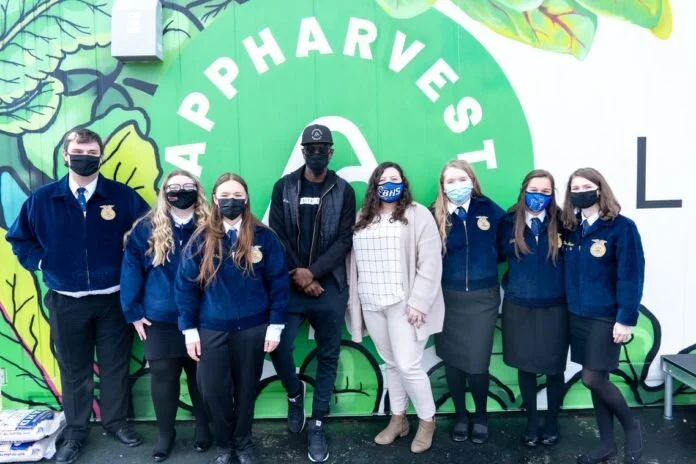
JACKSON, Ky. (WTVQ) — AppHarvest and the United States Department of Agriculture announced the expansion of the company’s educational high-tech container farm
program for Eastern Kentucky high school students, unveiling a new container farm unit at Breathitt High School in Jackson.
The program demonstrates the company’s ongoing commitment to fostering interest in high-tech farming, as it seeks to create America’s AgTech capital from within Appalachia.
The retrofitted shipping container will serve as a hands-on agricultural classroom for students at Breathitt High School, allowing them to grow and provide fresh leafy greens to their classmates and those in need in and around Jackson.
The U.S. Department of Agriculture provided the majority of funding for the unit through its Community Facilities grants program.
The educational container farm’s arrival was formally celebrated Friday, Jan. 15, with U.S. Department of Agriculture Rural Development State Director Hilda Legg and Appalachian Regional Commission Federal Co-Chairman Tim Thomas among those attending.
Attendees toured the container farm and learned about its high-tech tools.
“This amazing project will not only put fresh vegetables on the table, but, more importantly, it will teach tomorrow’s agribusiness leaders — and do all of that right here in Eastern Kentucky,” Legg said. “This public-private partnership is exactly what we need more of, and I’m proud to have been a part of it.”
The container farm is 2,880 cubic feet, weighs 7.5 tons and includes space to grow up to 4,608 seedlings and 8,800 mature plants all at once using 440 vertical crop columns. The container’s unique design utilizes cutting-edge LED lighting and closed-loop irrigation systems to allow students to grow far more than traditional open-field agriculture.
For instance, they can grow up to 940 full heads of lettuce, or 1,570 miniature heads, per week, as part of a single crop.
“We are excited to partner with the USDA and AppHarvest to bring a new container farm to our students and community members of Breathitt County,” said Breathitt County Schools Superintendent Phillip Watts. “Our goal is to teach the students how to grow fresh vegetables and support the local food supply. The inspiration, excitement and innovation that AppHarvest brings to Eastern Kentucky is a blessing for our region.”
Breathitt High School Agriculture Educator Taylor Masters teaches more than 200 students, who will utilize the container farm as part of their studies. “Our students will now be able to work hands-on yearround and the food they grow will help our community in addressing food deserts,” she said.
The Breathitt County container farm joins AppHarvest’s inaugural container farm serving Pike County’s Shelby Valley High School students and its second unit at Rowan County Senior High School.
All three containers are part of AppHarvest’s high school AgTech program, which provides Kentucky students with hands-on experience growing leafy greens and other nutritious foods in a high-tech environment.
Leafy greens from the inaugural Shelby Valley High School program have fed the surrounding community through a backpack program and donations to a food pantry.
A similar food distribution program is planned for the Breathitt County container farm.
AppHarvest is an applied technology company building some of the world’s largest indoor farms in Appalachia. The company combines conventional agricultural techniques with cutting-edge technology and is addressing key issues including improving access for all to nutritious food, farming more sustainably, building a home-grown food supply, and increasing investment in Appalachia.
The company’s 60-acre Morehead, Ky. facility is among the largest indoor farms in the U.S.

Vertical Grower Plenty Adds Former Impossible Foods’ Sales VP
"We are delighted to welcome Dana to the Plenty family as we continue to manage our substantial growth trajectory," Nate Storey, Plenty co-founder, said in the release
By CHRIS KOGER
January 14, 2021
Vertical farming company Plenty, South San Francisco, has added former Impossible Foods vice president of sales Dana Worth as senior vice president of commercial.
Worth led the debut of the plant-based Impossible Burger, building the sales and commercial teams for the company, according to a news release from Plenty. While at Impossible Foods, he helped sign deals with Starbucks, Burger King and other foodservice outlets to build the Impossible Burger brand.
"We are delighted to welcome Dana to the Plenty family as we continue to manage our substantial growth trajectory," Nate Storey, Plenty co-founder, said in the release. "Dana's experience working with fast-growing companies, such as Impossible Foods and PayPal, who are pioneers in their markets, will be instrumental as we accelerate both our corporate and commercial footprint and establish our platform as the standard for indoor vertical farming."
Plenty has promoted Megan Gillespie to vice president of farm operations and Daniel Malech to senior vice president of strategy and general counsel.
Gillespie, formerly of Tesla, joined Plenty in 2019 and has been pivotal in getting the company’s flagship farm operational. In 2020, she led an expansion strategy, tripling the production and ensuring product made it to stores and food banks, according to the release.
In her new role, Gillespie will oversee farm operations for Plenty's farms, including its latest facility - the world's first high-output, indoor vertical farm in Compton, California - bringing access to healthy vegetables and new jobs to the community.
Malech joined Plenty in 2018 as head of legal, advising the company on business strategy and implementation. His new role includes regulatory, compliance, and overseeing the company’s intellectual property portfolio.

Polygreens Podcast Episode: 009 - Hydroponic Consultant
Hydroponics is a growing method for beginners and experts alike
Hydroponics is a growing method for beginners and experts alike. This innovative farming system provides users with more controlled environments to grow their crops all-year-round. In this podcast, you will learn about hydroponics consulting, and we’ll cover the basics to get you started.
Nick GreensThe Nick Greens Grow Team has participated in many changes since they started developing indoor controlled agricultural environments in 2010. Our goal is to expand the vertical farming industry by helping ag-entrepreneurs manage their businesses better, avoid common mistakes, and improve crop yields based on what we have observed and developed over the past decade.
YouTube

Aquaponics Letter To The Biden-Harris Transition Team
In the Letter, the Aquaponics Association requests that the incoming Administration consider three actions to support the growth of aquaponics
January 7, 2021
The Aquaponics Association has sent a letter to the Leadership of the Biden-Harris Transition team for the U.S. Departments of Agriculture and Commerce.
View the Aquaponics Letter to the Biden-Harris Transition
In the Letter, the Aquaponics Association requests that the incoming Administration consider three actions to support the growth of aquaponics: 1) fully establish the USDA Office of Urban Agriculture and Innovative Production; 2) recognize new and emerging food production systems, such as aquaponics systems, as critical suppliers of food; and 3) ensure that aquaponics remains eligible for USDA Organic Certification.
Aquaponics will further establish the United States as a leader in sustainable agriculture and build a better future for generations to come.