


Welcome to iGrow News, Your Source for the World of Indoor Vertical Farming

US: OHIO: Global Indoor Farming Venture Deal Features Company With Hamilton Ties
Infinite Acres’ mission is to use technology and expertise to grow quality produce near urban population centers worldwide. The partner companies push to expand vertical indoor farming when consumers are seeking locally grown produce
Published: Wednesday, September 25, 2019
By: Eric Schwartzberg - Staff Writer
80 Acres Farms is taking steps to broaden the reach of the state-of-the-art vertical farming operation it already employs in Cincinnati and Hamilton.
— Ocado Group, the world’s largest dedicated online grocer, completed a deal to partner and invest in Infinite Acres, a full-service global solutions provider to the indoor horticulture and agriculture industries.
Headquartered in Delft, Netherlands, Infinite Acres is a partnership of three companies:
• Hamilton-based 80 Acres farms, a leader in technology-assisted indoor growing and a multi-farm operator marketing a wide variety of freshly harvested vegetables and fruits;
• UK-based Ocado; and
• Netherlands-based Priva Holding BV, a leading provider of technology solutions, services and automation systems to horticultural and other industries.
FIRST REPORT: Hamilton’s large indoor growing operation is so advanced they want it around the world
As Infinite Acres, the three companies work together to scale indoor food production through vertical farming done in environmentally controlled, pesticide-free facilities.
The joint venture was announced in June, and since has been engaged in several international projects.
Infinite Acres’ mission is to use technology and expertise to grow quality produce near urban population centers worldwide. The partner companies push to expand vertical indoor farming when consumers are seeking locally grown produce.
MORE: ‘The perfect home’: Why 80 Acres chose Hamilton to move its headquarters and create 125 jobs
“Infinite Acres is the only full-service solution available today addressing the difficult challenges of season-limiting produce production and the long-distance travel from field to the consumer,” said Tisha Livingston, chief executive officer of Infinite Acres. “In our experience, consumers prefer their produce to be grown nearby and freshly harvested when they purchase it.
“That’s something we can now provide year-round. We welcome Ocado’s innovative technology and customer-centric software systems, robotics, automation, and market intelligence as we revolutionize food production together with Priva and 80 Acres Farms.”
Stewart McGuire, Ocado Group head of corporate development, said the company is “delighted” to be part of the Infinite Acres joint venture, which will bring together “unprecedented and complementary expertise” in vertical farming.
“The future is about great tasting food, sustainably produced. Infinite Acres, supported by Ocado’s technology, will be an important catalyst in making this happen,” McGuire said.
MORE: Dilapidated Hamilton building transforms into an industry-changing grow facility

Indoor Farm Started In A Shipping Container
The Gruger Family Fungi farm has come a long way since its beginning in a metal shipping container. Today the mushroom farm is in a warehouse in an oilfield industrial park
September 26, 2019
Rachel Yadlowski shows some of the mushrooms grown in her family’s indoor farm. | Mary MacArthur photo
An Alberta family’s mushroom operation sells its produce to wholesale markets, restaurants, hotels and specialty stores
NISKU, Alta. — The Gruger Family Fungi farm has come a long way since its beginning in a metal shipping container. Today the mushroom farm is in a warehouse in an oilfield industrial park.
There may not be soil, gravel roads and quarter sections of land, but Rachel Yadlowski believes their warehouse bay is a new kind of farming.
“We are farming in a warehouse. It’s an indoor farm,” said Yadlowski, who operates the farm along with her husband, Carleton Gruger, and other family members.
“It’s a different kind of farming. It’s a different way of producing nutrition all year around.”
This farm doesn’t grow just one crop, it grows a colorful collection of tree-loving mushrooms few people have heard of, seen, or eaten.
The pink oyster mushroom has a subtle bacon flavor, while the blue oyster becomes soft and velvety when cooked. The gold oyster has “fruity notes” and the king oyster is nutty and cashew-like. The lion’s mane mushroom looks like cauliflower and tastes like lobster.
And those are just the eating mushrooms. The family grows reishi and codyceps for tinctures and creams sold for their health benefits.
For hundreds of years, mushrooms have been an important part of people’s diet as a source of protein and healing powers. Yadlowski wants to bring mushrooms back as an important part of our diet.
“We’ve lost our mushroom knowledge.”
Yadlowski has been making converts from her farmers market table and now from the grocery store promotion booth since the family fungi business started in 2015. When customers look at the strangely shaped fungi, they’re worried the mushrooms she sells are not safe to eat, or are just too strange to eat.
Almost half of their customers are vegan, buying mushrooms for their high level of protein. A growing number of chefs and home cooks want to incorporate the unique flavoured mushroom into foods. The mushrooms are now sold through wholesale markets, restaurants, hotels and specialty stores.
The process of raising mushrooms begins in the laboratory with spores grown in a petri dish.
“This is where we’re cultivating the seed for our fungi farm.”
The spores are added to jars of sugar water and then splashed into a bag of warm wheat grain to grow and expand. That bag is added to a mixture of hemp herd, hemp heart screens and mash from the nearby Rig Hand Distillery.
“It’s all nutrition for our mushrooms.”
The mycelium-rich mixture is mixed together in the mushroom mash mixing machine before it’s heated, cooled and squished into long, plastic-shaped logs and hung in one of 13 climate-controlled growing rooms.
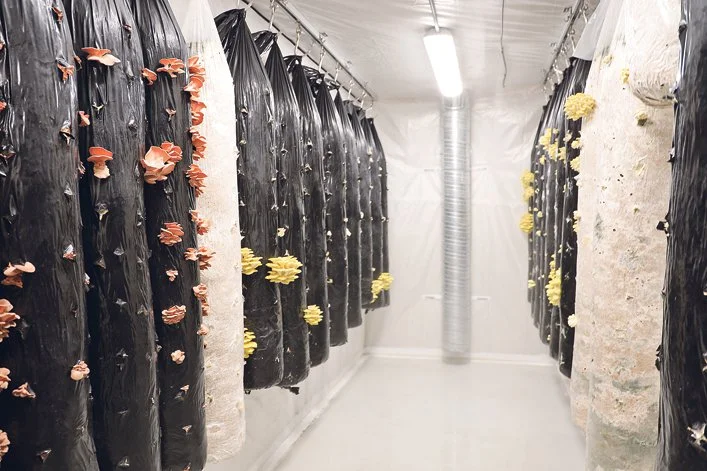
Pink, blue and gold oyster mushrooms grow on artificial logs in special climate controlled rooms. | Mary MacArthur photo
“We are creating artificial logs.”
In two weeks the pink, gold and blue mushrooms are poking out of the bags and picking begins. It takes about three weeks before the king oyster mushrooms can be harvested.
“Keeping the rhythm on our farm is important. We always have to make sure there is good rotation.”
In 2017, growing mushrooms was still a hobby, but the demand by restaurants for a more regular supply of unique mushrooms pushed the family to jump into mushroom production on a larger scale. The first harvest at their Nisku farm was March 2018 and with more demand and improved processes, they can double production on their farm at the same location.
When the mushroom growth in the rooms slows down, the logs still filled with thousands of mycelium are sold to home gardeners, spread onto soil and the mushroom growing continues in the backyard.
“Mushrooms give back that life and invite more micro-organisms back to the soil.”
ABOUT THE AUTHOR
Mary MacArthur's recent articles
Farm puts out welcome mat for trees September 19, 2019
Alberta greenhouse closure sign of a tough business September 12, 2019
Bowery Farming's Irving Fain Pens Essay On Need For 'Scalable Solutions' In Food Production
"When I founded Bowery Farming in 2015, vertical farming certainly wasn’t new. But to many, the concept as an answer to feeding a hungry planet was far more a dream than a reality
Bowery Farming's Irving Fain | Photo courtesy of Bowery Farming
Fain, the company's founder, says Bowery and other indoor farmers have to improve but are taking the right steps, in helping to combat climate change.
In an essay posted by Bowery Farming's Medium page, company founder and CEO wrote about climate change during 2019's 'Climate Week' and noted indoor farming's role in combating climate change.
"When I founded Bowery Farming in 2015, vertical farming certainly wasn’t new. But to many, the concept as an answer to feeding a hungry planet was far more a dream than a reality. However, here we are, just four years later, and Bowery has two fully operational farms and more in development," Fain wrote. "Our controlled indoor growing environment enables us to use zero pesticides and 95% less water to grow fresh produce — all of which make it on local store shelves within just a few days of harvest, minimizing food miles and extending shelf life to reduce food waste."
Related story: Bowery Farming's Irving Fain on technology, food safety, and new products.
"However, on the first day of Climate Week, I acknowledge that indoor vertical farming still has a way to go. Our sector is in its infancy, and we too have work to do in curbing our own emissions, investing in alternative energy sources, moving away from plastic packaging, and selling beyond just leafy greens. Fortunately, these are all areas that we’re aggressively making progress toward at Bowery. We have seen meaningful gains on many of these fronts already, and I am not dissuaded by the work ahead; in fact, I’m energized by the opportunities that are still in front of us. Today, our effort is now recognized as a scalable solution tailored to our most pressing problems."
You can read Fain's full post by clicking here.
Vertical farms Urban agriculture Technology

Indoor Ag Seen As Key To Feeding Planet
Sponsored by the Department of Agriculture; its subsidiary NIFA (National Institute of Food and Agriculture), and the University of Arizona Controlled Environment Agriculture Center, over 100 attendees of all stripes --- from growers and governmental entities to students and researchers --- met for 4 days to come up with a master plan designed to help in the goal of feeding a hungry planet
A prototype greenhouse for use on lunar or Mars missions is displayed at a recent conference on food production at Southern Arizona’s famous Biosphere2 research laboratory.
Open-field production faces limitations in land, labor, and resources
Lee Allen | Sep 25, 2019
It’s been said that a camel is really a horse that has been assembled by a committee after much discussion and lots of diverse input.
But sometimes great minds do think alike as in the case of the recent Controlled Environment Indoor and Vertical Food Production Coordinated Research Conference held at Southern Arizona’s world-famous Biosphere2 research laboratory.
Sponsored by the Department of Agriculture; its subsidiary NIFA (National Institute of Food and Agriculture), and the University of Arizona Controlled Environment Agriculture Center, over 100 attendees of all stripes --- from growers and governmental entities to students and researchers --- met for 4 days to come up with a master plan designed to help in the goal of feeding a hungry planet.
“Open field agriculture in the U.S. is the largest in the world aimed at feeding the largest number of people, but there are limitations in land, labor, and resources,” said co-coordinator Gene Giacomelli, estimating that the current greenhouse-grown vegetable effort represents slightly more than 1.3 million acres under glass.
“We want to compliment that food production capability by solving some of the problems of indoor growing to produce greater yield and enhanced nutrition.”
Plenty Inc. of San Francisco was one example in the form of keynote speaker Nate Story, Chief Science Officer and co-founder of the 2013 start-up funded in part by $200 million in backing from investors like Amazon’s Jeff Bezos.
EMERGING INDUSTRY
Already touting that Plenty is “Where Nature Meets Nurture” and promising to close the global nutrition gap, Story said his indoor grow efforts represented “an emerging industry trying to control costs while bringing high-quality product to market --- a difficult thing to do. We need to focus on research in order to help the industry drive value up and cost down by being both systems- and crop-specific.”
Story called plants “the smartest creatures on the planet because they have figured out how to make humans their slaves by domesticating them and spreading them all over the world. Once we understand the economics of indoor agriculture, this industry is going to be a boon for humanity.”
Over the course of the conference, 33 speakers told of their research successes and remaining problems in trying to grow things better, faster, and cheaper with discussions ranging from nutrition and post-harvest concerns to production systems and pest and disease management.
Audience interest was piqued with presentations on new technologies in plant breeding and how feeding folks in outer space may provide some suggestions on how to better accomplish that mission on the ground.
Noting that plant breeding has been around since the early days of crop domestication, Gail Taylor, Plant Sciences Chair at the University of California, Davis campus said the process took a quantum leap once DNA was explained.
“Today, generally involving big crops in outdoor environments and refinements in programs involving disease, pest management, stress tolerance, and increased yield, there’s a lot going on there, and by snipping away at plant DNA, adding to or taking away from, we can make new products that both outdoor field and indoor vertical farming can take advantage of.”
BREEDING SUCCESSES
Citing breeding program research successes like uncovering a gene that allows peppers to be more easily harvested mechanically to extending the shelf life and increasing the antioxidant properties of lettuce, Taylor said that modern breeding techniques allowed a new start to improving nutrition, flavor, and yield.
While some breeding successes have been noted in dwarf or super-dwarf crops as well as those that are more robotics-ready for mechanical management, the search continues for more vigorous, rapid, high-yielding traits that are faster flowering with a shorter life cycle and more efficient use of nutrients and depleted carbon dioxide.
Genetics research is on-going to produce plants with more appropriate architectures that will lend themselves to more efficient mechanical supervision and harvesting, produce that will maintain a longer shelf life, as well as crops that are cleaner because of less chemicals and healthier because of secondary phytochemicals.
“We struggle with the same issues that greenhouse growers and indoor vertical farms do in looking at food security, keeping astronauts operating at peak performance on long-duration missions,” said Ralph Fritsche, Senior Crop Project Manager in NASA’s Life Sciences Office.
Earlier space missions where crews were kept busy at work stations on their way to the moon didn’t have much time to plant something and grow it to harvest, but longer duration flights like those to Mars will allow the growing of plants, much of it done by automation as is happening in today’s terrestrial indoor and vertical grow efforts.
“Right now, NASA is taking from current CEA knowledge and technology with a pay-if-forward mentality. Once we find solutions to similar problems in space, light bulbs will light up in the CEA industry on how these answers can be applied on earth.”
HURDLES FOR FRUIT
Based on the presentations, nearly half of the attendees contributed concepts to a grant application workshop involving funding opportunities to support further research.
“Most of the currently-funded projects deal with leafy greens, but there are still major hurdles for profitable production of fruiting crops,” said Dr. Kai-Shu Ling of the USDA Vegetable Laboratory.
“We will work together to prepare, hopefully before the end of the year, a proposal for submittal to the USDA/NIFA Specialty Crop Initiative Research program to establish a coordinated agricultural project for controlled environment agriculture research, a roadmap for indoor food production agriculture in the United States,” said Ling.
To which Giacomelli added: “This report, interfacing all seven themes of the conference, will not be a report that gathers dust.”

VIEDO: How To Make Cupcake Microgreens At Home With A Cupcake Container And Lid
How to make cupcake microgreens at home with a cupcake container and lid.

Glase Provides Analysis of CEA Market Growth To Industry Members
Using the results of the USDA’s 2007, 2012 and 2017 censuses, Mattos discussed the national market growth of food crops produced under protection with detailed analyses of the top producing states
During GLASE’s Industry Talks series presentation, executive director Erico Mattos discussed changes to the CEA market based on USDA Census of Agriculture data.
By David Kuack
One of the benefits offered by the Greenhouse Lighting and Systems Engineering (GLASE) consortium to its industry members is its Industry Talks series. This series of informal conversations are presented by academics and field experts who focus on topics suggested by the consortium’s industry members.
During the consortium’s Industry Talks presentation in August, GLASE executive director Erico Mattos reviewed controlled environment production market growth based on the results of the USDA’s Census of Agriculture. Using the results of the USDA’s 2007, 2012 and 2017 censuses, Mattos discussed the national market growth of food crops produced under protection with detailed analyses of the top producing states. The full video can be accessed by GLASE members at the GLASE.org
Increasing value of protected food crops
Total market value for all protected food crops, including tomatoes, vegetables, berries, and fresh herbs, increased 17.9 percent from 2012 to 2017. Market growth for sales of all protected food crops increased 20 percent from $634 million in 2012 to $748 million in 2017. Greenhouse tomato sales increased 4.7 percent from $400 million in 2012 to $419 million in 2017. Other greenhouse vegetable sales increased 40.6 percent from $234 million in 2012 to $329 million in 2017. Fruit and berries sales decreased 13.5 percent from $29 million to $25.1 million even though production area for these crops rose from 7.9 million square feet to 11.7 million square feet.
Greenhouse tomato production area expanded from 55.1 million square feet in 2012 to 63.9 million square feet in 2017, a 16 percent increase. For other greenhouse vegetables, production area rose from 42.8 million square feet in 2012 to 48.6 million square feet in 2017, a 13.6 percent increase.
Only other greenhouse vegetables and fresh-cut herbs saw an increase in market share from 2012 to 2017, rising from 35 percent to 43 percent. Both greenhouse tomatoes and fruit and berries saw a decline in market share between 2012 and 2017. Tomatoes fell 6 percent from 60 percent in 2012 to 54 percent in 2017. The decrease for fruit and berries was only a 1 percent drop from 4 percent in 2012 to 3 percent in 2017.
Increase in protected food crop operations, production area
The number of protected growing operations increased for all crop categories between 2012 and 2017. The number of farms producing greenhouse tomatoes rose 26 percent, up from 6,323 operations in 2012 to 7,974 operations in 2017.
The number of farms producing other greenhouse vegetables rose 36.6 percent between 2102 with 5,268 operations to 7,198 operations in 2017.
Farms producing greenhouse fruit and berries also saw a double digit increase (25.7 percent), up from 673 operations in 2012 to 846 operations in 2017.
Number of small farms increasing
Mattos said the increase in the number of protected crop operations is driven by the establishment of smaller farms.
“There are a lot of smaller farms producing greenhouse vegetables, but they represent a very small part of the market share,’ he said. “In general, as the size of the farms increases the value of sales increases until the size of operations reaches 40,000 square feet or more where there is a dramatic jump in the value of sales.”
Small size farms from 1-999 square feet represent 31.6 percent of the number of farms in the United States. These small operations only cover 1.1 percent of the square foot production area for the total industry. These farms also only represent 1 percent of total sales. They are receiving a net rate of $5.74 per square foot for what they are selling.
Operations from 1,000 to 2,999 square feet account for 32.8 percent of U.S. farms. The net rate sales are the lowest for operations from 2,000 to 2,999 square feet at $4.42.
Those greenhouse vegetable operations with 20,000 to 39,999 square feet in size are earning the most money per square foot at $11.23 per square foot. Mattos said this size category might be a good mix of technology and greenhouse management and are definitely doing something right.
Mattos said there are fewer large farms producing greenhouse vegetables, but they dominate a big part of the market. The largest operations in the U.S. with 40,000 or more square feet represent 2.7 percent of the number of farms. However, they account for 67.6 percent of the square footage (76.1 million square feet) in the U.S. These large operations also have the highest value of sales per square foot at 67.8 percent. These farms are making $6.67 per square foot.
For greenhouse tomatoes, the largest operations are the most efficient, accounting for 74.5 percent of sales and having the largest return per square foot at $7.28.
Major protected-environment producing states
On a state-by-state basis for all greenhouse vegetable categories, the top state in regards to market share value was California with 46 percent, which had a market value increase of 26 percent from 2012 to 2017. Even though the number of farms decreased from 427 to 409, the amount of square footage grew 24 percent from 28.3 million to 35.2 million square feet.
Other leading states with market share included Texas (14 percent), Ohio (10 percent), New York (9 percent), Maine (8 percent), Virginia (7 percent) and Minnesota (6 percent). Ohio had the largest rise in sales, increasing from $10.5 million in 2012 to $43.8 million in 2017, accounting for an increase of 317 percent in just five years. Virginia also experienced a large sales increase (270 percent), going from $8.5 million in 2012 to $31.5 million in 2017.
While California still had the largest market share (33 percent) for greenhouse tomatoes, it wasn’t as dominant as it was for total greenhouse production. Other states which accounted for greenhouse tomato market share included Texas (21 percent), Ohio (13 percent), New York (12 percent), Minnesota (10 percent), Arizona (6 percent) and Illinois (4 percent).
States with the largest increase in tomato share included Ohio (908 percent increase), going from $3.2 million in 2012 to $32.1 million in 2017. Illinois also saw a major rise in greenhouse tomato sales going from $1.7 million in 2012 to $10.7 million in 2017, a 517 percent increase.
For other greenhouse vegetables and fresh-cut herbs, California dominates sales ($126. 2 million) with 60 percent of the market. Virginia followed with 11 percent of the market and Illinois had a 7 percent market share. These two states had the largest growth in this crop category with sales in Illinois rising 565.8 percent from $2.2 million in 2012 to $14.3 million in 2017. Virginia saw sales grow 245 percent from $6.7 million in 2012 to $23 million in 2017.
For more: Erico Mattos, Greenhouse Lighting and Systems Engineering (GLASE), (302) 290-1560; em796@cornell.edu; https://glase.org.
David Kuack is a freelance technical writer in Fort Worth, Texas; dkuack@gmail.com.
Posted in News

Netled To Supply SweGreen With Production Units
Netled has signed a distribution agreement with Swedish technology company SweGreen. They will start providing Vera Compact Production Units for SweGreen’s urban farming destinations in Sweden. SweGreen is an innovation and technology urban farming company based in Stockholm. The company provides circular solutions for controlled-environment urban farming
Netled has signed a distribution agreement with Swedish technology company SweGreen. They will start providing Vera Compact Production Units for SweGreen’s urban farming destinations in Sweden.
SweGreen is an innovation and technology urban farming company based in Stockholm. The company provides circular solutions for controlled-environment urban farming. By integrating smart vertical farming solutions into real estate properties SweGreen provides circular energy-waste-water and carbon-absorbing systems, which enable locally grown, quality greens and help minimize the environmental footprint of facilities. Under the brand Stadsbondens, SweGreen’s CityFarm in Stockholm produces herbs for ecological-minded citizens all year round in a sustainable way.
Netled´s Vera Compact Production Units are especially well-suited for limited scale production of salads, herbs, seedlings and pot plants, and will complement SweGreen’s efforts perfectly.
For more information:
Netled
netled.fi

Publication date: Tue, 08 Oct 2019

VIDEO: What Is Vertical Farming? And What Are The Benefits?
Higher yields, fresher food, smaller carbon footprint: This is the potential of vertical farming.
World Economic Forum
Higher yields, fresher food, smaller carbon footprint: This is the potential of vertical farming.
Read more about the inspiring pioneers finding creative solutions to climate catastrophe here:
https://wef.ch/pioneersforourplanet
About the series:
Each week we’ll bring you a new video story about the people striving to restore nature and fighting climate change. In collaboration with @WWF and the team behind the Netflix documentary #OurPlanet. #ShareOurPlanet
Want to raise your #VoiceForThePlanet? Life on Earth is under threat, but you can help. People around the world are raising their voice in support of urgent action. Add yours now at www.voicefortheplanet.org
Pakistan: A Futuristic Vertical Farm Now Blooms In Karachi’s Old Yarn Factory
Having setups like the vertical farm allows us to grow these vegetables within our own country throughout the year and then send it to the market. Pakistan’s first urban vertical farm is a commercial venture, with the produce being supplied to some of the city’s finest restaurants and supermarkets
NAIMAT KHAN
September 30, 2019
Pakistan’s first vertical farm grows eco-friendly, fresh greens for sale to city’s finest restaurants and markets
Urban agriculture is immune to the constraints of climate, allowing non-seasonal vegetables to grow year-round
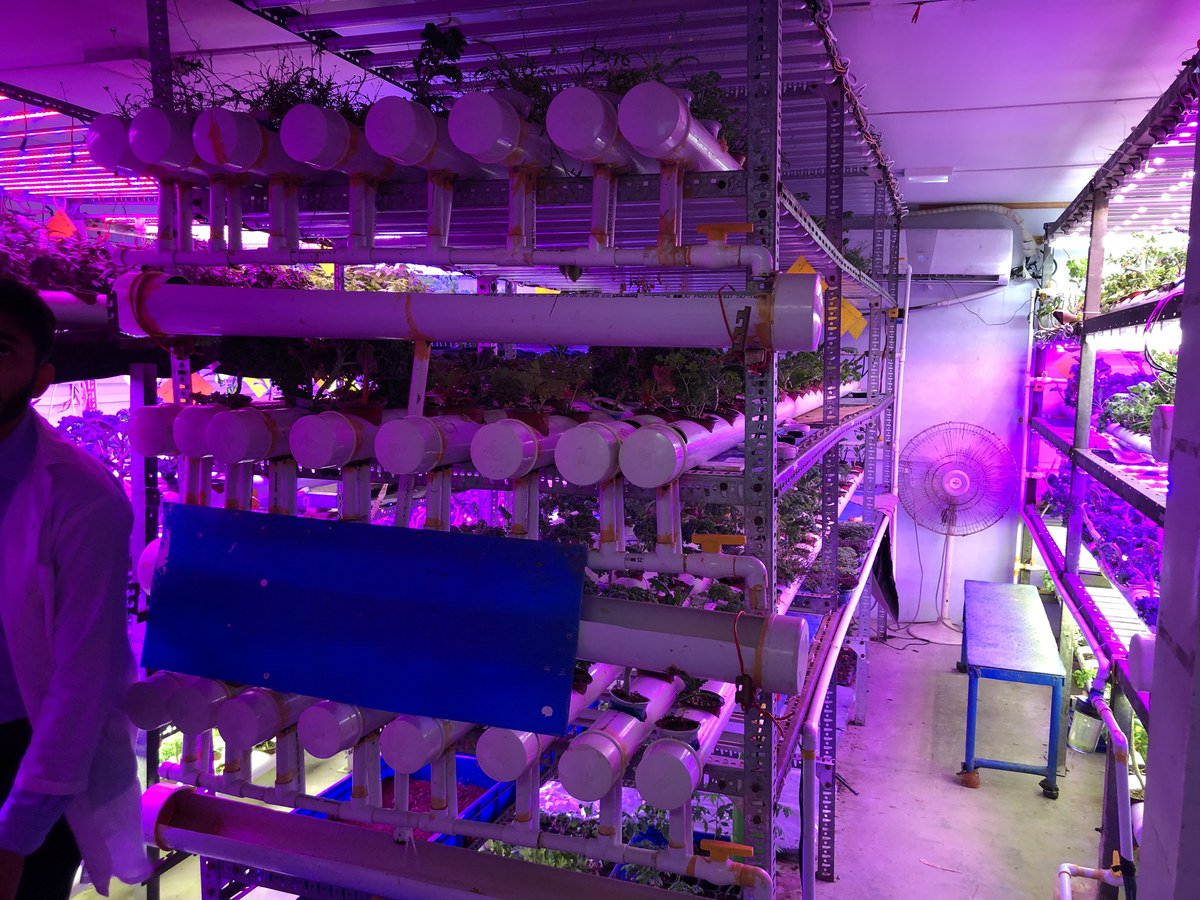
KARACHI: In 2006, Sohail Ahmed’s once-booming polyester filament yarn plant closed down due to a worldwide recession, alongside lawlessness and a power crisis at home, in Pakistan’s seaside metropolis of Karachi. Twelve years later, Ahmed has converted the top floor of the old yarn factory into a futuristic farm, with kale, rosemary and dozens of other vegetables growing vertically under the purple glow of LED lights.
Different types of vegetables, mostly non-seasonal, are grown at this vertical farm at the Site Industrial Area of Karachi, where light, humidity and temperature is optimally controlled. September 26, 2019. (AN Photo)
Pakistan’s first urban vertical farm is a commercial venture, with the produce being supplied to some of the city’s finest restaurants and supermarkets. But the use of hydroponics, where plants grow in nutrient solution instead of traditional soil, and where water is continuously recycled, contributes toward eco-friendly practices by using 90 percent less water than field farming, using no pesticides and omitting gas emissions involved in the long transportation routes from rural to urban centers- all leading to the freshest greens in the city.

Farhan Sohail, a process and product development engineer in Pakistan’s first vertical farm, speaks to Arab News in Karachi on September 26, 2019 (AN Photo)
“When our family business shut down in 2006, I started to think about different business models with the help of technology. In 2009, I did a course on environmentally friendly and futuristic plant growing technologies. In the next two years, we set up our flower greenhouses in Karachi and Murree,” Ahmed told Arab News, and added that the success of his greenhouses led him to think of urban agriculture as a serious business model.
Different types of vegetables, mostly non-seasonal, are grown at this vertical farm at the Site Industrial Area of Karachi, where light, humidity and temperature is optimally controlled. September 26, 2019. (AN Photo)
Ahmed and his son, Farhan Sohail, an engineering graduate from the American University, started working on the urban agriculture project in 2016 and by April 2018, their vertical farm had been set up in the 60 ft. room, and already blooming.
Farhan, who largely oversees the project, said around 2,500 plants of kale, cherry tomatoes, pak choi, iceberg lettuce, red swiss chard, rocket, basil, capsicum, jalapenos, microgreens, parsley, celery, oregano, rosemary, thyme, and sage are grown within a cycle of 45 to 60 days from the time of seeding to harvesting.
Different types of vegetables, mostly non-seasonal, are grown at this vertical farm at the Site Industrial Area of Karachi, where light, humidity and temperature is optimally controlled. September 26, 2019. (AN Photo)
Farhan explained the nutrient solution traveled from a tank into PVC pipes which became inundated, and because the plants rested inside these pipes, when they were flooded, the roots took water up and the plant watered itself.
Dim LED lights are optimized for every plant, adjusted according to its own declared spectrum.
“In addition to that, we also artificially provide exactly what the plant needs in terms of carbon dioxide, humidity as well as temperature levels,” Farhan said.
Different types of vegetables, mostly non-seasonal, are grown at this vertical farm at the Site Industrial Area of Karachi, where light, humidity and temperature is optimally controlled. September 26, 2019. (AN Photo)
“We have 70 times more production per square meter as compared to field farming,” he said, and added that the elimination of pesticides and preservatives, meant the produce that came out of his vertical farm was “extremely healthy.”
Urban agriculture is largely immune to the restraints of climate conditions, which force most farmers in Pakistan to stay away from growing certain crops throughout the year and adding to the country’s import bill, Farhan said.
Different types of vegetables, mostly non-seasonal, are grown at this vertical farm at the Site Industrial Area of Karachi, where light, humidity and temperature is optimally controlled. September 26, 2019. (AN Photo
“Having setups like the vertical farm allow us to grow these vegetables within our own country throughout the year and then send it to the market,” he said, and added that if the model was successful on a large scale, Pakistan could start producing vegetables for export to international markets as well, especially to the Middle East.

Rochester Institute of Technology: New "AgTech" Cropping Up On Campus
RIT recently hired its first-ever farmer, David Brault. Brault, a native of Irondequoit, New York and a University of Vermont graduate in Horticulture, is now taking care of leafy greens and herbs grown on-site in RIT’s new hydroponic container farm. The farm is located in a 40-by-8-by-9.5-foot up-cycled shipping container just behind the Campus Center
by Catherine Rafferty | published Oct. 8th, 2019


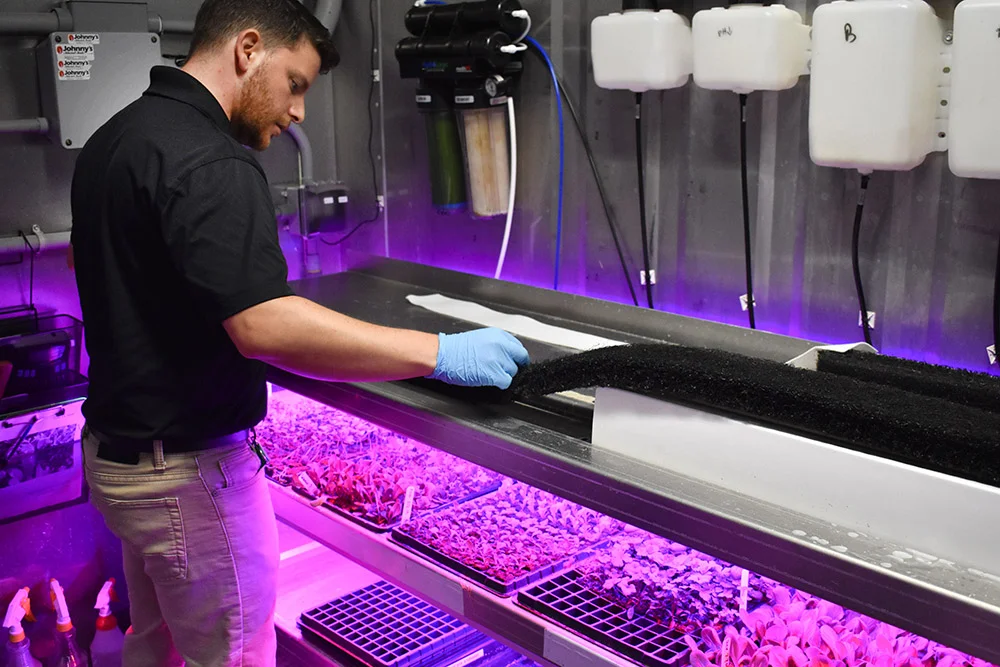


RIT recently hired its first-ever farmer, David Brault. Brault, a native of Irondequoit, New York and a University of Vermont graduate in Horticulture, is now taking care of leafy greens and herbs grown on-site in RIT’s new hydroponic container farm. The farm is located in a 40-by-8-by-9.5-foot up-cycled shipping container just behind the Campus Center.
“Alright, close your eyes and picture a farm. You'll see a field, maybe someone on a tractor and there's dirt and all that," Brault described. "Then you go a step removed, and you put in a greenhouse. And then you take a step farther and now you've got a hydroponic greenhouse. And you remove the greenhouse and you've got hydroponics inside this container. So it's different.”
The farm was installed on June 10, 2019. Kory Samuels, executive director of RIT Dining Services, said the project made sense with the recent renovation of Gracie’s as just another way to “up our game” in the quality of food on campus. RIT is just one of two universities in the state to have a hydroponic farm on campus, the other being Stony Brook University in Stony Brook, N.Y.
HOW DOES IT WORK?
Hydroponics is defined as growing plants with nutrients and water but without soil. The plants are rooted either in water or an artificial medium which can include substances like sand, gravel, perlite, peat moss, sawdust, coir or Rockwool.
Some crops are better to grow hydroponically than others. Brault said he started by growing lettuce and herbs because of their size and quick turnover rate. Crops like corn are a less practical option because of the lower yields and the space needed to grow it. The container is lit by LEDs that use special bulbs emitting only red and blue light spectra, the most beneficial lighting for optimizing plant growth.
RIT’s farm is a vertical farming system created by Freight Farms, which has provided shipping container farms to many other college campuses. The container is insulated so crops can be grown year-round. Brault can control lighting, temperature, humidity, carbon dioxide levels, concentration of fertilizer and pH levels in the farm all from his smartphone. It operates as a closed system, meaning the water used to feed the plants is recycled for the next crops.
"This is an offering that I think distinguishes us versus other campus dining programs."
WHY HYDRO?
Samuels first saw a shipping container farm at a National Association for College and University Food Service conference back in 2016. Samuels had noticed an interest in seasonal menus and locally sourced produce at other universities. RIT doesn't have an agriculture school, so Samuels saw the hydroponic farm as the perfect solution for RIT's tech-oriented community.
“It was an idea that was kind of put on our roadmap that it'd be cool to eventually get to the point where we are not just sourcing our food as local as possible, but potentially actually being a part of the food system," Samuels said.
In terms of food safety, it's safer for RIT Dining to produce their own product because they can control everything, including the cleanliness of the space, the fertilizer they grow with, the water they use and who touches the product.
In terms of sustainability, Brault explained, you don't have to worry about fertilizer runoff — a major concern in conventional agriculture. It's also hyperlocal, so any emissions that would have been produced in processing and transporting the product are eliminated.
“This requires capital investment, but once it’s operational, it is lower maintenance. Also you get more yield, so you can grow a lot more in a smaller space and you can grow crops faster and you get a better quality and quantity of crop — and you can do it all year,” Brault stated.
The farm is also an appealing addition to RIT's dining resume. RIT Dining can make decisions about its offerings since it's all in-house owned and operated. Samuels and Brault see this program as a new way to draw in prospective students. Campus life is an important part of the college experience, and food is just one aspect of that. Brault thinks that students' expectations are setting the bar high.
“They [students] are starting to expect a different level of experience in dining. This is an offering that I think distinguishes us versus other campus dining programs,” Brault said.
IMPACT
The first container is just a small seed in a larger plan for RIT Dining and its farm. Both Brault and Samuels would like to see the program expand, in growing more crops and potentially adding more containers to campus. They also see the farm becoming a teaching tool for students. Samuels suggested farming could become a new wellness or sustainability course offering in the future for students to learn more about the agriculture industry.
"I look at the farm as a way to connect our department and students in just another way."
Brault was hired to jump-start the program, but there's talk of bringing in student employees to assist with planting and harvesting. There's the potential for co-op and research opportunities collaborating with programs in the academic departments or Student Affairs. Collaboration could also extend out into the greater Rochester community through programs like FoodLink and Recover Rochester, said Samuels.
Overall, Samuels wants students to use the farm to connect and gain a new perspective.
"I look at the farm as a way to connect our department and students in just another way," he said.
RIT Dining will not be able to provide all the food on campus solely from the farm as they serve over 14,000 meals per day between all of their dining locations, concessions and catering. However, the farm will produce 10 to 15 percent of the produce on campus.
The farm is currently growing bibb lettuce, salanova lettuce, basil, cilantro, parsley, kale, swiss chard, tatsoi, mizuna and arugula. Next time you are at an RIT-catered event and you see some salad, know that it’s freshly grown — right from the container.

US (AZ): Controlled Environment Indoor And Vertical Food Production Coordinated Research Conference
FarmTech Society board member Penny McBride—who chairs the FTS committee on standardization—presented on the need for standards for food safety and was honored to sit on a panel alongside NASA plant scientists Gioia Massa and Arizona Food Safety inspector Stewart Jacobson
This year’s USDA–NIFA Conference, held at Biosphere 2 outside of Tucson, AZ, from September 9 to 12, brought together a diverse set of experts in the industry—scientists, engineers, economists, business people, and policymakers—to hear from panelists and form ongoing working groups.
Hosted by the University of Arizona’s innovative Controlled Environment Agriculture Center (CEAC), the goal of the conference was to create an interdisciplinary Controlled Environment Agriculture R&D Roadmap and Coordinated Research Plan, which will help these stakeholders apply for funding from the USDA to help fast-forward the CEA industry through basic and applied research.
The conference’s keynote speakers, panels, and breakout groups focused on:
Economics
Engineering
Production systems
Plant breeding
Pest and disease management
Food nutrition and safety
Industrial ecology in closed systems
FarmTech Society board member Penny McBride—who chairs the FTS committee on standardization—presented on the need for standards for food safety and was honored to sit on a panel alongside NASA plant scientists Gioia Massa and Arizona Food Safety inspector Stewart Jacobson. How CEA production can affect health and nutrition emerged as a key line of inquiry for researchers going forward.
Fellow board member Wythe Marschall—who chairs the FTS committee on education—served as record keeper for the engineering working group. The engineering group agreed on a need for benchmarks and open standards for lights, energy, sensors, and plant breeding.
Overall, FTS was brought into a series of discussions with leading CEA experts, furthering our mission of connecting the industry at a pre-competitive level and creating a platform for amplifying industry voices at the level of university education, government research, and policy.
The final day, conference participants met to discuss the current funding landscape for CEA and form new grant-writing groups to develop specific grant proposals.
For more information:
FarmTech Society
Tom Zoellner
tz@farmtechsociety.org
farmtechsociety.org
Publication date: Fri, 27 Sep 2019

Square Roots & Gordon Food Service Open Michigan Indoor Farm
The modular indoor farm, sited on less than two acres of the Gordon Food Service headquarters property, was almost immediately in production following construction completion earlier this month
September 30, 2019 - General News
(PHOTO: Square Roots) Meet the Square Roots Michigan Cohort (left to right): Rebekah Box, Winn Hermanski, Katie LaRue, Savie Sonsynath, Jacob Smaby, Jarad Jaent, Joshua Van Kleeck, Alyssa Patton, Amal Jennings.
PRESS RELEASE: Wyoming, MI, September 30, 2019
Gordon Food Service® BB #:100172, North America’s largest privately held and family-managed foodservice distributor, and Square Roots, the technology leader in urban indoor farming, today celebrated the opening of their strategic partnership’s first co-located farm at a ribbon-cutting event on the campus of Gordon Food Service’s headquarters in Wyoming, Michigan. In addition to executives and staff from both companies, guests included customers and local, state, and federal government officials. Attendees learned more about the facility, the first of its kind hosted by a broadline foodservice distributor, including a tour of the indoor farm’s operations.
In his remarks, Rich Wolowski, President and CEO, Gordon Food Service said, “We’re building exciting relationships with change agents that are helping to reshape how food is produced, prepared, and served – and Square Roots is a great example of leading-edge thinking and technology driving new solutions. We know it’s imperative that we participate in the future, today, to ensure we are relevant tomorrow, and this is a model that could help revolutionize our food systems. And it’s great that we can prove the concept in our own backyard.”
The modular indoor farm, sited on less than two acres of the Gordon Food Service headquarters property, was almost immediately in production following construction completion earlier this month. The ten cloud-connected growing units, employing sophisticated, digitally-controlled hydroponics and LED lighting systems, are projected to produce more than 50,000 lbs. of premium herbs and greens annually, or roughly the equivalent production of a traditional 50-acre farm. However, unlike more typical agriculture, the Square Roots produce will be non-GMO, pesticide-free, and harvested all year long. Initial crops will include basil, chives, and mint. The herbs will be sold to local foodservice customers in Grand Rapids as well as throughout Michigan, northern Indiana, and Ohio.
The companies noted that this first farm installation serves as a template, with ambitions to see additional indoor farms on or near Gordon Food Service’s more than two dozen distribution centers across Canada and the eastern U.S.
Tobias Peggs, Square Roots Co-founder and CEO, noted, “This partnership reflects our shared commitment to local, real food and at a scale that will serve people and communities across North America. But it’s also Square Roots’ mission to empower the next generation of leaders in urban farming. Through our Next-Gen Farmer Training Program, we train future farmers in all aspects of local food systems—from seed to shelf. And with each new Square Roots farm, the Next-Gen Farmer Training Program opens doors for more young people to start exciting careers in the agriculture industry.”
The new farm is tended by a cohort of Next-Gen Farmers selected by Square Roots as part of their unique Next-Gen Farmer Training Program. The paid, full-time and year-long commitment has attracted thousands of diverse applicants eager to be change-makers at the forefront of urban agriculture and contributing to the local, real food movement. Half of the Michigan team hails from in-state while others come from as far away as Texas and New York.
Rich Wolowski, North American President and CEO of Gordon Food Service, stated, “We are excited to be the first broadline foodservice distributor to host an urban farm, with the ability to bring fresh, hyper-local produce to our customers year-round. It’s an important example of our pursuit of innovation to better serve our foodservice customers, and our customers’ customers while answering the growing demand for fresh, nutritious and local food.”
About Gordon Food Service
Since 1897, we have delivered uncompromising quality and heartfelt service for our customers. We began as a simple butter-and-egg delivery service, and have grown to become the largest family business in the foodservice industry by upholding the same approach for over 120 years—remaining passionately committed to the people we serve. Today we serve foodservice operators in the Midwest, Northeast, Southeast, and Southwest regions of the United States and coast-to-coast in Canada. We also operate more than 175 Gordon Food Service Store® locations in the U.S., which are open to the public and provide restaurant-quality products and friendly, knowledgeable service without a membership fee. By partnering with organizations from across industries—healthcare to education, independent and chain restaurants, and event planners—we help our customers create food experiences that people choose, enjoy and remember. To learn more about Gordon Food Service visit gfs.com.
About Square Roots
Square Roots is the technology leader in urban indoor farming. Its scalable “farmer first” technology platform brings fresh, healthy food to urban areas year-round, while simultaneously training future generations of farmers. Founded in 2016 by serial entrepreneurs Tobias Peggs and Kimbal Musk, Square Roots has a mission to bring local, real food to people in cities across the world while empowering the next generation of leaders in urban farming.
Central to the Square Roots mission is a “Next-Gen Farmer Training Program”—a year-long program that puts participants at the forefront of the indoor urban farming industry while they are growing food as part of the Square Roots farm team. Using a unique and scalable technology platform, these young farmers are armed with intuitive tools, enabling them to quickly learn how to grow food that is delicious, responsible, healthy, and profitable. During their year at Square Roots, they’re also educated on plant science, food entrepreneurship frameworks, and engaging local communities—preparing them for successful subsequent leadership roles in urban agriculture. To learn more about Square Roots visit squarerootsgrow.com.
Tagged container farm, indoor farming
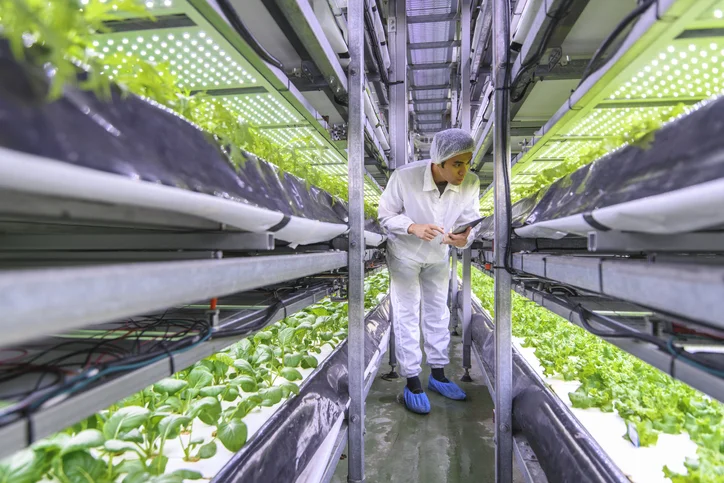
Is Indoor Farming Poised To Challenge The Status Quo?
Two categories of indoor farms dominate the industry: greenhouses, which use sunlight as at least part of their energy source; and vertical farms, which use artificial light, typically LEDs, and no sunlight
September 18, 2019
By Adam Bergman, Wells Fargo Head of AgTech and FoodTech Investment Banking Practice
Industrial agriculture is enabling farmers to successfully feed a rapidly growing global population.
In the U.S., production efficiencies and an ability to grow food inexpensively have reduced the share of disposable personal income spent on food by over 40 percent during the past 55 years. (1) Yet the characteristics that made industrial agriculture so successful—economies of scale (large-scale monoculture), fertilizers, pesticides, and innovation in seed genetics—have led to a backlash from today’s consumers.
In lockstep with the increased societal awareness of environmental issues tied to industrial agriculture is an increasingly vocal consumer base wanting foods with clean ingredient labels, grown locally and sustainably, and from farms that care for the environment and their employees. Today, many consumers associate the development of inexpensive and highly processed foods with higher fat, sugar, and sodium levels that lead to health issues, including obesity and diabetes, and also believe them to have lower nutritional value and less taste.
This backlash has generated a growing interest in the indoor farming sector, as consumers look for fresher, healthier, tastier, and more sustainable foods. Consumers looking to reduce the carbon footprint of the food they buy are asking “Where is my food grown?” And, this is driving a farm-to-table movement and resurgence of local farmers’ markets.
“How is my food grown?” This is another consumer question reflecting worries about chemicals and pesticides, following some recent large jury awards to individuals who had used these products. The goal for some consumers is that all of their food be grown in neighborhood indoor farms, enabling them to purchase fresher, tastier, and more environmentally friendly food that is pesticide-free. However, the reality is that the current generation of indoor farms grow mostly specialty products, like herbs, leafy greens, microgreens, and specialty peppers and tomatoes, leaving staples like carrots, corn, wheat, and potatoes to be grown in outdoor fields through traditional farming methods.
What is indoor farming?
Two categories of indoor farms dominate the industry: greenhouses, which use sunlight as at least part of their energy source; and vertical farms, which use artificial light, typically LEDs, and no sunlight. Most people equate greenhouses to the large industrial structures that have been used for growing crops indoors for over 150 years. However, today’s greenhouse designs are integrated with the latest technologies, including advanced seed genetics, data science, and machine learning, as well as robotics and automation. It is clear to these farmers that for greenhouses to be profitable, they must both optimize these technologies and achieve economies of scale.
In contrast, vertical farms utilize new technology and have mostly proliferated as a result of the rapidly declining prices of LED lights, but have yet to be proven profitable. Nevertheless, vertical farms offer tremendous opportunities as seed companies develop genetics to optimize growing conditions, including the replacement of sunshine with more reliable and predictable LED lights. Such controlled indoor environments provide significant advantages compared to the outdoor field, which is subject to the whim of Mother Nature. We are seeing the emergence of two different types of vertical farms: one built-in large warehouses to maximize economies of scale, and the other having a smaller footprint, like shipping containers, that can be placed at hotels, supermarkets, and universities, enabling produce to be harvested and eaten the same day.
Both greenhouses and vertical farms are looking to optimize production through the use of data analytics and machine learning, something much easier to do in a controlled environment than in a field. Additionally, field-grown products typically are grown far from the end consumer, leading to a large amount of spoilage and food waste. With over 30 percent of global food production ending up as food waste(2), this problem will need to be addressed in order to feed a population projected to reach over 9.5 billion people by 2050.(3)
Investment heats up
Strong consumer interest in indoor farming has been matched by a sizable amount of venture capital investment in this sector. Whereas indoor farming is a relatively nascent business in the U.S., the Netherlands has built a successful indoor agriculture industry, and has played a key role in feeding neighboring European countries for decades. Additionally, an increasing amount of the non-processed tomatoes and specialty peppers sold in the U.S. are grown in Canadian greenhouses, where electricity is cheaper, and in Mexican greenhouses, where labor and other production costs are lower. It isn’t surprising, therefore, that indoor farming companies have raised over $1 billion in equity during the past five years.(4)
A number of companies, including AeroFarms, AppHarvest, BrightFarms, Bowery Farming, Plenty Ag, and Shenandoah Growers each have raised over $50 million in equity, demonstrating the growing commitment to a variety of indoor farming techniques.(4) Significantly more capital is likely to be raised in the coming years as indoor farms are positioned for rapid growth, and investors bet on new entrants with unique technologies that might result in lower production costs than those realized with field-grown produce.
Trend or fad?
Despite all the capital that’s been raised, and the positive press surrounding indoor farming start-ups, many people have asked me whether indoor farming is a fad or a trend. Having worked closely with a number of thin-film solar companies as that sector emerged in 2004, I have noticed many parallels between that experience and what is happening in indoor farming. First, large sums of capital are being raised to fund new, but not-yet proven technology. Second, companies are making aggressive predictions about their cost structure once they reach commercial scale. Finally, a growing number of investors are rushing into a sector about which they have limited knowledge and investment experience. Consequently, as I began evaluating the indoor farming sector three years ago, I was very skeptical about its viability, since outdoor farming has occurred for thousands of years, and the growing process has already been revolutionized to substantially improve yields and reduce costs.
However, following my visit to an indoor farm in the Bay area, less than two hours’ drive from Salinas, California, known as the “Salad Bowl of America”, I started to understand the reason why indoor farming makes sense. The most compelling reason is taste. Produce that I have tasted that was grown in indoor farms tastes much better than the field-grown varieties available in stores and restaurants. Most people are unaware that the seed genetics used in field-grown produce are often selected based on ability to survive transport over long distances rather than for taste optimization. Furthermore, most of the produce eaten in the U.S. is grown in California, Arizona, and Mexico, and shipped throughout the U.S. on trains and in trucks. There is no greater evidence of logistics winning over taste than iceberg lettuce. Despite being comprised of almost all water and having little nutritional value, iceberg lettuce was identified as a product able to survive being packed in ice and shipped cross country. I know very few people who are excited to eat iceberg lettuce, yet it remains a staple on many dinner tables throughout the U.S.
In addition to taste, indoor farming offers a number of other potential benefits including:
Year-round production – important since even in California produce is typically harvested no more than nine months of the year, forcing reliance on additional supplies from global and potentially less regulated production areas
Environmental sustainability – indoor farming has a smaller environmental footprint as a result of elimination of pesticides, reduction in water, and reduction in cross-country transportation since product can be grown regionally throughout the country in close proximity to distribution centers or retail outlets
Consistent production whereby growers are able to provide the same size and quality of products to distributors and retailers in every location
Reduced manual labor through the use of robotics and automation
Elimination of climate dependency – produce can be grown in even the harshest weather conditions globally, which will become more important as the impact of climate change accelerates.
Indoor farming companies must overcome a number of issues to achieve success, the most important of which are cost structure, type of produce grown, and branding.
Achieving a competitive cost structure
Today, very few indoor farming companies are able to produce at a cost structure competitive with field-grown produce. With so much capital being raised, most indoor farming companies are more focused on scaling production rather than profitability. While many investors are less focused on near-term profitability, it will become more important as indoor farming companies look to build new farms, and need to be able to undertake financing using debt/project finance. Even if indoor farming companies can raise enough equity capital to build new indoor farms in the short term, long-term success will be tied to the optimization of capital structures through the use of low-cost debt capital.
Building market share
Although there is a substantial opportunity for indoor farms to take market share from field-grown herbs and leafy greens, these remain relatively small market opportunities. With so many indoor farming companies currently producing or preparing to produce herbs and leafy greens, these areas will likely get oversaturated at some point. Consequently, I think it is essential that indoor farms move into, or expand production in, other high-value and high-margin products such as berries, melons, peppers, and tomatoes.
Gaining brand recognition
The final area of concern is whether indoor farming companies will be able to build either category strength or a brand name that will catch on with consumers. Consumers are less familiar with the names of the companies that provide their fruit and vegetables, in contrast with major consumer-packaged-goods companies, like General Mills, Kellogg’s, Kraft Heinz, and Nestle, which have been highly successful at building brand-name products sold in the middle of the grocery store. Without brand visibility, most indoor farming companies likely will end up selling to larger established players, such as Taylor Farms, Del Monte, and Dole, and receive commodity pricing as opposed to the premium pricing of major brand label, which Beyond Meat and Impossible Foods have done successfully in the alternative protein sector.
Coming to a store near you
Consumers appreciate that there are major advantages for an increasing amount of high-end produce to be grown in “state-of-the-art” indoor farms. However, it remains to be seen whether indoor farming companies will have the breadth of products to truly challenge the dominance of incumbents, who have extensive field-grown production capabilities and efficient distribution networks. Indoor farms must deliver a high quality and better-tasting product at a competitive price to displace the existing growers. Nevertheless, though these are considerable challenges, I believe the indoor farming sector is poised to create significant disruption in a number of high-margin specialty crop segments. I foresee that, over time, the indoor farming sector will experience consolidation, leading to indoor farming companies with regional brands achieving a more national presence.
Adam Bergman, Wells Fargo Head of AgTech and FoodTech Investment Banking Practice
USDA Economic Research Service, Food Expenditure Series, October 24, 2018.
2. United Nations population report, June 13, 2013
3. United Nations Food and Agriculture report on Global Initiative on Food Loss and Waste Reduction, April 2, 2019
4. Pitchbook and company press releases

Inside Indoor AgTech
In order to better foster thought leadership through The Mixing Bowl and gain a deeper perspective for investment opportunities at Better Food Ventures, we have created a landscape of Indoor AgTech (Download Landscape Here)
Chris Taylor and Michael Rose provide a deep-dive analysis of Indoor Agriculture, tracking more than 1,000 companies to capture the technology ecosystem of controlled-environment agriculture: vertical farms, greenhouses, urban farms, plant factories, and container farms...
Understanding the Landscape
Controlled Environment Agriculture (CEA) or, Indoor Ag, as it is more commonly known, has been garnering tremendous attention because of the compelling benefits of growing indoors in a controlled environment. In order to better foster thought leadership through The Mixing Bowl and gain a deeper perspective for investment opportunities at Better Food Ventures, we have created a landscape of Indoor AgTech (Download Landscape Here). As with our partners’ landscape maps from Brita Rosenheim and Seana Day on FoodTech and AgTech (field production), this landscape focuses on the technology of the Indoor Ag market.
With the first release of this Indoor AgTech Landscape, we believed it was important to start with an ecosystem of the market as opposed to an investment heat map. As part of this effort, we are tracking more than 1,000 companies in the indoor space. This landscape is a subset of those companies, and others, that are active in the space. While some market assessments, including the notable AgFunder AgriFood Tech Investment Report, include cannabis, algae, and insect production, this landscape is limited to traditional food crop production, from seed to immediate post-harvest activities, and utilizes a lens focused on digital and information technology.
The landscape is segmented into broad categories of component technologies, production growing systems, and actual growers. Some other important components of indoor operations, such as the structures themselves, energy systems, and traditional or tangential equipment and supplies are not part of the map. Additionally, many companies in this space, particularly established vendors, offer products in multiple categories but are only represented once. Also, tools that are often shared with field farmers, such as supply-chain platforms and other downstream applications, are captured on the AgTech Landscape created by our colleague Seana Day.
Greenhouses as part of the Indoor Ag Landscape
While there has been much media attention on growing indoors with artificial lights in “Sunless” environments (sometimes referred to urban, vertical, indoor, plant factory,…), greenhouses, as an indoor farming approach, need to be included in the discussion and we have made a point to include them in this landscape. Greenhouses provide similar compelling benefits as a complete Sunless approach and have been utilized to enhance crop production for decades. They have evolved to become technically sophisticated, large in scale and widely deployed while incorporating a broad range of innovations in energy, sustainability, lighting, environmental control, irrigation, monitoring and automation. There are a number of greenhouse operations where production is already fully automated such as Little Leaf Farms in Massachusetts.
Component Technology
Indoor AgTech component technologies are represented on the left half of the landscape map segmented into environment, monitoring, management, and automation. In general, these technologies may be applicable to both sunless and greenhouse environments.
The landscape includes vendors of systems that are used to maintain an optimal growing environment, namely environmental control, irrigation/fertigation, and lighting. Environmental control and fertigation are not new technologies, but as they encapsulate and effectuate a grower’s decisions, they have enabled greater precision and scale in operations. Lighting, the third component, has seen more change in recent years as LEDs have emerged as a viable alternative to traditional lighting technologies. Lighting systems, most obvious in sunless environments, are also applied in greenhouse operations.
Companies offering monitoring solutions, including sensors and imaging systems to gather data on the environment, crop health and pests and disease pressure are also included. Environmental Monitoring companies measure conditions such as indoor and outdoor weather, soil moisture, and nutrient, CO2 and light levels; data that has been used historically to drive decisions and control at a relatively macro level. Newer innovations in Pest/Disease and Crop Monitoring like automated scouting, stress detection, and growth monitoring can shift focus from maintaining external conditions to a plant’s real-time response to a grower’s decisions.
The Management and Analytics segment, including crop and farm management solutions, may hold the most promise of all the component technologies. With more extensive deployment of sensors and associated big-data analytics, the growth environment will be increasingly managed by predictive, proactive, real-time, and autonomous optimization by AI that can recognize complex interactions beyond a grower’s capabilities. However, as with field farming, maximizing yield does not necessarily equate to maximizing the success of the overall operation. Forecasting, labor and overall farm management solutions address that greater requirement.
Production Growing Systems
In addition to individual component technologies being marketed to the Indoor Ag market, companies are also selling production growing systems in various formats and configurations: appliances, containers, and sunless and greenhouse production systems. These systems extend almost linearly in size and features from countertop consumer units to acres-scale installations, many being provided as complete growing environments. While one can find countless consumer and hobbyist growing systems on Amazon, Alibaba, and Walmart.com, the landscape does not capture them due to our commercial growing focus.
Industrial Appliances
A step up from the consumer growing systems are Industrial Appliances. These standalone units, intended for restaurants, grocery stores or corporate/school foodservice, are designed for volume production and can be located in the front of the store and in the “back of the house”. While primarily focused on greens and herbs, they provide retailers and foodservice with the freshest produce available, virtually eliminating the carbon footprint of distribution. Some questions do arise around food safety and challenges of adding new operational roles to this labor impacted sector. These appliances not only contain all the requisite elements of a growing environment and operating software, but many are offered with a service/supply program that included seeds, nutrient inputs, grow recipes and even remote monitoring and operation, i.e., remote growing by the appliance vendor.
Container Systems
Like the Industrial Appliances, Container Systems offer a complete growing environment but typically enclosed in a shipping-like container. In general, these units provide a significant increase in production volume and great flexibility in location, including and typically outdoors. Available for a moderate investment (roughly $100,000) they can produce tons of greens and herbs annually. This combination of benefits has made this approach appealing to a broad range of customers from retailers or food service locating units at their distribution centers to rural field farmers wanting to try their hand at indoor growing on a yearly basis.
Sunless and Greenhouse Production Systems
Manufacturers can deploy production systems at industrial scale. They are usually modular and allow purchasers to expand a system footprint as needed. Typically these systems are complete growing environments that include all the necessary components for production, often configured to be site-specific. These systems are specifically designed to reduce labor and maximize yield for the space allocated, often through the use of automation. As with other segments of the landscape, many of these system manufacturers are building products for both the sunless and greenhouse markets.
The growing environment of Sunless Production Systems is vertically oriented and typically configured as stacked horizontal trays or vertical growing panels/walls. Most of these systems deliver nutrients utilizing hydroponics though some providers are offering aeroponics approaches such as the Mobile Aeroponics system from the CombaGroup in Switzerland. Currently, most systems deployed are producing leafy greens and herbs, and in some cases strawberries. While generally smaller in footprint compared to greenhouses, they are capable of large production per floor area due to the system’s vertical orientation, such as at the Jones Food Company facility with its 17 levels stacked to a height of 36 feet. In some instances though, Sunless Production Systems have been deployed with larger footprints such as SananBio’s Chinese installation covering more than two acres and producing 1.5 tons of leafy greens a day. These systems are being offered with various business models. This can range from a simple equipment sale to a turnkey offering where a provider such as Infinite Acres will partner with the purchaser and provide operational expertise.
Greenhouse Production Systems are typically horizontally oriented with nutrients delivered through various approaches such as deep water with floating rafts, Nutrient Film Technique, or drip irrigation. The systems will operate in environments with ambient light, and supplemental lighting purchased separately. They are available for a range of crops from leafy greens and herbs to vining crops such as tomatoes, cucumbers and peppers and increasingly, strawberries. The footprint of a typical Greenhouse Production System is quite large with installation increments characterized in acres, or even tens of acres. Automation within systems varies and is usually crop dependent with a minimal amount in systems for vining crops and an extensive level in leafy greens and herbs. A number of providers such as Hortiplan and Viscon have extensive deployments of fully automated systems that handle seeding to harvest.
Growers
As mentioned above, we thought it was important to highlight indoor growers in addition to Indoor Ag technologies in this year’s landscape. While it is still farming at its core, technology is the essence of modern Indoor Ag and its operations. Not only do indoor producers leverage technology to farm, in many instances growers such Plenty, Bowery and aquaponics grower, Edenworks, are developing their own technology.
The landscape captures as a subset of the growers operating in the market today. Those represented are noted for the respective scale and scope of technology used in their operations, innovative systems integration, novel approaches, or that they are currently pioneering technical growing practices in their country or region.
Modern Sunless Growers, catching the spotlight in the last few years, are standing on the shoulders of early Plant Factories built in Asia where they began over 25 years ago. While most of the publicly identified funding for Sunless Growers over the last few years has been in the U.S., there are now more than 500 Plant Factories in operation throughout Asia according to New Bean Capital. Operating economics remains a key challenge and criticism for these facilities and sunless operations in general, although the Japanese grower Spread, which opened their second facility in late 2018, claims that through the use of technology, scale, and automation they are not only profitable but can be cost-competitive with field farming.
Greenhouses are the larger and more developed growing method. Cuesta Roble Consulting estimates that there are more than one million acres of vegetable production inside permanent structures worldwide. Though, most of the technically advanced and greatest concentration can be found in the Netherlands where there are more acres “under glass” than the size of Manhattan. While already well established as an indoor-growing approach, it appears the recent attention on Sunless farming and cannabis has stimulated additional activity in the sector. Since the beginning of 2018 more than $500 million has been invested in Sunless growers. During that same time period, the Greenhouse sector has seen the likes of Equilibrium raise and deploy its new Controlled Environment Foods Fund of $336 million, Gotham Greens and Bright Farms raise $84 million and investors such as ValueAct Capital Management and Revolution invest in AppHarvest, which is building one of the country’s largest greenhouse in Eastern Kentucky.
There are many impressive and much needed community-based and social impact organizations focused on indoor growing. These efforts range from Teens for Food Justice working on urban access of fresh produce to increasing employment opportunities for veterans by Veterans to Farmers. These are important entities but are not captured on the landscape as it focuses on commercial-scale businesses and production.
The Changing Landscape
For the purpose of this first Indoor AgTech Landscape, we make the distinction of Greenhouse and Sunless as a growing approach or market. This segmentation is done only to raise awareness, to ensure the entire market and various approaches are represented.
Too often we hear declarative statements that “this” is the “right” approach for Indoor Ag or is “the” future of farming. It is more appropriate to start with the question “what problem are you trying to solve?” The unique environmental, climate, economic, and market factors will inform the growing approach. It is doubtful that a one-size-fits-all solution will dominate, but rather utilization of the most appropriate growing structures, systems, and technologies for the desired crop, location and business goal. The challenges, needs, and parameters in Singapore are not going to be the same as St Louis, or Dubai. It is not always an either-or question.
Not only are we seeing vendors and technology providers offering products and systems for both the Sunless and Greenhouse segments, some growers are now utilizing or combining the two approaches. Veteran indoor grower Green Sense Farms is now designing combined facilities and Shenadoah Growers, a long time field and greenhouse grower, has added Sunless production to their operations. Deliscious, a Dutch lettuce grower has seamlessly integrated sunless seeding and propagation into the automation workflow before plants are transported and finished in a greenhouse mobile gutter system. Even on the financing front, start-up Contain is providing a leasing and insurance platform for all indoor farming approaches from “container farms and warehouse farms to the most sophisticated greenhouses and plant factories.”
Moving Forward
To meet its promise and continued expansion, particularly to those locations underserved by traditional production methods, Indoor Ag needs to drive down its cost of operations. Sunless production, especially, has further to go on this front mainly due to a lack of efficiencies from scale and energy use. While indoor costs need to be closer to field production, no one will benefit from a race to the bottom on cost. Indoor and field production are both working on some of the same challenges including labor, sustainability, safety, traceability, and profitability. Technology has an important role in meeting those challenges and we look forward to seeing further advances, innovations, and implementations in data capture and analytics, automation, and predictive and autonomous control.
We welcome your thoughts and reactions and look forward to following the Indoor AgTech landscape together for the coming years.
Bios:
Chris Taylor, a Senior Consultant on The Mixing Bowl team, has spent more than 20 years on global IT strategy and development innovation in manufacturing, design and healthcare, focusing most recently on Indoor AgTech.
Michael Rose is a Partner at The Mixing Bowl and Better Food Ventures where he brings more than 25 years immersed in new venture creation and innovation as an operating executive and investor across the Internet, mobile, restaurant, and Food Tech and AgTech sectors.

High-Tech Indoor Farming Seen As Key To Fixing Dubai’s Food Supply
Desert terrain, extremely high temperatures, and limited rainfall have historically made agriculture unworkable in the United Arab Emirates (UAE) — but thanks to new technology, companies in Dubai are finding ways to grow locally-sourced produce.
October 2, 2019
Desert terrain, extremely high temperatures, and limited rainfall have historically made agriculture unworkable in the United Arab Emirates (UAE) — but thanks to new technology, companies in Dubai are finding ways to grow locally-sourced produce.
With temperatures in the desert city regularly exceeding 40 degrees Celsius in summer months, a massive 80% of Dubai’s food supply is imported. But the government is keen to reduce dependency on imported foods.
Badia Farms is one of several firms tapping into the demand for locally grown foods by developing an indoor farm in the city.
Using hydroponics, a growing technique that doesn’t require soil, the farm is successfully growing fruit and vegetables that are already being served in some of Dubai’s top restaurants.
Speaking to CNBC’s Dan Murphy, founder and CEO Omar Al Jundi explained that crops are moved along a production line in artificially optimized conditions.
“As they move along the production line they sprout and grow, (then) at the end we take them out and offer them to the market,” he said, adding that some plants can be grown and sent to a restaurant in as little as 30 days.
“Our region is agriculturally challenged,” Al Jundi added. “I really wanted to solve a problem and impact this region positively — and I want to inspire the rest of the region as well. We have a long list of issues and problems, we need to start tackling them.”
By confronting the UAE’s food supply problem, Badia Farms is also helping Dubai work toward its sustainability goals. By reducing the need for long-distance transport, Al Jundi’s indoor farm and others like it are reducing the carbon footprint of the food consumed in the city. Additionally, thanks to the technology being employed, Al Jundi’s said his facility uses 90% less water than open-field farms.
“We control the humidity, we control the temperature, we control the CO2,” he told CNBC. “We’ve got dehumidifiers to regulate the humidity… and each one produces 60 liters of water, so in the summer we were water positive for the first time.”
The farm’s annual crop yield is claimed to be much higher than that of a traditional farm.
“Depending on the crop (we can produce) between four to eight times (as much),” Al Jundi said. “For example, with lettuce, we could grow twelve cycles a year, compared to conventional farming which has four cycles a year.”
“Once we take care of all the leafy greens we want to go into vine crops — tomato, capsicum, chilies, melons — everything that could be grown within this type of controlled environment,” he added. “In the future, you’ll be able to grow all these crops anywhere in the world, pesticide-free, with minimal use of water and environmentally-friendly setups,” he said.

MIT Media Lab Director Joi Ito Resigns Amid Epstein Funding Fallout
The director of the Massachusetts Institute of Technology’s Media Lab stepped down on Saturday after a New Yorker magazine article revealed the lab tried to conceal donations from disgraced late financier Jeffrey Epstein, the university said
REUTERS September 7, 2019
Former MIT Media Lab director Joi Ito - Image Credit: MIT Media Lab
(Reuters) — The director of the Massachusetts Institute of Technology’s Media Lab stepped down on Saturday after a New Yorker magazine article revealed the lab tried to conceal donations from disgraced late financier Jeffrey Epstein, the university said.
“This afternoon, Joi Ito submitted his resignation as Director of the Media Lab and as a professor and employee of the Institute,” MIT President Rafael Reif said in a letter posted online.
Ito could not be reached for immediate comment. The New York Times and New Yorker reported he said in an internal email, “After giving the matter a great deal of thought over the past several days and weeks, I think that it is best that I resign as director of the media lab and as a professor and employee of the Institute, effective immediately.”
Last month, Reif said the elite university would review its process for accepting donations after taking about $800,000 from foundations controlled by Epstein, who committed suicide while in jail awaiting trial on sex trafficking charges.
The New Yorker article uncovered deeper fundraising ties between the Media Lab and Epstein and said the institution had actively tried to conceal the extent of its connections with the disgraced financier.
On Saturday, Reif described the acceptance of contributions from Epstein as a “mistake of judgment” and said he had instructed MIT’s general counsel to bring in a prominent law firm to investigate the matter.
“Because the accusations in the (New Yorker) story are extremely serious, they demand an immediate, thorough and independent investigation,” Reif said.
Ito previously apologized for having accepted donations from Epstein and had said he would raise an amount equivalent to the donations the lab received from foundations controlled by Epstein and “direct those funds to nonprofits that focus on supporting survivors of trafficking.”
The New Yorker said Ito disclosed this week he received a further $1.2 million from Epstein for investment funds under Ito’s control and $525,000 for the lab. Epstein also secured $7.5 million in donations for the lab from other wealthy individuals.
On Saturday, Ito also resigned from the board of directors of The New York Times Co and of PureTech, a biotechnology firm, according to statements from the two companies.

CAN (ON): University of Guelph Has A New Controlled Environments Professor
The School of Environmental Sciences is pleased to welcome Thomas Graham as the new PhytoGro Research Chair in Controlled Environment Systems
Thomas Graham is the new PhytoGro Research Chair in Controlled Environment Systems
The School of Environmental Sciences is pleased to welcome Thomas Graham as the new PhytoGro Research Chair in Controlled Environment Systems.
In this new role, created through a $1 million donation from PhytoGro Canada, a PRM Inc. company, Graham will lead cutting edge research to develop novel approaches in controlled environment plant production systems in a range of applications from urban agriculture and phytopharmaceutical applications to space exploration.
“Thomas has a strong resume with impressive industry connections,” says Prof. Jon Warland, director of the School of Environmental Sciences. “He is well known in the American, German and European space agencies for his bio-regenerative life-support research, and it is great to have his unique skill set and knowledge part of our faculty.”
One of Graham’s primary areas of focus will be the optimization and standardization of plant-based medicine production, including medicinal cannabis.
“Most of the global population still relies on plant-based medicines as their primary medical intervention,” says Graham. “This puts an enormous and unsustainable pressure on the largely wild-harvested plants. Bringing these crops into controlled environment production will improve the quality, consistency, and safety of these medical commodities while also relieving the pressure on wild populations.”
“We feel extremely fortunate to be working with Professor Graham and the whole team at CESRF,” shares Ken Clement, founder of PRM Inc. “My dreams of producing plant-based medicine to pharmaceutical standards would not be possible without the efforts of the entire team and for that, I will be forever grateful.”
“I’m very excited for the opportunity to leverage leading-edge technology to tackle many of the pressing issues of our time,” says Graham.
“The University of Guelph is in a truly unique position to make major advances in several key areas including plant-based medicine production and standardization, addressing food insecurity, and advancing human space exploration through bioregenerative life-support.”
Graham is also very passionate about how controlled environment agricultural production can solve food insecurity issues in Canada and around the globe.
Graham has been the Research and Development Manager at the University’s Controlled Environment Systems Research Facility since 2015. Prior, he held a prestigious post-doctoral research fellowship at N.A.S.A. at the Kennedy Space Centre. He received both his Ph.D. and MSc from the University of Guelph. His B.Sc. is also from the University of Guelph, with part of the degree completed through an exchange with the University of Stirling in Scotland. To date, he has published 37 peer-reviewed articles.
Publication date: Thu, 26 Sep 2019

Singapore Airlines, One of The Most Ritzy Airlines In The World, Is Partnering With A High-Tech Urban Farm
AeroFarms, the company supplying the greens, is a high-tech "vertical farm," which uses a controlled climate, LED lights, and a new type of farming called aeroponics to grow crops in reclaimed urban spaces
Singapore Airlines, one of the most ritzy airlines in the world, is partnering with a high-tech urban farm to make sure it serves the best meal on every flight. Take a look inside the futuristic operation.
September 17, 2019
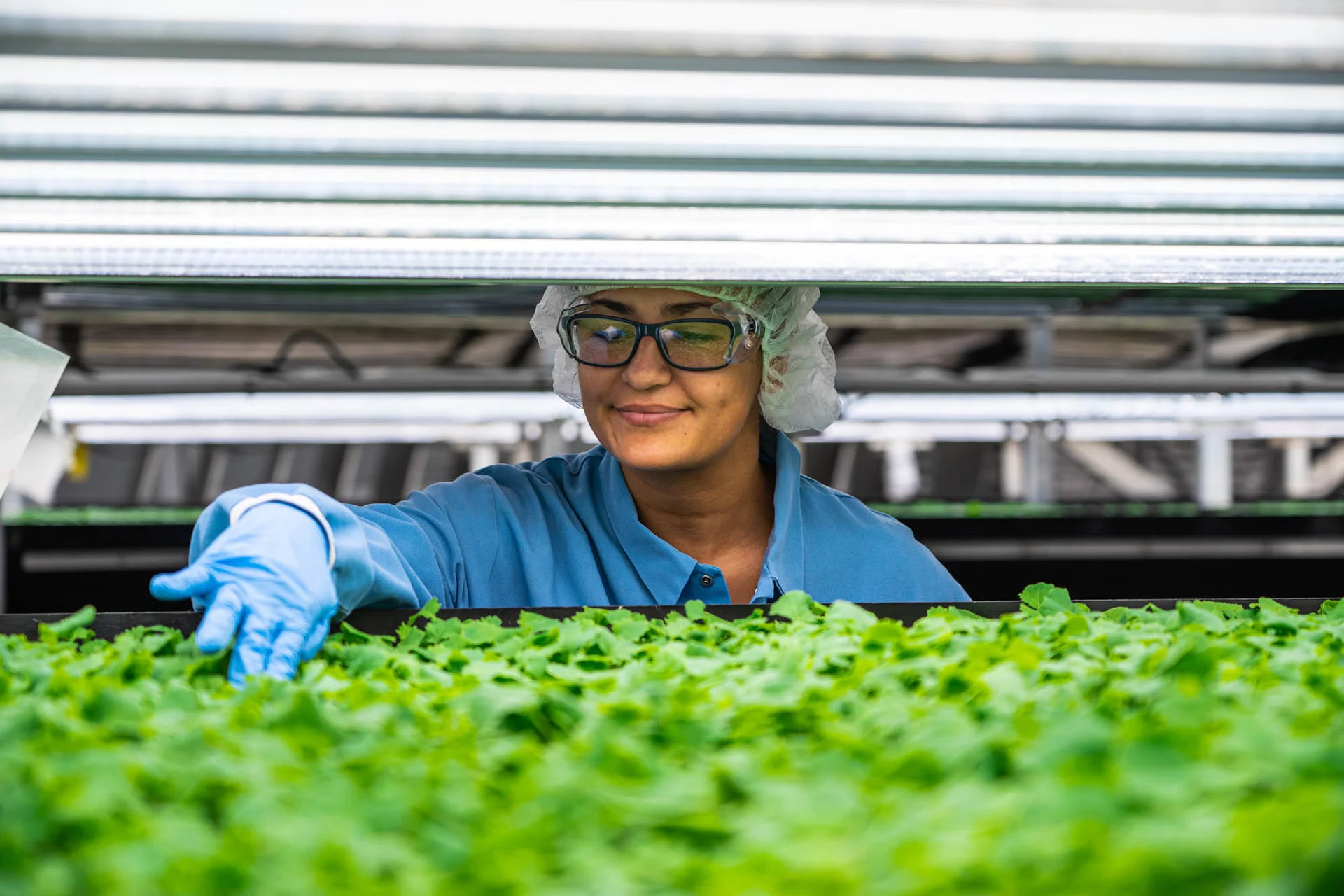
David Slotnick/Business Insider
Singapore Airlines is about to launch a new "farm-to-plane" dining program, using vegetables grown at a local farm in Newark, New Jersey, in dishes on board its flights from the New York City area.
AeroFarms, the company supplying the greens, is a high-tech "vertical farm," which uses a controlled climate, LED lights, and a new type of farming called aeroponics to grow crops in reclaimed urban spaces.
Business Insider toured the AeroFarms facility to learn more about how the process works, and how things like baby kale and watercress can go from the farm to 35,000 feet in just a few short hours. Scroll down to walk through this unique urban farm.
What's the deal with airplane food?
If Singapore Airlines has anything to say about it, that classic stand-up joke will soon be a thing of the past.
The airline made headlines in 2017 when it announced a new "farm-to-plane" dining service coming to its long-haul flights, and again this spring when it announced its first sourcing partner.
Now, the locally-sourced, fine-dining initiative is about to launch on the world's longest flight.
After months of planning and preparation, the farm-to-plane service is kicking off next month on the airline's flight between the New York City-area Newark airport and Singapore.
The airline will work with AeroFarms, a unique indoor vertical farming company based in Newark, New Jersey, to source leafy greens and vegetables for several of the appetizers in its business class cabin starting in October. Meals made with the local greens will eventually be expanded to other courses and other cabins — the plane operating the flight is entirely business class and premium economy.
While the novelty of the "farm-to-table" concept in the sky, coupled with the fresh taste of the meals has an obvious appeal, the airline also touts the sustainability of both sourcing ingredients locally, and supporting eco-efficient businesses like AeroFarms with its business. It could be easy to dismiss that — the airline, after all, is an airline, and relies on fossil fuels to fly emission-generating planes around the world — but there's a twofold benefit that sourcing crops from a company like AeroFarms can provide.
Normally, while catering in the winter, "the greens for our flights from Newark had to be flown in from 3,000 miles away, from California, Mexico, or Florida," said James Boyd, Singapore's head of US communications. "This allows us to instead source our greens from less than five miles away, cutting down on shipping waste."
Additionally, Singapore is looking to expand the farm-to-plane initiative with similar sustainable urban farms around the world, giving a boost to growing eco-friendly businesses — for instance, AeroFarms, which said it plans to add more facilities, is a certified B-Corp, a designation given to businesses that meet certain environmental and ethical standards.
Business Insider recently toured the AeroFarms facility at Newark to see how everything works. Take a look below for our walkthrough of the facility, and the process of getting the greens from the farm to the skies.
Welcome to AeroFarms.
David Slotnick/Business Insider
This high-tech, the one-acre vertical farm can be found at an old steel plant in Newark, New Jersey.
David Slotnick/Business Insider
The farm grows a variety of leafy greens and vegetables that will be used in dishes prepared by Singapore Airlines for its flight from Newark Airport to Singapore — the longest flight in the world.
David Slotnick/Business Insider
Despite its small one-acre footprint, the farm can grow roughly 390 times as much output as a normal farm with the same acreage.
David Slotnick/Business Insider
That incredible output isn't just because the crops are grown on trays stacked to the ceiling — it's because of a unique and proprietary method that AeroFarms uses, based off a technology called "aeroponics."
David Slotnick/Business Insider
Aeroponics is a seemingly simple but cutting-edge growing process.
AeroFarms
It uses a mist of water and air to help crops grow in an environment without soil, pesticides, sunlight, or weeds. Aeroponics farms can grow crops year-round, regardless of season.
David Slotnick/Business Insider
It starts with a cloth-like material on which seeds are placed, and where the roots will eventually take hold. The material is laid across trays, which are placed into the farm's growing racks.
David Slotnick/Business Insider
From there, the farm uses a mist of water, coupled with nutrients, to start the seeds' growth.
David Slotnick/Business Insider
Instead of sunlight, the farm uses LED bulbs emitting specific light spectrums, designed to discourage pests, optimize the nutrients the plants get, and even control the flavor of the plants.
David Slotnick/Business Insider
With this method, AeroFarms can grow mature, ready-to-harvest plants in a fraction of the time of a normal farm.
David Slotnick/Business Insider
While baby leafy greens would normally take 30–45 days to reach maturity, AeroFarms said that it only takes AeroFarms 12–14 days.
David Slotnick/Business Insider
That faster growth means that food can be supplied faster, keeping up with demand while using just a fraction of the energy.
David Slotnick/Business Insider
Within just a few days, the farm will see its seeds begin to germinate...
David Slotnick/Business Insider
...Begin to grow...
David Slotnick/Business Insider
... Take hold in the cloth medium ...
David Slotnick/Business Insider
... And grow ...
David Slotnick/Business Insider
... And grow ...
David Slotnick/Business Insider
... And grow.
David Slotnick/Business Insider
The farm has a variety of high-tech solutions to optimize plant growth, including computer-controlled misting...
David Slotnick/Business Insider
... Temperature controls ...
David Slotnick/Business Insider
... And systems that help manage the growth environment, ranging from fans, controlled air pressure between different rooms, and more.
David Slotnick/Business Insider
The racks of trays resembled a server room in an office, except that each row had plants growing on it ...
David Slotnick/Business Insider
... Something you typically wouldn't see around computer servers.
Singapore Airlines
Sensors, controls, and backups help ensure that the plants can grow in the best conditions possible ...
David Slotnick/Business Insider
... And make it easier to keep track of different crops and growing cycles.
David Slotnick/Business Insider
Employees and visitors take a number of precautions to avoid accidentally interfering with the growth or contaminating the food-bound plants ...
David Slotnick/Business Insider
... Including removing jewelry, entering through a series of pressurized rooms and doorways, and wearing hair nets, gowns, gloves, and more.
David Slotnick/Business Insider
The farm employs about 150 people.
David Slotnick/Business Insider
Once plants reach a certain point...
David Slotnick/Business Insider
... They're ready to go into the food supply — including in Singapore Airlines' dishes.
David Slotnick/Business Insider
Growing trays can be taken individually to the harvest room, whenever they're ready — unfortunately, we weren't able to take photos of the process ...
David Slotnick/Business Insider
... And then to the packaging room ...
David Slotnick/Business Insider
... Where they're packaged either for bulk delivery to clients like Singapore Airlines, or for retail.
David Slotnick/Business Insider
The growing, harvesting, and packaging operation may be unique ...
David Slotnick/Business Insider
... But AeroFarms is planning to expand, hoping to open additional locations.
David Slotnick/Business Insider
Business Insider sampled a few different harvested greens, including baby kale, and spicy watercress.
David Slotnick/Business Insider
After being packaged, the sky-bound greens are trucked to nearby Flying Food Group — the caterer that supplies Singapore's Newark flight, which is about four miles away — where they're used for the day's dishes. The airline said it would start with three appetizers, including a garden green salad, heirloom tomato ceviche, and a soy poached chicken, pictured here.
Singapore Airlines
Then, the dishes are brought from Flying Food Group just down the road to Newark Airport, where they're loaded onto the plane.
Nicolas Economou/NurPhoto via Getty Images
If you're interested in trying AeroFarms' produce and you're located in the New York City metropolitan area, the farm sells packaged goods in local grocery stores under the brand name Dream Greens.
David Slotnick/Business Insider

UK: Heliospectra To Supply New Technology For John Innes Centre
This order of Heliospectra’s fully controllable Elixia LED lights complements the previous orders made by the customer and will be part of a project retrofitting glasshouses automated by Heliospectra’s helioCORE light control software
Heliospectra, an intelligent lighting technology provider for greenhouse and controlled plant growth environments, announces a new order from the John Innes Centre in the United Kingdom. This order of Heliospectra’s fully controllable Elixia LED lights complements the previous orders made by the customer and will be part of a project retrofitting glasshouses automated by Heliospectra’s helioCORE light control software. The order value is SEK 2.4 million (£ 200,000).
The John Innes Centre is an independent, international research center of excellence in plant science, genetics and microbiology. To meet the challenge of feeding a growing population, plant breeders and scientists are continuously looking for ways to increase genetic gain in crop production. As a result, the John Innes Centre has become one of the world’s leading research centers on speed breeding which is a cultivation technique allowing researchers to shorten the breeding cycle and accelerate research studies through rapid generation of crops.
“A growing human population and changing environment have increased the concern regarding food security. We desperately need crops better suited to today’s climate. At the John Innes Centre, we are well-known for our speed breeding research and are conducting ongoing crop research on a range of different crops. For that, we need a solution that allows for complete control of all environmental parameters, such as light, temperature, and humidity,” said John Lord, Horticulture Manager at John Innes Centre. “Heliospectra’s ELIXIA lights enable us to upgrade our lighting environment to market-leading lighting standards with spectrum-based control. We have the capability to program each individual wavelength to adapt to individual crop needs.”
”The John Innes Centre is one of Europe’s leading research institutions with critical speed breeding expertise as the world is accelerating food production to support an additional two billion people by 2050. Heliospectra continues to work with the John Innes team to expand their large-scale helioCORE installation. We look forward to supporting their work and significant advancements in crop performance with our pioneering horticulture lighting, automation, and light control solutions,” said Peter Nyberg, Head of Technology and Development at Heliospectra.
Heliospectra's ELIXIA light creates clear business benefits for cultivation teams and researchers around the world. The fully adjustable LED lighting solution is compatible with Heliospectra's helioCORE light control software, enabling growers to improve the quality of plants and accelerate harvest and production cycles while providing consistent and standardized returns 365 days a year.
The order will be delivered in Q3 and visible in the accounts for Q4 2019.
For more information:
Heliospectra
Box 5401 SE-402 29 Göteborg Sweden
Phone: +46 31 40 67 10
Fax: +46 31 83 37 82
info@heliospectra.com
www.heliospectra.com
Publication date: 9/19/2019

Urban Crop Solutions Joins EIT RisingFoodStars Community
“The vertical farming industry is getting recognized as an important global game-changer in the future like the 3D printing industry was seen as such 10 years ago,” speaks Tom Debusschere, CEO of Urban Crop Solutions.“
Urban Crop Solutions has been accepted in the EIT RisingFoodStars community. EIT Food is a Knowledge and Innovation Community established by the European Institute for Innovation & Technology (EIT), an independent EU body set up in 2008 and working in Europe to make the food system more sustainable, healthy and trusted by consumers.
The mission of EIT Food is to support innovative impactful agrifood entrepreneurs, startups and scale-ups to deliver new food innovations and businesses across Europe. The RisingFoodStars program selects only those companies to participate in their community that will drive the disruption of the food system and thereby help tackle the strategic objectives of the EU.
Together with Urban Crop Solutions, 13 other young Agrifood companies were accepted from 10 different countries in Europe. The unique business model as a total solutions provider for indoor vertical farming, the built-up know-how on plant growth in closed environments, the availability of commercial working indoor farming growing solutions and the quality of the management team were all determining factors for the lengthy audit that resulted in the admission to the RisingFoodStars Association. The membership of the EIT Food RisingFoodStars will open many gates for Urban Crop Solutions in terms of increased visibility and access to, and collaboration with, an expert network of industrial and academic partners in EIT projects.
“Over the last 5 years we worked day and night with our team with the mission to secure all built up knowledge to develop commercial products and services for our customers” smiles a proud Maarten Vandecruys, co-founder and CTO of Urban Crop Solutions. “This acceptance is really the recognition of the great work of our team.”
Annick Verween, manager at EIT RisingFoodStars: “With Urban Crop Solutions we add again a new impactful member to our community who we know will leave a positive mark on society.”
“The vertical farming industry is getting recognized as an important global game-changer in the future like the 3D printing industry was seen as such 10 years ago,” speaks Tom Debusschere, CEO of Urban Crop Solutions. “This acceptance strengthens our vision that focusing on economical crop yield is the only way forward for our fast emerging and promising industry to become mature. Turning our in-depth know-how into value for our customers is the promise that we will keep making in future. ”
Urban Crop Solutions develops tailor-made indoor vertical farming solutions for its clients. These systems are turnkey, robotized and able to be integrated in existing production facilities or food processing units. Urban Crop Solutions also has its own range of standard growth container products. Being a total solution provider, Urban Crop Solutions can also supply seeds, substrates, and nutrients for clients that have limited or no knowledge or experience with (indoor) farming. Currently, the company has developed plant growing recipes for more than 220 varieties of crops that can be grown in closed environment vertical farms. Some of these recipes (ranging from leafy greens, vegetables, medicinal plants to flowers) are developed exclusively for its clients by the Urban Crop Solution team of plant scientists.
Urban Crop Solutions has its headquarter in Waregem (Belgium – Europe) but has also operations in Miami (Florida, US) and Osaka (Japan)