


Welcome to iGrow News, Your Source for the World of Indoor Vertical Farming

VIDEO: Get An Inside Look At A Vertical Indoor Microgreens Business - From Growing Systems To Harvesting
Located in East Garfield Park, Garfield Produce Company is an indoor vertical farm and a licensed wholesale food establishment in the City of Chicago
More About Garfield Produce Company:
Website: https://www.garfieldproduce.com/
Instagram: https://www.instagram.com/garfieldpro...
Twitter: https://twitter.com/garfieldproduce
Located in East Garfield Park, Garfield Produce Company is an indoor vertical farm and a licensed wholesale food establishment in the City of Chicago.
The company was formed with the social mission of serving the neighborhood by building sustainable wealth and creating employment in Chicago’s impoverished areas while growing some of the highest

Sustainable Urban Farming: M&S Partners With Infarm For In-Store Cultivated Fresh Herbs
Marks & Spencer is partnering with urban farming platform infarm to deliver a range of fresh produce – including Italian basil, Greek basil, Bordeaux basil, mint, mountain coriander, and curly parsley – to some London stores, where they will be grown and harvested
16 Sep 2019 --- Marks & Spencer is partnering with urban farming platform infarm to deliver a range of fresh produce – including Italian basil, Greek basil, Bordeaux basil, mint, mountain coriander and curly parsley – to some London stores, where they will be grown and harvested. The first in-store vertical farming will be in a newly reopened South West London store and the high-end UK grocer is set to roll out vertical farming units to a further six stores by the end of the year.
Each in-store farm unit uses 95 percent less water and 75 percent less fertilizer than traditional soil-based agriculture and is capable of producing the equivalent of 400 square meters of farmland. This results in a more sustainable use of natural resources and ensures zero pesticide use.
Infarm’s groundbreaking farming technology combines highly efficient vertical farming units with the latest Internet of Things (IoT) technologies and machine learning to deliver a controlled ecosystem with the optimum amount of light, air, and nutrients, says the company.
Each unit is remotely controlled using a cloud-based platform that learns, adjusts and continuously improves to ensure each plant grows better than the last one.
“Infarm’s innovative farming platform is a fantastic example of what can happen when passionate agricultural, food and technology experts work together,” says Paul Willgoss, Director of Food Technology, M&S Food. “We operate as part of a complex global food supply chain and want to understand the emerging technologies that could help provide more sustainable solutions, while also delivering fantastic products with exceptional taste, quality, and freshness.”
Erez Galonska, co-founder and CEO of infarm adds that London represents many of the sustainability challenges that people will experience in cities over the next several decades. “By offering produce grown and harvested in the heart of the city, we want to practice a form of agriculture that is resilient, sustainable and beneficial to our planet. This is also while meeting the needs of urban communities – first in London, and in the future, in cities across the UK,” he says.
M&S is the first UK retailer to work with infarm and the partnership will be supported by the construction of a series of infarm distribution centers in and around London. These central hubs will provide the seedlings for each unit, which are then grown in-store. Infarm farmers will visit the stores at least twice a week to harvest and add new seedlings to the farm. The plants retain their roots post-harvest to maintain flavor and freshness.
Founded in 2013, infarm is one of the world’s largest urban farming platforms harvesting and distributing more than 200,000 plants each month across its network. Infarm currently operates across Germany, Switzerland, France, Luxembourg and the UK, where it has deployed more than 500 farms in stores and distribution centers.
The herb range available in M&S will all be priced at £1.20 (US$1.49)
Edited by Gaynor Selby
To contact our editorial team please email us at editorial@cnsmedia.com

US: CHICAGO - Indoor Farm of The Future Uses Robots, A.I. And Cameras To Help Grow Produce
For the last three years Jake Counne, the founder and CEO of Backyard Fresh Farms, has been pilot testing vertical farming using the principles of manufacturing

September 27, 2019
By: Ash-har Quraishi
Farm of the future uses robots and A.I. to help grow produce
CHICAGO – According to the USDA, the average head of lettuce travels 1,500 miles from harvest to plate. That transport leaves a heavy carbon footprint as flavors in the produce also begin to degrade. While many have looked to vertical farming as an Eco-friendly alternative, high costs have been a challenge.
But inside a warehouse on Chicago’s south side, one entrepreneur hopes to unlock the secret to the future of farming.
For the last three years Jake Counne, the founder and CEO of Backyard Fresh Farms, has been pilot testing vertical farming using the principles of manufacturing.
“Being able to have the crop come to the farmer instead of the farmer going to the crop,” said Counne. “That translated into huge efficiencies because we can start treating this like a manufacturing process instead of a farming process.”
It’s a high-tech approach – implementing artificial intelligence, cameras, and robotics that help to yield leafy, organic greens of high quality while reducing waste and the time it takes to harvest.
Some have called it Old McDonald meets Henry Ford. Large pallets of vegetables are run down conveyor belts under LED lights.
“The system will be queuing up trays to the harvester based on where the plants are in their life-cycle,” explains Counne.
It’s the automation and assembly line he says that makes this vertical farming model unique. Artificial intelligence algorithms and cameras monitor the growth of the crops.
Lead research and development scientist Jonathan Weekley explains how the cameras work.
“They’re capturing live images, they’re doing live image analysis,” he said. “They’re also collecting energy use data so we can monitor how much energy our lights are using.”
“So, what essentially happens is the plant itself is becoming the sensor that controls its own environment,” Counne added.
Another factor that makes the process different is scaleability. Right now, Backyard Fresh Farms can grow 100 different varieties of vegetables with an eye on expansion.
“There’s really no end to the type of varieties we can grow and specifically in the leafy greens,” said Counne. “I mean flavors that explode in your mouth.”
And it’s becoming big business.
The global vertical farming market valued at $2.2 billion last year is projected to grow to nearly $13 billion by 2026.
Daniel Huebschmann, Corporate Executive Chef at Gibson’s Restaurant Group, says the quality of Backyard’s produce is of extremely high quality.
“We’ve talked about freshness, but the flavors are intense,” he says. “It’s just delivering an unbelievably sweet, tender product.”
Counne says he has nine patents pending for the hardware and software system he and his team have developed in the 2,000 square foot space. But, he says the ultimate goal is to have the product make its way to grocery shelves nationwide.
“The vision is really to build 100 square foot facilities near the major population centers to be able to provide amazing, delicious greens that were grown sustainably,” he said.
If he succeeds where others have failed, his high-tech plan could get him a slice of the $63 billion U.S. produce market. At the same time, he hopes to bring sustainable, fresh vegetables to a table near you.

Indoor Farming Technology Leader, SANANBIO®, Debuts UPLIFT Vertical Farming System
SANANBIO firmly believes that agriculture technology should be based on science paired with input from farmers. Michael Yates, SANANBIO's VP of Sales said, "Advanced knowledge of plant physiology and photobiology are fundamental to success in the vertical farming industry
The System Offers Customers A Fully
Automated Indoor Growing Process
LAS VEGAS, NEVADA (September 25, 2019) – SANANBIO®, a leading provider in LED horticulture lighting and vertical farm equipment and technology, announces the commercial release of its fully automated vertical farming system, UPLIFT (Unmanned Platform of Lean and Intelligent Farming Technology). Decades of manufacturing and automation experience, combined with successful multi-year vertical farm operations through parent company Sanan Optoelectronics has given SANANBIO the expertise in designing and operating the UPLIFT system to offer its customers a proven, fully automated indoor growing process.

SANANBIO firmly believes that agriculture technology should be based on science paired with input from farmers. Michael Yates, SANANBIO's VP of Sales said, "Advanced knowledge of plant physiology and photobiology are fundamental to success in the vertical farming industry. Through employing one of the world's largest teams focused on advancing vertical farming technology, UPLIFT is the solution born from the efforts of over 100 plant scientists and engineers."
The UPLIFT automated solution is based on SANANBIO's highly successful manual vertical farming grow system being used in farms today, RADIX. "With over 1M square feet of commercial vertical farms currently using RADIX, farmers and investors in more than 10 countries believe in our company's highly engineered grow technology. The proof is in the plants as our customers like to say," said Yates.
SANANBIO designed and installed the first pilot UPLIFT farm in April 2018 at its facility in Xiamen, China. After 18 months of operation and optimization, the UPLIFT system is now available for commercial deployment globally.
UPLIFT offers a full suite of automation for growing vertically. From seeding and germination to transplanting and harvesting, the high-stack, high-cube configuration offers the latest advancements in vertical farming solutions that reduce labor while achieving higher yields. The UPLIFT farming platform also benefits from an industry-standard production and inventory management system facilitating crop management, farm production planning, and crop traceability.
"Labor costs continue to be a major challenge for vertical farm operators while also maintaining profitability," stated Dr. Charlie Wang, SANANBIO CEO. "The UPLIFT system will help operators significantly reduce labor costs so they can sell more fresh and healthy produce, and therefore receive better returns on their investment. The system also provides an open platform to integrate technology that enables farms with more intelligence and controls allowing for maximized yields and profitability," said Wang.
SANANBIO's engineers and sales teams are prepared to work with leading farmers and investors in the industry who share the same passion to build ground-breaking projects in controlled environment agriculture using this cutting-edge technology.
SANANBIO® is a trademark carried and backed by Sanan Sino-science Photobiotech, a company invested in by Sanan Optoelectronics, one of the world’s largest LED chip manufacturers. Supported by an elite R&D team comprised of plant scientists, researchers, and engineers; SANANBIO utilizes state-of-the-art technology that enables growers worldwide in the horticulture industry to increase the quality and quantity of their yields. Years of extensive research and real-world deployment and operations allow SANANBIO to offer its customers proven, scalable, efficient and cost-effective solutions in LED horticulture lighting and Controlled Environment Agriculture (CEA) vertical farming grow systems. SANANBIO empowers growers with the technology and knowledge to achieve unprecedented results in farming operations.
To learn more visit: https://sananbious.com/
###

Indoor Farming, Crop Monitoring, Pathogen testing Showcased
Six of the nine companies have been featured in recent editions of Agri-View. This article features the final three companies – Alesca Life, Farm X, and ProteoSense
Lynn Grooms lgrooms@madison.com
September 23, 2019
A container-farming system developed by China's Alesca Life features monitoring, automation and climate control. It was developed for food processors and food retailers.
Nine startup companies were chosen to participate in the 2019 SVG Ventures-Thrive Accelerator Program. Silicon Valley Global Ventures, known as SVG Ventures, is a venture capital, innovation, and investment firm. The Thrive Accelerator program invests in mentors and connects startups with investors and businesses for partnerships.
Six of the nine companies have been featured in recent editions of Agri-View. This article features the final three companies – Alesca Life, Farm X, and ProteoSense.
Alesca Life of Beijing has developed various indoor-farming systems. Its container-farming system features monitoring, automation, and climate control. It was developed for food processors and food retailers.
The company also has developed a small cabinet farm for on-site food production in restaurants and schools. The compact system is suitable for growing micro-greens and other leafy vegetables.
Small cabinet farms for on-site food production in restaurants and schools are offered by Alesca Life.
Contributed
“Our target is that customers will see a return on their initial investment within four years,” said Stuart Oda, co-founder, and CEO of Alesca Life.
Stuart Oda is the co-founder and CEO of Alesca Life, which has developed various indoor-farming systems.
Contributed
Another of the company’s indoor-farming systems is “Alesca Sprout.” Developed for hydroponic farms its sensor-based system automates irrigation and other farm electrical equipment.
The Alesca Cloud is a smartphone-based supply-chain-management system. It aggregates operational tasks, farm capacity and production data, operational inventory, environmental sensor data, and other data points.
“Indoor farming is one of many ways to produce food in a hyper-efficient and localized way,” Oda said. “Just as there are different modes of transportation for different types of travel needs, indoor farming is a mode of food production optimized for certain geographies and crop types. As indoor vertical farms become more productive and efficient they’ll be able to produce larger volumes and varieties of vegetables.”
Alesca Life’s turnkey food-production systems enable even inexperienced growers to produce vegetables. The company wants to ensure its customers have positive experiences with indoor farming so it provides troubleshooting for the mechanical and electrical aspects of its systems, Oda said.
Farm X of Mountain View, California, provides growers monitoring and analysis to improve crop productivity. Bill Jennings, chief technical officer for Farm X, discussed the company’s tiers of service in June at the Forbes AgTech Summit.
Bill Jennings
A basic service that Farm X offers involves weather monitoring. The company collects data from the National Oceanic and Atmospheric Administration, the California Irrigation Management Information System, IBM’s Weather Underground and other third-party sources. The company combines the data with imagery from satellites and unmanned aerial vehicles to help growers monitor crop health and performance.
The next tier of service involves the use of in-ground sensors placed every 5 acres to monitor crop health as well as irrigation performance. Farm X combines that information with its models to help growers ensure uniform distribution of irrigation water and reduce electrical costs associated with irrigation pumps.
The third tier of service is a yield-management program. Farm X forecasts crop conditions about three to four months in advance of harvest. That enables growers to improve harvest planning such as how many workers will be needed for harvest. Growers also can use the forecasts to inform their supply-chain partners about future sales, Jennings said. The company’s focus to date has been in California’s vegetable-production areas.
ProteoSense of Columbus, Ohio, has developed a portable biosensor that detects foodborne pathogens such as Escherichia coli and Listeria monocytogenes. Mark Byrne, president and CEO of ProteoSense, has several years of experience working in the medical-device industry. But he saw the need for rapid detection of pathogens in food production and processing.
A portable biosensor developed by ProteoSense detects foodborne pathogens.
Contributed
ProteoSense’s biosensor has been in testing at Taylor Farms of Salinas, California, a large producer of fresh-cut vegetables. The biosensor was first tested in a food-packing house where Listeria monocytogenes can live on countertops, floor drains, coolers, and other equipment.
Food producers have traditionally taken swabs of suspect areas to send samples for laboratory testing. Food producers often need to wait for three days to a week before receiving test results. The ProteoSense biosensor can be used on-site to provide immediate results, Byrne said. Using the biosensor a food producer would take swabs mixed with a buffer. The buffer is placed into the biosensor. The device then displays results and transmits them for storage in the “cloud.”
Mark Byrne
There could be several uses for the biosensor. In addition to being used to detect pathogens on vegetables the biosensor could be used to test irrigation water and ponds for E. coli, Byrne said.
“We’re working with the Pork Checkoff to learn if the biosensor could help pork producers,” Byrne said. “We want to talk with more farmers about how they could use pathogen testing.”
Visit alescalife.com or farmx.co or proteosense.com or thriveagrifood.com or www.forbes.com/series/forbes-agtech-summit -- and search for "agtech summit" -- for more information.
Lynn Grooms writes about the diversity of agriculture, including the industry’s newest ideas, research and technologies as a staff reporter for Agri-View based in Wisconsin.

Best Media For Your Hydroponics Setup?
Does it puzzle you to select the right media for hydroponics setup growing vegetables using the hydroponic method? different Hydroponic formats and hence require different kinds of media
Does it puzzle you to select the right media for hydroponics setup growing vegetables using the hydroponic method? different Hydroponic formats and hence require different kinds of media.
Hydroton
Hydroton or clay balls is expanded round clay pellets and is one of the more widely used media in India. It can be used on its own in hydroponics, aeroponics or deep water culture (DWC) or combined with other media esp. in drip systems (Grow bags, Trough system or Dutch Buckets). It allows maximum drainage and aeration. Hydroton can also be re-used if cleaned and sanitized properly with hydrogen peroxide.
Perlite
Perlite is a medium that is commonly found in soilless mixes. It is made from amorphous volcanic glass that has relatively high water content, typically formed by the hydration of obsidian. Be careful using this media by itself, as it will float.
Cocopeat
Coconut Coir is the most popular medium in India. It is Ph neutral and can be used for multiple months without sterilizing again. It works best when combined with another medium such as hydroton. Coir has excellent nutrient and water holding capacity. It should be cleaned and sterilized after around 6-8 months.

Oasis Cube
Oasis Cubes are manufactured from water-absorbent foam, Phenolic foam, also known as Floral Foam. They act as good starting plug for seedlings and plant cuttings, and not so much as a full growing medium. They are very cheap but have to be changed after every crop.

Jiffy Bags
fine cloth netting is filled with high-quality cocopeat and then compressed to form a “tikky” like coin pellet. It grows to approximately 7 times in height as soon the water is added. Cocopeat is held together by cloth netting and ensures optimum air/water exchange. Available in 1.25 Inch size. It is slightly costlier than the oasis cube but offers better seedling. Like oasis cube, it should also be changed after every crop
Conclusion:
Media plays a very important role in Hydroponic, hence selecting the right and Best Media for your Hydroponics setup is very critical for the optimum growth of vegetables.
New York City Needs More Vertical Farms: Urban Growth On A Higher Plane
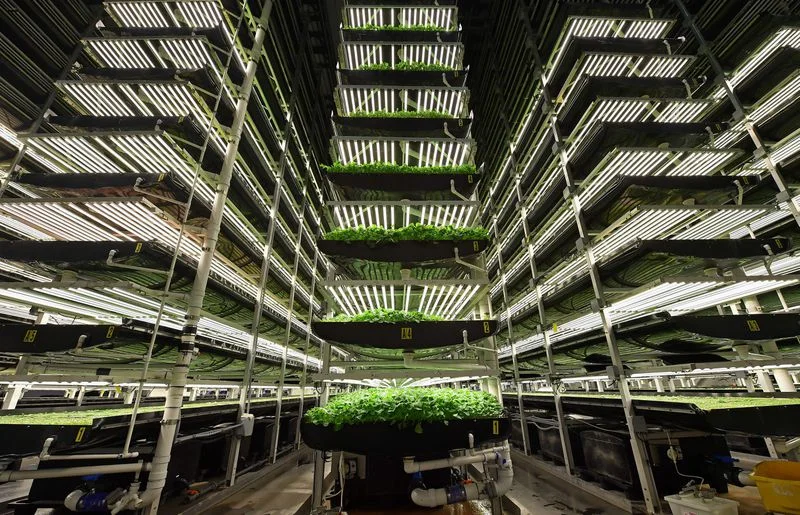
In the last few years a novel form of urban farming — vertical farming — has been slowly but surely emerging in the greater New York area, holding promise as a potent antidote to the city’s notably burgeoning food miles by growing and offering fresh produce locally
By JOEL CUELLO
NEW YORK DAILY NEWS
October 1, 2019
While New York City as a whole by no means is a food desert, wherein access to fresh produce by its residents is severely constrained, such access nonetheless appears to require significant enhancement.
The 2019 American Fitness Index for America’s 100 largest cities, for instance, shows that only 17% of New York City’s residents get their recommended daily portion of vegetables, compared with the top-ranked city in the category, Washington, D.C., wherein 30% of its residents do.
Intriguingly, the same survey shows that New York City only has 18 farmers’ markets per one million residents compared with Washington’s 82.
It does not help that the state of New York’s production of vegetables, representing a measly 7% of its total agricultural output, does not come close to meeting the city’s demand.
Not surprisingly, a significant portion of New York City’s fresh vegetables are sourced from California and Arizona, a distance of at least 2,500 miles. This leads to considerably diminished food freshness, food waste through spoilage, significant long-distance transport energy expenditure, and substantial greenhouse gas emissions, among other problems.
In the last few years a novel form of urban farming — vertical farming — has been slowly but surely emerging in the greater New York area, holding promise as a potent antidote to the city’s notably burgeoning food miles by growing and offering fresh produce locally.
Vertical farms are indoor crop production systems — using a warehouse, greenhouse or a modular structure like a shipping container — wherein crops are grown without soil and using liquid nutrient solution that is either flowing (hydroponic) or sprayed (aeroponic). Crop lighting in vertical farms is typically provided using red and blue LEDs, and ambient air temperature and relative humidity are also regulated. The concentration of carbon dioxide in its air is also typically enriched to hasten the crop’s photosynthetic growth.
Consequently, the growth, yield, and quality of crops in vertical farms are consistently much higher than in open-field cultivation, and the reliability of harvest throughout the year independent of the season and external climate conditions is virtually guaranteed.
And in addition to consuming less than 20% freshwater compared with open-field production, produce from vertical farms are patently fresh, pesticide-free and hyper-local — with all of the latter’s attendant benefits including local jobs creation.
The greater New York area is now home to a number of highly innovative and enterprising vertical farms, including Square Roots, Gotham Greens, Farm.One, Aerofarms and Bowery Farming, among others, most of which regularly deliver their produce to the city’s local grocers and even to Whole Foods Market and to numerous high-end restaurants.
To help ensure both the economic and environmental sustainability of New York City’s growing vertical farms, however, the city needs to see and recognize them also as crucial nodes in the design of the city’s emerging circular economy. We need many more vertical farms.
In a circular economy, the methods of production and consumption are looped into a continuous cycle of resource recycle and reuse, thus minimizing or eliminating waste, with a view to achieving optimized resource utilization and value preservation.
Vertical farms serve as crucial nodes in a circular economy because they consume energy and require material inputs in the form of water, nutrients and carbon dioxide, among others — which may be derived or up-cycled from the effluent streams of other existing nodes in the economy.
For instance, while Gotham Greens is already harnessing solar photovoltaic electricity to power their indoor farming operations, the use of renewable natural gas produced from digested organic wastes is also an already available option for others — and for which vertical farms can possibly deliver their own organics in the form of inedible plant biomass waste.
The needed freshwater, nutrients and carbon dioxide for vertical farms may similarly be bio-cycled from other existing nodes in the economy.
In New York City and other big cities around the world, the future of food is decidedly vertical and circular. Let’s seize it.
Cuello is vice-chair of the Association for Vertical Farming and professor of biosystems engineering at The University of Arizona.
Lead photo by: Growing up. (ANGELA WEISS/AFP/Getty Images)
Harvard Political Review: Green Thumb
Urban farms currently feed more than 800 million urban dwellers every year, but that number will certainly grow as the world’s population keeps increasing and urbanizing. Indeed, the UN estimated that 68 percent of the world’s population will live in cities by 2050, a larger proportion of a much larger number as the Earth’s population continues to grow more broadly
By Kendrick Foster | September 29, 2019
When I think of a farm, I usually imagine an Iowa cornfield stretching for miles on end. A combine harvester spews out straw in collecting this crop; perhaps it’s destined for our plates, but more likely it will become biofuel. Indeed, forty percent of the nation’s corn supply goes to ethanol. The vast majority of the remainder, meanwhile, goes to feed livestock or to manufacture high fructose corn syrup. Only a small portion of the corn grown on these rural farms is served as corn on the cob at America’s restaurants, barbecues, and supermarkets.
Urban farms differ in every way from the corporate behemoth that Midwestern corn agriculture has become. They are small, locally owned, and grow a wide range of crops, from garlic to tomatillos, callaloo to coriander. In turn, those crops often go directly onto plates, bypassing the dizzying amount of processing that most of our food goes through.
I must admit that I had a different conception of urban farming when I started this project. I imagined a monolithic venture, an industrial enterprise merely ported to the confines of the city. Of course, I was wrong: Even within Boston, urban farms range from small community farms to rooftop gardens on top of Fenway Park to hydroponic operations growing underneath the LED lights of a shipping container.
Urban farms currently feed more than 800 million urban dwellers every year, but that number will certainly grow as the world’s population keeps increasing and urbanizing. Indeed, the UN estimated that 68 percent of the world’s population will live in cities by 2050, a larger proportion of a much larger number as the Earth’s population continues to grow more broadly. Feeding these urban dwellers will require reimagining our agricultural systems, creating a puzzle for policymakers across the globe.
Urban farms can serve as a piece of the answer to that puzzle; increased urban farming will improve food security, aid in environmental justice, and help beautify neighborhoods, all while increasing community happiness. Urban farms certainly need increased governmental support, but policymakers must remember one key thing: Urban farming is a highly localized endeavor, and each city must consider its own local conditions before making generalized policies.
Garlic in the Ground
Jet engines from planes departing Logan Airport roared overhead as I ambled towards the Eastie Farm, just a short walk from Maverick Square in East Boston. The farm looked out of place, sandwiched between two multi-family rowhouses along Sumner Street, but I felt strangely relaxed at the farm, standing in the springtime breeze, smelling the dirt, and observing just a small slice of these plants’ gradual growth process.
Volunteers worked to clear the space in preparation for more fruitful times. Lanika Sanders, an Americorps volunteer assigned to the site, directed the work party while telling me a little more about the farm. This land used to house an apartment building, but community members started using it as a trash dump once the apartments were torn down. A group of concerned residents petitioned the city to clean it up, and they planted some garlic once they had finished. “When the city said time to take it back, they argued that they still had garlic in the ground, so they had to give it to them for another season,” Sanders explained. Eastie Farm eventually took over the space.
One hour and several subway transfers later, the Fowler-Clark-Epstein Farm looked less out of place in Mattapan, home to more yards than skyscrapers. Sprinklers whirred about watering seedlings, and garlic plants tentatively put their leaves in the air. Still, its history echoes Eastie Farms. Along with Historic Boston and the Trust for Public Land, the Urban Farming Institute renovated a 19th-century barn and farmhouse to serve as its offices and restarted farming on a property that had hosted farm operations as far back as the 1700s. The site lay vacant from 2013 until 2017, when the renovation project started. Currently, the UFI uses the site as a working farm, as well as the site of their well-reputed farmer training program, which has launched graduates into urban farms across the city.
Beantown Farming
Recently, the Boston urban farming scene has started to attract press attention — and a lot of it. An article in The Guardian described the city as “a haven for organic food and urban farming initiatives,” while Inhabitat declared Boston the second-best city in the United States for urban farming — just behind Austin.
Urban farms in Boston generally fall into three main categories: nonprofits like the UFI or Eastie Farm; community gardens in which individual farmer can grow whatever they want on an individual plot of land; or businesses out to make a profit. Some farms operate seasonally in traditional or rooftop gardens, while others operate all-year in greenhouses. Notable farms include Green City Growers’ rooftop farm at Fenway Park and a 2,400 square foot rooftop garden at the Boston Medical Center; smaller clusters of nonprofits, community farms, and greenhouses dot the Mattapan and Dudley Square areas. The city also hosts more than 200 community gardens and 100 school gardens.
An art installation outside the Dudley Greenhouse reads “Our Liberated Land” in English, Spanish and Cape Verdean Creole.
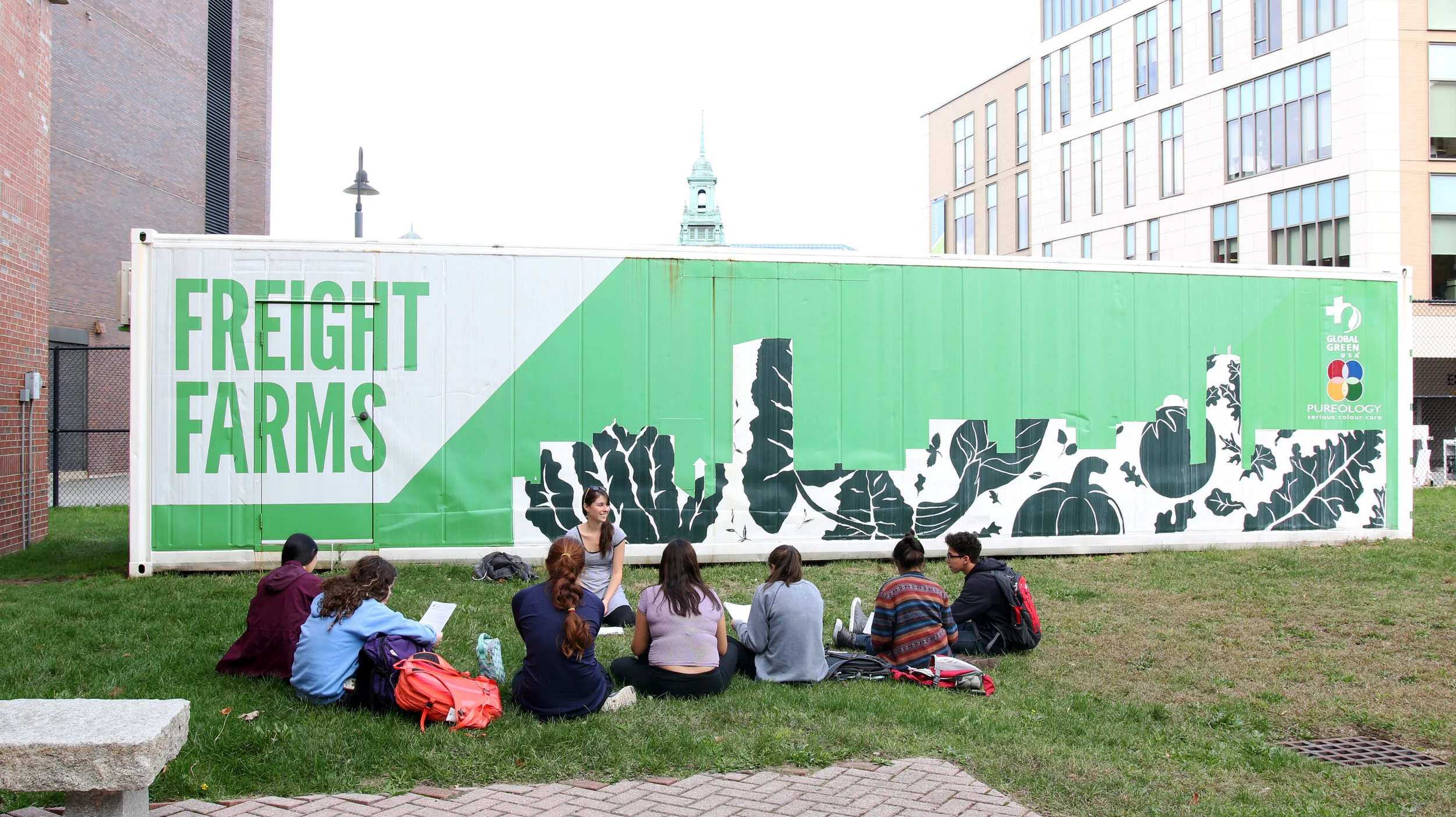
Boston has also spawned several agrotech startups that work in the urban farming business. Freight Farms has developed a turnkey farm entirely within a shipping container, ready to grow food as soon as it arrives at its destination. Their Greenery machine uses highly efficient LED panels, a hydroponic nursery, and artificial intelligence to create an extremely efficient automated farm system. Meanwhile, Grove Labs developed a bookshelf-sized hydroponic nursery that homeowners and business owners can control with an app.
Two major components have contributed to the general success of urban farms in Boston. On the technological side of things, a strong entrepreneurial culture means that Bostonians are willing to take risks, and the number of colleges and universities in the area gives entrepreneurs a large pool of talent to draw on to make their ideas come to fruition.
On the farming side, the 2013 passage of Article 89 changed the city’s zoning regulations to permit farming and beekeeping within the city’s jurisdiction. UFI played a major role in working out the kinks in this legislation, Patricia Spence, its Executive Director, described the process when I visited the Fowler-Clark-Epstein Farm. “We were the guinea pigs, in essence … We’ve got the water people, the inspection people, all these different entities that now have to work together in concert.” Even though some of the kinks still create problems, Boston farmers do not have to worry about the legality of their farms or greenhouses, unlike urban farmers in other cities who have to acquire permits on a case-by-case basis.
Out of the (Food) Desert?
The people I spoke with had differing motivations for entering the urban farming field. Spence remembered the importance of family in getting her start in urban farming. As we walked around the Fowler-Clark-Epstein farm in Mattapan, she recounted her story. “My grandfather farmed every piece of the property he owned in Roxbury, and we certainly ate from the yard. My mom and dad bought a vacant lot in Dorchester, and my dad grew food there all summer long. The passion comes from that vantage point.”
Karen Washington, meanwhile, remembers being galvanized by then-Mayor Rudy Giuliani’s proposal to auction off community garden sites. “Growing in empty lots wasn’t really about food. It was about beautification, taking back our neighborhood,” Washington, a food justice activist and founder of the suburban Rise and Root Farm outside of New York City, told the HPR. “In the middle of the night, we got backstabbed when Giuliani tried to auction off 100 community gardens. Looking back, it was the best thing that happened, but during that time, it was the worst thing that happened. People were telling us we couldn’t fight city hall, but then we said collectively we could fight city hall. A group of community gardens along with your allies, you’re much stronger. You can’t work in a silo, but when you get a community behind you, you can be a lot more successful.”
However, many people at the helm of Boston urban farms got their start in urban farming after they recognized the deficiencies in both local and national food systems. Jessie Banhazl, founder of Green City Growers, read the book Omnivore’s Dilemma, which inspired her to grow food more organically and sustainably. After moving back from New York City, she also realized something about the broader food system. “Upon returning back to the Boston area, I realized that I had been living in a food desert and that I was really feeling the effects of not having access to fresh produce,” she told me. Apolo Cátala, farm manager of the OASIS at Ballou farm in the Codman Square area, realized something similar after going on sabbatical in Puerto Rico.
Many the problems in these food systems center around nutrition and public health. “Many times, people have to go outside of their own neighborhood to find something that’s fresh, that’s edible, instead of the the junk food that’s inundating our community,” Washington said. When people eat junk food instead of fresh fruits and vegetables, their health declines — researchers have linked food deserts, areas without affordable access to fresh fruits and vegetables, to increased rates of obesity and diabetes. Obesity and diabetes disproportionately impact low-income Americans and people of color precisely because low-income Americans and people of color disproportionately live in food deserts.
Boston’s food system in particular presents numerous challenges for low-income residents. Overall, Boston has 30 percent fewer grocery stores per capita than the nationwide average, and predominantly minority neighborhoods in Dorchester, Roxbury, and Mattapan have even fewer, Barbara Knecht, the farmsite development coordinator at UFI, told the HPR. A Boston Globe investigation, meanwhile, found that 40 percent of Massachusetts residents live in a food desert. Even Harvard Square, home to affluent Harvard students, is widely considered to be a food desert.
Broader questions, though, revolve around the sustainability of our food supply and its relation to population growth. America’s farmers are notoriously inefficient. They consume large amounts of water, drawing on aquifers much faster than they can be replenished, and spray an inordinate amount of pesticides and fertilizers, creating a host of environmental issues, from resistant pests to algal deal zones. Meanwhile, the problem of overpopulation is always looming. Jon Friedman, the co-founder and COO of Freight Farms, told the HPR. “Our population is set to exceed our capabilities for food production, and that’s a big, hairy program that we have to solve,” he said.
Meanwhile, Dickson Despommier, a professor at the Columbia School of Public Health, connected urban farming and climate change in conversation with the HPR. “Climate change issues require a different approach because farmers can’t move when the climate changes. They grow corn where they live now, but in twenty or thirty years they won’t be able to because the climate won’t permit it,” he noted.
By bringing fresh produce into cities, urban farming can help address the racial inequalities that characterize food access in America.
It’s easy to imagine these problems converging in coming decades. Climate change causes refugees from low-lying areas to flock to cities, where they go hungry because rising seas have destroyed much of the world’s arable farmland. If they can eat at all, they rely on junk food because the remaining fecund land grows high-profit or subsidized crops. In its own way, urban farming can make a contribution to stop this spiral. It makes use of previously unutilized areas — especially rooftops and vacant lots — to grow more fresh, nutritious food, selling it to the communities that need it most at affordable prices.
Although urban farms do not necessarily operate under organic principles — a set of rules including prohibitions on pesticides and artificial fertilizers — many in the Boston area, including UFI and the OASIS farm, do. Those that do not are typically small, meaning that they cannot indiscriminately spray pesticides or fertilizer. The high price of water in many cities, meanwhile, has forced urban farmers to control their water usage or find new ways to get water.
Innovations in farming practices allow urban farmers to grow their produce without pesticides and fertilizers. In setting up a controlled environment for plants in a shipping container, Freight Farms has created a technology that allows plants to grow more efficiently, with inputs exactly tailored to the plants’ needs. “We’ve uncovered a world of ways that we can help the plant do what it wants to do best or do something it’s never been able to do without the use of chemicals, fertilizers, pesticides, and the like,” Friedman explained.
Beyond its environmental benefits, the green space created by urban farms also lifts property values and community spirits. Urban farming “turns urban spaces back into places where plants are being grown, where there’s oxygen being created, where there’s beautification happening,” Washington explained. “When you go from a vacant lot to an urban farm, it makes people happier.”
Banhazl added that urban farming helps to reduce emissions by decreasing the distance between the source and the consumer — a concept known as reducing ‘food miles’. “By localizing food, you cut down on all sorts of carbon emissions and use of resources [associated with] moving and trucking and distributing food from one point to another.”
Both Banhazl and Friedman emphasized the nutritional benefits of their business models. “The sooner you pick the food and then put it in your mouth, [the more] nutritional value you will get out of that plant,” Friedman explained, and the hyperlocal nature of Freight Farms’ containers (often located right next to the main consumers of the produce, such as restaurants as grocery stores) puts healthy produce into communities that need it. Furthermore, when local residents replace junk food or processed food with fresh vegetables, their health improves. “The whole idea is we’re tapping into local knowledge about healthy food and expanding it,” Knecht of the UFI explained.
Boston high school students visit the Freight Farms shipping containers, learning about innovations in agrotech.
Farming for Fairness
Every single person I spoke to emphasized food security in relation to urban farming. Many of the community gardens and nonprofits across Boston sell their produce at farm stands and farmers’ markets in their local communities, improving food access. Green City Growers donates a portion of their produce to local food banks and soup kitchens, while school gardens help provide at-risk teenagers with fresh produce in school lunches. Volunteering programs at many urban farms also provide residents with the opportunity to work with nature, which in turn encourages them to pick healthier foods when they go to the supermarket. In addition to teaching local residents how to grow their own food, the UFI’s farmer training program also helps them to develop useful skills for the workplace.
Above all, urban farms help to inspire the local community to grow their own food, which does the most to improve food access and nutrition. “The most successful thing is to inspire people to make a stronger connection to where their food comes from,” Cátala told me. “We have the ability to engage entire communities. It’s a small scale, but it’s still a scale that has a big impact, and it’s important to measure that.” Patricia Spence reiterated the importance of this point: “We say, whether you’ve got a little bit of dirt in the backyard, if you’ve got a porch, if you’ve got a windowsill, we want you growing food.”
Spence noted the impact urban farming can have beyond nutrition, citing two stories that have stuck with her. “Chris was a part of our class of 2014, and the success of our program is Chris’s story. He was reentering the workforce, he had been incarcerated. It took him a year or two to get into the program, but he went through the program in the 2014 year, lost 100 pounds, and learned what a real tomato tastes like. He became our tomato expert,” Spence began.
“He went on to work with at the Commonwealth Kitchen, this wonderful incubator of food businesses. A lot of the food trucks you see around the city actually do their food there. Chris started with working them, but after two years, he actually was like, ‘I miss the dirt!’ So he came back, and he was with us seasonally for the past two years, and he became our production manager. As of this year, I’m sorry to say, he’s not coming back because he has a full-time job at the Commonwealth Kitchen, and he’s a manager. I am sad, but it’s exactly what we want.”
“If you look at Ronald, it’s a similar story. When Ronald came to us, he was extremely quiet, a very, very quiet man, didn’t say a word. But he was a prolific journaler. He just wrote and wrote. We had to keep giving him journal books. By the end of the class, everyone was saying, ‘You talk all the time now!’ He went to work for the Commonwealth Kitchen as well, and he’s been there for four years. We had a big fundraiser last year, and he was asked to speak. This guy who didn’t speak spoke for seven minutes, I timed him, no script. He said this was the best year of his life.”
Up, Up, and Away
Dickson Despommier thinks he has another way to transform lives through food: vertical farming. Vertical farming is not a new idea, but its widespread implementation in the United States could radically change the way we think about urban farming. The HPR interviewed Despommier, who originally came up with the idea in 1999; he defined vertical farming as a “multiple-story greenhouse.” In the first few years, Despommier and the students who worked with him labored in obscurity. “We just carried out as if we were living on an iceberg somewhere floating in the middle of the Atlantic Ocean, and nobody would ever read anything we did or care about what we did, so we did whatever we want. That’s the best way to approach any problem: There’s no limits on the kinds of solutions you can suggest for something as long as the solutions make sense ecologically.”
In recent years, though, larger-scale farms making true use of the vertical farm concept have sprouted up in cities across the world. AeroFarms has four farms in the city of Newark. Using what it calls a “smart aeroponic” technology, it claims to use 95 percent less water than traditional agriculture to produce yields of 370 times that of the standard model. In Japan, Spread Company recently built a vertical farm in ‘Japan’s Silicon Valley’ with automated temperature, humidity, and maintenance controls. Singapore’s Sky Greens also operates a commercially successful vertical farm, consisting of several 4-story translucent structures. Many other businesses have developed smaller-scale vertical farm operations that can take advantage of unused garage space in private residences.
At this point, three major technologies form the basis of the majority of indoor farming projects globally: hydroponics, aeroponics, and aquaponics. Despommier described each system for the HPR. In the main hydroponic technology, plant roots take in an oxygen-infused nutrient mixture through holes in PVC pipes. However, this technology suffers from competing temperature priorities: High temperatures allow more nutrients to be dissolved but also less oxygen. Despite this, the technology remains common: Freight Farms and Grove Labs both rely upon hydroponics for their systems.
Freight Farms uses innovative technologies and methods like hydroponics to grow produce within shipping containers.
Aeroponics solves the temperature problem in hydroponics by suspending roots in a chamber, where a nutrient-rich mist is sprayed. However, aeroponics has a valve problem: The valves involved in spraying the mist “routinely clog up, and that became a big problem with troubleshooting. It’s a mess,” Despommier said. Fortunately, a Chinese company, AEssence Grows, has developed a much more reliable valve, one that makes aeroponic systems a lot more viable, he told the HPR.
A third option has also emerged: aquaponics, a combination of aquaculture — fish farming — and hydroponics. In aquaponics, the farm owner feeds tilapia or other kinds of herbivorous fish plant material. The fish then, for lack of a better expression, excrete waste into the water. After the farmer removes the ammonia from the system, the plants take up the nutrients from the fish waste. “This sets up an internal circular economy among the fish and the plants, and you get both for the price of one,” Despommier explained. “However, the big difficulty of this is that you get two completely different growth systems to worry about at the same time. Lots of things can go wrong, and they usually do.” As a result, aquaponics technology will require a lot more innovation before it can enter the world of large-scale vertical farming.
Any vertical farming project would need to be underpinned by one of these technologies, but Despommier has his favorite. “I think aeroponics is going to take over … You can squeeze in many more plants in aeroponics than hydroponics, and aeroponics uses far less resources, including water.”
Vertical farming makes a certain amount of sense agriculturally: you can grow food up instead of just out, and you can grow year-round indoors. Whether it makes sense economically, however, is another question: A recent study found that controlled environment agriculture (a more general term for indoor growing using technologies like hydroponics) in New York City contributed minimally to food security while expending significant resources on the controlled environment itself.
The answer to the vertical farming question may not be skyscrapers filled with stories and stories of aeroponics, but small hydroponic or aeroponic systems in people’s garages. Vertical farming technology seems more suited to for-profit businesses and restaurants hawking hyperlocal produce rather than community organizations focusing on city-wide food security.
Farms from Sea to Shining Sea
Boston has become a hub for urban farming, but many of the largest American cities have their own thriving urban farming ecosystems which include and go beyond vertical farming. It would be mind-numbingly boring to list the urban farms successfully operating in Los Angeles, San Francisco, and a range of other American cities. Cities with an especially sustainable and progressive bent, such as Austin, Seattle, and Portland, are particularly well-known for their urban farms.
Urban farms in these cities generally follow the same model as Boston: a mixture of nonprofits and businesses, greenhouses, rooftop farms, and more traditional farms. Chicago’s urban farms deserve some special note: The city boasts the world’s largest rooftop farm and the country’s largest aquaponic formation. New York schools, meanwhile, have introduced programs that allow students to grow food for their own cafeterias.
Although urban farms have their place in thriving cities, they can also play a role in revitalizing Rust Belt cities suffering because of the steel industry’s decline. Nonprofits have proposed turning vacant Cleveland lots into urban farms that could serve as the centerpieces of new communities, looking to Detroit — a real-life case study for urban farming, its relationship with food and racial justice, and its role in urban renewal. The housing crisis left lots vacant across the city, and many farmers have come to view these lots as an advantage. For example, a for-profit company recently bought 1,500 vacant lots to develop into the world’s largest urban farm. Community gardens have also bought vacant lots, where African-American and Hmong communities, among others, have used the idea of urban farming to reclaim their cultural heritage, educate their youth about food issues, and regain agency in food production.
Mary Carol Hunter, a professor at the School for Environment and Sustainability at the University of Michigan, agreed to talk to the HPR about the urban farming scene in Detroit, which she noted was, of course, too expansive to cover entirely in a single interview. Initially, Detroit urban farms faced strict regulations on the sale of food, Hunter explained, but then an entrepreneur named Dan Carmody stepped in. Carmody, who took over the local food wholesaler Detroit Eastern Market, “decided it was important to have it be a community building, even though it was a for-profit business,” she said. Over the better part of a decade, the market set up a nonprofit “to help people get a business started where they could sell their food and [gave them] all the support services that went along with it … They really wanted to get a value-added product from the food.” This nonprofit has been instrumental in enabling urban farms in Detroit to create jobs and make money selling local, nutritious food, Hunter argued.
Another key figure in the thriving Detroit urban farming scene is Malik Yakini. A former teacher and principal, Yakini realized the “incredible benefit [that] came to the kids who were actually participating” in hands-on farming. Today, Yakini runs the Detroit Black Community Food Security Network, which has emerged as an important voice in Detroit’s black community on a number of issues besides food security.
A second nonprofit, Keep Growing Detroit, has also served as a key actor in growing the Detroit urban farming industry. Several years ago, the organization realized that “they would be a much more powerful group if they focused on teaching leaders in all the communities and having them bring the information back to their own neighborhood,” Hunter said. That approach, she argued, “almost single-handedly removed the neoliberalism problem of nonprofits going into underserved areas and trying to ‘help.’”
Despite this range of benefits, urban farms have not received an exclusively positive response. The Atlantic’s Conor Friedersdorf argued that vacant lots in San Francisco should be transformed into affordable housing units instead of urban farms, while the Detroit Metro Times criticized what it called “colonialism” in one urban farm giving away its produce. By giving away food for free, the farm competed with other locally-owned farms that sold their produce at farmers’ markets, ultimately harming the community, the paper charged. Environmentally, meanwhile, a recent study from Sydney, Australia found that urban farms there used as much fertilizer as conventional farms.
Some of these concerns have merit, particularly ones regarding affordable housing, but each of these three critiques of urban farming examined one city in particular, and urban farming projects all have different local constraints. What may work in one city may not work in another, and vice versa. Putting community members at the helm of these urban farming projects can mitigate some of these concerns by allowing people with local knowledge to make crucial decisions around priority-setting and program design.
“By Definition Challenging”
Of course, the main challenge urban farmers face is the environment. “If any farmer or gardener says they’re an expert, they’re lying, because the only expert is Mother Nature. She will bring you to your knees if you think you know it all, she’ll test you,” Karen Washington said. For example, the OASIS on Ballou farm struggles to contend with its hillside location, Apolo Cátala told me. Meanwhile, Phoenix urban farmers must heavily irrigate their farms or use native plants since their city is located in the middle of a desert. Unsurprisingly, Phoenix’s heavily alkaline, salty, and rocky soil is quite poor.
Detroit urban farmers, meanwhile, contend with industrial pollutants such as lead and mercury in the soil leftover from the city’s industrial heyday. Leaded gasoline and “manufacturing concerns were the worst pollutants, and the stuff is airborne. But [lead] is everywhere,” Hunter said. “I know that in the area of the Ambassador Bridge, there have been some [manufacturing] plants … that still release a lot of airborne toxins. People who live in those areas are reminded and encouraged not to grow leafy vegetables like lettuce because those plants actually absorb [the pollutants] directly from the air right into the food that you eat.”
Interestingly enough, artificially high water prices in Detroit also contribute to the city’s urban farming challenges. “Despite the fact that Detroit has a huge amount of quite delicious and healthy water, it costs a lot more than water should cost,” Hunter noted. Additionally, the city of Detroit has charged high fees to maintain its aging and crumbling infrastructure. “So people have had to do as much as they possibly can to set up gardens that are water-wise and set up things like rain barrels. It’s an economic issue, not a conservation issue.”
The question of money came up time and time again. “Ask Harvard for a million dollars, some of that endowment money would be much appreciated,” joked Patricia Spence of the UFI. “We could be growing more food on more lots, but the financing has slowed up the process considerably,” she continued more seriously. Washington also turned to the question of resources. “In marginalized communities, resources are next to none. Nonexistent,” she said, skewering local politicians for not providing enough money to urban farming.
Banhazl also emphasized the difficulty associated with getting funding in the beginning stages of her business. “We didn’t have the opportunity to raise a ton of capital all at once because people were like, ‘Why would I invest in local farming? That doesn’t seem like a viable commercial business,’ which clearly it is,” she noted. The process of getting money in fits and spurts, she explained, took up a lot of her time in the formative years of Green City Growers, reducing her ability to focus on innovating and developing.
Indeed, despite the local nuance associated with urban farming, this lack of money seems to be a consistent problem across the country — even in cities with favorable regulatory frameworks. California recently passed tax incentives to convert vacant lots into urban farms, while Houston has no zoning regulations whatsoever. Yet urban farmers in Los Angeles have not taken the state up on its offer, with some landholders reportedly holding off for future development or because urban farms simply do not make enough money. Similarly, land in the Houston urban center is surprisingly expensive, and one of the few urban farms in the city worries that the city will terminate its lease in favor of future development.
Creating the Green Thumb
Obviously, a one-size-fits-all policy solution will not work for every urban farm in every city across the country, but a couple of solutions stick out. First, cities with unfriendly regulatory frameworks need to change those rules to remove the red tape that prevents urban farms from expanding or even starting.
Second, cities and states need to give more resources to urban farms, especially nonprofit farms or community gardens. The businesses selling microgreens or farms in freight containers to trendy restaurants seem to be doing pretty well for themselves, but the urban farms that directly impact local communities largely depend on grant money and donations. Tax incentives for urban farms or direct investment in these farms could do the trick.
As I plodded around the urban farms I visited, as I kneeled down to smell the first inklings of pungent garlic, as I envisioned the small seedlings growing into full-fledged plants, I realized somebody has to grow the food I eat — and that somebody is unlikely to ever be me. But if I did grow my own food, I would care so much more about what I ate and how I ate it, and if I went to a farmer’s market every weekend to hold produce in my hands, I would probably eat a lot more vegetables.
Urban farming has this effect on people. It certainly affects communities quantitatively, improving their access to healthy, nutritious food, but its impact is also more qualitative — it’s hard to calculate the value of bringing communities closer to their food sources and closer to Mother Nature.
Chris and Ronald, the two men who benefited so much from the Urban Farming Institute’s training program, exemplify this point perfectly. Going through the UFI training was “a life-altering scenario for them that got them on a transformative path,” Patricia Spence told the HPR. “I thought this job was all about food, but it’s really all about people, and food is a vehicle. We’ve been able to transform all these lives through this thing called growing food.”
Let’s grow more food.
The cover art for this article was created by Kelsey Chen, a student at Harvard College, for the exclusive use of the HPR’s Red Line.
Image Credits: Kendrick Foster / Matthew Rossi / Freight Farms / Freight Farms

Commercial Aquaponics Workshop At Auburn University
Are you trying to break into the aquaculture industry or already working in the field and looking to gain additional expertise for career development?
Auburn University’s Aquaculture And Fisheries Business Institute
Will Hold A Commercial Aquaponics Workshop
In Auburn, Alabama From 11-13 November.
24 September 2019
The workshop will include two days of lectures, hands-on activities and a tour at the Aquaponics Greenhouse at the Auburn Fisheries Station. On the third day, there will be a field trip to a commercial aquaponics facility in Birmingham, Alabama. Attendees will have the opportunity to see and hear about commercial aquaponic systems and their operations.
Aquaponic Workshops are offered as a response to the community’s overwhelming interest in aquaponics. Participants will receive detailed instruction on the basics of aquaponics, a tour of the school’s fish and plant greenhouses and guidance on designing and constructing aquaponics systems. No prior skills or training are required.
A combination of aquaculture and hydroponics, aquaponics combines the practice of raising aquatic animals in tanks with the cultivation of plants in water. An aquaponics system utilizes the animals’ waste to nourish the plants, while the plants, in turn, help clean the water.
Presenters include Mr. Huy Tran, Dr. Jesse Chappell, Dr. Terry Hanson, Dr. Fred Petit, and more. Seating is limited to 30 people so please register early.
Please contact David Cline, clinedj@auburn.edu or Amy Stone at Amy@aquaticed.com for more information or visit Auburn University's aquaponics page
Click Here To Register For The Auburn's Workshop
On 11/11-11/13/2019

Nurturing The Seeds of Vertical Farming
Vertical farming involves building indoor farms with LED lights to replace the sun and control every single variable in that farm to optimize plant growth
09.10.2019
By Dan Malovany
Vertical farming today is moving from a conceptual phase to the mainstream as a greater abundance of food is profitably grown in urban areas and new crops come under development, said Henry Gordon-Smith, founder, Agritecture Consulting Services during his Fresh Take Talk at the International Baking Industry Exposition on this cutting-edge movement on Sept. 8.
Vertical farming involves building indoor farms with LED lights to replace the sun and control every single variable in that farm to optimize plant growth. Despite the fact the first U.S. vertical farms are less than a decade old, the sustainable industry has blossomed with the flourishing demand for local, safe produce and farm-fresh ingredients as well as the need of city dwellers concerned about climate change to reconnect with food systems in their local communities.
Such farms allow craft bakers, high-end retailers and fine restaurants to fill a void and offer fresh-grown food harvested year-round.
“Retailers should think about value-added products through vertical farming through enhancing the retail experience or through growing something that could be used in their bakery products,” Mr. Gordon-Smith said.
He added they create the opportunity to cultivate customer loyalty through marketing value-added baked foods with herbs, vegetables and other free-from-pesticides ingredients harvested in their store or at a nearly indoor farm. These herbs and vegetables also can be sown in larger vertical farms that offer fresh seasonal food or in a smaller unit inside a store that also promotes a theater of community that grounds city dwellers with the food they consume.
The multi-level farms range from 250 square feet for a small retail shop to 3,000 to 10,000 square feet for a medium-sized operation that supplies the nearby neighborhood. The world’s largest one is about 60,000 square feet. Mr. Gordon-Smith said vertical farming is prospering globally, especially in colder climates and congested urban areas where farm-fresh food isn’t readily available.
Typically, wheat isn’t the best crop for vertical farms, mainly because it takes so much space to grow the volume needed to produce baked foods. Mr. Gordon-Smith added that wheat requires a soil structure that hydroponic soil cannot provide, although there may be opportunities to foster the growth of heirloom and specialty wheat as the trend expands. However, rosemary and other key minor fresh components in baked goods are more practical today.
“You’re essentially driving the value of a fresh product, and fresh wheat isn’t a huge value proposition because it’s stored and transports very well,” Mr. Gordon-Smith said. “Fresh lettuce doesn’t, so you can see why fresh lettuce and other products would be grown in a vertical farm and not wheat.”
Mr. Gordon-Smith expected vertical farming research of wheat, cocoa and other value-added commodities could become more widely available in five years. In recent years, he added, the quality of wheat has deteriorated due to myriad variables. The urban farms provide the possibility of naturally raising the quality of wheat by controlling all of the variables involved in growing the crop.
“We’re going to see more and more research on how to grow wheat indoors and how to develop indoor systems to grow wheat,” he said.
Lead photo: Source: Adobe Stock

BREAKING NEWS: Gordon Food Service-Square Roots Partnership’s First Indoor Farm Campus, Next-Gen Farmers
Gordon Food Service and Square Roots, the technology leader in urban indoor farming, today celebrated the opening of their strategic partnership ’s first co-located farm at a ribbon-cutting event on the campus of Gordon Food Service’s headquarters in Wyoming, MI
SEPTEMBER 30, 2019
Gordon Food Service and Square Roots, the technology leader in urban indoor farming, today celebrated the opening of their strategic partnership ’s first co-located farm at a ribbon-cutting event on the campus of Gordon Food Service’s headquarters in Wyoming, MI. In addition to executives and staff from both companies, guests included customers and local, state, and federal government officials. Attendees learned more about the facility, the first of its kind hosted by a broad-line foodservice distributor, including a tour of the indoor farm’s operations.
An artist's rendering of the new Square Roots' indoor farm at Gordon Food Service, Wyoming, Mich. ( Courtesy Square Roots )
In his remarks, Rich Wolowski, president and chief executive officer of Gordon Food Service, said, “We’re building exciting relationships with change agents that are helping to reshape how food is produced, prepared, and served — and Square Roots is a great example of leading-edge thinking and technology driving new solutions. We know it’s imperative that we participate in the future, today, to ensure we are relevant tomorrow, and this is a model that could help revolutionize our food systems. And it’s great that we can prove the concept in our own backyard.”
The modular indoor farm, sited on less than two acres of the Gordon Food Service headquarters property, was almost immediately in production following construction completion earlier this month. The ten cloud-connected growing units, employing sophisticated, digitally-controlled hydroponics and LED lighting systems, are projected to produce more than 50,000 pounds of premium herbs and greens annually, or roughly the equivalent production of a traditional 50-acre farm. However, unlike more typical agriculture, the Square Roots produce will be non-GMO, pesticide-free, and harvested all year long. Initial crops will include basil, chives and mint. The herbs will be sold to local foodservice customers in Grand Rapids as well as throughout Michigan, northern Indiana, and Ohio.
The companies noted that this first farm installation serves as a template, with ambitions to see additional indoor farms on or near Gordon Food Service’s more than two dozen distribution centers across Canada and the eastern U.S.
Tobias Peggs, Square Roots co-founder, and CEO, noted, “This partnership reflects our shared commitment to local, real food and at a scale that will serve people and communities across North America. But it’s also Square Roots’ mission to empower the next generation of leaders in urban farming.
Through our Next-Gen Farmer Training Program, we train future farmers in all aspects of local food systems — from seed to shelf. And with each new Square Roots farm, the Next-Gen Farmer Training Program opens doors for more young people to start exciting careers in the agriculture industry.”
The new farm is tended by a cohort of Next-Gen Farmers selected by Square Roots as part of their unique Next-Gen Farmer Training Program. The paid, full-time and year-long commitment has attracted thousands of diverse applicants eager to be change-makers at the forefront of urban agriculture and contributing to the local, real food movement. Half of the Michigan team hails from in-state while others come from as far away as Texas and New York.
Wolowski said, “We are excited to be the first broad-line foodservice distributor to host an urban farm, with the ability to bring fresh, hyper-local produce to our customers year-round. It’s an important example of our pursuit of innovation to better serve our foodservice customers, and our customers’ customers while answering the growing demand for fresh, nutritious and local food.”

Social Entrepreneur: Roots Up Wants To Expand Access To Urban Farming
Roots Up will manufacture and operate systems that enable efficient growing of food literally in the hallway of a home, the dining room of a restaurant and, at larger scale, in a garage, parking lot or empty urban lot
By Allen Proctor
September 26, 2019
John Schrock is an engineer who has an idea for how to transform the farm to table movement. Having worked on the concept for several years, this summer he plugged into Sea Change, an accelerator program in Central Ohio focused on jumpstarting social enterprises.
Roots Up will manufacture and operate systems that enable efficient growing of food literally in the hallway of a home, the dining room of a restaurant and, at larger scale, in a garage, parking lot or empty urban lot.
We talked with John to see how an accelerator helped and what he hopes Roots Up to become.
What is the problem you are solving?
Our food system is already strained and not sustainable as we expect 25% population growth. Water is scarce, traditional farmland is shrinking, shipping food long distances increases waste and cost. We need to make it more practical and affordable to produce food nearer our homes, workplaces, and restaurants.
Sounds like urban farming, which has had limited success. What are you doing differently?
The team and I have been able to learn from the initial wave of urban farming the last five years and understand how and why some groups failed, or succeeded, for very different reasons. We are creating a new approach to urban farming, which is why we use the phrase “urban farming re-invented.”
The first differentiator is that we are moving away from “urban gardening,” which is an outdoor and seasonal effort in Ohio, often in low-quality urban soil, usually volunteer-dependent, and with limited access to water. Our approach we call “urban farming,” which is year-round production in an efficient design that saves space, is not dependent on the seasonality of rain and sunlight, and is easy to maintain.
The second differentiator is to provide a range of sizes from food racks of eight square feet up to 40,000-square-foot systems of multiple 8-foot by 20-foot food containers. We will build to meet the demand of our partners, as compared to some other (vertical or indoor) urban farms that tried to build first and sell later. A chef or restaurant or apartment manager or school or nonprofit knows they want to grow a certain amount of specific vegetables year-round, and we build a custom solution to meet their needs.
The third differentiator is that we are not just growing herbs and greens to focus on high margin growth, but diversifying the portfolio with mushrooms and hearty vegetables.
How did you use the Sea Change accelerator program to develop your concept?
Sea Change was very helpful in refining our mission and the social impact that is feasible. This led to better messaging and more productive conversations. We have done macro and micro market research and understand better how to strategize the business growth. We believe we can donate 5% of all produce to local charities. It helped us to refine our pitch and, with some financial support from the final pitch, we have some runway to solidify the remaining pieces to get us to an established business.
Who are your ideal customers, what they would be buying from you, and how often?
Our ideal customers are successful, professional, consistent businesses with community-focused reputations, such as restaurants, hotels, corporate in-house food services, schools. They have a need for year-round food sourcing and prioritize quality, ethical, local food. For example, one local restaurant group with 10 locations is very interested in sourcing more locally and is currently spending an average of $40,000 per week on produce. We are able to supply them consistent food growth year-round that meets their existing demand and we can grow with them as they expand.
The food containers would be sized according to the amount of space they have available and the scale of their food needs. Our research has told us that customers would prefer us to locate the units near their locations but for us to operate them. So rather than buy or lease the units, they are essentially subscribing for specific volumes and types of food.
Where are you now in your development and what should we expect to see in the coming months?
We have a half-scale, fully operational unit in my garage that customers can tour by contacting info@rootsup.com. We have partnered with COSI to set up a 20-foot food container. It will be on display outside of COSI and grow herbs, greens, microgreens, and mushrooms to provide weekly produce bags. These bags will be sold with a portion donated directly to a community partner.
We will further refine the business model numbers and continue to work with our architects and industrial designers to refine the systems. We look to being on the ground in 2020.
Allen J. Proctor is CEO of SocialVentures. Learn about local social enterprises at socialventurescbus.com/marketplace.
Allen Proctor, Proctor Consulting
Vertical Farms Offer Solution For Unused Urban Space
InvertiGro founder and CEO Ben Lee will showcase vertical farming, which makes use of urban space to grow food, at the City of Sydney’s Emergent 2050 expo next month
26 September 2019
Indoor vertical farming is a more efficient way of growing crops because it is a controlled environment, proponents say.
Vertical farms can boost community engagement while making good use of vacant urban spaces, the founder of a vertical farming startup says.
Ben Lee
InvertiGro founder and CEO Ben Lee will showcase vertical farming, which makes use of urban space to grow food, at the City of Sydney’s Emergent 2050 expo next month.
Mr. Lee says the functional nature of vertical farms distinguishes them from vertical gardens, which are more ornamental.
He says vertical farming is good for community engagement and sustainable food production and has particular benefits for children in urban areas.
“Lots of children around the world don’t have access to outdoor natural spaces,” he told Government News. “So these indoor farms or vertical farms have been quite beneficial in being able to help with their development.”
Vertical farms can fill up spaces such as disused warehouses and car parks, which Mr Lee predicts will become increasingly available.
“The thought process behind that is, as autonomous cars become more prevalent in the future, car parks will become more and more disused because… you can’t really convert underground spaces into living quarters, and there’s a saturation of retail that you can have,” he says.
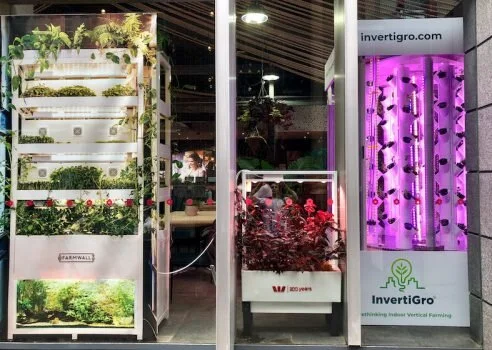
A recent InvertiGro pop-up in the basement of Westpac’s Sydney headquarters. Source: InvertiGro.com
Benefits of farming in a controlled environment
Indoor vertical farming is currently seen as futuristic technology where food is grown in a “lab environment”, and this can often be a barrier to communities embracing it, Mr Lee says.
But he says these fears are unfounded.
“It’s not any different from being grown in the field,” he says. “In fact, it’s much better, it’s much more efficient, it’s cleaner.”
The conditions of indoor farms often prove more favorable than crops grown in the field.
“The reality is that with the shifting weather patterns, being able to grow efficiently in a controlled environment is actually better because you can control the amount of output thereby reducing waste,” he says.
“And in a controlled environment, you’re growing product that is cleaner and safer to eat without the risk of microbial contamination, which has happened in some instances in field-grown products.”
Mr. Lee says vertical farming is being widely adopted overseas.
“It’s already starting to be seen as more commonplace, especially in the US and Europe, where larger corporations or businesses are adopting these as part of their strategy for food production, and also to reduce their carbon footprint through the distribution chain,” he says.
“And with more and more of these business coming to the fore and more focus on it, it’s already becoming part of the landscape rather than being totally futuristic.”
When clients approach InvertiGro about starting a vertical farm, Mr. Lee and his team engage with them to find the right sites to use, plan what the farm will look like, consider capacity and costs required, and then mobilize the resources to implement the project.
Sydney Lord Mayor Clover Moore
He says InvertiGro is currently exploring opportunities to work with the City of Sydney to determine potential spaces for vertical farming.
Lord Mayor Clover Moore told Government News Council is continuing to explore existing and emerging technologies to utilize buildings and open spaces to support sustainable communities.
She said increasing urbanization, which 80 percent of the world’s population expected to live in urban areas by 2050, would lead to an increased demand for food, pressure on water supplies and stresses on transport systems.
“Vertical farming potentially offers a significant opportunity to address these issues,” she said.
Going beyond leafy greens and herbs
The potential of vertical farming goes beyond regular fruits and vegetables, Mr. Lee says.
“Outside of the leafy greens and herbs, we are able to use the same infrastructure to grow things like fibre for the material industry,” he says.
“And there’s a whole range of other applications, from medicinal plants to viticulture, which we’re very excited about.”
The 2050 Emergent expo on October 19 is a headline event of the Spark Festival and will showcase emerging technologies, initiatives and ideas shaping the future of Sydney.
It will feature more than 30 startups and 50 displays as well as presentations on green cities, alternative housing models and the sharing economy.
“This event is a unique opportunity to learn more about emerging ideas and technologies, connect with their creators and give everyone a say in the Sydney they’d like to see in 2050,” Lord Mayor Clover Moore said in a statement.

Sugarmade Introduces New State-of-the-art iPower Cultivation Equipment on Amazon.com
Sugarmade, Inc. (OTCQB: SGMD) ("Sugarmade", "SGMD", or the "Company"), a leading supplier of hydroponics and cultivation equipment and resources, is excited to introduce its new line of "iPower" branded inline duct ventilation fans
PR Newswire September 10, 2019
LOS ANGELES, Sept. 10, 2019 /PRNewswire/ -- Sugarmade, Inc. (SGMD) ("Sugarmade", "SGMD", or the "Company"), a leading supplier of hydroponics and cultivation equipment and resources, is excited to introduce its new line of "iPower" branded inline duct ventilation fans. Designed for durability, high-performance, and affordability, this advanced equipment for indoor and hydroponic cultivators is now available for immediate purchase on the Company's website at zenhydro.com and on Amazon.com.
"Indoor and greenhouse cultivation is becoming increasingly sophisticated, helping both hobbyists and commercial cultivators maximize output regardless of seasonality or weather conditions," commented Jimmy Chan, CEO of Sugarmade. "This sophistication, along with expanding mainstream interest in products derived from hemp and hemp-related crops in North America, has driven increasing interest in both indoor and hydroponics cultivation, which has helped to foster booming demand for related equipment. We have positioned Sugarmade as a leading supplier of superior quality equipment catering to that boom. And our new line of iPower inline fans represents the latest example of our commitment to that standard and strategy."
Management notes that the global indoor farming market is valued at more than $106 billion, with steady growth anticipated over coming years due to projected declines in arable land and increasing demand to cultivate newly legalized cash crops in North America, suggesting upward demand pressure on the indoor and hydroponics cultivation equipment and supplies market. The Company also believes the 2018 US Farm Bill, with its positive implications for hemp-related cultivation, will drive further growth in expected demand forecasts for indoor and hydroponic cultivation equipment suppliers.
To meet that expanded demand, the Company sees ventilation as a core product category in the indoor and hydroponic cultivation market, on par with advanced lighting and nutrient resources. In addition to its new state-of-the-art iPower inline ventilation fans, the Company also offers an extensive grow light product portfolio.
The iPower inline fan has been designed to produce superior air flow while optimizing energy efficiency and minimizing noise production through its advanced composite fan blade and center hub design, which reduces noise and vibration. iPower inline fans are available in 4-inch, 6-inch, or 8-inch models, can be used with or without iPower carbon filters and duct ventilation, and come packaged in a unique lightweight yet durable housing.
Mr. Chan continued, "We are confident that the iPower line represents the superior choice in the marketplace. iPower inline fans provide strong flexibility in configurations and include intelligent programing capabilities. They make an excellent addition to our growing product portfolio as we continue to build a leadership role in catering to a very wide market footprint, from hobbyist cultivators all the way through the largest commercial cultivators."
About Sugarmade and iPower Brands
iPower is a leading manufacturer of grow light systems; supplying gardeners, worldwide, for over a decade. The product lines use the transformative power of light to make gardening more efficient and productive. In addition to HPS/MH and Ceramic MH technology, iPower product offer digital ballasts, fluorescent, and LED lighting systems. Sugarmade Inc. is a product and brand marketing company investing in products and brands with disruptive potential.
For more information, visit the company's website at www.Sugarmade.com.
FORWARD-LOOKING STATEMENTS: This release contains "forward-looking statements" within the meaning of the safe harbor provisions of the U.S. Private Securities Litigation Reform Act of 1995. Forward-looking statements also may be included in other publicly available documents issued by the Company and in oral statements made by our officers and representatives from time to time. These forward-looking statements are intended to provide management's current expectations or plans for our future operating and financial performance, based on assumptions currently believed to be valid. They can be identified by the use of words such as "anticipate," "intend," "plan," "goal," "seek," "believe," "project," "estimate," "expect," "strategy," "future," "likely," "may," "should," "would," "could," "will" and other words of similar meaning in connection with a discussion of future operating or financial performance. Examples of forward looking statements include, among others, statements relating to future sales, earnings, cash flows, results of operations, uses of cash and other measures of financial performance.
Because forward-looking statements relate to the future, they are subject to inherent risks, uncertainties and other factors that may cause the Company's actual results and financial condition to differ materially from those expressed or implied in the forward-looking statements. Such risks, uncertainties and other factors include, among others. such as, but not limited to economic conditions, changes in the laws or regulations, demand for products and services of the company, the effects of competition and other factors that could cause actual results to differ materially from those projected or represented in the forward looking statements.
Any forward-looking information provided in this release should be considered with these factors in mind. We assume no obligation to update any forward-looking statements contained in this report.
Contact:
Jimmy Chan
+1-(888)-982-1628
info@Sugarmade.com

VIDEO: Bibb Schools Install Hydroponic Gardens For Students To Grow Produce Indoors
Many Bibb County Schools have agriculture programs that use outdoor gardens, but at SOAR Academy, there isn't really enough space for one, so school leaders decided to install the district's first hydroponic gardens for students to farm inside
SOAR Academy students can grow vegetables and herbs year-round with a new indoor garden system.
Author: Pepper Baker
PSeptember 23, 2019
MACON, Ga. — Many Bibb County Schools have agriculture programs that use outdoor gardens, but at SOAR Academy, there isn't really enough space for one, so school leaders decided to install the district's first hydroponic gardens for students to farm inside
9th grader Z'nyiah Henderson and 10th grader Imani Ross haven't had a lot of experience gardening before.
"I know my grandma, she likes plants, so I always help her water her plants and stuff, but it's really a journey for me to start at school on something I ain't really ever did before," Henderson said.
Dalia Kinsey, a registered dietitian, says Bibb Schools' new hydroponic indoor garden units make it easy for students to learn how to grow their own produce.
"They're being watered all the time, and there is artificial sunlight being administered really consistently, so it's basically like you're growing plants in ideal conditions," Kinsey said.
Students can grow vegetables like lettuce and bok choy, or herbs like sage and cilantro, and they monitor its progress right from their phone.
"It's a smart unit, so on the app, it shows us when it's time to harvest when it's time to fertilize, when it's time to add water," Kinsey said.
The two units cost about $300 each.
School Nutrition Director Timikel Sharpe says students are seeing the farm to table process firsthand.
"We're teaching students where food comes from and how it's harvested and how it's used and we'll go as far as to use it in the cafeteria when it's done," Sharpe said.
Kinsey says they received the indoor garden units from a joint-partnership grant between a company, called Miracle Gro and the No Kid Hungry charity organization.

Bringing The Infarm Urban Farming (R)evolution To The UK With Marks & Spencer
Starting today, at Marks & Spencer’s Clapham Junction store in South West London, South London, you’ll be able to find fresh infarm herbs including Italian, Greek and Bordeaux Basil, fresh Mint, Curly Parsley and Mountain Coriander (just a few of the many varieties in our catalog)
infarm
By Erez Galonska, Guy Galonska and Osnat Michaeli — founders, infarm — Indoor Urban Farming, GmbH
Just under a decade ago, my co-founders and I started to experiment with growing our own fresh produce. We had just moved to Berlin, bought a 1955 Airstream trailer, outfitted it with DIY growing shelves and started experimenting with indoor farming.
Our 1955 Airstream in the early days of infarm
We grew all sorts of greens, lettuces, herbs and microgreens. The experience of having fresh basil, mint, lettuce and arugula and many other vegetables in the dead of winter, full of flavour and beauty was amazing. We never looked back.
Since launching the experiment that would mature into our company, infarm, we’ve installed our farms in hundreds of stores and distribution centers across Germany, France, Switzerland, Luxembourg and now, for the first time, we’re expanding our business to the UK with Marks & Spencer.
Starting today, at Marks & Spencer’s Clapham Junction store in South West London, South London, you’ll be able to find fresh infarm herbs including Italian, Greek and Bordeaux Basil, fresh Mint, Curly Parsley and Mountain Coriander (just a few of the many varieties in our catalog). We’ll be in additional Marks & Spencer locations in London through the end of the year.
infarm at M&S Clapham Junction
London — like Berlin — has been experiencing a revival of restaurants, Michelin-rated chefs and international cuisine which began around the time we started infarm in 2013.
We believe that whether you’re a top chef or just running by the grocer’s to put together a meal for your family after work, your food should not have traveled more than you have. It should be fresh and alive (with the roots still on), and bursting with nutrients when it reaches your plate.
Those of you who have already seen our modular farms, perhaps at an Intermarché in Paris, Edeka in Germany, Migros in Switzerland or Auchan in Luxembourg, may be curious about what to expect when you arrive at M&S.
What you can be sure of, is that the infarm herbs you find will be full of flavour and grown sustainably and with love, right in your neighbourhood.
This is the core of the infarm (r)evolution in food. Stop by M&S Clapham Junction store and taste our herbs for yourself. And feel free to experiment with them as you cook to upgrade your favourite dishes! Find out more about us at infarm.com.
WRITTEN by infarm
Fish Poop Keeps Family Farming Together
As he tossed freeze-dried crickets into a pool of eager bluegill, Andrew Mueth explained this was how he and his five brothers could farm together and preserve the 160-year-old Illinois family farm legacy. The family raises a wide variety of lettuce using an aquaponic system that was erected in a decades-old straw storage shed
September 20, 2019
Andrew Mueth and his five brothers use aquaponics to produce lettuce that is sold at farmers markets in the St. Louis, Mo. area.( Sonja Begemann )
As he tossed freeze-dried crickets into a pool of eager bluegill, Andrew Mueth explained this was how he and his five brothers could farm together and preserve the 160-year-old Illinois family farm legacy. The family raises a wide variety of lettuce using an aquaponic system that was erected in decades-old straw storage shed.
“It’s a way we could work together on a family farm and it’s a lot cheaper than getting into row crops,” Mueth says. His family still owns 300 row-crop acres, but they’re rented to other farmers.
From fish poop to food
Because each of the six brothers has a full-time job, they endured late nights and long weekends to convert their shed into a working aquaponics system. One half of the shed serves as a home for the fish, currently, bluegill caught on their farm pond, and the other half a greenhouse.
Each fish "tank" holds 3,500 gallons of water. C: Sonja Begemann
Aquaponics is a combination of fish and plant production using aquaculture and hydroponic systems, according to USDA. The Mueths run fish waste through a multi-part filtration system to save water, extract as much nutrient-filled waste as possible, and convert it into a form that is safe to apply to plants. Too much ammonia, for example, will damage and even kill the plant.
This filtration system processes about 1,000 gallons of fish waste per hour. C: Sonja Begemann
In about three hours the biofiltration system can completely filter the 3,500-gallon fish tank, extracting valuable nutrients along the way. After filtering the waste in its ammonia-rich form, it’s converted to nitrites and then nitrates. Once filtered, the nutrients are added to water that is piped into vertical towers at a rate of 30 gallons per hour.
The brothers harvest two towers each week, or about 900 heads of lettuce. C: Sonja Begemann
After about eight weeks the lettuce is ready to harvest, Mueth says. The family harvests around 900 heads weekly that are sold to local restaurants or at farmer’s markets. The lettuce is sold in pre-mixed bags with multiple varieties to enhance taste and texture.
The concept is simple, but the carryout is tedious. The family put in about 5,000 hours of labor to convert the shed and set up the fish tanks, Mueth says. Altogether it cost less than $100,000, but he admits that the number would be higher if they paid themselves for the labor.
After just one year, so in a few months, the family will be back in the green from their startup costs. “But, we don’t pay ourselves for our work,” he says.
Statista: Global value of Aquaponics
C: Statista
Because they were fished out of a family pond, the only costs associated with the fish is their food. However, they plan to switch fish with the seasons and will soon pay for their newest breed, tilapia.
As for the bluegill?
“I think we’ll have a fish fry,” Mueth says.

MIT Built A Theranos For Plants
The prestigious multidisciplinary MIT Media Lab built a “personal food computer” that worked so poorly that demos had to be faked Theranos-style, per a weekend report in Business Insider
September 8, 2019
The MIT Media Lab’s failed “personal food computer.” Screenshot: Seeker (YouTube)
The prestigious multidisciplinary MIT Media Lab built a “personal food computer” that worked so poorly that demos had to be faked Theranos-style, per a weekend report in Business Insider. Word of the project’s troubles comes as the Media Lab’s attempts to cover up its extensive financial ties to late financier and alleged sex trafficker Jeffrey Epstein have seriously damaged its credibility and led to resignation of its director, Joichi Ito.
According to Business Insider, the project—a plastic hydroponic grow box filled with “advanced sensors and LED lights” that would supposedly make it possible to replicate crop conditions from any part of the global—was a sham, with MIT’s Open Agriculture Initiative director Caleb Harper resorting to faking demos:
Ahead of big demonstrations of the devices with MIT Media Lab funders, staff were told to place plants grown elsewhere into the devices, the employees told Business Insider.
In another instance, one employee was asked to purchase herbs at a nearby flower market, dust off the dirt in which they were grown, and place them in the boxes for a photoshoot, she said... The aim was to make it look like the devices lived up to Harper’s claims, the employees said. Those claims, which included assertions that the devices could grow foods like broccoli four times faster than traditional methods, landed Harper and his team articles in outlets ranging from the Wall Street Journal to Wired and National Geographic.
All told, Business Insider’s sources said, the “personal food computers” amounted to hydroponic boxes that don’t work. Dietitian and former Open Agriculture Initiative project manager Paula Cerqueira told the site that the devices she worked on were “glorified grow boxes... with some sensors for collecting data,” and that on multiple occasions staff filled them with store-bought plants that had to be washed of dirt before presentations with funders. The boxes also weren’t air-tight, Cerqueira added, meaning that users couldn’t control for things like carbon dioxide levels or temperature and humidity.
Cerqueira told Business Insider that out of dozens of units sent to schools in the Boston region, only a handful ever worked. On one occasion, the Media Lab sent 30 of them to schools, and “It’s fair to say that of the 30-ish food computers we sent out, at most two grew a plant,” Cerqueira told the site. On another, the Media Lab couldn’t make the boxes work in time for a demo with a representative from the Bezos Family Foundation, something Cerqueira told Business Insider was “super embarrassing.”
In other words, this sounds a hell of a lot like Theranos, the disastrously failed startup that also promised a magical technology box (though in their case, it was fake blood-testing technology that helped the company achieve a valuation of $9 billion.) The food computer certainly doesn’t come anywhere the scale of Theranos, but Harper touted it with similarly grandiose claims: In a March 2019 video by Seeker, Harper stated that “You think Star Trek or Willy Wonka, that’s exactly what we’re going for.”
According to Business Insider, Harper directed an email requesting comment to an MIT spokesperson, who “didn’t provide a comment.”

MIT Media Lab Kept Regulators in the Dark, Dumped Chemicals in Excess of Legal Limit
Researchers at the Massachusetts Institute of Technology’s Media Lab have dumped wastewater underground in apparent violation of a state environmental regulation, according to documents and interviews, potentially endangering local waterways in and near the town of Middleton
Documents and interviews show the Media Lab, already under fire for accepting contributions from Jeffrey Epstein, is being investigated for an apparent violation of state environmental regulations. They paused operations after we asked questions.
by Lisa Song, ProPublica, and Max Larkin, WBUR-FM
September 20, 2019

Caleb Harper, in front of food computers, boxes that could supposedly be programmed to grow crops, leads the Open Agriculture Initiative at the MIT Media Lab. The project is being investigated for possibly violating state environmental regulations. (Robin Lubbock/WBUR)
This story was published in collaboration with WBUR in Boston.
CAMBRIDGE, Mass. — Researchers at the Massachusetts Institute of Technology’s Media Lab have dumped wastewater underground in apparent violation of a state environmental regulation, according to documents and interviews, potentially endangering local waterways in and near the town of Middleton.
Nitrogen levels from the lab’s wastewater registered more than 20 times above the legal limit, according to documents provided by a former Media Lab employee. When water contains large amounts of nitrogen, it can kill fish and deprive infants of oxygen.
Nine months ago, the Massachusetts Department of Environmental Protection began asking questions, but MIT’s health and safety office failed to provide the required water quality reports, according to documents obtained by ProPublica and WBUR. This triggered an ongoing state investigation.
After ProPublica and WBUR contacted MIT for comment, an institute official said the lab in question was pausing its operations while the university and regulators worked on a solution. Tony Sharon, an MIT deputy vice president who oversees the health and safety office, didn’t comment on the specific events described in the documents.
The state’s investigation adds to recent scrutiny of the Media Lab for accepting donations from Jeffrey Epstein, a convicted sex offender who was charged with trafficking minors before he died in jail last month. Joichi Ito, the director of the Media Lab, has resigned, and students have called for the resignation of MIT President L. Rafael Reif, who signed off on at least one of Epstein’s gifts.
The lab responsible for the dumping is the Open Agriculture Initiative, one of many research projects at the Media Lab. Led by principal research scientist Caleb Harper, who was trained as an architect, the initiative has been under fire for overhyping its “food computers”: boxes that could supposedly be programmed to grow crops, but allegedly didn’t work as promised.
Throughout early 2018, the lab’s research site in Middleton, about 20 miles north of the main MIT campus in Cambridge, routinely drained hundreds of gallons of water with nitrogen into an underground disposal well, at concentrations much higher than the lab’s permit allowed, according to documents and interviews. The nitrogen came from a fertilizer mix used to grow plants hydroponically.
The information comes from dozens of emails and lab results shared by Babak Babakinejad, a former researcher in Harper’s lab. Babakinejad said he decided to speak out because he’s worried about the health and environmental impacts of the dumping. Babakinejad’s account of the lab’s actions was confirmed by two other sources with knowledge of the experiments, who asked for anonymity.
Babakinejad told ProPublica and WBUR that he warned Harper and MIT’s Environment, Health and Safety Office (EHS) about the situation after he realized their hydroponic solution exceeded their environmental permit, which limited the wastewater to concentrations of 10 parts per million (ppm) for nitrogen.
EHS is responsible for health and safety throughout the institute, from environmental sustainability to the proper handling of toxic chemicals in research labs.
Water drains from tanks at the project’s lab in Middleton in January 2018. (Courtesy of Babak Babakinejad)
“Our base fertilizer regiment is at 150 ppm Nitrogen… way above the required limit,” Babakinejad wrote in an April 2018 email to Harper, other Media Lab employees and senior staffers at EHS. “I am looking forward to discuss available options such as diluting our wastewater… or apply for an appropriate license.”
Harper responded to Babakinejad within the hour, scolding him for emailing health and safety officials: “Writing emails directly to Senior EHS / Facilities teams at MIT, especially those that effect [sic] our groups ability to do research, without asking [the project’s assistant director] or I to review, comment and approve is inappropriate… If emails are directed to you regarding our teams [sic] EHS responsibilities please redirect them to me until further notice.”
This followed prior emails when Babakinejad had questioned Harper about whether the lab’s food computers could really do what Harper claimed. In news reports about this question, Harper did not address allegations about the project’s shortcomings.
Babakinejad said he later spoke to the Massachusetts Department of Environmental Protection (MassDEP) in the fall of 2018, prompting the agency to take a closer look at the lab’s wastewater disposal permit.
For more than five months, a MassDEP scientist tried to get basic information from MIT’s EHS office about how the lab disposed of its wastewater. This June, the scientist expressed frustration in an email to a senior EHS official:
“MassDEP is concerned about the time that it is taking to provide what should be easy to obtain information regarding the (disposal well) discharges and other on-site discharges,” he wrote. “MassDEP is concerned that MIT still hasn’t indicated to MassDEP its long term solution to the management of spent growing solution wastewater containing unacceptably high concentrations of total nitrogen.”
In a statement, MassDEP spokesman Edmund Coletta stated the agency was “concerned about the wastewater discharge issue connected to the Open Agriculture Initiative’s facility in Middleton (MA) and we are investigating the issue further. However, as this is a potential enforcement matter, I cannot offer any other comments.”
Harper provided a statement through his lawyer, David Siegal: “Mr. Harper and his lab are, and have always been, deeply committed to protecting the environment. He has been and will continue to be fully cooperative with and responsive to MIT’s Department of Environmental Health and Safety and the Massachusetts Department of Environmental Protection in their efforts to make sure the lab conforms to all environmental laws and regulations,” Siegal said.
At this point there is no evidence that the discharge from Harper’s lab has reached local drinking water or the nearby Ipswich River.
Excess nitrogen, when ingested by infants under four months old, can prevent blood from carrying oxygen, which can be fatal if left untreated. Municipal water systems routinely check for contaminants, but homes and businesses that use private drinking water wells are responsible for monitoring their own water. ProPublica and WBUR did not obtain any of those testing results.
Pamela Templer, a Boston University professor who studies biogeochemistry, said nitrogen is an essential component of all living things.
“But at high concentrations, it can become what we consider too much of a good thing,” she said. “In waterways, it can lead to phenomena like harmful algal blooms, which can be toxic to people and pets.”
The type of disposal well used by MIT is part of an Environmental Protection Agency program that handles industrial and municipal waste, said Carl Reeverts, former deputy director of the EPA’s Drinking Water Protection Division. There are more than 650,000 of these “Class V” wells across the country. They are designed to protect underground sources of drinking water, but only if the well is properly built, maintained and regularly inspected.
The wells are considered a lower priority for enforcement than others that store hazardous waste from mining, oil and gas, Reeverts said. In general, Class V wells are “most likely to be mismanaged… It’s the one that may be monitored least of all.”
Wastewater was less of a concern when the initiative was launched in 2015 on MIT’s Cambridge campus, which is connected to a municipal sewer system with a wastewater treatment plant that could handle some nitrogen. But with plans to expand to the school’s more rural Middleton facility, which lacks a public sewer system, questions arose about how to dispose of the water.
In August 2016, a consultant emailed the Media Lab’s director of facilities to explain that the best option was a disposal well if the nitrogen in the lab’s hydroponic water stayed below 10 ppm.
The setup would be easy, requiring just a one-time registration to install it with the EPA’s Underground Injection Control (UIC) program, he wrote.
But if the water showed higher nitrogen concentrations, regulations would be more stringent. “The water will need to be treated as sanitary waste (piped to municipal sewer, a septic system/field, or use a holding tank for monthly pickup by a waste management company),” the consultant wrote.
Samples from the months before and after that email showed a huge range of concentrations, as high as 276 ppm, according to documents provided, indicating that some staff knew they could exceed the nitrogen limits if they built a well.
The lab had a well-installed, and in December 2017, Massachusetts regulators granted a permit with restrictions. The permit lists Harper as the well operator and the head of MIT’s EHS Office as the well owner. As part of the permit, MIT can only accept about 1,300 gallons of water per month and must notify regulators within 10 days if it exceeded the 10 ppm nitrogen limit. Finally, the lab was required to provide monthly reports throughout 2018 showing the nitrogen content of the water discharged into the well.
Babakinejad said he joined Harper’s lab about half a year before it got the permit. He had a Ph.D. in neuroscience and nanotechnology from London’s Imperial College and saw the Open Agriculture Initiative as a chance to work on food science projects that could improve health care.
Babak Babakinejad said he warned Harper and MIT that the concentration of nitrogen in the lab’s hydroponic solution exceeded the environmental permit. (Robin Lubbock/WBUR)
He began spending time at the Middleton site, called Bates, in October 2017, overseeing research on cotton and basil. The plants were set up in two shipping containers, each filled with 10 to 12 racks of plants floating in pools of water enriched with fertilizer. Altogether, the experiments could hold more than 500 gallons of the nitrogen-water mix at a time.
The water had to be changed regularly, both to run new experiments and to prevent the tanks from filling with algae, Babakinejad said. A valve on the bottom of each tank allowed scientists to drain the solution into the well, before replacing it with a new fertilizer mix. Lab workers took regular water samples to track the experiments’ progress. The samples were sent to an outside lab, which analyzed the water for nitrogen and other compounds.
Emails and lab notes from early 2018 show the experiments were in full swing. They were changing the water every two weeks, including on March 23, draining it to “flush” the crops. Documents show samples taken that day had nitrogen levels reaching 222 ppm, which is 22 times the allowable concentration.
Babakinejad said the water, once drained, had to go into the well, because there was no other approved disposal method and nowhere to store hundreds of gallons of wastewater.
He first emailed Harper about his environmental concerns in April 2018: “Our license only allows for 10 ppm [of nitrogen] to be discharged as waste however the nitrogen concentration in fertilizers and sanitation materials is significantly higher than what our registration notice allows.”
Babakinejad repeated the warning in an April 16 email to Harper and EHS officials, prompting Harper’s reply that any emails to EHS should go through him first.
The next day, Phyllis Carter, senior program manager at the EHS office, emailed Harper, Babakinejad and other lab employees, explaining that a sample from the previous week had registered 140 ppm nitrogen. “You are correct in that discharge at these levels is not allowed,” she wrote.
Babakinejad said lab officials met to discuss the problem, but never resolved it. He left in mid-2018, disillusioned both by the nitrogen pollution and concerns that Harper had oversold the lab’s capabilities to funders, when it was struggling with a basic ability to grow plants. He said he felt pushed out, and that Harper retaliated against him for expressing concerns by giving him a work improvement plan that required him to document, in 30-minute increments, how he was using his time. Harper did not comment on the allegations of retaliation or circumstances of Babakinejad’s departure.
Babakinejad said he was particularly disappointed by what he saw as the health and safety department’s failure to enforce the permit.
“This is not about Open Agriculture, per se, or Caleb Harper,” he said. “This is a bigger issue… I took every action I could, to go through the right channels to address it. I came to a point that I realized that the institution, apparently, has made a decision not to address this.”
Basil plants grow in one of the lab’s facilities in February 2019. (Robin Lubbock/WBUR)
In January 2019, Joseph Cerutti, a DEP employee who handles its disposal well program, emailed Carter, the EHS officer, asking for the monthly reports her office was required to send to his agency the previous year. Carter had told him the lab hadn’t discharged anything into the well from April through June of 2018, but there were still nine months of missing reports.
After a month without a response, Cerutti wrote back with a terse reminder, adding Harper to the email. If Cerutti didn’t get answers within the next two weeks, he would issue a notice of noncompliance, followed by possible fines and revocation of the permit.
Harper responded quickly, writing, “We have been following the protocol agreed with EHS which was for any agricultural effluent was to be spread in the open field and NOT put into the UIC system.”
Cerutti seemed unaware of this. The lab’s permit only allowed MIT researchers to use the well. “When was the protocol to exclusively discharge the hydroponic growing solution to the open field rather than to the UIC well implemented?” he wrote back.
After a phone call with Carter in April, Cerutti was still left with basic questions. In June, he asked for copies of all nitrogen water sample results since January 2018. Carter responded in early July, attaching results since July 2018, but not the samples from March that frequently showed concentrations more than 10 times the limit.
State regulators did an on-site inspection of the facility in July. The investigation is ongoing.
Sharon, the MIT deputy vice president, issued a statement, saying EHS is “committed to working constructively with MassDEP to find a solution that enables OpenAg’s research at Bates to continue and meets their requirements.”
ProPublica reporter Talia Buford contributed to this report.
We’re going to keep looking into this. If you have any information about MIT’s Media Lab or its Health and Safety Office, we would love to hear it. Please contact lisa.song@propublica.org. If you’d like to send something more sensitive, here is our advice.
Lisa Song
Lisa Song reports on the environment, energy and climate change for ProPublica.

Intelligent Growth Solutions Attracts Further US AgriTech Investment To Scotland
Intelligent Growth Solutions Ltd (IGS), the Scottish-based indoor AgriTech and Commercial Lighting business, announced today a further raise of £1.6 million in the second and final close of its Series A funding
Edinburgh, Scotland – 26 September 2019 - Intelligent Growth Solutions Ltd (IGS), the Scottish-based indoor AgriTech and Commercial Lighting business, announced today a further raise of £1.6 million in the second and final close of its Series A funding. The £1.5 million received from globally established agri-investor Ospraie Ag Science (OAS), coupled with an additional £100k from Agfunder, brings IGS’ total Series A fundraise to £7 million.
Ospraie Ag Science (New York City) joins existing Series A investors S2G Ventures (Chicago), the most active agri-foodtech investor globally in 2018; online venture capital firm AgFunder (San Francisco); and the Scottish Investment Bank in the investment round.


Ospraie brings 25 years of agriculture investing experience to IGS, and its investment in the company is its first step towards building a global platform in the indoor AgriTech market.
Dwight Anderson, Chief Investment Officer at Ospraie Ag Science commented: “IGS has tremendous potential to transform the way food is produced and supplied, and our investment – Ospraie’s first in the indoor agriculture market and in Scotland – is a testament to our strong belief in the success of IGS’ technology. The benefits of IGS’s Vertical Farming align well with our mission of helping farmers do more with less. We look forward to leveraging our significant agriculture network to help IGS grow its business to meet the market’s demand for sustainable solutions.”
This latest raise allows IGS to further expand its market presence through global sales operations for both AgriTech and Commercial Lighting. Demands for its systems are high with the first deployments expected in early 2020.
IGS Chief Executive Officer David Farquhar said: “The further investment of £1.6 million is a hugely exciting one, not only for our business but also for the Scottish economy. Ospraie has chosen IGS as its initial investment target in the indoor agriculture market, and also as its first investment in Scotland, which is a substantial endorsement of our technology and approach to date. Working alongside our other investors in this Series A funding we are in a really strong position to take our offering to a global market and meet the demand that is growing almost daily.
“The pressures of climate change are real and clear and our technology and systems have the ability to play a part in addressing how we produce and supply food sustainably and productively all over the world. Our customers in the commercial property world are equally keen to adopt IOT-enabled smart lighting to create better indoor climates for their tenants and visitors alike.”
IGS has designed all its products to be highly pragmatic, flexible, modular and scalable in line with market expectations.
Sanjeev Krishnan, Managing Director of S2G Ventures said: “We are excited to partner again with Dwight and the Ospraie team. IGS will benefit greatly from the Ospraie insights, networks and entrepreneurial vision in building scaled businesses in the outdoor sector. Indoor Ag is set up to grow considerably and we are excited about IGS’ role in that effort.”
Michael Dean, founding partner at AgFunder commented: “We are delighted to see our friends at Ospraie join us as investors in IGS. We look forward to working with the Ospraie team to ensure that the game-changing IGS technology is rolled out to Controlled Environment Agriculture project developers globally.”
Kerry Sharp, Director, Scottish Investment Bank, said: “Intelligent Growth Solutions has made good progress recently. This latest investment is a testament to the hard work and vision of the management team and will help the company as it takes its technology to the global marketplace. A company like IGS securing three international investors in Ospraie, S2G, and AgFunder goes a long way to highlight the strength of opportunities available for Investors outside Scotland looking to invest in innovative Scottish companies. We look forward to continuing the journey with the company through our investment and our Scottish Enterprise account management service.”
The Scottish-led R&D team at IGS has developed, patented and productised a breakthrough, IoT-enabled power and communications platform consisting of patented electrical, electronic and mechanical technologies as well as the world’s most sophisticated ventilation system. All this is managed by a SaaS and data platform using AI to deliver economic and operational benefits to indoor environments across the globe.
About IGS:
IGS was formed in 2013. Its purpose was to bring indoor horticulture to commercial reality by combining efficient internet-enabled smart lighting with automation and power management. The founders’ experience combined extensive knowledge of horticulture, industrial automation, and big data.
IGS launched its first vertical demonstration facility in August 2018 and is now selling a revolutionary controlled-environment growth system. The location of IGS’ facility at the James Hutton Institute, a world-leading crop research facility, was deliberately chosen to enhance collaboration opportunities for the benefit of customers. Scientists and researchers at the Institute are working with the team at IGS to better understand how growing indoors can impact different varieties of crop growth, as well as driving increased productivity.
For more information visit www.intelligentgrowthsolutions.com or connect with us on Twitter and LinkedIn.
About Ospraie Ag Science:
Ospraie Ag Science LLC (OAS) identifies solutions to help farmers "Do More With Less". By increasing profitability, improving quality-adjusted yield, and reducing environmental impact, OAS’s companies not only benefit producers, but generate smarter, healthier, and more efficient food for consumers globally. Utilizing its extensive network and 25 years of experience investing in agriculture, OAS is positioned to help farmers achieve a sustainable future.
About S2G Ventures:
S2G Ventures (Seed to Growth) is a multi-stage venture fund investing in food and agriculture. The fund’s mission is to catalyze innovation to meet consumer demands for healthy and sustainable food. S2G has identified sectors across the food system that are ripe for change and is building a multi-stage portfolio including seed, venture, and growth-stage investments. Core areas of interest for S2G are agriculture, ingredients, infrastructure and logistics, IT and hardware, food safety and technology, retail and restaurants, and consumer brands. For more information about S2G, visit www.s2gventures.com or connect with us on Twitter and LinkedIn.
About AgFunder
AgFunder is an online Venture Capital Platform investing in the bold and exceptional entrepreneurs transforming our food and agriculture system. Our in-house technology enables us to invest globally and at scale, make better investment decisions, and support our portfolio companies. Through media and research, AgFunder has built a community of over 60,000 members and subscribers, giving us the largest and most powerful network in the industry.
Stay up-to-date with Food Tech and AgTech startup news, and other reports, by signing up to our newsletter here.
About the Scottish Investment Bank
The Scottish Investment Bank (SIB) is the investment arm of Scotland’s national economic development agency, Scottish Enterprise, operating Scotland-wide in partnership with Highlands and Islands Enterprise (HIE). SIB’s activities support Scotland’s SME funding market to ensure businesses with growth and export potential have adequate access to growth capital and loan funding.
SIB manages a suite of co-investment funds including the Scottish Co-investment Fund, the Scottish Venture Fund and the Energy Investment Fund on behalf of the Scottish Government. SIB is also an investor in Epidarex Capital’s Life Sciences Fund and is a participant in the Scottish-European Growth Co-Investment Programme with funding secured from the Scottish Government’s Scottish Growth Scheme alongside the European Investment Fund.
SIB also provides funding into LendingCrowd, Scotland’s marketplace lender providing loans to SMEs, and Maven's UK Regional Buy-Out Fund (MBO) that offers financial support for management buyouts (MBOs) and helps existing management teams acquire their businesses from their owners so they can continue to flourish. SIB’s team of financial readiness specialists help companies to prepare for new investment and access appropriate finance.