


Welcome to iGrow News, Your Source for the World of Indoor Vertical Farming
Edenworks Touts Results From Growing With Ecology Instead Of Chemicals
Oct 30, 2018
Edenworks Touts Results From Growing With Ecology Instead Of Chemicals
Edenworks micro kale. Leafy greens are grown in a proprietary growing media designed to host a wide range of beneficial bacteria, improving plant health from the roots up. Plants are fertilized from under their roots with fertilizer from fish. Plants are grown in a controlled environment, lit by energy efficient LEDs.EDENWORKS
Jason Green, the aptly named CEO of Edenworks, says too many articles on the growth of the indoor farming industry are missing its "most exciting aspect." That is, the ability to achieve new levels of plant health through ecology rather than chemicals.
Edenworks grows produce and fish in aquaponic ecosystems. The company is based in Brooklyn, New York. When Forbes caught up with Green in 2017 for a "30 Under 30" feature, he and cofounder Matt LaRosa had plans to expand by the end of 2018, moving to a space 40 times larger while rolling out five more product lines across the New York City area.
Those type of plans are still in the works, but the company has been growing in other ways during the past year: Shifting its focus from the plant to the microbe after a bout with root rot fungus. And Green says they've unlocked ways to virtually eliminate diseases in plants while increasing yields and using less fertilizer.
Edenworks cofounders. From left: Ben Silverman, Matt LaRosa, Jason Green. Behind them is a vertical farming system. Plants are grown in vertically stacked shelves.HEIDI LEE
Edenworks supplies greens to Whole Foods and other select grocers in Brooklyn. The plants are grown with nutrients provided by the waste from farmed fish. Edenworks has plans to commercially sell the fish, striped bass, later on, followed by shrimp and salmon.

Crops Take Root In Unlikely City Spaces
Urban Farming Could Produce 180m Tonnes Of Food Globally, According To Researchers
Paris mayor Anne Hidalgo has pledged to turn 30ha of the city into urban farms by 2020
Paris is giving a new meaning to local food as ingredients that usually travel hundreds of miles bloom in the heart of the city. Strawberries sprout inside a shipping container near the finance ministry, endives grow underground in a former parking lot previously plagued by drug dealers and prostitution, and curly kale is being harvested on the rooftops of chic department stores.
These are a few of the dozens of farms opening in improbable places across the French capital, many of them supported by its city hall. The mayor, Anne Hidalgo, is leasing public land at reduced rates to agricultural businesses and has pledged to turn 30ha of the city into urban farms by 2020.
Paris’s agriculturalists are part of a global trend of city farms proliferating in recent years, from the London start-up selling salad leaves grown in a second world war bomb shelter to the New York underground farms producing herbs for luxury restaurants.
But are such efforts merely a fad for the local food movement or, as some advocates hope, could inner city agriculture revolutionise how we feed the world’s metropolises and reduce climate change?
“Growing food without fields is a clear solution to reliably feed the planet of tomorrow,” says Guillaume Fourdinier, who co-founded Agricool, which grows strawberries in shipping containers and opened its first Paris site in 2015.
Mr Fourdinier and his business partner, Gonzague Gru, are both farmers’ sons and wanted the fresh berries they had enjoyed as children in northern France — but in cities and throughout the year. So they refitted steel shipping containers with hydroponics and LED lights to grow fruit without sunlight.
Today they produce strawberries in four containers around Paris. Each yields about seven tonnes of strawberries a year, they say, most of which is sold to Monoprix, a French retail chain.
Mr Fourdinier says urban farms could be particularly useful in places with poor agricultural climates, such as Dubai, where Agricool’s first container outside France opened in June.
“We can grow fruits [in cities] anywhere,” he says. “In China. In the desert.”
A few miles from Agricool’s original site, in Paris’s hip Marais district, another company is going further. On the roof of the BHV department store is a 600 sq m vertical farm, which opened last year and now produces strawberries, tomatoes, wheat, goji berries and sage, among other things.
This is one of 10 farms around the city set up by Sous Les Fraises (Under the Strawberries), since it was founded in 2014, including on top of Galeries Lafayette, the famous Paris department store.
Yohan Hubot, Sous Les Fraises’ founder, aims not just to reduce food miles. He says urban farms will also make cities more attractive and create a clean energy cycle that both recycles food waste and water and absorbs carbon dioxide.
We are at the beginning of a new farming culture Pénélope Komitès, Paris deputy mayor.
Some academics have pointed to urban farms’ potential downfalls, especially indoor farms that use a lot of electricity and artificial light. Louis Albright, an emeritus professor of biological and environmental engineering at Cornell University explained in a 2014 lecture how some “pie in the sky” vertical farms may use more energy and have higher carbon footprints than traditional methods.
Lettuces grown in vertical indoor farms in New York produced more than three times more carbon dioxide than greenhouse farms outside the city because of lighting costs alone, he found, and tomatoes even more. The carbon emissions from growing 4,000 heads of lettuce in an indoor farm in New York would be equivalent to the annual emissions of a passenger car.
Paris’s agricultural entrepreneurs are undeterred, and insist that projects can use renewable electricity to reduce their environmental impact. Some, such as Mr Hubot, say you can’t compare like-for-like energy use because of the social and environmental benefits brought by city farms, such as recycling waste water, educating people on the source of their food and creating urban jobs.
Pénélope Komitès, the city’s deputy mayor, responsible for green spaces, also insists that there are multiple benefits. She says urban farms have never sought to make Paris self-sufficient for food but believes they will be of huge benefit to cities if they expand in the right way.
“We are at the beginning of a new farming culture,” she says. “However, we must not do this to the detriment of traditional farming.” Ms Komitès adds that “urban farms are not gimmicks”, but a “trend that will keep spreading” around the world.
A study this year by researchers at five universities in the US and China, as well as Google, suggests she could be right. One of the first attempts to systematically analyse the global impacts of city farming, using satellite imaging and population and weather data, it estimates the practice could become a $160bn industry if farms expand across the world’s cities. The researchers see particular potential in the growing cities of Africa and Asia.
The possibilities go beyond profits or even reducing food miles. The researchers say urban farming could produce up to 180m tonnes of food each year — about 10 percent of the world’s pulses, roots and vegetables — create new homes for pest-eating predators, reduce flooding and could reduce electricity use by lowering city temperatures during the summer. Soil on rooftops can provide insulation that keeps buildings cooler without the need for air-conditioning.
“Urban agriculture is not going to replace the traditional food system,” says Matei Georgescu, a co-author of the study and professor of geographical sciences at Arizona State University. However, it may well replace part of our food system, he says, and benefit the environment in the process.

Russia: Moscow To Get 10 New Vertical Farms
A Russian start up, Mestnye Korny, which is engaged in the construction of urban vertical farms, will build 10 sites for the cultivation of leafy greens over the next three years, with an overall capacity of 1 thousand tons per year.
The project has attracted investments worth 79 thousand euros from the foundation TealTech Capital, founded by the owner of retail company VkusVill and his partners.
“For the kind of systems produced by Mestnye Korny, it is vitally important to have an efficient logistics scheme as the optimum selling period for lettuce is less than three days”, noted the executive director of the National Fruit and Vegetable Union, Mr. Mikhail Glushkov.
The representatives of Mestnye Korny are planning to have a yearly turnover of about 13 million euros. The overall investments to the project may reach 9.8 million euros. The conditions of franchise development in the regions have not been defined yet. The potential yearly volume of the city-farm greenery market is evaluated by the Mestnye Korny at 140 thousand tons and the turnover at 923 million euros. The first phase of the farm for 8 tons of basil and rucola will be launched in Moscow by the end of the year. By March 2019, the farm should be operating with a productivity of 160 tons.
Source: fruitnews.ru

North Carolina Indoor City Farm Nears Completion of Phase 1
Your Local Greens, an industrial size hydroponic indoor city farm located in Burlington, North Carolina, is nearing the completion of Phase I, and preparing its first crops consisting of a variety of lettuces and microgreens.
Owned and operated by YLG Partners, Inc., the company was founded on the belief that it is possible to hire individuals with disabilities, pay them a living wage with benefits, and seamlessly integrate them into the workforce while, at the same time, creating ideal conditions for growing produce.
Looking at new and disruptive ways of doing things does not stop with the workforce. Your Local Greens said it offers its customers access to fresh locally grown produce 12 months of the year. The company has utilizing LED grow light technology and plant recipes from Philips Horticulture in the Netherlands to construct 60,000 sq. ft. of growing space which is planned to be built in four phases.
"It is a study in the future of self-sustainable agriculture," the company says. "Plants grow in a safe, clean, controlled atmosphere, in water, and without soil using just the right mix of nutrients and light. This increases crop yield and nutritional value with less waste, while using fewer natural resources. The result is outstanding, all-natural disease-free produce without the use of pesticides."
The motto for Your Local Greens is "Live Better Than Organic", which the company says goes beyond the grow-room to include the use of non-petroleum, plant-based packaging for all of its microgreens, and recycled packages for its lettuces. Beginning in 2019, as larger packages become available, Plant Based Packaging will be used for all products. This will also be the case with new biodegradable labeling materials that are now under development and soon to come on-line. Your Local Greens said it supports companies who are working to create compostable products that do no harm to the environment.
Indoor city farming, reportedly uses 90 percent less water than in the field, non-GMO seeds, produces only 2 percent waste. According to Your Local Greens, it also meets 13 of the 17 UN Sustainable Development Goals.
For more information:
Dennis Harrell
Your Local Greens
Tel: +1 (336) 290-7373
info@yourlocalgreens.com
www.yourlocalgreens.com
Publication date : 10/16/2018

Current, Powered by GE and Stockbridge Technology Centre Partner to Research the Farm of the Future
Stockbridge Technology Centre’s Vertical Farming Development Facility to enable growers to test and model their individual urban farm setup prior to investment
Aims to propel the success of the vertical farming industry, projected to be worth $13.9 billion USD in 20241 and generate more “farmable land” to address future global food production pressures
Current by GE’s Arize LED horticulture solution will help researchers test growth of crops such as leafy greens and herbs in different conditions

Stockbridge Technology Centre's Vertical Farming Development Facility (Photo: Business Wire)
October 16, 2018
LONDON--(BUSINESS WIRE)--Current, powered by GE (NYSE: GE) today celebrated the opening of CHAP’s new Vertical Farming Development Facility, supported by Innovate UK and based at Stockbridge Technology Centre (STC), which leverages the company’s Arize horticultural lighting solution to propel commercial urban farming success in the UK. The state-of-the-art research facility, located in Selby, North Yorkshire, is designed to help entrepreneurs, growers and investors gain deeper insight into the technology and environmental parameters needed to optimise crop yields before breaking ground on their own vertical farming operations.
We can help growers create more farmable space in industrial and urban areas in a way that is commercially and environmentally sustainable - Malcolm Yare, Current by GE
Modelling the Farm of the Future
In its 2017 report, Global Market Insights, Inc. predicted that the vertical farming industry (both indoor and outdoor applications) will grow from revenue of $2.5 billion USD in 2017 to $13.9 billion USD in 20241 and the new facility is designed to support this trend. By testing the latest technology and approaches relevant to this production model, the STC will improve the industry’s understanding of ideal indoor farming crop light requirements and growing conditions.
Potential investors and vertical farmers can work with STC’s plant scientists and vertical farming experts to identify and test the perfect vertical farm setup to maximise their planned harvest’s size, nutritional value and visual appeal. In a controlled environment, they are able to monitor and tweak parameters such as the length of the growing day, C02 concentration, humidity, nutrients and temperature, to ensure that their proposed farm will be commercially sustainable prior to construction. The resulting data supports business planning activity and minimises risks previously associated with vertical farming.
This “farm of the future”, built by systems integrator GrowStack working in conjunction with TCE Electrical Ltd., is the latest research initiative to be led by CHAP and Stockbridge Technology Centre (STC), a pioneer in experimental and applied horticulture research since the 1950s. Since its inception, STC has acted as a bridge between academia and commerce, sharing valuable research and insight that has helped to revolutionise farming practice in the UK.
The installation contains two identical grow rooms - a total growing area of 228m2 - with full climate control and a recirculating hydroponics system as well as futuristic propagation and germination rooms. Four tiers of cropping racks are lit by 780m of Arize LED lighting, delivering a balanced spectrum of red and blue wavelengths that will help boost the development of a broad range of plants.
“As cities’ populations grow at an exponential rate, the demand for fresh produce grows as well,” states Dr Rhydian Beynon-Davies, head of novel growing systems at STC. “We have the potential to grow more produce at an industrial scale within our cities and the focus of this new facility is to support the growers who are taking this bold step into the future of farming. By developing controlled environment grow systems integrated with LED lighting, we can demonstrate how, through technology, urban farming can improve the supply and nutritional value of food in a way that is commercially viable.”
Shining a Light on the Potential of Urban Farming with Arize
“Over the years, Stockbridge Technology Centre has been at the forefront of innovation, devoted to one of the most fundamental industries in the UK – that of feeding the population,” comments Malcolm Yare, Horticulture Business Development Manager for Current by GE. “Light is critical to the success of any crop and by focusing on combining the most effective wavelengths with the optimal environmental conditions, we can help growers outpace traditional methods by creating more “farmable space” in industrial and urban areas, increasing global harvests in a way that is both commercially and environmentally sustainable.”
The Arize range of horticulture solutions has been developed based on Current by GE’s experience in intelligent, connected industrial lighting, combined with extensive research and collaboration with horticulture and agriculture experts. The lights have been designed for easy, plug-and-play installation and are also fully sealed and IP66 UL Wet rated for easy cleaning in high-care, cleanroom environments. Arize lighting is one of the most energy-efficient solutions on the market, using less energy to power the LEDs and generating less heat to tax the facility’s cooling systems. With a 36K-hour lifetime (L90) and five-year warranty, the horticulture lighting solutions allow growers to amortise their capital expenditure over a longer period for greater return on investment.
Notes to editors:
The Vertical Farming Development Facility has been developed in partnership between the Crop Health and Protection Centre (CHAP) and Stockbridge Technology Centre and is supported by Innovate UK.
About Current, powered by GE
Current is the digital engine for intelligent environments. A first-of-its-kind start-up within the walls of GE (NYSE: GE), Current blends advanced LED technology with networked sensors and software to make commercial buildings, retail stores and industrial facilities more energy efficient & digitally productive. Backed by the power of Predix*, GE’s platform for the Industrial Internet, and a broad ecosystem of technology partners, Current is helping businesses and cities unlock hidden value and realize the potential of their environments. www.currentbyge.com
For more information about Stockbridge Technology Centre
www.stockbridgetechnology.co.uk
1 Global Market Insights, Inc. Insights Report 2017, “Vertical Farming Market Size by Product, Fruits, Vegetables & Herbs, Aquatic Species, By Technology, By Application, Industry Analysis Report, Regional Outlook, Growth Potential, Price Trends, Competitive Market Share & Forecast, 2018 – 2024” www.gminsights.com/industry-analysis/vertical-farming-market
Contacts
Current, powered by GE
Karen O’Neil, +1 857-265-9113
karen.oneil@ge.com
or
Racepoint Global
Jenna Keighley, +44 208 811 2151
CurrentEU@racepointglobal.com
Vertical Farming As A Local Food Market Innovation
By Dr. Dawn Thilmany
and Elizabeth Thilmany
Wednesday, October 10, 2018
Vertical farming is an emerging niche in the food supply chain, defined as the practice of growing food indoors by controlling all elements of its development.
As vertical farms are stacked, multistory and typically aligned with large skyscrapers in densely populated urban areas, they can prompt mixed feelings about their aesthetics: Some observers believe they make urban areas feel green while others believe the structures will compete with their access to sunlight.
There are additional unique issues related to their role in food markets, the food environment and broader community impacts.
The nature of production
One potential benefit of vertical farming is its role in encouraging cities to become more self-reliant by producing at least some share of their food supplies. This may lead to more resiliency if there are natural or political events that disrupt our food distribution system. Plus, in an era of renewed interest in food-based economic development, a new generation of farmers may be attracted to vertical farming since their operations can be year-round and integrate high-tech solutions.
Still others see vertical farming as a potential innovation in real estate development — operations may be designed to be aesthetically pleasing, or, if rooftop development is used, permit buildings to conserve air-conditioning costs, and more broadly, help mitigate urban heat islands.
However, many potential benefits (eliminating food miles, reducing spoilage and food waste, better management of environmental implications from agricultural inputs) have yet to be evaluated.
Only a few successful vertical farms have been built, and both building and maintenance costs for a vertical farm are expensive, according to a 2014 article in the Journal of Agricultural Studies. In 2011, vertical farming pioneer Dickson Despommier estimated an upfront cost of $80 million to build a commercially viable vertical farm and over $6 million in annual energy expenditures (with other operating and labor costs above that).
One can quickly estimate that such investments are only possible if one is creative about the potential benefits that may accompany a vertical farming development, such as:
— A strong consumer base to create demand to provide a viable market for the local produce offerings as local produce is seen as a premium offering in mainstream food retailers and supply chains.
— The positive “spillovers”of such a real estate amenity, e.g., aesthetic, lifestyle or environmental benefits to the business, government or residential partners who may help offset the original investment of operating costs. For example, a residential building may see vertical farming as an amenity akin to a golf course or fitness center for its tenants.
— The multiple ways vertical farms can benefit communities economically — acting as a food provider to education venue to source of starter plants that expedite production on surrounding farms.
Consumers as a catalyst for change
We can address some of the research that has been done as a starting point to consider these economic tradeoffs.
Consumer research on food buyers is newly focused on where, how and even why people make their food purchase decisions and confirms that local food is a key driver for several food industry changes. For decades, there has been increasing evidence farmers markets were growing as consumers sought to reconnect with their food sources, but increasingly, local foods have been identified as a key market trend by food manufacturers, retailers and chefs as well.
Through farmers markets, community-supported agriculture and farmstands, direct-to-farmer consumer (DTC) engagement is found to be a value to a growing set of consumers — e.g., those who want to re-engage with their food producer, perceive direct purchases as higher quality or believe they can verify that the farms and ranches they purchase from are better environmental stewards or an important part of their local economy.
Direct markets are not always practical for producers (who have too much volume to sell or they live far from consumer markets) or consumers (who perceive barriers to the locations or prices of direct markets). Thus, the majority of consumers experience local food only in the context of intermediated channels, the term used for food hubs or distributors that broker local foods to mainline retailers, restaurants and other large buyers.
Within the U.S. food system, major food retailers see the integration of local foods into their product offerings as one means to compete, but local sourcing by retailers can be challenging as consumers rely on in-store signage, product labelling and/or recognized farm brands to identify local items.
Since retailers entering the local foods space will need to pay particular attention to clearly and credibly communicating their retailer-farmer partnerships, perhaps they will seek nearby sources, such as vertical farms that are visible to urban dwellers. Yet, it may require vertical farms to engage their communities, be transparent with their production processes, and align with other values that local food consumers seek (e.g., environmental benefits, returns to the farmer, healthful offerings and fair treatment of workers).
Since few locally oriented producers have the requisite scale and/or consistent quality to work with medium/large distribution or food retailer networks, vertical farms may be well-suited for intermediated local food sales. If consumers encourage their primary grocer to carry more local food offerings, vertical farms can seize the opportunity to be a key food source for their nearby retailers.
Vertical farming in communities
Urban agriculture, widely upheld as a solution to the food crises facing increasingly metropolitan populations, has seen a resurgence in recent years.
There are, however, potential disadvantages to this increasing drive for urban agriculture including associated urban health risks and threats to already limited water supplies. In response, cities such as Denver, New York City and Baltimore are bringing more permeable land to rooftops to capture and filter water in hopes of lessening the burden to overwhelmed sewage plants.
Clearly, the potential that controlled atmosphere systems, such as vertical agriculture, may have for addressing food security and economic development justifies a closer look, and public institutions are stepping up to that challenge. Expect to see more pilot programs of vertical agriculture aligned with real estate development such as Denver’s Green Roofs initiative (https://www.denvergreenroof.org/the-basics/), or technical assistance from land grants such as University of Maryland’s programs in Baltimore (http://extension.umd.edu/baltimore-city/urban-agriculture).
Still, it is important to realize these new innovations come with questions about best practices for production, and there is a need to develop a policy and regulatory environment that allows for this sector to operate effectively. As a response to new interest in urban farming as a potential food system investment in communities, the U.S. Department of Agriculture has developed toolkits that offer up resources for both urban agriculture producers (http://www.usda.gov/sites/default/files/documents/urban-agriculture-toolkit.pdf ) and the communities that want to assess their potential community and economic impacts (https://localfoodeconomics.com/toolkit/).
Dawn Thilmany McFadden, Ph.D., is a professor at Colorado State University and specializes in economic development related to food supply chains, focusing on market responses to consumer behavior. She has over 90 peer-reviewed publications and has presented to over 400 academic, industry, community and policy audiences. She is co-director for CSU’s Regional Economic Development Institute and worked with the USDA on many projects, most recently a Toolkit on the Economics of Local Foods (localfoodeconomics.com). She has provided leadership to the Colorado Food Systems Advisory Council, Agricultural and Applied Economics Association, the Western Agricultural Economics Association, and the Food Distribution Research Society.
• Elizabeth Thilmany is an undergraduate student at University of Maryland-College Park studying Agriculture and Natural Resource Economics and has conducted research with Colorado State University on adding value along the wheat supply chain for a Foundation for Food and Agriculture Research project. On campus, she is involved with the Food Recovery Network and the Sustainability Department.
For more information on local food consumers and vertical farming, please read:
Banerjee, C. and L. Adenaeuer. 2014. Up, Up and Away! The Economics of Vertical Farming. Journal of Agricultural Studies. 2, 1-21.
Bauman, A., D. Thilmany and B.B.R. Jablonski. 2018. The financial performance implications of differential marketing strategies: Exploring farms that pursue local markets as a core competitive advantage. Agricultural and Resources Economic Review. 1-28.
Bond, C., D. Thilmany, and J. Bond. 2008. “Understanding consumer interest in product and process-based attributes for fresh produce.” Agribusiness 24(2):231-252.
Despommier, D. 2011. The Vertical Farm: Feeding the World in the 21st Century, second ed. St. Martin’s Press, New York.

Alabama Power Looks Into Economic Feasibility of Indoor Agriculture
October 16, 2018
Alabama Power an electric utility company, has taken on a research project that is virtually unprecedented among utility companies. The power company is looking into the use of LED lighting to grow crops. A refurbished Freight Farm shipping container outside the Technology Applications Center at the General Services Complex in Calera is the location of the project.
Alabama Power engineer Blair Farley and Cheryl McFarland, commercial and industrial marketing support manager
In a specially customized, insulated and climate controlled shipping container, employees grow lettuce and other vegetables, as well as herbs and edible flowers. The goal of the project is to see if the cost of using electricity for indoor agriculture is economically feasible compared to traditional agriculture.
Exploring the container farm concept at Alabama Power originated from an increasing interest in indoor agriculture and the need to fully understand the benefits of using electricity to enhance the process.
Potential Advantages of Indoor Agriculture
It is thought that indoor agriculture could be a revolutionary for farmers, stores, restaurants, consumers. Alabama Power asserts that crop could be grown year-round in a controlled environment with nutrients in circulated water. Soil would not be necessary and few or no pesticides would be needed.
Furthermore, crops could be grown in urban settings and areas categorized as food deserts (locations where fresh food is not easily accessible). Also, transportation costs could be dramatically reduced or eliminated with food possibly grown near consumers and stores.
Alabama Power says for example that indoor farming can produce 12 more lettuce harvests a year, and needs up to 90 percent less water, than a traditional outdoor farm.
One way of saving on electricity, according to the company, is to use energy efficient LED lighting and other components which can be programmed to operate during off-peak hours to take advantage of cheaper electric rates. Alabama Power speculates that with the electricity needed to operate the lighting and climate control systems, indoor farming could present a new range of opportunities for the company.
Indoor Farming Could be Done in Repurposed Buildings and Warehouses
In theory, Repurposed vacant warehouses or buildings, including those with existing utilities, could be utilized for controlled-environment agriculture, providing jobs for Alabamians. Other potential advantages include growing crops during periods ofdrought or excessive rainfall; producing fruits and vegetables not native to a geographic area; and having uninterrupted growing seasons.
“Indoor agriculture can be a great addition to the already thriving agriculture industry in our state,” said Cheryl McFarland, commercial and industrial marketing support manager.
But there are challenges. Like any new, fast-growing concept, scarce data is available to determine long-term pros and cons. High start-up costs and unavailable labor may make it a financial risk. Additionally, vague or unfavorable city laws could pose a barrier to an indoor agriculture operation.
Shipping Container Farming Operation
In January 2017, Alabama Power employees installed a 40-foot hydroponic container and began producing lettuce one month later. The container has a seed germination table and 256 vertical towers holding up to 17 small heads of lettuce each. However, the food production is not limited to lettuce and includes basil, arugula, carrots, dill, and radishes.
With the help of automation, the APC container is relatively self-sufficient. However, one to two employees with other work responsibilities spend a little of their time each week planting, harvesting and performing routine maintenance in the container.Alabama Power plans to assess produce production and water and electricity usage, then compare findings with similar projects.
“We feel the interest in indoor agriculture is continuing to grow as consumers demand more fresh, local and healthy food options in stores and restaurants,” McFarland said.
“Interest in indoor agriculture or controlled environment agriculture is growing either in completely enclosed settings, such as our container, augmented greenhouses or empty buildings, like a vacant mall or Walmart,” McFarland added. “It’s a great way to provide access to fresh foods and jobs in rural communities and urban settings, particularly in areas of food deserts.”
Skyscraper Farm Raises Farming To A Higher Level
October 18, 2018
DES MOINES, Iowa -- The future of farming is on the rise. A new type of vertical farming is being introduced to the United States in the form of a skyscraper. Skyscraper Farms are 52 story green houses that produce food in a controlled environment as well as be a space for offices, retail and real estate.
The world's leading vertical farming economist and founder of Skyscraper Farms Nick Starling said the vertical farm will bring farm food to the table even faster.
"Our goal is to have farm to table in less than five hours for anybody living within 75 miles of our full sized skyscraper," Starling said.
Starling also plans to build 40 foot grow-only buildings that, just like the skyscraper, grow food in a controlled environment with zero pesticides and fungicides.
Another problem Starling hopes to help stop with the Skyscraper Farm is wasting water.
"Currently 80% of the world's fresh water is used on agriculture and with a global yield of about 50% that means a full 40% of the world's fresh water is used on agriculture that doesn't even make it to harvest," Starling said.
Starling said Skyscraper Farms use 99% less water than field farming.
"So that means all these developing countries and all these cities will have a lot more water for people to drink, to wash their clothes and other public health necessities, Starling said.
Plans to build the 52 story Skyscraper Farms are in development in several cities across the country but Starling hopes to build the 40 foot grow-only farms in rural areas across America by next summer.
Nick Starling is holding a presentation on the Skyscraper Farm at 7 A.M. on Thursday as a part of the World Food Prize Borlaug Dialogues.
FILED IN: NEWS

Indoor Garden Towers Installed At GBHS
Soon Great Bend High School students will be growing vegetables indoors in a soil-free system called a Garden Tower®, Assistant Principal Randy Wetzel said.
This Tower Garden® growing system in the GBHS Library is one of three purchased to grow plants without soil at Great Bend High School.
Students Will Grow Food Without Dirt
October 13, 2018
Soon Great Bend High School students will be growing vegetables indoors in a soil-free system called a Garden Tower®, Assistant Principal Randy Wetzel said.
The school used funds from the federal Carl D. Perkins Career and Technical Education bill to purchase three of the aeroponic, vertical growing systems to grow plants and vegetables in the classroom without dirt.
“The Tower Gardens were bought for our Family and Consumer Science Cluster (Culinary Pathway),” said Wetzel, who is also director of the Career Technical Education program at GBHS. They were assembled by students who are now learning how to use them.
The towers were suggested by Amber Wolking, the new Family and Consumer Science (FACS) teacher. They are set up in the library, a biology classroom and Wolking’s own classroom, the “foods lab.” Plants should start growing in the next couple of weeks.
“What’s great about the Tower Garden is that it takes up less than 3 square feet of space, indoors or outdoors, and you can grow 20+ fruits, vegetables or flowers using a vertical aeroponic growing system,” she said.
Like hydroponics, aeroponics is an alternative form of gardening. The main difference is that hydroponics uses water instead of soil as a growing medium, but aeroponics uses 90 percent less water than a traditional garden, Wolking said.
“We have two mineral blends that we will add to the (tower’s) green base, which is the water reservoir,” Wolking said. The plants are grown in rock wool.
“We also test the pH of the water and add an acid or base, depending on what is needed. The water and lights will come on in timed intervals to help simulate the outdoors. The water goes up the center and then gently falls on the root system inside the center tube,” Wolking said.
“Research has found aeroponic systems grow plants three times faster and produce 30 percent greater yields on average,” she added.
The students will have the opportunity to grow their own plants from seedlings purchased from a company that specializes in growing starter plants for Tower Gardens.
“I’m excited to have the students take ownership of the gardens and watch them grow. We will be utilizing what we harvest in the classroom to create different recipes, canning, taste testing and comparing to grocery store produce, experimenting with different herbs and offering extra produce to the community. The students will take pride in what they create from ‘Tower to Table’ and will learn that healthy can taste good!” Wolking said.

iGrow News Is the Longest Running International Online News Publication For The Indoor Farming Industry.
The Indoor Farming industry has relied on iGrow News for timely, accurate, unbiased news and insights.
The iGrow News portal covers industry-relevant topics including Indoor Vertical, Hydroponic, Aeroponic, Aquaponic, Greenhouse, Rooftop, Container Farming, Residential Systems, Education, Finance, Innovation, Sustainability and Technology.
We offer free publishing for all companies in our industry.
iGrow News has approximately 6,000 international unique visitors every thirty days.
Companies that cater to the Indoor Farming Business can reach their target audience by sponsoring i Grow News.. IGN readers include: Greenhouse Growers, Container Farmers, Urban farm developers, Rooftop Farmers, Lawyers, small business owners,

A New Crop of Benefits: Fresh Produce Grown At The Office
Indoor farming allows organizations to have fresh produce year-round, and one company wants to offer these indoor farms to companies as an employee community-supported agriculture benefit.
by Andie Burjek October 12, 2018
Most employers want their employees to be healthier, and healthy eating is one way to achieve that. One company is taking this idea to the extreme and offering organizations the chance to grow fresh produce on site with their own farm.
Boston-based agriculture technology company Freight Farms builds IoT-connected, vertical farms — literally growing plants on the walls of shipping containers — using hydroponics, a growing method that utilizes 90 percent less water than traditional growing and a mineral nutrient solution in a water solvent without soil. The company sells its farms — called the Leafy Green Machines — to companies that would then be the ones responsible for staffing and upkeeping the farms.
In September, Freight Farms announced a new service called Grown that provides the labor to manage the farm, said Caroline Katsiroubas, director of marketing and one of the founding members of Freight Farms. Previously, some organizations didn’t have the staffing or facilities maintenance capacity to maintain a farm. With the Grown service, organizations pay an average pay $5,000 a month, for custom crop scheduling, maintenance, supply replenishment, 24/7 farm monitoring and all farming operations, such as seeding, transplanting and harvesting.
“We hope to see this huge barrier to entry for these organizations get resolved,” she said.
Indoor farming has come a long way in the past two years and become increasingly mainstream, she said. It’s becoming less of a challenge to convince people that it’s possible to grow food in an indoor shipping container.
The Leafy Green Machine operates by growing in a shipping container, 40′ x 8′ x 9.5′ per unit, in a climate-controlled environment, Katsiroubas said. Air temperature, carbon dioxide levels and watering are managed. LED lights stimulate day and night for the plants to echo a more natural environment. A central brain in the farm knows when to increase or decrease and turn off or on these environmental factors.
LED lights stimulate day and night for the plants.
Freight Farms focuses on leafy greens such lettuce, heartier greens including kale and herbs because this produce uses the space more efficiently and growers get more food per square foot.
This isn’t unlike what many other indoor farms do, according to the “State of Indoor Farming, 2017” by Agrilyst, a management and analytics platform for indoor farms. Agrilyst tracks and analyzes farm data from 150 farmers who participated in this survey. This research found that 57 percent of growers focused on leafy greens, while only 16 percent grew tomatoes and 10 percent flowers.
Dassault Systemès SolidWorks Corp., a company that develops 3D editing software and is based in Waltham, Massachusetts, is using the vertical farm as an employee benefit, Katsiroubas said. “It helps them skip the produce aisle essentially when they’re going grocery shopping,” she added.
By growing its own fresh produce on campus Dassault Systemès was able to set up a community supported agriculture, or CSA, program with weekly deliveries that employees could sign up for, said Jim Wilkinson, former vice president of user experience architecture at Dassault Systemès and leader of the Boston Campus Employee Activities Committee. He recently retired after 22 years at the company.
Dassault Systemès SolidWorks Corporation is using fresh, company-grown produce as an employee benefit.
A CSA is an arrangement in which consumers can subscribe to receive a certain amount of fresh produce from a farmer on a regular basis. For example, by signing up, an employee could receive a couple heads of lettuce, a couple heads of kale and a box of herbs every week.
About 50 employees, or 6 percent of the campus population, signed up for the deliveries, which cost the same or less than other local CSA programs, he said. Also, the produce doesn’t need to be washed, lasts longer in the refrigerator and does not need to be consumed right away.
“Plus, we were able to give input on what type of produce we would prefer which was a big bonus,” Wilkinson said. “Often CSAs deliver types of produce that you don’t even know what to do with.”
Dassault Systemès, whose software Freight Farms uses to design their farms, was interested in having their own farm for a few years, but, before the CSA program was introduced, that was not possible, he said. Now, the software company is participating in the first pilot for Grown.
Another way employers can distribute this company-grown produce is by offering a salad bar to employees, Katsiroubas said.
Freight Farm’s service provides the labor needed to operate and maintain the vertical farm.
Freight Farms is starting out with its new service in the New England area with plans to grow in other geographies next year, according to Katsiroubas. Although she sees this as a benefit for interested employees, what often attracts leadership is how the hyper-local Leafy Green Machine contributes to corporate social responsibility, she added.
Also read:
Workplace CSA Models (Appalachian Sustainable Agricultural Project)
The Promise of Indoor, Hurricane-Proof ‘Vertical’ Farms (The Atlantic)
Green Thumbs and Living Walls in Urban Areas (Workforce)
Welcome to the Era of the Activist CEO (Talent Economy)

Andie Burjek is an associate editor at Human Capital Media. She primarily writes for the wellness and benefits beats for Workforce.
email editors@workforce.com.
Filed under: Benefits
Tagged with: community-supported agriculture, corporate social responsibility, CSA, Freight Farms

Grow & Roll With Vertical Farms
Vertical farming is one of the solutions to the problem of the growing demand for food. A multilayer system uses less surface, energy and water. And production takes place all year round, resulting in a higher yield. At Bosman Van Zaal they create vertical production systems, where sustainability, convenience and a higher yield are paramount.

A multi-layer production system consists of two or more levels with cultivation containers. Bosman Van Zaal's multilayer system uses air and light to optimise conditions. Besides efficient use of space and energy and reduction of labour costs, the system can be fully linked to other installations and can be integrated within total logistical cultivation systems.
As one component of their vertical agricultural and horticultural systems they introduced the Grow & Roll. The mobile container with multilayer carts functions as a closed laboratory for the efficient cultivation of seeds, cuttings and crops.
In the container any desired climate is simulated by means of adjusting temperature, humidity, light, CO2 and irrigation. Each module has its own docking station including water connection and electrical connection for dimmable LED lamps with white supplemental light and UV for disinfection of air and water. Air circulation can be fine-tuned. Moisture and temperature problems are thus reduced to a minimum. Disinfection of the container is made easy by the movable modules. Heat exchangers enable energy recovery.
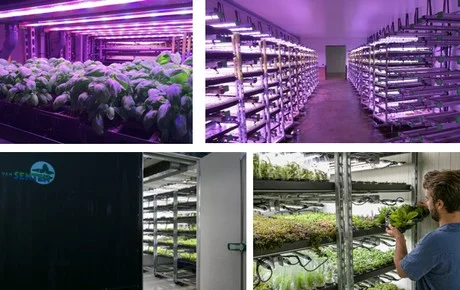
The climate is controlled by the iSii compact climate computer of partner Hoogendoorn, which measures and registers the growing conditions. This makes analyses easily available via the internet.
For more information:
Bosman van Zaal
+31 297 344 344
sales@bosmanvanzaal.com
www.bosmanvanzaal.com

The Changing Ways We Might Grow Food
Published by David Dunning
12th October 2018.
Access to safe and affordable food is something we all take for granted.
However, with more mouths to feed now than ever before, achieving this is no easy task.
To meet our increasing demands, with minimal environmental footprints, the way that we grow crops is changing.
To help drive this change, one of the Government’s four agri-tech Centres CHAP (Crop Health and Protection) has invested, with the support of Innovate UK, in two new ventures based at Stockbridge Technology Centre at Cawood, a leading applied R&D facility based in the heart of North Yorkshire.
Selby and Ainsty MP, Nigel Adams, is the guest of honour at the official opening today.
Vertical Farming Development Centre
Across the UK, hydroponic systems, along with the latest LED lighting technology, are beginning to be combined to produce certain crops in ‘urban farms’.
Operating independently of sunlight and seasons, food can be produced in these facilities 12 months a year, under conditions that have been optimised to grow safe and healthy produce in as shorter time as possible – giving a whole new meaning to the term ‘fast food’.
To operate effectively, these urban farms will need to take advantage of the very latest in modern technology, employing sensors to monitor crops and robots to manage operations such as harvesting. CHAP’s new ‘Vertical Farming Development Centre’ will mean that growers, food producers and researchers will be able to determine how these different technologies will impact the economics of LED vertical farming.
The aim is to develop technologies which will reduce production costs whilst maximising profits, potentially on a large scale.
Advanced Glasshouse Facility
CHAP’s Advanced Glasshouse Facility with a flexible design and multiple ‘bolt-ons’ that will allow new approaches to crop production and crop protection strategies to be tested and demonstrated to farmers.
The modern glasshouse recognises that the future of crop production is likely to be less reliant on synthetic inputs of chemicals and more reliant on combining different techniques, such as plant breeding and use of natural products and beneficial insects, to produce healthy and sustainable food.
These more complex crop protection strategies require more detailed and delicate testing procedures to show that they’re effective; this new facility will allow this work to take place across both field and glasshouse crops, including those now being grown in ‘hydroponic systems’, where plants are produced without soil.
About CHAP
CHAP (Crop Health and Protection) is one of the Government’s four agri-tech centres.
Their aim is to increase crop productivity for future generations through the uptake of new technologies. They work with pioneers to translate and promote these solutions for market adoption and improved crop productivity
Buffalo, New York - Vertical Farming Co-Op Growing Into New Space On East Side
Michael Zak, the chairman of vertical farming organization GroOperative, is moving his company to a 4,200-square-foot space at Clinton and Bailey avenues.
DMFOTOGRAPHY
By Dan Miner – Reporter, Buffalo Business First
October 10, 2018
Michael Zak has been searching for ways to make a big impact on inner-city Buffalo youth since he was a teenager.
Now the 34-year-old will have his chance.
Zak, the chairman of vertical farming organization GroOperative, is moving his company out of the small basement he leases underneath Buffalo Roots in University Heights to a 4,200-square-foot space at Clinton and Bailey avenues. He has room to grow the second-story space out to 20,000 square feet.
The move was supported with a $100,000 grant award won during this year’s Ignite Buffalo competition. Zak said he is also launching a $100,000 capital campaign in which people can buy shares of common stock in the company, earning them a small dividend while supporting urban farming in Buffalo.
The new home is expected to give GroOperative the scale to be a profitable enterprise while meeting the surging demand for its basil, lettuce and micro-green products. Zak said he will be able to grow more fish – which provide fertilizer for his plants and are also sold to customers – and expand his mission of teaching children about sustainable agriculture.
“This is becoming the business I always wanted it to be,” said Zak, who was part of GroOperative’s founding team in 2014. “We’ll be able to take up to 20,000 square feet of space, employ 20 to 30 people, provide fresh produce for people in the Buffalo area and teach children about sustainable farming systems.”
The African Heritage Food Co-Op will lease first floor space in the building, which was last home to Willowbrook Farms and is in a section of the city known for its cluster of food distribution warehouses.
GroOperative is built as a farming cooperative, and Zak said the goal is to support more owner-operators working alongside him. He expects to move into the new space by January.
Living Greens Unveiling Large Aeroponic Vegetable Farm
Living Greens said that its Faribault farm will be the second-largest aeroponics operation behind that of industry leader AeroFarms.
OCTOBER 6, 2018 - NEAL ST.ANTHONY@STANTHONYSTRIB
LIVING GREENS Executives Dave Augustine, left, and Dana Anderson foresee a rapid expansion of Living Greens Farm of Faribault.
The several-year founder of a growing aeroponic farm near Faribault is ready to prove his Living Greens low-input, no-dirt operation will have a big effect on the emerging world of year-round indoor vegetable growing.
CEO Dana Anderson, 50, a former financial adviser who worked on farms as a youth near Spicer, Minn., started tinkering with aeroponics in his Prior Lake garage in 2010.
Last year, Living Greens, staked by $8 million over several years contributed by founding shareholders, started slowly by testing and eventually producing increasingly larger crops of lettuce with a high-tech, rapid-growth system rooted in nutrient-rich misting and LED lighting.
By early next year, following completion of the last stage of construction, Living Greens should amount to 60,000 square feet of stacked, mechanized growing space capable of producing up to 3 million heads of high-quality lettuce.
That’s several fast-growing crops in one year.
The business plan and initial production proved impressive enough to recently draw $12 million in an inaugural round of institutional funding from Boston-based private-equity funds NXT and Wave Equity Partners.
“We’re exiting the research-and-development stage and going to market,” Anderson said.
The $6 million Faribault factory-farm will prove Living Greens’ technology innovation and its year-round, premium-lettuce model and spur construction of a second plant within a year outside of Minnesota, backers said.
“We think we have an opportunity to be a market leader in leafy greens,” Anderson said. “There are projections nationally that up to 50 percent of leafy greens could be grown indoors within 10 years from almost nothing today.
“Our goal is to be the largest indoor [farm operation]; corporate-owned and through licensing of the technology,” Anderson said. “We’re looking at joint ventures with food-service companies around the world.”
Living Greens said that its Faribault farm — a floor footprint of about 20,000 square feet that rises to about 16 feet, thus providing its 60,000 square feet of growing space — will be the second-largest aeroponics operation behind that of industry leader AeroFarms of Newark, N.J. It operates a 70,000-square-foot indoor farm in addition to smaller installations.
Living Greens already supplies a growing list of Minnesota and Wisconsin grocers with several types of leaf lettuce, arugula and mixed greens through Robinson Fresh, a division of C.H. Robinson.
By next year, it will have installed the technology to produce around 3 million bagged packages of salad greens for retail distributions.
Typical salad bags, depending on whether they include dressing and other ingredients as part of planned “salad kits,” will retail for $2.99 to $3.99.
“We’re producing about 500,000 units a year now, and it will be a sixfold expansion by spring,” Anderson projected.
The 20-employee Living Greens operation includes chief technology officer Dave Augustine, a University of Minnesota-trained electrical engineer and veteran industrialist who joined the board several years ago.
Augustine, 55, who grew up on a farm, was a several-year board member who stepped into the executive ranks as overseer of the company’s technology integration.
Living Greens has been awarded four patents on its growing process, according to Anderson.
The firm plans to produce as much lettuce indoors as would be produced by 100 times the farmland, using 95 percent less water, no pesticides, herbicides or other chemicals.
It does so thanks to its density and computer-controlled environment that blends natural light and ultra efficient LED lighting that has dramatically dropped in price in recent years thanks to widespread business and residential embracement.
“The price has been dropping by about 20 percent a year as illumination has increased by about 50 percent,” Anderson said. “The risks of foodborne illness are extremely muted compared to the traditional food chain. We use a ‘reverse-osmosis’ process to remove all the particulates from the water.”
Then there’s the local pitch.
Living Greens plans to deliver a premium product locally, at lower cost, because it won’t have the long-haul transportation expense and up to two weeks’ time to deliver from Mexico or the California-Texas Sun Belt where most fall-winter vegetables are grown.
To be sure, Living Greens has dreams of being a big company in a fragmented but fast-developing indoor agriculture market.
They include Revol Greens, the Minnesota-based greenhouse grower that has added some water- and energy-conserving wrinkles of its own, as well as Plenty, the California-based indoor grower that has raised $200 million and also has its eyes on China.
The sector is driven by the premise that farmland is limited, and industrial-scale farming can be very expensive and uses what can be unsustainable amounts of water, chemicals and land.
The challenge for the small, indoor innovators such as Living Greens is to entice buyers with tasty produce at a competitive but profitable price that customers also will patronize for their regional and environmental pitches.
“This took us longer and cost us more than we’d hoped, but I think we have a better system and technological lead,” Anderson said. “It’s a tremendous opportunity because of the demand for fresh, year-round local produce.”
Neal St. Anthony has been a Star Tribune business columnist/reporter since 1984. His work has been recognized by the Minnesota Society of Professional Journalists and the Society of American Business Editors and Writers.
Neal.St.Anthony@startribune.com 612-673-7144 @StAnthonyStrib

New Autonomous Farm Wants To Produce Food Without Human Workers
To View Video Please Click Here | COURTESY OF IRON OX
Down on a new robot farm, machines tend rows of leafy greens under the watch of software called “The Brain.”
by Erin Winick
October 3, 2018
Iron Ox isn’t like most robotics companies. Instead of trying to flog you its technology, it wants to sell you food.
As the firm’s cofounder Brandon Alexander puts it: “We are a farm and will always be a farm.”
But it’s no ordinary farm. For starters, the company’s 15 human employees share their work space with robots who quietly go about the business of tending rows and rows of leafy greens.
Today Iron Ox is opening its first production facility in San Carlos, near San Francisco. The 8,000-square-foot indoor hydroponic facility—which is attached to the startup’s offices—will be producing leafy greens at a rate of roughly 26,000 heads a year. That’s the production level of a typical outdoor farm that might be five times bigger. The opening is the next big step toward fulfilling the company’s grand vision: a fully autonomous farm where software and robotics fill the place of human agricultural workers, which are currently in short supply.
COURTESY OF IRON OX
Iron Ox isn’t selling any of the food it produces just yet (it is still in talks with a number of local restaurants and grocers). So for now, those tens of thousands of heads of lettuce are going to a local food bank and to the company salad bar. Its employees had better love eating lettuce.
The farm’s non-lettuce-consuming staff consists of a series of robotic arms and movers. The arms individually pluck the plants from their hydroponic trays and transfer them to new trays as they increase in size, maximizing their health and output—a luxury most outdoor farms don’t have. Big white mechanical movers carry the 800-pound water-filled trays around the facility.
COURTESY OF IRON OX
At first, making sure these different machines worked together was tricky. “We had different robots doing different tasks, but they weren’t integrated together into a production environment,” says Alexander.
So Iron Ox has developed software—nicknamed “The Brain”—to get them to collaborate. Like an all-seeing eye, it keeps watch over the farm, monitoring things like nitrogen levels, temperature, and robot location. It orchestrates both robot and human attention wherever it is needed.
Yes, although most of the operation is automated, it still does require a bit of human input. Currently, workers help with seeding and processing of crops, but Alexander says he hopes to automate these steps.
But why go to the trouble of automating farming at all?
Alexander sees it as solving two problems in one: the shortage of agricultural workers and the distances that fresh produce currently has to be shipped.
Rather than eliminating jobs, the company hopes, the robots will fill the gaps in the industry’s workforce. And he believes that by making it possible to grow crops close to urban areas without paying city-level salaries, the automated farms will enable stores to chose vegetables fresher than those that had to travel thousands of miles to get there. That is, assuming the startup can get its prices to match those of traditional competitors.
COURTESY OF IRON OX
“The problem with the indoor [farm] is the initial investment in the system,” says Yiannis Ampatzidis, an assistant professor of agricultural engineering at the University of Florida. “You have to invest a lot up front. A lot of small growers can’t do that.” This could risk creating a gap between the big farming institutions and smaller family-owned operations, in terms of gaining access to new technology.
To View Video Please Click Here | COURTESY OF IRON OX
Despite this, Ampatzidis says that bringing automation to both indoor and outdoor farming is necessary to help a wider swath of the agricultural industry solve the long-standing labor shortage.
“If we don’t find another way to bring people [to the US] for labor, automation is the only way to survive,” he says.
Erin Winick Associate Editor
I am the associate editor of the future of work at MIT Technology Review. I am particularly interested in automation and advanced manufacturing, spurring from my background in mechanical engineering. I produce our future of work e-mail… More

DelFrescoPure Goes Year-Round With Indoor Vertical Farm
Chris Koger October 9, 2018
CubicFarms constructs containers that grow leafy greens, like this one from the company's website. ( Courtesy CubicFarms )
DelFrescoPure is investing in technology with a new mechanized stand-alone growing system for the company’s living herbs and microgreens in a year-round process.
The system, known as LivingCube, is from CubicFarms, a supplier of indoor vertical farms.
The LivingCubes are 40-foot climate-controlled growing chambers that have 12 growing, germination and irrigation machines, according to a news release. The system includes a fully-enclosed work area.
The system is at DelFrescoPure’s Kingsville, Ontario, headquarters, and will be used to grow living lettuce and basil, and microgreens.
“We wanted to offer our retail partners new, innovative and local commodities and the ideal solution was to partner with CubicFarms,” Carl Mastronardi, DelFrescoPure president, said in the news release.
DelFrescoPure powers the LivingCube system with an off-the-grid cogeneration system, according to the release.

Co-Living Series - Alexander Olesen on Innovating Urban Agriculture With Micro-Farms
August 28, 2018
Indoor farming can be a solution to encouraging people to integrate nature into their urban lives. As part of the Co-Living Series, we asked Alexander Olesen, founder of Babylon Micro-Farms, to explain how his project is making this experience more user-friendly and more sustainable.
When nature enters the household
Urban agriculture is currently a trending initiative in the Western World and considered as a potential solution to making cities more sustainable. The Micro-Farm is an automated indoor farming appliance that was designed in Charlottesville, Virginia (USA) by a recent graduate from the University of Virginia. It allows anyone to grow fresh leafy greens, herbs, flowers and vegetables at the push of a button. Through Babylon’s proprietary technology, it grows a wide variety of plants two times faster and uses up to 90% less water.
Access to hydroponics plant cultivation has been limited by three main problems: the cost of technology, growing expertise and space requirements.
Design is fundamental to adapting our cities for the future. In order to get people to engage and learn about innovations, we must embrace design as the first line of attack when introducing people to new ideas.
Making urban agriculture more accessible
Thanks to a high-level of automation and pre-seeded refill pods, the Micro-Farm creates an intuitive user experience simple enough for people of all ages to experiment with. All users have to do is scan in the pre-seeded refill pod and the technology takes care of the rest, it grows automatically from seed to harvest and sends alerts to users.
The automated growing platform is capable of powering a wide variety of urban farming operations. This could range from a small residential appliance, a larger installation such as an amenity at a housing development, or a full-scale commercial operation.
Designing technology and consumables to be adaptable and scalable all while simplifying the user experience is key. Seeing is believing and the creation of eye-catching structures is essential to garnering public support that will ultimately drive policymakers to introduce nature into cities.
The Future
Smart Micro-Farms may soon be commonly found in all sorts of buildings, from offices to schools, apartments, hospitals, or anywhere else. By making automated indoor farming accessible to anyone, Babylon is proactively making people healthier and happier, creating environments that offer a sustainable source of sustenance, as well as shelter!
ABOUT BABYLON MICRO-FARMS
Babylon is an indoor farming specialist, combining cutting edge technology with innovative agricultural methods to empower a new generation of urban farmers. They have created a system that automates all of the complex aspects of plant cultivation.
Watch the video here

How Urban Farms In New York Schools Are Raising Food To Fight Inequality
Teens for Food Justice’s farm-to-table concept brings fresh, student-grown produce to the cafeteria
September 27, 2018
Teens for Food Justice
It’s the type of experience expected at a top-rated restaurant: Diners gaze at produce growing in a hydroponic garden next to the kitchen. Behind plexiglass, herbs are carefully plucked in anticipation of being added to every plate.
This high-tech take on farm-to-table, however, is being built for the cafeteria of a New York City public school in Manhattan.
As part of a nonprofit program called Teens for Food Justice, a handful of schools in Brooklyn, the Bronx, and Manhattan have turned spare classrooms, unused science labs, and, in one case, an empty closet into urban hydroponic farms, an experiment in self-sufficiency, science education, and food equity.
It’s not unheard of to find produce grown within the five boroughs: supermarket chains like Whole Foods and companies such as Gotham Greens have helped pioneer and popularize large-scale commercial farming in New York City.
But Teens for Food Justice isn’t just about urban farming, it’s about using agriculture in the classroom as a tool to educate and empower communities without easy access to fresh produce.
“These communities lack access to healthy food,” says Katherine Soll, the founder and CEO of Teens for Food Justice. “How could we utilize a school program to make it possible for food desert communities to provide food for their community?”
Teens for Food Justice
Teens for Food Justice now has more than 300 students in New York City public schools actively participating in hands-on learning, either during the school day or in after-school and weekend programming. The student farmers at the program’s three locations manage to raise an impressive annual harvest of leafy greens, herbs, tomatoes, and cucumbers: DeWitt Clinton High School in the Bronx grows 25,000 pound of produce a year, Brownsville Collaborative Middle School in Brooklyn brings in 15,000 pounds, and Brooklyn’s Urban Assembly Unison School nets 3,000 pounds.
After the food is harvested, cleaned, and cut, most of it gets used in school cafeterias to supplement existing dining options. Think salad bars with most of the items raised on site, including tomatoes, cucumbers, peppers, lettuce, kale, swiss chard, basil, and bok choy. Any remaining fresh produce gets sold at an affordable price to the community via farmer’s markets.
Connecting salads and service learning
Soll initially became involved in student service and philanthropy in 2009. A mother of two on the Upper West Side, Soll was disappointed student volunteer options weren’t addressing issues of inequality in New York City, and decided to take it upon herself to create more community-oriented programming.
“There wasn’t any rich service learning opportunities,” says Soll. “We felt that was really the key to creating a generation of young people who were civically engaged and involved in local justice.”
Soll helped launch Students for Service, which offered a variety of service learning opportunities. Within three years, the program was working with more than 1,000 students across a variety of city agencies and nonprofits. As the program grew, volunteers often worked on issues of sustainability, emergency food assistance, and urban gardening. According to the New York Food Bank, 16 percent of New Yorkers are food insecure, meaning they lack reliable access to fresh food, and more than 1 million reside in “food desert” communities, which lack access to fresh food.
An idea started taking shape: what if you could create a Gotham Greens-esque program, but for schools, and they could sell produce into their local communities?
The first Teens for Food Justice garden launched in 2013 in Bedford Stuyvesant, Brooklyn, at Urban Assembly Unison School. Initially, the program worked on a volunteer basis, with students from across New York participating in after-school gardening. In 2016, TFFJ decided to change how it operates, focusing on drawing volunteers from within the school. By integrating the program in the school day, the thinking went, the program offered new classroom and learning opportunities.
“For a youth led-project to really move the needle, the community needs to drive it,” says Soll. “If you really empower the children and families and leadership, you can embed it deeply in the ongoing learning of the school.”
Teens for Food Justice
Supporting social change from the ground up
With funding and support from companies such as Whole Foods and Green Mountain Energy Sun Club, as well as support from city government, the program is expanding its aim. Soll says the program is looking to increase the size of the farm at Urban Assembly Unison School, build a new farm at Manhattan’s Martin Luther King, Jr. Collaborative School in Columbus Circle, where the garden-in-cafeteria-concept is taking shape, and potentially launch new in-school farms in Miami.
The focus on sustainability isn’t just about produce. Soll says the program is working with Boston Consulting to develop a more self-sustaining platform, to make it easier to expand into new schools while helping existing sites grow and make a great impact on their communities.
The benefits of onsite gardens go beyond fresh food (which is a big deal in food-insecure communities). Students gain lessons about biology and nutrition, and DeWitt Clinton High has incorporated farm work into AP courses. Evaluations discovered students learn a lot of soft skills around collaboration, and gain confidence in the garden. But more importantly, Teens for Food Justice shows teens how they can make an impact.
“When children speak passionately about an issue, adults listen to them,” Soll says. “If you believe your voice can be heard, and you believe you have the power to make a difference, that builds confidence on so many levels, and triggers engagement and involvement.”

Economics of Urban Ag
Economics of Urban Ag
Departments - Urban Agriculture
Targeting high-value, niche markets or products, and adapting a social business model can help urban greenhouses derive profit.
September 27, 2018
Robin G. Brumfield and Charlotte Singer
Brooklyn Grange’s Brooklyn Naval Yard FarmPhoto courtesy of Brooklyn Grange
Editor's note: This article series is from the Resource Management in Commercial Greenhouse Production Multistate Research Project.
Urbanized agriculture is gaining momentum in response to increasing demands for locally produced fresh vegetables. Greenhouse or indoor vegetable production to meet local demands is the backbone for this evolving scenario. The viability of various indoor crop cultivation options demands proper documentation to guide appropriate recommendations that fit different production circumstances for growers.
Recently a popular trend toward eating local, deemed being a locavore, evidenced by a growing social movement, has evolved (Osteen, et al., 2012). While the benefits of buying food locally are debated due to the economics of comparative advantages, consumer groups support urban agriculture for a number of reasons, such as to support local farmers; to provide local, fresh food in inner city deserts; to buy fresh food; to know from where their food is coming; and to respect the environment (Peterson, et al., 2015). Specifically, one study found that 66 percent of those surveyed welcomed more local food options because local food supports local economies (Scharber and Dancs, 2015).
Many consumers also cite environmental impacts as a reason to buy local, evidenced by one study finding that environmental factors were an important reason to buy locally grown food for 61 percent of those surveyed (Scharber and Dancs, 2015; Reisman, 2012). Another popular reason is to reduce food insecurity. USDA defines food insecurity as “a household-level economic and social condition of limited or uncertain access to adequate food” (USDA ERS, 2017).
Buying locally grown food can reduce food insecurity in that having local farms provides consumers who might not have previously had access to fresh produce the opportunity to purchase it. Some urban farms make a point of targeting food insecurity, and having local farms allows a city to rely less heavily on external markets to feed its population. Despite debate of realized benefits, consumers eat local food to feel good about it (Scharber and Dancs, 2015).
High capital costs
The low supply of special varieties such as these microgreens can drive a higher price to help cover the high costs of running a greenhouse.Photo courtesy of Robin G. Brumfield
Regardless of the strength of their consumer base, the number of urban farms is still low due to the high costs that urban farmers face compared to rural farmers. Not only is the land more expensive, but also the limited plot size and probable contamination of the land with lead and toxins essentially necessitates the use of a greenhouse with high investment costs. Cost challenges that many urban greenhouse farmers face include securing funding, finding economies of scale, and facing high capital and operating costs.
The energy necessary to heat a greenhouse through the winter makes utility costs high, the most productive greenhouse technologies are expensive, and land is of much higher value in cities than in rural areas (Reisman, 2012). Not to mention, the initial infrastructure cost involved in building a greenhouse is much higher than the costs that farmers growing in a field face. The costs of urban greenhouses vary greatly depending on size and type. The construction of, for example, a hydroponic greenhouse entails costs for site preparation, construction, heating and cooling equipment, thermostats and controls, an irrigation system, a nutrient tank, and a growing system (Filion, et al., 2015).
Another problem with growing in cities is shade from tall buildings and skyscrapers. Jenn Frymark, chief greenhouse officer at Gotham Greens, cites this as the primary reason that the business built rooftop greenhouses. This creates its own set of problems and increases costs compared to standard greenhouses on the ground. Other urban producers address the shade problem in cities by producing in buildings using vertical agriculture and artificial lights. However, this increases the costs even further because of the need for light all year. These high costs keep the number of urban farms small.
Marketing: quality optimization, high-value plant products, year-round production
Due to these high costs, urban greenhouses must derive profit in creative ways, such as targeting high-value niche products or markets, and producing year-round. Targeting niche products and markets allows urban farmers to charge a premium that covers the added costs of operating in the city. Targeting a niche product could entail producing special varieties of vegetables, like how Brooklyn Grange, a successful New York City-based greenhouse, grows microgreens and heirloom tomatoes. The low supply of these special varieties can drive a higher price to help cover the high costs of the greenhouse. To increase profitability, farmers can also find a high-end market (Sace, 2015).
Targeting a niche market could entail selling produce to high-end restaurants and supermarkets, such as Whole Foods, whose customers are already expecting to pay a premium price, or it could entail marketing produce specifically to locavores. In fact, one study found that, for example, consumers were willing to pay a $1.06 price premium on one pound of locally grown, organic tomatoes. In the same study, the researchers also found that urban consumers were more likely to buy locally grown produce, compared with rural consumers (Yue and Tong, 2009). The high costs associated with living in a large city means that cities have a high concentration of people who can afford to eat local in this way, and the demographics of large cities translate to a high concentration of people who also see value in eating locally produced food. Together, these create a market of locavores willing and able to pay a premium for locally grown produce.
By targeting niche products and markets, urban greenhouse farmers can take advantage of existing high-end markets to cover their relatively high costs. Since these producers use greenhouses, and a few use indoor facilities, they can produce year-round, thus providing a constant supply and a steady demand for their products.
Harlem Grown in New York gives students the opportunity to learn about agriculture and the food system in a hands-on nature.Photo: Instagram: @harlemgrown
Agricultural jobs in urban settings and other social values
Adapting a social business model can open urban farmers up to alternate sources of funding. They may want to provide jobs to disadvantaged groups such as low-income inner-city dwellers, or people with autism. Some of these businesses have reduced labor costs through volunteerism, as individuals may be willing to volunteer on a farm that supports a social issue (Reisman, 2012). Some examples of causes that urban greenhouse social businesses focus on include education, research, the environment and food security. Harlem Grown in New York adds an educational component to the greenhouse, namely the opportunity for students to learn about agriculture and the food system in a hands-on nature, allowing the greenhouse to become eligible for funding from schools, governmental programs or donors particularly interested in education.
Targeting niche markets or products, adopting a social business model and finding inexpensive plots of land can help urban greenhouses derive profit.Graphic: Charlotte Singer
Other urban greenhouses can, for example, pitch themselves to city dwellers as an environmentally friendly alternative to commercial farms, using less fuel for transportation and fewer chemicals. This could again render the greenhouse eligible to new sources of funding. AeroFarms in Newark, New Jersey, has adapted a combination of the previous two models. It uses environmentally friendly techniques and collaborate with Philip’s Academy Charter School (Boehm, 2016).
Greenhouses can additionally focus their business models on alleviating food insecurity by providing fresh produce to urban food deserts (US. New York State Energy Research and Development Authority, 2013). Unlike the previous cases, greenhouses that choose to focus on alleviating food insecurity would not be able to additionally use the method of targeting high-end markets, unless they make an effort to use the high-end markets to subsidize the cost of providing their produce to food deserts. An example of an urban farm targeting food insecurity is World Hunger Relief Inc. in Waco, Texas, which brings produce grown in its greenhouse to food deserts in the City of Waco at a market or discount cost. What these three options share is a business model that incorporates multiple bottom lines, which allows them access to new funding and volunteer labor to reduce costs.
As consumers increasingly look to eat locally produced food, for reasons such as to support the local economy, to protect the environment, to change food deserts and to understand better where food is coming from, urban agriculture is becoming a growing trend. Targeting high-value, niche markets or products, and adopting a social business model to provide agricultural jobs in urban areas, constitute some of the ways urban greenhouses to derive profit in a capital-intensive industry. By utilizing these techniques, individuals looking to start their own urban greenhouses can add value to their business and derive profit.
Robin is a Professor at Rutgers, the State University of New Jersey, where she has been the Farm Management Extension Specialist since 1988. She is internationally known for her work in greenhouse economics. brumfiel@njaes.rutgers.edu
Charlotte is senior economics, mathematics, and statistics major in the Rutgers University Honors College and worked on urban agriculture through the Aresty Research Assistant Program. cts86@scarletmail.rutgers.edu
References:
Turner, Michael. 2008. A History of World Agriculture from the Neolithic Age to the Current Crisis By Marcel Mazoyer and Laurence Roudart. The Economic History Review 61(3): 766-67.
Vitiello, Domenic, and Catherine Brinkley. 2014. The Hidden History of Food System Planning. Journal of Planning History 13(2): 91-112.
Peterson, Hikaru Hanawa, Mykel R. Taylor, and Quentin Baudouin. 2015. Preferences of Locavores Favoring Community Supported Agriculture in the United States and France. Ecological Economics 119: 64-73.
United States. Department of Agriculture. 1945 Census. Vol. 2.USDA ERS. 2017. Farming and Farm Income. Feb. 2017
Osteen, Craig, Jessica Gottlieb, and Utpal Vasavada. 2012. Agricultural Resources and Environmental Indicators, 2012 Edition. SSRN Electronic Journal
Scharber, Helen, and Anita Dancs. 2015. Do Locavores Have a Dilemma? Economic Discourse and the Local Food Critique. Agriculture and Human Values 33(1): 121-33.
Reisman, Alexandra. 2012. A Greenhouse in the City: The Uses and Roles of Community-Oriented Urban Greenhouses.” ProQuest Dissertations Publishing.
USDA ERS. 2017. Definitions of Food Security. USDA ERS - Definitions of Food Security. Oct. 2016.
Filion, Nicole, Carly Wine, and Eli Turkel. 2015. Urban Farm Complex Research. University of Delaware Center for Research in Education and Social Policy, Apr. 2015.
Sace, Chito. 2015. Economic Analysis of an Urban Vertical Garden for Hydroponic Production of Lettuce. International Journal of Contemporary Applied Sciences 2(7).
Yue, Chengyan, and Cindy Tong. 2009. Organic or Local? Investigating Consumer Preference for Fresh Produce Using a Choice Experiment with Real Economic Incentive. HortScience 44(2).
Boehm, Jessica. 2016. Ag for Urbanites. New Jersey Department of Agriculture.
United States. New York State Energy Research and Development Authority. 2013. Sustainable Urban Agriculture: Confirming Viable Scenarios for Production., Mar. 2013.
Urban agriculture Tomato Sustainability Urban farm Local food Education Labor Microgreens Marketing