


Welcome to iGrow News, Your Source for the World of Indoor Vertical Farming

VIDEO: Is Tom Vilsack The Changed Person He Says He Is To Lead USDA Again?
For decades, USDA has misappropriated resources in supporting a factory farming system that harms communities, threatens human health, perpetuates racial inequity, and destroys natural ecosystems
For decades, USDA has misappropriated resources in supporting a factory farming system that harms communities, threatens human health, perpetuates racial inequity, and destroys natural ecosystems.
02-15-21
Gene Baur - Another View contributor
After heading up the U.S. Dairy Export Council, Tom Vilsack is in line to reprise his role as secretary of the US Department of Agriculture. Social justice, family farm, and sustainable agriculture groups have raised legitimate concerns about his longtime support of unjust and extractive practices, but at his confirmation hearing, Vilsack said that it’s a different time and he’s a different person, and that he now supports a more equitable and regenerative food system.
Let’s hope Vilsack has truly learned from past missteps and rises to the moment. He has huge opportunities to bring together diverse constituencies around common interests by reforming agriculture. We all benefit from access to wholesome food, produced in a just and compassionate way without destroying the planet or exploiting people and other animals.
For decades, USDA has misappropriated public resources in supporting a factory farming system that harms communities, threatens human health, perpetuates racial inequity, and destroys natural ecosystems. Raising and slaughtering animals by the billions demands inordinate resources, using 10 times more land in the US than plant-based farming. It is a major contributor to the climate crisis, the loss of biodiversity, and other ecological hazards, causing forests and other ecosystems to be destroyed to produce food for farm animals.
ANOTHER VIEW: Vilsack has the right stuff to move the Agriculture Department forward
Vast expanses of land are used for grazing and to produce corn, soybeans and other commodities to feed farm animals. It is far more efficient to grow crops to feed people directly, which could free up millions of acres to help sequester greenhouse gasses, create habitat for wildlife, and preserve natural ecosystems for future generations. Government programs should actively encourage this transition and remove all support, including financial instruments like carbon trading, that enable extractive practices linked to animal agriculture. Incentivizing biodigesters to turn animal excrement into energy at industrial farms, for example, is a short-sighted response to a chronic problem that allows agribusiness to further consolidate power, while greenwashing an untenable system.
Crowding animals by the thousands into factory farms increases risks for virulent pathogens and infectious diseases, including possibly future pandemics. These toxic conditions also sicken workers, disproportionately harming people of color, like the essential workers forced into slaughterhouses that were COVID-19 hotspots. Despite these and other hazards, however, most USDA funding, including COVID relief, has been used to perpetuate this unhealthy and unjust system, which concentrates wealth into the hands of fewer larger operations at the expense of family farmers, exploited workers and disenfranchised citizens.
We must shift USDA support and incentives away from industrialized animal agriculture, and toward a more resilient and equitable system that produces fruits, vegetables, legumes, whole grains and other nourishing foods. Our government should stop underwriting excess dairy production, for example, and distributing surplus artery-clogging cheese through food assistance programs. It is in our nation’s interest for the USDA to incentivize the production and distribution of nutritious plant-based foods instead. We could save billions of dollars in health care costs every year, while lightening our ecological footprint and creating meaningful jobs and opportunities through a diversified, community-centered, plant-based food system.
Concerns about food insecurity during the pandemic spurred a gardening movement, similar to the victory gardens during World War II that provided 40% of our nation’s produce. USDA’s vast network of land grant colleges and cooperative extension offices should build on this by supporting community gardens, urban agriculture, farmers markets and similar endeavors that provide fresh and healthy food, especially in communities that need it most. In some areas, there might also be opportunities for low-income housing to be connected with farming and food enterprises. Schools, churches, and other institutions, including those that serve vulnerable populations, can be enlisted to train the next generation of farmers. USDA food assistance programs that incentivize fresh fruits and vegetables should be expanded and leveraged to support local agriculture.
Industrial animal agriculture has perpetuated racism and structural inequity, often with USDA support. Most farm owners are white, but most agricultural workers are people of color, and they are commonly subjected to dangerous conditions. Black and brown communities experience environmental racism with pollution spilling out of factory farms, and they disproportionately lack access to wholesome food, which leads to elevated rates of diabetes, obesity, and other diet-related ailments. Recognizing this, Vilsack said, “I will ensure all programming is equitable and work to root out generations of systemic racism.”
At his confirmation hearing, Vilsack quoted Robert F. Kennedy about seeing things as they are, and aspiring to dream of things that are yet to be. Let’s hope we’re at an inflection point and that our incoming USDA secretary has truly changed and will actively work to manifest those dreams and the unfulfilled promises of our nation.
Gene Baur is president and co-founder of Farm Sanctuary, America’s first farm animal sanctuary and advocacy organization.

Growing Sprouts In A Former Slaughterhouse
Grow Up FARM has recently launched a new product, named Eat-Grow-Repeat: small pea shoots that grow on a small hemp-square in a bag. "Rip off the upper section of the bag, and the bottom of the bag is now the pot," Lasse Vilmar, Chief Executive Grower of the company, explains
Grow Up FARM has recently launched a new product, named Eat-Grow-Repeat: small pea shoots that grow on a small hemp-square in a bag. "Rip off the upper section of the bag, and the bottom of the bag is now the pot," Lasse Vilmar, Chief Executive Grower of the company, explains. "Place the bottom of the bag with pea plants on your table and the growth will continue. Harvest completely fresh pea sprouts for your salad bowl. Keep watering and within a week they will grow out once again."
Developing innovative packaging is a new field for Grow Up FARM, as the company has been working with mainly sprouts for three generations already. The Ringsted-based family business started with Lasse’s grandparents growing sprouts in the ‘60s. Lasse himself took over in 2013. “At that time, we were looking for new products to shoot the market. Our eyes fell on Koppert Cress and other companies that were doing microgreens. All of a sudden, it was like a light bulb that went off, and it felt like a natural direction to pursue”.

GrowUp FARM owners Jens Essemann and Lasse Vilmar
The new product had already been planned for quite some time, but the launch was accelerated the world-wide plot twist that the pandemic created. “We had just geared up and planned everything for the summer season to start, with all its parties and weddings. In the end, we only got to deliver one or two full batches before the lock-down”.
Although the company for years had focused on companies rather than local customers, selling to people in the area got them through the first lock-down. “We searched for Facebook community pages to advertise to local customers. Luckily we got rid of most of our stock that way, even though we only sold in large commercial-sized boxes. We combined different varieties in one box so that people had a chance to eat all of it. I even borrowed a van from a nearby car dealer on which I taped some of our roll-up banners. Like an old-school farmer I stood there, selling my produce. It was a fun period, but also nerve-wracking because we had no ideas when we could be able to continue our regular growing process again”.
Unlike the sprouts that Lasse has been working with for years, the microgreens are grown in a vertical farm. The building once was a poultry slaughterhouse, and the coolers have been turned into growing chambers. Isolation is important, as sprouts are grown completely in the dark. Even more importantly, isolation is needed for strict hygiene reasons.
“Growing sprouts is considered high-care production in the EU. The beans need a warm and moist environment, which are ideal circumstances for bacteria and molds. You need to be sure that the equipment is sterilized and that the water is drink-water quality. It takes a lot of control and procedures”. Most of the watering, which takes 400 liters every 3 hours per batch, is for cooling purposes. “The temperature in the core of the sprout-mass can rise to 70 degrees, so the sprouts could basically cook themselves”.
The sprouts are sold to both supermarkets and retailers, which makes it less vulnerable regarding covid-restrictions. Also, the Eat-Grow-Repeat plants are sold exclusively to supermarkets. “We’re doing 2000 bags delivery each week, and in a month we will launch the product to other supermarkets. The reviews have been raving, so we are quite proud of what we have achieved so far”.
Keeping an eye on the environment
The company strives to keep its packaging material as environmentally friendly as possible. The foodservice products are 100% recyclable, consisting only of FSC-cardboard and organic biodegradable hemp. Its current consumer packaging only consists of 6g of recyclable PE-plastic and organic biodegradable hemp, no pots or cardboard.
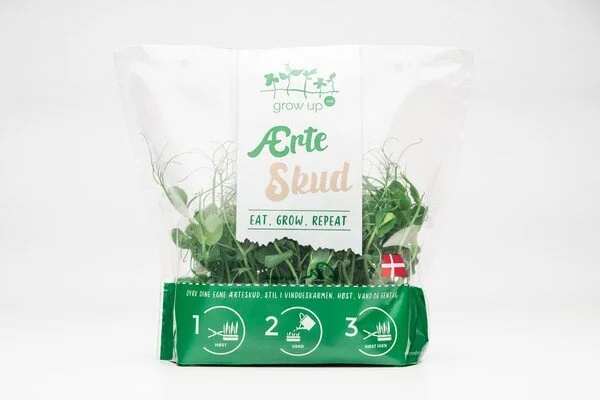
The Eat-Grow-Repeat product, with pea shoots
“Our farm is not much different from other vertical farms,” says Lasse. We are entirely electrified, and we have chosen an energy company (NaturEnergi) that pushes sustainable energy. This way our energy is constantly getting more sustainable.” In 2019 approximately 50% of the energy produced in Denmark came from wind and solar. “Ultimately we aim to plaster our roof with solar panels,” Lasse adds.
For more information:
Grow Up FARM
Lasse Vilmar, Owner and Chief Executive Grower
lasse@growupfarm.dk
www.growupfarm.dk

Source: Publication date: Thu 11 Feb 2021
Source: Author: Rebekka Boekhout
© VerticalFarmDaily.com

US - SOUTH CAROLINA: VIDEO: Columbia Vertical Farm Uses Technology To Cut Plastic Pollution And Boost Sustainability
With the use of agricultural technology, Vertical Roots farm in West Columbia created a packaging system for its leafy greens that cut down the company’s plastic usage by 30% and extends the shelf life of the lettuce
FEBRUARY 01, 2021
Vertical Roots is the largest hydroponic container farm in the country. They grow and package lettuce varieties and have recently implemented a packaging process that reduces plastic with a resealable film. TRACY GLANTZ TGLANTZ@THESTATE.COM
With the use of agricultural technology, Vertical Roots farm in West Columbia created a packaging system for its leafy greens that cut down the company’s plastic usage by 30% and extends the shelf life of the lettuce.
In 2015, high school friends Andrew Hare and Matt Daniels created the idea for Vertical Roots, now the largest hydroponic container farm in the country. Hare is the general manager of the company and Daniels acts as the chief horticulturist.
The first Vertical Roots opened in Charleston and expanded with its second farm site in West Columbia in 2019. Vertical Roots parent company, AmplifiedAg, manufactures the container farms and farm technology of which Vertical Roots operates.
The farms are part of a growing industry called controlled environmental agriculture (CEA) that uses technology to ramp up nutrient-rich food production year-round.
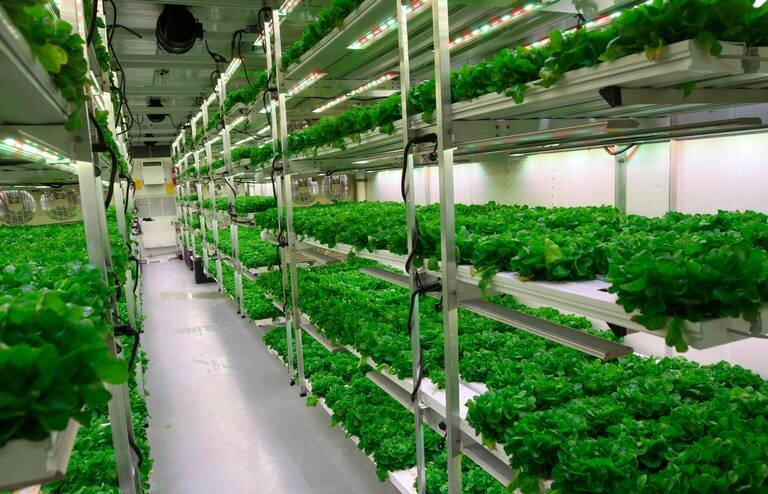
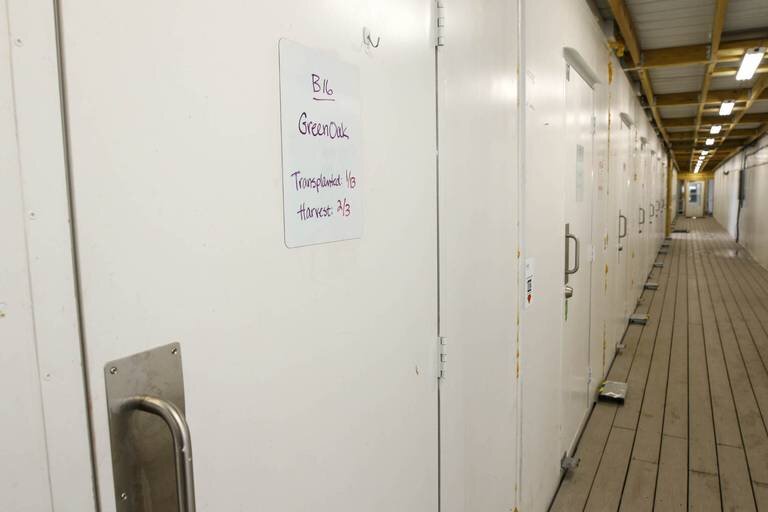
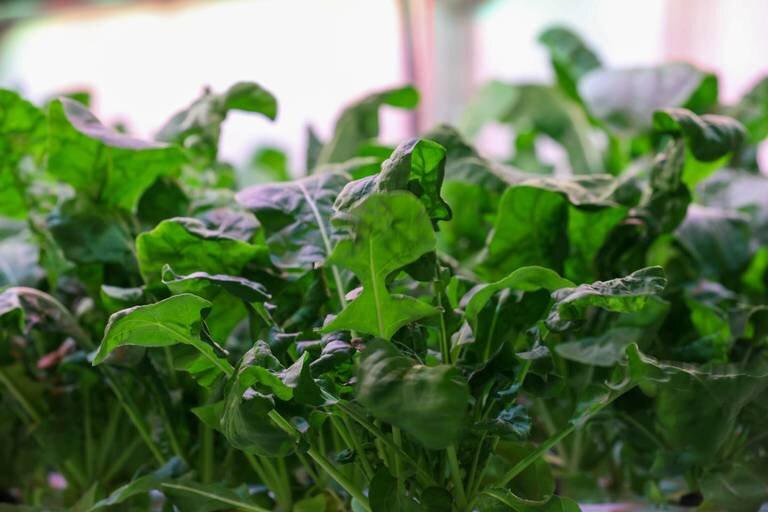
Hydroponics helps the farm uses 98% less water than traditional farming, according to Hare. Their technology creates an indoor environment to grow lettuce on the East Coast. Most lettuce in the U.S. comes from California and Arizona, where temperatures do not fluctuate much throughout the year, traveling 2,000 miles from farm to table. Vertical Roots offers a solution for local lettuce.
“Our mission is to revolutionize the way communities grow, distribute and consume food,” said Hare. As populations grow, Hare said the ability to produce enough food is a global concern.
VERTICAL ROOTS AGRICULTURAL INNOVATION
As a company committed to sustainability, Vertical Roots had to address its plastic usage and the consumer demand for environmentally friendly products.
“I think everyone can agree that the amount of plastic that’s consumed and used globally is a bit of a problem,” said Hare.
If Vertical Roots were to completely opt-out of using plastics, as much as 40% of the lettuce would be damaged in transportation to the retailers, Hare said. So the company decided to still use plastic containers in order to cut out food waste, but it changed the amount and type of plastic used.
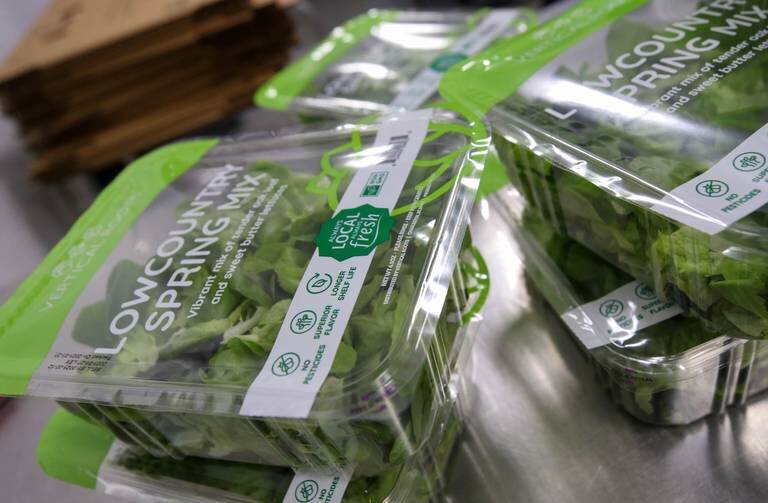
By replacing the conventional “clamshell” plastic lids that you see on a container of lettuce at the grocery store, Vertical Roots cut down more than 30% of plastic usage by creating a resealable film lid. The new packaging comes at no extra cost to the customer and will be cheaper in the long-run for Vertical Roots, according to Hare.
The farm also uses recycled plastic that can also be recycled again after use. Tiny perforations in the film lid of the packaging allows air to leave the lettuce container and extends the product’s freshness, making Vertical Roots lettuce last around 14 days on the shelf.
“We tested respiration and condensation with each lettuce variety, and ultimately found that we could extend the freshness and shelf life of our salad mixes even more,” said Hare.
GROWTH IN THE AGRICULTURAL TECHNOLOGY INDUSTRY
In the first three quarters of 2020, a record $754 million of venture capital was invested in the vertical farming industry, according to PitchBook data. This was a 34% increase from the entire previous year, Bloomberg reported in a January article.
A 2019 report from Global Market Insights showed that the vertical farming market size, or the number of potential customers or unit sales, surpassed $3 billion in 2018 and said it, “will exhibit a massive compound annual growth rate (CAGR) of over 27% from 2019 to 2026.”
In vertical farms, crops are harvested on several vertical layers indoors, where farmers can grow year-round by controlling light, temperature, water, and other factors, according to the U.S. Department of Agriculture.
Vertical agriculture is also seen as a growing industry because it “could help increase food production and expand agricultural operations as the world’s population is projected to exceed 9 billion by 2050,” according to the USDA.
However, some are skeptical about the future of vertical farming for several reasons. The farms use LED light bulbs to grow the crops, which require a lot of energy and money to operate.
Also, the farms mostly produce greens, which are low in calories because they take less water and light. The new farming technology is marketed as a way to combat world hunger, but in poorer countries, low-calorie greens are not as beneficial, according to Bloomberg.
THE FUTURE OF VERTICAL ROOTS
Despite a tough year due to COVID-19, Vertical Roots will open two more indoor, container farms in Georgia and Florida in 2021.
The company lost revenue from foodservice customers like restaurants, schools, and universities during the pandemic, said Hare.
Those food service customers accounted for about half of Vertical Roots’ business, Hare said. Grocery store business stayed steady and even grew during the pandemic. As schools and restaurants are slowly reopening, Vertical Roots is gaining business back.
The West Columbia farm location produces about $1.5 million pounds of produce per year, said Hare. Vertical Roots lettuce is in 1,200 different grocery stores in 11 states, including Lowes Foods stores, Publix, Harris Teeter, and Whole Foods Market chains.
Hare said the company is constantly working on sustainable initiatives, including figuring out a way to reduce light energy consumption by 20-25%, thinking about compostable packaging systems and finding ways to use less water at the farms.
In the future, Vertical Roots hopes to offer a larger variety of produce. The team is experimenting with growing foods like tomatoes, cucumbers, peppers, herbs and mushrooms to see if they could be viable products.

“COVID Is Helping The World to Re-Examine Its Values” - Says Plenty's Co-Founder Nate Storey
According to Dr. Nate Storey, co-founder and chief science officer at Plenty, supply chain disruptions have sometimes resulted in Plenty’s greens being the only fresh products on grocery store shelves
With all the health concerns and supply chain disruptions resulting from the pandemic, many consumers are looking for locally and responsibly produced fruits and vegetables. And Plenty is firing on all cylinders to meet this increased demand.
According to Dr. Nate Storey, co-founder and chief science officer at Plenty, supply chain disruptions have sometimes resulted in Plenty’s greens being the only fresh products on grocery store shelves. The company has also seen its purchase rates increase during the pandemic, with more people consuming fresh produce. As the world looks forward to a post-pandemic “new normal,”, Nate is optimistic about the future of Plenty and indoor farming
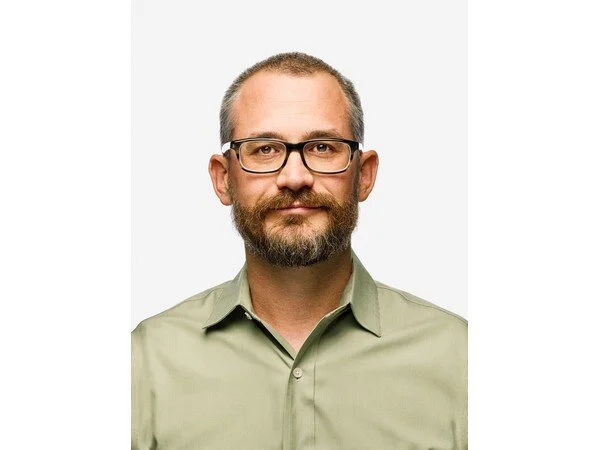
Dr. Nate Storey, co-founder and chief science officer
“I expect that even after COVID, we will see these trends continuing. Once people really get used to eating fresh products, especially ours which are consistently good, it will be very hard for them to go back to old habits. COVID is helping us re-examine our values,” says Nate.
With respect to consumer trends in 2021, Plenty expects an extension of trends that emerged in 2020, namely the increasing number of people who are exploring home cooking options, which has also fostered an awareness of high-quality ingredients. According to Nate, “when home cooking, it doesn’t take long to really start valuing high-quality ingredients. So I think that we’ll see a growth in the quality-focused parts of the produce industry. I think that we’re going to see a trend towards boosting immune health and creating snackable products, as people begin to incorporate more produce into snacks.”
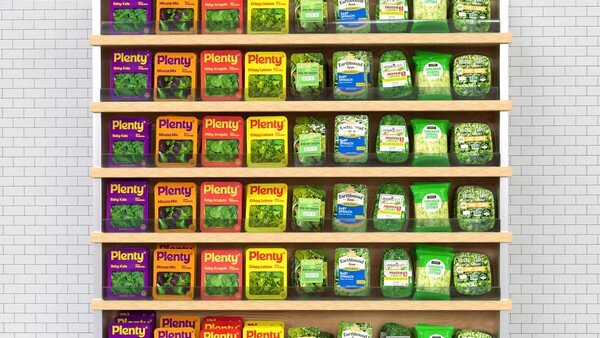
Plenty's recently launched product packaging
As such, quality is of the utmost importance to Plenty. The company approaches quality from three main angles, one being the real value of the product. As Nate explains, ensuring real value of their products means a commitment to offering consumers an attractive product whose packaging attracts consumers and preserves the product as long as possible.
“We ask ourselves: how can we give people three weeks, a month or as much time as possible? Hopefully, the product is consumed within a few days but for people who are watching their budgets, knowing that the product will last improves the value of the product,” says Nate.
More importantly, the company is focused on the quality of the greens themselves. Through careful varietal selection and precise control of the growing environment, Plenty produces greens with the best loft, consistency, texture and nutritional quality. The company’s third approach to quality, according to Nate, is its commitment to delivering a consistent product every day of the week. This consistent production, a major advantage of indoor farming overall, allows growers to eliminate seasonality so that consumers can count on the greens’ quality at any time of the year.
Propagation space in Plenty's San Francisco farm
Plenty’s commitment to the highest quality standards is reflected in the company’s mission, which is the provision of fresh, healthy food to people all over the world. As Nate explains, field-based agriculture currently produces only 30% of the global population’s needs for a healthy diet.
“We’re in the business of figuring out how we produce massive amounts of produce for consumers and make sure that they can supplement their diets with enough fruits and vegetables. Vertical farming and Plenty works to fill the void between 30% of what the world needs and 100% of what the world needs,” says Nate.
Plenty is also addressing consumers’ desire for sustainably produced fruits and vegetables by constantly working to improve water, space and energy use efficiency. Aside from environmental sustainability, the company strives for social sustainability by working to integrate itself into the communities where the farms are located by creating jobs and becoming a part of the local food system and culture.

For more information:
Plenty
Lizi Sprague
lizi@spronguepr.com
www.plenty.ag
Source: Publication date: Fri 12 Feb 2021
Source: Author: Rebekka Boekhout
© VerticalFarmDaily.com

AeroFarms Hires These New Executives
Newark, N.J.-based AeroFarms has hired several executives from companies such as Google, Earthbound Farm, PepsiCo, Kraft, Campbell’s Soup Co., and Tata Consumer Products
By AMY SOWDER
February 11, 2021
Newark, N.J.-based AeroFarms has hired several executives from companies such as Google, Earthbound Farm, PepsiCo, Kraft, Campbell’s Soup Co., and Tata Consumer Products.
Most recently, Dane Almassy joined the company as vice president of sales, according to a news release.
Almassy has more than 20 years of experience including time at Earthbound Farm, Aurora Organic Dairy, and PepsiCo.
Since 2004, AeroFarms has been working in not only vertical, aeroponic farming, but other aspects of agriculture, from genetics to post-harvest. The company’s more than 850 crop varieties can extend beyond food uses to pharmaceutical, cosmeceutical, and nutraceutical.
AeroFarms has been in major expansion mode with major announcements in 2020:
The build-out of a large research and development indoor vertical farm in Abu Dhabi in the United Arab Emirates;
Launch of the municipal indoor vertical farming program in Jersey City, N.J.; and
The World Economic Forum Healthy Communities and Cities initiative.
To help meet this growth, AeroFarms has made other key hires.
Andreas Sokollek, Stacy Kimmel, Ph.D., and MaryAlice Feinstein joined AeroFarms more than a year ago as chief operating officer, vice president of research and development, and chief people officer respectively, and Mark Boyland joined the summer of 2020 as general counsel.
“These key executive hires, each with deep industry expertise, have been helping us further capitalize on opportunities around the world as we continue to scale and build out our incredible culture and team, all aligned around our mission of growing the best plants possible for the betterment of humanity,” co-founder and CEO David Rosenberg said in the release.
Also, AeroFarms added in 2020 to its board of directors James “Jim” C. Borel, who has more than 40 years of experience in the global agriculture and food industry, including executive vice president and member of the DuPont Office of the Chief Executive.
Lead photo: AeroFarms hires several top executives. - (File photo courtesy AeroFarms)

These 2 Companies Are Putting Big Money Into Hawaii’s Agricultural Future. Will Their Bets Pay Off?
A pair of companies backed by a billionaire and a pension fund are trying to revitalize fallow farmland in the state
A pair of companies backed by a billionaire and a pension fund are trying to revitalize fallow farmland in the state.
02-15-21
On Lanai, where shreds of black plastic in the soil are the last vestiges of the island’s defunct pineapple fields, a sliver of long-abandoned farmland is getting an encore — and a reinvention.
In six high-tech greenhouses, a futuristic vision of food-growing is underway — one in which nutrient density and flavor are automated.
It doesn’t matter that the red dirt below the greenhouse is eroded or peppered with plastic that once served as Dole pineapple plantation’s weed control. In fact, the hydroponic tomatoes and leafy greens grown here by Sensei Ag don’t depend on soil at all.
The ag-tech company founded by Larry Ellison, the Oracle founder who owns nearly all of Lanai’s acreage, and Dr. David Agus, a physician, and medical researcher, is pioneering tools to produce affordable food in places like Lanai that — despite its history as an agricultural plantation — lack traditional farming essentials like water and fertile soil.
Sensei Farms Lanai, a two-acre indoor farming pilot project by Larry Ellison’s Sensei Ag, produced 35,000 pounds of produce in less than three months last year. Sensei Ag
In doing so, the company is redeploying a scrap of neglected farmland into active agriculture in an attempt to buck an unsettling trend: Hawaii imports more than 85% of its food.
Hawaii has tens of thousands of acres of fallow former sugar and pineapple plantation lands. There are many reasons why this land isn’t being used for farming — inadequate infrastructure, soil erosion, the sky-high price of agricultural real estate. All of these challenges and more make growing food on old plantation acreage unaffordable for most farming operations.
Putting more of this stagnant acreage into food production, however, is a worthwhile goal, experts say, because it could help the state wean itself off of a reliance on the cargo ships and planes that deliver food supplies to the islands.
“When you bring up Hawaii to anyone anywhere on earth, what they think of is paradise on earth,” said Vincent Mina, president of the Maui Farmers Union United. “But what paradise do you know of that brings in 85% of its food?”
State Efforts Have Fallen Short
Re-fashioning former sugar and pineapple plantations into viable food farms is what the Hawaii Agribusiness Development Corp. was designed to do.
However, a scathing state audit in January said that the 25-year-old state agency has so far failed its mission because “the economic void created when plantations ceased production remains mostly unfilled.”
Larry Jefts, one of the state’s largest produce producers, recently expanded his farm footprint with access to ADC lands in Central Oahu that had lain fallow since Del Monte stopped pineapple production nearly two decades ago.
The problem, according to Jefts, is not that the ADC is inert. It’s the state’s poor land use policy that has allowed some farmland to be developed, as well as society’s lack of commitment to local agriculture.
The Agribusiness Development Corp. has failed in its mission to reinvent Hawaii’s agricultural sector, two recent reports say. Office of the Auditor
“The problem is there’s no will here,” Jefts said. “Good farm ground is coming out to go into solar energy farms because the people who own it can make more money in solar. If they charged that much money to the farmers, the farmers would fail and imported foods would take over.”
Yet while Jefts is farming on a portion of the 1,200-acre Whitmore Project — land left vacant by Del Monte in 2004 and then acquired by the ADC for local agriculture in 2012 — hundreds of acres attached to the project remain fallow almost 10 years later.
That’s in part due to the time-intensive, bureaucratic process of securing money, permits, and contracts to build and repair the infrastructure required to make more of the acreage farmable, said Sen. Donovan Dela Cruz, a champion of the project.
It’s one thing to acquire the land, he said. But it’s another challenge entirely to ready it for farmers who need water, roads, electricity for refrigeration, and food safety-compliant facilities in order to make their businesses financially viable.
“With our state, there’s so many good intentions but just no money to put through to implementation,” said Kirsten Oleson, associate professor of ecological economics at the University of Hawaii College of Tropical Agriculture and Human Resources.
“If we’re serious about doubling production of food that is grown and eaten here, it would take some time to rethink policy and some pretty large and potentially risky investment that the state’s coffers don’t have.”
While state efforts flounder, a pair of new agriculture companies backed by a billionaire and a pension fund are stepping in with lofty goals to revitalize fallow farmland with diversified agriculture operations that aim to help Hawaii wean itself off of imported foods.
A Billionaire’s Bid To Boost Food Security
On Lanai, Sensei Ag is sidestepping many of the traditional high-yield farming requirements: lots of land, lots of water, lots of hard manual labor.
Founded by Oracle billionaire Larry Ellison, left, and medical researcher David Agus, Sensei Ag’s goal is to grow food that is more sustainable and nourishing than if it were farmed traditionally.
Sensei Ag
Although the company’s two-acre greenhouse farm is just a scrap of the 20,000 farmed acres that earned Lanai the moniker of the world’s largest pineapple plantation, yields from hydroponics can be far greater than those from conventional soil farming.
Sensei Ag CEO Sonia Lo projects the company will harvest 500,000 pounds of food for statewide consumption in 2021, including Swiss chard, basil, tomatoes, cucumber and eggplant.
“What we’re doing is we’re competing against the likes of Organic Girl that’s coming in from California or Earthbound Farms,” Lo said. “It’s pretty straightforward given that our stuff is a day old or two days old by the time it gets on a shelf as opposed to two weeks or three weeks old.”
Hydroponic growing is capital-intensive, however. Sensei Ag’s approach benefits from the fact that it’s bankrolled by Ellison, one of the richest people in the world.
Lo declined to reveal the amount of financial investment it took for the Lanai pilot project to achieve its inaugural harvest last October, but she acknowledged the role of Ellison’s wealth.
Yet while the cost to build a state-of-the-art greenhouse is out-of-reach for most farmers, indoor farming offers growers a chance to capture significant long-term financial savings since producing food this way requires significantly less land and water than traditional outdoor farming.
According to Lo, Sensei Farms Lanai requires about 10% of the amount of water it would take to produce a similar harvest in the dirt.
With this in mind, Sensei Ag’s mission includes efforts to make greenhouse farming more accessible. The company is aggregating risk assessment data in hopes that it will encourage banks to finance indoor growing mechanisms such as greenhouses and vertical farms. The company is also writing a playbook for people who want to build a successful indoor farm business, Lo said.
The rise of this kind of high-tech, high-yield farming could be a key to making Hawaii-farmed foods more competitive, according to Jesse Cooke, vice president of investments and analytics at the Ulupono Initiative.
“Using a hydroponic system, you could guarantee that every week you would have the same amount of quantity and the same quality (of produce) — and that’s what you need to sell to a large grocer,” Cooke said. “A lot of outdoor operations can’t guarantee that because they’re at the whim of nature itself.”
Brian Miyamoto, executive director of the Hawaii Farm Bureau Federation, agrees that indoor farming could be a game-changer — if Hawaii farmers can figure out how to raise enough capital to build the infrastructure without sabotaging future profits.
“We can grow a lot of things here in Hawaii as far as food products,” Miyamoto said. “What we struggle with is doing it competitively — that’s why we import so much.”
Hawaii can’t rely on billionaires to make the upfront investment in high-tech indoor farming, Oleson said. Rather, the state needs to follow in the footsteps of other countries that enacted public policies to encourage this kind of agriculture.
In places like Israel and the Netherlands, high-tech greenhouses are important food production tools, Oleson said.
Beyond policy and economics, Oleson said there are aesthetic and cultural considerations associated with scaling up indoor farming in the islands.
“You’re not looking across rolling green landscapes, you’re looking at lands with big infrastructure on it so there’s sometimes social pushback,” Oleson said. “I’m not a Native Hawaiian, but I would be very curious to know the response of the local community to that kind of agriculture because it’s very divorced from the earth.”
Will Mahi Pono’s ‘Serious Amount Of Money’ Pay Off?
On Maui, a partnership between a California farm management company and a Canadian pension fund is producing food on fallow land resulting from the 2016 closure of the state’s last sugar grower.
Since Mahi Pono bought 41,000 acres of Hawaiian Commercial & Sugar Co.’s former sugar cane fields in 2019, the company has begun growing some of Hawaii’s top food imports — potatoes and onions — in hopes of winning over some of that market share.
Mahi Pono’s mission to produce foods that Hawaii imports heavily and that are agriculturally possible to grow here is a smart one, according to Oleson. But she said it could be difficult for the company to compete with the price point for potatoes and onions imported from the mainland.
In 2016, Hawaii’s last remaining sugar grower shut down an operation that had run for 146 years. Now the 40,000 acres are owned by Mahi Pono, the marriage of a California farm management company and a Canadian pension fund. The company is growing produce with plans to reduce the state’s reliance on imports. Courtesy: Mahi Pono
It might also prove hard to convince consumers to pay more for locally grown potatoes and onions as opposed to more perishable produce.
“Potatoes and onions can sit on a boat and the quality doesn’t decline quite as fast, but all of us know what happens when you buy a box of spinach from Costco and if you don’t eat it that night it turns to slime,” Oleson said. “So the concern is growing foods locally where the freshness really matters.”
But Mahi Pono is growing more than just root vegetables. The company planted over a half million avocado and breadfruit trees, as well as rows of trees to shelter crops from the wind. The company plans to plant its 1 millionth tree by the end of June, according to community relations director Tiare Lawrence.
The company is also growing produce ranging from tangelos and finger limes to broccoli and eggplants, and it’s leasing affordable land and water to small farmers for an annual fee of $150 per acre.
Ultimately, Mahi Pono’s staple crops will be citrus, papaya, macadamia nuts, and coffee, Lawrence said.
And while the company is exporting papayas to Canada, and eventually plans to export coffee, macadamia nuts, and citrus to markets outside the state, the majority of the food produced by Mahi Pono will feed Hawaii’s people, Lawrence said.
“I personally think these lands can be brought into production,” Lawrence said. “We’ve seen it across Hawaii where farmers have been able to take former sugar and pineapple lands and turn it into a thriving farm and I refuse to entertain doomsday scenarios.”
Mahi Pono is growing red, yellow, and white potatoes with the goal of stealing away some of the Hawaii market share from mainland-grown potatoes. Courtesy: Mahi Pono
But the farm enterprise faces many challenges.
With an average wind speed of 30 miles per hour in the Central Maui plains, there are erosion issues, as well as crop damage from pests, deer, and pigs.
“We really can’t plant a field unless we fence it in, so that adds to our costs,” Lawrence said.
There’s also the problem of the former plantation’s aging, outdated infrastructure.
“Mahi Pono has spent a serious amount of money in updating the irrigation systems and making repairs to wells,” Lawrence said.
If Mahi Pono can surmount these challenges and find success, Cooke of Ulupono said the operation will be an example to follow.
“If they can get it up and running, that could be one of the hugest transformations that Hawaii has seen, especially going towards local food for local consumption,” Cooke said. “The worry is that it doesn’t work and somehow the land gets zoned residential and a housing development goes up.”
“Hawaii Grown” is funded in part by grants from the Ulupono Fund at the Hawaii Community Foundation, the Marisla Fund at the Hawaii Community Foundation, and the Frost Family Foundation.
Brittany Lyte is a reporter for Civil Beat. You can reach her by email at blyte@civilbeat.org or follow on Twitter at @blyte
Use the RSS feed to subscribe to Brittany Lyte's posts today

Vertical Farming At A Crossroads As Pandemic Shifts Focus To Fresh Produce
Getting the right business model to balance resource usage with socio-economic conditions is crucial to capturing new markets. Speakers will discuss the issues at the forthcoming Agri-TechE event on Thursday 25th February 2021
15-02-2021
Getting the right business model to balance resource usage with socio-economic conditions is crucial to capturing new markets. Speakers will discuss the issues at the forthcoming Agri-TechE event on Thursday 25th February 2021.
Although growing crops all year round with Controlled Environment Agriculture (CEA) has been proposed as a method to localize food production and increase resilience against extreme climate events, the efficiency and limitations of this strategy need to be evaluated for each location. Research by Luuk Graamans of Wageningen University & Research, a speaker at the upcoming Agri-TechE event on CEA, has revealed that integration with urban energy infrastructure can make vertical farms more viable.
“The pandemic has shifted the conversation to the global connectivity of countries, where people started questioning the sustainability and resilience of the international food network,” comments Luuk. “The big question is should countries or large cities (mainly) rely on imports to feed their citizens?
His research around the modeling of vertical farms shows that these systems are able to achieve higher resource use efficiencies, compared to more traditional food production, except for electricity. So, the vertical farm needs to offer additional benefits to off-set this increased energy use. One example his team has investigated is whether vertical farms could also provide heat.
“We investigated if vertical farms could provide not just food for people living in densely populated areas and also heat their homes using waste heat. We found that CEA can contribute to stabilizing the increasingly complex energy grid.”
This balance between complex factors both within the growing environment and the wider socio-economic conditions means that the rapidly growing CEA industry is beginning to diversify with different business models emerging.
Jack Farmer is CSO at LettUs Grow, the company has just launched its Drop & GrowTM growing units, which offer a complete farming solution, in a shipping container. He says that everyone in the vertical farming space is going to hit a crossroads, “Vertical farming, with its focus on higher value and higher density crops, is effectively a subset of the broader horticultural sector. All the players in the vertical farming space are facing a choice – to scale vertically and try to capture as much value in that specific space, or to diversify and take their technology expertise broader.”
LettUs Grow is focused on being the leading technology provider in containerized farming. Jack continues: “Drop & Grow:24, is primarily focused on people entering the horticultural space, and we expect it to be one of the most productive, ethical, and easy to use container farms on the market. This year is looking really exciting – supermarkets are investing to ensure a sustainable source of food production in the UK, which is what CEA provides. We’re also seeing a growth in ‘experiential’ food and retail and that’s also where we see our Drop & Grow container farm fitting in.”
Kate Hofman, CEO, GrowUp agrees, the company launched the UK’s first commercial-scale vertical farm in 2014. She comments: “It will be really interesting to see how the foodservice world recovers after lockdown – the rough numbers are that supermarket trade was up at least 11% in the last year – so retail still looks like a really good direction to go in. If we want to have an impact on the food system in the UK and change it for the better, we’re committed to partnering with those big retailers to help them deliver on their sustainability and values-driven goals.
“Our focus is very much as a salad grower that grows a fantastic product that everyone will want to buy. And we’re focusing on bringing down the cost of sustainable food, which means doing it at a big enough scale to gain the economies of production that are needed to be able to sell at everyday prices.”
The economics are an important part of the discussion. Recent investment in the sector has come from the Middle East, and other locations, where abundant solar power and scarce resources are driving interest in CEA. Luuk’s research has revealed a number of scenarios where CEA has a strong business case.
However, for the UK, CEA should be seen as a continuum from glasshouses to vertical farming. “Greenhouses can incorporate the technologies from vertical farms to increase climate control and to enhance their performance under specific climates.” Luuk continues.
It is this aspect that is grabbing the attention of conventional fresh produce growers in open field and covered crop production.
James Green is Director of Agriculture at G’s, one of Europe’s leading fresh produce growers. He explains: “There’s a balance in all of these systems between energy costs for lighting, energy costs for cooling, costs of nutrient supply, and then transportation and the supply and demand. At the end of the day, sunshine is pretty cheap and it comes up every day…
“I think a blended approach, where you’re getting as much benefit as you can from nature but you’re supplementing it and controlling the growth conditions, is what we are aiming for, rather than the fully artificially lit ‘vertical farming’.”
Luuk, Jack and Kate are to join a discussion with conventional vegetable producers, vertical farmers and technology providers at the Agri-TechE event “Controlled Environment Agriculture is growing up” 25th February 2021.
Find out more: agri-tech-e.co.uk/upcoming-events/
Agri-TechE is a business-focused membership organization, supporting the growth of a world-leading network of innovative farmers, producers, scientists, technologists, and entrepreneurs who share a vision of increasing the productivity, profitability, and sustainability of agriculture.
Together we aim to help turn challenges into business opportunities and facilitate mutually beneficial collaboration.
Agri-TechE

Why I Moved From California To Kansas To Grow Leafy Greens In All Seasons
Brad Fourby runs Leafy Green Farms LLC, a hydroponic shipping container farm in Pittsburg.
By Brad Fourby
January 9, 2021
The Kansas Reflector welcomes opinion pieces from writers who share our goal of widening the conversation about how public policies affect the day-to-day lives of people throughout our state. Brad Fourby runs Leafy Green Farms LLC, a hydroponic shipping container farm in Pittsburg.
Google Maps says the distance between Sacramento, California, and Pittsburg, Kansas, is 1,842 miles.
This year has been tough, with COVID shutdowns, a heart attack, bypass surgery, and the loss of a loved one. All of this slowed me down but did not stop me from leaving California and starting a year-round container farm that will provide Pittsburg with fresh leafy vegetables like lettuces, basils, and arugula.
Good nutrition starts with what is on your plate. Knowing where your food comes from and how it was grown is becoming more important to everyone.
While living in downtown Sacramento, I started Innovative Farms. I would build and help consult with others interested in aquaponics, growing fish and plants together in small places. Small towns have to wait and pay higher prices for food that has been grown and transported from California, China, Argentina, and other countries. The produce is picked early so that it may ripen in transit on ships or trucks while being treated with chemicals along the way.
Through this work, I met longtime Pittsburg residents Rob and Sara Morris, owners of Energy Group Consultants. They told me that Pittsburg and Crawford County were considered a food desert — like much of the Midwest, grocers in Crawford County import their food, while producers export what they grow, such as corn and soybeans.
I would visit the city a few times a year and got to know some of the people and businesses. I loved the vibe of the place.
Rob and Sara and I discussed increasing the farm-to-table opportunities in Pittsburg. We talked about container farming, using repurposed shipping containers that have been outfitted with computer-controlled vertical hydroponics. This highly efficient method requires no pesticides or herbicides to grow vegetables that can be harvested weekly regardless of the climate.
My previous experience with aquaponics reminded me of Freight Farms, a Boston farm manufacturer with a great track record of successful farms worldwide. Their farm design was expandable, and vegetables could grow in any weather condition.
I came up with the outline of a business plan. With three farms, my goal was to begin year-round harvests this winter in Pittsburg and support the farm-to-table lifestyle.
I began making phone calls to the city. Compared to the regulation and tax heavy California, Kansas felt welcoming to new business. I heard the term “agri-tourism,” and the idea of new agricultural developments directly helping the area was exciting for many people I spoke with.
The city planners loved the idea of a new business that supported other existing businesses like restaurants, grocers, and the farmers market community, many of them hurt by the COVID shutdowns.
Working with Pittsburg State University’s Small Business Development Center, I created a final business plan. Equity Bank signed on to assist with the Small Business Administration loan process.
So far it has been a real team effort. We really picked up steam after a call with Mike Green, Equity Bank’s small business banker. Turns out he grew up on a farm and instantly recognized the value the business would be to the entire area. We talked about how freshly picked non-chemically treated vegetables actually taste. The difference is night and day.
After that call I knew for sure Pittsburg would be the home of Leafy Green Farms.
The Kansas Healthy Food Initiative then stepped in and awarded the business $15,000 to assist with operating and equipment expenses. This kind of support was a real boost for everyone. KHFI and our farm goals are very much aligned.
It turned out that everyone agreed: Every Kansan should have access to healthy, affordable food.
The idea of more fresh food being produced in Pittsburg was something Live Well Crawford County director Brad Stroud told me he has been very supportive of. Joining their network has been a very positive experience.
We hope that by adding farms that are unique to the area that grows specialty crops, more people will visit the city and frequent some of the supporting businesses. We will take input from chefs and the community palate, and restaurants in the area will be able to offer menu items that their counterparts in large cities have no chance of offering. Our list of available herbs, roots, and vegetables is long and our variety is huge, with Firecracker Leaf Lettuce, Sylvesta Butterhead, and even Wasabi Arugula.
Sacramento County has around 1.5 million people, Crawford County 38,000. Many of my California friends and family are watching my move with great anticipation. When someone asks “Why Kansas?” my answer has remained the same since the beginning: Kansas is open for business.
Through its opinion section, the Kansas Reflector works to amplify the voices of people who are affected by public policies or excluded from public debate. Find information, including how to submit your own commentary, here.
Lead photo: A Freight Farms container on its way to a destination. (Submitted by Leafy Green Farms to Kansas Reflector)

USA: Wichita, Kansas - Fidelity Bank’s New ‘Car Park’ Adding Ground-Floor Restaurant, Rooftop Urban Farm
Called Rise Farms, it will include 5,000 square feet of space where fresh vegetables and herbs will be grown in raised beds, large planters, and a 24x70-foot long hoop house
Fidelity Bank is embarking on a $51 million project to build a 10-story tower next to its existing five-story headquarters at Main and English. It also plans a new 505-stall parking garage. BY JAIME GREEN
The ground level of Fidelity Bank’s new five-story “car park” on Market between Waterman and English will soon have a new 4,000-square-foot restaurant on its main level.
And that’s not even the biggest news to come out of the project this week.
In addition to the restaurant — which Fidelity isn’t ready to share details about quite yet — the new parking garage will also be home to a rooftop urban farm that bank officials say will be the largest in the Midwest.
Called Rise Farms, it will include 5,000 square feet of space where fresh vegetables and herbs will be grown in raised beds, large planters, and a 24x70-foot long hoop house. The food the farm produces will be used not only by the new ground-level restaurant tenant but also by other restaurants around Wichita. Fidelity Bank employees also will be beneficiaries of the produce, and the first crops should be ready by fall.
The rooftop project will include a private event center with retractable garage doors where Fidelity can house small events and gatherings during warm weather seasons as well as a 5,622 square-foot solar farm featuring 204 solar panels, which produce 380 watts each. The panels, which weigh about 35,000 pounds, are already up and running and producing enough energy to provide the power for the car park and its first-floor tenants.
A rendering of what Fidelity Bank’s rooftop Rise Farms will look like Courtesy FIDELITY BANK
The car park, which has 405 stalls, 24 electric car charging stations employees can use, and daytime public parking on the ground level, just opened and is the first part of a $51 million Fidelity Bank expansion project that also will include a new 10-story, 135,000 square-foot office tower at 100 E. English, where the bank’s parking deck is. Construction on that hasn’t started yet.
The idea for the rooftop farm came about after Fidelity polled its employees about what types of tenants they would like to see move into the 17,000 square feet of retail space on the car park’s ground level, said Aaron Bastian, Fidelity’s president, and CEO. Overwhelmingly, they said they’d want a restaurant.
In the course of meeting with potential restaurant tenants, Bastian said, one suggested the idea of raising fresh produce on the roof.
Bastian, who said that local food culture is a topic he’s passionate about, liked the idea, but bank leadership decided they’d need to consult with an expert to pull it off.
“When we started talking about this idea, we wanted to go out and find people we could partner with to help create what we think could really be a cool downtown amenity,” Bastian said.
Fidelity has since partnered with Leah Dannar-Garcia, the owner of Firefly Farm at West 21st Street North and North 159th Street East, who already raises produce that she sells to about 38 Wichita restaurants. She’ll be in charge of the farm and will offer its produce for sale to restaurants on her route. The ground-floor restaurant, though, will get first dibs.
Fidelity Bank’s new car park in downtown Wichita just opened to employees. By fall, it will have a ground-floor restaurant and a rooftop farm. Courtesy FIDELITY BANK
Dannar-Garcia has been working with the bank for about a year, she said and has mapped out her growing plans in detail. Once it gets going, she’ll have plants growing in beds and containers along both the north and west sides of the building as well as in the climate-controlled hoop house. The bank envisions a program in which Fidelity employees will be able to volunteer to work the farm, and they’ll also set up some type of program where employees can get boxes of fresh produce to take home.
Once it’s fully functioning, the farm will produce vegetables like beets, carrots, broccoli, cauliflower, sweet potatoes, and Brussels sprouts as well as greens like arugula, Swiss chard, and spinach. It’ll also grow herbs, including parsley, cilantro, and Greek oregano.
“We’re going to grow in all four seasons on this farm, so we’ll have spring, summer, fall, and winter crops,” Dannar-Garcia said.
The project is a “natural extension” of the bank’s health, wellness, and green initiatives, it says. One goal of the farm is that it produces zero wasted food.
“Whether that means it gets donated, we haven’t defined that yet,” said Melissa Knoeber, executive vice president at Fidelity who is also the bank’s director of culture and talent. “But that’s really important to us.”
Construction on Rise Farms should start in the spring, and the first crops should be ready by fall.

COURTESY FIDELITY BANK
DENISE NEIL
316-268-6327
Denise Neil has covered restaurants and entertainment since 1997. Her Dining with Denise Facebook page is the go-to place for diners to get information about local restaurants. She’s a regular judge at local food competitions and speaks to groups all over Wichita about dining.

Indoor Ag-Con To Change Dates, Location For 2021
The Indoor Ag-Con team is currently gathering feedback from its board and monitoring leading sources of health information to secure a fall date pattern and convenient venue that ensures a safe, cost-effective show
Co-Location With The NGA Show Shifts To 2022 Edition

Press Release — With safety in mind, the Indoor Ag-Con management team has made the decision to push the dates for its previously announced May 16-18, 2021 agriculture trade show and conference for the indoor and vertical farming industry to the third quarter of 2021. The decision is in keeping with The NGA Show | National Grocers Association decision to shift its show — which was previously scheduled to run concurrently at Caesars Forum in Las Vegas — to the third quarter as well. While venue and space limitations in the Las Vegas marketplace prevent co-location for this later time frame in 2021, the two events will come together in 2022.
The Indoor Ag-Con team is currently gathering feedback from its board and monitoring leading sources of health information to secure a fall date pattern and convenient venue that ensures a safe, cost-effective show. The new 2021 dates and location will be announced shortly.
“The safety of the indoor ag community is our top priority,” explains Brian Sullivan, co-owner, Indoor Ag-Con. “By moving our event to a Fall 2021 pattern, we’ll be better aligned with the expanding Covid-19 vaccine rollout and growing confidence levels in travel and attendance at live events. And, looking ahead to 2022, we’re excited to renew our plans to co-locate with The NGA Show and give our audience the incredible opportunity to connect with supermarket and food retail industry professionals.”
“We were very much looking forward to co-locating The NGA Show with Indoor Ag-Con this year and celebrating the synergy between the two events,” said Courtney Muller, chief corporate development and strategy officer with Clarion Events North America. “Delivering a cross-over resource to help retailers partner with growers in a new way to address supply chain challenges, transparency in food sourcing, and meeting consumer demand will only grow in value until we are able to co-locate the two events in 2022.”
For 2022, Indoor Ag-Con and The NGA Show will co-locate at Caesars Forum Convention Center in Las Vegas , February 27 – March 1, 2022. The NGA Show 2021 edition will be held September 19-21 at Paris Hotel Casino, Las Vegas, NV.
Indoor Ag-Con, launched in 2013, provides exhibitors and attendees with the latest technology and business strategies for growing crops in indoor systems, using hydroponic, aeroponic, and aquaponic techniques, bringing together growers, investors, chefs, produce buyers, academics, policymakers, industry suppliers and advocates. The 2021 edition will feature an expanded exhibit floor, new networking opportunities, and some of the industry’s top innovators and business leaders presenting keynote addresses and participating in a range of panel discussions.
About Indoor Ag-Con
Founded in 2013, Indoor Ag-Con has emerged as the premier trade event for vertical farming | indoor agriculture, the practice of growing crops in indoor systems, using hydroponic, aquaponic and aeroponic techniques. Its events are crop-agnostic and touch all sectors of the business, covering produce, legal cannabis |hemp, alternate protein and non-food crops. In December 2018, three event industry professionals – Nancy Hallberg, Kris Sieradzki and Brian Sullivan – acquired Indoor Ag-Con LLC, setting the stage for further expansion of the events globally. More information is at https://indoor.ag.
About The National Grocers Association
The National Grocers Association (NGA) is the national trade association representing the retail and wholesale grocers that comprise the independent sector of the food distribution industry. An independent retailer is a privately owned or controlled food retail company operating a variety of formats. The independent grocery sector is accountable for close to one percent of the nation’s overall economy and is responsible for generating $131 billion in sales, 944,000 jobs, $30 billion in wages and $27 billion in taxes. NGA members include retail and wholesale grocers, state grocers’ associations, as well as manufacturers and service suppliers. For more information about NGA, visit www.nationalgrocers.org.
About Clarion Events
Clarion Events (www.US.ClarionEvents.com) produces 37 events across 13 sectors of both trade and consumer events. Clarion Events, which is the U.S. division of Clarion Events UK and backed by The Blackstone Group, has become one of the fastest-growing event companies in the U.S. with aggressive growth through both acquisition and launch. Clarion acquired PennWell in early 2018, bringing four Tradeshow 200 events into the U.S. portfolio and supercharging the already rapid growth. Clarion Events has offices in Trumbull, Conn.; Kennesaw, Ga.; Boca Raton, Fla.; Tacoma, Wash., and Fairlawn, N.J. www.US.ClarionEvents.com

Farmland Asset Class Holds Strong During Volatile Year; Learn More At Global AgInvesting Events
Global AgInvesting (GAI) will host the preeminent community of agriculture investment stakeholders at a special edition of its flagship U.S. gathering on 13-15 July 2021 at the prestigious Sleepy Hollow Country Club here, just an hour north of NYC
NEW YORK (January 29, 2021) – Global AgInvesting (GAI) will host the preeminent community of agriculture investment stakeholders at a special edition of its flagship U.S. gathering on 13-15 July 2021 at the prestigious Sleepy Hollow Country Club here, just an hour north of NYC. Uncompromising industry-leading content and networking opportunities will be presented in-person while providing extra precautions for safety at this all-outdoor event.
“Through an unprecedented year of challenges across all businesses, farmland investing stayed resilient and gained greater recognition from institutional investors,” said Kate Westfall, COO of GAI for HighQuest Group, the parent company of Global AgInvesting. “And our global GAI community did not waver in its commitment to advancements and investments in the burgeoning sector during a year of virtual events. We are, however, very excited about coming together again this summer in a unique and safe way.”
The conference agenda will provide insight into agriculture as an impact investment, key in on sustainable strategies in the sector such as opportunities in regenerative agriculture and carbon capture, and highlight the value of investing in the stability of ag, as evidenced by NCREIF, the National Council of Real Estate Investment Fiduciaries (NCREIF) Farmland Index, numbers.
For the first quarter of 2020, NCREIF cited total returns that were down -0.10 percent – the first negative total return for the Index in nearly 20 years. While this might not seem inspiring at first glance, when compared with other indices, it highlights the strength of farmland as an asset class. For example, the Dow Jones Industrial Average finished Q1 having fallen by more than 23 percent, the Russell 3000 Index fell by 20.9 percent for the quarter and the S&P 500 posted a total return for Q1 of -19.60 percent.
“These factors are not unnoticed by institutions who are increasingly focused on stability in their investment portfolios,” said Westfall. “As the food and ag community comes together to find sustainable solutions through ESG initiatives and a commitment to natural capital, we expect to see growing allocations to agriculture as an asset class. GAI will continue to be the source for unrivaled networking and education in the sector, both through our annual conferences and year-round webinars.”
The GAI Community also will gather later this year for Global AgInvesting Asia, 28-29 October in Tokyo, and Global AgInvesting Europe in London, 6-7 December.
Register here for Global AgInvesting in New York, or here for the latest complimentary webinar, or to view any of the nearly 20 previous webinars on topics such as carbon markets, investing in Australian agriculture, COVID-19 and the impact on the agricultural sector, supply chain disruptions and the latest Global AgInvesting Rankings & Trends Report.
Connect with us on LinkedIn, Twitter or Facebook.
# # #
Global AgInvesting, a brand of HighQuest Group, is the world’s most well attended agricultural investment conference series and leading resource for news and insight into the global agricultural sector. www.globalaginvesting.com

A New White House Signals New Opportunities For AgTech Startups. Are We Up For The Challenge?
A radical new approach is needed, and startups have the agility to bring new technology to market at the pace which is required. So, are we up to the challenge?
February 9, 2021
Editor’s note: Ponsi Trivisvavet is CEO at Inari, a seed genetics startup based in Cambridge, Massachusetts. The views expressed in this guest article are the author’s own and do not necessarily represent those of AFN.
Much has been analyzed and debated as the new administration enters the White House, but President Joe Biden has made a number of appointments that clearly illustrate his commitment to addressing climate change and the critical role science will play.
He has elevated the role of Science Advisor to a cabinet-level position. It will be filled by mathematician, geneticist, MIT professor, and founding director of the Broad Institute, Eric Lander.
Biden has also created a new White House Office of Climate Policy. And one of his very first acts as president was signing executive orders to enable the US to rejoin the international Paris Agreement on climate change mitigation.
It’s also clear that agriculture will play a major role, with Biden saying, “we see farmers making American agriculture first in the world to achieve net-zero emissions and gaining new sources of income in the process.”
Invest with Impact. Click here.
Secretary of Agriculture nominee Tom Vilsack, who looks set to return to the post he held during the Obama administration, has indicated that he will quickly ramp up programs to combat climate change.
Simply put, “expect administrative actions aplenty from a variety of USDA [US Department of Agriculture] agencies to combat climate change,” he said.
The time is right
The need couldn’t be more pressing, or more clear. 2020 was one of the hottest years on record, tied with 2016 .Carlo Buontempo, director of the EU’s Copernicus service, noted it is “no surprise that the last decade was the warmest on record, and is yet another reminder of the urgency of ambitious emissions reductions to prevent adverse climate impacts in the future.”
Research reported by ScienceNews projects global farmland will need to grow 3.4 million square kilometers – approximately the size of India – by 2050 to meet the needs of a growing population. But, as the article notes, an overhaul of the global food system could drastically reduce the need for land while still feeding the world’s ever-expanding population.
The need to address climate change is nothing new, but the new White House is signaling new opportunities for agriculture to lead the way with science and technology.
Agriculture has an impressive history: the technology of recent times has allowed food producers to keep pace with the spectacular growth in the population, with approximately 6 billion more mouths to feed in the last 60 years alone. But agriculture currently requires more resources than can be replaced. This is clearly not sustainable.
A radical new approach is needed, and startups have the agility to bring new technology to market at the pace which is required. So, are we up to the challenge?
Leading with technology
The problem to date isn’t a lack of desire to address these pressing environmental issues. Simply put, existing practices and technology cannot sustainably feed a world of 8 billion people.
There is a great deal of focus being put on soil, which is critical; but let’s not forget the seed. Everything we grow begins with a seed – it holds all of the potential and determines the resources needed to grow.
The seed technology on the market today is primarily focused on pest and weed management. This was critical in meeting the demands of the recent past and will certainly continue to be relevant as we move forward.
However, in our efforts to address these issues, we inadvertently reduced the diversity in major crops – one of nature’s best survival tools – by selecting for traits that best met the needs of the day.
So, how can we bring back biodiversity without sacrificing productivity or growing crops that require more resources?
By designing better seeds.
At Inari, our SEEDesign platform aims to take on this challenge with the ambitious goal of satisfying demand while enriching the environment. Through predictive design and advanced multiplex gene editing, we are developing seeds that generate a positive impact on the planet. This technology is capable of addressing any crop in any geography.
Advanced multiplex gene editing opens the door to new possibilities with seed because it can address very complex genetic challenges.
President Biden and the future of regenerative agriculture in the US – read more here
To make a significant impact on yield or dramatically improve a plant’s use of water, you have to make multiple changes within a single plant. Basic gene knockout is often too blunt of an editing tool to properly address all of the changes required. While you might need to knock out a gene in one part of the code, another might require only a slight adjustment; whereas another might need to be replaced altogether, all within the same seed.
These types of edits aren’t simple, but are possible with the right technology. By understanding the full potential of seed, we can unlock new possibilities and better address the specific needs of growers based on their land, creating more diversity in the seeds being planted.
It’s not that others have decided not to tackle these complex issues within a seed – it’s simply that the technology didn’t exist. As startups, this is where our agility comes into play. When you are small, it’s easier to be nimble and quickly pivot.
Value creation across the system
Despite historical advances, the people who grow our food have not always received their fair share of the value created by new technology. While Vilsack recently spoke of creating a “whole new suite of revenue streams” for farm income, it’s equally important to ensure value creation with new technology being brought to market.
Part of the struggle in the past is that regulatory hurdles associated with genetic modification of seeds added significant time and cost. This made it nearly impossible for anyone but the large industry players to compete. The added time and costs also played a role in driving competitive intellectual property and exclusivity strategies, which only contributed to further to cost.
Conversely, the regulatory environment for gene-editing technology in the US will enable a clear and efficient path to get the technologies in the hands of growers. This will also help to democratize the technology and let players of all sizes compete in the development of new solutions.
In order to ensure value creation across the food system, we’re going to have to work with the new White House to ensure clear paths to market. This will encourage competition at every level and bring more viable solutions to growers.
In sharing value creation with farmers, we not only protect their income, but allow their communities to benefit as well.
Making agriculture the climate hero
With clear signals from the Biden administration, now is the time for startups to show our leadership with truly innovative solutions.
Many of us have dedicated our work to finding more sustainable solutions for agriculture. We have been asking for the opportunity to show how agriculture can mitigate climate change and we’ve seen a number of organizations roll-out ‘net zero’ commitments. This is a great start.
I challenge my fellow agtech leaders – especially those in the startup space – to work towards a shared goal of positively impacting the environment with the technology we bring forward. We know our organizations are best suited to move at the speed which is required to meet the challenges ahead. Let’s work in cooperation to address the needs of our industry and the planet.
So, are we up for the challenge?
I believe we are.

WIA Summit Europe Agenda Announced
Take your place at the virtual Women in Agribusiness Summit Europe where we celebrate women’s expertise in the Ag industry and find solutions to tipping the scales toward parity
International Women’s Day marks a call to action for accelerating women's equality. Take your place at the virtual Women in Agribusiness Summit Europe where we celebrate women’s expertise in the Ag industry and find solutions to tipping the scales toward parity.
Sessions And Interactive Workshops Include:


Farming Goes Indoors
THE pandemic has shone a light on many of the gaps that exist in the country’s economy. And one of these is the need for better food security, an issue that resonated with Gerard Lim long before Covid-19
By JOY LEE
06 Feb 2021
Beyond profits: Lim, seen here briefing an investor, says the company is also looking at creating new high-valued jobs and generate income for local communities.
THE pandemic has shone a light on many of the gaps that exist in the country’s economy. And one of these is the need for better food security, an issue that resonated with Gerard Lim long before Covid-19.
Many years ago, he started noticing that most of the vegetables sold in local supermarkets and grocers were not necessarily the best of quality as top-grade vegetables grown here were mainly exported. That means locals were consuming lower grade vegetables.
Additionally, a lot of the vegetables that can be grown in Malaysia were, in fact, imported.
Lim wasn’t a farmer but he knew that technology could help boost quality production for local consumption and improve the local supply chain for vegetables.
“My exposure and experience with farming started about five years ago when I introduced smart farming solutions using sensors, the Internet of Things, and Big Data to various farmers. But I found that many farmers in Malaysia were smallholders who could not afford the technology.
“I knew that if I wanted to move the needle, I had to adopt the technology and build large commercial scale, industrial-grade farms to achieve better economies of scale.
“What was compelling to me was that I was not alone in wanting better quality food and vegetables. There was a ready and strong demand from friends and contacts who wanted the same good quality, clean and fresh vegetables, ” he points out.
Lim has vast experience with tech startups and had previously served in the Malaysian Communications and Multimedia Commission (MCMC).
When he left the regulatory body last year, the time seemed right to embark on a venture that would focus on scaling up smart farming. And with the Covid-19 pandemic ongoing, it became even more evident that there was a need to grow food and vegetables closer to where they are consumed.
He founded Agroz Group Sdn Bhd, an agritech and indoor vertical farming company, to simplify the distribution supply chain of vegetables while reducing the long- and mid-haul transport of vegetables from far away farms. This is done by establishing indoor vertical farms to grow vegetables in local neighbourhoods instead.
Lim is targeting to build 100,000 sq ft of indoor vertical farms in Malaysia this year to make Agroz the largest indoor vertical farm operator in Malaysia.
While it should seem like a no-brainer to support a move into the agriculture industry at a time like this, Lim notes that it is not all straightforward. A lot of stakeholders do not understand that smart farming is different from traditional farms.
“Malaysia does not have policies to support the use of advanced technologies for smart farming, urban farming and indoor vertical farming. So, existing special grants, incentives and loans are provided for the use of chemical fertilisers and pesticides for traditional farming but there are no grants, incentives and loans for the use of technology in smart farming, ” he says.
This makes it a challenge for the company to access ongoing assistance for the agriculture industry.
The lack of policy support and guidelines also make it difficult for them to get funding from financial institutions. Lim says most banks in Malaysia were not particularly supportive of indoor vertical farming as they do not understand these new modern, high-tech forms of farming.
Agroz is currently seeking to raise RM100mil through the issuance of redeemable convertible preference shares to fund its expansion.
Lim says the company has drawn interest from several investors, both local and foreign, and they are in the midst of evaluating some of these offers. He is, however, open to any other interest.
To sweeten the deal for potential investors, Lim is looking at exit plans in five years’ time, either through an initial public offering or via a trade sale to a special purpose acquisition company.
At the moment, Agroz has a small farm in Seri Kembangan, Selangor. It is in the midst of building a 3,000 sq ft farm in Sg Buloh and upgrading a commercial-scale indoor vertical farm in Shah Alam to 90,000 sq ft.
Lim believes Agroz’s indoor vertical farms will complement traditional farming.
“Customers who demand for higher quality will prefer to buy their vegetables from sources like Agroz, which delivers clean, fresh and quality vegetables from farms that you can see and are located within your neighbourhood.
“At the same time, we need to recognise that the market is huge with Malaysia importing over RM5bil worth of vegetables in 2019 alone. And this number is increasing.
“So it will take an entire industry of indoor vertical farmers to grow clean and fresh vegetables in farms within the city before we even make a dent in the traditional agriculture space. Taking even a 10% share, which is only RM500mil, of the multi-billion ringgit market would take some time, ” he says.
However, its efforts, and perhaps that of many other budding agritech companies that have popped up in recent times, are moving in the right direction.
Lim points out that Malaysia ranks 28th on the 2019 Global Food Security (GFS) Index, according to the Economist Group. Singapore, on the other hand, which hardly produces its own food, has topped the index two years in a row, in 2018 and 2019.
A myriad of advanced technologies to ensure that the methods and approach of growing food is repeatable, scalable and traceable to feed a growing population is key to achieving better sufficiency to meet domestic demands.
“We also aim to create hundreds of new high-valued jobs and generate income in our local communities heading into this post-Covid-19 era, ” Lim says.
In some countries, green jobs have been mulled over as a potential area to generate jobs to help with economic recovery. This could also be a space that policymakers could explore further.
Currently, Agroz’s produce is sold directly to consumers through a subscription programme and also supplied to neighbourhood grocers, eateries, restaurants and the hospitality industry.
The company is already growing 200kg of produce per month and will soon have the capacity to grow 1 tonne per day from the various farms already committed.
Once its 100,000 sq ft of indoor vertical farms is achieved, it is expected to produce 3 tonnes of vegetables every day.
Agroz has a current order book of RM5mil to license its technology including supply of its indoor vertical farm systems to warehouses and land asset owners as well as through supply of vegetable products to consumers and businesses. Lim says its got more orders in the pipeline.
TAGS / KEYWORDS:SME , Startup , Indoor Farming , Agroz ,
TOPIC: Corporate News SME

How Vertical Farming Is Taking Off
Food supply chains are under more scrutiny than ever in the era of coronavirus and Brexit. The vertical farming movement offers solutions to some of the biggest challenges facing agriculture today
By George Nott
5 February 2021
Food supply chains are under more scrutiny than ever in the era of coronavirus and Brexit. The vertical farming movement offers solutions to some of the biggest challenges facing agriculture today
This feature is the first in a two-part series on the future of farming
Michiel Peters has been fielding some frantic calls in recent weeks. “People are saying, ‘You have to come now! We’re sorry we didn’t call you a year earlier!’” the CEO of vertical farming company PlantLab reports.
It seems vertical farming has reached a tipping point. For a long time, any consideration of the method soon ended with unit economics. But the price of produce has been rapidly falling – to the point that it’s now beginning to compete with traditional farms. And the unique advantages of vertical farming are suddenly coming into sharp relief for manufacturers, suppliers and retailers. So much so that the sector is preparing for a huge boom in interest and investment.
Indeed, demand is so heightened that Peters and his peers are having to turn potential customers away. Could now be vertical farming’s big moment?
“It’s not really a question of ‘if’ anymore. It’s going to happen,” Peters says. “And it’s already happening. It’s a matter of scaling up now.”
The benefits lie in the vertical farming method. Produce is grown indoors under LED lights, with a plant’s roots typically suspended in nutrient-rich water or mist. Temperature, humidity and light is carefully regulated within the sealed environment, and more plants can be packed into a space, on racks that can be seven storeys high.
While yield per square metre, low water consumption and lack of soil or pesticides have long been touted as the method’s main selling points, another one is becoming increasingly important: a guaranteed, year-round supply situated right where it is needed.
“On a small island or in remote locations, vertical farms can have a tremendous impact on food supply, especially in Covid times,” says Peters. “The food chain is typically very long and sensitive. When things break down, people realise their security of supply is not always a given.”
“It’s not really a question of ‘if’ any more. It’s going to happen. It’s a matter of scaling up now”
That’s not to say vertical farming businesses have been immune from the effects of the pandemic. The construction of Amsterdam-based PlantLab’s second overseas site in the Bahamas is being thwarted by current travel restrictions, for example. But Covid, and the disruption it has wreaked on global supply chains, is ultimately helping the sector make its case.
“There’s huge interest from island economies, hot economies and countries that have a higher propensity to import and have less arable land,” says Jamie Burrows, CEO of London-based Vertical Future. “From Iceland to Singapore, they all have very similar requirements.”
Plus, the pandemic isn’t the only threat to imports, Burrows adds. “If you import a lot of food, climate change is going to impact the countries that are producing that food for you. Even now, there have been pretty significant inflections in price on shelves and availability because of small fluctuations in temperature during the key growing seasons,” he explains.
And there is yet another factor that is throwing vertical farming into the spotlight in the UK, specifically: Brexit. That’s not just down to the immediate effect of imports disruption. The local produce sector remains riddled with uncertainty over access to the many seasonal workers that used to come from the EU, with a potential labour crisis looming.
Indoor farms, which are typically highly automated, require far fewer people to run. Furthermore, with constant harvesting, a small and constant rather than large and seasonal workforce is needed.
The yield and potential of vertical farming
The market opportunity for vertical farms is huge. Barclays Research analysts estimate the size of the global fruit & vegetable market is roughly $1.2tn (£800bn), and calculate that the addressable produce market for vertical farms is closer to $700bn (£513bn), leading to an approximately $50bn (£36.7bn) market opportunity. Plus, vertical farming boasts some environmental benefits, as produce requires less water and space to grow

Jones Food Company’s Scunthorpe vertical farm is a prime example. It has 26 tennis courts of growing space, operating 365 days a year – with a staff of six.
“Imagine if you have next to no labour in a farm that big. One of your largest costs is one you can really attack,” says James Lloyd-Jones, JFC CEO, and founder.
As a bonus, businesses such as JFC can boast lower carbon emissions than outdoor farms. While energy-intensive – to make up for the lack of natural sunlight – sector argues overall carbon savings are made when indoor farms are positioned close to where produce is needed, drastically reducing food miles.
Furthermore, Peters says, “if you make the chain radically short, you don’t need to waste so much of the harvest. You can avoid it altogether.”
This element could be particularly important to retailers with ambitious carbon commitments. “Retailers are being asked more questions than they’d probably like about carbon. You can’t just fudge it any more,” says Lloyd-Jones.
It’s not all plain sailing, though. There are some major hurdles for the sector to overcome – chiefly, the huge capex needed to build an indoor farm. Because of this, many vertical farming companies, whose main interest is in providing the technology for the farms to function, are becoming farm operators and even consumer brands.
PlantLab launched its first US production site – or ‘Plant Paradise’ – in December, within a former battery factory near Indianapolis city centre.
Having spent some time “working in relative silence” on the technology, PlantLab is now a site developer and operator. Local partners distribute and brand the end product into local supermarkets. As patent holder for its indoor farming tech in 74 countries, it is also in talks with major players about licensing the IP. But, adds Peters: “We’ve started this company to change the world, not just sit behind a desk and talk about licenses.”
It helps that PlantLab can point to the success of its own farms. Because building farms yourself is necessary to prove the technology and economics, says Lloyd-Jones. “There’s a lot of vertical farming companies that are tech companies, but they don’t grow anything so the person buying is the guinea pig,” he says.
For his part, he’s looking to refine the JFC concept further before embarking on a licensing model. The company already has plenty of expertise. Ocado-backed JFC is Europe’s largest vertical high-care farming operation, its 5,000 sq m facility stacking up 12 metres high with more than 17 layers of produce. But it will go one step further with its two new sites in the Midlands and the south west, due to open by the end of this year.
They will be more technologically advanced – “it’s like we built the first iPhone in Scunthorpe. We’ve jumped to making the iPhone 8,” Lloyd-Jones says – and will provide enough produce to meet 25% of UK demand for herbs.
The end goal is to develop a “cookie cutter” vertical farm that can be quickly and cheaply built wherever needed. “Once we’re happy with that we’ll look at a licensing model where we build these facilities all round the world. But anyone building them will know they’ve been stressed, used and run at 100%,” he says.
The model for vertical farming firms then is likely to be akin to Ocado and Ocado Retail, where the latter proves the case for the former’s technology, which rivals then adopt.
So similar, in fact, that Ocado itself is looking to get involved. In February last year, it formed Infinite Acres – a joint venture with Netherlands-based automation tech provider Priva Holding BV and US-based 80 Acres Farms, a vertical farm operator and brand. Customers have two options. They can either partner with Infinite Acres to build their own farm, or they can have 80 Acres run a farm on their behalf using that same technology.
If companies get it right, the licensing model can be lucrative. See Vertical Future for proof. It has two farms in London, with three more being built, but the output of the farms is only a small part of the business. “We retain them to keep our finger on the pulse and customer trends and it validates what we’re doing,” says Burrows. “Ninety-five per cent or more of our revenue now is from technology sales and software.”
Funding flurry
That potential has prompted a flurry of investment in the sector, kicked off in 2017 by Japanese media giant SoftBank, Alphabet’s Eric Schmidt and outgoing Amazon boss Jeff Bezos’ funding of San Francisco vertical farming startup Plenty. Plenty has now raised more than $200m in venture funding.
With it has come a lot of hype. “There is a lot of hot air in vertical farming,” Burrows says. “People can make crazy claims – one company said it could grow a head of lettuce in five days, which is ridiculous. And there is a lot of smoke and mirrors and low-grade companies trying to jump on the bandwagon.
“The risk is farms will fail and make the sector look bad,” he adds. “The impact for the good companies is investors will look at the sector and say it seems risky.”
Nevertheless, the pile-on is ultimately a positive thing, says Peters. “It’s maybe a matter of culture. In the US things tend to be more hyped and people tend to promise the world – then figure out after they have the money, they still need to do all the R&D,” he explains. “But it all helps to underline it’s really happening, and makes it acceptable and credible to consumers.”
Just how big vertical farming can get remains to be seen. Barclays estimates a $50bn (£36.7bn) market opportunity. As a total share of fresh produce output, it’s “going to be a single digit for years” says Burrows. “But as a standalone sector the growth rates are very high and will continue to be.”
Indeed, although it is currently focused on a small range of herbs and leafy greens, ultimately “you can grow anything” says Lloyd-Jones. While staples like rice and wheat might not be viable now, that will soon change. Competitive prices will doubtless be added to vertical farming’s multitude of advantages.
“We don’t want to get stuck in just being a premium, niche product that will only be affordable by a small part of the market,” says Peters. “We want to change the world.” Suddenly, that aim seems within reach.
Five firms leading the global vertical farming movement
InFarm
Vertical farms don’t have to be on a grand scale. In fact, they can fit in a chiller cabinet. InFarm places production right in the supermarket aisles at clients including Whole Foods Market and M&S.
“Modern agricultural production is built on a supply chain that is vulnerable to ecological and supply shocks. The global pandemic highlighted this. Retailers are having difficulties importing fresh produce, highlighting the need to develop a local and sustainable supply chain,” says Daniel Kats, VP of corporate sales.
Source: LettUs Grow
LettUs Grow
Bristol start-up LettUs Grow specialises in aeroponic farms that fit within a shipping container. Customers can purchase the full “business in a box”, which includes the grow beds and control system.
“Unlike a traditional farm, you’re not limited by location or climate. Your container farm needs no fertile land to operate and with its advanced climate control system, every day is a perfect summer’s day with ideal growing conditions,” LettUs Grow says. The company has raised a total £3.4m.
Source: PlantLab
PlantLab
This Dutch indoor farming firm launched its Indianapolis site in December. The 54,000 sq ft farm, developed in partnership with the Englewood Community Development Corporation, will provide an annual supply of close to 45,000 kg of fresh herbs and lettuce to local supermarkets and foodservice companies.
The fresh tomatoes, cucumbers, lettuce, and herbs grown in the ‘Plant Paradise’ are being marketed under the brand name Uplift, with the tagline ‘good food on purpose’.

Source: CropOne
CropOne
The world’s largest vertical farm is being built in Dubai, a joint venture between US firm Crop One and Emirates Flight Catering.
The $40m, 130,000 sq ft controlled environment facility will produce 6,000 pounds of high-quality, herbicide and pesticide-free leafy greens, harvested daily.
“We secure our own supply chain of high-quality and locally-sourced fresh vegetables, while significantly reducing our environmental footprint,” said Saeed Mohammed, EFC CEO.
Source: AeroFarms
AeroFarms
US firm AeroFarms last year announced it was building a 90,000 sq ft vertical farm in Abu Dhabi, which will be the world’s largest indoor agriculture research centre. The facility will house research centres for plant reproduction, seed breeding, machine learning and vision as well as robotics.
The company has grown more than 800 varieties of crops and is eyeing opportunity beyond food production in other industries like pharmaceutical, cosmeceutical and nutraceutical.
The Grocer
Lead photo: Source: AeroFarms
Topics: Farming Fruit & Veg Supply chain Sustainability & environment Technology

Purdue Plant Science Startup Receives NSF Funding to Advance In-Home Greenhouse Technologies
February 8, 2021
WEST LAFAYETTE, Ind. – A Purdue University-affiliated startup that designs, distributes and supports direct-to-consumer, in-home greenhouses has won a National Science Foundation Small Business Innovation Research grant.
The SBIR grant, worth $256,000, is in addition to $50,000 in matching funding from Elevate Ventures to conduct research and development work on multispectral photomorphogenesis in rotary aeroponic cultivation chambers.
Heliponix LLC, founded by Purdue Polytechnic Institute graduates Ivan Ball and Scott Massey, sells the GroPod Smart Garden Appliance. It is a small in-home greenhouse to grow daily servings of Pure Produce from subscription Seed Pods. The dishwasher-sized device fits under a kitchen counter and grows produce year-round, providing consumers with lettuce and other greens that are fresh and pesticide-free.
Heliponix, a Purdue-affiliated startup that designs, distributes and supports direct-to-consumer, in-home greenhouses, has won a National Science Foundation Small Business Innovation Research grant. (Image provided)
Heliponix LLC, founded by Purdue Polytechnic Institute graduates Ivan Ball and Scott Massey, sells the GroPod Smart Garden Appliance. It is a small in-home greenhouse to grow daily servings of Pure Produce from subscription Seed Pods. The dishwasher-sized device fits under a kitchen counter and grows produce year-round, providing consumers with lettuce and other greens that are fresh and pesticide-free.
As a leader in tunable horticultural research lighting systems, the Lighting Enabled Systems and Applications (LESA) Center of Rensselaer Polytechnic Institute is working with Heliponix to provide research-grade, multi-spectral, tunable LED modules and associated programmable control systems compatible with Heliponix’s rotary chamber.
These modules are based on the LESA Center’s TIGER horticulture research lighting modules and will provide the research flexibility needed in Phase I to optimize the LED illumination impact on plant growth variables in leafy greens including biomass, crop yield, nutritional content and energy efficiency.
“NSF is proud to support the technology of the future by thinking beyond incremental developments and funding the most creative, impactful ideas across all markets and areas of science and engineering,” said Andrea Belz, division director of the Division of Industrial Innovation and Partnerships at NSF. “With the support of our research funds, any deep technology startup or small business can guide basic science into meaningful solutions that address tremendous needs.”
Massey said, “In the wake of the ongoing coronavirus pandemic’s disruptive force on produce cultivation and recurring food safety recalls, there’s an urgent need to democratize cultivation to establish food sovereignty. We are incredibly thankful for the backing of the National Science Foundation, Purdue University, Elevate Ventures and the countless Hoosiers who have supported our pursuit to grow to become the world’s largest farm through our connected, smart garden appliances known as GroPods without owning a single acre of land.”
Once a small business gains a Phase I SBIR/STTR grant (up to $256,000), it becomes eligible to apply for a Phase II grant (up to $1 million). Small businesses with Phase II grants are eligible to receive up to $500,000 in additional matching funds with qualifying third-party investment or sales.
Startups or entrepreneurs who submit a three-page project pitch will know within three weeks if they meet the program’s objectives to support innovative technologies that show promise of commercial and/or societal impact and involve a level of technical risk. Small businesses with innovative science and technology solutions and commercial potential are encouraged to apply. All proposals submitted to the NSF SBIR/STTR program, also known as America’s Seed Fund powered by NSF, undergo a rigorous merit-based review process. Learn more about America’s Seed Fund powered by NSF.
About the Lighting Enabled Systems & Applications (LESA) Center
The LESA Center is a graduated National Science Foundation engineering research center, with matching fund support from the New York State Empire Development Corporation and corporate membership. LESA is an interdisciplinary, multi-university center developing “Systems that Think.” It is dedicated to developing autonomous intelligent systems to address modern challenges in the connected environment and is housed at Rensselaer Polytechnic Institute. To learn more, visit https://lesa.rpi.edu.
About Rensselaer Polytechnic Institute
Founded in 1824, Rensselaer Polytechnic Institute is America’s first technological research university. Rensselaer encompasses five schools, 32 research centers, more than 145 academic programs and a dynamic community made up of more than 7,600 students and over 100,000 living alumni. Rensselaer faculty and alumni include more than 145 National Academy members, six members of the National Inventors Hall of Fame, six National Medal of Technology winners, five National Medal of Science winners, and a Nobel Prize winner in physics. With nearly 200 years of experience advancing scientific and technological knowledge, Rensselaer remains focused on addressing global challenges with a spirit of ingenuity and collaboration. To learn more, visit www.rpi.edu.
About the National Science Foundation's Small Business Programs
America’s Seed Fund powered by NSF awards $200 million annually to startups and small businesses, transforming scientific discovery into products and services with commercial and societal impact. Startups working across almost all areas of science and technology can receive up to $1.75 million to support research and development, helping de-risk technology for commercial success. America’s Seed Fund is congressionally mandated through the Small Business Innovation Research (SBIR) program. The NSF is an independent federal agency with a budget of about $8.1 billion that supports fundamental research and education across all fields of science and engineering.
About Purdue University
Purdue University is a top public research institution developing practical solutions to today’s toughest challenges. Ranked the No. 5 Most Innovative University in the United States by U.S. News & World Report, Purdue delivers world-changing research and out-of-this-world discovery. Committed to hands-on and online, real-world learning, Purdue offers a transformative education to all. Committed to affordability and accessibility, Purdue has frozen tuition and most fees at 2012-13 levels, enabling more students than ever to graduate debt-free. See how Purdue never stops in the persistent pursuit of the next giant leap at purdue.edu.
Writer: Chris Adam, cladam@prf.org
Source: Scott Massey, scott@GroPod.io

USA - ARIZONA: UA-CEAC 2021 Online Short Course
Only a few weeks away from the 2021 Online Greenhouse Crop Production and Engineering Design Short Course put on by the University of Arizona's Controlled Environment Agriculture Center
Only a few weeks away from the 2021 Online Greenhouse Crop Production and Engineering Design Short Course put on by the University of Arizona's Controlled Environment Agriculture Center. This virtual program will be hosted through Zoom on Wednesdays- March 3rd, 10th, & 17th from 10 am-3 pm (MST). Come expand your knowledge, sharpen your skills, and hear innovative presentations given by industry leaders and academia experts in Controlled Environment Agriculture. Click here to register. Registration will close on February 26th.
For more information, visit ceac.arizona.edu/events/cea-short-course or email ellenworth@email.arizona.edu

USA - ALASKA: Big Grants & New Ideas
VH Hydroponics has modular growing systems, cabinets, and shipping containers for scalable vertical farming to meet the needs of anyone
Customized Vertical Farming
VH Hydroponics has modular growing systems, cabinets, and shipping containers for scalable vertical farming to meet the needs of anyone - individuals, organizations, communities, hotels, and schools - who want fresh, healthy choices and food security.
Multiple Delicious Options
Micro-Grant Scoping Pre-Application
Due February 15th
$1.8 million dollars in Mico-Grants for Food Security are available in 2021.
Full details at the State of Alaska Department of Natural Resources Division of Agriculture
The first step is to submit the Pre-Scoping Application by the February 15th deadline.

How Vertical Farming Will Shape The Post Pandemic Food Supply Chain
We're building for a future where modular vertical farming solutions are an accessible means of food production in urban areas. By modular vertical farming solution, we are referring to turnkey grow systems from the size of a shipping container down to a household appliance.
We're building for a future where modular vertical farming solutions are an accessible means of food production in urban areas. By modular vertical farming solution, we are referring to turnkey grow systems from the size of a shipping container down to a household appliance.
Q&A with Alexander Olesen, Co-Founder | Babylon Micro-Farms
Tell us about yourselves and Babylon Micro-Farms.
While still taking full course loads at the University of Virginia, we were actively involved in the Social Entrepreneur Program, a reflection of our values and determination to incubate a socially good company. Our original vision of starting an environmentally responsible company to provide fresh food to refugees living in camps by building hydroponic farms was put to the test when logistical realities of adequate power supply and access to clean water forced them to put that aspect of the business on hold. We became determined to develop a technology-based solution reducing the cost, complexity, and infrastructure requirements to grow fresh food. This technology is the backbone of Babylon’s platform today, the R&D has taken a dedicated effort for over 4 years. Our commitment to building Babylon into a successful company required an unforeseen amount of perseverance and we ran into a few issues along the way. We're now a team of 23 people working tirelessly towards the same goal of creating an integrated platform for modular vertical farming. It's inspiring to work alongside so many talented people and it's so rewarding to see how well our products are being received in the market and we're just getting started.
How have your customers' priorities shifted due to the pandemic?
Our institutional customers, predominantly from the education, healthcare, hospitality, and senior living spaces, have had a completely different set of priorities since the advent of COVID. We have been amazed at their complete commitment to their people - staff, students, patients, residents, and visitors. They were required to do an incredibly hard, fast pivot to safeguard the safety of the people they are responsible for and to and have done an outstanding job. Schools had to close their doors and learn how to operate virtually, hospitals were hit hard and continue to be, and the hospitality industry will take some time to recover. Senior living community residents have been the most vulnerable to the pandemic and the protocols that were put in place almost instantly have saved many lives. We are proud of how our partners responded to the ongoing public health crisis and that in the midst of all the challenges we continued to be able to supply them with fresh food, despite the lockdowns and quarantines. Our remote management system enabled us to make sure at least one thing stayed consistent for our partners during a difficult time for them.
How do you feel urban farming, and specifically modular indoor farming, addresses these new problems and priorities?
1. Supply chain resiliency - We provide peace of mind that fresh produce is being grown there on-site.
2. Reduced Food waste - Our customers love harvesting highly-perishable produce as needed and not having to waste anything
3. Improved Nutrition - We have much higher quality produce that is free from pesticides and it's helping our customers improve their diets.
How has the pandemic shaped the trajectory of indoor farming?
The pandemic has focused a very bright light on the frailty of our food systems and supply chain. The growth of the indoor farming industry has been rapidly escalating as a result, as demonstrated by the enormous sums being raised by companies that are actively involved in addressing the vulnerabilities and trying to ensure a safer, more sustainable, and hopefully a more equitable food system for the future.
Why is Babylon’s software platform important to the industry? How is it different from what’s out there today?
We're solving a very different set of problems to most people in this industry. We're building for a future where modular vertical farming solutions are an accessible means of food production in urban areas. By modular vertical farming solution, we are referring to turnkey grow systems typically from the size of a shipping container down to a household appliance. We do not compete with the large industrial growers at all. Most companies in this emerging segment are focused on creating configurations of hydroponic systems to optimize specific markets, aesthetics, or certain crop varieties, etc. There's nothing wrong with that and it's exciting to see all the innovation. However, our firm belief is that there is not a one size fits all solution to this market and that every modular vertical farming solution shares the same scalability challenges. These are the challenges we are trying to address through our remote management platform. The platform enables us to control semi-automated hydroponic systems through the cloud and aggregate the data from all the farms in our fleet. We combine this with an automated inventory fulfillment system that enables us to prepare and ship consumables to our customers while they interact with their farm through a simple app. The software infrastructure we are developing creates a superior user experience for the end consumer and provides data analysis that is critical to scaling support for a distributed network of vertical farms. In this way, we seek to be an enabling platform that can help grow the market for modular vertical farming solutions as an accessible alternative to large scale, capital intensive, commercial growers.
What is Babylon’s vision for the future?
See above. We envision a world where controlled environment crop cultivation becomes the predominant source of major highly-perishable produce categories, such as, leafy greens, herbs, vine crops, berries, etc.. As the market grows we need modular vertical farming solutions that are accessible and can scale more easily than the large scale, capital intensive, commercial operations that dominate the headlines today. These solutions are not mutually exclusive and we need both in order to reform our food system. New technologies and new business models are making modular vertical farms viable. We're aiming to be the platform that drives this segment forward.

About Alexander Olesen
Alexander Olesen, CEO, and Co-founder of Babylon has embraced and excelled at every opportunity he has encountered, from academic challenges to bootstrapping his second company, Babylon Micro-Farms, at the age of just 21 while still taking a full course load at the University of Virginia. Originally from England, Alexander relocated to attend the University and was actively involved in the Social Entrepreneur Program, a reflection of his values and determination to incubate a socially good company. The original research into the technology that became the basis for Babylon's success was based on research to provide low-cost food systems for refugees. He maintains the vision for the company and is an expert at managing people and bringing on partners and investors.
The content & opinions in this article are the author’s and do not necessarily represent the views of AgriTechTomorrow
![[WEBINAR] Hiring For Indoor Farming | Human Resources In 2021](https://images.squarespace-cdn.com/content/v1/57c8695d5016e11e71be1d83/1612437887845-LWSFQY46K41RE8IAMYL0/unnamed.png)
[WEBINAR] Hiring For Indoor Farming | Human Resources In 2021
During this insightful session, our panel will touch on the hot areas of hiring in the Indoor Vertical Farming market today
WHAT'S HAPPENING IN THE INDOOR FARMING JOB MARKET? JOIN THE CONVERSATION & FIND OUT!
SAVE YOUR SPOT

HIRING FOR INDOOR VERTICAL FARMING: HUMAN RESOURCES IN 2021
WEDNESDAY, FEBRUARY 17, 2021
2-3 PM EDT
During this insightful session, our panel will touch on the hot areas of hiring in the Indoor Vertical Farming market today, including:
• Disciplines Hiring Manager are Seeking (computer science, A/I, robotics, engineering, & more)
• Expansion and Hiring Regions
• How Academia Can Help With Farmers of the Future | NextGen Farmers
MODERATOR
Tim Hammerich, Senior Director for Strategic Communications, Cogent Consulting and creator |host of “Future of Agriculture” podcast
PANELISTS
MaryAlice Feinstein, Chief People Officer, People Operations, AeroFarms
Brac Webb, Co-founder, and CTO, Fifth Season
Keri Gasiorowski, Chief Human Resources Officer, Kalera Inc.
LEARN MORE & REGISTER
SPECIAL THANKS TO OUR INDOOR AG-CON
EXHIBITORS, SPONSORS, MEDIA ALLIES &
INDUSTRY PARTNERS

Indoor Ag-Con, 950 Scales Road, Building #200, Suwanee, GA 30024, United States