

Welcome to iGrow News, Your Source for the World of Indoor Vertical Farming

This Modular Hydroponics System Will Give You Fresh Vegetables Year-Round
If you want to enjoy fresh home-grown produce while also adding some greenery to your home, then consider the hydroponics system made by Rise Gardens
Rise Gardens Makes Growing Food
Easy With Its simple Setup And Handy App.
December 18, 2020
Hank Adams (Rise Gardens)
If you want to enjoy fresh home-grown produce while also adding some greenery to your home, then consider the hydroponics system made by Rise Gardens. This clever system grows more than 60 types of vegetables and herbs, including beets, eggplant, peas, green beans, celery, cucumbers, different variations of peppers and tomatoes, as well as rooted plants and microgreens. These can be grown anywhere in a home, thanks to built-in LED lights.
This is the only modular system on the market, which means you can buy whatever size you want and keep adding to it if you need more room to grow food. It can be built up to three tiers high, and those tiers can be set at different heights to accommodate plants of different sizes. A smaller countertop-sized Personal Garden is available for those who don't want to take up floor space with the Family Gardens.
Each of the levels holds a lot of plants. A company representative told Treehugger, "The single unit can hold up to 36 plants, and the largest unit can hold up to 108 (compared to competitors that can only hold a maximum of 30 plants). The Personal Garden can even hold up to 12 plants on its own."
Hydroponics may be a fancy-sounding word, but Rise Gardens has made the process incredibly simple. It takes only 45 minutes to assemble your garden (which is made of coated wood, not plastic, and makes for a much nicer aesthetic in the home), then you use the WiFi-enabled function to connect to an app on your smartphone that will tell you exactly what your plants need. (This step is optional.) Plant the seed pods provided by Rise Gardens by putting them into holes in the tray, then add water and plug in the system. Eventually, you'll add liquid nutrients, as well.
Hank Adams (Rise Gardens)
Rise Gardens assures that the plants will flourish in water. Through hydroponics, plants can grow larger than in soil because "they don’t have to work as hard to obtain nutrients. The plant doesn’t require an extensive root system, allowing more growth above ground." They also grow 25-30% faster, thanks to that direct contact with nutrients, and they require less water due to reduced evaporation and runoff.
While Rise Gardens does admit that soil-grown produce is more nutritious ("There is no way to compete with the power of sunlight and good soil, it's just the best"), keep in mind that the produce you buy at a store is usually picked unripe and transported from far away, which causes it to lose nutrients anyway. It could also be sprayed with pesticides, so you are still ahead by growing your own hydroponically. Plus, it's beautiful and convenient to have these vegetables flourishing in your own home.
Hank Adams (Rise Gardens)
The app is an interesting added feature, telling you exactly what your plants need at any given moment – whether they're low on water, how far along their growth is, if you should tweak their nutrient plan, etc. It also lets you set a schedule for the lights.
Rise Gardens is worth checking out for anyone interested in gardening. It's too late now for Christmas ordering, but units will deliver in early January – a little something to brighten a long, dark winter and add a satisfying crunch to your salad plate.
Gotham Greens Raises $87m Series D Funding To Decentralize Food Production
The round brings Gotham Greens’ total funding to $130 million. Although the Covid-19 pandemic made for a more complicated fundraising process, there was a silver lining, according to the startup’s CEO Viraj Puri. “It revealed opportunities in the food supply chain, which is really the core of what our mission is – to transform how and where fresh produce is grown,” he told AFN
December 9, 2020
Image credit: Gotham Greens
The indoor ag space is on fire this year and Gotham Greens is stoking the coals. The New York-based startup just raised an $87 million equity and debt round led by Colorado VC Manna Tree with participation from Florida real estate and private equity investor The Silverman Group and others.
The round brings Gotham Greens’ total funding to $130 million.
Although the Covid-19 pandemic made for a more complicated fundraising process, there was a silver lining, according to the startup’s CEO Viraj Puri.
“It revealed opportunities in the food supply chain, which is really the core of what our mission is – to transform how and where fresh produce is grown,” he told AFN.
“Supermarket retailers were facing a lot of voids on the shelf and it really provided an opportunity for us to fill some of those voids and be nimble. It was relatively easy for us to move from foodservice customers to food retail customers.”
Invest with Impact. Click here.
Founded in 2009, Gotham Greens operates a network of leafy greens-producing greenhouses across North America. It claims to use 100% renewable energy to power its greenhouses, which use 95% less water and 97% less land than conventional open-field farming.
Greenhouses vs vertical farms
There is quite a bit of tech under the greenhouse hood, as well. Gotham Greens has been ramping up its use of automation and data science in its climate-controlled greenhouses.
When it comes to tech, Puri sees a key differentiator between greenhouse operations and vertical farming businesses.
“We believe that the benefits of greenhouse farming currently outweigh those of vertical farming, which is an exciting extension of modern greenhouse farming. There are still some open questions around the technology and the financial sustainability primarily because fully indoor growing environments rely on artificial light,” he explained.
“Even though they can theoretically offer much higher yields and levels of climate control compared to modern greenhouses, those benefits will come with significantly higher capital and operating costs.”
Gotham Greens sells branded salad greens, herbs, salad dressings, and sauces. It claims to have doubled its revenue over the past year, selling its leafy greens in more than 40 US states and across 2,000 retail stores including Whole Foods, Albertsons, Meijer, Target, and Sprouts. It has doubled its capacity in the past 12 months by opening new greenhouse operations in Chicago, Providence, Baltimore, and Denver.
The new round of funding will be used to fund expansion into new channels and geographic markets, increase capacity, and development of new products. It has recently launched new products including grab-and-go salad bowls, packaged salads, and cooking sauces.
Although one may wonder how many products a startup can derive from a few core crops, Puri said there is plenty of whitespace left to explore.
“There’s channel diversification, there’s pack size diversification. There are just different ways to grow even within that category,” he said.
Can greenhouse startups keep up the pace?
There have been a slew of indoor ag fundings in 2020 despite the pandemic. Kentucky-based greenhouse tomato grower AppHarvest raised $28 million, added Martha Stewart and Impossible Foods’ chief financial officer to its board, and later went public at a $1 billion valuation. New York hydroponic greenhouse startup BrightFarms raised a $100 million Series E while Plenty scooped up a $140 million Series D to research strawberry cultivation with new investor Driscoll’s.
One cannot help but wonder whether consumers or investors will soon have had their fill of leafy greens and micro-herbs, or whether this space has some serious leg room left.
“On balance, I think the momentum is a good thing. I think we still play such a small role in the total addressable market,” Puri said. “If you look at leafy greens alone, it’s estimated to be about a $15 billion category in the US and Canada. Current indoor production is around 1% of that. I think there is a lot of room for growth and multiple winners.”
AUSTRALIA: Can Urban Areas Become A Powerhouse For Horticultural Production?
Hort Innovation, a grower-owned research corporation, is working with a consortium led by agricultural consultancy RMCG in partnership with the University of Technology Sydney (UTS) and urban agriculture consultancy Agritecture to assess the potential of emerging production technology and its application in urban Australia
DECEMBER 18, 2020
Australia is looking to become more engaged with the global swing to high-technology horticulture in urban areas.
High-tech urban hort is being implemented across the world using vertical farm systems, hydroponics and aquaponic systems and nearly fully automated production as well as rooftop, underground and floating farms.
Hort Innovation, a grower-owned research corporation, is working with a consortium led by agricultural consultancy RMCG in partnership with the University of Technology Sydney (UTS) and urban agriculture consultancy Agritecture to assess the potential of emerging production technology and its application in urban Australia.
They are looking at the potential benefits for growers and Australia through the wider use of technology such as vertical farm systems and hydroponics in food production and delivery systems.
Hort Innovation CEO Matt Brand said bringing such technology to Australia would attract capital and new entrants to the sector with new ideas, approaches and mindsets.
NO URBAN MYTH: CEO of Hort Innovation Matt Brand said the research and development corporation was keen to explore the potential for increased horticultural production in urban areas.
"It gives us the opportunity to grow more from less and to keep demonstrating the good work that Australian growers do, day in day out, providing food to families both here and overseas.
"Urban in this context also captures regional areas and hubs. Growers will use the technology as part of the overall production mix. It's another production system that will be part of the diversity and variety that is Aussie horticulture," he said.
"High technology horticulture may have the potential to play a significant role in increasing Australia's horticulture sector value and help achieve Australia's target of a $100 billion industry by 2030."
The feasibility study aims to identify the opportunities and challenges for high technology horticulture in urban Australia.
The outcomes of the study will identify future priorities for research, development and extension activities and investment into Australian high technology horticulture in urban areas.
The study is being guided by an industry-led reference group including growers and emerging commercial leaders engaged in urban high technology horticulture in Brisbane and Sydney, members of local city councils, and subject-matter experts in protected cropping.
Greenhouse and hydroponic consultant Graeme Smith said these new systems were the modern face of horticulture that should complement the current supply chain in a key range of nutritious and delicious produce.
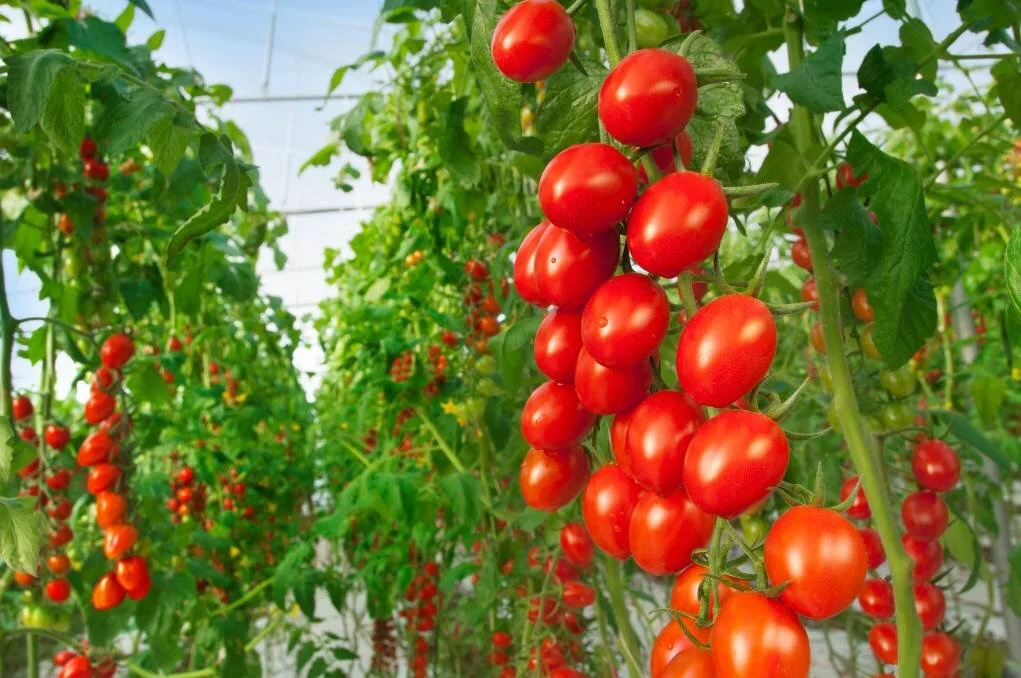
Lead photo: PERFECTLY RED: Hydroponics has enabled the intensive production of premium quality tomatoes and other horticultural staples in protected environments.
This story Can urban areas become a powerhouse for horticultural production? first appeared on Farm Online.
HortiPower Helps You Make Your HPS Lights Smarter
Several greenhouses are choosing hybrid lighting in which they combine LED lights and HPS lights. An issue with hybrid lighting however is that HPS lights are often not individually controllable, but rather by the whole row or group
A commonly used connector in horticulture is the Wieland rst20i3. Both HPS lights and LED grow lights are using this in the greenhouse and vertical farm.
Several greenhouses are choosing hybrid lighting in which they combine LED lights and HPS lights. An issue with hybrid lighting however is that HPS lights are often not individually controllable, but rather by the whole row or group.
With the HortiPower timer, growers are now able to turn the individual HPS lights on and off. The timer has a wifi-chip on board and supports max. 16 amp which means up to 6 grow lights of 600W with 230V.
The timer is controllable with MQTT protocol through the Amazon Web Services (AWS). Power measurement is possible as well.
The timer gives growers the ability to really choose which lights should turn on or off. Growers may use sensors and climate computers to make that decision for them and automation is possible through an API.
Watch a short intro here.
HortiPower | Right Light. Better Growth
HortiPower makes plant-centric lighting solutions for tissue culture, vertical farms and greenhouses.
For more information:
HortiPower
Indoor Agriculture Company Gotham Greens Raises $87 Million In Equity And Debt Capital
Gotham Greens operates one of the largest and most advanced networks of hydroponic leafy greens-producing greenhouses in North America where the demand for indoor-grown produce is rapidly increasing
By Annie Baker ● December 15, 2020
Gotham Greens — a pioneer in indoor agriculture operating high-tech greenhouses located across the United States — announced it has raised $87 million in new equity and debt capital, bringing the company’s total financing to $130 million. And the capital raise includes Gotham Greens’ recent Series D round led by Manna Tree and joined by The Silverman Group and other existing investors. Gotham Greens is known for operating one of the largest and most advanced networks of hydroponic leafy greens-producing greenhouses in North America, where the demand for indoor-grown produce is rapidly increasing.
And Gotham Greens grows and sells long-lasting leafy greens and herbs along with a line of fresh salad dressings and sauces. The brand recently launched several new fresh, plant-forward products, including new packaged salads, cooking sauces, and grab-and-go salad bowls featuring fresh Gotham Greens lettuce, Gotham Greens salad dressing and protein-packed toppings.
Gotham Greens operates one of the largest and most advanced networks of hydroponic leafy greens-producing greenhouses in North America where the demand for indoor-grown produce is rapidly increasing. And Gotham Greens grows and sells long-lasting, delicious leafy greens, and herbs along with a line of fresh salad dressings and sauces. The brand recently launched several new fresh plant-forward products, including new packaged salads, cooking sauces, and grab-and-go salad bowls featuring fresh Gotham Greens lettuce, Gotham Greens salad dressing, and protein-packed toppings.
And Gotham Greens has doubled its revenue in the past year, bringing its fresh produce and food products to retailers in more than 40 U.S. states through its network of high-tech, climate-controlled greenhouses. And the company’s expansion has driven 80% growth in retail unit sales year over year.
Gotham Greens has doubled capacity in the past year by opening new greenhouses in Chicago, Providence, R.I., Baltimore and Denver. And these facilities have expanded distribution of Gotham Greens’ salad greens, herbs, salad dressings and sauces to new regions, including the New England, Mid-Atlantic, Southeast and Mountain regions. Plus Gotham Greens products are available in more than 2,000 retail stores, including Whole Foods Market, Albertsons Companies (Safeway, Jewel-Osco and Shaw’s), Meijer, Target, King Soopers, Harris Teeter, ShopRite and Sprouts. The company’s items also are available for purchase through grocery ecommerce sites, including AmazonFresh, FreshDirect and Peapod.
KEY QUOTES:
“Given increasing challenges facing centralized food supply chains, combined with rapidly shifting consumer preferences, Gotham Greens is focused on expanding its regional growing operations and distribution capabilities at one of the most critical periods for America. We’re dedicated to changing how people think, feel and interact with their food while decreasing the environmental footprint of the traditional produce supply chain.”
— Viraj Puri, Co-Founder and CEO of Gotham Greens
“Manna Tree brings a global network of investors and shares our mission and commitment to expand access to healthy, sustainably-grown fresh produce. Our industry-leading crop yields and capital efficiency in building and operating indoor farms continues to attract strong support from both new and existing investors and underscores Gotham Greens’ value proposition and category leadership position.”
— Eric Haley, Co-Founder and CFO of Gotham Greens
“Gotham Greens is the fastest-growing indoor farming company in the United States today with a track-record of profitable, commercial-scale production. The pandemic has revealed flaws in America’s food supply chain system, particularly in the produce category, and new leaders and innovators need to emerge to ensure a stable food supply for the future. We believe Gotham Greens’ brand, highly scalable business model and leadership team position the company to be the market leader in the rapidly growing and changing landscape.”
— Brent Drever, Co-Founder and President of Manna Tree
First Tapkit In The USA (Texas) Helps Out With Local Food Production
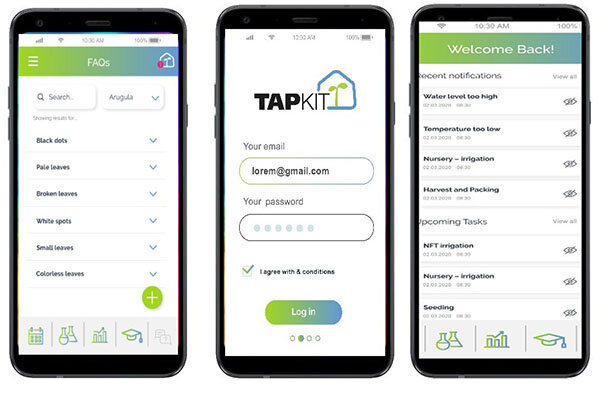
With a background of more than 30 installations in Israel, South Korea, Mauritius and the Philippines, the TAPKIT hydroponic systems is now celebrating the first installation in Houston Texas. The TAPKIT is a 500 m2 hydroponic unit, which can produce 6-12 tons of leafy vegetables and fresh herbs per year. It includes a growing system, packing station and plant nursery
With a background of more than 30 installations in Israel, South Korea, Mauritius and the Philippines, the TAPKIT hydroponic systems is now celebrating the first installation in Houston Texas. The TAPKIT is a 500 m2 hydroponic unit, which can produce 6-12 tons of leafy vegetables and fresh herbs per year. It includes a growing system, packing station and plant nursery.
Due to the COVID-19, all the installation process and the operation training, was done remotely. The day to day operation is supported by i-Droponix. This mobile app contains all the information needed, including crop advice on specific climate conditions, water quality and hundreds of FAQs
"As the TAPKIT offers affordable solution for the "farm to table" trend in the USA, we see great potential for it all around the state," says Avner Shohet, CEO of TAPKIT.
Over the last couple of years, 4 models of TAPKIT were created. "For different types of climate areas," Avner explains: "Sub-tropic, Tropic, desert and cold areas."
"With small adoptions to each climate, we are looking for the most ecological way to grow, by using the sun-light, recycling the water , and minimizing any effect on the environment."
For more information:
Teshuva Agricultural Projects
60 Nof Harim St., Olesh, 42855 Israel
+972-9-8940507
+972-50-7922579
+1-201-5803003
avner@taprojects.com
15 Dec 2020

CANADA: Sustainable Agriculture With LED Lighting
GoodLeaf opened it’s fully commercialized, a state-of-the-art vertical farm in Guelph in 2018. This after many years of research at its pilot farm that opened in Truro, Nova Scotia in 2015
11-12-2020 | Philips Lighting
CANADA, Ontario, Guelph- GoodLeaf opened it’s fully commercialized, a state-of-the-art vertical farm in Guelph in 2018. This after many years of research at its pilot farm that opened in Truro, Nova Scotia in 2015.
We wanted a partner that could help us scale the business. ''
-Jeff McKinnon, Chief Financial Officer and Vice President | Photo Courtesy of Philips Lighting
The Challenge
For GoodLeaf it’s all about sustainability. The facility incorporated innovations to enable the use of sustainable farming practices to execute on expectional product quality. With lighting being a primary component, GoodLeaf had specific needs they expected from a lighting solution and provider. The envisioned lighting solution needed to provide scalability whilst being energy efficient. GoodLeaf was looking for a true partner.
The LED lighting solution
“We’ve been using the Philips products since Generation one back in 2013; we did a lot of testing against the T5 light bulb. The Production Module Gen 1 performed well, they held up over time compared to competitors, using them ever since”, says Jeff McKinnon, CFO and VP at GoodLeaf. Over time GoodLeaf worked with 12 different providers of LED lights but in Signify found the partner they were looking for to move forward and to scale their business.
For their 45000 SQF multilayer growing facility in Guelph, Goodleaf installed Philips GeenPower LED production modules. The light recipe was designed in collaboration with the Truleaf design team and engineers together with the plant specialists of Signify. The installed lighting system delivers optimal lighting uniformity.
Benefits
As a branded producer, GoodLeaf Farms produces and packs fresh, nutritious, and pesticide-free micro and baby greens year-round for Canadian consumers. They expect to grow and harvest approximately 1 million pounds of fresh produce per year at their automated growing facility in Guelph. Plant specialists of GoodLeaf and Signify meet monthly to discuss optimizing their crop growth recipe. As part of the partnership, GoodLeaf has greatly improved the predictability of its fresh produce. In addition, Signify and GoodLeaf worked together to obtain a sizable utility rebate from the company’s hydro provider in Ontario. McKinnon said, “The partnership with Signify has been very advantageous to GoodLeaf. We will work with them on a go-forward basis and very much look forward to that”.
GreenPower LED Production Module Static Grow Light
A static module for multilayer applications with the ideal light recipe for higher yield, better quality, higher propagation success rates, and year-round production. Suitable for multilayer, indoor cultivation of leafy greens, microgreens, and herbs.
Source: Philips Lighting
Header photo: Screenshot from GoodLeaf Farm video on youtube
PODCAST: Pest Control
In this Podcast, we’re going to discuss using biological pest control or using none at all
Joe Swartz & Nick Greens | 12/11/2020
In this Podcast, we’re going to discuss using biological pest control or using none at all

5 Benefits of Corporate Wellness Programs
“Food has a direct impact on our cognitive performance,” according to Harvard Business Review author, Ron Friedman
11-12-2020 Babylon Microfarms
Your company wouldn't be functioning without the hard work and dedication of your staff. Day in and day out, they serve your business and help further its future. To retain happy, healthy employees for years to come, consider implementing an employee wellness program..
Show employees how much you genuinely care about their well-being in and outside the workplace
Learn the benefits of corporate wellness programs for both your company and employees.
1. Healthy Employees Are More Productive
Every employer wants to boost their employees’ level of productivity, but how?
Did you know that health and nutritional wellness link to cognitive wellness? Your brain needs fuel, but not just any fuel – high-quality foods that provide long-lasting energy.
“Food has a direct impact on our cognitive performance,” according to Harvard Business Review author, Ron Friedman.
In other words, people who eat healthier at work tend to focus and retain information better than those with an unhealthy lifestyle.
Have you ever heard of “brain food?” Several foods are associated with boosting brain power such as berries, walnuts, leafy vegetables, and fatty fish. However, your employees probably aren’t showing up to work with a bag of fresh produce.
Partnering with a company like Babylon-Micro Farms can help you empower healthy employees in the workplace.
Babylon-Micro Farms can quickly install a smart, indoor farming system with a seed bank delivered right to your door. The team of gardening experts will remotely manage your farm for an optimal harvest. Plus, you can monitor your garden through an app, giving your office fresh, healthy vegetables within arms reach.
2. Reduce Employee Health Risks
The traditional American diet exceeds the recommended consumption levels and limits of calories from solid fats and added sugars, refined grains, sodium, and saturated fat. The general unhealth of an average American explains these daunting statistics on health and wellness:
14% of adults aged 18 and older smoke cigarettes.
72% of adults aged 20 and older are obese or overweight.
80% of adults don’t exercise enough.
If you can help employees form healthy habits in the office, you’re supporting their wellness outside of the office. Employer wellness programs give employees access to professional medical help when they need it and take preventative measures when appropriate.
As it currently stands, studies show that diseases such as diabetes are likely to increase by more than 50% by 2030.
Employee wellness programs give employees health on a silver platter, which they might not have otherwise. Help employees defeat the odds and reduce their health risks with a wellness program that promotes healthier nutrition and effective behavior changes.
3. Reduce Employee Wellness Program Costs
If you're wondering how employee wellness programs benefit employers, here’s the answer: Employee wellness programs save employers money.
As Rucker notes, “The notion that workplace wellness can reduce an organization’s costs is not a new concept” (International Journal of Workplace Health Management). Unfortunately, some companies don’t take advantage of the benefits, and their employees pay for it.
Why have a wellness program? You can help prevent employees from becoming part of the statistics above, and, as a result, save money on employee healthcare costs.
A Rand study reviewed a decade of data from Fortune 100 employer’s wellness programs, and the cost savings amounted to $136 per member and a 30% reduction in hospital admissions.
The benefits of promotion of health and wellness in the workplace are equally helpful to employers and employees. Be the change in your company and promote wellness.
4. Help Employees Pursue Personal Wellness Goals
Many of your employees may think about getting healthier, but they haven't taken actionable steps to make it a reality. One of the benefits of corporate wellness programs that you can’t quantify is inspiring your staff to pursue a healthier version of themselves.
As the saying goes: the first step is always the hardest. You can help employees start a life-changing health journey by providing the information and resources they need.
For example, integrate a step-counting competition at work. What started as healthy workplace competition may turn into an employee’s passion for running!
Start Meatless Monday to encourage plant-based eating to promote employee health and support the environment. You may find that some employees enjoy a vegetarian day of the week and pursue an entirely plant-based lifestyle.
Giving your employees the initial push and introduction to health and wellness that they needed won't go unnoticed. Start pursuing health in small ways to create a ripple effect in your business.
5. Lessen Stress in Your Workplace
Do you want to reduce the amount of stress in your workplace? Stress doesn’t just happen at work, but it follows everyone – employees and employers – home.
A MediKeeper survey found that nationwide, people with access to an employee wellness program are less stressed about work and less stressed overall than the general population.
Employee wellness programs shouldn't merely be focused on promoting constant workouts and a healthy diet. Be sure to motivate employees to prioritize their mental health as well.
You can do this by integrating mental health days off, encouraging conversation about mental illness, and providing resources for those who need professional help.
Consider implementing mental wellness activities such as yoga, meditation, and daily walks to help your employees reduce their stress levels during the workday.
Bring Employee Wellness Into The Workplace
Now that you've seen several benefits associated with employee wellness programs, it's time to start one today.
Begin a lifelong journey of wellness in the workplace by installing micro-farms. Indoor farming is the wave of the future, and your company can lead the way.
Compact, indoor micro-farms can be a great way to show your dedication to employee wellness by providing fresh, healthy, pesticide-free food at their fingertips. Go above and beyond for your staff to promote the importance of employee health to your company.
Contact Babylon Micro-Farms to get started, ask questions, or get more information on using indoor farms to support your employees’ wellness.
Source and Photo Courtesy of Babylon Microfarms

VIDEOS: Vertical Farming: Hope or Hype?
Flurry of corporate activity has proponents hailing arrival of the future of agriculture
Flurry of corporate activity has proponents hailing arrival of the future of agriculture
Emiko Terazono - October 31, 2020
Vertical farming has become a hot topic during the coronavirus pandemic, as supply chain disruptions and labour shortages feed perennial fears over global food security.
The nascent sector, in which crops are grown in stacked indoor systems under artificial light and without soil, has enjoyed a flurry of activity this year.
Headline-grabbing developments have included the construction of Europe’s largest vertical farm, plans to build the world’s biggest indoor farm in the Abu Dhabi desert, and a $140m fundraising round by a SoftBank-backed start-up Plenty. Norway’s Kalera this week announced a $100m private placement ahead of its listing on the Oslo Stock Exchange’s Merkur Market on October 28.
Proponents believe that the technology represents the future of agriculture, hailing huge efficiency and environmental gains for the food industry, and about $1.8bn has flowed into the sector since 2014, according to data group Dealroom. However, agritech entrepreneurs and analysts warn that hype and lofty promises could undermine the sector’s credibility, putting off consumers and investors.
“There is a lot of BS coming from entrepreneurs,” said David Farquhar, chief executive of Scotland-based technology provider Intelligent Growth Solutions. “There are far too many unsubstantiated claims about energy use, the environmental benefits and quality of crops.”
High-cost, small-scale
The sector remains largely unprofitable and tiny. Vertical farming occupies the equivalent of 30 hectares of land worldwide, according to Rabobank analyst Cindy Rijswick, compared with outdoor cultivation of about 50m ha and 500,000 ha for greenhouses.
High initial capital investment and running costs mean it is hard to make a profit. Businesses must pay for specialised labour and face huge electricity bills for lighting and ventilation, while having to offer competitive prices to attract consumers.
Some operators in Japan are profitable while Nordic Harvest, the Danish start-up that has teamed up with Taiwan’s YesHealth Group to build Europe’s biggest vertical farm in Copenhagen, claims it will be profitable in its first year in 2021.
Keeping the faith
The industry is expected to grow over the next decade, with research group IDTechEx forecasting that annual sales of $700m will more than double to $1.5bn by 2030.
However, there is likely to be a cull of inefficient businesses in a sector that has always had a high level of failures.
“My big fear for this industry is that we will have some large failures,” said Mr Farquhar. “It’s not helpful for buyers’ confidence, for customers’ confidence and investors’ confidence.”
Vertical farming must also overcome perceptions among some consumers, often unfounded, that despite the various benefits it offers it cannot possibly match the taste of high-end produce grown with soil and sunlight.
Please click here to view the video - Can vertical farming feed cities of the future?
Tech challenge
Many vertical farms boast cutting-edge technology ranging from artificial intelligence and robotics to lighting and water filtration, and some companies, particularly in Asia, have established successful processes.
Stacked production systems allow the cultivation of produce in constrained spaces, including urban areas. That means food can be produced closer to its consumers, reducing transportation time and improving freshness at the point of sale.
But new entrants can face teething problems with automation and watering processes, leading to costs spiraling out of control. There have also been cases of black mold and pest infestations hitting the farms, which typically do not use pesticides, according to Michael Dent, an analyst at IDTechEx.
Taste test
Total control over the growing environment is one of vertical farming’s big selling points, ensuring reliable, high-quality crops. A reduction in “food miles” gives consumers access to fresher produce, giving further taste gains.
Skeptics are possibly associating the sector’s offerings with crops grown in greenhouses, which are often of low quality when growers prioritize yield over taste, according to Leo Marcelis, professor of crop production at Wageningen University in the Netherlands.
With many retailers only paying by volume, “growers think ‘I don't get extra money for the quality’ so they don’t pay much attention to that”, he said. Vertical farms may follow a similar path if and when they get to scale and price points of greenhouse rivals. However, for the moment, the sector’s reputation lies in higher-value, better-tasting produce.
Salad days
Mr. Dent believes boosterish claims that “we’ll all be eating food made in vertical farms” are “a red herring and not helpful for the industry”. While most things can technically be grown in a vertical farm, production costs mean offerings tend to focus on higher-value leafy greens, salad leaves, and herbs.
“Commodities like rice, corn, and soyabeans — crops that are cheaply grown in the field and stored easily, I don’t see as economic,” said Prof Marcelis.
Vertical farming was not going to replace banana groves or fields of wheat, said Mr Farquhar, who added that IGS was trialing fruit and root vegetables as well as seedlings for R&D.
As Ms Rijswick puts it, vertical farming will only ever be “part of the mix among various growing systems”.
Lead photo: The vertical farming industry is expected to grow over the next decade © Bloomberg
All rights reserved
Could Vertical Farming Help Avoid Brexit Supply Issues?
Hydroponic farming uses water rather than soil to grow plants
Hydroponic Farming Uses Water Rather
Than Soil To Grow Plants
11 Dec 2020
Agriculture & Consumer Affairs Correspondent
Ireland's network of disused mushroom houses could be the ideal infrastructure to develop a hydroponic farm system which could in turn reduce our dependence on imports of herbs, salads and small greens.
It uses much less water than conventional growing, a tiny amount of space and is immune from adverse weather conditions because it is indoors.
One farm in Tipperary has started the transition. Near Ballyporeen, one of eight mushroom tunnels is now converted into a vertical farm.
Brian O’Reilly had been growing mushrooms for almost two decades, but tight margins and an anxiety over the potential impact of Brexit made him change course.
"The risks were too high so we decided to step back. Tighter margins were number one and Brexit was the number two reason, and labour was a problem too," he said.
Now, he has turned to basil. His first crop will be harvested in the coming days and will be sold into the catering industry.
Mr O'Reilly said the process of growing herbs and small greens is similar to mushrooms. There is a cycle and within 32 days from planting a seed, the basil is finished.
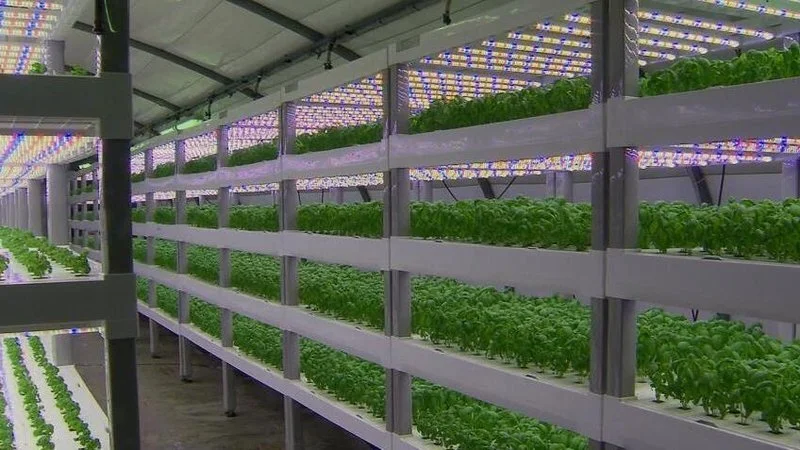
It is grown in tiny pods on shelves with the roots stretching down to nutrient-rich water. Bright LED lights encourage the growth, as does hot air blowing into the tunnel.
A wind turbine nearby generates the electricity and a hot humid house means the plant thrive. But the lights are also powered down for hours in order to let the plants sleep.
It looks a million miles from any conventional farm. The tunnel is filled with rows of white plastic shelves, with tiny holes through which the plants appear. Water is circulating under the shelves and overhead there are strips of lighting; white, red and blue.
It is bright and humid with the constant hum of air being pumped in and there is a gentle trickle of water flowing through the system.
Farmony, an Irish technology company, has developed the technology being used in Ballyporeen.
It has built farms in several countries and said the system could make Ireland self-sufficient in herbs and small greens within a few years.
Farmony's John Paul Prior said the range of plants that can be grown is vast and goes way beyond herbs.
He said: "In Ireland, we grow between May and September/October. Imagine if you could recreate that perfect summer's day all-year round.
"That is what we are doing with controlled environment farming, so we could come close to self-sufficient with all your leafy greens, all your microgreens and all your herbs."
Ireland imports the vast bulk of those products and the development offers a huge opportunity to expand the horticulture sector in Ireland.
It is environmentally positive too. If mushrooms houses are used, it is utilising something that has limited suitability for anything else. Farmony claims that the system uses 90% less water than conventional farming methods and is pesticide free too.
The tunnel in Ballyporeen is part funded by the Department of Agriculture as a pilot project and Mr O'Reilly is already testing crops other than basil.
"We are growing microgreens, peashoots and coriander at the moment. We are experimenting with them, we can change our model at any time and grow to what the customer wants," he said.
"When you think of it, this basil which we are growing would normally be imported, sometimes from thousands of miles away, from Morocco, Kenya, Israel, Spain or the UK. We are replacing that. The food miles are being dramatically reduced and we can do it without worrying about the weather outside."
Abandoned mushroom farms are dotted all over the country. There were more than 400 growers at one point, now there are just a few dozen. It is a tight margin business, which is dominated by a few companies and is almost entirely export dependent.
Last year, Ireland exported €102m worth of mushrooms. Up to September this year, we exported more than €82m worth of mushrooms.
Any delays at ports after Brexit could have a huge impact on delivering fresh product to supermarkets in the UK. The possible imposition of tariffs is also an issue.
The Government wants to expand Ireland's horticultural offering. It is lower emitting than sectors such as beef and dairy and there is huge scope for expansion.
Often, our climate is an issue. We have a shorter growing season than other countries and they can also offer scale and a cheaper cost base.
There are some areas of Ireland which grow high quality vegetables, but it is a sector in decline over recent years.
The dominance of the big multiples as the primary buyers has tightened margins and many growers complain that the sector is controlled by too few buyers. Up to September this year, Ireland imported €146m worth of vegetables alone.
Its dependence on UK imports of potatoes and other vegetables could be a problem after Brexit, but it is something which the sector is aware of.
Farmony hopes that developing a network of vertical farms could dramatically reduce our food miles, reduce a reliance on imports and also create jobs and revitalise a declining sector.
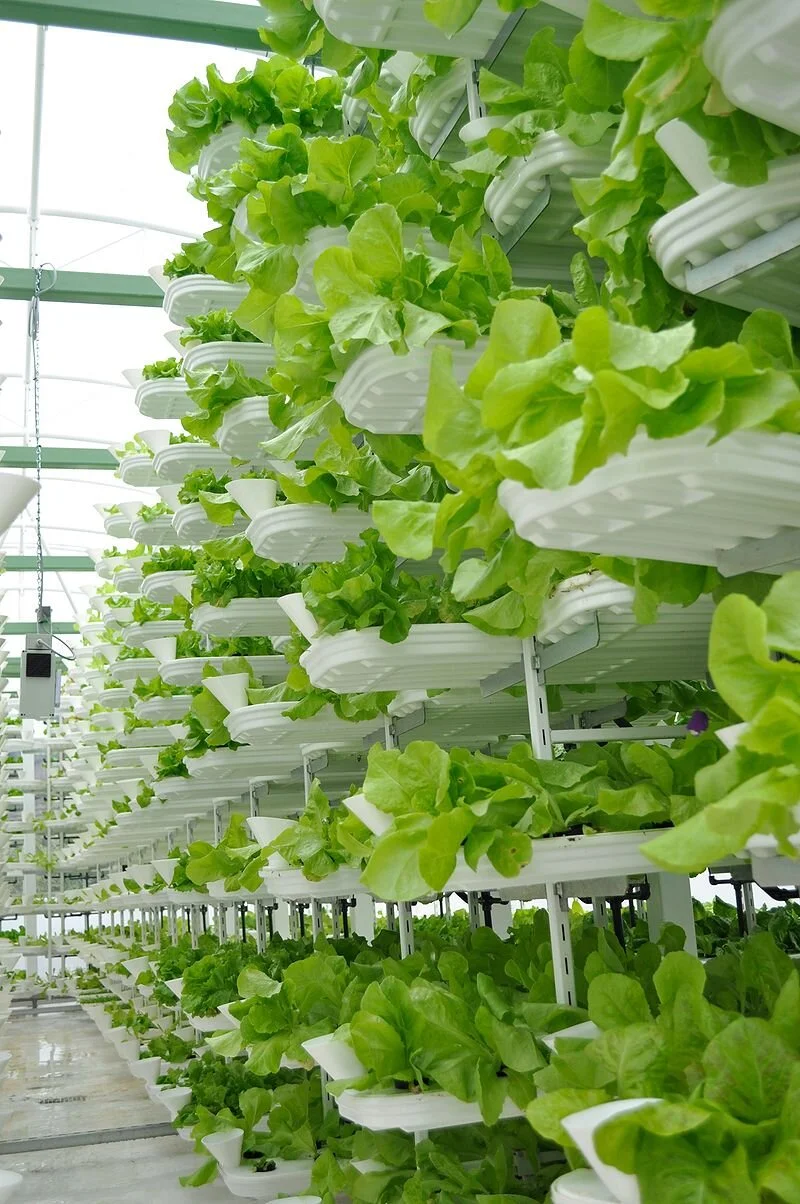
Making Singapore A Land of Farmers
By 2030, the government has announced that 30 percent of food consumed locally will be locally grown under its “30 by 30” initiative
AUTHOR Malay Mail
December 13, 2020
Kuala Lumpur, Dec. 13 — Singapore is known for its ambition.
This tiny nation (just 700 square kilometers in area, 400 times smaller than Malaysia) is now one of the most competitive economies on Earth.
And yet even by its own standards, it has set a very lofty goal.
By 2030, the government has announced that 30 percent of food consumed locally will be locally grown under its “30 by 30” initiative.
Presently, under 10 percent of the things Singaporeans eat are grown in Singapore. This is extremely low by global standards but again Singapore has a resident population of almost six million, on a small island, with just 400 acres of true farmland in the entire country.
Four hundred acres is the size of a single modest farm in places like the USA and even a mid-scale Malaysian plantation can be double the size.
Yet in Singapore, this is the sum total of all our agricultural land so how on earth are we going to feed millions of people?
The answer is an unprecedented deployment of technology. Vertical farms, advanced hydroponics and growing techniques using nutrients, perfectly calibrated irrigation systems, robotics, and 24/7 monitoring.
The government is also going to work to utilize urban spaces – rooftops, balconies, alleys – on quite an unprecedented scale to achieve greater food self-sufficiency.
While the investment will be high, Covid-19 has proved the benefits are likely to be worth it.
The pandemic showed us that global supply chains can collapse and in times of disruption, governments will prioritize feeding their own populations.
A country with no farmland and agriculture is completely at the mercy of its suppliers.
While Singapore has long been somewhat cognizant of this vulnerability – the government does hold strategic food reserves – this simply isn’t enough and some sort of local agricultural base is needed.
Of course, local sourcing doesn’t just improve our security, it also reduces our carbon footprint and can help ensure what is being consumed is of a very high standard.
So more local farming seems like a clear win all around.
But things are never quite so simple.
As we ramp up our urban farming capacity, won’t we once again be shifting more power and capital to the same tech companies and multinationals that already control so much of our lives?
Recently the government announced that well-known agri-tech company Bayer would launch a large-scale vertical farm in Singapore with a multimillion-dollar investment.
Surely it’s only a matter of time before we have Amazon and Tencent farms. They already supply our homes with all manner of goods, so why not farmed produce? Basically, are we about to see another great leap forward in the dominance of big tech?
Farming has long been the domain of a fairly diverse array of small- and medium-scale producers.
A shift to local production under large-scale corporations will disadvantage many Indonesian and Malaysian farmers who currently supply Singapore.
Previously our purchasing power helped the broader region as we paid high prices for our foodstuff.
And, of course, what of the local population? If there is going to be a shift to local agriculture how can we ensure it creates opportunities for ordinary Singaporeans?
If giant corporations set up automated vertical farms, how will this create employment for us?
The government is clearly aware of the issue and it has been working to increase the number of allotments (plots that give those with no access to a garden a small green space to grow their own fruits and vegetables).
Local sourcing needs to engage local communities yet the resources needed to allow significant local agriculture in Singapore means ordinary citizens will struggle to participate meaningfully in this bid for self-sufficiency.
To reach this 30 percent target sustainably and in a way that benefits us all, we will all need to become urban farmers.
Virtually every home would need a micro-irrigation system, HDB (government housing) corridors would need to overflow with produce and bomb shelters and basements would need to be converted into little hydroponic farms on a staggering scale.
It really could be transformative – bringing together an entire nation to achieve the objective of locally-sourced food.
Working together to sustain the basis of our existence and a return to farming – something the ancestors of most Singaporeans left some time ago.
But for this to happen, as much effort must go into investing in ordinary families and homes as in big corporations.
I for one am already prepared; I’ve bought a few mushroom-growing packs and just acquired a small tomato plant so in a few weeks I look forward to my homegrown pasta sauce.
And in the meantime, I’ll keep waiting for the government to give me the grant to install a giant indoor hydroponic system.
*This is the personal opinion of the columnist.
For any query with respect to this article or any other content requirement, please contact Editor at contentservices@htlive.com
Copyright 2017 Malay Mail Online

We Have Something New For You...
Our Commercial is designed with 16 trays. More work you think? Nope! They are designed to make (indoor) gardening even easier than before
NEW NEW NEW
We are super happy to present our latest development to you: our Urban Cultivator Commercial stainless steel edition! This timeless design fits seamlessly into any kitchen. Its luxurious appearance makes it a real eye-catcher at the same time.
Our Commercial is designed with 16 trays. More work you think? Nope! They are designed to make (indoor) gardening even easier than before. For more variety in your food and a colorful mixture on your plate. From farm to plate in less than 10 seconds!
DISCOVER NOW
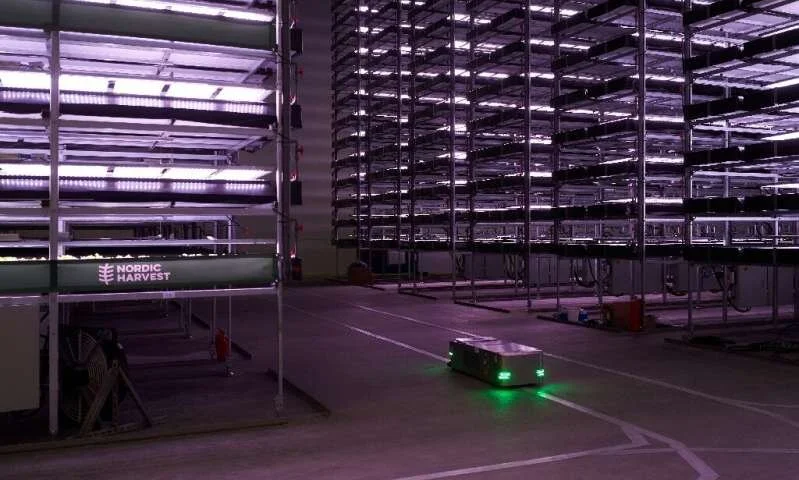
VIDEO: A Wind-Powered Vertical Farm: Giant Urban Farm Opens In Denmark
Inside a warehouse in an industrial zone in Copenhagen vast stacks of plants soar almost to the ceiling. In time, this newly opened vertical farm will be one of the largest in Europe, while power from Denmark's windfarms will ensure it is carbon-neutral, according to the company behind it
07/12/2020 | Text by: FRANCE 24 | Video by: Sam BALL
Inside a warehouse in an industrial zone in Copenhagen vast stacks of plants soar almost to the ceiling. In time, this newly opened vertical farm will be one of the largest in Europe, while power from Denmark's windfarms will ensure it is carbon-neutral, according to the company behind it.
Though they will never see daylight or soil, hundreds of tonnes of lettuce, herbs and kale will be harvested over the coming months from the vast farm, run by Danish start-up Nordic Harvest.
"We have only an output of about 200 tonnes per year but we have built the support facility to support a production of 1,000 tonnes per year," CEO Anders Riemann told AFP.
The futuristic farm uses 20,000 specialised LEDs to provide the plants with light, while robots deliver trays of seeds from aisle to aisle across the 7,000-square-metre hangar.
Vertical farming, in which plants are grown in racks to maximise space, has been touted as a way to use urban spaces to help meet the world's growing food demand and produce food locally.
But indoor vertical farms have faced criticism over the vast amount of electricity needed to provide artificial light.
Nordic Harvest, though, says its facility is powered entirely by renewable energy from Denmark's extensive wind farms, which produce around 40 percent of the country's electricity.
"A vertical farm is characterised by not harming the environment by recycling all the water and nutrition or fertiliser and in our case we use 100 percent energy from windmills which makes us CO2 neutral," said Riemann.
"Our vision is that it can actually be done: Take some of the food production back into the cities where you can grow in a much smaller land and space optimised in the height."
Tags: FARMING FOOD AGRICULTURE ENVIRONMENT

The Next (Vertical) Level of Farming
Vertical farming is the practice of growing crops in vertically stacked layers. It takes in controlled environment agriculture, and soilless farming techniques like hydroponics, aeroponics, and aquaponics to produce nutritious yields of food.
Victoria Dmitruczyk
04-23-20
If you’ve ever seen a farm, you know it looks something like this:
So cute. So inefficient, but cute.
These are normal farms. There’s nothing special about them. This is what we’re used to.
That’s not necessarily a good thing.
These farms typically use pesticides (which means the crops we get aren’t as nutrient-rich as they should be), are at risk from all weather conditions, take up SO much land, and uses 70% of the world’s water supply.
Not so ideal now. What if there was a way we could change that?
Meet your new best friend: Vertical Farming
In a nutshell:
Vertical farming is the practice of growing crops in vertically stacked layers. It takes in controlled environment agriculture, and soilless farming techniques like hydroponics, aeroponics, and aquaponics to produce nutritious yields of food.
Plenty’s Vertical Farm
Physical Layout
The main goal of vertical farming is to produce more food per square metre, hence, why everything grows upwards ⬆️.
Vertical Farm Structures
Now, one of the great things about vertical farming is that it’s pretty dang versatile. There are two main kinds of farms:
Above Ground Vertical Farms
The majority of vertical farms right now take place above ground. They’re generally more convenient to build. This could mean taking place in warehouses, greenhouses, the list continues. That doesn’t mean they’re boring though:
Abandoned buildings are becoming increasingly popular as a spot to host vertical farms. ‘The Plant’ is a farm in Chicago that was transformed from an old meatpacking facility.
‘Vertical Harvest’ built a three-story hydroponic greenhouse next to a parking lot, which aims to grow 100,000 lbs of produce annually.
‘Lokal’, by IKEA’s Space10 innovation lab, is making miniature vertical farms where you can grow crops out of your own kitchen!! The greens grow three times faster in Lokal than in traditional gardens.
Recycled shipping containers are also becoming a popular option for hosting vertical farms (See Square Roots down below 😉) .
These containers combine smart climate control and LED lighting, monitoring systems, and vertical hydroponics to get an efficient farm that is able to produce a high yield of produce per square food.
Freight Farms is also a company changing the vertical farming shipping container game
But wait… It gets better 🤩.
By stacking the shipping containers, we can save EVEN MORE space and achieve an EVEN HIGHER yield per square foot.
Underground Vertical Farms (Deep Farms)
As the name suggests, underground and deep farms are vertical farms, simply built underground, taking place in refurbished underground tunnels or even abandoned mine shafts (Say what?!! 🤯)
Growing Underground is said to be the world’s first underground farm. The produce is grown in a World War II bomb shelter 33 meters under Clapham, London.
Temperature and humidity underground are usually consistent and mild, and so, deep farms require less energy for heating. They can also use groundwater (which is nearby) to further reduce the cost of water supply.
When you combine all of these qualities together with automated harvesting programs, you get a fully self-sufficient farm that’s able to produce 7–9x more food than conventional farms above ground with the same amount of area used!!! 🤯
Lighting
🔑 Having good lighting is key to having a good vertical farm.
In order to get this to be perfect, combinations of natural and artificial lights are used to maintain optimal light levels while technologies such as rotating beds improve lighting efficiency.
Most vertical farms use blue and red LED lights. But, it’s not just for the sake of looking futuristic.
Crop One Holdings — A Vertical Farm start-up out of San Francisco uses smart LED lighting to grow nutritious plants for Dubai’s United Airlines ✈️
The white light of sunlight that plants receive in conventional farms emits wavelengths of the visible light spectrum. However, plants don’t need all. of these wavelengths.
Studies have shown that plants respond best to the blue and red wavelengths. The evolutionary reason behind this is that millions of years ago, plants only grew in the ocean. These wavelengths were able to penetrate the water most efficiently, and plants have grown to like this 🌊.
This means that traditional lights give plants unnecessary light spectra, and waste energy in turn. LED lighting isn’t like that. It gives the option of targeted wavelengths, meaning they’re able to emit solely the red and blue spectra. This is where we see that pink hue come from.
Process
Instead of soil, hydroponic, aeroponic, aquaponic, or growing mediums are used. Peat moss or coconut husks and similar non-soil mediums are very common in vertical farming.
Point being, vertical farming using membranes over the soil to grow plants. This helps eliminate the work that goes into maintaining good soil and ensures quality.
Notice how there’s no soil here 🧐
Controlled-Environment Agriculture (CEA) is what allows vertical farming to be used year round. It controls factors like air, temperature, light, water, humidity, carbon dioxide, and plant nutrition to extend the growing season and crop yield.
Current Vertical Farms Changing the Game
Square Roots
Apparently, Elon Musk’s brother, Kimbal Musk, is revolutionizing vertical farming 🤩 (Oh… and he’s also a cowboy 🤠)
His company, Square Roots is a vertical farming facility that is hosted in shipping containers.
Inside one of the containers
This not only makes the possibility of urban farming more feasible (and less transportation means we maintain the maximum amount of nutrients & have everything remain fresh!!), but it also makes it super versatile.
After all, it’s not that difficult to move a shipping container, while moving a whole traditional farm is well, more difficult…
Plenty
Plenty is a vertical farming startup that aims to make plants that taste so good, you’ll want to eat them over everything else.
Their facilities are HUGE, producing, well, plenty of food.
20 foot tall walls of Arugula. Need I say more?
Its farm in San Francisco can produce 1 million pounds of produce per year, while the farm being built in Compton will be a 95,000 square foot facility, also producing millions of pounds of food.
Even though it seems like this would leave a massive environmental footprint, it not only uses 1% to 5% of the water used to grow comparable crops on a traditional farm but also uses a fraction of the land. Not to mention, it’s all being run in a 100% renewable facility powered by a combination of wind and solar energy.
Farm.One
Rare Produce + Convenience = Farm.One
Farm.One is a New York underground vertical farm that grows rare produce for Michelin star restaurants, while being directly underneath them.
Farm.One’s main facility TriBeCa, under Atera, a two Michelin star restaurant.
They produce 500 different microgreens, edible flowers, and rare herbs year-round. This helps bring otherwise pretty inaccessible ingredients closer to home, all while maintaining freshness (#quality).
Why Vertical Farming?
Vertical Farming sounds scary to invest in. After all, why leap from the conventional system that you know has worked for years, to this, a whole new approach? But, there are many advantages:
By 2050, 80% of the world’s population is expected to live in urban areas, while food isn’t as accessible as we’ve grown used to it being. With this increased demand for food, not only from the actual growing population but from the population condensation means that vertical farming could make food easier-to-access.
Vertical farming allows us to produce more crops from the same square footage of growing area. In fact, 1 acre of an indoor area offers equivalent production to at least 4–6 acres of outdoor capacity, and this can still get monumentally higher. A facility in Japan is able to grow 100x more crops than the traditional farm.
We have a limited amount of fresh water on Earth, and conventional farming uses 70% of it. Vertical farming allows us to produce crops with 70–95 percent less water than traditional systems.
Crops in fields are vulnerable to storms, bugs, and other disasters, all things which are increasing as a result of climate change. Vertical Farms are protected from all of these things.
Since there are no bugs, vertical farming doesn’t require pesticides either. Special lighting provides the growth of nutritious, organic, pesticide-free crops.
Big equipment is controlled by robotics, and farmers don’t have to worry about receiving sicknesses or getting injured from machinery like on conventional farms.
Okay… that sounds great, but what are the downsides?
Now, vertical farming isn’t perfect, and there are definitely some downsides, the majority of them economical.
Vertical farming requires SUPER high amounts of energy. A hydroponic farm growing lettuce in Arizona would require 15,000 kJ of energy per kilogram of lettuce produced while a traditional outdoor lettuce farm in Arizona only requires 1100 kJ of energy per kilogram of lettuce grown.
Vertical farms have yet to overcome high upfront start-up costs. The initial building costs can exceed $100 million, for a 60-hectare vertical farm. This means it could take around approx. 6–7 years to pay back the start-up cost.
Vertical farming takes place in a controlled environment without the presence of insects, which means they don’t need pesticides. However, because of this, the pollination process needs to be done manually, which will be labor-intensive and costly.
Vertical farms have their weak spots, but, they also have so much potential. This is the future of farming.
With a growing population, and challenges like space flight on the rise, we’re going to need to invest in farming systems that are efficient and versatile, and this is precisely what vertical farming is.
It’s already making an impact, and it’s not long before it completely revolutionizes the way we approach our food.
🔑 Key Takeaways
Vertical farming is the process of growing food in vertically stacked layers. This allows more food per square meter to be grown.
Key components like Controlled Environment Agriculture and LED lighting make farms yield nutritious crops year round, regardless of outdoor weather conditions.
There are many vertical farming initiatives out there right now, which firms such as Square Roots, Farm.One, and Plenty changing the game.
Vertical farming has many advantages, such as being adaptive to a growing population, eliminating pesticides, and being available whenever, locally.
The biggest barriers to vertical farming right now are associated with large, upfront, energy costs.
👋 Hey! If you liked my article and would like to read more of my work, feel free to follow me on Medium! I’m also always thankful to hear feedback so, if you would like to get in contact with me (I don’t bite, shoot me a message!), connect with me on LinkedIn!
WRITTEN BY: Victoria Dmitruczyk
Tags: Vertical Farming Agtech Farming Agriculture Innovation

AppHarvest Hires CBRE’s Christopher Scott To Oversee Construction And Commissioning of New Indoor Farms
An Appalachian native, Scott comes to AppHarvest with decades of experience leading facility programs and business development for companies including CBRE, as well as information technology distribution companies Ingram Micro and BrightPoint
Appalachian Native’s Experience Includes Hundreds of Projects Across Multiple Countries

DECEMBER 9, 2020 — MOREHEAD, KENTUCKY — AppHarvest today announced the hiring of Christopher Scott as executive vice president and head of enterprise development. He will be responsible for overseeing the construction and commissioning of new facilities for the AgTech leader, which recently opened the first 30 of 60 acres of growing space at its flagship indoor farm in Morehead, Ky., that’s the equivalent of nearly 50 football fields.
An Appalachian native, Scott comes to AppHarvest with decades of experience leading facility programs and business development for companies including CBRE, as well as information technology distribution companies Ingram Micro and BrightPoint. He served in a variety of leadership roles over two decades for Ingram Micro and BrightPoint, which was acquired by Ingram Micro for $650 million in 2012. Scott has worked around the world overseeing the development and construction of buildings, including state-of- the-art fulfillment centers incorporating complex automation and technology solutions.
“This is a dream job for me, as AppHarvest is building some of the world’s largest indoor farms and utilizing cutting-edge technology in both construction and operations. As an Appalachian native, it’s incredible to see the impact the company is already making on both agriculture and the region,” Scott said.
Added AppHarvest Founder & CEO Jonathan Webb, “Christopher’s long-time focus on sustainability, including chairing BrightPoint’s sustainability program, demonstrates his commitment to our mission and values as we seek to redefine American agriculture.”
Scott joins AppHarvest from CBRE, where he served as director of professional services and business development. His prior work for Ingram Micro and BrightPoint also included overseeing the integration of multiple acquired companies.
He holds a bachelor’s degree in finance from Ball State University’s Miller College of Business.
At AppHarvest, Scott will be responsible for overseeing commissioning and construction of new facilities. The company in October opened the first 30 of 60 acres of growing space at its flagship farm in
Morehead, Ky. Construction is also underway on two additional facilities – a similar
60-plus acre facility outside Richmond, Ky., and a 15-acre facility to grow leafy greens in Berea, Ky.
How is AppHarvest different from traditional agriculture companies?
- The company’s controlled environment agriculture facilities are designed to reduce water usage by 90% due to unique circular irrigation systems connected with large-scale rainwater retention ponds. The system is designed to eliminate harmful agricultural runoff, which contributes to toxic algae blooms.
- AppHarvest farms are located in water-rich Central Appalachia in contrast to much of America’s vegetable production that is concentrated in Arizona and California, states that continue to confront water scarcity and climate disruptions.
- Strong relationships with leading AgTech universities and companies in the Netherlands position AppHarvest as a leading applied technology agriculture company. The Netherlands has developed a significant high-tech greenhouse industry, becoming the world’s second-largest agricultural exporter despite having a landmass roughly equal in size to Eastern Kentucky. Earlier this year, AppHarvest led a landmark 17-organization agreement uniting Dutch and Kentucky governments, universities, and private companies, with all committing to building America's AgTech capital from within Appalachia.
- AppHarvest puts the planet and people first as a registered Benefit Corporation and has also been certified as a B Corp by the nonprofit B Lab.
In just over two years, AppHarvest has attracted more than $150 million in investment into Central Appalachia and announced on September 29, 2020, its entry into a definitive agreement for a business combination with publicly-traded special purpose acquisition company Novus Capital Corporation (Nasdaq: NOVS). The combination, which is expected to close late in the fourth quarter of 2020 or early in the first quarter of 2021, is expected to provide $475 million of gross proceeds to the company, including $375 million from a fully committed common stock PIPE at $10.00 per share anchored by existing and new investors – including Fidelity Management & Research Company LLC, Inclusive Capital, and Novus Capital Corporation. Upon closing of the transaction, the combined company will be named AppHarvest and is expected to remain listed on Nasdaq under the ticker symbol APPH.
AppHarvest’s investors include Revolution’s Rise of the Rest Seed Fund, Inclusive Capital Partners, Equilibrium, Narya Capital, Lupa Systems, Breyer Capital, and Endeavor Catalyst. Endeavor selected AppHarvest Founder & CEO Jonathan Webb as an Endeavor Entrepreneur in 2019.
Board members include food icon Martha Stewart, Narya Capital Co-Founder, and Partner JD Vance, Impossible Foods Chief Financial Officer David Lee, and impact investor Jeff Ubben.
About AppHarvest
AppHarvest is an applied technology company building some of the world’s largest indoor farms in Appalachia. The Company combines conventional agricultural techniques with cutting-edge technology and is addressing key issues including improving access for all to nutritious food, farming more sustainably, building a home-grown food supply, and increasing investment in Appalachia. The Company’s 60-acre Morehead, KY facility is among the largest indoor farms in the U.S. For more information, visit https://www.appharvest.com/.
Forward-Looking Statements
Certain statements included in this press release that are not historical facts are forward-looking statements for purposes of the safe harbor provisions under the United States Private Securities Litigation Reform Act of 1995. Forward-looking statements generally are accompanied by words such as “believe,” “may,” “will,” “estimate,” “continue,” “anticipate,” “intend,” “expect,” “should,” “would,” “plan,” “predict,” “potential,” “seem,” “seek,” “future,” “outlook,” and similar expressions that predict or indicate future events or trends or that are not statements of historical matters. All statements, other than statements of present or historical fact included in this press release, regarding Novus Capital’s proposed acquisition of AppHarvest, Novus Capital’s ability to consummate the transaction, the benefits of the transaction and the combined company’s future financial performance, as well as the combined company’s growth plans and strategy, future operations, estimated financial position, estimated revenues and losses, projected costs, prospects, plans and objectives of management are forward-looking statements. These statements are based on various assumptions, whether or not identified in this press release, and on the current expectations of AppHarvest’s management and are not predictions of actual performance. These forward-looking statements are provided for illustrative purposes only and are not intended to serve as, and must not be relied on as, a guarantee, an assurance, a prediction, or a definitive statement of fact or probability. Actual events and circumstances are difficult or impossible to predict and will differ from assumptions. Many actual events and circumstances are beyond the control of AppHarvest. These forward-looking statements are subject to a number of risks and uncertainties, including those discussed in Novus Capital’s registration statement on Form S-4, filed with the SEC on October 9, 2020 (the “Registration Statement”), under the heading “Risk Factors,” and other documents Novus Capital has filed, or will file, with the SEC. If any of these risks materialize or our assumptions prove incorrect, actual results could differ materially from the results implied by these forward-looking statements. In addition, forward-looking statements reflect AppHarvest’s expectations, plans, or forecasts of future events and views as of the date of this press release. AppHarvest anticipates that subsequent events and developments will cause its assessments to change. However, while AppHarvest may elect to update these forward-looking statements at some point in the future, AppHarvest specifically disclaims any obligation to do so. These forward-looking statements should not be relied upon as representing AppHarvest’s assessments of any date subsequent to the date of this press release. Accordingly, undue reliance should not be placed upon the forward-looking statements.
Important Information for Investors and Stockholders
In connection with the proposed transaction, Novus Capital has filed the Registration Statement with the SEC, which includes a preliminary proxy statement to be distributed to holders of Novus Capital’s common stock in connection with Novus Capital’s solicitation of proxies for the vote by Novus Capital’s stockholders with respect to the proposed transaction and other matters as described in the Registration Statement, as well as the prospectus relating to the offer of securities to be issued to AppHarvest’s stockholders in connection with the proposed transaction. After the Registration Statement has been declared effective, Novus Capital will mail a definitive proxy statement, when available, to its stockholders. Investors and security holders and other interested parties are urged to read the proxy statement/prospectus, any amendments thereto, and any other documents filed with the SEC carefully and in their entirety when they become available because they will contain important information about Novus Capital, AppHarvest and the proposed transaction. Investors and security holders may obtain free copies of the preliminary proxy statement/prospectus and definitive proxy statement/prospectus (when available) and other documents filed with the SEC by Novus Capital through the website maintained by the SEC at http://www.sec.gov, or by directing a request to Novus Capital Corporation, 8556 Oakmont Lane, Indianapolis, IN 46260. The information contained on, or that may be accessed through, the websites referenced in this press release is not incorporated by reference into, and is not a part of, this press release.
Participants in the Solicitation
Novus Capital and its directors and officers may be deemed participants in the solicitation of proxies of Novus Capital’s shareholders in connection with the proposed business combination. Security holders may obtain more detailed information regarding the names, affiliations, and interests of certain of Novus Capital’s executive officers and directors in the solicitation by reading the Registration Statement and other relevant materials filed with the SEC in connection with the business combination when they become available. Information concerning the interests of Novus Capital’s participants in the solicitation, which may, in some cases, be different than those of their stockholders generally, is set forth in the Registration Statement.

Autogrow Officially Launches European Office With The Appointment of James Croy
With over 15 years’ experience in the agricultural sector, James is looking forward to introducing cutting-edge technology to one of the largest exporting areas in the world
8 December 2020: Netherlands based James Croy has joined Autogrow to support the growth of their digital solutions, Folium, and FarmRoad, in the region. With over 15 years’ experience in the agricultural sector, James is looking forward to introducing cutting-edge technology to one of the largest exporting areas in the world.
“There’s a tangible shift in the mindset of growers here in Europe who understand the importance of capturing data and how it can be used for improving operations. It’s not just the younger generation but growers of all ages, crops and business sizes,” explains James.
“The way crops are managed today is through visual inspection and judgement based on varying degrees of grower knowledge and experience. Data allows for more advanced analytics and understanding of what is driving physiological responses in the plant.”
One of the unique things about James is he also happens to be a New Zealander.
“I left New Zealand in 2006 and was based in London for a time before moving to the Netherlands in 2009. 11 years and three children later, I am firmly embedded in the culture and the environment of the region and love being in such a historically significant and accessible location.”
“It’s ironic how I moved over 18,000 kilometers away from New Zealand and now find myself working for a New Zealand headquartered company again. It’s also great to be representing such great solutions and a business that invests in products that continuously develop in line with the evolving market.”
James will be the key contact for any customers based in Europe interested in FarmRoad and Folium. To contact James – james.croy@farmroad.io
For more information on Folium Network Sensor - https://autogrow.com/products/folium
For more information on FarmRoad - https://www.farmroad.io
MEDIA QUERIES
Kylie Horomia, Head of Brand & Communications
(e) Kylie.horomia@autogrow.com
(w) www.autogrow.com www.farmroad.io
Sales queries – sales@farmroad.io
About Autogrow
Autogrow leverages the power of technology, data science, and plant biology to provide indoor growers affordable, accessible, and easy-to-use innovation – 24/7, anywhere in the world.
Our hardware, software, and data solutions support growers and resellers in over 40 countries producing over 100 different crop types.
We are the experts in Controlled Environment Agriculture (CEA) and continue to stay ahead of a rapidly evolving landscape.
Autogrow, Building 3, Level 1, 61 Constellation Drive, Mairangi Bay, Auckland, Auckland 0632, New Zealand

US: NEW YORK: Wall-To-Fork Fresh Produce Comes To Monsey
The iconic Evergreen Market is debuting a revolutionary 20-foot high geoponic (soil-based) wall farm that lets customers not only choose clean, fresh-picked produce but also see exactly where it comes from
NEW VERTICAL FIELD URBAN FARM SYSTEM AT EVERGREEN MARKET MEANS TASTY, HEALTHY AND BUG-FREE SUSTAINABLE PRODUCE 365 DAYS A YEAR
[Monsey, NY, DEC 9, 2020] – The world of freshly harvested greens and herbs is looking up – literally – in Monsey, NY. The iconic Evergreen Market is debuting a revolutionary 20-foot high geoponic (soil-based) wall farm that lets customers not only choose clean, fresh-picked produce but also see exactly where it comes from.
The pesticide-free lettuce, kale, arugula, basil, and cilantro from Evergreen’s on-site farm are sold at competitive prices in individual pots, making the “buying local” experience more convenient than ever. Pesticide-free and grown in soil that is never exposed to bugs, all products are Star-K Kosher Certified for purity.
“We are gratified to be the first kosher supermarket in the country to introduce the Vertical farm,” said Malki Levine of Evergreen. “Our customers are very much looking forward to buying fresh produce that is grown in our own backyard rather than being transported on long hauls from farms across the country. They will also appreciate the significantly reduced level of infestation, a major concern of kosher consumers.”
Shoppers can visit the thriving vertical farm when they visit the store. The state-of-the-art system features a controlled, sterile environment with soil beds containing a proprietary mix of minerals and nutrients. Advanced sensors constantly monitor, irrigate, and fertilize the crops throughout every growth stage.
Evergreen’s wall farm is the latest installation from Vertical Field (www.verticalfield.com), an Israeli ag-tech company that produces innovative vertical agricultural solutions that help the environment, improve human health conditions, and make fresh, delicious produce available all year round.
Geoponic (soil-based) vertical farming yields a new crop every few days, ensuring that fresh greens and herbs will always be in season in Monsey. The sustainable and eco-friendly method produces cleaner, healthier, tastier veggies than those shipped from miles away. And, reduced soil-to-plate time means a longer shelf life and fewer hands involved – a welcome benefit in the age of Covid-19.
“We are extremely excited with the partnership with Evergreen,” said Guy Elitzur, the CEO of Vertical Field. “They are precisely the type of supermarket that has the right customer base and will successfully integrate the latest technological advances in geoponic farming.”
About Vertical Field: Vertical Field is a leading ag-tech provider of vertical farming and active landscaping solutions for urban environments and smart cities. The company is operated by professionals, agronomists, researchers, and a multi-disciplinary team, enabling the development of smart plant-based solutions that combine the best of design and manufacturing, smart computerized monitoring, soil-based technology, water and lighting technology, and more. Vertical Field delivers next-generation vertical farming systems for a global clientele, including Facebook, Intel, Apple, Isrotel, Microsoft, and many more. Vertical Field is currently also on-site at Farmers And Chefs Restaurant in Poughkeepsie, NY, supplying fresh greens for the Chef's creative, locally-sourced menu.
About Evergreen: Located in Town Square in the heart of Monsey, NY, Evergreen is 30,000 square feet of grocery, butcher, bakery, health food, fish, produce, sushi, full-service deli & prepared foods. The store provides wide aisles, huge product selection & competitive prices. Evergreen is a shopping destination that combines the friendliness of a neighborhood grocery with the value and convenience of a state-of-the-art specialty supermarket. Evergreen also has a similar store in Lakewood, NJ, and will soon be opening its third major market in Pomona NY.

US: NORTH CAROLINA: Bourgeois Lettuce: New Microgreens And Hydroponic Farm Opens on Castle Street
Randall Rhyne has installed 90 8-foot hydroponic growing systems in his Castle Street shop, CraftGrown Farms. (Port City Daily/Shea Carver)

By Shea Carver
December 6, 2020
Randall Rhyne has installed 90 8-foot hydroponic growing systems in his Castle Street shop, CraftGrown Farms. (Port City Daily/Shea Carver)
WILMINGTON — “People never believe lettuce has a flavor,” Randall Rhyne said as he walked through his shop, CraftGrown Farms, on Castle Street.
Located where Aluna Works used to be (603 Castle St.), the microgreens and hydroponic farm is a modern twist on producing healthy, homegrown greens.
“What do you think spicy is?” he asked.
He handed over a handful of what he calls “painkiller.” The microgreens’ unassuming little leaves and stems tasted rather sweet at the start, but with each chew, lit up the entire mouth and tongue.
“But it fades quickly, doesn’t it?” Rhyne inquired.
The heat, in fact, didn’t last long.
He handed over a sunflower leaf — what he called a “palate cleanser.” Just like that, a blank slate on the tongue was prepped for a new flavor.
Microgreens and lettuce tastings are open to the public daily at Rhyne’s indoor farm, which is outfitted with 90, 8-foot, hydroponic LED strips, and multiple mini-greenhouse systems.
Rhyne is growing various microgreens, including but not limited to broccoli, cilantro, kale, collards, spinach, anise, basil, plus multitudes of lettuce — arugula, endive, fin star (a hybrid of romaine and iceberg), tatsoi (a mustardy Asian lettuce), Swiss chard, skyphos (red butter) and Muir (sweet green lettuce), among others.
“I seeded these on the 28th,” he said, pointing to small stems of greens that actually looked like tiny enoki mushrooms. “They’ll be ready for sale in two or three days.”
Rhyne is growing multiple varieties of lettuce that stay crisp and are nutrient dense with more flavor than normal lettuce. (Port City Daily/Shea Carver)
“What can I say? I like bourgie lettuce.”
Rhyne’s love for microgreens started a few years ago while he was deployed in Iraq and then Syria.
A staff sergeant for the Army Reserves, while on assignment Rhyne kept in touch with his neighbor, retired veteran Jason O’Connor, via social media. Back home in Richmond, Virginia, before Rhyne was deployed, they had begun growing their own gardens of fresh food.
While forced to eat the same 12 MREs day in, day out when deployed, Rhyne said having access to fresh, healthy vegetables never seemed more desirable. A friend told him to look into growing microgreens when he returned. He did.
By 2019, Rhyne and O’Connor started their own healthy homegrown food business, Two Veterans Farm. They grew microgreens in O’Connor’s garage, and Rhyne bought a ½ acre of land for them to build a 55-foot-by-25-foot greenhouse to grow tomatoes and other vegetables. Plus, they tilled another small portion of the rectangular land for root vegetables.
They sold their wares at the local farmers market and started a subscription veggie box. The box included homegrown microgreens, leafy lettuces, and root vegetables. It was a modest business at first, but once Covid-19 hit, it exploded.
“We went from eight customers to 28 in two days,” Rhyne said.
The problem then shifted to making sure they had enough product to keep boxes filled as their customer base kept growing through the pandemic. Yet, they didn’t have enough product planted.
“And you can’t sit there and say to a plant, ‘Grow faster,’” Rhyne quipped.
The two partners had different ideas on where they wanted to take the business. Rhyne wanted to grow larger quantities of the same crops to fill boxes, especially since the subscription side of the business was bringing in $2,000 every couple of weeks. But he said O’Connor wanted higher diversity of smaller batches of crops.
When they couldn’t come to an agreement, Rhyne decided to branch out into the niche market of microgreens and hydroponic lettuces.
“I just don’t like being a dirt farmer or farming outside,” he said. “What can I say? I like bourgie lettuce.”
He made the decision to move to Wilmington in June to launch his idea. The space on Castle St. already was outfitted with indoor drainage and a cooler perfect for running CraftGrown Farms.
Rhyne has created a near-perfect growing environment, so his plants have optimum flavor profiles and rich nutrient density.
Take broccoli, for example. He doesn’t allow the plants to grow beyond an inch or so out of the soilless jute mats (a wood-pulp byproduct that’s 100% compostable) before cutting them. It gives the plants 40% more nutrients than if allowing broccoli to grow to its full floret.
“A seed is the plant analogy of an egg,” said Rhyne, who also used to be a biology and earth, science teacher. “From an egg, you get feathers, bones, and the whole organ system of a chicken. A seed is the same: You’re getting the most nutrients when the plants are young.”
All microgreens grow on the jute mats, while lettuces and herbs grow in the hydroponic system. Basically, hydroponics allows Rhyne to grow vegetables without dirt. Plus, he doesn’t have to worry about outdoor environments that affect the growth: bugs, deer, weather, hours of daylight, pH of the soil, among other factors.
“The roots are where water takes up nutrients, leaves are where gas exchange occurs, and light is photosynthesis, what powers the whole process,” he explained.
He turns on the LED lights from 10 p.m. until 7 a.m. every day, and the system constantly provides a drip to the plants in their infancy from a sump pump that recycles and cleans the water through a UV filter.
“Water is a vector for the nutrients to get into the plant,” he said. “All I’m doing is providing support structure: water drips down the LED strips, roots have access to the water, with plenty of oxygen, fans are blowing on them to keep air moving, so they can transpire, and C02 can get taken in and oxygen can get pushed out.”
“I control it all,” Rhyne added.
Rhyne cuts off the process before the plant’s flower, as to not change the way they taste.
“Once lettuce bolts, it goes sour, bitter, and nasty,” he said.
Rhyne is growing microgreens aplenty, including carrot, broccoli, anise, basil, arugula, tatsoi, and other varieties. (Port City Daily/Shea Carver)
Growing the business
The lettuce, herbs, and microgreens have become popular already among restaurateurs in town. Rhyne is selling basil, tastoi, kale, arugula, and other lettuces to chefs at Floriana’s, Pinpoint, and Trucks in Wilmington. He’s currently growing 80 endive plants for The Chef and the Frog in Whiteville.
He wants to build his restaurant clientele, as well as draw in more foot traffic from the public. The public is welcome into the shop during operating hours for a taste tour, and to purchase the lettuce and greens first-hand. He sells microgreens for $3 per ounce and lettuce for $4 a head.
Rhyne will even take requests to specialize a customer’s order. If they want pea shoots, he’ll make it happen. A special blend of seeds? He can work on that, too.
With every plant bought, Rhyne arms customers with instructions on how to keep the plants for longer use.
“A lady in Virginia had a head of lettuce that lasted five months and never went bad,” he stated. “She used two leaves a day for her husband’s sandwich. My lettuce tends to stay very pretty. If you keep it the way I tell you to, you will eat it before it has a chance to go bad.”
Rhyne is hoping to team up with his Castle Street neighbor John Willse at Wilmington Wine to do events soon.
“John and I are putting together a tasting,” he explained. “Wines with microgreens and maybe get Daniel from Floriana’s to come and make a meal.”
Though CraftGrown Farms technically opened in July, Rhyne didn’t produce growth to sell until September — October is when the business began to turn sales. A subscription box will be folded into the mix soon enough.
Rhyne is toying around with adding gourmet rainbow carrots and baby beets, maybe a French Breakfast radish. “The flavor of a young beet is ridiculously wonderful,” he praised. Still, he doesn’t foresee going into full vegetable production.
Though he will evolve his herb menu. Rhyne is considering growing varieties of thyme and mint that restaurants and bars could use.
“I’m even growing a dessert microgreen,” he said.
He cut a small snippet of bronze fennel and lemon balm.
“I think this would be great with ice cream,” he said. “But I had a new customer come in yesterday, tasted it, and launched into a 20-minute list of everything it would be great with. That’s the fun part of the job.”
CraftGrown Farms is open Monday through Friday, noon – 6 p.m., and Saturdays, 2 p.m. – 6 p.m.
Rhyne has installed 90 8-foot hydroponic growing systems in his Castle Street shop, CraftGrown Farms. (Port City Daily/Shea Carver)
Lettuces run the gamut of flavor, from sweet and buttery to bitter and spicy, at CraftGrown Farms. (Port City Daily/Shea Carver)
Newly sprouted microgreens, grown on a jute mat, maintain 40% of their nutrients and pop with flavor. (Port City Daily/Shea Carver)
Rhyne is growing carrot, broccoli, anise, basil, arugula, tatsoi and other microgreen varieties. (Port City Daily/Shea Carver)
Folks can walk in off the street to CraftGrown Farms and enjoy a tasting of the various microgreens and lettuces that Rhyne grows. (Port City Daily/Shea Carver)
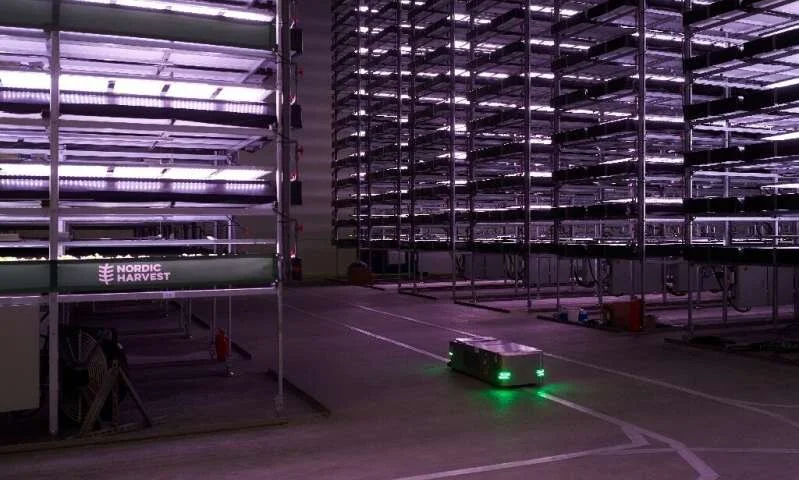
Giant Vertical Farm Opens in Denmark
The produce grown here will be harvested 15 times a year, despite never seeing soil or daylight. It is lit up around the clock by 20,000 specialized LED lightbulbs
DECEMBER 7, 2020
by Camille Bas-Wohlert
First developed around a decade ago, vertical farms have taken off in Asia and the United States
A purple glow illuminates stacked boxes where lettuce, herbs and kale will soon be sprouting at one of Europe's biggest "vertical farms" which has just opened in a warehouse in an industrial zone in Copenhagen.
Fourteen layers of racks soar from floor to ceiling in this massive, 7,000-square-metre (75,350-square-foot) hangar used by Danish start-up Nordic Harvest.
The produce grown here will be harvested 15 times a year, despite never seeing soil or daylight. It is lit up around the clock by 20,000 specialized LED lightbulbs.
Danish Nordic Harvest raises DKK 62 million. DKK to one of Europe's largest vertical farms
In this futuristic farm, little robots deliver trays of seeds from aisle to aisle.
The large aluminum boxes are mostly empty for now, but lettuce and other leafy greens will soon be growing.
Some 200 tonnes of produce are due to be harvested in the first quarter of 2021, and almost 1,000 tonnes annually when the farm is running at full capacity by the end of 2021, explains Anders Riemann, founder and chief executive of Nordic Harvest.
That would make the Taastrup warehouse one of Europe's biggest vertical farms.
These urban facilities have unsurprisingly received a cool welcome from rural farmers, who have questioned their ability to feed the planet and criticised their electricity consumption.
But Riemann stresses the environmental benefits of his farm, with produce grown close to consumers and its use of green electricity.
A robot, used to plant seeds and check the plants while growing, moves past vertical racks at 'Nordic Harvest' in Taastrup, a suburb west of Copenhagen
"A vertical farm is characterized by not harming the environment by recycling all the water and nutrition or fertilizer," says Riemann, who uses no pesticides.
In Denmark, a world leader in wind farms, about 40 percent of electricity consumption is wind-based.
"In our case, we use 100 percent energy from windmills which makes us CO2-neutral," he adds.
While he wouldn't disclose how much Nordic Harvest's electricity bill comes to, he said the power came with "wind certificates" registered on the Danish commodities exchange.
These legal documents guarantee that "the amount of electricity you consume in one year is equivalent to the electricity produced by numbered windmills offshore".
Slow start in Europe
First developed around a decade ago, vertical farms have taken off in Asia and the United States, which is home to the world's biggest.
The idea has slowly started to catch on in Europe.
Urban farming could even allow land exploited by single-culture farming to be reforested, Riemann said.
Shelves of the vertical plant farm 'Nordic Harvest' where lettuce, herbs and kale will soon be growing
"We moved the forests in order to have fields," he laments, noting that now farmers like him can bring "some of the food production back into the cities where you can grow on much smaller land and space-optimized in height".
His farm uses one liter of water per kilogram of produce, or 40 times less than underground farms and 250 times less than in fields, he says.
The names of his clients remain confidential, but they include caterers, restaurants, and even supermarkets.
According to a poll conducted by the Danish Farmers Union, 95 percent of Danes are ready to change their consumer behavior to protect the environment.
Nordic Harvest's products are however not labeled as organic.
"The EU regulation dictates that the word organic is linked to the word 'soil' so if you take soil out of the equation you can't name it organic anymore," he says.
But "we grow on the same terms as organic: we don't use pesticides or insecticides".
Meanwhile, Aarhus University agriculture professor Carl-Otto Ottosen notes that Denmark "doesn't have a space problem" and companies like Riemann's are largely a novelty that won't threaten Danish farming traditions.
"It works in Japan or Shanghai, where there's no space to farm and where they want quality products," he says.
But despite what polls suggest, Ottosen insists Danes are still more inclined to buy products based on "price, not taste".