

News About Farming in Shipping Containers & Limited Indoor Spaces

Restaurant Roundup: Blindfolded Bites, Rooftop Tacos, and Shipping Container Farming
Some would say Seattle’s food scene is at its best when the impact stretches beyond the immediate benefits of nourishment and taste.
That’s certainly the case at Cherry Street Farm, where Hip Hop is Green founder Keith Tuckets uses a shipping container hydroponic farm to help feed Seattle families, with future plans to educate kids about climate justice, sustainability, and vegan cooking. Currently, a community kitchen is under construction and eventually, the space will host live music and other teaching opportunities.

Where Food Justice Meets Hip-Hop: Inside Seattle's Cherry Street Farm
Nestled on a small hill between the vibrantly colored houses of East Cherry Street is a farm capable of producing two-and-a-half acres' worth of crops, all in a metal freight container the size of a school bus.
To any passersby, Cherry Street Farm looks no different from a misplaced shipping unit. Indeed, the hydroponics setup, which grows plants in a controlled climate using a nutrient-enhanced water drip, is built within a converted shipping container by Freight Farms based in Boston, and it's Seattle's first Freight Farms hydroponics lab.
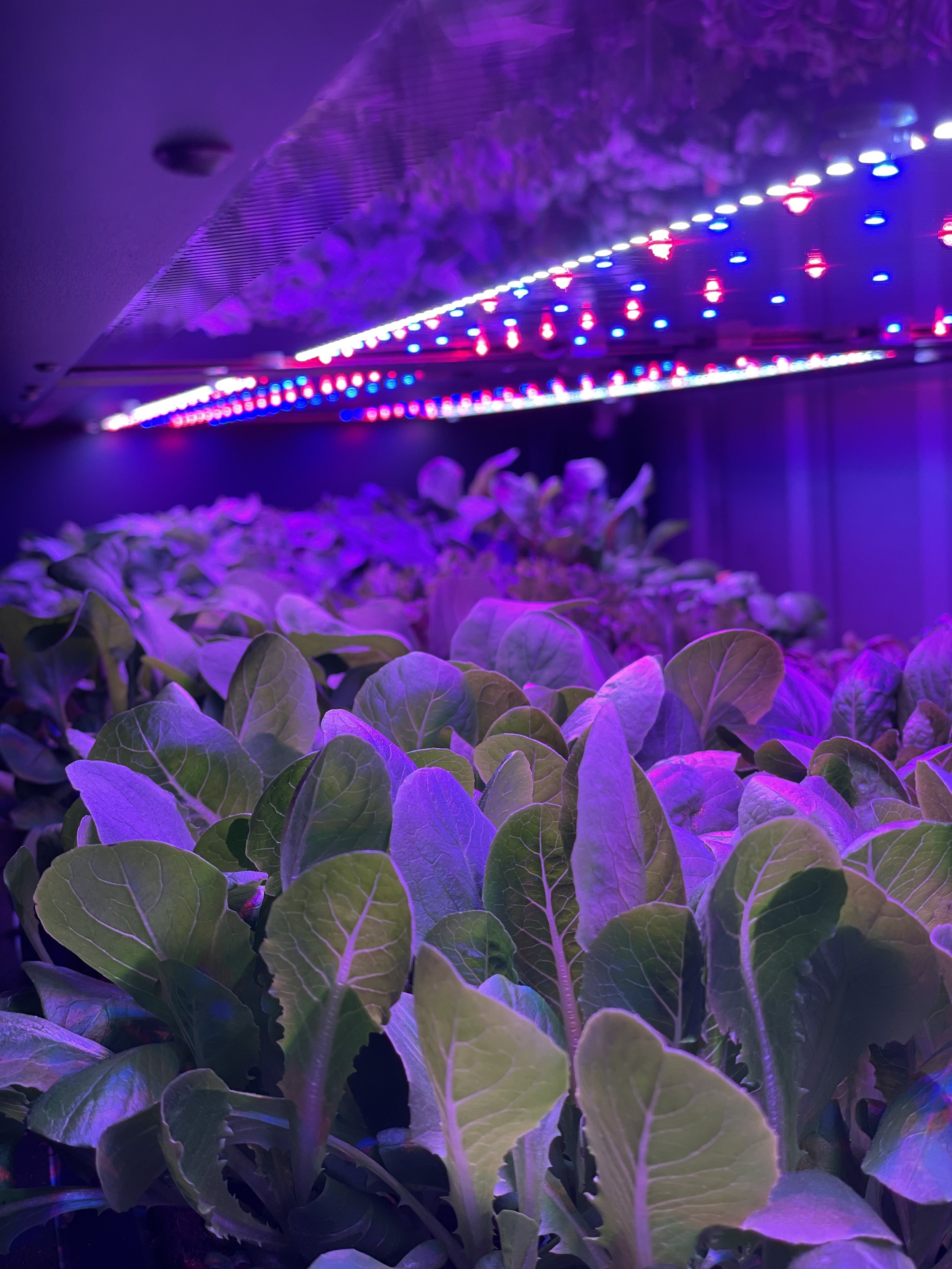
Stepping into the container is like walking into a completely new biome. First, the humid air hits the nose with the fragrance of fresh earth. It took a minute for my eyes to adjust to the intense glare of the red and blue LED lights before I could focus on the grow operation: four floor-to-ceiling sliding plant walls.

Beyond The Box: The Realities of Container Farming in 2025
The recent Indoor Ag-Conversations panel brought together four seasoned voices from the container farming world. The session was moderated by Grant Anderson of Better Fresh Farms, a container farm operator, and featured three manufacturers as panelists: Matt Daniels (AmplifiedAg®), Glenn Behrman (CEA Advisors LLC), and Tripp Williamson (Vertical Crop Consultants).
Their goal? To offer a clear-eyed look at what’s working, what’s not, and where the industry goes from here.
What followed was one of the most honest, detailed discussions the container farming sector has seen in some time.

An Ohio Zoo Is Using Hydroponics To Feed Animals Homegrown Greens
Cincinnati is not the only zoo producing its own food and sourcing items locally. Mike Maslanka, senior nutritionist at the Smithsonian National Zoo and chair of the Association of Zoos and Aquariums’ nutrition advisory group, estimates every one of the 238 AZA-accredited institutions is growing or sourcing at least some of their animals’ food locally.
“So, that's whole prey, that's insects, that's bamboo and brows, hay, produce,” Maslanka said.
A poster at the Cincinnati Zoo explains the process behind the giraffe's food. Isabel Nissley / The Ohio Newsroom
But, the number of zoos using hydroponics is smaller. Neither of zoos in Cleveland or Columbus currently grow food hydroponically.
Maslanka said that could be due to high costs of the technology.

VIDEO: Wyoming Students are Growing Salad in a Former Shipping Container
A group of Central Wyoming College (CWC) students have repurposed an 8-by-40-foot shipping container to successfully grow delicious vegetables and herbs without soil, sunshine and acres of space in a sustainable way, reports Cowboy State Daily. These students are enrolled on a Regenerative Small-Scale Farming AAS degree. According to CWC, it is the first of its kind in Wyoming.
“We’ve been fortunate to be able to bring this kind of technology to the area,” shares local food and agriculture instructor, Ethan Page. “I think this is one of two freight farms in the state, and the only one that’s kind of served, or has like an educational purpose,” he adds.

BRITISH COLUMBIA: How The U.S.-Canada Trade War Is Fueling Vertical Farming In B.C.
When Ranjot Singh Dhaliwal started Sustainabite Fresh Farms in a shipping container in Surrey, he knew he couldn’t repeat the mistakes of hi-tech indoor farms closing their doors around the Lower Mainland. “What I have seen in vertical farms is they put a lot of money in. So much unnecessary technology that was not needed. While I was building it, my main focus was to make it profitable,” explained Dhaliwal.
Dhaliwal has seen many indoor farms fail in recent years; a sentiment echoed by Chris Arthur of Sky Harvest, a organic microgreens farm inside an unassuming industrial space in Richmond.

The Challenge and Opportunity of Container Farming
The most recent monthly Indoor Ag Conversations webinar hosted by Indoor Ag-Con, held June 3, focused on “The State and Future of Container Farming.”
Container farming is a form of small-scale controlled environment agriculture — i.e. indoor or vertical farming — that is often built inside shipping containers. The units are self-contained, able to be moved to the necessary location and allow for small-scale out-of-season growth of fresh produce.
They are not without their challenges, however. The talk included four panelists from the container farming industry discussing the impacts of Freight Farms and its recent collapse, the challenges of the industry, and where it goes from here.

KAZAKHSTAN - The First “Machine Farm” Opened in Almaty
BoomGrow can grow leafy greens, microgreens, edible flowers, herbs, and even mushrooms. From planting to harvest, it takes 35-38 days , which is faster than in open ground or a greenhouse.
At the same time, the growing process uses 95% less water, soil, and fuel than traditional methods.The modular vertical farm is a development of the Malaysian startup BoomGrow . It operates in Malaysia, Indonesia, the Philippines and Singapore. Kazakhstan is the first Central Asian country where the project was scaled up.
The farm was developed and assembled in Malaysia and delivered to Almaty, now the container is located on the territory of the Kazakh National Research Technical University named after K. I. Satpayev.

SOUTH KOREA: Local Governments Across The Country are Working on a Project to Create a Smart Farm
Buk-gu, Gwangju Metropolitan City, is also pushing for a "one stone and three trillion" project to protect the environment and increase jobs for the youth and the elderly by installing a "container smart farm" that grows eco-friendly crops using public idle land in the city center. Recently, Buk-gu created a container-type urban smart farm in the parking lot space of Buk-gu Sae Village Association. The container-type smart farm is 40㎡ of land and can stack crops up to six layers without taking up a large area, so you can get a large amount of harvest compared to the use of the land.

New Vertical Farm at Illinois State University to Serve as Example of Sustainable Urban Agriculture
“This project is about more than just growing food,” said Illinois State University President Aondover Tarhule. “It’s about harnessing the power of technology to reduce our dependence on traditional, resource-demanding agricultural methods. Vertical farming technology can be used to address some of the biggest challenges we face, including food security, environmental responsibility, and sustainability.”
The Vertical Farm uses a repurposed shipping container with an enclosed, controlled environment for growing plants year-round. The 40-foot-by-8-foot (320 square feet) container is designed using a vertical hydroponic growing system with a recirculating nutrient solution and light-emitting diode (LED) lighting system. The Vertical Farm unit will be able to grow 4,600 plants, production equivalent to 1-2 acres of field production, using 95% less water or approximately 5 gallons of water per day.

VIDEO: Utah Company Builds Modular Farms That Conserves Water
PROVO — A Utah County startup is building ‘modular farms’ that they say waste very little water and double as a trout farm.
From a tower system to the container you’d see at the grocery store, the folks at Future Fresh Farms say they do it while keeping more than 90 percent of their water inside this closed-loop system.
It begins with the fish. Thousands of trout inside these huge 2-thousand gallon tanks. They are living inside the water supply for the farm.
Sean Burrows is the CEO and founder of Future Fresh Farms. It all started as a family hobby.

Hippotainer’s Breakthrough: Winning the Wageningen Entrepreneurship Grand
"We faced some tough questions from the jury regarding the feasibility and market potential of Hippotainer, but being well-prepared made all the difference," shares Tijmen Blok, founder and CTO of Hippotainer. "This recognition is a strong validation of the innovative capabilities and potential impact of our solutions in container farming."
Winning the Wageningen Entrepreneurship grant doesn't just come with prestige; it also opens doors to valuable networks. "The grant gives us and other participants an introduction to important connections we can use immediately to take Hippotainer further," he explains. One notable opportunity linked to the event is the Unstuck Award, hosted by Willem Sodderland, which helps young entrepreneurs overcome obstacles by connecting them with audience members who can provide support through their networks.

SOUTH AFRICA - PRETORIA: Shipping Container Farms - How UP is Revolutionising Mushroom Growing in SA
Research by the University of Pretoria (UP) is helping South African producers find new ways to grow white button mushrooms sustainably – including a project aimed at growing white button mushrooms in repurposed shipping containers.
“Many people think of mushrooms as a luxury item, without realising that they are a superfood packed with nutrients and represent a good alternative to meat products,” says Prof Lise Korsten, who leads mushroom studies in the Plant Pathology Research Group of the Faculty of Natural and Agricultural Sciences (NAS) and is co-director of the Department of Science, Technology and Innovation / National Research Foundation Centre of Excellence in Food Security.

Fighting Corporate Greenwashing With An On-Site Subscription Model
In an era where ESG commitments are under scrutiny and accusations of greenwashing abound, Latvia-based Carbon Less Future (CLF) offers companies a radical alternative: grow your trees where people can see them. Literally.
CLF's glazed-walled container farms cultivate up to 33,600 saplings per cycle using vertical farming technology, right on corporate premises, in public plazas, or near schools. For companies aiming to meet EU Taxonomy and ESG requirements, the system offers visibility, compliance, and credibility.

Wyoming Students Turn Shipping Container Into High-Tech Greenhouse
While the rest of the Wyoming is fast asleep, there’s a secret world in Lander filled with thousands of green and growing things that are all wide awake, bathed in bright LED sunshine.
The green and growing things are mostly stuff you’d eat in a salad — big Bibb lettuces and crinkly, crunchy kale. But there’s also mounds of emerald-green basil, whose leaves fill the air with the most enchanting aroma whenever a passerby happens to brush the leaves, no matter how gently.
These green creatures live in a most unlikely space. An 80-by-40-foot shipping container that a casual visitor could easily mistake for a storage unit. But open the doors and an amazing George Jetson-style farm is revealed.

How Shipping Containers Are Shaping Urban Vertical Farming
The concept of turning shipping containers into farms may seem futuristic, but it’s happening today in cities like New York, Tokyo, and London. Freight Farms, for example, has developed container-based farms capable of producing leafy greens and herbs year-round, regardless of weather conditions.
These farms rely on hydroponic systems, which use 90% less water than traditional methods, making them especially appealing in regions facing water scarcity.
Rees says: “A single 40ft container can produce as much food as an acre of traditional farmland, and a massive advantage of container farms is their scalability. In urban areas, where space is at a premium, shipping containers fit seamlessly.

Innovative Farmer Grows Fresh Produce All Winter Without Using Soil or Sunlight: 'Food is a Right For People'
Nour El-Naboulsi, an innovative farmer in Burlington, Vermont, grows tons of fresh produce all winter without using any soil or sunlight, according to Vermont Public Radio.
How is that possible, you ask? With hydroponics, a well-proven technique for growing plants indoors using nutrient-rich water and specific climate controls.
That might sound like something only a fancy laboratory can pull off, but El-Naboulsi built a fully operational growing space inside a retrofitted shipping container.

VIDEO: Freight Farms - Community Keynote: How Growcer Can Help + Survey
We’re actively supporting Freight Farms customers to keep growing. We’re working with current and former Freight Farms customers to create immediate and long-term solutions for your farm operations.
We are offering live support to chat through solutions and multiple support package options to help you move forward. Help us help you: Please take a minute to share your thoughts with us.
Your feedback will be used to build/source solutions that are relevant to where you need the most support.
What we need is a critical mass of farmers who are interested to unlock certain solutions so please signify your interest by taking the survey before the deadline.