


Welcome to iGrow News, Your Source for the World of Indoor Vertical Farming

Farming Goes Vertical
Vertical farming works by growing vegetables in stacked layers that takes place in a controlled environment, often without the use of soil and instead the use of light energy
06-08-2020 | This is money
Top of the agenda for many big firms across Britain and the world in recent years is to find ways to help reduce their environmental footprint and become more sustainable. This has been driven by consumer demand for change and warnings over irreversible damage by large companies, who can make small improvements to help that add up. One such way is vertical farming and it has seen one middle-class supermarket favourite get involved in some stores.
· Vertical farming works by growing fruits and veg in vertically stacked layers
· Claims it can significantly reduce environmental damage
· M&S Simply Food is one of the latest UK retailers to introduce vertical farming
Marks and Spencer is the latest UK retailer to adopt vertical farming into its stores, with a selection of herbs now freshly grown and harvested in stores across London for shoppers to buy.
Vertical farming works by growing fruits and vegetables in vertically stacked layers inside
It has partnered with Infarm, a fast-growing vertical farming firm based in Berlin, that also now operates in other supermarket chains across Europe.
Ocado has also invested £17million in vertical farming while John Lewis plans to grow salads in store in the future in a partnership with LettUs Grow.
Aside from Marks and Spencer, Infarm has recently partnered with the online sustainable supermarket Farmdrop, which stocks a selection of herbs and salad leaves.
It added it will be announcing some new retailers it has teamed up with in the next few months.
Inform also works with a number of chefs in Europe, some of whom have installed farms into their restaurants so they can access the herbs at the freshest point, whenever they want.
In the UK, it supplies produce to Zala Grill in Camden Lock, but it doesn't have a farm in the restaurant.
Meanwhile, in Germany, Infarm currently has eight restaurants with farms including the Michelin starred Sky Kitchen at Vienna House Andel's.
How does it work?
Vertical farming works by growing vegetables in stacked layers that takes place in a controlled environment, often without the use of soil and instead the use of light energy.
Emmanuel Evita, global communications director at Infarm, said: 'Our approach allows us to be climate independent and grow under any conditions, despite changing climate, extreme weather, or disasters which normally interfere with food production and distribution.
'Our vertical farms can be installed directly in any urban space, which is where the majority of the global population will live in the next few decades.'
Compared to conventional farming methods, Infarm argues that vertical farming uses less space, less water, and less transportation.
Its plants are also all locally-grown and free of chemical pesticides, making them better for both consumers and the planet.
When the food comes to harvest, it's just one person in store, moving the produce about a meter from the growing with no machinery, storage or long-distance haulage.
Infarm's hubs are used to initiate the growth seeds.
Once these seeds have developed to a certain maturity, they are delivered to the in-store farms at retailers, to complete their growth cycle and be offered to the consumer.
The hubs grow seeds across more than 65 combinations of herbs, microgreens and leafy greens and also deliver special varieties, like Peruvian Mint or Wasabi Rucola, directly to chefs for use that day.
The fruit and vegetables growing in vertical farming takes place in a controlled environment
One reason vertical farming can help reduce the ecological waste associated with traditional industrial farming, according to Infarm, is that it uses 95 percent less water and 75 percent less fertiliser.
It also uses no chemical pesticides, no genetically modified seeds and says it is able to save 14 litres of water per kilogram of produce.
Evita said: 'Growing fresh produce creates a huge environmental burden on our planet.
'People want to eat the same foods at all times of the year, and this, combined with lengthy transportation routes, and overtaxed soil take a heavy toll not just on the environment but also on the taste and nutrition of what we eat.'
He believes that more retailers are now interested in vertical farming due to the current climate uncertainty.
However, vertical farming is not the cheapest resource out there and has been predicted by some agriculture experts to be three to five times more expensive than traditional farming.
But Infarm says that the product they provide is worth the extra money, especially with the benefits it brings to the environment.
Retailers set the price for the produce Infarm provides in-store with M&S currently charging £1.20 for herbs.
It said the price does not tend to be significantly higher than their other produce offerings.
Vertical farming helps reduce the ecological waste associated with industrial farming
Evita added: 'We find that in recent years, investors from around the globe have been drawn to innovation that addresses the need for sustainable solutions to the challenges that affect our planet.
'Certainly, these are challenges that many countries and regions are dealing with now, and they are becoming increasingly urgent for all of us.'
Coronavirus has also posed many problems to the vertical farming industry, including the need to implement social distancing measures at hubs, although Infarm said it has been able to keep growing during this period.
It added that the global pandemic has seen increased interest from both investors and consumers in the industry with Infarm clients experiencing a 222 percent sales growth in the second quarter of this year.
This means the business has more than doubled its employees since June last year.
The future of vertical farming definitely looks bright. Infarm started just under a decade ago and since then, it has grown to more than 900 farms in supermarkets and distribution centres all around the world, allowing it to harvest over 250,000 plants a month and growing.
It is now expanding from just Europe to the United States with Kroger and Canada with Sobeys as well as recently announcing plans to enter Japan and build the first vertical farming network in Asia through a new partnership with Konikuniya.
Source: This is money
Photo Courtesy of Infarm

UAE, Israel Both Expect To Benefit From Agricultural Ties
The regional government in the capital, Abu Dhabi, announced in April that it was investing approximately $100 million in vertical farming
TARA KAVALER
08/23/2020
Emiratis will have access to Jewish state’s agritech while Israelis will gain financially
The United Arab Emirates, where less than 1% of the earth is arable, is set to reap major growth from its agricultural sector with the help of Israeli technology after the two countries normalize relations.
Israel, a world leader in agriculture under conditions with little water and high heat, will sell its expertise to farmers in the desert nation where the average temperature in August is 43°C (109°F) and the average annual temperature is 30°C (86°F). Israeli growers also plan to export food to the UAE, from where it may be re-exported to currently unreachable markets.
The UAE and other Gulf Cooperation Council countries have been trying to become more self-reliant in food, most of which they import. The UAE has already seen an explosion in agricultural growth, particularly in vertical farming and other next-generation planting techniques. It plans to start using hydroponics, soil-less crop cultivation, before the end of this year. The regional government in the capital, Abu Dhabi, announced in April that it was investing approximately $100 million in vertical farming.
“Any food production here requires a technological solution,” Nicholas Lodge, a UAE-based agricultural expert, told The Media Line.
“It doesn’t make sense to grow almost anything in terms of arable crops, except for higher-value crops like tomatoes that are grown in greenhouses, with the latest technology, like hydroponics, where minimal water is needed,” Lodge said.
Dr. Yaron Drori, an Israeli agronomist and co-owner of Etza Agriculture consultants, told The Media Line: “There are very sophisticated greenhouses all over the world, especially in northern Europe, but what is special about Israeli equipment is that we know how to deal with the excess of heat in the structures.”
“Most of the year in our greenhouses, we are trying to avoid overheating. This is the opposite of what you are trying to do in Europe, where you are trying to gain heat,” added Drori, whose company specializes in desert farming in southern Israel.
The greenhouses in Israel use shade nets that can be turned on automatically with a “smart” control system that monitors temperature, radiation, and humidity.
The system also activates cooling sprinklers, or a “curtain” of water, which brings outside air into the greenhouse to change the high temperatures and low humidity that make desert agriculture difficult.
The device also irrigates plants without wasting scarce resources. Saving water is one of the centerpieces of Israel’s “advanced innovation” in agritech, Drori said.
Associate Prof. Zvi Peleg of the Hebrew University in Jerusalem spoke to The Media Line about his work at the university’s Robert H. Smith Institute of Plant Sciences and Genetics in Agriculture to reduce the amount of water plants need.
“We are working now on how to improve water-use efficiency, meaning the plants will produce more biomass by using less water.”
“We are trying to change the plant … so it will be more suitable for the climate,” Peleg said. “We are changing the root system to become deeper … to get to the water more easily and reduce the size of the root architecture so it will not take so much water from the soil because it’s a very limited resource.”
He also explained some of Israel’s latest agricultural technology.
“By using sensors to check the water status in the soil and the plant, you improve productivity because you irrigate whenever the plants need water, not whenever you feel they need water,” Peleg said.
“We are also using thermal imaging to see if a plant needs water or nutrients. There are a lot of techniques now related to drones and different kinds of cameras to detect the plant’s growth, as well as diseases and other problems the plant has,” Peleg said. There is “a lot of technology that can benefit many regions, including the UAE.”
Meanwhile, the UAE is doing high tech agricultural research of its own. Dr. Mohammed Abdul Mushen Salem Alyafei, an associate professor at The College of Food and Agriculture at United Arab Emirates University, said studies are being done in the Emirates on an “open-top chamber,” which encircles a plant to examine the impact of carbon dioxide levels and an “aeroponic control unit.” Aeroponic devices grow plants in the air in a moist environment.
Israel’s successful efforts to make its own desert bloom have resulted in exports of its desert produce.
Some “60% of Israel’s [agricultural] exports, which include tomatoes and watermelon, come from the Arava [in the southeast], which is very similar to the UAE, with bad soil and poor [quality] and limited amounts of water,” Shafrir Godel, an agricultural business expert, told The Media Line.
“Everything is against the farmer, and yet it is the major export region for Israeli produce [sent] to Europe and America,” said Godel, founder and managing director of Israel-based AgriQuality, an international consulting company.
Long-distance exporting is very expensive, but Israel has figured how to do it profitably; this know-how could help the UAE.
“The chain from the seed to the supermarket shelf abroad is something that Israelis do well and cost-effectively: starting with the variety [of crop] to plant, the methods and technical solutions for growing, sorting, picking, the plastic you are using to extend shelf-life, and getting them to the right companies that have a hold on the main markets.”
Israeli growers are also looking for new markets.
“Over the years, Israeli farmers have grown with a capacity that is way beyond Israelis’ ability to eat. We need other markets. It is a new market, and it could be a transit station to places that we normally would not sell to,” Godel said.
The UAE is one of the world’s top three re-export hubs.
Agricultural expert Lodge noted that “the UAE has built a reputation as a transport hub serving many countries.” “It’s quite interesting what you might be able to do with that mix of location, technology, and capital for certain crops.”
Both countries’ agricultural businesspeople are excited about the potential for the new alliance.
“The UAE has a history of looking at where it can forge partnerships, where it can make investments where there’s a mutual benefit,” Lodge said. “Israel is an acknowledged leader in arid farming and the application of technology to make farming possible. I’m sure it’s one of the areas that could and should benefit both parties.”
Etza Agriculture’s Drori said: “If you bring the practical and academic knowledge and all the technology that we have to the UAE, we can all benefit from it, both the Emirati and the Israeli companies.”
“Israel gets business, so it benefits financially. But beyond that, it would be fascinating to work there. It’s a new place, you learn and see new things,” he said. “It’s a new world for us.”
Lead photo: Dr. Effi Tripler, a soil and water scientist, stands next to a solar-powered sensor that helps a drip-irrigation system know when and how much to water a crop of sorghum at the Central and Northern Arava R&D facility on May 21, 2015, in Hatzeva, Israel. The soil and water R&D facility tests and produces various crops in the dry, harsh climate of the Arava, near the Jordanian border. (Ann Hermes/The Christian Science Monitor via Getty Images)

The Technique Behind Watering Microgreens From The Bottom
When it comes to watering microgreens, there are various opinions saying it’s better to water from the bottom while others claim it’s best to water from the top
When it comes to watering microgreens, there are various opinions saying it’s better to water from the bottom while others claim it’s best to water from the top. When it comes to watering microgreens, the main goal is to avoid any chances of mold growth. In this article, we’re going to discuss watering microgreens from the bottom so that you can apply the technique to your own crops.
What Is The Point of Watering Microgreens From The Bottom?
Watering microgreens from the bottom is a technique adopted by farmers who sell microgreens to restaurants still in their seedling containers. This allows for microgreens to still grow upon and after delivery. When it comes to watering your microgreens from the bottom, remember to water your microgreens when the top of the soil feels dry. The size of your container can determine how many times a week you’ll need to water. For half-pint containers, you can expect to water your microgreens once a day, while full pint containers may need watering every other day.
How To Water Your Microgreens From The Bottom
Watering your microgreens from the bottom is a simple and easy process. We’ll break down the steps for you here:
Set Up A Pool of Water
It’s best to pour room-temperature filtered water into a bowl or a small tub until the water is half as deep as the microgreen container you have. Do not use cold water during this process since it can stunt the growth of the microgreens.
Put Your Microgreen Container In The Water
There should be holes at the bottom of your microgreen container, so when you place the container in the pool of water the soil will soak up the water. You should let the soil soak up the water for less than a minute or until the soil feels evenly moist. Once you can feel the moistened soil, remove the container from the water.
Empty Surplus Water
After removing the container from the water, you’ll want to place it somewhere where it can drain for a few minutes to remove any excess water. Remember tore fill water when needed especially if you’re working with more than four containers of microgreens. If you’re growing more than four types of microgreens, it’s best to use a large basin for this watering process since it will take less time rather than watering one container at a time.
Throw Out Leftover Water
At this point, you’ve successfully watered your microgreens from the bottom and you can toss out the pool of water. You may find leftover soil in this water, and if so, make sure you don’t allow it to go through the drain because it can cause clogging issues. Throw out the water outside or use a drain catcher to catch any soil remnants.
Watering microgreens from the bottom is another fantastic way to water and care for your plants. Our purpose at the Nick Greens Grow Team is to inform and educate our followers about the ease of growing your own food from home. Want to learn more about new and innovative farming methods? Subscribe to our blog and YouTube channel for weekly updates!
#growingmicrogreens #microgreens #microgreen #wateringmicrogreensfromthebottom #wateringmicrogreens

Agtech Sector Blooms As More Dollars And Startups Rush In
Farming has been around for thousands of years, but investments and startup activity in agricultural technology, commonly known as “agtech” or “agritech,” have only exploded over the past five years
Christine Hall | August 20, 2020.
Twitter: ChristineMHall
Farming has been around for thousands of years, but investments and startup activity in agricultural technology, commonly known as “agtech” or “agritech,” have only exploded over the past five years.
In fact, in each of the last two years, venture capitalists invested $4 billion in startups in the agtech space, according to Crunchbase data. Based on the $2.6 billion already given out as of Aug. 14 of this year, 2020 is poised to repeat or even exceed the previous years.
Better Food Ventures Partner Seana Day began tracking agtech startups more than five years ago. She said that farming is an area that isn’t typically tech-enabled. In fact, COVID-19 reminded the world about the food supply chain, she added.
“There was a disconnect between demand signals and supply, which is why you saw empty grocery shelves,” she said. “At the same time, the dairy farmers were dumping milk because they didn’t have a process in place to massively produce small consumer packaging.”
Day estimates that global food and agriculture fund managers have about $130 billion in assets under management, which is driving a surge in investments as well as a shift in thinking.
Farmers have historically been resistant to change, Day said, but at the end of the day, they are rational business people. That means that if a startup can show a farmer a product or service that will boost the return on investment—increasing revenue or decreasing costs—the company will have a better chance of making the sale.
The challenge comes in for tech companies that offer apps meant to save time and increase job productivity, areas that aren’t necessarily needed for farmers, she added.
There is also a shift in legacy food companies thinking digitally. Day points to Tyson Foods as an example. The meat producer earlier this month promoted Dean Banks to CEO. He joined Tyson as president last December from Alphabet’s high-tech incubator X.
“That is a huge signal from a company making bold moves, saying ‘we want to be a leader in this space,’” Day added.
New investments
This year has been particularly busy for the agtech innovation sector, as startups secured both big and small investments.
One of the largest went to Farmers Business Network, which raised $250 million in Series F funding earlier this month. Day said the San Carlos, California-based company was one of the pioneers in e-commerce models, helping farmers optimize their financial performances by finding demand for supply.
Meanwhile, Berkeley-based Pivot Bio announced a $100 million funding round in April, led by Breakthrough Energy Ventures and Temasek, to scale its microbial nitrogen technology. The company said the technology increases crop yields, and in turn, farmers’ revenues. Biodesign startup Geltor brought in $91.3 million in a Series B round in July, led by CPT Capital, to make proteins, such as collagen and elastin, but without animals. The startup’s products are used in beauty, and food and beverage products.
One of the newest is iFarm, a Finland-based startup providing indoor farming technology for growing fresh greens, berries and vegetables. On Thursday, it announced that Gagarin Capital led its $4 million investment with other investors including Matrix Capital, Impulse VC, IMI.VC and several angel investors.
iFarm, founded in 2017, has more than 50 ongoing projects with clients in Europe and the Middle East for 2020, Max Chizhov, co-founder and CEO, told Crunchbase News. The company will use the funding to develop its iFarm Growtune tech platform; expand into new regions in Eastern and Northern Europe and the Middle East; and will experiment with growing strawberries, cherry tomatoes, sweet peppers, radishes and other crops.
“We think this is an interesting time to be in agtech, and we think we are in the right time and right place, especially as there is more attention on food and agtech and a pipeline of investments,” Chizhov said. “We are focusing on how to change the supply chain, and we believe we are one of the solutions to solve this problem.”
Last week, we also reported on a new company, Unfold, which is focused on vertical farming. Bayer’s investment arm, Leaps by Bayer, and Singapore-based investment firm Temasek infused $30 million into the new company.
Unfold’s President and CEO John Purcell said he is bullish on the farming sector, seeing a need for genetics in vertical farming. The company has an agreement for certain rights to germplasm from Bayer’s vegetable portfolio that includes lettuce, spinach, tomatoes, peppers, and cucumbers.
“Technology has to catch up with the promise,” he said. “There has been an overall trend in produce moving toward vertical farming and greenhouse, but the hard part is you have to have the tech to make it feasible.”
The “tech” in question is lighting, mechanics and a system in place. Then it has to be competitive with the other forms of production so potential customers will see its value, Purcell added.
New areas of agtech
Purcell sees three promising areas for the agtech industry:
Major urban areas, where there is a desire for local, fresh food;
Self-sufficiency, or helping places where there is limited arable land; and
Produce supply chains, or getting food from the farm to fulfillment centers.
Ashley Tyrner, founder and CEO of Farmbox Direct, thinks there should be one more area: food as medicine. She is in the process of raising $10 million for her East Coast-based organic and natural produce delivery service.
Tyrner said she saw her business grow more than 2,000 percent during COVID-19. In that time, Farmbox also began working with Medicare to provide box services to patients identified as those who need to eat healthier to manage chronic disease.
“The climate has changed in Silicon Valley, and VCs are welcoming because we are doing food as medicine,” she added. “We were the first to find an insurance company to work with us to help patients change their eating patterns. We are creating a new space here.”
In the area of crop protection is Canada-based MustGrow Biologics, an agricultural biotechnology company taking natural compounds from mustard seeds and turning them into pesticides that fortify the soil.
The pesticide industry is valued at $65 billion, but most are synthetics, Corey Giasson, president and CEO of MustGrow, told Crunchbase News in an interview. The biologics side of the pesticide industry is growing, but is still worth only about one-sixth that amount, he said.
The slower growth is due to biologics in the past not being as effective as synthetic fertilizers, so MustGrow has been doing a lot of studies to show that its product works.
“Farmers want to use products that are healthy and safe, but need something effective to grow a crop that will suppress pests,” he said. “We also have a growing population globally, and we need to feed people, doing it in a safe, environmentally sustainable way.”
New opportunities
Crunchbase data shows that is the most active agtech venture investor, having made 20 venture investments in the agtech space since it was founded 10 years ago. It was most recently involved in India-based Intello Labs’ $5.9 million Series A round. The company uses image matching and machine learning to measure the quality of crops.
A new player is FTW Ventures, led by Brian Frank, who on Thursday announced he is raising his first “problem-focused fund” aimed at early-stage food and agricultural startups.
Frank already raised the $4 million fund, in which he will invest in 15 to 20 deals at about $200,000 to $250,000. He has already made five investments, the most recent in April as a part of Plantible Foods’ $4.6 million seed round. He was also an investor in Plantible’s pre-seed round. The San Marcos, California-based B2B food technology company is developing plant-based protein.
Frank predicts some of the hotter areas will include hardware and automation, software and SaaS, novel products–such as Plantible–and personalized nutrition. He also said that consumers are driving the way food makes its way from the farm to the fork.
“I came into this sector from mobile technology, artificial intelligence, and machine learning, with a deep-seated passion for food,” he said in an interview. “There is a major shift in consumer trends as they look for more resilient and sustainable food. Climate change is both an effect of food and it impacts food. Plants can’t just move to a new climate, so we need to help them.”
Illustration: Dom Guzman
Subscribe to the Crunchbase Daily

The World's Largest Indoor Farm Is Creating 300 Jobs In Kentucky
The 2.76-million square foot controlled environment agriculture facility is based in Morehead, Eastern Kentucky. A region where unemployment is 44 percent higher than the national average. AppHarvest aims to develop this area into an agricultural technology hub
AppHarvest's new indoor farm in Kentucky is creating jobs and shows an alternative, sustainable form of agriculture and farming.
The world's largest indoor farm just created 300 jobs in Kentucky. | AppHarvest/Instagram
August 21, 2020
High-tech greenhouse developer AppHarvest just opened the world’s largest indoor farm in Kentucky, creating 300 full-time permanent jobs.
The 2.76-million square foot controlled environment agriculture facility is based in Morehead, Eastern Kentucky. A region where unemployment is 44 percent higher than the national average. AppHarvest aims to develop this area into an agricultural technology hub.
“Eastern Kentucky, with its central U.S. location, provides the perfect place to build AppHarvest’s indoor farms,” said Johnathan Webb, the founder, and CEO of AppHarvest. “While also providing much-needed jobs to a ready workforce.”
AppHarvest combines agriculture with cutting edge technology to promote sustainable change within the industry. The new indoor farm drastically reduces the land needed to increase food production. It uses no pesticides and no GMO products.
All water needs are met exclusively by a closed-loop, recycled rainwater system. This also minimizes the water runoff unavoidable with traditional agricultural methods. Overall, AppHarvest’s sustainable greenhouses use 90 percent less water than other farming.
“It’s time for agriculture in America to change,” continued Webb. “The pandemic has demonstrated the need to establish more resilient food systems, and our work is on the forefront of that effort.”
The transportation of fresh produce can have significant carbon emissions.
The Future Of Farming
In addition to job creation, the new farm’s location will also reduce production costs and carbon emissions.
Morehead is less than one day’s drive from 70 percent of the U.S. population. This means a reduction in diesel fuel costs by 80 percent and allows for more competitive pricing against low-cost foreign imports.
AppHarvest recently closed on its $28 million Series C round of fundraising, making a total of over $150 million in just two years. The company has also expanded its board to include investor and author J.D. Vance, Rise of the Rest Seed Fund partner Anna Mason, and AOL co-founder Steve Case.
Impossible Foods CEO and plant-based food proponent David Lee and lifestyle icon and keen vegetable gardener Martha Stewart also sit on the AppHarvest board. Stewart said: “The future of food will be, has to be, growing nutrient-rich and delicious produce closer to where we eat.”
“That means food that tastes better and food that we feel better about consuming,” she added. “AppHarvest is driving us towards that future and working from within Appalachia to elevate the region.”
STAFF WRITER | BRISTOL, UNITED KINGDOM | CONTACTABLE VIA: LIAM@LIVEKINDLY.COM
Liam writes about environmental and social sustainability and the protection of animals. He has a BA Hons in English Literature and Film and also writes for Sustainable Business Magazine. Liam is interested in intersectional politics and DIY music.

Automated Vertical Indoor Farming Set To Sprout
Vertical farming, which utilizes vertically-stacked layers of crops grown in climate-controlled facilities, utilizes significantly less water and soil than traditional agriculture
Vertical Farms Could Make Use of Abandoned Professional
Spaces As The Pandemic Grinds On
By Greg Nichols for Robotics
August 20, 2020
A Finish startup has been climbing the walls during the pandemic. At least the crops it helps grow in vertical gardens have been, including greens, berries, and vegetables in areas like the Middle East.
Vertical farming, which utilizes vertically-stacked layers of crops grown in climate-controlled facilities, utilizes significantly less water and soil than traditional agriculture. Increasingly we're seeing examples of the concept scaling to industrial-levels, which is good news with populations booming, arable land in ever-shorter supply, and waning interest in agriculture among city-bound youth.
iFarm has figured out a smart value proposition in the still-nascent market as a developer of vertical farm management technology, essentially an operating system that utilizes tremendous volumes of sensor data to fine tune automated crop growing. The company believes it's entering a market primed for steep growth.
"Investors can participate in the worldwide network of vertical farms and receive a rate of return well above bank deposit rates.", says Alex Lyskovsky, co-founder and President of iFarm. "We already have a group of financial partners involved in the development of our farms, and now there is a direct opportunity for this type of investment in Finland, UK, Switzerland, Netherlands, Russia and UAE."
One of the interesting advantages of vertical farming, particularly in a pandemic when so many professional spaces stand empty, is that it's possible to utilize the urban environment to facilitate crop growing. By growing crops closer to city dwellers, the company can offer logistics efficiencies and unparalleled freshness.
This at a time when traditional farming is less and less viable. Global agricultural productivity is suddenly slowing for the first time in decades. No one is quite sure why, but it's likely a systemic problem related to the rise of monocultures and the overuse of fertilizers, which add harmful salts to soils. Farmers are also aging globally as younger generations migrate to cities. That's largely because a productivity boom over the last century has kept food prices low, which makes farming unattractive economically. It's a double whammy now that that productivity can no longer be taken for granted without major rethinks to the food supply chain.
Vertical farming and other smart agriculture innovations may offer realistic alternatives, and they've captured imaginations due to novel use of space and cutting edge technologies. iFarm's Growtune tech platform allows growers to leverage technologies like computer vision, machine learning, and huge volumes of data. The system can enable farming operations to spread vertical farms across distributed networks while still maintaining centralized control. And if there's any doubt that farming has changed, the level of control is staggering. The Growtune platform can determine the plant's weight, as well as growth deviations or pathologies, and build a system that improves crop quality and characteristics on its own. According to iFarm, the optimization will reduce labor costs for crops like strawberries, cherry tomatoes, sweet peppers, radish, and others.
"The 2020 pandemic exposed the problems of the global food system – food supplies, sowing and harvesting were disrupted across the globe", says Mikhail Taver, Managing Partner at Gagarin Capital. "iFarm is taking a novel approach to agriculture, offering an automated solution to grow crops close to the consumer and ensure food security. We believe that the future of the food market lies in modern technologies and are excited to support the project on its way."

VIDEO: iFarm Raises $4 Million To Automate Urban Farming With AI And Drones
The Finnish startup has developed a vertical agricultural system called iFarm Growtune. By growing food closer to consumers and in spaces where conditions can be carefully controlled, iFarm promises to produce food that is fresher while reducing environmental impact
August 20, 2020
Image Credit: iFarm
iFarm has raised $4 million to expand its automated system that uses AI and drones to grow fruits and vegetables in enclosed spaces. Gagarin Capital led the round of funding, which included investment from Matrix Capital, Impulse VC, IMI.VC, and some business angels.
The Finnish startup has developed a vertical agricultural system called iFarm Growtune. By growing food closer to consumers and in spaces where conditions can be carefully controlled, iFarm promises to produce food that is fresher while reducing environmental impact.
As companies rethink logistics and the environment in the wake of the pandemic, self-contained urban farms hold growing appeal.


“The main advantage of indoor farms is that you can be growing all year round, wherever you are,” said iFarm co-founder and CEO Max Chizhov. “And you don’t need a special technologist or agronomist who knows how to use software or grow stuff.”Automation, AI, robotics, and farming are increasingly converging. Paris-based Agricool installs automated systems shipping container to grow strawberries in urban areas. Naïo Technologies builds autonomous farming robots, a Berkeley lab is developing AI systems for polyculture gardening, Burro makes an autonomous vehicle to transport grapes during the harvest, and Enko Chem uses machine learning to help farmers protect their crops without pesticides.
Meanwhile, iFarm is working with clients, typically businesses or farmers, to set up systems in warehouses, factories, basements, and other spaces.
The iFarm system places seedbeds in long racks that are stacked up to 5 meters high. An array of sensors monitors and adjusts the lighting and humidity. Drones are equipped with computer vision to track the crops’ growth and provide further data for the system’s algorithm.
The company developed the algorithm by feeding it scientific data about plant growth, along with data obtained from working farms. The company’s platform can measure the size and weight of plants to help farmers modulate growing conditions. It also uses computer vision to spot potential diseases, which helps growers avoid the use of chemical treatments. In some cases, the system adjusts the microclimate automatically, but it can also provide recommendations to staff.
iFarm currently helps customers create farms ranging from 3,000 square meters to 5,000 square meters. The company has helped develop 11 farms in Finland, Switzerland, the U.K., the Netherlands, Andorra, Russia, and Kazakhstan. Chizhov said iFarm will use the new funding to continue the development of Growtune and expand into new countries in Europe and the Middle East.
Sign up for Funding Weekly to start your week with VB's top funding stories.

Darryn Keiller, Autogrow CEA And The Way Forward In A COVID-19 Reality
Autogrow is a New Zealand-based global technology company and a world leader in controlled environment farming
Autogrow is a New Zealand-based global technology company and a world leader in controlled environment farming. Most of the work they do is about moving farm operators from analog to digital management of the farm. They offer products for both smaller farms, like automation systems, and for newer, larger farms they offer a crop management platform FarmRoad and yield prediction for greenhouse based tomato production. Darryn Keiller, CEO of the company (photo right), talks about how the virus is impacting the industry and how their technologies can help growers post-COVID.
Dashboard FarmRoad
COVID-19 impacts
A major impact of COVID-19 is that virtually every greenhouse producer in the world relies on immigrant labour and there have been a lot of challenges to get labour forces across the borders everywhere. “There’s been high infection rates on large commercial greenhouse producers in North America.” There’s also been a concern about the safety of the produce.
The impacts of the virus have been very different for growers around the world. “For instance, we have two similar customers producing leafy greens and herbs, one in the US and one in Australia. They both supplied their produce to restaurants and specialty supermarkets and got hit really hard with those supermarkets and restaurants having to shut down. They had to find new ways of getting their product into the market. The one in the US started supplying directly to consumers, was able to pivot quickly. And unfortunately, the one in Australia is in a very remote location and did not have that option. They’re still operating but had to let a large portion of their staff go.”
Solutions
There were a lot of challenges in food production before COVID-19, but the virus does amplify those issues. To summarize it, farms have to become more efficient. Most of the industry is still analog, and Autogrow is creating new solutions to take growers into the digital realm. “It’s about how we apply software and data and artificial intelligence. In that regard, we’re having a lot of engagement from growers in Europe, the US, Mexico, Canada. All large enterprises looking for ways to advance the way that they operate their farms.”
Another thing that Darryn and his colleagues see it that the global crisis is invoking local business helping other local businesses. They are curious to see if those changes will stay, and expect that to become visible in the coming months or years. “And for us, it’s really about the growers who need help. Our focus is on them now. The last thirty years have been about the individual, now the situation requires us to work together and be more selfless.”
Vertical PAR
Action
The company has seen a little extra enquiry from the Middle East, but even more from India. People there are looking into hydroponics, looking to start up a hydroponic business for local productions. There is also more enquiry from South East Asia and parts of Europe. “People are taking more proactive action now, realising their own risk and wanting to do something about it.”
For more information:

Publication date: Fri 21 Aug 2020
Author: Marlies Guiljam
© HortiDaily.com
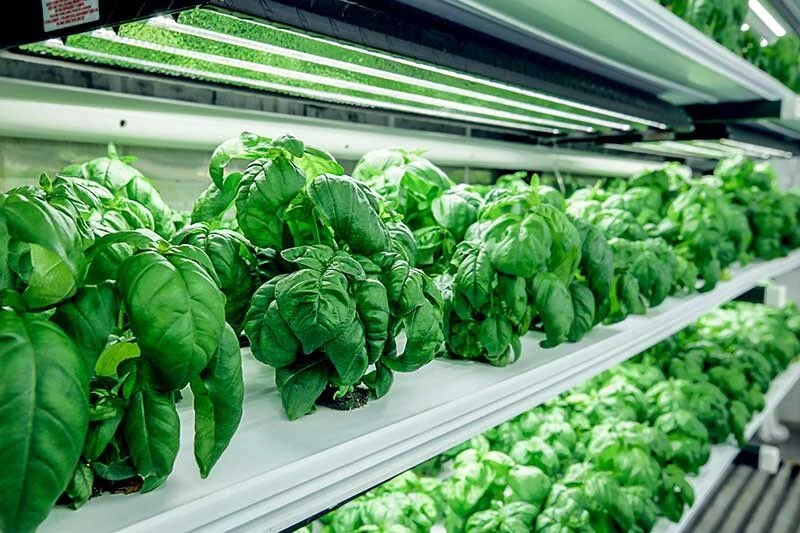
Dubai's Green Revolution Starts At Its Vertical Farms in The Middle of The Desert
Dubai is determined to start its green revolution through its ultra-modern vertical farm in the middle of the desert

Erika P. August 18, 2020
Dubai is determined to start its green revolution through its ultra-modern vertical farm in the middle of the desert. The country decided on this project, hoping to end its dependency on food imports. One of the vertical farms in Dubai, Al-Badia market garden farm, grows a range of vegetable crops in a multi-story set-up. Inside the facility, they make sure that the plants get proper lighting and irrigation while recycling 90% of the water the facility uses.
Basel Jammal, the farm's director, said that their project is a green revolution located in the middle of the desert. It is as if the crops were a guest in a five-star hotel complete with amenities essential for its survival: the right amount of light, humidity, heat, and water.
Inside the futuristic indoor farm that could revolutionize agriculture in the UAE Screenshot from YouTube ( Photo: YouTube)
Dubai's Vertical Farm
The United Arab Emirates relies heavily on food imports, and Dubai is no exception to that. However, food security is of concern, especially in a region where geopolitical tensions may arise unexpectedly.
The UAE started buying and leasing agricultural lands in east Africa and in other countries to prevent food shortages even in times of crisis more than ten years ago, . But they aim to eradicate dependence on food imports, giving birth to different agricultural strategies, such as stockpiling and ultra-modern agriculture.
Jammal said that his farm is the "choice for the future" as high-tech computers control the facility. They aim to produce their own crops all year round without relying on imports, or worrying about climate change, drought, or rainfall.
Several vertical farms have also started in Dubai in the past years, such as in less-developed areas in Al-Ain and the mountainous Ras al-Khaimah.
Abdellatif al-Banna uses the hydroponics technology in growing his pineapples that he sells online. He experimented with growing fruits, vegetables, and wheat on his farm. Even in colder months, he was able to produce enough grain for his family in what he hopes as a prototype.
Meanwhile, in an area not far from the skyscrapers of Dubai is a farm that cares for cows in air-conditioned sheds, helping the local market to produce dairy products. They were also rearing salmon in large tanks overseen by a control room despite the scorching heat outside the farm.
Dubai Has More Than Enough Food for the Entire Country
Although these vertical and high-tech farms are privately owned, the government is even encouraging such innovations, said Dubai's Food Security Committee chair Omar Bouchehab.
The Emirati government has launched a plan to raise agricultural production in Dubai by 15% in 2021 and boost using agricultural technologies, Bouchehab said.
AT THE BEGINNING OF THE PANDEMIC, Dubai did not experience shortages in food supplies, unlike other countries that saw shelves stripped of tinned goods, pasta, and toilet papers. It's all thanks to the airborne cargo services of the giant carrier Emirates. The country even promised to re-export various goods to its neighboring countries."
Dubai has an adequate infrastructure and a stock capable of meeting the needs of the United Arab Emirates, and even the needs of neighboring countries," said Fresh Market Executive director Redha al-Mansouri.
“Vertical Farming Costs Will Keep Going Down And Cut With Traditional Agriculture Costs"
“We want to bring sustainability to agriculture, and we are not going to be able to get there if we use traditional energy”, Cristián Sjogren, Co-founder and CEO of AgroUrbana says
Our plan is to supply our large operation with 100% renewable energy. AgroUrbana has three different approaches to it: one being, a solar farm with a combination of panels on the roof and on the ground. Secondly, a combination of powers on the roof and a power purchase agreement from a generator, coming from existing operating renewable power plants. The third approach is a contract with a generator to supply a 100% of our electrons from renewables, probably from both wind and solar farms. “We want to bring sustainability to agriculture, and we are not going to be able to get there if we use traditional energy”, Cristián Sjogren, Co-founder and CEO of AgroUrbana says.
Similar slope as LEDs five years ago
Chile started as a pioneer in renewable energy. “There’s a penetration of renewable energies going on in developing countries as they’re all going in the same road. We benefit from those competitive prices as well”, Sjögren continues. Pablo Bunster, Co-founder and CCO of AgroUrbana says: “When I started, ten years back, wind and solar were not as mature or competitive as they are today and there was a lot of discussion on what especially solar could do. Now, what you build is mostly wind and solar. That goes with technology and the curve of diminishing costs that you can see in technology when you factor in scale, plus where you can see it going.” Sjögren and Bunster see a similar trend in vertical farming. Such as, the cost of managing data, technology, and LED lighting.
Pablo Bunster and Cristián Sjögren
Bunster adds: “It’s relatable to solar panels as it’s the same slope. Five years ago, LEDs were considered very expensive, but too many people couldn’t do it because of the too high entry price to buy the lights. Today led is the new norm they go into everything and traditional light bulbs are out. When you see the slope on one side, which is data and on the other one, lights, you can see something very similar in the macrotrends of the renewable energy sector. There’s a huge opportunity to be able to be part of what could easily be a revolution in agriculture.”
‘Using technology to get there’
Sjögren states that vertical farming will become more evolving. AgroUrbana has the technology, the efficiency, the scale, and costs of capital. “As long there is more experience in this industry, you’ll see more capital and lenders as they will become more flexible and will understand the risks,” Sjögren says that food production needs to be increased by 70% in the next 30 years. “If we don’t bring technology to agriculture, we’re not going to get there. The good thing is that technology will allow us to increase performance and lower costs at the same time. There is going to be a point where vertical farming costs will keep going down and will cut with the traditional agriculture costs”, he adds.
Lettuce grown in AgroUrbana's pilot farm
Customer feedback
AgroUrbana received encouraging feedback from chefs to newspapers, to investors. Chefs are delighted with the food quality. The company started by focusing on high-end- and day-to-day restaurants. “After restaurants tried it, they were all about it and started posting about our products. They encouraged the quality of the product and that’s how we gained traction in the market around vertical farming”, Bunster affirms.
AgroUrbana has also received a few negative points on its packaging as 5% is plastic, despite in being recyclable. Bunster adds: “But we are working on this because we want 0% plastic in our packaging. Restaurants want to see prices; does it make sense on their profit line and do our customers keep buying from us? Then there is the consumers, a more sensitive sustainability group. They want to know how we grow our produce, what products were used for growing them and the impact food has on their planet. Chilean consumers would pay a higher premium to get a better product. We have addressed most of their concerns, which is: having a great product for the new generation. The story of traditional farming, which is a nice story but it doesn’t hold towards the future.”
A two-in-one product
Bunster continues: “AgroUrbana is already in the retail, e-commerce, restaurant and catering business. We might be about 10% above our closest competitor in retail but with far better product. The price signal communicates something in itself and we have that premium price.” According to Bunster, customers are looking for two things: convenience, that comes with ready to eat and health, healthy quality food. “They want to have food safety, where it’s produced and where it comes from, he says. You don’t find many products that can bring these two things in a package. They’re either convenient or healthy. Anything organic in Chile, has to be washed before eating, which is a choice and that’s perfect. But, we are able to bring the health of organic products and the convenience of more traditional products to the market.
Just a quick check-up on the microgreens
The millennials and generations after that have purchasing power are starting to control the market wallet. They’re not tech resistant, but they love technology. We have early on subscriptions, as people want our leafy greens in their houses every week. We need to take it further, which means doing it better and always drive down costs. It’s quality food for everyone and not only for a few.
Communicating the product to consumers “We are working on some storytelling videos so consumers know where the produce comes from. We just need to explain a little bit more on vertical farming. Especially in these times, vertical farming sounds as an abstract concept, but how do you communicate it? We just entered Chile’s top tier supermarket and talk are in place to further expand in retail. Our next step is to explain what vertical farming is through diagrams or an educational format”, Bunster says.
Sjögren says that millennials are 50% of the labor force. By 2025, they will be 75% of the labor force, so they are defining the market preference. He states that millennials are the generation that is reading product labels, more than any other generation in the past has done. “In the past, people were loyal to brands, volume vs. price, but that has completely changed. That is why this generation is perfect for vertical farming because they will value all these attributes that vertical farming brings. They will get informed; it’s just about finding the right communication strategy.”
For more information:
AgroUrbana
Cristián Sjögren, Co-Founder and CEO
cristian.sjogren@agrourbana.ag
Pablo Bunster, Co-Founder and CCO
pablo.bunster@agrourbana.ag
Publication date: Mon 17 Aug 2020
Author: Rebekka Boekhout
© HortiDaily.com

Selfridges To Grow Fresh Produce In-Store With Infarm
The move comes as part of Infarm’s global expansion, which is backed by a $100 million Series B funding round, and has seen Infarm partner with M&S, Farmdrop and now Selfridges in the UK, and retailers across ten markets including the US, Canada, France, Germany, and Japan
by Fiona Briggs
From today, shoppers in the iconic London Selfridges’ store will be able to purchase a range of fresh produce that has been grown directly in-store by Infarm – the world’s fastest-growing urban farming network.
As part of its continued UK expansion, Infarm has completed installation of one of its iconic modular vertical farming units into the Selfridges Foodhall. Shoppers will be able to purchase Infarm’s Super Leafy Greens containing a bundle of Scarlet kale, Nero di Toscana kale, and Golden Purslane and Infarm’s Spring Leafy Greens with Red Veined Sorrel, Mustard Mix and Red Stem Mizuna, both exclusive to the retail store. The produce will also be used in Selfridges’ restaurants.
The installation of Infarm’s technology launches in line with Selfridge’s major new sustainability initiative, Project Earth, which aims to change the way we shop by 2025. Each in-store Infarm farm unit uses 95% less water and 90% less transport than traditional agriculture, as well as 75% less fertiliser and no pesticides. Measuring just two square metres, these in-store farms produce more than 8000 plants per year.
The move comes as part of Infarm’s global expansion, which is backed by a $100 million Series B funding round, and has seen Infarm partner with M&S, Farmdrop and now Selfridges in the UK, and retailers across ten markets including the US, Canada, France, Germany, and Japan.
Erez Galonska, CEO and co-founder of Infarm, said: “Our partnership with Selfridges, as part of the launch of Project Earth, is a response to the fact that more and more customers care where their food comes from, and the impact their consumption has on the planet. The food industry needs to be proactive and innovative in its efforts to reduce environmental impact, and we’re proud to be part of that.”
With installation now complete, the seedlings have been planted and will be ready for harvesting from mid-September. Infarm farmers will visit the stores after each growth cycle to harvest and add new seedlings to the farm. The plants retain their roots post-harvest to maintain exceptional flavour and freshness, meaning they’re still alive when harvested. Prior to the mid-September harvest, shoppers will be able to purchase fresh Infarm produce freshly harvested and delivered to Selfridges directly from Infarm’s London plant hub.

Coronavirus Crisis Fuels Interest In Vertical Farming
The coronavirus pandemic has been a major worry for many British farmers, threatening access to agricultural labor and complicating international supply chains. But for proponents of indoor farming, the crisis has offered an opportunity
The coronavirus pandemic has been a major worry for many British farmers, threatening access to agricultural labor and complicating international supply chains. But for proponents of indoor farming, the crisis has offered an opportunity.
David Farquhar, chief executive of technology developer Intelligent Growth Solutions, says the pandemic has prompted a spike in interest in ‘vertical farms’, where batches of crops can be individually watered, fed and lit using LED lights, allowing them to be grown year-round with minimal labor near their markets, regardless of local soil or weather conditions.
At the company’s demonstration farm in Invergowrie near the Scottish city of Dundee, trays of produce stacked in 9 meter-tall towers are managed remotely from seeding to packaging. Humans only need to enter the towers for occasional maintenance. “You can run it entirely on robotics . . . You probably need to go in once every six months,” Mr. Farquhar said.
This higher productivity will have particular appeal to British farmers, who are facing a steep increase in costs because coronavirus restrictions have affected the arrival of seasonal workers from eastern Europe. Brexit may also make it more difficult to access labor from the bloc when the UK’s transition period expires at the end of the year.
Colin Campbell, chief executive of the James Hutton Institute, a research organization that hosts the IGS farm and another vertical farming company, Liberty Produce, said the global food supply system had generally worked well during the pandemic. But he added that the crisis had highlighted worries about food safety and the risks of relying on seedlings or produce grown far away from where it is consumed. “Covid-19 is making a lot of people rethink how we want to grow our food,” he said.
Read more at FT (Emiko Terazono)
Publication date: Tue 18 Aug 2020

In Partnership With Whole Cities Foundation - GrowGeneration to Donate Hydroponic Growing Systems to Urban Farms And Nonprofits
GrowGeneration Corp. announced its partnership with Whole Cities Foundation. Founded by Whole Foods Market in 2014, the independent, nonprofit organization is based in Austin, Texas, and has partnered with more than 190 community organizations in 100 cities across the U.S. to build thriving local food systems and improve health
GrowGeneration Corp. announced its partnership with Whole Cities Foundation. Founded by Whole Foods Market in 2014, the independent, nonprofit organization is based in Austin, Texas, and has partnered with more than 190 community organizations in 100 cities across the U.S. to build thriving local food systems and improve health.
The first projects to receive GrowGeneration support will be Newark Science & Sustainability and Greater Newark Conservancy, both recipients of the Whole Cities Foundation Fresh, Health Food Access grant. Both organizations have identified hydroponic growing as a goal for their community plans. Each group will benefit from an equipment grant. These two projects are part of a pilot that we expect will yield learnings over the course of the next year. GrowGen will provide equipment and expertise and partner with Whole Cities to evaluate community impact.
"Whole Cities Foundation is proud to partner with GrowGeneration, supplier of hydroponic equipment to 1000's of cultivators and growers, to support two locally-led Newark organizations in their efforts to increase production of food grown for their community members – hydroponically, said Nona Evans, Executive Director for Whole Cities Foundation. "The company and its team of experts provide support to growers across the nation. As the company expands, the GrowGen team is focused on ways they can use their knowledge and equipment to give back to communities focused on improving healthy food access."
Darren Lampert, GrowGeneration CEO stated, "As we have built a national chain of hydroponic garden centers, it has always been our mission to give back to the local communities. In our day to day operations, we see the results from growing hydroponically. We could not be prouder to partner with Whole Cities Foundation to donate hydroponic equipment and supplies to their community partners to support their gardens and increase access to fresh, healthy food."
"Our staff of over 250 dedicated team members, who have tremendous knowledge on growing hydroponically, are energized to lend a hand and their personal time to support Whole Cities Foundation. There is nothing more rewarding than participating with a community committed to growing its own food! Newark, NJ with its long history of urban agriculture is a great place to begin our partnership. We look forward to celebrating their first harvest together."
For more information:
GrowGenerationwww.growgeneration.com
Whole Cities Foundation
www.wholecitiesfoundation.org
Publication date: Fri 14 Aug 2020

The Museum Is Closed, But Its Tomato Man Soldiers On
David Litvin, an indoor crop specialist, tends the plants in a temporarily shuttered exhibition, “Countryside, The Future.” He moved to New York from Tel Aviv in February, along with his wife, Stefanie, and their Dutch shepherd, Ester, with a plan to stay six months harvesting the Guggenheim tomatoes.
Although the Guggenheim’s “Countryside”
Show Was Shuttered by The Pandemic,
its Crop of Cherry Tomatoes is Still Growing and Feeding New Yorkers.
David Litvin checks the tomatoes growing outside the Guggenheim Museum, where he is one of the few people who show up each day for work. Credit...Jeenah Moon for The New York Times
By Elizabeth A. Harris / May 17, 2020
The halls of the Guggenheim Museum are pretty quiet these days, with mostly just its ghosts and some security guards as company for the art.
Oh, and there’s the guy who takes care of the tomatoes.
David Litvin, an indoor crop specialist, tends the plants in a temporarily shuttered exhibition, “Countryside, The Future.” He moved to New York from Tel Aviv in February, along with his wife, Stefanie, and their Dutch shepherd, Ester, with a plan to stay six months harvesting the Guggenheim tomatoes. He was going to see the city, too.
“I went out once to a comedy bar, but that’s it,” he said.
The museum has been closed since March 13, but Mr. Litvin still walks across Central Park every day around noon from his rental on the Upper West Side to tend to his flock. “When you grow tomatoes on Fifth Avenue, you want to have the perfect tomatoes, there’s no room to mess up,” he said. “If I have ugly plants, I’ll hear it from the neighbors.”
In the evening, the light from the exhibit casts an alien glow onto Fifth Avenue.Credit...Jeenah Moon for The New York Times
These days, you can’t visit the mummies at the Metropolitan Museum of Art or soak in “The Starry Night” at the Museum of Modern Art. But you can still stand in front of the Guggenheim and get a good look at a thicket of cherry tomato vines and a really big tractor.
The tomatoes, housed in what looks like a radioactive shipping container on the sidewalk, were on view as part of the exhibition for just three weeks before the city folded in on itself. But they’re still growing, their vines snipped every Tuesday and donated to City Harvest, at least a hundred pounds at a time.
“This tomato-growing module couldn’t just be turned off with the lights,” said the Guggenheim curator Troy Conrad Therrien, who organized the exhibition with the architect Rem Koolhaas, and Samir Bantal of AMO, the research arm of Mr. Koolhaas’s firm. “We brought the exhibition to the street, and the street is still accessible.”
The tractor is a top-of-the-line Deutz-Fahr 9340 TTV Warrior. It has a computer in the cab, can lift more than 26,000 pounds, and looks completely out of place on the Upper East Side. But the tomatoes look nice there. The shed’s color matches the Guggenheim’s bone-white facade, and neat rows of vines — along with Mr. Litvin, when he’s there — are visible through a plate-glass window, bathed in a neon pink light that spills onto the sidewalk after sunset.


Left Image: Brioso tomatoes are the variety growing at the Guggenheim.Credit...Jeenah Moon for The New York Times
Right Image: A high-tech tractor, parked on the sidewalk, is part of the exhibition “Countryside, The Future.”Credit...Jeenah Moon for The New York Times

Urban Crop Solutions Launches New "Modulex Plant Factory" on Sept. 9th, 2020
Launch Webinar hosted by Henry Gordon-Smith, CEO of Agritecture, on Sept 9th, 2020 (9 am EDT, 3 pm CEST, 9 pm SGT - 45 minutes)
Register And Get A Sneak Preview on The
New www.urbancropsolutions.com Website
Launch Webinar hosted by Henry Gordon-Smith, CEO of Agritecture,
on Sept 9th, 2020 (9 am EDT, 3 pm CEST, 9 pm SGT - 45 minutes)
Indoor Vertical Farming is a fast-emerging agriculture technology that provides compelling solutions to the United Nation’s Sustainable Development Goals: waste less food and support local farmers (Goal 2), avoid wasting water (Goal 6), and provide decent work (Goal 8).
However, few early adopters are making a profit.
Urban Crop Solutions has worked tirelessly to find a sensible solution to the open issues many investors and growers still face today. The initial Capex or investment cost is high and creates the need for a scalable solution. The unique freshness, taste, and shelf life of the crops go to niche markets with ever-changing needs, which requires a Plant Factory to be extremely adaptable. Also, high labor costs push Indoor Farms to implement more automation and become more efficient.
Based on the experiences and feedback of the customers on the 1st generation products, a new generation Plant Factory was designed from the ground up. The company believes it developed a concept that ‘simply makes sense’.
The ModuleX, the “Sensible Plant Factory” is Scalable, Adaptable, and Efficient.
The ModuleX can be configured between 2 to 64 Grow Modules, which means that the Plant Factory is scalable. One Grow Module contains 86 m² (925 sq.ft) of growing surface, yielding about 6.000 kg/year (13.228 lbs/year) of fresh vegetables. Each separate module features an independent climate and nutrient system, allowing the mix of crops to be adaptable to customers’ needs.
The base price is an industry-low Capex of 1.800 EUR per m² growing surface ex-works (199 USD/sq.ft). The labor costs are reduced by the automated crop-to-person ‘BenchCarousel’. For example, the ModuleX-8 has 8 Grow Modules for a total of 688 m² (7.403 sq.ft). The base price is 1.238.400 EUR (approx. 1.47 mm USD) for an output of 44 ton/year of romaine lettuce (97.000 lbs/year). For mid-sized solutions under 5500 m² growing surface, this is probably the most efficient solution on the market today.
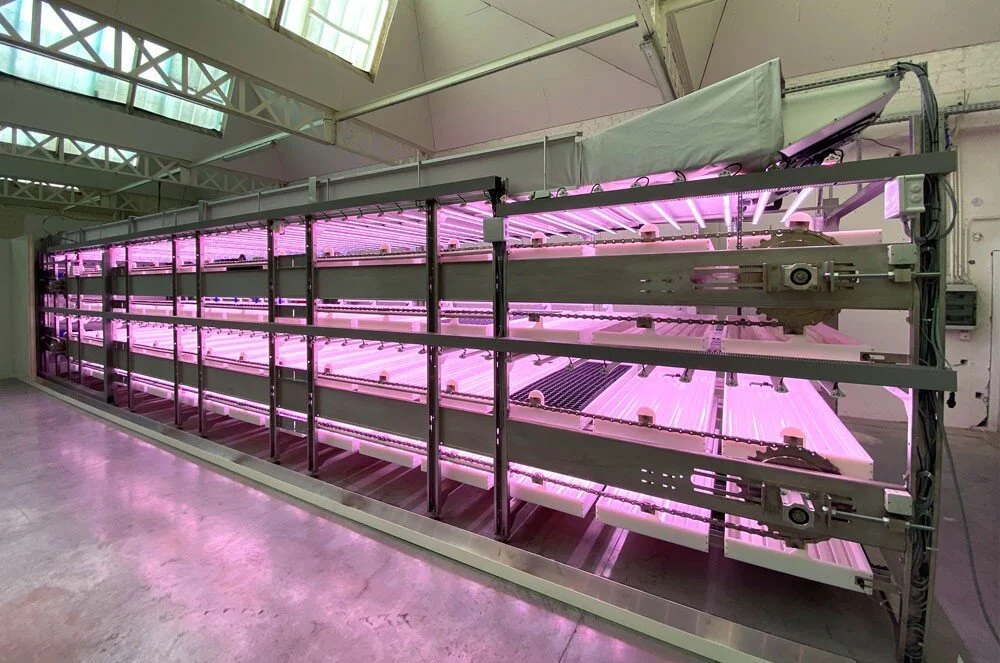

To help people in the long and confusing journey into indoor vertical farming, the company also initiates an end-to-end support program, with a free feasibility calculator, technical support, biological consulting, and contract research. Urban Crop Solutions also developed a Corona-proof support system for training, set-up, startup, and first harvest support of any ModuleX Grow Module, which all can now happen remotely.
Tom Debusschere, CEO of Urban Crop Solutions: “We’ve been listening closely to the feedback of our customers and we found improvements just about everywhere. But the breakthrough invention is the automated BenchCarousel. This new crop-to-person carousel brings any bench of your choice to you within 90 seconds. It also allows us to fit a growing surface of 86m² (925sq.ft) within a 40ft insulated freight container, which we believe is an industry record.
What you really pay for is growing surface, labor, and electricity, and the ModuleX Plant Factory offers a step-change improvement in each. We invite you to take a look at our new website, with the investment cost in full transparency, so you can quickly see which solution is the best fit for you.”
Urban Crop Solutions is an agtech pioneer in the fast-emerging world of ‘Indoor Vertical Farming’. Throughout years of research, 220+ ‘plant growth recipes’ were developed for efficient indoor growing. All drivers for healthy plant growth, such as optimal LED spectrum and intensity, nutrient mix, irrigation strategy, and climate settings are tested and validated daily in the company’s own Indoor Biology Research Center.
To date, Urban Crop Solutions has manufactured container Farms and a Plant Factory for clients throughout Europe, North America, and Asia. Urban Crop Solutions’ commercial farms are being operated for vegetables, herbs, and micro-greens for food retail, foodservice, and industrial applications. Research institutions operate the growing infrastructure of Urban Crop Solutions for scientific research on banana seedlings, flowers, hemp, and many more.
Visit www.urbancropsolutions.com for a full virtual tour.
For more information: www.urbancropsolutions.com
Brecht Stubbe, Sales Director brst@urbancropsolutions.com
Maarten Vandecruys, CTO mava@urbancropsolutions.com
Tom Debusschere, CEO tode@urbancropsolutions.com
European headquarters: Regional headquarters:
Grote Heerweg 67 800 Brickell Avenue, 1100 Suite
8791 Beveren-Leie (Waregem) Miami (FL 33131)
Belgium Florida
(+32) 56 96 03 06 +1 (727) 601 7158
Facebook: www.facebook.com/urbancropsolutions
Twitter: www.twitter.com/U_C_Solutions
LinkedIn: www.linkedin.com/company/urbancropsolutions
YouTube channel: http://www.youtube.com/c/UrbanCropSolutions
Instagram: https://www.instagram.com/urbancropsolutions/?hl=en

US (NY): Wall-To-Fork Fresh Produce Comes To Monsey
The iconic Evergreen Market is debuting a revolutionary 20-foot high geoponic (soil-based) wall farm that lets customers not only choose clean, fresh-picked produce but also see exactly where it comes from
The world of freshly harvested greens and herbs is looking up – literally – in Monsey, NY. The iconic Evergreen Market is debuting a revolutionary 20-foot high geoponic (soil-based) wall farm that lets customers not only choose clean, fresh-picked produce but also see exactly where it comes from.

The pesticide-free lettuce, kale, arugula, basil, and cilantro from Evergreen’s on-site farm are sold at competitive prices in individual pots, making the “buying local” experience more convenient than ever. Pesticide-free and grown in soil that is never exposed to bugs, all products are Star-K Kosher Certified for purity.
“We are gratified to be the first kosher supermarket in the country to introduce the Vertical farm,” said Malki Levine of Evergreen. “Our customers are very much looking forward to buying fresh produce that is grown in our own backyard rather than being transported on long hauls from farms across the country. They will also appreciate the significantly reduced level of infestation, a major concern of kosher consumers.”
Shoppers can visit the thriving vertical farm when they visit the store. The state-of-the-art system features a controlled, sterile environment with soil beds containing a proprietary mix of minerals and nutrients. Advanced sensors constantly monitor, irrigate, and fertilize the crops throughout every growth stage.
Evergreen’s wall farm is the latest installation from Vertical Field, an Israeli ag-tech company that produces innovative vertical agricultural solutions that help the environment, improve human health conditions, and make fresh, delicious produce available all year round.
Geoponic (soil-based) vertical farming yields a new crop every few days, ensuring that fresh greens and herbs will always be in season in Monsey. The sustainable and eco-friendly method produces cleaner, healthier, tastier veggies than those shipped from miles away. And, reduced soil-to-plate time means a longer shelf life and fewer hands involved – a welcome benefit in the age of Covid-19.
“We are extremely excited with the partnership with Evergreen,” said Guy Elitzur, the CEO of Vertical Field. “They are precisely the type of supermarket that has the right customer base and will successfully integrate the latest technological advances in geoponic farming.”
For more information:
Vertical Field
info@verticalfield.com
www.verticalfield.com
Publication date: Tue 18 Aug 2020

Canadian Space Agency Spends $450K on Latest Arctic Greenhouse
“The facility will be used to demonstrate plant production operations in a harsh environment and provide research opportunities while testing technology and operational procedures that may one day help astronauts grow food off Earth,” the Agency wrote
Postmedia News
August 14, 2020
Nunavut residents are being shown how to grow carrots by the Canadian Space Agency to the tune of $450,000.
The CSA described the effort as research on how to produce food during future space missions, according to Blacklock’s Reporter.
“The facility will be used to demonstrate plant production operations in a harsh environment and provide research opportunities while testing technology and operational procedures that may one day help astronauts grow food off Earth,” the Agency wrote.
The greenhouse, called the Nuarvik Food Production facility, is in Gjoa Haven — about 250 kilometres above the Arctic Circle, and is set to begin production in 2025.
“Developing capacity within the Gjoa Haven community for the long-term operation of the recently-installed facility is critical to its long-term success as both a local plant production facility and as a test bed for future space systems,” wrote staff.
The project is jointly funded with the Department of Agriculture and National Research Council, but the CSA didn’t reveal the total budget.
“The Agency has only recently commenced activities in the food production domain and is in the process of options analysis to explore how to help improve the accessibility of food across Canada including the North, with the aim of one day taking these lessons learned to help astronauts grow food off Earth,” wrote staff.
Past attempts at Arctic greenhouse operations have failed, according to research.
Sea cans are seen in Gjoa Haven, Nunavut in this undated handout photo. A pair of converted sea cans sitting on the rocky tundra are bringing fresh vegetables to the Arctic. The sea cans have been turned into greenhouses that are already producing lettuce and tomatoes for the residents of Gjoa Haven, well above the Arctic Circle. ARCTIC RESEARCH FOUNDATION / Via The Canadian Press

High-Tech Farmers Sow Seeds of Revolution In Dubai Desert
An ultra-modern vertical farm in the middle of the desert stands as a testament to Dubai's determination to spark a "green revolution" to overcome its dependence on food imports
18/08/2020
Dubai (AFP) An ultra-modern vertical farm in the middle of the desert stands as a testament to Dubai's determination to spark a "green revolution" to overcome its dependence on food imports.
Al-Badia market garden farm produces an array of vegetable crops in multi-storey format, carefully controlling light and irrigation as well as recycling 90 percent of the water it uses."
It's a green revolution in the middle of the desert," the farm's director Basel Jammal tells
Each plant is given the amount of light, humidity, heat, and water it needs. It's as if it were a guest in a five-star hotel," he says.
The COVID-19 pandemic, which disrupted global supply chains, has refocused attention on food security in the United Arab Emirates.
The UAE is rich in oil and ingenuity, but has little arable land and endures dry, baking summers.
That was not an issue decades ago when the area was sparsely inhabited by Bedouins.
But the wealth generated by oil discoveries since the 1970s sent expatriates flocking to the UAE.
Dubai now has more than 3.3 million inhabitants of 200 nationalities, relies largely on expensive desalinated water, and its food needs have grown and diversified.- 'Choices for the future' -Dubai, like the other six emirates that make up the UAE, is heavily dependent on imports, which make up 90 percent of its food needs according to official statistics.
Produce arrives from all over the world by air and at Dubai's state-of-the-art port, stocking supermarkets with a range that compares favourably to those of any Western capital.
But in a region where geopolitical tensions with nearby Iran frequently threaten to boil over, long-term food security and self-sufficiency are key goals.
More than a decade ago, the UAE began buying or leasing agricultural land abroad, mainly in East Africa, to lock in supply even in times of crisis.
Problems on the ground including political instability led it to look towards Australia and Eastern Europe.
But the need to address its over-reliance on imports has inspired other strategies including stockpiling and high-tech agriculture.
Jammal says his model farm where everything is controlled by computers, is a "choice for the future"."We no longer want to depend on imports. We want to produce locally, all year round, without worrying about climate change, rainfall or drought," he says.
Like Al-Badia, a number of farms are springing up in Dubai and less-developed areas like Al-Ain and the mountainous emirate of Ras al-Khaimah.
Abdellatif al-Banna is another independent farmer joining the innovation drive, growing pineapples in greenhouses using hydroponics -- without soil -- and selling his production via an internet platform.
At his farm in Al-Awir, Banna also experiments with growing fruits, vegetables, and even wheat in the cooler months -- producing enough grain for his family in what he hopes is a prototype.
Elsewhere, not far from Dubai's coastline and glitzy skyscrapers, several farms raise cows in air-conditioned sheds that help provide the local market with dairy products.
And in vast tanks overseen by a control room that duplicates Norway's sunrises and sunsets, salmon are being farmed in tanks, despite searing heat outside.
- Free of shortages -
Such farms are often private ventures but are actively encouraged by Emirati authorities, said Omar Bouchehab, who chairs Dubai's Food Security Committee.
Authorities have launched a plan to raise domestic agricultural production by 15 percent by 2021 and boost the use of agricultural technologies, he said.
At the beginning of the coronavirus crisis, while many developed cities saw shelves stripped of pasta, tinned goods, and toilet rolls, Dubai did not experience any shortages in fresh produce or staples.
Thanks to airborne cargo services via giant carrier Emirates, which repurposed passenger seats to boost capacity, Dubai was even able to ensure the re-export of various food products to its neighbours.
At the Fresh Market, a large wholesale enterprise, workers busily transported and stored tonnes of imported fresh food. Executive director Redha al-Mansouri was upbeat about the emirate's food security."
Dubai has adequate infrastructure and a stock capable of meeting the needs of the United Arab Emirates, and even the needs of neighbouring countries," he said.

Indoor Growing vs. Traditional Greenhouse Growing
Indoor growing offers some sustainability benefits because considerable savings can be made on water, nutrients and use of pesticides
Today, in theory, there is enough food on the planet to feed approximately 12 billion people, but the way it is distributed around the world is inefficient and unsustainable. As food is transported across the entire globe, its shelf life or freshness tends to deteriorate considerably and a lot of food often goes to waste. Indoor growing is a step closer to a new situation – one in which it is possible to grow locally produced, fresh food all year round, regardless of the weather and external conditions. It may even enable us to change the face of the food industry.
However, this requires a different way of thinking. “Indoor growing is different from growing in a greenhouse in several ways,” says Fred Ruijgt, Market Development Indoor Growing. “In an automated, glass greenhouse you have to deal with external influences such as wind, rain, and sun. These variables need to be managed as effectively as possible, with or without additional technology. The grower is constantly working to achieve a stable climate for the crop. Indoor growing allows you to create your own optimal climate. The grower determines the growing conditions, from light level to air circulation.”
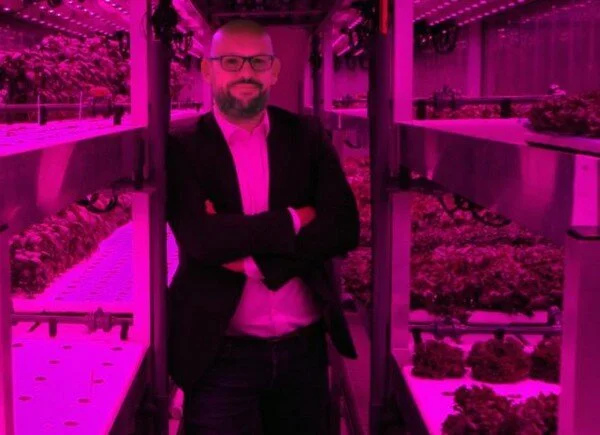
Fred Ruijgt
Comparing apples with oranges
According to Fred, many investors try to compare indoor growing with traditional horticulture. “In terms of investment and profitability, it is difficult to compare them,” he says. “It’s like comparing apples with oranges. It’s important to understand the differences between traditional horticultural practices and indoor growing. You can’t simply calculate what a greenhouse yields per square meter and compare it to an indoor farm. In a greenhouse you have to consider the crop cycle and in which months you can harvest and thus what you can supply to your customers. With indoor growing you can supply all year round, creating more opportunities to reach supply agreements with customers. But you also need to invest.
Indoor growing offers some sustainability benefits because considerable savings can be made on water, nutrients and use of pesticides. But, compared to a traditional greenhouse, much more artificial lighting is required. Also, the location and local sales potential should be included in the comparison. After all, a traditional greenhouse is not even an option in some countries, whereas in the Netherlands, for example, it probably costs two to three times more to grow fresh produce in an indoor farm than it does in a greenhouse.” Another difference is that traditional horticulture has traditional sales channels such as auctions, traders and cooperatives. That’s not the case with indoor growing – it’s more important to understand and collaborate with the entire chain.
Food security and food safety
The fact that indoor growing doesn’t have traditional sales channels is precisely what makes it special. “Indoor growing is clean and pesticide-free, resulting in high-quality and plannable production. An indoor farm can also be built in urban areas, which means that there’s always fresh, locally grown produce available for consumers. The product is often shipped directly from the indoor farm to, for example, the supermarket, so the route to the consumer is shorter. Therefore, in the case of indoor growing, it is important that the facility is an integrated part of the total chain: from suppliers to customers. That keeps the route nice and short,” continues Fred.
An indoor farm can be situated anywhere in the world and in any type of climate, whereas it is often not possible to build a greenhouse in certain areas. Fred: “In Singapore, for example, no more greenhouses can be built because there’s no agricultural or horticultural land available. An indoor farm offers a solution because it can be set up inside an existing building. This is an efficient alternative and it greatly reduces the dependence on food imports.”
Down to the consumer
The technology has already been proven in a number of large-scale indoor growing projects. So why isn’t this way of growing more common? “That’s because of several factors,” explains Fred. “Right now, indoor farms are mainly being integrated into existing retail chains. In addition, the demand largely comes from areas with a high average income. The existing retail chains have a vision and they always want to deliver good-quality products, so it makes sense for them to invest in this. But what are consumers prepared to pay for a fresh head of lettuce, for example,? If consumers start to value fresh and good-quality food more, entrepreneurs will be more willing to invest in a more sustainable way of producing food.”
For more information:
Priva
www.priva.com
contact.priva@priva.nl
Publication date: Tue 18 Aug 2020

August Indoor Science Cafe August 25th, Tuesday 11:00 AM EST
This month's cafe will discuss a most frequently asked question -- "Are indoor-grown veggies more nutritious?"
This month's cafe will discuss a most frequently asked question -- "Are indoor grown veggies more nutritious?"
"Nutritional Composition of CEA Leafy Greens: a Case Study on Carotenoids of Kale Grown in Field, Greenhouse, or Indoors"
by
Dr. Neil Mattson (Cornell University)
Dr. Marianne Nyman (Rensselaer Polytechnic Institute)
Please sign up so that you will receive Zoom link info.
Indoor Ag Science Cafe is an open discussion forum, organized by Chieri Kubota (OSU), Erik Runkle (MSU), and Cary Mitchell (Purdue U.) supported by USDA SCRI grants.
Sign Up Here
Cafe Archive & QA Forum
Please visit the Indoor Ag Science Cafe page in OptimIA website and ask your questions.
Submit Your General Questions for 'Indoor Ag Sci Queries'!
Please submit your questions (anonymously if you wish) about sciences and technologies of indoor farming to this submission site. Any questions are welcome! The site is always open for your questions. Selected questions will be discussed in our future Indoor Ag Science Queries series.
Indoor Ag Science Cafe is organized by the OptimIA project team funded by USDA SCRI grants program.
Previous café recordings are available in the OptimIA project website.
Please contact for more info: kubota.10@osu.edu