

Welcome to iGrow News, Your Source for the World of Indoor Vertical Farming

CubicFarms Announces Sale of 16-Machine Commercial-Scale System in Armstrong, BC
"We invite growers to contact us for a visit to our facility in Pitt Meadows, BC to get a first-hand view of our technology and learn how we can help them scale up their business
VANCOUVER, BC, July 10, 2020,/CNW/
CubicFarm® Systems Corp. (CUB.V) ("CubicFarms" or the "Company") is pleased to announce that its automated, controlled-environment system has been selected by a new customer to grow commercial quantities of leafy greens for retail markets in the Okanagan region in British Columbia, Canada .
The Company has finalized an agreement for the sale of 16 CubicFarms machines, and received a deposit from a British Columbia -based agriculture industry expert specialized in equipment sales in Western Canada.
CubicFarms CEO Dave Dinesen commented: "We are excited to be working with our new customer who plans to supply commercial-scale greens in the Okanagan region. While the Okanagan Valley is a great location for growing fresh produce, the weather can affect growing seasons. CubicFarms allows our customers to eliminate the weather variable and grow locally, all year round.
"We invite growers to contact us for a visit to our facility in Pitt Meadows, BC to get a first-hand view of our technology and learn how we can help them scale up their business. Interested parties can also opt for tours via live video calls, or receive the same in-person tour experience through our virtual tour available on our website. We look forward to continue serving our customers and sales leads to help them supply their markets with fresh produce and nutritious livestock feed."
The system includes 14 growing machines, two propagation machines, and an irrigation system, representing a total of US$2,145,000 (excluding installation and shipping) in anticipated sales revenues to the Company. The system is expected to be installed by the end of the year in Armstrong, BC.
The Company has a current backlog of approximately US$20 million representing 161 machines under deposit and awaiting installation – demonstrating continued sales momentum due in part to the growing demand for its systems. The current backlog is anticipated to be recognized in revenue in late-2020 to mid-2022.
Neither the TSX Venture Exchange nor it’s Regulation Services Provider (as that term is defined in the policies of the TSX Venture Exchange) accepts responsibility for the adequacy or accuracy of this release.
About CubicFarm® Systems Corp.
CubicFarm Systems Corp. ("CubicFarms") is a technology company that is developing and deploying technology to feed a changing world. Its proprietary technologies enable growers around the world to produce high-quality, predictable crop yields. CubicFarms has two distinct technologies that address two distinct markets. The first technology is its patented CubicFarm™ System, which contains patented technology for growing leafy greens and other crops. Using its unique, undulating-path growing system, the Company addresses the main challenges within the indoor farming industry by significantly reducing the need for physical labour and energy, and maximizing yield per cubic foot. CubicFarms leverages its patented technology by operating its own R&D facility in Pitt Meadows, British Columbia, selling the System to growers, licensing its technology, and providing vertical farming expertise to its customers.
The second technology is CubicFarms' HydroGreen System for growing nutritious livestock feed. This system utilizes a unique process to sprout grains, such as barley and wheat, in a controlled environment with minimal use of land, labour and water. The HydroGreen System is fully automated and performs all growing functions including seeding, watering, lighting, harvesting, and re-seeding – all with the push of a button – to deliver nutritious livestock feed without the typical investment in fertilizer, chemicals, fuel, field equipment, and transportation. The HydroGreen System not only provides superior nutritious feed to benefit the animal but also enables significant environmental benefits to the farm.
Cautionary statement on forward-looking information
Certain statements in this release constitute "forward-looking statements" or "forward-looking information" within the meaning of applicable securities laws, including, without limitation, statements with respect to the customer's ability to supply leafy greens to the Okanagan region, CubicFarms' expected revenue recognition, and installation of the system by the end of the year. Such statements involve known and unknown risks, uncertainties, and other factors including evolving market conditions, which may cause the actual results, performance, or achievements of CubicFarm Systems Corp., or industry results, to be materially different from any future results, performance, or achievements expressed or implied by such forward-looking statements or information including the Company obtaining the approval of the Offering from the TSX Venture Exchange. Such statements can be identified by the use of words such as "may", "would", "could", "will", "intend", "expect", "believe", "plan", "anticipate", "estimate", "scheduled", "forecast", "predict", and other similar terminology, or state that certain actions, events, or results "may", "could", "would", "might", or "will" be taken, occur, or be achieved.
These statements reflect the Company's current expectations regarding future events, performance, and results and speak only as of the date of this news release. Consequently, there can be no assurances that such statements will prove to be accurate and actual results and future events could differ materially from those anticipated in such statements. Except as required by securities disclosure laws and regulations applicable to the Company, the Company undertakes no obligation to update these forward-looking statements if the Company's expectations regarding future events, performance, or results change.
SOURCE CubicFarm Systems Corp.
View original content to download multimedia: http://www.newswire.ca/en/releases/archive/July2020/10/c9695.html

Future of Indoor Vertical Farming With Microgrids
Schneider Electric’s Don Wingate discusses how microgrids can help the indoor vertical farming movement realize its full potential
09-07-2020 | Microgrid Knowledge
Schneider Electric’s Don Wingate discusses how microgrids can help the indoor vertical farming movement realize its full potential.
While indoor agriculture has steadily gained traction in recent years as the world seeks alternative ways to feed growing populations, the uncertainty of today’s global pandemic has accelerated a rethinking of the way we obtain our food. In the last few months, modern supply chains experienced volatility like never before and it wasn’t long before we started to see the impact beyond medical gear and personal protective equipment and began to affect food production. According to the Institute of Supply Chain Management, 75% of companies reported some kind of supply chain disruption due to COVID-19.
Indoor vertical farming is emerging as an alternative to conventional farming because it both requires lower land-use and introduces the opportunity to bring agricultural production closer to consumers — shortening supply chains and increasing footprint productivity. This is especially important during times of turmoil, which is broader than the current pandemic as weather events and changing climate patterns continue to put constant strain on traditional farming practices. In addition to shortening supply chains, indoor farming has many other advantages in comparison to traditional agriculture such as using zero pesticides, employing 95% less water, and reducing food waste. Health benefits also include fresher food, increased urban availability, and pollution reduction.
Despite the major advantages, there is one looming barrier to mainstream adoption: the process is very energy-intensive.
Solving for the energy intensity problem
Vertical farming presents a unique opportunity to grow food on already developed land and increase domestic food production, but the energy demand required to power these facilities is much higher than other methods of food production. In fact, we’ve identified indoor agriculture as one of the four major drivers that will increase electricity consumption in the next decade, along with electric vehicles, data centers, and the electrification of heat. This is why more of today’s modern farming companies are turning to microgrids as a possible solution to ease their energy challenges.
Although most of today’s facilities are not equipped to meet the electricity needs of an indoor agriculture operation, microgrids can provide dynamic energy management and the resources required to support maximum productivity, sustainability, and energy efficiency. They can provide localized power generation and utilize renewable distributed energy resources to help deliver power and reach clean energy goals, while also allowing users more control and reliability. Additionally, microgrids can capture and repurpose CO2 emissions to help in crop production.
Moreover, microgrids provide resilience from unexpected outages that could result in a loss in production. A key advantage of vertical farms is their ability to allow crops to grow year-round, and communities rely on their ability to deliver on this promise. Microgrids not only have several clean energy benefits, but they also increase business continuity that maximizes output. Given their ability to operate either in conjunction with or as an island from the utility grid, they can keep the farm producing even when the grid goes down.
The case for investment: Securing an affordable solution
Building and operating a vertical farm requires various technologies that can translate to high startup cost and design complex processes. At the same time, it is more expensive to maintain a vertical farming operation than traditional field farming. Microgrids offer a compelling value proposition, but they’re inherently complex machines and not many companies have the upfront capital or in-house expertise needed to make the investment. Fortunately, innovative business models such as energy-as-a-service (EaaS) help provide price certainty and make the investment attainable.
For example, a modern farming company, Bowery Farming, created a facility wherein crop production is 100 times more efficient than traditional farmland. This generated a need for a greater need for reliable, efficient power. Thus, the company made the decision to integrate a hybrid microgrid system that would feature a rooftop solar array, natural gas generator, and a lithium-ion battery energy storage system through an EaaS business model. Through EaaS, Bowery Farming saved upfront capital that can be used toward additional operational investments.
By 2050, the world’s population is expected to grow by another 2 billion people, and feeding it will be a major challenge. According to the projections of the Food and Agriculture Organization, we have to increase overall food production by 70% by this timeline. Coupled with new concerns that have surfaced as a result of today’s global pandemic and unstable weather, vertical farming will play a key role in future food production and institutions will take notice. However, the technology that will help ease some of the industry’s ongoing energy challenges will be just as important to aid the transition.
Don Wingate is the VP of utility and microgrid solutions at Schneider Electric.
Source: Microgrids Knowledge
Photo Courtesy of Microsoft News

Chicago-Area Greenhouse BrightFarms Expands As Pandemic Fuels Demand For Local Lettuce, Spinach and Other Greens
BrightFarms’ Rochelle greenhouse, which annually supplies 1 million pounds of lettuce, spinach, arugula, basil and other greens to Mariano’s and other regional grocery stores, is increasing production by 40% by adding more hydroponic ponds to the two-acre facility, CEO Steve Platt said
CHICAGO TRIBUNE | JULY 07, 2020
Silvia Penaran grabs a handful of spring mix to pack in a container at BrightFarms on July 1, 2020, in Rochelle. (Stacey Wescott / Chicago Tribune)
BrightFarms is boosting capacity at its Chicago-area greenhouse as the pandemic-driven rise in cooking at home fuels demand for locally grown greens.
BrightFarms’ Rochelle greenhouse, which annually supplies 1 million pounds of lettuce, spinach, arugula, basil and other greens to Mariano’s and other regional grocery stores, is increasing production by 40% by adding more hydroponic ponds to the two-acre facility, CEO Steve Platt said.
BrightFarms was seeing year-over-year sales growth of about 20% before the COVID-19 pandemic hit the U.S., but in March and April growth jumped to 40% as stay-at-home orders set in and customers flocked to grocery stores, Platt said. The at-home cooking trend has remained steady, with growth now leveled out above 30%.
“We’re seeing really great demand,” said Platt, whose company, based in Irvington, New York, has other greenhouses in Northern Virginia, Ohio, and Pennsylvania and is building one in North Carolina. “The pandemic has supercharged that.”
Baby romaine lettuce fills sections of the greenhouse at BrightFarms on July 1, 2020, in Rochelle. (Stacey Wescott / Chicago Tribune)
Greens grown indoors, either in sprawling sunlit greenhouses or under artificial lights in vertical farms, occupy a tiny niche of the market. But they have been gaining popularity in recent years in the Midwest as consumers opt for more local, pesticide-free produce that doesn’t travel thousands of miles from California or Arizona farms to reach their dinner plates.
In addition to addressing environmental and freshness concerns, growing year-round in a controlled environment guards against bacterial contamination that lead to illness and recalls.
Local greenhouses had an advantage as demand from grocery stores surged during the rush to stockpile food during the pandemic because they could pivot quickly while some of the large operators of field-grown produce couldn’t get enough product to stores shelves quickly enough, Platt said.
“When the customers needed product we were able to deliver it,” Platt said. BrightFarms added 800 stores to its distribution this year and now has 2,000 customers nationwide, he said.
Angelica Vasquez cleans the floors at BrightFarms in Rochelle on July 1, 2020. (Stacey Wescott / Chicago Tribune)
In Chicago, locally grown greens represented 11.5% of the tender leaf packaged salad market during the first half of this year, up from 9.4% last year and 7.9% in 2018, according to data from the market research firm SPINS provided by Bright Farms. Nationally the share is much lower, at 3.2%.
The growing interest fits with a broader trend toward more premium foods, with people willing to pay more for products they perceive as healthier. A clamshell of BrightFarms romaine or spinach is $2.99, twice the cost of the cheapest option though on par with field-grown organic produce, Platt said.
But Platt attributes the growth not only to consumer demand but also retailer demand, as stores try to avoid the disruption of recalls. Last month certain bagged garden salads from Jewel-Osco, Aldi, Hy-Vee, and Walmart were recalled due to suspected contamination of cyclospora, a bacteria found in human feces, and E. coli illnesses have prompted mass recalls of romaine lettuce in recent years.
Other indoor growers also are expanding in response to increased demand.
Gotham Greens last year more than doubled its capacity to serve the Chicago area when it opened a new 100,000-square-foot greenhouse in Pullman, a stone’s throw from its existing 75,000-square-foot greenhouse on the roof of the Method soap manufacturing plant.
MightyVine, which grows hydroponic tomatoes in a greenhouse in Rochelle, is doubling its footprint to 30 acres.
Alexia Elejalde-Ruiz
Alexia Elejalde-Ruiz covers the food industry for the Chicago Tribune's business section. Prior beats include workplace issues, the retail sector and lifestyle features, plus stints at RedEye, the Daily Herald and the City News Service. Alexia grew up in Washington, D.C., and has her degree in international relations from Brown University.

VIRTUAL SUMMIT: Connecting Technology & Business To Create Healthy, Resilient Food Systems - July 23, 2020
By sharing best practice from around the globe, and facilitating new connections and collaborations, the summit offers an invaluable platform to develop new business and accelerate projects across the Indoor AgTech ecosystem
The Indoor AgTech Innovation Summit is going virtual! This year’s summit will be live online on July 23, 2020, providing an essential opportunity for the industry to meet, network, https://indooragtechnyc.com/, and exchange ideas at this critical time for our industry.
The world’s leading farm operators, food retailers, and investors will present live, before hosting virtual discussion groups on the emerging trends and technologies that will shape your business as we emerge from the current crisis into a redesigned food system:
Key Themes:
· Finding Growth in Crisis: Responding to a Rapidly Changing Food Landscape
· Scaling Up: Co-locating Food Production and Distribution Centers
· Enhancing Nutritional Value: Towards a Perfect Plant Recipe
· Optimizing Seeds for Indoor Agriculture: Breeding a Competitive Advantage
· Analytics and the Cloud: Digital Integration to Optimize Indoor Agriculture
· Robotics: Developing a Contactless Food System
· Energy Consumption: Driving Efficiency and Economic Viability
· Financing Growth: Can Capital Keep Pace with Industry Demand?
· Consumer Awareness: How to Build a “Holistic” Indoor Brand
All participants can schedule video 1-1 meetings with potential partners and clients throughout the summit, and for an extended period before and after the sessions.
By sharing best practice from around the globe, and facilitating new connections and collaborations, the summit offers an invaluable platform to develop new business and accelerate projects across the Indoor AgTech ecosystem.
Summit website: https://indooragtechnyc.com/
Registration:
- One summit pass Indoor AgTech: $195.00
- Start-Up pass: $95.00 / Please contact jamie.alexander@rethinkevents.com to enquire about the criteria to qualify for special rates.
Vertical Farming With Hydroponics
In recent years, urban farming using vertical hydroponic systems has gained a lot of attention. Using the latest technology, these hydroponic farms are able to optimize plant growth, providing fresh, local produce, while minimizing water usage, space, transport, and pesticides
In recent years, urban farming using vertical hydroponic systems has gained a lot of attention. Using the latest technology, these hydroponic farms are able to optimize plant growth, providing fresh, local produce, while minimizing water usage, space, transport, and pesticides. However, whether hydroponic farms are superior to traditional farming methods and whether they can replace them has been subject to controversy.
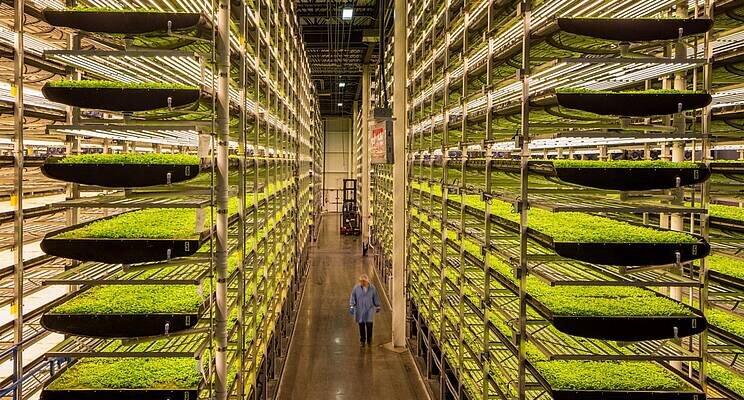
AeroFarms vertical farming facility source: https://time.com/collection/best-inventions-2019/5733085/aerofarms/
What is a hydroponic system?
Hydroponics refers to the soilless techniques used to grow plants. There are a number of varieties of hydroponic systems, including aquaponics where live fish are used to provide fertilizer for the plants, traditional hydroponics which involves adding chemical solutions of the required nutrients, and aeroponics which uses a nutrient-infused mist. Hydroponic systems can be grown in a greenhouse using natural light, or more commonly in a vertical system using LED lights, to save space.
Aerofarms aeroponic system uses a nutrient infused mist. Source: https://aerofarms.com/technology/
Advantages of hydroponics
1. No soil
The earth has a finite coverage of arable land on which crops can be grown. Climate change and destructive farming practices cause loss of this soil. Soil erosion is one of the greatest threats to food security. As a result there is a growing demand for alternative, innovative approaches to provide food for the growing population. Hydroponics is one of these, providing a soilless system that can be used anywhere, particularly suited to cities.
2. Transport
As previously mentioned, hydroponic systems offer the advantage of the ability to be grow anywhere, even in the middle of a soilless city. As a result, fresh produce can be made available locally, sold in restaurants and farmers markets with minimal transport. This helps minimise greenhouse gas emissions as well as minimise nutrient loss and damage of produce, as leafy greens are quick to lose their nutritional content once harvested. Better yet, many hydroponic farms allow transport of the live produce to the market, providing the freshest possible option.
3. Reduced water usage
Hydroponic systems can use up to 10 times less water compared to traditional soil-based cultivation due to the recirculation of the water used. This offers a huge advantage as water shortage is of great concern, with field-based agriculture being one of the greatest consumers of freshwater sources - up to 80% of ground and surface waters in the U.S. Therefore, hydroponics offers a sustainable option for crop cultivation, with the growing population causing an increasing demand for food and water.
4. Controlled environment
Growing indoors allows better control of temperature, light, air composition and pests. As a result, crop growth rates, quality and yield can be maximised and can also be grown year-round. Therefore, these indoor farms can play an important role in filling the market gap, providing fresh produce in all seasons.
5. Less space
Indoor hydroponic farms are typically grown vertically, with LED lights for each layer of crops, this allows maximum usage of small spaces making it a viable option for growing crops in the city homes, in a spare room or basement. Moreover, in hydroponic systems plant roots don’t spread out as much in the search for nutrients like when grown in soil, as the roots are suspended directly in nutrient-rich solution. As a result, it is possible to grow crops much closer together, saving space.
6. Less need for herbicides and pesticides
Due to the controlled, soilless environment, pests and disease are minimised. As a result there is little need for use of chemical herbicides and pesticides which is a big bonus for health and food safety, with often no need to even wash the harvested crops.
Disadvantages and challenges of hydroponics
1. Organics debate
It has been subject to debate whether hydroponic systems should be permitted organic certification. Standard hydroponics typically uses a chemical nutrient solution, which are often not organically sourced. Moreover, it is controversial whether the absence of the soil microbiome may effect the food quality, with unknown impacts on the human microbiome, as increasing evidence suggests that the microbes we obtain from food may be an important contribution to our health.
2. limited crop variety
Due to the high light demands of fruiting plants, often requiring a wider light spectrum with a longer growth period, hydroponic technology is currently mostly limited to leafy greens due to costs. Therefore, hydroponics can in no way be seen as a complete replacement for traditional farming methods. Despite this, technological advancements are constantly improving hydroponic growth, possibly making it a viable option for a wider range of crops in the future.
3. Technical knowledge and difficulties
Understanding of the technical set-up of the hydroponics system and plant growth requirements is essential for preventing system failures. Leakages can occur and different crop types may require vastly different nutrient, temperature and lighting conditions. In addition, the close proximity of water and electrics poses risk and careful, regular monitoring of the system is required.
4. initial expenses
Although setting up a hydroponic system can be done on a budget with minimal costs, on a commercial scale, the specialist equipment required can be expensive. After the initial set up costs will be limited mainly to electricity and nutrient costs, the increased plant growth rates and yield often outweigh these added costs.
Concluding remarks
Despite the number of challenges and limitations associated with vertical farming with hydroponic systems, it still offers great potential to contribute to a more sustainable future of farming. It is important to emphasize that vertical farming and hydroponics is in no way a viable replacement for traditional farming practices but an alternative option, particularly suited to cities to help support the demand for fresh, locally-sourced healthy greens, with the growing population. Technological advancements are expected to further improve the costs and efficiency of plant growth in hydroponic systems, giving it high hopes for the future.

Tepco Unit Launches Giant Vertical Farm in Shizuoka Powered by Artificial Lighting
A unit of Tokyo Electric Power Company Holdings Inc. has launched an indoor vertical farm in Shizuoka that can yield up to 5 tons of produce a day — one of the world’s largest such facilities to rely solely on artificial lighting
KYODO
JUL 5, 2020
A unit of Tokyo Electric Power Company Holdings Inc. has launched an indoor vertical farm in Shizuoka that can yield up to 5 tons of produce a day — one of the world’s largest such facilities to rely solely on artificial lighting.
Tepco Energy Partner Inc. started running the farm Wednesday in Fujieda, Shizuoka Prefecture, to grow lettuce and other leafy greens by using light-emitting diodes.
The company aims to initially produce about a ton of vegetables per day at the 9,000-sq.-meter facility and begin shipping around August. It said it plans to raise the output to 5 tons a day by next year and move into the black in 2023.
Vertical farming via artificial lighting has been drawing attention as a way to ensure stability in food production and distribution because it is not affected by undesirable weather and other risks, such as epidemics, the Tepco unit said.
Such facilities are also expected to provide solutions to problems faced by Japanese agriculture, such as the decline in the number of farmers and the aging of those still working their land, it added.
Tepco Energy Partner, which engages in electricity retailing, also said an indoor environment allows farmers to better maintain quality and freshness, which can help reduce food waste.
“We would like to make the most of our energy-saving technologies,” said an official of the company. “Since it’s indoors, vegetables are resistant to abnormal weather, and they are also safe because they are grown without using agrichemicals.”

See You Next Week? Take A Virtual Tour of The Greenery™ With Us! July 16, 2020 - 4:30 PM EST
Explore the Freight Farms Greenery™ alongside farm expert Derek, where you'll learn about the basics of controlled environment agriculture, hydroponics, and vertical farming...from the comfort of your own home!
Come Check Out The Greenery™
Explore the Freight Farms Greenery™ alongside farm expert Derek, where you'll learn about the basics of controlled environment agriculture, hydroponics, and vertical farming...from the comfort of your own home!
Joining is simple – register for free below.
RSVP
When
Thursday, July 16th, 2020
4:30-5:15 PM EST
Where
Zoom Video
Click Here To Reserve Your Spot!
US: IDAHO - PODCAST - In Episode 6, We Spoke With Dave Ridill, A Shipping Container Hydroponic Farmer That Supplies The Teton Valley
We discuss the learning curve of vertical farming, the impact that Covid-19 has had on the industry and the importance of being nimble as an entrepreneur
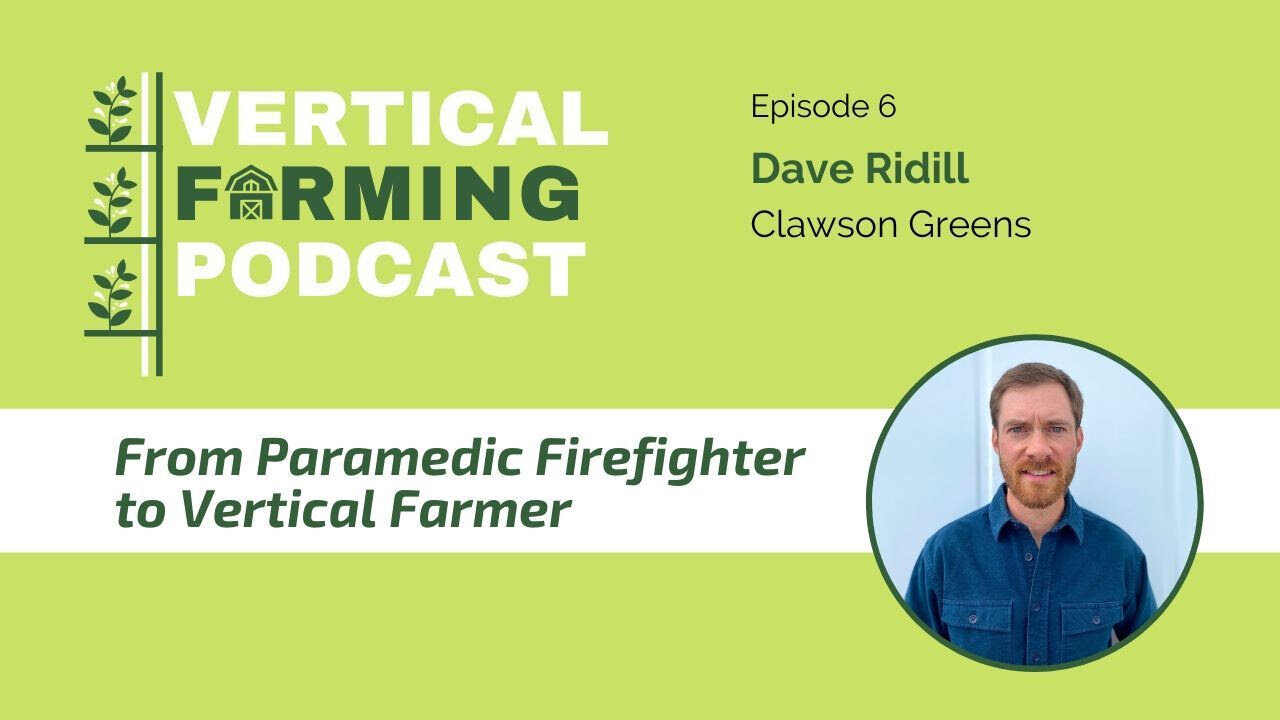
In Episode 6, we spoke with Dave Ridill, a hydroponic farmer as well as the owner and head of operations at Clawson Greens, an organization that supplies Teton Valley and surrounding areas with fresh clean greens, locally grown year-round.
We discuss the learning curve of vertical farming, the impact that Covid-19 has had on the industry and the importance of being nimble as an entrepreneur.
Dave tells the story of how he chose a career as a vertical farmer over that of a paramedic firefighter and the impact he wishes to make in AgTech.
Listen to our conversation and read the full show notes
here: https://verticalfarmingpodcast.com/s1e6
VIDEO: The Supermarkets That Grow Their Own Food
There's a food-tech revolution happening in our supermarkets, and it could change the way we eat forever
Jul-2020
Ian Dickson
There's a food-tech revolution happening in our supermarkets, and it could change the way we eat forever.
To View The Video, Please Click Here.
From romaine lettuce to curly parsley, salads and herbs are leaving the fields behind to be grown in-store in front of customers' eyes.
Under the glare of artificial light and computer-controlled temperatures, these pioneering plants are part of an ambitious vertical farming project. One that could fundamentally change how fresh food is grown and help dramatically reduce food miles (the distance food travels to get to your plate) and the use of natural resources.
Behind the revolution is Germany-based Infarm, one of a growing number of companies weaving technology and food production together.
Infarm sells supermarkets a modular growing chamber, a bit like a giant fridge, with plants stacked in rows to ceiling height, where they're remotely controlled through a cloud-based and "internet of things" enabled farming platform.
Currently, Infarm supplies more than 700 local "farms" across the world, from The Netherlands to Japan, and harvests in excess of 250,000 plants a month.
So far, these farms have saved 2.4 million kilometers of transport, 27 million liters of water and 38,000 square kilometers of land.
Infarm are based in Berlin, and were founded in 2013. /Infarm
Emmanuel Evita is the global communications director at Infarm and he says it's vital to grow fresh produce as close as you can to where it will be consumed because of the environmental burden of agriculture supply chains.
He tells CGTN Europe: "At Infarm, we want to find another way. We want to practice a form of agriculture that is resilient, sustainable and beneficial to our planet."
The farms are designed to easily "plug into any urban space." As Evita says: "Our in-store farms each occupy less than 2 square meters of ground. When these plants are purchased, they are so fresh they are still living."
Over in the UK, supermarket chain M&S has been trialing Infarm at seven of its London branches. It says that each of its micro-farms produces a crop equivalent to 400 square meters of farmland.
And because they are controlled by self-learning internet of things technology, the plants are continually monitored and receive only the optimum level of light, water and nutrients.
As a result, M&S says its store-grown plants use 95 percent less water and 75 percent less fertilizer than traditional soil-grown plants.
"Infarm's innovative farming platform is a fantastic example of what can happen when passionate agricultural, food and technology experts work together," said Paul Willgoss, director of food technology at M&S Food. "We operate as part of a complex global food supply chain and want to understand the emerging technologies that could help provide more sustainable solutions, while also delivering fantastic products."
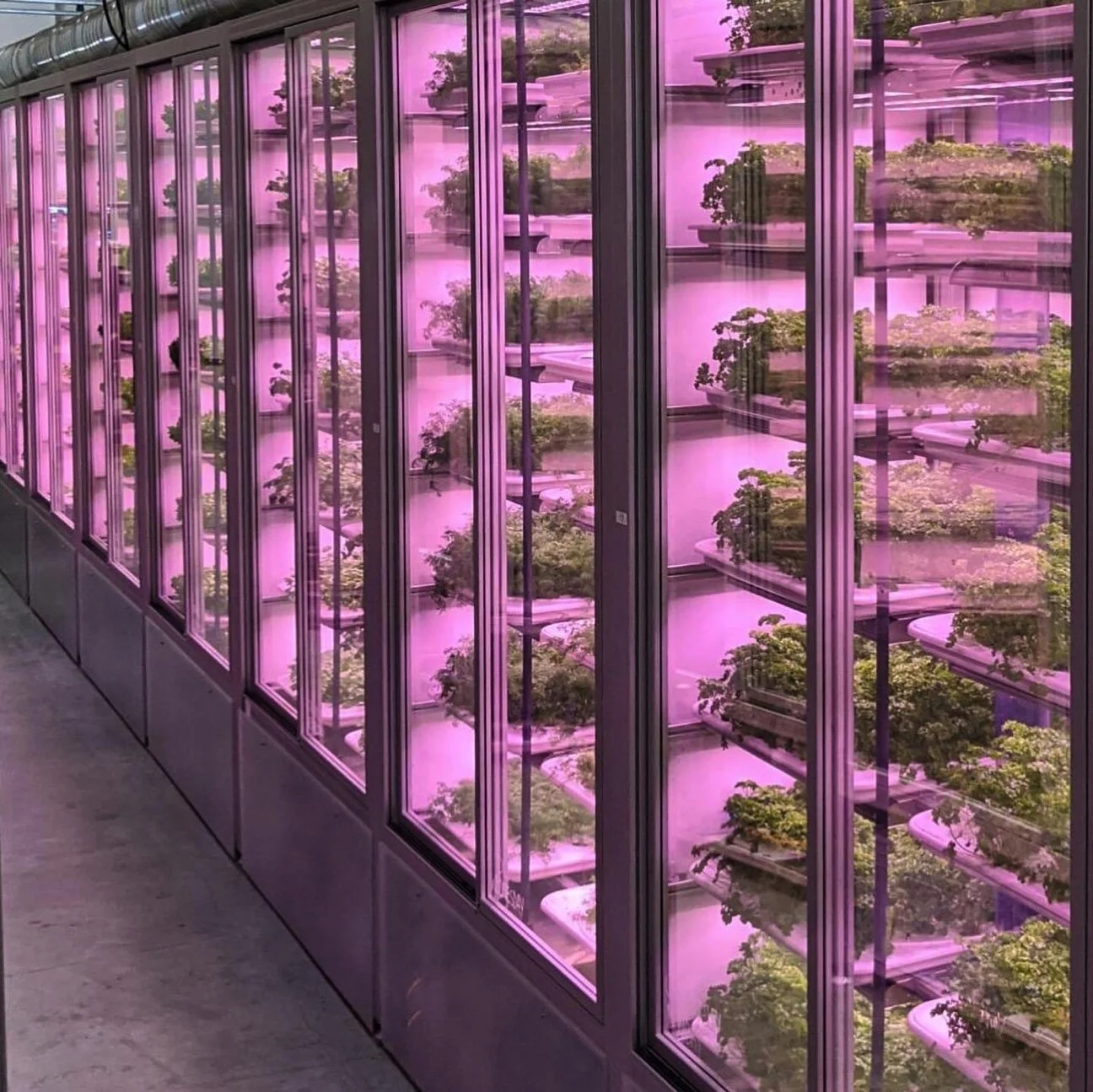
Infarm's vertical farms specialise in herbs. /Infarm
In May, Infarm partnered with Germany's ALDI SUD to grow chives, parsley, basil, mint, and coriander in stores across Frankfurt and Dusseldorf. Additionally, ALDI SUD is providing 300 more stores with fresh Infarm produce from centralized distribution centers.
"Our customers can watch the herbs grow. They are grown and harvested in our stores – they couldn't be more fresh," says David Labinsky, group buying director at ALDI SUD.
While customers can watch the plants grow, they can't pick their own. Instead, they're harvested on a regular basis and packaged in-store where they're at their freshest.
Could vertical farms be the future of food? That's certainly what Paul Gauthier, professor of plant science at Delaware Valley University, believes. As he told The Daily Princetonian newspaper: "There is no question about it, vertical farming will be part of our lives. It's important to start thinking and finding solutions for the future."
Video editor: David Bamford

VIDEO: IGS Intelligent System Design – FTS Finds Out More
IGS has, as a company, focused from the outset on automation, intelligent system design, and the energy equation of CEA vertical farming
July 6, 2020
IGS has, as a company, focused from the outset on automation, intelligent system design, and the energy equation of CEA vertical farming. This has garnered them a reputation as one of the leading and most innovative companies in the industry. We took some time to have a chat with them and find out a bit more about how this all works in practice.
FTS: Hello and thanks for taking the time to talk with us. Can you briefly introduce IGS, its history as well as its outlook?
IGS: IGS was founded in 2013 bringing together decades of farming and engineering experience with a vision to revolutionize the indoor growing market. The two founders, farmer Henry Aykroyd and our CTO Dave Scott had an appetite for innovation and realized that there were significant gaps in the provision of scalable technology for the sector.
Henry knew how to grow and understood the challenges which faced traditional farming: Dave knew how to manage automation and power controls in an industrial environment. The opportunity to bring greater climate control to a growing environment was significant. The ability to manage power consumption was revolutionary. The simplicity of its implementation and use is pivotal.
We opened our first vertical farm demonstrator in Scotland in 2018. Artificial intelligence determines optimal nutritional input and the exact combination or ‘recipes’ of weather: lighting, watering, and ventilation. Data is collected continuously and machine learning used to make iterative adjustments, all of which is monitored through a web-based app. The whole Intelligent Growth platform is IOT-enabled to automate system control and management. Our degree of control is so fine that each 6m2 growth tray has its own microclimate. Technical simplicity is at the heart of our mechanical design.
Our commitment to innovation has continued apace and we have evolved the applications of our technology beyond agriculture to create solutions for a wide variety of indoor environments, developing the Intelligent Grid platform.
The Intelligent Grid uses the same IOT-enabled power and controls platform to manage and monitor lights, sensors, cameras, and communications for complete climate control and reporting. It too has a very simple, clean, and elegant design for application in any commercial building, greenhouse or livestock shed. In contrast to the vertical farm, we use our same core technology through the Intelligent Grid to create whole-space macroclimates.
Both IGS demonstrators are based at the James Hutton Institute, a world-renowned crop, and plant science research facility. IGS and the Hutton collaborate closely to help advance the understanding of plant science for indoor growing.
Until 2018 IGS had invested approximately £7m in R&D to ensure that its platforms offered the greatest levels of control and achieved levels of economic viability, scale, and minimal environmental impact compared to other systems on the market. In 2019 IGS raised £7 million in institutional capital to enter production and take its systems to global markets. We continue to invest over £1m per annum in R&D.
FTS: You have recently shared news of two reseller partnerships – one in the Middle East and one in the UK and Italy with TEP Renewables. Can you tell us briefly a bit more about them?
IGS: We have been talking to International Real Estate Partners (IREP), the international facilities management firm for some time in the Middle East, and we’re really pleased to recently sign this referral agreement which is specifically focused on indoor vertical farming for the UAE and Saudi Arabian markets.
We also have an opportunity to extend into Asian markets in the future. It gives us a greater capacity to service the Middle East market and secure and deploy vertical farming platforms across the region. IREP’s presence in this market is well established with many existing customers across agriculture, retail, and construction and it is a very positive development for both companies we believe.
The agreement with TEP Renewables is an MOU (Memorandum of Understanding) or a reseller-type partnership if we identify customers who would like to operate solar-powered vertical farms in Italy or the United Kingdom that we will work with them.
FTS: Fantastic! In the end, any vertical farm (indeed any farm!) is only as environmentally sustainable as its energy equations. But it is also only as financially sustainable as its energy cost. You have focused quite intensely on this energy cost question. As we see this dramatic collapse of fossil fuel energy production return on investment, it seems that NOW is the time to have renewable energy options on hand for CEA. Do you believe that renewable energy can be cost-competitive – both in terms of installation, sustainable life-cycle and with regard to the price of the final product for the consumer?
IGS: We consider a variety of power distribution and supply methods. Renewables can have considerable benefits from an environmental perspective and also specific to grants and other financial support for utilizing renewable energy resources.
The “virtual power plant” capabilities of our systems indicate strong Demand Side Response (DSR) potential. We can manipulate our growth cycles to respond to power availability and respond to inherent instabilities in power networks. This is already having an influence on our engagement in circular energy projects to utilize spare energy for growing and allows for more renewable power sources to be adopted.
FTS: Labor cost is the other biggest outlay for any vertical farm. You have invested heavily in automation. Is the trade-off of increased capital expenditure for automation worth the reduction in operational expenditure for labor, in your experience?
IGS: Absolutely. Driving down the farm gate price is the ultimate goal and while labor costs vary from region to region, we believe that this investment in the automation (and indeed the associated patents) within our growing operations is imperative and differentiates our systems considerably.
FTS: You’ve set about designing modular and intelligent systems. Such a bespoke system offers advantages of course, as we’ve seen above. But it can also present challenges if it cannot be integrated with other equipment and systems later. Do you future-proof your systems to be able to accommodate such updates and integrations over time?
IGS: We have thought about this from the outset, and our systems are designed in a plug and play model, rather than being bespoke as such. Scalability is paramount for our customers and this has been a consideration throughout our R&D development. Rather than using proprietary systems for processes such as sowing and harvesting, we use off-the-shelf equipment and components. This means we can keep startup and maintenance costs down by providing items with which farmers are already familiar. If a section of the vertical farming system needs to be replaced or upgraded, such as a water filter, a lighting panel or a tray, it can be done with almost no interruption.
However, what is also imperative to think about in terms of future proofing, and a hugely important part of our approach, is how we work so closely with the science community to better understand plant light interactions. The level of control we have designed into our hardware systems allows us to flex and adapt as we need to deploy the most up to date plant light information through our software development, which is continuously evolving.
The approach of our software development has also involved maximising security of our systems and ensuring simplicity of operation. This will be continuously updated, but with seamless integration for our customers.
FTS: Along with FTS, you’ve joined a number of other associations and similar collaborative groups. Why is this important to you as a company, and how do you balance the proprietary needs of your company against this desire to cooperate?
IGS: Collaboration and cooperation across this sector is essential. Our vision is that sustainable change will only be delivered not only when we collaborate, but when we are all open and honest about the limitations, as well as the opportunities for this sector. We want to work alongside technology vendors with complementary products, and with growers and producers, supported by science and greater understanding of growing plants indoors, all backed by far-sighted investors.
We firmly believe that through innovation, collaboration and investment we can create an economically and environmentally sustainable global indoor food industry.
FTS: Thanks so much for taking the time to talk with us today. We wish you every success and look forward to working with you in the future.
IGS: Thanks very much indeed. We look forward very much to be part of Farmtech Society as we all move forward in the development and innovation of agricultural technology.
For IGS
David Farquhar
CEO

OptimIA Free Indoor Ag Webinar - July 29, 2020 - 1 PM EST
OptimIA offers free indoor ag webinar on July 29, 2020. The OptimIA (Optimizing Indoor Agriculture) project team invites indoor farmers, allied trades, and professionals to their first annual meeting to share recent research results with leafy greens and discuss future activities
By urbanagnews
July 6, 2020
OptimIA offers free indoor ag webinar on July 29, 2020
The OptimIA (Optimizing Indoor Agriculture) project team invites indoor farmers, allied trades, and professionals to their first annual meeting to share recent research results with leafy greens and discuss future activities. OptimIA is a USDA-supported Specialty Crop Research Initiative project to advance the emerging indoor farming industry to become more profitable and sustainable through critical research and extension activities.
TENTATIVE AGENDA / TOPICS
Promotion of lettuce growth under an increasing daily light integral depends on the light intensity and photoperiod
Influence of light intensity and CO2 concentration on dill, parsley, and sage growth and development at harvest
Major energy savings during production of baby greens
Managing nutrient disorders of hydroponic leafy greens
Improving air distribution and humidity management in vertical farming systems
Critical elements of CEA economics
View the agenda and register at http://scri-optimia.org/stakeholder2020.php. The webinar is free, but space is limited and is on a first-come, first-served basis.
OptimIA Director and PIs
Erik Runkle, Michigan State University (Project Director)
Murat Kacira, University of Arizona
Chieri Kubota, The Ohio State University
Roberto Lopez, Michigan State University
Cary Mitchell, Purdue University
Simone Valle de Souza, Michigan State University
OptimIA Collaborators
Jennifer Boldt, USDA ARS
David Hamby, OSRAM
H. Christopher Peterson, Michigan State University
Nadia Sabeh, Dr. Greenhouse Inc.

Pandemic Gardening Moves Indoors With a Smart Garden in The Kitchen
It’s not hard to see why. Even as public spaces begin to open up, many people remain leery of winding through the narrow aisles of their grocery stores
By Mandy Behbehani | July 3, 2020
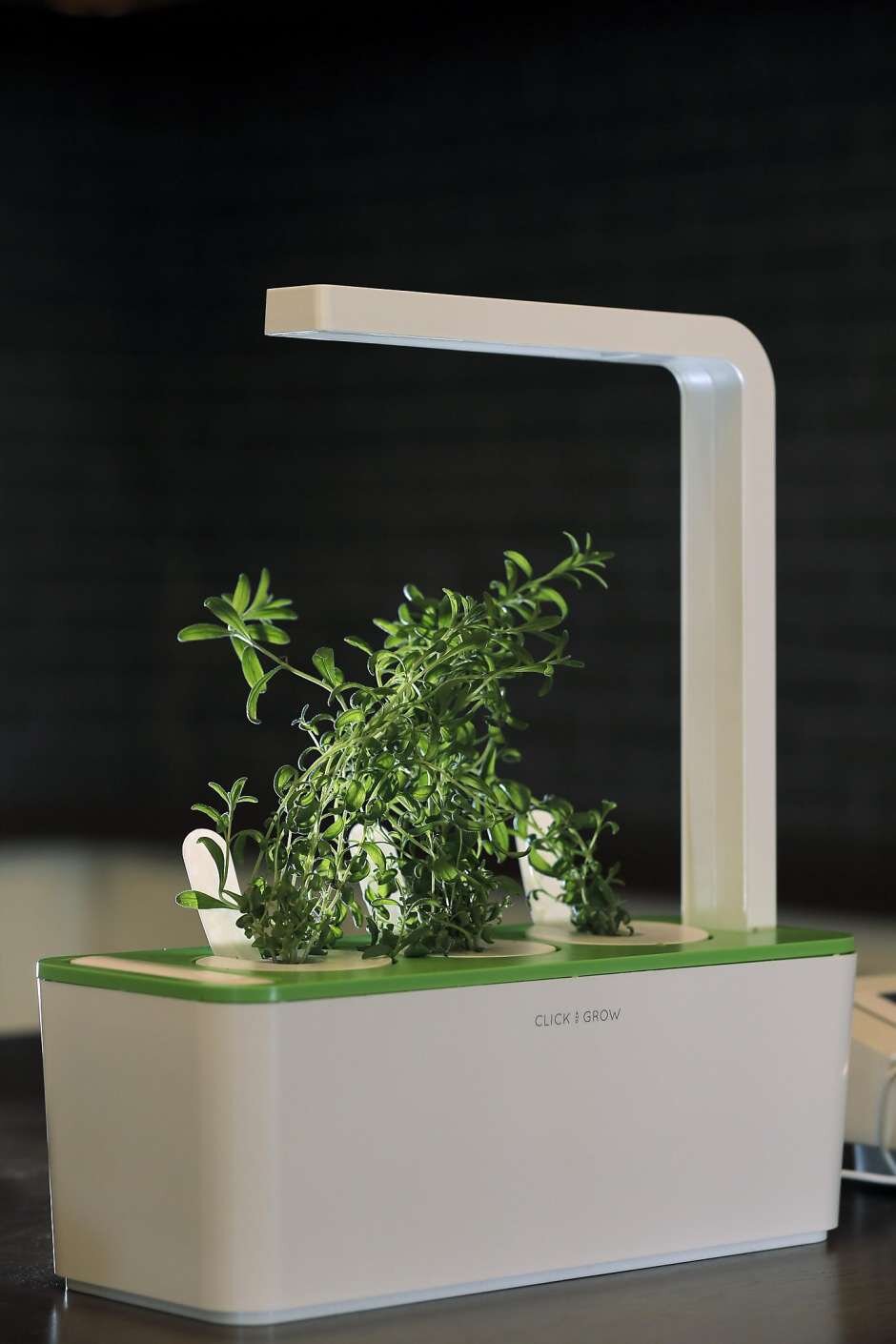
The Click and Grow Smart Herb Garden uses “smart soil” to provide everything the plants need. The company has seen huge increases in orders because of the coronavirus.
Photo: Carlos Avila Gonzalez / The Chronicle 2016
In April, after the shutdown had made going to the grocery store a risky proposition, Jon Lechich plunked down nearly $1,000 for a three-tier, indoor smart garden. Living on a hill in Lafayette, the entrepreneur and his physician wife had limited outside space and could only grow plants in pots.
When the kit arrived, Lechich dropped a dozen pods that look like coffee capsules into a “nursery” container. After a couple of weeks, when the pods had grown roots and leaves, he transferred them into a sleek white unit that evokes a tropical bookcase. He added water, plugged in the system, and sprinkled in some nutrients. Already he’s harvested basil, kale, lettuce, peppers, and strawberries. Soon, says Lechich, “the only thing we’ll need to get at the grocery store will be meat.”
Indoor smart gardens are having their moment in the sun — er, under the LED lamp — with companies reporting unprecedented sales and even backorders. Rise Gardens, which made Lechich’s system, received a $2.6 million, ahem, seed round in May. Across the United States, Google searches for “smart garden” reached an all-time high the second week of April.
It’s not hard to see why. Even as public spaces begin to open up, many people remain leery of winding through the narrow aisles of their grocery stores. A springtime of understocked supermarket shelves reminded us not to take food-supply chains for granted, and shelter-in-place orders made spring planting season more stressful than usual. Besides, when every day feels the same, the prospect of something blossoming before our very eyes, and within the walls of the home we’re mostly confined in gains appeal.“
It’s very aesthetically pleasing,” Lechich says of his unit. “I love the light, it’s very quiet and has a great green look to it.” He and his wife have been discussing whether to move the unit from the spare room into the living room. She seems open to it, he says.
To be sure, the promise of the smart garden is not new. Neither is the indoor garden and, in fact, people throughout the Bay Area have long embraced the idea of growing their own fresh produce in micro greenhouses on their kitchen counter, a bookshelf or on a ladder up against a wall, without battling pests, contaminants or their friendly neighborhood rabbit.
Or their own non-green thumbs.“
I pretty much kill everything that is not a succulent,” says Michelle Leigh, who lives in a loft in an industrial area of Oakland where she has been advised not to grow food outdoors. She got the coronavirus in March, ordered a Rise Garden in April and received it May 20.
She planted basil, lettuces, cilantro, bananas, peppers, tomatoes, and green beans.“
My partner and I were also nervous about food shortages,” says Leigh, 43. “My diet is meat and vegetables, and I thought, ‘Oh my God if I get stuck having to eat canned or frozen food in some (economic) depression, I’m going to be screwed.’”
To reduce the chances for mishaps, Leigh wanted a hydroponic system, which grows plants using nutrients and water rather than soil and sunlight. So far, so good: All she’s had to do so far is fill the water once a week, and she’s already harvested her lettuce, basil, and cilantro.
Rise Garden says 50 percent of orders come from the Bay Area. But hydroponics are not the only game in town. Units from Click and Grow, one of the older purveyors, use a proprietary “smart soil.” The fluffy substance keeps the levels of oxygen, water, pH, and nutritional ingredients at optimal levels. You insert plant pods (biodegradable, natch) into the mix, add water, and plug the thing in.
Click and Grow, which is based in Estonia but does most of its business in California and New York reports huge increases in orders because of the coronavirus. In March, April and May, revenues were three to five times higher than in the same months last year, says Martin Laidla, a company spokesman. He attributes the jump in sales to fresh-food shortages and fear of them. “Leafy greens are not things you can stockpile,” he says. “You have to have them fresh.”
That’s exactly why Ken Lamb, 60, ordered his unit in April. “I use a lot of basil and oregano,” says Lamb, who lives in San Francisco and co-founded an early-stage VC firm. “I knew they would be useful during a time when there might be trouble having access to fresh herbs for a while.” He’s growing herbs, piri piri chile peppers, and more. “They’re so easy,” he says. “You get the package, which took five minutes to put together, fill with water, open the capsules, stick them into the holes and all you have to do is to fill it with water.”
Worth noting: Major appliance-makers are sowing their own indoor gardening dreams. At the annual Consumer Electronics Show in February, Samsung unveiled its prototype BeSpoke Plant Fridge, while LG showed off an indoor gardening appliance.
Might such technology be used on a much larger scale for commercial farming indoors? Not yet, says Hank Adams, CEO, and founder of Rise Gardens. “There are plenty of empty buildings out there, but it’s not the space, it’s the cost of electricity and of labor to harvest,” he says. The economics just aren’t favorable, he says.
But the “counter-to-table” model has plenty of appeal, he says. There’s a lot of food you can’t grow year-round outside, Adams notes. Besides, he says, plants lose half their water-soluble vitamins within 48 hours of harvest.“
My vision is that in the same way we never envisioned dishwashers and washing machines in everybody’s house and now we can’t live without them, I’d like that for indoor gardening.”
Mandy Behbehani lives in San Francisco. Email: Culture@sfchronicle.com

The Future of Food: Inside The World's Largest Urban Farm – Built on a Rooftop
On top of a striking new exhibition hall in the southern 15th arrondissement of Paris, the world’s largest urban rooftop farm has started to bear fruit. Strawberries, to be precise: small, intensely flavoured and resplendently red
In Paris, urban farmers are trying a soil-free approach to agriculture that uses less space and fewer resources. Could it help cities face the threats to our food supplies?
Urban farming on a Parisian rooftop. Photograph: Stéphane de Sakutin/AFP/Getty Images
08 Jul 2020
On top of a striking new exhibition hall in the southern 15th arrondissement of Paris, the world’s largest urban rooftop farm has started to bear fruit. Strawberries, to be precise: small, intensely flavoured and resplendently red.
They sprout abundantly from cream-coloured plastic columns. Pluck one out to peer inside and you see the columns are completely hollow, the roots of dozens of strawberry plants dangling into thin air.
From identical vertical columns nearby burst row upon row of lettuces; near those are aromatic basil, sage, and peppermint. Opposite, in narrow, horizontal trays packed not with soil but coco coir (coconut fibre), grow heirloom and cherry tomatoes, shiny aubergines, and brightly coloured chards.
“It is,” says Pascal Hardy, surveying his domain, “a clean, productive and sustainable model of agriculture that can in time make a real contribution to the resilience – social, economic and also environmental – of the kind of big cities where most of humanity now lives.
And look: it really works.”Hardy, an engineer, and sustainable development consultant, began experimenting with vertical farming and aeroponic growing towers – as those soil-free plastic columns are known – on his Paris apartment block roof five years ago.
This space is somewhat bigger: 14,000 sq metres, the size (almost exactly) of two football pitches. Coronavirus delayed its opening by a couple of months, but Nature Urbaine, as the operation is called, is now up and running, and has planted roughly a third of the available space.
Already, the team of young urban farmers who tend it have picked, in one day, 3,000 lettuces and 150 punnets of strawberries. When the remaining two-thirds of the vast rooftop of Paris Expo’s Pavillon 6 are in production, 20 staff will harvest up to 1,000kg of perhaps 35 different varieties of fruit and vegetables, every day.“
We’re not ever, obviously, going to feed the whole city this way,” cautions Hardy. “In the urban environment you’re working with very significant practical constraints, clearly, on what you can do and where. But if enough unused space – rooftops, walls, small patches of land – can be developed like this, there’s no reason why you shouldn’t eventually target maybe between 5% and 10% of consumption.”
Nature Urbaine is already supplying local residents, who can order fruit and veg boxes online; a clutch of nearby hotels; a private catering firm that operates 30 company canteens in and around Paris; and an airy bar and restaurant, Le Perchoir, which occupies one extremity of the Pavillon 6 rooftop.
Nature Urbaine. Photograph: Magali Delporte/The Guardian
Perhaps most significantly, however, this is a real-life showcase for the work of Hardy’s flourishing urban agriculture consultancy, Agripolis, which is currently fielding inquiries from around the world – including in the UK, the US, and Germany – to design, build and equip a new breed of soil-free inner-city farm.“The method’s advantages are many,” he says. “First, I don’t know about you, but I don’t much like the fact that most of the fruit and vegetables we eat have been treated with something like 17 different pesticides, or that the intensive farming techniques that produced them are such huge generators of greenhouse gases.“I don’t much like the fact, either, that they’ve travelled an average of 2,000 refrigerated kilometres to my plate, that their quality is so poor, because the varieties are selected for their capacity to withstand that journey, or that 80% of the price I pay goes to wholesalers and transport companies, not the producers.”
Produce grown using this soil-free method, on the other hand – which relies solely on a small quantity of water, enriched with organic nutrients, minerals and bacteria, pumped around a closed circuit of pipes, towers and trays – is “produced up here, and sold locally, just down there. It barely travels at all,” Hardy says.“It uses less space. An ordinary intensive farm can grow nine salads per square metre of soil; I can grow 50 in a single tower. You can select crop varieties for their flavour, not their resistance to the transport and storage chain, and you can pick them when they’re really at their best, and not before.”
No pesticides or fungicides are needed, no soil is exhausted, and the water that gently showers the plants’ roots every 12 minutes is recycled, so the method uses 90% less water than a classic intensive farm for the same yield. The whole automated process can be monitored and controlled, on site or remotely, with a tablet computer.
Urban farming is not, of course, a new phenomenon. The mayor of Paris, Anne Hidalgo, aims eventually to have at least 100 hectares of rooftops, walls and facades covered with greenery – including 30 hectares producing fruit and vegetables.
A programme called Les Parisculteurs invites local groups to come up with suitable projects for up to a dozen new sites every year.Inner-city agriculture is booming from Shanghai to Detroit and Tokyo to Bangkok. Strawberries are being grown in disused shipping containers; mushrooms in underground carparks. Not all techniques, however, are environmentally friendly: ultra-intensive, 10-storey indoor farms that have sprung up in the US rely on banks of LED lighting and are major consumers of energy, Hardy says.
Aeroponic farming, he says, is “virtuous”. The equipment weighs little, can be installed on almost any flat surface, and is cheap to buy: roughly €100 to €150 per sq metre. It is cheap to run, too, consuming a tiny fraction of the electricity used by some techniques.
Aeroponic farming is ‘virtuous’, says Pascal Hardy. Photograph: Magali Delporte/The Guardian
Produce grown this way typically sells at prices that, while generally higher than those of classic intensive agriculture, are lower than soil-based organic growers. In Paris, Nature Urbaine should break even, Hardy estimates, some time next year – a few months later than planned because of the pandemic
.There are limits to what farmers can grow this way, of course, and much of the produce is suited to the summer months. “Root vegetables we cannot do, at least not yet,” he says. “Radishes are OK, but carrots, potatoes, that kind of thing – the roots are simply too long. Fruit trees are obviously not an option. And beans tend to take up a lot of space for not much return.”
But Agripolis runs a smaller test farm, on top of a gym and swimming pool complex in the 11th arrondissement, where it experiments with new varieties and trials new techniques. A couple of promising varieties of raspberries are soon to make the transition to commercial production.
Urban agriculture is not the only development changing the face of farming. As with almost every other sector of the economy, digitisation and new technologies are transforming the way we grow food.
Artificial intelligence (AI) and the internet of things are beginning to revolutionise farming, from driverless, fully automated farm machinery that can sow seeds and fertilise and water soil with maximum precision to systems that monitor exactly how healthy individual animals are and how much they are producing (a concept known as the “connected cow”).
Other AI systems analyse satellite and remote ground sensor data, for example, to monitor plant health, soil condition, temperature and humidity and even to spot potential crop diseases.
Drones, too, have multiple potential uses on farms. With the world’s bee population in steep decline due to global heating, pesticides, and other factors, drones are increasingly being used to pollinate crops fields and fruit orchards. To avoid wasting pollen by wafting it randomly at crops, or the damage to individual flowers caused by drones rubbing against them, scientists in Japan have developed a system in which a drone uses what can only be described as a bubble gun to blow balls of specially formulated liquid containing pollen at individual blossoms.
With global food production estimated to need to increase by as much as 70% over the coming decades, many scientists believe genetic editing, which has already been used to create crops that produce higher yields or need less water to grow, will also have to play a bigger role.
The technique could help build plant and animal resistance to disease, and reduce waste. For example, with methane known to be a stronger greenhouse gas than carbon dioxide, research is under way into the stomach bacteria of cows in the hope that tweaking animals’ gut microbes may eventually allow them to produce not just more meat, but also less gas.
Seating at Le Perchoir. Photograph: Magali Delporte/The Guardian
Urban farming of the kind being practised in Paris is one part of a bigger and fast-changing picture. “Here, we’re really talking about about building resilience, on several levels – a word whose meaning I have come to understand personally,” says Hardy, pointing to the wheelchair he has been forced to use since being injured by a falling tree.
“That resilience can be economic: urban farming, hyper-local food production, can plainly provide a measure of relief in an economic crisis. But it is also environmental: boosting the amount of vegetation in our cities will help combat some of the effects of global heating, particularly urban ‘heat islands’.”
Done respectfully, and over time, inner-city agriculture can prompt us to think differently both about cities, by breaking down their traditional geography of different zones for working, living and playing, and about agriculture, by bringing food production closer into our lives. “It’s changing paradigms,” says Hardy.

Barclays and Unreasonable Selects 80 Acres Farms To Receive $100,000 Grant in Support of COVID-19 Related Work
Unreasonable Impact COVID-19 Response is a new initiative launched by Barclays and Unreasonable Group awarding $100,000 grants each to ten Unreasonable ventures that have pivoted their businesses to combat challenges related to COVID1
Barclays and Unreasonable Group launch $1,000,000 fund for entrepreneurial solutions addressing challenges resulting from the global pandemic
July 8, 2020 – LONDON – 80 Acres Farms has been awarded a $100,000 grant in recognition of the exceptional work being undertaken in addressing the immediate and long-term challenges resulting from the effects of the global pandemic.ar
Unreasonable Impact COVID-19 Response is a new initiative launched by Barclays and Unreasonable Group awarding $100,000 grants each to ten Unreasonable ventures that have pivoted their businesses to combat challenges related to COVID19.
The grant is designed to support and amplify the impact of the work 80 Acres Farms is doing.
The initiative was launched as a direct response to the outbreak of COVID19 and is an extension of Unreasonable Impact, the unique multi-year partnership between the two companies supporting growth-stage entrepreneurs across the Americas, Europe, and Asia Pacific regions solving many of the world’s most pressing issues.
80 Acres Farms was Chosen by a selection committee for the meaningful work the company has been doing during the COVID-19 pandemic. They bring access to fresh foods to the communities they serve. This grant will further their efforts by deploying mobile markets, “Veggie Vans” to neighborhoods most adversely affected by this pandemic. By growing differently, in a completely controlled environment, 80 Acres Farms can improve the nutritional value of foods, not only getting it to the customer hours after harvest, but also increasing vitamins and minerals, and antioxidants naturally during the growing process.
80 Acres Farms Mike Zelkind will join the nine other recipients at a live virtual event, The Unreasonable Impact COVID19 Response Global Summit, created with Barclays on July 8th where he will have a chance to share his exceptional work with a global audience.
Joe McGrath, Barclays’ Global Head of Banking, commented, “Through Unreasonable Impact, we set out to help entrepreneurs take their businesses to the next level. They are already tackling almost impossible-sounding challenges, so when COVID-19 took hold we weren’t surprised that they would point their talent and drive towards responding to the pandemic. We’re in awe of the speed that they’ve pivoted their businesses and of the positive impact that they’ve already made, so we’re delighted to be able to support them through the Unreasonable Impact COVID-19 Response.”
Daniel Epstein, Founder, and CEO of Unreasonable Group, added, “Unreasonable Impact was co-created with Barclays with a shared intention to support and scale up entrepreneurial solutions to the world's most pressing challenges. The global impact of COVID-19 is unlike any challenge any of us has seen in our lifetimes. Setting up the COVID-Response to support and amplify ventures leveraging business to combat challenges related to the pandemic is a natural extension of our mission. We are humbled to be supporting the exceptional work 80 Acres Farms."
For more information and to register to attend the Global Summit, visit https://unreasonablegroup.com/initiatives/unreasonable-impact/covid-global-summit/
Full list of ventures selected:
1MG Technologies: India’s leading mobile healthcare platform with over 9 million downloads and 33 million monthly visits
80 Acres Farms: Converting urban spaces in ultra-efficient indoor farms that produce accessible, tasty and affordable local food year-round
Airlabs: Transforming polluted cities into clean air zones by removing 95% nitrogen dioxide along with all other pollutants
Day Owl: Turning trash from the poorest neighbourhoods in the world into purpose filled recycled fabrics
Ecoware: Creating 100% biodegradable eco-friendly and compostable certified food packaging and garbage bags
eFishery: Creating the future of aquaculture with an IoT smart feeding technology to help hundreds of millions of farmers at the bottom of the pyramid
Globechain: Creating the world’s largest reuse marketplace that connects corporates to charities and people to redistribute unwanted items
Nanobiosym: Using nanotechnology to empower people worldwide with rapid affordable and portable diagnostic information about their own health
Olio: connecting neighbours and local shops so surplus food and other household items can be shared rather than thrown away
Zero Mass: Making drinking water an ultimate resource with SOURCE, a set of panels that make water from air
About Unreasonable Impact, created with Barclays
Unreasonable Impact is an innovative multi-year multi-geographic partnership between Barclays and Unreasonable Group to launch the world’s first global network focused on scaling up entrepreneurial solutions that will help employ thousands worldwide in the emerging green economy. To date, the more than 100 ventures that comprise the global cohort operate in more than 180 countries, have raised over $2.1bn USD in funding, have generated over $2bn USD in revenue, and have created more than 30,000 net new jobs since joining Unreasonable Impact. For more information, please visit www.unreasonableimpact.com.
About Barclays
Barclays is a British universal bank. The company is diversified by business, by different types of customers and clients, and by geography. Barclays’ businesses include consumer banking and payments operations around the world, as well as a top-tier, full service, global corporate and investment bank, all of which are supported by their service company which provides technology, operations and functional services across the Group.
For further information about Barclays, please visit www.home.barclays.
About Unreasonable Group
Bringing together a global network of entrepreneurs, investors, creatives, and business leaders, Unreasonable acts as a catalytic platform for entrepreneurs tackling some of the world’s most pressing challenges facing us today. From designing highly curated immersive programmes, facilitating access to a global network of mentors to operating a private equity fund, and providing advanced storytelling and media activities, Unreasonable operates at the highest intersection of business and impact. It is uniquely positioned to support growth-stage entrepreneurs solving key global environment and social challenges to scale up through the deployment of knowledge, networks and capital.
For more information about Unreasonable, please visit www.unreasonablegroup.com.
Media Contact
Rebecca Haders
+01 513.910.9089

OptimIA Annual Stakeholder Meeting (Virtual) - July 29, 2020
OptimIA (Optimizing Indoor Agriculture) project team invites indoor farmers, allied trades, and professionals interested in participating in our first annual stakeholder meeting (virtual)
OptimIA (Optimizing Indoor Agriculture) project team invites indoor farmers, allied trades, and professionals interested in participating in our first annual stakeholder meeting (virtual). Join us as we share recent research results and discuss future activities. OptimIA is a USDA-supported Specialty Crop Research Initiative project to advance the emerging indoor farming industry to become more profitable and sustainable through critical research and extension activities.
For more information and registration please visit this page. Or contact Dr. Erik Runkle, Michigan State University. Space is limited and is on a first-come, first-served basis.
OptimIA Project Team
Project Director and PIs
Erik Runkle, Michigan State University (Project Director)
Murat Kacira, University of Arizona
Chieri Kubota, The Ohio State University
Roberto Lopez, Michigan State University
Cary Mitchell, Purdue University
Simone Valle de Souza, Michigan State University
OptimIA Collaborators
Jennifer Boldt, USDA ARS
David Hamby, OSRAM
H. Christopher Peterson, Michigan State University
Nadia Sabeh, Dr. Greenhouse Inc.
Click here for more information about the meeting.

US - VIRGINIA - What Does Governor Northam Have to Say About Babylon?
“Congratulations to Babylon Micro-Farms, an inspiring up and coming Virginia business, on its CRCF award. Babylon first received seed capital funding from CIT GAP Funds in August 2019
June 30, 2020
We are very excited to share the news that Governor Northam announced last week that Babylon has been awarded matching funds from the Center for Innovative Technology (CIT) for the Small Business Innovation Research (SBIR) grant we received from the National Science Foundation. The funding from the NSF made Babylon eligible for a highly competitive application process that CIT holds annually through the Commonwealth Research Commercialization Fund which provides additional support for SBIR recipients to foster ongoing innovation by Virginia-based companies.
“Congratulations to Babylon Micro-Farms, an inspiring up and coming Virginia business, on its CRCF award. Babylon first received seed capital funding from CIT GAP Funds in August 2019. I had the pleasure to get to know the team and learn about the vital work they are doing for indoor farming,” said Ed Albrigo, President and CEO of CIT. “They continue to move forward on research and development of their disruptive platform for hydroponic farming, which has now earned them funding support through CIT CRCF. The Babylon CRCF award, along with CIT GAP funding, is a prime example of how our programs work together to help sustain companies through the difficult first stages of the commercialization process. Sustainable urban agriculture technologies are among the most critical emerging technologies in the nation today, and thanks to Babylon, Virginia will play an essential role in the future of farming."

Babylon added Lansdowne Resort in Leesburg, VA to our portfolio of high-end resorts and we are happy to welcome them to the Babylon family. Lansdowne is very focused on the connection between food and health and has a history of being at the forefront of hospitality trends that incorporate wellness and mindfulness-based activity options. They offer their guests a carefully curated offering of dietary choices based on their commitment to providing them the highest possible quality available in every aspect of their experience. Babylon is proud to be part of that commitment.
The recently installed farm at Champion Brewing Company Pub is the first partnership between Babylon and our hometown pioneer of the rapidly growing craft beer movement. When founder Hunter Smith envisioned the Pub, he wanted to create a fun community space that was hip and cool, but truly more than that – a place for people to connect. Mission accomplished and since Babylon is all about connecting people to their food by growing it right in front of them, it was a natural fit. The synergy of two local startups working together to bring the best of local food and drink to the table is a winning combination. Stop by and have a cold beer, it's hot outside!

VIDEO: Dubai’s Badia is GCC’s First Commercial Vertical Indoor Farm
Badia Farms in Al Quoz Industrial area in Dubai is the GCC’s first commercial vertical indoor farm that supports Dubai’s agricultural sustainability
June 26, 2020
An expert takes notes on the health of vegetables.
Gulf Today, Staff Reporter
Badia Farms in Al Quoz Industrial area in Dubai is the GCC’s first commercial vertical indoor farm that supports Dubai’s agricultural sustainability.
The large-scale high-tech vertical farm produces 3,500kg of chemical, pesticide, and herbicide-free fruits and vegetables per year.
Badia Farms said, “We have a growing reputation for supplying the finest micro-greens and herbs to Dubai’s top restaurants, caterers and chefs.”
Vertical farming is the practice of producing food vertically in stacked layers, vertically inclined surfaces, and/or integrated in other structures.
It uses a combination of indoor farming techniques and controlled-environment agriculture (CEA) technology.
Experts examine a produce.
Vertical farms can grow non-native produce in locations where traditional agricultural methods are impossible. Also, there’s no exposure to the hazards of traditional farming, such as bugs, diseases, pesticides and weather.
In some ways, it’s as simple as it sounds: a vertical farm is a multi-story greenhouse where fruit and vegetables are grown in stacked up towers. There’s obviously a lot more to it than that – and here’s where we’ll try not to blind you with science.
The techy term for it all is hydroponics, which is a technique for growing produce without soil. Seeds are planted in a sterile, soil-less growing environment and then grown in nutrient-rich water. Water is recycled, and everything from air and water temperature through to humidity and lighting are controlled to create the perfect growing environment.
Badia Farms Vertical Farming Agriculture Dubai UAE InnovationTechnology
Vertical Farming In LatAm: AgroUrbana Closes $1m Seed Funding
Access to vertical farming technologies is deepening and widening across the world, bringing down the costs and hassle of locally producing anything from Singapore strawberries to Arctic tomatoes
July 2, 2020
Access to vertical farming technologies is deepening and widening across the world, bringing down the costs and hassle of locally producing anything from Singapore strawberries to Arctic tomatoes.
In Latin America, however, indoor vertical farms are still largely written off on a continent known for its abundant fertile soil and plentiful sunlight. Why need of artificial light or indoor automation when the sun is free and labor is cheap?
That said, there are early signs of a LatAm vertical farming awakening in Chile, where AgroUrbana has just raised a $1 million seed round, bringing its total capital raised to $1.5 million. AgroUrbana is South America’s first vertical farm, according to the Association for Vertical Farming.
Leading the round by contributing 33% of the cash was the CLIN Private Investment Fund administered by Chile Global Ventures, the venture capital arm of Fundación Chile, a public-private initiative for innovation and sustainability in the country. Support financing also came from CORFO (Chile’s Development Agency) and private investors like company builder and VC Engie Factory, the country’s largest telecommunications company Entel, and sustainability investor Zoma Capital.
In a video call with AFN, AgroUrbana f0unders Cristián Sjögren and Pablo Bunster described how the funds would be put to work at their 3,000 square feet pilot facility in the suburbs of Santiago, where testing is ongoing on layered stacks of hydroponically grown, LED-lit, renewable energy powered leafy greens and fruits. AgroUrbana’s first big offtake deal had just been inked with a major Chilean grocery retailer, they said.
A pre-planned switch from restaurant to retail
“It’s been run, run, run,” recalled Bunster, describing the political turmoil in Chile that brought curfews and shuttered restaurants months before Covid-19 locked down the country. That earlier disruption, he added, had actually had its upsides, as it got them thinking more about e-commerce and direct-to-consumer sales — so when the team’s restaurant deals dried up during the Covid-19 pandemic, the switch to retail was already scoped out.
As to scaling up further, Sjögren envisioned an eventual 30,000 square foot facility that would be bankrolled by a Series A that they plan to work towards later this year; the design and output would depend on the results of their pilot trials.
This size of farm sets the team somewhere in the middle of the two dominant visions of vertical farming: centralized versus distributed. Proponents of centralized systems argue that large-scale production—and financial viability—depend on ever-bigger and higher farms. These farms, or plant factories as they are sometimes called, are proliferating, aided by huge sums of capital. Plenty scooped up a whopping $200 million in Series B funding back in 2017. US-based AeroFarms raised $100 million in late-stage funding in 2019 while Fifth Season secured $50 million last year.
Although centralized facilities have generally dominated the vertical farming venture capital domain, distributed and decentralized business models are gaining pace, according to AgFunder’s 2019 industry report. One in particular—Germany’s Infarm—nabbed $100 million last year to deploy its connected growing cabinets in supermarkets. The theatricality of these cabinets harmoniously glowing in office buildings or hospitals in a post-corona world also holds sway in the popular and corporate imagination of 2020, with companies like Square Mile Farms recently crowdfunding over $300,000 on the promise of re-kitting office spaces like those of Microsoft’s London premises with fresh produce. In New York, Farmshelf has its own grow cabinets deployed in WeWork FoodLabs.
Learning from cash-heavy first movers
Mention of giants like Plenty or InFarm could be daunting for newer companies like Square Mile Farms or AgroUrbana and their hitherto modest sums raised. But there is perhaps an advantage in starting late — so long as the team learns from the costly mistakes and hubris of earlier endeavors. Here, both Bunster and Sjögren see parallels with the renewable industry, where they worked previously, and see the arrival of cheaper, more sustainable energy and capital in Chile as crucial to making vertical farming competitive.
AgroUrbana is exploring three options for solar going forward: either establish a PPA, in which they buy renewable energy from an existing plant; to finance a power plant which will sell to them later; or build their own solar farm. But they acknowledge that the larger the facility, the less feasible it is to have solar onsite.
The pair described how some Chilean outdoor farming is already lean and competitive, yet much of it has been geared towards high-value crops like avocados — and that stuff is primed for export. For the urbanizing local market, they see gaps for hyper-local fresh produce, where the competition would actually be with low-tech smallholder farmers with less traceable supply chains. In the context of Covid-19 and an ensuing consumer embrace of e-commerce options, better nutrition, less water use, and fewer pesticides, the pair reckon there is much to gain from providing produce that is consistently fresh 365 days a year.
Any chance of the world’s first vertically-farmed avocados any time soon? Unlikely, replied Bunster. As for gene editing, where Latin America is known to have more lax regulations than North America, Bunster said the plan was to work with what nature already provides, and just give them “the conditions of spring every day of the year.”

Podcast Agency FullCast Launches Vertical Farming Podcast with David Farquhar of Intelligent Growth Solutions
David Farquhar, CEO of Intelligent Growth Solutions (IGS), says Covid-19 has prompted a spike in interest in vertical farming, as retailers and governments scramble to improve supply chain resilience and lower their reliance on imported food
MINNEAPOLIS, May 6, 2020 /PRNewswire/ — In the inaugural interview of the Vertical Farming Podcast, David Farquhar, CEO of Intelligent Growth Solutions (IGS), says Covid-19 has prompted a spike in interest in vertical farming, as retailers and governments scramble to improve supply chain resilience and lower their reliance on imported food.
The vertical farming industry must ‘take a hard look at itself’ before it fulfills its promise of reliable, quality food, produced affordably and sustainably, says one of its leading figures.
Vertical Farming Podcast produced by FullCast
“But it will be fascinating to see what changes last on the back of this pandemic,” he says. “To what degree are we willing to invest to prepare ourselves to survive another one? We’re working with a lot of governments to think how this might happen.
“Yes, there are huge opportunities, but let’s be realistic. Vertical farming and indoor agriculture are young; making them work is a marathon task. Anyone who says otherwise is lying.”
“In three decades in the tech sector, I’ve never seen anything that’s attracted so much interest nor created so much misinformation.”
“A lot of people are telling a lot of lies. The industry must grow up. Many commentators and participants within the industry feel the same.”
A former British Army officer, Farquhar announced on the podcast that he’s committing the company to openly publish all its data – energy consumption, water usage and nutrient utilization – from its ‘in a box’ vertical farming systems, in a bid to demonstrate the industry-wide honesty and transparency that he believes is so sorely needed.
Headquartered in Scotland, IGS is currently working with commercial and government groups across Australasia, the Middle East, the Caribbean, and North America. Farquhar was interviewed for the first episode of Vertical Farming Podcast, a new show produced by FullCast and hosted by Harry Duran. Harry has launched VFP to engage with the leaders, founders, and visionaries of the evolving vertical farming industry, to bring their insights and knowledge to a wider audience.
Farquhar kicks off a line-up of guests that includes Agritecture’s Henry Gordon-Smith, Freight Farms Co-Founder & COO Jon Friedman, and AgTech journalist Louisa Burwood-Taylor of AgFunderNews.
Listeners are invited to subscribe today at: https://verticalfarmingpodcast.com
Contact InformationCompany: FullCast
Contact Name: Harry Duran
Email: harry@verticalfarmingpodcast.com
Phone: +1-323-813-6570
Address: 340 S Lemon Ave #5557 Walnut, CA 91789
Website: https://verticalfarmingpodcast.com
Source: PRNewsire
VIEDO: Vertical Farming Conference: 8 October 2020, Online or Offline At High Tech Campus Eindhoven, The Netherlands
A JakajimaTV talk with Jasper den Besten, HAS University of Applied Sciences about the importance of the variety choice for vertical farming
Basil, Exploring genetics for Vertical Farming
A JakajimaTV talk with Jasper den Besten, HAS University of Applied Sciences about the importance of the variety choice for vertical farming. Choosing the correct variety is often underexposed in vertical farming. However, the differences between varieties are huge.
Jasper den Besten will also be speaking at the Vertical Farming Conference, see the program here.
Source: Vertical Farming Conference.
#VerticalFarm #AgriFoodC #phapps