


Welcome to iGrow News, Your Source for the World of Indoor Vertical Farming

Phytoponics - Deep Water Culture (DWC) Hydroponic Growing Systems
Phytoponics designs and manufactures Deep Water Culture (DWC) hydroponic growing systems for supply to commercial produce growers
MAKING FRESH PRODUCE ABUNDANT AND MORE SUSTAINABLE


Phytoponics designs and manufactures Deep Water Culture (DWC) hydroponic growing systems for supply to commercial produce growers.
Our mission is to realize and promote the sustainable benefits of hydroponic agriculture at scale through the global deployment of our Deep Water Culture substrate-less growing solutions.
Phytoponics has taken an ancient hydroponic method and we have adapted and evolved it for use at scale by designing a range of Deep Water Culture (DWC) growing modules containing nutrient solutions which are kept oxygenated by built-in aerators.
Plants are located in the growing module and the roots of the plant are suspended in the water which has the crop specific nutrient recipe and the correct amount of dissolved oxygen.
The growing modules are serviced by a computerized nutrient control system that maintains the nutrient and pH at optimum levels whilst also irrigating the rootzone of the plants according to a carefully designed inlet and drain duty cycles.

All Phytoponics' Deep Water Culture solutions are configured around proprietary designed and patent protected grow modules which enable fully controlled soilless growing conditions without the need for additional substrates such as rockwool or coconut coir, but with the additional ability to apply unique root zone management to the crop.

We have developed a range of Deep Water Culture hydroponic growing solutions that are suitable for large scale commercial crop production, tested and refined to deliver high quality taste and yields for vine tomatoes, cucumbers, peppers, with recent trials on soft fruits.

Our DWC approach uses less water and produces less waste than other traditional methods of hydroponics for example drip irrigation using rockwool or coir substrates. As such Phytoponics offers a more sustainable means of growing produce, something that will be increasingly preferred by consumers and retail produce buyers.

Our customers, whom we prefer to think of as partners, are typically large scale commercial growers who are looking to take advantage of the efficiency and sustainability benefits we can help them deliver at better or comparable cost to incumbent growing techniques.
For more information, please visit: https://phytoponics.com/


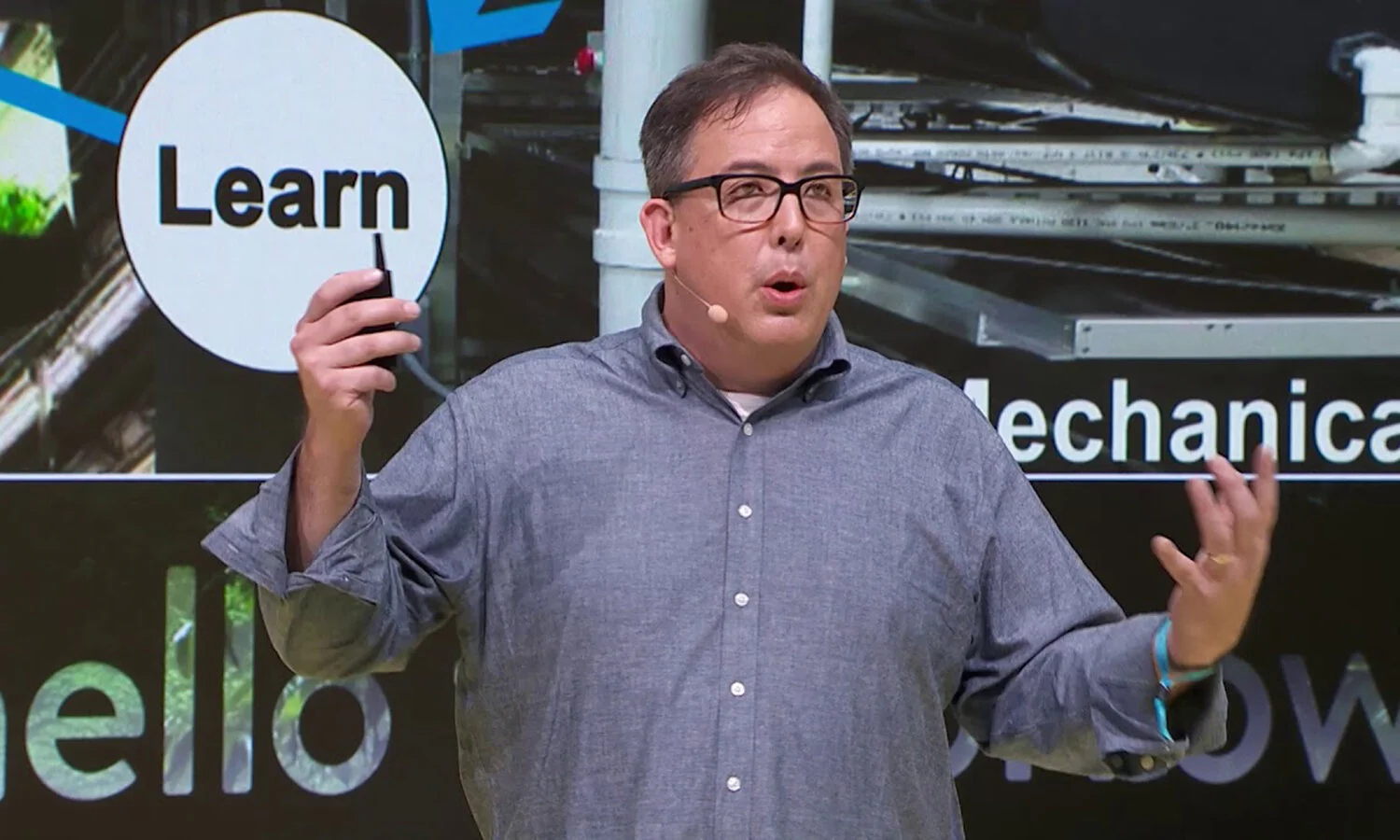
Marc Oshima on Innovations In Urban Vertical Farming and Frida Herrera-Endinjok on Nutrition Justice
Today on “Food Talk with Dani Nierenberg,” Dani interviews Marc Oshima, Co-Founder and Chief Marketing Officer for AeroFarms, a technology company that operates indoor vertical farms around the world
To Listen, Please Click Here
Today on “Food Talk with Dani Nierenberg,” Dani interviews Marc Oshima, Co-Founder and Chief Marketing Officer for AeroFarms, a technology company that operates indoor vertical farms around the world. They discuss how the latest innovations in controlled agriculture can bring healthy food to urban communities while also minimizing environmental impact. Dani also interviews Frida Herrera-Endinjok, a student activist, master gardener, and food system leader from California State University at Northridge. They discuss Frida’s work eliminating food waste on college campuses and improving nutrition in underserved communities through urban community gardening education.
You can listen to “Food Talk with Dani Nierenberg” on Apple iTunes, Stitcher, Google Play Music, Spotify, or wherever you consume your podcasts. While you’re listening, subscribe, rate, and review the show; it would mean the world to us to have your feedback.

Cooked Up For Climate, UAE's High-Tech Food Plan Pays Off in Pandemic
“Thanks to the work being done to harness the benefits of innovation, agriculture is becoming possible and profitable in a country with harsh climatic conditions,” Elouafi said.
MAY 27, 2020
ABU DHABI (Thomson Reuters Foundation) - In the past four years, the United Arab Emirates has grown a small but rising share of its own organic tomatoes, aiming to shore up food security in an import-dependent desert country.
The effort - part of a broader push to produce more home-grown food amid fears climate change could trigger instability in the global food trade - started after the country was hit by food export bans during the 2008-2009 financial crisis.
Today, the move to build up food resilience is paying off early in the face of another crisis: the coronavirus pandemic.
When the United Arab Emirates (UAE) went into lockdown in April to contain the spread of the novel coronavirus, residents had the same reaction as millions of others around the world - they started panic-buying.
The instinct to stock up made sense in a country where more than 80% of food is imported, said Ismahane Elouafi, director-general of the International Center for Biosaline Agriculture (ICBA).
Nonetheless supermarket shelves have remained fully stocked, partly because the UAE has long had policies in place to ensure an uninterrupted supply of food from abroad, she noted.
But in the face of the pandemic, the UAE’s confidence that it will continue to have enough food is bolstered by its success in growing its own, using innovations like vertical farming and climate-resilient crops, she added.
“Thanks to the work being done to harness the benefits of innovation, agriculture is becoming possible and profitable in a country with harsh climatic conditions,” Elouafi said.
According to data from the World Bank, the contribution of agriculture to the country’s gross domestic product rose from $2.39 billion in 2012 to $3.06 billion in 2018.
The UAE’s Ministry of Food Security declined to respond to a request for comment.
FARMING WITH FEWER RESOURCES
Currently ranked 21 out of 113 countries on the Economist Intelligence Unit’s Global Food Security Index, the UAE aims to be in the top 10 by 2021 and number one by mid-century.
By then, the federal government hopes half the food Emiratis consume will be produced locally, compared to 20% today.
Under the UAE’s National Food Security Strategy - which was officially launched in 2018, but had already been woven into government policy for several years before - the country has worked to boost domestic food production.
It has built infrastructure, including complexes for cattle-breeding - and introduced financial measures, from exempting value-added tax on food produced on local farms to paying subsidies on fodder.
But traditional farming methods can only go so far in a country with limited supplies of freshwater and arable land.
Last year, the World Resources Institute classified the UAE as under “extremely high water stress”, meaning more than 80% of the available surface and groundwater supply is withdrawn on average every year.
The bulk of that water is used by the agricultural sector. Combined with a warming climate and a growing population, this is causing available groundwater levels to drop by 0.5 cm (0.2 inches) per year.
To meet the country’s freshwater needs, the government is increasingly turning to energy-intensive desalination methods.
Another challenge is that less than 1% of the UAE’s land is arable, according to the World Bank.
The focus is on finding ways to farm with fewer resources - which is where technology and experimenting with new crops can help, said Sajid Maqsood, associate professor in the College of Food and Agriculture at United Arab Emirates University.
“Urban and vertical farming has to be an important part of the strategy,” he said by phone.
YEAR-ROUND FRUIT & VEG
Farming in the UAE has been moving in a high-tech direction over the past decade.
In 2009, for example, the Middle Eastern country had 50 hydroponic farms, where plants are grown without soil using nutrient-infused water. Today, it has more than 1,000, according to the ICBA.

UAE Based Company ‘Smart Acres’ to Launch Hydroponic Vertical Farming in 2020
In the efforts to push the country’s agriculture to new heights, a company named ‘Smart Acres’ will be launching a new Hydroponic Vertical Farm, which is anticipated to come in the third quarter of 2020
Nikita Arya 7 June 2020
United Arab Emirates (UAE) has been putting countless efforts in boosting agriculture in the country. The country is creating its presence in the global market with its outstanding marketing of fresh local produce. In the efforts to push the country’s agriculture to new heights, a company named ‘Smart Acres’ will be launching a new Hydroponic Vertical Farm, which is anticipated to come in the third quarter of 2020. This new hydroponic plant will be set up in Abu Dhabi and the company aims to expand it all over the country in the following years.
Smart Acres has designed the system using IoT-based technology, which will help the growers in monitoring and growing produce with the consumption of fewer resources. The hydroponics usually generate high quality of crops, and with IoT based technology, the growers could easily grow their produce.
Another unique differentiating thing about the farm is that all the plants are going to be stacked vertically. In vertical farms, the crops are stacked into one another, which creates room for more saplings. The environment needs to be controlled with no natural sunlight or soil. The nutrients are dissolved in the water-based solvent and reach the plants through roots. Roots are generally kept in the water-based system but can also be kept in other solids, which again will contain the necessary nutrients to help the plants grow.
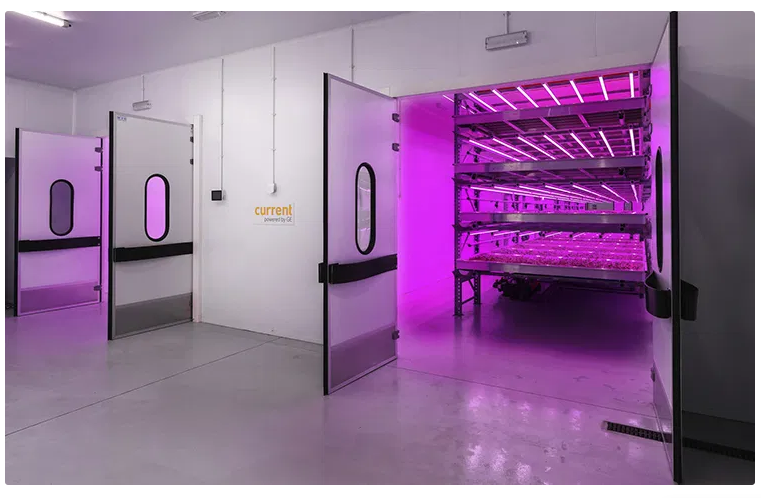
Indoor Farming: How Can You Ensure Success?
Any business can fail for any number of reasons, but indoor farming is an incredibly delicate organism that depends on many disparate factors being perfectly aligned and in balance
Any business can fail for any number of reasons, but indoor farming is an incredibly delicate organism that depends on many disparate factors being perfectly aligned and in balance. This increases the risk of failure for those unaware of the number of plates that need to be kept spinning in perfect time. This list is not definitive but gives you a good idea of the most common mistakes to avoid.
1. Avoid a Trial and Error Approach to Design
There are multitudes of factors that are naturally managed and balanced with indoor farming. The sun cannot be changed, irrigation to every plant is different as weather patterns can change from moment to moment and even the nutrition in the soil can vary across the area of the field. Planning your farm therefore gives you the ultimate control but also dramatically increases the variables that you can and must consider.
These variables start with the facility’s very layout, such as the size of growing space, plant distribution, airflow and more. Additionally, without having the right models in place to determine the exact light recipe and combination of CO₂, nutrients and water required to grow a successful crop, growers can find themselves wasting time and money on testing phases to try to maximize yield and revenue. Once you have developed a model for your vertical farm, you should then put it through a testing phase on a smaller scale to ensure it is viable.
2. Pick the Right Crop
It’s far easier to develop a profitable and scalable facility if you know the needs of your crop inside and out. That ideally means specializing in one type of crop that you can design your facility around, electing the right growth spectrum and studying that particular plant’s biology to better understand how to optimize irrigation, nutrition, air flow, CO₂ concentration and propagation in order to maximize elements such as taste, nutritional content, visual appeal, potency or shelf life.
Too many growers have tried to hedge against perceived risk by trying to grow multiple crops. By default, it is extremely difficult to have one installation that is optimized for a wide variety of plants, and therefore the returns from each crop are lower than they could have been. The facility then may have to suffer through downtime as the technology is tweaked and optimized for the next crop — eating into profitability and adding unnecessary costs.
3. Location, Location, Location
The old adage that location is half the battle has never been more relevant than in vertical farming today. Vertical farms have a key advantage in their ability to be located close to their customer, whether they are selling to food processors, supermarkets or local shops. Removing the vast transport logistics associated with today’s food supply chain slashes costs and helps appeal to an increasingly conscientious customer. The lack of transport costs also helps counter the higher production costs resulting from higher energy and labor inputs.
At city planning level, there are also many advantages of co-locating a vertical farm with other facilities such as office buildings, shops or residences — which could draw the vertical farm’s excess heat to reduce demands on other sources of energy.
4. Simplify Your Business Model
Proximity to customers and the ability to produce crops year-round at a sustainable rate is a strong advantage in the market, whether you’re growing for the food or pharmaceutical sectors. Therefore, consider the opportunities available through establishing exclusive contracts with customers at a fixed rate that will offer more financial security as you build your business.
5. Be Realistic About Operational Cost
Setup and fit-out costs represent a high initial outlay for any indoor farming entrepreneur, but the ongoing operational costs (energy, labor, inputs, maintenance, etc.) are also significant. Businesses not only need to find creative ways to mitigate these risks (e.g. growing through the night when energy tariffs are lower and the outdoor climate is cooler to assist HVAC systems’ efficiency), but also consider the cost-benefits of different configurations and process flow.
6. Set Prices Based on What Consumers Will Pay
At the 2017 inaugural AgLanta Conference11, PodPonics’ CEO admitted that the company missed out on higher potential margins as it priced its crops to compete with conventional growers, ignoring the price premium that food traceability, pesticide-free growing and local production can increasingly attract from consumers in some markets.
7. The Skills Gap
In many cases, those who have embraced the promise of indoor farming have not been traditional growers but rather tech entrepreneurs, engineers or hobbyists. Vertical farming requires a unique mix of skills to be successful: big data scientists, systems integrators, project managers, engineers, growers and plant scientists all have a role to play in addition to the core functions that any business needs to be successful (financial strategists, marketing and business development, etc.). From the leadership perspective, experience at replicating and scaling a business is critical. Ignoring any one of these functions leaves a serious gap in business capability that could undermine the overall success of the operation.
8. Remember What You’re Selling
In a bid to capitalize on the new technology and growth models offered by vertical farming, some growers have forgotten that their primary focus should be on growing and selling the highest quality food. Instead, they have tried to recoup their investment by trying to commercialize their vertical farm’s technology, process and methodology. Unfortunately, as we have seen, every vertical farm is different with potentially very different needs. The trick is to not to try and do many different things at once, but instead keep a clear focus on doing one thing as well as possible.
Source: www.currentbyge.com/ideas

UAE To Launch Hydroponic Vertical Farming in 2020
Set to launch in Q3 of 2020, the vertical farming company Smart Acres will be set up in Abu Dhabi, with an aim to expand across the UAE
With a mission to improve food security and support UAE local farms

Darragh Murphy
June 03, 2020
With the UAE making strides in agriculture, and now competing globally by marketing fresh local produce, it’s now adding to this by launching a new hydroponic vertical farm.
Set to launch in Q3 of 2020, the vertical farming company Smart Acres will be set up in Abu Dhabi, with an aim to expand across the UAE.
The new systems aim to develop the UAE’s farming capabilities, along with improving food security to potential socioeconomic threats, such as pandemics, and to help businesses locally source food produce from UAE farms.
The company has designed farm modules using an IoT-based technology system to grow and monitor their produce, a system that consumes less resources and generates ultra-high quality crops.
Smart Acres’ vertical farming method completely reduces water waste, depletion of nutrients in soil, and infestation of insects, along with the elimination of any pesticides.
Currently, the company is producing a variety of lettuce and herbs, such as green glace, oakleaf, lollo rosso, and shiso, with plans to eventually grow baby spinach, mature spinach, and baby arugula.
Looking for locally sourced greens and can’t get enough fresh fruit, vegetable, and more? Check out these organic markets to shop at.
To stay updated on the latest in Dubai, click here, for Abu Dhabi, here, and for Sharjah, right here.
Be the first to get all the latest Dubai news, reviews and deals into your inbox by signing up to our free newsletter, click here to sign up.

ABU DHABI: US Educator Outlines Urban Farming Vision in ADIBF Virtual Session
American educator, urban farmer, and innovator Stephen Ritz revealed how his tower garden-growing technology is flourishing in the UAE during the latest Abu Dhabi International Book Fair, ADIBF, Virtual Session
ABU DHABI, 2nd June 2020 (WAM)
American educator, urban farmer, and innovator Stephen Ritz revealed how his tower garden-growing technology is flourishing in the UAE during the latest Abu Dhabi International Book Fair, ADIBF, Virtual Session.
The talk, titled ‘Changing the World with the Power of a Plant’, on Thursday covered Ritz’s rise to fame through his innovative teaching methods in some of the USA’s poorest communities, his ongoing projects in the UAE, and the numerous books he has published.
As the 30th edition of ADIBF has been postponed until next year, the Department of Culture and Tourism – Abu Dhabi, has instead organized the virtual sessions for scheduled guests to present their talks online, so viewers can watch safely in their homes.
Ritz, who has become known as ‘America’s Favourite Teacher’, has spawned a green movement through the changes he brought to the school where he taught in the South Bronx, New York. Utilizing hydroponics and aquaponics, he began to grow plants in the classroom, which in turn encouraged his students to follow sustainable and healthy lifestyles.
He first came to the UAE in 2015 as one of the ten finalists in the Global Teacher Prize. While he didn’t win, he used his runner-up prize money to create the Green Bronx Machine, a curriculum for a green classroom, which is now being taught around the world.
His work caught the attention of Dr. Abdulla Al Karam, Chairman of the Board of Directors and Director-General of the Knowledge and Human Development Authority, KHDA, in Dubai, who invited Ritz back to the UAE. Soon Ritz was visiting schools, universities, and businesses here to explain his methods. He also began working alongside Sheikh Dr. Abdul Aziz bin Ali Al Nuaimi, the Environmental Advisor to the Government of Ajman, who is also known as the ‘Green Sheikh’ for his environmental work. The pair are currently authoring a book called Bringing the Farm to the Desert to be released in 2021.
Ritz also works with Esol Education, the international network of private schools that operates many schools across the UAE, and has been appointed as its Director of Health, Wellness and Innovation. He is now based at Fairgreen International School in The Sustainable City, Dubai, hence he says he now thinks of the UAE as his "second home".
Ritz said he enjoys nothing more than meeting children, inspiring teachers, inspiring healthy living, and inspiring healthy learning for everyone across the UAE through his passion, purpose, and hope.
With the 30th edition of the ADIBF postponed until next year, the DCT Abu Dhabi has launched a series of live virtual broadcasts to showcase artists and authors and open up new creative conversations with readers.
The virtual sessions will run until Monday, 15th June 2020, and feature ten speakers from around the world, to discuss a wide variety of themes – from history and education to entertainment and science – designed to appeal a wide audience of different age groups and tastes.
Other ADIBF Virtual Sessions have featured the Swedish behavioral expert Thomas Erikson, military survival specialist John Hudson; Lemn Sissay, the award-winning British-Ethiopian poet; and Annabel Karmel, the children’s cookbook author.
WAM/Tariq alfaham/Nour Salman

VIDEO: Community Supported Agriculture - CSA - Basics - Massachusetts
Red Fire Farm currently farms two pieces of farmland, one in Granby, MA and one in Montague, MA. The two properties allow more effective soil building and crop rotation than could be achieved on either piece individually.
People "don't want that many hands on their food right now," said Sarah Voiland. "And we can offer that."
She and her husband, Ryan, run the organic CSA Red Fire Farm, in the Connecticut River Valley outside of Amherst, Mass.
Enjoy the Seasons With Us!
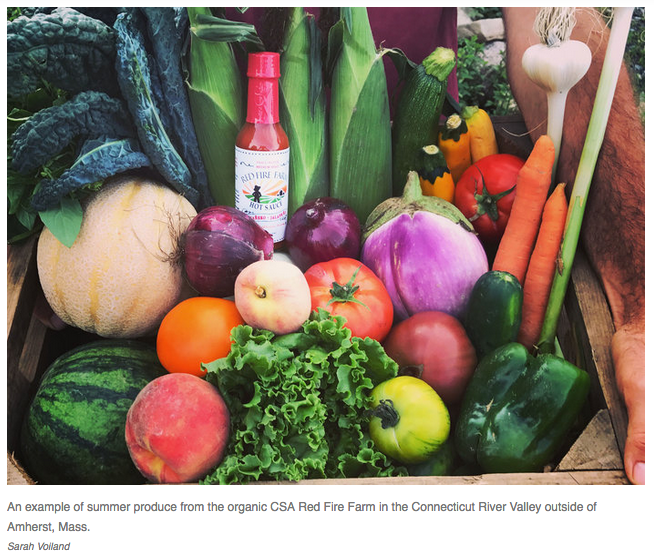
Delicious heirloom tomatoes, crisp salad greens, tender tasty carrots, hearty golden potatoes… these are just a few of the many exciting vegetables that members will find in the Red Fire Farm Community Supported Agriculture (CSA) farm shares this season.
We offer local organic vegetable farm shares, local fruit shares, pasture-raised egg shares, fresh mushroom shares, and local organic flower shares for pickup or delivery to various locations in Western Massachusetts and the Boston area.
Here’s How the CSA Works:
Members sign up for a farm share in the winter and spring
We seed and raise lots of produce for the CSA at the farm
Then the CSA season starts, and each week…We harvest, wash, and deliver the week’s share to you
Members pick up shares at locations around Western MA and the Boston Area, getting super-fresh produce harvested just the day before
Members cook it up and eat very well!
Pick up your weekly share of fresh, organic produce either at the farm in Granby and in Montague or delivered to locations in Northampton, Springfield, Jamaica Plain, Somerville, Worcester, Brighton, Watertown, Cambridge, Boston, and Newton.
Extra Benefits for All Red Fire Farm CSA Members:
Pick Your Own (PYO) for free at the farm in Granby or Montague
(including peas, beans, cherry tomatoes, strawberries, herbs, flowers and other crops)Weekly newsletter full of recipes and farm stories
Bulk produce ordering with convenient pickup locations
Farm events like the Tomato Festival, cooking demonstrations, and more
For more information visit: https://www.redfirefarm.com/


VeggiTech Builds and Operates Digital Smart Farms For Customers
In conversation with Hemant Julka, Chief Operating Officer, VeggiTech
By GN Focus | May 28, 2020 | Gulf News
In conversation with Hemant Julka, Chief Operating Officer, VeggiTech
Could you tell us about VeggiTech and its operations in the UAE?
VeggiTech is an agro-tech organisation focused on disrupting the agriculture industry to create sustainable and eco-friendly farms. We focus on LED-assisted hydroponics for indoor vertical farms and protected hydroponics to farm sustainably even in the UAE’s challenging conditions, where soil, temperature and water are not conducive to traditional farming. Our farming landscape has grown to over 60 acres of protected hydroponic farms and more than 45,000 sq ft of indoor vertical farms, with a team of over 150 qualified agronomists, engineers and farmers.
How could you help traditional farms in the country incorporate hydroponic farming practices?
VeggiTech’s business model is to build and operate digital smart farms for our customers. We drive the transformation of farms with these innovative technologies in a cost-effective manner. The year 2019 saw more than 35 acres of traditional farms converted into protected hydroponics and the introduction of 45,000 sq ft of indoor vertical farms in Sharjah alone.

Given our expertise, we ensure the latest innovation in farming technology is delivered with optimal return on investment for our customers.
Could you talk about a couple of key projects that you have handled recently?
Some of our recent successes were the conversion of a traditional farms (640,000 sq ft) into modern protected hydroponic farms and the commissioning of the indoor vertical farm of 25,000 sq ft grow area. Our protected hydroponics technologies provide a harvest of 40-45kg per sq m per annum, while our indoor vertical farms provide a harvest of 85-90kg per sq m per annum using less than 5 percent of the water used in traditional farming.
What initiatives have you taken to create more awareness on hydroponics and other innovative farming technologies for a sustainable agricultural ecosystem in the UAE?
Education is key for long term sustainable impact. We work closely with the Ministry of Climate Change and Environment (MOCCAE). Our Chief Agronomy Officer, Bhaskar Rao, leads our Learning Hub platform that hosts the Urban Grower’s programme for students, parents and teachers. We have had more than 50 graduate participants from the programme.


What’s Next For Vertical Farming? Proprietary Strawberries And Other Non-Leafy Produce
Agtech investment firm AgFunder announced this week that it has added agtech company SinGrow to its investment portfolio for an undisclosed sum
Agtech investment firm AgFunder announced this week that it has added agtech company SinGrow to its investment portfolio for an undisclosed sum. AgFunder founding partner Michael Dean wrote in a post that SinGrow “isn’t just looking to be another vertical farmer selling leafy greens.” Instead, the company uses a combination of plant biology, hydroponic vertical farming, and other technologies to grow what it hopes will be a range of produce types, starting with its own novel varieties of strawberries.
As Dean lays out in his post, SinGrow has developed a vertical farming solution that addresses every stage of a plant’s agricultural journey, from breeding to harvesting. (Most vertical farm solutions do not address plant breeding.) It breeds strawberry varieties adapted to humid weather and has two proprietary strawberry cultivators specifically developed for Singapore’s tropical climate. Both of those things mean SinGrow’s system uses less energy because it needs less air conditioning pumped in to cool the facility and reach the ideal growing temperature for the strawberries.
The company also grows the plants on a strawberry-specific rack it has developed, where the plants grow outward instead of upward. That in turn allows a harvesting robot to drive alongside the rack and simply snip the strawberries off rather than pick them.
Why strawberries? Well, first, they’ve been a hobby of SinGrow cofounder Bao Shengjie, who has been cross-breeding strawberry seeds since 2016. That particular fruit was of interest to the founders because it’s difficult to actually get in Singapore, at least at an affordable price point. SinGrow lists expenses, poor taste, and an unstable supply chain as reasons strawberries are difficult for the average consumer to buy in that region.
The company has this neat explainer video that delves more into the specifics on how it grows its strawberries.
Singapore also relies on imports for about 90 percent of its foods, hence the Singaporean government’s 30x30 initiative launched in response to the COVID-19 pandemic: Singapore should have 30 percent of its foods produced domestically by 2030.
On that note, SinGrow hopes to soon move beyond strawberries to grow grapes, saffron, and other crops, according to Dean’s post.
A (very small) handful of companies are also exploring what else they can grow beyond the leafy green. UK-based Phytoponics is trialing a system for plants like cucumbers, tomatoes, and peppers. And a while back, San Francisco startup Plenty said it wanted to grow “exotic” produce on its farm Tigris. To date, though, the company’s website still offers only leafy green varieties.
If a company like SinGrow can show others how to use biology, technology, and farming to grow a greater assortment of produce items, it could change vertical farming’s role in our system from an add-on method to a primary source for getting certain fruits and vegetables. It’s early days yet, but the technology looks to be moving in that direction.
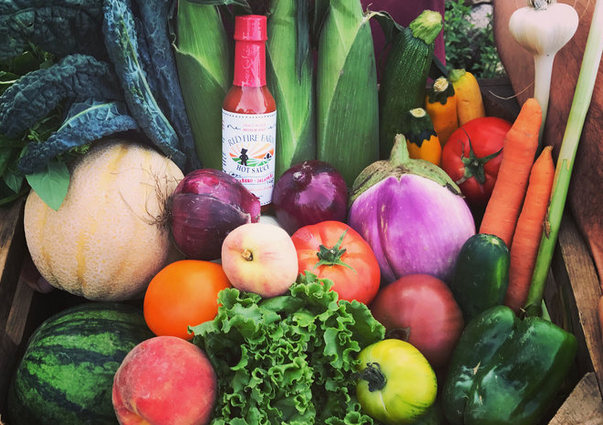
As Food Supply Chain Breaks Down, Farm-To-Door CSAs Take Off
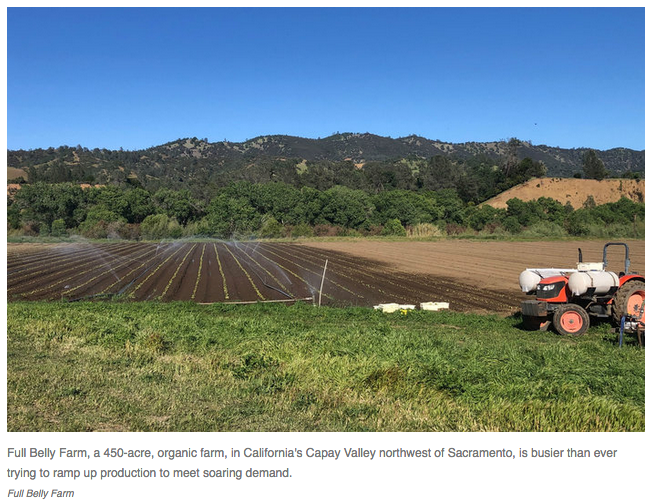
Redmond, a founding partner of the 450-acre, organic Full Belly Farm, is busier than ever trying to ramp up production to meet soaring demand. "The interest in getting local, fresh, organic produce just has skyrocketed during this crisis," Redmond said.
By Eric Westervelt | NPR | May 10, 2020
Images of some American farmers dumping milk, plowing under crops and tossing perishables amid sagging demand and falling prices during the deadly coronavirus pandemic has made for dramatic TV.
But it's not the whole story.
"We had a reporter call here and say, 'We want to see some produce rotting in the field and milk going down the drains,' " said Judith Redmond, a longtime farmer in California's Capay Valley, northwest of Sacramento. "And I said, 'Well, actually, that's not what's happening in the Capay Valley.' "
Redmond, a founding partner of the 450-acre, organic Full Belly Farm, is busier than ever trying to ramp up production to meet soaring demand.
From California to Maine, the movement known as community supported agriculture (CSA) is booming. Members buy a share of a farm's often organic harvest that gets delivered weekly in a box. CSA programs almost everywhere report a surge in memberships and growing waiting lists.
"The interest in getting local, fresh, organic produce just has skyrocketed during this crisis," Redmond said.
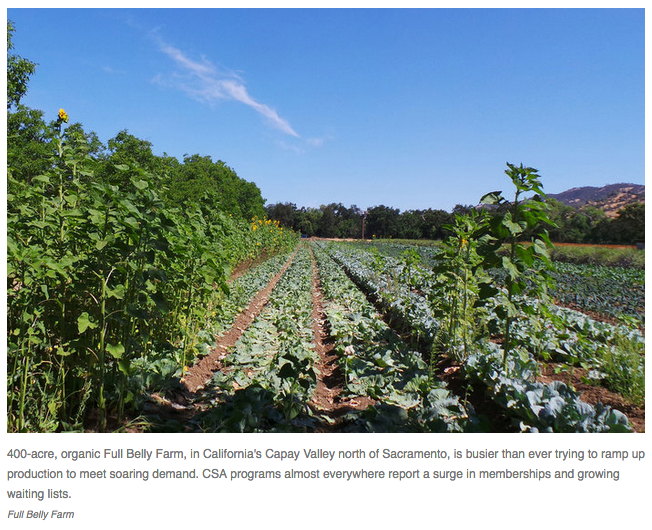
As with many farms, the restaurant and farmers market sides of her business have cratered. But the CSA side, which includes business across the San Francisco Bay Area, has jumped to 2,000 boxes a week. "We've doubled our CSA box numbers and quadrupled our add-ons like wheat flour, oils like olive oil, nuts, fruit juices, even yarn," Redmond said.
CSAs have long been something of a niche market that have never really penetrated the mainstream. Yet, the coronavirus just might prove to be sparking community supported agriculture's breakout moment.
"In all the time that we've worked with CSAs, which is several decades, we've never seen a surge as quickly as we have of the last few weeks," said Evan Wiig with the Community Alliance with Family Farmers, which supports and lobbies on behalf of CSAs across California.
"It's sort of a heyday for CSAs," he said. "Farmers that were starting in March struggling to get enough members for the season – which we see every year — by mid-March were dealing with waiting lists with hundreds of people trying to get in."
The coronavirus has exposed the vulnerabilities and fragility of the U.S. global agribusiness supply chain. The CSA model's focus on local and fresh is ideally suited for a crisis that has people deeply worried about germs on lettuce, beets or broccoli as the crops make their way from the field to the kitchen counter.
People "don't want that many hands on their food right now," said Sarah Voiland. "And we can offer that."
She and her husband, Ryan, run the organic CSA Red Fire Farm, in the Connecticut River Valley outside of Amherst, Mass.
The low-touch factor is an especially big draw at a time when a trip to a supermarket can involve masks, social-distancing lines, hand sanitizer and angst. "The supply chain with CSA is very short. It's like, we harvest the produce and you come pick it up" at a local site, she said.
"We think people's habits will shift because of this" pandemic, said John Tecklin, who runs the CSA Mountain Bounty Farm, serving the northern California communities around Truckee, Nevada City and Lake Tahoe, as well as Reno, Nev. "For a lot of them, it's kind of a wake-up call: 'what's really important to you?' "
In a move spurred partly by the pandemic, and a sign of the changing times for CSAs, Tecklin's farm is now entering into a partnership called Forever Farms with a non-profit land trust, a local food advocacy group and a food cooperative to help secure ownership of part of the farm's land in perpetuity.
"It's local food security for our community," Tecklin said. "In these times it's more important than ever now."
He believes that's the same motivation driving the recent doubling of interest in his CSA. "Everyone is just all of a sudden, 'Wow this is the kind of thing we need, we need local farmers who we're dealing with directly.' "
Some farms, large and small, that relied on restaurant, hotel, school and university food-service contracts have been hit hard. Many are now scrambling to adapt to a CSA-type model, at least in the short term, to survive. Some are now partnering with CSAs in a mutually beneficial pact that helps CSAs meet growing demand while offering an outlet for suffering farms.
Federal and state governments are also now taking a page from CSAs. As part of its coronavirus relief, the U.S. Department of Agriculture has put out a call for $3 billion in contracts for farmers to produce and deliver fresh produce and dairy boxes to food banks, many of which are struggling to support the growing ranks of Americans who are hurting and out of work.
Some states are trying to redirect to charities farm produce that in normal times would have headed to restaurants and hotels. California has expanded funding to help cover the costs of harvesting, packaging and transporting fresh fruits and vegetables from farms to local food banks. The state's Farm to Family Program, a partnership with the California Association of Food Banks (CAFB) and the USDA, provides fresh produce to needy households across the state.
CSAs still represent a very small slice of America's $100 billion farm economy. But their renaissance marks a rare bit of good economic news for an agriculture industry battered by trade wars, threatened by climate change and now facing a global pandemic.
And the new success brings new challenges. Many CSAs are now scrambling to find additional labor to plant, harvest and deliver produce to meet the moment. "We're totally able to produce so much more than we are, but we don't have the workers," said Redmond, of Full Belly Farm. "We're so stressed out by that that, you know, just knowing that there's going to be a difficult time getting workers, it just doesn't make any sense to ramp up production."
A big question for CSAs is whether the renewed interest represents a fleeting reaction to fear or a more sustainable, long-term trend.
"When the lockdown or shelter-in-place started in March, people were just a little panicked," Redmond said. "And what we're trying to do is turn it into a longer-term relationship with our farm and those members so that they see that there's a tremendous advantage of getting food locally from people that they know."

Farms of The Future: The Paris Rooftops At The Heart of an Urban Revolution
A bumblebee zig-zags through rows of lettuce, over a healthy patch of red peppers and lingers next to a juicy strawberry, before buzzing away and off the rooftop of a six-story building in central Paris. Based on the top floor of a municipal swimming pool in the busy Marais district, this thriving city farm is at the heart of an urban food revolution in the French capital
Words by Peter Yeung
June 3, 2020
The world's largest urban farm is opening in the French capital and will soon produce around 1,000kg of organic produce every day
A bumblebee zig-zags through rows of lettuce, over a healthy patch of red peppers and lingers next to a juicy strawberry, before buzzing away and off the rooftop of a six-story building in central Paris.
Based on the top floor of a municipal swimming pool in the busy Marais district, this thriving city farm is at the heart of an urban food revolution in the French capital.
Opened in 2017 by Agripolis, it is part of a series of City Hall-led projects, called Parisculteurs, which will see 100 hectares of vegetation planted across Paris by the end of the year. Agripolis alone has 10 farms running or in planning around the city.
The farm’s vertical system is closed-loop, doesn’t waste any water, and doesn’t use pesticides. In season, it produces some 20-30,000 portions of fruit, salad, and vegetables. It has come to be a blueprint for changing how the city eats.
“We don’t throw anything away,” says Pascal Hardy, an agronomist and the founder of Agripolis, who only entered the world of urban farming in 2015 by growing vegetables on the roof of his Parisian apartment.
“My principal motivation has always been environmental. Our farms are great for biodiversity and efficiency, and they have a very low carbon footprint.”
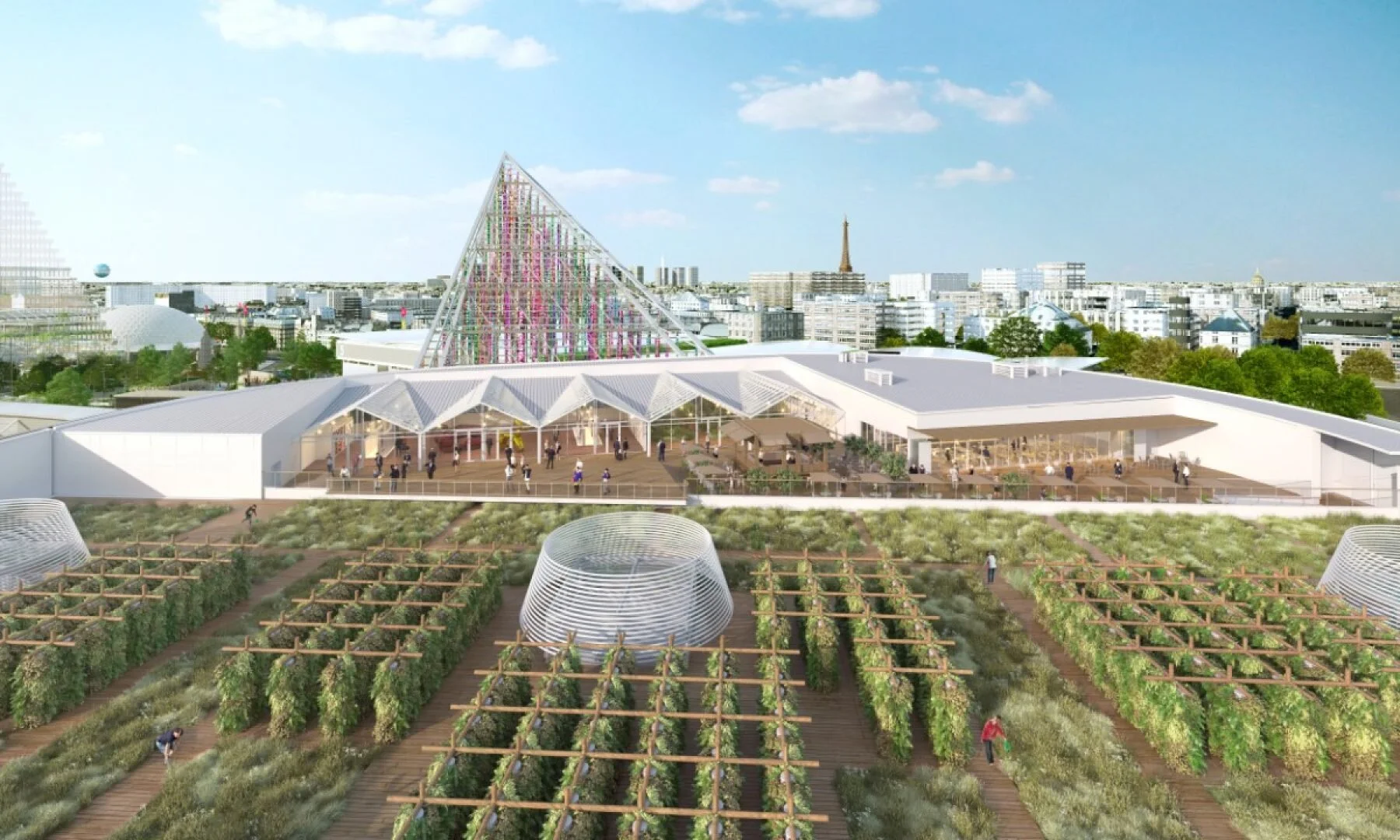
Agripolis is also set to unveil a 14,000sq m farm atop the Paris Expo Porte de Versailles, an exhibition center in the south-west of the city. The project was due to open in April but this had to be delayed because of the lockdown in France in response to the pandemic. When it opens at the end of June, it will be the largest urban rooftop farm in the world – and the largest urban farm of any kind in Europe. With more than 30 different plant species, the Porte de Versailles site will produce around 1,000kg of goods every day in high season. The first harvest of greens is expected after a month.
Visitors will be able to eat at a 300-cover on-site restaurant, attend educational tours and even lease small vegetable plots of their own. The all-organic produce, cultivated by around 20 gardeners, will be grown using aeroponic vertical farming methods.
We don’t throw anything away
“Our produce will be available across the whole of the city in a variety of shops, restaurants, and schemes,” adds Hardy.
There’s evidence that Hardy’s urban farms will be a success. “We’ve had a huge demand for their products, with customers asking specifically for Agripolis produce,” says Jeremy, an assistant at a nearby shop that has been stocking food from the Marais farm for six months. “We just need to cross the road to get the products.”
For now, Hardy’s main challenge is reducing the relatively premium cost of city-grown food, although advances in technology mean it continues to become cheaper. Coupled with low emissions and almost no “food miles”, the few extra cents could be a small price to pay.
Main image: Agripolis

Hydroponics - A Growing Trend in Architecture
Hydroponics might as well be the most sustainable way to feed the growing communities in moving forward. It is most efficient to grow leafy vegetables in vertical farms. Compared to traditional farms, vertical farms use 90% less land, gives 90% more fruit, and uses 90-98% less water with no soil.
‘In which Annie gives it those ones’, a movie that came out in the year 1989 featuring an honest life of a typical architecture college and its students. The principal figure is a titular character – Annie, or Anand Grover (played by Arjun Raina) who dreams of revolutionizing India through radical concepts. With a motive to reverse the whole process of urbanization, he suggests the growth of fruit farms alongside railway lines to make better use of excreta dumped on tracks by passing trains. This would end the migration from rural villages to urban cities. Such hare-brained schemes are “those ones” of the title – hippy-dippy fantasies of using architecture to be of some use of society. He questions in the movie, how could anyone else have not thought of the idea before he did. Well, the real scenario was even worse until hydroponics occupied its seat in the field of Architecture.
Farmlands in urban cities ©www.dezeen.com
Hydroponics Brings Farmlands To Urban Cities
With the rapid change in the world, there is a proportional decline in land availability and the quality of the soil. Resources like freshwater are left to count on throughout the world. By the year 2050, the population figure is predicted to rise to 9 billion and at the same time climate change could lower crop production by 25%.
Currently, with the expansion of cities & exhaustion of the rural lands, a vegetable growing on farmland travels about 2400 km before it reaches households. To keep it fresh and edible, it is sprayed by pesticides and chemicals. The food that one eats thus gets reduced to 50% of its nutrients, even 100% in some cases. Hence, the future of farming is being brought to cities across the world. Kimble Musk, brother of Elon Musk, and co-founder of Square Roots has a shipping container farm in Brooklyn. Under the streets of London there is a shelter being converted into an underground farm. There are tiny farms under Michelin Star Restaurants in New York City and a Tokyo office building which has its own rice paddy field in the lobby.
Vertical Farming in True Garden, Arizona ©www.usatoday.com
Hydroponics might as well be the most sustainable way to feed the growing communities in moving forward. It is most efficient to grow leafy vegetables in vertical farms. Compared to traditional farms, vertical farms use 90% less land, gives 90% more fruit, and uses 90-98% less water with no soil. The UN estimates that 20-40% of crops that are grown are destroyed by pests. So, growing in a closed environment without soil means no pests and thus, no pesticides. Tower Garden collaborated with Tower Farms to birth True Gardens in Arizona, USA. It is one of the major successful examples who have envisioned to drastically reduce the regional agricultural problems against the temperatures and lack of resources.
Hydroponics In Small-Scale Projects
Courtyards in office space ©www.archdaily.com
Backyards ©www.wallpaper.com
While people are getting under built concrete to fabricate urban farms in the cities, some architects open a new aspect of Hydroponics in the field of Architecture. C.C Arquitectos – an architectural firm in Mexico, designed a contemporary office that meets modern hydroponics. The site became a major driving force for this project. The building block is located between two production warehouses of leafy green vegetables. The project was intended to resolve the location of offices in a space that made emphasis on the constant interaction of the areas.
The context consists of agricultural fields that generate deep horizons. This became the second aspect the architect wanted to address: how to contain workspaces, bring a human scale to the whole, and provide visual breaks. He took advantage of the proximity to one of the production plant warehouses to visually involve the production process. It was intended to promote a friendly atmosphere, take distance from the corporate condition, and try to approach a community working for common purposes. This example shall inspire one, and all the designers to break the stereotypical boundary of application of hydroponics that limits to only vertical farming.
Hydroponics Meets Art
Before you proceed to read further, I would like you to take a pause and imagine –what if, hydroponics meets art and architecture with a pinch of technology? In advance of you declaring the amalgamation impossible, I would like to introduce a project known as Kinetic Green Canvas, built by Associative Data (BAD) along with Green Studios to create a prototype green art installation for building façades.
The Canvas consists of individual modules, each of which is a cube made from a steel framework, back paneling, L-shaped jambs, secondary structure, waterproofing board, irrigation piping, Green Studios hydroponic skin, and plants. These layered components are assembled on four sides of the cube module, with a motor and water pipe attachment that circulates water throughout. Varied shades of green grass are grown on each face and can create changeable ‘pixel’ art. All we need is art and plants to cheer up the neighborhood, so why not combine the best of both worlds?
Kinetic module ©www.materialdistrict.com
Stacking rows of pixel units’ ©www.materialdistrict.com
Kinetic green canvas creating art ©www.architectureanddesign.com
Hydroponics Builds A Tiny Ecosystem
Solar power at top level ©www.smithsonianmag.com
Fish farming at bottom level; ©www.smithsonianmag.com
Amidst the sea or river, grows a field yielding tons of vegetables, fruits, and fish each year! Barcelona-based architectural firm – Forward Thinking Architecture floats an idea of a complete ecosystem. With the ideology of no land-no problem, the firm proposes ‘Smart Floating Farms’; large triple-decker agriculture barges that feature fish farms down below, hydroponic gardens up top and, solar panels on the roof to keep things running. The designers contend that all of this could, in theory, operate pretty much automatically with minimal human intervention. A project takes the right direction when the classical elements merge together to support life and are self-sufficiently sustainable.
The extent of Hydroponics spreads exponentially more and beyond. It has been experimented in the farming sector and is successfully solving major world crises in the present and for the coming future. The growing trend in architecture shall meet advanced technology and who knows, we might even have growing buildings using hydroponics! Contradicting what we’ve always been taught – I would recommend building castles in the air. It could be one significant bridge for the human race to jump to productive architecture.
Architectural Journalist
Rethinking The Future
Tanushree Saluja is constantly inspired by connecting different forms of art and translating into architectural experiences. She strives for the eccentricity that’s interminable in the mind of the receiver. Bringing in fresh perspectives and unique outlook has been the greatest challenge and reward to her creativity.

What American Can Learn From Other Food Cultures
“There is no landscape in the world that sustainably allows us to eat how we think we want to.” In another sense, says Barber, food is the physical manifestation of our relationship with the natural world. It is where culture and ecology intersect.
Food feeds the soul. To the extent that we all eat food, and we all have souls, food is the single great unifier across cultures. But what feeds your soul?
For me, a first-generation Korean-American, comfort food is a plate of kimchi, white rice, and fried Spam. Such preferences are personally meaningful — and also culturally meaningful. Our comfort foods map who are, where we come from, and what happened to us along the way. Notes Jennifer 8. Lee (TED Talk: Jennifer 8. Lee looks for General Tso), “what you want to cook and eat is an accumulation, a function of your experiences — the people you’ve dated, what you’ve learned, where you’ve gone. There may be inbound elements from other cultures, but you’ll always eat things that mean something to you.”
Jennifer Berg, director of graduate food studies at New York University, notes that food is particularly important when you become part of a diaspora, separated from your mother culture. “It’s the last vestige of culture that people shed,” says Berg. “There’s some aspects of maternal culture that you’ll lose right away. First is how you dress, because if you want to blend in or be part of a larger mainstream culture the things that are the most visible are the ones that you let go. With food, it’s something you’re engaging in hopefully three times a day, and so there are more opportunities to connect to memory and family and place. It’s the hardest to give up.”
Food as identity
The “melting pot” in American cuisine is a myth, not terribly unlike the idea of a melting pot of American culture, notes chef Dan Barber (TED Talk: How I fell in love with a fish). “Most cultures don’t think about their cuisine in such monolithic terms,” he says. “French, Mexican, Chinese, and Italian cuisines each comprise dozens of distinct regional foods. And I think “American” cuisine is moving in the same direction, becoming more localized, not globalized.”
American cuisine is shaped by the natural wealth of the country. Having never faced agricultural hardship, Americans had the luxury of not relying on rotating crops, such as the Japanese, whose food culture now showcases buckwheat alongside rice, or the Indians, or the French and Italians, who feature lentils and beans alongside wheat. “That kind of negotiation with the land forced people to incorporate those crops in to the culture,” says Barber. And so eating soba noodles becomes part of what it means to be Japanese, and eating beans becomes part of what it means to be French.
So if what we eat is what we are, what are Americans? Well, meat. “If Americans have any unifying food identity, I would say we are a (mostly white) meat culture,” says Barber. “The protein-centric dinner plate, whether you’re talking about a boneless chicken breast, or a 16-ounce steak, as an everyday expectation is something that America really created, and now exports to the rest of the world.”
Every single culture and religion uses food as part of their celebrations, says Ellen Gustafson, co-founder of the FEED Project and The 30 Project, which aims to tackle both hunger and obesity issues globally. (Watch her TED Talk: Obesity + hunger = 1 global food issue.) “The celebratory nature of food is universal. Every season, every harvest, and every holiday has its own food, and this is true in America as well. It helps define us.”
Food as survival
Sometimes food means survival. While the Chinese cooks who exported “Chinese” food around the world ate authentic cooking at home, the dishes they served, thus creating new cuisines entirely, were based on economic necessity. Chinese food in America, for example, is Darwinian, says Lee. It was a way for Chinese cooks to survive in America and earn a living. It started with the invention of chop suey in the late 1800s, followed by fortune cookies around the time of World War II, and the pervasive General Tso’s Chicken, in the 1970s. Waves of more authentic Chinese food followed, as Hunan and Sichuan cooking came to the U.S. by way of Taiwan.
In Chinese cities, meanwhile, only grandparents are cooking and eating the way that people from outside of China might imagine “Chinese” food. The older generation still would shop every day in the wet market, bargain for tomatoes, then go home that night and cook traditional dishes, says Crystyl Mo, a food writer based in Shanghai. But most people born after the Cultural Revolution don’t know how to cook. “That generation was focused purely on studying, and their parents never taught them how to cook,” says Mo. “So they’re very educated, but they’re eating takeout or going back to their parents’ homes for meals.”
Food as status
Those slightly younger people have been the beneficiaries of the restaurant culture exploding in Shanghai. The city is home to 23 million people, and has more than 100,000 restaurants, up from less than ten thousand a decade ago. Now, you can find food from all of the provinces of China in Shanghai, as well as every kind of global food style imaginable.
The introduction of global foods and brands has compounded food as a status symbol for middle-class Chinese. “Food as status has always been a huge thing in China,” says Mo. “Being able to afford to eat seafood or abalone or shark’s-fin or bird’s-nest soup, or being able to show respect to a VIP by serving them the finest yellow rice wine, is part of our history. Now it’s been modernized by having different Western foods represent status. It could be a Starbucks coffee, or Godiva chocolates, or a Voss water bottle. It’s a way of showing your sophistication and worldliness.”
Eating is done family style, with shared dishes, and eating is the major social activity for friends and families. Eating, exchanging food, taking photos of food, uploading photos of food, looking at other people’s photos of food — this is all a way that food brings people together in an urban center. Even waiting in line is part of the event. People may scoff at the idea of waiting two hours in line to eat in a trendy restaurant, says Mo, but waiting in line for a restaurant with your friends is an extension of your experience eating with them.
How and why you eat your food, is, of course, also very cultural. In China, people eat food not necessarily for taste, but for texture. Jellyfish or sliced pig ear don’t have any taste, but do have desirable texture. Foods must either be scalding hot or very cold; if it’s warm, there’s something wrong with the dish. At a banquet, the most expensive things are served first, such as scallops or steamed fish, then meats, then nice vegetables, and finally soup, and if you’re still hungry, then rice or noodles or buns. “If you started a meal and they brought out rice after the fish, you’d be very confused,” says Mo. “Like, is the meal over now?”
Food as pleasure
“Food in France is still primarily about pleasure,” says Mark Singer, technical director of cuisine at Le Cordon Bleu in Paris. “Cooking and eating are both past time and pleasure.” The French might start their day with bread, butter, jam, and perhaps something hot to drink — “There’s no way that it would expand to eggs and bacon,” says Singer — but it’s a time of the day when the whole family can be united. Singer, who was born in Philadelphia, has lived in France for more than 40 years. (He doesn’t eat breakfast.)
“Things have changed dramatically in the past 20 years when it comes to food in the country,” he says. “What was a big affair with eating has slowly softened up. There are still events in the year, like birthdays and New Year’s Eve and Christmas Eve that still say really anchored into traditional food and cooking. But it’s not every day.”
Some of the ideas of French food life may be a performance, adds Berg. “I led a course in Paris this summer on myth-making and myth-busting and the performance of Frenchness. The students want to believe that France is this pastoral nation where people are spending five hours a day going to 12 different markets to get their food. The reality is most croissants are factory made, and most people are buying convenience food, except for the very elite. But part of our identity relies on believing that mythology.”
How a country savors a food is also telling. In Italy, as in France, takeout is still relatively rare. “Eating fast is not at all part of our culture,” says Marco Bolasco, editorial director of Slow Food and an Italian food expert. Our meals are relaxed, even during lunch break.”
Food in Italy is love, then nutrition, then history, then pleasure, he says. An Italian child’s first experience with food is not buns or rice or eggs, but probably ice cream, notes Bolasco. Status and wealth play less of a role in food than say, in China.
Food as community
In Arab cultures, community is key to the food culture. The daily iftar that breaks the fast during Ramadan, for example, features platters of traditional fare such as tharid and h’riss that are shared by all who are sitting down to break the fast, eating with their hand from the same dishes. Families and institutions will host private iftars, of course, but mosques, schools, markets and other community organizations will also offer large iftar meals, and all are open to the public and shared. This family style of eating is not dissimilar to the dishes on a Chinese dinner table, where one does not eat a single portioned and plated dish, but is expected to eat from shared, communal platters.
Food as humanity
Perhaps cuisine, though, isn’t so much about progress as it is about restraint.
“One of the great things about cuisine is that it the best way to hold back our worst kind of hedonism,” says Barber. “There is no landscape in the world that sustainably allows us to eat how we think we want to.” In another sense, says Barber, food is the physical manifestation of our relationship with the natural world. It is where culture and ecology intersect. It can become even more important than language, and even geography, when it comes to culture.
“Your first relationship as a human being is about food,” says Richard Wilk, anthropology professor at the University of Indiana and head of its food studies program. “The first social experience we have is being put to the breast or bottle. The social act of eating, is part of how we become human, as much as speaking and taking care of ourselves. Learning to eat is learning to become human.”
About the author
Amy S. Choi is a freelance journalist, writer and editor based in Brooklyn, N.Y. She is the co-founder and editorial director of The Mash-Up Americans, a media and consulting company that examines multidimensional modern life in the U.S.

The Sickness In Our Food Supply
The very system that made possible the bounty of the American supermarket—its vaunted efficiency and ability to “pile it high and sell it cheap”—suddenly seems questionable, if not misguided
By Michael Pollan | The New York Review of Books | June 11, 2020 Issue
“Only when the tide goes out,” Warren Buffett observed, “do you discover who’s been swimming naked.” For our society, the Covid-19 pandemic represents an ebb tide of historic proportions, one that is laying bare vulnerabilities and inequities that in normal times have gone undiscovered. Nowhere is this more evident than in the American food system. A series of shocks has exposed weak links in our food chain that threaten to leave grocery shelves as patchy and unpredictable as those in the former Soviet bloc. The very system that made possible the bounty of the American supermarket—its vaunted efficiency and ability to “pile it high and sell it cheap”—suddenly seems questionable, if not misguided. But the problems the novel coronavirus has revealed are not limited to the way we produce and distribute food. They also show up on our plates, since the diet on offer at the end of the industrial food chain is linked to precisely the types of chronic disease that render us more vulnerable to Covid-19.
The juxtaposition of images in the news of farmers destroying crops and dumping milk with empty supermarket shelves or hungry Americans lining up for hours at food banks tells a story of economic efficiency gone mad. Today the US actually has two separate food chains, each supplying roughly half of the market. The retail food chain links one set of farmers to grocery stores, and a second chain links a different set of farmers to institutional purchasers of food, such as restaurants, schools, and corporate offices. With the shutting down of much of the economy, as Americans stay home, this second food chain has essentially collapsed. But because of the way the industry has developed over the past several decades, it’s virtually impossible to reroute food normally sold in bulk to institutions to the retail outlets now clamoring for it. There’s still plenty of food coming from American farms, but no easy way to get it where it’s needed.
How did we end up here? The story begins early in the Reagan administration, when the Justice Department rewrote the rules of antitrust enforcement: if a proposed merger promised to lead to greater marketplace “efficiency”—the watchword—and wouldn’t harm the consumer, i.e., didn’t raise prices, it would be approved. (It’s worth noting that the word “consumer” appears nowhere in the Sherman Anti-Trust Act, passed in 1890. The law sought to protect producers—including farmers—and our politics from undue concentrations of corporate power.)1 The new policy, which subsequent administrations have left in place, propelled a wave of mergers and acquisitions in the food industry. As the industry has grown steadily more concentrated since the 1980s, it has also grown much more specialized, with a tiny number of large corporations dominating each link in the supply chain. One chicken farmer interviewed recently in Washington Monthly, who sells millions of eggs into the liquified egg market, destined for omelets in school cafeterias, lacks the grading equipment and packaging (not to mention the contacts or contracts) to sell his eggs in the retail marketplace.2 That chicken farmer had no choice but to euthanize thousands of hens at a time when eggs are in short supply in many supermarkets.
On April 26, John Tyson, the chairman of Tyson Foods, the second-largest meatpacker in America, took out ads in The New York Times and other newspapers to declare that the food chain was “breaking,” raising the specter of imminent meat shortages as outbreaks of Covid-19 hit the industry.3 Slaughterhouses have become hot zones for contagion, with thousands of workers now out sick and dozens of them dying.4 This should come as no surprise: social distancing is virtually impossible in a modern meat plant, making it an ideal environment for a virus to spread. In recent years, meatpackers have successfully lobbied regulators to increase line speeds, with the result that workers must stand shoulder to shoulder cutting and deboning animals so quickly that they can’t pause long enough to cover a cough, much less go to the bathroom, without carcasses passing them by. Some chicken plant workers, given no regular bathroom breaks, now wear diapers.5 A worker can ask for a break, but the plants are so loud he or she can’t be heard without speaking directly into the ear of a supervisor. Until recently slaughterhouse workers had little or no access to personal protective equipment; many of them were also encouraged to keep working even after exposure to the virus. Add to this the fact that many meat-plant workers are immigrants who live in crowded conditions with little or no access to health care, and you have a population at dangerously high risk of infection.
When the number of Covid-19 cases in America’s slaughterhouses exploded in late April—12,608 confirmed, with forty-nine deaths as of May 11—public health officials and governors began ordering plants to close. It was this threat to the industry’s profitability that led to Tyson’s declaration, which President Trump would have been right to see as a shakedown: the president’s political difficulties could only be compounded by a shortage of meat. In order to reopen their production lines, Tyson and his fellow packers wanted the federal government to step in and preempt local public health authorities; they also needed liability protection, in case workers or their unions sued them for failing to observe health and safety regulations.
Within days of Tyson’s ad, President Trump obliged the meatpackers by invoking the Defense Production Act. After having declined to use it to boost the production of badly needed coronavirus test kits, he now declared meat a “scarce and critical material essential to the national defense.” The executive order took the decision to reopen or close meat plants out of local hands, forced employees back to work without any mandatory safety precautions, and offered their employers some protection from liability for their negligence. On May 8, Tyson reopened a meatpacking plant in Waterloo, Iowa, where more than a thousand workers had tested positive.
The president and America’s meat eaters, not to mention its meat-plant workers, would never have found themselves in this predicament if not for the concentration of the meat industry, which has given us a supply chain so brittle that the closure of a single plant can cause havoc at every step, from farm to supermarket. Four companies now process more than 80 percent of beef cattle in America; another four companies process 57 percent of the hogs. A single Smithfield processing plant in Sioux Falls, South Dakota, processes 5 percent of the pork Americans eat. When an outbreak of Covid-19 forced the state’s governor to shut that plant down in April, the farmers who raise pigs committed to it were stranded.
Once pigs reach slaughter weight, there’s not much else you can do with them. You can’t afford to keep feeding them; even if you could, the production lines are designed to accommodate pigs up to a certain size and weight, and no larger. Meanwhile, you’ve got baby pigs entering the process, steadily getting fatter. Much the same is true for the hybrid industrial chickens, which, if allowed to live beyond their allotted six or seven weeks, are susceptible to broken bones and heart problems and quickly become too large to hang on the disassembly line. This is why the meat-plant closures forced American farmers to euthanize millions of animals, at a time when food banks were overwhelmed by demand.6
Under normal circumstances, the modern hog or chicken is a marvel of brutal efficiency, bred to produce protein at warp speed when given the right food and pharmaceuticals. So are the factories in which they are killed and cut into parts. These innovations have made meat, which for most of human history has been a luxury, a cheap commodity available to just about all Americans; we now eat, on average, more than nine ounces of meat per person per day, many of us at every meal.7 Covid-19 has brutally exposed the risks that accompany such a system. There will always be a tradeoff between efficiency and resilience (not to mention ethics); the food industry opted for the former, and we are now paying the price.
Imagine how different the story would be if there were still tens of thousands of chicken and pig farmers bringing their animals to hundreds of regional slaughterhouses. An outbreak at any one of them would barely disturb the system; it certainly wouldn’t be front-page news. Meat would probably be more expensive, but the redundancy would render the system more resilient, making breakdowns in the national supply chain unlikely. Successive administrations allowed the industry to consolidate because the efficiencies promised to make meat cheaper for the consumer, which it did. It also gave us an industry so powerful it can enlist the president of the United States in its efforts to bring local health authorities to heel and force reluctant and frightened workers back onto the line.

Another vulnerability that the novel coronavirus has exposed is the paradoxical notion of “essential” workers who are grossly underpaid and whose lives are treated as disposable. It is the men and women who debone chicken carcasses flying down a line at 175 birds a minute, or pick salad greens under the desert sun, or drive refrigerated produce trucks across the country who are keeping us fed and keeping the wheels of our society from flying off. Our utter dependence on them has never been more clear. This should give food and agricultural workers a rare degree of political leverage at the very moment they are being disproportionately infected. Scattered job actions and wildcat strikes are beginning to pop up around the country—at Amazon, Instacart, Whole Foods, Walmart, and some meat plants—as these workers begin to flex their muscle.8 This is probably just the beginning. Perhaps their new leverage will allow them to win the kinds of wages, protections, and benefits that would more accurately reflect their importance to society.
So far, the produce sections of our supermarkets remain comparatively well stocked, but what happens this summer and next fall, if the outbreaks that have crippled the meat industry hit the farm fields? Farmworkers, too, live and work in close proximity, many of them undocumented immigrants crammed into temporary quarters on farms. Lacking benefits like sick pay, not to mention health insurance, they often have no choice but to work even when infected. Many growers depend on guest workers from Mexico to pick their crops; what happens if the pandemic—or the Trump administration, which is using the pandemic to justify even more restrictions on immigration—prevents them from coming north this year?
The food chain is buckling. But it’s worth pointing out that there are parts of it that are adapting and doing relatively well. Local food systems have proved surprisingly resilient. Small, diversified farmers who supply restaurants have had an easier time finding new markets; the popularity of community-supported agriculture (CSA) is taking off, as people who are cooking at home sign up for weekly boxes of produce from regional growers. (The renaissance of home cooking, and baking, is one of the happier consequences of the lockdown, good news both for our health and for farmers who grow actual food, as opposed to commodities like corn and soy.) In many places, farmer’s markets have quickly adjusted to pandemic conditions, instituting social-distancing rules and touchless payment systems. The advantages of local food systems have never been more obvious, and their rapid growth during the past two decades has at least partly insulated many communities from the shocks to the broader food economy.
The pandemic is, willy-nilly, making the case for deindustrializing and decentralizing the American food system, breaking up the meat oligopoly, ensuring that food workers have sick pay and access to health care, and pursuing policies that would sacrifice some degree of efficiency in favor of much greater resilience. Somewhat less obviously, the pandemic is making the case not only for a different food system but for a radically different diet as well.
It’s long been understood that an industrial food system built upon a foundation of commodity crops like corn and soybeans leads to a diet dominated by meat and highly processed food. Most of what we grow in this country is not food exactly, but rather feed for animals and the building blocks from which fast food, snacks, soda, and all the other wonders of food processing, such as high-fructose corn syrup, are manufactured. While some sectors of agriculture are struggling during the pandemic, we can expect the corn and soybean crop to escape more or less unscathed. That’s because it takes remarkably little labor—typically a single farmer on a tractor, working alone—to plant and harvest thousands of acres of these crops. So processed foods should be the last kind to disappear from supermarket shelves.
Unfortunately, a diet dominated by such foods (as well as lots of meat and little in the way of vegetables or fruit—the so-called Western diet) predisposes us to obesity and chronic diseases such as hypertension and type-2 diabetes. These “underlying conditions” happen to be among the strongest predictors that an individual infected with Covid-19 will end up in the hospital with a severe case of the disease; the Centers for Disease Control and Prevention have reported that 49 percent of the people hospitalized for Covid-19 had preexisting hypertension, 48 percent were obese, and 28 percent had diabetes.9
Why these particular conditions should worsen Covid-19 infections might be explained by the fact that all three are symptoms of chronic inflammation, which is a disorder of the body’s immune system. (The Western diet is by itself inflammatory.) One way that Covid-19 kills is by sending the victim’s immune system into hyperdrive, igniting a “cytokine storm” that eventually destroys the lungs and other organs. A new Chinese study conducted in hospitals in Wuhan found that elevated levels of C-reactive protein, a standard marker of inflammation that has been linked to poor diet, “correlated with disease severity and tended to be a good predictor of adverse outcomes.”10
A momentous question awaits us on the far side of the current crisis: Are we willing to address the many vulnerabilities that the novel coronavirus has so dramatically exposed? It’s not hard to imagine a coherent and powerful new politics organized around precisely that principle. It would address the mistreatment of essential workers and gaping holes in the social safety net, including access to health care and sick leave—which we now understand, if we didn’t before, would be a benefit to all of us. It would treat public health as a matter of national security, giving it the kind of resources that threats to national security warrant.
But to be comprehensive, this post-pandemic politics would also need to confront the glaring deficiencies of a food system that has grown so concentrated that it is exquisitely vulnerable to the risks and disruptions now facing us. In addition to protecting the men and women we depend on to feed us, it would also seek to reorganize our agricultural policies to promote health rather than mere production, by paying attention to the quality as well as the quantity of the calories it produces. For even when our food system is functioning “normally,” reliably supplying the supermarket shelves and drive-thrus with cheap and abundant calories, it is killing us—slowly in normal times, swiftly in times like these. The food system we have is not the result of the free market. (There hasn’t been a free market in food since at least the Great Depression.) No, our food system is the product of agricultural and antitrust policies—political choices—that, as has suddenly become plain, stand in urgent need of reform.
—May 12, 2020
An earlier version of this article included an incomplete credit for “‘The Workers Are Being Sacrificed’: As Cases Mounted, Meatpacker JBS Kept People on Crowded Factory Floors,” which was a collaboration between FERN and Mother Jones. The footnote has been amended.
This history is recounted in Barry C. Lynn, Cornered: The New Monopoly Capitalism and the Economics of Destruction (Wiley, 2011), pp. 135–138. ↩
See Claire Kelloway, “Why Are Farmers Destroying Food While Grocery Stores Are Empty?,” Washington Monthly, April 28, 2020. ↩
See “In America, the Virus Threatens a Meat Industry That Is Too Concentrated,” The Economist, April 30, 2020. ↩
See Leah Douglas, “Mapping Covid-19 in Meat and Food Processing Plants,” Food and Environmental Reporting Network (FERN), April 22, 2020. FERN has covered this story extensively and compiled statistics. Also see Esther Honig and Ted Genoways, “‘The Workers Are Being Sacrificed’: As Cases Mounted, Meatpacker JBS Kept People on Crowded Factory Floors,” FERN and Mother Jones, May 1, 2020. Civil Eats, FERN, and Mother Jones have done an excellent job of covering the outbreaks in the meat industry. ↩
See Magaly Licolli, “As Tyson Claims the Food Supply Is Breaking, Its Workers Continue to Suffer,” Civil Eats, April 30, 2020. ↩
See Tyler Whitley, “Don’t Blame Farmers Who Have to Euthanize Their Animals. Blame the Companies They Work For,” Civil Eats, April 30, 2020. ↩
It’s worth remembering that the federal government actively promotes meat consumption in myriad ways, from USDA advertising campaigns—“Beef: It’s What’s for Dinner”—to exempting feedlots from provisions of the Clean Water and Clean Air Acts, to the dietary guidelines it issues and the heavy subsidies it gives for animal feed. ↩
See, for example, Daniel A. Medina, “As Amazon, Walmart, and Others Profit Amid Coronavirus Crisis, Their Essential Workers Plan Unprecedented Strike,” The Intercept, April 28, 2020. ↩
See Shikha Garg et al., “Hospitalization Rates and Characteristics of Patients Hospitalized with Laboratory-Confirmed Coronavirus Disease 2019, COVID-NET, 14 States, March 1–30, 2020,” Morbidity and Mortality Weekly Report, Vol. 69, No. 15 (April 17, 2020). ↩
See Xiaomin Luo et al., “Prognostic Value of C-Reactive Protein in Patients with COVID-19,” medRxiv, March 23, 2020. The study has not yet been peer-reviewed.


Skyfarms - U.S. - Seed To Sky - The Way To Zero Hunger
The challenge: Zero Hunger. The opportunity: A $15B market, 60% increase in food production to feed a growing population, most which are living in urban areas with no access to local food, and 80% of agriculture pursuing SMART upgrades in farming.

When we didn’t have enough money to buy food we grew it. But why in a world, where we produce enough food to feed 10B, do 1/3 go hungry and 1/3 are obese? Almost 1/3 is lost or wasted, or given to livestock.
The UN decided to tackle this challenge by declaring in 2001 in the Millenium Sustainable Development Goals that we had the technology and resources to end hunger. A greater focus on farming was on the rise. Then in 2015 the Sustainable Development Goals decided we had reached the moment where by 2030 we would reach Zero Hunger.
Additionally, plant-based diets are being recommended by health professionals around the world as a way for us to sustain ourselves as a whole population. And ever since we have been teaching and talking to anyone who wanted to know more about agriculture.
After working with a CEO of a $4B Fortune 500 company for a year, our founder decided it was time to take matters into his own hands and launch an agriculture movement. Getting back to his sustainable roots, the founder pursued a vision that was ahead of its time but is finally now in fashion. This came with challenges as the AgTech and Smart Farming market was unknown and has just reached its tipping point in 2018. Vertical growing, and growing in soilless mediums in any location, at anytime, would be the way we could grow food on every corner, but required better incentives for regular citizens to become stakeholders in the food production, distribution and consumption.
It once was said, ”let thy food be thy medicine.” And rightfully so. It not only provides us energy, but catapults entire civilisations and controls populations. Historically, the agrarian age brought about writing, money, roads, laws, and society as we know it.
Food is such an intrinsic part of survival so the people who owned the food became kings, but then resources of the many began to flow to the few. And its been that way ever since. It’s time to democratise, empathise and re-civilise through food distribution, and disruption.
The challenge: Zero Hunger. The opportunity: A $15B market, 60% increase in food production to feed a growing population, most which are living in urban areas with no access to local food, and 80% of agriculture pursuing SMART upgrades in farming.


Tech-Driven Vertical Farming Company Kalera Announces New CIO, VP of Sales
Today, technology-driven vertical farming company Kalera announced that it has hired two new executives to fill the positions of CIO and VP of Sales. New Chief Information Officer Jeremy Johnston brings over 15 years of experience in a broad range of fields, including technology, manufacturing, and retail
The appointment of these executives coincides with Kalera’s recent expansion into new markets
ORLANDO, Fla., June 02, 2020 (GLOBE NEWSWIRE) | Source: Kalera
Today, technology-driven vertical farming company Kalera announced that it has hired two new executives to fill the positions of CIO and VP of Sales. New Chief Information Officer Jeremy Johnston brings over 15 years of experience in a broad range of fields, including technology, manufacturing, and retail. The newly appointed VP of Sales Jeff Larsen brings with him 23 years of sales experience from a diverse set of industries with Fortune 100 companies.
With over 15 years of experience, Jeremy Johnston has spent his career leading information technology for the world’s largest companies including Deloitte, Amazon, and National Oilwell Varco. Most recently, Johnston worked in technology as the CTO of Qoreboard and PH6 Labs. He has also worked with global technology at Deloitte, where he managed several massive technology transformations in the oil & gas and healthcare verticals.
New Chief Information Officer Jeremy Johnston brings over 15 years of experience in a broad range of fields, including technology, manufacturing, and retail.
At Amazon, Johnston led the design and implementation of Amazon’s internal HRIS system responsible for the timekeeping and payroll for over 250,000 employees across nine countries. Johnston spent eight years at National Oilwell Varco early in his career where he oversaw custom application development, data warehousing, and ERP implementation for over 40,000 employees in 21 countries. Johnston will manage Kalera’s Information Technology policies, procedures, strategies, standards, and roadmap. At Kalera, being a data-driven company, advanced automation and data collection with IoT, Big Data Analytics and AI capabilities are essential.
“I am thrilled to be joining a company as forward-thinking and exciting as Kalera. I believe my global experience with diverse, complex companies will inform and accelerate Kalera’s rapid growth plans as we change the way produce is grown around the world,” said Jeremy Johnston, Kalera’s new Chief Information Officer.
Kalera has also named Jeff Larsen the Vice President of Sales. A multi-faceted and seasoned sales professional, Larsen has achieved many awards and accolades across a diverse range of industries. Larsen has over 20 years of experience in sales across various industries with Fortune 100 companies. Larsen has excelled at both regional and national levels in large scale distribution, business development, and account management.
The newly appointed VP of Sales Jeff Larsen brings with him 23 years of sales experience from a diverse set of industries with Fortune 100 companies.
“From foodservice and hospitality to grocery, I am excited to be supporting this groundbreaking business with my years of sales expertise,” noted Jeff Larsen, Kalera’s new Vice President of Sales. “People need safe, delicious and affordable produce now more than ever. Kalera is leading the charge in supplying the public with the freshest, most delicious lettuce on the market.”
"As Kalera continues to focus on our rapid national and international expansion, building a world-class executive team has been among our top priorities, and we are beyond excited to welcome Jeremy and Jeff to the Kalera family,” noted Kalera CEO Daniel Malechuk.
Kalera has experienced significant growth in recent months, with plans of its new growing facility in Atlanta being announced only months after the opening of its facility in Orlando. Its Orlando facility is currently the single largest indoor vertical farm in the Southeastern United States, and the Atlanta facility will be even larger. Kalera also made headlines after pivoting their business strategy amidst the COVID-19 crisis, shifting from a foodservice-focus to land their produce in the aisles of Publix. During this time, Kalera also organized giveaways for the Orlando community, giving away tens of thousands of heads of lettuce to provide access to fresh, local, produce to residents.
Central to Kalera’s business is good science. The company is planting non-GMO seed, and over the past several years has perfected plant and data science-driven methods to naturally optimize the factors that make plants thrive. Kalera manages these natural factors in a way that makes plants reach their maximum potential, resulting in the highest quality produce, grown locally with consistent high yields year-round.
By using a closed-loop irrigation system, Kalera’s plants grow while consuming 95% less water compared to field farming. While a head of lettuce grown in a field may use as much as 60 gallons of water, Kalera’s systems result in a healthier plant with less than five gallons.
The company utilizes cleanroom technology and processes to eliminate the use of chemicals and remove exposure to pathogens. With indoor facilities situated right where the demand is, Kalera is able to supply an abundance of produce locally, eliminating the need to travel long distances when shipping perishable products and ensuring the highest quality and freshness.
About Kalera
Kalera is a technology-driven vertical farming company with unique growing methods combining optimized nutrients and light recipes, precise environmental controls, and cleanroom standards to produce safe, highly nutritious, pesticide-free, non-GMO vegetables with consistent high quality and longer shelf life year-round. The company’s high-yield, automated, data-driven hydroponic production facilities have been designed for rapid rollout with industry-leading payback times to grow vegetables faster, cleaner, at a lower cost, and with less environmental impact.
Elka Karl
Phone: 510-508-7328
Email: elka@dadascope.com

USA: Nebullam Launches Farm-To-Door Program For Central Iowa Residents
“In the span of six days we decided to pivot from selling to restaurants to going from farm-to-door, offering fresh lettuce and microgreens direct to consumers weekly or bi-weekly,” said Clayton Mooney, co-founder of Nebullam. “We put up an e-commerce site, got everything set up, and launched.”
Screenshot from the shop section of Nebullam's website.
Nebullam, an emerging indoor farming company based in Ames, has launched a delivery service of its fresh food products to Central Iowa residents, to ensure that Iowans have access to locally grown lettuce, herbs, and microgreens during the COVID-19 pandemic, as well as year-round.
“In the span of six days we decided to pivot from selling to restaurants to going from farm-to-door, offering fresh lettuce and microgreens direct to consumers weekly or bi-weekly,” said Clayton Mooney, co-founder of Nebullam. “We put up an e-commerce site, got everything set up, and launched.”
Since pivoting, Nebullam has had its best month of revenue to date and is growing at almost ten percent month over month, Mooney told Clay & Milk.
“In some ways, the change has really been a blessing in disguise for our business model,” said Mooney.
Nebullam was founded in 2017 with a primary focus of improving indoor farming technologies to help indoor farm owners and operators become profitable, faster. Today, Nebullam owns and operates its own indoor farm within the Iowa State University Research Park.
“Prior to COVID, about 3/4 of Nebullam’s produce was going to Central Iowa restaurants with the remain 1/4 going to grocery stores,” said Mooney. “In early March, we began talking to friends on the west coast who are indoor farmers about restaurants shutting down there and felt like it was inevitably going to happen here as well.”
Nebullam’s indoor farm produces red butterhead lettuce and microgreens such as broccoli sprouts and micro radish. Through Nebullam’s site residents from Ames, Boone, Nevada, Ankeny, and Des Moines can subscribe to have fresh produce delivered directly to their door, every week or every other week. In addition to Nebullam’s website options, you can always find fresh Nebullam lettuce and broccoli sprouts at Wheatsfield Co-op in Ames.
“We do have two restaurant partners that have come back online. When our other restaurant partners are able to get back up and going again, we’ll have the production to meet their weekly needs,” said Mooney. “As for the direct-to-consumer, we’re pretty excited to continue to pursue that.”

Valoya Announces Its Spectrum Technology Licensing Program
Valoya’s extensive patent portfolio in the field of horticultural LED lighting is a result of significant innovation and investments into R&D over the past 11 years
Valoya, the research-driven LED grow light manufacturer has today announced a licensing program making their patented technology available to LED manufacturers and horticultural LED fixture providers.
Valoya’s extensive patent portfolio in the field of horticultural LED lighting is a result of significant innovation and investments into R&D over the past 11 years. The patents are in the field of light spectra for plant cultivation and lighting applications. At the moment, the portfolio consists of over 100 patents, all of which can be reviewed at valoya.com/patents.

'We have always been curious about the possibilities of light and how its potential could be pushed further to make cultivation of crops we use for food or medicine production more efficient. When we started in 2009, LED meant piercing purple light produced by red and blue chips. We were the first to apply wide spectrum LED light to plants in our experiments and to introduce wide spectrum light to the market. We are now in a business phase where we can extend this intellectual property and know-how to other companies wishing to produce premium quality horticultural LED luminaires through our licensing program' comments Lars Aikala, the CEO and Co-Founder of Valoya.
The research and development at Valoya does not stop. ‘After having conducted over 600 plant trials on over 300 plant varieties/species, we have an understanding of plant response to light, unmatched by other LED companies in the market. The focus remains on advancing horticulture through developing even better spectra and helping our customers grow. We are happy we get to share this expertise with other companies now’, comments Nemanja Rodic, Marketing Director of Valoya.
To learn more about Valoya's patent licensing program,
please click here.
About Valoya
Valoya is a provider of high end, energy-efficient LED grow lights for use in crop science, vertical farming, and medicinal plants cultivation. Valoya LED grow lights have been developed using Valoya's proprietary LED technology and extensive plant photobiology research. Valoya's customer base includes numerous vertical farms, greenhouses, and research institutions all over the world (including 8 out of 10 world’s largest agricultural companies).
Additional information:f
Valoya Oy, Finland
Tel: +358 10 2350300
Email: sales@valoya.com
Web: www.valoya.com
Facebook: https://www.facebook.com/valoyafi/
Twitter: https://twitter.com/valoya
VIDEO: May 2020 - Indoor Science Cafe Recording is Now Available - How to Fund Your Indoor Farm
This presentation 'How to Fund Your Indoor Farm' was given by Nicola Kerslake (Contain Inc.) during our 19th cafe forum on May 26th, 2020. Indoor Ag Science Cafe is organized by the OptimIA project team funded by USDA SCRI grant program.
This presentation 'How to Fund Your Indoor Farm' was given by Nicola Kerslake (Contain Inc.) during our 19th cafe forum on May 26th, 2020. Indoor Ag Science Cafe is organized by the OptimIA project team funded by USDA SCRI grant program.