


Welcome to iGrow News, Your Source for the World of Indoor Vertical Farming

INDIA: The Changing Face of Urban Food System: UrbanKissan
The majority of the World’s future population will live in urban areas in the near future as we witness a mass migration to the cities due to climate impact, related health hazards and associated risks. Feeding the planet ’s population will be one of humanity's greatest challenges by 2050
12 March 2020
The majority of the World’s future population will live in urban areas in the near future as we witness a mass migration to the cities due to climate impact, related health hazards and associated risks. Feeding the planet ’s population will be one of humanity's greatest challenges by 2050. Current food systems in cities are being challenged because they fail to provide permanent and reliable access to adequate safe, local, diversified, fair, healthy and nutrient-rich food to host over half the world’s population. The world at present produces more food than ever before, yet dietary diversity is declining and food insecurity is on the rise.
Food is an effective entry point to improve a city’s resilience. Currently, food production is responsible for almost 25% of global greenhouse gas emissions, and poorly managed fertilization exacerbates pollution of the air, ground, and water. We need to imagine an improved food production system grounded in better use of resources. This will involve moving to a circular economy, particularly in towns and cities. Faced with the acceleration of these tendencies and determined to bring about a reinvention of food policies, urban agriculture is emerging as one driver for this new-look approach. Cities need to explore various opportunities in developing sustainable food systems. Many interesting platforms are reworking on the need for Urban Agriculture and City Region Food Systems.
The Agriculture Industry becomes a complicated place with technologies and marketing tools and techniques that are launched almost on a daily basis. At this juncture how does one feel to step into a farm and purchase greens fresh in an Urban farm and buy it at costs lower than ever thought possible?
UrbanKisaan, the Vertical Farming Startup that puts quality first, has debuted its 3000 sqft new-age urban farm and retail store in Manikonda, Hyderabad. Here, customers can walk into the retail store, harvest fresh and clean products of their choice which are grown in the indoor farm which is on the other side of a glass wall. Urbankissan redefines the category ’Fresh
’!India’s First Urban Retail Farm and Store “Urbankissan” is now open in Hyderabad!
Walk-in, Pick your produce, Harvest on the spot and Walk out with the freshest cleanest produce there is. Grown locally and sustainably, we grow fresh produce that is beyond organic and like no other urban Kissan will change the shopper behavior where consumers are increasingly shifting their purchases to more experience-oriented retail locations in urban areas. Urban Kissan is inspiring a trend of having an indoor farm and a store in the same location and this will necessitate the immediate availability of Good Quality Vegetables within the vicinity of Urban areas for the urban consumers. This will also enable urban consumers in having the choice of vegetables at much lesser prices.
While Interacting with Vihari Kanikollu, CEO of Urban Kissan he eloquently explains the concept of Urbankisaan to be a full stack of plant science and food production technology — a sustainable, high-tech, high-efficiency, automated indoor vertical farm that can produce delicious, nutritious food at massive scale for lower costs than ever before thought possible. Urbankisaan brings together the unified design of a complete large-scale farm that maximizes the applications of energy, process control, and big data, along with with with advanced plant science to create maximum flavor, better shelf life, and ultra-clean food at incredible yields. By combining the latest plant science with these technologies, Urbankisaan farms are ideally optimized to produce yields of delicious, nutrient-rich food at a lower cost. ● 1.75 Acres produce grown in 2,000 Sq. Ft ● 30 days from seedling to harvest ● 365 harvests per year ● The shop and the farm are divided and the shop if of 500 sq ft and the farm of 2000 sq ft.
Urbankissan thereby plans to build a series of indoor vertical farms across India and will grow pesticide-free produce with 95 % less water and requiring less than 1% of the land needed for outdoor farms thereby saving 2,16,000 liters of water per farm per month. Vihari reiterates the Supply Chain’s approach to decentralize F&V production and distribution by being inside and close to the consumption centers (cities). By cutting down thousands of food miles, the produce is in consumers’ hands within hours of harvest, not days or weeks as is now. They harvest at the peak of taste and quality versus harvesting early for transportation. As and when the product gets finished in the shop they harvest more according to the need.UrbanKisaan has been recently funded by Ycombinator in Winter 2020 batch and has gone on to raise further.

THE ARCTIC CIRCLE - This Greenhouse In A Sea Can In Gjoa Haven Is Powered by Wind And Solar Energy
Betty Kogvik and Susie Kununak are making sure those little fruits — which will mark the second harvest from the community's new agricultural research station — have all the warmth and light they need, despite the dark winter outside
'It was so fresh, not like what we get in the store,' says technician at shipping container research station
Beth Brown - CBC News
These sea cans in Gjoa Haven are actually a new research station and grow pod used for growing vegetables. The solar and wind-powered project is called Naurvik, which means, the growing place. (Submitted by Thomas Surian)
In a sea can outside Gjoa Haven, Nunavut, there are rows of ripening cherry tomatoes working to grow from green to red.
Betty Kogvik and Susie Kununak are making sure those little fruits — which will mark the second harvest from the community's new agricultural research station — have all the warmth and light they need, despite the dark winter outside.
The two women are technicians, or guardians, for a new wind and solar-powered greenhouse that the Kitikmeot community named "Naurvik." That means "the growing place" in Inuinnaqtun.
The first harvest, of lettuce, grew in around four weeks. It was given to Gjoa Haven elders who have played a large role as advisors for the Naurvik project, which is led by the not-for-profit group, the Arctic Research Foundation.
One elderly lady even danced with joy when she got her lettuce.- Betty Kogvik"It was so fresh, not like what we get in the store. Sometimes when we get [lettuce] in the stores it is almost rotten. The ones we harvested are really fresh and tasty," Kogvik said. "One elderly lady even danced with joy when she got her lettuce."
Agriculture could grow new economy
The research station is built of two sea cans (shipping containers brought up on the summer sealift), two windmills and a row of solar panels. It has a generator for backup when the wind and sun both fall short.
It's on a hill, near a bay, in a place that elders said gets a lot of wind, and is only a few minutes ride by snowmobile from town.
Naurvik technician Betty Kogvik harvests the first lettuce grown in the sea can greenhouse in Gjoa Haven. (Submitted by the Arctic Research Foundation)
Every day, the technicians, including Kogvik's husband Sammy, spend time monitoring the station. The current harvest only uses a quarter of what the station could grow. Come summer, they want to run a trial growing cloudberry and blueberry plants, and other tundra plants used for medicine and tea.
"At the beginning, it was really confusing," Kogvik said. "We didn't know what to do, but we've got the hang of it now."
In the spring, Sammy says he wants to travel to Taloyoak to help that community start its own version of the Naurvik grow pod.
For the Arctic Research Foundation, the focus of Naurvik is on improving food insecurity, and on researching how to most efficiently grow food in remote and harsh environments, said project lead Adrian Schimnowski.
But it's also meant to foster the economy. Schimnowski said he'd like to see a local product grown to a scale where it's ready for export. For now, he's working to be able to employ and train students, as well as community-based technicians.
The Arctic Research Foundation is calling its new Naurvik greenhouse project in Gjoa Haven the most northern agriculture pod to be powered by wind and solar electricity. (Submitted by Thomas Surian)
The foundation is funding the program with help from Agriculture and Agri-Food Canada, the National Research Council of Canada, and the Canadian Space Agency.
"It's a mini, mobile research station. We can add as we expand," said Schimnowski. "It's directed by the wishes of the community."
Space agency looks to Gjoa Haven
Because Naurvik is working on more efficient technology to grow vegetation in an environment it usually wouldn't survive in, that same research can also be used to help scientists understand how to grow food in harsh environments — like space.
"We are hoping to find strategies that could help astronauts grow food in space," Christian Lange, head of exploration strategic planning with the Canadian Space Agency, said in a news release. Research from "extreme or remote environments," like Gjoa Haven, could be part of that, he said.
This crop of potted cherry tomato plants are thriving under LED grow lights. They will be the second kind of plant harvested at the Naurvik grow pod in Gjoa Haven. (Submitted by the Arctic Research Foundation)
The research station itself is built to be hyper-efficient, project lead Schimnowski said.
"It's very narrow and tight, similar to what it would be like in a spaceship, but everything is well organized and everything has purpose."
While gardening isn't an Inuit tradition, using the land to care for and store food is. Elders who are working with Naurvik said using the green energy to run the research station made them think of a community freezer, the kind built into the ground. Those elders said the hill near the station could be used to build a traditional freezer.
"When I first heard of [the project] I thought it would never work up here," Gjoa Haven elder Peter Akkikungnaq is quoted in the news release. "Not in this 40 below zero. Now I know anything is possible if you have the right idea ... I had a taste of the vegetation. It was fresh."
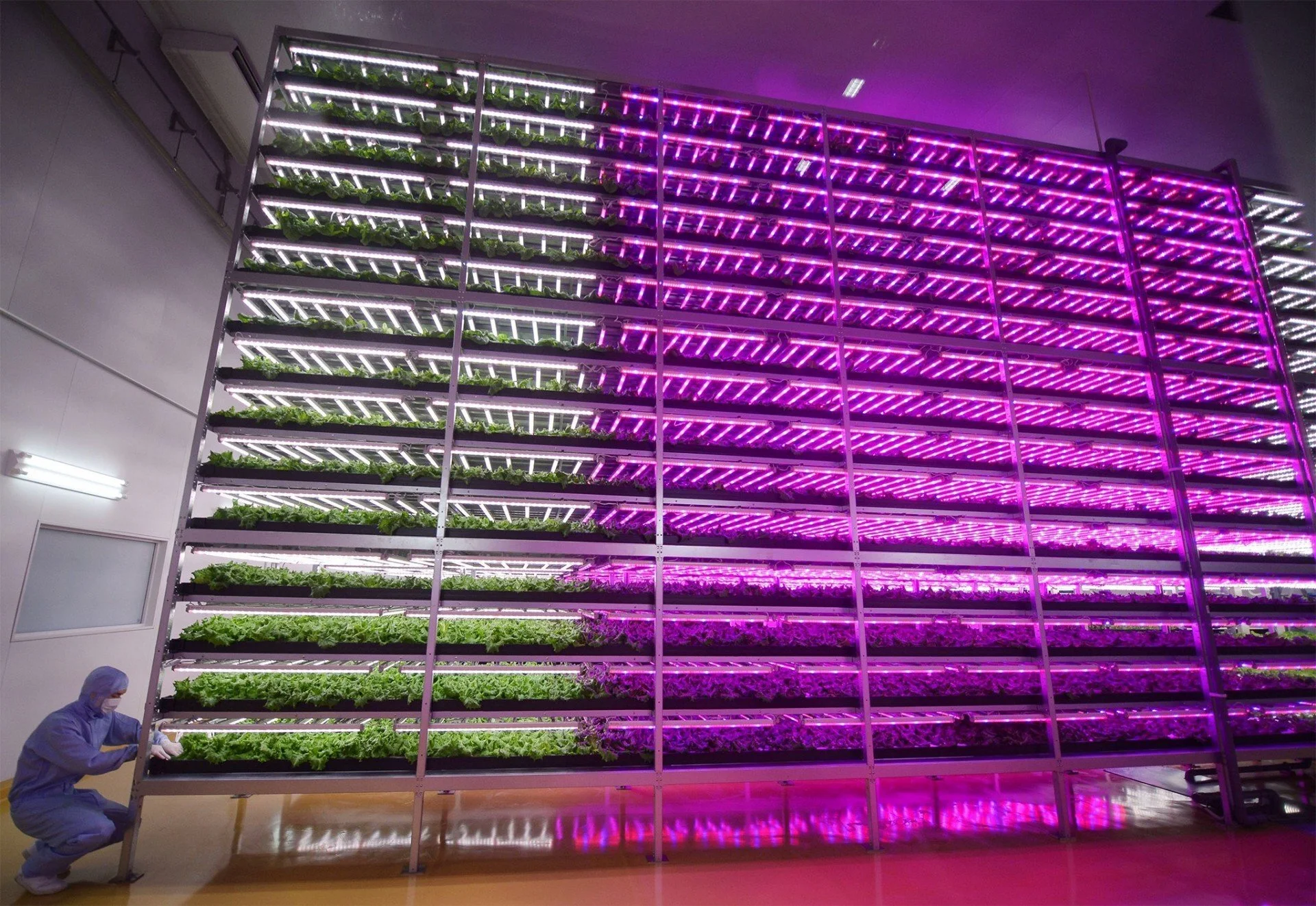
Vertical Farming: The Advantages of Growing Up, Not Out
Vertical farming refers to growing crops in multiple vertical layers in controlled indoor environments, such as repurposed buildings, growth chambers and even shipping containers
We share this planet with more than 7 billion people, and the UN forecasts that by 2050 we will need to feed over 9.7 billion. If you’re like me, you’re wondering what we can do to scale farming to meet the needs of the future. That’s where vertical farming comes in, along with innovative technologies that make growing up, not out, a more viable option.
by Ali Ahmadian, CEO Heliospectra
Vertical farming refers to growing crops in multiple vertical layers in controlled indoor environments, such as repurposed buildings, growth chambers, and even shipping containers. While growing crops in the greenhouse have its own merits, depends on the crop and technology used vertical farming has advantages over single-layer crops grown in a field or greenhouse:
Vertical farming enables growers to optimize their costs per square meter and produce more within the same footprint. A vertical format could potentially produce a harvest that is 3- to 4-times larger (or more!) than a field the same size could produce.
Vertical farming is done in an automated, controlled environment, which eliminates many of the risks involved with traditional field farming. Variables such as seasonal weather and environmental issues are taken out of the mix to produce a thriving crop year-round – no matter what’s happening outdoors.
Crop yields are standardized in vertical farming, with every harvest cycle producing the same quantity, quality, flavor and appearance that customers expect.
Vertical farming enables growers to meet changing market demands, by easily introducing new crops or varieties based on consumer or retail preferences.
Due to its smaller footprint, vertical farming is a viable and environmentally sound solution for feeding cities. The UN predicts that close to 70% of the population will be living in urban areas by 2050. To reduce the carbon footprint of our food, we need to think of ways to bring food production closer to the dining table. A LCA is necessary to weigh in such decision making.
While we continue to build larger and larger cities to accommodate our growing population, arable farmlands will be pushed further out. Vertical farming can ensure our cities have plentiful locally grown food – food that has a predictable harvest, optimizes costs per square meter, looks beautiful, fresh and tastes delicious.
Source: LinkedIn
Publication date: Fri 6 Mar 2020
Lawsuit Demands USDA Stop Certifying Hydroponic Foods as 'Organic'
Hydroponics is a type of farming or gardening that uses water (rather than soil) as a growth medium for a variety of fruits, vegetables, herbs, and other plants—including cannabis. Hydroponic growth can be accomplished indoors with the addition of commercially available lighting, nutrients, and other materials
Dirt Farmers Want The Feds To Stack The Deck in Their Favor.
BAYLEN LINNEKIN | 3.14.2020
(Rodrigo Reyes Marin/ZUMA Press/Newscom)
Earlier this month, a group of organic farmers and advocates sued the U.S. Department of Agriculture (USDA) over the agency's certification of some hydroponic produce as "organic." The suit seeks to bar the USDA from awarding its organic seal to hydroponically raised foods.
Hydroponics is a type of farming or gardening that uses water (rather than soil) as a growth medium for a variety of fruits, vegetables, herbs, and other plants—including cannabis. Hydroponic growth can be accomplished indoors with the addition of commercially available lighting, nutrients, and other materials.
The suit was filed by the Center for Food Safety (CFS)—a "litigious" California-based nonprofit that boasts nearly a million members—along with a handful of organic farmers and the Maine Organic Farmers & Gardeners Association. CFS petitioned the USDA early last year, asking the agency to develop rules that would prohibit organic certification of hydroponic operations. The agency denied the petition in June.
The suit alleges that the USDA's actions fly in the face of the 1990 law that established the agency's authority over the labeling of organic foods. That argument hinges in large part on the language around fostering soil fertility in the 1990 law, the Organic Foods Production Act (OFPA), which gave rise to the USDA's certification program. Under the law, which refers to "soil" only a handful of times, farmers must have in place an "organic plan [which] shall contain provisions designed to foster soil fertility, primarily through the management of the organic content of the soil." A farmer raising crops she wishes to market under the USDA's organic seal must submit its organic plan to a certifying body such as Oregon Tilth.
That group, the nation's first organic certifying body, was established in the early 1970s. The word "tilth" refers to soil quality.
"Organic farmers and consumers believe that the Organic label means not just growing food in soil, but improving the fertility of that soil," says Andrew Kimbrell, executive director of the Center for Food Safety, in a release announcing the lawsuit. "USDA's loophole for corporate hydroponics to be sold under the Organic label guts the very essence of 'Organic.'"
According to the handful of farmers who are part of the lawsuit—and who grow a host of organic fruits and vegetables, many of them having done so for decades—they're facing stiff competition from (typically) larger hydroponic farmers, who incur lower costs to grow the same food and can, therefore, offer more value to consumers for the same products.
What exactly is "organic"? For regulatory purposes, the term refers as much to what doesn't go into producing a particular food as what does go into it. As I explained in a 2016 column, under USDA rules the term "organic" refers to foods that are produced 1) "without excluded methods;" 2) " using allowed substances;" and 3) under the oversight of a USDA-authorized organic certifying agent.
The hydroponic-organic fight dates back to at least 2010, according to Food Dive, a news website that has a helpful chronology on the fight.
As I detailed in 2016, the Cornucopia Institute, which promotes organic foods, had recently filed a complaint with the USDA over hydroponic organics.
TOP ARTICLES1/5After a State-Authorized Medical Marijuana Patient Had an EpilepticSeizure and Crashed Her Car, Police Arrested Her for Driving With 'Marijuana in Her System
"It's not hard to make the case that soil is as central to the concept of 'organic' as any other idea or thing," I wrote. "On the other hand, it's also not hard to make the case that soil isn't central to the concept of what is and isn't organic. While most of our food is grown in soil, only a small percentage of that food is 'organic' under USDA rules. In other words, whether or not food is grown in soil tells us little that's useful about whether that food is 'organic' or not."
When I last wrote about this issue, the Boston Globe editorial board had just weighed in on the debate over hydroponics and organics. Step off, the paper told the USDA.
"It would be better for the authorities to focus on ensuring the safety of food and the accuracy of label information about things like nutrition and allergens, while letting consumers figure out for themselves what organic means to them," write the Globe's editors.
That latter point is so important—and something USDA rules simply don't allow for. It's also just one of the many flaws inherent in the USDA's oversight of organic food. For example, I detail the arguments of several leading supporters of organic foods who are also leading critics of the USDA's organic labeling program in my book, Biting the Hands that Feed Us: How Fewer, Smarter Laws Would Make Our Food System More Sustainable
If CFS and its fellow plaintiffs lose, then the result will likely be more innovation, more competition, and lower costs for consumers. The USDA's organic seal has very little integrity to begin with. Allowing hydroponic crops to be certified as organic—while not as welcome as would be getting the USDA out of the organic-labeling business altogether—won't damage that integrity any further.
BAYLEN LINNEKIN is a food lawyer, scholar, and adjunct law professor, as well as the author of Biting the Hands that Feed Us: How Fewer, Smarter Laws Would Make Our Food System More Sustainable (Island Press 2016).
ORGANIC FOODDEPARTMENT OF AGRICULTUREREGULATIONFOOD LABELING
Is Vertical Farming The Future of Agriculture?
To address these issues of resource scarcity and loss, many scientists and innovators have been hard at work to come up with a solution
MARCH 14, 2020
To address these issues of resource scarcity and loss, many scientists and innovators have been hard at work to come up with a solution. A viable option that has come up is controlled environment agriculture, or weather or climate-proof farming, or vertical farming. This is increasingly being utilized in urban centers, arid zones, and some populous Asian countries.
This kind of farming is done in vertical rack systems as opposed to conventional farming. Oda has successfully experimented with this technology in arid zones and urban centers in Beijing.
His company has successfully used an abandoned shipment container to grow vegetables in the dry climate of Dubai.
Vertical farming is finding more acceptance commercially with innovations in efficiency and affordability, says Oda.
So how does this vertical farming work?
A lot of artificial elements are introduced to take the place of sunlight, water, etc. LEDs are used to provide energy in place of sunlight. Nutrients are pumped directly into the root zones of the vegetables, which are recyclable, for plant growth. Hydroponics and aeroponics systems are used for efficiency. Soil substitutes like polyurethane sponges, biodegradable peat moss, and even inorganic materials like perlite and clay pellets are used.
Racking systems can be16 to 14 stories high. A sophisticated automation and monitoring system is used to increase productivity, efficiency, and consistency of the food.
The benefits of indoor vertical farming are many. There is year-round production, which is of consistent quality, and one can be assured of a certain quantifiable output. It is great in terms of resource efficiency. Water, fertilizers and land use goes down by almost 99 percent in this type of farming. Moreover, as the system is weatherproof, the need for fertilizers is nil.
The produce can be made totally chemical-free. It gives 350 times more food per square meter than conventional farming. It will shorten the supply chain and maintain the nutritional content as the growth centers will be near urban and city centers. Also, such type of farming can be seamlessly integrated into the urban landscape with the utilization of underused civic structures, office corners, etc.
Considering the advantages, you may wonder why there is no widespread adoption of the method. The reason being it is a very energy-intensive program. Also, the variety of vegetables produced like this is limited. The cost of production is still very high for it to be widely adopted. For a better energy solution, higher efficient LED lights are being developed. Another option is to use laser lights for plant growth. Fiber optics cables to channelize sunlight to the facility in daylight hours is also another option.
Vertical farming may be the solution to an imminent water and food crisis that the world is facing. The biggest advantage is it will give equitable access to nutritional food to the most underprivileged, too once it becomes a common practice and is widely accepted. Still, a lot needs to be done before it becomes a shared reality.
Stuart Oda has floated his own vertical farming company called Alesca Life.
TAGS: AGRICULTURE, INDOOR VERTICAL FARMING, VERTICAL FARMING
GreenTech Americas Program Focuses On 2 Main Themes
During GreenTech Americas fifty Mexican and international speakers will present various topics for ‘crop optimization in protected horticulture’ and ‘strategic themes focused on business and investment’
By urbanagnews
February 21, 2020
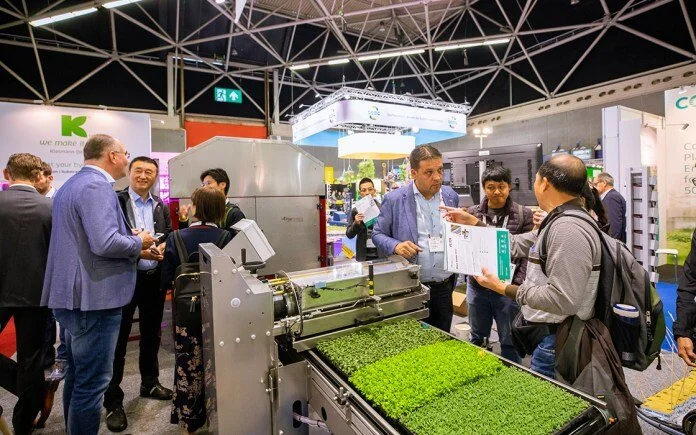
Press Release – During GreenTech Americas fifty Mexican and international speakers will present various topics for ‘crop optimization in protected horticulture’ and ‘strategic themes focused on business and investment’. The objective is to present trends, knowledge and new solutions to all levels of professionals in the horticultural industry of Latin America. The show and program will be held from March 24 to 26, 2020, at the Congress Center, Querétaro Mexico.
Program
Within the framework of this event, a program of conferences and panels is developed with 2 main themes 1: Crop optimization
and 2: Business and investment. A few of the many highlights are:
Saber Merismailli, CEO of Ecoation, talks about “How artificial intelligence can help us grow clean food. And how early detection of issues can increase the revenue in your greenhouse”;
Chris Higgins, Hort Americas, tells you all you want to know about vertical farms. “Do vertical farms build stronger plants? How will the vertical farming industry develop and how does it impact you?”;
Peter Hendriks, director of LetsGrow.com, gives an update about big data. “Big data is no longer a stranger. How can you implement it to your business?”;
“The world’s population is growing and with it the demand for raw materials. However, the supply of crucial raw materials is limited”. A delegate of The World Bank explains the importance of Circular Economy, trends and developments for a sustainable future;
Héctor Manuel Cotero, Dummen Orange, discusses the trends in high-quality flower production. “What are the latest technologies and trends in this industry?’.
Experts and panel leaders
To name a few of the experts who will participate:
Erik J. Plaisier, Agricultural Counsellor for Mexico and Cuba, Nature and Food Embassy of the Netherlands;
Aldo Mares, President of the National Association of Exporters of Berries, Aneberries;
Oscar Woltman de Vries, General Director of Hortinvest Mexico;
Ricardo Martínez, Director General de Asesores en Invernaderos;
Alfonso Torres, Director General, Koppert Mexico, Koppert Biological Systems;
Edison Torrado León, Founder of Naturavisión;
Mauricio Revah, CEO, United Farms;
Paul Arkesteijn, Product Manager & Consultant, Ludvig Svensson;
Remy Matt, Manager, Cultilene;
Rene Beerkens, Consultant, Hoogendoorn.
About GreenTech Americas
GreenTech Americas is a spin-off of GreenTech Amsterdam with the goal to meet the needs of regional growers, breeders, and suppliers. GreenTech Americas will enable a greater exchange of knowledge, experiences, and success stories of the horticultural industry from Mexico and its region. The show is organized by RAI Amsterdam and Tarsus México. Please find more information and to register at www.greentech.nl.
About GreenTech Amsterdam
GreenTech Amsterdam will be held Monday 8 – Wednesday 10 June 2020. The exhibition is a global meeting place for all horticultural technology professionals. GreenTech focuses on the early stages of the horticultural chain and the current issues growers face. All Dutch front runners, greenhouse builders and suppliers are present. Last year a total of 12,489 professionals from 114 countries visited GreenTech Amsterdam.

Inside The Change: How Hamilton’s 80 Acres Works On The Front Lines of Farming
He’s not knocking lifelong farmers, but Mike Zelkind, CEO and co-founder of 80 Acres Farms, says the 20-something growers working for him in some ways have the experience of 5o-year-old traditional farmers
By Mike Rutledge, Staff Writer
03-14-20
HAMILTON — He’s not knocking lifelong farmers, but Mike Zelkind, CEO, and co-founder of 80 Acres Farms says the 20-something growers working for him in some ways have the experience of 5o-year-old traditional farmers.
That’s because they grow crops every month of the year, and may grow 17 crop cycles in a year, instead of one or two, because in the completely enclosed indoor growing environments, there are no off seasons to slow the crops down.
Using video monitors and other devices, they can see how plants grow differently when the humidity drops by 3 percent, or temperatures are 1 degree higher.
And with crops growing in such rapid succession, “They’ll see all these little things that if you’re growing a crop now and you’re growing it again in a year, you’re not going to remember all that,” he said.80 Acres, co-founded by Zelkind and Tisha Livingston, is at a technological frontier of completely enclosed indoor farming, where pesticides are not needed or used, where adjustable LED light replaces the sun, and things like temperatures are completely controlled. Universities all over are studying various aspects of what 80 Acres and other companies are doing.
Meanwhile, 80 Acres is raising “fireworks tomatoes” and other crops that are very flavorful — the kind you buy at a roadside farm stand on a good day. And does so even through Ohio winters.“We’re learning every day with this. That’s the fun part of the job. That’s what attracts the Timmys, the Megans, the Haleys,” he said, naming three Hamilton employees, “because this is how they think. They grew up with video games, playing with joy sticks.”He and his workers don’t compete against Ohio farmers: They don’t grow things that nearby farms are producing in-season. In fact, Zelkind says the company employees some farmers during their off-seasons, and works with farmers to help them better market their products and better get their fruits and vegetables into stores more profitably.
READ MORE: Ohio agriculture leader visits future of farming in Hamilton
With the fruits and other crops, 80 Acres grows in Hamilton and elsewhere, water use is way less than is needed outdoors. Where lettuce or leafy greens might use 650,000 gallons for certain production outdoors, they can use less than 20,000, he said.
About 90 percent of the water plants drink in through their roots they respire into the environment. The containers surrounding each 80 Acres “growing zone” recapture that evaporated water and condense it. It is run through ultraviolet filters and other systems, the nutrients in the water are measured and supplemented with nutrients that the plants consumed.“We can show you on tomatoes where our yields are 2-3 times what any greenhouse will get you,” said Zelkind, who has decades in the food-growing industry, as does his co-founder, Tisha Livingston, company co-founder and CEO of sister company Infinite Acres, based in the Netherlands.
80 Acres, which last year decided to locate its headquarters on the 7th floor of Hamilton’s city building, has about 130 employees nationwide and more than 40 in Hamilton.
The company’s growers mix the art of experimentation with the science of indoor agriculture. In one artistic twist, its growers strategically stress their plants to stir different flavors.
When growing things like tomatoes or grapes outdoors, “there’s all these random stresses,” Zelkind said. “That’s why sometimes you have the most incredible, phenomenal crops.”When it’s too wet, too dry, too sunny or too cold, plants naturally create phytochemicals and secondary metabolites as defense mechanism, which make them more healthy for people to eat, and also add flavors.“We can get a grape to fruit in eight months, instead of three years,” he said. “We do that in Arkansas.”Indoor growers also could replicate the grape-growing conditions of France, down to the fabled Mistral winds that many believe improve grapes.“If I know what you want the wind to be, and if I know what nutrients you want, then we can duplicate it completely,” he said. “Absolutely.”
The company now operates six indoor “farms: in Alabama, Arkansas, North Carolina, Cincinnati and two in Hamilton (on South Second Street and in a 10,000-square-foot research-and-development farm in the city’s Enterprise Park industrial park).
Next to that building, the company is building a $10-million-plus, 70,000-square-foot building that will take the best of the company’s other procedures to create a larger commercial-scale indoor farm.
Within five years, Zelkind hopes to have more than 20 indoor farms.
The company’s current “grow zones” have sometimes been in shipping containers that are used for cargo on ships and trains, because those canisters were sturdy, inexpensive, and could be retrofitted easily. Grow zones at the new Hamilton building, to open this year, will be larger. The increased production volume should allow the company to lower prices from organic levels to closer to prices for conventional crops.
Dennis Chrisman, vice president of Dayton-area Dorothy Lane Market gourmet stores, said 80 Acres has “some great combos that offer some great flavors, especially when they mix in some microgreens in their salad mixes. I think they’ve got powerful flavor.”Customers especially “love the Queen City mix. For those that are regulars with them, I think that’s one of their best options,” he said.
Rather than choosing seeds, like far-away farmers must, that create plants that are durable during transportation, Zelkind asks his seed providers for those producing their best-tasting fruits, but that were too temperamental for the outdoors.
Chieri Kubota, a professor of controlled environment agriculture at Ohio State University, said a big advantage of 80 Acres’ approach on raising food for local markets is it reduces the supply chain between it and markets, eliminating fuel waste, transportation time and distribution costs.
Rather than California lettuce spending two weeks being shipped here, the kind grown in Hamilton can be in stores within hours.
Rebecca Haders, the company’s vice president for marketing and creative, said it is worth it for customers to pay more for such products, because, “some of our salads can last 21, 28 days if they’re in the right conditions. You’re giving the shelf life to the customer, versus the truck.”80 Acres has been featured in such publications as Techweek, and in 2018 won the North Carolina Manufacturing Extension Partnership’s leadership award for Manufacturing Excellence.
Although its completely-enclosed-agricultural systems can be expensive to create, limiting their ability to be used for many crops, such farming also has potential to reduce droughts and famines by putting farms inside cities and using far less water than traditional cultivation. There’s also no fertilizer runoff into rivers.
Tim Brodbeck, a 22-year-old grower from Norwood who has been with the company three years, said: “It’s coming to work with a purpose. I love coming to my job every day, and every day is just another step toward feeding the world and feeding the people who don’t have the access to this food.”

INDIA: These Urban Farming Startups Are Going The Extra Mile To Bring Organic Food To Your Table
With new technologies like hydroponics and vertical farming, these startups are helping people grow produce in small urban spaces
With new technologies like hydroponics and vertical farming, these startups are helping people grow produce in small urban spaces.
By Suman Singh
11th Mar 2020
The Green Revolution in the 50s and 60s may have allowed our farmers to better their yields, but it also brought with it the evils of using pesticides and chemical fertilizers.
Urban farming
Over the years, they have been incorporated into conventional farming methods, bringing with them a host of problems. They are not only found to be toxic to humans by increasing the risk of getting cancers, but they also cause pollution, degradation of soil and water, and poison domestic animals.
Now, many farmers and urban-dwellers have switched to organic farming or urban farming. According to the International Federation of Organic Agriculture Movements (IFOAM),
“Organic agriculture is a production system that sustains the health of soils, ecosystems, and people. It relies on ecological processes, biodiversity, and cycles adapted to local conditions, rather than the use of inputs with adverse effects.”
Just a few years back, farming in cities would have been thought to be impossible. But new technologies like hydroponics and vertical farming have made growing produce in small urban spaces possible.
Here are six urban farming startups which are going the extra mile to bring sustainable farming practices in India:
UGF Farms
Started by Linesh Narayan Pillai in 2017, Urban Green Fate (UGF) Farms converts unused spaces into live food gardens. Live food gardens are built in a way that they do no structural damage to buildings. The Mumbai-based startup sends residents microgreens (vegetable greens after they’ve produced first leaves) in pots, to grow them in organic coco peat as opposed to heavy soil. All a user needs to do is cut the greens from the live plant as and when they need them.
Further, UGF also helps to address issues of starvation, malnutrition, food contamination, and food insecurity by collaborating with schools as well as corporates that work for underprivileged communities as part of their CSR initiatives.
UGF Farms
Since its inception, the startup has planted over 10,000 kg of microgreens. It has also educated 4,000 people over 150 workshops across multiple locations in Delhi and Mumbai about the importance of growing food in their homes and going organic.
Back2basics
Back2basics is the brainchild of S Madhusudhan. Started in 2015, it is an organic farm spread across close to 200 acres around Bengaluru, producing high-quality organic fruits and vegetables.
Run by a father-daughter duo, Back2basics supplies produce to grocery chains, retailers, organic stores, and gated communities in Bengaluru. Its produce is also exported to organic food supply chains and retailers in other parts of the world.
Back2basics
The startup deals in more than 90 varieties of seasonal produce in four categories – fruits, vegetables, greens, and exotics. It has reserved almost three to four acres for customers who wish to visit the farm and try their hand out in agriculture.
It produces products that are 100 percent organic. The producer has full control over the colour and texture of the greens, making them healthier and tastier.
Pindfresh
After returning from New York where he worked as a banker, Somveer Singh Anand, much like UGF Farms' Linesh, found it impossible to source organic food in India.
To address this concern, Somveer developed indoor hydroponic technology suitable for Indian climatic conditions and started Pindfresh in 2016 in Chandigarh. The startup sets up indoor and outdoor hydroponic plants for people who want to farm using the technology across India.
Pindfresh
The lighting, humidity, and temperature are controlled all the time for these microgreens to grow. And to that effect, Pindfresh manufactures quality controlled pipes, lights, and all the necessary equipment required to set up a hydroponic plant.
Growing Greens
Former Infosys employees Hamsa V and Nithin Sagi partnered to start a hydroponic farm, Growing Greens. The Bengaluru-based B2B startup grows and sells microgreens, salad leaves, sprouts, edible flowers, and herbs to high-end restaurants in the city.
Growing Greens
These microgreens, which are about one to three inches tall, are mostly used to decorate and garnish food. They have concentrated nutrient levels that can be almost 40 times higher than the normal-sized produce.
The duo did thorough research by talking to various chefs to understand their requirements before venturing into the business.
Started in 2012 on a small terrace, the startup is currently farming on four acres of land, which it plans to expand to 10 acres.
Herbivore Farms
Not many 24-year-olds would choose to ditch well-paying jobs and take up farming. But after paying a visit to Auroville in Puducherry in 2017, Mumbai-based Joshua Lewis and Sakina Rajkotwala were inspired by musician and organic farmer Krishna Mckenzie who started Solitude Farm with the aim of “honouring Mother Nature through local food.”
Herbivore Farms
The duo got down to business with Herbivore Farms, Mumbai’s first hyperlocal, hydroponic farm. Today, the farm is spread across 1,000 sq ft and grows 2,500 plants. It sells fresh, organic vegetables to customers across Mumbai from its temperature-controlled indoor setting.
The vegetables are grown in a clean, sterile environment, with zero pesticides. As compared to conventional farming methods, the setup consumes up to 80 percent less water to grow the produce due to “recirculating irrigation system.”
Harvested vegetables are delivered to the customers’ homes within hours, maintaining their freshness, nutrition, and flavour.
(Edited by Kanishk Singh)

The Value of Third-Party Verification For Horticultural Lighting
Horticultural lighting comprises the largest percentage of power demand in controlled environment agriculture (CEA) facilities for fruit and vegetable production
By urbanagnews
February 24, 2020
By Leora Radetsky
The US vertical farming market is projected to reach $3 billion by 2024, exhibiting a compound annual growth rate of over 24 percent, according to a February 2019 report. Another report, by the US Department of Energy’s Office of Energy Efficiency and Renewable Energy, put the annual electricity consumption of US horticultural lighting installations at 5.9 terawatt hours – equal to the annual usage of about 550,000 US households, and projected that to increase 15 to 25 percent annually.
Horticultural lighting comprises the largest percentage of power demand in controlled environment agriculture (CEA) facilities for fruit and vegetable production. A 2019 study by Toronto’s Independent Electricity System Operator (IESO) found, for example, that “a lit vegetable greenhouse consumes 10 times as much electricity as an unlit vegetable greenhouse, with essentially all the additional electricity used for lighting”.
Clearly, getting a handle on facility efficiency, including horticultural lighting, is a must-have if individual states and the US as a whole hope to rein in carbon emissions and meet energy reduction goals. This increase in electricity usage comes as states, provinces, and cities across North America are confronting the impacts of climate change and working to reduce – not grow – greenhouse gas (GHG) emissions from the electrical generation sector. In the US, 23 states and the District of Columbia have adopted specific GHG reduction targets. Massachusetts law, for example, requires the state to reduce GHG emissions by 80 percent below 1990 levels by 2050, and California is under a statutory mandate to cut emissions by 40 percent below 1990 levels by 2030.
The good news is there are reliable, third-party lighting and safety standards to help indoor farmers make the leap from old-school lighting to state-of-the-art light-emitting diodes (LEDs) that use a fraction of the electricity and are increasingly effective for growing a variety of crops. Perhaps even better for farmers is the availability of a new industry-wide benchmark for horticultural lighting and a growing list of qualified products that are third-party certified to meet it.
More about the benchmark later – first, it’s useful to walk through the various lighting and safety standards specific to horticultural lighting.
Most lighting fixtures in the North American market go through rigorous inspection by certified labs. The first part of the check is for safety. An official UL safety standard tailored for the unique challenges of the greenhouse environment was recently released (UL 8800, the Standard for Horticultural Lighting Equipment and Systems). This standard and similar safety certifications at other major labs address wiring, environmental conditions, ingress protection, and worker safety related to prolonged photobiological exposure to the eyes and skin. Growers should always ask a lighting fixture manufacturer about safety certification specifically for horticultural environments.
Next on the standards checklist for horticultural lighting fixtures is performance testing. This often happens at the same labs that do safety testing but is designed to verify efficacy, output, spectrum, and other important performance variables. Commercial labs are certified for specific standards so that a test on a fixture is repeatable at any other lab certified to the same standard. This performance testing results in a report summarizing items such as photosynthetic photon flux (PPF), input power (watts), photosynthetic flux efficacy (PPE, measured in μmol/J or micromoles of photosynthetic photons per joule of electrical input power), and spectral content (flux per nanometer (nm) between 400 and 700 nm).
Then, there are flux maintenance standards for LEDs (such as IES LM-80 and IES TM-21) that help make sure the photosynthetic light output of LED products degrades at an acceptable rate to make a grower’s investment worthwhile. The testing and calculation methods that go into these standards were painstakingly developed through a consensus of knowledgeable lighting stakeholders. A key difference between general lighting and plant lighting, however, is how flux maintenance is measured and benchmarked – the bar is significantly higher for plants compared to people since their metabolism and growth are dependent on the light spectrum and amount.
Against this backdrop of standards and testing, lighting and related technologies are quickly evolving. For indoor growers, questions abound – from how long a fixture will last and whether a manufacturer’s claims about efficacy are accurate to the effectiveness of various wavelengths for growing particular crops. The tests described above produce a lot of important information, but it takes an informed reader to analyze and use it to select appropriate horticultural lighting. This is where our organization, the DesignLights Consortium (DLC), comes in. Through our Horticultural Lighting Program, the DLC strives to make the process of vetting lighting products easier, freeing up growers to focus on their core business.
Horticultural lighting specification is a relatively recent addition to the DLC’s work. The organization was founded in the early days of LED lighting to help electric utilities compare different lighting factors and reports to inform their energy efficiency rebate/incentive programs for commercial and industrial electric customers. The DLC began serving as a central clearinghouse for setting energy efficiency and other product performance minimum standards, and for evaluating products against those standards. Then and now, lighting products that pass review qualify for an online qualified products list (QPL) that utilities use to quickly and accurately incentivize high-performing products.
Back to the benchmark mentioned earlier, the goal of the DLC’s new minimum performance standards for horticultural light fixtures is to accelerate the adoption of new energy-saving LED fixtures in controlled agriculture environments. To be on the new DLC Horticultural QPL, an LED fixture must have a PPE of 1.9 micro mol/J, which means it will be at least 10 percent more efficacious than the best non-LED alternative – a 1,000-watt double-ended high-pressure sodium (HPS) fixture. It also must have a Q90 of 36,000 hours (the number of hours before the photon flux output depreciates to 90 percent), and its driver and fan (if included) must have a rated life of at least 50,000 hours.
Importantly, every product is listed online in a searchable, filterable database to help growers and controlled environment agriculture facility designers quickly narrow their options. For example, in a retrofit, a grower might know what PPF is needed from each fixture but might also need to stay within a power budget to avoid rewiring circuits. The DLC’s Horticultural QPL can be filtered to quickly find and compare conforming products.
For utilities and horticultural lighting users alike, trusted, third-party verification holds the same value as it does in other industries. It plays a critical role in ensuring the integrity of a growing array of products – providing assurance that an independent party has done the legwork and is vouching that a fixture can do the job and save electricity.
As the IESO study referenced above noted, horticultural lighting standards developed by the DLC, as well as the American Society of Agricultural and Biological Engineers, “should help to build trust between growers and lighting manufacturers and suppliers regarding performance information as LED technology continues to mature”.
Just over a year since it was unveiled, the DLC’s Horticultural QPL contains 58 products from 18 manufacturers, and additional products are reviewed and added regularly. We’re confident this growing roster of third-party certified products is expanding the options for farmers and providing a greater level of assurance about product performance, leading to quicker and wider adoption of advanced, energy-efficient horticultural lighting technology.
Leora Radetsky (lradetsky@designlights.org) is a Senior Lighting Scientist at the DesignLights Consortium.

Armela Brings Fresh Perspective To Farming In UAE
Armela Farms, an expert in hydroponic farming and the largest producer of water-grown lettuce in the UAE, now has a production capacity of 1.6 million lettuce heads – the equivalent of 330 tonnes per year

March 15, 2020
ABU DHABI
Armela Farms, an expert in hydroponic farming and the largest producer of water-grown lettuce in the UAE, now has a production capacity of 1.6 million lettuce heads – the equivalent of 330 tonnes per year.
As an innovator in the large-scale commercial production, packing and distribution of lettuce and kale, Armela Farms utilizes cutting-edge hydroponic growing technology, on-site storage, packing, and local distribution methods to redefine local food supply, the company said.
By producing natural, eco-friendly, locally grown, farm-fresh, 100% pesticide-free products, Armela Farms continuously reaffirms its commitment to feeding people in cities in a way that is positive for the environment.
The UAE is globally renowned for blending the core values of its agricultural history with the latest innovations and technologies. The Ministry of Climate Change and Environment has prioritized increasing the use of hydroponic farms, cooling and climate control technologies to overcome the historical problems of scarcity of water resources and arable land, soil salinity, difficult environmental conditions, and typically high production costs. Consequently, Armela Farms is striving to perfect the process and become the industry standard in UAE, it said.
After launching the company in August 2016, the Armela team has spent more than two years in Research and Development regarding the best techniques, varieties of produce and optimum climate conditions, before celebrating its first harvest in August 2018. Since then, the team has advanced its process to achieve over 250% of an increase in production and is currently finalizing the opening of a new facility for Q1 2021, which will boast over 3 hectares of fully automated advanced lettuce farm, making the largest commercial hydroponic project in the UAE.
At Armela Farms, produce is delivered immediately upon harvesting, with no or minimum storage or shipping time, to provide customers with produce that is fresher, tastier and more nutritious, while lasting longer. As the topic of food security becomes more prevalent across the GCC, these fantastic new technologies are going to make access to affordable and nutritious food easier for everyone.
Avir Shah, CEO and co-founder of Armela Farms, states: “Our mission is to sell hydroponic produce that is of high quality and high nutritional value, to maximize consumer benefits towards healthy living in the United Arab Emirates.”
Rachana Shah, director and co-founder at Armela Farms, adds: “Most people maybe don’t realize is that locally produced harvest, and, in particular, commercial hydroponics farming, provide not only better quality products, but also a cheaper price tag to benefit the customer, be it, retailers or consumers.” -
TradeArabia News Service

Satellites Show Italy's Air Pollution Dissipating As Covid-19 Outbreak Worsens
After China, Italy has been the second-hardest-hit by the Covid-19 pandemic racing around the world. In an effort to staunch the number of cases, the Italian government severely restricted travel this week in northern Italy—the pandemic epicenter for the country—before extending restrictions to the entire country
Satellite data showing nitrogen dioxide emissions over northern Italy on March 7 (left) and February 8 (right). Image: Sam Gassó
After China, Italy has been the second-hardest-hit by the Covid-19 pandemic racing around the world. In an effort to staunch the number of cases, the Italian government severely restricted travel this week in northern Italy—the pandemic epicenter for the country—before extending restrictions to the entire country.
Under similar circumstances, scientists observed a huge drop in Chinese pollution that was visible from space. At the time, Fei Liu, an air quality researcher at NASA, said that “this is the first time I have seen such a dramatic drop-off over such a wide area for a specific event.” Now, it appears the same thing is happening in northern Italy, as the region grinds to a halt.
The European Space Agency’s Sentinel-5 satellite is able to track all sorts of human-caused pollution, including nitrogen dioxide. Those emissions come from tailpipes and electricity generation, particularly coal-fired power plants. With Italy severely restricting travel and whole sectors of the economy essentially shutting down and using less power, it would seem to follow that nitrogen dioxide emission would drop.
Before and after imagery from Santiago Gassó, a NASA atmospheric science researcher, shows the stark difference from before the Covid-19 outbreak and after. The images at the top of the page show nitrogen dioxide emissions on March 7 and February 7, respectively. Santiago tweeted that the data still needed more formal verification, but he told Earther in an email that “in the last 48 hours, colleagues have been posting similar trends from other sensors, and even this morning ESA came out with a video confirming what I pointed out. So indeed the trend seems real.”
Indeed, the video in question shows the drop in pollution is extremely rapid. The Sentinel-5 data in the video from the ESA runs from January through mid-March. The bright red and orange spot of pollution over northern Italy goes dark shortly after the government issued the lockdown orders this past Sunday.
The drop in pollution is obviously a good thing, particularly at a time when people with pre-existing respiratory issues are facing increased risks from Covid-19. But the cause for the drop is most definitely bad. Data tracked by Johns Hopkins shows that as of Friday afternoon, there have been more than 1,000 deaths in Italy amid more than 15,000 cases reported.
The number of cases in other countries, particularly the U.S., continues to climb. So, too, are precautions to prevent the further spread of the coronavirus. Flights are beginning to be grounded after flying empty. The U.S. has declared a national emergency amid what is still a very sluggish, botched federal response.
Even a number of Disney’s various properties are shutting down. All of this adds up to a likely sharp decline in pollution in other parts of the world, as people hunker down in an attempt to stop the disease from spreading further.
Brian Kahn Posts Email Twitter
Managing editor, Earther

US: New York City - COVID-19 Update - All Schools Closed
Clearly, we are in exceptional times with COVID-19. As a business, we need to think differently. Our priority is to ensure our team’s safety as well as the safety of the wider community. The single best way to do that is to enforce social distancing. The simplest way to do that is for everyone to work from home
Clearly, we are in exceptional times with COVID-19. As a business, we need to think differently.
Our priority is to ensure our team’s safety as well as the safety of the wider community. The single best way to do that is to enforce social distancing. The simplest way to do that is for everyone to work from home.
However, we are also a company that produces food. We have farms and farmers, and we can grow food to feed people. No one knows exactly where this situation is heading, but we’re already seeing supermarket shelves emptying in New York. Sooner rather than later, food supply will surely become an issue. So it feels like we have a moral obligation to use the resources we have—skilled farmers and our farm-tech platform—to keep growing food, and to find ways to get that food to as many people as possible.
We have analyzed the situation carefully and determined that there is a way to balance both objectives—i.e. to keep growing food, in a safe way for our team and others. But it requires changes in our operations and the day-to-day workflow on our farms. For example, we have decided to stop the time-intensive and people-intensive task in our current process of packing harvested food into small clam shells, ready for retail distribution. Instead, we are going to pack quickly in bulk bags (as always, with gloves and love).
Any farmers or other staff not absolutely required to manage our temporary, slimmed-down operation at our Brooklyn campus, have been asked to stay at home on full pay.
This week, you will not find Square Roots packaged products on the shelves of retail grocery stores in New York City. Instead, to get the food we grow to people who need it most, we have decided to extend our existing partnership with ReThink Food NYC - who are safely creating meals for those in need from their kitchens in the Navy Yards. On Monday, we are going to donate *all* the food we harvest in Brooklyn to them.
Follow along on our social media for additional updates regarding our New York and Michigan campuses. Stay safe, everyone.
Read More

Empire Partners With Infarm To Bring Innovative And Sustainable In-Store Farms To Select Sobeys, Safeway And Thrifty Foods Stores
"Our partnership with Empire builds upon our vision to grow a resilient ecosystem that can help feed people living in cities around the world by 2050, while improving the environmental footprint of our food," said Erez Galonska , co-founder and CEO of Infarm
CNW Group March 9, 2020
National partnership to deliver fresh farmed and harvested in-store produce
STELLARTON, NS, March 9, 2020,/CNW/ - Empire's family of brands is partnering with Infarm, one of the world's most advanced and fastest-growing in-store farming platforms, to grow and harvest a range of fresh produce in select Sobeys, Safeway and Thrifty Foods stores across Canada. Each vertical farming unit is a stand-alone ecosystem, enabled by machine learning and AI technology, that creates the optimum environment required for plants to flourish.
"Our goal at Empire is to be the fastest-growing and most innovative retailer in Canada. As we strive to achieve that goal, we continuously seek out first-to-market opportunities," said Niluka Kottegoda, Vice President Customer Experience, Sobeys Inc. "Our partnership with Infarm is unique in Canada and offers our customers a world-leading urban farming solution. The products we will offer in-store are unique to customers in urban communities. We're excited to test and learn with our customers along the way."
Launching this Spring, the first fresh produce harvests will include a range of herbs at two Safeway stores in Vancouver, 8475 Granville Street and 2733 West Broadway. Empire will place farms in stores across seven cities in Canada, ( Calgary, Edmonton, Halifax, Toronto, Vancouver, Victoria, Winnipeg ) growing millions of hyper-local plants for our customers.
"Our partnership with Empire builds upon our vision to grow a resilient ecosystem that can help feed people living in cities around the world by 2050 while improving the environmental footprint of our food," said Erez Galonska, co-founder and CEO of Infarm. "For example, through vertical farming, we can introduce plants to markets that were previously unavailable because they were too delicate to be transported. We're proud to partner with Empire to share the Infarm revolution with Canadians."
The in-store farms produce fresh, nutritious and flavourful produce all year round without the use of chemical pesticides. The vertical farms use 95 percent less water, 90 percent less transportation and 75 percent less fertilizer than industrial agriculture.
How it works:
Infarm has developed the world's most advanced, sustainable, easily scalable and rapidly deployable modular farms.
Each in-store farm has a controlled energy-friendly environment designed to bring out the natural flavour and properties of each plant.
The plants are all grown in-store, dramatically reducing carbon emissions that result from transportation.
The individual farms are connected and remotely controlled from a central farming platform that gathers up-to-the-minute information about the growth of each plant and learns, adjusts and improves the growing conditions.
About Empire
Empire Company Limited (EMP-A.TO) is a Canadian company headquartered in Stellarton, Nova Scotia . Empire's key businesses are food retailing, through wholly-owned subsidiary Sobeys Inc., and related real estate. With approximately $25.6 billion in annualized sales and $13.8 billion in assets, Empire and its subsidiaries, franchisees, and affiliates employ approximately 123,000 people.
About InFarm
Founded in 2013 by Osnat Michaeli and the brothers Erez and Guy Galonska, Infarm combines highly efficient vertical farms with IoT technologies and Machine Learning, to offer an alternative food system that is resilient, transparent, and affordable. The company distributes its smart modular farms throughout the urban environment to grow fresh produce for the city's inhabitants. With cutting edge R&D, patented technologies, and a leading multi-disciplinary team, Infarm was founded on a visionary mission: helping cities become self-sufficient in their food production while significantly improving the safety, quality, and environmental footprint of our food. Infarm currently operates across Denmark, France, Germany, Luxembourg, the United Kingdom, the United States and Switzerland where it has deployed more than 500 farms in stores and distribution centres.
Infarm (CNW Group/Empire Company Limited)
SOURCE Empire Company Limited

Freight Farms Announces New Horticultural Funding From Ospraie Ag Science
A Series B venture round of $15 million will allow Freight Farms to invest in plant science, add features to its software control platforms, and expand the customer base for its vertical farms housed in shipping containers
Mar 2nd, 2020
A Series B venture round of $15 million will allow Freight Farms to invest in plant science, add features to its software control platforms, and expand the customer base for its vertical farms housed in shipping containers.
Vertical-farm supplier Freight Farms has received $15M in Series B funding from investment first Ospraie Ag Science for its all-in-one, shipping-container-based agriculture model. (Photo credit: Image courtesy of Freight Farms.)
Shipping-container-based, vertical-farm manufacturer Freight Farms has announced that it received $15 million in Series B venture funding from investment firm Ospraie Ag Science. Freight Farms will use the investment to further optimize its Farmhand software platform, invest in plant science, and expand the customer base for its LED-lit Greenery container farms.
Freight Farms originally branded its container farms The Leafy Green Machine but has since simplified the product name to The Greenery. A Greenery farm includes everything a grower needs to launch a hydroponic farm all integrated into a shipping container. The outfitted Greenery container includes LED lighting, plumbing for nutrient supply, climate, and environmental control, and the Farmhand software to automate the operation of the farm.
The idea of a shipping container for a vertical farm is not a new one. For example, we covered a Dallas grocery store that uses a shipping-container farm to grow some produce right outside the store’s back door. And we covered a Los Angeles area farm using shipping containers right in the downtown metropolitan area back in 2016.
Freight Farms, however, brings unique aspects to its business both in the science behind Greenery and in the company’s business model. Taking the business model first, Freight Farms is specifically in the business of selling turnkey farms. Some other players have vacillated between selling technology and operating as growers.
The configuration of the Freight Farms product is also unique. When we first covered vertical farming back in 2016, the term was primarily utilized to describe growing operations where horizontal trays of plants were stacked in layers vertically to more fully utilize a space, especially for crops such as leafy greens and herbs where there is not much space needed between layers and where LEDs that don’t radiate heat can be placed in close proximity to the plant canopy.
We have since seen other concepts. Plenty, for example, is based in California’s Silicon Valley Area, has received more than 200 million in funding from well-known investors such as Amazon’s Jeff Bezos, and utilizes a system where plants are placed horizontally into the growing structure but run continuously in a vertical row from floor to ceiling.
Freight Farms partitions its systems in the close confines of the shipping container. There is a dedicated area where horizontal racks are used in the initial stages of sprouting. But later plants are transplanted into a vertical row structure where nutrients can drip from the top of each vertical row of plants and unused nutrient is recaptured at the bottom of each row.
Freight Farms said its 328-ft2 container can produce equivalent vegetables to a two-acre outdoor plot. And the container farm uses less than five gallons of water per day. For Freight Farms, the mission is solving the looming issue of feeding a growing global population. “With the Greenery and Farmhand, we’ve created an infrastructure that lowers the barrier of entry into food production, an industry that’s historically been difficult to get into,” said Jon Friedman, Freight Farms COO. “With this platform, we’re also able to harness and build upon a wider set of technologies including cloud IoT, automation, and machine learning, while enabling new developments in plant science for future generations.”
And make no mistake that controlled environment agriculture farming is becoming big business. We recently ran an article that discussed the investment capital coming into the market. Clearly, Ospraie sees an opportunity in the container concept. Freight Farms says it has sold farms into 44 states and 25 countries.
“Freight Farms has redefined vertical farming and made decentralizing the food system something that’s possible and meaningful right now, not in the future of food,” said Jason Mraz, president of Ospraie Ag Science. “Full traceability, high nutrition without herbicides and pesticides, year-round sourcing – these are elements that should be inherent to food sourcing. Freight Farms’ Greenery makes it possible to meet this burgeoning demand globally for campuses, hospitals, municipal institutions, and corporate businesses, while also enabling small business farmers to meet these demands themselves for their customers.”

2020 GLASE Summit - CANCELLED
GLASE will host its annual Summit in Leamington, Ont. Canada. Participants will discuss the latest GLASE research innovations, the CEA market trends and connect with Canadian greenhouse growers
2020 GLASE Summit
Leamington, Ont. Canada
Best Western Plus Conference Center
March 26 - 27, 2020
GLASE will host its annual Summit in Leamington, Ont. Canada. Participants will discuss the latest GLASE research innovations, the CEA market trends and connect with Canadian greenhouse growers.
Over 60% of Ontario's greenhouses can be found in Leamington/Kingsville area. With the largest concentration of greenhouses in North America (nearly 2,000 acres under cover) Leamington host some of the largest CEA facilities in Canada and US.
To learn more about it please contact GLASE director Erico Mattos at em796@cornell.edu

UAE: Armela Farms Gears Up To Open 3 ha Automated Lettuce Farm
After launching in August 2016, the Armela team has spent more than two years in Research and Development regarding techniques, varieties of produce and optimum climate conditions, before celebrating their first harvest in August 2018
After launching in August 2016, the Armela team has spent more than two years in Research and Development regarding techniques, varieties of produce and optimum climate conditions, before celebrating their first harvest in August 2018. Since then, the team has advanced its process to achieve over 250% of an increase in production and is currently finalizing the opening of a new facility for Q1 2021, which will boast over 3 hectares of fully automated advanced lettuce farm, making it the largest facility of its kind in the GCC.
Armela Farms will also partner with several leaders in the Dutch agriculture sector to build the largest automated data-driven growing facility in the United Arab Emirates. Located in Abu Dhabi, the farm will be able to create over 9,000,000 lettuce heads per annum; that’s equivalent to 2,300 tonnes per annum.
Dutch tech
Armela Farms has chosen Van der Hoeven Horticultural Products to supply the project. In conjunction, Armela Farms will be using specialist technologies from a variety of suppliers like Hoogendoorn, Patron Agri Systems, Green Production Systems, Rijk Zwaan, Jiffy, Koppert, due to the expertise and experience by each company in their individual fields.
Mr. Avir Shah, CEO, and Founder of Armela Farms states, “Our aim is to produce products which exceed our community's expectation and reduce the reliance of imported highly-priced products by bridging the supply and demand gap with affordable price. We can achieve this vision by utilizing available resources and transforming it into a hi-tech, sustainable food production facility in accordance with the country’s vision of National Food Security and self-sustainability.”
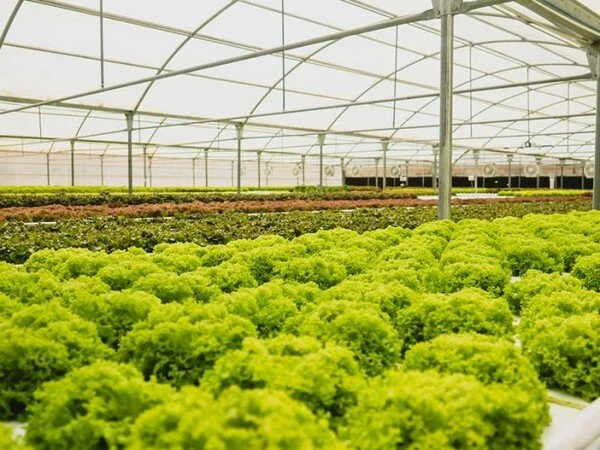
Mr. Yazan Abu Jaish, General Manager of Armela Farms: “The new facility, for example, will enable us to monitor the evaporation of a single plant at any given time and many other advanced parameters required for optimum plant grown and output. Armela Farms is now moving from traditional hydroponic farming to data-driven farming.”
Mr. Gerard Oorthuys of Van der Hoeven Horticultural Projects: “I was very impressed by the sheer knowledge of the Armela farms team and wanted to show them one of our constructed greenhouses to show our capability. From our regional experience, we understand the climatic challenges more than any other company and we are confident we will deliver them a fantastic project.”
For more information:
Armela Farms
armelafarms.com
Publication date: Mon 9 Mar 2020

Democracy, Trust And The Virus
March 15, 2020
This Is A Moment To Be Sanguine.
Read This Letter With That in Mind.
For readers outside of the UK, please note the parochial focus of this particular missive touches on many issues that might be relevant in your country.
[T]he allocation criteria need to guarantee that those patients with the highest chance of therapeutic success will retain access to intensive care.
These are the new guidelines for the Italian College of Anesthesia, Analgesia, Resuscitation and Intensive Care, written an eon ago on Monday when Italy had 40% fewer cases of coronavirus than as I type these words. (There has been an update reported by the Daily Telegraph, “This is how it is in a war.”)
As COVID19 continues its exponential growth in most countries, the strategies which country select will have a massive impact on the severity outcome of this pandemic. Ignoring science at the top of government is unacceptable. However, science must not equally be a shield under which leaders absolve themselves of their political responsibility.
Writes my friend Nicolas Granatino, in a recent issue of his newsletter, Coronadaily reflecting on the British government’s approach to tackling the epidemic.
Boris Johnson and two senior science advisors delivered an impressive presentation. but their strategy for tackling the spread of the virus is controversial. As is becoming clear, the British government’s approach to handling the pandemic has been understood, in a nutshell, rightly or wrongly, as “let it roll through the population, avoiding tough containment measures because Brits will get bored, and protect the old until enough of us have herd immunity.”
It turns out it is more complicated than that.
Adam Kucharski, the epidemic modeler, author of The Rules of Contagion, and a member of one of the expert groups that comprise SAGE which advises the government, makes it very clear here.
A lot of modellers around the world are working flat out to find best way to minimise impact on population and healthcare. A side effect may end up being herd immunity, but this is merely a consequence of a very tough option - albeit one that may help prevent another outbreak.
Ian Donald, a psychology professor with expertise in anti-microbial resistance points out:
The govt strategy on #Coronavirus is more refined than those used in other countries and potentially very effective. But it is also riskier and based on a number of assumptions. They need to be correct, and the measures they introduce need to work when they are supposed to…
This is probably the best strategy, but they should explain it more clearly. It relies on a lot of assumptions, so it would be good to know what they are - especially behavioural. (emphasis mine.)
Models, even scientific ones, tell different stories, depending on the assumptions you put in. The assumptions are often uncertain and represent judgments & choices. The outputs of models have variances, based on the assumptions you make.
And an epidemiological model is a complex one with many inputs, variables, feedback loops and delays. (See this video here.)
These outputs become scenarios, which are based on your assumptions and judgments. Scenarios which you can navigate and use to explore future possibilities.
How you validate those assumptions is critical. How you select them is critical. How you make those judgments is also critical. It is also a human process that lends itself to argument and debate.
It is not sufficient to say “We are using the best science” and leave it at that. And certainly not in the era of open science, open data, and common tools to foster a healthy critical debate.
In the UK, the government gave us one choice, one approach, “from the science” as a fait-accompli.
But no model works like that. Science doesn't work like that.
Behavioral scientists have challenged one tenet of the British government’s plan: that of behavioral fatigue. Here a stampede of behavior scientists write: (I don’t know what the collective noun for behavioral scientists is. Stampede seemed a reasonable choice)
we are not convinced that enough is known about “behavioural fatigue” or to what extent these insights apply to the current exceptional circumstances. Such evidence is necessary if we are to base a high-risk public health strategy on it.
An abelian of mathematicians has also written to challenge the UK government’s approach.
Science doesn’t work the way Boris Johnson suggested it did.
Especially not in the context of health decisions. Readers will remember part of my tooth fell out a couple of weeks ago. Even my dentist offered me the choice of yet another filling or a crown. Science drove my dentist’s assessment, and I was still offered two choices.
There are discussions, arguments, challenges, disagreements, external trade-offs that went into the final recommendations. But with millions of lives at stake and an entire economy built with and enabling those lives, there needs to be a deeper debate, deeper scrutiny.
The doctors in Lombardy have had to become utilitarians, applying clear criteria of survivability on the decisions they make. I support them--on the front line they have few luxuries.
But the British government is making similar decisions with many more variables, without clearly explaining the choices they faced and the roads they took.
There is no doubt about the capabilities of the Chief Scientific Officer or Chief Medical Officer or the work of epidemiologists in various expert groups. Or the quality of their models. (Although no model is perfect, many are wrong and some may even have catastrophic mistakes in them. Think back to the models driving financial risk in the run-up to the global financial crisis. Remember David Viniar’s bullshit about “twenty-five standard deviation” events?)
It is that the modeling only throws light on a couple of aspects of the problem at hand. The model’s job is to also outline the possible paths of specific political choices.
It was a curious approach by the British government. One which has lost the trust. Yet, as I argued two weeks ago, public health emergencies require public trust.
the current British government, fought its electoral campaign with explicit attacks on the mechanisms of the state that stand outside politics, such as the judiciary and the Civil Service. At a moment when trust is most needed, to manage this burgeoning public health crisis, the government has been involved in a vicious attack on the very institutions that engender that trust.
How do you regain trust?
You can brief journalists and you can get your more articulate ministers to write an article in friendly newspapers. This is an industrial-age approach that might have worked with the poorly-educated, information-starved, under-networked, populace of the 1930s.
In the exponential age, your population is vastly more educated, resource-rich and networked. It has access to pretty much the same international research you do. It has, in many cases, better capabilities than the government can rely on.
And we can look on the Internet and read what is happening in South Korea, Taiwan, Singapore, Spain, Italy, Norway, Iceland, the Faroe Islands, China and you name it. We can see what they are doing. The temperature guns. The drive-through testing.
Italy looks like it can flatten the curve.
South Korea (below) is squishing new cases even as it tests vigorously. We can see this because the information is available from reliable sources.
We can hear Andy Slavitt, Obama’s healthcare majordomo, sound the alarm for the impending tsunami.
Nearly 30m of us have read Tomas Pueyo’s “Coronavirus: Why you must act now”. Some will have read the critique of whether “flattening the curve is a delusion.” You might have seen the Washington Post’s visualisations on how flattening the curve works.
Or perhaps you have been following the work of Yanner Bar-Yam and colleagues at the New England Complexity Science Institute whose models suggest “massive testing can stop the coronavirus outbreak” or their earlier work on Ebola contact tracing which has led them to suggest that even low compliance towards travel can stop outbreaks.
Many will wonder how quickly we could administer drugs to stop the cytokine storm that kills many who die of Covid-19. Or could we expand testing of and access to remdesivir, chloroquine or viagra, all of which seem to have some efficacy.
Some will ask whether acting aggressively now to slow the spread could buy time for health capacity to build up, even marginally. Or for Senegal to finish work on its 10-minute PCR test kit, or for us to validate Singapore’s serological tests.
In 2002, most Brits do not sit around doing the Daily Telegraph crossword, sipping tea, eating crumpets, waiting to lap-up the latest announcement from Downing Street on the wireless. So it’s truly bizarre to present a plan (perhaps it is the best??) that is such a massive outlier to the rest of the world and not expect pushback.
Openness, transparency about these types of decisions is a pillar of a democratic society. And it is foolish to think you can get away with a decision like this without someone asking difficult questions. Much more so when scientists are willing to state they disagree with you. And even more so in the era of the Internet. ( Paul Ginsparg demonstrated the value of open access when he launched Arxiv in 1991. Arguably Gutenberg did if even earlier.)
A better approach would be to open the model, to open the assumptions, for constructive discussion in the brief moments we have available, in a way that could catalyze improvements. You still have to lead, as Prime Minister, without question but you have to bring people with you. And we only at most a few weeks before the tsunami hits and our hospitals are, likely, overwhelmed.
Playing with one epidemic simulator, as it happens, helped me better understand Sir Patrick Vallance and Chris Witty, the UK government’s advisors rationale. Don’t get hung up on the model simulation I used. It is a toy simulator. Its conclusions are mostly useless. I don’t know what was under the hood. And it almost certainly ignores many of the more nuanced variables and relationships the real models used by SAGE have.
This toy simulator irrelevant except that:
It is clarifying for a citizen to play with a model like this, fiddle with assumptions, run simulations. It helped you understand the trade-offs that we face in tackling this epidemic—and it starts to outline what our personal responsibility and capacities may be.
The trade-offs are complex with non-linear effects of such a baffling nature I can only describe them as counter-intuitive. (Which more shows up the weaknesses in my expertise, more than anything else.)
I have no deep professional expertise on whether these epidemiological models. But I do understand the useful limits of models and can grok that the model is one input into an overall decision. That there are nuances. I do know there are assumptions on which decisions are made. The British government failed to give us their assumptions, the tools and democratic rigor to allow us to come to any kind of conclusion.
They still have a chance to do that. And early signs are that the British Government is demonstrating some pretty creative thinking (especially in enlisting the private sector and ramping up the NHS, our vehicle for universal, socialised medicine.)
But in being clearer and more inclusive in their communications, they might enlist creativity and talent and trust around the country in myriad other ways—not least in our willingness to step up and do the right thing.
What if we are more resilient and self-organizing and willing to clamp down on contact immediately? And will we do, as my community is, to support the vulnerable at a community level? What if we, the people, understand the horrific consequences of widespread promiscuous lunching at the local boozer?
Public health crises require public trust. A crisis like this, as we are learning from Italy, is more like a war. And it will be a long, grinding war, for which citizen trust, forbearance, and participation will be required.
As I went to bed on Saturday night, #boristhebutcher was, perhaps unfairly, trending on the socials. Such is the cost of forgetting about open, transparent, interactive communication that the internet enables.
This is the shape of democracy in the exponential age.
My friend from Shenzhen, six weeks into quarantine, sent me a WhatsApp. I know he won’t mind me sharing it with you: “Covid19 cases going up in Europe. Pls, take care.”
And let me add, keep your distance and WASH YOUR HANDS.
Azeem
P.S. On the point about the economy and its importance during a crisis… we’ll need a healthy economy of sorts to survive this marathon. The economy provides the goods and services that keep our population fed, nourished and healthy, and creates capacity in our health system. This isn’t so much an argument about GDP growth, but more than a healthy economy enables a healthy population and a functioning medical system.
Thanks to Nicolas Granatino, Vishal Gulati, Hampus Jakobsson, Paola Bonomo and many others for discussions that helped with this letter.
Thanks for subscribing to Exponential View.
This post is public, so feel free to share it. Share
Coalition for Sustainable Organics Disappointed in Latest Attempts Center for Food Safety to Restrict Supplies Organic Foods Through Lawsuit
Lee Frankel, the executive director of the CSO stated, “It is disappointing to see groups target pioneering organic farmers that use the most appropriate organic growing methods adapted to their site-specific conditions on their farms to meet the needs of consumers
SAN DIEGO, CALIFORNIA March 3, 2020 – The Coalition for Sustainable Organics (CSO) is saddened by the latest attempts by the Center for Food Safety and their allies to limit fair competition and organic supplies in the market through legal action.
Lee Frankel, the executive director of the CSO stated, “It is disappointing to see groups target pioneering organic farmers that use the most appropriate organic growing methods adapted to their site-specific conditions on their farms to meet the needs of consumers. The members of the CSO are strongly committed to the integrity of organic standards and the organic label. The groups behind the lawsuit failed to convince the members of the National Organic Standards Board (NOSB) to prohibit container and hydroponic production methods after significant industry debate and submission of public comments. Instead of unifying the industry after the decision made by representatives of the organic community at the NOSB, the CFS is seeking to eliminate public input to achieve their goals of restricting competition to drive up the price of organics for organic consumers to allow favored producers to increase their profit margins.”
Frankel continued, “Growers using containers adhere to the U.S. Department of Agriculture organic standards under the National Organic Program (NOP) and have been allowed to grow certified organic produce since the initiation of the NOP more than 25 years ago. After extensive study in 2010, the USDA through the NOP opted not to change these high standards for certifying organic produce – and affirmed that organic produce can be grown through containerized methods. After additional review in 2015-2017, the National Organic Standards Board voted to reject a proposed prohibition on container and hydroponic systems.”
Karen Archipley of Archi’s Acres of Escondido, California added “Our production systems are managed in accordance with the federal organic law. We chose to incorporate hydro-organic methods at our operations since it is the most appropriate way to promote ecological balance by drastically reducing our water use, conserve biological diversity by preserving valuable habitat while still incorporating the microbial processes described by organic pioneers to recycle nutrients to nourish our crops. Every choice we make and every input we use must be audited and approved by USDA-accredited certifying agents like any other Organic Farmer.”
Archipley continued “Changing the rules now would limit the amount of organic produce available to the public – just as the public is demanding more organic produce. This is not an issue that should be settled in the courts or politicized. If a grower meets USDA standards for organic certification, they should be able to market organic produce, whether they grow in soil or any other sustainable, certified organic growing media.”
#######

2020 Women in Agribusiness Summit in Nashville, September 16 - 18, 2020
Early Bird Pricing Will End April 3rd
Register Now For
The 2020 Women in Agribusiness Summit in Nashville,
September 16 - 18, 2020.
Be a part of this vibrant agribusiness community where the sharing of business knowledge and industry innovations are at the forefront of helping women excel in the sector.
Our best pricing of the year is scheduled to end on Friday, April 3rd. Register now to save $300 on the conference you will be glad you attended.
Early Bird Pricing: $1099 Standard Registration
(only available until April 3, 2020)
or
Become a member!
WIA Summit Early Admission + Annual WIA Membership: $1,228.00
Students and Government rates are also available.
Register With Early Bird Pricing

Stop Basil Downy Mildew With These Simple LED Strategies
Every basil grower’s worst nightmare is Basil Downy Mildew. You walk down the aisles, peer across the canopy, and then “Oh No!”. You see leaf yellowing and fuzzy purple growth. The once sweet smell of herbaceous goodness no longer smells so sweet knowing you have hours not days to react
"Every very basil grower’s worst nightmare is Basil Downy Mildew. You walk down the aisles, peer across the canopy, and then “Oh No!”. You see leaf yellowing and fuzzy purple growth. The once sweet smell of herbaceous goodness no longer smells so sweet knowing you have hours not days to react.
Image source: Cornell University
This awful gut feeling can be felt by any plant grower, and most know it too well. In cucumbers, it’s all about powdery mildew. In cannabis, white powdery mildew.
Traditional techniques call for using fungicides and adjusting your environment. These are still important methods given the severity of the situation, but there’s now a new promise of prevention strategies using light.
First, what is Basil Downy Mildew?
Basil that’s become infected with downy mildew will begin to turn yellow and may be mistaken for a problem with nutrition. This yellowing may be followed by dark brown or purple fuzz as sporulation continues to develop. Peronospora belbahrii is the Latin name for basil downy mildew.
The promise of using light to stop downy mildew in basil
Light has many effects on plants and other organisms’ physiology. In the case of downy mildew, disrupting the dark period with red light while managing temperature and humidity has been shown to prevent the production of spores in sweet basil.
Image source: Cohen Y, Vaknin M, Ben-Naim Y, Rubin AE (2013) Light Suppresses Sporulation and Epidemics of Peronospora belbahrii. PLoS ONE 8(11): e81282. https://doi.org/10.1371/journal.pone.0081282
Researchers at Bar-IIan University in Israel found that low-intensity red light inhibited sporulation of Peronospora belbahrii on sweet basil when applied during the dark period while maintaining moderate temperatures and low humidity.
Infected basil leaves were exposed to 5 or 10 micromoles of blue, green, red, or incandescent light. They were incubated at 20°C in moist conditions for 20 hours in a growth chamber.
Results showed that red light (at a peak of 625 nanometers) inhibited 99.7% sporulation regardless of the leaf surface exposed to light! Light strongly inhibited sporulation on leaves incubated at 15-27°C, but not on leaves incubated at 10°C.
What to do about powdery mildew in cucumbers
In the case of powdery mildew cucumber diseases, blue light has been shown to prevent the spread of disease by preventing the release of fungal spores.
Researchers at the Department of Chemical Biological Sciences in the Women’s University of Tokyo found that blue light can prevent the release of powdery mildew spores from developed fungal bodies and prevent the spread of disease melons.
Melon plants, inoculated with Podosphaera xanthii were grown in growth chambers under purple, blue, green, orange, red and broad-spectrum light, as well as in complete darkness and in a greenhouse under solar light. Light treatments were used on the powdery mildew for 14 days under continuous illumination of 59.5 micromoles of light.
Results showed that, while conidium fungal spores were still produced under all light treatments, spores were not released from conidiospores (or reproductive fungal spores) under blue light in the growth chamber. This research proves promising for preventing the spread of mildew in cucumbers, melons, and other cucurbits.
What this means for the future of Basil Downy and Powdery Mildew
These researchers have shown that light quality has the potential to stop the spread of fungal pathogens. It’s possible that in many cases, light spectrum must be readily controlled to inhibit the spread of mildew and other disease types.
In the case of fungal pathogens, light has been shown to suppress disease by disrupting the pathogen’s reproductive cycle and by exploiting natural adaptations in its circadian rhythm.
Depending on the fungi and plant species in question, this disruption can be a response to specific light wavelengths, the duration of the light period, duration of the dark period, total light intensity or a combination of these factors.
Light can also suppress disease by increasing the plant’s secondary metabolite production, which enhances the plant’s ability to defend against attack.
Using light to suppress disease in your operation
Research on light’s ability to suppress plant disease is in its early stages, but there are some important findings that can help guide growers when trialing light treatments for disease suppression.
Light treatments are plant and pathogen-specific, so it’s important to seek out information for light treatments specific to your particular crop and pathogen.
Depending on whether a disease is suppressed by enhancing the plant’s defense system or disrupting the pathogen’s physiological processes, light treatments may need to be applied throughout the plant’s entire growth cycle, limited to a short exposure or applied during a specific growth period in order to be effective.
Like all crop production processes, light treatment is only one part of the integrated strategy. Environmental factors like temperature and humidity, as well as production processes like irrigation and crop management, should be considered as part of an integrated pest management plan.
For more information:
LumiGrow
800-514-0487
info@lumigrow.com
www.lumigrow.com
Publication date: Mon 9 Mar 2020