

Welcome to iGrow News, Your Source for the World of Indoor Vertical Farming
Challenges of Commercial Aquaponics in Europe: Beyond The Hype
The results reveal that the development of commercial aquaponics has hit the level of “disillusionment”
21 Jan 2020
In recent years, aquaponics has been receiving increased interest globally as a commercial food production technology and aquaponics start-up companies have been formed in most European countries.
Between 2014 and 2018, the European-funded COST Action FA1305 “The EU Aquaponics Hub-Realising Sustainable Integrated Fish and Vegetable Production for the EU” created a strong network of researchers and entrepreneurs. However, surveys show that aquaponic production in Europe is still very limited, and very few companies are economically viable.
In order to obtain insights into the barriers to early development of commercial aquaponics, two surveys were carried out—one in Europe, which included France, and one in France alone, with a different protocol. Henceforth, for simplicity, the former will be referred to as Europe and the latter as France.
The results reveal that the development of commercial aquaponics has hit the level of “disillusionment”, caused by numerous challenges facing commercial food production. As the understanding of the processes involved in aquaponics is increasing, it will be very interesting to follow the developments in the field over the coming years in order to ascertain whether aquaponics will follow the phases outlined by the “Gartner’s Hype Cycle” and thus proceed to become an established technology, or whether it will remain an “one hit wonder” and disappear in the “Trough of Disillusionment”.

Coronavirus Shows The Importance of Local, Efficient Agriculture
This pandemic shows that we need to invest in local agriculture to boost our supply of local, reliable food. Aquaponics, hydroponics, and controlled-environment agriculture can produce large amounts of food with minimal space and resources
By Brian Filipowich
The coronavirus outbreak is already disrupting international travel and trade. The pandemic could impact the global food supply chain and leave some populations without adequate nutrition.
Aquaponic system at the University of the District of Columbia
This pandemic shows that we need to invest in local agriculture to boost our supply of local, reliable food. Aquaponics, hydroponics, and controlled-environment agriculture can produce large amounts of food with minimal space and resources. These water-based growing methods do not require soil and can be practiced from arid deserts to urban rooftops.
Hidden Cost of the Global Food Supply Chain
Our modern food system involves long travel distances and several steps along the supply chain. The average head of lettuce in the U.S. travels approximately 1,500 miles. Over 90% of our seafood is imported.
The coronavirus is exposing one major hidden cost of our global system: it is at risk from disruptions like pandemics, extreme weather events, military events, and economic or political upheavals. As the climate changes, these extreme events are more likely.
How does this hidden cost of the global food supply chain manifest itself?
An American consumer can find similar prices for a tomato grown 100 miles away and a tomato grown in another country 2,000 miles away. But during a global travel ban or category 5 hurricane, your local tomato will still be there. How do we account for this benefit during the good times, so that there are enough local growers to support us during possible disruptions?
Aquaponics, Hydroponics, and Controlled-Environment Agriculture
The problem is that with a changing climate, water shortages, and growing population, there is less land to grow for more people. Deserts, freezing climates, and urban areas do not have the arable soil to grow a meaningful amount of their own food to achieve food security.
Aquaponics is a food production method integrating fish and plants in a closed, soil-less system. This symbiotic relationship mimics the biological cycles found in nature. Benefits include dramatically less water use; no toxic chemical fertilizers or pesticides; and no agriculture discharge to air, water or soil.
Hydroponics is the practice of growing plants in water-based systems with externally supplied nutrients.
Controlled-Environment Agriculture (CEA) is the practice of raising crops in a protected, optimal environment like a greenhouse.
These growing methods maximize the amount of crops that can be produced per square area per year. Plants can be grown densely and quickly because conditions are ideal and roots are delivered exactly what they need. And controlled-environments allow for year-round production.
Aquaponics brings the added benefit of fish – an efficient supply of animal protein. It takes 30 pounds of feed to produce a one-pound steak, only 2 pounds for a one-pound tilapia filet. Fish can be grown densely and indoors, compared to the large operations required for beef, pork, and poultry.
Economies across the globe must find ways to value the hidden benefits of local, efficient agriculture to encourage more local growing. There will always be another coronavirus-type event, let’s make sure we have a reliable supply of local food for it.
Please click here to let us know how
has the Coronavirus outbreak affected your aquaponic growing?

Sobeys, Safeway, Thrifty Foods Adding In-Store Hydroponic Farms
The first stand-alone ecosystems will launch this spring at two Safeway stores in Vancouver, British Columbia, followed by additional stores in seven Canadian cities: Calgary, Edmonton, Halifax, Toronto, Vancouver, Victoria and Winnipeg
By Abby Kleckler - 03/09/2020
Empire's family of brands has partnered with in-store farming technology company Infarm to add vertical farming units to select Sobeys, Safeway and Thrifty Foods stores in Canada. The first stand-alone ecosystems will launch this spring at two Safeway stores in Vancouver, British Columbia, followed by additional stores in seven Canadian cities: Calgary, Edmonton, Halifax, Toronto, Vancouver, Victoria, and Winnipeg.
Shoppers in the United States can already find Infarm systems like this one at some Kroger-owned QFC banners in Washington state
"Our goal at Empire is to be the fastest-growing and most innovative retailer in Canada. As we strive to achieve that goal, we continuously seek out first-to-market opportunities," said Niluka Kottegoda, VP customer experience at Stellarton, Niva Scotia-based Sobeys Inc. "Our partnership with Infarm is unique in Canada and offers our customers a world-leading urban farming solution. The products we will offer in store are unique to customers in urban communities. We're excited to test and learn with our customers along the way."
The in-store farms use machine learning and AI technology to produce fresh, nutritious and flavorful produce year-round without the use of chemical pesticides. The vertical farms use 95% less water, 90% less transportation and 75% less fertilizer than industrial agriculture does.
Infarm currently operates in the United States — through its partnership with Kroger at some QFC banner stores in Washington — Denmark, France, Germany, Luxembourg, the United Kingdom and Switzerland.
"Our partnership with Empire builds upon our vision to grow a resilient ecosystem that can help feed people living in cities around the world by 2050, while improving the environmental footprint of our food," said Erez Galonska, co-founder and CEO of Berlin, Germany-based Infarm. "For example, through vertical farming, we can introduce plants to markets that were previously unavailable because they were too delicate to be transported. We're proud to partner with Empire to share the Infarm revolution with Canadians."
The Philadelphia Zoo Is Running A Farm Inside A Converted Shipping Container
Tua lives at the Philadelphia Zoo, the first zoo in the country with its own on-site vertical garden used to grow leafy greens for its animals. And she loves the produce they’re feeding her
by Brianna Baker, For The Inquirer, March 4, 2020
Kristen Waldren, director of strategic initiatives at The Philadelphia Zoo, walks through the zoo's new "Cropbox" — a vertical farm being used to grow plants that are harvested to feed animals. MARGO REED
If you’re a fan of homegrown arugula and mustard greens, you just may have the same taste as Tua, a 27-year-old Sumatran orangutan.
Tua lives at the Philadelphia Zoo, the first zoo in the country with its own on-site vertical garden used to grow leafy greens for its animals. And she loves the produce they’re feeding her.
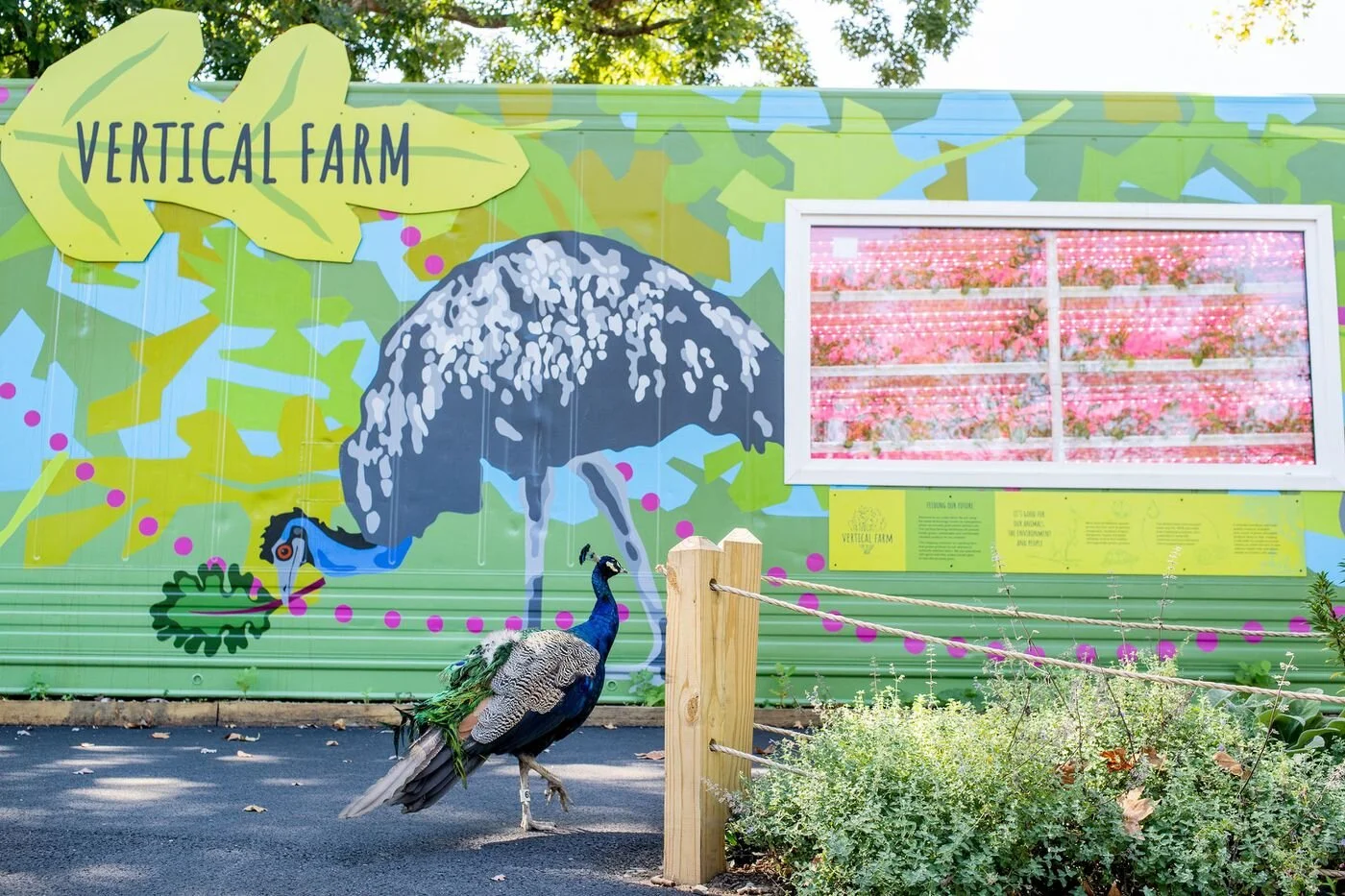
The garden is located in a retrofitted shipping container in the Urban Green, the zoo’s open-air food marketplace. A mural, by Philly-based environmental artist and activist Eurhi Jones, transforms the front of the shipping container into a colorful collage of the animals who’ll chow down on the vegetation.
But the real beauty is inside, where stacked, tidy shelves hold rows of plants that are grown hydroponically, in nutrient-rich water instead of soil. LED lights, a substitute for sunlight, shine 18 hours a day. Farm operators use a mobile app to remotely control the container’s light, temperature, and humidity levels.
Kristen Lewis-Waldron, director of strategic initiatives at the zoo, said the vertical farm is far more sustainable than bringing in food from outside sources. It uses 70% to 90% less water than traditional farming, has no need for pesticides or herbicides, and cuts greenhouse gas emissions out of the equation since no motor-powered transportation is necessary to get the food to the zoo.
“It really kind of creates this farm-to-table [model] — in this case, shipping container-to-exhibit,” she said of the project, which is in a pilot phase.
Want to know what's going on in Philly? Find out about upcoming concerts, shows, and other events with our weekly newsletter.
Lewis-Waldron is short on farming experience but knows a thing or two about feeding animals. She landed her first role at the zoo 23 years ago as a nutrition intern. She went on to work for, and eventually lead, the zoo’s conservation department, before transitioning to her current position. Growing greens for the animals makes her feel like she’s come full circle, she said.
A peacock at the Philadelphia Zoo walks past the "Cropbox," a converted shipping container being used to grow plants being used to help feed the animals. MARGO REED
To launch the project, she enlisted the services of CropBox (which is also what the zoo calls the vertical farm), a North Carolina company that provides all the equipment customers need, including the shipping container, and helps set up the system.
Lewis-Waldron also consulted with industry experts, including those who operate their own vertical farms, to learn best practices and how to troubleshoot technical challenges. All in all, the preparation process took about a year.
In its nine months of operation, the CropBox has fed 20 animal species with its microgreens. It produces 275 pounds of leafy greens a month, which is only 10 percent of the zoo’s monthly requirement. But that number, Lewis-Waldron said, will grow once the pilot year concludes and the project is expanded.
“You can take over a vacant warehouse or vacant building and convert it,” she said. “You could take six of these and make a dent in the requirements of our collection.”
The CropBox also benefits the zoo economically by replacing a collection of food it would otherwise purchase.
But perhaps most importantly, the greens grown in the vertical farm are rich in nutrients. The zoo takes animals’ diets very seriously and even employs a full-time nutritionist. By feeding leafy greens to the animals, the zoo is keeping their health in shape.
Still, that doesn’t mean the greens are every species’ favorite snack. Just like humans, animals have unique palates. And the current variety growing in the CropBox — a stir-fry mix that includes arugula and mustard greens — isn’t always a crowd-pleaser.
“It’s got a little kick to it, a little bit of spice. Our emus were a little hesitant,” Lewis-Waldron said. “But our monkeys, langurs, apes, gorillas, orangutans, tortoises absolutely love it. So it’s interesting, and we’ll continue to test out different types of greens.”
Brianna Baker, For The Inquirer

High Hopes For UK Vertical Farming Startup
Vertical farming startup LettUs Grow is one of a number of UK firms developing technology that could help shore up the UK’s food security. Andrew Wade reports

By Andrew Wade 3rd March 2020
Vertical farming startup LettUs Grow is one of a number of UK firms developing technology that could help shore up the UK’s food security. Andrew Wade reports.
LettUs Grow co-founder Charlie Guy inspecting produce
Between the UK’s EU exit and the growing threat of climate change, food security has become a headline topic. The supply lines from farm to fork that many of us take for granted can be more fragile than we think, as illustrated by recent weather events in the UK.
“At the height of the heatwave that we had last summer, (the UK) was importing lettuce by plane from California, importing around 30,000 heads a week just to keep food on our shelves,” explained Charlie Guy, managing director and co-founder of agritech startup, LettUs Grow.
Set up in 2015 while Guy was still at Bristol University, LettUs Grow is one of several emerging UK businesses focused on vertical farming, where plants and crops are grown indoors in upright stacks, typically without soil, using LED lighting, climate control, and targeted nutrient delivery. Although still a relatively niche enterprise, it’s attracting plenty of attention, with grocery retailer Ocado recently announcing a £17m investment in the sector.
Green machines: sowing the seeds of farming 4.0
For its part, LettUs Grow has just secured £2.35 million in seed funding, which Guy says the company will use to scale up and invest in new products. Currently, the business has two major components: its aeroponic nutrient delivery system and an integrated farm management software platform called Ostara. According to LettUs Grow, its aeroponics equipment can boost growth rate by 70 percent across a range of crops compared to other vertical farming methods such as hydroponics, as well as reduce water usage by 95 percent versus traditional agriculture.
“At LettUs Grow we’ve developed two key technologies,” Guy explained. “The first is a new aeroponic method where we irrigate the crop roots with a very fine mist using a patent-pending method that we’ve developed over the last few years. It has massive benefits in terms of how scalable the technology is and controllable and optimizable it is.
“It’s all about the amount in the root zone that plants experience. Everyone knows that healthy soil has good pockets of oxygen and nutrients and is well aerated. So this is really what we’re maximizing. By having no soil and an air gap you’ve got bountiful oxygen and carbon dioxide for plants to perform at their biological optimum.”
Vertical farming sees trays of produce stacked under LED lights
Somewhat misleadingly, LettUs Grow is primarily a technology provider rather than an actual food grower, supplying its equipment and software to farmers and entrepreneurs seeking out new opportunities. According to Guy, the return on investment of aeroponics takes just two to three years, while the more widely used hydroponics takes between four and five.
But nutrient delivery is just one part of the vertical farming picture. Advances in LED lighting, coupled with a reduction in cost, have played a key role in the sector’s boom. Rather than simply replicating sunlight, LEDs can be finely tuned to different wavelengths for various crops. Combined with carefully controlled climate conditions, LEDs and aeroponics can enhance every aspect of growth, maximizing crop yields.
“All of these are effectively ways that we can optimize or tune the performance of a plant so that it’s most photosynthetically efficient and working at its optimum,” said Guy.
The second pillar of LettUs Grow is Ostara, a bespoke software platform that can monitor and control indoor growing in greenhouses as well as vertical farms. Sensors throughout the growing environment feedback to the software, which collates the data and provides crop growth analysis. On top of this, Ostara also incorporates tracing of crop history, something that Guy believes has become more important for retailers and consumers given events of recent years.
“The real importance of this was seen in 2018 with the romaine lettuce scandal in the US, where contaminated produce was on shelves and nobody knew where it had come from,” he explained.
“One of the massive benefits of indoor and controlled-environment agriculture is that we can really know where our produce has gone and what it’s experienced after it was produced and grown.”
The elephant in the room remains cost. Swapping sunshine and soil for LEDs and aeroponics may deliver a host of benefits, but is also comes at a price. The energy inputs currently required for vertical farming make it difficult to turn a profit on anything but high-value herbs and leafy greens. Basil, parsley, and watercress grow quickly and sell at a premium, making them the perfect candidates for vertical farming in terms of competitiveness.
“To date, we’ve grown around 60 different crops in our facility,” said Guy. “We’re mainly focused on the high-value herbs or lettuce and leafy green crops, but we’ve also grown things like carrots, radishes strawberries and a whole host of things like tobacco and propagation for trees.”
Energy inputs make up the bulk of the crops’ final cost
Seasonal demand sees peaks and troughs in the price of things like cress and lettuce, and carefully choreographed growing at scale could allow vertical farms to be profitable in these types of markets. Whereas traditional agriculture has been pushed to the limits of its productivity, this nascent farming method has plenty of headroom to make leaps in efficiency as it scales up and technology improves. Urban farms that supply on-demand to high-end city restaurants is one business model that Guy thinks could work, but knowing your market is key.
“There’s no point growing crops that are fashionable but you don’t know where you’re going to sell them,” he said.
“We’ve been working with a company that supplies 20 or so of the best restaurants in Bristol – Michelin Star quality. So quality is definitely one of the biggest selling points.”
Ultimately, the produce also has to be able to match conventional agriculture on price.
“Food grown in these systems has to be competitive with traditional methods…and we’re building tools and features into our software that will enable efficiencies in labor and energy as well,” said Guy.
One of those features is integration with renewable energy. LettUs Grow recently partnered with Octopus Energy to optimize power usage throughout the day, avoiding times of peak demand. In a controlled indoor environment, day and night can be variable concepts that reflect the vagaries of the energy market rather than the rising and setting of the sun.
“We’ve already shown around a 15 percent reduction in energy through this,” said Guy. “And with energy being one of the biggest contributors to most crops in an indoor facility, this is pretty significant.”
As well as herbs and leafy greens, the company has identified a more niche area with potential for profit. Research sectors, including the pharmaceutical industry, often require exotic plants or novel strains of crops. The closely controlled environment of vertical farming can not only guarantee provenance, it can provide tweaks and adjustments in growing conditions to produce an abundance of different outcomes on demand.
“We’ve been working with a company testing crops that could be used for vaccine production,” Guy explained, “so there’s all sorts of novel uses where you really want that tight level of control.”
Despite the produce being endorsed by high-end restaurants and big pharma, the nature of the growing method has also brought some unexpected hurdles.
“At the moment we aren’t able to certify as organic, even though our sustainability credentials are arguably better than organic,” said Guy. “This is a bit of a sticking point because we don’t have any soil, and without any soil, it’s hard to certify that soil as organic.”
As much a philosophical problem as a technical one, the absence of soil is nonetheless preventing vertical farming from achieving the same certifications as traditionally grown food. It’s symptomatic of an industry still coming to terms with a new method and its impact. As the sector expands, these growing pains will no doubt be overcome, allowing vertical farming to play an important role in agriculture’s 21st-century tech revolution.

AeroFarms Reveals To California North Coast Food Producers Its High-Tech Controlled Environment Agriculture
Imagine a farming method so efficient that you could grow a variety of leafy greens in half the time it traditionally takes — without any pesticides, herbicides or fungicides — and where the sun has no role
NORTH BAY BUSINESS JOURNAL March 2, 2020
CHERYL SARFATY
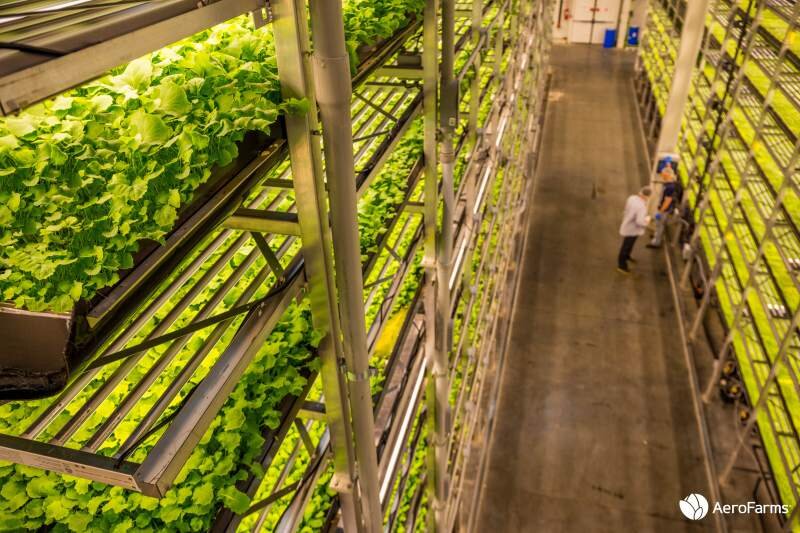
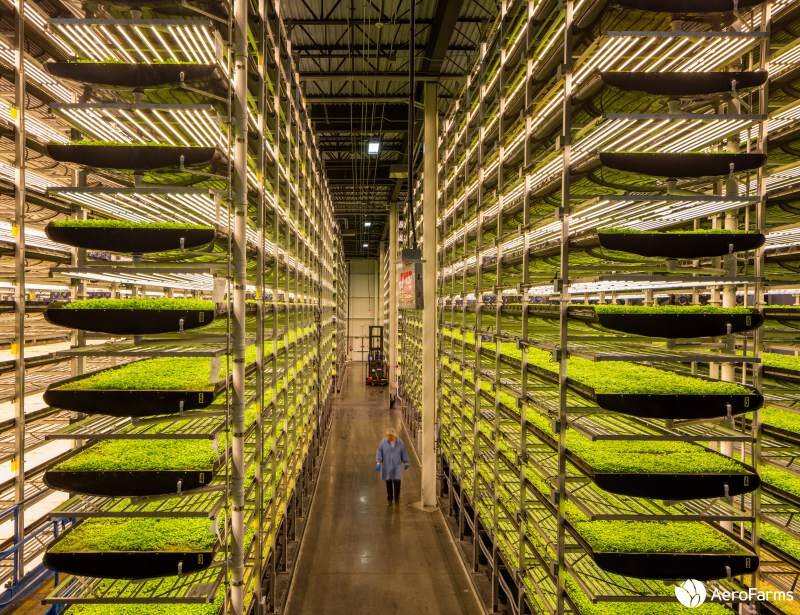


Imagine a farming method so efficient that you could grow a variety of leafy greens in half the time it traditionally takes — without any pesticides, herbicides or fungicides — and where the sun has no role.
It’s all done indoors, and it’s a growing trend known as controlled environment agriculture (CEA). The biggest player in the space is AeroFarms, a Newark, New Jersey-based operation that was among the businesses that participated at the Feb. 25 North Coast Specialty Food & Beverage Conference.
“We track everything that happens to the plants, from its genetics all the way to harvest. And by measuring along the way, we can use that data to learn more about what makes plants grow,” said AeroFarms Chief Financial Officer Guy Blanchard. “The ability to do this is transformative, it’s brand new if you think of the difference with field farming, where you can’t control the temperature and you can’t control the weather. You’re really reacting and trying to respond to the things that Mother Nature is throwing at you.”
In addition to AeroFarms, which is privately held, there are a variety of CEA players in the marketplace, including Bright Farms, Little Leaf Farms, Bowery Farms, Revol Greens and Plenty, which is based in South San Francisco. The majority of these businesses are headquartered in the Midwest and further east, where bad weather makes it impossible to grow the greens outdoors.
There are a variety of growing methods within the CEA category, the two most common being hydroponics and aeroponics. With hydroponics, plants are grown with mineral nutrients in a water base rather than in soil. Aeroponics, which is AeroFarms’ method, also uses no soil, instead of planting seeds in fabric and misting them with mineral nutrients.
AeroFarms grows 800 varieties of edible greens, such as lettuce, arugula, and spinach. The plants require 95% less water than on farms and are completely grown in 12 to 14 days, rather than 30 to 45 days in the field. The company’s retail brand, Dream Greens, is sold in grocery stores in New Jersey and New York.
Blanchard declined to disclose the company’s financial metrics. According to ROI-NJ, a New Jersey business publication, AeroFarms raised $40 million in 2017.
The vertical farming market size was valued at $2.23 billion in 2018 and projected to hit $12.77 billion by 2026, according to Allied Marketing Research.
There’s going to be change, but I don’t want to lose our small farmers.
Pegi Ball, Santa Rosa Original Certified Farmers Market
Pegi Ball and Janet Ciel, who each run farmers markets in the North Bay, said at the conference they wonder how the CEA industry might someday impact the region’s farmers“.
There’s going to be change, but I don’t want to lose our small farmers,” said Ball, who manages the Santa Rosa Original Certified Farmers Market at the Luther Burbank Center for the Arts. “It’s more than just lettuce and that sort of thing. It’s the culture, it’s the tradition, it’s our community, so that’s what concerns me.”Ciel, who manages the Healdsburg Certified Farmers Market and also works with the Agricultural Institute of Marin’s Stonestown Farmers Market in San Francisco, came away impressed by Blanchard’s presentation, but also curious about how traditional farming and controlled environment agriculture could potentially coexist.
“I think the technology is brilliant,” Ciel said.
“I just think the small farmer is … dealing with the weather and pests and (various other factors), and they don’t have the funding or the education to pull something like this off. Is there something there that is for them?”
Blanchard views the growing CEA industry to be more comparable to — and therefore more competitive with — commercial food-processing operations than traditional farming because of the costs involved, from investing in capital equipment to staffing, of which AeroFarms employs about 160 people.
“If you’re going to have a farm manager, a safety manager, a shipping manager and a maintenance manager (among the staff), you may be up to like $600,000 a year in wages and benefits before you’ve even gotten to anything really related to the farm,” Blanchard said. “In many ways, even though the processes are different, this isn’t different than some other food-processing (businesses) necessarily, and you’ve got to manage it.”
I’m certain we’ll continue to see new and different commodities take advantage of innovative growing techniques of a controlled environment.
Mary Coppola, United Fresh Produce Association
Another reason CEA poses little to no threat to farmers, at least at this point in time, is because food grown in this vertical indoor environment is limited primarily to leafy greens. Greenhouses have more latitude.
“There are a number of companies who are growing greenhouse strawberries, peppers, cucumbers and tomatoes with much success,” said Mary Coppola, vice president for marketing and communications at United Fresh Produce Association. The Washington, D.C.-based organization was founded in 1904 and advocates for companies in the fresh produce supply chain. “I’m certain we’ll continue to see new and different commodities take advantage of innovative growing techniques of a controlled environment.”
And where agriculture industry experts laud controlled environment agriculture for its renewable and sustainable efforts, such as conserving land and water, there are other cost concerns.“
They rely a lot on artificial lighting, so obviously energy consumption is an issue,” said Humberto Izquierdo, agricultural commissioner, and sealer of weights and measures for Napa County. “I think the economics have to be there.”
Guy Blanchard, chief financial officer of AeroFarms, explains how the New Jersey-based startup gets dozens of turns of fresh produce annually through its vertical indoor farm, speaking at North Bay Business Journal’s North Coast Specialty Food and Beverage Industry Conference on Tuesday, Feb. 25, 2020, at Doubletree Hotel by Hilton Sonoma Wine Country in Rohnert Park. (Jeff Quackenbush / North Bay Business Journal)
Blanchard said he doesn’t view energy consumption as a challenge for AeroFarms.“I think when people think about energy or environmental footprint, it’s tough to see how much is really embedded in traditional agriculture when you have all the energy going to root watering, soil and soil degradation, and the energy that goes into fertilizers and harvesting a field,” Blanchard said, as well as transporting, cooling and washing.
Marc Oshima, AeroFarms co-founder, and chief marketing officer said the company and its competitors are focused on strengthening the overall agriculture industry, such as sharing their expertise about how to grow greens safely to avoid contamination. They also formed their own group, called the Controlled Environment Agriculture Food Safety Coalition.
“(It) was a critical step to establishing best practices and educating the FDA and customers on why indoor farming has so many more safeguards versus traditional field farming, and less exposure that often occurs with co-mingling at the major leafy greens processors, who are sourcing from multiple growing regions both domestically and internationally,” he said.
The coalition also has partnered with Foundation for Food and Agriculture Research on a $2 million, three-year program to identify stressors of leafy greens in order to optimize taste and nutrition, he said.
Staff Writer Cheryl Sarfaty covers tourism, hospitality, health care, and education. Reach her at cheryl.sarfaty@busjrnl.com or 707-521-4259.
Huge Wisconsin Operation Shows Promise of Aquaponics in Midwest
“We’re producing about 30 times more produce per square foot than traditional organic farming,” Brandon Gottsacker, president of Superior Fresh, says
By Kristen Leigh Painter Star Tribune MARCH 7, 2020
Superior Fresh's grand experiment raises an intriguing question that,
for now, can't be answered:
How many other Midwest farmers can follow its path?
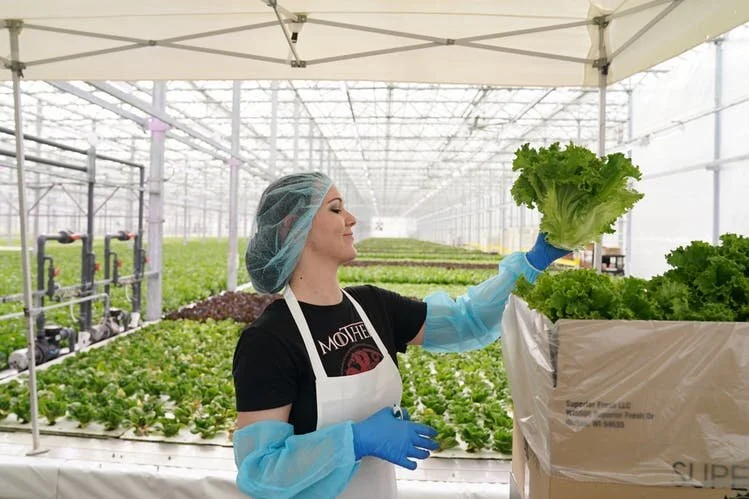
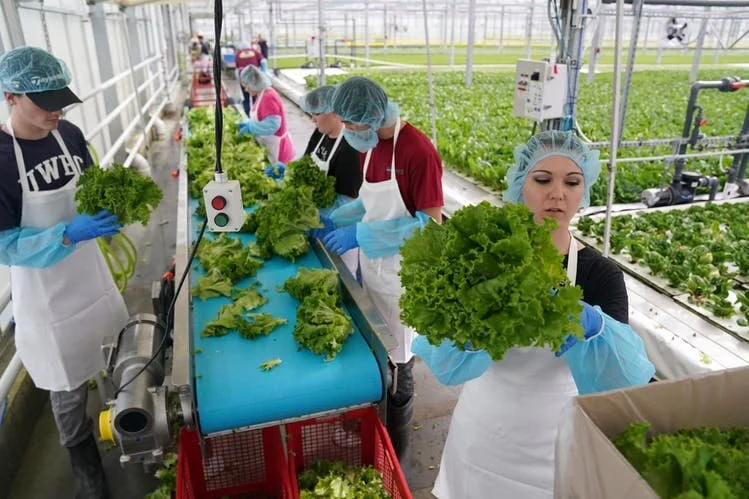
NORTHFIELD, Wis. – Stepping into the massive greenhouse of Superior Fresh — 6 acres under one roof — the gentle embrace of warm, humid air is quickly followed by the smell of lush, green plants.
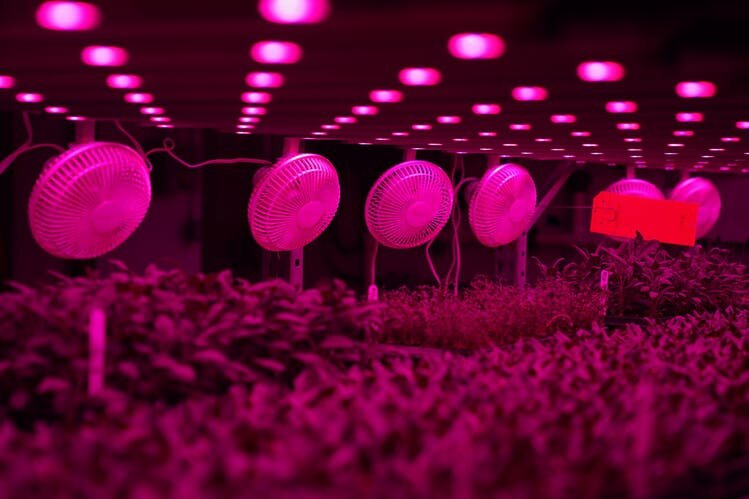
Daylight streams through the roof and the sound of sloshing water tricks the senses into a kind of tropical reverie. Seen from nearby Interstate 94, the greenhouse at night glows purple as red and blue lights come on to help organic leafy greens grow during sun-deprived winter months.
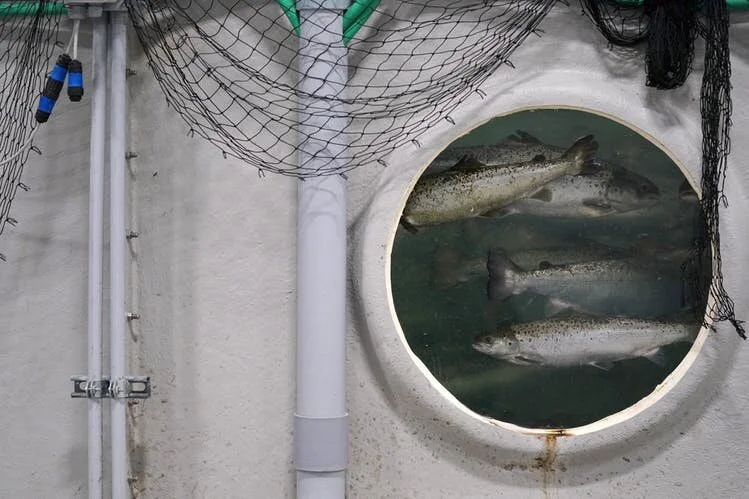
But Superior Fresh is not just another player in the nature-defying business of growing produce all year in the Midwest. It runs the nation’s, and likely the world’s, largest aquaponics facility, raising vegetables and fish in a way that benefits both.
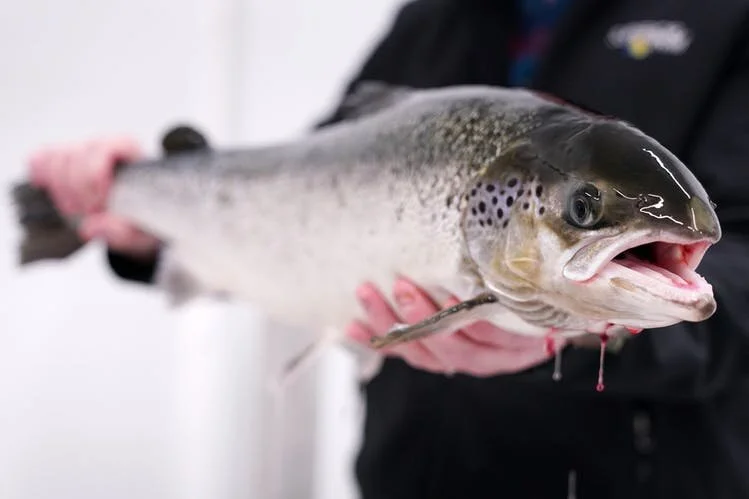
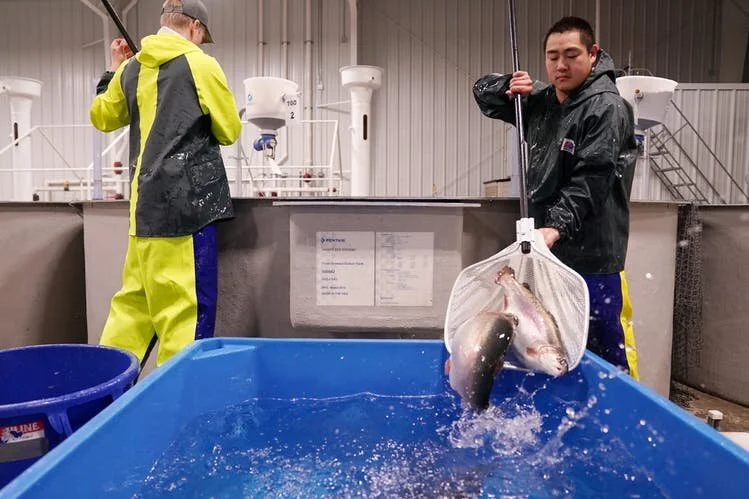
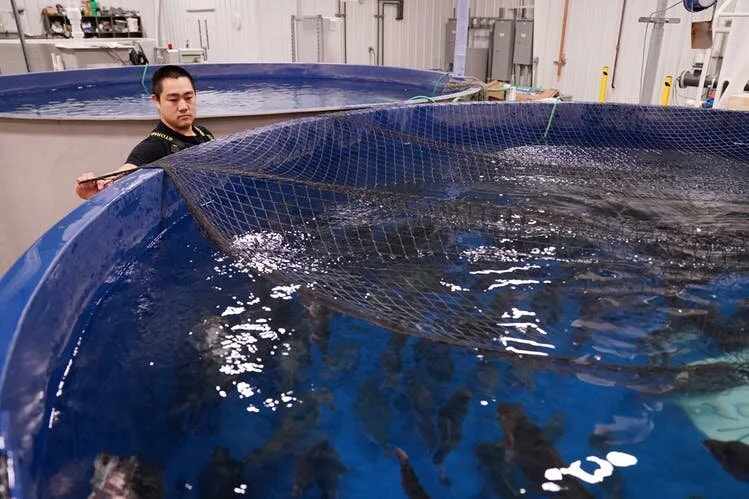
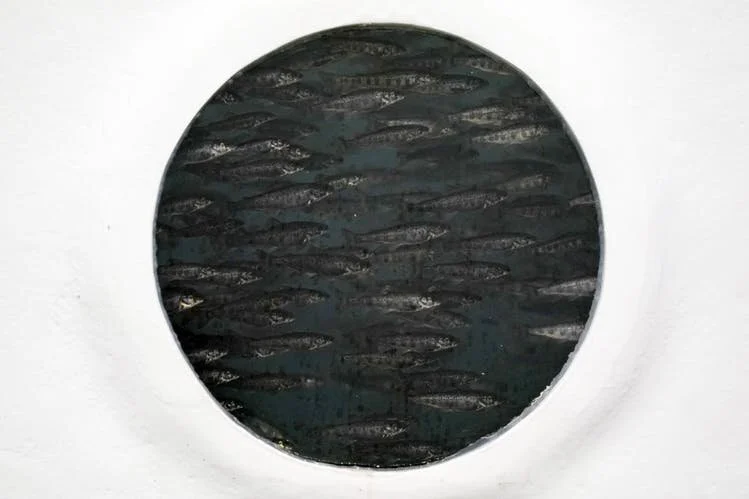
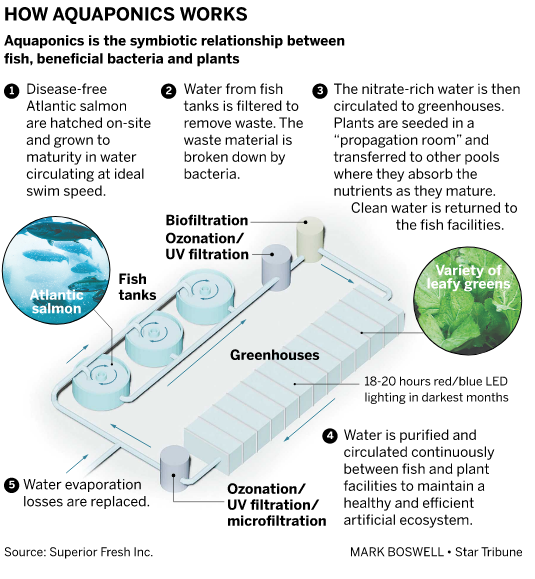
Next to its greenhouse is a fish house where 600,000 Atlantic salmon swim in giant tanks. Sharing a closed-loop water system, the fish fertilize the greens, and the greens filter water for the fish.
“We’re producing about 30 times more produce per square foot than traditional organic farming,” Brandon Gottsacker, president of Superior Fresh, says.
Built-in 2015, the farm first reached its full output in 2018 and last year produced 3 million pounds of greens and about 200,000 pounds of salmon. Both were sold to groceries and restaurants, and ultimately consumers, throughout the Midwest.
The farm’s owners, members of the family that owns Ashley Furniture in Arcadia, Wis., aim to double its size and production this year. Even then, Superior Fresh will produce just a tiny fraction of the nation’s demand for leafy vegetables and salmon.
But as it tests the prospect for fish farming in the landlocked Midwest, Superior Fresh’s grand experiment raises an intriguing question that, for now, can’t be answered: How many other Midwest farmers can follow its path?
“I’ve been working with some dairy farmers in Wisconsin, who have reached out and asked how much retraining would they need to convert from a dairy farm to a fish farm,” said Chris Hartleb, professor of fisheries biology and co-director of the University of Wisconsin-Stevens Point Northern Aquaculture Demonstration Facility.
Aquaponics is heralded as a sustainable, local solution for a future where resources are under increased strain from a ballooning global population.
“There are very few places in the world where you can actually put salmon farms into the oceans, and those areas are kind of tapped out now,” said Christopher Good, director of research at the Conservation Fund’s Freshwater Institute. “But the demand keeps rising, so the solution has to be land-based and I think the major salmon companies are starting to realize that.”
Hartleb said he sees nothing but growth in aquaponics. “More and more we are realizing that we have very little food safety and control over our food. Most of that risk is eliminated in aquaponics,” he said.
But it’s an expensive business to start and a difficult one to sustain.
Pentair shuttered Urban Organics’ tilapia-and-greens plant in St. Paul last year without explanation. Some farmers and entrepreneurs have found that focusing solely on either plants — through a system called hydroponics — or the fish, called aquaculture, is easier to manage.
“You have to achieve a certain size to become commercially viable. Prior to that, it’s a hobby or side business,” Hartleb said. “But to start out at that large size you have to have private financial backing because banks aren’t willing to take the risk.”
There are a fair number of what Hartleb calls “medium-sized” aquaponic farms in operation that support two to three employees and largely serve local markets. These are financially viable because they keep their costs in check with their smaller output.
“Most people getting involved with commercial aquaponics lack the farming background and this can lead to failure,” Hartleb said. “Current farmers have that experience, so they would just need to learn about water-based aquaponics.”
The owners of Superior Fresh decided to go big. The company spent $30 million on the first phase alone. The current expansion is phase three.
They invested in expensive systems that ozonate (adding oxygen) and filter the water with ultraviolet light as it returns to the fish. The farm also constantly monitors and tests water for pathogens, temperature and other crucial factors. It has backup pumps for their backup pumps, and generators powerful enough to keep the whole operation running if the power went out.
The farm produced its first harvest of lettuce about a month after opening in 2017. That brought revenue as salmon grew to harvest weight, which took two years.
“It’s not an easy business. If you make one mistake, you can literally kill fish in minutes,” Gottsacker said. “So if you’re going to do it, do it right. This is definitely a farm, so you can’t just leave for the weekend.”
Gottsacker, who studied biology with a focus on fisheries and aquaculture, started the farm with backing from Todd Wanek, chief executive and co-owner of Ashley Furniture, and wife Karen Wanek.
Superior Fresh greens are certified organic. Its salmon is fed an organic, non-GMO diet of fishmeal and fish oil. They are never given antibiotics or pesticides. The farm earned a certification for humane kill methods. The facility also sits on nearly 800 acres that was changed from monoculture farmland to oak savanna and prairie.
“The hundreds of acres of land that you would need here to grow the same amount of production now can be converted back to its native state,” Gottsacker said.
On paper, raising salmon makes sense for livestock farmers. Salmon need 1.1 pounds of feed to grow 1 pound. Hogs need 3 pounds of feed to yield 1 pound of pork, and cattle need 10 pounds of feed for a pound of beef.
With vegetables in the mix, the numbers look even better. Every 1.1 pounds of feed produces 1 pound of salmon and 10 pounds of organic leafy greens, Gottsacker said.
Critics of aquaponics often point to the energy required to keep a controlled system stable. Superior Fresh also has to heat the greenhouse and fish house all winter.
But Gottsacker said, “Compared to shipping seafood thousands of miles or trucking produce across the country, the energy footprint to grow fish and greens locally is significantly less than the alternative.”
When it comes to animal and environmental welfare, salmon raised in the closed-loop water system — called a recirculating aquaculture system, or RAS, in the industry — receives the highest “best choice” ranking from Seafood Watch, which is run by the Monterey Bay Aquarium and informs consumers and chefs on sustainable seafood.
“Farmed salmon, generally speaking, tends to have a pretty bad reputation,” Ryan Bigelow, senior program manager for Seafood Watch. “There are a lot of old tapes still playing on how wild is better than farmed. And while there is a lot of truth to parts of that, RAS tends to be a much better way to raise salmon than in [ocean] net pens.”
The organization is critical of large net-pen farms where fish escape and concentration of feed are concerns. Sea lice, a naturally occurring ocean pest, is worsened in tight spaces. “They are also interacting with wild animals, which probably means higher use of antibiotics,” Bigelow said.
Open ponds are the most common form of aquaculture in the U.S., but they aren’t feasible in northern climates. Flow-through systems look like streams and are a common way to raise salmon and trout.
“The negative side is you are constantly flushing water through the property, which is high in nutrients,” Hartleb said. Flow-through systems are highly regulated in most states to prevent water pollution, so this style of farm is becoming less common, “because the permitting is nearly impossible,” he said.
RAS systems are the newest and therefore the least common.
The waste is being filtered out and, depending on the facility, either treated on-site or sent to feed plants. Because the entire system is contained, it’s unlikely to find parasites in the water, reducing the use of drugs. And the risk of a food-borne illness at an indoor aquaponics facility is also very low.
Some of the nation’s biggest leafy green recalls in recent years have been traced back to outdoor farms where the groundwater was contaminated with waste from nearby cattle farms. Salmon are a coldwater fish that aren’t known as E. coli carriers.
“As long as you keep your biosecurity up, and pathogen-free eggs, then you can raise really healthy fish,” Good said.
Because salmon get their pink hue from eating carotenoid-rich food like krill and shrimp, Superior Fresh had to find a natural way to achieve that same color. The company doesn’t add a synthetic dye to achieve the color, a technique at farmed facilities around the world. Instead, they feed the fish a product called Panaferd that’s derived from a microorganism found in the ocean. The product is approved for use in the organic aquaculture industry.
More than 90% of salmon in the U.S. is imported, with the majority coming from Chile, Norway and Canada. The vast majority of salmon sold to Americans is raised in ocean net pens.
Right now, land-based RAS aquaculture — and the even smaller aquaponics subset within it — is largely being pioneered by entrepreneurs and angel investors.
“But the major salmon companies are watching this. As soon as one of those companies decides that land-based is the way to go, this will really take off,” Good said.
When completed later this year, Superior Fresh’s greenhouse will expand from 6 acres to 13 acres and the fish house will double from 1 acre to 2 acres. Its salmon harvest could rise to 1.3 million pounds a year. Even though no other aquaponics facility in the U.S. is as large as Superior Fresh, many fish-only RAS farms are larger.
“We want to keep growing. We’ve got other sites that we like throughout the U.S. — one on the East Coast, one on the West Coast — where we would build farms, likely as large or larger than this one because the markets are bigger there,” Gottsacker said. “This is a long-term game and a long-term business plan with long-term solutions.”
Kristen Leigh Painter covers the food industry for the Star Tribune. She previously covered growth and development for the paper. Prior to that, Painter was a business reporter at the Denver Post, covering airlines and aerospace. She frequently writes about sustainable food production, consumer food trends, and airlines.
All Photos: ANTHONY SOUFFLE – STAR TRIBUNE

Signify Expands Collaboration With Planet Farms
Thanks to the latest agreement, Europe’s largest vertical farm will boost the quality and yield of the crops using the Philips GreenPower LED production module managed by the Philips GrowWise Control System
Signify is expanding its collaboration with Planet Farms, a European operator of vertical farms based in Italy. Thanks to the latest agreement, Europe’s largest vertical farm will boost the quality and yield of the crops using the Philips GreenPower LED production module managed by the Philips GrowWise Control System.
Signify has also reached an agreement to provide horticultural LED grow lights to an additional five vertical farms that Planet Farms is planning to build in different European countries in the coming years, including Switzerland and the UK.
The Philips Greenpower LED production module, Signify’s latest horticultural LED innovation for vertical farming, helps growers optimize multilayer crop cultivation. By managing the lights with Philips GrowWise Control System, growers can easily create and run custom light recipes on dimmable and color-controllable modules to meet the needs of different crops and growth phases. This gives growers the ability and flexibility to create and control their own time-based light recipes and improve crop results and operational efficiency in closed, climate-controlled cultivation facilities.
“We started working with Signify five years ago because of the company’s knowledge and expertise of horticultural LEDs and light recipes,” said Luca Travaglini, co-founder and co-CEO of Planet Farms. “Thanks to the collaboration we’re able to grow high-quality crops all year round and that’s why we’re now expanding our collaboration. The GrowWise Contol System helps us easily adjust light recipes and continuously enhance the taste of our crops, which is crucial for us.”
This year, Planet Farms will finish construction of Europe’s largest vertical farm in Cavenago, just north of Milan. The vertical farm will cover more than 9,000 m2, which is the equivalent size of 45 tennis courts. Planet Farms operates an innovative integrated growth process that starts with the seeds and ends with packaged products. The production process is entirely automated meaning that consumers are the first to touch the crops.
“We’re proud to provide Europe’s largest vertical farm with our innovative lighting products and knowledge and expertise of light recipes. This next step in our collaboration shows that we can really help vertical farmers around the globe to improve the quality, yield and taste of their produce,” said Udo van Slooten, Business Leader Horticulture lighting at Signify. “The plans to build another five farms across Europe shows that vertical farming is rapidly growing and evolving. It’s a thrilling time to be involved in vertical farming, and we’re excited to help shape its future.”
Signify and Planet Farms formalized their collaboration in 2018 when Planet Farms announced the construction of Italy’s first vertical farm research lab in Milan. This lab opened in 2019. Signify supported Planet Farms with its lighting expertise for vertical farming and by providing its Philips GreenPower LED production module Dynamic grow lights.
For more information:
Signify: www.philips.com/horti

FDA Suspends Inspections In Foreign Countries Due To Coronavirus
The FDA announced the decision on March 10 with a statement from Commissioner Stephan Hahn. Customs and Border Protection officers will continue to examine produce arriving at U.S. points of entry, but food safety inspections at foreign facilities are postponed until April, according to the FDA.“
March 11, 2020
The Food and Drug Administration has halted most inspections of food facilities outside of the U.S. through April, as travel restrictions increase in response to the COVID-19 outbreak.
The FDA announced the decision on March 10 with a statement from Commissioner Stephan Hahn. Customs and Border Protection officers will continue to examine produce arriving at U.S. points of entry, but food safety inspections at foreign facilities are postponed until April, according to the FDA.“
Mission-critical” inspections will be decided on a case-by-case basis.
The decision also affects on-site inspections at foreign drug and medical device manufacturers.
The FDA is employing interim measures, including Denial of imports;
Examination and sampling of products at ports of entry;
Reviewing a company’s compliance history;
Using information-sharing agreements with foreign governments; and
Requesting records “in advance of or in lieu of” on-site inspection.“
The FDA will continue working with U.S. Customs and Border Protection to target products intended for importation into the U.S. that violate applicable legal requirements for FDA-regulated products, which may come from a variety of sources, such as first-time importers unfamiliar with regulatory requirements or repeat offenders trying to skirt the law,” Hahn wrote in the statement.
The FDA uses the Predictive Risk-based Evaluation for Dynamic Import Compliance Targeting (PREDICT) system for risk-based import screening to focus on high-risk imports. The agency also checks for “port shopping” or cargo diversions, according to Hahn.
The FDA continues to monitor the outbreak’s effect on operations.“
As this remains a dynamic situation, we will continue to assess and calibrate our approach as needed to help advance federal response efforts in the fight against this outbreak,” according to Hahn’s statement.
Related stories:
Coronavirus gives ‘body blow’ to exporters, worries consumers
United Fresh discusses coronavirus, product trends at FPFC event
Gotham Greens Greenhouse Replaces Bethlehem Steel Mill
Like other Gotham Greens facilities, the greenhouse uses hydroponic systems and is 100 percent powered by renewable energy
March 3, 2020
By Anca Gagiuc
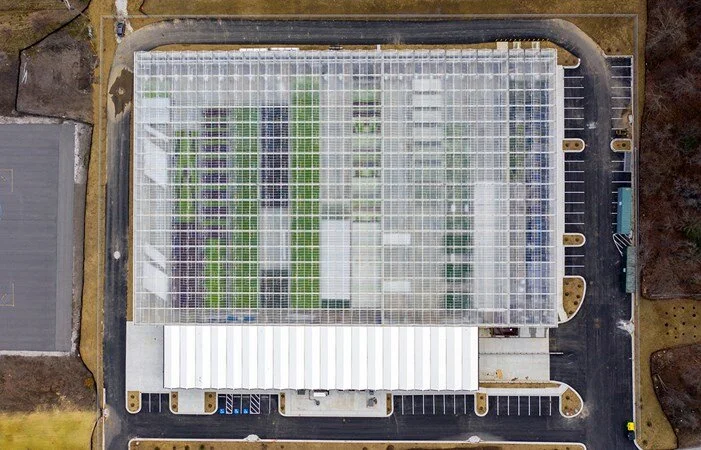
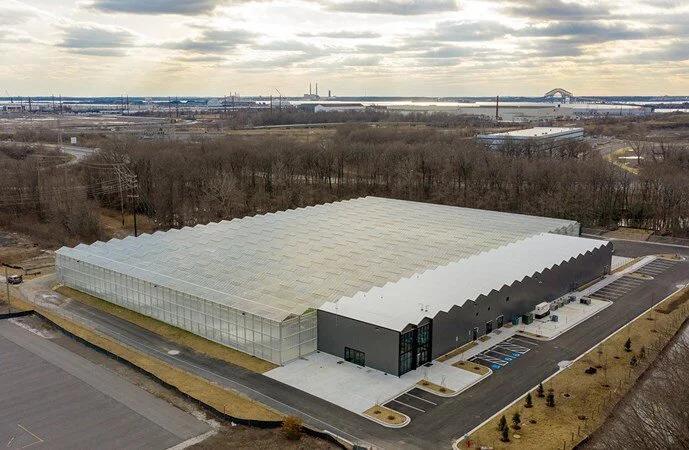

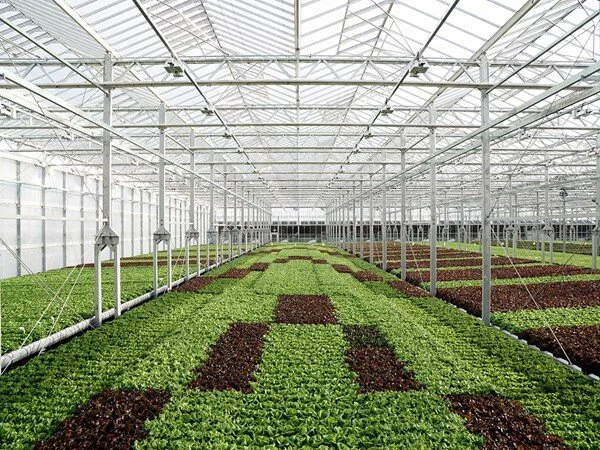
All images courtesy of Gotham Greens and Julie McMahon
Like other Gotham Greens facilities, the greenhouse uses hydroponic systems and is 100 percent powered by renewable energy.
A portion of the former Bethlehem Steel Mill in Sparrows Point, Md., has sprouted as a hydroponic greenhouse. The 100,000-square-foot facility is located just outside of Baltimore, Md., and is Gotham Greens’ seventh facility of its kind nationwide.
Like the other Gotham Greens facilities, this greenhouse uses hydroponic systems and is 100 percent powered by renewable energy. The company claims that it uses 95 percent less water and 97 percent less land than conventional farming. In addition, the new greenhouse is served by proprietary data-driven tools that enable the producer to run one of the highest-yielding, most energy-efficient indoor farming systems available on the market.
The greenhouse will be the first to provide a year-round supply of fresh lettuce to retail, restaurant and foodservice customers across 10 states in the Mid-Atlantic and Southeast regions. The current project opens 60 full-time green jobs in Baltimore. The firm has partnered with the Baltimore County Department of Economic and Workforce Development and the Center for Urban Families to find the best candidates for the positions.
Bethlehem Steel Mill has its origins in the 1880s and was acquired by Bethlehem Steel in 1916 when Sparrows Point became the world’s largest steel-producing center, where girders for the Golden Gate, George Washington and Bay bridges, as well as steel for shipbuilding during the World Wars, was produced. The facility gradually deteriorated until its bankruptcy in 2012.

Agri Tech Conf 2020 | September 22-23, 2020 | Dubai, UAE
On behalf of the Organizing Committee, we invite all participants from around the world to attend the International Conference on Agriculture Technology in Dubai, UAE with the theme of “Discovering Natural Resources through Agriculture” scheduled on September 22-23, 2020
On behalf of the Organizing Committee, we invite all participants from around the world to attend the International Conference on Agriculture Technology in Dubai, UAE with the theme of “Discovering Natural Resources through Agriculture” scheduled on September 22-23, 2020.
“It also gives a main integrative stage to researchers, professionals and instructors to introduce and talk about the latest development, patterns, and challenges just as common-sense difficulties experienced and arrangements received in the fields of agriculture.
ME Conferences aims is to offer an opportunity to share skills, expertise along with unparalleled networking opportunities between a large number of agriculture professionals like Directors, Heads, Deans, Professors, Scientists, Researchers, agronomists, agrarians, Founders, Associations, Organizations, technologists, Laboratory members and Young researchers working in the field of agriculture technology.
International Conference on Agriculture Technology
For further queries and assistance do not hesitate to contact us.
Amelia Sage
Program Manager
Agri Tech Conf 2020
Tel: (+44) 772-358-4425

Grocery Micro-Farms Take Off
Kroger has teamed up with Infarm, a six-year-old startup based in Germany, to install modular vertical farms. In these mini-farms, which use a hydroponic farming method, nine varieties of lettuce and herbs are stacked in rows and grown in nutrient-rich water until they are mature enough to be sold to customers
Kroger And Infarm Install Vertical Farms In Stores
By Phil Lempert on Feb. 24, 2020
In our annual trend report three years ago we correctly predicted that the time has come for supermarkets to install their own indoor farms, in which shoppers could pick their own produce right from the farm—the ultimate in freshness, taste and local. Kroger is leading the way by adding these mini-farms to two of its Quality Food Centers (QFC) stores in the state of Washington.
Kroger has teamed up with Infarm, a six-year-old startup based in Germany, to install modular vertical farms. In these mini-farms, which use a hydroponic farming method, nine varieties of lettuce and herbs are stacked in rows and grown in nutrient-rich water until they are mature enough to be sold to customers.
Infarm has more than 500 such installations in stores and distribution centers in other parts of the world, but this is its first installations in U.S. grocery stores. The growing process at the two pilot stores involves LEDs and an irrigation system with recycled water.
Infarm uses a cloud-based technology system to remotely control the temperature and lighting for each of its farms.“
Customers today want transparency; they want to know exactly where their product is from, the provenance where it was grown,” said Suzy Monford, Kroger’s group VP of fresh foods.
The program has already been deemed a success by Kroger. Monford said the stores have been selling everything from kale to cilantro as fast as the plants have been able to mature. Kroger has announced plans to expand vertical farming to 13 more QFCs in Washington and Oregon by April.
Infarm’s the ultimate goal is to make local food production mainstream. “For the bulk of the last century, food has been produced far from where it is consumed, generating a supply chain that is environmentally unsustainable,” said Osnat Michaeli, the company’s co-founder and chief brand officer. “Our modular farms offer the potential of turning the supply chain on its head by building the world’s first global farming network.”

US: Florida - Aquaponics: Winter Gardening Reaches New Heights In Winter Garden
A sustainable garden on a Winter Garden rooftop has everything from a fish farm to produce to a water filtration system
By: Irene Sans and George Waldenberger
February 26, 2020
ORLANDO Fla. — A sustainable garden on a Winter Garden rooftop has everything from a fish farm to produce to a water filtration system.
This type of garden is becoming more popular because they are sustainable, they require less space, they can mitigate dangerous heat and they may serve many ecological causes.
Certified meteorologist George Waldenberger visited Green Sky Grows, a Winter Garden aquaponics facility run by Valencia College.

Fireside Chat With Square Roots CEO & Co-Founder Tobias Peggs: Scaling Indoor Farming At Speed
Indoor Ag-Con is excited to announce that Square Roots Co-Founder & CEO Tobias Peggs has joined our conference line-up for the May 18-20, 2020 edition! Tobias will join Nicola Kerslake, Indoor Ag-Con Founder and Co-Founder, Contain, for the afternoon Fireside Chat: Scaling Indoor Farming At Speed
Square Roots Co-Founders Tobias Peggs and Kimbal Musk Empowering Next-Gen Farmers
Indoor Ag-Con is excited to announce that Square Roots Co-Founder & CEO Tobias Peggs has joined our conference line-up for the May 18-20, 2020 edition! Tobias will join Nicola Kerslake, Indoor Ag-Con Founder and Co-Founder, Contain, for the afternoon Fireside Chat: Scaling Indoor Farming At Speed. If our industry is to bring high-quality, local produce to customers all year round, we must collectively understand how to scale farming at speed to reach as many people as possible. Using a unique and scalable ‘farmer-first’ technology platform, Square Roots is doing just that. Tobias will share how this tech-enabled urban farming company is training and empowering the next generation of leaders in urban agriculture to grow local food that is delicious, responsible, nutritious, and profitable. And, be sure to check out the story further down in this issue highlighting our special guest blog post from Square Roots Co-Founder Kimbal Musk, too!
CHECK OUT FULL CONFERENCE SCHEDULE >>>
During Indoor Ag-Con, we’ll be featuring the panel presentation, What Is the Next Technical Frontier for LED Lighting” on Monday, May 18 from 10 – 10:45 am. Moderated by Dr. Morgan Pattison, SSLS, Inc., the panel will include Blake Lange, Signify, formerly Philips Lighting – City Farming; Brandon Newkirk, LumiGrow; and Xander Yang, Sananbio.
Ahead of the session, we reached out to our participants to find out, from an LED perspective, what is the next hot thing in lighting?
WHAT'S THE NEXT HOT THING IN LED LIGHTING? >>>
KIMBAL MUSK: 10 WAYS SQUARE ROOTS' FARM-TECH PLATFORM EMPOWERS THE NEXT GENERATION OF FARMERS
Ahead of Square Roots CEO & Co-Founder Tobias Peggs' Fireside Chat at Indoor Ag-Con, Co-Founder & Exec Chairman Kimbal Musk has shared a guest blog post with us.
"There are a lot of smart people in this industry, many with different visions for the optimum architecture and model for indoor farming (e.g. plant factories)," says Musk. "But all working hard to bring better food to market — which, given our wider vision to bring real food to everyone, is wonderful to see. The more of us working on the real food revolution the better — and we want all of these systems to flourish. But here are 10 reasons why we think container farming rocks.....”
10 WAYS SQUARE ROOTS' FARM-TECH PLATFORM EMPOWERS NEXT-GEN FARMERS>>>
YOU COULD WIN 2 TICKETS TO BIOSPHERE 2!
When you arrive at Indoor Ag-Con, be sure to enter for your chance to win two general admission tickets to Biosphere 2 and an overnight stay at B2 cabanas!
The winners will get to tour one of the world’s most unique facilities dedicated to the research and understanding of global scientific issues. The Biosphere 2 facility serves as a laboratory for controlled scientific studies, an arena for scientific discovery and discussion, and a far-reaching provider of public education.
What’s more, as part of the package, the University of Arizona Controlled Environment Agriculture Center (UA-CEAC) would like to also extend an invitation for the recipients to its vertical farm research and educational facility (UAgFarm) at UA-CEAC and other UA-CEAC projects/facilities as an additional welcome!
SEE WHO'S SPEAKING | SEE WHO'S EXHIBITING
INSIDE INDOOR AG | INDUSTRY NEWS HARVEST
PRODUCE GROWER: Elevate Farms Closes on $1.8 Million In Round Of Funding
GREENHOUSE GROWER: Gotham Greens Opens Another Massive Greenhouse
NEW YORK POST: I Tasted A Bug Diet, the Sustainable Protein That Could Save The WorldIGROW NEWS --CubicFarm Systems Announces Largest Sale To Date
SPECIAL THANKS TO OUR GROWING ROSTER OF
SPONSORS, MEDIA ALLIES & INDUSTRY PARTNERS

In addition, Indoor Ag-Con is proud to be a member of the Hemp Industries Association.
US: Pennsylvania - Hope Street Learning Lab Opening Aquaponics Classroom This Summer
Hydroponics and aquaponics are two urban farming techniques in which plants are grown in water without soil and fertilized with fish waste. These techniques often help provide fresh produce in food deserts
Lindsay C VanAsdalan York Dispatch
Mar 2, 2020
Hope Street Learning Lab will be opening a community aquaponics classroom this summer, following plans announced in November to install a hydroponics lab.
"We are super excited about it, and the ability to partner with somebody like Dr. Bracey-Green — it really is phenomenal," said Blanda Nace, executive director of York City's Redevelopment Authority. Jamie Bracey-Green, director of the Center for Inclusive Competitiveness at Temple University's College of Engineering, is partnering with the Hope Street nonprofit to donate shipping containers for its aquaponics and hydroponics in York City.
The partnership comes through a local chapter of MESA — Mathematics, Engineering and Science Achievement — housed in the center, to bring more of those studies to underserved areas.
Hope Street lab looks to buy a stretch of York City property
Jamie Bracey-Green, director for the Center of Inclusive Competitiveness at Temple University, is providing shipping containers for a new aquaponics classroom for Hope Street Learning Lab. She announced the proposed classroom along with Hope Street officials in February. The addition to the York City community learning center will involve soil-less hydroponic and aquaponic growing techniques. The classroom is slated to be open this July. Pictured, L to R: State Rep. Carol Hill-Evans, D-York City, Jamie Bracey-Green, Lincoln Charter Director of Community Outreach Anne Clark. Submitted, c/o Randy Flaum
Hydroponics and aquaponics are two urban farming techniques in which plants are grown in water without soil and fertilized with fish waste. These techniques often help provide fresh produce in food deserts.
Groundbreaking for the classroom is expected to commence March 31, and with it will be other additions to the Hope Street property, including a greenhouse next to the lab on the east side and a mint and herb garden on the west side.
The produce would be donated to the community. One shipping container is the equivalent to planting on 2 acres of ground, said Hope Street Executive Director Anne Clark.
Clark said the learning lab has been offering produce to residents in the city's west end for years, and the goal is to expand those efforts.
"It really is a neighborhood asset," Nace said of the planned farming technology, noting that the west end is definitely a priority in the city, but the need for food is even broader.
"The city in its entirely is a food desert," he said. "Anything we can do that change that is a step in the right direction."
York College and Temple will work with Hope Street on design to allow some natural light in the shipping containers so they'll fit in with their environment, Clark said.
"I really want the indoor classroom to be part of outside," she said, but the challenge will be also keeping them dark enough to allow the artificial light needed for the hydroponic and aquaponic farming techniques.
West Shore aquaponics supports urban agriculture, STEM education
Clark, who is also the director of outreach for Lincoln Charter School, said Hope Street is also working with the state Department of Education to match standards for the new classroom with each grade level.
Lincoln Charter School president and CEO Leonard Hart speaks at the announcement of a new aquaponics classroom for Hope Street Learning Lab in February. Lincoln Charter School is a founding partner of the learning lab, and its students often use the facility. The addition to the York City community learning center will involve soil-less hydroponic and aquaponic growing techniques in two shipping containers. The classroom is slated to be open this July. Submitted, c/o Randy Flaum
It would be available to all York County schools, as well as adult residents.
The cost of the project is about $10,000, which Clark plans to cover through financial or material donations of items such as paint, desk chairs, and solar panels.
The nonprofit is also looking at partnerships with Crispus Attucks York and York County School of Technology on some building elements and possible student mentoring.
Annual maintenance costs of Hope Street Learning Lab, which will increase about $5,000 with the new additions, would be offset in part by giving students the opportunity to plant and sell flowers.
Clark also plans to meet with the RDA in May to purchase the lab's property. Hope Street has an agreement with the authority to operate for a year, but does not own the property.
Nace said it will be up to the RDA's board to decide, but the authority has been working to assemble all the Hope Street properties into one parcel. The RDA owns several, one is privately owned and two are owned by the city.
The new aquaponics classroom is slated to open by July.
Pennsylvania Rep. Carol Hill-Evans, D-York City, speaks at the announcement of a new aquaponics classroom for Hope Street Learning Lab in February. The addition to the York City community learning center will involve soil-less hydroponic and aquaponic growing techniques in two shipping containers. The classroom is slated to be open this July.
Submitted, c/o Randy Flaum

Indoor Farming And Qualified Opportunity Funds
In a recent interview with OpportunityDB’s Jimmy Atkinson, Local Grown Salads Founder Zale Tabakman explained that Opportunity Zones and indoor vertical farming are a good combination because these operations can be set up in “food deserts,”
2020
Qualified Opportunity Funds have been set up to fund Qualified Opportunity Zones and Qualified Opportunity Zone Businesses. One such QOF, the LGS Opportunity Zone fund, focuses on the development and maintenance of indoor vertical urban neighborhood farms, grown and distributed by Local Grown Salads. The “farms” are being developed in older buildings, situated in Baltimore, MD Opportunity Zones. According to the company’s website, four properties have been identified, to date, with the farms set up in 15,000-square-foot increments.
The product coming out of these businesses are packaged salads consisting of lettuce, cucumbers, chard, kale, and others, which are sold to local restaurants and the community.
In a recent interview with OpportunityDB’s Jimmy Atkinson, Local Grown Salads Founder Zale Tabakman explained that Opportunity Zones and indoor vertical farming are a good combination because these operations can be set up in “food deserts,” lower-income areas where people have to drive or take a bus long distances to get food to eat. Additionally, they are environmentally sound because the food grown isn’t using pesticides or fungicide, and little runoff. Tabakman also cited a carbon footprint reduction, pointing out that the locally grown food has less distance to travel than, say, produce from California to the East Coast.
Finally, these farms are set up to create local jobs. Tabakman indicated that each farm can create 25 jobs, with pay averaging around $15 per hour. Additionally, the company is working with the bank to ensure financial literacy for employees.
From Tabakman’s point of view, LSG’s vertical farms tick off the many boxes of Opportunity Zone investments, being located in the federally-designated areas, and providing a positive impact on the community. “Indoor vertical farming, because it’s food, is great . . . but any other product being produced locally really makes sense in an Opportunity Zone . . . especially when you need to be close to your customers,” he told Atkinson.
CONNECT WITH LOCAL GROWN SALADS

US: New Jersey - Hope Cahill Starts As Coordinator At Hydroponic Farm
A hydroponic farm, in the middle of a municipal center? Well, it all started in 2016, when Robbinsville Mayor Dave Fried found out about hydroponic farming in freight containers
By Lois Levine
March 1, 2020
A hydroponic farm, in the middle of a municipal center? Well, it all started in 2016, when Robbinsville Mayor Dave Fried found out about hydroponic farming in freight containers.
“He loved the idea and thought it would be beneficial to the township in terms of feeding programs and education on how to grow greens and learn more about nutrition,” said Kevin Holt, recreation manager for the Robbinsville Township.
Hope Cahill, the new coordinator of Robbinsville’s hydroponic farm, holds some of the farm’s yield.
Now, the farm has a new coordinator—Hope Cahill, who took over for original caretaker Kyle Clement in January.
“We can grow anything that is a leafy green,” Cahill said. “Here we are growing butterhead, oak leaf, and lollo lettuce, as well as spring mix.”
The farm also grows some herbs, basil, and cilantro. Cahill, 25, is certified in aquaponics, an off-breed of hydroponics.
After graduating high school, she got certified in a variety of different areas of agriculture, and before taking this position working as a naturalist at various garden centers, as well as with the Monmouth County Park system. Born and raised in Tinton Falls, Cahill will be soon moving to Freehold.
Hydroponic farming is farming done without soil. Plants typically get all their nutrients from the soil. In hydroponic farming, however, nutrient-rich water takes the place of the soil, enriching the seedlings as they grow into fully mature plants and watering them at precise times through a computerized system.
With the system that the Robbinsville Township purchased, known as the Leafy Green Machine, lettuces and herbs are grown in a vertical hydroponic farm that lives within a recycled, refrigerated, insulated, custom-built shipping container.
Between the nutrient-rich water and light energy from powerful LEDs, greens can be independent of the need for land, climate and season, growing in a modular design that is also mobile and can theoretically live anywhere.
The container consists of insulation, where it maintains an average internal temperature of 70 degrees Fahrenheit in extreme climates; climate control, built with an integrated “economizer” that saves energy by drawing in cool outside air when appropriate and also doubling as an intake fan; a dehumidifier to maintain optimal humidity levels and decreasing the farms overall water consumption; airflow ducts, consisting of two fans that distribute cool carbon dioxide enriched air evenly; and a carbon dioxide regulator with a safety shut-off feature, providing plants with exactly the right amount of carbon dioxide needed for photosynthesis.
In addition, the greenery’s LED lights provide the plants with the best quality light at its most efficient point. The LED boards are designed to emit only particular wavelengths of red and blue light, which are the colors that plants are able to absorb most easily for photosynthesis (red light is essential for stem and leaf growth, while blue light helps develop thick stems and dark green foliage).
Just as it is in nature, Cahill and her team start with the seeds, which begin in a flowing hydroponic system and are placed into compressed peat moss, known as grow plugs. The peat-moss plugs act as a sponge for absorbing nutrient-rich water. The seeds soak for 10 minutes, are covered with a humidity dome and sit under grow lights for about a week.
At that point, the seeds have become sprouts, with small roots, short stems, and a few young leaves. They then move up to the next level, a flow troth, where the roots “get completely soaked,” Cahill said. Now actual seedlings, taller and sturdier than they had been, with a secure root system, the plants sit in that troth for another two weeks, getting consistent water and light to develop strong stems needed to support the plant’s weight later in its life cycle.
After this time period, the seedlings are harvested and transplanted into the main cultivation area, where they are now in the towers, growing vertically for the first time. The roots, which are still in the peat-moss grow plugs, are wedged into stiff foam panels, which provide firm support, with the plant facing outward towards the LED light, encouraging the leaves to grow. Here, in this final destination, they spend from two to five weeks until they are ready for their harvest..
A view of the produce inside of the shipping container that houses Robbinsville’s hydroponic farm
“It is a continual cycle of putting new lettuce and herbs in, taking grown ones out,” Cahill said.
Every week, the team has something to harvest.
“What is nice about the system is that it is computerized so that plants get exactly the nutrients it needs at the right time,” Cahill said. “Sensors on the computer know when they might need nitrates or some other nutrient.”
Freight Farm, the company that built the hydroponic farm equipment, also developed an app that can be used via a person’s iPhone or desktop computer to keep an eye on all sensor data.
Holt admits he did not know much about hydroponic farming until Fried asked him to look into purchasing a machine.
“I did a ton of research on what hydroponic farming is, to educate myself, and then looked into what companies are out there to make these container farms,” he said. “We talked to a lot of companies, and decided on Freight Farm, out of Boston. At the time, they told us we were the only municipality they had ever sold a freight farm container to.”
Once Cahill and Holt have the finished products, the lettuce and herbs get donated back to the Robbinsville Senior Center.
“We also give some of the produce to Meals on Wheels, and also Mercer Street Friends, who disperse it to schools,” Cahill said. “They distribute it to about a dozen schools in the Trenton area.”
And how does the finished product taste?
“It is honestly the best lettuce you can ever eat,” Holt said. “You really can see and taste the difference between this produce and the produce you buy in a supermarket.”
It looks good and feels good, too, Cahill said.
“Before we distribute it, we take care to remove any brown or damaged leaves,” she said. “There are, of course, no pesticides, no chemicals that the greens were treated with, so it is very safe and very clean.”
Both Cahill and Holt rave about how green and fresh the lettuce is, “with so much more taste to it than what you get in the stores, which by comparison, tastes so bland,” Holt said.
Since starting the farm at the municipal center in 2017, companies have come through to see the set-up, expressing interest in buying machines for themselves. Holt said the township has also hosted schools and colleges, as well as field trips and local education programs.
“Our mission is to grow, educate and unite: we grow the lettuce, give it away, educate the community about how hydroponic farming works, and unite people by asking them to volunteer or hold events, which is a catalyst for bringing people together,” Holt said. “This has been a huge win-win for the community.”
Cahill said she is always seeking volunteers and visitors, as well.
To schedule a tour or for more information, visit robbinsville.net/recreation or send an email to hcahill@robbinsville.net.
Bowery Farming Appoints Newton Kalengamaliro To Role of Senior Agricultural Scientist
Kalengamaliro boasts over two decades of experience in plant breeding, physiology, biochemistry and product development, with a specific focus on the produce market
New York, NY – Bowery Farming (Bowery), the leader in sustainable indoor farming, announced today the appointment of Newton Kalengamaliro to the role of Senior Agricultural Scientist. Kalengamaliro boasts over two decades of experience in plant breeding, physiology, biochemistry and product development, with a specific focus on the produce market. He joins Bowery as a senior leader on the Agricultural Science Team and will be tasked with optimizing yield and quality.
“As we look ahead to the future of Bowery, we are confident that Newton will play a pivotal role in optimizing yield and quality,” said Susan MacIsaac, Bowery Farming’s Head of AgScience. “We welcome him to the team and look forward to leveraging his decades-long research and industry expertise.”
As a whole-plant physiologist/ecologist, Kalengamaliro has dedicated much of his career to studying how plants adapt to stress and developing strategies and tools that enhance plant resilience. Prior to joining Bowery, Kalengamaliro held positions at Philip Morris USA and British Petroleum. Most recently, he was Director of Driscoll’s on its Breeding and Variety Development team. Kalengamaliro is a graduate of Purdue University where he earned an MSc and Ph.D. in crop physiology and later studied at Virginia Commonwealth University where he earned an MBA.
“My sustained interest in business development, specifically, linking crop research findings to new business opportunities in the produce industry, perfectly aligns with Bowery’s current operations,” said Kalengamaliro. “I look forward to working alongside the Bowery team to stay at the forefront of research and development as it relates to produce and agtech.”
For more information about Bowery, please visit www.boweryfarming.com.
ABOUT BOWERY FARMING
Bowery is growing food for a better future by revolutionizing agriculture. Its modern farming company combines the benefits of the best local farms with advances made possible by technology to grow produce consumers can feel good about eating. BoweryOS, its proprietary software system, uses vision systems, automation technology, and machine learning to monitor plants and all the variables that drive their growth 24/7. Because Bowery controls the entire process from seed to store, its farms use zero pesticides, 95% less water, and are 100+ times more productive on the same footprint of land than traditional agriculture.
Bowery produce is currently available at select Whole Foods and Foragers stores in the Tristate area and featured on the menus of Tom Colicchio’s New York restaurants Craft and Temple Court. Based in New York City, the company has raised over $170 million from leading investors including GV, General Catalyst, GGV Capital, First Round Capital, Temasek, and Almanac.
This Ain’t Your Grandfather’s Lettuce: Meet The Farm Of The Future
The vegetable farming of the future looks very different from the fields of lettuce and other crops you’ll find in places like California’s Salinas Valley today, according to Daniel Malechuk, the 38-year-old CEO of Kalera, a vertical farming company based in Orlando, Florida
Daniel D'Ambrosio Senior Contributor
entrepreneurs I write about entrepreneurship and intriguing startups across the U.S.
The vegetable farming of the future looks very different from the fields of lettuce and other crops you’ll find in places like California’s Salinas Valley today, according to Daniel Malechuk, the 38-year-old CEO of Kalera, a vertical farming company based in Orlando, Florida.
Daniel Malechuk, CEO of Kalera, a vertical farming company, with a head of lettuce. KALERA
Kalera’s lettuce, including Bibb, Oakleaf, Frisee, Crystal, Gem, Batavia and mini-Romaine, is grown indoors in white towers of trays with carefully controlled temperature, light, and humidity.
Kalera claims to have adopted cleanroom technology from the semiconductor industry, ensuring that the plants in the growing rooms, bathed in a surreal pink-purple light, are never exposed to animal or human pathogens. As a result, pesticides are never used. Not an unimportant claim considering the travails Romaine lettuce has suffered in recent months as a result of contamination.
Kalera’s vertical indoor farms also utilize a closed-loop irrigation system that cuts water use by 95% compared to those fields in California, according to Malechuk. Kalera is scheduled to open a 33,000-square-foot facility in Orlando in February, which Malechuk describes as the largest indoor growing center in the southeastern United States.
Kalera builds towers with racks of lettuce. No soil or pesticides needed. KALERA
“When you walk in it’s racking from floor to ceiling with multiple layers of plants,” Malechuk said. “We’re 100 times more efficient than traditional farming, and we use five percent of the water.”
Kalera also claims the advantage of being close to its markets, drastically cutting transportation costs, along with the carbon footprint of its harvest. Malechuk points out that lettuce starts to die the second you cut it; and that it can take 10 days for a head of lettuce to travel the nearly 3,000 miles from California to the East Coast.
“Our vision is to quickly and rapidly bring food to people exactly where they are in a much more healthy, sustainable manner,” Malechuk said.
There is no soil involved in Kalera’s growing process. The roots of the lettuce grow directly in free flowing water, with nutrients added. The totally closed system eliminates the possibility of contamination from E. coli, according to Malechuk.
Malechuk has what he describes as “massive expansion plans” for Kalera, not only in the United States but also around the world. The key, he says, will be a franchise model that will make indoor farming as easy as “copy and paste.”
The new look of farming, as Kalera sees it. KALERA
Malechuk envisions Kalera moving into “food deserts” in cities like Detroit, where his parents grew up.
“After we decide to go somewhere we can produce millions of heads of lettuce, not taking up any land,” Malechuk said.
There are plenty of empty warehouses in Detroit where Kalera could build a vertical farm, he said.
Malechuk believes indoor vertical farming’s time has arrived.
“A whole lot of smart people spent years researching how to make this happen,” he said. “Not just Kalera, but key partners driving lighting costs down, figuring out the right seeds and right varieties to grow; countless hours of analyzing the right mix of water and nutrients.”
“I like to think we’re on the cusp of one of the most incredible evolutions we’ve ever gone through.”
Follow me on Twitter.
I am a business reporter based in Burlington, Vermont. In the last eight years, I have covered everything from IBM's "sale" of its semiconductor fab in Essex Junction

80 Acres Farms Will Grow Tomatoes On Fifth Avenue In Guggenheim Exhibition
Based in Hamilton, Ohio, 80 Acres Farms is a leader in technology-assisted indoor growing and a multi-farm operator marketing a wide variety of freshly picked vegetables and fruits to retailers such as Giant Eagle, Kroger, Whole Foods, Jungle Jim’s and Dorothy Lane Markets
80 Acres Farms will grow tomatoes on one of the busiest streets in New York City outside the Solomon R. Guggenheim Museum as part of the Guggenheim’s new exhibition in collaboration with Rem Koolhaas, “Countryside, The Future.”
Along with its commercial partners Infinite Acres and Priva Holding BV, 80 Acres Farms will grow cherry tomatoes in an indoor grow module right outside the museum on Fifth Avenue.
Based in Hamilton, Ohio, 80 Acres Farms is a leader in technology-assisted indoor growing and a multi-farm operator marketing a wide variety of freshly picked vegetables and fruits to retailers such as Giant Eagle, Kroger, Whole Foods, Jungle Jim’s and Dorothy Lane Markets.
The company was founded by veteran food industry executives Mike Zelkind and Tisha Livingston, who are supported by a deep team and a board of directors representing executive and leadership experience at leading food, healthcare and other companies.
Window on tomato production
People in New York will be able to look through a large window in the indoor farm to view a crop of fresh tomatoes being grown continuously during the next six months under precise LED lighting and other controlled conditions.
The first tomatoes will be ready for harvest by late-March.
The grow module will demonstrate how indoor farming can benefit the world through growing fresh, pesticide-free food near populations, anywhere in the world while using fewer natural resources.
The “Countryside, The Future” exhibition will examine political forces, social issues and environmental factors altering landscapes across the world, including traditional farmlands.
80 Acres Farms is a founding member of the Infinite Acres partnership venture, along with Netherlands-based Priva Holding BV, a leading provider of technology solutions, services and automation systems to horticultural and other industries; and Ocado Group, one of the world’s largest dedicated online grocery retailers, operating its own grocery and general merchandise retail businesses.
That partnership is now building large-scale, fully automated indoor farms in the U.S., Asia and Europe.
“We believe that what we are doing is about the future of food. We are changing the way fruits and vegetables are grown and harvested locally then delivered to grocers the very next day,” Zelkind said.
“There is an enormous market and consumer appetite around the world for produce that our crop scientists and other food experts have been perfecting during the past five years,” he said. “Our participation in this exhibition will allow New York residents and visitors to experience how the freshest, tastiest locally grown tomatoes can be grown year-round indoors in one of the busiest cities in the world.”
700-square-foot grow center
For the Guggenheim exhibition, 80 Acres Farms, Infinite Acres, and Priva Holding have collaborated on the 700-square-foot grow center and all of the state-of-the art ag-technology within it.
While in operation for the next six months outside the Guggenheim, the Infinite Acres grow module is expected to grow 50,000 tomatoes.
Additional tomatoes will be donated to City Harvest, a New York City food rescue organization that safely recovers excess food and distributes it to people in need.
“Countryside, The Future” will be open to the public through Aug. 14.