


Welcome to iGrow News, Your Source for the World of Indoor Vertical Farming

A Collaboration Between CropKing (USA) and Urban Crop Solutions (BE) Has Been Cultivated - CropKing Will Operate A Vertical Container Farm Showcase
“By combining their strengths, the companies want to consider newmarkets. Their collaboration could be a perfect match.”
Cropking and Urban Crop Solutions are excited to announce the start of a flourishing collaboration. The goal will be to combine the extensive hydroponic experience of Cropking with the high-quality controlled environment technology in vertical farming of Urban Crop Solutions. By combining these different experiences and expertise, both companies get the chance to develop together in the Controlled Environment Agriculture industry in the United States. CropKing will operate the FarmPro vertical container farm as a showcase, continued research, and testing facility.
Hydroponic farm by CropKing
“By combining their strengths, the companies want to consider new
markets. Their collaboration could be a perfect match.”
Cropking is the only full-service hydroponic company in the U.S. that specializes in the business of controlled environment agriculture and hydroponic growing since 1982. Their 37 years of experience makes them the leader in hydroponic systems and greenhouse manufacturing. Their headquarters are in Lodi, Ohio whereas their facility structures and systems can be found across 20 different countries including the United States, Canada, Mexico, countries in Europe and the Caribbean.
According to Paul Brentlinger the President of Cropking Inc.: “We are excited to be working with Urban Crop Solutions and the opportunity to validate the effectiveness of automated container farming. Their personal and custom-made approach could fulfill the needs of many clients. The shipping container system offers advantages like climate control, irrigation system, automated growing process, … which has captured our interest for the past few years.” CropKing will receive its first Urban Crop Solutions FarmPro Container in March and will start testing it in their facilities with the help of in-house plant scientists.
Inside FarmPro container
Urban Crop Solutions has recently celebrated its 5th anniversary and already has 28 active projects across the world. They are the only turnkey solutions provider, that also offers biological know-how, in the indoor vertical farming industry. Besides that, they have already developed over 200 plant growing recipes, for a variety of industries, through their inhouse research method. Paulina Murrath, the business development manager of Urban Crop Solutions, will serve as a point of contact for the North American market through the office of Urban Crop Solutions in Miami, Florida.
In the opinion of Paulina Murrath: “It’s a great honor to start a collaboration with CropKing and Paul Brentlinger who is a controlled environmental agriculture expert with extensive knowledge of growing high-quality food products. CropKing shares the same values that we consider important, like bringing higher yields, nutritional value, food security, local production, and consumption, … to different industries. That’s why we believe that our collaboration will be rewarding.”
For more information:CropKing: www.cropking.com
Facebook: https://www.facebook.com/CropKing/
LinkedIn: https://www.linkedin.com/company/cropking-inc./
YouTube channel: http://www.youtube.com/user/cropkinginc
Urban Crop Solutions: www.urbancropsolutions.com
For more information on this press release on Urban Crop Solutions or on the products and services of Urban Crop Solutions, you may contact Maarten Vandecruys (CTO) or Tom Debusschere (CEO):
Maarten Vandecruys, CTO maarten.vandecruys@urbancropsolutions.com
Tom Debusschere, CEO tom.debusschere@urbancropsolutions.com
European headquarters: Regional headquarters:
Grote Heerweg 67 800 Brickell Avenue, 1100 Suite
8791 Beveren-Leie (Waregem) Miami (FL 33131)
Belgium Florida
(+32)56 96 03 06 +1 (786) 408-6027

A Belly Ache Can lead To A Trip To The Urgent Care. E. coli Poisoning Lands You In The Emergency Room
The FDA has called little attention to the surge in E. coli outbreaks from leafy green vegetables. It has been slow to investigate or publicize risks and did not disclose one outbreak to the public until the Globe contacted agency officials about reports of E. coli poisonings
Dietitian Determined To Save Salads!
February 12, 2020
Written by Dr. Jenna Bell, RD VP of Nutritional Science at Crop One
Crop One is the world’s largest scalable, completely controlled, vertical farming company. Our Greater Boston brand is FreshBox Farms.
Spend a few days bent over, writhing in abdominal pain and you’ll understand how serious foodborne illnesses can be. It may even require a trip to urgent care. Experience an outbreak of E. coli O157:H7 from salad greens and you may be among hundreds heading to the ER.
E. coli poisoning can be life-threatening.
What is E. coli, anyway?
Straight out of the Center for Disease Control (CDC):
“Escherichia coli (abbreviated as E. coli) are bacteria found in the environment, foods, and intestines of people and animals. E. coliare a large and diverse group of bacteria. Although most strains of E. coli are harmless, others can make you sick. Some kinds of E. coli can cause diarrhea, while others cause urinary tract infections, respiratory illness and pneumonia, and other illnesses.”
To be crystal clear — we’re talking about fecal contamination. Poo in food. Bird, cow, human, someone’s poop.
As a registered dietitian, I swear by colorful salads of leafy greens with favorite fruits, veggies, seeds, nuts and proteins atop. Making that recommendation sans lettuce feels blasphemous and unfulfilling. But given the pace at which the outdoor-grown romaine industry reports bacterial outbreaks, food safety threatens our salad fixings.
Break out bacteria
Over the past few years, romaine has been hit hard by outbreaks of bacterial contamination — especially from the strain, E. coli O157:H7. The most recent string of outbreaks is considered “under control” by the CDC and Food and Drug Administration (FDA), but the final count as of January 13, 2020, is 167 individuals reported in the US.
“Reported” is a key word here because how many times have you called the CDC or the FDA when you were sick?
Lettuce + E. coli is not a new thing
Several years ago (2013), a scientific investigation of a decade-worth of data on hospitalizations and deaths attributed to food commodities (including seafood, farm animals and plants) revealed that among the 17 commodities, more illnesses were associated with leafy vegetables (2.2 million [22%]). Illnesses associated with leafy vegetables were the second most frequent cause of hospitalizations (14%) and the fifth most frequent cause of death (6%).¹
A 2020 piece in the Boston Globe written by venerated reporter, Christine Haughney Dare-Bryan, traced the tracks of the recent outbreaks and illuminated the grimness with a family’s horrific experience with E. coli poisoning in their two-year-old son. In the article, Haughney Dare-Bryan reflects on the quick response from then commissioner of the FDA, Scott Gottlieb:
…[Gottlieb] tweeted to a startled nation that they should stop eating romaine lettuce just two days before Thanksgiving 2018.
E. coli fatigue
However the seriousness, history shows that someone hit the snooze button. Despite the number of updates and investigations, CDC and the FDA can’t seem to get ahead of it. Haughney explains:
Despite the growing number of outbreaks, the agency remains protective of the growers, taking little enforcement action and sometimes shielding growers suspected of causing outbreaks from bad publicity. Consider:
The FDA has called little attention to the surge in E. coli outbreaks from leafy green vegetables. It has been slow to investigate or publicize risks and did not disclose one outbreak to the public until the Globe contacted agency officials about reports of E. coli poisonings. FDA officials insist they planned to disclose the early fall 2019 outbreak all along.
The FDA has not punished any farm or distributor in connection with the seven outbreaks traced to lettuce since 2017 even though federal law prohibits the sale of contaminated foods. The agency concluded that three of the outbreaks were linked to a single California lettuce grower but declined to release the name.
The FDA staff monitoring lettuce production is just a small fraction of that detailed to the federal oversight of beef: There are 614 FDA field investigators responsible for leafy greens compared to 7,068 workers overseeing beef for the Department of Agriculture. Congress recently gave the FDA $8 million to better handle outbreaks, but the agency doesn’t want to talk about the state of its staffing. When the Globe tried to examine just how understaffed the agency is, officials redacted hundreds of pages of records discussing their internal problems.
The agency relies almost entirely on voluntary cooperation from the lettuce industry, an approach that has brought about some safety improvements. But FDA has asked relatively little of the industry and recently delayed implementing rules aimed at preventing E. coli contamination of irrigation water until 2022.
What do we do now?
From one salad enthusiast to another, or one mom to another, or one PhD/dietitian to consumer (take your pick): there is a safer way to grow your lettuce and eat it too.
We can grow indoors. Out of the soil and away from questionable water, weather disruption messes and “run-off” contaminants (think poop).
I found my safe salad environment when I met and started working for CROP ONE.
How do I know it’s safe?
Concealed, confined, enclosed, controlled, secured, safe, protected — all synonyms for Crop One’s modular growing rooms (“mods”). Mods are protected by double door entryways with fancy sliding doors like at the supermarket and a vestibule. Anyone who enters is fully gloved and covered in stylish lab wear (no, not stylish).
Pictured: The most stylish lab wear in Massachusetts
I should add here that because our plants are protected from the world, we don’t need or use any type of -cide (pesticides, herbicides or fungicides), nor do we deal with pests, insects, rain, contaminated water or other farm’s fertilizer or chemicals. We’re free from all that stuff you’re trying to stay free from.
Pure, clean, filtered — water and air. Each mod is carefully controlled for contaminants, chemicals, heavy metals, and other unwanted impurities through a multi-step, quality-controlled purification system.
FreshBox KVH Kosher Certified romaine lettuce.
Two words: Kosher. Certified.
If you’re not familiar with the process by which produce is certified Kosher, visualize microscopes, tweezers, fastidious inspectors, etc. KVH Kosher certification officers perform comprehensive inspections to ensure that Crop One/FreshBox Farms’ produce is free of all pests and insects.
The salad solution.
Crop One can keep your salad safe. Miraculously, along with safety, our modular enclosures are scalable and sustainable in any climate, on very little land, with barely any water compared to traditional farms (about 95–99% less water required), but we’ll save that for another conversation.
Jenna A. Bell, PhD, RD, joined the Crop One team in September 2019 as the VP of Nutritional Science to be part of the global food supply solution.
References:
Painter JA, Hoekstra RM, Ayers T, et al. Attribution of Foodborne Illnesses, Hospitalizations, and Deaths to Food Commodities by using Outbreak Data, United States, 1998–2008. Emerging Infectious Diseases. 2013;19(3):407–415. doi:10.3201/eid1903.111866.
Haughney Dare-Bryan C. Green Alert. Boston Globe. Last accessed January 30, 2020: https://edition.pagesuite.com/popovers/dynamic_article_popover.aspx?artguid=a497f64d-df30-4f48-b026-10aadc66901b&appid=1165
WRITTEN BY
Crop One Holdings
We grow the cleanest, healthiest greens for anyone, anywhere in the world. Our sustainable vertical farms are free from chemicals and climate-proof.

USDA Grants Call For Aquaponics
USDA AFRI Grants will disburse $192 Million across several different programs and specifically call for aquaponics and hydroponics projects
Federal Grants have recently been published that can apply to aquaponics growers. USDA AFRI Grants will disburse $192 Million across several different programs and specifically call for aquaponics and hydroponics projects.
The USDA Agriculture and Food Research Initiative (AFRI) will award $192 Million for FY2020. Due dates for grant applications range from March 12 to May 28, 2020, depending on the project. The AFRI program is to invest in research, education, and extension projects that support more sustainable, productive, and economically viable agricultural systems. Click here for AFRI Request for Applications.
Kentucky State University, 2019 Aquaponics Conference
Aquaponics Projects Can Fit Into
Multiple Programs Within The Grant, Including:
Foundational Knowledge of Agricultural Production Systems
Pests and Beneficial Species in Agricultural Production Systems
Small- and Medium-Sized Farms
Water Quantity and Quality
Separately, USDA Aquaculture Research Grants have also been published. These grants total $1.2 Million. The due date is April 22, 2020.
Click here for Aquaculture Request for Application
For more information:
Aquaponics Association
4531 Airlie Way, Annandale VA 22003
info@aquaponicsassociation.org
aquaponicsassociation.org
Publication date: Mon 17 Feb 2020

Researchers Tackling Viability of Leafy Greens In Vertical Farming Production
To better serve this burgeoning industry, researchers hope to integrate the indoor vertical growers within the specialty crop segment of agriculture, with the ultimate goal of increasing sustainability and profitability
Posted by Brian Sparks
February 19, 2020
Murat Kacira, University of Arizona. Photo: Rosemarie Brandt/College of Agriculture and LIfe SciencesA research team from the University of Arizona, Michigan State University, Purdue University, and The Ohio State University is using a $2.7 million grant from USDA’s Specialty Crops Research Initiative to study indoor leafy green production, with the goal of improving the quality, quantity, efficiency, and cost-effectiveness of indoor vertical farming production.
The initiative — called Optimizing Indoor Agriculture, or OptimIA — has caught the eye of more than 25 industry leaders, whose matching financial support brings the project total to $5.4 million.
“We’re privileged to work with a team of powerhouse scientists, engineers, economists, and industry partners to collectively address the significant challenges faced by the indoor vertical farming industry,” says Murat Kacira, a Professor of Biosystems Engineering and Director of the University of Arizona Controlled Environment Agriculture Center. “Controlled environmental agriculture is one piece of the puzzle, combining plant science, engineering, and computer-controlled production systems to enhance the yield and quality of our crops and optimize resource use.”
To better serve this burgeoning industry, researchers hope to integrate the indoor vertical growers within the specialty crop segment of agriculture, with the ultimate goal of increasing sustainability and profitability.
To do that, the multi-university team plans to assess variable environmental conditions, such as humidity, air movement, temperature, light, and carbon dioxide concentration, and then provide a more complete picture of best practices for indoor farming stakeholders.
Kacira and his team will be using computer simulations, modeling, and experimental studies to design and test more effective localized air-distribution methods, environmental monitoring, and control strategies for indoor vertical farms
.Michigan State University will lead final economic modeling, with Erik Runkle collaborating with co-principal investigators Roberto Lopez and Simone Valle de Souza. Chieri Kubota will take the reins testing environmental condition variables at The Ohio State University, and Cary Mitchell will lead closed canopy and phasic lighting tests at Purdue University.
Learn more about the research here.
Brian Sparks is senior editor of Greenhouse Grower and editor of Greenhouse Grower Technology.
See all author stories here.

February Indoor Science Cafe Recording Is Now Available!
This presentation was given by Dr. Paul Fisher at the University of Florida during our 16th cafe forum on February 20th, 2020. Indoor Ag Science Cafe is organized by the project team funded by USDA SCRI grants program
This presentation was given by Dr. Paul Fisher at the University of Florida during our 16th cafe forum on February 20th, 2020. Indoor Ag Science Cafe is organized by the project team funded by the USDA SCRI grants program.
Questions?
Please visit the Indoor Ag Science Cafe QA forum at Public Good Ag website and ask your questions. OptimIA team is collaborating with Penny McBride to develop an information-sharing site with the lively discussion platform to better understand indoor farming.
Submit Your General Questions
for 'Indoor Ag Sci Queries'!
Please submit your questions (anonymously if you wish) about the sciences and technologies of indoor farming to this submission site. Any questions are welcome! The site is always open for your questions. Selected questions will be discussed in our future Indoor Ag Science Queries series.
Indoor Ag Science Cafe is organized by the OptimIA project team funded by USDA SCRI grants program.
Previous café recordings are available on the OptimIA project website.
Please contact for more info: kubota.10@osu.edu
Upcoming Cafes:
March 10th, 1:30 PM EST 'Controlled Environment Production for Safer Leafy Greens' by Paul Lightfoot (BrightFarms)
April 14th, 12 PM EST 'Photons = Flavor, the case study of basil' by Dr. Roberto Lopez & Kellie Walters [Michigan State University]
May 26th, 11 AM EST 'How to fund your indoor farm' by Nicola Kerslake [Contain Inc.]
Interested in giving a talk to share your thoughts and experiences? Please contact us!
Related Events:
March 15-18, 2020 - NCERA-101 Committee on Controlled Environment Technology and Use Annual & International Meeting (Tucson, AZ) [More Information]
June 8-12, 2020 - ISHS International Symposium on Light in Horticulture (Malmö, Sweden) [More Information]
July 10, 2020 - Plant Empowerment Workshop - Advanced learning to optimize crop production (Columbus, OH) [More Information]
July 11-14, 2020 - Cultivate '20 (Columbus, OH) [More Information]
July 29, 2020 - OptimIA Annual Stakeholder Meeting (East Lansing, MI) (more information TBA)

Controlled Environment Agriculture: Scale-Up or Keep Niche?
"Scale-up is the next big challenge for controlled environment agriculture,” comments Dr Belinda Clarke, Director of Agri-TechE, which is bringing together innovators to discuss progress in an industry that is predicted to be valued at almost £10Bn by 2026, five times the size it is today
06-02-2020
Indoor farming is expanding at an astounding rate - and with the urban population alone set to soar by almost a third in the next 30 years, viable scale-up is the next big challenge facing the industry. Agri-TechE is bringing together international experts and industry leaders to discuss the progress and pitfalls of Controlled Environment Agriculture at an all-day event at The John Innes Centre, Norwich, next month.
"Scale-up is the next big challenge for controlled environment agriculture,” comments Dr. Belinda Clarke, Director of Agri-TechE, which is bringing together innovators to discuss progress in an industry that is predicted to be valued at almost £10Bn by 2026, five times the size it is today.
“There are still obstacles to overcome and the industry is experimenting with different technologies and business models, such as diversification of existing vegetable production, purpose-built facilities or niche cultivation close to the point of use – to gain competitive market price for its products.”
Industry leaders including LettUs Grow, Growpura, Capital Agri International and Square Mile Farms will be sharing their insights and learnings at Agri-TechE’s ‘Controlled Environment Agriculture (CEA) – The Industry is Growing Up’ event in Norwich, 18 March 2020.
“The urban population is set to increase to 6.3 billion by 2050 and this will place increasing pressure on supply chains,” Luuk Graamans of Wageningen University & Research explains. Luuk, who is also due to speak at the Agri-TechE CEA conference, continues: “One proposed solution is a closed production system, that maximizes resource use efficiency by adapting the interior climate to provide uniformity and limiting the interaction with the external climate.
“A shortcoming of this system is the need for artificial illumination and high demand for cooling and vapor removal; creating a high energy load. The viability of plant factories [vertical farms] depends on their resource productivity.
“Our research shows that when compared to greenhouses, a plant factory produces dry matter that is higher and more consistent and uses resources more efficiently. This could be further improved by increasing the production layers, enabling more growing area on the same amount of land.”
“Indoor vertical farms need economies of scale to really get down to current market pricing,” reflects Jack Farmer, co-founder of LettUs Grow – developers of aeroponic systems. “So, we are working with key players to boost productivity and crop quality at scale.”
LettUs Grow is also working on a farm management system, Ostara, that uses powerful data on biological growing conditions to enable automation of facilities. The software can also be retrofitted into more traditional glasshouse environments and Jack sees synergy between the existing horticulture business model and advances in CEA: “Essentially, vertical farms will prove complementary to glasshouse horticulture, with technology increasingly being shared between them.”
Jack continues, “The benefits of aeroponics come from the health of the plant’s root base and this is particularly valuable when you are seeking to accelerate the growth rate, such as in leafy green production or propagation. But we are very open to collaborating with different tech providers where that adds value to the grower.”
Jock Richardson of Growpura (formerly H20-ganics) agrees there is a place for multiple solutions in CEA, his technology is designed for big production facilities. It uses hydroponics in a cleanroom environment and features an automated moving system to allow movement of the plants.
Jock comments: “We are going to see continued invention for small scale hydroponics, but on the industrial end the challenge to be broached is how growing operations are scaled. A lot of operators have some great technology but to grow bigger means a linear, or worse increase in costs.
"Energy management is one of the key issues to be solved in this. There is a lot happening in sustainable energy supply and I think it is going to make a big difference to how farmers and consumers view CEA in the coming years.”
Kiryon Skippen of investment firm Capital Agri International adds: “I think CEA will provide a solution, but not on its own, it has to be part of the bigger picture. We are not leaving land-based food production behind.
“Also, the systems need to be properly de-risked, while indoor farms provide ideal growing conditions for plants, they are good for pests too. Systems in Asia are ahead of us as they’ve built systems more conservatively and then, year on year, tweaked and build them up. A more haste less speed approach.”
Urban farms may help reunite consumers with food production; doing more than simply growing fresh produce, they also re-engage consumers with the impact of food on our health and the environment.
Johnathan Ransom’s family are farmers in Lincolnshire and he could see the potential for a complementary approach in smaller urban spaces. Together with Patrick Dumas and Doug Bar, he founded Square Mile Farms out of a desire to re-engineer urban food systems and shorten the current food supply chains.
Johnathan explains: “Initially we came up with ‘flat-pack farms’, which enabled us to put growing units into tight urban spaces such as offices or on rooftops. However, growing and supplying food in cities is challenging and we realized we needed a commercial model that is not wholly reliant on produce sales to ensure this was going to really work for the future.”
So Square Mile Farms now offers farm installations to big businesses, to help them achieve their sustainability and employee engagement goals. After receiving an invitation from British Land, the company opened its flagship farm in February 2019. It grows leafy greens, microgreens, and herbs on the rooftop of British Land’s north-west London campus in Paddington Central. Produce is delivered to local restaurants and fresh ‘veg bags’ provided for local employees.
Johnathan and his team have also installed farms for multinational businesses based on the campus and deliver a suite of activities and workplace experiences, centered on the farms and their produce.
Luuk, Jack, Jock, Kiryon, Johnthan and 20 or so other speakers and exhibitors from CEA will be at Agri-TechE’s ‘Controlled Environment Agriculture – The Industry is Growing Up’. The all-day event will be held at The John Innes Centre, Norwich Research Park NR4 7UH on 18 March, 9:00 am – 5:00 pm.
For more information, full program details and tickets please visit Agri-TechE's dedicated event page.
Lead Image: Leafy greens and herbs on the roof of Microsoft's office in NW London
CREDIT Square Mile Farms

Making Vertical Farming Big In The UK
Food technology and vertical farming are both growing markets. In 2018, vertical farming was worth $3bn globally and it is predicted to grow to $22bn between 2019 and 2026
Growing greens in a Vertical Future farm - VERTICAL FUTURE
Food technology and vertical farming are both growing markets. In 2018, vertical farming was worth $3bn globally and it is predicted to grow to $22bn between 2019 and 2026.
British-based husband and wife team Jamie and Marie Burrows founded Vertical Future with aims of being “the largest urban vertical farming company in the UK”.
“We produce high-quality, sustainable produce, primarily baby leaf vegetables and herbs, as well as developing efficient and sustainable methods of food production and supply,” explains Jamie.
The company has one active production site which has been operational for three years and services more than 100 food establishments in London.
“We’re focused on improving population health by building better, smarter, more sustainable food production and supply systems,” says Jamie. “Advancements in basic technologies associated with vertical farms have improved the business case for vertical farming businesses.”
Jamie says this, combined with increases in population and urban population density, has led to a “steep rise” in the number of vertical farming businesses, primarily in urban areas.
There were no vertical farms as recently as 2010; as of 2016, there were 2.3 million square feet of indoor farms worldwide.
Inside a Vertical Future farm - VERTICAL FUTURE
Nature Fresh Farms Matt Quiring Transitions Role to Director of Sales
As Director of Sales, Matt will now be overseeing the development of all their retail accounts. “Matt’s transition into Director of Sales was a very easy and natural choice,” shared Vice President, John Ketler
Leamington, ON (February 21, 2020) – Nature Fresh Farms announced Matt Quiring’s recent role transition from Executive Retail Sales Accounts, Manager, to Director of Sales.
Matt Quiring, son of Nature Fresh Farms president and founder Peter Quiring, showed interest in Nature Fresh Farms at an early age, after gaining experience outside of the industry he joined Nature Fresh Farms Sales established in 2010. Developing his retail accounts from the ground-up, he advanced into the role of Executive Retail Sales Accounts Manager. In this position, Matt played an important role in developing partnerships with many of their major retailers and various customers.
As Director of Sales, Matt will now be overseeing the development of all their retail accounts. “Matt’s transition into Director of Sales was a very easy and natural choice,” shared Vice President, John Ketler. “With Matt handling the vast majority of our sales to date, it is clear that he has the drive, passion, and industry knowledge necessary to develop these relationships with our partners.”
General Manager, Frank Neufeld also expanded on Matt’s transition mentioning Nature Fresh Farms continuous expansion and what it means for the company. “With the growth of Nature Fresh Farms and Nature Fresh Farms Sales, we are welcoming many new members to our team, including additional sales staff. It was evident to us, seeing Matt’s experience, that he would be the one to lead the entire sales team moving forward,” said Frank. “We look forward to Matt bringing his leadership and mentoring skills to the rest of the sales team, helping them to strengthen the relationships he has established over the last several years with our partners.”
As Nature Fresh Farms focuses on company growth and developing relations, Matt’s role will assist in the continued progression of their team and retail partnerships. Nature Fresh Farms is excited for their future with the continuous expansion of their team, their advancements in technology and product innovation allowing them to provide fresh produce all year-round.
-30-
About Nature Fresh Farms -
Continuously expanding, Nature Fresh Farms has become one of the largest independent, vertically integrated greenhouse vegetable farms in North America. As a year-round grower with farms in Leamington, ON, Delta, OH, and Mexico, Nature Fresh Farms prides itself on consistently delivering exceptional flavor and quality to key retailers throughout North America, while continuing to innovate and introduce more viable and sustainable growing and packaging solutions.
SOURCE: Nature Fresh Farms | info@naturefresh.ca T: 519 326 1111 | www.naturefresh.ca

Miele Commitment To Vertical Agriculture At Home
Miele continues with its commitment to acquire or participate in new projects to diversify its business and redefine the experience in the field of cooking, with the purchase of Agrilution assets
02/14/2020
Miele continues with its commitment to acquire or participate in new projects to diversify its business and redefine the experience in the field of cooking, with the purchase of Agrilution assets . This young company of German origin has opted to offer vertical agriculture solutions, which many experts have defined as the future of greenhouses, in the home itself.
This type of agriculture, which is based on aeroponics (a technology that does not require land, sun, or water) makes plants grow based on the humidity and heat of artificial light. Its domestic use means having a kind of standard refrigerator, which offers the perfect growing conditions, with minimal care and an extra design contribution both in the kitchen and in the living room.
In the words of Maximilian Lössl, founder of Agrilution together with Philipp Wagner, "our domestic greenhouse provides fresher lettuce, herbs, and micro vegetables directly on the table."
Agrilution's home greenhouses allow fresh, aromatic and nutrient-rich sprouts, herbs and micro vegetables to be enjoyed at home throughout the year, through a self-contained ecosystem with simple seed coatings, regulated lighting, and a controlled microclimate, as well as automatic irrigation.
The first crop can be harvested one to three weeks after commissioning.
To establish a comparison that clearly illustrates its effectiveness, a lettuce grown in the field requires up to 120 liters of water to grow and that volume is sufficient to supply an entire Plantcube throughout the year.

‘Farm of The Future’ To Unlock Potential of Horticulture
Modular Farms Australia director James Pateras said the training farm would help unlock potential in the Australian farming landscape
Special report: EMILY BRADFIELD, Rural Weekly
February 19, 2020
THE Darling Downs is at the forefront of agricultural innovation and is now home to Australia’s first educational modular farm.
This month, TAFE Toowoomba welcomed its first cohort of students to the new Rural Centre of Excellence.
The $2.7 million facility includes a groundbreaking indoor vertical farm, allowing farmers of the future to get their hands on new technology and help shape the future of Australia’s food supply chain.
The vertical farm is the first educational facility of its kind in Australia and one of just two modular farms in the country.
Modular Farms Australia director James Pateras said the training farm would help unlock potential in the Australian farming landscape.
The LED growing lights inside the pod were designed specifically for the system to promote maximum growth .
INSIDE THE FARM
Mr. Pateras describes the farm as a “complete growing system” where plants are grown from seed to harvest inside the controlled growing environment.
The process of growing inside the pod starts with seeds planted in a host plug made from peat moss and allowed to germinate and grow into a seedling, which usually takes about two and a half weeks in most crops.
Plants are grown from seed, rather than seedling, to prevent pathogens or disease entering the pod.
From there the seedling is moved into a vertical tower on the growing wall, where it remains until ready for harvest.
Modular Farms pods are generally used to grow herbs and small leafy greens or even strawberries and blueberries.
The growing lights inside the pod were designed specifically for the system to promote maximum growth and are placed at an ideal distance from the plant canopy.
The farm is also much more water-efficient, using 95 percent less water than traditional crops, as well as the ability to recapture and recirculate water used inside the farm.
The pod is controlled by four indicators: lighting, climate, fertigation, and irrigation, and can be monitored and controlled remotely using an app.
“With a consistent environment, the plants mature much faster than those in a traditional crop.
“It allows us to create a very solid and clean environment for the plants to live in. There’s no cold one day, hot the next day, it’s a very steady environment inside,” Mr. Pateras said.
“A farm like ours can turn a basil seed into a harvestable crop in about five weeks, which is about half the time you’d see in a traditional greenhouse.”
The yield in the vertical farm is also significantly higher than that of a traditional crop.
Inside the 36sq m container farm, there are four growing walls with a surface area of about 65sq m. That 65sq m is able to produce the equivalent of 1000sq m in traditional crops, which equates to about one tonne of basil per year, or upwards of 45,000 lettuces.
Plants are grown in the vertical tower from seedling to harvest.
IN THE CLASSROOM
Dubbed by students as the “farm of the future”, Mr. Pateras said the farm would give students the opportunity to learn about indoor growing technology as the way of the future.
“To be able to do what we do and use as little water as we use is a great opportunity for the kids to realize how we can save on the environment and still consume and grow food,” he said.
The Modular Farms installation at the TAFE campus is one farm with two growing environments, allowing students to experience two different nutrient programs side by side.
“It’s got a dual irrigation system which allows (students) to run experiments side by side but then really focus on the plant biology as well. They can run tests a lot quicker and faster from that set-up,” Mr Pateras said.
Mr Pateras hopes hands-on experience in the growing pod will get the students thinking about the future of food production.
“What I think it will do is create a huge awareness about where plants are going and also allows the kids to learn a lot more about growing plants indoors, which is not new but growing plants on a commercial scale indoors is obviously becoming a bigger factor in the agricultural landscape.
“So it will definitely teach them a lot about what the future may hold about growing food in Australia,” he said.
“The idea of getting in a tractor and plowing up a paddock will maybe one day be a thing of the past, time will tell.
“The technology right now isn’t going to replace the farmer tomorrow but the farm of the future is here now.
“It’s just a matter of more and more people realizing the benefits of what this type of farming can bring to the environment, the community and the people consuming the food.”
A Modular Farms vertical farming operation.
THE FUTURE
Mr. Pateras believes the future of indoor farming is bright, with the potential to completely change the food supply chain and provide fresher, locally sourced produce to communities.
“I definitely think the indoor agriculture space is growing in steam,” he said.
“With the technology improvements over the course of the last few years, we’re seeing reduced entry costs in that controlled system’s space.
“We’re even seeing a lot of the traditional farmers supplementing their traditional greenhouses with growing lights to try to fast-track the speed of growth of their normal traditional greenhouse.”
The container farm has huge potential for isolated communities and city landscapes in delivering clean, fresh produce and eliminating food miles.
“As our cities begin to grow … the opportunity to grow in those areas is huge,” he said.
“It’s probably just scratching the surface in terms of where these types of systems can live, how they can change the food supply chain and improve the quality of food.
“We’re a very lucky country in Australia, where we can grow a lot of our food year-round. What our system allows people to do is create that microeconomy and sense of community farming.
“These things can live anywhere, so the ability to grow fresh leafy greens in Mt Isa or Birdsville is quite powerful in itself.”
The farms also have the potential to eliminate any unnecessary food miles. Australia’s first modular farm is located at Brisbane’s Eat Street Northshore, supplying vendors with fresh produce.
“We harvest our crop on a Thursday, we walk it down 50m to the vendors who buy our crops and by the next night, the produce is on the plate.
“You won’t be able to get in any fresher than that, and in terms of food miles we’re talking 50m,” Mr Pateras said.
“If you can grow food locally with one of our farms, I think it will be a far better injection into the local economy than bringing food in from interstate or overseas.”

Robot Farmers Are Changing The Future of Agriculture
80 Acres Farms doesn't just want to make fresh, local produce for Cincinnati and neighboring areas; it wants to completely overhaul the food system in the US
A robot named Sam rules over this atypical Ohio Farm.

Megan Wollerton February 9, 2020
It's a cloudy day in early October and I'm circling my rented Jeep Wrangler around a maze of industrial buildings in Hamilton, Ohio. Hamilton is a small city 30 miles north of Cincinnati with a population of just over 62,000 people. Like much of Ohio, farming is important here.
I'm on my way to a farm called 80 Acres, but it isn't the sprawling midwestern wheat field you're picturing in your mind. This tech-centric farm is indoors, housed entirely in a nondescript 10,000-square-foot warehouse.
You can't tell from the outside, but this is a bustling produce farm that has tested over 100 varieties of leafy greens. Megan Wollerton/CNET
Food and agriculture are the top contributors to Ohio's economy. There are about 78,000 farms in Ohio, putting it near the top of every list ranking US states by number of farms. Its biggest crops are soybeans, corn, and wheat.
But US farming is in trouble. There are roughly 2 million farms in the country spread across 900 million acres and they earned a total of $389 billion in sales in 2017, according to the 2017 Census of Agriculture, released in April 2019. All three of those numbers are lower than they were five years ago. There are fewer farms, there's less land dedicated to agriculture and the remaining farms are making less money.
There are a lot of reasons for these declines, from dropping commodity prices, to climate change and a trade war with China. There's also a growing trend of larger farms making the majority of the profits. Less than four percent of US farms made more than two-thirds of ]=agriculture sales in 2017.
80 Acres Farms doesn't just want to make fresh, local produce for Cincinnati and neighboring areas; it wants to completely overhaul the food system in the US.
"We decided that the [food] industry was really broken and that it had to be fixed from within. Farmers are struggling and they don't want their kids to be in farming," 80 Acres CEO Mike Zelkind explains as we watch a robot named "Sam" expertly maneuver containers of leafy greens around a series of stacked shipping containers inside the Hamilton warehouse.
I'm here to see how 80 Acres is changing farming for this corner of Ohio -- and how its sister company, Infinite Acres, is selling its sustainable technology to other farms with an ultimate goal of "feeding the world."
A plan to feed the world
Zelkind and Tisha Livingston, the president of 80 Acres and CEO of Infinite Acres, came up with the idea for their farm in 2015. Back then, "controlled-environment agriculture" -- more commonly known as indoor or vertical farming -- was a relatively new industry. Indoor farming is a type of climate-controlled agriculture that typically relies on artificial lights and other technology to grow crops indoors.
Zelkind has a lot of respect for early indoor farming pioneers, but he says there's one thing they don't have that sets 80 Acres Farms apart: He and Livingston have over 50 years of combined experience in the food industry.
Zelkind worked for General Mills from 1991-1996. He later transitioned to VP and SVP roles at ConAgra Foods, Bumble Bee Foods, and AdvancePierre Foods. He was the CEO of Sager Creek Vegetable Company before he and Livingston co-founded 80 Acres.
Livingston held various roles at Pierre Foods and AdvancePierre Foods from 1995-2014, before becoming a VP and then COO at Sager Creek Vegetable Company.
We're exhilarated and we're scared and we've gotten further than anybody else we know. And we're absolutely nowhere. We know that this won't cut it, and this is yesterday. We're working on tomorrow. Mike Zelkind
The duo witnessed firsthand the systemic problems with the food industry for decades. Zelkind says three things need to happen for any long-lasting, positive change to take place: We need to grow things differently, change the supply chain and distribution channels and merchandise differently.
For 80 Acres Farms, "growing things differently" translates to indoor farming.
Indoor farms can grow produce without pesticides, year-round. That immediately negates concerns about any of the synthetic or natural pesticides used in commercial and organic agricultural production and the inherent seasonality of traditional outdoor farming, as well as weather-related issues due to climate change such as droughts and floods.
Mike Zelkind and his business partner, Tisha Livingston, stand in front of Sam the robot inside their Hamilton, Ohio farm. | Tyler Lizenby/CNET
Even if you grow it differently, you can't stick it on some broken supply chain," Zelkind adds. Tomatoes and strawberries are bred for transportation -- and food in the US travels at least 2,000 miles on average to get from the farm to your grocery store shelf, he explains.
Tomatoes and strawberries are specifically bred to have thicker skins and they're picked from farms before they're ripe -- just so they will survive the 2,000 journeys to your town. When you factor in the travel time, the shelf life of produce is significantly lower than it would've been if it were picked at peak ripeness and sent to a local store.
80 Acres puts its farms near the stores it serves and currently has six fully operational facilities. There's one in Alabama, one in North Carolina, two in Arkansas and two in Ohio, including the one I'm visiting today.
The name 80 Acres comes from their other Ohio farm, which is located on a quarter acres of land and grows the equivalent of 80 acres worth of crops.
The Ohio farms supply local grocery stores including Kroger, Whole Foods, Jungle Jim's and Dorothy Lane Market (a Dayton, Ohio-based store that also happens to make the best brownies I've ever tasted).
80 Acres has a dedicated produce section in a downtown Cincinnati Kroger.Tyler Lizenby/CNET
80 Acres has a dedicated produce section in a downtown Cincinnati Kroger.
Tyler Lizenby/CNET
The final hurdle for 80 Acres is how to merchandise their food, which they package locally in-house. For this, they forget about the tech powering 80 Acres and lean on the taste. "We are sampling in the store aggressively because once you taste it, you know," says Rebecca Haders, vice president of creative and marketing at 80 Acres, who's tagging along with us today.
Of course, the tech really doesn't matter if the produce doesn't taste good -- but Zelkind, Livingston, and Haders are unanimous: You really *can* taste the difference between typical grocery store produce and produce from 80 Acres Farms.
I bought a carton of their "Fireworks Tomatoes" at a Kroger in downtown Cincinnati and they were right; they were delicious. They tasted better than standard grocery store tomatoes, but on-par with the freshest, most flavorful produce at your local farmers market.
One drawback is the price. The 9-ounce carton of 80 Acres cherry tomatoes cost me $3.99. Kroger-brand conventional cherry tomatoes come in a 10-ounce carton and cost $2.49; Kroger's Simple-Truth-brand cherry tomatoes cost $2.99 for a 10-ounce carton. Even Whole Foods, a brand known for its higher pricing, sells packaged tomatoes for less than 80 Acres.
While 80 Acres' tomatoes were better, I wouldn't want to spend over $1 more on them each time I went to the store. I asked 80 Acres why budget-conscious customers -- or any customers, really -- should buy their produce when it costs more. Haders tells me the retailer sets the price, not 80 Acres.
"We know, based on consumer feedback, that the customer highly values our consistent flavor, truly pesticide-free, local, just picked-fresh tomatoes. Pricing is at par today with local, organic, but with efficiencies of scale, we intend to bring prices down without compromising product quality, freshness, or flavor," Haders adds.
Their focus may be on taste, but the truth is, Zelkind and the rest of the team care deeply about the tech. It's the crucial piece that has enabled 80 Acres Farms to grow so quickly. It's also the key component in solving the challenges associated with overhauling the food industry.
80 Acres "Fireworks Tomatoes" are described on the packaging as "an explosion of flavor."Megan Wollerton/CNET
A top-secret facility"
This facility is kind of top-secret," Zelkind says as we stand in front of ten stacked shipping containers. "Everything in here is proprietary." I'm the first reporter to see it, I learn, and Zelkind, Livingston and Haders talk about the technology here in hushed, excited tones. While other indoor farms rely on tech, 80 Acres says it has taken a more holistic commercial approach with fully-automated robots loading produce for shipping and computer systems to help monitor the crops and manage their lighting schedule.
The team has spent five years on intensive trial and error to build this farm. They've brought in tech from other companies and also experimented by building their own to get as close as they can to an "optimal" indoor farm.
Each new farm they build benefits from the things they learned the last time around -- and this facility in Hamilton is their newest and most high-tech farm."
We're exhilarated and we're scared and we've gotten further than anybody else we know. And we're absolutely nowhere. We know that this won't cut it, and this is yesterday. We're working on tomorrow," Zelkind explains.
80 Acres' Hamilton farm has 10 shipping containers that measure 40 feet long, eight feet wide and eight feet tall. Each shipping container has between four to six levels and can accommodate roughly 4,000 plants. If every shipping container is filled to capacity, that's 40,000 plants total. This facility focuses on lettuces and other leafy greens.
There's a reason why 80 Acres and other indoor farms focus on these types of crops, explains Erik Runkle, professor of horticulture at Michigan State University. Customers want them year-round, despite seasonal availability -- and leafy greens are typically transported long distances, despite being perishable. Their nutritional content can also decrease during shipping.
Then the question becomes: How economically viable is indoor farming really? In short, we don't exactly know yet, Runkle tells me. He and colleagues from Michigan State and other universities received a grant from the USDA (the US Department of Agriculture) to study this exact thing, but even after the four-year study, Runkle doesn't expect the answer to be a simple "yes" or "no."
Commercial indoor farming in the US got started about 8-10 years ago, Runkle explains. He estimates that less than 1% of US produce farming comes from indoor farming today. Most of the early companies have gone out of business. Some well-known pioneers, like New Jersey's AeroFarms, are still around.
"Indoor farming is always going to be much more expensive than anything grown in a field," Runkle adds. He doesn't expect indoor farming to replace traditional farming anytime soon -- or perhaps ever. But he does see it as a potential solution in places where water is a limitation and field irrigation is either unrealistic or impossible.
Fortunately, some technological advancements have reduced the cost of indoor farming, making at least a little more viable today than it would've been a decade ago.
Ten modular "grow zones" are stacked inside their warehouse. During my visit, the team was testing dozens of different varieties of leafy greens. Tyler Lizenby/CNET
LED lights have been one of the most significant technological advancements that made 80 Acres possible. Older lights cost more money, used more energy and made the environment too hot for plants. Now, with LEDs, 80 Acres has customizable, automated lighting systems in place to simulate daylight with different color temperatures. They use less energy, spend less money and the plants are happier too.
This farm also relies on two robots, Sam and Barney, to handle most of the heavy lifting. The bots load and unload pallets of plants from each shipping container on a set schedule -- or manually, as needed. Other companies still hire people to go up on scissor lifts and move these heavy plant containers, Zelkind explains.
There are cameras inside each container, too, so the team can check in on their plants whenever they want. And 80 Acres is developing machine learning to identify irregularities -- pests, color deficiencies, variations in plant sizes and much more -- so that growers don't have to watch the plants 24/7.
When the cameras find an irregularity, it can be shared across the 80 Acres team to more quickly identify the potential issue and work toward a solution.
"We use all of that [technology] to assist growers, not to replace growers," Zelkind says. The AI tech today isn't anywhere near where it would need to be to take over the job of a grower, but making room for technology has definitely changed how growers interact with plants. 80 Acres even offers its own training classes to teach employees how to use their technologies.
Controlled-environment agriculture is becoming an increasingly prevalent area of study in agriculture departments at the University of Arizona, Cornell University, University of Nebraska and many other schools.
Plant manager Tim Brobbeck is so dedicated to the work, he sometimes sleeps at the Hamilton farm.
Tyler Lizenby/CNET
Tim Brobbeck started out as a grower at 80 Acres three years ago. Now Brobbeck's the plant manager. Brobbeck says it can be tricky to gauge what's going on with a certain plant when you can't climb up and access it easily. The cameras help, but it can still be difficult sometimes to tell what exactly is happening. This tech learning curve is exactly what Livingston is focused on as the CEO of Infinite Acres.
To Infinite Acres -- and beyond
Infinite Acres is 80 Acres' tech company. As head of Infinite Acres, Livingston works to make the tech as smart as possible, in order to support the growers and the rest of the team here. But there's another goal that goes way beyond the Hamilton farm or even 80 Acres' five other farms: She wants to take what they've learned about indoor farming tech from 80 Acres and sell it to other farmers all over the world.
80 Acres is open to selling its technology to other farms and helping them run things or simply selling the tech, training the existing staff to use it and leaving them to it, Livingston explains. They're eager to share what they know about lighting, sensors, vision systems, robots and automation with other farmers -- and there's a big demand for it.
These are "R&D" crops, leafy greens they're testing out at the Hamilton farm. Tyler Lizenby/CNET
I ask the 80 Acres team what makes them special, how they managed to keep going. "Our pedigree is grit," Zelkind chimes in. Their failures, coupled with their existing knowledge of the food industry and genuine passion for the work keep them going.
"We say, 'fail fast and cheap with tremendous insights,'" Livingston adds. It's kind of their motto. They've made a lot of mistakes, they readily admit.
They've killed a lot of crops. They've had so much humidity in grow zones that it literally rained, and killed everything. "We were in the process at one point where we were just continuing to seed knowing that we were gonna kill all of the crops that we had," Zelkind says with a chuckle.
But they've come this far and they're determined to train a new generation of farmers, just like Tim Brobbeck, to make healthy produce more accessible than ever before. "I love the scalability of [80 Acres] and the idea that we can go out and maybe feed the world someday," says Brobbeck. That sounds pretty good to me.

Infarm’s Tech-Powered Micro Farms Deliver Fresh Produce On-Site In Urban Settings
Based in Berlin, Infarm has been pioneering a whole new wave of agricultural innovation with its product, a modular smart farm that operates on IoT and machine learning technologies to produce highly nutritious and flavorful greens that are grown fresh and sold in urban environments, such as local supermarkets and restaurants
By Liz Vaknin, NoCamels February 18, 2020
What started as a small initiative in 2013 by Israeli-born brothers Guy and Erez Galonska and Osnat Michaeli to cultivate greens in the dead of the German winter, grew into a multinational brand that, in just six short years, has managed to draw a decent amount of media attention and bring in an impressive $134.1 million to date from investors.
Based in Berlin, Infarm has been pioneering a whole new wave of agricultural innovation with its product, a modular smart farm that operates on IoT and machine learning technologies to produce highly nutritious and flavorful greens that are grown fresh and sold in urban environments, such as local supermarkets and restaurants.
In recent years, the field of urban farming has rapidly expanded on a global level and has been especially successful in places where the growing climate is seasonal and temperamental, like Canada or Saudia Arabia, or where the demands of a developing population can no longer be met solely by traditional farming practices due to spatial, financial and environmental concerns. Large, industrial-scale farms that produce food hundreds and thousands of miles away from the final destination are slowly proving their inability to provide a constant, safe supply of produce, especially leafy greens, and sometimes result in public safety horrors that damage consumer trust and company valuations.
Infarm’s model is based on hydroponics (a method of growing plants without soil), patented modular ‘growth trays’ and energy tech. The company puts a premium on nutrition, taste, and freshness while also emphasizing an environmentally conscious approach. The Galonska brothers told Friends of Friends, an interview-focused Berlin magazine, in 2014 that they were inspired in part by NASA’s biofarming methods and sustainable design.

“For us, there is an important combination between gardens, flowers, trees – which is nature – and this more futuristic side of things: LED, artificial light, hydroponic fogs, the more NASA-style elements. We combine these two sides through experience. Experience for Infarm means tasty food: herbs from the vertical garden, for tea, for salads, for fresh products of any kind,” according to Erez Galonska.
Infarm’s unique, cloud-based technology allows its operators to monitor a network of 678 micro farms (and growing) from its Berlin headquarters, gathering data to offer the highest quality products, and making it easy for their clients to sell the just-harvested greens. The systems produce enough still-living micro-greens, salad greens, and herbs to serve thousands of city dwellers which would not have ready access to that degree of freshness otherwise.
This approach also does away with food miles and has created an opportunity to provide the most nutritious versions of greens, even introducing plants that were previously unavailable because they do not transport well. According to Infarm, their system uses 95 percent less water and 75 percent less fertilizers to grow the produce. There are no chemical pesticides involved, and their product demands 90 percent less transportation and 99 percent less space than traditionally farmed lettuces and herbs.
Moreover, the cloud-based technologies utilized to monitor the growing processes of their micro-farms continuously feed data into their IoT and machine learning algorithms to maximize their growing methods according to criteria such as yield and nutrition. With 22 varieties of leafy greens and herbs, Infarm’s systems offer a range of flavors, shapes, and textures that truly embody the values of farm-to-table cuisine.
From trailer to brand
Erez Galonska told EU Startups in September that he and his co-founders “realized that our current food system’s biggest deficiency is that it is too far removed from the people it is trying to feed.”
At Infarm, “rather than asking ourselves how to fix these deficiencies in the current supply chain, we looked to redefining the entire chain from start to finish; Instead of building large-scale farms outside of the city, optimizing on a specific yield, and then distributing the produce, we decided it would be more effective to distribute the farms themselves throughout the city,” he explained.


The founders, he went on, came around the idea that “being close to the land and particularly its produce is vital to our health and creativity as a society. And from the beginning, we began to explore – through travel, growing and experimentation – ways to bring natural vitality of the local farm into the city and the freshness and flavor back into our lives.”
They began by building a hydroponic system in their home in Neukölln, creating a space for over 100 plants. “It was snowing outside and we had fresh vegetables inside,” Galonska recalled in the Friends of Friends interview, telling the magazine that from that moment “we knew that we had something.” The founders then moved to a studio and eventually bought a 1955 Airstream trailer, converting it into a mobile vertical farm and setting up shop in a popular urban farm space in the city.
“This trailer became a hub for our early experimentation, where visitors could harvest herbs and microgreens and we could welcome a vibrant community of urban planners, designers, food activists, bio-dynamic farmers, architects, chefs, biologists, and hackers to explore the diverse challenges behind making urban farming a reality. This research station and lab would form the beginnings of what we today call Infarm,” Galonska told EU startups.
Infarm’s urban farming system in Germany. Photo via Kroger
Infarm’s urban farming system at M&S. Photo: Samuel Cane / Marks & Spencer
The company scaled in Berlin, earning a grant from Horizon 2020 in 2017 and later partnering with Metro Group, one of Europe’s biggest wholesalers. In 2018, Infarm expanded and secured partnerships with two large German grocery chains and a number of restaurants. It also raised significant funding ($25 million from Balderon Capital) and launched its first Infarm system in France that same year.
By 2019, Infarm expanded to two other European cities, London and most recently Copenhagen. In London, where the company has a partnership with Marks and Spencer, Paul Willgoss, Director of Food and Technology for the British chain, said in a press release that the collaboration is a “fantastic example of what can happen when passionate agricultural, food and technology experts work together. We operate as part of a complex global food supply chain and want to understand the emerging technologies that could help provide more sustainable solutions, whilst also delivering fantastic products with exceptional taste, quality, and freshness for our customers”.
Following a recent $100 million Series B round and a partnership deal with Kroger, the highest-grossing American supermarket chain, Infarm is also poised to rapidly expand in the American market.
Launching in Seattle, a city notorious for the amount of rain it receives annually, Infarm is set to prove how valuable its product is when the local climate is not conducive to growing anything, let alone delicate greens, in the depths of winter.
In a televised interview with Bloomberg, when asked how Infarm plans to spend the new investment, Erez Galonska responded by saying that “a big part of this round is really to start thinking about how we can build Infarm into a global company, expanding into the US and Asia, and building those relationships.”
SEE ALSO: Israel’s Unique Successes in AgTech May Help Stem Looming World Food Crisis
With partners like Kroger Group, Infarm is on the right track. “Kroger believes that everyone deserves access to fresh, affordable and delicious food, no matter who you are, how you shop or how you like to eat,” said Suzy Munford, Kroger Group’s VP of Fresh, at the first Infarm harvest in the QFC Kirkland store in Seattle in early December 2019. “Our partnership with Infarm allows us to innovate by combining ground-breaking in-store farming technology with our passion for fresh, local produce and ecological sourcing. Kroger is excited to be first to market and offer the best of the season, and we’re proud to lead the US on this journey.”
According to the Seattle Times, after the second location in Bellevue has opened, there are plans to open up in fifteen more QFC supermarkets in Washington and Oregon by April of 2020.
With an average of three new locations per month, Infarm is expanding at a rapid pace that isn’t uncommon for tech startups that reach the west coast. Hopefully, the cofounders have learned from the mistakes of other west coast based agricultural technology startups, and are prepared with data-backed solutions to tackle significant logistical, infrastructural and marketing issues that frequently arise in this niche vertical.
Lead Photo: Infarm's urban farming system in Germany. Photo via Kroger
Hamilton’s 80 Acres Farms To Grow Tons of Tomatoes On New York City’s Fifth Avenue
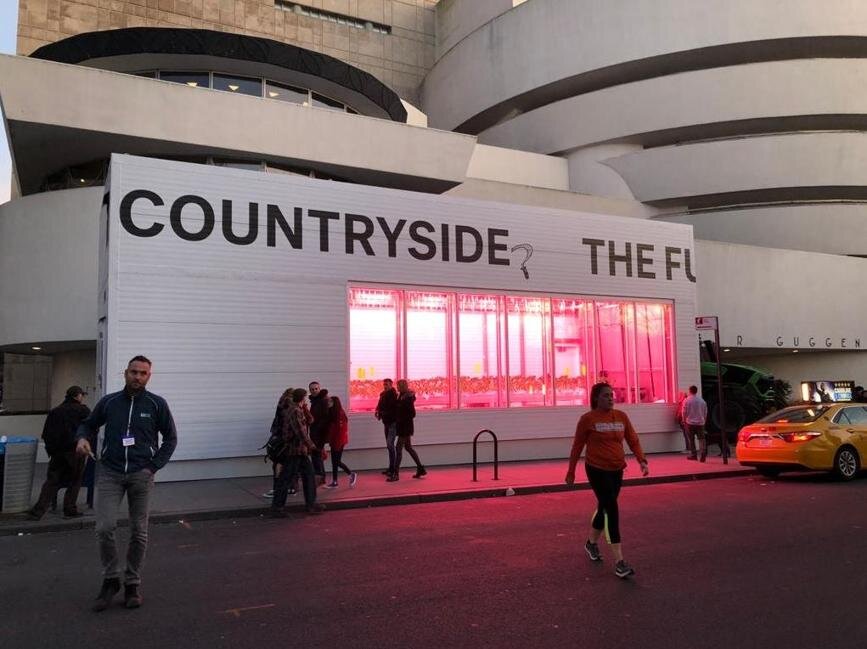
Hamilton-based 80 Acres Farms will grow tomatoes on one of the busiest streets in New York outside the Solomon R. Guggenheim Museum. The grow is part of “Countryside, The Future,” the Guggenheim’s new exhibition in collaboration with Rem Koolhaas, which opens to the public Feb. 20, and runs through Aug. 14
February 21, 2020
By Eric Schwartzberg, Staff Writer
HAMILTON —
80 Acres Farms will grow tomatoes on one of the busiest streets in New York outside the Solomon R. Guggenheim Museum.
The grow is part of “Countryside, The Future,” the Guggenheim’s new exhibition in collaboration with Rem Koolhaas, which opens to the public today and runs through Aug. 14.
Along with its commercial partner’s Infinite Acres and Priva Holding BV, 80 Acres Farms will grow cherry tomatoes in an indoor grow area right outside the museum on Fifth Avenue.
80 Acres Farms is a leader in indoor growing for retailers such as Kroger, Jungle Jim’s International Market, Whole Foods, Dorothy Lane Markets, and Giant Eagle.
MORE: ‘The perfect home’: Why 80 Acres chose Hamilton to move its headquarters and create 125 jobs
People in New York will be able to look through a large window in the indoor farm to view a crop of fresh tomatoes being grown continuously during the next six months. The first tomatoes grown will be ready for harvesting and consumption by late March.
The “Countryside, The Future” exhibition will examine political forces, social issues, and environmental factors altering landscapes across the world, including traditional farmlands.
“We believe that what we are doing is about the future of food,” said Mike Zelkind, chief executive officer of 80 Acres Farms. “We are changing the way fruits and vegetables are grown and harvested locally then delivered to grocers the very next day. There is an enormous market and consumer appetite around the world for produce that our crop scientists and other food experts have been perfecting during the past five years.”
MORE: Dilapidated Hamilton building transforms into an industry-changing grow facility
Zelkind said 80 Acres’ participation in the “Countryside, The Future” exhibition will allow New York residents and visitors to experience how “the freshest, tastiest locally-grown tomatoes” can be grown year-round indoors in one of the busiest cities in the world.
For the Guggenheim exhibition, 80 Acres Farms, Infinite Acres, and its Priva partners have collaborated on the 700-square-foot grow center, which is expected to grow 50,000 tomatoes in six months. Additional tomatoes will be donated to City Harvest, a New York City food rescue organization that recovers excess food and distributes it to people in need.
MORE: Hamilton’s large indoor growing operation is so advanced they want it around the world
Last year saw a massive year of growth for 80 Acres. It opened its automated facility on Enterprise Drive, a facility that grows leafy vegetables, herbs and strawberries, then a downtown Hamilton location on South 2nd St. that grows vine crops, including tomatoes, cucumbers, and peppers.
The company also launched Infinite Acres, an independent joint venture aimed at providing large-scale indoor farming facilities worldwide. The venture also includes UK-based Ocado Group, one of the world’s largest dedicated online grocery retailers, and Netherlands-based Priva Holding BV, a leading provider of technology solutions, services, and automation systems to horticultural and other industries.
That partnership is now building large-scale, fully automated indoor farms in the United States, Asia and Europe.
It also inked a deal to moved its headquarters from Cincinnati to Hamilton and was granted a tax credit for committing to create 125 new jobs and investing at least $26.9 million.
MORE: Innovative Hamilton indoor growing company part of a worldwide deal to supply food

Interview With Thomas Hausmaninger
Indoor farming allows for precise control of growing conditions such as light, water, temperature and nutrition
The award-winning junior researcher on his love for experimental projects, communicating bold ideas to the public and how universities can foster creativity
February 6, 2020
Thomas Hausmaninger is a researcher in optical spectroscopy, the study of how matter interacts with electromagnetic radiation, at the Centre for Metrology at VTT Technical Research Centre of Finland. In November, he was awarded €100,000 (£85,000) for winning a global research pitching competition for postdoctoral researchers. The contest was organized by Slush and Skolar, a Finnish community of academics, research funders, and science communications professionals.
Where and when were you born? Salzburg, Austria in 1987.
How has this shaped who you are? My parents often took us out for mountain hikes. I loved to look down from a mountaintop and see the city from this perspective. I was fascinated by seeing how all the places were connected by streets and how tiny everything seemed from up there. Maybe, therefore, I also want to see the bigger picture and understand how things connect after diving into the details of a research question.
What kind of undergraduate were you?
I was fascinated by the world of theoretical physics and enjoyed seeing how one could suddenly understand complex natural phenomena after getting used to a certain formalism or concept. However, I didn’t have the patience to go deep into theoretical physics unless I really needed it. On the other hand, when it came to experimental physics and experimental projects, I could never let it be “good enough” and always wanted to improve things and try yet another idea to further optimize an experimental setup, a code, or a measurement procedure.
Your winning research idea is to create a breathalyzer to understand plants better. Why is this important?
Plants are an essential and versatile source of food for humans. The climate crisis is reducing resources like water and, at the same time, the world population is growing. This implies that the food crisis is becoming more and more severe. One solution is to grow plants indoors in vertical farms that can save orders of magnitude in water and valuable land. Indoor farming allows for precise control of growing conditions such as light, water, temperature, and nutrition. However, the condition of the plants is still controlled manually. With the plant breathalyzer, one can automatically monitor the plants and grow more food with fewer resources. For example, it will be possible to avoid crop failure by early pest detection and save resources by optimizing the nutrition supply.
What do you think will be the biggest challenge in bringing this project to fruition?
Understanding how the gases emitted by the plants are connected to their metabolism and their needs is certainly a challenge; learning a new language takes time. Furthermore, in the vertical farms, the signals are diluted by convection. Therefore, sensitive detectors are required to measure them. We are facing the challenge of identifying suitable biomarkers in the gas around the plants and developing the sensitive measurement techniques needed to measure them in real-time in indoor farms. The combination of these two challenges also makes this project fun, since they require a lot of interdisciplinary work between engineering and biology.
What other interesting projects are you working on?
Currently, I’m part of the environmental metrology team at VTT where we develop laser spectrometry-based trace-gas sensors for various applications. This includes real-time monitoring of beer brewing that reveals how complex this biological process is and how strongly it gets affected by slight changes of the starting parameters. Furthermore, we are also developing monitoring instruments to make nuclear power plant decommissioning safer. Such applications require sensitive field-deployable detectors. I’m currently applying for funding for the development of a field-deployable trace-gas detector with unprecedented sensitivity that can detect gases present at concentrations below parts-per-quadrillion levels.
What is the biggest misconception about your field of study?
That it is impossible for outsiders to understand what we are working on and that we are doing research on things that are not useful for any practical purposes. I think one reason for this is that it is often difficult to predict the outcome of fundamental research. It is challenging for scientists to communicate science because it is their job to be critical and avoid drawing conclusions that are not sound. However, I think scientists should be less afraid of having bold ideas about future applications of their research and telling people about these visions.
What have you found to be the hardest part about being an early career researcher?
Workplaces that offer freedom in research and at the same time good working conditions are difficult to find. In addition, many world-leading institutes have a reputation for strong internal competition instead of strong teamwork. That is why I left the track of pure fundamental research towards more applied research. In this area, I found more options for doing excellent research combined with good working conditions. It is tough to make these decisions since they can strongly affect both your future career as well as your private life.
How can universities create an environment that enables creativity?
Freedom, trust, and safety enable researchers to unfold their full potential. The necessary challenges should come from scientific discussions with colleagues and not from career pressure. Universities should trust that the vast majority of researchers are eager to have the best ideas and to do the best research. Universities should also support researchers at all stages to make the right decisions and find their way to success. To be creative, scientists should get the time to do what they do best – that is to focus on their research.
If you weren’t an academic, what do you think you would be doing?
I would build my own home laboratory to do fun experiments and to be astonished by nature.
ellie.bothwell@timeshighereducation.com
Lead Photo: Kirstin Vonderstein

Safe, Not Sorry
There are certainly many reasons why agriculture is making a big move indoors. It can be argued that CEA offers more local and sustainable food production and that it requires less water than field growing and doesn’t impact topsoil or lead to erosion
By Leslie F. Halleck
Food poisoning is not something you wish on anyone.
It’s horrible, miserable and downright deadly.
If you’ve ever had an E. coli or Salmonella infection, then you probably take food safety seriously. I know I do. Outbreaks of E. coli have plagued the field-grown leafy greens industry for the past three years in a row, with the most recent outbreaks sending romaine lettuce to the garbage bins across the country. With each recall, consumers are forced to focus more closely on where and how their food is grown.
With animal feces and surface water contamination for field-grown produce at the center of most of the leafy greens recalls, some food companies and restaurants are making shifts to buy from hydroponic and CEA producers. While this is a great opportunity for those of you growing under glass or in controlled environments, don’t make the mistake of thinking that you won’t come under the same safety and transparency scrutiny, or liability.
There are certainly many reasons why agriculture is making a big move indoors. It can be argued that CEA offers more local and sustainable food production and that it requires less water than field growing and doesn’t impact topsoil or lead to erosion. Controlled growing may also create conditions where fewer, or no, pesticides or herbicides are used. And when you’re growing local, with potentially less pest pressure, you can grow edible varieties that offer up better flavor and nutritional value, versus having to grow varieties or use harvesting methods that cater to shipability.
While there may be a perception that the boundaries created by greenhouses or controlled environments mean safer produce, we all know that there are still plenty of ways contamination can happen. Growing in a controlled environment means you lose the benefits of nature’s sanitizers: air and sunlight. Close monitoring of all environmental conditions is a must in hydroponics and controlled environments. Anywhere there is water involved, pathogens can spread. And of course, any time you have people involved in your production process, there’s ample opportunity for all sorts of contamination.
With venture capitalists jumping into the CEA game, and new operations launching left and right, we can also argue that this is a very young industry with a lot of learning and growing to do. Mistakes are bound to happen. Many CEA growers may not even have a good understanding of what translates to safe, or not safe, growing or processing procedures. Technology is changing rapidly, influencing a variety of production techniques utilized differently by different growers. You do have much better opportunities for authentic transparency and traceability as a CEA, but collective standard protocols aren’t yet where we need them to be.
This is a very young industry with a lot of learning and growing to do.
Enter, the CEA Food Safety Coalition (FSC). This new independent and member-governed organization debuted in 2018 and just recently announced the appointment of its first executive director. The goal of the organization is to bring together CEA growers of leafy greens to self-submit to external audits of their production processes. Then, thorough evaluation to develop appropriate food safety standards and consumer education.
If you grow leafy greens using any sort of controlled environment, be it hydroponics, aeroponics or aquaponics, and you’re willing to submit to a third-party food safety audit, then you are welcome to join the CEA FSC.
If you grow produce, do you have a Farm Food Safety Plan (FFSP) in place? If not, it’s time to get your house in order. You need to make sure you’re keeping a detailed record of your operation’s procedures and adherence to growing and processing safe greens or other produce. I suspect the CEA FSC will be working with members to develop FFSPs that help them fine-tune their safety measures and comply with federal regulations.
Good news if you’ll be attending the United Fresh 2020 Convention & Expo, because they’ve just partnered with the CEA FSC to create a new Controlled Environmental Pavilion at the show. The Pavilion will showcase thought leaders and foster discussions between experienced and new growers, as well as highlight new technologies and food safety issues. If you’re a CEA or service provider, you can now book booths both inside and adjacent to the Pavilion.
No one likes getting food poisoning, and we already throw away far too much food in this country. Growing as a CEA offers up the ability to not only limit waste of resources but also produce safer and contamination-free food. Consumers are willing to pay you a bit more for your produce when you can be totally transparent about your methods and food safety concerns. But it’s going to take a lot more research, learning, communication, and community standards before CEAs can truly take the lead on produce safety.
Lead photo: PHOTO: © freshidea | Adobe stock
Leslie (CPH) owns Halleck Horticultural, LLC, through which she provides horticultural consulting, business and marketing strategy, product development and branding, and content creation for green industry companies. lesliehalleck.com

French Public Buildings To Be Built With 50 Percent Wood
The measure will be implemented by 2022 and affect all public buildings financed by the French state, according to Agence France-Presse (AFP).
The French government has announced plans for a sustainability law that will ensure all new public buildings are built from at least 50 percent timber or other natural materials.
The measure will be implemented by 2022 and affect all public buildings financed by the French state, according to Agence France-Presse (AFP).
"I impose on all the public establishments which depend on me and which make the development or the policy of land to build buildings with materials which are at least 50 percent of wood or bio-based materials," the country's minister for cities and housing Julien Denormandie told the French news agency.
Bio-based materials are made from matter derived from living organisms, with examples including hemp and straw.
Like wood, they have a significantly lower embodied carbon footprint compared to other construction materials like concrete and steel.
"We made this commitment for the Olympic Games"
The proposal aligns with France's Sustainable City plan launched in 2009, and also president Emmanuel Macron's drive for the country to be carbon-neutral by 2050.
The comment by Denormandie to AFP was made following his seminar at the Living in the city of tomorrow event at UNESCO on February 5.
During the event, he explained that his decision to introduce the law encouraging the use of bio-based materials was informed by the construction of the 2024 Paris Olympics complex. Any building in the development that rises more than eight stories will be built entirely from timber.
"We made this commitment for the Olympic Games," Denormandie said, reported Le Figaro. "There is no reason why what is possible for the Olympic Games should not be possible for the usual constructions."
100 urban farms to be built in city suburbs
According to Denormandie, the French government will also invest €20 million (£16.8 million) for the imminent construction of 100 urban farms in city suburbs.
The farms are set to be built in priority neighborhoods – designated areas within cities that need additional investment to combat specific problems. The hope is to create greener suburbs across France and introduce more opportunities for locally grown produce.
"As a father, I prefer that what is on my children's plates come from the local area, rather than being imported on a plane," Denormandie said.
Architects Populous and engineers Egis first revealed the masterplan for the 2024 Paris Olympic Games in 2017. In recognition of the city's commitment to tackling climate change, the proposal is hoped to be the most sustainable Olympics yet.
It will make use of a number of existing buildings in the city, and see temporary venues installed in front of some of the capital's most famous attractions.
News follows other sustainable construction initiatives
Denormandie's plans to make France's construction industry more sustainable follows a number of other eco-friendly initiatives in recent months, in response to the growing effects of climate change.
Last year, Paris revealed its plans to go green by planting "urban forest" around architectural landmarks, and in the UK RIBA published the Sustainable Outcomes Guide to help its members and the wider architecture industry avert the climate disaster.

Related story
Paris plans to go green by planting "urban forest" around architectural landmarks
Elsewhere, Foster + Partners' introduced a sustainability manifesto that will go beyond current environmental certification schemes, and Snøhetta pledged it will make all of its buildings carbon negative within 20 years.
The main photo is by David Foessel. Odile Guzy Architectes' social housing scheme in Chalon-sur-Saône, France

The Inside Scoop On Indoor Farming
Food retailers from coast to coast are increasingly turning to indoor, vertical and greenhouse farming to meet the demand for locally grown produce, reduce food miles and offer the freshest product possible
Grocers look to indoor farming to
source a steady stream of local greens
Feb. 03, 2020
Food retailers from coast to coast are increasingly turning to indoor, vertical and greenhouse farming to meet the demand for locally grown produce, reduce food miles and offer the freshest product possible. Some, such as Tops Friendly Markets in Williamsville, N.Y., are partnering with greenhouse operators off-site, while others, such as Whole Foods Market and The Kroger Co., work with greenhouse and indoor farming experts to grow on-site and in-store.“As our climate continues to change in primary growing regions, Mother Nature continues to add challenges that are very hard for growers to overcome.
Customers are demanding we have product regardless of that,” says Jeff Cady, director of produce and floral for Tops. “Greenhouses give us an opportunity to meet our customers’ needs day in and day out.”
Tops has partnered with greenhouse builder and operator BrightFarms of Irvington, N.Y., to offer shoppers lettuce, arugula, and spinach grown closer to home—specifically in a Wilmington, Ohio, greenhouse about 400 miles from Tops’ distribution center. “The idea was to try and take miles out of the supply chain and ultimately get as fresh a product as we can for our customers,” Cady says.
Photograph courtesy of BrightFarms
Cady, who estimates Tops sells 25% to 35% more greenhouse-grown produce than it did five years ago, sees continued potential for growth.“We will expand as products come online. Greenhouse-grown strawberries were not available five years ago. We have been bringing them in and have had very good results,” he says. “Perception is reality. Add in the perceived food safety and environmentally friendly components, and greenhouses will continue to thrive.
”In-Store Farming
The Kroger Co. recently partnered with Infarm, an indoor farming company based in Berlin, to bring high-tech modular farms inside its U.S. stores. The program, which began with 15 QFC stores in Bellevue and Kirkland, Wash., grows leafy greens inside glass tanks located in the produce department.
“Kroger believes that everyone deserves to have access to fresh, affordable and delicious food, no matter who you are, how you shop or what you like to eat,” Suzy Monford, Kroger’s group VP of fresh, said in November when announcing the Infarm partnership, which she said enables the Cincinnati-based chain “to innovate by combining groundbreaking in-store farming technology with our passion for fresh, local produce and ecological sourcing.
”The alliance with Kroger marks the first U.S. rollout for Infarm, which was founded in 2013 and has more than 500 farms in food stores and distribution centers in Germany, Switzerland, France, Luxembourg, and the U.K. Infarm remotely controls growing conditions at its units through a cloud-based farming platform that adjusts to the specific needs of each plant. The company says it can re-create growing conditions from around the world, bringing plants that were previously too delicate, rare or expensive to stores.“
The grocery retailer landscape is facing increased competition and demand for fresh herbs and leafy greens,” says Jeffrey Landau, director of business development for Agritecture Consulting in New York. “Vertical-farming companies such as Square Roots, Infarm and Dream Harvest Farming Co. are providing grocery stores with a fresher product that has a longer shelf life due in part to being grown within a few miles, if not feet from the store.”
Agritecture consults across the board, from controlled-environment agriculture (CEA) operations (both greenhouse and indoor vertical) to soil-based farms. Clients such as New York-based Square Roots, which grows all of its produce in modified shipping containers using 100% artificial light, sells throughout New York City to Whole Foods, the Greene Grape, C-Town and more.
Vertical vs. Greenhouse
The vertical-farming market is anticipated to reach $9.96 billion by 2025, according to a recent report by San Francisco-based Grand View Research, which points to increased use of internet of things sensors for producing crops, as well as the growth in agriculture automation and the use of big data to maximize yields as market drivers.
In the vertical-farming industry, there have been several high-profile capital funding deals within the past few years, says Landau. AeroFarms of Newark, N.J., raised $100 million in Series E funding and announced it will invest $42 million to build its largest facility to date, in Danville, Va. Investors have also backed Infarm, which raised $100 million in Series B funding in June 2019, and San Francisco’s Plenty, which raised an industry record of $200 million in Series B funding in 2017.“
All in all, the vertical-farming industry is on pace for substantial growth,” Landau says. “As it compares to the greenhouse industry, vertical farming is still a relatively new industry and profitability is not guaranteed. Most large-scale vertical farms take at least six years to return on their investment. However, greenhouse operations, if done correctly, can be profitable within the first two to three years of operation.”
As a result, the greenhouse industry has also experienced considerable growth in recent years. Both New York-based Gotham Greens and BrightFarms received substantial equity funding ($29 million and $55 million, respectively) in June 2018, while Little Leaf Farms of Devens, Mass., received $18 million in financing from Bank of America in December 2019, to be followed by an additional $20 million.“It’s difficult to say which one is growing faster, but it is clear from the numbers that both industries are experiencing strong growth,” Landau says.
Little Leaf Farms produces more than 1 million boxes of fresh greenhouse-grown baby green lettuce a month. Its greens are delivered to every major supermarket chain in New England in 24 hours, year-round
.When the company expands from five acres to 10 acres with the opening of a new Devens greenhouse in May 2020, its production of sustainably grown lettuce will double to 2 million boxes delivered to New York and New Jersey’s major supermarket chains, said Little Leaf.
Two-Mile-Farm to Fork
Denver-based Altius Farms is redefining the meaning of local for area restaurants and retailers. The vertical farm, which can be seen through tall glass windows above a popular downtown Denver restaurant, sells to 40 area restaurants and five local grocers, including Leevers Locavore, Choice Market and Marczyk Fine Foods.
All of Altius Farms’ highly perishable salad greens, herbs, and edible flowers are sold within a 10-mile radius, with the majority sold within a 2-mile radius. “We want to reduce our food miles and change the way we grow food. [Vertical farming] also reduces waste and depreciation of flavor content,” says Sally Herbert, Altius Farms co-founder, and CEO.
Increased production that uses fewer resources within a smaller footprint is another benefit of vertical farming. “We can grow 10 times the amount of produce than conventional farming,” says Herbert, former president and CEO of GS1, the largest supply-chain standards organization in the world.
Photograph courtesy of Altius Farms
Altius Farms cultivates 12 to 14 harvests on a series of 8-foot towers each year, producing 37,000 pounds of greens annually. “It’s a lot of bang for your buck,” she says. But the labor costs associated with vertical farming can be steep. “Labor is responsible for 40% to 50% of the cost of sale, and in some cases even higher.”
The higher price point for some indoor-grown greens means that consumer education is critical to category success.“
The consumer has to make a choice. We’ve got to get them to see the value of local. Small-format grocers are wonderful to work with and are really our partners in this,” says Herbert, whose Altius Farms leads in-store samplings to educate and inform consumers. “Whenever we do a Saturday demo at the grocery, we see an uptick in sales.
”Promoting local is also key. Choice Market uses little flags in its cold cases to alert shoppers that Altius Farms’ greens are a local product grown up the road.“Social media is also pretty important these days,” says Herbert, who points to grocery partners who have touted recipes featuring Altius local greens on their websites and digital communications. “It brings the product to the customer in a more personal way.”
For Herbert, who has worked for many years as a supply-chain executive, Altius Farms offers a solution in providing responsibly grown fresher food. “This is one way to grow. Mass-produced in a warehouse is also a way to grow, as is farming outdoors,” she says. “It’s not about a right way or a wrong way—it’s about giving movement to growing closer to consumption so we can start to see the impact on the climate and quality of product.”
Local Year-Round
U.S. consumers will place increased pressure on manufacturers to produce locally in 2020 and beyond, according to new research from New York-based Nielsen, which finds that local ingredients and food sourced and produced close to home are important to nearly half (48%) of consumers.
As locally grown, fresher produce continues to top the list of consumer demands, Steve Platt, CEO of BrightFarms, sees continued growth in greenhouse cultivation. Since 2016, BrightFarms has partnered with Ahold Delhaize USA’s Giant Food Stores and its supermarkets under the Giant and Martin’s banners, as well as Kroger’s Roundy’s.
“They chose to work with us early on because they saw the enormous potential of a year-round local program in the salad category,” says Platt. “These partnerships continue to play a major role in the growth of our company and are our primary focus. As early believers in fresh and local food, our retail partners have seen category growth beyond their competitors.” At press time in January, BrightFarms was on track to open a new Selinsgrove, Pa., greenhouse, which will service customers in the New York and New Jersey metro areas. The greenhouse grower’s operations have expanded by about 420,000 square feet to 740,000 square feet in the past several years.
“This growth is a direct result of the growing demand from new and existing retail partners,” says Platt, citing SPINS data that “shows that when retailers introduce our products, their salad category grows.
”Concerns around food safety are also driving demand for produce grown indoors, Platt says. “Leafy greens grown in controlled, indoor environments, like a greenhouse, deliver a structurally safer supply chain for retailers and consumers,” he says. “By growing indoors, we eliminate many of the risk factors associated with field-grown produce like agricultural water and proximity to animals.”
BrightFarms grows, packs and distributes its greens from one farm labeled clearly on the package. This “avoids co-mingled processing facilities that make it extremely difficult to trace pathogens back to a single contamination source,” says Platt.
Lead Photo: Photograph: Shutterstock

US: The Secret To Singapore Airlines' Delicious Meals Is An Indoor, Vertical Farm In New Jersey
Inside a nondescript warehouse, sprouts are thriving under banks of LED lamps: kale, bok choy, arugula, tiny little plants only a horticulturalist could identify
BY PAUL BRADY
FEBRUARY 14, 2020
Photo: COURTESY OF SINGAPORE AIRLINES
On an industrial block in Newark, New Jersey, behind the cement and brick Ironbound Recreation Center, there’s some magic happening. Inside a nondescript warehouse, sprouts are thriving under banks of LED lamps: kale, bok choy, arugula, tiny little plants only a horticulturalist could identify. Rows and rows and towers and towers of plants — like a scene from a super-sanitized version of "The Matrix" — are quickly becoming salad greens at AeroFarms. This 70,000-square-foot vertical farm, which the company says is the largest of its kind in the world, is hidden in plain sight — as planes roar overhead, on final approach for Newark Liberty International Airport.
Photo: COURTESY OF AEROFARMS
During a recent visit to the farm, Travel + Leisure got an up-close look at how aeroponic farming works: A variety of greens are grown from seed to harvest, planted not in soil but rather in reusable cloth that’s woven from recycled plastic water bottles. Lettuces and other leafy greens are constantly monitored, and environmental sensors throughout the facility make frequent adjustments. AeroFarms co-founder and chief marketing officer Marc Oshima says they’re even able to alter the taste of their crops — say, making arugula that much more peppery — by manipulating water levels, lighting, and other factors. (They don’t, he’s quick to point out, use any pesticides or herbicides.)
Despite the energy-intensive technology powering the operation, AeroFarms says its food is significantly better for the environment compared to traditional farming. A single square foot of vertical farm — like the one in Newark — can yield 390 times the produce as one outdoors, Oshima says. Water use is limited, as the plants are grown aeroponically and only misted when necessary. All this helps reduce the carbon footprint of the food, both by greatly reducing the resources it takes to grow the greens in the first place and by putting the harvested crop closer to market.
The Top 10 International Airports
That’s where Singapore Airlines comes in. The carrier, which operates the longest flight in the world between Newark and Singapore, has been working for years to reduce its carbon footprint, an airline rep says. One way to do that? Reduce the impact of on-board meals by sourcing greens from right down the road. AeroFarms, which is just a few miles from Singapore Airlines’ catering facility at Newark, is now supplying hyper-local produce for the nearly 19-hour Singapore Airlines Flight 21.
“Passengers understand that we’re trying to limit carbon footprint,” says Singapore Airlines food and beverage director Antony McNeil. Beyond that, high-tech vertical farming gives a level of control not found anywhere else, he says. “The beautiful thing is that we can work together to design, say, do we want more pepper in the arugula?” he says. “It’s like Star Trek!” Singapore Airlines will start serving AeroFarms produce on their flights from JFK International Airport, starting next month, and they may soon have sustainably sourced cuisine on all flights from the six U.S. cities the airline serves.
“The goal is, in the coming months, to have ‘farm-to-plane’ at every one of our U.S. gateways,” said James Bradbury-Boyd, a spokesman for Singapore Airlines. That could mean sustainably fished seafood for Seattle flights or thoughtfully made cheeses from Oregon aboard West Coast routes, McNeil said, in addition to vertically farmed greens.
For now, passengers will find AeroFarms produce in both business class and premium economy on flights from Newark, in these selections: Soy Poached Chicken, a riff on the classic Singaporean dish chicken rice; The Garden Green, a hot-smoked salmon salad; and Heirloom Tomato Ceviche, a sort-of caprese salad with burrata and arugula.
It’s possible that the partnership could grow in the future: AeroFarms has started an expansion of its Newark headquarters, which will give them even more space for indoor farming. And if they scale up, who knows? We may all soon be eating Star Trek–style salad in the air, no matter our destination.
Podcast - Future of Agriculture - Jim Pantaleo
This show explores the people, companies, and ideas shaping the future of agribusiness
Welcome to the Future of Agriculture Podcast with Tim Hammerich.
This show explores the people, companies, and ideas shaping the future of agribusiness. If you are curious about innovations in AgTech, rural entrepreneurship, agricultural sustainability, and food security, this is the show for you!
For more details on the guests featured on this show, visit the blog at www.FutureOfAg.com. Or, to learn more about career opportunities in agriculture, visit www.AgGrad.com

Growing In Space Touches Down In May
'Growing In Space' Panel Joins May 18-20, 2020
Las Vegas Educational Line-Up
'GROWING IN SPACE' PANEL TOUCHES DOWN AT MAY 2020 EDITION OF INDOOR AG-CON LAS VEGAS
Dr. Joel Cuello will moderate "Growing In Space With Help From Industry, Academia and Government," on Wednesday, May 20 during Indoor Ag-Con Las Vegas.
Ahead of his panel, Cuello has shared a blog post observing that while the world’s space programs were instrumental in spinning off vertical farming, today’s vertical farming industry will likely enable NASA - and other space programs - to realize their future food production systems on the Moon, Mars and beyond.
As Cuello writes, "Just as Elon Musk’s Space X, Jeff Bezos’ Blue Origin and Richard Branson’s Virgin Galactic have partnered with NASA to innovate on and advance space transportation, it is highly likely that partnerships with NASA for the design and operation of its future Lunar and Martian space farms will be brokered with the likes of AeroFarms, Plenty, Bowery Farming, CropOne Holdings, Gotham Greens, 80 Acres Farms, BrightFarms, AEssense, Seven Steps to Heaven and/or other indoor farming companies, some of which have yet to be formed."
Read Full "Growing In Space" Post >
OH, HELLO NEW EXHIBITORS!
You come to conferences to see what's new. And Indoor Ag-Con will deliver! Our show floor is filling up with new companies every week. Whether you're looking for horticultural lighting, irrigation systems, greenhouse manufacturers, or IT solutions and more, you'll find the latest innovations here in May!
Show Floor Sneak Preview ›
SWEET DEAL|SAVE UP TO $300 PER DELEGATE WITH EARLY BIRD RATE!
Conference pass includes access to all educational sessions, the expo floor, cocktail receptions and hospitality features, the Indoor Ag-Con library, new White Paper, and the welcome gift bag.
GET YOUR EARLY BIRD PASS & SAVE ›
INSIDE INDOOR AG | INDUSTRY NEWS HARVEST
DESIGNBOOM: A Tree Assembles In Brooklyn With Framlab's Vertical Farming Solution, 'Glasir'
CNET: Robots Are Changing The Future of Farming
CRAIN'S DETROIT BUSINESS : Former Founders Chairman Pursues Future of Farming With Hydroponic Lettuce Company