


Welcome to iGrow News, Your Source for the World of Indoor Vertical Farming

Superior Fresh Expanding Their Aquaponics Operation
Superior Fresh utilizes aquaponics to raise seafood and leafy greens for retailers across the Midwest.They are now expanding their greenhouse footprint from six acres to 13 acres and their aquaculture center from 40,000 square feet to 100,000 square feet
Mike Beiermeister
Hixton, Wis. (WXOW) — Superior Fresh utilizes aquaponics to raise seafood and leafy greens for retailers across the Midwest.
To View The Video, Please Click Here
They are now expanding their greenhouse footprint from six acres to 13 acres and their aquaculture center from 40,000 square feet to 100,000 square feet.
“Most people wouldn’t think that you could grow organic vegetables in the middle of Wisconsin in the middle of the winter,” said Brandon Gottsacker, president of Superior Green.
The company was founded back in 2011. Since the creation, Superior Fresh has become the first indoor Atlantic Salmon farm in the United States. They are also able to grow leafy greens year-round thanks to their aquaponics system and sustainable practices.
“You know you’re doing something for not just us, for the rest of the world and leading the harvest of the first Atlantic Salmon in the United States, right here,” said Kyle Woolever, aquaculture manager for Superior Fresh.
Aquaponics integrates fish and plant growth to create a symbiotic environment. Superior Fresh utilizes these practices to produce around 4,000 pounds of leafy greens per day and around 4,000 pounds of Atlantic Salmon each week. By this time next year, they plan to produce 25,000 pounds of Atlantic Salmon each week. Right now, they have 200,000 Atlantic Salmon swimming in their tank.
“We’re probably the most sustainable farm on the planet when you talk about how many pounds of fish and produce were producing on the volume of water,” said Gottsacker.
The company uses the bulk of summer sun to shed light on their produce with the help of diffused glass. They use LED lighting for winter months. Their produce is pesticide-free, non-GMO, and constantly controlled for perfect growing.
“Our goal is to locate these farms all over the world, so in theory, you could build a facility like this in the desert, you could build it right outside of a city where food is scarce, or it has travel really far to get there,” said Gottsacker. “Our goal is to provide really good, high quality, safe, healthy food for everyone.”
Mike Beiermeister
WXOW Weekend Anchor and Reporter
This UVA-Born Startup Is Revolutionizing The Home Farming Industry
Imagine a world where you can grow your own produce right in your kitchen. That world might be closer than we think
December 23, 2019
Share Facebook Twitter Linkedin
Imagine a world where you can grow your own produce right in your kitchen. That world might be closer than we think.
Alexander Olesen, CEO of Babylon Micro-Farms, and his business partner Graham Smith, CTO, started exploring hydroponics in 2016 while in school at the University of Virginia in terms of its hypothetical applications to grow crops in refugee camps.
“We realized that this was an incredibly efficient way of growing crops,” Olesen said.
Upon researching into how large commercial greenhouses use this technology, Olesen and Smith began looking into how it could be used on a smaller scale. While the technology never made it into refugee camps, they started looking into practical applications in their community and researching the minimum square foot of farming space needed to feed one person, feed a family or sustain a business.
Image courtesy of Babylon Micro-Farms.
When they realized those measurements could fit into a home or business, the idea of the small vertical farming modules utilizing unique hydroponics technology that Babylon Micro-Farms creates today was born.
Named for the famed ancient Hanging Gardens, Babylon Micro-Farms produces self-contained vertical farming units that can easily fit into a home or business. The company sends weekly “meal-prep style” subscription packages of produce kits and remotely manages the units, including the airflow, irrigation, sunlight-mimicking grow lights, fertilizer mixes and pH for the acidity of the water. Customers lease the farming space on a 24-month contract, which includes an all-inclusive monthly fee.
“We’ve essentially automated the need for a green thumb,” Olesen said.
The company just this year finalized a $2.4 million seed round of fundraising from investors including CIT GAP Funds and Plug and Play Ventures, following a $600,000 pre-seed round in 2018. Additionally, Babylon received a $25,000 grant to continue their research this year from the National Science Foundation.
Grown out of UVA, the company is still based in Charlottesville but hopes to begin expanding its operations into Richmond soon. The company is focusing on building their core market in Virginia and expects to see the growth of customers in commercial food service and corporate dining.
While Olesen and Smith have ambitions to bring their farming units into the household, the business currently targets clients in industries such as institutional food service and restaurants, higher education and corporate dining. Babylon’s products are already in use at companies including Dominion Energy, Commonwealth Senior Living, and Hampton Roads Academy, to name a few.
Currently, the company has 14 employees with a heavy emphasis on software and mechanical engineering, developing their patented software platform, app, hardware product, and weekly subscriptions.
Olesen believes this is just the beginning of a booming industry, similar to the way in which solar panels have become popular for use even on residential homes.
“We’re in the infancy of an industry for fresh produce or herbs,” Olesen said. “Vertical farming is going to disrupt that industry and become the status quo given how inefficient things are today. We see what we’re doing as a sustainable infrastructure play that is going to become a necessity.”
Image courtesy of Babylon Micro-Farms
Christmas Lists To Santa Claus Ask For Mini Munchies
“This holiday season, something magical happened, even more magical than usual. At the North Pole, we were getting letters from kids but something was different. Instead of the remote-control cars, video games, or super doll, it was all about the Mini Munchies™”, said Bernard, Head Elf, The North Pole
Leamington, ON (December 20th, 2019) – Kids of all ages are making their Christmas lists for the holidays but one item that Santa Claus keeps seeing on these lists only comes from Pure Flavor®.
“This holiday season, something magical happened, even more, magical than usual. At the North Pole, we were getting letters from kids but something was different. Instead of the remote-control cars, video games, or super doll, it was all about the Mini Munchies™”, said Bernard, Head Elf, The North Pole. With only a few more shopping days until Christmas, the elves are frantically putting the finishing touches on the items to be delivered. “Santa said he wants a couple of packs on the sleigh, he says they are the perfect on the go snack”, said Bernard.
The Mini Munchies Program is snack-sized veggie program that combines the best snacking products from Pure Flavor® in two convenient formats. Format 1: Juno Bites Red Grape Tomatoes, Aurora Bites Mini Sweet Peppers, and Poco Bites Cocktail Cucumbers, all packed in a convenient 4oz themed bag. Format 2: the new Mini Munchies Tomato Snack Pack that comes in a 12oz (4 chamber) breakaway pack that is being launched this winter.
“When the phone rang and my call display said “The North Pole”, I thought it was a prank to be honest but when I picked up and Bernard told me who he was and said he needed our help, we just couldn’t say no”, said Chris Veillon, Chief Marketing Officer. “The timelines were tight and very specific so we had to act fast. It’s not every day that you get that last-minute call from Santa’s Workshop so our team was up for the challenge”, said Veillon.
The team at Pure Flavor® were equally surprised to see Bernard & his team scurrying around the greenhouse & distribution center during their brief stop in Leamington.
The video: https://youtu.be/x7Lf5jWH8yQ
“This is a great opportunity to get fresh snacks into the hands of kids all over North America (and the world!), we appreciate the help from Bernard & his team to get this to Santa’s sleigh. We gave the elves both types of Mini Munchie packs to make sure they had the variety they needed”, said Veillon.
“He's making a list, he's checking it twice, he's gonna find out who's naughty or nice, Santa Claus is coming to town!”
The story of how Bernard and the rest of Santa’s elves came to Pure Flavor® in search of Mini Munchies is sure to be a new Christmas classic.
Read the full story: https://www.pure-flavor.com/the-week-before-christmas/
To learn more about the Pure Flavor®, please visit pure-flavor.com.
Happy Holidays!
-30-
About Pure Flavor® -
Pure Flavor® is a family of greenhouse vegetable growers who share a commitment to bringing A Life of Pure Flavor™ to communities everywhere. Our passion for sustainable greenhouse growing, strong support for our retail & foodservice customers, and focus on engaging consumers is built on a foundation drawn from generations of growing expertise.
We are the next generation of vegetable growers, inspired to put quality, flavor, and customers first by providing greenhouse-grown vegetables from our farms that are strategically located throughout North America.

Mpatisi Moyo Joins Autogrow
Working closely with the wider R&D team and alongside the Director of Agronomy & Crop Science, Dr. Tharindu Weeraratne; Mpatisi will focus on yield prediction models and computer vision enhanced products
Autogrow has recruited Mpatisi Moyo Ph.D. as Head of Artificial Intelligence (A.I.) to further their strategy towards creating the digital farmer.
PHOTO: Mpatisi Moyo
Working closely with the wider R&D team and alongside the Director of Agronomy & Crop Science, Dr Tharindu Weeraratne; Mpatisi will focus on yield prediction models and computer vision enhanced products.
“A.I. by itself is not enough to solve the larger issues across the industry. We see the value in the combination of biological science with modern cloud technologies creating value and insight for our customers. You can’t make improvements to crop growth without fully understanding the crop itself and all the variables that go into getting quality yield,” says Jonathan Morgan, Chief Technology Officer.
“Mpatisi’s background in statistical, biological and machine learning technologies will enable us to further extend our solutions and push into new and as yet undiscovered areas of Controlled Environment Agriculture.”
Mpatisi has worked across the health, government and corporate sector and is eager to find ways to assist growers with forecast revenue and harvest times.
“The experience Mpastisi brings will be particularly useful across our FarmRoad solution where the focus is on bringing together what can be incredibly broad and complex information in a format that is easy to understand and manage - especially for larger, global organizations,” explains CEO Darryn Keiller.
“His appointment as Head of A.I. represents our absolute commitment to leading the industry in the long-term development of cognitive services such as the virtual agronomist; leveraging vision, voice, language and critically knowledge - comprising genetics, environment, and management.”
About Autogrow
Autogrow leverages the power of technology, data science, and plant biology to provide indoor growers affordable, accessible and easy-to-use innovation – 24/7, anywhere in the world.
Our hardware, software and data solutions support growers and resellers in over 40 countries producing over 100 different crop types.
We are the experts in Controlled Environment Agriculture (CEA) and continue to stay ahead of a rapidly evolving landscape.

NEW YORK: Bronx School Garden Program Serves Up Good Hydroponically Grown Greens
The students are learning the bigger-picture benefits of urban farming. “Food justice is about the ability to get that healthy food and how it’s not really that easy to get it because there’s a lot of fast-food places around.”
Drive through the littered streets of the Bronx, New York City’s poorest borough. You’ll pass children playing in the water spray from a fire hydrant and empty storefronts covered in graffiti. Folks are perched on their stoops, hoping to catch a bit of breeze on a hot summer day. The last thing that comes to mind is farming. The second to last may be vegetables: block after block of bright neon signs announce the presence of yet another meat- and carbohydrate-heavy fast-food joint—a typical urban food desert.
The Bronx is home to DeWitt Clinton High School, incongruously housed in a majestic 1920s building complete with Tiffany chandeliers and a roster of famous alumni including James Baldwin, Neil Simon, Stan Lee, and Ralph Lauren. The school’s glory days are long past, however. Last year, DeWitt Clinton ranked fourth-highest among all New York City schools in the number of gun seizures, and it graduated significantly fewer students who went on to college than the average city high school.
But way up on the third floor, at the end of a long hallway, sits a classroom unlike any other at the school. Flooded with light and filled with shelf after shelf of leafy vegetables, it is the source of all the vegetables served in the nearly 3,000-student school’s cafeteria—and of both inspiration and aspiration for the student-farmers who care for it.
Green teens
Those vegetables—everything from bok choy to wasabi arugula —are growing hydroponically, as part of a program called Teens for Food Justice (TFFJ). The students grow enough lettuces, leafy greens, and herbs—an extraordinary 19,000 pounds a year—not just to supply the cafeteria but to sell at their community market at reasonable prices. This is no small feat in a neighborhood where approximately 46 percent of children live below the poverty line, 33 percent of the population is obese, and access to fresh vegetables is limited.
TFFJ is an independent nonprofit that organizes programs like the one at DeWitt Clinton in a growing number of food-insecure communities. Since 2013, when the organization built its first hydroponic farm in the low-income neighborhood of Bedford-Stuyvesant, Brooklyn, the focus has been on training youth in hydroponic urban agricultural farming in order to give their communities access to sustainable, healthy food. In the process, the students learn about entrepreneurship, health and nutrition, community advocacy, and the science and technology skills they’ll need in a new green-sector economy. There are currently two other established programs in Brooklyn, and three more sites in New York City are planned for in the next year. The organization is also developing three sites in Miami in partnership with the Gloria Estefan Foundation. TFFJ is just one of countless such programs all over the country that teach young people what it means to grow your own food.
About 100 students from DeWitt Clinton participate in TFFJ every year. While the majority are involved through school curriculum classes (environmental sustainability or advanced placement environmental science), a handful participate in an after-school program that has an additional focus on social entrepreneurship, food justice and advocacy and relieving the problems of food insecurity. All the students build and maintain a high-tech hydroponic farm, where they learn about the biology of plants, use chemistry, math, and data tracking to maintain plant health, and learn basic plant and human nutrition.
Best of all, the students are learning about urban farming in a tangible, real-life, hands-on context, in which they advocate for their communities and acquire the tools they need to create an oasis in their food desert and build a healthier future.
Student advocates
Joshua Delgado, who graduated from DeWitt Clinton in June, shows visitors around the farm, he speaks with pride about both the growing process and the vegetables. He walks around the racks of shelves, pointing as he explains how the plants are transplanted. His favorite job, he says with a broad smile on his face, is “to clean the systems—I’d make sure they were sparkling clean.”
The students are learning the bigger-picture benefits of urban farming. “Food justice is about the ability to get that healthy food and how it’s not really that easy to get it because there’s a lot of fast-food places around,” says Joshua. In fact, in this neighborhood, there are 114 square feet of supermarket per 100 people—as compared to 450 square feet per 100 people in one wealthier Staten Island neighborhood, for example.
Learning about the health impacts of eating more vegetables is an important part of TFFJ. At the program’s Fresh Food Box market, where the produce not used by the cafeteria is offered for sale, several students stand behind tables laden with baskets of greens, herbs, peppers, and other produce with a cashbox at the ready. Tenth-grader Miguel Graham is demonstrating how to cook a stir-fry of yellow and green peppers with sausage. As Miguel flips the food around in the sizzling pan, he talks about how the program has taught him how vegetables “can help you live longer.” Before he says, “I wasn’t really interested in vegetables, but since I’ve been in this program, I started loving vegetables more.”
TFFJ intern Jholie Meikle, who graduated from DeWitt Clinton this past June, is walking a potential customer through the various greens. Jholie says that the program has taught her that staying healthy doesn’t have to be expensive, and it has changed the way she shops. “Now when I go, I look at the nutrition facts.” Jholie also credits the program for exposing her three-year-old daughter to new fresh foods. “She comes with me a lot,” says Jholie. “One day she saw Swiss chard and she just started eating it. Now, every time she sees it, she has to have it.”
Learning experiences
As the students learn the science of hydroponic farming, they are also learning how to reduce their environmental impact. Hydroponics requires just a quart of water per head of lettuce, while traditional agriculture methods use more than 4 gallons. The students use no herbicides, pesticides, or fungicides. And by growing right where the produce is being consumed, they avoid the cost in both dollars and carbon emissions of transportation.
“The kids are really motivated by the environmental impact of the farm and are aware of current environmental issues,” says Clare Hyre, TFFJ’s senior program manager. An added benefit: “The food I grow tastes better than the food other people grow,” Miguel states emphatically.
But TFFJ was not conceived as simply a place to grow food. Students gain a hands-on, relatable STEM education as they learn how to build and maintain a high-tech hydroponic farm, which requires engineering, architectural drafting, and mathematics. They learn about the biology of plants and use chemistry and data tracking (math again!) to maintain plant health. They also learn basic plant and human nutrition, explore the nutrient content of what they grow, and apply their nutrition knowledge while tracking their own food consumption and exercise.
Social entrepreneurship is also an important part of the program. The students write a business plan to run their own farm stand. They learn to address the details required to run a successful business, including targeting an audience, distribution, and analyzing the competition.
As the teens become excited about the program and advocate for it to others, they are building self-confidence, and communication and public speaking skills. After their first round of apprenticeship in the program, they can come back and train, or mentor, other students, which helps develop their ability to lead. After they graduate from the program, they can earn a stipend as they help run the Fresh Food Box program, mentor students, and continue to develop their leadership abilities.
Growing their food—and their world in a resource-deprived neighborhood where canned and fast foods dominate, learning to farm helps these young people break away from the confines of their environment. Farming gives them access to healthier foods, amps up their STEM education, and makes them better leaders, stewards of their environment, and advocates for their community. And sometimes it makes them want to be farmers. Joshua dreams of having enough money to build his own hydroponic farm. He has researched it online, he says, and he thinks he could do it.
When he does, he will be part of the solution for sustainable farming that brings healthy food to communities in need—just like the organization that taught and inspired him.
For more information:
Corteva Agriscience
www.corteva.com
Publication date: Thu 19 Dec 2019

Detroit Organization Uses Shipping Containers As Farms Providing Food For Soup Kitchen, Restaurant
The farming being done inside the shipping container is the equivalent of almost two acres of land
By Amy Lange
December 2, 2019
DETROIT (FOX 2) - At the new Three Cats restaurant in Clawson, co-owner and Chef Matt Prentice is serving up the Cass Community arugula salad and the beet stack with Cass basil.
Prentice, a big fan of farm to table, says this is as close and as fresh as you can get.
Shipping container farm is as close to fresh as it gets
It comes from the Freight Farm at Cass Community Social Services in Detroit where seeds are watered in trays then transferred to hangers farming vertically inside a shipping container"It gets harvested two, three, four days a week.
The arugula that I get from California -- I mean it's fine, but it's two weeks old before I get it. Here it's sometimes two hours old," he said.
That's because it comes from the Freight Farm at Cass Community Social Services in Detroit, where seeds are watered in trays then transferred to hangers, farming vertically inside a shipping container."So you can see everything's dated - what it is and when it was started so they'll know," said Faith Fowler, Cass Community Social Services. "It comes down almost like drip irrigation so that you're wasting very little water at all."
This is a great solution to having fresh good food year-round.
"Donated by the Ford Fund about a year ago, the Freight Farm is now producing fresh produce year-round for the soup kitchen at Cass and at Three Cats."
It means his restaurant is able to have farm to table, table to farm in a really good way and to support the work we're doing here, with hungry people and homeless people and others," said Rev. Faith Fowler with Cass Community Social Services. Fowler runs Cass Community Social Services, where serving the homeless and getting them work and housing is also about health and the environment."It tastes really good and it is good for you," she said. "We're using solar for here and considerably less water so it ties in with sustainability which is a theme at Cass.
"The farming being done inside the shipping container is the equivalent of almost two acres of land.
"It's a lot better product but it also gets the Cass name out there," said Prentice. "I mean, this little kitchen here feeds hundreds of thousands of people every year."
Prentice should know. As a longtime volunteer at Cass who then became the director of food services, serving up fresh produce to clients at the soup kitchen and customers here at Three Cats - it's about more than just good food."
The bottom line is, the fresher the produce is, the better it is for you - it's just that simple," he said. "There's a lot of advantages to it but the biggest thing is just making people aware of what we're doing down here."
Indoor Agriculture And The Farm Bill
Jim Pantaleo is an Indoor Vertical Farming Adviser and Writer based in Orange County. Pantaleo…”When you look at the major costs of indoor farming, there's three of them that will jump right out at you. Number one is your building costs. Number two are your labor costs. Number three are your energy costs.”
Wednesday, Dec 18th, 2019
News Reporter
Indoor agriculture has certainly gained in momentum over the past decades as technology has improved and some of the costs of production have declined.
Still, it can be a costly endeavor, and like any young industry, there have been companies unable to make the numbers work.
Jim Pantaleo is an Indoor Vertical Farming Adviser and Writer based in Orange County.
Pantaleo…”When you look at the major costs of indoor farming, there's three of them that will jump right out at you. Number one is your building costs. Number two are your labor costs. Number three are your energy costs.”
As indoor farmers try to manage these costs to provide year-round local and fresh produce, some help may be on the way from funds allocated in last year’s farm bill. Here’s Jim Pantaleo again.
Pantaleo…”In the 2018 farm bill, there's four, five, or six areas that are, are targeted specifically for what they're calling controlled environment agriculture (CEA) and urban farming. At the moment, there's about $50 million from the 2018 farm bill. Allotted of towards those, the definition of CEA and urban farming.”
Jim notes the loss of arable land, the disconnect from producer and consumer, and the changing climate as just a few of the reasons indoor agriculture is important. He is not alone as entrepreneurs, investors, universities, and governments show interest in these growing methods for the future of agriculture.

It’s Time To Redefine Indoor Agriculture
If you think about indoor agriculture as exclusively the preserve of small mom and pop farms selling leafy greens, or of a handful of VC-funded plant factories, you might want to think again

Nicola Kerslake
Dec 17, 2019
If you think about indoor agriculture as exclusively the preserve of small mom and pop farms selling leafy greens, or of a handful of VC-funded plant factories, you might want to think again.
Although this misconception is understandable — there are many indoor farms that grow leafy greens and operate at a smaller scale — the proposition doesn’t even begin to capture the scale or the diversity of the indoor agriculture industry.
So how should we think about indoor agriculture?
Let’s get one thing straight: the indoor growing sector isn’t small — no matter how you spin it.
Let’s start by looking at the finances of indoor growing. According to a Global Hydroponics Market Source, the global market size is currently valued at $8.1 billion and is expected to grow to $16 billion in 2025. In 2019, the indoor agriculture sector raised $56 million in the first quarter alone — that would be a lot of mom and pop shops!
Media coverage portrays indoor agriculture as the exclusive purview of large scale plant factories, tech-focused entirely controlled environment facilities. These plant factories focus on economies of scale and farm economics. Sometimes, the focus on securing large corporate partnerships, establishing their own produce brands or franchising their approach.
Companies like San Francisco-based Plenty, have raised a total of $226 million; AeroFarms raised $138 million; Bowery raised $118 million; BrightFarms raised $113 million. Oasis Biotech has had a listed parent, SananBio, committed a hefty one billion dollars to indoor agriculture development. Some assume that these raises end up solely in more production, but that’s rarely the case as companies compete to create ever-better tech and recognizable brand names.
But is that the whole picture?
According to Nicola Kerslake, founder of Contain Inc, part of the reason that we think about indoor agriculture as only being large scale plant factories growing leafy greens is because of how we define indoor agriculture.
“Part of the challenge is that some define indoor agriculture as just being a small group of plant factories, such as AeroFarms and Plenty Ag. But we define it to include all forms of protected agriculture, such as greenhouses, hoop houses, and container farms in addition to warehouse farms, which is a much more diverse group,” she said.
As a result, we need to rethink and redefine indoor growing.
To be sure, indoor farm sizes are on the rise regardless of the form they take. We are starting to see more, bigger farms, and see those farms represent a larger percentage of the overall capacity of indoor farming. Greenhouses, in particular, are seeing a revival in fortunes with labor-saving automation technology becoming more common. In California, a state that represents a large portion of indoor growing in the United States, 28 percent of capacity consists of large greenhouse operators of 30 acres or more. We also have the farms that have broken the 100 acre, and 300-acre threshold, like Nature Sweet in Arizona, which is 336 Acres or Windset Farms-Calif which is 125 acres. Produce major Mastronardi announced just this week that it is close to completing the largest single greenhouse in the country, in New York.
Large companies, that historically haven’t been involved with agriculture, are starting to take up indoor agriculture. The globally known Swedish furniture store, Ikea, announced that they would start sourcing their greens from container farms right on site. Singapore Airlines partnered with New Jersey-based AeroFarms to grow food to serve on their flights right at the airport itself.
But this still leaves plenty of space for other players in a market that is growing at 12%+ CAGR. According to the USDA, more than 90% of America’s farms are small, and there is no reason to believe that indoor agriculture will not replicate this pattern as new farmers opt to serve their communities with year-round leafy greens, manufacturers grow their own ingredients or schools and hospitals grow for their own needs.
Indoor agriculture should not be defined by leafy greens, but by the diversity of its offerings.
“At Contain Inc, we cover both traditional leafy greens, and other types of produce, mushrooms, fish, insects and licensed hemp.” says Kerslake.
As time passes, technology develops and indoor agriculture continues to change. A diverse sector becomes even more diverse. One great example of this is strawberries, a newer crop for indoor systems, now moving indoors apace.
Indoor growers are finding that strawberries grow particularly well in an indoor setting — especially in combination with new growing technology.
One vertical farm in The Netherlands saw a 300 percent increase in strawberry yield when compared to traditional cultivation. In a piece for HortiDaily, they told the website that they grew a year’s worth of harvest in just one season using new LED technology.
And others are starting to hop on to the trend. The city of Murray Utah is getting the world’s first commercial farm dedicated to growing strawberries with 40,609 square feet for operations.
There is a role for every kind of grower in indoor agriculture, not just the small ones. Now, it is just a matter of giving indoor farms, big and small, the right resources to get started.
“We’ve seen in other industries like solar, that — when the right financing mechanisms are in place — the industry grows rapidly. At Contain Inc, we’re aiming to do the same for indoor agriculture.”
In the view of Kerslake, “indoor agriculture is inevitable as it starts to be adopted by outdoor farmers, newcomers and mega corps alike.”
Indoor agriculture is large-scale, 100-acre farms. Indoor agriculture is also smaller farms. Indoor agriculture includes growing insects; it includes leafy greens. Indoor agriculture is all of this, and more. All of these sectors together, the big and the small make indoor growing the industry that it is today.
Agriculture Greenhouse Indoor Agriculture Hydroponics
WRITTEN BY Nicola Kerslake
We’re Contain Inc. We use data to improve access to capital for indoor growers, those farming in warehouses, containers & greenhouses. https://www.contain.ag/

Scientists Consider Vertical Farming Ahead of Changing Climate
University of Arizona agricultural and biological engineering professor Joel Cuello is among those developing vertical farming methods that do not use soil or depend on the weather but use water more efficiently
DECEMBER 13, 2019
by Anthony Perkins TWEET SHARE
A UA researcher says the technique could help solve future food concerns.
Scientists are focusing on new ways of farming that can be climate-smart and sustainable.
University of Arizona agricultural and biological engineering professor Joel Cuello is among those developing vertical farming methods that do not use soil or depend on the weather but use water more efficiently.
He thinks interest in sustainable growing methods increased with the growth of the middle class in countries like China.
"That really brought to the fore the critical significance of having our food supply increase because that is a humongous middle class that has been produced, not only in China but all over the world," said Cuello.
Cuello added scientists are considering the same techniques for growing food in future habitats on the moon and Mars.
MORE: AGRICULTURE, CLIMATE CHANGE, ENVIRONMENT, NEWS, SCIENCE
Lead Photo: Vertical farmed plants are fed with liquid nutrients instead of soil.Needpix.com

Trading Houseplants And Making Friends
Her apartment building, a TF Cornerstone property in Long Island City, advertised a communal plant swap, she attended. One Saturday this fall, she placed her plants (including a jade) on a table in the courtyard. She spent hours convincing fellow participants to trade their species for hers. She returned home with a new cactus her cat wouldn’t touch
Plant swaps have become a way to ditch old plants, find new ones and meet new people along the way.

Tiannis Coffie, Angela Chack, and Nathalie Helfer drink matcha and socialize at a plant swapping event at Athleta Flatiron in New York City. Plant lovers often make like-minded friends at these types of events.Credit...Rebecca Smeyne for The New York Times
By Alyson Krueger
November 26, 2019
Elisabeth Andersson, a 23-year-old stock exchange analyst, was in a bind. She had a new cat that was eating her aloe plants. No friend or family member wanted the plants, nor could she bring herself to just trash them. “I had been growing the plant for 9 or 10 years, harvesting the little babies and replanting them,” she said. “It would make me too sad.”
So when her apartment building, a TF Cornerstone property in Long Island City, advertised a communal plant swap, she attended.
One Saturday this fall, she placed her plants (including a jade) on a table in the courtyard. She spent hours convincing fellow participants to trade their species for hers. She returned home with a new cactus her cat wouldn’t touch.
It was also fun socially. “These people are like homegrown botanists,” she said. “They made me want to learn more.”
Catch up and prep for the week ahead with this newsletter of the most important business insights delivered on Sundays.
Plant swaps are gaining in popularity across New York City. Some are organized events. Others are individual trades that occur with the help of listservs or social media. It’s a solution for people who might want to diversify their collection or who need to get rid of their plants — perhaps because of an allergy or a new workplace policy that doesn’t allow them.
Plant owners often bring clips of plants they have grown in hopes of getting a plant they don’t yet own. Credit...Rebecca Smeyne for The New York Times
“People are starting to look at their plants differently,” said Summer Rayne Oakes, author of “How to Make a Plant Love You.” She has organized plant swaps across the country, including the one that Ms. Andersson attended in Long Island City. “There is a trend of people trading clips that they have grown or plants they got from their parents. It’s meaningful.”
Her first plant swap took place in the fall of 2017 at Lululemon’s Hub Seventeen, the brand’s event space. (“It’s hard to find great spaces in the city that are relatively open,” she explained. “You need table space. You need horizontal space.”) She advertised it through social media and was thrilled when 70 people attended. Since then she has organized eight plant swaps, six of them in New York City. Tickets cost $10 to $15 (donated to charity) and include gift bags, panels and nonalcoholic drinks like kombucha.
Earlier this year, she launched a global calendar where people all over the world can advertise their events on Homestead Brooklyn. Since April, the site has listed 84 plant swaps, most of them in the U.S., but also including ones in Sydney, Cape Town, and Amsterdam.
For Robert Jeffery, a 31-year-old clinical lab supervisor in Williamsburg, the timing of plant swaps has never been right. “I just returned from visiting Chatuchak Flower Market in Bangkok, and I was also able to visit the Jianguo Weekend flower market in Taipei,” he said over email. “Turns out I had at least two other friends hosting plant swaps back in the city while I was away. FOMO.” So he’s getting the job done over social media.
On an Instagram story, he shared his desire to own a peperomia argyreia, a South American plant whose leaves look like a watermelon. He is now swapping a few stems of that plant for ceropegia woodii, also called rosary vine and native to South Africa, and senecio rowleyanus or string-of-pearls, which is native to southwest Africa, with a stranger from Sunset Park. Instagram has been so successful, he said, “It is sort of like Plant Currency, PlantCoin.”

Plant owners show off their trades at a plant swapping event Nov. 22 in New York City. These events allow people to get rid of plants they don’t want without throwing them away.Credit...Rebecca Smeyne for The New York Times
Other people turn to dedicated plant swapping sites.
A few years ago, Luca Iorga, who splits her time between the Bronx and Owego, N. Y., where she runs a domestic animal sanctuary, was walking in midtown when she saw a gigantic, healthy plant in a dumpster. Realizing people needed a way to recycle their houseplants if they’re moving or if they simply no longer have space for a particular plant, she launched PlantSwap.org, a social network where people can list species they want to give or receive. “We had 44 people sign up the first day,” she said. “Now in the New York City area alone, we have about 1,250 users.”
Larger companies and nonprofit organizations are starting to use the free service.
Art Start, a nonprofit organization that works inside Nelson Family Residence, a family shelter in the South Bronx, received 43 plants from a company that was moving offices and couldn’t take their plants with them. “Without those plants being donated there is no way we could have afforded them at that size and quality,” said Mariam Aryai Rivera, an associate program manager for Art Start. Among the plants donated were dracaena warneckii, a plant native to tropical Africa that is known for its pointy, striped leaves and that can cost more than $100 each.
Attendees at a plant swapping event at Athleta in New York City’s Flatiron district share information about a plant. People often walk away with new knowledge about species.Credit...Rebecca Smeyne for The New York Times
Of course plant swapping can come with risks. “If I see a listing of something obviously diseased, I take it down,” said Ms. Iorga. “But I honestly can’t guarantee these plants are healthy.”
There is also the trouble involved with finding a perfect match. Many people using these services are looking for rare or exotic plants.
“The process was much more competitive and cut throat than I expected,” said Ms. Andersson. “I had beginner plants, and all these people had exotic ones. I would be like, “Are you willing to trade a cactus for an aloe and they would say, ‘Nah.’”
But she, like many plant lovers, will tell you that’s also part of the fun. “I can’t wait to go again,” she said. “I will definitely prepare a little more next time. I need selling points and to pick my best plants and bring them all clean and shiny.”
Jules Hunt, who runs a wellness and mindful lifestyle brand, organized this plant swap in New York City where she previously lived. “It was more about making connections versus the actual act of trading the plants,” she said.Credit...Rebecca Smeyne for The New York Times
In late November, Jules Hunt, 28, an Austin native who runs a wellness and mindful lifestyle brand, hosted a plant swap at Athleta, a sports clothing store in the Flatiron district. She wanted the event to be more about community and fun than competition.
“I know some people can take plant swaps very seriously,” she said. So she dedicated half an hour at the beginning of the evening to strictly socializing before getting down to business. The 30 participants were having so much fun chatting they stayed long after the plant swapping had ended.

CANADA: Lettuce Crop Planted In Old School Library As Couple Turn Building Into A Farm
A Quebec couple have moved to the tiny community of Saint-Léolin in northeastern New Brunswick with plans to turn a former school into a large, indoor vertical farm, capable of producing 750,000 heads of lettuce a year
Chantal Gagnon and Daniel Ratté plan to hire 20 people for their indoor farm in Saint-Léolin
Gabrielle Fahmy · CBC News · Posted: Dec 17, 2019
A Quebec couple have moved to the tiny community of Saint-Léolin in northeastern New Brunswick with plans to turn a former school into a large, indoor vertical farm, capable of producing 750,000 heads of lettuce a year.
The opportunity for the farm cropped up after the village of 600 saw its school close in 2012. Saint-Léolin was dealing with a problem experienced by many rural communities: there weren't enough students to keep the school open.
Saint-Léolin Mayor Guy Cormier started looking for someone to purchase the 2,200-square-metre building after the doors closed.
About a year ago, he met Chantal Gagnon and Daniel Ratté, who were living in the United States at the time. The couple were looking to come back to Canada and for a new project to keep them busy.
They'd been inspired by a visit to a vertical farm in Florida a few months earlier.
The couple grow lettuce and other leafy greens in the room where the school's library used to be. (CBC)
"This is when we decided this is what we're going to do," said Gagnon.
"I was very excited. I grew up on a farm."
The mayor gave them a tour of the school by video chat and the rest is history.
Gagnon grew up in the Matapedia Valley of eastern Quebec, just across the border from Campbellton. And so after looking at buildings all across the country, she was drawn by the prospect of returning to a place close to home.
Vertical farming is similar to other methods of indoor farming, such as hydroponics, in that the plants are grown without soil.
Can't keep up with demand
But cultivating them in "trees" allows producers to use the space, and resources, more efficiently.
Instead of rays of sunshine, LED lights are used.
If a purple hue often radiates from these farms, it's because the lights' blue and red wavelengths provide the plants what they need.
The plants get their nutrients through a water system that constantly reuses the supply.
The couple invested $55,000 of their own money in the equipment, and right now, lettuce and other leafy greens, herbs and microgreens are being grown in the school's old library.
What was initially supposed to be just the pilot project has gotten the community so excited that Gagnon and Ratté are having a hard time keeping up with the demand.
The only sign of the couple's indoor farm right now is the purple hue coming from one of the windows, where the library was. (CBC)
"We are amazed," said Gagnon.
"We didn't think that people would respond so well."
Every Saturday morning, when they open their doors to the public, people have been lining up to buy the produce, and the crops usually sell out in a couple of hours.
Chantal Gagnon and Daniel Ratté moved to Saint-Léolin in northeastern New Brunswick last year. (Gabrielle Fahmy/CBC)
Watch - This former school was transformed into an indoor vertical farm
A Quebec couple bought a building that used to be a school in Saint-Léolin and turned it into an indoor vertical farm, capable of producing 750,000 heads of lettuce a year. 1:00
The vertical farm began selling its produce on Oct. 29 and the couple are selling at grocery store prices. Customers can pick up a head of romaine lettuce for $2.99.
Romaine troubles
Ratté is not surprised. He thinks ongoing troubles with romaine lettuce coming from California has played a big role in driving people to find alternatives produced closer to home.
He also thinks with climate change and other threats to traditional agriculture, this type of farming will only become more common.
"There's no more land anymore to grow anything," said Ratté.
"And the one we have right now, there's a lot of issues with the pesticides, with the chemicals."
Ratté said if their plants ever get sick, they are treated with vinegar and hydrogen peroxide.
Daniel Ratté thinks this type of indoor farming is part of the solution to worldwide threats to traditional agriculture. (CBC)
The couple hopes to attract investors and fill every classroom with plants so they can supply customers, grocery stores and restaurants in northern New Brunswick year-round, a project estimated at $4.5 million.
Saint-Léolin's mayor said the prospect of new life being injected into the village is helping to spread the word.
"I think it's the future," said Cormier.
"I talk with other friends from other towns around, and they say you're lucky to get that in your town."
Turkey: High-Tech Massive Greenhouse To Be Established In Izmir
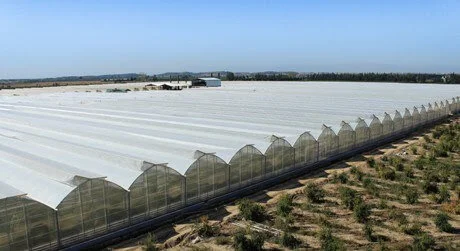
The swamp in the Dikili district of Izmir will be utilized as an organized greenhouse production zone. The massive greenhouse will create jobs for 3.500 people and will produce around 80.000 tons of vegetables annually
The swamp in the Dikili district of Izmir will be utilized as an organized greenhouse production zone. The massive greenhouse will create jobs for 3.500 people and will produce around 80.000 tons of vegetables annually. Dikili has been one of the important agricultural production areas in the Aegean Region and with this project, the district will become one of the main greenhouse production areas in the entire country.
Geothermal resources will also be used in the operations of the greenhouse and Bergama Chamber of Commerce Chairman Fikret Urper announced that the main production item will be tomatoes. Fikret Urper: “We expect revenue of 150 million USD in total and most of the production will be exported. Thus we will be contributing to the national economy with this project. The growers in the project will decide on the assortment depending on the demand from abroad and with the use of geothermal resources, our production costs will go down. Thus we will have a competitive advantage in the global market place.”
The project is undertaken by the joint committee of Dikili Organized Greenhouse Commercial Zone Investors Group, Izmir Chamber of Commerce, Aegean Region Chamber of Industry, Izmir Trade Board, Aegean Exporters Association and Izmir Municipality Investment Monitoring and Coordination Agency.
AeroFarms' Eco-Friendly Indoor Farms For Minimal Environmental Impact
As the population continues to grow, there will be increased farmland competition as more space is needed for housing, schools, and hospitals to accommodate the rising number of people
By Sarah Moore
December 16, 2019
AeroFarms has developed eco-friendly aeroponic technology to take vertical farming to the next level. Image Credit: Morinka/Shutterstock.com
Exponential population growth is putting pressure on many factors of human life. The world has a limited potential to generate resources, and as the population grows, our demand for resources comes close to the maximum output the world can produce. Recent figures estimate that in just two decades, the population will have grown to 9.7 billion, growing from the current estimated 7.7 billion. The number of people in the world who do not have adequate nutrition is close to one billion, with statistics estimating that just under 800 million people are failing to access enough food.
As the population continues to grow, there will be increased farmland competition as more space is needed for housing, schools, and hospitals to accommodate the rising number of people. This problem of malnutrition will worsen unless we make fundamental changes to the face of agriculture.
Another growing pressure on the agriculture sector is the urgency of addressing the reduction of emissions to combat climate change. The latest figures attribute 8.4% of US emissions to agricultural activities.
The agricultural industry is challenged not only to innovate a way to grow more food in a reduced space but to also reduce emissions. A recent innovation in agriculture could provide a solution.
Population Growth, Global Emissions, and Looming Food Crisis Sparks Farming Revolution
Over the last decade, significant development has been made in the area of controlled environmental agriculture in tall buildings, also known as vertical farming. The concept is that rather than growing crops on a single layer, as is done in conventional farming, it makes use of vertical space, growing crops upwards and minimizing the ground area required for farming.
The innovation, which utilizes the technology of aeroponics, will help to create eco-friendly farms that rely significantly less on water and energy. Further developments are required to enable it to fully support environmentally friendly agriculture.
The establishment of vertical farming projects will likely prove vital to solving the increasingly pressing challenge of providing enough food for the population while addressing climate change issues.
What is Aeroponics?
The establishment of vertical farming has been achieved thanks to the development of a farming technique known as aeroponics. The method accommodates the growth of crops in vertical-stacked plant beds, using artificial techniques to assume the roles of natural sources of light, water, and soil.
Aeroponics allows for the specific growing conditions to be controlled for each crop type, maximizing crop yield and growing more crops per square foot of land without accounting for the vertical stacked space.
One vertical farming project in New Jersey, US, believes it can grow up to 70 times more produce than conventional farms.
How Vertical Farming Reduces Environmental Impact
Other than tackling the looming food crisis, the main aim of vertical farming is to lessen the impact that conventional farming has on the environment in several ways. Firstly, because significantly less land is required to achieve the same crop output, experts argue that a significant switch towards vertical farming will allow more land that has previously been dedicated to farming to be returned to its natural state. This will allow diverse ecosystems to thrive in the absence of destructive modern farming techniques.
Data has also confirmed that this form of environmentally-friendly farming uses up to 90% less water than conventional farms. This benefits the environment by reducing the energy used to pump the water, which leads to emissions and contributes to greenhouse gases. It also means that fewer chemicals are used because less wastewater is being produced that requires chemical treatment.
Because vertical farming projects are usually set up in urban areas, such as in abandoned factories or similar buildings, produce doesn’t have to travel as far as it would when grown on farms to reach urban populations. This means that there is a reduced need for transportation, indirectly reducing carbon dioxide emissions by decreasing the need to transport produce.
However, vertical farms still require large amounts of energy to run, and this needs to be addressed to further add to the advantages of this revolutionary farming method. To power the artificial conditions produced for its crops, a significant amount of energy is required. Some argue that it counteracts the environmental benefits of a vertical farm, limiting its virtues as an eco-friendly farming example.
While development is needed before vertical farming can be widely adopted, some companies in the sector are already contributing significant advancements, helping the technology to move forward.
AeroFarms: Taking Vertical Farming to the Next Level
AeroFarms was recently named as one of Fast Company’s most innovative companies in the world in the data science category. The company has developed award-winning aeroponic technology that constructs tailored conditions to meet the needs of each crop species. The technology also boasts the benefits of being minimal in terms of its environmental impact.
Data science is the foundation of the success of AeroFarm’s method. The company has created patented vertical farming technology that utilizes data to maximize the efficiency of crop growth. AeroFarms considers itself to be industry-leading in terms of how it has developed an understanding of plant biology which it uses to increase the productivity of its eco-friendly farms.
Combining revolutionary technology in the form of machine learning and machine vision, alongside the integration of the internet of things, which helps to incorporate data collected from sensors, has led the company to success in growing over 500 million plants to date, of more than 300 varieties.
The company is capitalizing on partnerships with influential market leaders, such as Dell Technologies, to advance its competency at automation and analysis of data, helping to increase plant health, growth and yield.
Video Source: Stories/YouTube.com
The Impact of Eco-Friendly Farming
The model that has been demonstrated by AeroFarms will likely be influential in informing how the agriculture sector will develop in the future. Its innovative use of data and technology to grow crops vertically, minimizing the use of ground space and reducing the impact of farming on the environment, will need to be adopted by future agricultural companies to address the growing food crisis and meet emissions targets.
References and Further Reading
AeroFarms Named to Fast Company’s 2019 Most Innovative Companies, AeroFarms, https://aerofarms.com/2019/02/20/aerofarms-named-to-fast-companys-2019-most-innovative-companies/
Is vertical farming really sustainable?, EIT Food, Tessa Naus, https://www.eitfood.eu/blog/post/is-vertical-farming-really-sustainable
Latest agriculture emissions data show rise of factory farms, IATP, Ben Lilliston, https://www.iatp.org/blog/201904/latest-agriculture-emissions-data-show-rise-factory-farms
What You Should Know About Vertical Farming, The Balance Small Business, Rick Leblanc, https://www.thebalancesmb.com/what-you-should-know-about-vertical-farming-4144786
World's largest vertical farm grows without soil, sunlight or water in Newark, The Guardian, Malavika Vyawahare, https://www.theguardian.com/environment/2016/aug/14/world-largest-vertical-farm-newark-green-revolution
5 Startups That Prove Tech Can Solve The World’s Biggest Problems, AeroFarms, https://aerofarms.com/2018/08/30/5-startups-that-prove-tech-can-solve-the-worlds-biggest-problems/
Disclaimer: The views expressed here are those of the author expressed in their private capacity and do not necessarily represent the views of AZoM.com Limited T/A AZoNetwork the owner and operator of this website. This disclaimer forms part of the Terms and conditions of use of this website.
Written by: Sarah Moore
After studying Psychology and then Neuroscience, Sarah quickly found her enjoyment for researching and writing research papers; turning to a passion to connect ideas with people through writing.

Your Grocery Store Could Soon Have A Farm Inside It
Just before Thanksgiving, grocery chain Kroger launched an initiative in partnership with Infarm, a German startup that specializes in “modular vertical farms,” to install hydroponic farms right inside two of their Seattle-area stores
December 16, 2019
Plants grown by Verticrop, a UK-based vertical farm, in 2011.
Photo: Phil Clarke Hill/In Pictures Ltd. (Getty Images)
Just before Thanksgiving, grocery chain Kroger launched an initiative in partnership with Infarm, a German startup that specializes in “modular vertical farms,” to install hydroponic farms right inside two of their Seattle-area stores. Even though it’s been less than a month since the rollout, CityLab reports, Kroger is already declaring the project a success and looking to expand it to other locations.
Vertical farming is a space- and energy-efficient way of growing produce such as lettuce, herbs, and peas right inside the grocery stores where customers shop. According to CityLab, items are sold in bunches, “roots and all,” and shoppers have taken to these tiny farms so quickly that sometimes the produce sells out quicker than new produce can mature.
“For the bulk of the last century, food has been produced far from where it is consumed, generating a supply chain that is environmentally unsustainable,” said Infarm CEO Osnat Michaeli. “Our modular farms offer the potential of turning the supply chain on its head by building the world’s first global farming network.”
Kroger, for its part, touts the program as a way for shoppers to make informed food choices. “Customers today want transparency; they want to know exactly where their product is from, the provenance where it was grown,” said Suzy Monford, vice president of fresh foods at Kroger Group. This is Infarm’s first time collaborating with a U.S. grocery chain to bring customers these in-store hydroponic farms.
Kroger plans to expand vertical farming to 13 more of its locations (all in Washington and Oregon) by April 2020.

Why ‘Vertical’ Farming Is Growing In The UK
Vertical farming – sometimes called indoor farming – is the practice of growing plants under fully controlled conditions in buildings in many stacked layers, without solar light. Unlike glasshouse production, which relies on sunlight, it makes use of LED lighting to provide different wavelengths of light, according to crop and growth stage need

18 December 2019
Louise Impey
© Wu Kailiang/Alamy Stock Photo
Being able to produce crops 365 days a year, without the need for pesticides or much human intervention, while being unaffected by the weather, will appeal to many growers after such prolonged, wet autumn.
Vertical farming – sometimes called indoor farming – is the practice of growing plants under fully controlled conditions in buildings in many stacked layers, without solar light.
Unlike glasshouse production, which relies on sunlight, it makes use of LED lighting to provide different wavelengths of light, according to crop and growth stage need.
Together with soil-less growing techniques and environmental control systems, vertical farming is a specialist business.
Vertical farming – what is it?
The practice of growing crops in stacked layers, vertical farming often incorporates controlled environment agriculture and can be housed in buildings, shipping containers, underground tunnels and even abandoned mine shafts.
Vertical farms use soil-free growing techniques and stack crops in specially designed beds and trays, making use of artificial lighting and climate control to get the desired results.
During the growing process, four elements are controlled – lighting, irrigation, fertigation and climate.
Global and fast-growing
And it’s a fast-growing sector. Worldwide, it was worth £1.72bn in 2018, with experts predicting that will rise to £9.84bn by 2026. Japan and the US are leading the way, but other countries are catching on.
Enthusiasts say that vertical farming offers a means of guaranteeing yields and reducing the industry’s environmental impact, while improving the supply of safe, healthy and nutritious food and minimising the miles involved in its distribution.
Their vision – locally grown, quick-to-market fruit and vegetables, produced in the neighbourhood where it is consumed, with the traceability and integrity that food supply chains demand – is already being delivered by various facilities worldwide.
Solutions to challenges
These high-tech units are presented as the solution to many of the challenges facing traditional production methods, such as pollution and water use – even if they are currently limited to higher- or added-value crops in order to be profitable.
As they spring up around the world, they are also seen as a means of reducing reliance on food imports.
The use of automation and robotics to keep human intervention and labour costs to a minimum is attracting interest, while less food waste and making better use of limited land space are bonus features too.
Trends driving vertical farming
Environmental impact of food production
Demand for healthy, safe food
Legislation
Urbanisation
Growing world population
Scarcity of natural resources
Changing eating habits
UK projects
In the UK, there have been several big projects announced in the last 12 months. Edinburgh-based Shockingly Fresh has ambitions to develop 40 sites and already has five on the go – one in Scotland and four in England.
Ocado is involved too, having invested £17m in the sector during 2019. That has seen it enter a joint venture with 32ha, a US firm, and Priva Holdings in the Netherlands, known as Infinite Acres.
It has also taken a 58% stake in Jones Food Company, a Lincolnshire-based business producing 420t of leafy greens each year at a facility of 5,120sq m – equivalent in size to 26 tennis courts.
In London, there is Growing Underground, which produces micro greens and salad leaves below the busy streets of Clapham, while in Bristol there is LettUs Grow, which provides the cutting edge technology required.
Technological advances
According to Leo Marcelis of Wageningen University, the vertical farming industry received a kick start from advances in the performance of LED lighting, which can be used to provide the type of light that different plant species need at a much better price than the previously used high-pressure sodium lamps.
“This is the most interesting bit,” he says. “LED lights, which are essential for replicating natural daylight, can be used to change the way plants grow, when they flower and how they taste. It’s all about varying the spectrum used at different growth stages.”
LED lights have other advantages, he notes. “They can be positioned between plants and layers, produce hardly any heat radiation and are more energy efficient.”
Asked whether vertical farming is sustainable, Prof Marcelis says that the current bottleneck is energy use.
“It meets so many requirements, such as much lower water and nutrient use, but it is energy-intensive. Of course, that is improving all the time, especially with lower-cost LED lighting and other technical developments.”
Vertical farming is capital intensive too. Plenty of start-up funding is required, with pay-back times depending on the unit’s operational efficiency and chosen retail route. While some have failed, others are finally starting to make small profits.
Case Study: LettUs Grow
© Jack Wiseall Photography
Extreme weather events and consumer demand for freshness are the two reasons LettUs Grow’s co-founder Charlie Guy (pictured) cites as being behind the current interest in vertical farming.
In addition, being able to get consistent yields and produce quality for 12 months of the year, with the traceability and integrity that supply chains require, is opening up market opportunities for both existing growers and entrepreneurs, he says.
“Whether it’s a very cold spell, such as the Beast from the East, or a lengthy summer drought bringing water shortages, the frequency of extreme weather events is increasing. This has a cost to both growers and consumers.”
Diversification
His Bristol-based company designs the hardware and software needs for indoor growing facilities and is seeing interest from traditional producers, who are looking at an indoor system as a diversification project.
“For existing growers, they can add a valuable revenue stream,” he says. “They are predictable and scaleable, offer year-round production and tend to fit in well with existing projects such as renewable energy and anaerobic digesters.”
Technology
The LettUs Grow concept is based on aeroponics and a technology platform known as Ostara. Aeroponics give better growth rates than hydroponics, he claims, while using up to 95% less water than conventional agriculture.
“Aeroponics puts more oxygen in the root zone, which is why the plants perform better.”
Ostara – its cloud-hosted software – offers closed-loop control.
Mr. Guy explains it that does the data capture and automated control of the growing environment, bringing the food safety and traceability that’s needed, but also offering the potential to use sensors and robotic technology.
“That’s important because energy and labour should be the two key areas of focus with any vertical farming project,” he says. “They have the final say on profitability.”
Vertical farming is not just about lettuce, he stresses. “Although the focus has been on high-value herbs and pea shoots, there are around 60 different crops that can be grown in this way.
“The key to choosing what’s right for you is to look at what access you have to various markets, rather than opting for the fashionable crops.”
Hydroponics or aeroponics?
Both hydroponics and aeroponics deal with plants without the traditional growing medium of soil.
How the plants’ roots are situated in the systems determines the way in which they receive nutrients.
In hydroponic systems, the roots are submerged in water and nutrients are delivered in the water.
In aeroponics, the roots are exposed and sprayed with a mist containing water and nutrients, resulting in a humid, fog-like environment
The Promise And Peril of Vertical Farming
The indoor agriculture industry spans centuries-old growing methodologies and high-tech, computerized urban farms
August 10th, 2018
MARIYA KHANDROS
As part of the Anchor Procurement Initiative, Economy League staff investigate new and emerging industries that could yield opportunities to localize institutional spend. Over the last 4 months, Mariya Khandros, Economy League’s Director of Shared Solutions, has been investigating the current state and future promise of the indoor, vertical farming industry. Conceptually, vertical farming can meet the institutional demand for produce via high-tech, indoor, commercial-scale urban farms. Mariya attended the Aglanta Conference, Indoor AgTech Innovation convening, and participated in working sessions at USDA’s Innovation and Design in Vertical Agriculture & Sustainable Urban Ecosystems conference to help define USDA's research agenda on the subject of indoor agriculture. The following article is a summary of her findings.
The indoor agriculture industry spans centuries-old growing methodologies and high-tech, computerized urban farms.
For most people, the concept of indoor farming typically conjures images of neat rows of greens in futuristic self-contained boxes under violet LED lights. But indoor farming – known as Controlled Environment Agriculture (CEA) among those in the industry – has been a reality in Pennsylvania since 1885. Kennett Square mushroom farms produce half of America’s mushrooms, primarily indoors. CEA encompasses a wide range of farms, ranging from lower-tech plastic hoop houses to greenhouses, to high-tech vertical farms. While great advances have been made across the spectrum, significant media and investor attention have homed in on high-tech vertical farms – large plant factories that grow vegetation indoors primarily using LED lights, and relying on sophisticated computer systems to track, measure and, often, harvest crops.
The rest of this article investigates the newest addition to the CEA family - the vertical farm.
As the population grows, arable land shrinks and water becomes scarce, the world faces a looming food crisis.
The growth of the global population, combined with a looming water crisis is moving the Earth towards a global food crisis. Feeding the projected population of 2050 (9.7B) requires an additional 109 million arable hectares, a landmass larger than Brazil. Given that 80% of arable land is already in use, absent major changes to traditional agriculture practices the world faces a significant food shortage.
Water scarcity, likely to be made worse by climate change, is another threat to the global food system. According to the United Nations, by 2025, two-thirds of the world's population will live in water-stressed regions as a result of use, growth, and climate change. Currently, 70% of the world’s freshwater is used for traditional agriculture, so a water crisis will inevitably reinforce the food crisis.
The impact of climate change will be variable and unpredictable, which will also add pressure on the food system. For example, higher CO2 levels will increase some plant yields, but will reduce their nutritional values. Warmer temperatures may lead to the growth of many new pests and weeds. Extreme temperatures may lead to droughts or extreme rainfall, both of which can prevent crops from growing.
Vertical farming could be part of the solution because it uses less water and allows farmers to control the growing climate
Dr. Dickson Despommier, who popularized the idea of vertical farming in the US, has estimated that a 30-story building covering one city block (5 acres) could have the productivity of a 2,400 acre traditional farm, because of the year-round growing season and the ability to use vertical space to stack vegetables. Because a controlled environment allows easier water recapture and reduces evaporation, vertical farming is estimated to use 70-95% less water than traditional agriculture. For this reason, areas with limited water supplies are early adopters of vertical farming. The United Arab Emirates is building the world's largest indoor farm, as the country's arid climate, poor soil quality and occasional locust plagues make indoor farming a more financially viable alternative.
However, the industry is young and grappling with many open questions.
The vertical farming industry today can be compared to the home video industry when VHS was still competing with Betamax. There are no standards around technology or growing processes. Data on growing efficiency and financial sustainability is just starting to emerge.
Most vertical farms are struggling financially. According to an Agrilyst survey, only 27% of indoor vertical farms are profitable, as compared to 67% of greenhouse farms and 50% of container farms. Despite a year-round growing cycle, vertical farms can only profitably grow a limited number of crops. Excluding cannabis, the most lucrative crops in 2016 were reported to be tomatoes and other vine crops, strawberries, herbs, and microgreens, salad greens and edible flowers. The single biggest reason for low profitability are the massive start-up costs – an estimated $4 million of up-front investment is needed for a 30,000 square-foot farm, and that does not include the sizeable electricity bills associated with farm operations.
Critics are also concerned with the environmental impact of indoor farms, pointing to the inefficiency of replacing natural light with fossil fuel-powered lights. A study completed by Cornell suggested that vertical farms have a much higher carbon footprint than greenhouses. Critics see vertical farming as an over-engineered solution to the problems plaguing the food system and suggest that improving crop diversity, reducing food waste and maintaining soil integrity in traditional agriculture will address the long-term nutritional needs of the planet.
As a city, Philadelphia has seen first-hand the ‘over-promise and under-deliver’ downside of the indoor farming industry, with the recent revelations about the legal and operating troubles of the much-hyped Metropolis Farms. It also saw the rise and fall of a once-promising aquaponics endeavor in the early 2000s.
Despite early struggles, the industry may be reaching a tipping point; rapidly falling cost of LEDs, artificial intelligence and the global water crisis may tilt the scale in favor of vertical farms.
In the United States, there are an estimated 40,000 CEA farms producing $14.1B of market value each year; when compared to 2.1 million farms overall, with $395 billion in agricultural products, the number of vertical farms seems negligible. However, despite comprising a small portion of farming, indoor farms seem to take the lion’s share of investor attention. In 2016, investment in vertical farming grew from $36 million to $271 million (+653%), driven primarily by Plenty Farms. Several technological and environmental developments are driving this trend.
Despite murky profitability prospects associated with vertical farms, investors see potential because of rapid development in two technologies – LED lights and artificial intelligence. Many companies made their fortunes on the falling cost of a technology: Google on the cost of data storage, CRISPR on the reduced price in DNA sequencing. This is what ultimately convinced prominent investors, including Amazon’s Jeff Bezos, to give $200M to Plenty, a fledgling, but ambitious vertical farm company.
The second development driving down the cost of indoor farms is the leaps and bounds being made in the realm of artificial intelligence. Labor is one of a cost that indoor farmers are open about seeking to minimize. A familiar debate tends to emerge around the question of job destruction; with vertical farmers saying that they are replacing hard, back-breaking labor of harvesting with family-sustaining technician jobs, while critics allege that the new jobs will not benefit individuals who are losing the low-end job. However, by and large, vertical farmers are not aiming to replace traditional farming, but capture untapped demand generated by a growing population and an increased appetite for greens and other produce. Anecdotal evidence demonstrates that so far, the job creation story aligns with this vision. Vertical farming is creating entirely new jobs and drawing from a young, urban, highly-educated population that would be unlikely to pursue traditional farming jobs.
The third economic lever is related to environmental change. Historically, water has been highly subsidized in the US. However, as water becomes scarce, and in regions such as the Middle East, where it already has, the cost of traditional agriculture will rise, compared to the more-water efficient vertical farms.
Aquaponics Bed, CC Image courtesy of Plant Chicago on Flickr
In the US, vertical farming has the potential to provide numerous benefits to cities, including the revitalization of vacant spaces, job training programs and an innovative approach to nutritional education.
Around the country, cities have employed vertical agriculture as a tool for education, food system resiliency, job training, and community-building by incorporating vertical farms into broader community initiatives and building deep connections with neighborhoods in which farms are located.
For example, in Washington DC, Urban Food Hubs are small scale systems centered on high-efficiency urban food production (traditional urban farming methods combined with hydroponic and aquaponic systems), co-located with commercial kitchens and community spaces for education. These centers provide nutritional education, vocational training in vertical farming and food processing, and help address nutritional deficiencies in neighborhoods by growing food for local distribution.
In 2017, a Baltimore company, Urban Pastoral, partnered with workforce training organization Humanim, a nonprofit that creates sustainable social enterprises, to build a vertical farm that will train workers in “new generation farming.” This year they are slated to open another farm on the grounds of a high school to teach students about farming and running a business.
In Chicago, Plant Chicago is a collective of businesses with a mission to cultivate ‘circular economies’ (systems where waste from one process is repurposed as inputs for another to create a closed-loop model of material reuse). An aquaponic vertical farm is one of the components of the system, interchanging CO2 and oxygen with a co-located kombucha producer and beer brewer.
Atlanta sees vertical farming as a puzzle piece in their urban agriculture landscape and another way of increasing the resiliency of their food system, under the Smart Cities initiative. Additionally, their policymakers work to attract farms to vacant lots and buildings in order to help increase surrounding property values.
It should be noted that although the initial pitch of a vertical farmer to a city typically starts with the promise of job creation, this is not a benefit most cities seek from vertical farms. By design, vertical farms are not very labor-intensive. One of the most successful indoor growing operations, Gotham Greens, is building the world’s largest rooftop farm (140,000 sf) in Chicago’s 9th Ward. It will create 60 permanent jobs. Despite this limited workforce development potential, policy makers see value in vertical farms as a tool for community engagement and education, at least while the industry is in its early stages.
Philadelphia should be positioning itself to capitalize on the vertical farming opportunity while implementing policies to mitigate risks associated with the industry.
Vertical farming can benefit Philadelphia’s economy in a variety of ways: indoor farms can help improve the utilization of abandoned warehouses and buildings, provide another means of nutritional education and help a new generation become enthusiastic about farming through workforce development initiatives. At the same time, vertical farming is an industry in flux, making it difficult for policymakers to predict the success or failure of any given venture. In order to mitigate risk, rather than picking winners for large tax incentives, policymakers should create an ecosystem that allows many vertical farms to thrive.
The following are policy areas that Philadelphia should consider to encourage the growth of vertical farming while limiting the city's exposure to the industry's downside.
Including Vertical Agriculture in City Planning Efforts
Rather than seeing vertical farming as a stand-alone industry, policymakers should consider it in the broader context of the regional food system. Not only does Pennsylvania have a robust farming industry, Philadelphia’s traditional urban farms have been a vehicles for lot beautification, food justice, and income generation for decades. Consequently, any urban farming plans or zoning policies should take existing urban and regional farms into account. Atlanta offers a great example of comprehensive planning. Atlanta included urban food policy into its Resilient Atlanta Strategy and promotes every type of agriculture, from lot farming to high tech indoor farming through Aglanta, a program under the umbrella of the Mayor’s Office of Resilience. Aglanta, in turn, cooperates with the state-wide Georgia Grown program.
Tax Incentives
Both Philadelphia and the Commonwealth of Pennsylvania offer extensive tax incentives and grants to new companies for job creation, investment in disinvested neighborhoods, property renovation, and environmental sustainability. Additionally, there are programs at the state and federal levels specifically targeted to farmers. Rather than adding new incentives, Philadelphia policymakers should assemble relevant tax breaks into a package that entrepreneurs can use to identify applicable incentives and navigate the process of applying for each program.
Defining the Market
A market study that quantifies the demand for locally grown produce, identifies distribution centers, institutional buyers and other potential clients can catalyze the creation or expansion of farms by demonstrating the opportunities available in the Philadelphia market. The Economy League’s assessment of the Philadelphia food economy can serve as the foundation for such a study. Beyond a report, actively making connections between farmers and institutional food buyers can support fledgling ventures by providing a stable source of revenue.
Due Diligence
Because vertical agriculture is a new and evolving industry, few investors and clients have the skillset to assess the technological capabilities, revenue projections and growth forecasts of vertical farms. Policymakers can help build credibility with both set of parties by identifying organizations or companies that provide due diligence. For example, Eric Stein is developing a Center of Excellence for Indoor Agriculture in Pennsylvania. Nationally, Agrictecture specializes in helping municipalities develop policies and foster the creation of vertical farming economies. By identifying a skilled and neutral party to help investors and buyers distinguish between promising and floundering ventures, policymakers will help build a local knowledge base and reduce risk.
Industry Networking Opportunities
Many entrepreneurs in the vertical farming space are not focused on building and managing farms, but on producing different parts of a whole (lighting, fertilizer, irrigation system). For this reason, creating a space to bring together technology companies, farmers, customers and funders will be critical to the success of the industry. However, limiting these events to vertical farmers would be a mistake. Rather, these events should provide an opportunity to create linkages between urban and rural farmers, as well as Philadelphia's traditional and high-tech farms, to facilitate knowledge and technology transfer.
Education and Workforce Training
Building out a workforce requires breaking down siloes between technology and agriculture, working with universities (such as Philadelphia’s two nearest land grant universities – Rutgers and Penn State) to create opportunities for training and knowledge transfer. When it comes to equity, vertical farming is in danger of repeating the mistakes of Silicon Valley – creating opportunities almost exclusively for an ethnically homogenous group of wealthy individuals. Placing growing towers in public schools and community centers, creating multi-functional food hubs and developing job training program are ways that cities have worked to distribute opportunities more equitably. Working with vertical farms to ensure they are growing culturally appropriate products for their neighborhoods will deepen linkages to surrounding neighborhoods and, consequently, a more diverse workforce.
The Economy League's Anchor Procurement Initiative team will remain attentive to developments within the industry.
Vertical farming alone will not solve food deserts, nor eliminate unemployment. However, it is an exciting new industry that promises to revolutionize many aspects of agriculture, while redefining local by bringing farming into our most intimate spaces: homes, offices, and schools. If Philadelphia approaches this new industry with discipline and intention, our city will be poised to reap the benefits for many years to come.
Although the vertical farming industry is currently in too early of a stage to be able to provide a stable supply of produce to anchor institutions, it is developing very rapidly. The API team will keep track of the developments within the industry, in order to identify viable opportunities as they appear in our city.
"Lack of Knowledge One of The Biggest Issues In Indoor Ag"
Lack of knowledge is one of the biggest issues in indoor agriculture, says Eric Stein, Executive Director of the Center of Excellence for Indoor Agriculture. "Lack of knowledge of the market place, lack of knowledge of growing, lack of knowledge of how to be profitable," he sums up
Eric Stein, e3garden
Lack of knowledge is one of the biggest issues in indoor agriculture, says Eric Stein, Executive Director of the Center of Excellence for Indoor Agriculture. "Lack of knowledge of the market place, lack of knowledge of growing, lack of knowledge of how to be profitable," he sums up. "In addition, there is confusion about the best technologies to use." With the launch of the Center, he hopes to help growers get over these challenges. From an online platform, it will grow eventually to a headquarters and a technology demo facility.
"Our goal is to provide a place for connection and exchange to take place every day of the year", says Eric. He is Associate Professor of Business at Penn State and CEO of Barisoft Consulting Group and advised businesses interested in setting up indoor farms, run workshops for the USDA on indoor farming and designed and operated an indoor vertical farm himself (e3garden) to conduct applied research on the economics of indoor farms.
Eric believes there's a lack of knowledge-sharing in the industry. "You have to go to the industry-specific conferences such as Indoor Ag-Con and Agtech NYC, which are great but bring together people for only a few days of the year."
The new center wants to connect growers with universities and investors to facilitate those relationships. "For example, we are working to bring in a Silicon Valley investment group that is interested in funding agtech start-ups. We also offer an energy savings program for our members, esp. growers, who want to cut operating costs. We are in the process of populating an Amazon-like multi-vendor marketplace just for indoor ag. We are also developing discount programs for members to receive reduced rates to key conferences like Indoor Ag-Con."
This all takes place at the newly launched website, indooragcenter.org. “The site offers an opportunity to create a highly networked community for indoor agriculture that is available to the members throughout the year. We expect it will help investors find farms to invest in, help growers find the products and services they need, highlight key conferences and events, and develop a knowledge base of best practices, solutions, cases, and research. We invite all types of indoor growers to participate regardless of technology or product type; e.g., from greenhouses to plant factories and from leafy greens to mushrooms", says Eric.
In the near future, the Center of Excellence for Indoor Agriculture wants to go offline as well. Phase two of its development includes raising capital and building a COE headquarters and technology demo facility in the greater Philadelphia area.
"Every industry has grown through bench-marking and knowledge sharing. The pharmaceutical industry is a case in point. I think we are reaching the point where indoor ag investors want accountability and transparency. We think the Center can help in this regard", Eric concludes.
"As we have seen recently, several companies have gone out of business. For instance, the container farms seem to not be doing well. I am not surprised because the logistics for growing in spaces like this are not optimal and the wild claims of profitability were not realistic, esp. given the high price of these units. We need to ground the business model for indoor ag on fundamentals, and that just is not happening in many cases. We think the investors will drive the need for better, curated knowledge, which is what the Center is all about."
For more information:
Indoor Ag Centerindooragcenter.org
Publication date: Wed 18 Dec 2019
© HortiDaily.com / Contact

Have You Ever Considered Turning A Shipping Container Into A Greenhouse?
Here Lucchini custom-made a BoxXLand container with Senmatic’s LED-fixtures, fertilizer mixer, and climate control to fit the specific needs at HAMK University
That is what happened at HAMK University in Finland. The entire project started when our partner and greenhouse-supplier Lucchini was contacted by HAMK University in Lepaa, Finland. They asked Lucchini to assist in building and supplying box container system with the aim of R&D of indoor farming.
Here Lucchini custom-made a BoxXLand container with Senmatic’s LED-fixtures, fertilizer mixer, and climate control to fit the specific needs at HAMK University.
At the university, they are doing trials on lettuce and herbs of all kinds – and so far, they have been very happy with the results from the first production cycle. The box container greenhouse brings several benefits such as being able to grow vegetables in locations, where the climate normally makes it impossible.
Read the full article here

Another E. coli Outbreak – A New Solution to Help
Another continent-wide romaine lettuce recall from an outbreak of E. coli is underway with 67 people reported sick in 19 states
CO2GRO
December 6, 2019
Another continent-wide romaine lettuce recall from an outbreak of E. coli is underway with 67 people reported sick in 19 states. The source of the latest outbreak was found in irrigation reservoir sediments. The chief suspect is wild animal feces entering the irrigation reservoir. The last several outbreaks began on farms in Monterrey, Santa Barbara, Salinas, and Santa Maria, California growing romaine lettuce.
The economic impact including costs of shipping returns, taking the lettuce off shelves, plant destruction, medical care costs and increases in retail prices due to shrinking supply can be up to $350 million. The Center for Disease Control (CDC) estimates that 265,000 STEC infections occur each year in the United States. E. coli O157:H7 causes more than 36% of these infections.
E. coli are bacteria that typically live in the intestines of healthy humans and animals. Most types of E. coli bacteria are harmless but some can cause severe diarrhea and urinary tract infections while more severe strains can cause kidney failure in children and other severe symptoms.
Leafy greens are highly regulated in California but vulnerable to bacterial infections. The primary method for preventing E. coli is good hygiene in the grow facility and monitoring bacterial levels. Beyond these practices, there is little that growers can do to inhibit the spread of E. coli, especially once an infection has taken to a crop in the facility or in areas where there are several grow facilities.
CO2 Delivery Solutions’ Success Inhibiting the Spread of E. coli
CO2 Delivery Solutions has been demonstrated to inhibit the spread of E. coli by up to 99% in trials on pepper plants and Cannabis. CO2 Delivery Solutions dissolves and saturates CO2 gas into the water to form an aqueous CO2 solution that is misted on to plant leaves.
The microdroplets create a thin aqueous film around the leaf surface isolating the leaf from the atmosphere. Gradient diffusion allows CO2 molecules to move into the leaf. This CO2 transfer occurs within 90 seconds and the moisture evaporates in minutes. Misting is done for a few seconds up to four times an hour during the light cycle.
The inhibition of single-cell pathogens such as E. coli on plants is caused by the frequent aqueous CO2 misting. Aqueous CO2 is acidic therefore dropping the pH on the plant surface for a few seconds. Once the CO2 is transferred the pH rebounds back up towards neutral. This continual fluctuation in pH makes for an unfavorable environment for single-cell pathogens such as E. coli, powdery mildew, and others to thrive, thus inhibiting their growth and spread.
This pH volatility process is 100% natural without the requirement for any chemical sprays. Increasing the efficiency of CO2 uptake in plants from using CO2 Delivery Solutions also increases and accelerates indoor and outdoor crop growth resulting in higher biomass yields, faster cycle time for more harvests and reducing crop loss, all adding to grower profitability and consumer safety.

Greenhouse Might Be Key Ingredient In Safer Salads
Consumers should only eat romaine if it is from a harvest region other than Salinas, Calif., or if it was grown indoors, the Centers for Disease Control and Prevention (CDC) and the U.S. Food and Drug Administration (FDA) said
Greenhouse Might Be Key Ingredient In Safer Salads
By Kristen Leigh Painter Star Tribune
DECEMBER 9, 2019
Jay Johnson, Revol Greens president and partner, with greens at the company's Medford, Minn., indoor growing facility. DAVID JOLES – STAR TRIBUNE
Another outbreak of E. coli in romaine lettuce has sickened more than 100 people nationwide and left others wondering if raw salad is safe.
As food-safety investigators clear the vegetable aisle of contaminated lettuce, authorities provided more guidance on how to shop for a safer product.
Consumers should only eat romaine if it is from a harvest region other than Salinas, Calif., or if it was grown indoors, the Centers for Disease Control and Prevention (CDC) and the U.S. Food and Drug Administration (FDA) said. If it's not labeled with a harvest region or growing method, don't eat it.
By singling out indoor-grown lettuce as a potentially safer alternative to field-grown lettuce, food-safety regulators are boosting demand for product grown by Medford-based Revol Greens and its greenhouse-growing peers around the country.
"That [government advice] is definitely helping us out this time," said Brendon Krieg, a partner and sales manager at Revol Greens. "We are seeing an uptick in demand from retailers and restaurants because it has such a major impact on their business when they suddenly can't serve salads."
E. coli contamination in produce nearly always comes from irrigation water used on fields, said Kirk Smith, director of the Minnesota Integrated Food Safety Center of Excellence, one of six centers around the U.S. designated by the CDC to strengthen the safety of the nation's food system.
Revol Greens is a new competitor to the California greens market and is growing five varieties of lettuce in greenhouses only an hour's drive south of Minneapolis at a fraction of the transportation costs. Here, a worker inside the sprawling greenhouse at Revol Greens Tuesday, Feb. 13, 2018, in Medford, MN.
DAVID JOLES, STAR TRIBUNE
A lettuce field could be contaminated by dust, pests or wild animals carrying E. coli from elsewhere, but it is usually through the irrigation water source "in some way, shape or form," he said.
A major risk with outdoor-grown lettuce is sharing a water source with a nearby animal farm. It's especially risky near cattle, which are widely considered the largest reservoir of E. coli, Smith said.
Some food-safety experts theorize that during California's dry season — which lasts into the fall — the water table drops and the surface water from a cattle operation gets sucked down into the groundwater that is then used to irrigate lettuce crops.
That's why the CDC and FDA are telling consumers to consider buying leafy greens from greenhouse-grown facilities that use alternative water sources.
Revol Greens captures rainwater and snow melt from its greenhouse roof that it then stores in a covered, on-site holding pond. The company tests its water daily and runs it through a chemical-free UV sterilization process to make sure there's no festering bacteria before spraying its indoor lettuce. "Most, if not all, indoor growers of a certain size will have some sort of sterilization for their water," Krieg said.
Symptoms of E. coli usually surface within a few days to a week after ingesting the bacteria and include stomach cramps, diarrhea and vomiting.
Cases in the current outbreak span 23 states, with 31 in Wisconsin — the most of any state. Three cases have been reported in Minnesota. For now, it appears the rate of illness is slowing, with symptoms of the last reported cases beginning Nov. 18. Still, the CDC and FDA recommend consumers avoid purchasing Salinas-grown lettuce for the remainder of this growing season.
A year ago, an E. coli outbreak sickened 88 people in the U.S. and Canada and led regulators to issue a blanket don't-eat-romaine-lettuce warning. Retailers and restaurants pulled all romaine lettuce from shelves and menus before investigators zeroed in on north and central California as the likely source of contamination. But, by then, all romaine growers suffered the consequences.
In response, Revol and five other greenhouse lettuce growers formed a coalition to increase consumer and regulator education, and to encourage the controlled-environment agriculture (CEA) community to adopt stricter standards than already established.
"The coalition was established to develop credible, strong, and appropriate food safety standards, educate consumers and regulators on controlled environment growing, and communicate the value of controlled environment agriculture," said Marni Karlin, executive director of the group, called the CEA Food Safety Coalition.
This year, authorities took a more tailored approach to their warnings, identifying Salinas as the likely growing region in the first public health notice last month. Karlin said the companies she represents were pleased that the CDC and FDA's most recent update called out the relative safety of indoor-grown lettuce.
While most E. coli bacteria are harmless, these investigations track the dangerous types, such as Shiga toxin-producing E. coli, that can be life threatening. Such pathogenic outbreaks have been identified since the mid-1990s with at least one leafy-green outbreak occurring every year since Smith said.
But what's disconcerting, he said, is how little progress has been made in preventing these outbreaks since the U.S. Department of Agriculture and the FDA gave the industry more serious directives in addressing the problem in the early to mid-2000s.
"This has been a known problem for a long time now, but there are a couple of remarkable things that have happened recently," Smith said. First, spring 2018 was marked by the largest leafy green outbreak of E. coli ever, specifically in romaine, with 219 reported illnesses. The other noteworthy trend, Smith said, is that "we now have recurring outbreaks of the same strain and region."
The reason it keeps happening, he said, is that investigators are rarely able to trace the contamination all the way back to the exact farm.
Lettuce farmers often send their produce to a central processing facility where it is washed and packed. "You could get a bag of lettuce that includes stuff from many different sources," Smith said.
Indoor agriculture is generally much smaller in scale and therefore more easily protected from weather, pests and animals, he said.
Kristen Leigh Painter covers the food industry for the Star Tribune. She previously covered growth and development for the paper. Prior to that, Painter was a business reporter at the Denver Post, covering airlines and aerospace. She frequently writes about sustainable food production, consumer food trends and airlines.